Chapter XIII · THE SAFE-CONDUCT
Reading edition
Failure was all he reaped at Madrid in his efforts to win some measure of justice for his family, a fact that hardly could have astonished him then and seems but normal now. In the seats of authority was no man that loved justice so much as he feared the huge political machine set up by the friars and administered (through particularly appropriate selection) by the ruffian Weyler. Early in 1891, Rizal returned to Paris, where he revisited his former friends, and so passed to Ghent. There he settled himself to the finishing of “El Filibusterismo” and worked without further interruption until the book was done and on its way to the publisher.
From his happy country of those days not a soul could depart without the sanction of the Government. To secure this for anybody connected with him would be hard enough; even for an individual and a temporary absence like Lucia’s it was hard. How much harder it would be to rescue a whole tribe, and all so hated! Revenge was not so to be cheated, nor the account of “Noli Me Tangere” left unsettled. If passports were to be had at all, a personal explanation and appeal offered the best chance. This he determined to attempt, if he could have some reasonable promise of safety, being more inclined to go because thereby he might again see his father and mother.
It was the Philippines in one of the recurrent spasms of reform that he must now approach—sure sign in itself that a storm was brewing. A new governor-general, one Eulogio Despujol, expert, as was afterward proved, in the unctuous shaking of hands and the agile escape from promises, had arrived with much éclat and promulgated a liberal program. Rizal wrote to him, asking for permission and a safe-conduct to visit Manila.
For this he has been much criticized on the ground that to return to Manila was inconsistent with his former experiences there and virtual deportation thence. If any one had been furnished with convincing knowledge of the duplicity of the Philippine Government, surely it was Rizal. By the same token, it was said, he knew well the murderous attitude of the governing class toward him, and to go deliberately to the thrusting of his head into those jaws was madness. These, again, are but the strictures of ignorance. Rizal returned to the Philippines under a compelling sense of duty. At whatsoever cost to himself he must try to rescue his family from the tireless pursuit of the Interests he had offended, and the North Borneo project was clearly the way to achieve this. But it was a plan about which the Government would be certain to object. If nothing else were handy, there was always the argument that it would draw inhabitants of the Islands into an alien territory, and this reasoning could be met only by face to face encounter with the governor-general.
The step I am about to take is undoubtedly attended with peril, and I need not say to you that I take it after long deliberation. I understand that nearly all my friends are opposed to it; but I know also that hardly any one else comprehends what is in my heart. I cannot live on and see so many persons suffer injustice and persecution on my account; I cannot bear longer the fact that my sisters and their families are treated like criminals. I prefer death and cheerfully relinquish my life to free so many innocent persons from such great wrong.
I am aware that at present the future of our country pivots in some degree around me, that at my death many of its enemies will feel triumph, and consequently many of them are now wishing for my fall. What of it?
I hold duties of conscience above all else. I have obligations to the families that suffer, to my aged parents whose sighs strike me to the heart. If with my death I can secure for them happiness and a peaceful home in their native land, I am ready. So far as the country is concerned, I am all my parents have, but the country has many, many more sons that can take my place and do my work better than I.
Besides, I wish to show those that deny us patriotism that we know how to die for duty and principle.
What matters death, if one dies for what one loves, for native land and those dear to one?
If I thought that I were the only resource of the policy of progress in the Philippines, and were I convinced that my countrymen were about to make use of my services, perhaps I should hesitate about this step; but there are others that can take my place, and take it with advantage. Furthermore, there are probably those that hold that I am not needed, and this is why I am not utilized, but find myself reduced to inactivity.
Always I have loved our unhappy land, and I am sure I shall continue to love it until my last moment, in case men prove unjust to me. Life, career, happiness, I am ready to sacrifice for it. Whatever my fate, I shall die blessing it and longing for the dawn of its redemption.
The other document was a letter addressed to his parents, brothers, and sisters. In it he said:
The affection I have ever professed for you suggests this step, and time alone can tell whether it was wise. The wisdom of acts is decided by their results, but whether these be favorable or unfavorable, it may always be said that duty urged me; so if I die in doing my duty it will not matter.
I realize how much suffering I have caused you; still I do not regret what I have done. Rather, if I had to begin again I should follow the same course, for it has been only duty. Gladly I go to expose myself to peril. Not as an expiation for misdeeds (in this matter I believe myself guiltless of any) but to complete my work I offer myself an example of the doctrine I have preached.
A man ought to be ready to die for duty and his principles.
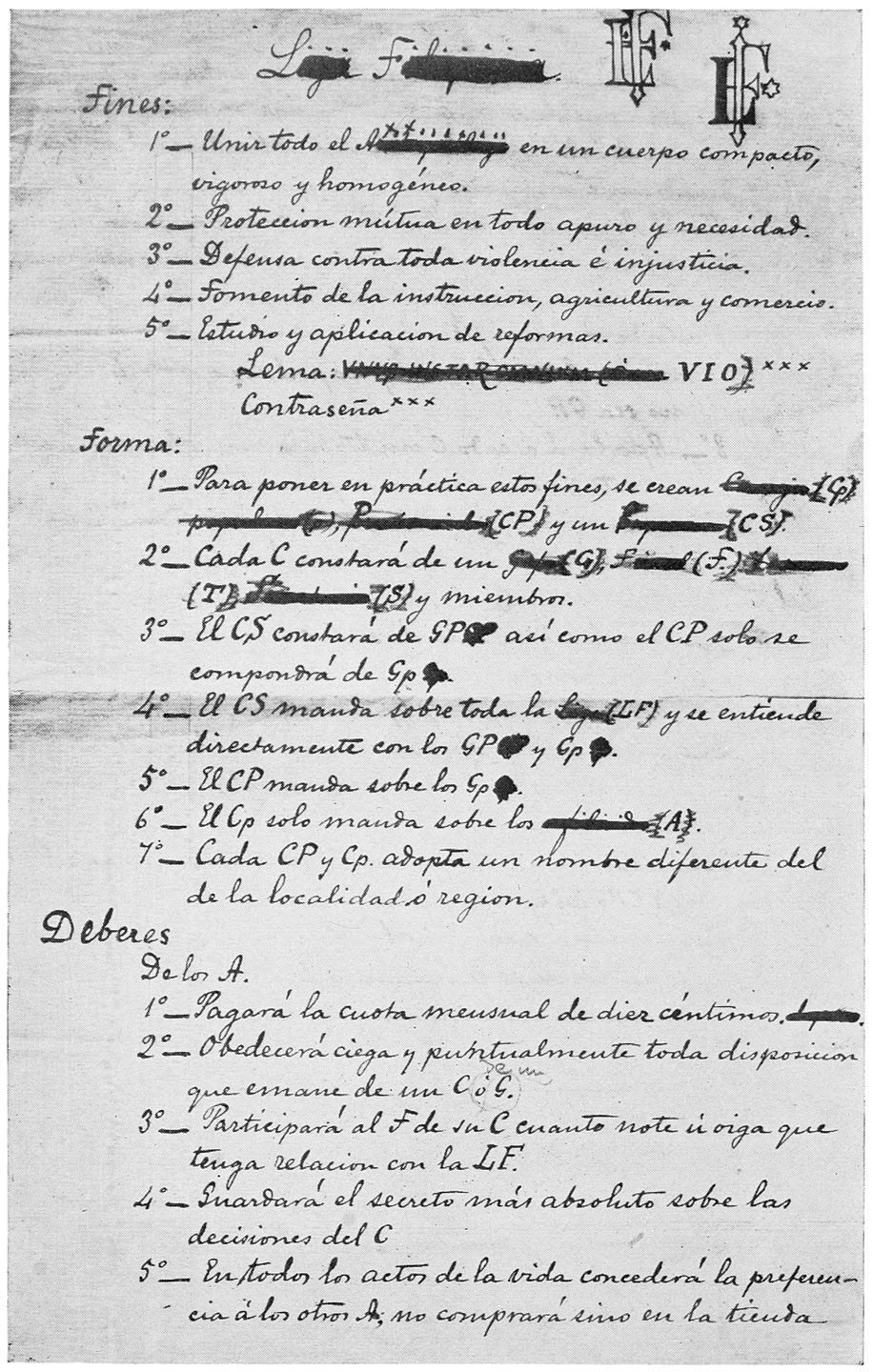
THE OUTLINE OF THE CONSTITUTION OF THE “LIGA FILIPINA”
Photograph of the original. Note the erasures and the abbreviations intended to be used instead of the real names in Rizal’s handwriting.
In this instance the treasonable stuff was found, official superservice asserted, in certain pillow-cases that Lucia had in her trunk. When all was done, it consisted of a brief circular or tract entitled “The Poor Friars.” Among reasoning men and enlightened systems of society, treason is held to be a crime directed against Government; other offenses may be committed by individuals against individuals, but for these the police and the ordinary criminal code are enough. The incendiary document Lucia was alleged to have brought in said nothing against the Government. This is the fact that will strike the modern reader as strangest of all. How can there be other treason or other sedition than against Government? Yet in all this document is not a word against anybody or thing except the friars and even as to the friars speaks of but one order, and that in terms adults might smile at but assuredly would never care to reread. Lest it should be thought that any part of the description of the Insular Government attempted in these pages is extravagant, here is the whole of this ferocious document:
POOR FRIARS
A bank has just suspended payment; the New Oriental has just become bankrupt.
Great losses in India. In the Island of Mauritius, to the South of Africa [sic], cyclones and tempests have laid waste its riches, swallowing more than 36,000,000 pesos. These 36,000,000 represented the hopes, the savings, the well-being, and the future of numerous individuals and families.
Among those that have suffered most we are able to mention the Reverend Corporation of the Dominicans, which lost in this catastrophe many hundreds of thousands. The exact amount is not known because they handle so much money and have so many accounts that it would be necessary to employ many accountants to calculate the immense sums in transit.
But, neither should the friends of these sainted monks that hide behind the cloak of poverty be downhearted nor should their enemies feel triumphant.
To one and all we can say that they can be tranquil. The Corporation still has many millions on deposit in the banks of Hong-Kong, and even if all of those should fail, and even if all of their many thousands of rented houses should be destroyed, still there would be left the curates and the haciendas, there would still remain the Filipinos always ready to answer their call for alms. What are four or five hundred thousands? Why take the trouble to run about the towns and ask alms to replace these losses? A year ago, through the bad business administration of the cardinals, the Pope lost 14,000,000 pesos of the money of St. Peter; the Pope, in order to cover this deficit, called upon us and we took from our “tampipis” the very last cent, because we knew that the Pope has many worries; about five years ago he married off his niece bestowing upon her a palace and 300,000 francs besides. Therefore, generous Filipinos, make a brave effort and likewise help the Dominicans.
However, these hundreds of thousands lost are not theirs, they claim. How can they have this when they take a vow of poverty? They are to be believed then, when, to protect themselves, they say this money belongs to widows and orphans. Very likely some of it belongs to the widows and orphans of Calamba, and who knows if not to their murdered husbands? And the virtuous priests handle this money solely as depositories to return it to them afterward righteously with all interest when the day to render accounts arrives! Who knows? Who better than they can take charge of collecting the few household goods while the houses burn, the orphans and widows flee without meeting hospitality, since others are prohibited from offering them shelter, while the men are made prisoners and prosecuted? Who has more bravery, more audacity, and more love for humanity than the Dominicans?
But now the devil has carried off the money of the widows and the orphans, and it is to be feared that he will carry away everything, because when the devil begins the devil has to finish. Does not that money set up a bad precedent?
If things are thus, we should recommend to the Dominicans that they should exclaim as Job: “Naked I came from the womb of my mother (Spain), and naked will I return to her; the devil gave, the devil took away; blessed be the name of the Lord”!
Fr[aile] Jacinto.
Government in the Philippines had sunk so low that this could be deemed seditious.
Nevertheless, for some days thereafter the trap was not sprung upon the victims. Rizal with his sister went about the city, visiting old friends. More than once he called upon Governor-General Despujol and was rather astonished to find that his footing seemed to be secure upon the dark and slippery precincts of Malacañan. In his usual frank way he discussed with the governor-general the brand-new program of reforms, commending most of their features and hoping for the best, as was likewise his habit. Despujol, responding to all this, seemed equally ingenuous. No one would have suspected that while he stressed so much gracious hospitality he was but waiting for the most convenient season to strike to death the man before him. Rizal pleaded in behalf of his persecuted relatives. Despujol promised immunity for the father, but not for the brother or sisters. Afterward he was willing to concede even these favors. They discussed Rizal’s project of a settlement in North Borneo, and the governor-general applied his veto. For this he gave the expected reasons but never once the real one. He objected to taking people out of the colony but said nothing about the wrath of the friars if he should let their victims escape unhurt.
Don’t gamble.
Don’t be a drunkard.
Don’t break the laws.
Don’t be cruel in any way.
Don’t be a rabid partisan.
Don’t be merely a fault-finding critic.
Don’t put yourself in the way of humiliation.
Don’t treat any one with haughtiness or contempt.
Don’t condemn any man without first hearing his side.
Don’t abandon the poor man that has right on his side.
Don’t forget those that although worthy have come to want.
Don’t fail those without means that show application and ability.
Don’t associate with immoral persons or with persons of bad habits.
Don’t overlook the value to your country of new machinery and industries.
Don’t cease at any time to work for the prosperity and welfare of our native land.