Chapter XVI · “I CAME FROM MARTYRDOM UNTO THIS PEACE”
Reading edition
It was November 3, 1896, when Rizal, heavily guarded, passed again through the dark gateway of Fort Santiago, whence he had issued four years before to go to Dapitan. Now his enemies had him wholly in their power; he was dragged to earth at last. Yet for a time they were puzzled how to proceed with him. Dull as they were and remote from the highways of European thought, they were not unaware that the eyes of a scornful world were upon them. Therefore they could not, as in the cases of so many “unvalued men,” shoot him at sunrise on a dunghill. Some pretense of legality must be followed; there must be regard to decency.
Meantime José, though undeceived as to his probable fate, fought for his life with the resolute courage of his kin. He knew there was no evidence against him, that before no court with the least respect for justice could he be convicted. But he determined to make that conviction as difficult as possible and as shameful in the eyes of the world. From his prison-house he issued this address:
My countrymen:
On my return from Spain I learned that my name had been in use, among some who were in arms, as a war-cry. The news came as a painful surprise, but, believing the incident to be closed, I kept silence over what seemed to be irremediable. I now notice indications that the disturbances are continuing, and lest any persons, in good faith or bad, should avail themselves of the use of my name, to stop such an abuse and to undeceive the unwary I hasten to address you these lines and make known the truth.
From the very beginning, when I first had notice of what was being planned, I opposed it, fought it, and demonstrated its absolute impossibility. This is the fact, and witnesses to my words are still living. I was convinced that the scheme was utterly absurd, and, what was worse, would bring great suffering.
I did even more. When later, against my advice, the movement materialized, of my own accord I offered not alone my good offices, but my very life, and even my name, to be used in whatever way might seem best, toward stifling the rebellion; for, convinced of the ills which it would bring, I considered myself fortunate if, at any sacrifice, I could prevent such useless misfortunes. This is equally of record. My countrymen, I have given proofs that I am one most anxious for liberties for our country, and I am still desirous of them. But I place as a prior condition the education of the people, that by means of instruction and industry our country may have an individuality of its own and make itself worthy of these liberties. I have recommended in my writings the study of the civic virtues, without which there is no redemption. I have written also (and I repeat my words) that reforms, to be beneficial, must come from above, that those which come from below are irregularly gained and uncertain.
Holding these ideas, I cannot do less than condemn, and I do condemn this uprising—as absurd, savage, and plotted behind my back—which dishonors us Filipinos and discredits those that could plead our cause. I abhor its criminal methods and disclaim all part in it, pitying from the bottom of my heart the unwary that have been deceived into taking part in it.
José Rizal.
Fort Santiago, December 15, 1896.
Still remained for his enemies the necessity of a semblance of charges upon which might be based the semblance of a trial. As a move of obvious desperation they now fell back upon the fantasy that La Liga Filipina was an illegal body and upon the precarious assertion that even if he had no connection with the Katipunan it had been formed as a result of his teachings. Upon these grounds and only these his life was to be sought; the first wholly untrue, the other tenuous and fraught with grave danger to the existence of any system of justice. As for La Liga Filipina, that was as seditious as an average board of trade, and as secret; it had no purposes but economic improvement and Filipino union. But the other charge was a different matter. If it could be held that Rizal’s teachings were such that they instigated an uprising he had always opposed, then any but a paralyzed dumb man could be held responsible for anything that happened anywhere. Suppose, for instance, a British newspaper to criticize severely the British prime minister, and the next day a man attempt the assassination of that minister. Who is to say, if this doctrine be sound, that the newspaper did not instigate the murderous attempt? It is apparent that if such a view were ever deemed valid an end would come to all free discussion or the pretense of a free press; no journal would dare to have an opinion about anything but the weather.
The inhibition would never stop with the press; the most ordinary and the most useful activities of organized society would be put into jeopardy. Suppose, for instance, Rizal had opposed and denounced vivisection, and a weak-minded man anywhere, maddened by the loss of his pet dog, should assault the physician that had cut it to pieces. Who could say that Rizal under this doctrine was not the guilty assailant? Even supposing the man that did the deed never to have read Rizal nor heard of him, Rizal’s influence might have been transmitted through many persons and still be his. It is evident that at once we plunge into limitless possibilities for oppression and wrong. Suppose an American reformer to denounce some official grafter and a fanatic to shoot that grafter. The reformer might be hanged, and the assassin go free.
Of all places in the civilized circuit the Philippine Islands were then the most perilous in which to introduce such a theory. In the Philippines an evil oligarchy maintained itself by terrorizing the population. Before its need and greed, justice was at best farcical. To admit that any man that criticized its methods might be held responsible for the acts of any revolutionist, murderer, or lunatic whatsoever was to place in the hands of the oligarchy the last and worst of weapons. It would need nothing else to render unassailable and unlimited its already despotic power. The courts would be a hangman’s noose.
Yet on such preposterous grounds and none other the terrible travesty of justice was now urged along. It is likely that since the days of Caiaphas has been no such desperate hunting for testimony against innocence. “This man spake blasphemy,” cried the high priests, and, when they could find no confirmation of the charge, twisted to a desired meaning the most casual utterance, the cross being made ready in advance. The proceedings were as illegal as unjust. Supposing the offenses charged to have been committed, they were under the civil law of the Islands. The civil law and the civil courts were brushed aside lest even in the Philippines they might fail of legalized murder, or halt it; and the proceedings were held by court martial.
There was no taking of testimony in any sense that civilized nations have of that term. A few terrified Filipinos were put upon the stand, and answers were extracted from their lips to carefully prepared questions; but cross-examination was not allowed, and the value of their admissions was nothing. The judge-advocate denounced Rizal as a traitor and an enemy to Spain. Extracts were read from his writings that it was pretended had encouraged the existing revolt. The Christmas holidays intervened while the ghastly processes of slaughter were still incomplete. On December 29 the court found him guilty and sentenced him to be shot within twenty-four hours.
To this and nothing else he had looked forward from the beginning of the hearing. Some nights before the verdict, knowing well what it would be, he had written in his cell by the light of his little alcohol lamp his farewell to his country, his family, and his friends. It is that poem now become the national classic of the Philippines, the beautiful and tender elegy that he called “My Last Farewell.” On the last night he folded the manuscript and hid it in the bowl of the lamp.
Land I adore, farewell! thou land of the southern sun’s choosing.
Pearl of the Orient seas! our forfeited Garden of Eden,
Joyous, I yield up for thee my sad life, and were it far brighter,
Young, or rose-strewn, for thee and thy happiness still would I give it.
Far afield, in the din and rush of maddening battle,
Others have laid down their lives, nor wavered, nor paused, in the giving.
What matters way or place—the cypress, the lily, the laurel,
Gibbet or open field, the sword or inglorious torture—
When ’tis the hearth and the country that call for the life’s immolation?
Dawn’s faint lights bar the east; she smiles through the cowl of the darkness,
Just as I die.…
Vision I followed from afar, desire that spurred on and consumed me!
Greeting! my parting soul cries, and greeting again! O my country!
Beautiful is it to fall, that the vision may rise to fulfilment
Giving my life for thy life, and breathing thine air in the death-throe;
Sweet to eternally sleep in thy lap, O land of enchantment!
If in the deep rich grass that covers my rest in thy bosom,
Some day thou seest upspring a lowly tremulous blossom,
Lay there thy lips—’tis my soul!…
And if at eventide a soul for my tranquil sleep prayeth,
Pray thou, O my fatherland! for my peaceful reposing;
Pray for those who go down to death through unspeakable torments;
Pray for those who remain to suffer torture in prison;
Pray for the bitter grief of our mothers, our wives, our orphans;
Oh, pray, too, for thyself, on the way to thy final redemption!
When our still dwelling-place wraps night’s dusky mantle about her,
Leaving the dead alone with the dead, to watch till the morning,
Break not our rest, and seek not to lay death’s mystery open.
If now and then thou shouldst hear the string of a lute or a zithern,
Mine is the hand, dear country, and mine is the voice that is singing.
When my tomb, that all have forgot, no cross nor stone marketh,
There let the laborer guide his plow, there cleave the earth open.
So shall my ashes at last be one with thy hills and thy valleys.
Little ’t will matter, then, my country, that thou shouldst forget me!
I shall be air in thy streets, and I shall be space in thy meadows;
I shall be vibrant speech in thine ears, shall be fragrance and color,
Light and shout, and loved song, for ever repeating my message.
Idolized fatherland, thou crown and deep of my sorrows,
Lovely Philippine Isles, once again adieu! I am leaving
All with thee—my friends, my love. Where I go are no tyrants;
There one dies not for the cause of his faith; there God is the ruler.
Farewell, father and mother and brother, dear friends of the fireside!
Thankful ye should be for me that I rest at the end of the long day.
Farewell, sweet, from the stranger’s land—my joy and my comrade!
Farewell, dear ones, farewell! To die is to rest from our labors!
As was to have been expected in the conditions attending his fate, the power that had dragged him down with so much of trickery and deceit attempted to soil with other deceit the name he should leave to his countrymen. To the newspaper reporter he said that “Noli Me Tangere” had been much misunderstood because the authorities had selected from it only passages that seemed to indicate sacrilegious or seditious purpose, whereas when read in their proper places with the context they had no such appearance. This statement was so distorted as to appear as an expression of regret that he had written the book. When he said that the Republicans in Spain had mistaken their strength and their opportunities, this was distorted into a petulant charge that the Spanish Republicans had been the cause of all his troubles. When he spoke with characteristic modesty of his own work as feeble and of small avail, the remark was twisted into a dubiety of his basic faith.
On the basis of evidence so untrustworthy the tale was fabricated that he had retracted his political views. It was brazen impudence that put out this fable and simple credulity that believed it. Much that happened in the last scenes of his tragedy is and always will be uncertain, but the one thing about which is no doubt is that he went to his death unshaken in his loyalty to the great causes to which he had dedicated his life and labors, to the rights, emancipation, and progress of his country.
Even in these last hours efforts were made by his friends to rescue him from the jaws that had opened to rend him. Relatives and friends besieged the governor-general; he would not even admit them to his presence. In Spain fervent appeals were made to the National Government. All scientific and sympathetic Europe was horror-stricken at the impending murder of one of the most learned men of the age. There is a story that the Spanish prime minister wished to yield to these demands. It was the queen regent that he found implacable. Something in one of Rizal’s books had mortally offended her. She, too, was determined to have his blood.
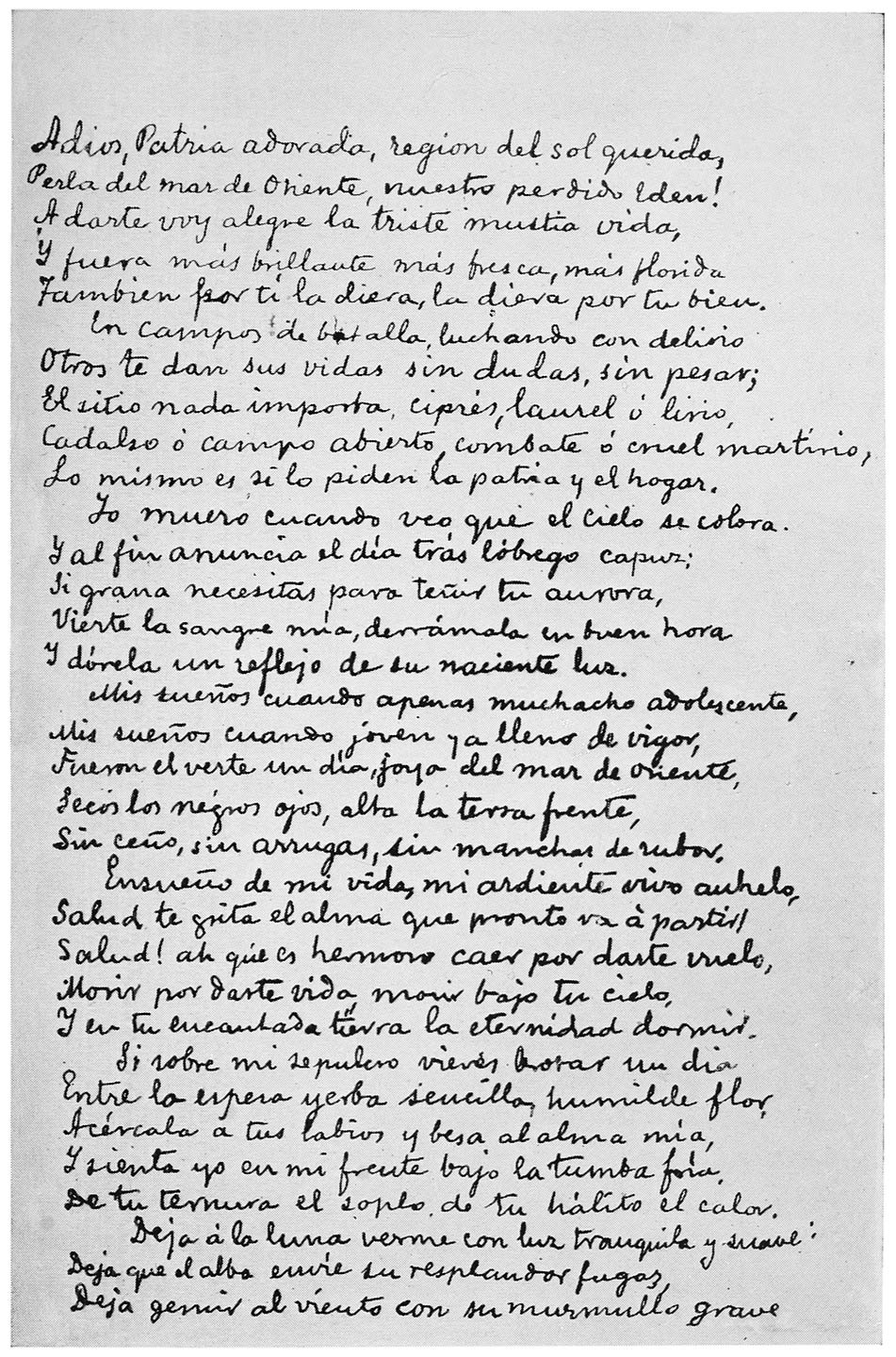
PHOTOGRAPH OF THE ORIGINAL OF “MY LAST FAREWELL”
Note the handwriting
It was a beautiful morning, men still remember, calm, cool, and bright, “the bridal of the earth and sky,” typical of the sweet December weather in the Philippines; the air so clear the mountains on both sides stood out marvelously brown and rugged; so clear one could even make out far Corregidor on guard at the entrance of the bay.
At seven o’clock the troopers came and tightly bound his arms behind his back. He wore a neat black suit with a sack-coat and a black hat.
Outside, the trumpets sounded and the drums beat. The troopers placed him in the center of a strong guard. Then they led him forth from the prison door.
With the drum always beating at the head of the band, thus he was marched almost a mile through scenes that had been familiar to him in his boyhood. Thirty-seven years and twenty-eight days before, another martyr had gone forth to his death with the same clear-souled, untroubled calm. “This is a beautiful country,” said John Brown, Osawatomie Brown, as with the sheriff he drove to the execution-place; “I never noticed it before.” With the same sense of drawing in for the last time the breath of God’s bounty to men, Rizal looked about him and spoke of the loveliness of the scene. “I used to walk here with my sweetheart,” said he, thinking of Leonora. Above the roofs he saw the Ateneo, where he had spent so many happy days. Since his time the buildings had been altered. “When were those two towers added?” he asked and observed the effect with a critical eye. All the way he went with head erect, unflushed cheek, unruffled mien, as one that goes forth to meet fair weather in the morning.
By his side marched the Jesuit priests, his comforters and supporters, for he always remembered tenderly his days at the Ateneo.
A crowd lined the street, for the most part silent, but among the Spaniards were some exclamations of joy. One foreigner, a Scotchman, watching the scene, was moved to cry aloud a brief good-by. A little company of Rizal’s former students at Dapitan stood together and wept.
He looked out upon the bay and the ships.
“How beautiful is the morning, Father! How clear is the view of Corregidor and the Cavite Mountains! I walked here with my sweetheart, Leonora, on mornings like this.”
“The morning to be is still more beautiful, my son,” answered the priest.
“Why is that, Father?” asked Rizal, not quite understanding his confessor’s words.
The officer in charge of the squad stepped between them, and the father’s reply was not heard.
Thus they moved to the place of execution, the dreadful Bagumbayan Field, the spot where so many others had been slain for defying tyranny, where Fathers Gomez, Burgos, and Zamora had given up their lives. To their memory he had dedicated his protest against the beast that had torn them. Now in his own turn he was come to be torn.
A great troop of soldiers had formed a square to hold the people back. Artillery was drawn up as if a rescue were feared, and at one side—strange and incongruous spectacle!—a band to sound the national anthem of triumph over this one man. To the governing class the occasion was all holiday. Hundreds of that class stood there, men and women, and uttered cries of animal pleasure when they saw their enemy come bound and helpless to be killed before their eyes.
Neither they nor the engines of death they had evoked seemed to pierce the serenity that wrapped him around. As they reached the field, he stopped before the captain in command and said quietly:
“Will you shoot me in the front, please?”
“It cannot be,” said the captain. “I have orders to shoot you in the back.”
“But I was never traitor to my own country nor to Spain.”
“My duty is to comply with the orders I have received.”
He asked that the soldiers be instructed to aim not at his head but his heart, and that he should not be compelled to kneel but might receive his death standing. These requests the captain granted.
Into the square he marched, between two batteries of artillery, a company of cavalry in front, another behind. With him still went the priests, Fathers Estanislao March and José Villaclara, and behind them the man that had been his counsel in the mock trial, Luis de Andrade. Rizal stepped to the place where he was to die and looked out over the blue sea, bright in the sunlight. And then for the first time the iron composure seemed shaken. It may have been some thought of his lost youth, or the terror of the scene that reached out at him like something coldly palpable. A shiver seemed to go over him; the mortal man that he had so long suppressed in him reasserted itself; and one great sigh seemed to burst from his heart.
“O Father, how terrible it is to die! How one suffers! Father, I forgive every one from the bottom of my heart; I have no resentment against any one: believe me, your reverence!”
The next instant the spasm had passed. The will with which he had ruled himself so long came back to its accustomed empire. He was himself again and stood erect, with no twitching of his lips and no fear in his eyes.
The executioners marched upon the field.
Rizal shook hands firmly with the priests and with his counsel. Father March held to him the cross for him to kiss.
He now turned his face to the east and stood with his back to the firing-squad. Eight native soldiers had been told off to slay their fellow-countryman. Behind them were eight Spanish soldiers with leveled rifles. They were to shoot the executioners if these failed to obey orders.
At that instant a military doctor, amazed by such a show of fortitude, ran out from the line of officers.
“Colleague,” he cried, “may I feel your pulse?”
Rizal said nothing but thrust his right hand as far as he could from the bands that held it.
The pulse was hardly a beat above normal.
“You are well, colleague,” said the doctor, “very well!” and stepped back to his place.
Rizal made no response and resumed his former attitude. He now twisted his right hand and indicated the spot in his back at which the soldiers should aim.
The captain gave the signal. The eight soldiers fired together.
In the thirty-sixth year of his age and the twenty-fourth year of his service—poet, patriot, and martyr.
Cheers and laughter arose from the crowd as his blood was seen to be pouring upon the field. Women waved their handkerchiefs and clapped their hands; men shouted with delight. This was the end of him that had unveiled to the world the realities of their social order; that had ridiculed all their structure of rank and caste. He had died like a dog before them.
The band played the national anthem. “Viva España!” shouted the crowd. A photographer made pictures of the scene. It was a great day for Spain. Her supremacy in the Philippines was approved and established for ever. For whomsoever thereafter might venture to question its righteousness, the same fate. Let him also die like a dog to the applause and laughter of the existing order, rock-rooted and eternal.
“Viva España!” How poor are they that will not ponder history! From the hanging of John Brown to the Emancipation Proclamation was three years and twenty-nine days. From the murder of José Rizal to the surrender of Manila was one year, eight months, and seventeen days.
Not even yet was satiated the hot thirst for blood that seemed to rage in this abnormal community. The jails had been stuffed with other members of the Liga Filipina, men that like Rizal had committed the crime of desiring their country’s good. On January 11, 1897, two weeks after the sacrifice of Rizal, fourteen of his companions were led forth to Bagumbayan Field and shot, as he had been shot. Two of these were priests of the church; among the laymen were members of ancient Filipino families, and men of conspicuously blameless walk and notable attainments. Father Inocencio Herrera and Father Prieto Gerónimo led the procession of the condemned whose names were now to be added to the long roll of those that had made that one field a shrine of liberty hardly to be equaled in men’s acquaintance. Others whose blood was shed with theirs that day on that sacred spot were Domingo Franco, Moisés Salvador, Numeriano Adriano, Antonio Salazar, José Dizon, Luis Enciso Villareal, Faustino Villareal, Ramón A. Padilla, Manuel Avella, Roman Basa, Cristobal Medina, and Francisco Roxas. It was a flag dripping with blood that Spain raised to the world that morning.
In a short time there was left no last doubt of the seriousness of the revolt; with reason this time the Spanish colony cowered. The thirty-fourth since the beginning of Spanish dominion in the Philippines, it threatened at last to sweep that vicious anomaly into the sea. A man had arisen capable of verifying the most sanguine of Bonifacio’s prophecies, a college-bred farmer, without military training but with a strange gift of military prescience, able with an equipment of native genius to outwit, outmanœuver, and outlast the best of the Spanish commanders. Against the skill and restless energy of Emilio Aguinaldo they seemed to make no permanent progress, and one reading the records of those days is irresistibly reminded of Francis Marion and the Carolinas. If the regulars drove him hence to-day, he would attack them there to-morrow. A union of Filipino hearts such as Rizal, living, had hardly dared to dream of had been cemented by his death. For the first time the possibility of ridding all the Islands of all Spanish power laid hold upon determined and reasoning men, and there began a life and death struggle between light and darkness, the nineteenth century and the sixteenth.