Chapter XVII · RESULTS AND INFLUENCES
Reading edition
In this long conflict character shone forth and latent ability, refuting old slanders on the race. The Filipino disclosed himself. By ancient repute the Malayan was cruel and treacherous; the test of warfare showed him to be much more humane than the Spaniard and much more sensible of honor and faith. He had been described as incapable of combined and sustained activities; he revealed himself as organizing a government out of chaos, coördinating the energies of peoples unused to common effort, launching a democracy founded upon the most advanced ideas of political philosophy, defending it with skill and tenacious courage comparable to the best traditions of the Swiss mountaineers. Men whose talents had never been suspected because they had never had a chance to function arose in the Filipino ranks to astonish their enemies and overwhelm prejudice. Great commanders appeared like Luna and del Pilar; statesmen and thinkers like Felipe Calderon; and profoundly philosophical and illuminating intellects like Apolinario Mabini.
Next to Rizal himself, this was the greatest genius the Islands had produced and one that would have deserved eminence in any country or any time. He was come of poor people in the province of Batangas and had won an education partly through the pathetic sacrifices of his mother and partly through his own exertions, which in that time and place amounted to heroism. He was first in a school at Tanauan and then at the College of San Juan de Letran in Manila, where he earned his way by teaching. His mother’s hope had been that he would take holy orders; but his studies had made him skeptical instead of reverent; he revolted at the priesthood, and chose the bar, to which he was admitted in 1894.
Like Bonifacio he was a great reader, but on different lines. The warehouse porter, hanging by night over such books as he could lay hands upon, was set aflame by the struggles of mankind against oppression, particularly by that which is the epitome and symbol of them all, the French Revolution. Mabini, cool and even-pulsed philosopher, was concerned not so much with the physical aspects of revolution as with its causes. If the human story told true, revolutions were some rebound of the spirit of man against a privileged class that held or sought to hold the rest as bondmen. As this conflict between two main forces occupied so much of the history he was analyzing with his keen sure mind, and as it seemed the only thing there of enduring importance, he molded from its pages a philosophy of human life and its import not unworthy of Jefferson and Mill. The basis of everything good he conceived to be liberty; without liberty there could be no light and no progress. With a coolly measuring eye, as an architect looks at a building, he went over the system of government erected by Spain in the Philippines and estimated its fatal defects as a structure no longer tenable, knowing well that its fall was overdue.
Much more than Rizal he seems to have seized the fundamental facts about man’s capacity for self-government and the only way to uncover and develop that capacity. He, too, was of the cloister, and might have slipped likewise into the darling errors of the schoolmen about the magic keys to this wisdom believed to be buried in a classical education. He made no such error. Not even Jefferson was of a clearer faith. He accepted the whole democratic theory of government, not sentimentally but as the ultimate fact in human existence. On philosophical grounds, for unassailable reasons, popular rule was right; in the end the only human wisdom was the general thought. In the verdict of the majority he saw plainly the manifestation of the will of God.
He was not influenced by Bonifacio, of whose existence he seems to have been unaware until 1892. As one of the earliest members of La Líga Filipina he may have been influenced at one time by Rizal; but there was little chance and less need that he should be influenced by anybody. His was a mind accustomed to independent action; it seems always to have moved to its own conclusions in its own way.
He was an early recruit to the Katipunan, where, after a time, he became one of Bonifacio’s chief advisers. A stroke of paralysis crippled his body but left his mind clear and active. When the storm burst and official lunacy raged in Manila, his physical infirmities prevented his flight with his fellows. Trapped among other unfortunates, a drum-head doomed him to be shot. It is likely the Government knew little of his real connection with the Katipunan and nothing of his capacity to cause trouble. The sentence of death upon him was delayed. At last, homicidal mania spent itself even in Manila. Then, because of his physical condition, he was set at liberty.
This was in 1897, when revolution had changed all the outlook in the Philippines and the governing class was beginning to doubt its destiny. For the next year he was undergoing medical treatment at the hot springs of Los Baños. In the summer of 1898 he made his way to the revolutionary forces and was thereafter their ablest counselor, the shrewd adviser of the commanders in the field, the first voice in all negotiations, and to the masses of people the endless source of inspiration; for in all emergencies, however sudden or perplexing, here was the heart indomitable.
In him as in Rizal, the mysteries of an unusual power resolve themselves at last into unusual character. What was Mabini’s character may be gathered from this decalogue he composed for his own guidance and that of his countrymen:
First. Thou shalt love God and thine honor above all things; God as the fountain of all truth, of all justice, and of all activity; and thine honor, the only power that will oblige thee to be faithful, just, and industrious.
Second. Thou shalt worship God in the form that thy conscience may deem most righteous and worthy; for in thy conscience, which condemns thine evil deeds and praises thy good ones, speaks thy God.
Third. Thou shalt cultivate the special gifts that God has granted thee, working and studying according to thine ability, never leaving the path of righteousness and justice, in order to attain to thine own perfection, by means whereof thou shalt contribute to the progress of humanity. Thus thou shalt fulfil the mission to which God has appointed thee, and by so doing thou shalt be honored, and, being honored, thou shalt glorify thy God.
Fourth. Thou shalt love thy country after God and thine honor and more than thyself: for she is the only paradise which God has given thee in this life, the only patrimony of thy race, the only inheritance of thine ancestors, and the only hope of thy posterity; because of her, thou hast life, love, and interests, happiness, honor, and God.
Fifth. Thou shalt strive for the happiness of thy country before thine own, making of her the kingdom of reason, of justice, and of labor; for if she be happy, thou, together with thy family, shalt likewise be happy.
Sixth. Thou shalt strive for the independence of thy country; for only thou canst have any real interest in her advancement and exaltation, because her independence constitutes thine own liberty; her advancement, thy perfection; and her exaltation, thine own glory and immortality.
Seventh. Thou shalt not recognize in thy country the authority of any person that has not been elected by thee and thy countrymen; for authority emanates from God, and as God speaks in the conscience of every man, the person designated and proclaimed by the conscience of a whole people is the only one that can use true authority.
Eighth. Thou shalt strive for a republic and never for a monarchy in the country; for the latter exalts one or several families and founds a dynasty; the former makes a people noble and worthy through reason, great through liberty, and prosperous and brilliant through labor.
Ninth. Thou shalt love thy neighbor as thyself; for God has imposed upon him the obligation to help thee, as upon thee the obligation to help him, and not to do to thee what he would not have thee do unto him; but if thy neighbor, failing in this sacred duty, attempt against thy life, thy liberty, and thy interests, then thou shalt destroy and annihilate him, for the supreme law of self-preservation prevails.
Tenth. Thou shalt consider thy countryman as more than thy neighbor; thou shalt see in him thy friend, thy brother, or at least thy comrade, with whom thou art bound by one fate, by the same joys and sorrows, and by common aspirations and interests.
Therefore, as long as national frontiers subsist, raised and maintained by the selfishness of race and of family, with thy countryman alone shalt thou unite in a perfect solidarity of purpose and interest, in order to have force, not only to resist the common enemy but also to attain all the aims of human life.
Meantime, in the great events that had shaken this ancient theater of bold deeds, the freedom of which Mabini and his fellows had dreamed had more than once lightened before them. With the news of the discovery of the Katipunan and the cruelties of the hysteria in high places that followed next, the revolution spread swiftly to the provinces. Cavite, Batangas, Zambales, Tarlac rose as the clans rose in Scotland; a remarkable fact, for here had been no preparation, and the Katipunan had not gone far beyond Manila walls. Nothing would seem to show more plainly that the psychology of the people had been all misread. At Rizal’s school he had noticed that the Spaniards deemed the natives submissive to kicks and insults when in reality wrath burned in the native heart. It was so here; while the “miserable Indio” had borne in silence the lash of the governing class he had not ceased at any time to resent its sting, and at the first call to revolt the whole Island went aflame. In a week the comfortable fictions about Filipino incapacity were shattered by such ponderable facts as shot and shell, and Spain was retreating before the gravest crisis it had known in its 325 years of mismanagement.
Bonifacio’s forces increased daily. He gave battle to the regular troops sent against him and sometimes he beat them, sometimes he was beaten; but never was he dismayed. He developed captains among the young men that flocked around him; with others, this Emilio Aguinaldo of whom we have spoken. This was a youth lately out of college that had never set a squadron in the field nor the divisions of a battle knew more than Cassio. Yet he quickly showed such natural talents for command that he made his fame enduring among the military leaders of all times. He was born in the city of Cavite in March, 1869, and had studied at the College of San Juan with no more thought of being a soldier than of being a chiropodist. He had read his horoscope in the face of fate and perceived that he was to be a farmer and lead a quiet life among dingles and rice-plots. No sooner had he fingered his degree at San Juan than he hastened to fulfil this modest destiny by taking a farm in Cavite province and trying to better the yield of rice there. He had character, a presence, and a good mind; he had not been farming long when he was made municipal captain of his district. From his youth he seems to have been strong for nationalism, being a type of the class of young men rising in all parts of the Islands on whom the Spanish collar rested uneasily if at all, the class of which Rizal was the best example and natural leader. In 1894 he joined the Katipunan. When Father Gil pulled the strings and revealed, to the fevered imagination of the Spaniards, the lair of this frightful monster, Aguinaldo was one of the first to proclaim the revolution. Chiefly it was his work that made Cavite an insurrectionary stronghold. In whatever he undertook he showed the executive faculty, the power to get things done quickly and efficiently, and a cool, hardy courage that no emergency could shake. Bonifacio advanced him to the highest commands, and in each instance the result justified the election, for the man had undoubtedly an instinct for war.
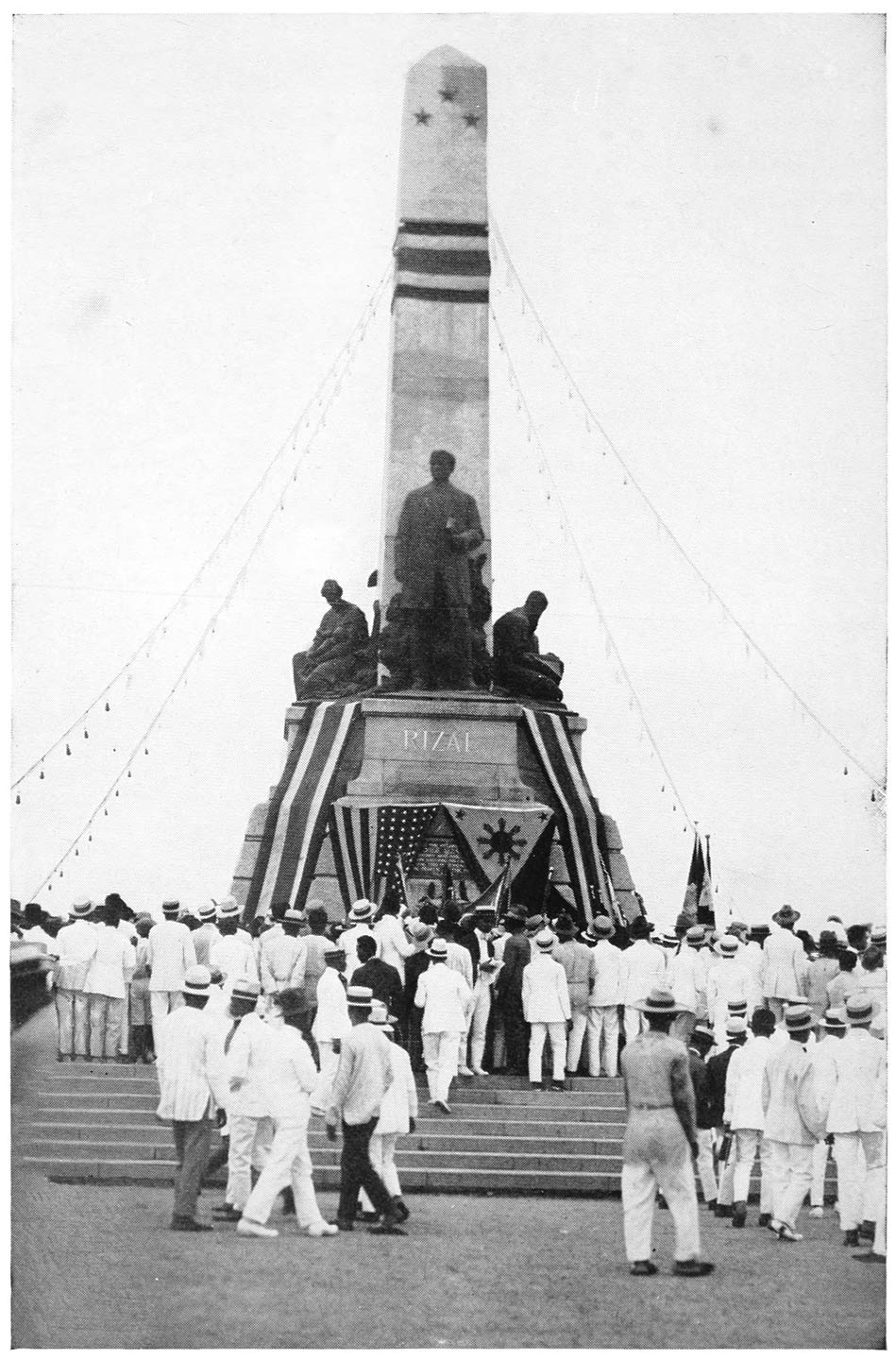
THE RIZAL MONUMENT AT THE LUNETA DECORATED FOR RIZAL DAY, DECEMBER 30
On March 12, 1897, seven months after the Katipunan explosion, a convention of the revolutionists met to establish a Provisional Government. No doubt Bonifacio, still head of the Katipunan, expected to be made president of the Provisional Republic, also; but the convention’s choice was Aguinaldo. Intrigue may have played some part in this dénouement; but the impulse to it was Aguinaldo’s brilliant operations in the field—Napoleon and the Directoire again. Bonifacio was offered the place of secretary of the interior. He angrily refused it and took to the mountains with his brothers. In trying to arrest him a party of soldiers wounded him to death.
Amnesty for all that had taken part in the revolution was promised, with momentous changes in the methods of government. There was to be no longer an irresponsible oligarchy ruling as it pleased; the Philippines were to have representation in the Spanish Parliament; they were to emerge from the darkness that fostered iniquity and dwell in the critical spotlights of civilization. There was to be a free press, free speech, free assembly; there were to be radical reforms in the courts and other desirable novelties. A sum of money was to be deposited by the Spanish Government to guarantee the fulfilment of these pledges and to provide for the families of the revolutionists killed in the war. Aguinaldo and his commanders were to retire from the country.
This was signed December 14, 1897. In two months it was evident that the Spanish Government had no intention to keep any of the pledges thus made. The orders abated nothing of their power and insolence; the captured revolutionists were rigorously punished and often horribly mishandled; there was no free speech, no free press; no improvements were made in the courts; only a part of the guarantee fund was deposited. The revolution was resumed with new fury. Again the Filipinos drove the Spanish regulars before them until the noise of their guns was heard in Manila itself, when the blowing up of the American battle-ship Maine in the harbor of Havana gave to the relations between Spain and the United States a new and startling aspect.
Soon after the declaration of war between these nations and before the battle of Manila Bay, Commodore Dewey invited Aguinaldo to join him. On May 11, 1898, the Filipino leader landed at Cavite and took command of the insurgent army. From that time the Spanish troops met with nothing but disaster. Step by step they were driven (by native troops and these only) out of every stronghold, not only in Luzon but in the other Islands, until August when they were shut up in Manila and completely surrounded with Filipino trenches, while Dewey’s ships held the sea approaches. On August 10, Aguinaldo captured the Manila waterworks, and had the city at his mercy. On August 13 it surrendered, not to him that really had reduced it, but to the American naval and land forces; although of such land forces there was but a handful.
Aguinaldo had made Mabini the president of his council and secretary of foreign affairs. Mabini now bent himself to organize a constitutional government, and if the achievement that followed had been staged nearer to the center of the world’s attention it would have been hailed as a triumph of constructive statesmanship. On September 15, the first Philippine Congress met at Malolos, about twenty-five miles north of Manila, and proceeded to draft for the Philippine Republic a constitution that for wisdom and sound democratic philosophy may be compared with any other similar chart by which any government ever was steered. On November 29, 1898, the Congress adopted this constitution, and on the following January 21, the Philippine Republic, complete and functioning, was installed in place of the Provisional Government. Mabini was chief justice of the Supreme Court.
On March 23, 1901, President Aguinaldo was captured, and thereafter the war slowly subsided until on July 4, 1902, President Roosevelt issued a proclamation of amnesty and the American Government took up the work of reconstruction, of which the first purpose was to prepare the natives for the independence repeatedly promised them.
“I have,” said Mabini, speaking always in the same low, even voice.
“Whom have you heard?”
“Myself.”
“What? Are you opposed to the rule of the United States in the Philippines?”
“I certainly am. I am opposed to the rule of any power here except that of the people of these Islands. If you wish to shoot somebody for holding such sentiments, shoot me. Do not shoot or imprison those to whom I have urged this doctrine; do not waste time in hunting for them. Shoot me, the author of it. I am ready whenever you are.”
He died in Manila, May 13, 1903. Next to that of Rizal, his memory is dearest to the Filipino people.
The historian and the philosopher considering these typical passages in the long struggle upward will see that, while ostensibly the Philippine Republic had been defeated, in reality it had triumphed. Instead of being crushed and obliterated, it had never ceased to exist. To this day it is not a memory but a living organism of veritable and powerful influence. Its flag flies side by side with that of the United States on every public building; it functions in effect in every session of the Philippine legislature. So far as one can see now it was a deathless creation that Rizal unconsciously called into being, and there could be no more impressive lesson in the inevitable destiny of democracy than the reflection that the cruelties intended to destroy freedom in the Philippines really gave to it enduring life. When so easily the governing class shattered Rizal’s body and silenced his physical voice, it did but give wings to his teachings, vindicating them at once and multiplying them. If the result is not yet complete and the Philippines lack still their national entity, no one that knows their people and no one that has studied attentively the significance the life and death of Rizal have for them will believe that this anomaly can continue. They live now under the solemn undertaking of the United States to set them free; that pledge they have accepted at its face-value; from day to day they continue in expectation of its fulfilment.
In such strange and fateful ways of which he never dreamed, Rizal has come to be the liberator of his country and the inspiration of its national life. It is a story so different from any other in the records of the human advance that it may be deemed worth the world’s attention on its own account. With arms and conflict Washington and the other patriots of his time freed America, Bolivar and San Martin freed South America, Garibaldi and Mazzini freed Italy. With an idea and an ideal Rizal freed the Philippines.
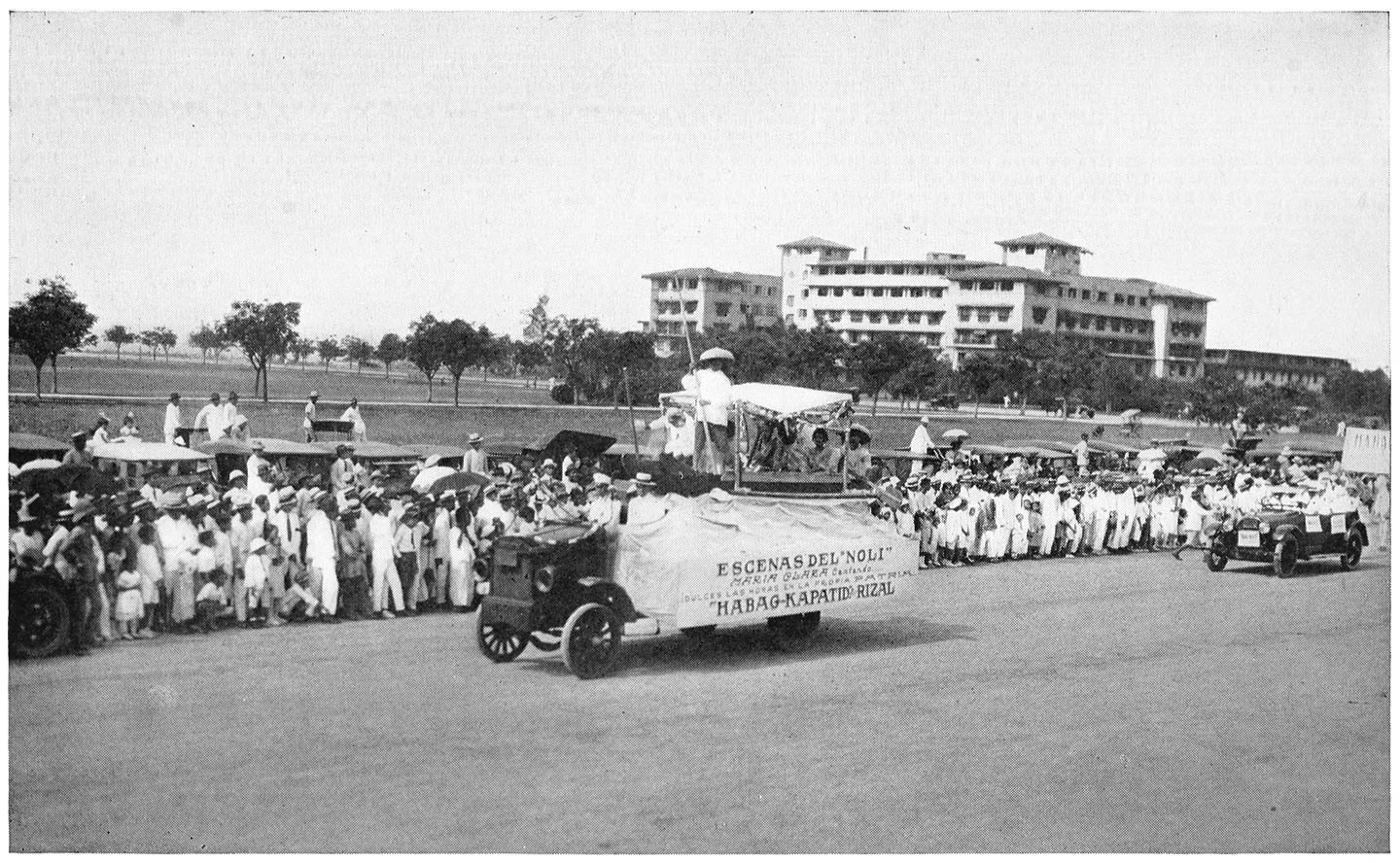
A FLOAT, RIZAL DAY, DECEMBER 30, 1922
Each return of Rizal day is marked with elaborate ceremonies; addresses are delivered to his memory; the schools hold special exercises; the press reviews his life and dwells upon its import. Year by year the earnestness of these tributes increases. Other men, as their tangible presence recedes, become more or less the lay figures of history. This man seems to become with time only the more potent and real.
Happy should be the land that has such a national hero, in whom the pitiless searchings of later years have not discovered enough of flaw to discredit any part of the homage paid him but instead cause him to appear always the more imposing figure, morally as well as intellectually. It is but truth to say that his analogue is hard to find in any nation of any color at any period of history. He had, what is so seldom to be found in the men we call great, a union of brilliant gifts and of lofty character. Of him it is never necessary to offer the Baconian apology; he was of the brightest and wisest of mankind but without an alloying trace of the mean.
Intellectually, there is no doubt he deserved the praise paid wonderingly to him by Sir Hugh Clifford and others; he was a master figure. To the capacity of his mind there seemed no normal limit; he could comprehend any subject, learn any craft, acquire any language, absorb any science. It seemed to be a mind of the order of Octopi, with tentacles that reached out and pumped up not the superficies but the heart of the matter. Hence he could out-argue the learned theologians with the most abstruse lore of their cult, discuss with the artists the recondite principles of their art, classify for entomologists and zoölogists unheard-of specimens of life, thread with economists the endless mazes of theoretical taxation, write exquisite lyrics and sing them to music of his own composing. Such are the facts of his life, however reluctant prejudice may be to acknowledge them. If there has yet appeared upon this earth what may be justly called a universal genius, it seems from the records that he was not of the white race, the world’s confident overlords, but of the misunderstood Malay.
So slowly we yield to truth when it runs counter to theories that it may be advisable to dwell for another moment on this man’s indisputable achievements. Let us say, then, that to have attained to his mastery of any two of the branches of knowledge he followed would have deserved distinction; yet he attained to this mastery in six or seven. He was one of the greatest ophthalmologists of his time; he was a great ethnologist, anthropologist, biologist, zoölogist, linguist; he was sculptor, painter, illustrator, poet, novelist, publicist, engineer, educator, reformer. With almost any of these gifts or accomplishments or whatever they may be termed, he could have won to eminence or to wealth anywhere among civilized men. He is almost the only example we have of a man marvelously endowed for material success and putting it all aside and every thought of it; putting aside, too, even the natural yearning for renown, that he might give himself entirely to the one end of benefiting his people.
As to few men it has been given to bring to the struggles of life so great a natural armament, few also have been able to wield in so short a time a power so momentous. To all the Far East he is slowly becoming a figure of inspiration and hope. To the modern Filipino world he gave an impetus and an impress it can hardly lose in generations if ever. To the movement for Philippine independence he gave vitality, character, and energy that have grown stronger year after year. Even when we consider the natural passion of the race for freedom and the long succession of revolts with which it shook Spanish rule, this remains substantially true. With his teachings first, then his sarcasms and censures, then his appeals, he showed the way to unity and drove the people along it. At his death he bequeathed to them his unquenchable yearning for liberty, while he gave them the necessary background of sacrifice for it. Whatever has been gained for nationality has been gained under this inspiration; without or beyond his knowledge, Rizal was the father of Philippine independence and the lofty model toward which Philippine life may aspire.
Those that seek to disparage the race (so called) to which he belonged find some refuge in the assertion that he was a strange and inexplicable exception to the general incompetence, a star against a background of ineptitude. Against this all just men will protest. Elsewhere the great minds of every nation have exalted that nation in the world’s esteem. The single lives that make up so much of the historic glory surrounding Greece, Rome, Italy, Holland, and our own Revolutionary period we do not sharply contrast against a darkness of general inferiority around these men, but think of them as lighting up all the land that bore them. Even if it were true that Rizal was the only great man of the Filipino people, Filipinos might well claim the same basis of judgment. But the more the leaders of the Philippine revolution are studied—Mabini, Luna, the two del Pilars, Calderon—the more men will be convinced that Rizal was the highest expression of an intellectual force, stimulated by the growing passion for liberty but still a power inherent in the race.
A race that gave such men to the world, that has at the same time proved so incontestably its capacity equally for self-expansion and for self-mastery, may well expect to be heard when asserting the foundation principles of faith and common honesty, it faces the United States and in the circle of nations demands the place it has earned.