Chapter II · SCHOOL-DAYS AND FIRST IMPRESSIONS
Reading edition
The boy that so early and by this savage tuition came to be initiated into his people’s sorrows was then chiefly remarkable for a gentle, tractable disposition and a liking for books and study. He had been born at Calamba, June 19, 1861. In his earliest childhood he seemed undersized and undervitalized; but when he was six years old there came to his father’s house his uncle Manuel, a figure of health and a resolute practitioner of open-air sports, who took José in hand and with daily exercises and rigorous living built his body to normal strength and agility. Filipinos have a natural aptitude for athletics; he verified now the ancestral blood in his veins. He ran and jumped; he took long walks; he learned to fence, to ride, and to like the sun and the wind.
By all accounts he must have been a singularly attractive child, even in a country where handsome children are common. His color was the fine tint of his people, a light, clean, even brown; his face a delicate oval, but the chin firm and rather long; the forehead nobly shaped, the nose almost classical, the lips full but nothing sensual. His eyes had a hardly discernible slant; when he was animated they flashed out of black depths a kind of black fire; but when he was quiescent they seemed gravely introspective. Long afterward his neighbors and relatives, trying to recall his boyhood, and perhaps overstraining memory, thought he seemed always much older than his years, a notion that may have arisen from his unusual habits. He liked to read or be read to; he liked at times to be alone; he liked to hear his elders argue; he liked to go to church to see the people there; and he liked to reason.
Once she read to him a moral tale, “The Moth and the Candle,” translating as she went along, and emphasizing the lesson. The moth had been told by its mother to keep away from the flame, and now see what happened. A cocoanut-oil lamp was burning on the table as she read; winged insects were flying about and losing their lives in the blaze. José became much more interested in them than in the salutary warnings of his mother. He said afterward that he was not so much sorry for the insects that lost their lives as fascinated by their fate.
The advice and warnings sounded feebly in my ears [he wrote]. What I thought of most was the death of the heedless moth. But in the depths of my heart I did not blame it. My mother’s care had not quite the result she intended.
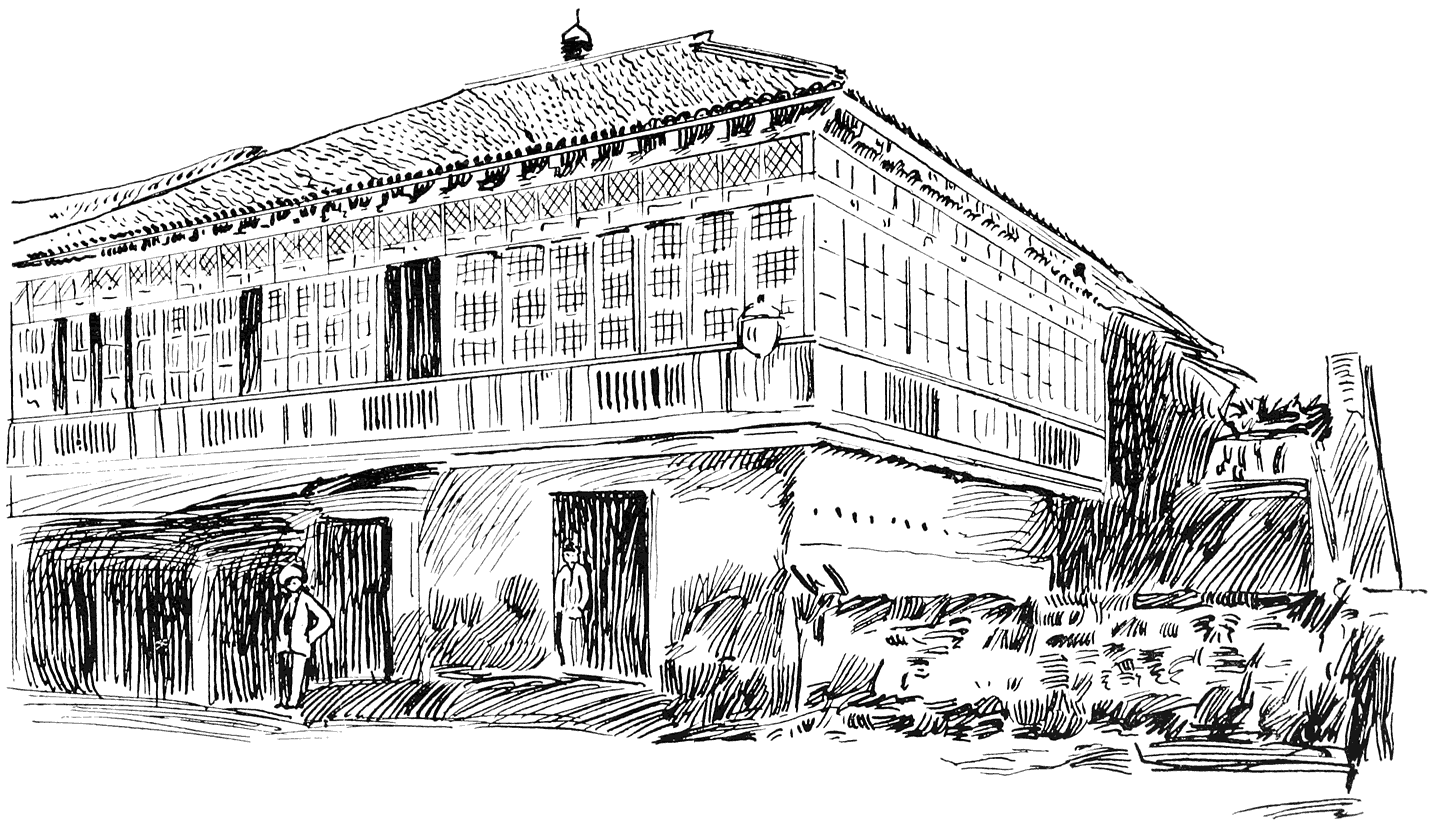
The House at Calamba in which Rizal was born
Years afterward, when he was entering upon man’s estate, he was induced to write what he called the story of his boyhood. It proved to be a juiceless sketch of a few pages covering many years. He was not enough egotist to make a good autobiographer. He begins by saying he was born a few days before the full of the moon. Then he adds:
I had some slight notions of the morning sun and of my parents. That is as much as I can recall of my baby days.
On moonlight nights, I took my supper on the azotea. My nurse, who was very fond of me, used to threaten to leave me to a terrible but imaginary being like the bogy of the Europeans if I did not eat.
At nightfall, my mother had us all say our prayers together. Then we would go to the azotea, or to a window from which we could see the moon. There my nurse would tell us stories. Sometimes sad and sometimes gay, they were always oriental in their imagination. Dead people, gold and plants on which diamonds grew were all mixed together.
When I was four years of age, I lost my little sister, Concha, and for the first time my tears fell because of love and sorrow. Till then I had shed them only for my own faults. These my loving, prudent mother well knew how to correct.
The environment would seem nevertheless to be more propitious for the breeding of an agitator than of either a moralist or an artist. “Almost every day in our town,” he says, “we saw the Guardia Civil lieutenant caning or injuring some unarmed and inoffensive villager. The only fault would be that while at a distance he had not taken off his hat and made his bow. The alcalde did the same thing whenever he visited us.”
We saw no restraint put upon brutality. Those whose duty it was to look out for the public peace committed acts of violence and other excesses. They were the real outlaws, and against such lawbreakers our authorities were powerless.
His father looked carefully to the beginnings of José’s education. There was daily drilling in all the elementary studies; an old man came and lived in the house to teach the boy Latin.
When he was nine years old he was sent to the boys’ school at Biñan, where his uncle José Alberto lived, and where he acquired knowledge in the traditional manner and under a liberal application of the rod. Dr. Justiniano Cruz, his teacher, seems to have had no modern illusions about the sparing of this implement; to have it hang by the side of the Bible and be more frequently used was his notion of thorough instruction.
José wrote of his experiences there:
When I entered the class-room for the first time, he said to me:
“You, do you speak Spanish?”
“A little, sir,” I answered.
“Do you know Latin?”
“A little, sir,” I again answered.
Because of these answers, the teacher’s son, who was the worst boy in the class, began to make fun of me. He was some years my elder and had an advantage in height, yet we had a tussle. Somehow or other, I don’t know how, I got the better of him. I bent him down over the class benches. Then I let him loose, having hurt only his pride.
From this feat, the other boys thought he was a clever wrestler. One of them challenged him. His pride had an early fall. The challenger threw him and came near to break his head on the sidewalk.
I do not wish to take up the time with telling of the beatings I got, nor shall I attempt to say how it hurt when I received the first ruler-blow on my hand. I used to win in the competitions, for no one happened to be better than I. Of these successes I made the most. In spite of the reputation I had of being a good boy, rare were the days in which my teacher did not call me up to receive five or six blows on the hand.
There was near-by an aged painter. José used to haunt his studio and learned much there about the secrets of pictorial art. He continues:
He found much at the Ateneo that sharpened his observations of the source of the national disease. All things considered, the school professed unusual virtues; its wise conductors made something of a vaunt of equal treatment for all their pupils. Yet even so it was impossible to shut out or to mitigate the contempt and hatred the Spaniards had for the Filipinos. Before the faculty, Spanish boys and Filipino boys might have an equal chance to pass their examinations; outside of the class-rooms, the Spanish boys sedulously imitated the arrogance and brutalities of their elders. One of the first remarks made by José Rizal in his new academe was that the Spanish boys always bore themselves with aggressive insolence toward their schoolmates of darker skin; the “miserable Indio” attitude over again. The next was that while the Filipino boys seemed as a rule to accept a situation they were powerless to end, they were one and all insubmissive in their hearts. Next he made note that the Filipino boys were so little impressed with Spanish superiority that in secret they laughed at their white tyrants, mocking them and well aware of their faults and weaknesses. Finally, he satisfied himself many times in many ways, that the Filipino mind was not in any respect inferior to the Spanish; for the pretense of Spanish superiority there was no other basis but the accident of the overawing military.
In cannon and not in mind, spirit, or genius lay all of Spain’s prestige.
Here was a revelation to shake the towers of accepted doctrine. In the light of it how great (and how hideous!) was the wrong done to the people of the Philippines! The pretense upon which Spain ruled in this iron fashion, with so much cruelty and dishonesty, was (in effect) that in the cells of the brains and in the corpuscles of the blood of these people some undefined and mysterious essence was lacking, and for want of this they were incapable of ruling themselves or even of taking a place among the other children of earth. Being put to the test, no such lack appeared, but only aptitude, mental health, mental vigor, equal at least to those of the white man. The European ruled, then, because he had a larger share of the brute in him, because he had a sensual ambition to rule, because his taste found pleasure in humiliating and exploiting others, because he had a tougher conscience, and because luck had been on his side. Of any essential, irradicable, structural difference between race and race there was not an indication. What the Asiatic really lacked was opportunity, not intellect; and liberty, not character.
It appears that he would make full allowance for individuals of unusual gifts, for the Shakespeares and Hugos, Goethes and Voltaires. What he was considering was men in the mass, not individuals. If we may judge from his writings and the testimony of his friends he was singularly free from vanity; certainly from the little vanities of self-seekers. He could hardly have failed to perceive even then that he himself was of the order of the exceptional; at the same time he saw plainly enough that his own attainments were won by hard and systematic toil rather than the rare blessings of the gods dropped into his lap. Still looking upon men in the mass, he saw that to assign special qualities as special inheritances out of the reach of other complexions was wrong in science and foolish in practice. One race could not possibly inherit the right to rule another; one race could not possibly be dearer than another to the Omnipotence that he believed had created all.
Equality, then, was not a dream of enthusiasts, like those of France; equality was the scientific fact. Liberty was not a rare chrism with which were touched the lips of a few peoples set apart by their complexions for this distinction; liberty was the indefeasible right of all.
Manila, Philippine Islands, year 1876—this was. He found nothing in the text-books put into his hands then that bred any of these ideas; above all, there was nothing of the kind in the tuition he was receiving. When he was a student at the Ateneo and later at the University of Santo Tomas, the trend of thought there and elsewhere ran all the other way. By his own mental processes he had worked out, when he was hardly more than a boy, the theory to which gray-beard science was to come a few years later. What he felt then the best schools teach now; a fact that if there were nothing else would establish his precocity. But we are to remember that he had formed early a habit of independent thinking and had been stimulated to form it. This accounts for much. Walls of convention that shut in upon and crushed the intellectual machinery of so many other youths (there and elsewhere) had no terrors for him; despite all weight of eminent authority he would at all times and on all subjects think for himself. To be thus erect intellectually in a university, even of these days and in these nations of ours abreast with the front line of human advance, is still not so easy that we fail to mark it if ever we find it. In his day, in his nation, then intellectually dragged along at the moldering chariot-wheels of antique formality, behold a marvel and no less.
This habitual attitude of mind was a great asset in his make-up—the complete intellectual emancipation of the querist that will take nothing for granted, but without bias or passion will investigate, consider, weigh, seek, and decide. Being without feeling, it was curiously counterpoised against another asset that was all feeling, deep and real. His mind might climb into abstraction’s chilly heights; his heart would be hot for Filipinas. He was an example of that enlightened patriotism that has redeemed the word from its cheap and reactionary definitions. It was no mere instinct of attachment to the walls wherein he was born that moved him, the instinct that causes goats to come home and cows to low when they are sold. He saw a people of whom he was a member bowed under monstrous injustice, denied the birthright of opportunity, slandered by oppressors, and contemned by a world that took these slanderous inventions for a true coinage. In a soul that worshiped justice and loved equity, he revolted against these abominations, as it was certain he would have revolted against the same wrongs practised against another people.
Not in the same degree; for at home the brand had been thrust deep into him. He might not even have come, so far in advance of his time, upon the modern theory of races if he had not started with a sense of resentment against the suffering of his own. But when he had satisfied himself of the truth of his theory, he naturally applied it to his own people and felt more than ever the yoke that galled and hobbled them. If the Filipino was not in fact made of different stuff from the marl that made up the white man; if he was held in subjection not because he was inferior in capacity but because he was shouldered out of his due share of the world’s light and hope, again how much more terrible was his plight! An aspiring soul, as fine and sure as any other, held as a brother to the ox, Rizal began to perceive even in those early days that the Filipinos were like a river that some great arbitrary force had closed in and dammed back. He could see the water rising and hear it struggling, and knew that some time it would break through the barriers and run its due course. To his thinking, the real powers of his people were latent, but of a kind the world would have to admit when these powers should be set free. And what should set them free?
Education and political liberty.
For all his good passing-mark, he came near to miss the opening he sought. Father Fernando, the Jesuit priest then in charge of the Ateneo, looked upon him without favor. He had come late in the term, for one thing; and then he was so small and slight. Only at the intercession of Dr. Manuel Burgos, a nephew of the priest officially murdered on Bagumbayan Field, the rules were relaxed and the midget from Calamba allowed to come in. For the moment he forgot his forebodings. With joy he put on the school uniform, the white coat called an americana, the necktie, and the rest. When he found himself in the chapel of the Jesuit fathers to hear mass, surrounded with strange faces, a new boy in a new school, he prayed fervently. Then he says he went to the class-room and appraised his teachers and school-fellows, on whom he seems to have looked with preternaturally keen eyes.
Father José Bech was a tall man, thin and somewhat stooping, but quick in his movements. His face was ascetic, yet animated. The eyes were small and sunken, the nose sharp and Grecian. His thin lips curved downward. He was a little eccentric, at times being out of humor and intolerant and at other times amusing himself by playing like a child.
Some of my schoolmates were interesting enough to warrant mentioning them by name. A boy, or rather a young man from my own province, Florencio Gavino Oliva, was of exceptional talents but only average application. The same was true of Moisés Santiago. He was a mathematician and penman. Also it was true of Gonzalo Manzano. The last named then held the position of Roman Emperor.
The title seems incongruous, but Rizal explains that to stimulate the boys in Jesuit colleges the custom was to divide them into two “empires,” one Roman, the other Carthaginian or Greek. These were continually at war—academic. The battles fought were in the class-room, over recitations. Points were scored by discovering errors in the work of the hated foe. Rizal was placed at the bottom of the cohorts of one of these “empires,” a private in the rear ranks. Within a month he was emperor; he had outstripped everybody else.
The Ateneo was not an easy school in which to gain distinction or to win favor; Rizal speedily achieved both. By the end of the first week he was going up in his class. In a month he had captured his first prize and seems to have looked upon it with rapture. At the end of the first quarter he had won another prize and the grade of “excellent.” He confesses that for the rest of that year he did not care to apply himself. He had taken on a boyish resentment to something a teacher had said, he explains. Possibly he was not yet inured to the prevailing method of driving instruction into the heads of the young with the aid of sarcasm and shouts. At the end of the year he says as if with a kind of sigh, “I had only second place in all my subjects.” He received the grade of “excellent” but no prizes, and the lack seems to have goaded him to remorse.
About this time he began to lay out his days into a schedule of hours to which he aimed rigidly to adhere; so many hours for study, so many for reading; from four to five, exercise; five to six, something else. This was a plan he followed, or tried to follow, all the rest of his life, and accounts in part for that list of achievements that still staggers the investigators. It was strict economy of time and likewise an exercise in self-mastery, a virtue on which he set great store and in the practice of which few men outside of monastery walls have equaled him. He came to look upon his body as a kind of mechanism with which, as its master, he could do as he pleased; feed it, starve it, or run races with it. At the Ateneo he held it in subjection while he accumulated medals, fought when necessary, and composed treatises in chemistry, which, next to poetry and sculpture, had become his pleasure.