Part 1 — PART I. CHIEFLY NARRATIVE.
Reading edition
Ages are your days, Ye grand expressors of the present tense And types of permanence; Firm ensigns of the fatal Being Amid these coward shapes of joy and grief That will not bide the seeing. Hither we bring Our insect miseries to the rocks, And the whole flight with pestering wing Vanish and end their murmuring, Vanish beside these dedicated blocks.
Emerson
GLACIERS OF THE ALPS.
INTRODUCTORY. (1.)
In the autumn of 1854 I attended the meeting of the British Association at Liverpool; and, after it was over, availed myself of my position to make an excursion into North Wales. Guided by a friend who knew the country, I became acquainted with its chief beauties, and concluded the expedition by a visit to Bangor and the neighbouring slate quarries of Penrhyn.
From my boyhood I had been accustomed to handle slates; had seen them used as roofing materials, and had worked the usual amount of arithmetic upon them at school; but now, as I saw the rocks blasted, the broken masses removed to the sheds surrounding the quarry, and there cloven into thin plates, a new interest was excited, and I could not help asking after the cause of this extraordinary property of cleavage. It sufficed to strike the point of an iron instrument into the edge of a plate of rock to cause the mass to yield and open, as wood opens in advance of a wedge driven into it. I walked round the quarry and observed that the planes of cleavage were everywhere parallel; the rock was capable of being split in one direction only, and this direction remained perfectly constant throughout the entire quarry.
CLEAVAGE OF SLATE ROCKS.
I was puzzled, and, on expressing my perplexity to my companion, he suggested that the cleavage was nothing more than the layers in which the rock had been originally deposited, and which, by some subsequent disturbance, had been set on end, like the strata of the sandstone rocks and chalk cliffs of Alum Bay. But though I was too ignorant to combat this notion successfully, it by no means satisfied me. I did not know that at the time of my visit this very question of slaty cleavage was exciting the greatest attention among English geologists, and I quitted the place with that feeling of intellectual discontent which, however unpleasant it may be for a time, is very useful as a stimulant, and perhaps as necessary to the true appreciation of knowledge as a healthy appetite is to the enjoyment of food.
On inquiry I found that the subject had been treated by three English writers, Professor Sedgwick, Mr. Daniel Sharpe, and Mr. Sorby. From Professor Sedgwick I learned that cleavage and stratification were things totally distinct from each other; that in many cases the strata could be observed with the cleavage passing through them at a high angle; and that this was the case throughout vast areas in North Wales and Cumberland. I read the lucid and important memoir of this eminent geologist with great interest: it placed the data of the problem before me, as far as they were then known, and I found myself, to some extent at least, in a condition to appreciate the value of a theoretic explanation.
Everybody has heard of the force of gravitation, and of that of cohesion; but there is a more subtle play of forces exerted by the molecules of bodies upon each other when these molecules possess sufficient freedom of action. In virtue of such forces, the ultimate particles of matter are enabled to build themselves up into those wondrous edifices which we call crystals. A diamond is a crystal self-erected from atoms of carbon; an amethyst is a crystal built up from particles of silica; Iceland spar is a crystal built by particles of carbonate of lime. By artificial means we can allow the particles of bodies the free play necessary to their crystallization. Thus a solution of saltpetre exposed to slow evaporation produces crystals of saltpetre; alum crystals of great size and beauty may be obtained in a similar manner; and in the formation of a bit of common sugar-candy there are agencies at play, the contemplation of which, as mere objects of thought, is sufficient to make the wisest philosopher bow down in wonder, and confess himself a child.
CRYSTALLIZATION THEORY.
The particles of certain crystalline bodies are found to arrange themselves in layers, like courses of atomic masonry, and along these layers such crystals may be easily cloven into the thinnest laminæ. Some crystals possess one such direction in which they may be cloven, some several; some, on the other hand, may be split with different facility in different directions. Rock salt may be cloven with equal facility in three directions at right angles to each other; that is, it may be split into cubes; calcspar may be cloven in three directions oblique to each other; that is, into rhomboids. Heavy spar may also be cloven in three directions, but one cleavage is much more perfect, or more eminent as it is sometimes called, than the rest. Mica is a crystal which cleaves very readily in one direction, and it is sufficiently tough to furnish films of extreme tenuity: finally, any boy, with sufficient skill, who tries a good crystal of sugar-candy in various directions with the blade of his penknife, will find that it possesses one direction in particular, along which, if the blade of the knife be placed and struck, the crystal will split into plates possessing clean and shining surfaces of cleavage.
POLAR FORCES.
Professor Sedgwick was intimately acquainted with all these facts, and a great many more, when he investigated the cleavage of slate rocks; and seeing no other explanation open to him, he ascribed to slaty cleavage a crystalline origin. He supposed that the particles of slate rock were acted on, after their deposition, by "polar forces," which so arranged them as to produce the cleavage. According to this theory, therefore, Honister Crag and the cliffs of Penrhyn are to be regarded as portions of enormous crystals; a length of time commensurate with the vastness of the supposed action being assumed to have elapsed between the deposition of the rock and its final crystallization.
When, however, we look closely into this bold and beautiful hypothesis, we find that the only analogy which exists between the physical structure of slate rocks and of crystals is this single one of cleavage. Such a coincidence might fairly give rise to the conjecture that both were due to a common cause; but there is great difficulty in accepting this as a theoretic truth. When we examine the structure of a slate rock, we find that the substance is composed of the débris of former rocks; that it was once a fine mud, composed of particles of sensible magnitude. Is it meant that these particles, each taken as a whole, were re-arranged after deposition? If so, the force which effected such an arrangement must be wholly different from that of crystallization, for the latter is essentially molecular. What is this force? Nature, as far as we know, furnishes none competent, under the conditions, to produce the effect. Is it meant that the molecules composing these sensible particles have re-arranged themselves? We find no evidence of such an action in the individual fragments: the mica is still mica, and possesses all the properties of mica; and so of the other ingredients of which the rock is composed. Independent of this, that an aggregate of heterogeneous mineral fragments should, without any assignable external cause, so shift its molecules as to produce a plane of cleavage common to them all, is, in my opinion, an assumption too heavy for any theory to bear.
Nevertheless, the paper of Professor Sedgwick invested the subject of slaty cleavage with an interest not to be forgotten, and proved the stimulus to further inquiry. The structure of slate rocks was more closely examined; the fossils which they contained were subjected to rigid scrutiny, and their shapes compared with those of the same species taken from other rocks. Thus proceeding, the late Mr. Daniel Sharpe found that the fossils contained in slate rocks are distorted in shape, being uniformly flattened out in the direction of the planes of cleavage. Here, then, was a fact of capital importance,—the shells became the indicators of an action to which the mass containing them had been subjected; they demonstrated the operation of pressure acting at right angles to the planes of cleavage.
MECHANICAL THEORY.
The more the subject was investigated, the more clearly were the evidences of pressure made out. Subsequent to Mr. Sharpe, Mr. Sorby entered upon this field of inquiry. With great skill and patience he prepared sections of slate rock, which he submitted to microscopic examination, and his observations showed that the evidences of pressure could be plainly traced, even in his minute specimens. The subject has been since ably followed up by Professors Haughton, Harkness, and others; but to the two gentlemen first mentioned we are, I think, indebted for the prime facts on which rests the mechanical theory of slaty cleavage.[A]
LECTURE AT THE ROYAL INSTITUTION.
The observations just referred to showed the co-existence of the two phenomena, but they did not prove that pressure and cleavage stood to each other in the relation of cause and effect. "Can the pressure produce the cleavage?" was still an open question, and it was one which mere reasoning, unaided by experiment, was incompetent to answer. Sharpe despaired of an experimental solution, regarding our means as inadequate, and our time on earth too short to produce the result. Mr. Sorby was more hopeful. Submitting mixtures of gypsum and oxide of iron scales to pressure, he found that the scales set themselves approximately at right angles to the direction in which the pressure was applied. The position of the scales resembled that of the plates of mica which his researches had disclosed to him in slate rock, and he inferred that the presence of such plates, and of flat or elongated fragments generally, lying all in the same general direction, was the cause of slaty cleavage. At the meeting of the British Association at Glasgow, in 1855, I had the pleasure of seeing some of Mr. Sorby's specimens, and, though the cleavage they exhibited was very rough, still, the tendency to yield at right angles to the direction in which the pressure had been applied, appeared sufficiently manifest.
At the time now referred to I was engaged, and had been for a long time previously, in examining the effects of pressure upon the magnetic force, and, as far back as 1851, I had noticed that some of the bodies which I had subjected to pressure exhibited a cleavage of surpassing beauty and delicacy. The bearing of such facts upon the present question now forcibly occurred to me. I followed up the observations; visited slate yards and quarries, observed the exfoliation of rails, the fibres of iron, the structure of tiles, pottery, and cheese, and had several practical lessons in the manufacture of puff-paste and other laminated confectionery. My observations, I thought, pointed to a theory of slaty cleavage different from any previously given, and which, moreover, referred a great number of apparently unrelated phenomena to a common cause. On the 10th of June, 1856, I made them the subject of a Friday evening's discourse at the Royal Institution.[B]
ORIGIN OF RESEARCHES.
Such are the circumstances, apparently remote enough, under which my connexion with glaciers originated. My friend Professor Huxley was present at the lecture referred to: he was well acquainted with the work of Professor Forbes, entitled 'Travels in the Alps,' and he surmised that the question of slaty cleavage, in its new aspect, might have some bearing upon the laminated structure of glacier-ice discussed in the work referred to. He therefore urged me to read the 'Travels,' which I did with care, and the book made the same impression upon me that it had produced upon my friend. We were both going to Switzerland that year, and it required but a slight modification of our plans to arrange a joint excursion over some of the glaciers of the Oberland, and thus afford ourselves the means of observing together the veined structure of the ice.
Had the results of this arrangement been revealed to me beforehand, I should have paused before entering upon an investigation which required of me so long a renunciation of my old and more favourite pursuits. But no man knows when he commences the examination of a physical problem into what new and complicated mental alliances it may lead him. No fragment of nature can be studied alone; each part is related to every other part; and hence it is, that, following up the links of law which connect phenomena, the physical investigator often finds himself led far beyond the scope of his original intentions, the danger in this respect augmenting in direct proportion to the wish of the inquirer to render his knowledge solid and complete.
A BOY'S BOOK.
When the idea of writing this book first occurred to me, it was not my intention to confine myself to the glaciers alone, but to make the work a vehicle for the familiar explanation of such general physical phenomena as had come under my notice. Nor did I intend to address it to a cultured man of science, but to a youth of average intelligence, and furnished with the education which England now offers to the young. I wished indeed to make it a boy's class-book, which should reveal the mode of life, as well as the scientific objects, of an explorer of the Alps. The incidents of the past year have caused me to deviate, in some degree, from this intention, but its traces will be sufficiently manifest; and this reference to it will, I trust, excuse an occasional liberty of style and simplicity of treatment which would be out of place if intended for a reader of riper years.
FOOTNOTES:
THE OBERLAND. 1856.
EXPEDITION OF 1856. THE OBERLAND. (2.)
On the 16th of August, 1856, I received my Alpenstock from the hands of Dr. Hooker, in the garden of the Pension Ober, at Interlaken. It bore my name, not marked, however, by the vulgar brands of the country, but by the solar beams which had been converged upon it by the pocket lens of my friend. I was the companion of Mr. Huxley, and our first aim was to cross the Wengern Alp. Light and shadow enriched the crags and green slopes as we advanced up the valley of Lauterbrunnen, and each occupied himself with that which most interested him. My companion examined the drift, I the cleavage, while both of us looked with interest at the contortions of the strata to our left, and at the shadowy, unsubstantial aspect of the pines, gleaming through the sunhaze to our right.
FOLDED ROCKS. 1856.
What was the physical condition of the rock when it was thus bent and folded like a pliant mass? Was it necessarily softer than it is at present? I do not think so. The shock which would crush a railway carriage, if communicated to it at once, is harmless when distributed over the interval necessary for the pushing in of the buffer. By suddenly stopping a cock from which water flows you may burst the conveyance pipe, while a slow turning of the cock keeps all safe. Might not a solid rock by ages of pressure be folded as above? It is a physical axiom that no body is perfectly hard, none perfectly soft, none perfectly elastic. The hardest body subjected to pressure yields, however little, and the same body when the pressure is removed cannot return to its original form. If it did not yield in the slightest degree it would be perfectly hard; if it could completely return to its original shape it would be perfectly elastic.
Let a pound weight be placed upon a cube of granite; the cube is flattened, though in an infinitesimal degree. Let the weight be removed, the cube remains a little flattened; it cannot quite return to its primitive condition. Let us call the cube thus flattened No. 1. Starting with No. 1 as a new mass, let the pound weight be laid upon it; the mass yields, and on removing the weight it cannot return to the dimensions of No. 1; we have a more flattened mass, No. 2. Proceeding in this manner, it is manifest that by a repetition of the process we should produce a series of masses, each succeeding one more flattened than the former. This appears to be a necessary consequence of the physical axiom referred to above.
Now if, instead of removing and replacing the weight in the manner supposed, we cause it to rest continuously upon the cube, the flattening, which above was intermittent, will be continuous; no matter how hard the cube may be, there will be a gradual yielding of its mass under the pressure. Apply this to squeezed rocks—to those, for example, which form the base of an obelisk like the Matterhorn; that this base must yield, seems a certain consequence of the physical constitution of matter: the conclusion seems inevitable that the mountain is sinking by its own weight. Let two points be fixed, one near the summit, the other near the base of the obelisk; next year these points will have approached each other. Whether the amount of approach in a human lifetime be measureable we know not; but it seems certain that ages would leave their impress upon the mass, and render visible to the eye an action which at present is appreciable by the imagination only.
THE JUNGFRAU AND SILBERHORN. 1856.
We halted on the night of the 16th at the Jungfrau Hotel, and next morning we saw the beams of the rising sun fall upon the peaked snow of the Silberhorn. Slowly and solemnly the pure white cone appeared to rise higher and higher into the sunlight, being afterwards mottled with gold and gloom, as clouds drifted between it and the sun. I descended alone towards the base of the mountain, making my way through a rugged gorge, the sides of which were strewn with pine-trees, splintered, broken across, and torn up by the roots. I finally reached the end of a glacier, formed by the snow and shattered ice which fall from the shoulders of the Jungfrau. The view from this place had a savage magnificence such as I had not previously beheld, and it was not without some slight feeling of awe that I clambered up the end of the glacier. It was the first I had actually stood upon. The loneliness of the place was very impressive, the silence being only broken by fitful gusts of wind, or by the weird rattle of the débris which fell at intervals from the melting ice.
AVALANCHES. 1856.
Once I noticed what appeared to be the sudden and enormous augmentation of the waters of a cascade, but the sound soon informed me that the increase was due to an avalanche which had chosen the track of the cascade for its rush. Soon afterwards my eyes were fixed upon a white slope some thousands of feet above me; I saw the ice give way, and, after a sensible interval, the thunder of another avalanche reached me. A kind of zigzag channel had been worn on the side of the mountain, and through this the avalanche rushed, hidden at intervals, and anon shooting forth, and leaping like a cataract down the precipices. The sound was sometimes continuous, but sometimes broken into rounded explosions which seemed to assert a passionate predominance over the general level of the roar. These avalanches, when they first give way, usually consist of enormous blocks of ice, which are more and more shattered as they descend. Partly to the echoes of the first crash, but mainly, I think, to the shock of the harder masses which preserve their cohesion, the explosions which occur during the descent of the avalanche are to be ascribed. Much of the ice is crushed to powder; and thus, when an avalanche pours cataract-like over a ledge, the heavier masses, being less influenced by the atmospheric resistance, shoot forward like descending rockets, leaving the lighter powder in trains behind them. Such is the material of which a class of the smaller glaciers in the Alps is composed. They are the products of avalanches, the crushed ice being recompacted into a solid mass, which exhibits on a smaller scale most of the characteristics of the large glaciers.
After three hours' absence I reascended to the hotel, breakfasted, and afterwards returned with Mr. Huxley to the glacier. While we were engaged upon it the weather suddenly changed; lightning flashed about the summits of the Jungfrau, and thunder "leaped" among her crags. Heavy rain fell, but it cleared up afterwards with magical speed, and we returned to our hotel. Heedless of the forebodings of many prophets of evil weather we set out for Grindelwald. The scene from the summit of the Little Scheideck was exceedingly grand. The upper air exhibited a commotion which we did not experience; clouds were wildly driven against the flanks of the Eiger, the Jungfrau thundered behind, while in front of us a magnificent rainbow, fixing one of its arms in the valley of Grindelwald, and, throwing the other right over the crown of the Wetterhorn, clasped the mountain in its embrace. Through jagged apertures in the clouds floods of golden light were poured down the sides of the mountain. On the slopes were innumerable chalets, glistening in the sunbeams, herds browsing peacefully and shaking their mellow bells; while the blackness of the pine-trees, crowded into woods, or scattered in pleasant clusters over alp and valley, contrasted forcibly with the lively green of the fields.
THE HEISSE PLATTE. 1856.
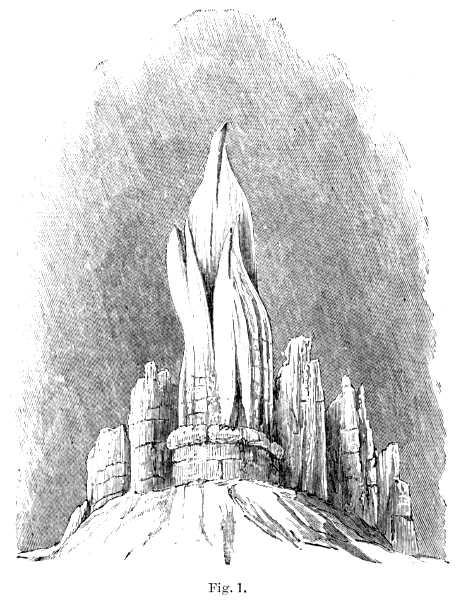
At Grindelwald, on the 18th, we engaged a strong and competent guide, named Christian Kaufmann, and proceeded to the Lower Glacier. After a steep ascent, we gained a point from which we could look down upon the frozen mass. At first the ice presented an appearance of utter confusion, but we soon reached a position where the mechanical conditions of the glacier revealed themselves, and where we might learn, had we not known it before, that confusion is merely the unknown intermixture of laws, and becomes order and beauty when we rise to their comprehension. We reached the so-called Eismeer—Ice Sea. In front of us was the range of the Viescherhörner, and a vast snow slope, from which one branch of the glacier was fed. Near the base of this névé, and surrounded on all sides by ice, lay a brown rock, to which our attention was directed as a place noted for avalanches; on this rock snow or ice never rests, and it is hence called the Heisse Platte—the Hot Plate. At the base of the rock, and far below it, the glacier was covered with clean crushed ice, which had fallen from a crown of frozen cliffs encircling the brow of the rock. One obelisk in particular signalised itself from all others by its exceeding grace and beauty. Its general surface was dazzling white, but from its clefts and fissures issued a delicate blue light, which deepened in hue from the edges inwards. It stood upon a pedestal of its own substance, and seemed as accurately fixed as if rule and plummet had been employed in its erection. Fig. 1 represents this beautiful minaret of ice.
ICE MINARET. 1856.
Fig. 1. Ice Minaret.
While we were in sight of the Heisse Platte, a dozen avalanches rushed downwards from its summit. In most cases we were informed of the descent of an avalanche by the sound, but sometimes the white mass was seen gliding down the rock, and scattering its smoke in the air, long before the sound reached us. It is difficult to reconcile the insignificant appearance presented by avalanches, when seen from a distance, with the volume of sound which they generate; but on this day we saw sufficient to account for the noise. One block of solid ice which we found below the Heisse Platte measured 7 feet 6 inches in length, 5 feet 8 inches in height, and 4 feet 6 inches in depth. A second mass was 10 feet long, 8 feet high, and 6 feet wide. It contained therefore 480 cubic feet of ice, which had been cast to a distance of nearly 1000 yards down the glacier. The shock of such hard and ponderous projectiles against rocks and ice, reinforced by the echoes from the surrounding mountains, will appear sufficient to account for the peals by which their descent is accompanied.
ECHOES OF THE WETTERHORN. 1856.
A second day, in company with Dr. Hooker, completed the examination of this glacier in 1856; after which I parted from my friends, Mr. Huxley intending to rejoin me at the Grimsel. On the morning of the 20th of August I strapped on my knapsack and ascended the green slopes from Grindelwald towards the Great Scheideck. Before reaching the summit I frequently heard the wonderful echoes of the Wetterhorn. Some travellers were in advance of me, and to amuse them an alpine horn was blown. The direct sound was cut off from me by a hill, but the echoes talked down to me from the mountain walls. The sonorous waves arrived after one, two, three, and more reflections, diminishing gradually in intensity, but increasing in softness, as if in its wanderings from crag to crag the sound had undergone a kind of sifting process, leaving all its grossness behind, and returning in delightful flute notes to the ear.
Let us investigate this point a little. If two looking-glasses be placed perfectly parallel to each other, with a lighted candle between them, an infinite series of images of the candle will be seen at both sides, the images diminishing in brightness the further they recede. But if the looking-glasses, instead of being parallel, enclose an angle, a limited number of images only will be seen. The smaller the angle which the reflectors make with each other, or, in other words, the nearer they approach parallelism, the greater will be the number of images observed.
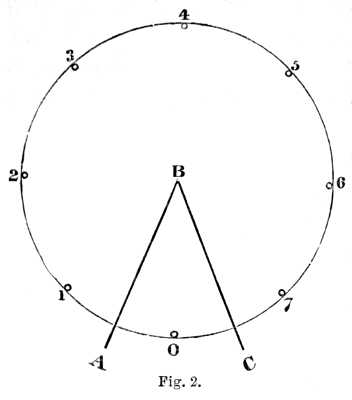
To find the number of images the following is the rule:—Divide 360, or the number of degrees in a circle, by the number of degrees in the angle enclosed by the two mirrors, the quotient will be one more than the number of images; or, counting the object itself, the quotient is always equal to the number of images plus the object. In Fig. 2 I have given the number and position of the images produced by two mirrors placed at an angle of 45°. a b and b c mark the edges of the mirrors, and 0 represents the candle, which, for the sake of simplicity, I have placed midway between them. Fix one point of a pair of compasses at B, and with the distance B 0 sweep a circle:—all the images will be ranged upon the circumference of this circle. The number of images found by the foregoing rule is 7, and their positions are marked in the figure by the numbers 1, 2, 3, &c.
Fig. 2. Diagram of an angular reflector.
ECHOES EXPLAINED. 1856.
Suppose the ear to occupy the place of the eye, and that a sounding body occupies the place of the luminous one, we should then have just as many echoes as we had images in the former case. These echoes would diminish in loudness just as the images of the candle diminish in brightness. At each reflection a portion both of sound and light is lost; hence the oftener light is reflected the dimmer it becomes, and the oftener sound is reflected the fainter it is.
Now the cliffs of the Wetterhorn are so many rough angular reflectors of the sound: some of them send it back directly to the listener, and we have a first echo; some of them send it on to others from which it is again reflected, forming a second echo. Thus, by repeated reflection, successive echoes are sent to the ear, until, at length, they become so faint as to be inaudible. The sound, as it diminishes in intensity, appears to come from greater and greater distances, as if it were receding into the mountain solitudes; the final echoes being inexpressibly soft and pure.
REICHENBACH AND HANDECK. 1856.
After crossing the Scheideck I descended to Meyringen, visiting the Reichenbach waterfall on my way. A peculiarity of the descending water here is, that it is broken up in one of the basins into nodular masses, each of which in falling leaves the light foaming mass which surrounds it as a train in the air behind; the effect exactly resembles that of the avalanches of the Jungfrau, in which the more solid blocks of ice shoot forward in advance of the lighter débris, which is held back by the friction of the air.
Next day I ascended the valley of Hasli, and observed upon the rocks and mountains the action of ancient glaciers which once filled the valley to the height of more than a thousand feet above its present level. I paused, of course, at the waterfall of Handeck, and stood for a time upon the wooden bridge which spans the river at its top. The Aar comes gambolling down to the bridge from its parent glacier, takes one short jump upon a projecting ledge, boils up into foam, and then leaps into a chasm, from the bottom of which its roar ascends through the gloom. A rivulet named the Aarlenbach joins the Aar from the left in the very jaws of the chasm: falling, at first, upon a projection at some depth below the edge, and, rebounding from this, it darts at the Aar, and both plunge together like a pair of fighting demons to the bottom of the gorge. The foam of the Aarlenbach is white, that of the Aar is yellow, and this enables the observer to trace the passage of the one cataract through the other. As I stood upon the bridge the sun shone brightly upon the spray and foam; my shadow was oblique to the river, and hence a symmetrical rainbow could not be formed in the spray, but one half of a lovely bow, with its base in the chasm, leaned over against the opposite rocks, the colours advancing and retreating as the spray shifted its position. I had been watching the water intently for some time, when a little Swiss boy, who stood beside me, observed, in his trenchant German, "There plunge stones ever downwards." The stones were palpable enough, carried down by the cataract, and sometimes completely breaking loose from it, but I did not see them until my attention was withdrawn from the water.
HUT OF M. DOLLFUSS. 1856.
On my arrival at the Grimsel I found Mr. Huxley already there, and, after a few minutes' conversation, we decided to spend a night in a hut built by M. Dollfuss in 1846, beside the Unteraar glacier, about 2000 feet above the Hospice. We hoped thus to be able to examine the glacier to its origin on the following day. Two days' food and some blankets were sent up from the Hospice, and, accompanied by our guide, we proceeded to the glacier.
HÔTEL DES NEUFCHÂTELOIS. 1856.
Having climbed a great terminal moraine, and tramped for a considerable time amid loose shingle and boulders, we came upon the ice. The finest specimens of "tables" which I have ever seen are to be found upon this glacier—huge masses of clean granite poised on pedestals of ice. Here are also "dirt-cones" of the largest size, and numerous shafts, the forsaken passages of ancient "moulins," some filled with water, others simply with deep blue light. I reserve the description and explanation of both cones and moulins for another place. The surfaces of some of the small pools were sprinkled lightly over with snow, which the water underneath was unable to melt; a coating of snow granules was thus formed, flexible as chain armour, but so close that the air could not escape through it. Some bubbles which had risen through the water had lifted the coating here and there into little rounded domes, which, by gentle pressure, could be shifted hither and thither, and several of them collected into one. We reached the hut, the floor of which appeared to be of the original mountain slab; there was a space for cooking walled off from the sleeping-room, half of which was raised above the floor, and contained a quantity of old hay. The number 2404 mètres, the height, I suppose, of the place above the sea, was painted on the door, behind which were also the names of several well-known observers—Agassiz, Forbes, Desor, Dollfuss, Ramsay, and others—cut in the wood. A loft contained a number of instruments for boring, a surveyor's chain, ropes, and other matters. After dinner I made my way alone towards the junction of the Finsteraar and Lauteraar glaciers, which unite at the Abschwung to form the trunk stream of the Unteraar glacier. Upon the great central moraine which runs between the branches were perched enormous masses of rock, and, under the overhanging ledge of one of these, M. Agassiz had his Hôtel des Neufchâtelois. The rock is still there, bearing traces of names now nearly obliterated by the weather, while the fragments around also bear inscriptions. There in the wilderness, in the gray light of evening, these blurred and faded evidences of human activity wore an aspect of sadness. It was a temple of science now in ruins, and I a solitary pilgrim to the desecrated blocks. As the day declined, rain began to fall, and I turned my face towards my new home; where in due time we betook ourselves to our hay, and waited hopefully for the morning.
But our hopes were doomed to disappointment. A vast quantity of snow fell during the night, and, when we arose, we found the glacier covered, and the air thick with the descending flakes. We waited, hoping that it might clear up, but noon arrived and passed without improvement; our fire-wood was exhausted, the weather intensely cold, and, according to the men's opinion, hopelessly bad; they opposed the idea of ascending further, and we had therefore no alternative but to pack up and move downwards. What was snow at the higher elevations changed to rain lower down, and drenched us completely before we reached the Grimsel. But though thus partially foiled in our design, this visit taught us much regarding the structure and general phenomena of the glacier.
THE RHONE GLACIER. 1856.
The morning of the 24th was clear and calm: we rose with the sun, refreshed and strong, and crossed the Grimsel pass at an early hour. The view from the summit of the pass was lovely in the extreme; the sky a deep blue, the surrounding summits all enamelled with the newly-fallen snow, which gleamed with dazzling whiteness in the sunlight. It was Sunday, and the scene was itself a Sabbath, with no sound to disturb its perfect rest. In a lake which we passed the mountains were mirrored without distortion, for there was no motion of the air to ruffle its surface. From the summit of the Mayenwand we looked down upon the Rhone glacier, and a noble object it seemed,—I hardly know a finer of its kind in the Alps. Forcing itself through the narrow gorge which holds the ice cascade in its jaws, and where it is greatly riven and dislocated, it spreads out in the valley below in such a manner as clearly to reveal to the mind's eye the nature of the forces to which it is subjected. Longfellow's figure is quite correct; the glacier resembles a vast gauntlet, of which the gorge represents the wrist; while the lower glacier, cleft by its fissures into finger-like ridges, is typified by the hand.
Furnishing ourselves with provisions at the adjacent inn, we devoted some hours to the examination of the lower portion of the glacier. The dirt upon its surface was arranged in grooves as fine as if produced by the passage of a rake, while the laminated structure of the deeper ice always corresponded to the superficial grooving. We found several shafts, some empty, some filled with water. At one place our attention was attracted by a singular noise, evidently produced by the forcing of air and water through passages in the body of the glacier; the sound rose and fell for several minutes, like a kind of intermittent snore, reminding one of Hugi's hypothesis that the glacier was alive.
RINGS AROUND THE SUN. 1856.
We afterwards climbed to a point from which the whole glacier was visible to us from its origin to its end. Adjacent to us rose the mighty mass of the Finsteraarhorn, the monarch of the Oberland. The Galenstock was also at hand, while round about the névé of the glacier a mountain wall projected its jagged outline against the sky. At a distance was the grand cone of the Weisshorn, then, and I believe still, unscaled;[A] further to the left the magnificent peaks of the Mischabel; while between them, in savage isolation, stood the obelisk of the Matterhorn. Near us was the chain of the Furca, all covered with shining snow, while overhead the dark blue of the firmament so influenced the general scene as to inspire a sentiment of wonder approaching to awe. We descended to the glacier, and proceeded towards its source. As we advanced an unusual light fell upon the mountains, and looking upwards we saw a series of coloured rings, drawn like a vivid circular rainbow quite round the sun. Between the orb and us spread a thin veil of cloud on which the circles were painted; the western side of the veil soon melted away, and with it the colours, but the eastern half remained a quarter of an hour longer, and then in its turn disappeared. The crevasses became more frequent and dangerous as we ascended. They were usually furnished with overhanging eaves of snow, from which long icicles depended, and to tread on which might be fatal. We were near the source of the glacier, but the time necessary to reach it was nevertheless indefinite, so great was the entanglement of fissures. We followed one huge chasm for some hundreds of yards, hoping to cross it; but after half an hour's fruitless effort we found ourselves baffled and forced to retrace our steps.
SPIRIT OF THE BROCKEN. 1856.
The sun was sloping to the west, and we thought it wise to return; so down the glacier we went, mingling our footsteps with the tracks of chamois, while the frightened marmots piped incessantly from the rocks. We reached the land once more, and halted for a time to look upon the scene within view. The marvellous blueness of the sky in the earlier part of the day indicated that the air was charged, almost to saturation, with transparent aqueous vapour. As the sun sank the shadow of the Finsteraarhorn was cast through the adjacent atmosphere, which, thus deprived of the direct rays, curdled up into visible fog. The condensed vapour moved slowly along the flanks of the mountain, and poured itself cataract-like into the valley of the Rhone. Here it met the sun again, which reduced it once more to the invisible state. Thus, though there was an incessant supply from the generator behind, the fog made no progress; as in the case of the moving glacier, the end of the cloud-river remained stationary where consumption was equal to supply. Proceeding along the mountain to the Furca, we found the valley at the further side of the pass also filled with fog, which rose, like a wall, high above the region of actual shadow. Once on turning a corner an exclamation of surprise burst simultaneously from my companion and myself. Before each of us and against the wall of fog, stood a spectral image of a man, of colossal dimensions; dark as a whole, but bounded by a coloured outline. We stretched forth our arms; the spectres did the same. We raised our alpenstocks; the spectres also flourished their bâtons. All our actions were imitated by these fringed and gigantic shades. We had, in fact, the Spirit of the Brocken before us in perfection.
At the time here referred to I had had but little experience of alpine phenomena. I had been through the Oberland in 1850, but was then too ignorant to learn much from my excursion. Hence the novelty of this day's experience may have rendered it impressive: still even now I think there was an intrinsic grandeur in its phenomena which entitles the day to rank with the most remarkable that I have spent among the Alps. At the Furca, to my great regret, the joint ramblings of my friend and myself ended; I parted from him on the mountain side, and watched him descending, till the gray of evening finally hid him from my view.
FOOTNOTES:
THE TYROL. 1856.
THE TYROL. (3.)
My subsequent destination was Vienna; but I wished to associate with my journey thither a visit to some of the glaciers of the Tyrol. At Landeck, on the 29th of August, I learned that the nearest glacier was that adjacent to the Gebatsch Alp, at the head of the Kaunserthal; and on the following morning I was on my way towards this valley. I sought to obtain a guide at Kaltebrunnen, but failed; and afterwards walked to the little hamlet of Feuchten, where I put up at a very lonely inn. My host, I believe, had never seen an Englishman, but he had heard of such, and remarked to me in his patois with emphasis, "Die Engländer sind die kühnsten Leute in dieser Welt." Through his mediation I secured a chamois-hunter, named Johann Auer, to be my guide, and next morning I started with this man up the valley. The sun, as we ascended, smote the earth and us with great power; high mountains flanked us on either side, while in front of us, closing the view, was the mass of the Weisskugel, covered with snow. At three o'clock we came in sight of the glacier, and soon afterwards I made the acquaintance of the Senner or cheesemakers of the Gebatsch Alp.
THE GEBATSCH ALP. 1856.
The chief of these was a fine tall fellow, with free, frank countenance, which, however, had a dash of the mountain wildness in it. His feet were bare, he wore breeches, and fragments of stockings partially covered his legs, leaving a black zone between the upper rim of the sock and the breeches. His feet and face were of the same swarthy hue; still he was handsome, and in a measure pleasant to look upon. He asked me what he could cook for me, and I requested some bread and milk; the former was a month old, the latter was fresh and delicious, and on these I fared sumptuously. I went to the glacier afterwards with my guide, and remained upon the ice until twilight, when we returned, guided by no path, but passing amid crags grasped by the gnarled roots of the pine, through green dells, and over bilberry knolls of exquisite colouring. My guide kept in advance of me singing a Tyrolese melody, and his song and the surrounding scene revived and realised all the impressions of my boyhood regarding the Tyrol.
Milking was over when we returned to the chalet, which now contained four men exclusive of myself and my guide. A fire of pine logs was made upon a platform of stone, elevated three feet above the floor; there was no chimney, as the smoke found ample vent through the holes and fissures in the sides and roof. The men were all intensely sunburnt, the legitimate brown deepening into black with beard and dirt. The chief senner prepared supper, breaking eggs into a dish, and using his black fingers to empty the shell when the albumen was refractory. A fine erect figure he was as he stood in the glowing light of the fire. All the men were smoking, and now and then a brand was taken from the fire to light a renewed pipe, and a ruddy glare flung thereby over the wild countenance of the smoker. In one corner of the chalet, and raised high above the ground, was a large bed, covered with clothes of the most dubious black-brown hue; at one end was a little water-wheel turned by a brook, which communicated motion to a churndash which made the butter. The beams and rafters were covered with cheeses, drying in the warm smoke. The senner, at my request, showed me his storeroom, and explained to me the process of making cheese, its interest to me consisting in its bearing upon the question of slaty cleavage. Three gigantic masses of butter were in the room, and I amused my host by calling them butter-glaciers. Soon afterwards a bit of cotton was stuck in a lump of grease, which was placed in a lantern, and the wick ignited; the chamois-hunter took it, and led the way to our resting-place, I having previously declined a good-natured invitation to sleep in the big black bed already referred to.
AN ALPINE CHALET. 1856.
There was a cowhouse near the chalet, and above it, raised on pillars of pine, and approached by a ladder, was a loft, which contained a quantity of dry hay: this my guide shook to soften the lumps, and erected an eminence for my head. I lay down, drawing my plaid over me, but Auer affirmed that this would not be a sufficient protection against the cold; he therefore piled hay upon me to the shoulders, and proposed covering up my head also. This, however, I declined, though the biting coldness of the air, which sometimes blew in upon us, afterwards proved to me the wisdom of the suggestion. Having set me right, my chamois-hunter prepared a place for himself, and soon his heavy breathing informed me that he was in a state of bliss which I could only envy. One by one the stars crossed the apertures in the roof. Once the Pleiades hung above me like a cluster of gems; I tried to admire them, but there was no fervour in my admiration. Sometimes I dozed, but always as this was about to deepen into positive sleep it was rudely broken by the clamour of a group of pigs which occupied the ground-floor of our dwelling. The object of each individual of the group was to secure for himself the maximum amount of heat, and hence the outside members were incessantly trying to become inside ones. It was the struggle of radical and conservative among the pachyderms, the politics being determined by the accident of position.
THE GEBATSCH GLACIER. 1856.
I rose at five o'clock on the 1st of September, and after a breakfast of black bread and milk ascended the glacier as far as practicable. We once quitted it, crossed a promontory, and descended upon one of its branches, which was flanked by some fine old moraines. We here came upon a group of seven marmots, which with yells of terror scattered themselves among the rocks. The points of the glacier beyond my reach I examined through a telescope; along the faces of the sections the lines of stratification were clearly shown; and in many places where the mass showed manifest signs of lateral pressure, I thought I could observe the cleavage passing though the strata. The point, however, was too important to rest upon an observation made from such a distance, and I therefore abstained from mentioning it subsequently. I examined the fissures and the veining, and noticed how the latter became most perfect in places where the pressure was greatest. The effect of oblique pressure was also finely shown: at one place the thrust of the descending glacier was opposed by the resistance offered by the side of the valley, the direction of the force being oblique to the side; the consequence was a structure nearly parallel to the valley, and consequently oblique to the thrust which I believe to be its cause.
A CHAMOIS ON THE ROCKS. 1856.
After five hours' examination we returned to our chalet, where we refreshed ourselves, put our things in order, and faced a nameless "Joch," or pass; our aim being to cross the mountains into the valley of Lantaufer, and reach Graun that evening. After a rough ascent over the alp we came to the dead crag, where the weather had broken up the mountains into ruinous heaps of rock and shingle. We reached the end of a glacier, the ice of which was covered by sloppy snow, and at some distance up it came upon an islet of stones and débris, where we paused to rest ourselves. My guide, as usual, ranged over the summits with his telescope, and at length exclaimed, "I see a chamois." The creature stood upon a cliff some hundreds of yards to our left, and seemed to watch our movements. It was a most graceful animal, and its life and beauty stood out in forcible antithesis to the surrounding savagery and death.
On the steep slopes of the glacier I was assisted by the hand of my guide. In fact, on this day I deemed places dangerous, and dreaded them as such, which subsequent practice enabled me to regard with perfect indifference; so much does what we call courage depend upon habit, or on the fact of knowing that we have really nothing to fear. Doubtless there are times when a climber has to make up his mind for very unpleasant possibilities, and even gather calmness from the contemplation of the worst; but in most cases I should say that his courage is derived from the latent feeling that the chances of safety are immensely in his favour.
PASSAGE OF A JOCH. 1856.
After a tough struggle we reached the narrow row of crags which form the crest of the pass, and looked into the world of mountain and cloud on the other side. The scene was one of stern grandeur—the misty lights and deep cloud-glooms being so disposed as to augment the impression of vastness which the scene conveyed. The breeze at the summit was exceedingly keen, but it gave our muscles tone, and we sprang swiftly downward through the yielding débris which here overlies the mountain, and in which we sometimes sank to the knees. Lower down we came once more upon the ice. The glacier had at one place melted away from its bounding cliff, which rose vertically to our right, while a wall of ice 60 or 80 feet high was on our left. Between the two was a narrow passage, the floor of which was snow, which I knew to be hollow beneath: my companion, however, was in advance of me, and he being the heavier man, where he trod I followed without hesitation. On turning an angle of the rock I noticed an expression of concern upon his countenance, and he muttered audibly, "I did not expect this." The snow-floor had, in fact, given way, and exposed to view a clear green lake, one boundary of which was a sheer precipice of rock, and the other the aforesaid wall of ice; the latter, however, curved a little at its base, so as to form a short steep slope which overhung the water. My guide first tried the slope alone; biting the ice with his shoe-nails, and holding on by the spike of his bâton, he reached the other side. He then returned, and, divesting myself of all superfluous clothes, as a preparation for the plunge which I fully expected, I also passed in safety. Probably the consciousness that I had water to fall into instead of pure space, enabled me to get across without anxiety or mischance; but had I, like my guide, been unable to swim, my feelings would have been far different.
This accomplished, we went swiftly down the valley, and the more I saw of my guide the more I liked him. He might, if he wished, have made his day's journey shorter by stopping before he reached Graun, but he would not do so. Every word he said to me regarding distances was true, and there was not the slightest desire shown to magnify his own labour. I learnt by mere accident that the day's work had cut up his feet, but his cheerfulness and energy did not bate a jot till he had landed me in the Black Eagle at Graun. Next morning he came to my room, and said that he felt sufficiently refreshed to return home. I paid him what I owed him, when he took my hand, and, silently bending down his head, kissed it; then, standing erect, he stretched forth his right hand, which I grasped firmly in mine, and bade him farewell; and thus I parted from Johann Auer, my brave and truthful chamois-hunter.
On the following day I met Dr. Frankland in the Finstermuntz pass, and that night we bivouacked together at Mals. Heavy rain fell throughout the night, but it came from a region high above that of liquidity. It was first snow, which, as it descended through the warmer strata of the atmosphere, was reduced to water. Overhead, in the air, might be traced a surface, below which the precipitate was liquid, above which it was solid; and this surface, intersecting the mountains which surround Mals, marked upon them a beautifully-defined snow-line, below which the pines were dark and the pastures green, but above which pines and pastures and crags were covered with the freshly-fallen snow.
THE STELVIO. 1856.
On the 2nd of September we crossed the Stelvio. The brown cone of the well-known Madatschspitze was clear, but the higher summits were clouded, and the fragments of sunshine which reached the lower world wandered like gleams of fluorescent light over the glaciers. COLOUR OF FRESH SNOW. 1856. Near the snow-line the partial melting of the snow had rendered it coarsely granular, but as we ascended it became finer, and the light emitted from its cracks and cavities a pure and deep blue. When a staff was driven into the snow low down the mountain, the colour of the light in the orifice was scarcely sensibly blue, but higher up this increased in a wonderful degree, and at the summit the effect was marvellous. I struck my staff into the snow, and turned it round and round; the surrounding snow cracked repeatedly, and flashes of blue light issued from the fissures. The fragments of snow that adhered to the staff were, by contrast, of a beautiful pink yellow, so that, on moving the staff with such fragments attached to it up and down, it was difficult to resist the impression that a pink flame was ascending and descending in the hole. As we went down the other side of the pass, the effect became more and more feeble, until, near the snow-line, it almost wholly disappeared.
We remained that night at the baths of Bormio, but the following afternoon being fine we wished to avail ourselves of the fair weather to witness the scene from the summit of the pass. Twilight came on before we reached Santa Maria, but a gorgeous orange overspread the western horizon, from which we hoped to derive sufficient light. It was a little too late when we reached the top, but still the scene was magnificent. A multitude of mountains raised their crowns towards heaven, while above all rose the snow-white cone of the Ortler. Far into the valley the giant stretched his granite limbs, until they were hid from us by darkness. As this deepened, the heavens became more and more crowded with stars, which blazed like gems over the heads of the mountains. At times the silence was perfect, unbroken save by the crackling of the frozen snow beneath our own feet; while at other times a breeze would swoop down upon us, keen and hostile, scattering the snow from the roofs of the wooden galleries in frozen powder over us. Long after night had set in, a ghastly gleam rested upon the summit of the Ortler, while the peaks in front deepened to a dusky neutral tint, the more distant ones being lost in gloom. We descended at a swift pace to Trafoi, which we reached before 11 p.m.
SINGULAR HAILSTORM. 1856.
Meran was our next resting-place, whence we turned through the Schnalzerthal to Unserfrau, and thence over the Hochjoch to Fend. From a religious procession we took a guide, who, though partly intoxicated, did his duty well. Before reaching the summit of the pass we were assailed by a violent hailstorm, each hailstone being a frozen cone with a rounded end. Had not their motion through the air something to do with the shape of these hailstones? The theory of meteorites now generally accepted is that they are small planetary bodies drawn to the earth by gravity, and brought to incandescence by friction against the earth's atmosphere. Such a body moving through the atmosphere must have condensed hot air in front of it, and rarefied cool air behind it; and the same is true to a small extent of a hailstone. This distribution of temperature must, I imagine, have some influence on the shape of the stone. Possibly also the stratified appearance of some hailstones may be connected with this action.[A]
THE HOCHJOCH AND FEND. 1856.
The hail ceased and the heights above us cleared as we ascended. At the top of the pass we found ourselves on the verge of a great névé, which lay between two ranges of summits, sloping down to the base of each range from a high and rounded centre: a wilder glacier scene I have scarcely witnessed. Wishing to obtain a more perfect view of the region, I diverged from the track followed by Dr. Frankland and the guide, and climbed a ridge of snow about half a mile to the right of them. A glorious expanse was before me, stretching itself in vast undulations, and heaping itself here and there into mountainous cones, white and pure, with the deep blue heaven behind them. Here I had my first experience of hidden crevasses, and to my extreme astonishment once found myself in the jaws of a fissure of whose existence I had not the slightest notice. Such accidents have often occurred to me since, but the impression made by the first is likely to remain the strongest. It was dark when we reached the wretched Wirthshaus at Fend, where, badly fed, badly lodged, and disturbed by the noise of innumerable rats, we spent the night. Thus ended my brief glacier expedition of 1856; and on the observations then made, and on subsequent experiments, was founded a paper presented to the Royal Society by Mr. Huxley and myself.[B]
FOOTNOTES:
THE LAKE OF GENEVA. 1857.
EXPEDITION OF 1857. THE LAKE OF GENEVA. (4.)
The time occupied in the observations of 1856 embraced about five whole days; and though these days were laborious and instructive, still so short a time proved to be wholly incommensurate with the claims of so wide a problem. During the subsequent experimental treatment of the subject, I had often occasion to feel the incompleteness of my knowledge, and hence arose the desire to make a second expedition to the Alps, for the purpose of expanding, fortifying, or, if necessary, correcting first impressions.
On Thursday, the 9th of July, 1857, I found myself upon the Lake of Geneva, proceeding towards Vevey. I had long wished to see the waters of this renowned inland sea, the colour of which is perhaps more interesting to the man of science than to the poets who have sung about it. Long ago its depth of blue excited attention, but no systematic examination of the subject has, so far as I know, been attempted. It may be that the lake simply exhibits the colour of pure water. Ice is blue, and it is reasonable to suppose that the liquid obtained from the fusion of ice is of the same colour; but still the question presses—"Is the blue of the Lake of Geneva to be entirely accounted for in this way?" The attempts which have been made to explain it otherwise show that at least a doubt exists as to the sufficiency of the above explanation.
BLUENESS OF THE WATER. 1857.
It is only in its deeper portions that the colour of the lake is properly seen. Where the bottom comes into view the pure effect of the water is disturbed; but where the water is deep the colour is deep: between Rolle and Nyon for example, the blue is superb. Where the blue was deepest, however, it gave me the impression of turbidity rather than of deep transparency. At the upper portion of the lake the water through which the steamer passed was of a blue green. Wishing to see the place where the Rhone enters the lake, I walked on the morning of the 10th from Villeneuve to Novelle, and thence through the woods to the river side. Proceeding along an embankment, raised to defend the adjacent land from the incursions of the river, an hour brought me to the place where it empties itself into the lake. The contrast between the two waters was very great: the river was almost white with the finely divided matter which it held in suspension; while the lake at some distance was of a deep ultramarine.
The lake in fact forms a reservoir where the particles held in suspension by the river have time to subside, and its waters to become pure. The subsidence of course takes place most copiously at the head of the lake; and here the deposit continues to form new land, adding year by year to the thousands of acres which it has already left behind it, and invading more and more the space occupied by the water. Innumerable plates of mica spangled the fine sand which the river brought down, and these, mixing with the water, and flashing like minute mirrors as the sun's rays fell upon them, gave the otherwise muddy stream a silvery appearance. Had I an opportunity I would make the following experiments:—
(a.) Compare the colour of the light transmitted by a column of the lake water fifteen feet long with that transmitted by a second column, of the same length, derived from the melting of freshly fallen mountain snow.
(b.) Compare in the same manner the colour of the ordinary water of the lake with that of the same water after careful distillation.
(c.) Strictly examine whether the light transmitted by the ordinary water contains an excess of red over that transmitted by the distilled water: this latter point, as will be seen farther on, is one of peculiar interest.
The length is fixed at fifteen feet, because I have found this length extremely efficient in similar experiments.
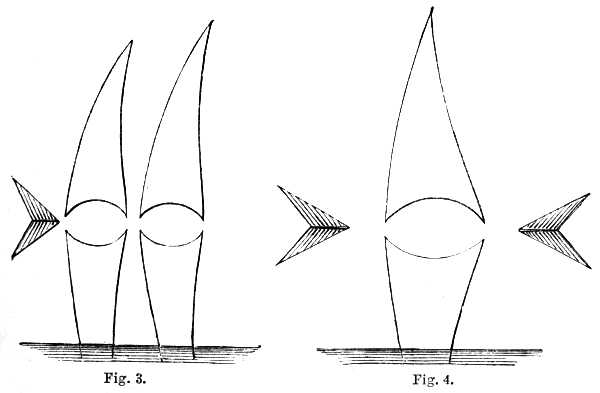
Fig. 3, 4. Boats' sails inverted by Atmospheric Refraction.
ATMOSPHERIC REFRACTION. 1857.
On returning to the pier at Villeneuve, a peculiar flickering motion was manifest upon the surface of the distant portions of the lake, and I soon noticed that the coast line was inverted by atmospheric refraction. It required a long distance to produce the effect: no trace of it was seen about the Castle of Chillon, but at Vevey and beyond it, the whole coast was clearly inverted; and the houses on the margin of the lake were also imaged to a certain height. Two boats at a considerable distance presented the appearance sketched in Figs. 3 and 4; the hull of each, except a small portion at the end, was invisible, but the sails seemed lifted up high in the air, with their inverted images below; as the boats drew nearer the hulls appeared inverted, the apparent height of the vessel above the surface of the lake being thereby nearly doubled, while the sails and higher objects, in these cases, were almost completely cut away. When viewed through a telescope the sensible horizon of the lake presented a billowy tumultuous appearance, fragments being incessantly detached from it and suspended in the air.
MIRAGE. 1857.
The explanation of this effect is the same as that of the mirage of the desert, which may be found in almost any book on physics, and which so tantalized the French soldiers in Egypt. They often mistook this aërial inversion for the reflection from a lake, and on trial found hot and sterile sand at the place where they expected refreshing waters. The effect was shown by Monge, one of the learned men who accompanied the expedition, to be due to the total reflection of very oblique rays at the upper surface of the layer of rarefied air which was nearest to the heated earth. A sandy plain, in the early part of the day, is peculiarly favourable for the production of such effects; and on the extensive flat strand which stretches between Mont St. Michel and the coast adjacent to Avranches in Normandy, I have noticed Mont Tombeline reflected as if glass instead of sand surrounded it and formed its mirror.
CHAMOUNI AND THE MONTANVERT. 1857.
CHAMOUNI AND THE MONTANVERT. (5.)
On the evening of the 12th of July I reached Chamouni; the weather was not quite clear, but it was promising; white cumuli had floated round Mont Blanc during the day, but these diminished more and more, and the light of the setting sun was of that lingering rosy hue which bodes good weather. Two parallel beams of a purple tinge were drawn by the shadows of the adjacent peaks, straight across the Glacier des Bossons, and the Glacier des Pèlerins was also steeped for a time in the same purple light. Once when the surrounding red illumination was strong, the shadows of the Grands Mulets falling upon the adjacent snow appeared of a vivid green.
This green belonged to the class of subjective colours, or colours produced by contrast, about which a volume might be written. The eye received the impression of green, but the colour was not external to the eye. Place a red wafer on white paper, and look at it intently, it will be surrounded in a little time by a green fringe: move the wafer bodily away, and the entire space which it occupied upon the paper will appear green. A body may have its proper colour entirely masked in this way. Let a red wafer be attached to a piece of red glass, and from a moderately illuminated position let the sky be regarded through the glass; the wafer will appear of a vivid green. If a strong beam of light be sent through a red glass and caused to fall upon a screen, which at the same time is moderately illuminated by a separate source of white light, an opaque body placed in the path of the beam will cast a green shadow upon the screen which may be seen by several hundred persons at once. If a blue glass be used, the shadow will be yellow, which is the complementary colour to blue.
COLOURED SHADOWS. 1857.
When we suddenly pass from open sunlight to a moderately illuminated room, it appears dark at first, but after a little time the eye regains the power of seeing objects distinctly. Thus one effect of light upon the eye is to render it less sensitive, and light of any particular colour falling upon the eye blunts its appreciation of that colour. Let us apply this to the shadow upon the screen. This shadow is moderately illuminated by a jet of white light; but the space surrounding it is red, the effect of which upon the eye is to blind it in some degree to the perception of red. Hence, when the feeble white light of the shadow reaches the eye, the red component of this light is, as it were, abstracted from it, and the eye sees the residual colour, which is green. A similar explanation applies to the shadows of the Grands Mulets.
On the 13th of July I was joined by my friend Mr. Thomas Hirst, and on the 14th we examined together the end of the Mer de Glace. In former times the whole volume of the Arveiron escaped from beneath the ice at the end of the glacier, forming a fine arch at its place of issue. This year a fraction only of the water thus found egress; the greater portion of it escaping laterally from the glacier at the summit of the rocks called Les Mottets, down which it tumbled in a fine cascade. The vault at the end of the glacier was nevertheless respectable, and rather tempting to a traveller in search of information regarding the structure of the ice. Perhaps, however, Nature meant to give me a friendly warning at the outset, for, while speculating as to the wisdom of entering the cavern, it suddenly gave way, and, with a crash which rivalled thunder, the roof strewed itself in ruins upon the floor.
SUNRISE AT CHAMOUNI. 1857.
Many years ago I had read with delight Coleridge's poem entitled 'Sunrise in the Valley of Chamouni,' and to witness in all perfection the scene described by the poet, I waited at Chamouni a day longer than was otherwise necessary. On the morning of Wednesday, the 15th of July, I rose before the sun; Mont Blanc and his wondrous staff of Aiguilles were without a cloud; eastward the sky was of a pale orange which gradually shaded off to a kind of rosy violet, and this again blended by imperceptible degrees with the deep zenithal blue. The morning star was still shining to the right, and the moon also turned a pale face towards the rising day. The valley was full of music; from the adjacent woods issued a gush of song, while the sound of the Arve formed a suitable bass to the shriller melody of the birds. The mountain rose for a time cold and grand, with no apparent stain upon his snows. Suddenly the sunbeams struck his crown and converted it into a boss of gold. For some time it remained the only gilded summit in view, holding communion with the dawn while all the others waited in silence. These, in the order of their heights, came afterwards, relaxing, as the sunbeams struck each in succession, into a blush and smile.
GLACIER DES BOIS. 1857.
On the same day we had our luggage transported to the Montanvert, while we clambered along the lateral moraine of the glacier to the Chapeau. The rocks alongside the glacier were beautifully scratched and polished, and I paid particular attention to them, for the purpose of furnishing myself with a key to ancient glacier action. The scene to my right was one of the most wonderful I had ever witnessed. Along the entire slope of the Glacier des Bois, the ice was cleft and riven into the most striking and fantastic forms. It had not yet suffered much from the wasting influence of the summer weather, but its towers and minarets sprang from the general mass with clean chiselled outlines. Some stood erect, others leaned, while the white débris, strewn here and there over the glacier, showed where the wintry edifices had fallen, breaking themselves to pieces, and grinding the masses on which they fell to powder. Some of them gave way during our inspection of the place, and shook the valley with the reverberated noise of their fall. I endeavoured to get near them, but failed; the chasms at the margin of the glacier were too dangerous, and the stones resting upon the heights too loosely poised to render persistence in the attempt excusable.
We subsequently crossed the glacier to the Montanvert, and I formally took up my position there. The rooms of the hotel were separated from each other by wooden partitions merely, and thus the noise of early risers in one room was plainly heard in the next. For the sake of quiet, therefore, I had my bed placed in the château next door,—a little octagonal building erected by some kind and sentimental Frenchman, and dedicated "à la Nature." My host at first demurred, thinking the place not "propre," but I insisted, and he acquiesced. True the stone floor was dark with moisture, and on the walls a glistening was here and there observable, which suggested rheumatism, and other penalties, but I had had no experience of rheumatism, and trusted to the strength which mountain air and exercise were sure to give me, for power to resist its attacks. Moreover, to dispel some of the humidity, it was agreed that a large pine fire should be made there on necessary occasions.
QUARTERS AT THE MONTANVERT. 1857.
Though singularly favoured on the whole, still our residence at the Montanvert was sufficiently long to give us specimens of all kinds of weather; and thus my château derived an interest from the mutations of external nature. Sometimes no breath disturbed the perfect serenity of the night, and the moon, set in a black-blue sky, turned a face of almost supernatural brightness to the mountains, while in her absence the thick-strewn stars alone flashed and twinkled through the transparent air. Sometimes dull dank fog choked the valley, and heavy rain plashed upon the stones outside. On two or three occasions we were favoured by a thunderstorm, every peal of which broke into a hundred echoes, while the seams of lightning which ran through the heavens produced a wonderful intermittence of gloom and glare. And as I sat within, musing on the experiences of the day, with my pine logs crackling, and the ruddy fire-light gleaming over the walls, and lending animation to the visages sketched upon them with charcoal by the guides, I felt that my position was in every way worthy of a student of nature.
THE MER DE GLACE. (6.)
A RIVER OF ICE. 1857.
The name "Mer de Glace" has doubtless led many who have never seen this glacier to a totally erroneous conception of its character. Misled probably by this term, a distinguished writer, for example, defines a glacier to be a sheet of ice spread out upon the slope of a mountain; whereas the Mer de Glace is indeed a river, and not a sea of ice. But certain forms upon its surface, often noticed and described, and which I saw for the first time from the window of our hotel on the morning of the 16th of July, suggest at once the origin of the name. The glacier here has the appearance of a sea which, after it had been tossed by a storm, had suddenly stiffened into rest. The ridges upon its surface accurately resemble waves in shape, and this singular appearance is produced in the following way:—
Some distance above the Montanvert—opposite to the Echelets—the glacier, in passing down an incline, is rent by deep fissures, between each two of which a ridge of ice intervenes. At first the edges of these ridges are sharp and angular, but they are soon sculptured off by the action of the sun. The bearing of the Mer de Glace being approximately north and south, the sun at mid-day shines down the glacier, or rather very obliquely across it; and the consequence is, that the fronts of the ridges, which look downward, remain in shadow all the day, while the backs of the ridges, which look up the glacier, meet the direct stroke of the solar rays. The ridges thus acted upon have their hindmost angles wasted off and converted into slopes which represent the back of a wave, while the opposite sides of the ridges, which are protected from the sun, preserve their steepness, and represent the front of the wave. Fig. 5 will render my meaning at once plain.
FROZEN WAVES. 1857.
Fig. 5. Wave-like forms on the Mer de Glace.
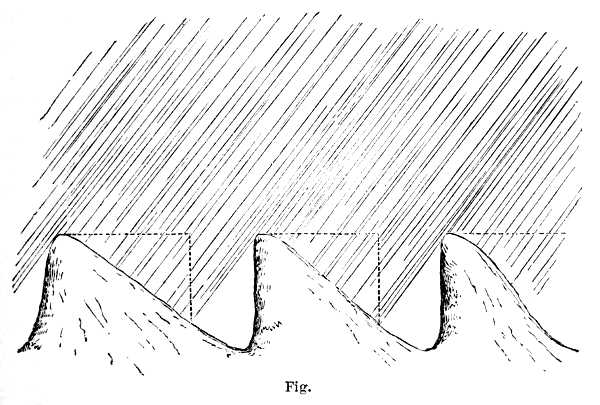
The dotted lines are intended to represent three of the ridges into which the glacier is divided, with their interposed fissures; the dots representing the boundaries of the ridges when the glacier is first broken. The parallel shading lines represent the direction of the sun's rays, which, falling obliquely upon the ridges, waste away the right-hand corners, and finally produce wave-like forms.
We spent a day or two in making the general acquaintance of the glacier. On the 16th we ascended till we came to the rim of the Talèfre basin, from which we had a good view of the glacier system of the region. The laminated structure of the ice was a point which particularly interested me; and as I saw the exposed sections of the névé, counted the lines of stratification, and compared these with the lines upon the ends of the secondary glaciers, I felt the absolute necessity either of connecting the veined structure with the strata by a continuous chain of observations, or of proving by ocular evidence that they were totally distinct from each other. I was well acquainted with the literature of the subject, but nothing that I had read was sufficient to prove what I required. Strictly speaking, nothing that had been written upon the subject rose above the domain of opinion, while I felt that without absolute demonstration the question would never be set at rest.
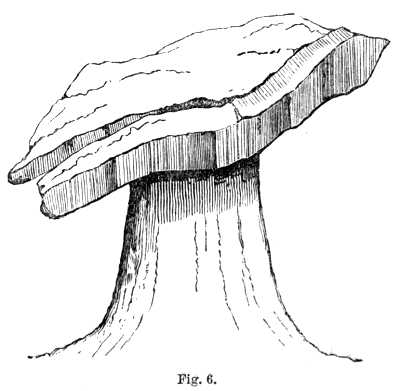
Fig. 6. Glacier Table.
GLACIER TABLES. 1857.
On this day we saw some fine glacier tables; flat masses of rock, raised high upon columns of ice: Fig. 6 is a sketch of one of the finest of them. Some of them fell from their pedestals while we were near them, and the clean ice-surfaces which they left behind sparkled with minute stars as the small bubbles of air ruptured the film of water by which they were overspread. I also noticed that "petit bruit de crépitation," to which M. Agassiz alludes, and which he refers to the rupture of the ice by the expansion of the air-bubbles contained within it. When I first read Agassiz's account of it, I thought it might be produced by the rupture of the minute air-bubbles which incessantly escape from the glacier. This, doubtless, produces an effect, but there is something in the character of the sound to be referred, I think, to a less obvious cause, which I shall notice further on.
FIRST SIGHT OF THE DIRT-BANDS. 1857.
At six p.m. this day I reached the Montanvert; and the same evening, wrapping my plaid around me, I wandered up towards Charmoz, and from its heights observed, as they had been observed fifteen years previously by Professor Forbes, the dirt-bands of the Mer de Glace. They were different from any I had previously seen, and I felt a strong desire to trace them to their origin. Content, however, with the performance of the day, and feeling healthily tired by it, I lay down upon the bilberry bushes and fell asleep. It was dark when I awoke, and I experienced some difficulty and risk in getting down from the petty eminence referred to.
The illumination of the glacier, as remarked by Professor Forbes, has great influence upon the appearance of the bands; they are best seen in a subdued light, and I think for the following reasons:—
The dirt-bands are seen simply because they send less light to the eye than the cleaner portions of the glacier which lie between them; two surfaces, differently illuminated, are presented to the eye, and it is found that this difference is more observable when the light is that of evening than when it is that of noon.
It is only within certain limits that the eye is able to perceive differences of intensity in different lights; beyond a certain intensity, if I may use the expression, light ceases to be light, and becomes mere pain. The naked eye can detect no difference in brightness between the electric light and the lime light, although, when we come to strict measurement, the former may possess many times the intensity of the latter. It follows from this that we might reduce the ordinary electric light to a fraction of its intensity, without any perceptible change of brightness to the naked eye which looks at it. But if we reduce the lime light in the same proportion the effect would be very different. This light lies much nearer to the limit at which the eye can appreciate differences of brightness, and its reduction might bring it quite within this limit, and make it sensibly dimmer than before. Hence we see that when two sources of intense light are presented to the eye, by reducing both the lights in the same proportion, the difference between them may become more perceptible.
BANDS SEEN BEST BY TWILIGHT. 1857.
Now the dirt-bands and the spaces between them resemble, in some measure, the two lights above mentioned. By the full glare of noon both are so strongly illuminated that the difference which the eye perceives is very small; as the evening advances the light of both is lowered in the same proportion, but the differential effect upon the eye is thereby augmented, and the bands are consequently more clearly seen.
(7.)
On Friday, the 17th of July, we commenced our measurements. Through the kindness of Sir Roderick Murchison, I found myself in the possession of an excellent five-inch theodolite, an instrument with the use of which both my friend Hirst and myself were perfectly familiar. We worked in concert for a few days to familiarize our assistant with the mode of proceeding, but afterwards it was my custom to simply determine the position where a measurement was to be made, and to leave the execution of it entirely to Mr. Hirst and our guide.
On the 20th of July I made a long excursion up the glacier, examining the moraines, the crevasses, the structure, the moulins, and the disintegration of the surface. I was accompanied by a boy named Edouard Balmat,[A] and found him so good an iceman that I was induced to take him with me on the following day also.
THE CLEFT STATION. 1857.
Looking upwards from the Montanvert to the left of the Aiguille de Charmoz, a singular gap is observed in the rocky mountain wall, in the centre of which stands a detached column of granite. Both cleft and pillar are shown in the frontispiece, to the right. The eminence to the left of this gap is signalised by Professor Forbes as one of the best stations from which to view the Mer de Glace, and this point, which I shall refer to hereafter as the Cleft Station, it was now my desire to attain. From the Montanvert side a steep gully leads to the cleft; up this couloir we proposed to try the ascent. At a considerable height above the Mer de Glace, and closely hugging the base of the Aiguille de Charmoz, is the small Glacier de Tendue, shown in the frontispiece, and from which a steep slope stretches down to the Mer de Glace. This Tendue is the most talkative glacier I have ever known; the clatter of the small stones which fall from it is incessant. Huge masses of granite also frequently fall upon the glacier from the cliffs above it, and, being slowly borne downwards by the moving ice, are at length seen toppling above the terminal face of the glacier. The ice which supports them being gradually melted, they are at length undermined, and sent bounding down the slope with peal and rattle, according as the masses among which they move are large or small. The space beneath the glacier is cumbered with blocks thus sent down; some of them of enormous size.
ROUGH ASCENT. 1857.
The danger arising from this intermittent cannonade, though in reality small, has caused the guides to swerve from the path which formerly led across the slope to the promontory of Trélaporte. I say "small," because, even should a rock choose the precise moment at which a traveller is passing to leap down, the boulders at hand are so large and so capable of bearing a shock that the least presence of mind would be sufficient to place him in safety. But presence of mind is not to be calculated on under such circumstances, and hence the guides were right to abandon the path.
Reaching the mouth of our gully after a rough ascent, we took to the snow, instead of climbing the adjacent rocks. It was moist and soft, in fact in a condition altogether favourable for the "regelation" of its granules. As the foot pressed upon it the particles became cemented together. A portion of the pressure was transmitted laterally, which produced attachments beyond the boundary of the foot; thus as the latter sank, it pressed upon a surface which became continually wider and more rigid, and at length sufficiently strong to bear the entire weight of the body; the pressed snow formed in fact a virtual camel's foot, which soon placed a limit to the sinking. It is this same principle of regelation which enables men to cross snow bridges in safety. By gentle cautious pressure the loose granules of the substance are cemented into a continuous mass, all sudden shocks which might cause the frozen surfaces to snap asunder being avoided. In this way an arch of snow fifteen or twenty inches in thickness may be rendered so firm that a man will cross it, although it may span a chasm one hundred feet in depth.
As we ascended, the incline became very steep, and once or twice we diverged from the snow to the adjacent rocks; these were disintegrated, and the slightest disturbance was sufficient to bring them down; some fell, and from one of them I found it a little difficult to escape; for it grazed my leg, inflicting a slight wound as it passed. Just before reaching the cleft at which we aimed, the snow for a short distance was exceedingly steep, but we surmounted it; and I sat for a time beside the granite pillar, pleased to find that I could permit my legs to dangle over a precipice without prejudice to my head.
CHAMOIS ON THE MOUNTAINS. 1857.
While we remained here a chamois made its appearance upon the rocks above us. Deeming itself too near, it climbed higher, and then turned round to watch us. It was soon joined by a second, and the two formed a very pretty picture: their attitudes frequently changed, but they were always graceful; with head erect and horns curved back, a light limb thrown forward upon a ledge of rock, looking towards us with wild and earnest gaze, each seemed a type of freedom and agility. Turning now to the left, we attacked the granite tower, from which we purposed to scan the glacier, and were soon upon its top. My companion was greatly pleased—he was "très-content" to have reached the place—he felt assured that many old guides would have retreated from that ugly gully, with its shifting shingle and débris, and his elation reached its climax in the declaration that, if I resolved to ascend Mont Blanc without a guide, he was willing to accompany me.
SCENE FROM THE STATION. 1857.
From the position which we had attained, the prospect was exceedingly fine, both of the glaciers and of the mountains. Beside us was the Aiguille de Charmoz, piercing with its spikes of granite the clear air. To my mind it is one of the finest of the Aiguilles, noble in mass, with its summits singularly cleft and splintered. In some atmospheric colourings it has the exact appearance of a mountain of cast copper, and the manner in which some of its highest pinnacles are bent, suggesting the idea of ductility, gives strength to the illusion that the mass is metallic. At the opposite side of the glacier was the Aiguille Verte, with a cloud poised upon its point: it has long been the ambition of climbers to scale this peak, and on this day it was attempted by a young French count with a long retinue of guides. He had not fair play, for before we quitted our position we heard the rumble of thunder upon the mountain, which indicated the presence of a foe more terrible than the avalanches themselves. Higher to the right, and also at the opposite side of the glacier, rose the Aiguille du Moine; and beyond was the basin of the Talèfre, the ice cascade issuing from which appeared, from our position, like the foam of a waterfall. Then came the Aiguille de Léchaud, the Petite Jorasse, the Grande Jorasse, and the Mont Tacul; all of which form a cradle for the Glacier de Léchaud. Mont Mallet, the Périades, and the Aiguille Noire, came next, and then the singular obelisk of the Aiguille du Géant, from which a serrated edge of cliff descends to the summit of the "Col."
SÉRACS OF THE COL DU GÉANT. 1857.
Over the slopes of the Col du Géant was spread a coverlet of shining snow, at some places apparently as smooth as polished marble, at others broken so as to form precipices, on the pale blue faces of which the horizontal lines of bedding were beautifully drawn. As the eye approaches the line which stretches from the Rognon to the Aiguille Noire, the repose of the névé becomes more and more disturbed. Vast chasms are formed, which however are still merely indicative of the trouble in advance. If the glacier were lifted off we should probably see that the line just referred to would lie along the summit of a steep gorge; over this summit the glacier is pushed, and has its back periodically broken, thus forming vast transverse ridges which follow each other in succession down the slope. At the summit these ridges are often cleft by fissures transverse to them, thus forming detached towers of ice of the most picturesque and imposing character.[B] These towers often fall; and while some are caught upon the platforms of the cascade, others struggle with the slow energy of a behemoth through the débris which opposes them, reach the edges of the precipices which rise in succession along the fall, leap over, and, amid ice-smoke and thunder-peals, fight their way downwards.
GLACIER MOTION. 1857.
A great number of secondary glaciers were in sight hanging on the steep slopes of the mountains, and from them streams sped downwards, falling over the rocks, and filling the valley with a low rich music. In front of me, for example, was the Glacier du Moine, and I could not help feeling as I looked at it, that the arguments drawn from the deportment of such glaciers against the "sliding theory," and which are still repeated in works upon the Alps, militate just as strongly against the "viscous theory." "How," demands the antagonist of the sliding theory, "can a secondary glacier exist upon so steep a slope? why does it not slide down as an avalanche?" "But how," the person addressed may retort, "can a mass which you assume to be viscous exist under similar conditions? If it be viscous, what prevents it from rolling down?" The sliding theory assumes the lubrication of the bed of the glacier, but on this cold height the quantity melted is too small to lubricate the bed, and hence the slow motion of these glaciers. Thus a sliding-theory man might reason, and, if the external deportment of secondary glaciers were to decide the question, De Saussure might perhaps have the best of the argument.
And with regard to the current idea, originated by M. de Charpentier, and adopted by Professor Forbes, that if a glacier slides it must slide as an avalanche, it may be simply retorted that, in part, it does so; but if it be asserted that an accelerated motion is the necessary motion of an avalanche, the statement needs qualification. An avalanche on passing through a rough couloir soon attains a uniform velocity—its motion being accelerated only up to the point when the sum of the resistances acting upon it is equal to the force drawing it downwards. These resistances are furnished by the numberless asperities which the mass encounters, and which incessantly check its descent, and render an accumulation of motion impossible. The motion of a man walking down stairs may be on the whole uniform, but it is really made up of an aggregate of small motions, each of which is accelerated; and it is easy to conceive how a glacier moving over an uneven bed, when released from one opposing obstacle will be checked by another, and its motion thus rendered sensibly uniform.
MORAINES. 1857.
TRIBUTARIES OF THE MER DE GLACE. 1857.
Fig. 7. Tributaries of the Mer de Glace.
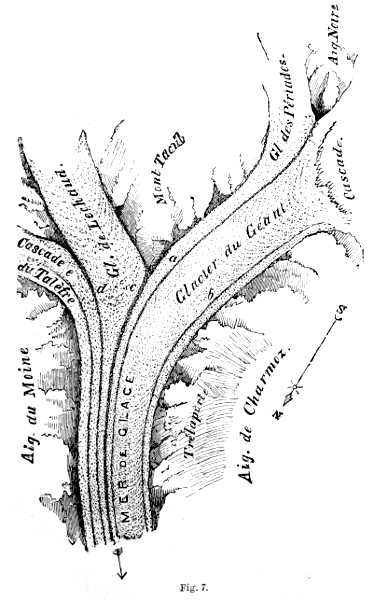
From the Aiguille du Géant and Les Périades a glacier descended, which was separated by the promontory of La Noire from the glacier proceeding from the Col du Géant. A small moraine was formed between them, which is marked a upon the diagram, Fig. 7. The great mass of the glacier descending from the Col du Géant came next, and this was bounded on the side nearest to Trélaporte by a small moraine b, the origin of which I could not see, its upper portion being shut out by a mountain promontory. Between the moraine b and the actual side of the valley was another little glacier, derived from some of the lateral tributaries. It was, however, between the moraines a and b that the great mass of the Glacier du Géant really lay. At the promontory of the Tacul the lateral moraines of the Glacier des Périades and of the Glacier de Léchaud united to form the medial moraine c of the Mer de Glace. Carrying the eye across the Léchaud, we had the moraine d formed by the union of the lateral moraines of the Léchaud and Talèfre; further to the left was the moraine e, which came from the Jardin, and beyond it was the second lateral moraine of the Talèfre. The Mer de Glace is formed by the confluence of the whole of the glaciers here named; being forced at Trélaporte through a passage, the width of which appears considerably less than that of the single tributary, the Glacier du Géant.
In the ice near Trélaporte the blue veins of the glacier are beautifully shown; but they vary in distinctness according to the manner in which they are looked at. When regarded obliquely their colour is not so pronounced as when the vision plunges deeply into them. The weathered ice of the surface near Trélaporte could be cloven with great facility; I could with ease obtain plates of it a quarter of an inch thick, and possessing two square feet of surface. On the 28th of July I followed the veins several times from side to side across the Géant portion of the Mer de Glace; starting from one side, and walking along the veins, my route was directed obliquely downwards towards the axis of the tributary. At the axis I was forced to turn, in order to keep along the veins, and now ascended along a line which formed nearly the same angle with the axis at the other side. Thus the veins led me as it were along the two sides of a triangle, the vertex of which was near the centre of the glacier. The vertex was, however, in reality rounded off, and the figure rather resembled a hyperbola, which tended to coincidence with its asymptotes. This observation corroborates those of Professor Forbes with regard to the position of the veins, and, like him, I found that at the centre the veining, whose normal direction would be transverse to the glacier, was contorted and confused.