Part 1 — PART I. CHIEFLY NARRATIVE. (continued 4)
Reading edition
The sun had long shone down upon me with intense fervour, but I now noticed a strange modification of the light upon the slopes of snow. I looked upwards, and saw a most gorgeous exhibition of interference-colours. A light veil of clouds had drawn itself between me and the sun, and this was flooded with the most brilliant dyes. Orange, red, green, blue—all the hues produced by diffraction were exhibited in the utmost splendour. There seemed a tendency to form circular zones of colour round the sun, but the clouds were not sufficiently uniform to permit of this, and they were consequently broken into spaces, each steeped with the colour due to the condition of the cloud at the place. Three times during my ascent similar veils drew themselves across the sun, and at each passage the splendid phenomena were renewed. As I reached the middle of the mountain an avalanche was let loose from the sides of the Lyskamm; the thunder drew my eyes to the place; I saw the ice move, but it was only the tail of the avalanche; still the volume of sound told me that it was a huge one. Suddenly the front of it appeared from behind a projecting rock, hurling its ice-masses with fury into the valley, and tossing its rounded clouds of ice-dust high into the atmosphere. A wild long-drawn sound, multiplied by echoes, now descended from the heights above me. It struck me at first as a note of lamentation, and I thought that possibly one of the party which was now near the summit had gone over the precipice. On listening more attentively I found that the sound shaped itself into an English "hurrah!" I was evidently nearing the party, and on looking upwards I could see them, but still at an immense height above me. The summit still rose before them, and I therefore thought the cheer premature. A precipice of ice was now in front of me, around which I wound to the right, and in a few minutes found myself fairly at the bottom of the Kamm.
GIDDINESS ON THE KAMM. 1858.
I paused here for a moment, and reflected on the work before me. My head was clear, my muscles in perfect condition, and I felt just sufficient fear to render me careful. I faced the Kamm, and went up slowly but surely, and soon heard the cheer which announced the arrival of the party at the summit of the mountain. It was a wild, weird, intermittent sound, swelling or falling as the echoes reinforced or enfeebled it. In getting through the rocks which protrude from the snow at the base of the last spur of the mountain, I once had occasion to stoop my head, and, on suddenly raising it, my eyes swam as they rested on the unbroken slope of snow at my left. The sensation was akin to giddiness, but I believe it was chiefly due to the absence of any object upon the snow upon which I could converge the axes of my eyes. Up to this point I had eaten nothing. I now unloosed my scrip, and had two mouthfuls of sandwich and nearly the whole of the tea that remained. I found here that my load, light as it was, impeded me. SCRIP LEFT BEHIND. 1858. When fine balancing is necessary, the presence of a very light load, to which one is unaccustomed, may introduce an element of danger, and for this reason I here left the residue of my tea and sandwich behind me. A long, long edge was now in front of me, sloping steeply upwards. As I commenced the ascent of this, the foremost of those whose cheer had reached me from the summit some time previously, appeared upon the top of the edge, and the whole party was seen immediately afterwards dangling on the Kamm. We mutually approached each other. Peter Bohren, a well-known Oberland guide, came first, and after him came the gentleman in his immediate charge. Then came other guides with other gentlemen, and last of all my guide, Lauener, with his strong right arm round the youngest of the party. We met where a rock protruded through the snow. The cold smote my naked throat bitterly, so to protect it I borrowed a handkerchief from Lauener, bade my new acquaintances good bye, and proceeded upwards. I was soon at the place where the snow-ridge joins the rocks which constitute the crest of the mountain; through these my way lay, every step I took augmenting my distance from all life, and increasing my sense of solitude. I went up and down the cliffs as before, round ledges, through fissures, along edges of rock, over the last deep and rugged indentation, and up the rocks at its opposite side, to the summit.
ALONE ON THE SUMMIT. 1858.
A world of clouds and mountains lay beneath me. Switzerland, with its pomp of summits, was clear and grand; Italy was also grand, but more than half obscured. Dark cumulus and dark crag vied in savagery, while at other places white snows and white clouds held equal rivalry. The scooped valleys of Monte Rosa itself were magnificent, all gleaming in the bright sunlight—tossed and torn at intervals, and sending from their rents and walls the magical blue of the ice. Ponderous névés lay upon the mountains, apparently motionless, but suggesting motion—sluggish, but indicating irresistible dynamic energy, which moved them slowly to their doom in the warmer valleys below. I thought of my position: it was the first time that a man had stood alone upon that wild peak, and were the imagination let loose amid the surrounding agencies, and permitted to dwell upon the perils which separated the climber from his kind, I dare say curious feelings might have been engendered. But I was prompt to quell all thoughts which might lessen my strength, or interfere with the calm application of it. Once indeed an accident made me shudder. THE AXE SLIPS. 1858. While taking the cork from a bottle which is deposited on the top, and which contains the names of those who have ascended the mountain, my axe slipped out of my hand, and slid some thirty feet away from me. The thought of losing it made my flesh creep, for without it descent would be utterly impossible. I regained it, and looked upon it with an affection which might be bestowed upon a living thing, for it was literally my staff of life under the circumstances. One look more over the cloud-capped mountains of Italy, and I then turned my back upon them, and commenced the descent.
The brown crags seemed to look at me with a kind of friendly recognition, and, with a surer and firmer feeling than I possessed on ascending, I swung myself from crag to crag and from ledge to ledge with a velocity which surprised myself. I reached the summit of the Kamm, and saw the party which I had passed an hour and a half before, emerging from one of the hollows of the mountain; they had escaped from the edge which now lay between them and me. The thought of the possible loss of my axe at the summit was here forcibly revived, for without it I dared not take a single step. My first care was to anchor it firmly in the snow, so as to enable it to bear at times nearly the whole weight of my body. In some places, however, the anchor had but a loose hold; the "cornice" to which I have already referred became granular, and the handle of the axe went through it up to the head, still, however, remaining loose. Some amount of trust had thus to be withdrawn from the staff and placed in the limbs. A curious mixture of carelessness and anxiety sometimes fills the mind on such occasions. I often caught myself humming a verse of a frivolous song, but this was mechanical, and the substratum of a man's feelings under such circumstances is real earnestness. The precipice to my left was a continual preacher of caution, and the slope to my right was hardly less impressive. I looked down the former but rarely, and sometimes descended for a considerable time without looking beyond my own footsteps. The power of a thought was illustrated on one of these occasions. I had descended with extreme slowness and caution for some time, when looking over the edge of the cornice I saw a row of pointed rocks at some distance below me. These I felt must receive me if I slipped over, and I thought how before reaching them I might so break my fall as to arrive at them unkilled. This thought enabled me to double my speed, and as long as the spiky barrier ran parallel to my track I held my staff in one hand, and contented myself with a slight pressure upon it.
I came at length to a place where the edge was solid ice, which rose to the level of the cornice, the latter appearing as if merely stuck against it. A groove ran between the ice and snow, and along this groove I marched until the cornice became unsafe, and I had to betake myself to the ice. The place was really perilous, but, encouraging myself by the reflection that it would not last long, I carefully and deliberately hewed steps, causing them to dip a little inward, so as to afford a purchase for the heel of my boot, never forsaking one till the next was ready, and never wielding my hatchet until my balance was secured. I was soon at the bottom of the Kamm, fairly out of danger, and full of glad vigour I bore swiftly down upon the party in advance of me. It was an easy task to me to fuse myself amongst them as if I had been an old acquaintance, and we joyfully slid, galloped, and rolled together down the residue of the mountain.
ACCIDENT ON THE KAMM. 1858.
The only exception was the young gentleman in Lauener's care. A day or two previously he had, I believe, injured himself in crossing the Gemmi, and long before he reached the summit of Monte Rosa his knee swelled, and he walked with great difficulty. But he persisted in ascending, and Lauener, seeing his great courage, thought it a pity to leave him behind. I have stated that a portion of the Kamm was solid ice. On descending this, Mr. F.'s footing gave way, and he slipped forward. Lauener was forced to accompany him, for the place was too steep and slippery to permit of their motion being checked. Both were on the point of going over the Lyskamm side of the mountain, where they would have indubitably been dashed to pieces. "There was no escape there," said Lauener, in describing the incident to me subsequently, "but I saw a possible rescue at the other side, so I sprang to the right, forcibly swinging my companion round; but in doing so, the bâton tripped me up; we both fell, and rolled rapidly over each other down the incline. I knew that some precipices were in advance of us, over which we should have gone, so, releasing myself from my companion, I threw myself in front of him, stopped myself with my axe, and thus placed a barrier before him." After some vain efforts at sliding down the slopes on a bâton, in which practice I was fairly beaten by some of my new friends, I attached myself to the invalid, and walked with him and Lauener homewards. Had I gone forward with the foremost of the party, I should have completed the expedition to the summit and back in a little better than nine hours.
DANGER OF CLIMBING ALONE. 1858.
I think it right to say one earnest word in connexion with this ascent; and the more so as I believe a notion is growing prevalent that half what is said and written about the dangers of the Alps is mere humbug. No doubt exaggeration is not rare, but I would emphatically warn my readers against acting upon the supposition that it is general. The dangers of Mont Blanc, Monte Rosa, and other mountains, are real, and, if not properly provided against, may be terrible. I have been much accustomed to be alone upon the glaciers, but sometimes, even when a guide was in front of me, I have felt an extreme longing to have a second one behind me. Less than two good ones I think an arduous climber ought not to have; and if climbing without guides were to become habitual, deplorable consequences would assuredly sooner or later ensue.
(23.)
The 18th of August I spent upon the Furgge glacier at the base of Mont Cervin, and what it taught me shall be stated in another place. The evening of this day was signalised by the pleasant acquaintances which it gave me. It was my intention to cross the Weissthor on the morning of the 19th, but thunder, lightning, and heavy rain opposed the project, and with two friends I descended, amid pitiless rain, to Zermatt. Next day I walked by way of Stalden to Saas, where I made the acquaintance of Herr Imseng, the Curé, and on the 21st ascended to the Distel Alp. Near to this place the Allalein glacier pushes its huge terminus right across the valley and dams up the streams descending from the mountains higher up, thus giving birth to a dismal lake. At one end of this stands the Mattmark hotel, which was to be my headquarters for a few days.
ASCENT OF A BOULDER. 1858.
I reached the place in good company. Near to the hotel are two magnificent boulders of green serpentine, which have been lodged there by one of the lateral glaciers; and two of the ladies desiring to ascend one of these rocks, a friend and myself helped them to the top. The thing was accomplished in a very spirited way. Indeed the general contrast, in regard to energy, between the maidens of the British Isles and those of the Continent and of America is extraordinary. Surely those who talk of this country being in its old age overlook the physical vigour of its sons and daughters. They are strong, but from a combination of the greatest forces we may obtain a small resultant, because the forces may act in opposite directions and partly neutralize each other. Herein, in fact, lies Britain's weakness; it is strength ill-directed; and is indicative rather of the perversity of young blood than of the precision of mature years.
DISMAL QUARTERS. 1858.
Immediately after this achievement I was forsaken by my friends, and remained the only visitor in the hotel. A dense gray cloud gradually filled the entire atmosphere, from which the rain at length began to gush in torrents. The scene from the windows of the hotel was of the most dismal character; the rain also came through the roof, and dripped from the ceiling to the floor. I endeavoured to make a fire, but the air would not let the smoke of the pine-logs ascend, and the biting of the hydrocarbons was excruciating to the eyes. On the whole, the cold was preferable to the smoke. During the night the rain changed to snow, and on the morning of the 22nd all the mountains were thickly covered. The gray delta through which a river of many arms ran into the Mattmark See was hidden; against some of the windows of the salle à manger the snow was also piled, obscuring more than half their light. I had sent my guide to Visp, and two women and myself were the only occupants of the place. It was extremely desolate—I felt, moreover, the chill of Monte Rosa in my throat, and the conditions were not favourable to the cure of a cold.
On the 23rd the Allalein glacier was unfit for work; I therefore ascended to the summit of the Monte Moro, and found the Valaisian side of the pass in clear sunshine, while impenetrable fog met us on the Italian side. I examined the colour of the freshly fallen snow; it was not an ordinary blue, and was even more transparent than the blue of the firmament. When the snow was broken the light flashed forth; when the staff was dug into the snow and withdrawn, the blue gleam appeared; when the staff lay in a hole, although there might be a sufficient space all round it, the coloured light refused to show itself.
My cough kept me awake on the night of the 23rd, and my cold was worse next day. I went upon the Allalein glacier, but found myself by no means so sure a climber as usual. The best guides find that their powers vary; they are not equally competent on all days. I have heard a celebrated Chamouni guide assert that a man's morale is different on different days. The morale in my case had a physical basis, and it probably has so in all. The Allalein glacier, as I have said, crosses the valley and abuts against the opposite mountain; here it is forced to turn aside, and in consequence of the thrust and bending it is crumpled and crevassed. The wall of the Mattmark See is a fine glacier section: looked at from a distance, the ridges and fissures appear arranged like a fan. The structure of the crumpled ice varies from the vertical to the horizontal, and the ridges are sometimes split along the planes of structure. The aspect of this portion of the glacier from some of the adjacent heights is exceedingly interesting.
THE VAULT OF THE ALLALEIN. 1858.
On the morning of the 25th I had two hours' clambering over the mountains before breakfast, and traced the action of ancient glaciers to a great height. The valley of Saas in this respect rivals that of Hasli; the flutings and polishings being on the grandest scale. After breakfast I went to the end of the Allalein glacier, where the Saas Visp river rushes from it: the vault was exceedingly fine, being composed of concentric arches of clear blue ice. I spent several hours here examining the intimate structure of the ice, and found the vacuum disks which I shall describe at another place, of the greatest service to me. As at Rosenlaui and elsewhere, they here taught me that the glacier was composed of an aggregate of small fragments, each of which had a definite plane of crystallization. Where the ice was partially weathered the surfaces of division between the fragments could be traced through the coherent mass, but on crossing these surfaces the direction of the vacuum disks changed, indicating a similar change of the planes of crystallization. The blue veins of the glacier went through its component fragments irrespective of these planes. Sometimes the vacuum disks were parallel to the veins, sometimes across them, sometimes oblique to them.
Several fine masses of ice had fallen from the arch upon its floor, and these were disintegrated to the core. A kick, or a stroke of an axe, sufficed to shake masses almost a cubic yard in size into fragments varying not much on either side of a cubic inch. The veining was finely preserved on the concentric arches of the vault, and some of them apparently exhibited its abolition, or at least confusion, and fresh development by new conditions of pressure. The river being deep and turbulent this day, to reach its opposite side I had to climb the glacier and cross over the crown of its highest arch; this enabled me to get quite in front of the vault, to enter it, and closely inspect those portions where the structure appeared to change. I afterwards ascended the steep moraine which lies between the Allalein and the smaller glacier to the left of it; passing to the latter at intervals to examine its structure. I was at length stopped by the dislocated ice; and from the heights I could count a system of seven dirt-bands, formed by the undulations on the surface of the glacier. On my return to the hotel I found there a number of well-known Alpine men who intended to cross the Adler pass on the following day. Herr Imseng was there: he came to me full of enthusiasm, and asked me whether I would join him in an ascent of the Dom: we might immediately attack it; and he felt sure that we should succeed. The Dom is the highest of the Mischabel peaks, and is one of the grandest of the Alps. I agreed to join the Curé, and with this understanding we parted for the night.
AVALANCHE AT SAAS. 1858.
Thursday, 26th August.—A wild stormy morning after a wild and rainy night: the Adler pass being impassable, the mountaineers returned, and Imseng informed me that the Dom must be abandoned. He gave me the statistics of an avalanche which had fallen in the valley some years before. Within the memory of man Saas had never been touched by an avalanche, but a tradition existed that such a catastrophe had once occurred. On the 14th of March, 1848, at eight o'clock in the morning, the Curé was in his room; when he heard the cracking of pine-branches, and inferred from the sound that an avalanche was descending upon the village. It dashed in the windows of his house and filled his rooms with snow; the sound it produced being sufficient to mask the crashing of the timbers of an adjacent house. Three persons were killed. On the 3rd of April, 1849, heavy snow fell at Saas; the Curé waited until it had attained a depth of four feet, and then retreated to Fée. That night an avalanche descended, and in the line of its rush was a house in which five or six and twenty people had collected for safety: nineteen of them were killed. The Curé afterwards showed me the site of the house, and the direction of the avalanche. It passed through a pine wood; and on expressing my surprise that the trees did not arrest it, he replied that the snow was "quite like dust," and rushed among the trees like so much water. To return from Fée to Saas on the day following he found it necessary to carry two planks. Kneeling upon one of them, he pushed the other forward, and transferred his weight to it, drawing the other after him and repeating the same act. The snow was like flour, and would not otherwise bear his weight. Seeing no prospect of fine weather, I descended to Saas on the afternoon of the 26th. I was the only guest at the hotel; but during the evening I was gratified by the unexpected arrival of my friend Hirst, who was on his way over the Monte Moro to Italy.
THE FÉE GLACIER. 1858.
For the last five days it had been a struggle between the north wind and the south, each edging the other by turns out of its atmospheric bed, and producing copious precipitation; but now the conflict was decided—the north had prevailed, and an almost unclouded heaven overspread the Alps. The few white fleecy masses that remained were good indications of the swift march of the wind in the upper air. My friend and I resolved to have at least one day's excursion together, and we chose for it the glacier of the Fée. Ascending the mountain by a well-beaten path, we passed a number of "Calvaries" filled with tattered saints and Virgins, and soon came upon the rim of a flattened bowl quite clasped by the mountains. In its centre was the little hamlet of Fée, round which were fresh green pastures, and beyond it the perpetual ice and snow. It was exceedingly picturesque—a scene of human beauty and industry where savagery alone was to be expected. The basin had been scooped by glaciers, and as we paused at its entrance the rounded and fluted rocks were beneath our feet. The Alphubel and the Mischabel raised their crowns to heaven in front of us; the newly fallen snow clung where it could to the precipitous crags of the Mischabel, but on the summits it was the sport of the wind. Sometimes it was borne straight upwards in long vertical striæ; sometimes the fibrous columns swayed to the right, sometimes to the left; sometimes the motion on one of the summits would quite subside; anon the white peak would appear suddenly to shake itself to dust, which it yielded freely to the wind. SNOW, VAPOUR AND CLOUD. 1858. I could see the wafted snow gradually melt away, and again curdle up into true white cloud by precipitation; this in its turn would be pulled asunder like carded wool, and reduced a second time to transparent vapour.
In the middle of the ice of the Fée stands a green alp, not unlike the Jardin; up this we climbed, halting at intervals upon its grassy knolls to inspect the glacier. I aimed at those places where on à priori grounds I should have thought the production of the veined structure most likely, and reached at length the base of a wall of rock from the edge of which long spears of ice depended. Here my friend halted, while Lauener and myself climbed the precipice, and ascended to the summit of the alp. The snow was deep at many places, and our immersions in unseen holes very frequent. From the peak of the Fée Alp a most glorious view is obtained; in point of grandeur it will bear comparison with any in the Alps, and its seclusion gives it an inexpressible charm. We remained for half an hour upon the warm rock, and then descended. It was our habit to jump from the higher ledges into the deep snow below them, in which we wallowed as if it were flour; but on one of these occasions I lighted on a stone, and the shock produced a curious effect upon my hearing. I appeared suddenly to lose the power of appreciating deep sounds, while the shriller ones were comparatively unimpaired. After I rejoined my friend it required attention on my part to hear him when he spoke to me. This continued until I approached the end of the glacier, when suddenly the babblement of streams, and a world of sounds to which I had been before quite deaf burst in upon me. The deafness was probably due to a strain of the tympanum, such as we can produce artificially, and thus quench low sounds, while shrill ones are scarcely affected.
"A TERRIBLE HOLE." 1858.
I was anxious to quit Saas early next morning, but the Curé expressed so strong a wish to show us what he called a schauderhaftes Loch—a terrible hole—which he had himself discovered, that I consented to accompany him. We were joined by his assistant and the priest of Fée. The stream from the Fée glacier has cut a deep channel through the rocks, and along the right-hand bank of the stream we ascended. It was very rough with fallen crags and fallen pines amid which we once or twice lost our way. At length we came to an aperture just sufficient to let a man's body through, and were informed by our conductor that our route lay along the little tunnel: he lay down upon his stomach and squeezed himself through it like a marmot. I followed him; a second tunnel, in which, however, we could stand upright, led into a spacious cavern, formed by the falling together of immense slabs of rock which abutted against each other so as to form a roof. It was the very type of a robber den; and when I remarked this, it was at once proposed to sing a verse from Schiller's play. The young priest had a powerful voice—he led and we all chimed in.
SONG OF THE ROBBERS. 1858.
"Ein frohes Leben führen wir, Ein Leben voller Wonne. Der Wald ist unser Nachtquartier, Bei Sturm und Wind hanthieren wir, Der Mond ist unsre Sonne."
Herr Imseng wore his black coat; the others had taken theirs off, but they wore their clerical hats, black breeches and stockings. We formed a singular group in a singular place, and the echoed voices mingled strangely with the gusts of the wind and the rush of the river.
Soon afterwards I parted from my friend, and descended the valley to Visp, where I also parted with my guide. He had been with me from the 22nd of July to the 29th of August, and did his duty entirely to my satisfaction. He is an excellent iceman, and is well acquainted both with the glaciers of the Oberland and of the Valais. He is strong and good-humoured, and were I to make another expedition of the kind I don't think that I should take any guide in the Oberland in preference to Christian Lauener.
(24.)
CLIMBERS AND SCIENCE. 1858.
It is a singular fact that as yet we know absolutely nothing of the winter temperature of any one of the high Alpine summits. No doubt it is a sufficient justification of our Alpine men, as regards their climbing, that they like it. This plain reason is enough; and no man who ever ascended that "bad eminence" Primrose Hill, or climbed to Hampstead Heath for the sake of a freer horizon, can consistently ask a better. As regards physical science, however, the contributions of our mountaineers have as yet been nil, and hence, when we hear of the scientific value of their doings, it is simply amusing to the climbers themselves. I do not fear that I shall offend them in the least by my frankness in stating this. Their pleasure is that of overcoming acknowledged difficulties, and of witnessing natural grandeur. But I would venture to urge that our Alpine men will not find their pleasure lessened by embracing a scientific object in their doings. They have the strength, the intelligence, and let them add to these the accuracy which physical science now demands, and they may contribute work of enduring value. Mr. Casella will gladly teach them the use of his minimum-thermometers; and I trust that the next seven years will not pass without making us acquainted with the winter temperature of every mountain of note in Switzerland.[A]
I had thought of this subject since I first read the conjectures of De Saussure on the temperature of Mont Blanc; but in 1857 I met Auguste Balmat at the Jardin, and there learned from him that he entertained the idea of placing a self-registering thermometer at the summit of the mountain. Balmat was personally a stranger to me at the time, but Professor Forbes's writings had inspired me with a respect for him, which this unprompted idea of his augmented. He had procured a thermometer, the graduation of which, however, he feared was not low enough. As an encouragement to Balmat, and with the view of making his laudable intentions known, I communicated them to the Royal Society, and obtained from the Council a small grant of money to purchase thermometers and to assist in the expenses of an ascent. I had now the thermometers in my possession; and having completed my work at Zermatt and Saas, my next desire was to reach Chamouni and place the instruments on the top of Mont Blanc. I accordingly descended the valley of the Rhone to Martigny, crossed the Tête Noire, and arrived at Chamouni on the 29th of August, 1858.
DIFFICULTIES AT CHAMOUNI. 1858.
Balmat was engaged at this time as the guide of Mr. Alfred Wills, who, however, kindly offered to place him at my disposal; and also expressed a desire to accompany me himself and assist me in my observations. I gladly accepted a proposal which gave me for companion so determined a climber and so estimable a man. But Chamouni was rife with difficulties. In 1857 the Guide Chef had the good sense to give me considerable liberty of action. Now his mood was entirely changed: he had been "molested" for giving me so much freedom. I wished to have a boy to carry a small instrument for me up the Mer de Glace—he would not allow it; I must take a guide. If I ascended Mont Blanc he declared that I must take four guides; that, in short, I must in all respects conform to the rules made for ordinary tourists. I endeavoured to explain to him the advantages which Chamouni had derived from the labours of men of science; it was such men who had discovered it when it was unknown, and it was by their writings that the attention of the general public had been called towards it. It was a bad recompense, I urged, to treat a man of science as he was treating me. This was urged in vain; he shrugged his shoulders, was very sorry, but the thing could not be changed. I then requested to know his superior, that I might apply to him; he informed me that there were a President and Commission of guides at Chamouni, who were the proper persons to decide the question, and he proposed to call them together on the 31st of August, at seven p.m., on condition that I was to be present to state my own case. To this I agreed.
I spent that day quite alone upon the Mer de Glace, and climbed amid a heavy snow-storm to the Cleft station over Trélaporte. When I reached the Montanvert I was wet and weary, and would have spent the night there were it not for my engagement with the Guide Chef. I descended amid the rain, and at the appointed hour went to his bureau. He met me with a polite sympathetic shrug; explained to me that he had spoken to the Commission, but that it could not assemble pour une chose comma ça; that the rules were fixed, and I must abide by them. "Well," I responded, "you think you have done your duty; it is now my turn to perform mine. If no other means are available I will have this transaction communicated to the Sardinian Government, and I don't think that it will ratify what you have done." The Guide Chef evidently did not believe a word of it.
Previous to taking any further step I thought it right to see the President of the Commission of Guides, who was also Syndic of the commune. I called upon him on the morning of the 1st of September, and, assuming that he knew all about the transaction, spoke to him accordingly. He listened to me for a time, but did not seem to understand me, which I ascribed partly to my defective French pronunciation. I expressed a hope that he did comprehend me; he said he understood my words very well, but did not know their purport. In fact he had not heard a single word about me or my request. He stated with some indignation that, so far from its being a subject on which the Commission could not assemble, it was one which it was their especial duty to take into consideration. Our conference ended with the arrangement that I was to write him an official letter stating the case, which he was to forward to the Intendant of the province of Faucigny resident at Bonneville. All this was done.
THE INTENDANT MEMORIALISED. 1858.
I subsequently memorialised the Intendant himself; and Balmat visited him to secure his permission to accompany me. I have to record, that from first to last the Intendant gave me his sympathy and support. He could not alter laws, but he deprecated a "judaical" interpretation of them. His final letter to myself was as follows:—
THE INTENDANT'S RESPONSE. 1858.
"Intendance Royale de la Province de Faucigny, "Bonneville, 11 Septembre, 1858.
"Monsieur,—
"J'apprends avec une véritable peine les difficultés que vous rencontrez de la part de M. le Guide Chef pour l'effectuation de votre périlleuse entreprise scientifique, mais je dois vous dire aussi avec regret que ces difficultés résident dans un règlement fait en vue de la sécurité des voyageurs, quel que puisse être le but de leurs excursions.
"Désireux néanmoins de vous être utile, notamment en la circonstance, j'invite aujourd'hui même M. le Guide Chef à avoir égard à votre projet, à faire en sa faveur une exception au règlement ci-devant eu, tant qu'il n'y aura aucun danger pour votre sûreté et celle des personnes qui vous accompagneront, et enfin de se prêter dans les limites de ses moyens et attributions pour l'heureux succès de l'expédition, dont les conséquences et résultats n'intéressent pas seulement la science, mais encore la vallée de Chamounix en particulier.
"Agréez, Monsieur, "l'assurance de ma consideration très-distinguée. "Pour l'Intendant en congé, "Le Secrétaire, "Deléglise."
While waiting for this permission I employed myself in various ways. On the 2nd of September I ascended the Brévent, from which Mont Blanc is seen to great advantage. From Chamouni its vast slopes are so foreshortened that one gets a very imperfect idea of the extent to be traversed to reach the summit. What, however, struck me most on the Brévent was the changed relation of the Aiguille du Dru and the Aiguille Verte. From Montanvert the former appears a most imposing mass, while the peak of the latter appears rather dwarfed behind it; but from the Brévent the Aiguille du Dru is a mere pinnacle stuck in the breast of the grander pyramid of the Aiguille Verte.
THE "SÉRACS" REVISITED. 1858.
On the 4th I rose early, and, strapping on my telescope, ascended to the Montanvert, where I engaged a youth to accompany me up the glacier. The heavens were clear and beautiful:—blue over the Aiguille du Dru, blue over the Jorasse and Mont Mallet, deep blue over the pinnacles of Charmoz, and the same splendid tint stretched grandly over the Col du Géant and its Aiguille. No trace of condensation appeared till towards eleven o'clock, when a little black balloon of cloud swung itself over the Aiguilles Rouges. At one o'clock there were two large masses and a little one between them; while higher up a white veil, almost too thin to be visible, spread over a part of the heavens. At the zenith, however, and south, north, and west, the blue seemed to deepen as the day advanced. I visited the ice-wall at the Tacul, which seemed lower than it was last year; the cascade of le Géant appeared also far less imposing. Only in the early part of summer do we see the ice in its true grandeur: its edges and surfaces are then sharp and clear, but afterwards its nobler masses shrink under the influence of sun and air. The séracs now appeared wasted and dirty, and not the sharp angular ice-castles which rose so grandly when I first saw them. Thirteen men had crossed the Col du Géant on the day previous, and left an ample trace behind them. This I followed nearly to the summit of the fall. The condition of the glacier was totally different from that of the opposite side on the previous year. The ice was riven, burrowed, and honeycombed, but the track amid all was easy: a vigorous English maiden might have ascended the fall without much difficulty. My object now was to examine the structure of the fall; but the ice was not in a good condition for such an examination: it was too much broken. Still a definite structure was in many places to be traced, and some of them apparently showed structure and bedding at a high angle to each other, but I could not be certain of it. I paused at every commanding point of view and examined the ice through my opera-glass; but the result was inconclusive. I observed that the terraces which compose the fall do not front the middle of the glacier, but turn their foreheads rather towards its eastern side, and the consequence is that the protuberances lower down, which are the remains of these terraces, are highest at the same side. Standing at the base of the Aiguille Noire, and looking downwards where the Glacier des Périades pushes itself against the Géant, a series of fine crumples is formed on the former, cut across by crevasses, on the walls of which a forward and backward dipping of the blue veins is exhibited. Huge crumples are also formed by the Glacier du Géant, which are well seen from a point nearly opposite the lowest lateral moraine of the Glacier des Périades. In some cases the upper portions of the crumples had scaled off so as to form arches of ice—a consequence doubtless of the pressure.
THERMOMETER AT THE JARDIN. 1858.
The beauty of some Alpine skies is treacherous; in fact the deepest blue often indicates an atmosphere charged almost to saturation with aqueous vapour. This was the case on the present occasion. Soon after reaching Chamouni in the evening, rain commenced and continued with scarcely any intermission until the afternoon of the 8th. I had given up all hopes of being able to ascend Mont Blanc; and hence resolved to place the thermometers in some more accessible position. On the 9th accordingly, accompanied by Mr. Wills, Balmat, and some other friends, I ascended to the summit of the Jardin, where we placed two thermometers: one in the ice, at a depth of three feet below the surface; another on a ledge of the highest rock.[B] The boiling point of water at this place was 194.6° Fahr.
Deep snow was upon the Talèfre, and the surrounding precipices were also heavily laden. Avalanches thundered incessantly from the Aiguille Verte and the other mountains. Scarcely five minutes on an average intervened between every two successive peals; and after the direct shock of each avalanche had died away the air of the basin continued to be shaken by the echoes reflected from its bounding walls.
EVENING RED. 1858.
The day was far spent before we had completed our work. All through the weather had been fine, and towards evening augmented to magnificence. As we descended the glacier from the Couvercle the sun was just disappearing, and the western heaven glowed with crimson, which crept gradually up the sky until finally it reached the zenith itself. Such intensity of colouring is exceedingly rare in the Alps; and this fact, together with the known variations in the intensity of the firmamental blue, justify the conclusion that the colouring must, in a great measure, be due to some variable constituent of the atmosphere. If the air were competent to produce these magnificent effects they would be the rule instead of the exception.
FINISHED WORK. 1858.
No sooner had the thermometers been thus disposed of than the weather appeared to undergo a permanent change. On the 10th it was perfectly fine—not the slightest mist upon Mont Blanc; on the 11th this was also the case. Balmat still had the old thermometer to which I have already referred; it might not do to show the minimum temperature of the air, but it might show the temperature at a certain depth below the surface. I find in my own case that the finishing of work has a great moral value: work completed is a safe fulcrum for the performance of other work; and even though in the course of our labours experience should show us a better means of accomplishing a given end, it is often far preferable to reach the end, even by defective means, than to swerve from our course. The habits which this conviction had superinduced no doubt influenced me when I decided on placing Balmat's thermometer on the summit of Mont Blanc.
FOOTNOTES:
SECOND ASCENT OF MONT BLANC, 1858. (25.)
SHADOWS OF THE AIGUILLES. 1858.
On the 12th of September, at 51/2 a.m. the sunbeams had already fallen upon the mountain; but though the sky above him, and over the entire range of the Aiguilles, was without a cloud, the atmosphere presented an appearance of turbidity resembling that produced by the dust and thin smoke mechanically suspended in a London atmosphere on a dry summer's day. At 20 minutes past 7 we quitted Chamouni, bearing with us the good wishes of a portion of its inhabitants.
INTERFERENCE-SPECTRA. 1858.
A lady accompanied us on horseback to the point where the path to the Grands Mulets deviates from that to the Plan des Aiguilles; here she turned to the left, and we proceeded slowly upwards, through woods of pine, hung with fantastic lichens: escaping from the gloom of these, we emerged upon slopes of bosky underwood, green hazel, and green larch, with the red berries of the mountain-ash shining brightly between them. Through the air above us, like gnomons of a vast sundial, the Aiguilles cast their fanlike shadows, which moved round as the day advanced. Slopes of rhododendrons with withered flowers next succeeded, but the colouring of the bilberry-leaves was scarcely less exquisite than the freshest bloom of the Alpine rose. For a long time we were in the cool shadow of the mountain, catching, at intervals, through the twigs in front of us, glimpses of the sun surrounded by coloured spectra. On one occasion a brow rose in front of me; behind it was a lustrous space of heaven, adjacent to the sun, which, however, was hidden behind the brow; against this space the twigs and weeds upon the summit of the brow shone as if they were self-luminous, while some bits of thistle-down floating in the air appeared, where they crossed this portion of the heavens, like fragments of the sun himself. Once the orb appeared behind a rounded mass of snow which lay near the summit of the Aiguille du Midi. Looked at with the naked eyes, it seemed to possess a billowy motion, the light darting from it in dazzling curves,—a subjective effect produced by the abnormal action of the intense light upon the eye. As the sun's disk came more into view, its rays however still grazing the summit of the mountain, interference-spectra darted from it on all sides, and surrounded it with a glory of richly-coloured bars. Mingling however with the grandeur of nature, we had the anger and obstinacy of man. With a view to subsequent legal proceedings, the Guide Chef sent a spy after us, who, having satisfied himself of our delinquency, took his unpleasant presence from the splendid scene.
Strange to say, though the luminous appearance of bodies projected against the sky adjacent to the rising sun is a most striking and beautiful phenomenon, it is hardly ever seen by either guides or travellers; probably because they avoid looking towards a sky the brightness of which is painful to the eyes. In 1859 Auguste Balmat had never seen the effect; and the only written description of it which we possess is one furnished by Professor Necker, in a letter to Sir David Brewster, which is so interesting that I do not hesitate to reproduce it here:—
PROFESSOR NECKER'S LETTER. 1858.
"I now come to the point," writes M. Necker, "which you particularly wished me to describe to you; I mean the luminous appearance of trees, shrubs, and birds, when seen from the foot of a mountain a little before sunrise. The wish I had to see again the phenomenon before attempting to describe it made me detain this letter a few days, till I had a fine day to go to see it at the Mont Salève; so yesterday I went there, and studied the fact, and in elucidation of it I made a little drawing, of which I give you here a copy: it will, with the explanation and the annexed diagram (Fig. 9), impart to you, I hope, a correct idea of the phenomenon. You must conceive the observer placed at the foot of a hill interposed between him and the place where the sun is rising, and thus entirely in the shade; the upper margin of the mountain is covered with woods or detached trees and shrubs, which are projected as dark objects on a very bright and clear sky, except at the very place where the sun is just going to rise, for there all the trees and shrubs bordering the margin are entirely,—branches, leaves, stem and all,—of a pure and brilliant white, appearing extremely bright and luminous, although projected on a most brilliant and luminous sky, as that part of it which surrounds the sun always is. All the minutest details, leaves, twigs, &c., are most delicately preserved, and you would fancy you saw these trees and forests made of the purest silver, with all the skill of the most expert workman. The swallows and other birds flying in those particular spots appear like sparks of the most brilliant white. Unfortunately, all these details, which add so much to the beauty of this splendid phenomenon, cannot be represented in such small sketches.
Fig. 9. Luminous Trees projected against the sky at sunrise.
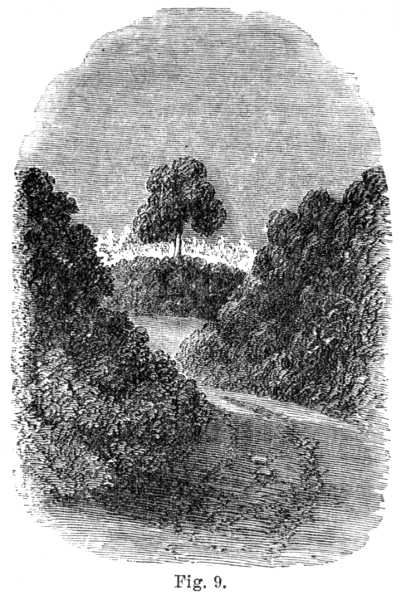
"Neither the hour of the day nor the angle which the object makes with the observer appears to have any effect; for on some occasions I have seen the phenomenon take place at a very early hour in the morning. Yesterday it was 10 a.m., when I saw it as represented in Fig. 10. I saw it again on the same day at 5 p.m., at a different place of the same mountain, for which the sun was just setting. At one time the angle of elevation of the lighted white shrubs above the horizon of the spectator was about 20°, while at another place it was only 15°. But the extent of the field of illumination is variable, according to the distance at which the spectator is placed from it. When the object behind which the sun is just going to rise, or has just been setting, is very near, no such effect takes place. In the case represented in Fig. 9 the distance was about 194 mètres, or 636 English feet, from the spectator in a direct line, the height above his level being 60 mètres, or 197 English feet, and the horizontal line drawn from him to the horizontal projection of these points on the plane of his horizon being 160 mètres, or 525 English feet, as will be seen in the following diagram, Fig. 10.
SILVER TREES AT SUNRISE. 1858.
Fig. 10. Luminous Trees projected against the sky at sunrise.
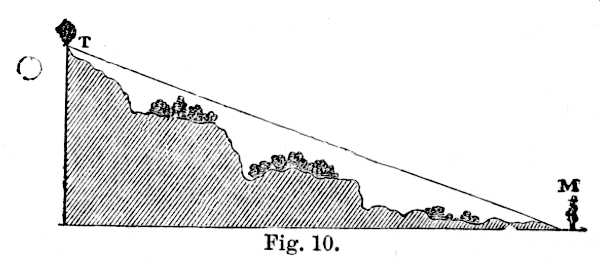
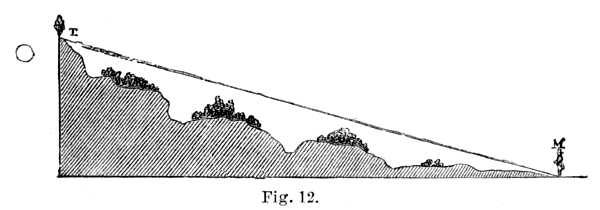
"In this case only small shrubs and the lower half of the stem of a tree are illuminated white, and the horizontal extent of this effect is also comparatively small; while at other places when I was near the edge behind which the sun was going to rise no such effect took place. But on the contrary, when I have witnessed the phenomenon at a greater distance and at a greater height, as I have seen it other times on the same and on other mountains of the Alps, large tracts of forests and immense spruce-firs were illuminated white throughout their whole length, as I have attempted to represent in Fig. 11, and the corresponding diagram, Fig. 12. BIRDS AS SPARKS OR STARS. 1858. Nothing can be finer than these silver-looking spruce-forests. At the same time, though at a distance of more than a thousand mètres, a vast number of large swallows or swifts (Cypselus alpinus), which inhabit these high rocks, were seen as small brilliant stars or sparks moving rapidly in the air. From these facts it appears to me obvious that the extent of the illuminated spots varies in a direct ratio of their distance; but at the same time that there must be a constant angular space, corresponding probably to the zone, a few minutes of a degree wide, around the sun's disk, which is a limit to the occurrence of the appearance. This would explain how the real extent which it occupies on the earth's surface varies with the relative distance of the spot from the eye of the observer, and accounts also for the phenomenon being never seen in the low country, where I have often looked for it in vain. Now that you are acquainted with the circumstances of the fact, I have no doubt you will easily observe it in some part or other of your Scotch hills; it may be some long heather or furze will play the part of our Alpine forests, and I would advise you to try and place a bee-hive in the required position, and it would perfectly represent our swallows, sparks, and stars."
Fig. 11. Luminous Trees projected against the sky at sunrise.
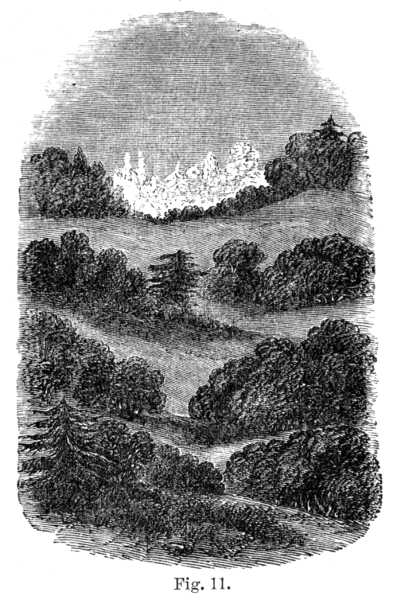
Fig. 12. Luminous Trees projected against the sky at sunrise.
THE LADDER CONDEMNED. 1858.
Our porters, with one exception, reached the Pierre à l'Echelle as soon as ourselves; and here having refreshed themselves, and the due exchange of loads having been made, we advanced upon the glacier, which we crossed, until we came nearly opposite to the base of the Grands Mulets. The existence of one wide crevasse, which was deemed impassable, had this year introduced the practice of assailing the rocks at their base, and climbing them to the cabin, an operation which Balmat wished to avoid. At Chamouni, therefore, he had made inquiries regarding the width of the chasm, and acting on his advice I had had a ladder constructed in two pieces, which, united together by iron attachments, was supposed to be of sufficient length to span the fissure. On reaching the latter, the pieces were united, and the ladder thrown across, but the bridge was so frail and shaky at the place of junction, and the chasm so deep, that Balmat pronounced the passage impracticable.
CROSSING CREVASSES. 1858.
The porters were all grouped beside the crevasse when this announcement was made, and, like hounds in search of the scent, the group instantly broke up, seeking in all directions for a means of passage. The talk was incessant and animating; attention was now called in one direction, anon in another, the men meanwhile throwing themselves into the most picturesque groups and attitudes. All eyes at length were directed upon a fissure which was spanned at one point by an arch of snow, certainly under two feet deep at the crown. A stout rope was tied round the waist of one of our porters, and he was sent forward to test the bridge. He approached it cautiously, treading down the snow to give it compactness, and thus make his footing sure as he advanced; bringing regelation into play, he gave the mass the necessary continuity, and crossed in safety. The rope was subsequently stretched over the pont, and each of us causing his right hand to slide along it, followed without accident. Soon afterwards, however, we met with a second and very formidable crevasse, to cross which we had but half of our ladder, which was applied as follows:—The side of the fissure on which we stood was lower than the opposite one; over the edge of the latter projected a cornice of snow, and a ledge of the same material jutted from the wall of the crevasse, a little below us. The ladder was placed from ledge to cornice, both of its ends being supported by snow. I could hardly believe that so frail a bearing could possibly support a man's weight; but a porter was tied as before, and sent up the ladder, while we followed protected by the rope. We were afterwards tied together, and thus advanced in an orderly line to the Grands Mulets.
GORGEOUS SUNSET. 1858.
The cabin was wet and disagreeable, but the sunbeams fell upon the brown rocks outside, and thither Mr. Wills and myself repaired to watch the changes of the atmosphere. I took possession of the flat summit of a prism of rock, where, lying upon my back, I watched the clouds forming, and melting, and massing themselves together, and tearing themselves like wool asunder in the air above. It was nature's language addressed to the intellect; these clouds were visible symbols which enabled us to understand what was going on in the invisible air. Here unseen currents met, possessing different temperatures, mixing their contents both of humidity and motion, producing a mean temperature unable to hold their moisture in a state of vapour. The water-particles, obeying their mutual attractions, closed up, and a visible cloud suddenly shook itself out, where a moment before we had the pure blue of heaven. Some of the clouds were wafted by the air towards atmospheric regions already saturated with moisture, and along their frontal borders new cloudlets ever piled themselves, while the hinder portions, invaded by a drier or a warmer air, were dissipated; thus the cloud advanced, with gain in front and loss behind, its permanence depending on the balance between them. The day waned, and the sunbeams began to assume the colouring due to their passage through the horizontal air. The glorious light, ever deepening in colour, was poured bounteously over crags, and snows, and clouds, and suffused with gold and crimson the atmosphere itself. I had never seen anything grander than the sunset on that day. Clouds with their central portions densely black, denying all passage to the beams which smote them, floated westward, while the fiery fringes which bordered them were rendered doubly vivid by contrast with the adjacent gloom. The smaller and more attenuated clouds were intensely illuminated throughout. Across other inky masses were drawn zigzag bars of radiance which resembled streaks of lightning. The firmament between the clouds faded from a blood-red through orange and daffodil into an exquisite green, which spread like a sea of glory through which those magnificent argosies slowly sailed. Some of the clouds were drawn in straight chords across the arch of heaven, these being doubtless the sections of layers of cloud whose horizontal dimensions were hidden from us. The cumuli around and near the sun himself could not be gazed upon, until, as the day declined, they gradually lost their effulgence and became tolerable to the eyes. All was calm—but there was a wildness in the sky like that of anger, which boded evil passions on the part of the atmosphere. The sun at length sank behind the hills, but for some time afterwards carmine clouds swung themselves on high, and cast their ruddy hues upon the mountain snows. Duskier and colder waxed the west, colder and sharper the breeze of evening upon the Grands Mulets, and as twilight deepened towards night, and the stars commenced to twinkle through the chilled air, we retired from the scene.
STORM ON THE GRANDS MULETS. 1858.
The anticipated storm at length gave notice of its coming. The sea-waves, as observed by Aristotle, sometimes reach the shore before the wind which produces them is felt; and here the tempest sent out its precursors, which broke in detached shocks upon the cabin before the real storm arrived. Billows of air, in ever quicker succession, rolled over us with a long surging sound, rising and falling as crest succeeded trough and trough succeeded crest. And as the pulses of a vibrating body, when their succession is quick enough, blend to a continuous note, so these fitful gusts linked themselves finally to a storm which made its own wild music among the crags. Grandly it swelled, carrying the imagination out of doors, to the clouds and darkness, to the loosened avalanches and whirling snow upon the mountain heads. Moored to the rock on two sides, the cabin stood firm, and its manifest security allowed the mind the undisturbed enjoyment of the atmospheric war. We were powerfully shaken, but had no fear of being uprooted; and a certain grandeur of the heart rose responsive to the grandeur of the storm. Mounting higher and higher, it at length reached its maximum strength, from which it lowered fitfully, until at length, with a melancholy wail, it bade our rock farewell.
A little before half-past one we issued from the cabin. The night being without a moon, we carried three lanterns. The heavens were crowded with stars, among which, however, angry masses of cloud here and there still wandered. The storm, too, had left a rear-guard behind it; and strong gusts rolled down upon us at intervals, at one time, indeed, so violent as to cause Balmat to express doubts of our being able to reach the summit. With a thick handkerchief bound around my hat and ears I enjoyed the onset of the wind. Once, turning my head to the left, I saw what appeared to me to be a huge mass of stratus cloud, at a great distance, with the stars shining over it. In another instant a precipice of névé loomed upon us; we were close to its base, and along its front the annual layers were separated from each other by broad dark bands. Through the gloom it appeared like a cloud, the lines of bedding giving to it the stratus character.
A COMET DISCOVERED. 1858.
Immediately before lying down on the previous evening I had opened the little window of the cabin to admit some air. In the sky in front of me shone a curious nodule of misty light with a pale train attached to it. In 1853, on the side of the Brocken, I had observed, without previous notice, a comet discovered a few days previously by a former fellow student, and here was another "discovery" of the same kind. I inspected the stranger with my telescope, and assured myself that it was a comet. Mr. Wills chanced to be outside at the time, and made the same observation independently. As we now advanced up the mountain its ominous light gleamed behind us, while high up in heaven to our left the planet Jupiter burned like a lamp of intense brightness. The Petit Plateau forms a kind of reservoir for the avalanches of the Dôme du Goûter, and this year the accumulation of frozen débris upon it was enormous. We could see nothing but the ice-blocks on which the light of the lanterns immediately fell; we only knew that they had been discharged from the séracs, and that similar masses now rose threatening to our right, and might at any moment leap down upon us. Balmat commanded silence, and urged us to move across the plateau with all possible celerity. The warning of our guide, the wild and rakish appearance of the sky, the spent projectiles at our feet, and the comet with its "horrid hair" behind, formed a combination eminently calculated to excite the imagination.
DAWN ON THE GRAND PLATEAU. 1858.
And now the sky began to brighten towards dawn, with that deep and calm beauty which suggests the thought of adoration to the human mind. Helped by the contemplation of the brightening east, which seemed to lend lightness to our muscles, we cheerily breasted the steep slope up to the Grand Plateau. The snow here was deep, and each of our porters took the lead in turn. We paused upon the Grand Plateau and had breakfast; digging, while we halted, our feet deeply into the snow. Thence up to the corridor, by a totally different route from that pursued by Mr. Hirst and myself the year previously; the slope was steep, but it had not a precipice for its boundary. Deep steps were necessary for a time, but when we reached the summit our ascent became more gentle. The eastern sky continued to brighten, and by its illumination the Grand Plateau and its bounding heights were lovely beyond conception. The snow was of the purest white, and the glacier, as it pushed itself on all sides into the basin, was riven by fissures filled with a cœrulean light, which deepened to inky gloom as the vision descended into them. The edges were overhung with fretted cornices, from which depended long clear icicles, tapering from their abutments like spears of crystal. The distant fissures, across which the vision ranged obliquely without descending into them, emitted that magical firmamental shimmer which, contrasted with the pure white of the snow, was inexpressibly lovely. Near to us also grand castles of ice reared themselves, some erect, some overturned, with clear cut sides, striped by the courses of the annual snows, while high above the séracs of the plateau rose their still grander brothers of the Dôme du Goûter. There was a nobility in this glacier scene which I think I have never seen surpassed;—a strength of nature, and yet a tenderness, which at once raised and purified the soul. The gush of the direct sunlight could add nothing to this heavenly beauty; indeed I thought its yellow beams a profanation as they crept down from the humps of the Dromedary, and invaded more and more the solemn purity of the realm below.
BALMAT IN DANGER. 1858.
Our way lay for a time amid fine fissures with blue walls, until at length we reached the edge of one which elicited other sentiments than those of admiration. It must be crossed. At the opposite side was a high and steep bank of ice which prolonged itself downwards, and ended in a dependent eave of snow which quite overhung the chasm, and reached to within about a yard of our edge of the crevasse. Balmat came forward with his axe, and tried to get a footing on the eave: he beat it gently, but the axe went through the snow, forming an aperture through which the darkness of the chasm was rendered visible. Our guide was quite free, without rope or any other means of security; he beat down the snow so as to form a kind of stirrup, and upon this he stepped. The stirrup gave way, it was right over the centre of the chasm, but with wonderful tact and coolness he contrived to get sufficient purchase from the yielding mass to toss himself back to the side of the chasm. The rope was now brought forward and tied round the waist of one of the porters; another step was cautiously made in the eave of snow, the man was helped across, and lessened his own weight by means of his hatchet. He gradually got footing on the face of the steep, which he mounted by escaliers; and on reaching a sufficient height he cut two large steps in which his feet might rest securely. Here he laid his breast against the sloping wall, and another person was sent forward, who drew himself up by the rope which was attached to the leader. Thus we all passed, each of us in turn bearing the strain of his successor upon the rope; it was our last difficulty, and we afterwards slowly plodded through the snow of the corridor towards the base of the Mur de la Côte.
STORM ON MONT BLANC. 1858.
Climbing zigzag, we soon reached the summit of the Mur, and immediately afterwards found ourselves in the midst of cold drifting clouds, which obscured everything. They dissolved for a moment and revealed to us the sunny valley of Chamouni; but they soon swept down again and completely enveloped us. Upon the Calotte, or last slope, I felt no trace of the exhaustion which I had experienced last year, but enjoyed free lungs and a quiet heart. The clouds now whirled wildly round us, and the fine snow, which was caught by the wind and spit bitterly against us, cut off all visible communication between us and the lower world. As we approached the summit the air thickened more and more, and the cold, resulting from the withdrawal of the sunbeams, became intense. We reached the top, however, in good condition, and found the new snow piled up into a sharp arête, and the summit of a form quite different from that of the Dos d'un Ane, which it had presented the previous year. Leaving Balmat to make a hole for the thermometer, I collected a number of bâtons, drove them into the snow, and, drawing my plaid round them, formed a kind of extempore tent to shelter my boiling-water apparatus. The covering was tightly held, but the snow was as fine and dry as dust, and penetrated everywhere: my lamp could not be secured from it, and half a box of matches was consumed in the effort to ignite it. At length it did flame up, and carried on a sputtering combustion. The cold of the snow-filled boiler condensing the vapour from the lamp gradually produced a drop, which, when heavy enough to detach itself from the vessel, fell upon the flame and put it out. It required much patience and the expenditure of many matches to relight it. Meanwhile the absence of muscular action caused the cold to affect our men severely. My beard and whiskers were a mass of clotted ice. The bâtons were coated with ice, and even the stem of my thermometer, the bulb of which was in hot water, was covered by a frozen enamel. The clouds whirled, and the little snow granules hit spitefully against the skin wherever it was exposed. The temperature of the air was 20° Fahr. below the freezing point. I was too intent upon my work to heed the cold much, but I was numbed; one of my fingers had lost sensation, and my right heel was in pain: still I had no thought of forsaking my observation until Mr. Wills came to me and said that we must return speedily, for Balmat's hands were gelées. I did not comprehend the full significance of the word; but, looking at the porters, they presented such an aspect of suffering that I feared to detain them longer. They looked like worn old men, their hair and clothing white with snow, and their faces blue, withered, and anxious-looking. THERMOMETER BURIED. 1858. The hole being ready, I asked Balmat for the magnet to arrange the index of the thermometer: his hands seemed powerless. I struck my tent, deposited the instrument, and, as I watched the covering of it up, some of the party, among whom were Mr. Wills and Balmat, commenced the descent.[A]
BALMAT FROSTBITTEN. 1858.
I followed them speedily. Midway down the Calotte I saw Balmat, who was about a hundred yards in advance of me, suddenly pause and thrust his hands into the snow, and commence rubbing them vigorously. The suddenness of the act surprised me, but I had no idea at the time of its real significance: I soon came up to him; he seemed frightened, and continued to beat and rub his hands, plunging them, at quick intervals, into the snow. Still I thought the thing would speedily pass away, for I had too much faith in the man's experience to suppose that he would permit himself to be seriously injured. But it did not pass as I hoped it would, and the terrible possibility of his losing his hands presented itself to me. He at length became exhausted by his own efforts, staggered like a drunken man, and fell upon the snow. Mr. Wills and myself took each a hand, and continued the process of beating and rubbing. I feared that we should injure him by our blows, but he continued to exclaim, "N'ayez pas peur, frappez toujours, frappez fortement!" We did so, until Mr. Wills became exhausted, and a porter had to take his place. Meanwhile Balmat pinched and bit his fingers at intervals, to test their condition; but there was no sensation. He was evidently hopeless himself; and, seeing him thus, produced an effect upon me that I had not experienced since my boyhood—my heart swelled, and I could have wept like a child. The idea that I should be in some measure the cause of his losing his hands was horrible to me; schemes for his support rushed through my mind with the usual swiftness of such speculations, but no scheme could restore to him his lost hands. At length returning sensation in one hand announced itself by excruciating pain. "Je souffre!" he exclaimed at intervals—words which, from a man of his iron endurance, had a more than ordinary significance. But pain was better than death, and, under the circumstances, a sign of improvement. We resumed our descent, while he continued to rub his hands with snow and brandy, thrusting them at every few paces into the mass through which we marched. At Chamouni he had skilful medical advice, by adhering to which he escaped with the loss of six of his nails—his hands were saved.
I cannot close this recital without expressing my admiration of the dauntless bearing of our porters, and of the cheerful and efficient manner in which they did their duty throughout the whole expedition. Their names are Edouard Bellin, Joseph Favret, Michel Payot, Joseph Folliguet, and Alexandre Balmat.
FOOTNOTES:
(26.)
PROCÈS-VERBAL. 1858.
The hostility of the chief guide to the expedition was not diminished by the letter of the Intendant; and he at once entered a procès-verbal against Balmat and his companions on their return to Chamouni. I felt that the power thus vested in an unlettered man to arrest the progress of scientific observations was so anomalous, that the enlightened and liberal Government of Sardinia would never tolerate such a state of things if properly represented to it. The British Association met at Leeds that year, and to it, as a guardian of science, my thoughts turned. I accordingly laid the case before the Association, and obtained its support: a resolution was unanimously passed "that application be made to the Sardinian authorities for increased facilities for making scientific observations in the Alps."
Considering the arduous work which Balmat had performed in former years in connexion with the glaciers, and especially his zeal in determining, under the direction of Professor Forbes, their winter motion—for which, as in the case above recorded, he refused all personal remuneration—I thought such services worthy of some recognition on the part of the Royal Society. I suggested this to the Council, and was met by the same cordial spirit of co-operation which I had previously experienced at Leeds. A sum of five-and-twenty guineas was at once voted for the purchase of a suitable testimonial; and a committee, consisting of Sir Roderick Murchison, Professor Forbes, and myself, was appointed to carry the thing out. Balmat was consulted, and he chose a photographic apparatus, which, with a suitable inscription, was duly presented to him.
BRITISH ASSOCIATION. 1858.
Thus fortified, I drew up an account of what had occurred at Chamouni during my last visit, accompanied by a brief statement of the changes which seemed desirable. This was placed in the hands of the President of the British Association, to whose prompt and powerful co-operation in this matter every Alpine explorer who aspires to higher ground than ordinary is deeply indebted. The following letter assured me that the facility applied for by the British Association would be granted by the Sardinian Government, and that future men of science would find in the Alps a less embarrassed field of operations than had fallen to my lot in the summer of 1858.
THE PRESIDENT'S LETTER. 1858.
"12, Hertford-street, Mayfair, W., "February 18th, 1859.
"My dear Sir,—
"Having, as I informed you in my last note, communicated with the Sardinian Minister Plenipotentiary the day after receiving your statement relative to the guides at Chamouni, I have been favoured by replies from the Minister, of the 4th and 17th February. In the first the Marquis d'Azeglio assures me that he will bring the subject before the competent authorities at Turin, accompanying the transmission 'd'une récommandation toute spéciale.' In the second letter the Marquis informs me that 'the preparation of new regulations for the guides at Chamouni had for some time occupied the attention of the Minister of the Interior, and that these regulations will be in rigorous operation, in all probability, at the commencement of the approaching summer.' The Marquis adds that, 'as the regulations will be based upon a principle of much greater liberty, he has every reason to believe that they will satisfy all the desires of travellers in the interests of science.'
"With much pleasure at the opportunity of having been in any degree able to bring about the fulfilment of your wishes on the subject,
"I remain, my dear Sir, "Faithfully yours, "Richard Owen. "Pres. Brit. Association.
"Prof. Tyndall, F.R.S."
It ought to be stated that, previous to my arrival at Chamouni in 1858, an extremely cogent memorial drawn up by Mr. John Ball had been presented to the Marquis d'Azeglio by a deputation from the Alpine Club. It was probably this memorial which first directed the attention of the Sardinian Minister of the Interior to the subject.
WINTER EXPEDITION TO THE MER DE GLACE, 1859. (27.)
Having ten days at my disposal last Christmas, I was anxious to employ them in making myself acquainted with the winter aspects and phenomena of the Mer de Glace. On Wednesday, the 21st of December, I accordingly took my place to Paris, but on arriving at Folkestone found the sea so tempestuous that no boat would venture out.
FIRST DEFEAT, AND FRESH ATTEMPT. 1859.
The loss of a single day was more than I could afford, and this failure really involved the loss of two. Seeing, therefore, the prospect of any practical success so small, I returned to London, purposing to give the expedition up. On the following day, however, the weather lightened, and I started again, reaching Paris on Friday morning. On that day it was not possible to proceed beyond Macon, where, accordingly, I spent the night, and on the following day reached Geneva.
Much snow had fallen; at Paris it still cumbered the streets, and round about Macon it lay thick, as if a more than usually heavy cloud had discharged itself on that portion of the country. Between Macon and Roussillon it was lighter, but from the latter station onwards the quantity upon the ground gradually increased.
GENEVA TO CHAMOUNI. 1859.
On Christmas morning, at 8 o'clock, I left Geneva by the diligence for Sallenches. The dawn was dull, but the sky cleared as the day advanced, and finally a dome of cloudless blue stretched overhead. The mountains were grand; their sunward portions of dazzling whiteness, while the shaded sides, in contrast with the blue sky behind them, presented a ruddy, subjective tint. The brightness of the day reached its maximum towards one o'clock, after which a milkiness slowly stole over the heavens, and increased in density until finally a drowsy turbidity filled the entire air. The distant peaks gradually blended with the white atmosphere above them and lost their definition. The black pine forests on the slopes of the mountains stood out in strong contrast to the snow; and, when looked at through the spaces enclosed by the tree branches at either side of the road, they appeared of a decided indigo-blue. It was only when thus detached by a vista in front that the blue colour was well seen, the air itself between the eye and the distant pines being the seat of the colour. Goethe would have regarded it as an excellent illustration of his 'Farbenlehre.'
We reached Sallenches a little after 4 p.m., where I endeavoured to obtain a sledge to continue my journey. A fit one was not to be found, and a carriage was therefore the only resort. We started at five; it was very dark, but the feeble reflex of the snow on each side of the road was preferred by the postilion to the light of lamps. Unlike the enviable ostrich, I cannot shut my eyes to danger when it is near: and as the carriage swayed towards the precipitous road side, I could not fold myself up, as it was intended I should, but, quitting the interior and divesting my limbs of every encumbrance, I took my seat beside the driver, and kept myself in readiness for the spring, which in some cases appeared imminent. My companion however was young, strong, and keen-eyed; and though we often had occasion for the exercise of the quality last mentioned, we reached Servoz without accident.
DESOLATION. 1859.
Here we baited, and our progress afterwards was slow and difficult. The snow on the road was deep and hummocky, and the strain upon the horses very great. Having crossed the Arve at the Pont-Pelissier, we both alighted, and I went on in advance. The air was warm, and not a whisper disturbed its perfect repose. There was no moon, and the heavy clouds, which now quite overspread the heavens, cut off even the feeble light of the stars. The sound of the Arve, as it rushed through the deep valley to my left, came up to me through crags and trees with a sad murmur. Sometimes on passing an obstacle, the sound was entirely cut off, and the consequent silence was solemn in the extreme. It was a churchyard stillness, and the tall black pines, which at intervals cast their superadded gloom upon the road, seemed like the hearse-plumes of a dead world. I reached a wooden hut, where a lame man offers bâtons, minerals, and eau de vie, to travellers in summer. It was forsaken, and half buried in the snow. I leaned against the door, and enjoyed for a time the sternness of the surrounding scene. My conveyance was far behind, and the intermittent tinkle of the horses' bells, which augmented instead of diminishing the sense of solitude, informed me of the progress and the pauses of the vehicle. At the summit of the road I halted until my companion reached me; we then both remounted, and proceeded slowly towards Les Ouches. We passed some houses, the aspect of which was even more dismal than that of Nature; their roofs were loaded with snow, and white buttresses were reared against the walls. There was no sound, no light, no voice of joy to indicate that it was the pleasant Christmas time. We once met the pioneer of a party of four drunken peasants: he came right against us, and the coachman had to pull up. Planting his feet in the snow and propping himself against the leader's shoulder, the bacchanal exhorted the postilion to drive on; the latter took him at his word, and overturned him in the snow. After this we encountered no living thing. The horses seemed seized by a kind of torpor, and leaned listlessly against each other; vainly the postilion endeavoured to rouse them by word and whip; they sometimes essayed to trot down the slopes, but immediately subsided to their former monotonous crawl. As we ascended the valley, the stillness of the air was broken at intervals by wild storm-gusts, sent down against us from Mont Blanc himself. These chilled me, so I quitted the carriage, and walked on. Not far from Chamouni, the road, for some distance, had been exposed to the full action of the wind, and the snow had practically erased it. Its left wall was completely covered, while a few detached stones, rising here and there above the surface, were the only indications of the presence and direction of the right-hand wall. I could not see the state of the surface, but I learned by other means that the snow had been heaped in oblique ridges across my path. I staggered over four or five of these in succession, sinking knee-deep, and finally found myself immersed to the waist. This made me pause; I thought I must have lost the road, and vainly endeavoured to check myself by the positions of surrounding objects. A HORSE IN THE SNOW. 1859. I turned back and met the carriage: it had stuck in one of the ridges; one horse was down, his hind legs buried to the haunches, his left fore leg plunged to the shoulder in snow, and the right one thrown forward upon the surface. C'est bien la route? demanded my companion. I went back exploring, and assured myself that we were over the road; but I recommended him to release the horses and leave the carriage to its fate. He, however, succeeding in extricating the leader, and while I went on in advance seeking out the firmer portions of the road, he followed, holding his horses by their heads; and half an hour's struggle of this kind brought us to Chamouni.
CHAMOUNI ON CHRISTMAS NIGHT. 1859.
It also was a little "city of the dead." There was no living thing in the streets, and neither sound nor light in the houses. The fountain made a melancholy gurgle, one or two loosened window-shutters creaked harshly in the wind, and banged against the objects which limited their oscillations. The Hôtel de l'Union, so bright and gay in summer, was nailed up and forsaken; and the cross in front of it, stretching its snow-laden arms into the dim air, was the type of desolation. We rang the bell at the Hôtel Royal, but the bay of a watch-dog resounding through the house was long our only reply. The bell appeared powerless to wake the sleepers, and its sound mingled dismally with that of the wind howling through the deserted passages. The noise of my boot-heel, exerted long on the front door, was at length effective; it was unbarred, and the physical heat of a good stove soon added itself to the warmth of the welcome with which my hostess greeted me.
December 26th.—The snow fell heavily, at frequent intervals, throughout the entire day. Dense clouds draped all the mountains, and there was not the least prospect of my being able to see across the Mer de Glace. I walked out alone in the dim light, and afterwards traversed the streets before going to bed. They were quite forsaken. Cold and sullen the Arve rolled under its wooden bridge, while the snow fell at intervals with heavy shock from the roofs of the houses, the partial echoes from the surfaces of the granules combining to render the sound loud and hollow. Thus were the concerns of this little hamlet changed and fashioned by the obliquity of the earth's axis, the chain of dependence which runs throughout creation, linking the roll of a planet alike with the interests of marmots and of men.
ASCENT OF THE MOUNTAIN. 1859.
Tuesday, 27th December.—I rose at six o'clock, having arranged with my men to start at seven, if the weather at all permitted. Edouard Simond, my old assistant of 1857, and Joseph Tairraz were the guides of the party; the porters were Edouard Balmat, Joseph Simond (fils d'Auguste), François Ravanal, and another. They came at the time appointed; it was snowing heavily, and we agreed to wait till eight o'clock and then decide. They returned at eight, and finding them disposed to try the ascent to the Montanvert, it was not my place to baulk them. Through the valley the work was easy, as the snow had been partially beaten down, but we soon passed the habitable limits, and had to break ground for ourselves. Three of my men had tried to reach the Montanvert by la Filia on the previous Thursday, but their experience of the route had been such as to deter them from trying it again. We now chose the ordinary route, breasting the slope until we reached the cluster of chalets, under the projecting eave of one of which the men halted and applied "pattens" to their feet. These consisted of planks about sixteen inches long and ten wide, which were firmly strapped to the feet. My first impression was that they were worse than useless, for though they sank less deeply than the unarmed feet, on being raised they carried with them a larger amount of snow, which, with the leverage of the leg, appeared to necessitate an enormous waste of force. I stated this emphatically, but the men adhered to their pattens, and before I reached the Montanvert I had reason to commend their practice as preferable to my theory. I was however guided by the latter, and wore no pattens. The general depth of the snow along the track was over three feet; the footmarks of the men were usually rigid enough to bear my weight, but in many cases I went through the crust which their pressure had produced, and sank suddenly in the mass. The snow became softer as we ascended, and my immersions more frequent, but the work was pure enjoyment, and the scene one of extreme beauty. SNOW ON THE PINES. 1859. The previous night's snow had descended through a perfectly still atmosphere, and had loaded all the branches of the pines; the long arms of the trees drooped under the weight, and presented at their extremities the appearance of enormous talons turned downwards. Some of the smaller and thicker trees were almost entirely covered, and assumed grotesque and beautiful forms; the upper part of one in particular resembled a huge white parrot with folded wings and drooping head, the slumber of the bird harmonizing with the torpor of surrounding nature. I have given a sketch of it in Fig. 13.
Fig. 13. Snow on the Pines.
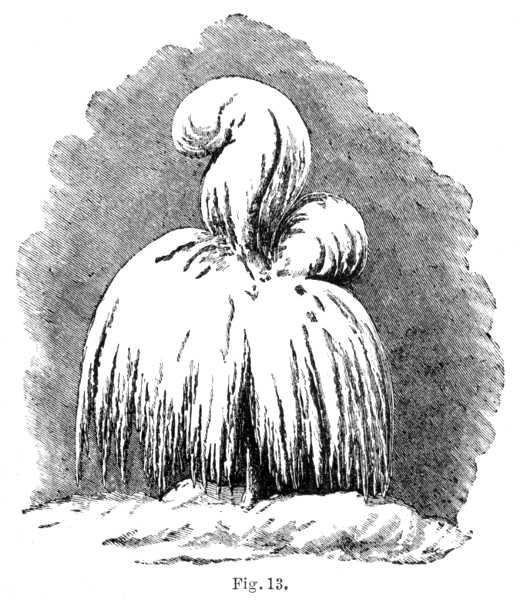
SOUND OF BREAKING SNOW. 1859.
Previous to reaching the half-way spring, where the peasant girls offer strawberries to travellers in summer, we crossed two large couloirs filled with the débris of avalanches which had fallen the night before. Between these was a ridge forty or fifty yards wide on which the snow was very deep, the slope of the mountain also adding a component to the fair thickness of the snow. My shoulder grazed the top of the embankment to my right as I crossed the ridge, and once or twice I found myself waist deep in a vertical shaft from which it required a considerable effort to escape. Suddenly we heard a deep sound resembling the dull report of a distant gun, and at the same moment the snow above us broke across, forming a fissure parallel to our line of march. The layer of snow had been in a state of strain, which our crossing brought to a crisis: it gave way, but having thus relieved itself it did not descend. Several times during the ascent the same phenomenon occurred. Once, while engaged upon a very steep slope, one of the men cried out to the leader, "Arrêtez!" Immediately in front of the latter the snow had given way, forming a zigzag fissure across the slope. We all paused, expecting to see an avalanche descend. Tairraz was in front; he struck the snow with his bâton to loosen it, but seeing it indisposed to descend he advanced cautiously across it, and was followed by the others. I brought up the rear. The steepness of the mountain side at this place, and the absence of any object to which one might cling, would have rendered a descent with the snow in the last degree perilous, and we all felt more at ease when a safe footing was secured at the further side of the incline.
At the spring, which showed a little water, the men paused to have a morsel of bread. The wind had changed, the air was clearing, and our hopes brightening. As we ascended the atmosphere went through some extraordinary mutations. Clouds at first gathered round the Aiguille and Dôme du Goûter, casting the lower slopes of the mountain into intense gloom. After a little time all this cleared away, and the beams of the sun striking detached pieces of the slopes and summits produced an extraordinary effect. The Aiguille and Dôme were most singularly illumined, and to the extreme left rose the white conical hump of the Dromedary, from which a long streamer of snow-dust was carried southward by the wind. The Aiguille du Dru, which had been completely mantled during the earlier part of the day, now threw off its cloak of vapour and rose in most solemn majesty before us; half of its granite cone was warmly illuminated, and half in shadow. The wind was high in the upper regions, and, catching the dry snow which rested on the asperities and ledges of the Aiguille, shook it out like a vast banner in the air. The changes of the atmosphere, and the grandeur which they by turns revealed and concealed, deprived the ascent of all weariness. We were usually flanked right and left by pines, but once between the fountain and the Montanvert we had to cross a wide unsheltered portion of the mountain which was quite covered with the snow of recent avalanches. This was lumpy and far more coherent than the undisturbed snow. We took advantage of this, and climbed zigzag over the avalanches for three-quarters of an hour, thus reaching the opposite pines at a point considerably higher than the path. This, though not the least dangerous, was the least fatiguing part of the ascent.
COLOUR OF SNOW. 1859.
I frequently examined the colour of the snow: though fresh, its blue tint was by no means so pronounced as I have seen it on other occasions; still it was beautiful. The colour is, no doubt, due to the optical reverberations which occur within a fissure or cavity formed in the snow. The light is sent from side to side, each time plunging a little way into the mass; and being ejected from it by reflection, it thus undergoes a sifting process, and finally reaches the eye as blue light. The presence of any object which cuts off this cross-fire of the light destroys the colour. I made conical apertures in the snow, in some cases three feet deep, a foot wide at the mouth, and tapering down to the width of my bâton. When the latter was placed along the axis of such a cone, the blue light which had previously filled the cavity disappeared; on the withdrawal of the bâton it was followed by the light, and thus by moving the staff up and down its motions were followed by the alternate appearance and extinction of the light. I have said that the holes made in the snow seemed filled with a blue light, and it certainly appeared as if the air contained in the cavities had itself been coloured, and thereby rendered visible, the vision plunging into it as into a blue medium. Another fact is perhaps worth notice: snow rarely lies so smooth as not to present little asperities at its surface; little ridges or hillocks, with little hollows between them. Such small hollows resemble, in some degree, the cavities which I made in the snow, and from them, in the present instance, a delicate light was sent to the eye, faintly tinted with the pure blue of the snow-crystals. In comparison with the spots thus illuminated, the little protuberances were gray. The portions most exposed to the light seemed least illuminated, and their defect in this respect made them appear as if a light-brown dust had been strewn over them.
THE MONTANVERT IN WINTER. 1859.
After five hours and a half of hard work we reached the Montanvert. I had often seen it with pleasure. Often, having spent the day alone amid the séracs of the Col du Géant, on turning the promontory of Trélaporte on my way home, the sight of the little mansion has gladdened me, and given me vigour to scamper down the glacier, knowing that pleasant faces and wholesome fare were awaiting me. This day, also, the sight of it was most welcome, despite its desolation. The wind had swept round the auberge, and carried away its snow-buttresses, piling the mass thus displaced against the adjacent sheds, to the roofs of which one might step from the surface of the snow. The floor of the little château in which I lodged in 1857 was covered with snow, and on it were the fresh footmarks of a little animal—a marmot might have made such marks, had not the marmots been all asleep—what the creature was I do not know.