Part 2 — PART II. CHIEFLY SCIENTIFIC.
Reading edition
Aber im stillen Gemach entwirft bedeutende Zirkel Sinnend der Weise, beschleicht forschend den schaffenden Geist, Prüft der Stoffe Gewalt, der Magnete Hassen und Lieben, Folgt durch die Lüfte dem Klang, folgt durch den Aether dem Strahl, Sucht das vertraute Gesetz in des Zufalls grausenden Wundern, Sucht den ruhenden Pol in der Erscheinungen Flucht.
Schiller.
ON LIGHT AND HEAT. (1.)
THEORIES OF LIGHT.
What is Light? The ancients supposed it to be something emitted by the eyes, and for ages no notion was entertained that it required time to pass through space. In the year 1676 Römer first proved that the light from Jupiter's satellites required a certain time to cross the earth's orbit. Bradley afterwards found that, owing to the velocity with which the earth flies through space, the rays of the stars are slightly inclined, just as rain-drops which descend vertically appear to meet us when we move swiftly through the shower. In Kew Gardens there is a sun-dial commemorative of this discovery, which is called the aberration of light. Knowing the velocity of the earth, and the inclination of the stellar rays, Bradley was able to calculate the velocity of light; and his result agrees closely with that of Römer. Celestial distances were here involved, but a few years ago M. Fizeau, by an extremely ingenious contrivance, determined the time required by light to pass over a distance of about 9000 yards; and his experiment is quite in accordance with the results of his predecessors.
But what is it which thus moves? Some, and among the number Newton, imagined light to consist of particles darted out from luminous bodies. This is the so-called Emission-Theory, which was held by some of the greatest men: Laplace, for example, accepted it; and M. Biot has developed it with a lucidity and power peculiar to himself. It was first opposed by the astronomer Huyghens, and afterwards by Euler, both of whom supposed light to be a kind of undulatory motion; but they were borne down by their great antagonists, and the emission-theory held its ground until the commencement of the present century, when Thomas Young, Professor of Natural Philosophy in the Royal Institution, reversed the scientific creed by placing the Theory of Undulation on firm foundations. He was followed by a young Frenchman of extraordinary genius, who, by the force of his logic and the conclusiveness of his experiments, left the Wave-Theory without a competitor. The name of this young Frenchman was Augustin Fresnel.
Since his time some of the ablest minds in Europe have been applied to the investigation of this subject; and thus a mastery, almost miraculous, has been attained over the grandest and most subtle of natural phenomena. True knowledge is always fruitful, and a clear conception regarding any one natural agent leads infallibly to better notions regarding others. Thus it is that our knowledge of light has corrected and expanded our knowledge of heat, while the latter, in its turn, will assuredly lead us to clearer conceptions regarding the other forces of Nature.
I think it will not be a useless labour if I here endeavour to state, in a simple manner, our present views of light and heat. Such knowledge is essential to the explanation of many of the phenomena referred to in the foregoing pages; and even to the full comprehension of the origin of the glaciers themselves. A few remarks on the nature of sound will form a fit introduction.
NATURE OF SOUND.
It is known that sound is conveyed to our organs of hearing by the air: a bell struck in a vacuum emits no sound, and even when the air is thin the sound is enfeebled. Hawksbee proved this by the air-pump; De Saussure fired a pistol at the top of Mont Blanc,—I have repeated the experiment myself, and found, with him, that the sound is feebler than at the sea level. Sound is not produced by anything projected through the air. The explosion of a gun, for example, is sent forward by a motion of a totally different kind from that which animates the bullet projected from the gun: the latter is a motion of translation; the former, one of vibration. To use a rough comparison, sound is projected through the air as a push is through a crowd; it is the propagation of a wave or pulse, each particle taking up the motion of its neighbour, and delivering it on to the next. These aërial waves enter the external ear, meet a membrane, the so-called tympanic membrane, which is drawn across the passage at a certain place, and break upon it as sea-waves do upon the shore. The membrane is shaken, its tremors are communicated to the auditory nerve, and transmitted by it to the brain, where they produce the impression to which we give the name of sound.
CAUSE OF MUSIC.
In the tumult of a city, pulses of different kinds strike irregularly upon the tympanum, and we call the effect noise; but when a succession of impulses reach the ear at regular intervals we feel the effect as music. Thus, a vibrating string imparts a series of shocks to the air around it, which are transmitted with perfect regularity to the ear, and produce a musical note. When we hear the song of a soaring lark we may be sure that the entire atmosphere between us and the bird is filled with pulses, or undulations, or waves, as they are often called, produced by the little songster's organ of voice. This organ is a vibrating instrument, resembling, in principle, the reed of a clarionet. Let us suppose that we hear the song of a lark, elevated to a height of 500 feet in the air. Before this is possible, the bird must have agitated a sphere of air 1000 feet in diameter; that is to say, it must have communicated to 17,888 tons of air a motion sufficiently intense to be appreciated by our organs of hearing.
CAUSE OF PITCH.
Musical sounds differ in pitch: some notes are high and shrill, others low and deep. Boys are chosen as choristers to produce the shrill notes; men are chosen to produce the bass notes. Now, the sole difference here is, that the boy's organ vibrates more rapidly than the man's—it sends a greater number of impulses per second to the ear. In like manner, a short string emits a higher note than a long one, because it vibrates more quickly. The greater the number of vibrations which any instrument performs in a given time, the higher will be the pitch of the note produced. The reason why the hum of a gnat is shriller than that of a beetle is that the wings of the small insect vibrate more quickly than those of the larger one. We can, with suitable arrangements, make those sonorous vibrations visible to the eye;[A] and we also possess instruments which enable us to tell, with the utmost exactitude, the number of vibrations due to any particular note. By such instruments we learn that a gnat can execute many thousand flaps of its little wings in a second of time.
NATURE OF LIGHT.
In the study of nature the coarser phenomena, which come under the cognizance of the senses, often suggest to us the finer phenomena which come under the cognizance of the mind; and thus the vibrations which produce sound, and which, as has been stated, can be rendered visible to the eye by proper means, first suggested that light might be due to a somewhat similar action. This is now the universal belief. A luminous body is supposed to have its atoms, or molecules, in a state of intense vibration. The motions of the atoms are supposed to be communicated to a medium suited to their transmission, as air is to the transmission of sound. This medium is called the luminiferous ether, and the little billows excited in it speed through it with amazing celerity, enter the pupil of the eye, pass through the humours, and break upon the retina or optic nerve, which is spread out at the back of the eye. Hence the tremors they produce are transmitted along the nerve to the brain, where they announce themselves as light. The swiftness with which the waves of light are propagated through the ether, is however enormously greater than that with which the waves of sound pass through the air. An aërial wave of sound travels at about the rate of 1100 feet in a second: a wave of light leaves 192,000 miles behind it in the same time.
CAUSE OF COLOUR.
Thus, then, in the case of sound, we have the sonorous body, the air, and the auditory nerve, concerned in the phenomenon; in the case of light, we have the luminous body, the ether, and the optic nerve. The fundamental analogy of sound and light is thus before us, and it is easily remembered. But we must push the analogy further. We know that the white light which comes to us from the sun is made up of an infinite number of coloured rays. By refraction with a prism we can separate those rays from each other, and arrange them in the series of colours which constitute the solar spectrum. The rainbow is an imperfect or impure spectrum, produced by the drops of falling rain, but by prisms we can unravel the white light into pure red, orange, yellow, green, blue, indigo, and violet. Now, this spectrum is to the eye what the gamut is to the ear; each colour represents a note, and the different colours represent notes of different pitch. The vibrations which produce the impression of red are slower, and the waves which they produce are longer, than those to which we owe the sensation of violet; while the vibrations which excite the other colours are intermediate between these two extremes. This, then, is the second grand analogy between light and sound: Colour answers to Pitch. There is therefore truth in the figure when we say that the gentian of the Alps sings a shriller note than the wild rhododendron, and that the red glow of the mountains at sunset is of a lower pitch than the blue of the firmament at noon.
LENGTH OF ETHEREAL WAVES.
These are not fanciful analogies. To the mind of the philosopher these waves of ether are almost as palpable and certain as the waves of the sea, or the ripples on the surface of a lake. The length of the waves, both of sound and light, and the number of shocks which they respectively impart to the ear and eye, have been the subjects of the strictest measurement. Let us here go through a simple calculation. It has been found that 39,000 waves of red light placed end to end would make up an inch. How many inches are there in 192,000 miles? My youngest reader can make the calculation for himself, and find the answer to be 12,165,120,000 inches. It is evident that, if we multiply this number by 39,000, we shall obtain the number of waves of red light in 192,000 miles; this number is 474,439,680,000,000. All these waves enter the eye in one second; thus the expression "I see red colour," strictly means, "My eye is now in receipt of four hundred and seventy-four millions of millions of impulses per second." To produce the impression of violet light a still greater number of impulses is necessary; the wave-length of violet is the 1/57500th part of an inch, and the number of shocks imparted in a second by waves of this length is, in round numbers, six hundred and ninety-nine millions of millions. The other colours of the spectrum, as already stated, rise gradually in pitch from the red to the violet.
A very curious analogy between the eye and ear may here be noticed. The range of seeing is different in different persons—some see a longer spectrum than others; that is to say, rays which are obscure to some are luminous to others. Dr. Wollaston pointed out a similar fact as regards hearing; the range of which differs in different individuals. Savart has shown that a good ear can hear a musical note produced by 8 shocks in a second; it can also hear a note produced by 24,000 shocks in a second; but there are ears in which the range is much more limited. It is possible indeed to produce a sound which shall be painfully shrill to one person, while it is quite unheard by another. I once crossed a Swiss mountain in company with a friend; a donkey was in advance of us, and the dull tramp of the animal was plainly heard by my companion; but to me this sound was almost masked by the shrill chirruping of innumerable insects which thronged the adjacent grass; my friend heard nothing of this, it lay quite beyond his range of hearing.
A third and most important analogy between sound and light is now to be noted; and it will be best understood by reference to something more tangible than either. When a stone is thrown into calm water a series of rings spread themselves around the centre of disturbance. If a second stone be thrown in at some distance from the first, the rings emanating from both centres will cross each other, and at those points where the ridge of one wave coincides with the ridge of another the water will be lifted to a greater height. At those points, on the contrary, where the ridge of one wave crosses the furrow of another, we have both obliterated, and the water restored to its ordinary level. Where two ridges or two furrows unite, we have a case of coincidence; but where a ridge and a furrow unite we have what is called interference. It is quite possible to send two systems of waves into the same channel, and to hold back one system a little, so that its ridges shall coincide with the furrows of the other system. The "interference" would be here complete, and the waves thus circumstanced would mutually destroy each other, smooth water being the result. In this way, by the addition of motion to motion, rest may be produced.
LIGHT ADDED TO LIGHT MAKES DARKNESS.
In a precisely similar manner two systems of sonorous waves can be caused to interfere and mutually to destroy each other: thus, by adding sound to sound, silence may be produced. Two beams of light also may be caused to interfere and effect their mutual extinction: thus, by adding light to light, we can produce darkness. Here indeed we have a critical analogy between sound and light—the one, in fact, which compels the most profound thinkers of the present day to assume that light, like sound, is a case of undulatory motion.
We see here the vision of the intellect prolonged beyond the boundaries of sense into the region of what might be considered mere imagination. But, unlike other imaginations, we can bring ours to the test of experiment; indeed, so great a mastery have we obtained over these waves, which eye has not seen, nor ear heard, that we can with mathematical certainty cause them to coincide or to interfere, to help each other or to destroy each other, at pleasure. It is perhaps possible to be a little more precise here. Let two stones—with a small distance between them—be dropped into water at the same moment; a system of circular waves will be formed round each stone. Let the distance from one little crest to the next following one be called the length of the wave, and now let us inquire what will take place at a point equally distant from the places where the two stones were dropped in. Fixing our attention upon the ridge of the first wave in each case, it is manifest that, as the water propagates both systems with the same velocity, the two foremost ridges will reach the point in question at the same moment; the ridge of one would therefore coincide with the ridge of the other, and the water at this point would be lifted to a height greater than that of either of the previous ridges.
COINCIDENCE AND INTERFERENCE.
Again, supposing that by any means we had it in our power to retard one system of waves so as to cause the first ridge of the one to be exactly one wave length behind the first ridge of the other, when they arrive at the point referred to. It is plain that the first ridge of the retarded system now falls in with the second ridge of the unretarded system, and we have another case of coincidence. A little reflection will show the same to be true when one system is retarded any number of whole wave-lengths; the first ridge of the retarded system will always, at the point referred to, coincide with a ridge of the unretarded system.
But now suppose the one system to be retarded only half a wave-length; it is perfectly clear that, in this case the first ridge of the retarded system would fall in with the first furrow of the unretarded system, and instead of coincidence we should have interference. One system, in fact, would tend to make a hollow at the point referred to, the other would tend to make a hill, and thus the two systems would oppose and neutralize each other, so that neither the hollow nor the hill would be produced; the water would maintain its ordinary level. What is here said of a single half-wave-length of retardation, is also true if the retardation amount to any odd number of half-wave-lengths. In all such cases we should have the ridge of the one system falling in with the furrow of the other; a mutual destruction of the waves of both systems being the consequence. The same remarks apply when the point, instead of being equally distant from both stones, is an even or an odd number of semi-undulations farther from the one than from the other. In the former case we should have coincidence, and in the latter case interference, at the point in question.
LIQUID WAVES.
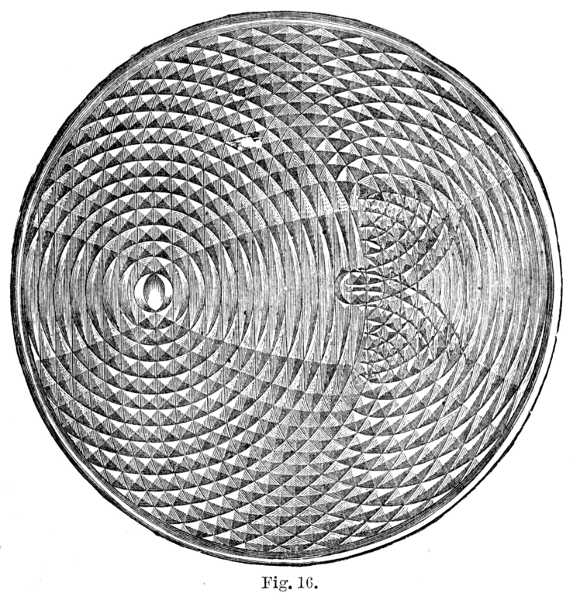
To the eye of a person who understands these things, nothing can be more interesting than the rippling of water under certain circumstances. By the action of interference its surface is sometimes shivered into the most beautiful mosaic, shifting and trembling as if with a kind of visible music. When the tide advances over a sea-beach on a calm and sunny day, and its tiny ripples enter, at various points, the clear shallow pools which the preceding tide had left behind, the little wavelets run and climb and cross each other, and thus form a lovely chasing, which has its counterpart in the lines of light converged by the ripples upon the sand underneath. When waves are skilfully generated in a vessel of mercury, and a strong light reflected from the surface of the metal is received upon a screen, the most beautiful effects may be observed. The shape of the vessel determines, in part, the character of the figures produced; in a circular dish of mercury, for example, a disturbance at the centre propagates itself in circular waves, which after reflection again encircle the centre. If the point of disturbance be a little removed from the centre, the intersections of the direct and reflected waves produce the magnificent chasing shown in the annexed figure (16), which I have borrowed from the excellent work on Waves by the Messrs. Weber. The luminous figure reflected from such a surface is exceedingly beautiful. When the mercury is lightly struck by a glass point, in a direction concentric with the circumference of the vessel, the lines of light run round the vessel in mazy coils, interlacing and unravelling themselves in the most wonderful manner. If the vessel be square, a splendid mosaic is produced by the crossing of the direct and reflected waves. Description, however, can give but a feeble idea of these exquisite effects;—
"Thou canst not wave thy staff in the air, Or dip thy paddle in the lake, But it carves the brow of beauty there, And the ripples in rhymes the oar forsake."
CHASING PRODUCED BY WAVES.
Fig. 16. Chasing produced by waves.
EFFECT OF RETARDATION.
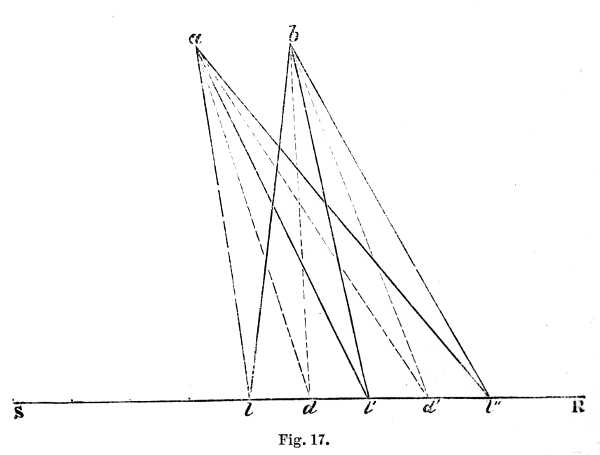
Now, all that we have said regarding the retardation of the waves of water, by a whole undulation and a semi-undulation, is perfectly applicable to the case of light. Two luminous points may be placed near to each other so as to resemble the two stones dropped into the water; and when the light of these is properly received upon a screen, or directly upon the retina, we find that at some places the action of the rays upon each other produces darkness, and at others augmented light. The former places are those where the rays emitted from one point are an odd number of semi-undulations in advance of the rays sent from the other; the latter places are those where the difference of path described by the rays is either nothing, or an even number of semi-undulations. Supposing a and b (Fig. 17) to be two such sources of light, and s r a screen on which the light falls; at a point l, equally distant from a and b, we have light; at a point d, where a d is half an undulation longer than b d, we have darkness; at l', where a l' is a whole wave-length, or two semi-undulations, longer than b l', we again have light; and at a point d', where the difference is three semi-undulations, we have darkness; and thus we obtain a series of bright and dark spaces as we recede laterally from the central point l.
Fig. 17. Diagram explanatory of Interference.
Let a bit of tin foil be closely pasted upon a piece of glass, and the edge of a penknife drawn across the foil so as to produce a slit. Looking through this slit at a small and distant light, we find the light spread out in a direction at right angles to the slit, and if the light looked at be monochromatic, that is, composed of a single colour, we shall have a series of bright and dark bars corresponding to the points at which the rays from the different points of the slit alternately coincide and interfere upon the retina. By properly drawing a knife across a sheet of letter-paper a suitable slit may also be obtained; and those practised in such things can obtain the effect by looking through their fingers or their eyelashes.
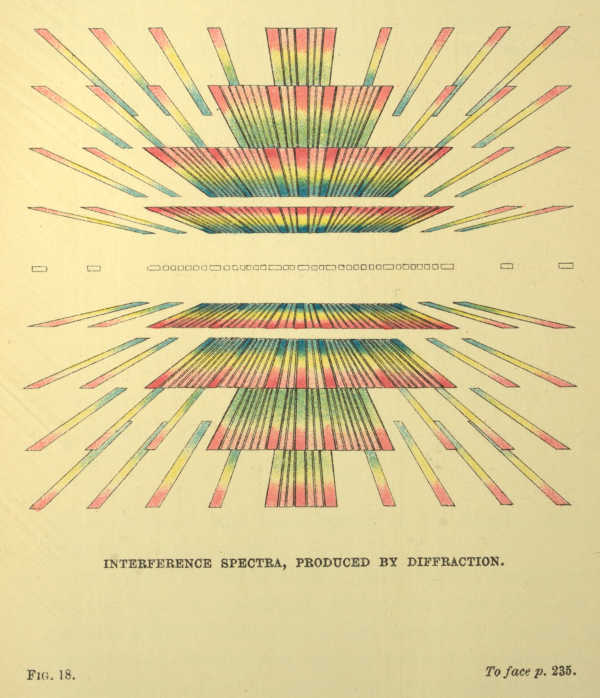
INTERFERENCE SPECTRA, PRODUCED BY DIFFRACTION. Fig. 18.
CHROMATIC EFFECTS.
But if the light looked at be white, the light of a candle for example, or of a jet of gas, instead of having a series of bright and dark bars, we have the bars coloured. And see how beautifully this harmonizes with what has been already said regarding the different lengths of the waves which produce different colours. Looking again at Fig. 17 we see that a certain obliquity is necessary to cause one ray to be a whole undulation in advance of the other at the point l'; but it is perfectly manifest that the obliquity must depend upon the length of the undulation; a long undulation would require a greater obliquity than a short one; red light, for example, requires a greater obliquity than blue light; so that if the point l' represents the place where the first bar of red light would be at its maximum strength, the maximum for blue would lie a little to the left of l'; the different colours are in this way separated from each other, and exhibit themselves as distinct fringes when a distant source of white light is regarded through a narrow slit.
By varying the shape of the aperture we alter the form of the chromatic image. A circular aperture, for example, placed in front of a telescope through which a point of white light is regarded, is seen surrounded by a concentric system of coloured rings. If we multiply our slits or apertures the phenomena augment in complexity and splendour. To give some notion of this I have copied from the excellent work of M. Schwerd the annexed figure (Fig. 18) which represents the gorgeous effect observed when a distant point of light is looked at through two gratings with slits of different widths.[B] A bird's feather represents a peculiar system of slits, and the effect observed on properly looking through it is extremely interesting.
COLOURS OF THIN FILMS.
There are many ways by which the retardation necessary to the production of interference is effected. The splendid colours of a soap-bubble are entirely due to interference; the beam falling upon the transparent film is partially reflected at its outer surface, but a portion of it enters the film and is reflected at its inner surface. The latter portion having crossed the film and returned, is retarded, in comparison with the former, and, if the film be of suitable thickness, these two beams will clash and extinguish each other, while another thickness will cause the beams to coincide and illuminate the film with a light of greater intensity. From what has been said it must be manifest that to make two red beams thus coincide a thicker film would be required than would be necessary for two blue or green beams; thus, when the thickness of the bubble is suitable for the development of red, it is not suitable for the development of green, blue, &c.; the consequence is that we have different colours at different parts of the bubble. Owing to its compactness and to its being shaded by a covering of débris from the direct heat of the sun, the ice underneath the moraines of glaciers appears sometimes of a pitchy blackness. While cutting such ice with my axe I have often been surprised and delighted by sudden flashes of coloured light which broke like fire from the mass. These flashes were due to internal rupture, by which fissures were produced as thin as the film of a soap-bubble; the colours being due to the interference of the light reflected from the opposite sides of the fissures.
If spirit of turpentine, or olive oil, be thrown upon water, it speedily spreads in a thin film over the surface, and the most gorgeous chromatic phenomena may be thus produced. Oil of lemons is also peculiarly suited to this experiment. If water be placed in a tea-tray, and light of sufficient intensity be suffered to fall upon it, this light will be reflected from the upper and under surfaces of the film of oil, and the colours thus produced may be received upon a screen, and seen at once by many hundred persons. If the oil of cinnamon be used, fine colours are also obtained, and the breaking up of this film exhibits a most interesting case of molecular action. By using a kind of varnish, instead of oil, Mr. Delarue has imparted such tenacity to these films that they may be removed from the water on which they rest and preserved for any length of time. By such films the colours of certain beetles, and of the wings of certain insects, may be accurately imitated; and a rook's feather may be made to shine with magnificent iridescences. The colours of tempered metals, and the beautiful metallochrome of Nobili are also due to a similar cause.
DIFFRACTION.
These colours are called the colours of thin plates, and are distinguished in treatises on optics from the coloured bars and fringes above referred to, which are produced by diffraction, or the bending of the waves round the edge of an object. One result of this bending, which is of interest to us, was obtained by the celebrated Thomas Young. Permitting a beam of sunlight to enter a dark room through an aperture made with a fine needle, and placing in the path of the beam a bit of card one-thirtieth of an inch wide, he found the shadow of this card, or rather the line on which its shadow might be supposed to fall, always bright; and he proved the effect to be due to the bending of the waves of ether round the two edges of the card, and their coincidence at the other side. It has, indeed, been shown by M. Poisson, that the centre of the shadow of a small circular opaque disk which stands in the way of a beam diverging from a point is exactly as much illuminated as if the disk were absent. The singular effects described by M. Necker in the letter quoted at page 178 at once suggest themselves here; and we see how possible it is for the solar rays, in grazing a distant tree, so to bend round it as to produce upon the retina, where shadow might be expected, the impression of a tree of light.[C] Another effect of diffraction is especially interesting to us at present. Let the seed of lycopodium be scattered over a glass plate, or even like a cloud in the air, and let a distant point of light be regarded through it; the luminous point will appear surrounded by a series of coloured rings, and when the light is intense, like the electric or the Drummond light, the effect is exceedingly fine.
CLOUD IRIDESCENCE, ETC., EXPLAINED.
And now for the application of these experiments. I have already mentioned a series of coloured rings observed around the sun by Mr. Huxley and myself from the Rhone glacier; I have also referred to the cloud iridescences on the Aletschhorn; and to the colours observed during my second ascent of Monte Rosa, the magnificence of which is neither to be rendered by pigments nor described in words. All these splendid phenomena are, I believe, produced by diffraction, the vesicles or spherules of water in the case of the cloud acting the part of the sporules in the case of the lycopodium. The coloured fringe which surrounds the Spirit of the Brocken, and the spectra which I have spoken of as surrounding the sun, are also produced by diffraction. By the interference of their rays in the earth's atmosphere the stars can momentarily quench themselves; and probably to an intermittent action of this kind their twinkling, and the swift chromatic changes already mentioned, are due. Does not all this sound more like a fairy tale than the sober conclusions of science? What effort of the imagination could transcend the realities here presented to us? The ancients had their spheral melodies, but have not we ours, which only want a sense sufficiently refined to hear them? Immensity is filled with this music; wherever a star sheds its light its notes are heard. Our sun, for example, thrills concentric waves through space, and every luminous point that gems our skies is surrounded by a similar system. I have spoken of the rising, climbing and crossing of the tiny ripples of a calm tide upon a smooth strand; but what are they to those intersecting ripples of the "uncontinented deep" by which Infinity is engine-turned! Crossing solar and stellar distances, they bring us the light of sun and stars; thrilled back from our atmosphere, they give us the blue radiance of the sky; rounding liquid spherules, they clash at the other side, and the survivors of the tumult bear to our vision the wondrous cloud-dyes of Monte Rosa.
FOOTNOTES:
RADIANT HEAT.
(2.)
Thus, then, we have been led from Sound to Light, and light now in its turn will lead us to Radiant Heat; for in the order in which they are here mentioned the conviction arose that they are all three different kinds of motion. It has been said that the beams of the sun consist of rays of different colours, but this is not a complete statement of the case. The sun emits a multitude of rays which are perfectly non-luminous; and the same is true, in a still greater degree, of our artificial sources of illumination. Measured by the quantity of heat which they produce, 90 per cent. of the rays emanating from a flame of oil are obscure; while 99 out of every 100 of those which emanate from an alcohol flame are of the same description.[A]
OBSCURE RAYS.
In fact, the visible solar spectrum simply embraces an interval of rays of which the eye is formed to take cognizance, but it by no means marks the limits of solar action. Beyond the violet end of the spectrum we have obscure rays capable of producing chemical changes, and beyond the red we have rays possessing a high heating power, but incapable of exciting the impression of light. This latter fact was first established by Sir William Herschel, and it has been amply corroborated since.
The belief now universally prevalent is, that the rays of heat differ from the rays of light simply as one colour differs from another. As the waves which produce red are longer than those which produce yellow, so the waves which produce this obscure heat are longer than those which produce red. In fact, it may be shown that the longest waves never reach the retina at all; they are completely absorbed by the humours of the eye.
What is true of the sun's obscure rays is also true of calorific rays emanating from any obscure source,—from our own bodies, for example, or from the surface of a vessel containing boiling water. We must, in fact, figure a warm body also as having its particles in a state of vibration. When these motions are communicated from particle to particle of the body the heat is said to be conducted; when, on the contrary, the particles transmit their vibrations through the surrounding ether, the heat is said to be radiant. This radiant heat, though obscure, exhibits a deportment exactly similar to light. It may be refracted and reflected, and collected in the focus of a mirror or of a suitable lens. The principle of interference also applies to it, so that by adding heat to heat we can produce cold. The identity indeed is complete throughout, and, recurring to the analogy of sound, we might define this radiant heat to be light of too low a pitch to be visible.
I have thus far spoken of obscure heat only; but the selfsame ray may excite both light and heat. The red rays of the spectrum possess a very high heating power. It was once supposed that the heat of the spectrum was an essence totally distinct from its light; but a profounder knowledge dispels this supposition, and leads us to infer that the selfsame ray, falling upon the nerves of feeling, excites heat, and falling upon the nerves of seeing, excites light. As the same electric current, if sent round a magnetic needle, along a wire, and across a conducting liquid, produces different physical effects, so also the same agent acting upon different organs of the body affects our consciousness differently.
FOOTNOTES:
(3.)
HEAT A KIND OF MOTION.
Heat has been defined in the foregoing section as a motion of the molecules or atoms of a body; but though the evidence in favour of this view is at present overwhelming, I do not ask the reader to accept it as a certainty, if he feels sceptically disposed. In this case, I would only ask him to accept it as a symbol. Regarded as a mere physical image, a kind of paper-currency of the mind, convertible, in due time, into the gold of truth, the hypothesis will be found exceedingly useful.
All known bodies possess more or less of this molecular motion, and all bodies are communicating it to the ether in which they are immersed. Ice possesses it. Ice before it melts attains a temperature of 32° Fahr., but the substance in winter often possesses a temperature far below 32°, so that in rising to 32° it is warmed. In experimenting with ice I have often had occasion to cool it to 100° and more below the freezing point, and to warm it afterwards up to 32°.
If then we stand before a wall of ice, the wall radiates heat to us, and we also radiate heat to it; but the quantity which we radiate being greater than that which the ice radiates, we lose more than we gain, and are consequently chilled. If, on the contrary, we stand before a warm stove, a system of exchanges also takes place; but here the quantity we receive is in excess of the quantity lost, and we are warmed by the difference.
In like manner the earth radiates heat by day and by night into space, and against the sun, moon, and stars. By day, however, the quantity received is greater than the quantity lost, and the earth is warmed; by night the conditions are reversed; the earth radiates more heat than is sent to her by the moon and stars, and she is consequently cooled.
But here an important point is to be noted:—the earth receives the heat of the sun, moon, and stars, in great part as luminous heat, but she gives it out as obscure heat. I do not now speak of the heat reflected by the earth into space, as the light of the moon is to us; but of the heat which, after it has been absorbed by the earth, and has contributed to warm it, is radiated into space, as if the earth itself were its independent source. Thus we may properly say that the heat radiated from the earth is different in quality from that which the earth has received from the sun.
QUALITIES OF HEAT.
In one particular especially does this difference of quality show itself; besides being non-luminous, the heat radiated from the earth is more easily intercepted and absorbed by almost all transparent substances. A vast portion of the sun's rays, for example, can pass instantaneously through a thick sheet of water; gunpowder could easily be fired by the heat of the sun's rays converged by passing through a thick water lens; the drops upon leaves in greenhouses often act as lenses, and cause the sun to burn the leaves upon which they rest. But with regard to the rays of heat emanating from an obscure source, they are all absorbed by a layer of water less than the 20th of an inch in thickness: water is opaque to such rays, and cuts them off almost as effectually as a metallic screen. The same is true of other liquids, and also of many transparent solids.
THE ATMOSPHERE LIKE A RATCHET.
Assuming the same to be true of gaseous bodies, that they also intercept the obscure rays much more readily than the luminous ones, it would follow that while the sun's rays penetrate our atmosphere with freedom, the change which they undergo in warming the earth deprives them in a measure of this penetrating power. They can reach the earth, but they cannot get back; thus the atmosphere acts the part of a ratchet-wheel in mechanics; it allows of motion in one direction, but prevents it in the other.
De Saussure, Fourier, M. Pouillet, and Mr. Hopkins have developed this speculation, and drawn from it consequences of the utmost importance; but it nevertheless rested upon a basis of conjecture. Indeed some of the eminent men above-named deemed its truth beyond the possibility of experimental verification. Melloni showed that for a distance of 18 or 20 feet the absorption of obscure rays by the atmosphere was absolutely inappreciable. Hence, the total absorption being so small as to elude even Melloni's delicate tests, it was reasonable to infer that differences of absorption, if such existed at all, must be far beyond the reach of the finest means which we could apply to detect them.
DIFFERENCES OF ABSORPTION BY GASES.
This exclusion of one of the three states of material aggregation from the region of experiment was, however, by no means satisfactory; for our right to infer, from the deportment of a solid or a liquid towards radiant heat, the deportment of a gas, is by no means evident. In both liquids and solids we have the molecules closely packed, and more or less chained by the force of cohesion; in gases, on the contrary, they are perfectly free, and widely separated. How do we know that the interception of radiant heat by liquids and solids may not be due to an arrangement and comparative rigidity of their parts, which gases do not at all share? The assumption which took no note of such a possibility seemed very insecure, and called for verification.
My interest in this question was augmented by the fact, that the assumption referred to lies, as will be seen, at the root of the glacier question. I therefore endeavoured to fill the gap, and to do for gases and vapours what had been already so ably done for liquids and solids by Melloni. I tried the methods heretofore pursued, and found them unavailing; oxygen, hydrogen, nitrogen, and atmospheric air, examined by such methods, showed no action upon radiant heat. Nature was dumb, but the question occurred, "Had she been addressed in the proper language?" If the experimentalist is convinced of this, he will rest content even with a negative; but the absence of this conviction is always a source of discomfort, and a stimulus to try again.
The principle of the method finally applied is all that can here be referred to; and it, I hope, will be quite intelligible. Two beams of heat, from two distinct sources, were allowed to fall upon the same instrument,[A] and to contend there for mastery. When both beams were perfectly equal, they completely neutralized each other's action; but when one of them was in any sensible degree stronger than the other, the predominance of the former was shown by the instrument. It was so arranged that one of the conflicting beams passed through a tube which could be exhausted of air, or filled with any gas; thus varying at pleasure the medium through which it passed. The question then was, supposing the two beams to be equal when the tube was filled with air, will the exhausting of the tube disturb the equality? The answer was affirmative; the instrument at once showed that a greater quantity of heat passed through the vacuum than through the air.
The experiment was so arranged that the effect thus produced was very large as measured by the indications of the instrument. But the action of the simple gases, oxygen, hydrogen, and nitrogen, was incomparably less than that produced by some of the compound gases, while these latter again differed widely from each other. Vapours exhibited differences of equal magnitude. The experiments indeed proved that gaseous bodies varied among themselves, as to their power of transmitting radiant heat, just as much as liquids and solids. It was in the highest degree interesting to observe how a gas or vapour of perfect transparency, as regards light, acted like an opaque screen upon the heat. To the eye, the gas within the tube might be as invisible as the air itself, while to the radiant heat it behaved like a cloud which it was almost impossible to penetrate.
SELECTED HEAT.
Applying the same method, I have found that from the sun, from the electric light, or from the lime-light, a large amount of heat can be selected, which is unaffected not only by air, but by the most energetic gases that experiment has revealed to me; while this same heat, when it has its quality changed by being rendered obscure, is powerfully intercepted. Thus the bold and beautiful speculation above referred to has been made an experimental fact; the radiant heat of the sun does certainly pass through the atmosphere to the earth with greater facility than the radiant heat of the earth can escape into space.
POSSIBLE HEAT OF NEPTUNE.
It is probable that, were the earth unfurnished with this atmospheric swathing, its conditions of temperature would be such as to render it uninhabitable by man; and it is also probable that a suitable atmosphere enveloping the most distant planet might render it, as regards temperature, perfectly habitable. If the planet Neptune, for example, be surrounded by an atmosphere which permits the solar and stellar rays to pass towards the planet, but cuts off the escape of the warmth which they excite, it is easy to see that such an accumulation of heat may at length take place as to render the planet a comfortable habitation for beings constituted like ourselves.[B]
But let us not wander too far from our own concerns. Where radiant heat is allowed to fall upon an absorbing substance, a certain thickness of the latter is always necessary for the absorption. Supposing we place a thin film of glass before a source of heat, a certain percentage of the heat will pass through the glass, and the remainder will be absorbed. Let the transmitted portion fall upon a second film similar to the first, a smaller percentage than before will be absorbed. A third plate would absorb still less, a fourth still less; and, after having passed through a sufficient number of layers, the heat would be so sifted that all the rays capable of being absorbed by glass would be abstracted from it. Suppose all these films to be placed together so as to form a single thick plate of glass, it is evident that the plate must act upon the heat which falls upon it, in such a manner that the major portion is absorbed near the surface at which the heat enters. This has been completely verified by experiment.
COLD OF UPPER ATMOSPHERE.
Applying this to the heat radiated from the earth, it is manifest that the greatest quantity of this heat will be absorbed by the lowest atmospheric strata. And here we find ourselves brought, by considerations apparently remote, face to face with the fact upon which the existence of all glaciers depends, namely, the comparative coldness of the upper regions of the atmosphere. The sun's rays can pass in a great measure through these regions without heating them; and the earth's rays, which they might absorb, hardly reach them at all, but are intercepted by the lower portions of the atmosphere.[C]
Another cause of the greater coldness of the higher atmosphere is the expansion of the denser air of the lower strata when it ascends. The dense air makes room for itself by pushing back the lighter and less elastic air which surrounds it: it does work, and, to perform this work, a certain amount of heat must be consumed. It is the consumption of this heat—its absolute annihilation as heat—that chills the expanded air, and to this action a share of the coldness of the higher atmosphere must undoubtedly be ascribed. A third cause of the difference of temperature is the large amount of heat communicated, by way of contact, to the air of the earth's surface; and a fourth and final cause is the loss endured by the highest strata through radiation into space.
FOOTNOTES:
ORIGIN OF GLACIERS. (4.)
THE SNOW-LINE.
Having thus accounted for the greater cold of the higher atmospheric regions, its consequences are next to be considered. One of these is, that clouds formed in the lower portions of the atmosphere, in warm and temperate latitudes, usually discharge themselves upon the earth as rain; while those formed in the higher regions discharge themselves upon the mountains as snow. The snow of the higher atmosphere is often melted to rain in passing through the warmer lower strata: nothing indeed is more common than to pass, in descending a mountain, from snow to rain; and I have already referred to a case of this kind. The appearance of the grassy and pine-clad alps, as seen from the valleys after a wet night, is often strikingly beautiful; the level at which the snow turned to rain being distinctly marked upon the slopes. Above this level the mountains are white, while below it they are green. The eye follows this snow-line with ease along the mountains, and when a sufficient extent of country is commanded its regularity is surprising.
The term "snow-line," however, which has been here applied to a local and temporary phenomenon, is commonly understood to mean something else. In the case just referred to it marked the place where the supply of solid matter from the upper atmospheric regions, during a single fall, was exactly equal to its consumption; but the term is usually understood to mean the line along which the quantity of snow which falls annually is melted, and no more. Below this line each year's snow is completely cleared away by the summer heat; above it a residual layer abides, which gradually augments in thickness from the snow-line upwards.
MOUNTAINS UNLOADED BY GLACIERS.
Here then we have a fresh layer laid on every year; and it is evident that, if this process continued without interruption, every mountain which rises above the snow-line must augment annually in height; the waters of the sea thus piled, in a solid form, upon the summits of the hills, would raise the latter to an indefinite elevation. But, as might be expected, the snow upon steep mountain-sides frequently slips and rolls down in avalanches into warmer regions, where it is reduced to water. A comparatively small quantity of the snow is, however, thus got rid of, and the great agent which Nature employs to relieve her overladen mountains is the glaciers.
Let us here avoid an error which may readily arise out of the foregoing reflections. The principal region of clouds and rain and snow extends only to a limited distance upwards in the atmosphere; the highest regions contain very little moisture, and were our mountains sufficiently lofty to penetrate those regions, the quantity of snow falling upon their summits would be too trifling to resist the direct action of the solar rays. These would annually clear the summits to a certain level, and hence, were our mountains high enough, we should have a superior, as well as an inferior, snow-line; the region of perpetual snow would form a belt, below which, in summer, snowless valleys and plains would extend, and above which snowless summits would rise.
(5.)
WHITE AND BLUE ICE.
At its origin then a glacier is snow—at its lower extremity it is ice. The blue blocks that arch the source of the Arveiron were once powdery snow upon the slopes of the Col du Géant. Could our vision penetrate into the body of the glacier, we should find that the change from white to blue essentially consists in the gradual expulsion of the air which was originally entangled in the meshes of the fallen snow. Whiteness always results from the intimate and irregular mixture of air and a transparent solid; a crushed diamond would resemble snow; if we pound the most transparent rock-salt into powder we have a substance as white as the whitest culinary salt; and the colourless glass vessel which holds the salt would also, if pounded, give a powder as white as the salt itself. It is a law of light that in passing from one substance to another possessing a different power of refraction, a portion of it is always reflected. Hence when light falls upon a transparent solid mixed with air, at each passage of the light from the air to the solid and from the solid to the air a portion of it is reflected; and, in the case of a powder, this reflection occurs so frequently that the passage of the light is practically cut off. Thus, from the mixture of two perfectly transparent substances, we obtain an opaque one; from the intimate mixture of air and water we obtain foam; clouds owe their opacity to the same principle; and the condensed steam of a locomotive casts a shadow upon the fields adjacent to the line, because the sunlight is wasted in echoes at the innumerable limiting surfaces of water and air.
AIR-BUBBLES IN ICE.
The snow which falls upon high mountain-eminences has often a temperature far below the freezing point of water. Such snow is dry, and if it always continued so the formation of a glacier from it would be impossible. The first action of the summer's sun is to raise the temperature of the superficial snow to 32°, and afterwards to melt it. The water thus formed percolates through the colder mass underneath, and this I take to be the first active agency in expelling the air entangled in the snow. But as the liquid trickles over the surfaces of granules colder than itself it is partially deposited in a solid form on these surfaces, thus augmenting the size of the granules, and cementing them together. When the mass thus formed is examined, the air within it is found as round bubbles. Now it is manifest that the air caught in the irregular interstices of the snow can have no tendency to assume this form so long as the snow remains solid; but the process to which I have referred—the saturation of the lower portions of the snow by the water produced by the melting of the superficial portions—enables the air to form itself into globules, and to give the ice of the névé its peculiar character. Thus we see that, though the sun cannot get directly at the deeper portions of the snow, by liquefying the upper layer he charges it with heat, and makes it his messenger to the cold subjacent mass.
The frost of the succeeding winter may, I think, or may not, according to circumstances, penetrate through this layer, and solidify the water which it still retains in its interstices. If the winter set in with clear frosty weather, the penetration will probably take place; but if heavy snow occur at the commencement of winter, thus throwing a protective covering over the névé, freezing to any great depth may be prevented. Mr. Huxley's idea seems to be quite within the range of possibility, that water-cells may be transmitted from the origin of the glacier to its end, retaining their contents always liquid.
SNOW PRESSED TO ICE.
It was formerly supposed, and is perhaps still supposed by many, that the snow of the mountains is converted into the ice of the glacier by the process of saturation and freezing just indicated. But the frozen layer would not yet resemble glacier ice; it is only at the deeper portions of the névé that we find an approximation to the true ice of the glacier. This brings us to the second great agent in the process of glacification, namely, pressure. The ice of the névé at 32° may be squeezed or crushed with extreme facility; and if the force be applied slowly and with caution, the yielding of the mass may be made to resemble the yielding of a plastic body. In the depths of the névé, where each portion of the ice is surrounded by a resistant mass, rude crushing is of course out of the question. The layers underneath yield with extreme slowness to the pressure of the mass above them; they are squeezed, but not rudely fractured; and even should rude fracture occur, the ice, as shall subsequently be shown, possesses the power of restoring its own continuity. Thus, then, the lower portions of the névé are removed by pressure more and more from the condition of snow, the air-bubbles which give to the névé-ice its whiteness are more and more expelled, and this process, continued throughout the entire glacier, finally brings the ice to that state of magnificent transparency which we find at the termination of the glacier of Rosenlaui and elsewhere. This is all capable of experimental proof. The Messrs. Schlagintweit compressed the snow of the névé to compact ice; and I have myself frequently obtained slabs of ice from snow in London.
COLOUR OF WATER AND ICE. (6.)
The sun is continually sending forth waves of different lengths, all of which travel with the same velocity through the ether. When these waves enter a prism of glass they are retarded, but in different degrees. The shorter waves suffer the greatest retardation, and in consequence of this are most deflected from their straight course. It is this property which enables us to separate one from the other in the solar spectrum, and this separation proves that the waves are by no means inextricably entangled with each other, but that they travel independently through space.
In consequence of this independence, the same body may intercept one system of waves while it allows another to pass: on this quality, indeed, depend all the phenomena of colour. A red glass, for example, is red because it is so constituted that it destroys the shorter waves which produce the other colours, and transmits only the waves which produce red. I may remark, however, that scarcely any glass is of a pure colour; along with the predominant waves, some of the other waves are permitted to pass. The colours of flowers are also very impure; in fact, to get pure colours we must resort to a delicate prismatic analysis of white light.
LONG WAVES MOST ABSORBED.
It has already been stated that a layer of water less than the twentieth of an inch in thickness suffices to stop and destroy all waves of radiant heat emanating from an obscure source. The longer waves of the obscure heat cannot get through water, and I find that all transparent compounds which contain hydrogen are peculiarly hostile to the longer undulations. It is, I think, the presence of this element in the humours of the eye which prevents the extra red rays of the solar spectrum from reaching the retina. It is interesting to observe that while bisulphide of carbon, chloride of phosphorus, and other liquids which contain no hydrogen, permit a large portion of the rays emanating from an iron or copper ball, at a heat below redness, to pass through them with facility, the same thickness of substances equally transparent, but which contain hydrogen, such as ether, alcohol, water, or the vitreous humour of the eye of an ox, completely intercepts these obscure rays. The same is true of solid bodies; a very slight thickness of those which contain hydrogen offers an impassable barrier to all rays emanating from a non-luminous source.[A] But the heat thus intercepted is by no means lost; its radiant form merely is destroyed. Its waves are shivered upon the particles of the body, but they impart warmth to it, while the heat which retains its radiant form contributes in no way to the warmth of the body through which it passes.
FINAL COLOUR OF ICE AND WATER BLUE.
Water then absorbs all the extra red rays of the sun, and if the layer be thick enough it invades the red rays themselves. Thus the greater the distance the solar beams travel through pure water the more are they deprived of those components which lie at the red end of the spectrum. The consequence is, that the light finally transmitted by the water, and which gives to it its colour, is blue.
EXPERIMENT.
I find the following mode of examining the colour of water both satisfactory and convenient:—A tin tube, fifteen feet long and three inches in diameter, has its two ends stopped securely by pieces of colourless plate glass. It is placed in a horizontal position, and pure water is poured into it through a small lateral pipe, until the liquid reaches half way up the glasses at the ends; the tube then holds a semi-cylinder of water and a semi-cylinder of air. A white plate, or a sheet of white paper, well illuminated, is then placed at a little distance from one end of the tube, and is looked at through the tube. Two semicircular spaces are then seen, one by the light which has passed through the air, the other by the light which has passed through the water; and their proximity furnishes a means of comparison, which is absolutely necessary in experiments of this kind. It is always found that, while the former semicircle remains white, the latter one is vividly coloured.[B]
When the beam from an electric lamp is sent through this tube, and a convex lens is placed at a suitable distance from its most distant end, a magnified image of the coloured and uncoloured semicircles may be projected upon a screen. Tested thus, I have sometimes found, after rain, the ordinary pipe-water of the Royal Institution quite opaque; while, under other circumstances, I have found the water of a clear green. The pump-water of the Institution thus examined exhibits a rich sherry colour, while distilled water is blue-green.
The blueness of the Grotto of Capri is due to the fact that the light which enters it has previously traversed a great depth of clear water. According to Bunsen's account, the laugs, or cisterns of hot water, in Iceland must be extremely beautiful. The water contains silica in solution, which, as the walls of the cistern arose, was deposited upon them in fantastic incrustations. These, though white, when looked at through the water appear of a lovely blue, which deepens in tint as the vision plunges deeper into the liquid.
ICE OPAQUE TO RADIANT HEAT.
Ice is a crystal formed from this blue liquid, the colour of which it retains. Ice is the most opaque of transparent solids to radiant heat, as water is the most opaque of liquids. According to Melloni, a plate of ice one twenty-fifth of an inch thick, which permits the rays of light to pass without sensible absorption, cuts off 94 per cent. of the rays of heat issuing from a powerful oil lamp, 991/2 per cent. of the rays issuing from incandescent platinum, and the whole of the rays issuing from an obscure source. The above numbers indicate how large a portion of the rays emitted by our artificial sources of light is obscure.
When the rays of light pass through a sufficient thickness of ice the longer waves are, as in the case of water, more and more absorbed, and the final colour of the substance is therefore blue. But when the ice is filled with minute air-bubbles, though we should loosely call it white, it may exhibit, even in small pieces, a delicate blue tint. This, I think, is due to the frequent interior reflection which takes place at the surfaces of the air-cells; so that the light which reaches the eye from the interior may, in consequence of its having been reflected hither and thither, really have passed through a considerable thickness of ice. The same remark, as we have already seen, applies to the delicate colour of newly fallen snow.
FOOTNOTES:
COLOURS OF THE SKY. (7.)
NEWTON'S HYPOTHESIS.
In treating of the Colours of Thin Plates we found that a certain thickness was necessary to produce blue, while a greater thickness was necessary for red. With that wonderful power of generalization which belonged to him, Newton thus applies this apparently remote fact to the blue of the sky:—"The blue of the first order, though very faint and little, may possibly be the colour of some substances, and particularly the azure colour of the skies seems to be of this order. For all vapours, when they begin to condense and coalesce into small parcels, become first of that bigness whereby such an azure is reflected, before they can constitute clouds of other colours. And so, this being the first colour which vapours begin to reflect, it ought to be the colour of the finest and most transparent skies, in which vapours are not arrived at that grossness requisite to reflect other colours, as we find it is by experience."
M. Clausius has written a most interesting paper, which he endeavours to show that the minute particles of water which are supposed by Newton to reflect the light, cannot be little globes entirely composed of water, but bladders or hollow spheres; the vapour must be in what is generally termed the vesicular state. He was followed by M. Brücke, whose experiments prove that the suspended particles may be so small that the reasoning of M. Clausius may not apply to them.
But why need we assume the existence of such particles at all?—why not assume that the colour of the air is blue, and renders the light of the sun blue, after the fashion of a blue glass or a solution of the sulphate of copper? I have already referred to the great variation which the colour of the firmament undergoes in the Alps, and have remarked that this seems to indicate that the blue depends upon some variable constituent of the atmosphere. Further, we find that the blue light of the sky is reflected light; and there must be something in the atmosphere capable of producing this reflection; but this thing, whatever it is, produces another effect which the blue glass or liquid is unable to produce. These transmit blue light, whereas, when the solar beams have traversed a great length of air, as in the morning or the evening, they are yellow, or orange, or even blood-red, according to the state of the atmosphere:—the transmitted light and the reflected light of the atmosphere are then totally different in colour.
GOETHE'S HYPOTHESIS.
Goethe, in his celebrated 'Farbenlehre,' gives a theory of the colour of the sky, and has illustrated it by a series of striking facts. He assumed two principles in the universe—Light and Darkness—and an intermediate stage of Turbidity. When the darkness is seen through a turbid medium on which the light falls, the medium appears blue; when the light itself is viewed through such a medium, it is yellow, or orange, or ruby-red. This he applies to the atmosphere, which sends us blue light, or red, according as the darkness of infinite space, or the bright surface of the sun, is regarded through it.
As a theory of colours Goethe's work is of no value, but the facts which he has brought forward in illustration of the action of turbid media are in the highest degree interesting. He refers to the blueness of distant mountains, of smoke, of the lower part of the flame of a candle (which if looked at with a white surface behind it completely disappears), of soapy water, and of the precipitates of various resins in water. One of his anecdotes in connexion with this subject is extremely curious and instructive. The portrait of a very dignified theologian having suffered from dirt, it was given to a painter to be cleaned. The clergyman was drawn in a dress of black velvet, over which the painter, in the first place, passed his sponge. To his astonishment the black velvet changed to the colour of blue plush, and completely altered the aspect of its wearer. Goethe was informed of the fact; the experiment was repeated in his presence, and he at once solved it by reference to his theory. The varnish of the picture when mixed with the water formed a turbid medium, and the black coat seen through it appeared blue; when the water evaporated the coat resumed its original aspect.
SUSPENDED PARTICLES.
With regard to the real explanation of these effects, it may be shown, that, if a beam of white light be sent through a liquid which contains extremely minute particles in a state of suspension, the short waves are more copiously reflected by such particles than the long ones; blue, for example, is more copiously reflected than red. This may be shown by various fine precipitates, but the best is that of Brücke. We know that mastic and various resins are soluble in alcohol, and are precipitated when the solution is poured into water: Eau de Cologne, for example, produces a white precipitate when poured into water. If however this precipitate be sufficiently diluted, it gives the liquid a bluish colour by reflected light. Even when the precipitate is very thick and gross, and floats upon the liquid like a kind of curd, its under portions often exhibit a fine blue. To obtain particles of a proper size, Brücke recommends 1 gramme of colourless mastic to be dissolved in 87 grammes of alcohol, and dropped into a beaker of water, which is kept in a state of agitation. In this way a blue resembling that of the firmament may be produced. It is best seen when a black cloth is placed behind the glass; but in certain positions this blue liquid appears yellow; and these are the positions when the transmitted light reaches the eye. It is evident that this change of colour must necessarily exist; for the blue being partially withdrawn by more copious reflection, the transmitted light must partake more or less of the character of the complementary colour; though it does not follow that they should be exactly complementary to each other.
THE SUN THROUGH LONDON SMOKE.
When a long tube is filled with clear water, the colour of the liquid, as before stated, shows itself by transmitted light. The effect is very interesting when a solution of mastic is permitted to drop into such a tube, and the fine precipitate to diffuse itself in the water. The blue-green of the liquid is first neutralized, and a yellow colour shows itself; on adding more of the solution the colour passes from yellow to orange, and from orange to blood-red. With a cell an inch and a half in width, containing water, into which the solution of mastic is suffered to drop, the same effect may be obtained. If the light of an electric lamp be caused to form a clear sunlike disk upon a white screen, the gradual change of this light by augmented precipitation into deep glowing red, resembling the colour of the sun when seen through fine London smoke, is exceedingly striking. Indeed the smoke acts, in some measure, the part of our finely-suspended matter.
MORNING AND EVENING RED.
By such means it is possible to imitate the phenomena of the firmament; we can produce its pure blue, and cause it to vary as in nature. The milkiness which steals over the heavens, and enables us to distinguish one cloudless day from another, can be produced with the greatest ease. The yellow, orange, and red light of the morning and evening can also be obtained: indeed the effects are so strikingly alike as to suggest a common origin—that the colours of the sky are due to minute particles diffused through the atmosphere. These particles are doubtless the condensed vapour of water, and its variation in quality and amount enables us to understand the variability of the firmamental blue, and of the morning and the evening red. Professor Forbes, moreover, has made the interesting observation that the steam of a locomotive, at a certain stage of its condensation, is blue or red according as it is viewed by reflected or transmitted light.
These considerations enable us to account for a number of facts of common occurrence. Thin milk, when poured upon a black surface, appears bluish. The milk is colourless; that is, its blueness is not due to absorption, but to a separation of the light by the particles suspended in the liquid. The juices of various plants owe their blueness to the same cause; but perhaps the most curious illustration is that presented by a blue eye. Here we have no true colouring matter, no proper absorption; but we look through a muddy medium at the black choroid coat within the eye, and the medium appears blue.[A]
COLOUR OF SWISS LAKES.
Is it not probable that this action of finely-divided matter may have some influence on the colour of some of the Swiss lakes—as that of Geneva for example? This lake is simply an expansion of the river Rhone, which rushes from the end of the Rhone glacier, as the Arveiron does from the end of the Mer de Glace. Numerous other streams join the Rhone right and left during its downward course; and these feeders, being almost wholly derived from glaciers, join the Rhone charged with the finer matter which these in their motion have ground from the rocks over which they have passed. But the glaciers must grind the mass beneath them to particles of all sizes, and I cannot help thinking that the finest of them must remain suspended in the lake throughout its entire length. Faraday has shown that a precipitate of gold may require months to sink to the bottom of a bottle not more than five inches high, and in all probability it would require ages of calm subsidence to bring all the particles which the Lake of Geneva contains to its bottom. It seems certainly worthy of examination whether such particles suspended in the water contribute to the production of that magnificent blue which has excited the admiration of all who have seen it under favourable circumstances.
FOOTNOTES:
THE MORAINES. (8.)
The surface of the glacier does not long retain the shining whiteness of the snow from which it is derived. It is flanked by mountains which are washed by rain, dislocated by frost, riven by lightning, traversed by avalanches, and swept by storms. The lighter débris is scattered by the winds far and wide over the glacier, sullying the purity of its surface. Loose shingle rattles at intervals down the sides of the mountains, and falls upon the ice where it touches the rocks. Large rocks are continually let loose, which come jumping from ledge to ledge, the cohesion of some being proof against the shocks which they experience; while others, when they hit the rocks, burst like bomb-shells, and shower their fragments upon the ice.
LATERAL MORAINES.
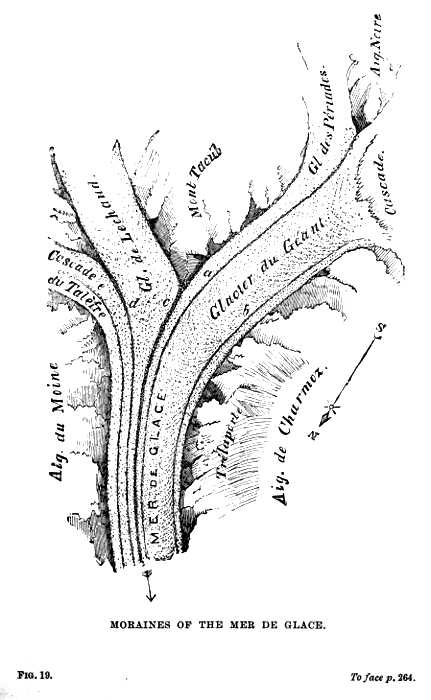
Thus the glacier is incessantly loaded along its borders with the ruins of the mountains which limit it; and it is evident that the quantity of rock and rubbish thus cast upon the glacier depends upon the character of the adjacent mountains. Where the summits are bare and friable, we may expect copious showers; where they are resistant, and particularly where they are protected by a covering of ice and snow, the quantity will be small. As the glacier moves downward, it carries with it the load deposited upon it. Long ridges of débris thus flank the glacier, and these ridges are called lateral moraines. Where two tributary glaciers join to form a trunk-glacier, their adjacent lateral moraines are laid side by side at the place of confluence, thus constituting a ridge which runs along the middle of the trunk-glacier, and which is called a medial moraine. The rocks and débris carried down by the glacier are finally deposited at its lower extremity, forming there a terminal moraine.
MEDIAL AND TERMINAL MORAINES.
It need hardly be stated that the number of medial moraines is only limited by the number of branch glaciers. If a glacier have but two branches, it will have only one medial moraine; if it have three branches, it will have two medial moraines; if n branches, it will have n-1 medial moraines. The number of medial moraines, in short, is always one less than the number of branches. A glance at the annexed figure will reveal the manner in which the lateral moraines of the Mer de Glace unite to form medial ones. (See Fig. 19.)
MORAINES OF THE MER DE GLACE. Fig. 19.
When a glacier diminishes in size it leaves its lateral moraines stranded on the flanks of the valleys. Successive shrinkings may thus occur, and have occurred at intervals of centuries; and a succession of old lateral moraines, such as many glacier-valleys exhibit, is the consequence. The Mer de Glace, for example, has its old lateral moraines, which run parallel with its present ones. The glacier may also diminish in length at distant intervals; the result being a succession of more or less concentric terminal moraines. In front of the Rhone-glacier we have six or seven such moraines, and the Mer de Glace also possesses a series of them.
Let us now consider the effect produced by a block of stone upon the surface of a glacier. The ice around it receives the direct rays of the sun, and is acted on by the warm air; it is therefore constantly melting. The stone also receives the solar beams, is warmed, and transmits its heat, by conduction, to the ice beneath it. If the heat thus transmitted to the ice through the stone be less than an equal space of the surrounding ice receives, it is manifest that the ice around the stone will waste more quickly than that beneath it, and the consequence is, that, as the surface sinks, it leaves behind it a pillar of ice, on which the block is elevated. If the stone be wide and flat, it may rise to a considerable height, and in this position it constitutes what is called a glacier-table. (See Fig. 6.)
GLACIER TABLES ACCOUNTED FOR.
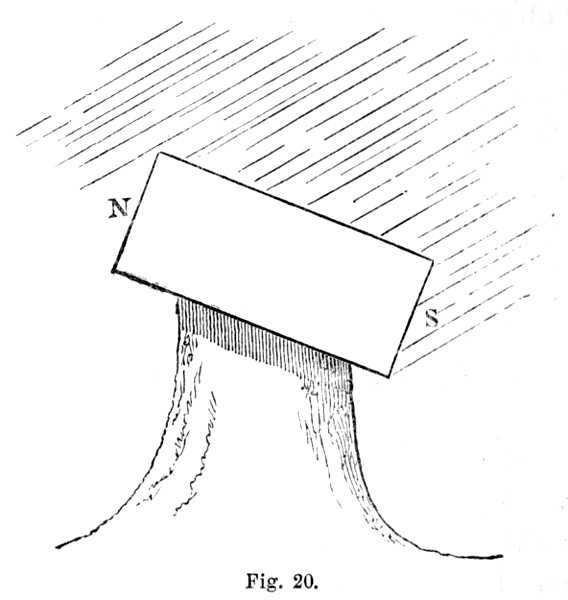
Almost all glaciers present examples of such tables; but no glacier with which I am acquainted exhibits them in greater number and perfection than the Unteraar glacier, near the Grimsel. Vast masses of granite are thus poised aloft on icy pedestals; but a limit is placed to their exaltation by the following circumstance. The sun plays obliquely upon the table all day; its southern extremity receives more heat than its northern, and the consequence is, that it dips towards the south. Strictly speaking, the plane of the dip rotates a little during the day, being a little inclined towards the east in the morning, north and south a little after noon, and inclined towards the west in the evening; so that, theoretically speaking, the block is a sun-dial, showing by its position the hour of the day. This rotation is, however, too small to be sensible, and hence the dip of the stones upon a glacier sufficiently exposed to the sunlight, enables us at any time to draw the meridian line along its surface. The inclination finally becomes so great that the block slips off its pedestal, and begins to form another, while the one which it originally occupied speedily disappears, under the influence of sun and air. Fig. 20 represents a typical section of a glacier-table, the sun's rays being supposed to fall in the direction of the shading lines.
TYPE "TABLE."
Fig. 20. Typical section of a glacier Table.
Stones of a certain size are always lifted in the way described. A considerable portion of the heat which a large block receives is wasted by radiation, and by communication to the air, so that the quantity which reaches the ice beneath is trifling. Such a mass is, of course, a protector of the ice beneath it. But if the stone be small, and dark in colour, it absorbs the heat with avidity, communicates it quickly to the ice with which it is in contact, and consequently sinks in the ice. This is also the case with bits of dirt and the finer fragments of débris; they sink in the glacier. Sometimes, however, a pretty thick layer of sand is washed over the ice from the moraines, or from the mountain-sides; and such sand-layers give birth to ice-cones, which grow to peculiarly grand dimensions on the Lower Aar glacier. I say "grow," but the truth, of course, is, that the surrounding ice wastes, while the portion underneath the sand is so protected that it remains as an eminence behind. At first sight, these sand-covered cones appear huge heaps of dirt, but on examination they are found to be cones of ice, and that the dirt constitutes merely a superficial covering.
Turn we now to the moraines. Protecting, as they do, the ice from waste, they rise, as might be expected, in vast ridges above the general surface of the glacier. In some cases the surrounding mass has been so wasted as to leave the spines of ice which support the moraines forty or fifty feet above the general level of the glacier. I should think the moraines of the Mer de Glace about the Tacul rise to this height. But lower down, in the neighbourhood of the Echelets, these high ridges disappear, and nought remains to mark the huge moraine but a strip of dirt, and perhaps a slight longitudinal protuberance on the surface of the glacier. How have the blocks vanished that once loaded the moraines near the Tacul? They have been swallowed in the crevasses which intersect the moraines lower down; and if we could examine the ice at the Echelets we should find the engulfed rocks in the body of the glacier.
MORAINES ENGULFED AND DISGORGED.
Cases occur, wherein moraines, after having been engulfed, and hidden for a time, are again entirely disgorged by the glacier. Two moraines run along the basin of the Talèfre, one from the Jardin, the other from an adjacent promontory, proceeding parallel to each other towards the summit of the great ice-fall. Here the ice is riven, and profound chasms are formed, in which the blocks and shingle of the moraines disappear. Throughout the entire ice-fall the only trace of the moraines is a broad dirt-streak, which the eye may follow along the centre of the fall, with perhaps here and there a stone which has managed to rise from its frozen sepulchre. But the ice wastes, and at the base of the fall large masses of stone begin to reappear; these become more numerous as we descend; the smaller débris also appears, and finally, at some distance below the fall, the moraine is completely restored, and begins to exercise its protecting influence; it rises upon its ridge of ice, and dominates as before over the surface of the glacier.
TRANSPARENCY OF ICE UNDER THE MORAINES.
The ice under the moraines and sand-cones is of a different appearance from that of the surrounding glacier, and the principles we have laid down enable us to explain the difference. The sun's rays, striking upon the unprotected surface of the glacier, enter the ice to a considerable depth; and the consequence is, that the ice near the surface of the glacier is always disintegrated, being cut up with minute fissures and cavities, filled with water and air, which, for reasons already assigned, cause the glacier, when it is clean, to appear white and opaque. The ice under the moraines, on the contrary, is usually dark and transparent; I have sometimes seen it as black as pitch, the blackness being a proof of its great transparency, which prevents the reflection of light from its interior.
The ice under the moraines cannot be assailed in its depths by the solar heat, because this heat becomes obscure before it reaches the ice, and as such it lacks the power of penetrating the substance. It is also communicated in great part by way of contact instead of by radiation. A thin film at the surface of the moraine-ice engages all the heat that acts upon it, its deeper portions remaining intact and transparent.
GLACIER MOTION. PRELIMINARY. (9.)
NÉVÉ AND GLACIER.
Though a glacier is really composed of two portions, one above and the other below the snow-line, the term glacier is usually restricted to the latter, while the French term névé is applied to the former. It is manifest that the snow which falls upon the glacier proper can contribute nothing to its growth or permanence; for every summer is not only competent to abolish the accumulations of the foregoing winter, but to do a great deal more. During each summer indeed a considerable quantity of the ice below the snow-line is reduced to water; so that, if the waste were not in some way supplied, it is manifest that in a few years the lower portion of the glacier must entirely disappear. The end of the Mer de Glace, for example, could never year after year thrust itself into the valley of Chamouni, were there not some agency by which its manifest waste is made good. This agency is the motion of the glacier.
To those unacquainted with the fact of their motion, but who have stood upon these vast accumulations of ice, and noticed their apparent fixity and rigidity, the assertion that a glacier moves must appear in the highest degree startling and incredible. They would naturally share the doubts of a certain professor of Tübingen, who, after a visit to the glaciers of Switzerland, went home and wrote a book flatly denying the possibility of their motion. But reflection comes to the aid of sense, and qualifies first impressions. We ask ourselves how is the permanence of the glacier secured? How are the moraines to be accounted for? Whence come the blocks which we often find at the terminus of a glacier, and which we know belong to distant mountains? The necessity of motion to produce these results becomes more and more apparent, until at length we resort to actual experiment. We take two fixed points at opposite sides of the glacier, so that a block of stone which rests upon the ice may be in the straight line which unites the points; and we soon find that the block quits the line, and is borne downwards by the glacier. We may well realize the interest of the man who first engaged in this experiment, and the pleasure which he felt on finding that the block moved; for even now, after hundreds of observations on the motion of glaciers have been made, the actual observance of this motion for the first time is always accompanied by a thrill of delight. Such pleasure the direct perception of natural truth always imparts. Like Antæus we touch our mother, and are refreshed by the contact.
HUGI'S MEASUREMENTS.
The fact of glacier-motion has been known for an indefinite time to the inhabitants of the mountains; but the first who made quantitative observations of the motion was Hugi. He found that from 1827 to 1830 his cabin upon the glacier of the Aar had moved 100 mètres, or about 110 yards, downwards; in 1836 it had moved 714 mètres; and in 1841 M. Agassiz found it at a distance of 1,428 mètres from its first position. This is equivalent in round numbers to an average velocity of 100 mètres a year. In 1840 M. Agassiz fixed the position of the rock known as the Hôtel des Neufchâtelois; and on the 5th of September, 1841, he found that it had moved 213 feet downward. Between this date and September, 1842, the rock moved 273 feet, thus accomplishing a distance of 486 feet in two years.
But much uncertainty prevailed regarding the motion of the boulders, for they sometimes rolled upon the glacier, and hence it was resolved to use stakes of wood driven into the ice. In the month of July, 1841, M. Escher de la Linth fixed a system of stakes, every two of which were separated from each other by a distance of 100 mètres, across the great Aletsch glacier. A considerable number of other stakes were fixed along the glacier, the longitudinal separation being also 100 mètres. On the 8th of July the stakes stood at a depth of about three feet in the ice. On the 16th of August he returned to the glacier. Almost all the stakes had fallen, and no trace, even of the holes in which they had been sunk, remained. M. Agassiz was equally unsuccessful on the glacier of the Aar. It must therefore be borne in mind, that, previous to the introduction of the facile modes of measurement which we now employ, severe labour and frequent disappointment had taught observers the true conditions of success.
After his defeat upon the Aletsch, M. Escher joined MM. Agassiz and Desor on the Aar glacier, where, between the 31st of August and the 5th of September, they fixed in concert the positions of a series of blocks upon the ice, with the view of measuring their displacements the following year.
AGASSIZ'S MEASUREMENTS.
Another observation of great importance was also commenced in 1841. Warned by previous failures, M. Agassiz had iron boring-rods carried up the glacier, with which he pierced the ice at six places to a depth of ten feet, and at each place drove a wooden pile into the ice. These six stations were in the same straight line across the glacier; three of them standing upon the Finsteraar and three on the Lauteraar tributary. About this time also M. Agassiz conceived the idea of having the displacements measured the year following with precise instruments, and also of having constructed, by a professional engineer, a map of the entire glacier, on which all its visible "accidents" should be drawn according to scale. This excellent work was afterwards executed by M. Wild, now Professor of Geodesy and Topography in the Polytechnic School of Zürich, and it is published as a separate atlas in connexion with M. Agassiz's 'Système Glaciaire.'
PROF. J. D. FORBES INVITED.
M. Agassiz is a naturalist, and he appears to have devoted but little attention to the study of physics. At all events, the physical portions of his writings appear to me to be very often defective. It was probably his own consciousness of this deficiency that led him to invoke the advice of Arago and others previous to setting out upon his excursions. It was also his desire "to see a philosopher so justly celebrated occupy himself with the subject," which induced him to invite Prof. J. D. Forbes of Edinburgh to be his guest upon the Aar glacier in 1841. On the 8th of August they met at the Grimsel Hospice, and for three weeks afterwards they were engaged together daily upon the ice, sharing at night the shelter of the same rude roof. It is in reference to this visit that Prof. Forbes writes thus at page 38 of the 'Travels in the Alps':—"Far from being ready to admit, as my sanguine companions wished me to do in 1841, that the theory of glaciers was complete, and the cause of their motion certain, after patiently hearing all they had to say and reserving my opinion, I drew the conclusion that no theory which I had then heard of could account for the few facts admitted on all hands." In 1842 Prof. Forbes repaired, as early as the state of the snow permitted, to the Mer de Glace; he worked there, in the first instance, for a week, and afterwards crossed over to Courmayeur to witness a solar eclipse. The result of his week's observations was immediately communicated to Prof. Jameson, then editor of the 'Edinburgh New Philosophical Journal.'
CENTRE MOVES QUICKEST.
In that letter he announces the fact, but gives no details of the measurement, that "the central part of the glacier moves faster than the edges in a very considerable proportion; quite contrary to the opinion generally entertained." He also announced at the same time the continuous hourly advance of the glacier. This letter bears the date, "Courmayeur, Piedmont, 4th July," but it was not published until the month of October following.
Meanwhile M. Agassiz, in company with M. Wild, returned to complete his experiment upon the glacier of the Aar. On the 20th of July, 1842, the displacements of the six piles which he had planted the year before were determined by means of a theodolite. Of the three upon the Finsteraar affluent, that nearest the side had moved 160 feet, the next 225 feet, while that nearest to the centre had moved 269 feet. Of those on the Lauteraar, that nearest the side had moved 125 feet, the next 210 feet, and that nearest the centre 246 feet. These observations were perfectly conclusive as to the quicker motion of the centre: they embrace a year's motion; and the magnitude of the displacements, causing errors of inches, which might seriously affect small displacements, to vanish, justifies us in ranking this experiment with the most satisfactory of the kind that have ever been made. The results were communicated to Arago in a letter dated from the glacier of the Aar, on the 1st of August, 1842; they were laid before the Academy of Sciences on the 29th of August, 1842, and are published in the 'Comptes Rendus' of the same date.
The facts, then, so far as I have been able to collect them, are as follows:—M. Agassiz commenced his experiment about ten months before Professor Forbes, and the results of his measurements, with quantities stated, were communicated to the French Academy about two months prior to the publication of the letter of Professor Forbes in the 'Edinburgh Philosophical Journal.' But the latter communication, announcing in general terms the fact of the speedier central motion, was dated from Courmayeur twenty-seven days before the date of M. Agassiz's letter from the glacier of the Aar.
STATE OF THE QUESTION.
The speedier motion of the central portion of a glacier has been justly regarded as one of cardinal importance, and no other observation has been the subject of such frequent reference; but the general impression in England is that M. Agassiz had neither part nor lot in the establishment of the above fact; and in no English work with which I am acquainted can I find any reference to the above measurements. Relying indeed upon such sources for my information, I remained ignorant of the existence of the paper in the 'Comptes Rendus' until my attention was directed to it by Professor Wheatstone. In the next following chapters I shall have to state the results of some of my own measurements, and shall afterwards devote a little time to the consideration of the cause of glacier-motion. In treating a question on which so much has been written, it is of course impossible, as it would be undesirable, to avoid subjecting both my own views and those of others to a critical examination. But in so doing I hope that no expression shall escape me inconsistent with the courtesy which ought to be habitual among philosophers or with the frank recognition of the just claims of my predecessors.
MOTION OF THE MER DE GLACE. (10.)
MY FIRST OBSERVATION.
On Tuesday, the 14th of July, 1857, I made my first observation on the motion of the Mer de Glace. Accompanied by Mr. Hirst I selected on the steep slope of the Glacier des Bois a straight pinnacle of ice, the front edge of which was perfectly vertical. In coincidence with this edge I fixed the vertical fibre of the theodolite, and permitted the instrument to stand for three hours. On looking through it at the end of this interval, the cross hairs were found projected against the white side of the pyramid; the whole mass having moved several inches downwards.
The instrument here mentioned, which had long been in use among engineers and surveyors, was first applied to measure glacier-motion in 1842; by Prof. Forbes on the Mer de Glace, and by M. Agassiz on the glacier of the Aar. The portion of the theodolite made use of is easily understood. The instrument is furnished with a telescope capable of turning up and down upon a pivot, without the slightest deviation right or left; and also capable of turning right or left without the slightest deviation up or down. Within the telescope two pieces of spider's thread, so fine as to be scarcely visible to the naked eye, are drawn across the tube and across each other. When we look through the telescope we see these fibres, their point of intersection being exactly in the centre of the tube; and the instrument is furnished with screws by means of which this point can be fixed upon any desired object with the utmost precision.