Part 2 — PART II. CHIEFLY SCIENTIFIC. (continued 4)
Reading edition
STRUCTURE OF RHONE GLACIER.
Fig. 41. Plan of part of ice-fall, and of glacier below it (Glacier of the Rhone).
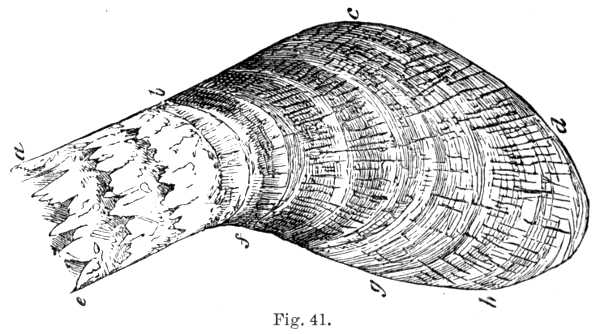
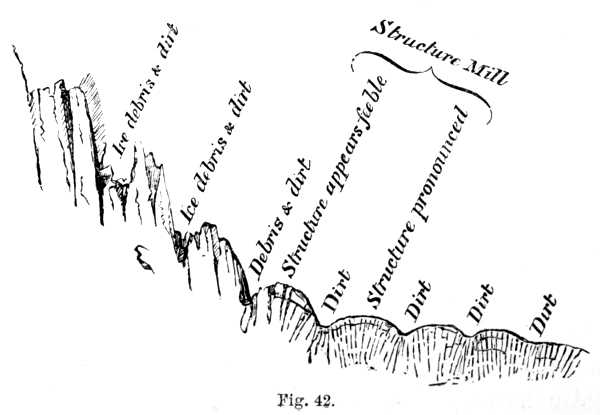
Fig. 42. Section of part of ice-fall, and of glacier below it (Glacier of the Rhone).
TRANSVERSE STRUCTURE.
This case of structural development will be better appreciated on reference to Figs. 41 and 42, the former of which is a plan, and the latter a section, of a part of the ice-fall and of the glacier below it; a b e f is the gorge of the fall, f b being the base. The transverse cliffy ice-ridges are shown crossing the cascade, being subdued at the base to protuberances which gradually disappear as they advance downwards. The structure sweeps over the glacier in the direction of the fine curved lines; and I have also endeavoured to show the direction of the radial crevasses, which, in the centre at least, are at right angles to the veins. To the manifestation of structure here considered I have, for the sake of convenient reference, applied the term transverse structure.
A third exhibition of the structure is now to be noticed. We sometimes find it in the middle of a glacier and running parallel to its length. On the centre of the ice-fall of the Talèfre, for example, we have a structure of this kind which preserves itself parallel to the axis of the fall from top to bottom. But we discover its origin higher up. The structure here has been produced at the extremity of the Jardin, where the divided ice meets, and not only brings into partial parallelism the veins previously existing along the sides of the Jardin, but develops them still further by the mutual pressure of the portions of newly welded ice. Where two tributary glaciers unite, this is perhaps without exception the case. Underneath the moraine formed by the junction of the Talèfre and Léchaud the structure is finely developed, and the veins run in the direction of the moraine. The same is true of the ice under the moraine formed by the junction of the Léchaud and Géant. These afterwards form the great medial moraines of the Mer de Glace, and hence the structure of the trunk-stream underneath these moraines is parallel to the direction of the glacier. This is also true of the system of moraines formed by the glaciers of Monte Rosa. It is true in an especial manner of the lower glacier of the Aar, whose medial moraine perhaps attains grander proportions than any other in the Alps, and underneath which the structure is finely developed.
LONGITUDINAL STRUCTURE.
Fig. 43. Figure explanatory of Longitudinal Structure.
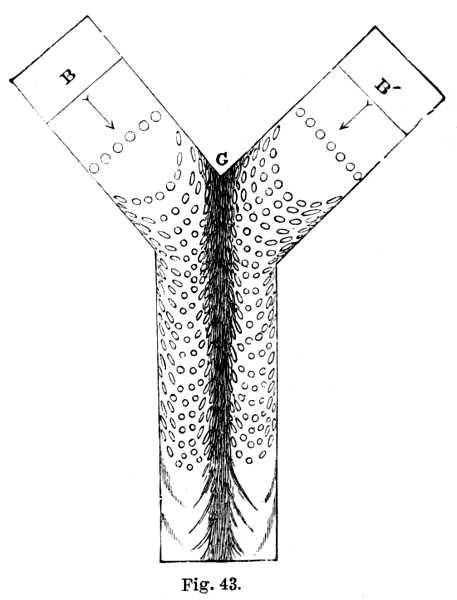
The manner in which I have illustrated the production of this structure will be understood from Fig. 43. b b are two wooden boxes, communicating by sluice-fronts with two branch canals, which unite to a common trunk at g. They are intended to represent respectively the trunk and tributaries of the Unteraar Glacier, the part g being the Abschwung, where the Lauteraar and Finsteraar glaciers unite to form the Unteraar. The mud is first permitted to flow beneath the two sluices until it has covered the bottom of the trough for some distance, when it is arrested. The end of a glass tube is then dipped into a mixture of rouge and water, and small circles are stamped upon the mud. The two branches are thickly covered with these circles. The sluices being again raised, the mud in the branches moves downwards, carrying with it the circles stamped upon it; and the manner in which these circles are distorted enables us to infer the strains and pressures to which the mud is subjected during its descent. The figure represents approximately what takes place. The side-circles, as might be expected, are squeezed to oblique ovals, but it is at the junction of the branches that the chief effect of pressure is produced. Here, by the mutual thrust of the branches, the circles are not only changed to elongated ellipses, but even squeezed to straight lines. In the case of the glacier this is the region at which the structure receives its main development. To this manifestation of the veins I have applied the term longitudinal structure.
The three main sources of the blue veins are, I think, here noted; but besides these there are many local causes which influence their production. I have seen them well formed where a glacier is opposed by the sudden bend of a valley, or by a local promontory which presents an obstacle sufficient to bring the requisite pressure into play. In the glaciers of the Tyrol and of the Oberland I have seen examples of this kind; but the three principal sources of the veins are, I think, those stated above.
EFFORTS TO SOLVE QUESTION.
It was long before I cleared my mind of doubt regarding the origin of the lamination. When on the Mer de Glace in 1857 I spared neither risk nor labour to instruct myself regarding it. I explored the Talèfre basin, its cascade, and the ice beneath it. Several days were spent amid the ice humps and cliffs at the lower portion of the fall. I suppose I traversed the Glacier du Géant twenty times, and passed eight or ten days amid the confusion of its great cascade. I visited those places where, it had been affirmed, the veins were produced. I endeavoured to satisfy myself of the mutability which had been ascribed to them; but a close examination reduced the value of each particular case so much that I quitted the glacier that year with nothing more than an opinion that the structure and the stratification were two different things. I, however, drew up a statement of the facts observed, with the view of presenting it to the Royal Society; but I afterwards felt that in thus acting I should merely swell the literature of the subject without adding anything certain. I therefore withheld the paper, and resolved to devote another year to a search among the chief glaciers of the Oberland, of the Canton Valais, and of Savoy, for proofs which should relieve my mind of all doubt upon the subject.
EXPEDITION FOR THIS PURPOSE.
Accordingly in 1858 I visited the glaciers of Rosenlaui, Schwartzwald, Grindelwald, the Aar, the Rhone, and the Aletsch, to the examination of which latter I devoted more than a week. I afterwards went to Zermatt, and, taking up my quarters at the Riffelberg, devoted eleven days to the examination of the great system of glaciers of Monte Rosa. I explored the Görner Glacier up almost to the Cima de Jazzi; and believed that in it I could trace the structure from portions of the glacier where it vanished, through various stages of perfection, up to its full development. I believe this still; but yet it is nothing but a belief, which the utmost labour that I could bestow did not raise to a certainty. The Western glacier of Monte Rosa, the Schwartze Glacier, the Trifti Glacier, the glacier of the little Mont Cervin, and of St. Théodule, were all examined in connexion with the great trunk-stream of the Görner, to which they weld themselves; and though the more I pursued the subject the stronger my conviction became that pressure was the cause of the structure, a crucial case was still wanting.
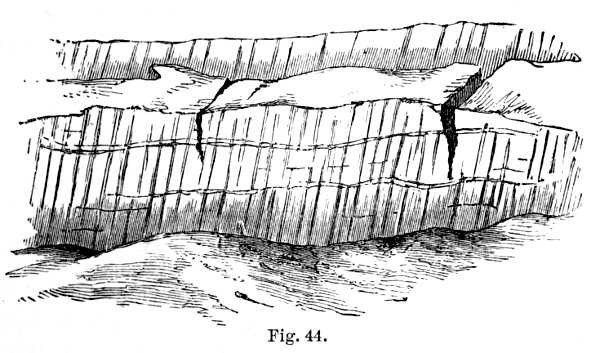
In the phenomena of slaty cleavage, it is often, if not usually, found that the true cleavage cuts the planes of stratification—sometimes at a very high angle. Had this not been proved by the observations of Sedgwick and others, geologists would not have been able to conclude that cleavage and bedding were two different things, and needed wholly different explanations. My aim, throughout the expedition of 1858, was to discover in the ice a parallel case to the above; to find a clear and undoubted instance where the veins and the stratification were simultaneously exhibited, cutting each other at an unmistakable angle. On the 6th of August, while engaged with Professor Ramsay upon the Great Aletsch Glacier, not far from its junction with the Middle Aletsch, I observed what appeared to me to be the lines of bedding running nearly horizontal along the wall of a great crevasse, while cutting them at a large angle was the true veined structure. I drew my friend's attention to the fact, and to him it appeared perfectly conclusive. It is from a sketch made by him at the place that Fig. 44 has been taken.
CASE OF STRUCTURE ON THE ALETSCH.
Fig. 44. Structure and bedding on the Great Aletsch Glacier.
This was the only case of the kind which I observed upon the Aletsch Glacier; and as I afterwards spent day after day upon the Monte Rosa glaciers, vainly seeking a similar instance, the thought again haunted me that we might have been mistaken upon the Aletsch. In this state of mind I remained until the 18th of August, a day devoted to the examination of the Furgge Glacier, which lies at the base of the Mont Cervin.
STRUCTURE OF THE FURGGE GLACIER.
Crossing the valley of the Görner Glacier, and taking a plunge as I passed into the Schwarze See, I reached, in good time, the object of my day's excursion. Walking up the glacier, I at length found myself opposed by a frozen cascade composed of four high terraces of ice. The highest of these was chiefly composed of ice-cliffs and séracs, many of which had fallen, and now stood like rocking-stones upon the edge of the second terrace. The glacier at the base of the cascade was strewn with broken ice, and some blocks two hundred cubic feet in volume had been cast to a considerable distance down the glacier.
Upon the faces of the terraces the stratification of the névé was most beautifully shown, running in parallel and horizontal lines along the weathered surface. The snow-field above the cascade is a frozen plain, smooth almost as a sheltered lake. The successive snow-falls deposit themselves with great regularity, and at the summit of the cascade the sections of the névé are for the first time exposed. Hence their peculiar beauty and definition.
ICE TERRACE EXAMINED.
Indeed the figure of a lake pouring itself over a rocky barrier which curves convexly upwards, thus causing the water to fall down it, not only longitudinally over the vertex of the curve, but laterally over its two arms, will convey a tolerably correct conception of the shape of the fall. Towards the centre the ice was powerfully squeezed laterally, the beds were bent, and their continuity often broken by faults. On inspecting the ice from a distance with my opera glass, I thought I saw structural groovings cutting the strata at almost a right angle. Had the question been an undisputed one, I should perhaps have felt so sure of this as not to incur the danger of pushing the inquiry further; but, under the circumstances, danger was a secondary point. Resigning, therefore, my glass to my guide, who was to watch the tottering blocks overhead, and give me warning should they move, I advanced to the base of the fall, removed with my hatchet the weathered surface of the ice, and found underneath it the true veined structure, cutting, at nearly a right angle, the planes of stratification. The superficial groovings were not uniformly distributed over the fall, but appeared most decided at those places where the ice appeared to have been most squeezed. I examined three or four of these places, and in each case found the true veins nearly vertical, while the bedding was horizontal. Having perfectly satisfied myself of these facts, I made a speedy retreat, for the ice-blocks seemed most threatening, and the sunny hour was that at which they fall most frequently.
I next tried the ascent of the glacier up a dislocated declivity to the right. The ice was much riven, but still practicable. My way for a time lay amid fissures which exposed magnificent sections, and every step I took added further demonstration to what I had observed below. The strata were perfectly distinct, the structure equally so, and one crossed the other at an angle of seventy or eighty degrees. Mr. Sorby has adduced a case of the crumpling of a bed of sandstone through which the cleavage passes: here on the glacier I had parallel cases; the beds were bent and crumpled, but the structure ran through the ice in sharp straight lines. This perhaps was the most pleasant day I ever spent upon the glaciers: my mind was relieved of a long brooding doubt, and the intellectual freedom thus obtained added a subjective grandeur to the noble scene before me. Climbing the cliffs near the base of the Matterhorn, I walked along the rocky spine which extends to the Hörnli, and afterwards descended by the valley of Zmutt to Zermatt.
A year after my return to England a remark contained in Professor Mousson's interesting little work 'Die Gletscher der Jetzzeit' caused me to refer to the atlas of M. Agassiz's 'Système Glaciaire,' from which I learned that this indefatigable observer had figured a case of stratification and structure cutting each other. If, however, I had seen this figure beforehand, it would not have changed my movements; for the case, as sketched, would not have convinced me. I have now no doubt that M. Agassiz has preceded me in this observation, and hence my results are to be taken as mere confirmations of his.
LAMINATION AND STRATIFICATION.
Fig. 45 represents a crumpled portion of the ice with the lines of lamination passing through the strata. Fig. 46 represents a case where a fault had occurred, the veins at both sides of the line of dislocation being inclined towards each other.
Fig. 45. Structure and Stratification on the Furgge glacier.
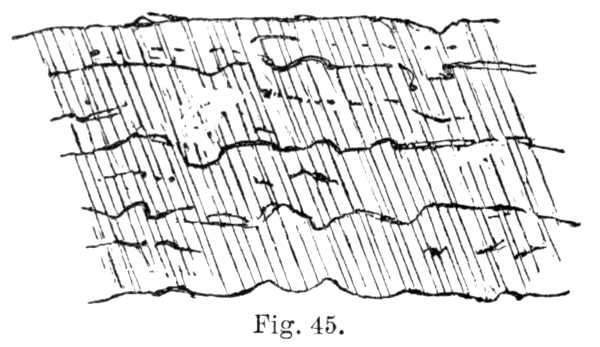
Fig. 46. Structure and Stratification on the Furgge glacier.
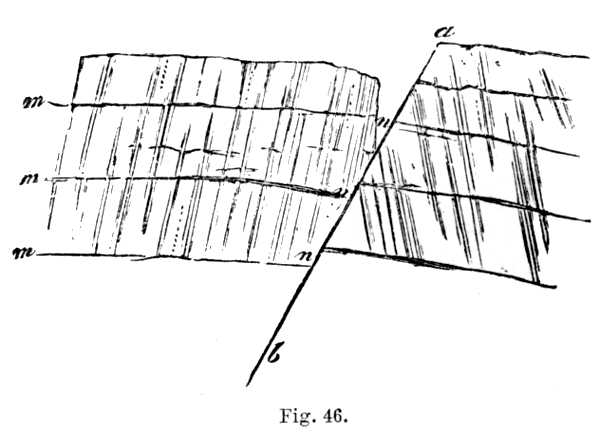
[Figs. 45 and 46 are from sketches made on the Furgge Glacier.—L. C. T.]
FOOTNOTES:
THE VEINED STRUCTURE AND THE DIFFERENTIAL MOTION. (28.)
DIFFERENTIAL MOTION GREATEST AT EDGES.
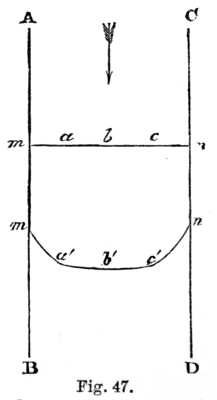
I have now to examine briefly the explanation of the structure which refers it to differential motion—to a sliding of the particles of ice past each other, which leaves the traces of its existence in the blue veins. The fact is emphatically dwelt upon by those who hold this view, that the structure is best developed nearest to the sides of the glacier, where the differential motion is greatest. Why the differential motion is at its maximum near to the sides is easily understood. Let a b, c d, Fig. 47, represent the two sides of a glacier, moving in the direction of the arrow, and let m a b c n be a straight line of stakes set out across the glacier to-day. Six months hence this line, by the motion of the ice downwards, will be bent to the form m a' b' c' n: this curve will not be circular, it will be flattened in the middle; the points a and c, at some distance on each side of the centre b, move in fact with nearly the same velocity as the centre itself. Not so with the sides:—a' and c' have moved considerably in advance of m and n, and hence we say that the difference of motion, or the differential motion, of the particles of ice near to the side is a maximum.
Fig. 47. Diagram illustrating Differential Motion.
During all this time the points m a' b' c' n have been moving straight down the glacier; and hence it will be understood that the sliding of the parts past each other, or, in other words, the differential motion, is parallel to the sides of the glacier. This, indeed, is the only differential motion that experiment has ever established; and consequently, when we find the best blue veins referred to the sides of the glacier because the differential motion is there greatest, we naturally infer that the motion meant is parallel to the sides.
STRUCTURE OBLIQUE TO SIDES.
But the fact is, that this motion would not at all account for the blue veins, for they are not parallel to the sides, but oblique to them. This difficulty revealed itself after a time to those who first propounded the theory of differential motion, and caused them to modify their explanation of the structure. Differential motion is still assumed to be the cause of the veins, but now a motion is meant oblique to the sides, and it is supposed to be obtained in the following way:—Through the quicker motion of the point c' the ice between it and n becomes distended; that is to say, the line c' n is in a state of strain—there is a drag, it is said, oblique to the sides of the glacier; and it is therefore in this direction that the particles will be caused to slide past each other. Dr. Whewell, who advocates this view, thus expounds it. He supposes the case of an alpine valley filled with india-rubber which has been warmed until it has partially melted, or become viscous, and then asks, "What will now be the condition of the mass? The sides and bottom will still be held back by the friction; the middle and upper part will slide forwards, but not freely. This want of freedom in the motion (arising from the viscosity) will produce a drag towards the middle of the valley, where the motion is freest; hence the direction in which the filaments slide past each other will be obliquely directed towards the middle. The sliding will separate the mass according to such lines; and though new attachments will take place, the mass may be expected to retain the results of this separation in the traces of parallel fissures."[A] Nothing can be clearer than the image of the process thus placed before the mind's eye.
One fact of especial importance is to be borne in mind: the sliding of filaments which is thus supposed to take place oblique to the glacier has never been proved; it is wholly assumed. A moraine, it is admitted, will run parallel to the side of a glacier, or a block will move in the same direction from beginning to end, without being sensibly drawn towards the centre, but still it is supposed that the sliding of parts exists, though of a character so small as to render it insensible to measurement.
STRUCTURE CROSSES LINES OF SLIDING.
My chief difficulty as regards this theory may be expressed in a very few words. If the structure be produced by differential motion, why is the large and real differential motion which experiments have established incompetent to produce it? And how can the veins run, as they are admitted to do, across the lines of maximum sliding from their origin throughout the glacier to its end?
That a drag towards the centre of the glacier exists is undeniable, but that in consequence of the drag there is a sliding of filaments in this direction, is quite another thing. I have in another place[B] endeavoured to show experimentally that no such sliding takes place, that the drag on any point towards the centre expresses only half the conditions of the problem; being exactly neutralized by the thrust towards the sides. It has been, moreover, shown by Mr. Hopkins that the lines of maximum strain and of maximum sliding cannot coincide; indeed, if all the particles be urged by the same force, no matter how strong the pull may be, there will be no tendency of one to slide past the other.
FOOTNOTES:
THE RIPPLE-THEORY OF THE VEINED STRUCTURE. (29.)
THEORY STATED.
The assumption of oblique sliding, and the production thereby of the marginal structure, have, however, been fortified by considerations of an ingenious and very interesting kind. "How," I have asked, "can the oblique structure persist across the lines of greatest differential motion throughout the length of the glacier?" But here I am met by another question which at first sight might seem equally unanswerable—"How do ripple-marks on the surface of a flowing river, which are nothing else than lines of differential motion of a low order, cross the river from the sides obliquely, while the direction of greatest differential motion is parallel to the sides?" If I understand aright, this is the main argument of Professor Forbes in favour of his theory of the oblique marginal structure. It is first introduced in a note at page 378 of his 'Travels;' he alludes to it in a letter written the following year; in his paper in the 'Philosophical Transactions' he develops the theory. He there gives drawings of ripple-marks observed in smooth gutters after rain, and which he finds to be inclined to the course of the stream, exactly as the marginal structure is inclined to the side of the glacier. The explanation also embraces the case of an obstacle placed in the centre of a river. "A case," writes Professor Forbes, "parallel to the last mentioned, where a fixed obstacle cleaves a descending stream, and leaves its trace in a fan-shaped tail, is well known in several glaciers, as in that at Ferpêcle, and the Glacier de Lys on the south side of Monte Rosa; particularly the last, where the veined structure follows the law just mentioned." In his Twelfth Letter he also refers to the ripples "as exactly corresponding to the position of the icy bands." In his letter to Dr. Whewell, published in the 'Occasional Papers,' page 58, he writes as follows:—"The same is remarkably shown in the case of a stream of water, for instance a mill-race. Although the movement of the water, as shown by floating bodies, is exceedingly nearly (for small velocities sensibly) parallel to the sides, yet the variation of the speed from the side to the centre of the stream occasions a ripple, or molecular discontinuity, which inclines forwards from the sides to the centre of the stream at an angle with the axis depending on the ratio of the central and lateral velocity. The veined structure of the ice corresponds to the ripple of the water, a molecular discontinuity whose measure is not comparable to the actual velocity of the ice; and therefore the general movement of the glacier, as indicated by the moraines, remains sensibly parallel to the sides." THEORY EXAMINED. This theory opens up to us a series of interesting and novel considerations which I think will repay the reader's attention. If the ripples in the water and the veins in the ice be due to the same mechanical cause, when we develop clearly the origin of the former we are led directly to the explanation of the latter. I shall now endeavour to reduce the ripples to their mechanical elements.
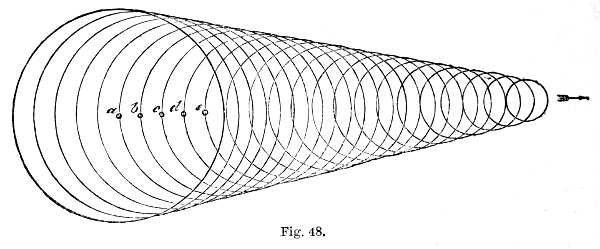
The Messrs. Weber have described in their 'Wellenlehre' an effect of wave-motion which it is very easy to obtain. When a boat moves through perfectly smooth water, and the rower raises his oar out of the water, drops trickle from its blade, and each drop where it falls produces a system of concentric rings. The circular waves as they widen become depressed, and, if the drops succeed each other with sufficient speed, the rings cross each other at innumerable points. The effect of this is to blot out more or less completely all the circles, and to leave behind two straight divergent ripple-lines, which are tangents to all the external rings; being in fact formed by the intersections of the latter, as a caustic in optics is formed by the intersection of luminous rays. Fig. 48, which is virtually copied from M. Weber, will render this description at once intelligible. The boat is supposed to move in the direction of the arrow, and as it does so the rings which it leaves behind widen, and produce the divergence of the two straight resultant lines of ripple.
RIPPLES DEDUCED FROM RINGS.
Fig. 48. Diagram explanatory of the formation of Ripples.
The more quickly the drops succeed each other, the more frequent will be the intersections of the rings; but as the speed of succession augments we approach the case of a continuous vein of liquid; and if we suppose the continuity to be perfectly established, the ripples will still be produced with a smooth space between them as before. This experiment may indeed be made with a well-wetted oar, which on its first emergence from the water sends into it a continuous liquid vein. The same effect is produced when we substitute for the stream of liquid a solid rod—a common walking-stick for example. A water-fowl swimming in calm water produces two divergent lines of ripples of a similar kind.
We have here supposed the water of the lake to be at rest, and the liquid vein or the solid rod to move through it; but precisely the same effect is produced if we suppose the rod at rest and the liquid in motion. Let a post, for example, be fixed in the middle of a flowing river; diverging from that post right and left we shall have lines of ripples exactly as if the liquid were at rest and the post moved through it with the velocity of the river. If the same post be placed close to the bank, so that one of its edges only shall act upon the water, diverging from that edge we shall have a single line of ripples which will cross the river obliquely towards its centre. It is manifest that any other obstacle will produce the same effect as our hypothetical post. In the words of Professor Forbes, "the slightest prominence of any kind in the wall of such a conduit, a bit of wood or a tuft of grass, is sufficient to produce a well-marked ripple-streak from the side towards the centre."
MEASURE OF DIVERGENCE OF RIPPLES.
The foregoing considerations show that the divergence of the two lines of ripples from the central post, and of the single line in the case of the lateral post, have their mechanical element, if I may use the term, in the experiment of the Messrs. Weber. In the case of a swimming duck the connexion between the diverging lines of ripples and the propagation of rings round a disturbed point is often very prettily shown. When the creature swims with vigour the little foot with which it strikes the water often comes sufficiently near to the surface to produce an elevation,—sometimes indeed emerging from the water altogether. Round the point thus disturbed rings are immediately propagated, and the widening of those rings is the exact measure of the divergence of the ripple lines. The rings never cross the lines;—the lines never retreat from the rings.
RIPPLES AND VEINS DUE TO DIFFERENT CAUSES.
If we compare the mechanical actions here traced out with those which take place upon a glacier, I think it will be seen that the analogy between the ripples and the veined structure is entirely superficial. How the structure ascribed to the Glacier de Lys is to be explained I do not know, for I have never seen it; but it seems impossible that it could be produced, as ripples are, by a fixed obstacle which "cleaves a descending stream." No one surely will affirm that glacier-ice so closely resembles a fluid as to be capable of transmitting undulations, as water propagates rings round a disturbed point. The difficulty of such a supposition would be augmented by taking into account the motion of the individual liquid particles which go to form a ripple; for the Messrs. Weber have shown that these move in closed curves, describing orbits more or less circular. Can it be supposed that the particles of ice execute a motion of this kind? If so, their orbital motions may be easily calculated, being deducible from the motion of the glacier compounded with the inclination of the veins. If so important a result could be established, all glacier theories would vanish in comparison with it.
POSITION OF RIPPLES NOT THAT OF STRUCTURE.
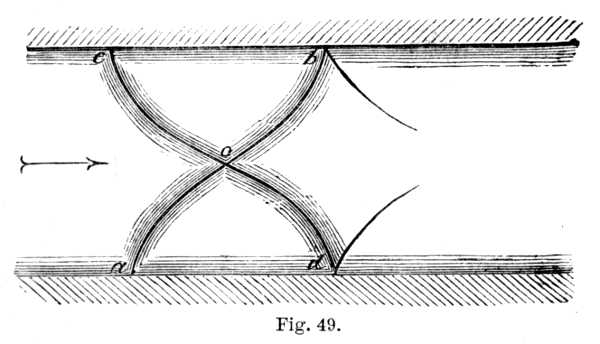
There is another interesting point involved in the passage above quoted. Professor Forbes considers that the ripple is occasioned by the variation of speed from the side to the centre of the stream, and that its inclination depends on the ratio of the central and lateral velocity. If I am correct in the above analysis, this cannot be the case. The inclination of the ripple depends solely on the ratio of the river's translatory motion to the velocity of its wave-motion. Were the lateral and central velocities alike, a momentary disturbance at the side would produce a straight ripple-mark, whose inclination would be compounded of the two elements just mentioned. If the motion of the water vary from side to centre, the velocity of wave-propagation remaining constant, the inclination of the ripple will also vary, that is to say, we shall have a curved ripple instead of a straight one. This, of course, is the case which we find in Nature, but the curvature of such ripples is totally different from that of the veined structure. Owing to the quicker translatory movement, the ripples, as they approach the centre, tend more to parallelism with the direction of the river; and after having passed the centre, and reached the slower water near the opposite side, their inclination to the axis gradually augments. Thus the ripples from the two sides form a pair of symmetric curves, which cross each other at the centre, and possess the form a o b, c o d, shown in Fig. 49. A similar pair of curves would be produced by the reflection of these. Knowing the variation of motion from side to centre, any competent mathematician could find the equation of the ripple-curves; but it would be out of place for me to attempt it here.
Fig. 49. Diagram explanatory of the formation of Ripples.
THE VEINED STRUCTURE AND PRESSURE. (30.)
If a prism of glass be pressed by a sufficient weight, the particles in the line of pressure will be squeezed more closely together, while those at right angles to this line will be forced further apart. The existence of this state of strain may be demonstrated by the action of such squeezed glass upon polarised light. It gives rise to colours, and it is even possible to infer from the tint the precise amount of pressure to which the glass is subjected. M. Wertheim indeed has most ably applied these facts to the construction of a dynamometer, or instrument for measuring pressures, exceeding in accuracy any hitherto devised.
When the pressure applied becomes too great for the glass to sustain, it flies to pieces. But let us suppose the sides of the prism defended by an extremely strong jacket, in which the prism rests like a closely-fitting plug, and which yields only when a pressure more than sufficient to crush the glass is applied. Let the pressure be gradually augmented until this point is attained; afterwards both the glass and its jacket will shorten and widen; the jacket will yield laterally, being pushed out with extreme slowness by the glass within.
POSSIBLE EXPERIMENT WITH GLASS PRISM.
Now I believe that it would be possible to make this experiment in such a manner that the glass should be flattened, partly through rupture, and partly through lateral molecular yielding; the prism would change its form, and yet present a firmly coherent mass when removed from its jacket. I have never made the experiment; nobody has, as far as I know; but experiments of this kind are often made by Nature. In the Museum of the Government School of Mines, for example, we have a collection of quartz stones placed there by Mr. Salter, and which have been subjected to enormous pressure in the neighbourhood of a fault. These rigid pebbles have, in some cases, been squeezed against each other so as to produce mutual flattening and indentation. Some of them have yielded along planes passing through them, as if one half had slidden over the other; but the reattachment is very strong. Some of the larger stones, moreover, which have endured pressure at a particular point, are fissured radially around this point. In short, the whole collection is a most instructive example of the manner and extent to which one of the most rigid substances in Nature can yield on the application of a sufficient force.
POSSIBLE EXPERIMENT WITH PRISM OF ICE.
Let a prism of ice at 32° be placed in a similar jacket to that which we have supposed to envelop the glass prism. The ice yields to the pressure with incomparably greater ease than the glass; and if the force be slowly applied, the lateral yielding will far more closely resemble that of a truly plastic body. Supposing such a piece of ice to be filled with numerous small air-bubbles, the tendency of the pressure would be to flatten these bubbles, and to squeeze them out of the ice. Were the substance perfectly homogeneous, this flattening and expulsion would take place uniformly throughout its entire mass; but I believe there is no such homogeneous substance in nature;—the ice will yield at different places, leaving between them spaces which are comparatively unaffected by the pressure. From the former spaces the air-bubbles will be more effectually expelled; and I have no doubt that the result of such pressure acting upon ice so protected would be to produce a laminated structure somewhat similar to that which it produces in those bodies which exhibit slaty cleavage.
LAMINATION PRODUCED BY PRESSURE.
I also think it certain that, in this lateral displacement of the particles, these must move past each other. This is an idea which I have long entertained, as the following passage taken from the paper published by Mr. Huxley and myself will prove:—"Three principal causes may operate in producing cleavage: first, the reducing of surfaces of weak cohesion to parallel planes; second, the flattening of minute cavities; and third, the weakening of cohesion by tangential action. The third action is exemplified by the state of the rails near a station where a break is habitually applied to a locomotive. In this case, while the weight of the train presses vertically, its motion tends to cause longitudinal sliding of the particles of the rail. Tangential action does not, however, necessarily imply a force of the latter kind. When a solid cylinder an inch in height is squeezed to a vertical cake a quarter of an inch in height, it is impossible, physically speaking, that the particles situated in the same vertical line shall move laterally with the same velocity; but if they do not, the cohesion between them will be weakened or ruptured. The pressure, however, will produce new contact; and if this have a cohesive value equal to that of the old contact, no cleavage from this cause can arise. The relative capacities of different substances for cleavage appear to depend in a great measure upon their different properties in this respect. In butter, for example, the new attachments are equal, or nearly so, to the old, and the cleavage is consequently indistinct; in wax this does not appear to be the case, and hence may arise in a great degree the perfection of its cleavage. The further examination of this subject promises interesting results." I would dwell upon this point the more distinctly as the advocates of differential motion may deem it to be in their favour; but it appears to me that the mechanical conceptions implied in the above passage are totally different from theirs. NO SLIDING OF FILAMENTS. If they think otherwise, then it seems to me that they should change the expressions which refer the differential motion to a "drag" towards the centre, and the structure to the sliding of "filaments" past each other in consequence of this drag. Such filamentary sliding may take place in a truly viscous body, but it does not take place in ice.
In one particular the ice resembles the butter referred to in the above quotation; for its new attachments appear to be equal to the old, and this, I think, is to be ascribed to its perfect regelation. As justly pointed out by Mr. John Ball, the veined ice of a glacier, if unweathered, shows no tendency to cleave; for though the expulsion of the air-bubbles has taken place, the reattachment of the particles is so firm as to abolish all evidence of cleavage. When the ice, on the contrary, is weathered, the plates become detached, and I have often been able to split such ice into thin tablets having an area of two or three square feet.
In his Thirteenth Letter Professor Forbes throws out a new and possibly a pregnant thought in connexion with the veins. If I understand him aright—and I confess it is usually a matter of extreme difficulty with me to make sure of this—he there refers the veins, not to the expulsion of the air from the ice, but to its redistribution. The pressure produces "lines of tearing in which the air is distributed in the form of regular globules." I do not know what might be made of this idea if it were developed, but at present I do not see how the supposed action could produce the blue bands; and I agree with Professor Wm. Thomson in regarding the explanation as improbable.[A]
FOOTNOTES:
THE VEINED STRUCTURE AND THE LIQUEFACTION OF ICE BY PRESSURE. (31.)
I have already noticed an important fact for which we are indebted to Mr. James Thomson, and have referred to the original communications on the subject. I shall here place the physical circumstances connected with this fact before my reader in the manner which I deem most likely to interest him.
INFLUENCE OF PRESSURE ON BOILING POINT.
When a liquid is heated, the attraction of the molecules operates against the action of the heat, which tends to tear them asunder. At a certain point the force of heat triumphs, the cohesion is overcome, and the liquid boils. But supposing we assist the attraction of the molecules by applying an external pressure, the difficulty of tearing them asunder will be increased; more heat will be required for this purpose; and hence we say that the boiling point of the liquid has been elevated by the pressure.
INFLUENCE OF PRESSURE ON FUSING POINT.
If molten sulphur be poured into a bullet-mould, it will be found on cooling to contract, so as to leave a large hollow space in the middle of each sphere. Cast musket-bullets are thus always found to possess a small cavity within them produced by the contraction of the lead. Conceive the bullet placed within its mould and the latter heated; to produce fusion it is necessary that the sulphur or the lead should swell. Here, as in the case of the heated water, the tendency to expand is opposed by the attraction of the molecules; with a certain amount of heat however this attraction is overcome and the solid melts. But suppose we assist the molecular attraction by a suitable force applied externally, a greater amount of heat than before will be necessary to tear them asunder; and hence we say that the fusing point has been elevated by the pressure. This fact has been experimentally established by Messrs. Hopkins and Fairbairn, who applied to spermaceti and other substances pressures so great as to raise their points of fusion a considerable number of degrees.
Let us now consider the case of the metal bismuth. If the molten metal be poured into a bullet-mould it will expand on solidifying. I have myself filled a strong cast-iron bottle with the metal, and found its expansion on cooling sufficiently great to split the bottle from neck to bottom. Hence, in order to fuse the bismuth the substance must contract; and it is manifest that an external pressure which tends to squeeze the molecules more closely together here assists the heat instead of opposing it. Hence, to fuse bismuth under great pressure, a less amount of heat will be required than when the pressure is removed; or, in other words, the fusing point of bismuth is lowered by the pressure. Now, in passing from the solid to the liquid state, ice, like bismuth, contracts, and if the contraction be promoted by external pressure, as shown by the Messrs. Thomson, a less amount of heat suffices to liquefy it.
EXPERIMENTS.
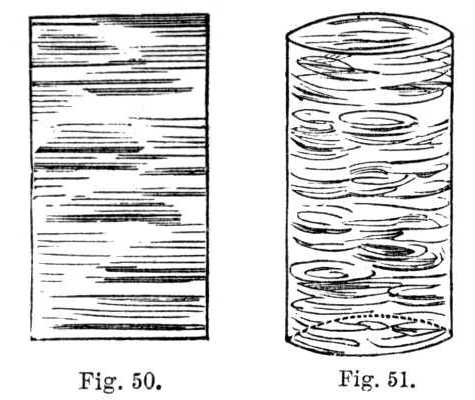
These remarks will enable us to understand a singular effect first obtained by myself at the close of 1856 or in January 1857, noticed at the time in the 'Proceedings of the Royal Society,' and afterwards fully described in a paper presented to the Society in December of that year. A cylinder of clear ice two inches high and an inch in diameter was placed between two slabs of box-wood, and subjected to a gradual pressure. I watched the ice in a direction perpendicular to its length, and saw cloudy lines drawing themselves across it. As the pressure continued, these lines augmented in numbers, until finally the prism presented the appearance of a crystal of gypsum whose planes of cleavage had been forced out of optical contact. When looked at obliquely it was found that the lines were merely the sections of flat dim surfaces, which lay like laminæ one over the other throughout the length of the prism. Fig. 50 represents the prism as it appeared when looked at in a direction perpendicular to its axis; Fig. 51 shows the appearance when viewed obliquely.[A]
Fig. 50, 51. Appearance of a prism of ice partially liquefied by Pressure.
At first sight it might appear as if air had intruded itself between the separated surfaces of the ice, and to test this point I placed a cylinder two inches long and an inch wide upright in a copper vessel which was filled with ice-cold water. The ice cylinder rose about half an inch above the surface of the water. Placing the copper vessel on a slab of wood, and a second slab on the top of the cylinder of ice, the latter was subjected to the gradual action of a small hydraulic press. When the hazy surfaces were well developed in the portion of the ice above the water, the cylinder was removed and examined: the planes of rupture extended throughout the entire length of the cylinder, just as if it had been squeezed in air. I subsequently placed the ice in a stout vessel of glass, and squeezed it, as in the last experiment: the surfaces of discontinuity were seen forming under the liquid quite as distinctly as in air.
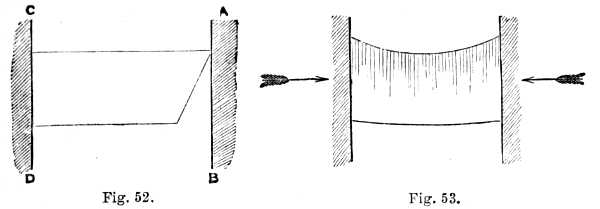
To prove that the surfaces were due to compression and not to any tearing asunder of the mass by tension, the following experiment was made:—A cylindrical piece of ice, one of whose ends, however, was not parallel to the other, was placed between the slabs of wood, and subjected to pressure. Fig. 52 shows the disposition of the experiment. The effect upon the ice cylinder was that shown in Fig. 53, the surfaces being developed along that side which had suffered the pressure. On examining the surfaces by a pocket lens they resembled the effect produced upon a smooth cold surface by breathing on it.
Fig. 52, 53. Figures illustrative of compression and liquefaction of ice.
LIQUID LAYERS PRODUCED BY PRESSURE.
The surfaces were always dim; and had the spaces been filled with air, or were they simply vacuous, the reflection of light from them would have been so copious as to render them much more brilliant than they were observed to be. To examine them more particularly I placed a concave mirror so as to throw the diffused daylight from a window full upon the cylinder. On applying the pressure dim spots were sometimes seen forming in the very middle of the ice, and these as they expanded laterally appeared to be in a state of intense motion, which followed closely the edge of each surface as it advanced through the solid ice. Once or twice I observed the hazy surfaces pioneered through the mass by dim offshoots, apparently liquid, and constituting a kind of decrystallisation. From the closest examination to which I was able to subject them, the surfaces appeared to me to be due to internal liquefaction; indeed, when the melting point of ice, having already a temperature of 32°, is lowered by pressure, its excess of heat must instantly be applied to produce this effect.
APPLICATION TO THE VEINED STRUCTURE.
I have already given a drawing (p. 386) showing the development of the veined structure at the base of the ice-cascade of the Rhone; and if we compare that diagram with Fig. 53 a striking similarity at once reveals itself. The ice of the glacier must undoubtedly be liquefied to some extent by the tremendous pressure to which it is here subjected. Surfaces of discontinuity will in all probability be formed, which facilitate the escape of the imprisoned air. The small quantity of water produced will be partly imbibed by the adjacent porous ice, and will be refrozen when relieved from the pressure. This action, associated with that ascribed to pressure in the last section, appears to me to furnish a complete physical explanation of the laminated structure of glacier-ice.
FOOTNOTES:
WHITE ICE-SEAMS IN THE GLACIER DU GÉANT. (32.)
GENERAL APPEARANCE OF WHITE ICE-SEAMS.
On the 28th of July, 1857, while engaged upon the Glacier du Géant, my attention was often attracted by protuberant ridges of what at first appeared to be pure white snow, but which on examination I found to be compact ice filled with innumerable round air-cells; and which, in virtue of its greater power of resistance to wasting, often rose to a height of three or four feet above the general level of the ice. As I stood amongst these ridges, they appeared detached and without order of arrangement, but looked at from a distance they were seen to sweep across the proper Glacier du Géant in a direction concentric with its dirt-bands and its veined structure. In some cases the seams were admirable indications of the relative displacement of two adjacent portions of the glacier, which were divided from each other by a crevasse. Usually the sections of a seam exposed on the opposite sides of a fissure accurately faced each other, and the direction of the seam on both sides was continuous; but at other places they demonstrated the existence of lateral faults, being shifted asunder laterally through spaces varying from a few inches to six or seven feet.
On the following day I was again upon the same glacier, and noticed in many cases the white ice-seams exquisitely honeycombed. The case was illustrative of the great difference between the absorptive power of the ice itself and of the objects which lie upon its surface. Deep cylindrical cells were produced by spots of black dirt which had been scattered upon the surface of the white ice, and which sank to a depth of several inches into the mass. I examined several sections of the veins, and in general I found that their deeper portions blended gradually with the ice on either side of them. But higher up the glacier I found that the veins penetrated only to a limited depth, and did not therefore form an integrant portion of the glacier. Figs. 54 and 55 show the sections of two of the seams which were exposed on the wall of a crevasse at some distance below the great ice-fall of the Glacier du Géant.
SECTIONS OF SEAMS.
Fig. 54, 55. Sections of White Ice-seams.
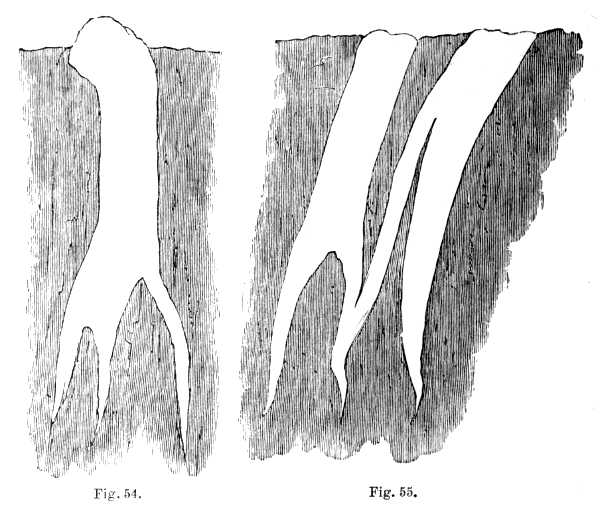
Fig. 56. Variations in the Dip of the Veined Structure.
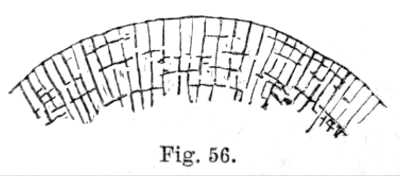
It was at the base of the Talèfre cascade that the explanation of these curious seams presented itself to me. In one of my earliest visits to this portion of the glacier I was struck by a singular disposition of the blue veins on the vertical wall of a crevasse. Fig. 56 will illustrate what I saw. The veins, within a short distance, dipped backward and forward, like the junctions of stones used to turn an arch. In some cases I found this variation of the structure so great as to pass in a short distance from the vertical to the horizontal, as shown in Fig. 57.
VARIATIONS IN "DIP" OF STRUCTURE.
Fig. 57. Variations in the Dip of the Veined Structure.
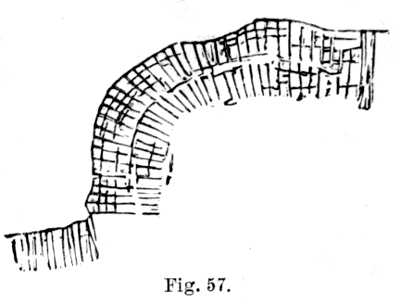
Further examination taught me that the glacier here is crumpled in a most singular manner; doubtless by the great pressure to which it is exposed. The following illustration will convey a notion of its aspect: Let one hand be laid flat upon a table, palm downwards, and let the fingers be bent until the space between the first joint and the ends of the fingers is vertical; one of the crumples to which I refer will then be represented. The ice seems bent like the fingers, and the crumples of the glacier are cut by crevasses, which are accurately typified by the spaces between the fingers. Let the second hand now be placed upon the first, as the latter is upon the table, so that the tops of the bent fingers of the second hand shall rest upon the roots of the first: two crumples would thus be formed; a series of such protuberances, with steep fronts, follow each other from the base of the Talèfre cascade for some distance downwards.
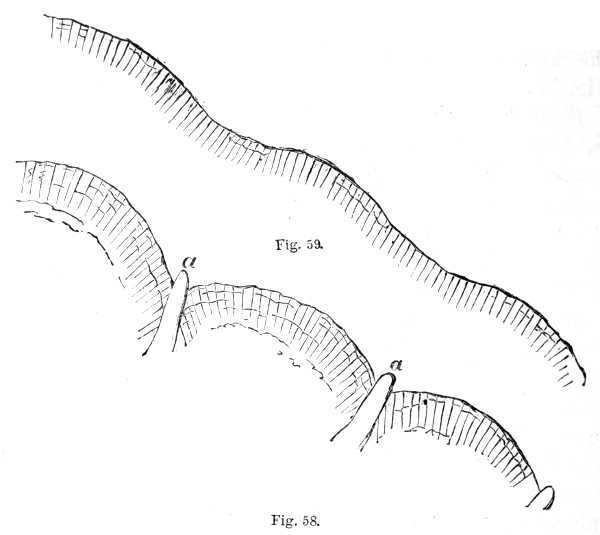
On Saturday the 1st of August I ascended these rounded terraces in succession, and observed among them an extremely remarkable disposition of the structure. Fig. 58 is a section of a series of three of the crumples, on which the shading lines represent the direction of the blue veins. At the base of each protuberance I found a seam of white ice wedged firmly into the glacier, and each of the seams marked a place of dislocation of the veins. The white seams thinned off gradually, and finally vanished where the violent crumpling of the ice disappeared. In Fig. 59 I have sketched the wall of a crevasse, which represents what may be regarded as the incipient crumpling. The undulating line shows the contour of the surface, and the shading lines the veins. It will be observed that the direction of the veins yields in conformity with the undulation of the surface; and an augmentation of the effect would evidently result in the crumples shown in Fig. 58. The appearance of the white seams at those places where a dislocation occurred was, as far as I could observe, invariable; but in a few instances the seams were observed upon the platforms of the terraces, and also upon their slopes. The width of a seam was very irregular, varying from a few inches at some places to three or four feet at others.
CRUMPLES OF THE TALÈFRE.
Fig. 58. Section of three glacier Crumples. Fig. 59. Wall of a crevasse, with incipient crumpling.
MOULDS OF WHITE ICE-SEAMS.
On the 3rd of August I was again at the base of the Talèfre cascade, and observed a fact the significance of which had previously escaped me. The rills which ran down the ice-slopes collected at the base of each protuberance into a stream, which, at the time of my visit, had hollowed out for itself a deep channel in the ice. At some places the stream widened, at others its banks of ice approached each other, and rapids were produced; in fact, the channels of such streams appeared to be the exact moulds of the seams of white ice.
Instructed thus far, I ascended the Glacier du Géant on the 5th of August, and then observed on the wrinkles of this glacier the same leaning backwards and forwards of the blue veins as I had previously observed upon the Talèfre. I also noticed on this day that a seam of white ice would sometimes open out into two branches, which, after remaining for some distance separate, would reunite and thus enclose a little glacier-island. At other places lateral branches were thrown off from the principal seam, thus suggesting the form of a glacier-rivulet which had been fed by tributary branches. On the 7th of August I hunted the seams still farther up the glacier; and found them at one place descending a steep ice-hill, being crossed by other similar bands, which however were far less white and compact. I followed these new bands to their origin, and found it to be a system of crevasses formed at the summit of the hill, some of which were filled with snow. Lower down the crevasses closed, and the snow thus jammed between their walls was converted into white ice. These seams, however, never attained the compactness and prominence of the larger ones which had their origin far higher up. I singled out one of the best of the latter, and traced it through all the dislocation and confusion of the ice, until I found it to terminate in a cavity filled with snow.
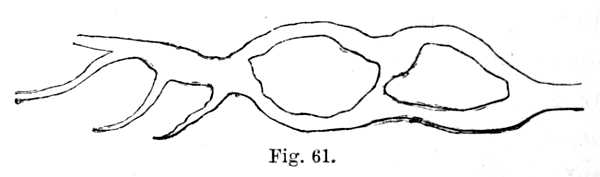
This was near the base of the séracs, and the streams here were abundant. Comparing the shapes of some of them with that of the ice-bands lower down the glacier, a striking resemblance was observed. Fig. 60 is the plan of a deep-cut channel through which a stream flowed on the day to which I now refer. Fig. 61 is the plan of a seam of white ice sketched on the same day, low down upon the glacier. Instances of this kind might be multiplied; and the result, I think, renders it certain that the white ice-seams referred to are due to the filling up of the channels of glacier-streams by snow during winter, and the subsequent compression of the mass to ice during the descent of the glacier. I have found such seams at the bases of all cascades that I have visited; and in all cases they appear to be due to the same cause. The depth to which they penetrate the glacier must be profound, or the ablation of the ice must be less than what is generally supposed; for the seams formed so high up on the Glacier du Géant may be traced low down upon the trunk-stream of the Mer de Glace.[A]
STREAMS AND SEAMS.
Fig. 60. Plan of a Stream on the Glacier du Géant.
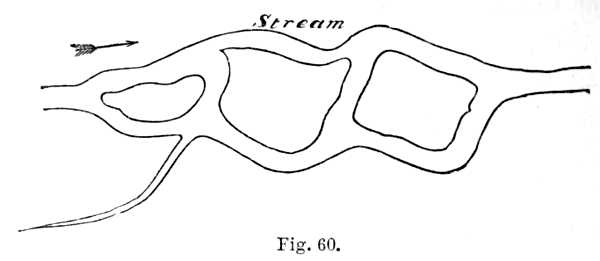
Fig. 61. Plan of a Seam of White Ice on the Glacier du Géant.
SCALING OFF BY PRESSURE.
These observations on the white ice-seams enable us to add an important supplement to what has been stated regarding the origin of the dirt-bands of the Mer de Glace; The protuberances at the base of the cascade are due not only to the toning down of the ridges produced by the transverse fracture of the glacier at the summit of the fall, but they undergo modifications by the pressure locally exerted at its base. The state of things represented in Fig. 57 is plainly due to the partial pushing of one crumple over that next in advance of it. There seems to be a differential motion of the parts of the glacier in the same longitudinal line; showing that upon the general motion of the glacier smaller local motions are superposed. The occurrence of the seams upon the faces of the slopes seems also to prove that the pressure is competent, in some cases, to cause the bases of the protuberances to swell, so that what was once the base of a crumple may subsequently form a portion of its slope. Another interesting fact is also observed where the pressure is violent: the crumples scale off, bows of ice being thus formed which usually span the crumples over their most violently compressed portions. I have found this scaling off at the bases of all the cascades which I have visited, and it is plainly due to the pressure exerted at such places upon the ice.
FOOTNOTES:
(33.)
COMPRESSION OF GLACIER DU GÉANT.
Not only at the base of its great cascade, but throughout the greater part of its length, the Glacier du Géant is in a state of longitudinal compression. The meaning of this term will be readily understood: Let two points, for example, be marked upon the axis of the glacier; if these during its descent were drawn wider apart, it would show that the glacier was in a state of longitudinal strain or tension; if they remained at the same distance apart, it would indicate that neither strain nor pressure was exerted; whereas, if the two points approached each other, which could only be by the quicker motion of the hinder one, the existence of longitudinal compression would be thereby demonstrated.
Taking "Le Petit Balmat" with me, to carry my theodolite, I ascended the Glacier du Géant until I came near the place where it is joined by the Glacier des Périades, and whence I observed a patch of fresh green grass upon the otherwise rocky mountain-side. To this point I climbed, and made it the station for my instrument. Choosing a well-defined object at the opposite side of the glacier, I set, on the 9th of August, in the line between this object and the theodolite, three stakes, one in the centre of the glacier, and the other two at opposite sides of the centre and about 100 yards from it. This done, I descended for a quarter of a mile, when I again climbed the flanking rocks, placing my theodolite in a couloir, down which stones are frequently discharged from the end of a secondary glacier which hangs upon the heights above. Here, as before, I fixed three stakes, chiselled a mark upon the granite, so as to enable me to find the place, and regained the ice without accident. A day or two previously we had set out a third line at some distance lower down, and I was thus furnished with a succession of points along the glacier, the relative motions of which would decide whether it was pressed or stretched in the direction of its length. On the 10th of August Mr. Huxley joined us; and on the following day we all set out for the Glacier du Géant, to measure the progress of the stakes which I had fixed there. Hirst remained upon the glacier to measure the displacements; I shouldered the theodolite; and Huxley was my guide to the mountain-side, sounding in advance of me the treacherous-looking snow over which we had to pass.
Calling the central stake of the highest line No. 1, that of the middle line No. 2, and that of the line nearest the Tacul No. 3, the following are the spaces moved over by these three points in twenty-four hours:
Inches.Distances asunder.
No. 120.55
}545 yards.
No. 215.43
}487 yards.
No. 312.75
Here we have the fact which the aspect of the glacier suggested. The first stake moves five inches a day more than the second, and the second nearly three inches a day more than the third. As surmised, therefore, the glacier is in a state of longitudinal compression, whereby a portion of it 1000 yards in length is shortened at the rate of eight inches a day.
STRUCTURE IN WHITE ICE-SEAMS.
In accordance with this result, the transverse undulations of the Glacier du Géant, described in the chapter upon Dirt-Bands, shorten as they descend. A series of three of them measured along the axis of the glacier on the 6th of August, 1857, gave the following respective lengths:—955 links, 855 links, 770 links, the shortest undulation being the farthest from the origin of the undulations. This glacier then constitutes a vast ice-press, and enables us to test the explanation which refers the veined structure of the ice to pressure. The glacier itself is transversely laminated, as already stated; and in many cases a structure of extreme definition and beauty is developed in the compressed snow, which constitutes the seams of white ice. In 1857 I discovered a well-developed lenticular structure in some of these seams. In 1858 I again examined them. Clearing away the superficial portions with my axe, I found, drawn through the body of the seams, long lines of blue ice of exquisite definition; in fact, I had never seen the structure so delicately exhibited. The seams, moreover, were developed in portions of the white ice which were near the centre of the glacier, and where consequently filamentous sliding was entirely out of the question.
PARTIAL SUMMARY.