Part 1 — PART I. CHIEFLY NARRATIVE. (continued 3)
Reading edition
He was called, and I asked him whether he would accompany me alone to the top of the Finsteraarhorn. To this he at first objected, urging the possibility of his having to render me assistance, and the great amount of labour which this might entail upon him; but this was overruled by my engaging to follow where he led, without asking him to render me any help whatever. He then agreed to make the trial, stipulating, however, that he should not have much to carry to the cave of the Faulberg, where we were to spend the night. To this I cordially agreed, and sent on blankets, provisions, wood, and hay, by two porters.
IRIDESCENT CLOUD. 1858.
My desire, in part, was to make a series of observations at the summit of the mountain, while a similar series was made by Professor Ramsay in the valley of the Rhone, near Viesch, with a view to ascertaining the permeability of the lower strata of the atmosphere to the radiant heat of the sun. During the forenoon of the 2nd I occupied myself with my instruments, and made the proper arrangements with Ramsay. I tested a mountain-thermometer which Mr. Casella had kindly lent me, and found the boiling point of water on the dining-room table of the hotel to be 199.29° Fahrenheit. At about three o'clock in the afternoon we quitted the hotel, and proceeded leisurely with our two guides up the slope of the Æggischhorn. We once caught a sight of the topmost pinnacle of the Finsteraarhorn; beside it was the Rothhorn, and near this again the Oberaarhorn, with the Viescher glacier streaming from its shoulders. On the opposite side we could see, over an oblique buttress of the mountain on which we stood, the snowy summit of the Weisshorn; to the left of this was the ever grim and lonely Matterhorn; and farther to the left, with its numerous snow-cones, each with its attendant shadow, rose the mighty Mischabel. We descended, and crossed the stream which flows from the Märjelen See, into which a large mass of the glacier had recently fallen, and was now afloat as an iceberg. We passed along the margin of the lake, and at the junction of water and ice I bade Ramsay good-bye. At the commencement of our journey upon the ice, whenever we crossed a crevasse, I noticed Bennen watching me; his vigilance, however, soon diminished, whence I gathered that he finally concluded that I was able to take care of myself. Clouds hovered in the atmosphere throughout the whole time of our ascent; one smoky-looking mass marred the glory of the sunset, but at some distance was another which exhibited colours almost as rich and varied as those of the solar spectrum. I took the glorious banner thus unfurled as a sign of hope, to check the despondency which its gloomy neighbour was calculated to produce.
EVENING NEAR THE JUNGFRAU. 1858.
Two hours' walking brought us near our place of rest; the porters had already reached it, and were now returning. We deviated to the right, and, having crossed some ice-ravines, reached the lateral moraine of the glacier, and picked our way between it and the adjacent mountain-wall. We then reached a kind of amphitheatre, crossed it, and climbing the opposite slope, came to a triple grotto formed by clefts in the mountain. In one of these a pine-fire was soon blazing briskly, and casting its red light upon the surrounding objects, though but half dispelling the gloom from the deeper portions of the cell. I left the grotto, and climbed the rocks above it to look at the heavens. The sun had quitted our firmament, but still tinted the clouds with red and purple; while one peak of snow in particular glowed like fire, so vivid was its illumination. During our journey upwards the Jungfrau never once showed her head, but, as if in ill temper, had wrapped her vapoury veil around her. She now looked more good-humoured, but still she did not quite remove her hood; though all the other summits, without a trace of cloud to mask their beautiful forms, pointed heavenward. The calmness was perfect; no sound of living creature, no whisper of a breeze, no gurgle of water, no rustle of débris, to break the deep and solemn silence. Surely, if beauty be an object of worship, those glorious mountains, with rounded shoulders of the purest white—snow-crested and star-gemmed—were well calculated to excite sentiments of adoration.
THE CAVE OF THE FAULBERG. 1858.
I returned to the grotto, where supper was prepared and waiting for me. The boiling point of water, at the level of the "kitchen" floor, I found to be 196° Fahr. Nothing could be more picturesque than the aspect of the cave before we went to rest. The fire was gleaming ruddily. I sat upon a stone bench beside it, while Bennen was in front with the red light glimmering fitfully over him. My boiling-water apparatus, which had just been used, was in the foreground; and telescopes, opera-glasses, haversacks, wine-keg, bottles, and mattocks, lay confusedly around. The heavens continued to grow clearer, the thin clouds, which had partially overspread the sky, melting gradually away. The grotto was comfortable; the hay sufficient materially to modify the hardness of the rock, and my position at least sheltered and warm. One possibility remained that might prevent me from sleeping—the snoring of my companion; he assured me, however, that he did not snore, and we lay down side by side. The good fellow took care that I should not be chilled; he gave me the best place, by far the best part of the clothes, and may have suffered himself in consequence; but, happily for him, he was soon oblivious of this. Physiologists, I believe, have discovered that it is chiefly during sleep that the muscles are repaired; and ere long the sound I dreaded announced to me at once the repair of Bennen's muscles and the doom of my own. The hollow cave resounded to the deep-drawn snore. I once or twice stirred the sleeper, breaking thereby the continuity of the phenomenon; but it instantly pieced itself together again, and went on as before. I had not the heart to wake him, for I knew that upon him would devolve the chief labour of the coming day. At half-past one he rose and prepared coffee, and at two o'clock I was engaged upon the beverage. We afterwards packed up our provisions and instruments. Bennen bore the former, I the latter, and at three o'clock we set out.
"SHALL WE TRY THE JUNGFRAU?" 1858.
We first descended a steep slope to the glacier, along which we walked for a time. A spur of the Faulberg jutted out between us and the ice-laden valley through which we must pass; this we crossed in order to shorten our way and to avoid crevasses. Loose shingle and boulders overlaid the mountain; and here and there walls of rock opposed our progress, and rendered the route far from agreeable. We then descended to the Grünhorn tributary, which joins the trunk glacier at nearly a right angle, being terminated by a saddle which stretches across from mountain to mountain, with a curvature as graceful and as perfect as if drawn by the instrument of a mathematician. The unclouded moon was shining, and the Jungfrau was before us so pure and beautiful, that the thought of visiting the "Maiden" without further preparation occurred to me. I turned to Bennen, and said, "Shall we try the Jungfrau?" I think he liked the idea well enough, though he cautiously avoided incurring any responsibility. "If you desire it, I am ready," was his reply. He had never made the ascent, and nobody knew anything of the state of the snow this year; but Lauener had examined it through a telescope on the previous day, and pronounced it dangerous. In every ascent of the mountain hitherto made, ladders had been found indispensable, but we had none. I questioned Bennen as to what he thought of the probabilities, and tried to extract some direct encouragement from him; but he said that the decision rested altogether with myself, and it was his business to endeavour to carry out that decision. "We will attempt it, then," I said, and for some time we actually walked towards the Jungfrau. A gray cloud drew itself across her summit, and clung there. I asked myself why I deviated from my original intention? The Finsteraarhorn was higher, and therefore better suited for the contemplated observations. I could in no wise justify the change, and finally expressed my scruples. A moment's further conversation caused us to "right about," and front the saddle of the Grünhorn.
MAGNIFICENT SCENE. 1858.
The dawn advanced. The eastern sky became illuminated and warm, and high in the air across the ridge in front of us stretched a tongue of cloud like a red flame, and equally fervid in its hue. Looking across the trunk glacier, a valley which is terminated by the Lötsch saddle was seen in a straight line with our route, and I often turned to look along this magnificent corridor. The mightiest mountains in the Oberland form its sides; still, the impression which it makes is not that of vastness or sublimity, but of loveliness not to be described. The sun had not yet smitten the snows of the bounding mountains, but the saddle carved out a segment of the heavens which formed a background of unspeakable beauty. Over the rim of the saddle the sky was deep orange, passing upwards through amber, yellow, and vague ethereal green to the ordinary firmamental blue. Right above the snow-curve purple clouds hung perfectly motionless, giving depth to the spaces between them. There was something saintly in the scene. Anything more exquisite I had never beheld.
We marched upwards over the smooth crisp snow to the crest of the saddle, and here I turned to take a last look along that grand corridor, and at that wonderful "daffodil sky." The sun's rays had already smitten the snows of the Aletschhorn; the radiance seemed to infuse a principle of life and activity into the mountains and glaciers, but still that holy light shone forth, and those motionless clouds floated beyond, reminding one of that eastern religion whose essence is the repression of all action and the substitution for it of immortal calm. The Finsteraarhorn now fronted us; but clouds turbaned the head of the giant, and hid it from our view. The wind, however, being north, inspired us with a strong hope that they would melt as the day advanced. I have hardly seen a finer ice-field than that which now lay before us. Considering the névé which supplies it, it appeared to me that the Viescher glacier ought to discharge as much ice as the Aletsch; but this is an error due to the extent of névé which is here at once visible: since a glance at the map of this portion of the Oberland shows at once the great superiority of the mountain treasury from which the Aletsch glacier draws support. Still, the ice-field before us was a most noble one. The surrounding mountains were of imposing magnitude, and loaded to their summits with snow. Down the sides of some of them the half-consolidated mass fell in a state of wild fracture and confusion. In some cases the riven masses were twisted and overturned, the ledges bent, and the detached blocks piled one upon another in heaps; while in other cases the smooth white mass descended from crown to base without a wrinkle. The valley now below us was gorged by the frozen material thus incessantly poured into it. We crossed it, and reached the base of the Finsteraarhorn, ascended the mountain a little way, and at six o'clock paused to lighten our burdens and to refresh ourselves.
THE MOUNTAIN ASSAILED. 1858.
The north wind had freshened, we were in the shade, and the cold was very keen. Placing a bottle of tea and a small quantity of provisions in the knapsack, and a few figs and dried prunes in our pockets, we commenced the ascent. The Finsteraarhorn sends down a number of cliffy buttresses, separated from each other by wide couloirs filled with ice and snow. We ascended one of these buttresses for a time, treading cautiously among the spiky rocks; afterwards we went along the snow at the edge of the spine, and then fairly parted company with the rock, abandoning ourselves to the névé of the couloir. The latter was steep, and the snow was so firm that steps had to be cut in it. Once I paused upon a little ledge, which gave me a slight footing, and took the inclination. The slope formed an angle of 45° with the horizon; and across it, at a little distance below me, a gloomy fissure opened its jaws. The sun now cleared the summits which had before cut off his rays, and burst upon us with great power, compelling us to resort to our veils and dark spectacles. Two years before, Bennen had been nearly blinded by inflammation brought on by the glare from the snow, and he now took unusual care in protecting his eyes. The rocks looking more practicable, we again made towards them, and clambered among them till a vertical precipice, which proved impossible of ascent, fronted us. Bennen scanned the obstacle closely as we slowly approached it, and finally descended to the snow, which wound at a steep angle round its base: on this the footing appeared to me to be singularly insecure, but I marched without hesitation or anxiety in the footsteps of my guide.
THE CREST OF ROCKS. 1858.
We ascended the rocks once more, continued along them for some time, and then deviated to the couloir on our left. This snow-slope is much dislocated at its lower portion, and above its precipices and crevasses our route now lay. The snow was smooth, and sufficiently firm and steep to render the cutting of steps necessary. Bennen took the lead: to make each step he swung his mattock once, and his hindmost foot rose exactly at the moment the mattock descended; there was thus a kind of rhythm in his motion, the raising of the foot keeping time to the swing of the implement. In this manner we proceeded till we reached the base of the rocky pyramid which caps the mountain.
THE SUMMIT GAINED. 1858.
One side of the pyramid had been sliced off, thus dropping down almost a sheer precipice for some thousands of feet to the Finsteraar glacier. A wall of rock, about 10 or 15 feet high, runs along the edge of the mountain, and this sheltered us from the north wind, which surged with the sound of waves against the tremendous barrier at the other side. "Our hardest work is now before us," said my guide. Our way lay up the steep and splintered rocks, among which we sought out the spikes which were closely enough wedged to bear our weight. Each had to trust to himself, and I fulfilled to the letter my engagement with Bennen to ask no help. My boiling-water apparatus and telescope were on my back, much to my annoyance, as the former was heavy, and sometimes swung awkwardly round as I twisted myself among the cliffs. Bennen offered to take it, but he had his own share to carry, and I was resolved to bear mine. Sometimes the rocks alternated with spaces of ice and snow, which we were at intervals compelled to cross; sometimes, when the slope was pure ice and very steep, we were compelled to retreat to the highest cliffs. The wall to which I have referred had given way in some places, and through the gaps thus formed the wind rushed with a loud, wild, wailing sound. Through these spaces I could see the entire field of Agassiz's observations; the junction of the Lauteraar and Finsteraar glaciers at the Abschwung, the medial moraine between them, on which stood the Hôtel des Neufchâtelois, and the pavilion built by M. Dollfuss, in which Huxley and myself had found shelter two years before. Bennen was evidently anxious to reach the summit, and recommended all observations to be postponed until after our success had been assured. I agreed to this, and kept close at his heels. Strong as he was, he sometimes paused, laid his head upon his mattock, and panted like a chased deer. He complained of fearful thirst, and to quench it we had only my bottle of tea: this we shared loyally, my guide praising its virtues, as well he might. Still the summit loomed above us; still the angry swell of the north wind, beating against the torn battlements of the mountain, made wild music. Upward, however, we strained; and at last, on gaining the crest of a rock, Bennen exclaimed, in a jubilant voice, "Die höchste Spitze!"—the highest point. In a moment I was at his side, and saw the summit within a few paces of us. A minute or two placed us upon the topmost-pinnacle, with the blue dome of heaven above us, and a world of mountains, clouds, and glaciers beneath.
A notion is entertained by many of the guides that if you go to sleep at the summit of any of the highest mountains, you will
"Sleep the sleep that knows no waking."
THERMOMETER PLACED. 1858.
Bennen did not appear to entertain this superstition; and before starting in the morning, I had stipulated for ten minutes' sleep on reaching the summit, as part compensation for the loss of the night's rest. My first act, after casting a glance over the glorious scene beneath us, was to take advantage of this agreement; so I lay down and had five minutes' sleep, from which I rose refreshed and brisk. The sun at first beat down upon us with intense force, and I exposed my thermometers; but thin veils of vapour soon drew themselves before the sun, and denser mists spread over the valley of the Rhone, thus destroying all possibility of concert between Ramsay and myself. I turned therefore to my boiling-water apparatus, filled it with snow, melted the first charge, put more in, and boiled it; ascertaining the boiling point to be 187° Fahrenheit. On a sheltered ledge, about two or three yards south of the highest point, I placed a minimum-thermometer, in the hope that it would enable us in future years to record the lowest winter temperatures at the summit of the mountain.[A]
SCENE FROM THE SUMMIT. 1858.
It is difficult to convey any just impression of the scene from the summit of the Finsteraarhorn: one might, it is true, arrange the visible mountains in a list, stating their heights and distances, and leaving the imagination to furnish them with peaks and pinnacles, to build the precipices, polish the snow, rend the glaciers, and cap the highest summits with appropriate clouds. But if imagination did its best in this way, it would hardly exceed the reality, and would certainly omit many details which contribute to the grandeur of the scene itself. The various shapes of the mountains, some grand, some beautiful, bathed in yellow sunshine, or lying black and riven under the frown of impervious cumuli; the pure white peaks, cornices, bosses, and amphitheatres; the blue ice rifts, the stratified snow-precipices, the glaciers issuing from the hollows of the eternal hills, and stretching like frozen serpents through the sinuous valleys; the lower cloud field—itself an empire of vaporous hills—shining with dazzling whiteness, while here and there grim summits, brown by nature, and black by contrast, pierce through it like volcanic islands through a shining sea,—add to this the consciousness of one's position which clings to one unconsciously, that undercurrent of emotion which surrounds the question of one's personal safety, at a height of more than 14,000 feet above the sea, and which is increased by the weird strange sound of the wind surging with the full deep boom of the distant sea against the precipice behind, or rising to higher cadences as it forces itself through the crannies of the weatherworn rocks,—all conspire to render the scene from the Finsteraarhorn worthy of the monarch of the Bernese Alps.
"HAVE NO FEAR." 1858.
My guide at length warned me that we must be moving; repeating the warning more impressively before I attended to it. We packed up, and as we stood beside each other ready to march he asked me whether we should tie ourselves together, at the same time expressing his belief that it was unnecessary. Up to this time we had been separate, and the thought of attaching ourselves had not occurred to me till he mentioned it. I thought it, however, prudent to accept the suggestion, and so we united our destinies by a strong rope. "Now," said Bennen, "have no fear; no matter how you throw yourself, I will hold you." Afterwards, on another perilous summit, I repeated this saying of Bennen's to a strong and active guide, but his observation was that it was a hardy untruth, for that in many places Bennen could not have held me. Nevertheless a daring word strengthens the heart, and, though I felt no trace of that sentiment which Bennen exhorted me to banish, and was determined, as far as in me lay, to give him no opportunity of trying his strength in saving me, I liked the fearless utterance of the man, and sprang cheerily after him. DISCIPLINE. 1858. Our descent was rapid, apparently reckless, amid loose spikes, boulders, and vertical prisms of rock, where a false step would assuredly have been attended with broken bones; but the consciousness of certainty in our movements never forsook us, and proved a source of keen enjoyment. The senses were all awake, the eye clear, the heart strong, the limbs steady, yet flexible, with power of recovery in store, and ready for instant action should the footing give way. Such is the discipline which a perilous ascent imposes.
DESCENT BY GLISSADES. 1858.
We finally quitted the crest of rocks, and got fairly upon the snow once more. We first went downwards at a long swinging trot. The sun having melted the crust which we were compelled to cut through in the morning, the leg at each plunge sank deeply into the snow; but this sinking was partly in the direction of the slope of the mountain, and hence assisted our progress. Sometimes the crust was hard enough to enable us to glide upon it for long distances while standing erect; but the end of these glissades was always a plunge and tumble in the deeper snow. Once upon a steep hard slope Bennen's footing gave way; he fell, and went down rapidly, pulling me after him. I fell also, but turning quickly, drove the spike of my hatchet into the ice, got good anchorage, and held both fast; my success assuring me that I had improved as a mountaineer since my ascent of Mont Blanc. We tumbled so often in the soft snow, and our clothes and boots were so full of it, that we thought we might as well try the sitting posture in gliding down. We did so, and descended with extraordinary velocity, being checked at intervals by a bodily immersion in the softer and deeper snow. I was usually in front of Bennen, shooting down with the speed of an arrow and feeling the check of the rope when the rapidity of my motion exceeded my guide's estimate of what was safe. Sometimes I was behind him, and darted at intervals with the swiftness of an avalanche right upon him; sometimes in the same transverse line with him, with the full length of the rope between us; and here I found its check unpleasant, as it tended to make me roll over. My feet were usually in the air, and it was only necessary to turn them right or left, like the helm of a boat, to change the direction of motion and avoid a difficulty, while a vigorous dig of leg and hatchet into the snow was sufficient to check the motion and bring us to rest. Swiftly, yet cautiously, we glided into the region of crevasses, where we at last rose, quite wet, and resumed our walking, until we reached the point where we had left our wine in the morning, and where I squeezed the water from my wet clothes, and partially dried them in the sun.
THE VIESCH GLACIER. 1858.
We had left some things at the cave of the Faulberg, and it was Bennen's first intention to return that way and take them home with him. Finding, however, that we could traverse the Viescher glacier almost to the Æggischhorn, I made this our highway homewards. At the place where we entered it, and for an hour or two afterwards, the glacier was cut by fissures, for the most part covered with snow. We had packed up our rope, and Bennen admonished me to tread in his steps. Three or four times he half disappeared in the concealed fissures, but by clutching the snow he rescued himself and went on as swiftly as before. Once my leg sank, and the ring of icicles some fifty feet below told me that I was in the jaws of a crevasse; my guide turned sharply—it was the only time that I had seen concern on his countenance:—
"Gott's Donner! Sie haben meine Tritte nicht gefolgt."
"Doch!" was my only reply, and we went on. He scarcely tried the snow that he crossed, as from its form and colour he could in most cases judge of its condition. For a long time we kept at the left-hand side of the glacier, avoiding the fissures which were now permanently open. We came upon the tracks of a herd of chamois, which had clambered from the glacier up the sides of the Oberaarhorn, and afterwards crossed the glacier to the right-hand side, my guide being perfect master of the ground. His eyes went in advance of his steps, and his judgment was formed before his legs moved. The glacier was deeply fissured, but there was no swerving, no retreating, no turning back to seek more practicable routes; each stride told, and every stroke of the axe was a profitable investment of labour.
We left the glacier for a time, and proceeded along the mountain side, till we came near the end of the Trift glacier, where we let ourselves down an awkward face of rock along the track of a little cascade, and came upon the glacier once more. Here again I had occasion to admire the knowledge and promptness of my guide. The glacier, as is well known, is greatly dislocated, and has once or twice proved a prison to guides and travellers, but Bennen led me through the confusion without a pause. We were sometimes in the middle of the glacier, sometimes on the moraine, and sometimes on the side of the flanking mountain. Towards the end of the day we crossed what seemed to be the consolidated remains of a great avalanche; on this my foot slipped, there was a crevasse at hand, and a sudden effort was necessary to save me from falling into it. In making this effort the spike of my axe turned uppermost, and the palm of my hand came down upon it, thus receiving a very ugly wound. We were soon upon the green alp, having bidden a last farewell to the ice. Another hour's hard walking brought us to our hotel. No one seeing us crossing the alp would have supposed that we had laid such a day's work behind us; the proximity of home gave vigour to our strides, and our progress was much more speedy than it had been on starting in the morning. I was affectionately welcomed by Ramsay, had a warm bath, dined, went to bed, where I lay fast locked in sleep for eight hours, and rose next morning as fresh and vigorous as if I had never scaled the Finsteraarhorn.
FOOTNOTES:
(17.)
A ROTATING ICEBERG. 1858.
On the 6th of August there was a long fight between mist and sunshine, each triumphing by turns, till at length the orb gained the victory and cleansed the mountains from every trace of fog. We descended to the Märjelen See, and, wishing to try the floating power of its icebergs, at a place where masses sufficiently large approached near to the shore, I put aside a portion of my clothes, and retaining my boots stepped upon the floating ice. It bore me for a time, and I hoped eventually to be able to paddle myself over the water. On swerving a little, however, from the position in which I first stood, the mass turned over and let me into the lake. I tried a second one, which served me in the same manner; the water was too cold to continue the attempt, and there was also some risk of being unpleasantly ground between the opposing surfaces of the masses of ice. A very large iceberg which had been detached some short time previously from the glacier lay floating at some distance from us. Suddenly a sound like that of a waterfall drew our attention towards it. We saw it roll over with the utmost deliberation, while the water which it carried along with it rushed in cataracts down its sides. Its previous surface was white, its present one was of a lovely blue, the submerged crystal having now come to the air. The summerset of this iceberg produced a commotion all over the lake; the floating masses at its edge clashed together, and a mellow glucking sound, due to the lapping of the undulations against the frozen masses, continued long afterwards.
We subsequently spent several hours upon the glacier; and on this day I noticed for the first time a contemporaneous exhibition of bedding and structure to which I shall refer at another place. We passed finally to the left bank of the glacier, at some distance below the base of the Æggischhorn, and traced its old moraines at intervals along the flanks of the bounding mountain. At the summit of the ridge we found several fine old roches moutonnées, on some of which the scratchings of a glacier long departed were well preserved; and from the direction of the scratchings it might be inferred that the ice moved down the mountain towards the valley of the Rhone. A plunge into a lonely mountain lake ended the day's excursion.
END OF THE ALETSCH GLACIER. 1858.
On the 7th of August we quitted this noble station. Sending our guide on to Viesch to take a conveyance and proceed with our luggage down the valley, Ramsay and myself crossed the mountains obliquely, desiring to trace the glacier to its termination. We had no path, but it was hardly possible to go astray. We crossed spurs, climbed and descended pleasant mounds, sometimes with the soft grass under our feet, and sometimes knee-deep in rhododendrons. It took us several hours to reach the end of the glacier, and we then looked down upon it merely. It lay couched like a reptile in a wild gorge, as if it had split the mountain by its frozen snout. We afterwards descended to Mörill, where we met our guide and driver; thence down the valley to Visp; and the following evening saw us lodged at the Monte Rosa hotel in Zermatt.
The boiling point of water on the table of the salle à manger, I found to be 202.58° Fahr.
MEADOWS INVADED BY ICE. 1858.
On the following morning I proceeded without my friend to the Görner glacier. As is well known, the end of this glacier has been steadily advancing for several years, and when I saw it, the meadow in front of it was partly shrivelled up by its irresistible advance. I was informed by my host that within the last sixty years forty-four chalets had been overturned by the glacier, the ground on which they stood being occupied by the ice; at present there are others for which a similar fate seems imminent. In thus advancing the glacier merely takes up ground which belonged to it in former ages, for the rounded rocks which rise out of the adjacent meadow show that it once passed over them.
I had arranged to meet Ramsay this morning on the road to the Riffelberg. The meeting took place, but I then learned that a minute or two after my departure he had received intelligence of the death of a near relative. Thus was our joint expedition terminated, for he resolved to return at once to England. At my solicitation he accompanied me to the Riffel hotel. We had planned an ascent of Monte Rosa together, but the arrangement thus broke down, and I was consequently thrown upon my own resources. Lauener had never made the ascent, but he nevertheless felt confident that we should accomplish it together.
FIRST ASCENT OF MONTE ROSA, 1858. (18.)
THE RIFFELBERG. 1858.
On Monday, the 9th of August, we reached the Riffel, and, by good fortune, on the evening of the same day, my guide's brother, the well-known Ulrich Lauener, also arrived at the hotel on his return from Monte Rosa. From him we obtained all the information possible respecting the ascent, and he kindly agreed to accompany us a little way the next morning, to put us on the right track. At three a.m. the door of my bedroom opened, and Christian Lauener announced to me that the weather was sufficiently good to justify an attempt. The stars were shining overhead; but Ulrich afterwards drew our attention to some heavy clouds which clung to the mountains on the other side of the valley of the Visp; remarking that the weather might continue fair throughout the day, but that these clouds were ominous. At four o'clock we were on our way, by which time a gray stratus cloud had drawn itself across the neck of the Matterhorn, and soon afterwards another of the same nature encircled his waist. We proceeded past the Riffelhorn to the ridge above the Görner glacier, from which Monte Rosa was visible from top to bottom, and where an animated conversation in Swiss patois commenced. Ulrich described the slopes, passes, and precipices, which were to guide us; and Christian demanded explanations, until he was finally able to declare to me that his knowledge was sufficient. We then bade Ulrich good-bye, and went forward. All was clear about Monte Rosa, and the yellow morning light shone brightly upon its uppermost snows. Beside the Queen of the Alps was the huge mass of the Lyskamm, with a saddle stretching from the one to the other; next to the Lyskamm came two white rounded mounds, smooth and pure, the Twins Castor and Pollux, and further to the right again the broad brown flank of the Breithorn. Behind us Mont Cervin gathered the clouds more thickly round him, until finally his grand obelisk was totally hidden. We went along the mountain-side for a time, and then descended to the glacier. SOUNDS ON THE GLACIER. 1858. The surface was hard frozen, and the ice crunched loudly under our feet. There was a hollowness and volume in the sound which require explanation; and this, I think, is furnished by the remarks of Sir John Herschel on those hollow sounds at the Solfaterra, near Naples, from which travellers have inferred the existence of cavities within the mountain. At the place where these sounds are heard the earth is friable, and, when struck, the concussion is reinforced and lengthened by the partial echoes from the surfaces of the fragments. The conditions for a similar effect exist upon the glacier, for the ice is disintegrated to a certain depth, and from the innumerable places of rupture little reverberations are sent, which give a length and hollowness to the sound produced by the crushing of the fragments on the surface.
We looked to the sky at intervals, and once a meteor slid across it, leaving a train of sparks behind. The blue firmament, from which the stars shone down so brightly when we rose, was more and more invaded by clouds, which advanced upon us from our rear, while before us the solemn heights of Monte Rosa were bathed in rich yellow sunlight. As the day advanced the radiance crept down towards the valleys; but still those stealthy clouds advanced like a besieging army, taking deliberate possession of the summits, one after the other, while gray skirmishers moved through the air above us. The play of light and shadow upon Monte Rosa was at times beautiful, bars of gloom and zones of glory shifting and alternating from top to bottom of the mountain.
ADVANCE OF THE CLOUDS. 1858.
At five o'clock a gray cloud alighted on the shoulder of the Lyskamm, which had hitherto been warmed by the lovely yellow light. Soon afterwards we reached the foot of Monte Rosa, and passed from the glacier to a slope of rocks, whose rounded forms and furrowed surfaces showed that the ice of former ages had moved over them; the granite was now coated with lichens, and between the bosses where mould could rest were patches of tender moss. As we ascended, a peal to the right announced the descent of an avalanche from the Twins; it came heralded by clouds of ice-dust, which resembled the sphered masses of condensed vapour which issue from a locomotive. A gentle snow-slope brought us to the base of a precipice of brown rocks, round which we wound; the snow was in excellent order, and the chasms were so firmly bridged by the frozen mass that no caution was necessary in crossing them. Surmounting a weathered cliff to our left, we paused upon the summit to look upon the scene around us. The snow gliding insensibly from the mountains, or discharged in avalanches from the precipices which it overhung, filled the higher valleys with pure white glaciers, which were rifted and broken here and there, exposing chasms and precipices from which gleamed the delicate blue of the half-formed ice. Sometimes, however, the névés spread over wide spaces without a rupture or wrinkle to break the smoothness of the superficial snow. The sky was now for the most part overcast, but through the residual blue spaces the sun at intervals poured light over the rounded bosses of the mountain.
MONTE ROSA CAPPED. 1858.
At half-past seven o'clock we reached another precipice of rock, to the left of which our route lay, and here Lauener proposed to have some refreshment; after which we went on again. The clouds spread more and more, leaving at length mere specks and patches of blue between them. Passing some high peaks, formed by the dislocation of the ice, we came to a place where the névé was rent by crevasses, on the walls of which the stratification due to successive snow-falls was shown with great beauty and definition. Between two of these fissures our way now lay: the wall of one of them was hollowed out longitudinally midway down, thus forming a roof above and a ledge below, and from roof to ledge stretched a railing of cylindrical icicles, as if intended to bolt them together. A cloud now for the first time touched the summit of Monte Rosa, and sought to cling to it, but in a minute it dispersed in shattered fragments, as if dashed to pieces for its presumption. The mountain remained for a time clear and triumphant, but the triumph was short-lived: like suitors that will not be repelled, the dusky vapours came; repulse after repulse took place, and the sunlight gushed down upon the heights, but it was manifest that the clouds gained ground in the conflict.
Until about a quarter past nine o'clock our work was mere child's play, a pleasant morning stroll along the flanks of the mountain; but steeper slopes now rose above us, which called for more energy, and more care in the fixing of the feet. Looked at from below, some of these slopes appeared precipitous; but we were too well acquainted with the effect of fore-shortening to let this daunt us. At each step we dug our bâtons into the deep snow. When first driven in, the bâtons[A] dipped from us, but were brought, as we walked forward, to the vertical, and finally beyond it at the other side. The snow was thus forced aside, a rubbing of the staff against it, and of the snow-particles against each other, being the consequence. We had thus perpetual rupture and regelation; while the little sounds consequent upon rupture, reinforced by the partial echoes from the surfaces of the granules, were blended together to a note resembling the lowing of cows. Hitherto I had paused at intervals to make notes, or to take an angle; but these operations now ceased, not from want of time, but from pure dislike; for when the eye has to act the part of a sentinel who feels that at any moment the enemy may be upon him; when the body must be balanced with precision, and legs and arms, besides performing actual labour, must be kept in readiness for possible contingencies; above all, when you feel that your safety depends upon yourself alone, and that, if your footing gives way, there is no strong arm behind ready to be thrown between you and destruction; under such circumstances the relish for writing ceases, and you are willing to hand over your impressions to the safe keeping of memory.
THE "COMB" OF THE MOUNTAIN. 1858.
From the vast boss which constitutes the lower portion of Monte Rosa cliffy edges run upwards to the summit. Were the snow removed from these we should, I doubt not, see them as toothed or serrated crags, justifying the term "kamm," or "comb," applied to such edges by the Germans. Our way now lay along such a kamm, the cliffs of which had, however, caught the snow, and been completely covered by it, forming an edge like the ridge of a house-roof, which sloped steeply upwards. On the Lyskamm side of the edge there was no footing, and, if a human body fell over here, it would probably pass through a vertical space of some thousands of feet, falling or rolling, before coming to rest. On the other side the snow-slope was less steep, but excessively perilous-looking, and intersected by precipices of ice. Dense clouds now enveloped us, and made our position far uglier than if it had been fairly illuminated. The valley below us was one vast cauldron, filled with precipitated vapour, which came seething at times up the sides of the mountain. Sometimes this fog would partially clear away, and the light would gleam upwards from the dislocated glaciers. My guide continually admonished me to make my footing sure, and to fix at each step my staff firmly in the consolidated snow. At one place, for a short steep ascent, the slope became hard ice, and our position a very ticklish one. We hewed our steps as we moved upwards, but were soon glad to deviate from the ice to a position scarcely less awkward. The wind had so acted upon the snow as to fold it over the edge of the kamm, thus causing it to form a kind of cornice, which overhung the precipice on the Lyskamm side of the mountain. ASCENT ALONG A CORNICE. 1858. This cornice now bore our weight: its snow had become somewhat firm, but it was yielding enough to permit the feet to sink in it a little way, and thus secure us at least against the danger of slipping. Here also at each step we drove our bâtons firmly into the snow, availing ourselves of whatever help they could render. Once, while thus securing my anchorage, the handle of my hatchet went right through the cornice on which we stood, and, on withdrawing it, I could see through the aperture into the cloud-crammed gulf below. We continued ascending until we reached a rock protruding from the snow, and here we halted for a few minutes. Lauener looked upwards through the fog. "According to all description," he observed, "this ought to be the last kamm of the mountain; but in this obscurity we can see nothing." Snow began to fall, and we recommenced our journey, quitting the rocks and climbing again along the edge. Another hour brought us to a crest of cliffs, at which, to our comfort, the kamm appeared to cease, and other climbing qualities were demanded of us.
"DIE HÖCHSTE SPITZE." 1858.
On the Lyskamm side, as I have said, rescue would be out of the question, should the climber go over the edge. On the other side of the edge rescue seemed possible, though the slope, as stated already, was most dangerously steep. I now asked Lauener what he would have done, supposing my footing to have failed on the latter slope. He did not seem to like the question, but said that he should have considered well for a moment and then have sprung after me; but he exhorted me to drive all such thoughts away. I laughed at him, and this did more to set his mind at rest than any formal profession of courage could have done. We were now among rocks: we climbed cliffs and descended them, and advanced sometimes with our feet on narrow ledges, holding tightly on to other ledges by our fingers; sometimes, cautiously balanced, we moved along edges of rock with precipices on both sides. Once, in getting round a crag, Lauener shook a book from his pocket; it was arrested by a rock about sixty or eighty feet below us. He wished to regain it, but I offered to supply its place, if he thought the descent too dangerous. He said he would make the trial, and parted from me. I thought it useless to remain idle. A cleft was before me, through which I must pass; so, pressing my knees and back against its opposite sides, I gradually worked myself to the top. I descended the other face of the rock, and then, through a second ragged fissure, to the summit of another pinnacle. The highest point of the mountain was now at hand, separated from me merely by a short saddle, carved by weathering out of the crest of the mountain. I could hear Lauener clattering after me, through the rocks behind. I dropped down upon the saddle, crossed it, climbed the opposite cliff, and "die höchste Spitze" of Monte Rosa was won.
GLOOM ON THE SUMMIT. 1858.
Lauener joined me immediately, and we mutually congratulated each other on the success of the ascent. The residue of the bread and meat was produced, and a bottle of tea was also appealed to. Mixed with a little cognac, Lauener declared that he had never tasted anything like it. Snow fell thickly at intervals, and the obscurity was very great; occasionally this would lighten and permit the sun to shed a ghastly dilute light upon us through the gleaming vapour. I put my boiling-water apparatus in order, and fixed it in a corner behind a ledge; the shelter was, however, insufficient, so I placed my hat above the vessel. The boiling point was 184.92° Fahr., the ledge on which the instrument stood being 5 feet below the highest point of the mountain.
The ascent from the Riffel hotel occupied us about seven hours, nearly two of which were spent upon the kamm and crest. Neither of us felt in the least degree fatigued; I, indeed, felt so fresh, that had another Monte Rosa been planted on the first, I should have continued the climb without hesitation, and with strong hopes of reaching the top. I experienced no trace of mountain sickness, lassitude, shortness of breath, heart-beat, or headache; nevertheless the summit of Monte Rosa is 15,284 feet high, being less than 500 feet lower than Mont Blanc. It is, I think, perfectly certain, that the rarefaction of the air at this height is not sufficient of itself to produce the symptoms referred to; physical exertion must be superadded.
"FROZEN FLOWERS." 1858.
After a few fitful efforts to dispel the gloom, the sun resigned the dominion to the dense fog and the descending snow, which now prevented our seeing more than 15 or 20 paces in any direction. The temperature of the crags at the summit, which had been shone upon by the unclouded sun during the earlier portion of the day, was 60° Fahr.; hence the snow melted instantly wherever it came in contact with the rock. But some of it fell upon my felt hat, which had been placed to shelter the boiling-water apparatus, and this presented the most remarkable and beautiful appearance. The fall of snow was in fact a shower of frozen flowers. All of them were six-leaved; some of the leaves threw out lateral ribs like ferns, some were rounded, others arrowy and serrated, some were close, others reticulated, but there was no deviation from the six-leaved type. Nature seemed determined to make us some compensation for the loss of all prospect, and thus showered down upon us those lovely blossoms of the frost; and had a spirit of the mountain inquired my choice, the view, or the frozen flowers, I should have hesitated before giving up that exquisite vegetation. It was wonderful to think of, as well as beautiful to behold. Let us imagine the eye gifted with a microscopic power sufficient to enable it to see the molecules which composed these starry crystals; to observe the solid nucleus formed and floating in the air; to see it drawing towards it its allied atoms, and these arranging themselves as if they moved to music, and ended by rendering that music concrete. Surely such an exhibition of power, such an apparent demonstration of a resident intelligence in what we are accustomed to call "brute matter," would appear perfectly miraculous. And yet the reality would, if we could see it, transcend the fancy. If the Houses of Parliament were built up by the forces resident in their own bricks and lithologic blocks, and without the aid of hodman or mason, there would be nothing intrinsically more wonderful in the process than in the molecular architecture which delighted us upon the summit of Monte Rosa.
STARTLING AVALANCHE. 1858.
Twice or thrice had my guide warned me that we must think of descending, for the snow continued to fall heavily, and the loss of our track would be attended with imminent peril. We therefore packed up, and clambered downward among the crags of the summit. We soon left these behind us, and as we stood once more upon the kamm, looking into the gloom beneath, an avalanche let loose from the side of an adjacent mountain shook the air with its thunder. We could not see it, could form no estimate of its distance, could only hear its roar, which coming to us through the darkness, had an undefinable element of horror in it. Lauener remarked, "I never hear those things without a shudder; the memory of my brother comes back to me at the same time." His brother, who was the best climber in the Oberland, had been literally broken to fragments by an avalanche on the slopes of the Jungfrau.
We had been separate coming up, each having trusted to himself, but the descent was more perilous, because it is more difficult to fix the heel of the boot than the toe securely in the ice. Lauener was furnished with a rope, which he now tied round my waist, and forming a noose at the other end, he slipped it over his arm. This to me was a new mode of attachment. Hitherto my guides in dangerous places had tied the ropes round their waists also. Simond had done it on Mont Blanc, and Bennen on the Finsteraarhorn, proving thus their willingness to share my fate whatever that might be. But here Lauener had the power of sending me adrift at any moment, should his own life be imperilled. I told him that his mode of attachment was new to me, but he assured me that it would give him more power in case of accident. I did not see this at the time; but neither did I insist on his attaching himself in the usual way. It could neither be called anger nor pride, but a warm flush ran through me as I remarked, that I should take good care not to test his power of holding me. I believe I wronged my guide by the supposition that he made the arrangement with reference to his own safety, for all I saw of him afterwards proved that he would at any time have risked his life to save mine. The flush however did me good, by displacing every trace of anxiety, and the rope, I confess, was also a source of some comfort to me. We descended the kamm, I going first. "Secure your footing before you move," was my guide's constant exhortation, "and make your staff firm at each step." We were sometimes quite close upon the rim of the kamm on the Lyskamm side, and we also followed the depressions which marked our track along the cornice. This I now tried intentionally, and drove the handle of my axe through it once or twice. At two places in descending we were upon the solid ice, and these were some of the steepest portions of the kamm. They were undoubtedly perilous, and the utmost caution was necessary in fixing the staff and securing the footing. These however once past, we felt that the chief danger was over. We reached the termination of the edge, and although the snow continued to fall heavily, and obscure everything, we knew that our progress afterwards was secure. There was pleasure in this feeling; it was an agreeable variation of that grim mental tension to which I had been previously wound up, but which in itself was by no means disagreeable.
SPLENDID BLUE OF THE SNOW. 1858.
I have already noticed the colour of the fresh snow upon the summit of the Stelvio pass. Since I observed it there it has been my custom to pay some attention to this point at all great elevations. This morning, as I ascended Monte Rosa, I often examined the holes made in the snow by our bâtons, but the light which issued from them was scarcely perceptibly blue. Now, however, a deep layer of fresh snow overspread the mountain, and the effect was magnificent. Along the kamm I was continually surprised and delighted by the blue gleams which issued from the broken or perforated stratum of new snow; each hole made by the staff was filled with a light as pure, and nearly as deep, as that of the unclouded firmament. When we reached the bottom of the kamm, Lauener came to the front, and tramped before me. As his feet rose out of the snow, and shook the latter off in fragments, sudden and wonderful gleams of blue light flashed from them. Doubtless the blue of the sky has much to do with mountain colouring, but in the present instance not only was there no blue sky, but the air was so thick with fog and descending snow-flakes, that we could not see twenty yards in advance of us. A thick fog, which wrapped the mountain quite closely, now added its gloom to the obscurity caused by the falling snow. Before we reached the base of the mountain the fog became thin, and the sun shone through it. STIFLING HEAT. 1858. There was not a breath of air stirring, and, though we stood ankle-deep in snow, the heat surpassed anything of the kind I had ever felt: it was the dead suffocating warmth of the interior of an oven, which encompassed us on all sides, and from which there seemed no escape. Our own motion through the air, however, cooled us considerably. We found the snow-bridges softer than in the morning, and consequently needing more caution; but we encountered no real difficulty among them. Indeed it is amusing to observe the indifference with which a snow-roof is often broken through, and a traveller immersed to the waist in the jaws of a fissure. The effort at recovery is instantaneous; half instinctively hands and knees are driven into the snow, and rescue is immediate. Fair glacier work was now before us; after which we reached the opposite mountain-slope, which we ascended, and then went down the flank of the Riffelberg to our hotel. The excursion occupied us eleven and a half hours.
FOOTNOTES:
(19.)
On the afternoon of the 11th I made an attempt alone to ascend the Riffelhorn, and attained a considerable height; but I attacked it from the wrong side, and the fading light forced me to retreat. I found some agreeable people at the hotel on my return. One clergyman especially, with a clear complexion, good digestion, and bad lungs—of free, hearty, and genial manner—made himself extremely pleasant to us all. He appeared to bubble over with enjoyment, and with him and others on the morning of the 13th I walked to the Görner Grat, as it lay on the way to my work. We had a glorious prospect from the summit: indeed the assemblage of mountains, snow, and ice, here within view is perhaps without a rival in the world.[A] I shouldered my axe, and saying "good-bye" moved away from my companions.
"Are you going?" exclaimed the clergyman. "Give me one grasp of your hand before we part."
This was the signal for a grasp all round; and the hearty human kindness which thus showed itself contributed that day to make my work pleasant to me.
A DIFFICULT DESCENT. 1858.
We proceeded along the ridge of the Rothe Kumme to a point which commanded a fine view of the glacier. The ice had been over these heights in ages past, for, although lichens covered the surfaces of the old rocks, they did not disguise the grooves and scratchings. The surface of the glacier was now about a thousand feet below us, and this it was our desire to attain. To reach it we had to descend a succession of precipices, which in general were weathered and rugged, but here and there, where the rock was durable, were fluted and grooved. Once or twice indeed we had nothing to cling to but the little ridges thus formed. We had to squeeze ourselves through narrow fissures, and often to get round overhanging ledges, where our main trust was in our feet, but where these had only ledges an inch or so in width to rest upon. These cases were to me the most unpleasant of all, for they compelled the arms to take a position which, if the footing gave way, would necessitate a wrench, for which I entertain considerable abhorrence. We came at length to a gorge by which the mountain is rent from top to bottom, and into which we endeavoured to descend. We worked along its rim for a time, but found its smooth faces too deep. We retreated; Lauener struck into another track, and while he tested it I sat down near some grass tufts, which flourished on one of the ledges, and found the temperature to be as follows:—
Temperature of rock42°C.
Of air an inch above the rock32
Of air a foot from rock22
Of grass25
The first of these numbers does not fairly represent the temperature of the rock, as the thermometer could be in contact with it only at one side at a time. It was differences such as these between grass and stone, producing a mixed atmosphere of different densities, that weakened the sound of the falls of the Orinoco, as observed and explained by Humboldt.
SINGULAR ICE-CAVE. 1858.
By a process of "trial and error" we at length reached the ice, after two hours had been spent in the effort to disentangle ourselves from the crags. The glacier is forcibly thrust at this place against the projecting base of the mountain, and the structure of the ice correspondingly developed. Crevasses also intersect the ice, and the blue veins cross them at right angles. I ascended the glacier to a region where the ice was compressed and greatly contorted, and thought that in some cases I could see the veins crossing the lines of stratification. Once my guide drew my attention to what he called "ein sonderbares Loch." On one of the slopes an archway was formed which appeared to lead into the body of the glacier. We entered it, and explored the cavern to its end. The walls were of transparent blue ice, singularly free from air-bubbles; but where the roof of the cavern was thin enough to allow the sun to shine feebly through it, the transmitted light was of a pink colour. My guide expressed himself surprised at "den röthlichen Schein." At one place a plate of ice had been placed like a ceiling across the cavern; but owing to lateral squeezing it had been broken so as to form a V. I found some air-bubbles in this ice, and in all cases they were associated with blebs of water. A portion of the "ceiling," indeed, was very full of bubbles, and was at some places reduced, by internal liquefaction, to a mere skeleton of ice, with water-cells between its walls.
STRUCTURE AND STRATA. 1858.
High up the glacier (towards the old Weissthor) the horizontal stratification is everywhere beautifully shown. I drew my guide's attention to it, and he made the remark that the perfection of the lower ice was due to the pressure of the layers above it. "The snow by degrees compressed itself to glacier." As we approached one of the tributaries on the Monte Rosa side, where great pressure came into play, the stratification appeared to yield and the true structure to cross it at those places where it had yielded most. As the place of greatest pressure was approached, the bedding disappeared more and more, and a clear vertical structure was finally revealed.
FOOTNOTES:
THE GÖRNER GRAT AND THE RIFFELHORN. MAGNETIC PHENOMENA. (20.)
At an early hour on Saturday, the 14th of August, I heard the servant exclaim, "Das Wetter ist wunderschön!" which good news caused me to spring from my bed and prepare to meet the morn. The range of summits at the opposite side of the valley of St. Nicholas was at first quite clear, but as the sun ascended light cumuli formed round them, increasing in density up to a certain point; below these clouds the air of the valley was transparent; above them the air of heaven was still more so; and thus they swung midway between heaven and earth, ranging themselves in a level line along the necks of the mountains.
GENERATION OF CLOUDS. 1858.
It might be supposed that the presence of the sun heating the air would tend to keep it more transparent, by increasing its capacity to dissolve all visible cloud; and this indeed is the true action of the sun. But it is not the only action. His rays, as he climbed the eastern heaven, shot more and more deeply into the valley of St. Nicholas, the moisture of which rose as invisible vapour, remaining unseen as long as the air possessed sufficient warmth to keep it in the vaporous state. High up, however, the cold crags which had lost their heat by radiation the night before, acted like condensers upon the ascending vapour, and caused it to curdle into visible fog. The current, however, continued ascensional, and the clouds were slowly lifted above the tallest peaks, where they arranged themselves in fantastic forms, shifting and changing shape as they gradually melted away. One peak stood like a field-officer with his cap raised above his head, others sent straggling cloud-balloons upwards; but on watching these outliers they were gradually seen to disappear. At first they shone like snow in the sunlight, but as they became more attenuated they changed colour, passing through a dull red to a dusky purple hue, until finally they left no trace of their existence.
THE ROCKS WARMED. 1858.
SCENE FROM THE GÖRNER GRAT. 1858.
As the day advanced, warming the rocks, the clouds wholly disappeared, and a hyaline air formed the setting of both glaciers and mountains. I climbed to the Görner Grat to obtain a general view of the surrounding scene. Looking towards the origin of the Görner glacier the view was bounded by a wide col, upon which stood two lovely rounded eminences enamelled with snow of perfect purity. They shone like burnished silver in the sunlight, as if their surfaces had been melted and recongealed to frosted mirrors from which the rays were flung. To the right of these were the bounding crags of Monte Rosa, and then the body of the mountain itself, with its crest of crag and coat of snows. To the right of Monte Rosa, and almost rivalling it in height, was the vast mass of the Lyskamm, a rough and craggy mountain, to whose ledges clings the snow which cannot grasp its steeper walls, sometimes leaning over them in impending precipices, which often break, and send wild avalanches into the space below. Between the Lyskamm and Monte Rosa lies a large wide valley into which both mountains pour their snows, forming there the Western glacier of Monte Rosa[A]—a noble ice stream, which from its magnitude and permanence deserves to impose its name upon the trunk glacier. It extends downwards from the col which unites the two mountains; riven and broken at some places, but at others stretching white and pure down to its snow-line, where the true glacier emerges from the névé. From the rounded shoulders of the Twin Castor a glacier descends, at first white and shining, then suddenly broken into faults, fissures, and precipices, which are afterwards repaired, and the glacier joins that of Monte Rosa before the junction of the latter with the trunk stream. Next came a boss of rock, with a secondary glacier clinging to it as if plastered over it, and after it the Schwarze glacier, bounded on one side by the Breithorn, and on the other by the Twin Pollux. This glacier is of considerable magnitude. Over its upper portion rise the Twin eminences, pure and white; then follows a smooth and undulating space, after passing which the névé is torn up into a collection of peaks and chasms; these, however, are mended lower down, and the glacier moves smoothly and calmly to meet its brothers in the main valley. Next comes the Trifti glacier,[B] embraced on all sides by the rocky arms of the Breithorn; its mass is not very great, but it descends in a graceful sweep, and exhibits towards its extremity a succession of beautiful bands. Afterwards we have the glacier of the Petit Mont Cervin and those of St. Théodule, which latter are the last that empty their frozen cargoes into the valley of the Görner. All the glaciers here mentioned are welded together to a common trunk which squeezes itself through the narrow defile at the base of the Riffelhorn. Soon afterwards the moraines become confused, the glacier drops steeply to its termination, and ploughs up the meadows in front of it with its irresistible share.
In a line with the Riffelhorn, and rising over the latter so high as to make it almost vanish by comparison, was the Titan obelisk of the Matterhorn, from the base of which the Furgge glacier struggles downwards. On the other side are the Zmutt glacier, the Schönbühl, and the Hochwang, from the Dent Blanche; the Gabelhorn and Trift glaciers, from the summits which bear those names. Then come the glaciers of the Weisshorn. Describing a curve still farther to the right we alight on the peaks of the Mischabel, dark and craggy precipices from this side, though from the Æggischhorn they appear as cones of snow. Sweeping by the Alphubel, the Allaleinhorn, the Rympfischorn, and Strahlhorn—all of them majestic—we reach the pass of the Weissthor, and the Cima di Jazzi. This completes the glorious circuit within the observer's view.
COMPASS AT FAULT. 1858.
I placed my compass upon a piece of rock to find the bearing of the Görner glacier, and was startled at seeing the sun and it at direct variance. What the sun declared to be north, the needle affirmed to be south. I at first supposed that the maker had placed the S where the N ought to be, and vice versâ. On shifting my position, however, the needle shifted also, and I saw immediately that the effect was due to the rock of the Grat. Sometimes one end of the needle dipped forcibly, at other places it whirled suddenly round, indicating an entire change of polarity. The rock was evidently to be regarded as an assemblage of magnets, or as a single magnet full of "consequent points." A distance of transport not exceeding an inch was, in some cases, sufficient to reverse the position of the needle. I held the needle between the two sides of a long fissure a foot wide. The needle set along the fissure at some places, while at others it set across it. Sometimes a little jutting knob would attract the north end of the needle, while a closely adjacent little knob would forcibly repel it, and attract the south end. One extremity of a ledge three feet long was north magnetic, the other end was south magnetic, while a neutral point existed midway between the two, the ledge having therefore the exact polar arrangement of an ordinary bar-magnet. At the highest point of the rock the action appeared to be most intense, but I also found an energetic polarity in a mass at some distance below the summit.
MAGNETISM OF ROCKS. 1858.
Remembering that Professor Forbes had noticed some peculiar magnetic effect upon the Riffelhorn, I resolved to ascend it. Descending from the Grat we mounted the rocks which form the base of the horn; these are soft and soapy from the quantity of mica which they contain; the higher rocks of the horn are, however, very dense and hard. The ascent is a pleasant bit of mountain practice. We climbed the walls of rock, and wound round the ledges, seeking the assailable points. I tried the magnetic condition of the rocks as we ascended, and found it in general feeble. In other respects the Riffelhorn is a most remarkable mass. The ice of the Görner glacier of former ages, which rose hundreds, perhaps thousands of feet above its present level, encountered the horn in its descent, and was split by the latter, a diversion of the ice along the sides of the peak being the consequence. Portions of the vertical walls of the horn are polished by this action as if they had come from the hands of a lapidary, and the scratchings are as sharp and definite as if drawn by points of steel. I never saw scratchings so perfectly preserved: the finest lines are as clear as the deepest, a consequence of the great density and durability of the rock. The latter evidently contains a good deal of iron, and its surface near the summit is of the rich brown red due to the peroxide of the metal. When we fairly got among the precipices we left our hatchets behind us, trusting subsequently to our hands and feet alone. Squeezing, creeping, clinging, and climbing, in due time we found ourselves upon the summit of the horn.
ASCENT OF THE RIFFELHORN. 1858.
A pile of stones had been erected near the point where we gained the top. I examined the stones of this pile, and found them strongly polar. The surrounding rocks also showed a violent action, the needle oscillating quickly, and sometimes twirling swiftly round upon a slight change of position. The fragments of rock scattered about were also polar. Long ledges showed north magnetism for a considerable length, and again for an equal length south magnetism. Two parallel masses separated from each other by a fissure, showed the same magnetic distribution. While I was engaged at one end of the horn, Lauener wandered to the other, on which stood two or three hommes de pierres. He was about disturbing some of the stones, when a yell from me surprised him. In fact, the thought had occurred to me that the magnetism of the horn had been developed by lightning striking upon it, and my desire was to examine those points which were most exposed to the discharge of the atmospheric electricity; hence my shout to my guide to let the stones alone. I worked towards the other end of the horn, examining the rocks in my way. Two weathered prominences, which seemed very likely recipients of the lightning, acted violently upon the needle. I sometimes descended a little way, and found that among the rocks below the summit the action was greatly enfeebled. On reaching another very prominent point, I found its extremity all north polar, but at a little distance was a cluster of consequent points, among which the transport of a few inches was sufficient to turn the needle round and round.
MAGNETISM OF THE HORN. 1858.
The piles of stone at the Zermatt end of the horn did not seem so strongly polar as the pile at the other end, which was higher; still a strong polar action was manifested at many points of the surrounding rocks. Having completed the examination of the summit, I descended the horn, and examined its magnetic condition as I went along. It seemed to me that the jutting prominences always exhibited the strongest action. I do not indeed remember any case in which a strong action did not exhibit itself at the ends of the terraces which constitute the horn. In all cases, however, the rock acted as a number of magnets huddled confusedly together, and not as if its entire mass was endowed with magnetism of one kind.
Fig. 8. Magnetic Boulder of the Riffelhorn.
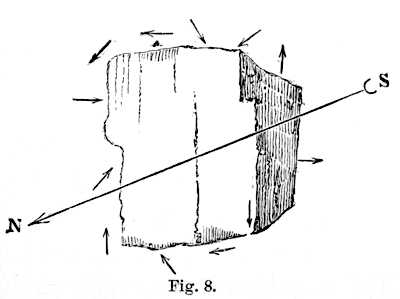
On the evening of the same day I examined the lower spur of the Riffelhorn. Amid its fissures and gullies one feels as if wandering through the ruins of a vast castle or fortification; the precipices are so like walls, and the scratching and polishing so like what might be done by the hands of man. I found evidences of strong polar action in some of the rocks low down. In the same continuous mass the action would sometimes exhibit itself over an area of small extent, while the remainder of the rock showed no appreciable action. Some of the boulders cast down from the summit exhibited a strong and varied polarity. Fig. 8 is a sketch of one of these; the barbed end of each arrow represents the north end of the needle, which assumed the various positions shown in the figure. Midway down the spur I lighted upon a transverse wall of rock, which formed in earlier ages the boundary of a lateral outlet of the Görner glacier. It was red and hard, weathered rough at some places, and polished smooth at others. The lines were drawn finely upon it, but its outer surface appeared to be peeling off like a crust; the polished layer rested upon the rock like a kind of enamel. The action of the glacier appeared to resemble that of the break of a locomotive upon rails, both being cases of exfoliation brought about by pressure and friction. This wall measured twenty-eight yards across, and one end of it, for a distance of ten or twelve yards, was all north polar; the other end for a similar distance was south polar, but there was a pair of consequent points at its centre.
THE MAGNETIC FORCE. 1868.
To meet the case of my young readers, I will here say a few words about the magnetic force. The common magnetic needle points nearly north and south; and if a bit of iron be brought near to either end of the needle, they will mutually attract each other. A piece of lead will not show this effect, nor will copper, gold, nor silver. Iron, in fact, is a magnetic metal, which the others are not. It is to be particularly observed, that the bit of iron attracts both ends of the needle when it is presented to them in succession; and if a common steel sewing needle be substituted for the iron it will be seen that it also has the power of attracting both ends of the magnetic needle. But if the needle be rubbed once or twice along one end of a magnet, it will be found that one of its ends will afterwards repel a certain end of the magnetic needle and attract the other. By rubbing the needle on the magnet, we thus develop both attraction and repulsion, and this double action of the magnetic force is called its polarity; thus the steel which was at first simply magnetic, is now magnetic and polar.
It is the aim of persons making magnets, that each magnet should have but two poles, at its two ends; it is, however, easy to develop in the same piece of steel several pairs or poles; and if the magnetization be irregular, this is sometimes done when we wish to avoid it. These irregular poles are called consequent points.
Now I want my young reader to understand that it is not only because the rocks of the Görner Grat and Riffelhorn contain iron, that they exhibit the action which I have described. They are not only magnetic, as common iron is, but, like the magnetized steel needle, they are magnetic and polar. And these poles are irregularly distributed like the "consequent points" to which I have referred, and this is the reason why I have used the term.
BEARINGS FROM THE RIFFELHORN. 1858.
Professor Forbes, as I have already stated, was the first to notice the effect of the Riffelhorn upon the magnetic needle, but he seems to have supposed that the entire mass of the mountain exercised "a local attraction" upon the needle; (upon which end he does not say). To enable future observers to allow for this attraction, he took the bearing of several of the surrounding mountains from the Riffelhorn; but it is very probable that had he changed his position a few inches, and perfectly certain had he changed it a few yards, he would have found a set of bearings totally different from those which he has recorded. The close proximity and irregular distribution of its consequent points would prevent the Riffelhorn from exerting any appreciable influence on a distant needle, as in this case the local poles would effectually neutralize each other.
FOOTNOTES:
(21.)
MONT CERVIN AS CLOUD-MAKER. 1858.
On the morning of the 15th the Riffelberg was swathed in a dense fog, through which heavy rain showered incessantly. Towards one o'clock the continuity of the gray mass was broken, and sky-gleams of the deepest blue were seen through its apertures; these would close up again, and others open elsewhere, as if the fog were fighting for existence with the sun behind it. The sun, however, triumphed, the mountains came more and more into view, and finally the entire air was swept clear. I went up to the Görner Grat in the afternoon, and examined more closely the magnetism of its rocks; here, as on the Riffelhorn, I found it most pronounced at the jutting prominences of the Grat. Can it be that the superior exposure is more favourable to the formation of the magnetic oxide of iron? I secured a number of fragments, which I still possess, and which act forcibly upon a magnetic needle. The sun was near the western horizon, and I remained alone upon the Grat to see his last beams illuminate the mountains, which, with one exception, were without a trace of cloud. This exception was the Matterhorn, the appearance of which was extremely instructive. The obelisk appeared to be divided in two halves by a vertical line drawn from its summit half way down, to the windward of which we had the bare cliffs of the mountain; and to the left of it a cloud which appeared to cling tenaciously to the rocks. In reality, however, there was no clinging; the condensed vapour incessantly got away, but it was ever renewed, and thus a river of cloud had been sent from the mountain over the valley of Aosta. The wind in fact blew lightly up the valley of St. Nicholas charged with moisture, and when the air that held it rubbed against the cold cone of the Matterhorn the vapour was chilled and precipitated in his lee. The summit seemed to smoke sometimes like a burning mountain; for immediately after its generation, the fog was drawn away in long filaments by the wind. As the sun sank lower the ruddiness of his light augmented, until these filaments resembled streamers of flame. The sun sank deeper, the light was gradually withdrawn, and where it had entirely vanished it left the mountain like a desolate old man whose
"hoary hair Stream'd like a meteor in the troubled air."
For a moment after the sun had disappeared the scene was amazingly grand. The distant west was ruddy, copious gray smoke-wreaths were wafted from the mountains, while high overhead, in an atmospheric region which seemed perfectly motionless, floated a broad thin cloud, dyed with the richest iridescences. The colours were of the same character as those which I had seen upon the Aletschhorn, being due to interference, and in point of splendour and variety far exceeded anything ever produced by the mere coloured light of the setting sun.
CELLS IN THE ICE. 1858.
On the 16th I was early upon the glacier. It had frozen hard during the night, and the partially liberated streams flowed, in many cases, over their own ice. I took some clear plates from under the water, and found in them numerous liquid cells, each associated with an air-bubble or a vacuous spot. The most common shape of the cells was a regular hexagon, but there were all forms between the perfect hexagon and the perfect circle. Many cells had also crimped borders, intimating that their primitive form was that of a flower with six leaves. A plate taken from ice which was defended from the sunbeams by the shadow of a rock had no such cells; so that those that I observed were probably due to solar radiation.
My first aim was to examine the structure of the Görnerhorn glacier,[A] which descends the breast of Monte Rosa until it is abruptly cut off by the great Western glacier of the mountain.[B] Between them is a moraine which is at once terminal as regards the former, and lateral as regards the latter. The ice is veined vertically along the moraine, the direction of the structure being parallel to the latter. I ascended the glacier, and found, as I retreated from the place where the thrust was most violent, that the structure became more feeble. From the glacier I passed to the rocks called "auf der Platte," so as to obtain a general view of its terminal portion. The gradual perfecting of the structure as the region of pressure was approached was very manifest: the ice at the end seemed to wrinkle up in obedience to the pressure, the structural furrows, from being scarcely visible, became more and more decided, and the lamination underneath correspondingly pronounced, until it finally attained a state of great perfection.
STRUCTURE OF THE ICE. 1858.
I now quitted the rocks and walked straight across the Western glacier of Monte Rosa to its centre, where I found the structure scarcely visible. I next faced the Görner Grat, and walked down the glacier towards the moraine which divides it from the Görner glacier. The mechanical conditions of the ice here are quite evident; each step brought me to a place of greater pressure, and also to a place of more highly developed structure, until finally near to the moraine itself, and running parallel to it, a magnificent lamination was developed. Here the superficial groovings could be traced to great distances, and beside the moraine were boulders poised on pedestals of ice through which the blue veins ran. At some places the ice had been weathered into laminæ not more than a line in thickness.
I now recrossed the Monte Rosa glacier to its junction with the Schwartze glacier, which descends between the Twins and Breithorn. The structure of the Monte Rosa glacier is here far less pronounced than at the other side, and the pressure which it endures is also manifestly less; the structure of the Schwartze glacier is fairly developed, being here parallel to its moraine. The cliffs of the Breithorn are much exposed to weathering action, and boulders are copiously showered down upon the adjacent ice. Between the Schwartze glacier and the glacier which descends from the breast of the Breithorn itself these blocks ride upon a spine of ice, and form a moraine of grand proportions. From it a fine view of the glacier is attainable, and the gradual development of its structure as the region of maximum pressure is approached is very plain. A number of gracefully curved undulations sweep across the Breithorn glacier, which are squeezed more closely together as the moraine is approached. All the glaciers that descend from the flanking mountains of the Görner valley are suddenly turned aside where they meet the great trunk stream, and are reduced by the pressure to narrow stripes of ice separated from each other by parallel moraines.
TRIBUTARIES EXPLORED. 1858.
I ascended the Breithorn glacier to the base of an ice-fall, on one side of which I found large crumples produced by the pressure, the veined structure being developed at right angles to the direction of the latter. No such structure was visible above this place. The crumples were cut by fissures, perpendicular to which the blue veins ran. I now quitted the glacier, and clambered up the adjacent alp, from which a fine view of the general surface was attainable. As in the case of the Görnerhorn glacier, the gradual perfecting of the structure was very manifest; the dirt, which first irregularly scattered over the surface, gradually assumed a striated appearance, and became more and more decided as the moraine was approached. Descending from the alp, I endeavoured to measure some of the undulations; proceeding afterwards to the junction of the Breithorn glacier with that of St. Théodule. The end of the latter appears to be crumpled by its thrust against the former, and the moraine between them, instead of being raised, runs along a hollow which is flanked by the crumples on either side. The Breithorn glacier became more and more attenuated, until finally it actually vanished under its own moraines. On the sides of the crevasses, by which the Théodule glacier is here intersected, I thought I could plainly see two systems of veins cutting each other at an angle of fifteen or twenty degrees. Reaching the Görner glacier, at a place where its dislocation was very great, I proceeded down it past the Riffelhorn, to a point where it seemed possible to scale the opposite mountain wall. Here I crossed the glacier, treading with the utmost caution along the combs of ice, and winding through the entanglement of crevasses until the spur of the Riffelhorn was reached; this I climbed to its summit, and afterwards crossed the green alp to our hotel.
TEMPTATION. 1858.
The foregoing good day's work was rewarded by a sound sleep at night. The tourists were called in succession next morning, but after each call I instantly subsided into deep slumber, and thus healthily spaced out the interval of darkness. Day at length dawned and gradually brightened. I looked at my watch and found it twenty minutes to six. My guide had been lent to a party of gentlemen who had started at three o'clock for the summit of Monte Rosa, and he had left with me a porter who undertook to conduct me to one of the adjacent glaciers. But as I looked from my window the unspeakable beauty of the morning filled me with a longing to see the world from the top of Monte Rosa. I was in exceedingly good condition—could I not reach the summit alone? Trained and indurated as I had been, I felt that the thing was possible; at all events I could try, without attempting anything which was not clearly within my power.
FOOTNOTES:
SECOND ASCENT OF MONTE ROSA, 1858. (22.)
A LIGHT SCRIP. 1858.
Whether my exercise be mental or bodily, I am always most vigorous when cool. During my student life in Germany, the friends who visited me always complained of the low temperature of my room, and here among the Alps it was no uncommon thing for me to wander over the glaciers from morning till evening in my shirt-sleeves. My object now was to go as light as possible, and hence I left my coat and neckcloth behind me, trusting to the sun and my own motion to make good the calorific waste. After breakfast I poured what remained of my tea into a small glass bottle, an ordinary demi-bouteille, in fact; the waiter then provided me with a ham sandwich, and, with my scrip thus frugally furnished, I thought the heights of Monte Rosa might be won. I had neither brandy nor wine, but I knew the immense amount of mechanical force represented by four ounces of bread and ham, and I therefore feared no failure from lack of nutriment. Indeed, I am inclined to think that both guides and travellers often impair their vigour and render themselves cowardly and apathetic by the incessant "refreshing" which they deem it necessary to indulge in on such occasions.
THE GUIDE EXPOSTULATES. 1858.
The guide whom Lauener intended for me was at the door; I passed him and desired him to follow me. This he at first refused to do, as he did not recognise me in my shirt-sleeves; but his companions set him right, and he ran after me. I transferred my scrip to his shoulders, and led the way upward. Once or twice he insinuated that that was not the way to the Schwarze-See, and was probably perplexed by my inattention. From the summit of the ridge which bounds the Görner glacier the whole grand panorama revealed itself, and on the higher slopes of Monte Rosa—so high, indeed, as to put all hope of overtaking them, or even coming near them, out of the question—a row of black dots revealed the company which had started at three o'clock from the hotel. They had made remarkably good use of their time, and I was afterwards informed that the cause of this was the intense cold, which compelled them to keep up the proper supply of heat by increased exertion. I descended swiftly to the glacier, and made for the base of Monte Rosa, my guide following at some distance behind me. One of the streams, produced by superficial melting, had cut for itself a deep wide channel in the ice; it was not too wide for a spring, and with the aid of a run I cleared it and went on. Some minutes afterwards I could hear the voice of my companion exclaiming, in a tone of expostulation, "No, no, I won't follow you there." He however made a circuit, and crossed the stream; I waited for him at the place where the Monte Rosa glacier joins the rock, "auf der Platte," and helped him down the ice-slope. At the summit of these rocks I again waited for him. He approached me with some excitement of manner, and said that it now appeared plain to him that I intended to ascend Monte Rosa, but that he would not go with me. THE GUIDE HALTS. 1858. I asked him to accompany me to the summit of the next cliff, which he agreed to do; and I found him of some service to me. He discovered the faint traces of the party in advance, and, from his greater experience, could keep them better in view than I could. We lost them, however, near the base of the cliff at which we aimed, and I went on, choosing as nearly as I could remember the route followed by Lauener and myself a week previously, while my guide took another route, seeking for the traces. The glacier here is crevassed, and I was among the fissures some distance in advance of my companion. Fear was manifestly getting the better of him, and he finally stood still, exclaiming, "No man can pass there." At the same moment I discovered the trace, and drew his attention to it; he approached me submissively, said that I was quite right, and declared his willingness to go on. We climbed the cliff, and discovered the trace in the snow above it. Here I transferred the scrip and telescope to my own shoulders, and gave my companion a cheque for five francs. He returned, and I went on alone.
The sun and heaven were glorious, but the cold was nevertheless intense, for it had frozen bitterly the night before. The mountain seemed more noble and lovely than when I had last ascended it; and as I climbed the slopes, crossed the shining cols, and rounded the vast snow-bosses of the mountain, the sense of being alone lent a new interest to the glorious scene. I followed the track of those who preceded me, which was that pursued by Lauener and myself a week previously. Once I deviated from it to obtain a glimpse of Italy over the saddle which stretches from Monte Rosa to the Lyskamm. Deep below me was the valley, with its huge and dislocated névé, and the slope on which I hung was just sufficiently steep to keep the attention aroused without creating anxiety. I prefer such a slope to one on which the thought of danger cannot be entertained. I become more weary upon a dead level, or in walking up such a valley as that which stretches between Visp and Zermatt, than on a steep mountain side. The sense of weariness is often no index to the expenditure of muscular force: the muscles may be charged with force, and, if the nervous excitant be feeble, the strength lies dormant, and we are tired without exertion. But the thought of peril keeps the mind awake, and spurs the muscles into action; they move with alacrity and freedom, and the time passes swiftly and pleasantly.
LEFT ALONE. 1858.
Occupied with my own thoughts as I ascended, I sometimes unconsciously went too quickly, and felt the effects of the exertion. I then slackened my pace, allowing each limb an instant of repose as I drew it out of the snow, and found that in this way walking became rest. This is an illustration of the principle which runs throughout nature—to accomplish physical changes, time is necessary. Different positions of the limb require different molecular arrangements; and to pass from one to the other requires time. By lifting the leg slowly and allowing it to fall forward by its own gravity, a man may get on steadily for several hours, while a very slight addition to this pace may speedily exhaust him. Of course the normal pace differs in different persons, but in all the power of endurance may be vastly augmented by the prudent outlay of muscular force.