Part 2 — PART II. CHIEFLY SCIENTIFIC. (continued 3)
Reading edition
This molecular work is that which has usually been called specific heat, or capacity for heat. According to the materialistic view of heat, bodies are figured as sponges, and heat as a kind of fluid absorbed by them, different bodies possessing different powers of absorption. According to the dynamic view, as already explained, heat is regarded as a motion, and capacity for heat indicates the quantity of that motion consumed in internal changes.
The greatest of these changes occurs when a body passes from one state of aggregation to another, from the solid to the liquid, or from the liquid to the aëriform state; and the quantity of heat required for such changes is often enormous. To convert a pound of ice at 32° Fahr. into water at the same temperature would require an amount of heat competent, if applied as mechanical force, to lift the same pound of ice to a height of 110,000 feet; it would raise a ton of ice nearly 50 feet, or it would lift between 49 and 50 tons to a height of one foot above the earth's surface. To convert a pound of water at 212° into a pound of steam at the same temperature would require an amount of heat which would perform nearly seven times the amount of mechanical work just mentioned.
HEAT CONSUMED IN MOLECULAR WORK.
This heat is entirely expended in interior work,[A] and does nothing towards augmenting the temperature; the water is at the temperature of the ice which produced it, both are 32°; and the steam is at the temperature of the water which produced it, both are 212°. The whole of the heat is consumed in producing the change of aggregation; I say "consumed," not hidden or "latent" in either the water or the steam, but absolutely non-existent as heat. The molecular forces, however, which the heat has sacrificed itself to overcome are able to reproduce it; the water in freezing and the steam in condensing give out the exact amount of heat which they consumed when the change of aggregation was in the opposite direction.
At a temperature of several degrees below its freezing point ice is much harder than at 32°. I have more than once cooled a sphere of the substance in a bath of solid carbonic acid and ether to a temperature of 100° below the freezing point. During the time of cooling the ice crackled audibly from its contraction, and afterwards it quite resisted the edge of a knife; while at 32° it may be cut or crushed with extreme facility. The cold sphere was subjected to pressure; it broke with the detonation of a vitreous body, and was taken from the press a white opaque powder; which, on being subsequently raised to 32° and again compressed, was converted into a pellucid slab of ice.
ICE NEAR THE MELTING POINT.
But before the temperature of 32° is quite attained, ice gives evidence of a loosening of its crystalline texture. Indeed the unsoundness of ice at and near its melting point has been long known. Sir John Leslie, for example, states that ice at 32° is friable; and every skater knows how rotten ice becomes before it thaws. M. Person has further shown that the latent heat of ice, that is to say, the quantity of heat necessary for its liquefaction, is not quite expressed by the quantity consumed in reducing ice at 32° to the liquid state. The heat begins to be rendered latent, or in other words the change of aggregation commences, a little before the substance reaches 32°,—a conclusion which is illustrated and confirmed by the deportment of melting ice under pressure.
ROTTEN ICE AND SOFTENED WAX.
In reference to the above result Professor Forbes writes as follows:—"I have now to refer to a fact ... established by a French experimenter, M. Person, who appears not to have had even remotely in his mind the theory of glaciers, when he announced the following facts, viz.—'That ice does not pass abruptly from the solid to the fluid state; that it begins to soften at a temperature of 2° Centigrade below its thawing point; that, consequently, between 28° 4' and 32° of Fahr. ice is actually passing through various degrees of plasticity within narrower limits, but in the same manner that wax, for example, softens before it melts.'" The "softening" here referred to is the "friability," of Sir J. Leslie, and what I have called a "loosening of the texture." Let us suppose the Serpentine covered by a sheet of pitch so smooth and hard as to enable a skater to glide over it; and which is afterwards gradually warmed until it begins to bend under his weight, and finally lets him through. A comparison of this deportment with that of a sheet of ice under the same circumstances enables us to decide whether ice "passes through various degrees of plasticity in the same manner as wax softens before it melts." M. Person concerned himself solely with the heat absorbed, and no doubt in both wax and ice that heat is expended in "interior work." In the one case, however, the body is so constituted that the absorbed heat is expended in rendering the substance viscous; and the question simply is, whether the heat absorbed by the ice gives its molecules a freedom of play which would entitle it also to be called viscous; whether, in short, "rotten ice" and softened wax present the same physical qualities?
FOOTNOTES:
(20.)
There is one other point in connexion with the viscous theory which claims our attention. The announcement of that theory startled scientific men, and for two or three years after its first publication it formed the subject of keen discussion. This finally subsided, and afterwards Professor Forbes drew up an elaborate paper, which was presented in three parts to the Royal Society in 1845 and 1846, and subsequently published in the 'Philosophical Transactions.'
In the concluding portion of Part III. Professor Forbes states and answers the question, "How far a glacier is to be regarded as a plastic mass?" in these words:—"Were a glacier composed of a solid crystalline cake of ice, fitted or moulded to the mountain bed which it occupies, like a lake tranquilly frozen, it would seem impossible to admit such a flexibility or yielding of parts as should permit any comparison to a fluid or semifluid body, transmitting pressure horizontally, and whose parts might change their mutual positions so that one part should be pushed out whilst another remained behind. But we know, in point of fact, that a glacier is a body very differently constituted. It is clearly proved by the experiments of Agassiz and others that the glacier is not a mass of ice, but of ice and water, the latter percolating freely through the crevices of the former to all depths of the glacier; and it is a matter of ocular demonstration that these crevices, though very minute, communicate freely with one another to great distances; the water with which they are filled communicates force also to great distances, and exercises a tremendous hydrostatic pressure to move onwards in the direction in which gravity urges it, the vast porous mass of seemingly rigid ice in which it is as it were bound up."
CAPILLARY HYPOTHESIS.
"Now the water in the crevices," continues Professor Forbes, "does not constitute the glacier, but only the principal vehicle of the force which acts on it, and the slow irresistible energy with which the icy mass moves onwards from hour to hour with a continuous march, bespeaks of itself the presence of a fluid pressure. But if the ice were not in some degree ductile or plastic, this pressure could never produce any the least forward motion of the mass. The pressure in the capillaries of the glacier can only tend to separate one particle from another, and thus produce tensions and compressions within the body of the glacier itself, which yields, owing to its slightly ductile nature, in the direction of least resistance, retaining its continuity, or recovering it by reattachment after its parts have suffered a bruise, according to the violence of the action to which it has been exposed."
I will not pretend to say that I fully understand this passage, but, taking it and the former one together, I think it is clear that the water which is supposed to gorge the capillaries of the glacier is assumed to be essential to its motion. Indeed, an extreme degree of sensitiveness has been ascribed to the glacier as regards the changes of temperature by which the capillaries are affected. In three succeeding days, for example, Professor Forbes found the diurnal summer motion of a point upon the Mer de Glace to increase from 15.2 to 17.5 inches a day; a result which he says he is "persuaded" to be due to the increasing heat of the weather at the time. If, then, the glacier capillaries can be gorged so quickly as this experiment would indicate, it is fair to assume that they are emptied with corresponding speed when the supply is cut away.
TEMPERATURE AT CHAMOUNI; WINTER 1859.
The extraordinary coldness of the weather previous to the Christmas of 1859 is in the recollection of everybody: this lowness of temperature also extended to the Mer de Glace and its environs. I had last summer left with Auguste Balmat and the Abbé Vueillet thermometers with which observations were made daily during the cold weather referred to. I take the following from Balmat's register.
Date.Minimum temperature Centigrade.
December16-15°
"17-20
"18-161/2
"19-9
"20-13
"21-201/2
"22-41/4
December23-41/2°
"24-61/2
"25-2
"26+2
"27-3
"28-101/2
"29-6
The temperature at the Montanvert during the above period may be assumed as generally some degrees lower, so that for a considerable period, previous to my winter observations, the portion of the Mer de Glace near the Montanvert had been exposed to a very low temperature. I reached the place after the weather had become warm, but during my stay there the maximum temperature did not exceed -41/2° C. Considering therefore the long drain to which the glacier had been subjected previous to the 29th of December, it is not unreasonable to infer that the capillary supply assumed by Professor Forbes must by that time have been exhausted. Notwithstanding this, the motion of the glacier at the Montanvert amounted at the end of December to half its maximum summer motion.
BALMAT'S MEASUREMENTS.
The observations of Balmat which have been published by Professor Forbes[A] also militate, as far as they go, against the idea of proportionality between the capillary supply and the motion. If the temperatures recorded apply to the Mer de Glace during the periods of observation, it would follow that from the 19th of December 1846 to the 12th of April 1847 the temperature of the air was constantly under zero Centigrade, and hence, during this time, the gorging of the capillaries, which is due to superficial melting, must have ceased. Still, throughout this entire period of depletion the motion of the glacier steadily increased from twenty-four inches to thirty-four and a half inches a day. What has been here said of the Montanvert, and of the points lower down where Balmat's measurements were made, of course applies with greater force to the higher portions of the glacier, which are withdrawn from the operation of superficial melting for a longer period, and which, nevertheless, if I understand Professor Forbes aright, have their motion least affected in winter. He records, for example, an observation of Mr. Bakewell's, by which the Glacier des Bossons is shown to be stationary at its end, while its upper portions are moving at the rate of a foot a day. This surely indicates that, at those places where the glacier is longest cut off from superficial supply, the motion is least reduced, which would be a most strange result if the motion depended, as affirmed, upon the gorging of the capillaries.
BAKEWELL'S OBSERVATIONS.
The perusal of the conclusion of Professor Forbes's last volume shows me that a thought similar to that expressed above occurred to Mr. Bakewell also. Speaking of a shallow glacier which moved when the alleged temperature was so enormously below the freezing point that Professor Forbes regards the observation as open to question (in which I agree with him), Mr. Bakewell asks, "Is it possible that infiltrated water can have any action whatever under such circumstances?" The reply of Professor Forbes contains these words:—"I have nowhere affirmed the presence of liquid water to be a sine quâ non to the plastic motion of glaciers." This statement, I confess, took me by surprise, which was not diminished by further reading. Speaking of the influence of temperature on the motion of the Mer de Glace, Professor Forbes says, the glacier "took no real start until the frost had given way, and the tumultuous course of the Arveiron showed that its veins were again filled with the circulating medium to which the glacier, like the organic frame, owes its moving energy."[B] And again:—"It is this fragility precisely which, yielding to the hydrostatic pressure of the unfrozen water contained in the countless capillaries of the glacier, produces the crushing action which shoves the ice over its neighbour particles."[C]
HUXLEY'S OBSERVATIONS.
After the perusal of the foregoing paragraphs the reader will probably be less interested in the question as to whether the assumed capillaries exist at all in the glacier. According to Mr. Huxley's observations, they do not.[D] During the summer of 1857 he carefully experimented with coloured liquids on the Mer de Glace and its tributaries, and in no case was he able to discover these fissures in the sound unweathered ice. I have myself seen the red liquid resting in an auger-hole, where it had lain for an hour without diffusing itself in any sensible degree. This cavity intersected both the white ice and the blue veins of the glacier; and Mr. Huxley, in my presence, cut away the ice until the walls of the cavity became extremely thin, still no trace of liquid passed through them. Experiments were also made upon the higher portions of the Mer de Glace, and also on the Glacier du Géant, with the same result. Thus the very existence of these capillaries is rendered so questionable, that no theory of glacier-motion which invokes their aid could be considered satisfactory.
FOOTNOTES:
THOMSON'S THEORY. (21.)
In the 'Transactions' of the Royal Society of Edinburgh for 1849 is published a very interesting paper by Prof. James Thomson of Queen's College, Belfast, wherein he deduces, as a consequence of a principle announced by the French philosopher Carnot, that water, when subjected to pressure, requires a greater cold to freeze it than when the pressure is removed. He inferred that the lowering of the freezing point for every atmosphere of pressure amounted to .0075 of a degree Centigrade. This deduction was afterwards submitted to the test of experiment by his distinguished brother Prof. Wm. Thomson, and proved correct. On the fact thus established is founded Mr. James Thomson's theory of the "Plasticity of Ice as manifested in Glaciers."
STATEMENT OF THEORY.
The theory is this:—Certain portions of the glacier are supposed first to be subjected to pressure. This pressure liquefies the ice, the water thus produced being squeezed through the glacier in the direction in which it can most easily escape. But cold has been evolved by the act of liquefaction, and, when the water has been relieved from the pressure, it freezes in a new position. The pressure being thus abolished at the place where it was first applied, new portions of the ice are subjected to the force; these in their turn liquefy, the water is dispersed as before, and re-frozen in some other place. To the succession of processes here assumed Mr. Thomson ascribes the changes of form observed in glaciers.
This theory was first communicated to the Royal Society through the author's brother, Prof. William Thomson, and is printed in the 'Proceedings' of the Society for May, 1857. It was afterwards communicated to the British Association in Dublin, in whose 'Reports' it is further published; and again it was communicated to the Belfast Literary and Philosophical Society, in whose 'Proceedings' it also finds a place.
On the 24th of November, 1859, Mr. James Thomson communicated to the Royal Society, through his brother, a second paper, in which he again draws attention to his theory. He offers it in substitution for my views as the best argument that he can adduce against them; he also controverts the explanations of regelation propounded by Prof. James D. Forbes and Prof. Faraday, believing that his own theory explains all the facts so well as to leave room for no other.
DIFFICULTIES OF THEORY.
But the passage in this paper which demands my chief attention is the following:—"Prof. Tyndall (writes Mr. Thomson), in papers and lectures subsequent to the publication of this theory, appears to adopt it to some extent, and to endeavour to make its principles co-operate with the views he had previously founded on Mr. Faraday's fact of regelation." I may say that Mr. Thomson's main thought was familiar to me long before his first communication on the plasticity of ice appeared; but it had little influence upon my convictions. Were the above passage correct, I should deserve censure for neglecting to express my obligations far more explicitly than I have hitherto done; but I confess that even now I do not understand the essential point of Mr. Thomson's theory,—that is to say, its application to the phenomena of glacier motion. Indeed, it was the obscurity in my mind in connexion with this point, and the hope that time might enable me to seize more clearly upon his meaning, which prevented me from giving that prominence to the theory of Mr. Thomson which, for aught I know, it may well deserve. I will here briefly state one or two of my difficulties, and shall feel very grateful to have them removed.
IMPROBABLE DEDUCTION.
Let us fix our attention on a vertical slice of ice transverse to the glacier, and to which the pressure is applied perpendicular to its surfaces. The ice liquefies, and, supposing the means of escape offered to the compressed water to be equal all round, it is plain that there will be as great a tendency to squeeze the water upwards as downwards; for the mere tendency to flow down by its own gravity becomes, in comparison to the forces here acting on the water, a vanishing quantity. But the fact is, that the ice above the slice is more permeable than that below it; for, as we descend a glacier, the ice becomes more compact. Hence the greater part of the dispersed water will be refrozen on that side of the slice which is turned towards the origin of the glacier; and the consequence is, that, according to Mr. Thomson's principle, the glacier ought to move up hill instead of down.
I would invite Mr. Thomson to imagine himself and me together upon the ice, desirous of examining this question in a philosophic spirit; and that we have taken our places beside a stake driven into the ice, and descending with the glacier. We watch the ice surrounding the stake, and find that every speck of dirt upon it retains its position; there is no liquefaction of the ice that bears the dirt, and consequently it rests on the glacier undisturbed. After twelve hours we find the stake fifteen inches distant from its first position: I would ask Mr. Thomson how did it get there? Or let us fix our attention on those six stakes which M. Agassiz drove into the glacier of the Aar in 1841, and found erect in 1842 at some hundreds of feet from their first position:—how did they get there? How, in fine, does the end of a glacier become its end? Has it been liquefied and re-frozen? If not, it must have been pushed down by the very forces which Mr. Thomson invokes to produce his liquefaction. Both the liquefaction, as far as it exists, and the motion, are products of the same cause. In short, this theory, as it presents itself to my mind, is so powerless to account for the simplest fact of glacier-motion, that I feel disposed to continue to doubt my own competence to understand it rather than ascribe to Mr. Thomson an hypothesis apparently so irrelevant to the facts which it professes to explain.
Another difficulty is the following:—Mr. Thomson will have seen that I have recorded certain winter measurements made on the Mer de Glace, and that these measurements show not only that the ice moves at that period of the year, but that it exhibits those characteristics of motion from which its plasticity has been inferred; the velocity of the central portions of the glacier being in round numbers double the velocity of those near the sides. Had there been any necessity for it, this ratio might have been augmented by placing the side-stakes closer to the walls of the glacier. Considering the extreme coldness of the weather which preceded these measurements, it is a moderate estimate to set down the temperature of the ice in which my stakes were fixed at 5° Cent. below zero.
REQUISITE PRESSURE CALCULATED.
Let us now endeavour to estimate the pressure existing at the portion of the glacier where these measurements were made. The height of the Montanvert above the sea-level is, according to Prof. Forbes, 6300 feet; that of the Col du Géant, which is the summit of the principal tributary of the Mer de Glace, is 11,146 feet: deducting the former from the latter, we find the height of the Col du Géant above the Montanvert to be 4846 feet.
Now, according to Mr. Thomson's theory and his brother's experiments, the melting point of ice is lowered .0075° Centigrade for every atmosphere of pressure; and one atmosphere being equivalent to the pressure of about thirty-three feet of water, we shall not be over the truth if we take the height of an equivalent column of glacier-ice, of a compactness the mean of those which it exhibits upon the Col du Géant and at the Montanvert respectively, at forty feet. The compactness of glacier ice is, of course, affected by the air-bubbles contained within it.
ACTUAL PRESSURE INSUFFICIENT.
If, then, the pressure of forty feet of ice lower the melting point .0075° Centigrade, it follows that the pressure of a column 4846 feet high will lower it nine-tenths of a degree Centigrade. Supposing, then, the unimpeded thrust of the whole glacier, from the Col du Géant downwards, to be exerted on the ice at the Montanvert; or, in other words, supposing the bed of the glacier to be absolutely smooth and every trace of friction abolished, the utmost the pressure thus obtained could perform would be to lower the melting point of the Montanvert ice by the quantity above mentioned. Taking into account the actual state of things, the friction of the glacier against its sides and bed, the opposition which the three tributaries encounter in the neck of the valley at Trélaporte, the resistance encountered in the sinuous valley through which it passes; and finally, bearing in mind the comparatively short length of the glacier, which has to bear the thrust, and oppose the latter by its own friction merely;—I think it will appear evident that the ice at the Montanvert cannot possibly have its melting point lowered by pressure more than a small fraction of a degree.
The ice in which my stakes were fixed being -5° Centigrade, according to Mr. Thomson's calculation and his brother's experiments, it would require 667 atmospheres of pressure to liquefy it; in other words, it would require the unimpeded pressure of a column of glacier-ice 26,680 feet high. Did Mont Blanc rise to two and a half times its present height above the Montanvert, and were the latter place connected with the summit of the mountain by a continuous glacier with its bed absolutely smooth, the pressure at the Montanvert would be rather under that necessary to liquefy the ice on which my winter observations were made.
MEASUREMENTS APPLY TO SURFACE.
If it be urged that, though the temperature near the surface may be several degrees below the freezing point, the great body of the glacier does not share this temperature, but is, in all probability, near to 32°, my reply is simple. I did not measure the motion of the ice in the body of the glacier; nobody ever did; my measurements refer to the ice at and near the surface, and it is this ice which showed the plastic deportment which the measurements reveal.
Such, then, are some of the considerations which prevent me from accepting the theory of Mr. Thomson, and I trust they will acquit me of all desire, to make his theory co-operate with my views. I am, however, far from considering his deduction the less important because of its failing to account for the phenomena of glacier motion.
THE PRESSURE-THEORY OF GLACIER-MOTION. (22.)
POSSIBLE MOULDING OF ICE.
Broadly considered, two classes of facts are presented to the glacier-observer; the one suggestive of viscosity, and the other of the reverse. The former are seen where pressure comes into play, the latter where tension is operative. By pressure ice can be moulded to any shape, while the same ice snaps sharply asunder if subjected to tension. Were the result worth the labour, ice might be moulded into vases or statuettes, bent into spiral bars, and, I doubt not, by the proper application of pressure, a rope of ice might be formed and coiled into a knot. But not one of these experiments, though they might be a thousandfold more striking than any ever made upon a glacier, would in the least demonstrate that ice is really a viscous body.
Fig. 30. Moulds used in experiments with ice.
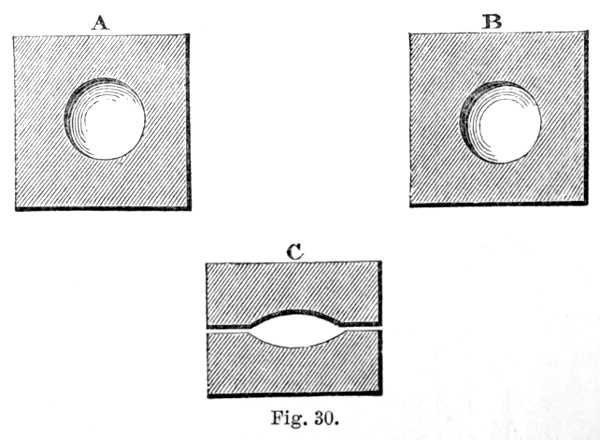
I have here stated what I believe to be feasible. Let me now refer to the experiments which have been actually made in illustration of this point. Two pieces of seasoned box-wood had corresponding cavities hollowed in them, so that, when one was placed upon the other, a lenticular space was enclosed. a and b, Fig. 30, represent the pieces of box-wood with the cavities in plan: c represents their section when they are placed upon each other.
ACTUAL MOULDING OF ICE.
A sphere of ice rather more than sufficient to fill the lenticular space was placed between the pieces of wood and subjected to the action of a small hydraulic press. The ice was crushed, but the crushed fragments soon reattached themselves, and, in a few seconds, a lens of compact ice was taken from the mould.
Fig. 31. Moulds used in experiments with ice.
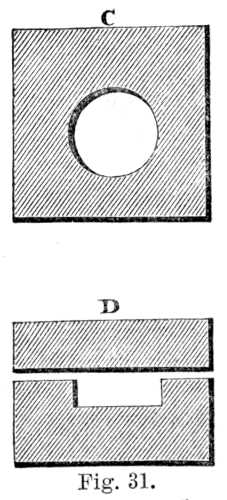
This lens was placed in a cylindrical cavity hollowed out in another piece of box-wood, and represented at c, Fig. 31; and a flat piece of the wood was placed over the lens as a cover, as at d. On subjecting the whole to pressure, the lens broke, as the sphere had done, but the crushed mass soon re-established its continuity, and in less than half a minute a compact cake of ice was taken from the mould.
Fig. 32. Moulds used in experiments with ice.
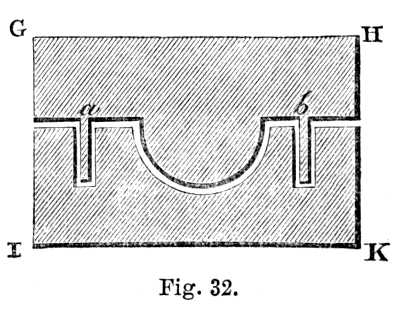
In the following experiment the ice was subjected to a still severer test:—A hemispherical cavity was formed in one block of box-wood, and upon a second block a hemispherical protuberance was turned, smaller than the cavity, so that, when the latter was placed in the former, a space of a quarter of an inch existed between the two. Fig. 32 represents a section of the two pieces of box-wood; the brass pins a, b, fixed in the slab g h, and entering suitable apertures in the mould i k, being intended to keep the two surfaces concentric. A lump of ice being placed in the cavity, the protuberance was brought down upon it, and the mould subjected to hydraulic pressure: after a short interval the ice was taken from the mould as a smooth compact cup, its crushed particles having reunited, and established their continuity.
ICE MOULDED TO CUPS AND RINGS.
Fig. 33. Moulds used in experiments with ice.
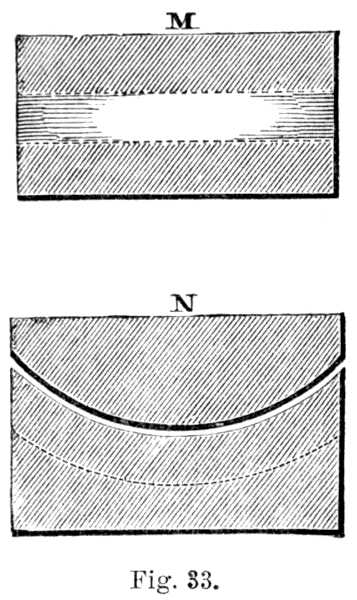
To make these results more applicable to the bending of glacier-ice, the following experiments were made:—A block of box-wood, m, Fig. 33, 4 inches long, 3 wide, and 3 deep, had its upper surface slightly curved, and a groove an inch wide, and about an inch deep, worked into it. A corresponding plate was prepared, having its under surface part of a convex cylinder, of the same curvature as the concave surface of the former piece. When the one slab was placed upon the other, they presented the appearance represented in section at n. A straight prism of ice 4 inches long, an inch wide, and a little more than an inch in depth, was placed in the groove; the upper slab was placed upon it, and the whole was subjected to the hydraulic press. The prism broke, but, the quantity of ice being rather more than sufficient to fill the groove, the pressure soon brought the fragments together and re-established the continuity of the ice. After a few seconds it was taken from the mould a bent bar of ice. This bar was afterwards passed through three other moulds of gradually augmenting curvature, and was taken from the last of them a semi-ring of compact ice.
The ice, in changing its form from that of one mould to that of another, was in every instance broken and crushed by the pressure; but suppose that instead of three moulds three thousand had been used; or, better still, suppose the curvature of a single mould to change by extremely slow degrees; the ice would then so gradually change its form that no rude rupture would be apparent. Practically the ice would behave as a plastic substance; and indeed this plasticity has been contended for by M. Agassiz, in opposition to the idea of viscosity. As already stated, the ice, bruised, and flattened, and bent in the above experiments, was incapable of being sensibly stretched; it was plastic to pressure but not to tension.
A quantity of water was always squeezed out of the crushed ice in the above experiments, and the bruised fragments were intermixed with this and with air. Minute quantities of both remained in the moulded ice, and thus rendered it in some degree turbid. Its character, however, as to continuity may be inferred from the fact that the ice-cup, moulded as described, held water without the slightest visible leakage.
SOFTNESS OF ICE DEFINED.
Ice at 32° may, as already stated, be crushed with extreme facility, and glacier-ice with still more readiness than lake-ice: it may also be scraped with a knife with even greater facility than some kinds of chalk. In comparison with ice at 100° below the freezing point, it might be popularly called soft. But its softness is not that of paste, or wax, or treacle, or lava, or honey, or tar. It is the softness of calcareous spar in comparison with that of rock-crystal; and although the latter is incomparably harder than the former, I think it will be conceded that the term viscous would be equally inapplicable to both. My object here is clearly to define terms, and not permit physical error to lurk beneath them. How far this ice, with a softness thus defined, when subjected to the gradual pressures exerted in a glacier, is bruised and broken, and how far the motion of its parts may approach to that of a truly viscous body under pressure, I do not know. The critical point here is that the ice changes its form, and preserves its continuity, during its motion, in virtue of external force. PRESSURE AND TENSION. It remains continuous whilst it moves, because its particles are kept in juxtaposition by pressure, and when this external prop is removed, and the ice, subjected to tension, has to depend solely upon the mobility of its own particles to preserve its continuity, the analogy with a viscous body instantly breaks down.[A]
FOOTNOTES:
REGELATION. (23.)
FARADAY'S FIRST EXPERIMENT.
I was led to the foregoing results by reflecting on an experiment performed by Mr. Faraday, at a Friday evening meeting of the Royal Institution, on the 7th of June, 1850, and described in the 'Athenæum' and 'Literary Gazette' for the same month. Mr. Faraday then showed that when two pieces of ice, with moistened surfaces, were placed in contact, they became cemented together by the freezing of the film of water between them, while, when the ice was below 32° Fahr., and therefore dry, no effect of the kind could be produced. The freezing was also found to take place under water; and indeed it occurs even when the water in which the ice is plunged is as hot as the hand can bear.
A generalisation from this interesting fact led me to conclude that a bruised mass of ice, if closely confined, must re-cement itself when its particles are brought into contact by pressure; in fact, the whole of the experiments above recorded immediately suggested themselves to my mind as natural deductions from the principle established by Faraday. A rough preliminary experiment assured me that the deductions would stand testing; and the construction of the box-wood moulds was the consequence. We could doubtless mould many solid substances to any extent by suitable pressure, breaking the attachment of their particles, and re-establishing a certain continuity by the mere force of cohesion. With such substances, to which we should never think of applying the term viscous, we might also imitate the changes of form to which glaciers are subject: but, superadded to the mere cohesion which here comes into play, we have, in the case of ice, the actual regelation of the severed surfaces, and consequently a more perfect solid. In the Introduction to this book I have referred to the production of slaty cleavage by pressure; and at a future page I hope to show that the lamination of the ice of glaciers is due to the same cause; but, as justly observed by Mr. John Ball, there is no tendency to cleave in the sound ice of glaciers; in fact, this tendency is obliterated by the perfect regelation of the severed surfaces.
RECENT EXPERIMENTS OF FARADAY.
Mr. Faraday has recently placed pieces of ice, in water, under the strain of forces tending to pull them apart. When two such pieces touch at a single point they adhere and move together as a rigid piece; but a little lateral force carefully applied breaks up this union with a crackling noise, and a new adhesion occurs which holds the pieces together in opposition to the force which tends to divide them. Mr. James Thomson had referred regelation to the cold produced by the liquefaction of the pressed ice; but in the above experiment all pressure is not only taken away, but is replaced by tension. Mr. Thomson also conceives that, when pieces of ice are simply placed together without intentional pressure, the capillary attraction brings the pressure of the atmosphere into play; but Mr. Faraday finds that regelation takes place in vacuo. A true viscidity on the part of ice Mr. Faraday never has observed, and he considers that his recent experiments support the view originally propounded by himself, namely, that a particle of water on a surface of ice becomes solid when placed between two surfaces, because of the increased influence due to their joint action.
CRYSTALLIZATION AND INTERNAL LIQUEFACTION. (24.)
HOW CRYSTALS ARE "NURSED."
In the Introduction to this book I have briefly referred to the force of crystallization. To permit this force to exercise its full influence, it must have free and unimpeded action; a crystal, for instance, to be properly built, ought to be suspended in the middle of the crystallizing solution, so that the little architects can work all round it; or if placed upon the bottom of a vessel, it ought to be frequently turned, so that all its facets may be successively subjected to the building process. In this way crystals can be nursed to an enormous size. But where other forces mingle with that of crystallization, this harmony of action is destroyed; the figures, for example, that we see upon a glass window, on a frosty morning, are due to an action compounded of the pure crystalline force and the cohesion of the liquid to the window-pane. A more regular effect is obtained when the freezing particles are suspended in still air, and here they build themselves into those wonderful figures which Dr. Scoresby has observed in the Polar Regions, Mr. Glaisher at Greenwich, and I myself on the summit of Monte Rosa and elsewhere.
Not only however in air, but in water also, figures of great beauty are sometimes formed. Harrison's excellent machine for the production of artificial ice is, I suppose, now well known; the freezing being effected by carrying brine, which had been cooled by the evaporation of ether, round a series of flat tin vessels containing water. The latter gradually freezes, and, on watching those vessels while the action was proceeding very slowly, I have seen little six-rayed stars of thin ice forming, and rising to the surface of the liquid. I believe the fact was never before observed, but it would be interesting to follow it up, and to develop experimentally this most interesting case of crystallization.
DISSECTION OF ICE BY SUNBEAM.
The surface of a freezing lake presents to the eye of the observer nothing which could lead him to suppose that a similar molecular architecture is going on there. Still the particles are undoubtedly related to each other in this way; they are arranged together on this starry type. And not only is this the case at the surface, but the largest blocks of ice which reach us from Norway and the Wenham Lake are wholly built up in this way. We can reveal the internal constitution of these masses by a reverse process to that which formed them; we can send an agent into the interior of a mass of ice which shall take down the atoms which the crystallizing forces had set up. This agent is a solar beam; with which it first occurred to me to make this simple experiment in the autumn of 1857. I placed a large converging lens in the sunbeams passing through a room, and observed the place where the rays were brought to a focus behind the lens; then shading the lens, I placed a clear cube of ice so that the point of convergence of the rays might fall within it. On removing the screen from the lens, a cone of sunlight went through the cube, and along the course of the cone the ice became studded with lustrous spots, evidently formed by the beam, as if minute reflectors had been suddenly established within the mass, from which the light flashed when it met them. On examining the cube afterwards I found that each of these spots was surrounded by a liquid flower of six petals; such flowers were distributed in hundreds through the ice, being usually clear and detached from each other, but sometimes crowded together into liquid bouquets, through which, however, the six-starred element could be plainly traced. At first the edges of the leaves were unbroken curves, but when the flowers expanded under a long-continued action, the edges became serrated. When the ice was held at a suitable angle to the solar beams, these liquid blossoms, with their central spots shining more intensely than burnished silver, presented an exhibition of beauty not easily described. I have given a sketch of their appearance in Fig. 34.
LIQUID FLOWERS IN ICE.
Fig. 34. Liquid Flowers in lake ice.
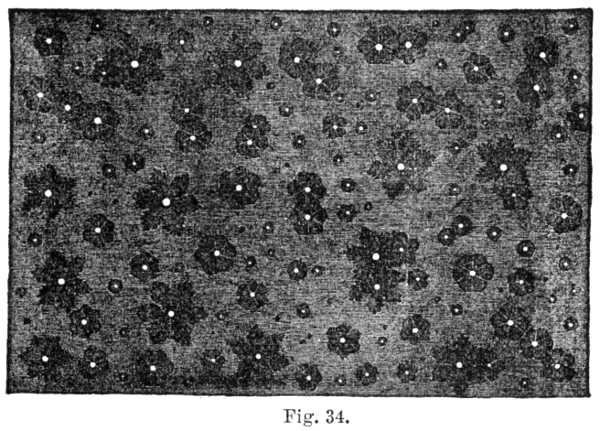
I have here to direct attention to an extremely curious fact. On sending the sunbeam through the transparent ice, I often noticed that the appearance of the lustrous spots was accompanied by an audible clink, as if the ice were ruptured inwardly. But there is no ground for assuming such rupture, and on the closest examination no flaw is exhibited by the ice. What then can be the cause of the noise? I believe the following considerations will answer the question:—
Water always holds a quantity of air in solution, the diffusion of which through the liquid, as proved by M. Donny, has an immense effect in weakening the cohesion of its particles; recent experiments of my own show that this is also the case in an eminent degree with many volatile liquids. M. Donny has proved that, if water be thoroughly purged of its air, a long glass tube filled with this liquid may be inverted, while the tenacity with which the water clings to the tube, and with which its particles cling to each other, is so great that it will remain securely suspended, though no external hindrance be offered to its descent. Owing to the same cause, water deprived of its air will not boil at 212° Fahr., and may be raised to a temperature of nearly 300° without boiling; but when this occurs the particles break their cohesion suddenly, and ebullition is converted into explosion.
Now, when ice is formed, every trace of the air which the water contained is squeezed out of it; the particles in crystallizing reject all extraneous matter, so that in ice we have a substance quite free from the air, which is never absent in the case of water; it therefore follows that if we could preserve the water derived from the melting of ice from contact with the atmosphere, we should have a liquid eminently calculated to show the effects described by M. Donny. Mr. Faraday has proved by actual experiment that this is the case.
WATER DEPRIVED OF AIR SNAPS ASUNDER.
Let us apply these facts to the explanation of the clink heard in my experiments. On sending a sunbeam through ice, liquid cavities are suddenly formed at various points within the mass, and these cavities are completely cut off from atmospheric contact. But the water formed by the melting ice is less in volume than the ice which produces it; the water of a cavity is not able to fill it, hence a vacuous space must be formed in the cell. I have no doubt that, for a time, the strong cohesion between the walls of the cell and the drop within it augments the volume of the latter a little, so as to compel it to fill the cell; but as the quantity of liquid becomes greater the shrinking force augments, until finally the particles snap asunder like a broken spring. At the same moment a lustrous spot appears, which is a vacuum, and simultaneously with the appearance of this vacuum the clink was always heard. Multitudes of such little explosions must be heard upon a glacier when the strong summer sun shines upon it, the aggregate of which must, I think, contribute to produce the "crepitation" noticed by M. Agassiz, and to which I have already referred.
FIGURES IN ICE; VACUOUS SPOTS.
In Plate VI. of the Atlas which accompanies the 'Système Glaciaire' of M. Agassiz, I notice drawings of figures like those I have described, which he has observed in glacier-ice, and which were doubtless produced by direct solar radiation. I have often myself observed figures of exquisite beauty formed in the ice on the surface of glacier-pools by the morning sun. In some cases the spaces between the leaves of the liquid flowers melt partially away, and leave the central spot surrounded by a crimped border; sometimes these spaces wholly disappear, and the entire space bounded by the lines drawn from point to point of the leaves becomes liquid, thus forming perfect hexagons. The crimped borders exhibit different degrees of serration, from the full leaves themselves to a gentle undulating line, which latter sometimes merges into a perfect circle. In the ice of glaciers, I have seen the internal liquefaction ramify itself like sprigs of myrtle; in the same ice, and particularly towards the extremities of the glacier, disks innumerable are also formed, consisting of flat round liquid spaces, a bright spot being usually associated with each. These spots have been hitherto mistaken for air-bubbles; but both they and the lustrous disks at the centres of the flowers are vacuous. I proved them to be so by plunging the ice containing them into hot water, and watching what occurred when the walls of the cells were dissolved, and a liquid connexion established between them and the atmosphere. In all cases they totally collapsed, and no trace of air rose to the surface of the warm water.
No matter in what direction a solar beam is sent through lake-ice, the liquid flowers are all formed parallel to the surface of freezing. The beam may be sent parallel, perpendicular, or oblique to this surface; the flowers are always formed in the same planes. Every line perpendicular to the surface of a frozen lake is in fact an axis of symmetry, round which the molecules so arrange themselves, that, when taken down by the delicate fingers of the sunbeam, the six-leaved liquid flowers are the result.
In the ice of glaciers we have no definite planes of freezing. It is first snow, which has been disturbed by winds while falling, and whirled and tossed about by the same agency after it has fallen, being often melted, saturated with its own water, and refrozen: it is cast in shattered fragments down cascades, and reconsolidated by pressure at the bottom. In ice so formed and subjected to such mutations, definite planes of freezing are, of course, out of the question.
CONSTITUTION OF GLACIER-ICE.
The flat round disks and vacuous spots to which I have referred come here to our aid, and furnish us with an entirely new means of analysing the internal constitution of a glacier. When we examine a mass of glacier-ice which contains these disks, we find them lying in all imaginable planes; not confusedly, however—closer examination shows us that the disks are arranged in groups, the members of each group being parallel to a common plane, but the parallelism ceases when different groups are compared. The effect is exactly what would be observed, supposing ordinary lake-ice to be broken up, shaken together, and the confused fragments regelated to a compact continuous mass. In such a jumble the original planes of freezing would lie in various directions; but no matter how compact or how transparent ice thus constituted might appear, a solar beam would at once reveal its internal constitution by developing the flowers parallel to the planes of freezing of the respective fragments. A sunbeam sent through glacier-ice always reveals the flowers in the planes of the disks, so that the latter alone at once informs us of its crystalline constitution.
VACUOUS CELLS MISTAKEN FOR AIR-CELLS.
Hitherto, as I have said, these disks have been mistaken for bubbles containing air, and their flattening has been ascribed to the pressure to which they have been subjected. M. Agassiz thus refers to them:—"The air-bubbles undergo no less curious modifications. In the neighbourhood of the névé, where they are most numerous, those which one sees on the surface are all spherical or ovoid, but by degrees they begin to be flattened, and near the end of the glacier there are some that are so flat that they might be taken for fissures when seen in profile. The drawing represents a piece of ice detached from the gallery of infiltration. All the bubbles are greatly flattened. But what is most extraordinary is, that, far from being uniform, the flattening is different in each fragment; so that the bubbles, according to the face which they offer, appear either very broad or very thin." This description of glacier-ice is correct: it agrees with the statements of all other observers. But there are two assumptions in the description which must henceforth be given up; first, the bubbles seen like fissures in profile are not air-bubbles at all, but vacuous spots, which the very constitution of ice renders a necessary concomitant of its inward melting; secondly, the assumption that the bubbles have been flattened by pressure must be abandoned; for they are found, and may be developed at will, in lake-ice on which no pressure has been exerted.
CELLS OF AIR AND WATER.
But these remarks dispose only of a certain class of cells contained in glacier-ice. Besides the liquid disks and vacuous spots, there are innumerable true bubbles entangled in the mass. These have also been observed and described by M. Agassiz; and Mr. Huxley has also given us an accurate account of them. M. Agassiz frequently found air and water associated in the same cell. Mr. Huxley found no exception to the rule: in each case the bubble of air was enclosed in a cell which was also partially filled with water. He supposes that the water may be that of the originally-melted snow which has been carried down from the névé unfrozen. This hypothesis is worthy of a great deal more consideration than I have had time to give to it, and I state it here in the hope that it will be duly examined.
My own experience of these associated air and water cells is derived almost exclusively from lake-ice, in which I have often observed them in considerable numbers. In examining whether the liquid contents had ever been frozen or not, I was guided by the following considerations. If the air be that originally entangled in the solid, it will have the ordinary atmospheric density at least; but if it be due to the melting of the walls of the cell, then the water so formed being only eight-ninths of that of the ice which produced it, the air of the bubble must be rarefied. I suppose I have made a hundred different experiments upon these bubbles to determine whether the air was rarefied or not, and in every case found it so. Ice containing the bubbles was immersed in warm water, and always, when the rigid envelope surrounding a bubble was melted away, the air suddenly collapsed to a fraction of its original dimensions. I think I may safely affirm that, in some cases, the collapse reduced the bubbles to the thousandth part of their original volume. From these experiments I should undoubtedly infer, that in lake-ice at least, the liquid of the cells is produced by the melting of the ice surrounding the bubbles of air.
But I have not subjected the bubbles of glacier-ice to the same searching examination. I have tried whether the insertion of a pin would produce the collapse of the bubbles, but it did not appear to do so. I also made a few experiments at Rosenlaui, with warm water, but the result was not satisfactory. That ice melts internally at the surfaces of the bubbles is, I think, rendered certain by my experiments, but whether the water-cells of glacier-ice are entirely due to such melting, subsequent observers will no doubt determine.
"LIQUID LIBERTY."
I have found these composite bubbles at all parts of glaciers; in the ice of the moraines, over which a protective covering had been thrown; in the ice of sand-cones, after the removal of the superincumbent débris; also in ice taken from the roofs of caverns formed in the glacier, and which the direct sunlight could hardly by any possibility attain. That ice should liquefy at the surface of a cavity is, I think, in conformity with all we know concerning the physical nature of heat. Regarding it as a motion of the particles, it is easy to see that this motion is less restrained at the surface of a cavity than in the solid itself, where the oscillation of each atom is controlled by the particles which surround it; hence liquid liberty, if I may use the term, is first attained at the surface. Indeed I have proved by experiment that ice may be melted internally by heat which has been conducted through its external portions without melting them. These facts are the exact complements of those of "regelation;" for here, two moist surfaces of ice being brought into close contact, their liquid liberty is destroyed and the surfaces freeze together.
THE MOULINS. (25.)
MOULIN OF GRINDELWALD GLACIER.
The first time I had an opportunity of seeing these remarkable glacier-chimneys was in the summer of 1856, upon the lower glacier of Grindelwald. Mr. Huxley was my companion at the time, and on crossing the so-called Eismeer we heard a sound resembling the rumble of distant thunder, which proceeded from a perpendicular shaft formed in the ice, and into which a resounding cataract discharged itself. The tube in fact resembled a vast organ-pipe, whose thunder-notes were awakened by the concussion of the falling water, instead of by the gentle flow of a current of air. Beside the shaft our guide hewed steps, on which we stood in succession, and looked into the tremendous hole. Near the first shaft was a second and smaller one, the significance of which I did not then understand; it was not more than 20 feet deep, but seemed filled with a liquid of exquisite blue, the colour being really due to the magical shimmer from the walls of the moulin, which was quite empty. As far as we could see, the large shaft was vertical, but on dropping a stone into it a shock was soon heard, and after a succession of bumps, which occupied in all seven seconds, we heard the stone no more. The depth of the moulin could not be thus ascertained, but we soon found a second and still larger one which gave us better data. A stone dropped into this descended without interruption for four seconds, when a concussion was heard; and three seconds afterwards the final shock was audible: there was thus but a single interruption in the descent. DEPTH OF THE SHAFT. Supposing all the acquired velocity to have been destroyed by the shock, by adding the space passed over by the stone in four and in three seconds respectively, and making allowance for the time required by the sound to ascend from the bottom, we find the depth of the shaft to be about 345 feet. There is, however, no reason to suppose that this measures the depth of the glacier at the place referred to. These shafts are to be found in almost all great glaciers; they are very numerous in the Unteraar Glacier, numbers of them however being empty. On the Mer de Glace they are always to be found in the region of Trélaporte, one of the shafts there being, par excellence, called the Grand Moulin. Many of them also occur on the Glacier de Léchaud.
As truly observed by M. Agassiz, these moulins occur only at those parts of the glacier which are not much rent by fissures, for only at such portions can the little rills produced by superficial melting collect to form streams of any magnitude. The valley of unbroken ice formed in the Mer de Glace near Trélaporte is peculiarly favourable for the collection of such streams; we see the little rills commencing, and enlarging by the contributions of others, the trunk-rill pouring its contents into a little stream which stretches out a hundred similar arms over the surface of the glacier. Several such streams join, and finally a considerable brook, which receives the superficial drainage of a large area, cuts its way through the ice.
MOULINS EXPLAINED.
But although this portion of the glacier is free from those long-continued and permanent strains which, having once rent the ice, tend subsequently to widen the rent and produce yawning crevasses, it is not free from local strains sufficient to produce cracks which penetrate the glacier to a great depth. Imagine such a crack intersecting such a glacier-rivulet as we have described. The water rushes down it, and soon scoops a funnel large enough to engulf the entire stream. The moulin is thus formed, and, as the ice moves downward, the sides of the crack are squeezed together and regelated, the seam which marks the line of junction being in most cases distinctly visible. But as the motion continues, other portions of the glacier come into the same state of strain as that which produced the first crack; a second one is formed across the stream, the old shaft is forsaken, and a new one is hollowed out, in which for a season the cataract plays the thunderer. I have in some cases counted the forsaken shafts of six old moulins in advance of an active one. Not far from the Grand Moulin of the Mer de Glace in 1857 there was a second empty shaft, which evidently communicated by a subglacial duct with that into which the torrent was precipitated. Out of the old orifice issued a strong cold blast, the air being manifestly impelled through the duct by the falling water of the adjacent moulin.
These shafts are always found in the same locality; the portion of the Mer de Glace to which I have referred is never without them. Some of the guides affirm that they are motionless; and a statement of Prof. Forbes has led to the belief that this was also his opinion.[A] M. Agassiz, however, observed the motion of some of these shafts upon the glacier of the Aar; and when on the spot in 1857, I was anxious to decide the point by accurate measurements with the theodolite.
My friend Mr. Hirst took charge of the instrument, and on the 28th of July I fixed a single stake beside the Grand Moulin, in a straight line between a station at Trélaporte and a well-defined mark on the rock at the opposite side of the valley. On the 31st, the displacement of the stake amounted to 50 inches, and on the 1st of August it had moved 741/2 inches—the moulin, to all appearance, occupying throughout the same position with regard to the stake. To render this certain, moreover we subsequently drove two additional stakes into the ice, thus enclosing the mouth of the shaft in a triangle. On the 8th of August the displacements were measured and gave the following results:—
Total Motion.
First (old) stake198inches.
Second (new) do.123"
Third124"
MOTION OF THE MOULINS.
The old stake had been fixed for 11 days, and its daily motion—which was also that of the moulin—averaged 18 inches a day. Hence the moulins share the general motion of the glacier, and their apparent permanence is not, as has been alleged, a proof of the semi-fluidity of the glacier, but is due to the breaking of the ice as it passes the place of local strain.
DEPTH OF "GRAND MOULIN" SOUGHT.
Wishing to obtain some estimate as to the depth of the ice, Mr. Hirst undertook the sounding of some of the moulins upon the Glacier de Léchaud, making use of a tin vessel filled with lumps of lead and iron as a weight. The cord gave way and he lost his plummet. To measure the depth of the Grand Moulin, we obtained fresh cord from Chamouni, to which we attached a four-pound weight. Into a cavity at the bottom of the weight we stuffed a quantity of butter, to indicate the nature of the bottom against which the weight might strike. The weight was dropped into the shaft, and the cord paid out until its slackening informed us that the weight had come to rest; by shaking the string, however, and walking round the edge of the shaft, the weight was liberated, and sank some distance further. The cord partially slackened a second time, but the strain still remaining was sufficient to render it doubtful whether it was the weight or the action of the falling water which produced it. We accordingly paid out the cord to the end, but, on withdrawing it, found that the greater part of it had been coiled and knotted up by the falling water. We uncoiled, and sounded again. At a depth of 132 feet the weight reached a ledge or protuberance of ice, and by shaking and lifting it, it was caused to descend 31 feet more. A depth of 163 feet was the utmost we could attain to. We sounded the old moulin to a depth of 90 feet; while a third little shaft, beside the large one, measured only 18 feet in depth. We could see the water escape from it through a lateral canal at its bottom, and doubtless the water of the Grand Moulin found a similar exit. There was no trace of dirt upon the butter, which might have indicated that we had reached the bed of the glacier.
FOOTNOTES:
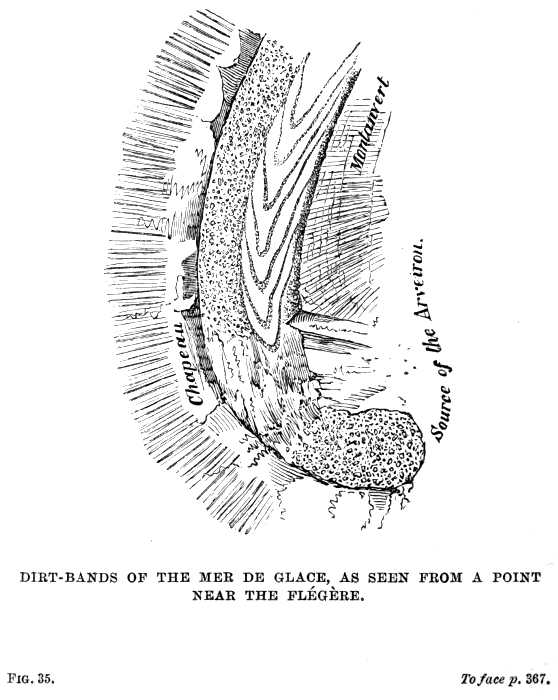
DIRT-BANDS OF THE MER DE GLACE, AS SEEN FROM A POINT NEAR THE FLÉGÈRE. Fig. 35.
DIRT-BANDS OF THE MER DE GLACE. (26.)
DIRT-BANDS FROM THE FLEGÈRE.
These bands were first noticed by Prof. Forbes on the 24th of July, 1842, and were described by him in the following words:—"My eye was caught by a very peculiar appearance of the surface of the ice, which I was certain that I now saw for the first time. It consisted of nearly hyperbolic brownish bands on the glacier, the curves pointing downwards, and the two branches mingling indiscriminately with the moraines, presenting an appearance of a succession of waves some hundred feet apart."[A] From no single point of view hitherto attained can all the Dirt-Bands of the Mer de Glace be seen at once. To see those on the terminal portion of the glacier, a station ought to be chosen on the opposite range of the Brévent, a few hundred yards beyond the Croix de la Flegère, where we stand exactly in front of the glacier as it issues into the valley of Chamouni. The appearance of the bands upon the portion here seen is represented in Fig. 35.
It will be seen that the bands are confined to one side of the glacier, and either do not exist, or are obliterated by the débris, upon the other side. The cause of the accumulation of dirt on the right side of the glacier is, that no less than five moraines are crowded together at this side. In the upper portions of the Mer de Glace these moraines are distinct from each other; but in descending, the successive engulfments and disgorgings of the blocks and dirt have broken up the moraines; and at the place now before us the materials which composed them are strewn confusedly on the right side of the glacier. The portion of the ice on which the dirt-bands appear is derived from the Col du Géant. They do not quite extend to the end of the glacier, being obliterated by the dislocation of the ice upon the frozen cascade of Des Bois.
DIRT-BANDS FROM LES CHARMOZ.
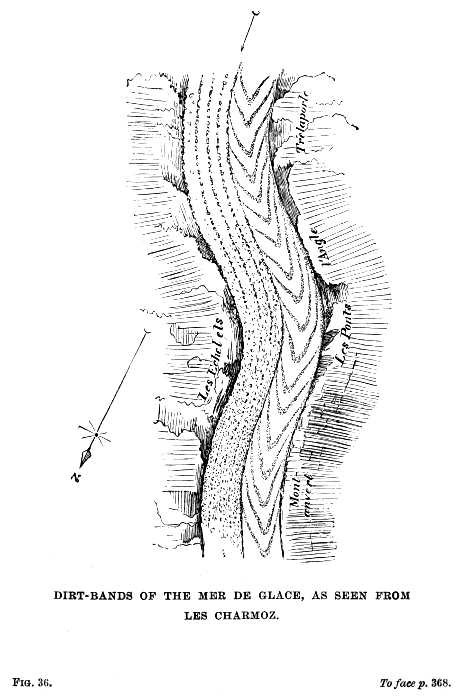
Let us now proceed across the valley of Chamouni to the Montanvert; where, climbing the adjacent heights to an elevation of six or eight hundred feet above the hotel, we command a view of the Mer de Glace, from Trélaporte almost to the commencement of the Glacier des Bois. It was from this position that Professor Forbes first observed the bands. Fifteen, sixteen, and seventeen years later I observed them from the same position. The number of bands which Professor Forbes counted from this position was eighteen, with which my observations agree. The entire series of bands which I observed, with the exception of one or two, must have been the successors of those observed by Professor Forbes; and my finding the same number after an interval of so many years proves that the bands must be due to some regularly recurrent cause. Fig. 36 represents the bands as seen from the heights adjacent to the Montanvert.
DIRT-BANDS OF THE MER DE GLACE, AS SEEN FROM LES CHARMOZ. Fig. 36.
I would here direct attention to an analogy between a glacier and a river, which may be observed from the heights above the Montanvert, but to which no reference, as far as I know, has hitherto been made. When a river meets the buttress of a bridge, the water rises against it, and, on sweeping round it, forms an elevated ridge, between which and the pier a depression occurs which varies in depth with the force of the current. This effect is shown by the Mer de Glace on an exaggerated scale. Sweeping round Trélaporte, the ice pushes itself beyond the promontory in an elevated ridge, from which it drops by a gradual slope to the adjacent wall of the valley, thus forming a depression typified by that already alluded to. A similar effect is observed at the opposite side of the glacier on turning round the Echelets; and both combine to form a kind of skew surface. A careful inspection of the frontispiece will detect this peculiarity in the shape of the glacier.
FROM THE CLEFT-STATION.
From neither of the stations referred to do we obtain any clue to the origin of the dirt-bands. A stiff but pleasant climb will place us in that singular cleft in the cliffy mountain-ridge which is seen to the right of the frontispiece; and from it we easily attain the high platform of rock immediately to the left of it. We stand here high above the promontory of Trélaporte, and occupy the finest station from which the Mer de Glace and its tributaries can be viewed. From this station we trace the dirt-bands over most of the ice that we have already scanned, and have the further advantage of being able to follow them to their very source.
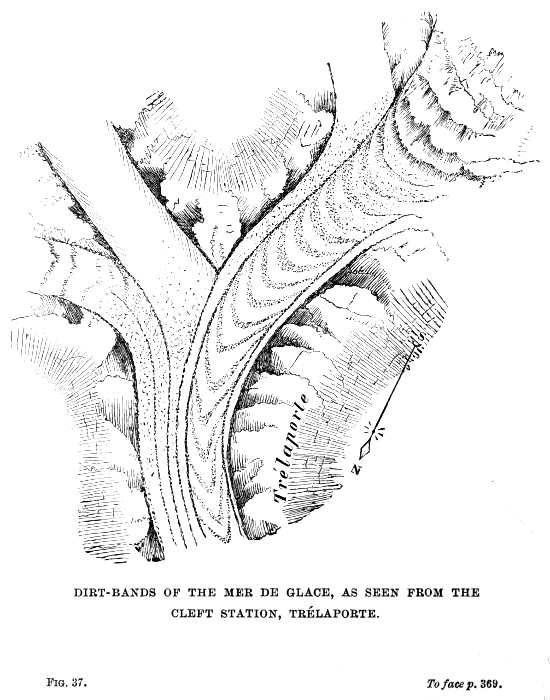
This source is the grand ice-cascade which descends in a succession of precipices from the plateau of the Col du Géant into the valley which the Glacier du Géant fills. We see from our present point of view that the bands are confined to the portion of the glacier which has descended the cascade. Fig. 37 represents the bands as seen from the Cleft-station above Trélaporte.
DIRT-BANDS OF THE MER DE GLACE, AS SEEN FROM THE CLEFT STATION, TRÉLAPORTE. Fig. 37.
We are now however at such a height above the glacier and at such a distance from the base of the cascade, that we can form but an imperfect notion of the true contour of the surface. Let us therefore descend, and walk up the Glacier du Géant towards the cascade. At first our road is level, but we gradually find that at certain intervals we have to ascend slopes which follow each other in succession, each being separated from its neighbour by a space of comparatively level ice. The slopes increase in steepness as we ascend; they are steepest, moreover, on the right-hand side of the glacier, where it is bounded by that from the Périades, and at length we are unable to climb them without the aid of an axe. Soon afterwards the dislocation of the glacier becomes considerable; we are lost in the clefts and depressions of the ice, and are unable to obtain a view sufficiently commanding to subdue these local appearances and convey to us the general aspect. We have at all events satisfied ourselves as to the existence, on the upper portion of the glacier, of a succession of undulations which sweep transversely across it. The term "wrinkles," applied to them by Prof. Forbes, is highly suggestive of the appearance which they present.
SNOW-BANDS ON THE GLACIER DU GÉANT.
From the Cleft-station bands of snow may also be seen partially crossing the glacier in correspondence with the undulations upon its surface. If the quantity deposited the winter previous be large, and the heat of summer not too great, these bands extend quite across the glacier. They were first observed by Professor Forbes in 1843. In his Fifth Letter is given an illustrative diagram, which, though erroneous as regards the position of the veined structure, is quite correct in limiting the snow-bands to the Glacier du Géant proper.
At the place where the three welded tributaries of the Mer de Glace squeeze themselves through the strait of Trélaporte, the bands undergo a considerable modification in shape. Near their origin they sweep across the Glacier du Géant in gentle curves, with their convexities directed downwards; but at Trélaporte these curves, the chords of which a short time previous measured a thousand yards in length, have to squeeze themselves through a space of four hundred and ninety-five yards wide; and as might be expected, they are here suddenly sharpened. The apex of each being thrust forward, they take the form of sharp hyperbolas, and preserve this character throughout the entire length of the Mer de Glace.
I would now conduct the reader to a point from which a good general view of the ice cascade of the Géant is attainable. From the old moraine near the lake of the Tacul we observe the ice, as it descends the fall, to be broken into a succession of precipices. It would appear as if the glacier had its back periodically broken at the summit of the fall, and formed a series of vast chasms separated from each other by cliffy ridges of corresponding size. These, as they approach the bottom of the fall, become more and more toned down by the action of sun and air, and at some distance below the base of the cascade they are subdued so as to form the transverse undulations already described. These undulations are more and more reduced as the glacier descends; and long before the Tacul is attained, every sensible trace of them has disappeared. The terraces of the ice-fall are referred to by Professor Forbes in his Thirteenth Letter, where he thus describes them:—"The ice-falls succeed one another at regulated intervals, which appear to correspond to the renewal of each summer's activity in those realms of almost perpetual frost, when a swifter motion occasions a more rapid and wholesale projection of the mass over the steep, thus forming curvilinear terraces like vast stairs, which appear afterwards by consolidation to form the remarkable protuberant wrinkles on the surface of the Glacier du Géant."
FORBES'S EXPLANATION.
With regard to the cause of the distribution of the dirt in bands, Professor Forbes writes thus in his Third Letter:—"I at length assured myself that it was entirely owing to the structure of the ice, which retains the dirt diffused by avalanches and the weather on those parts which are most porous, whilst the compacter portion is washed clean by the rain, so that those bands are nothing more than visible traces of the direction of the internal icy structure." Professor Forbes's theory, at that time, was that the glacier is composed throughout of a series of alternate segments of hard and porous ice, in the latter of which the dirt found a lodgment. I do not know whether he now retains his first opinion; but in his Fifteenth Letter he speaks of accounting for "the less compact structure of the ice beneath the dirt-band."
It appears to me that in the above explanation cause has been mistaken for effect. The ice on which the dirt-bands rest certainly appears to be of a spongier character than the cleaner intermediate ice; but instead of this being the cause of the dirt-bands, the latter, I imagine, by their more copious absorption of the sun's rays and the consequent greater disintegration of the ice, are the cause of the apparent porosity. I have not been able to detect any relative porosity in the "internal icy structure," nor am I able to find in the writings of Professor Forbes a description of the experiments whereby he satisfied himself that this assumed difference exists.
TRANSVERSE UNDULATIONS.
Several days of the summer of 1857 were devoted by me to the examination of these bands. I then found the bases and the frontal slopes of the undulations to which I have referred covered with a fine brown mud. These slopes were also, in some cases, covered with snow which the great heat of the weather had not been able entirely to remove. At places where the residue of snow was small its surface was exceedingly dirty—so dirty indeed that it appeared as if peat-mould had been strewn over it; its edges particularly were of a black brown. It was perfectly manifest that this snow formed a receptacle for the fine dirt transported by the innumerable little rills which trickled over the glacier. The snow gradually wasted, but it left its sediment behind, and thus each of the snowy bands observed by Professor Forbes in 1843, contributed to produce an appearance perfectly antithetical to its own. INFLUENCE OF DIRECTION OF GLACIER. I have said that the frontal slopes of the undulations were thus covered; and it was on these, and not in the depressions, that the snow principally rested. The reason of this is to be found in the bearing of the Glacier du Géant, which, looking downwards, is about fourteen degrees east of the meridian.[B] Hence the frontal slopes of the undulations have a northern aspect, and it is this circumstance which, in my opinion, causes the retention of the snow upon them. Irrespective of the snow, the mere tendency of the dirt to accumulate at the bases of the undulations would also produce bands, and indeed does so on many glaciers; but the precision and beauty of the dirt-bands of the Mer de Glace are, I think, to be mainly referred to the interception by the snow of the fine dark mud before referred to on the northern slopes of its undulations.
BANDS DO NOT CROSS MORAINES.
Were the statements of some writers upon this subject well founded, or were the dirt-bands as drawn upon the map of Professor Forbes correctly shown, this explanation could not stand a moment. It has been urged that the dirt-bands cannot thus belong to a single tributary of the Mer de Glace; for if they did, they would be confined to that tributary upon the trunk-glacier; whereas the fact is that they extend quite across the trunk, and intersect the moraines which divide the Glacier du Géant from its fellow-tributaries. From my first acquaintance with the Mer de Glace I had reason to believe that this statement was incorrect; but last year I climbed a third time to the Cleft-station for the purpose of once more inspecting the bands from this fine position. I was accompanied by Dr. Frankland and Auguste Balmat, and I drew the attention of both particularly to this point. Neither of them could discern, nor could I, the slightest trace of a dirt-band crossing any one of the moraines. Upon the trunk-stream they were just as much confined to the Glacier du Géant as ever. If the bands even existed east of the moraines, they could not be seen, the dirt on this part of the glacier being sufficient to mask them.
The following interesting fact may perhaps have contributed to the production of the error referred to. Opposite to Trélaporte the eastern arms of the dirt-bands run so obliquely into the moraine of La Noire that the latter appears to be a tangent to them. But this moraine runs along the Mer de Glace, not far from its centre, and consequently the point of contact of each dirt-band with the moraine moves more quickly than the point of contact of the western arm of the same band with the side of the valley. Hence there is a tendency to straighten the bands; and at some distance down the glacier the effect of this is seen in the bands abutting against the moraine of La Noire at a larger angle than before. The branches thus abutting have, I believe, been ideally prolonged across the moraines.
Fig. 38. Plan of Dirt-bands taken from Johnson's 'Physical Atlas.'
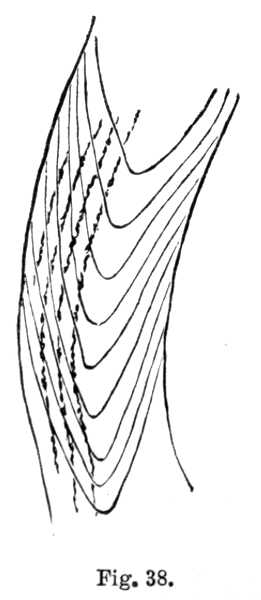
On the map published by Prof. Forbes in 1843 the bands are shown crossing the medial moraines of the Mer de Glace; and they are also thus drawn on the map in Johnson's 'Physical Atlas' published in 1849. The text is also in accordance with the map:—"Opposite to the Montanvert, and beyond les Echelets, the curved loops (dirt-bands) extend across the entire glacier. They are single, and therefore cut the medial moraine, though at a very slight angle."—'Travels,' p. 166. The italics here belong to Prof. Forbes. In order to help future observers to place this point beyond doubt, I annex, in Fig. 38, a portion of the map of the Mer de Glace taken from the Atlas referred to. If it be compared with Fig. 35 the difference between Prof. Forbes and myself will be clearly seen. The portion of the glacier represented in both diagrams may be viewed from the point near the Flegère already referred to.
ANNUAL "RINGS."
The explanation which I have given involves three considerations:—The transverse breaking of the glacier on the cascade, and the gradual accumulation of the dirt in the hollows between the ridges; the subsequent toning down of the ridges to gentle protuberances which sweep across the glacier; and the collection of the dirt upon the slopes and at the bases of these protuberances. Whether the periods of transverse fracture are annual or not—whether the "wrinkles" correspond to a yearly gush—and whether, consequently, the dirt-bands mark the growth of a glacier as the "annual rings" mark the growth of a tree, I do not know. It is a conjecture well worthy of consideration; but it is only a conjecture, which future observation may either ratify or refute.
FOOTNOTES:
THE VEINED STRUCTURE OF GLACIERS. (27.)
GENERAL APPEARANCE.
The general appearance of the veined structure may be thus briefly described:—The ice of glaciers, especially midway between their mountain-sources and their inferior extremities, is of a whitish hue, caused by the number of small air-bubbles which it contains, and which, no doubt, constitute the residue of the air originally entrapped in the interstices of the snow from which it has been derived. Through the general whitish mass, at some places, innumerable parallel veins of clearer ice are drawn, which usually present a beautiful blue colour, and give the ice a laminated appearance. The cause of the blueness is, that the air-bubbles, distributed so plentifully through the general mass, do not exist in the veins, or only in comparatively small numbers.
In different glaciers, and in different parts of the same glacier, these veins display various degrees of perfection. On the clean unweathered walls of some crevasses, and in the channels worn in the ice by glacier-streams, they are most distinctly seen, and are often exquisitely beautiful. They are not to be regarded as a partial phenomenon, or as affecting the constitution of glaciers to a small extent merely. A large portion of the ice of some glaciers is thus affected. The greater part, for example, of the Mer de Glace consists of this laminated ice; and the whole of the Glacier of the Rhone, from the base of the ice-cascade downwards, is composed of ice of the same description.
GROOVES ON THE SURFACE OF GLACIERS.
Those who have ascended Snowdon, or wandered among the hills of Cumberland, or even walked in the environs of Leeds, Blackburn, and other towns in Yorkshire and Lancashire, where the stratified sandstone of the district is used for building purposes, may have observed the weathered edges of the slate rocks or of the building-stone to be grooved and furrowed. Some laminæ of such rocks withstand the action of the atmosphere better than others, and the more resistant ones stand out in ridges after the softer parts between them have been eaten away. An effect exactly similar is observed where the laminated ice of glaciers is exposed to the action of the sun and air. Little grooves and ridges are formed upon its surface, the more resistant plates protruding after the softer material between them has been melted away.
One consequence of this furrowing is, that the light dirt scattered by the winds over the surface of the glacier is gradually washed into the little grooves, thus forming fine lines resembling those produced by the passage of a rake over a sanded walk. These lines are a valuable index to some of the phenomena of motion. From a position on the ice of the Glacier du Géant a little higher up than Trélaporte a fine view of these superficial groovings is obtained; but the dirt-lines are not always straight. A slight power of independent motion is enjoyed by the separate parts into which a glacier is divided by its crevasses and dislocations, and hence it is, that, at the place alluded to, the dirt-lines are bent hither and thither, though the ruptures of continuity are too small to affect materially the general direction of the structure. On the glacier of the Talèfre I found these groovings useful as indicating the character of the forces to which the ice near the summit of the fall is subjected. The ridges between the chasms are in many cases violently bent and twisted, while the adjacent groovings enable us to see the normal position of the mass.
GUYOT'S OBSERVATIONS.
The veined structure has been observed by different travellers; but it was probably first referred to by Sir David Brewster, who noticed the veins of the Mer de Glace on the 10th of September, 1814. It was also observed by General Sabine,[A] by Rendu, by Agassiz, and no doubt by many others; but the first clear description of it was given by M. Guyot, in a communication presented to the Geological Society of France in 1838. I quote the following passage from this paper:—"I saw under my feet the surface of the entire glacier covered with regular furrows from one to two inches wide, hollowed out in a half snowy mass, and separated by protruding plates of harder and more transparent ice. It was evident that the mass of the glacier here was composed of two sorts of ice, one that of the furrows, snowy and more easily melted; the other that of the plates, more perfect, crystalline, glassy, and resistant; and that the unequal resistance which the two kinds of ice presented to the atmosphere was the cause of the furrows and ridges. After having followed them for several hundreds of yards, I reached a fissure twenty or thirty feet wide, which, as it cut the plates and furrows at right angles, exposed the interior of the glacier to a depth of thirty or forty feet, and gave a beautiful transverse section of the structure. As far as my vision could reach I saw the mass of the glacier composed of layers of snowy ice, each two of which were separated by one of the plates of which I have spoken, the whole forming a regularly laminated mass, which resembled certain calcareous slates."
FORBES'S RESEARCHES.
Previous observers had mistaken the lamination for stratification; but M. Guyot not only clearly saw that they were different, but in the comparison which he makes he touches, I believe, on the true cause of the glacier-structure. He did not hazard an explanation of the phenomenon, and I believe his memoir remained unprinted. In 1841 the structure was noticed by Professor Forbes during his visit to M. Agassiz on the lower Aar Glacier, and described in a communication presented by him to the Royal Society of Edinburgh. He subsequently devoted much time to the subject, and his great merit in connexion with it consists in the significance which he ascribed to the phenomenon when he first observed it, and in the fact of his having proved it to be a constitutional feature of glaciers in general.
FORBES'S THEORY.
The first explanation given of those veins by Professor Forbes was, that they were small fissures formed in the ice by its motion; that these were filled with the water of the melted ice in summer, which froze in winter so as to form the blue veins. This is the explanation given in his 'Travels,' page 377; and in a letter published in the 'Edinburgh New Philosophical Journal,' October, 1844, it is re-affirmed in these words:—"With the abundance of blue bands before us in the direction in which the differential motion must take place (in this case sensibly parallel to the sides of the glacier), it is impossible to doubt that these infiltrated crevices (for such they undoubtedly are) have this origin." This theory was examined by Mr. Huxley and myself in our joint paper; but it has been since alleged that ours was unnecessary labour, Prof. Forbes himself having in his Thirteenth Letter renounced the theory, and substituted another in its place. The latter theory differs, so far as I can understand it, from the former in this particular, that the freezing of the water in the fissures is discarded, their sides being now supposed to be united "by the simple effects of time and cohesion."[B] For a statement of the change which his opinions have undergone, I would refer to the Prefatory Note which precedes the volume of 'Occasional Papers' recently published by Prof. Forbes; but it would have diminished my difficulty had the author given, in connexion with his new volume, a more distinct statement of his present views regarding the veined structure. With many of his observations and remarks I should agree; with many others I cannot say whether I agree or not; and there are others still with which I do not think I should agree: but in hardly any case am I certain of his precise views, excepting, indeed, the cardinal one, wherein he and others agree in ascribing to the structure a different origin from stratification. Thus circumstanced, my proper course, I think, will be to state what I believe to be the cause of the structure, and leave it to the reader to decide how far our views harmonize; or to what extent either of them is a true interpretation of nature.
USUAL ASPECT OF BLUE VEINS.
Most of the earlier observers considered the structure to be due to the stratification of the mountain-snows—a view which has received later development at the hands of Mr. John Ball; and the practical difficulty of distinguishing the undoubted effects of stratification from the phenomena presented by structure, entitles this view to the fullest consideration. The blue veins of glaciers are, however, not always, nor even generally, such as we should expect to result from stratification. The latter would furnish us with distinct planes extending parallel to each other for considerable distances through the glacier; but this, though sometimes the case, is by no means the general character of the structure. We observe blue streaks, from a few inches to several feet in length, upon the walls of the same crevasse, and varying from the fraction of an inch to several inches in thickness. In some cases the streaks are definitely bounded, giving rise to an appearance resembling the section of a lens, and hence called the "lenticular structure" by Mr. Huxley and myself; but more usually they fade away in pale washy streaks through the general mass of the whitish ice. In Fig. 39 I have given a representation of the structure as it is very commonly exhibited on the walls of crevasses. Its aspect is not that which we should expect from the consolidation of successive beds of mountain snow.
Fig. 39. Veined Structure of the walls of crevasses.
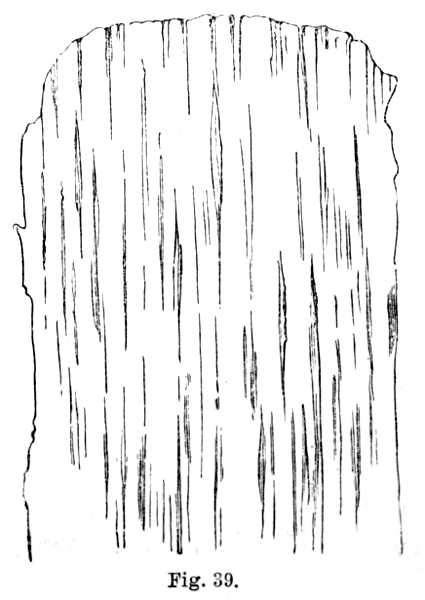
Further, at the bases of ice-cascades the structural laminæ are usually vertical: below the cascade of the Talèfre, of the Noire, of the Strahleck branch of the Lower Grindelwald Glacier, of the Rhone, and other ice-falls, this is the case; and it seems extremely difficult to conceive that a mass horizontally stratified at the summit of the fall, should, in its descent, contrive to turn its strata perfectly on end.
Again, we often find a very feebly-developed structure at the central portions of a glacier, while the lateral portions are very decidedly laminated. This is the case where the inclination of the glacier is nearly uniform throughout; and where no medial moraines occur to complicate the phenomenon. But if the veins mark the bedding, there seems to be no sufficient reason for their appearance at the lateral portions of the glacier, and their absence from the centre.
ILLUSTRATIVE EXPERIMENTS.
This leads me to the point at which what I consider to be the true cause of the structure may be referred to. The theoretic researches of Mr. Hopkins have taught us a good deal regarding the pressures and tensions consequent upon glacier-motion. Aided by this knowledge, and also by a mode of experiment first introduced by Professor Forbes, I will now endeavour to explain the significance of the fact referred to in the last paragraph. If a plastic substance, such as mud, flow down a sloping canal, the lateral portions, being held back by friction, will be outstripped by the central ones. When the flow is so regulated that the velocity of a point at the centre shall not vary throughout the entire length of the canal, a coloured circle stamped upon the centre of the mud stream, near its origin, will move along with the mud, and still retain its circular form; for, inasmuch as the velocity of all points along the centre is the same, there can be no elongation of the circle longitudinally or transversely by either strain or pressure. A similar absence of longitudinal pressure may exist in a glacier, and, where it exists throughout, no central structure can, in my opinion, be developed.
But let a circle be stamped upon the mud-stream near its side, then, when the mud flows, this circle will be distorted to an oval, with its major axis oblique to the direction of motion; the cause of this is that the portion of the circle farthest from the side of the canal moves more freely than that adjacent to the side. The mechanical effect of the slower lateral motion is to squeeze the circle in one direction, and draw it out in the perpendicular one.
MARGINAL STRUCTURE.
Fig. 40. Figure explanatory of the Marginal Structure.
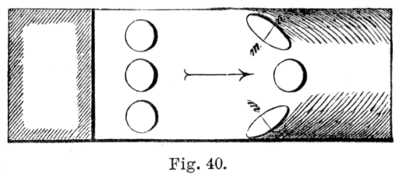
A glance at Fig. 40 will render all that I have said intelligible. The three circles are first stamped on the mud in the same transverse line; but after they have moved downwards they will be in the same straight line no longer. The central one will be the foremost; while the lateral ones have their forms changed from circles to ovals. In a glacier of the shape of this canal exactly similar effects are produced. Now the shorter axis m n of each oval is a line of squeezing or pressure; the longer axis is a line of strain or tension; and the associated glacier-phenomena are as follows:—Across the line m n, or perpendicular to the pressure, we have the veined structure developed, while across the line of tension the glacier usually breaks and forms marginal crevasses. Mr. Hopkins has shown that the lines of greatest pressure and of greatest strain are at right angles to each other, and that in valleys of a uniform width they enclose an angle of forty-five degrees with the side of the glacier. To the structure thus formed I have applied the term marginal structure. Here, then, we see that there are mechanical agencies at work near the side of such a glacier which are absent from the centre, and we have effects developed—I believe by the pressure—in the lateral ice, which are not produced in the central.
I have used the term "uniform inclination" in connexion with the marginal structure, and my reason for doing so will now appear. In many glaciers the structure, instead of being confined to the margins, sweeps quite across them. This is the case, for example, on the Glacier du Géant, the structure of which is prolonged into the Mer de Glace. In passing the strait at Trélaporte, however, the curves are squeezed and their apices bruised, so that the structure is thrown into a state of confusion; and thus upon the Mer de Glace we encounter difficulty in tracing it fairly from side to side. Now the key to this transverse structure I believe to be the following: Where the inclination of the glacier suddenly changes from a steep slope to a gentler, as at the bases of the "cascades,"—the ice to a certain depth must be thrown into a state of violent longitudinal compression; and along with this we have the resistance which the gentler slope throws athwart the ice descending from the steep one. At such places a structure is developed transverse to the axis of the glacier, and likewise transverse to the pressure. The quicker flow of the centre causes this structure to bend more and more, and after a time it sweeps in vast curves across the entire glacier.
STRUCTURE OF GRINDELWALD GLACIER.
In illustration of this point I will refer, in the first place, to that tributary of the Lower Glacier of Grindelwald which descends from the Strahleck. Walking up this tributary we come at length to the base of an ice-fall. Let the observer here leave the ice, and betake himself to either side of the flanking mountain. On attaining a point which commands a view both of the fall and of the glacier below it, an inspection of the glacier will, I imagine, solve to his satisfaction the case of structure now under consideration.
It is indeed a grand experiment which Nature here submits to our inspection. The glacier descending from its névé reaches the summit of the cascade, and is broken transversely as it crosses the brow; it afterwards descends the fall in a succession of cliffy ice-ridges with transverse hollows between them. In these latter the broken ice and débris collect, thus partially choking the fissures formed in the first instance. Carrying the eye downwards along the fall, we see, as we approach the base, these sharp ridges toned down; and a little below the base they dwindle into rounded protuberances which sweep in curves quite across the glacier. At the base of the fall the structure begins to appear, feebly at first, but becoming gradually more pronounced, until, at a short distance below the base of the fall, the eye can follow the fine superficial groovings from side to side; while at the same time the ice underneath the surface has become laminated in the most beautiful manner.
It is difficult to convey by writing the force of the evidence which the actual observation of this natural experiment places before the mind. The ice at the base of the fall, retarded by the gentler inclination of the valley, has to bear the thrust of the descending mass, the sudden change of inclination producing powerful longitudinal compression. The protuberances are squeezed more closely together, the hollows between them appear to wrinkle up in submission to the pressure—in short, the entire aspect of the glacier suggests the powerful operations of the latter force. At the place where it is exerted the veined structure makes its appearance; and being once formed, it moves downwards, and gives a character to other portions of the glacier which had no share in its formation.
BASE OF CASCADE A "STRUCTURE-MILL."
An illustration almost as good, and equally accessible, is furnished by the Glacier of the Rhone. I have examined the grand cascade of this glacier from both sides; and an ordinary mountaineer will find little difficulty in reaching a point from which the fall and the terminal portion of the glacier are both distinctly visible. Here also he will find the cliffy ridges separated from each other by transverse chasms, becoming more and more subdued at the bottom of the fall, and disappearing entirely lower down the glacier. As in the case of the Grindelwald Glacier the squeezing of the protuberances and of the spaces between them, is quite apparent, and where this squeezing commences the transverse structure makes its appearance. All the ice that forms the lower portion of this glacier has to pass through the structure-mill at the bottom of the fall, and the consequence is that it is all laminated.