Part 1 — PART I. CHIEFLY NARRATIVE. (continued 5)
Reading edition
CRYSTAL CURTAIN. 1859.
In the application of her own principles, Nature often transcends the human imagination; her acts are bolder than our predictions. It is thus with the motion of glaciers; it was thus at the Montanvert on the day now referred to. The floors, even where the windows appeared well closed, were covered with a thin layer of fine snow; and some of the mattresses in the bedrooms were coated to the depth of half an inch with this fine powder. Given a chink through which the finest dust can pass, dry snow appears competent to make its way through the same fissure. It had also been beaten against the windows, and clung there like a ribbed drapery. In one case an effect so singular was exhibited, that I doubted my eyes when I first saw it. In front of a large pane of glass, and quite detached from it, save at its upper edge, was a festooned curtain formed entirely of minute ice-crystals. It appeared to be as fine as muslin; the ease of its curves and the depth of its folds being such as could not be excelled by the intentional arrangement of ordinary gauze. The frost-figures on some of the window-panes were also of the most extraordinary character: in some cases they extended over large spaces, and presented the appearance which we often observe in London; but on other panes they occurred in detached clusters, or in single flowers, these grouping themselves together to form miniature bouquets of inimitable beauty. I placed my warm hand against a pane which was covered by the crystallization, and melted the frostwork which clung to it. I then withdrew my hand and looked at the film of liquid through a pocket-lens. The glass cooled by contact with the air, and after a time the film commenced to move at one of its edges; atom closed with atom, and the motion ran in living lines through the pellicle, until finally the entire film presented the beauty and delicacy of an organism. The connexion between such objects and what we are accustomed to call the feelings may not be manifest, but it is nevertheless true that, besides appealing to the pure intellect of man, these exquisite productions can also gladden his heart and moisten his eyes.
THE MER DE GLACE IN WINTER. 1859.
The glacier excited the admiration of us all: not as in summer, shrunk and sullied like a spent reptile, steaming under the influence of the sun; its frozen muscles were compact, strength and beauty were associated in its aspect. At some places it was pure and smooth; at others frozen fins arose from it, high, steep, and sharply crested. Down the opposite mountain side arrested streams set themselves erect in successive terraces, the fronts of which were fluted pillars of ice. There was no sound of water; even the Nant Blanc, which gushes from a spring, and which some describe as permanent throughout the winter, showed no trace of existence. From the Montanvert to Trélaporte the Mer de Glace was all in shadow; but the sunbeams pouring down the corridor of the Géant ruled a beam of light across the glacier at its upper portion, smote the base of the Aiguille du Moine, and flooded the mountain with glory to its crest. At the opposite side of the valley was the Aiguille du Dru, with a banneret of snow streaming from its mighty cone. The Grande Jorasse, and the range of summits between it and the Aiguille du Géant, were all in view, and the Charmoz raised its precipitous cliffs to the right, and pierced with its splinter-like pinnacles the clear cold air. As the night drew on, the mountains seemed to close in upon us; and on looking out before retiring to rest, a scene so solemn had never before presented itself to my eyes or affected my imagination.
THE FIRST NIGHT. 1859.
My men occupied the afternoon of the day of our arrival in making a preliminary essay upon the glacier while I prepared my instruments. To the person whom I intended to fix my stations, three others were attached by sound ropes of considerable length. Hidden crevasses we knew were to be encountered, and we had made due preparation for them. Throughout the afternoon the weather remained fine, and at night the stars shone out, but still with a feeble lustre. I could notice a turbidity gathering in the air over the range of the Brévent, which seemed disposed to extend itself towards us. At night I placed a chair in the middle of the snow, at some distance from the house, and laid on it a registering thermometer. A bountiful fire of pine logs was made in the salle à manger; a mattress was placed with its foot towards the fire, its middle line bisecting the right angle in which the fireplace stood; this being found by experiment to be the position in which the draughts from the door and from the windows most effectually neutralized each other. In this region of calms I lay down, and covering myself with blankets and duvets, listened to the crackling of the logs, and watched their ruddy flicker upon the walls, until I fell asleep.
The wind rose during the night, and shook the windows: one pane in particular seemed set in unison to the gusts, and responded to them by a loud and melodious vibration. I rose and wedged it round with sous and penny pieces, and thus quenched its untimely music.
December 28th.—We were up before the dawn. Tairraz put my fire in order, and I then rose. The temperature of the room at a distance of eight feet from the fire was two degrees of Centigrade below zero; the lowest temperature outside was eleven degrees of Centigrade below zero,—not at all an excessive cold. The clouds indeed had, during the night, thrown vast diaphragms across the sky, and thus prevented the escape of the earth's heat into space.
While my assistants were preparing breakfast I had time to inspect the glacier and its bounding heights. On looking up the Mer de Glace, the Grande Jorasse meets the view, rising in steep outline from the wall of cliffs which terminates the Glacier de Léchaud. Behind this steep ascending ridge, which is shown on the frontispiece, and upon it, a series of clouds had ranged themselves, stretching lightly along the ridge at some places, and at others collecting into ganglia. A string of rosettes was thus formed which were connected together by gauzy filaments. The portion of the heavens behind the ridge was near the domain of the rising sun, and when he cleared the horizon his red light fell upon the clouds, and ignited them to ruddy flames. Some of the lighter clouds doubled round the summit of the mountain, and swathed its black crags with a vestment of transparent red. The adjacent sky wore a strange and supernatural air; indeed there was something in the whole scene which baffled analysis, and the words of Tennyson rose to my lips as I gazed upon it:—
A "ROSE OF DAWN." 1859.
"God made Himself an awful rose of dawn."
I have spoken several times of the cloud-flag which the wind wafted from the summit of the Aiguille du Dru. On the present occasion this grand banner reached extraordinary dimensions. It was brindled in some places as if whipped into curds by the wind; but through these continuous streamers were drawn, which were bent into sinuosities resembling a waving flag at a mast-head. All this was now illuminated with the sun's red rays, which also fringed with fire the exposed edges and pinnacles both of the Aiguille du Dru and the Aiguille Verte. Thus rising out of the shade of the valley the mountains burned like a pair of torches, the flames of which were blown half a mile through the air. Soon afterwards the summits of the Aiguilles Rouges were illuminated, and day declared itself openly among the mountains.
THE STAKES FIXED. 1859.
But these red clouds of the morning, magnificent though they were, suggested thoughts which tended to qualify the pleasure which they gave: they did not indicate good weather. Sometimes, indeed, they had to fight with denser masses, which often prevailed, swathing the mountains in deep neutral tint, but which, again yielding, left the glory of the sunrise augmented by contrast with their gloom. Between eight and nine a.m. we commenced the setting out of our first line, one of whose termini was a point about a hundred yards higher up than the Montanvert hotel; a withered pine on the opposite mountain side marking the other terminus. The stakes made use of were four feet long. With the selfsame bâton which I had employed upon the Mer de Glace in 1857, and which Simond had preserved, the worthy fellow now took up the line. At some places the snow was very deep, but its lower portions were sufficiently compact to allow of a stake being firmly fixed in it. At those places where the wind had removed the snow or rendered it thin, the ice was pierced with an auger and the stake driven into it. The greatest caution was of course necessary on the part of the men; they were in the midst of concealed crevasses, and sounding was essential at every step. By degrees they withdrew from me, and approached the eastern boundary of the glacier, where the ice was greatly dislocated, and the labour of wading through the snow enormous. Long détours were sometimes necessary to reach a required point; but they were all accomplished, and we at length succeeded in fixing eleven stakes along this line, the most distant of which was within about eighty yards of the opposite side of the glacier.
STORM ON THE GLACIER. 1859.
The men returned, and I consulted them as to the possibility of getting a line across at the Ponts; but this was judged to be impossible in the time. We thought, however, that a second line might be staked out at some distance below the Montanvert. I took the theodolite down the mountain-slope, wading at times breast-deep in snow, and having selected a line, the men tied themselves together as before, and commenced the staking out. The work was slowly but steadily and steadfastly done. The air darkened; angry clouds gathered around the mountains, and at times the glacier was swept by wild squalls. The men were sometimes hidden from me by the clouds of snow which enveloped them, but between those intermittent gusts there were intervals of repose, which enabled us to prosecute our work. This line was more difficult than the first one; the glacier was broken into sharp-edged chasms; the ridges to be climbed were steep, and the snow which filled the depressions profound. The oblique arrangement of the crevasses also magnified the labour by increasing the circuits. I saw the leader of the party often shoulder-deep in snow, treading the soft mass as a swimmer walks in water, and I felt a wish to be at his side to cheer him and to share his toil. Each man there, however, knew my willingness to do this if occasion required it, and wrought contented. At length the last stake being fixed, the faces of the men were turned homeward. The evening became wilder, and the storm rose at times to a hurricane. On the more level portions of the glacier the snow lay deep and unsheltered; among its frozen waves and upon its more dislocated portions it had been partially engulfed, and the residue was more or less in shelter. Over the former spaces dense clouds of snow rose, whirling in the air and cutting off all view of the glacier. The whole length of the Mer de Glace was thus divided into clear and cloudy segments, and presented an aspect of wild and wonderful turmoil. A large pine stood near me, with its lowest branch spread out upon the surface of the snow; on this branch I seated myself, and, sheltered by the trunk, waited until I saw my men in safety. The wind caught the branches of the trees, shook down their loads of snow, and tossed it wildly in the air. Every mountain gave a quota to the storm. The scene was one of most impressive grandeur, and the moan of the adjacent pines chimed in noble harmony with the picture which addressed the eyes.
At length we all found ourselves in safety within doors. The windows shook violently. The tempest was however intermittent throughout, as if at each effort it had exhausted itself, and required time to recover its strength. As I heard its heralding roar in the gullies of the mountains, and its subsequent onset against our habitation, I thought wistfully of my stations, not knowing whether they would be able to retain their positions in the face of such a blast. That night however, as if the storm had sung our lullaby, we all slept profoundly, having arranged to commence our measurements as early as light permitted on the following day.
HEAVY SNOW. 1859.
Thursday, 29th December.—"Snow, heavy snow: it must have descended throughout the entire night; the quantity freshly fallen is so great; the atmosphere at seven o'clock is thick with the descending flakes." At eight o'clock it cleared up a little, and I proceeded to my station, while the men advanced upon the glacier; but I had scarcely fixed my theodolite when the storm recommenced. I had a man to clear away the snow and otherwise assist me; he procured an old door from the hotel, and by rearing it upon its end sheltered the object-glass of the instrument. Added to the flakes descending from the clouds was the spitting snow-dust raised by the wind, which for a time so blinded me that I was unable to see the glacier. The measurement of the first stake was very tedious, but practice afterwards enabled me to take advantage of the brief lulls and periods of partial clearness with which the storm was interfused.
A MAN IN A CREVASSE. 1859.
At nine o'clock my telescope happened to be directed upon the men as they struggled through the snow; all evidence of the deep track which they had formed yesterday having been swept away. I saw the leader sink and suddenly disappear. He had stood over a concealed fissure, the roof of which had given way and he had dropped in. I observed a rapid movement on the part of the remaining three men: they grouped themselves beside the fissure, and in a moment the missing man was drawn from between its jaws. His disappearance and reappearance were both extraordinary. We had, as I have stated, provided for contingencies of this kind, and the man's rescue was almost immediate.
SIX-RAYED CRYSTALS. 1859.
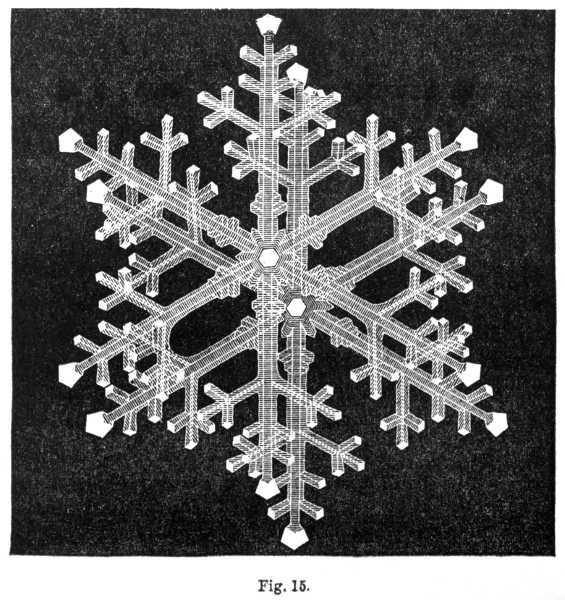
My attendant brought two poles from the hotel which we thrust obliquely into the snow, causing the free ends to cross each other; over these a blanket was thrown, behind which I sheltered myself from the storm as the men proceeded from stake to stake. At 9.30 the storm was so thick that I was unable to see the men at the stake which they had reached at the time; the flakes sped wildly in their oblique course across the field of the telescope. Some time afterwards the air became quite still, and the snow underwent a wonderful change. Frozen flowers similar to those I had observed on Monte Rosa fell in myriads. For a long time the flakes were wholly composed of these exquisite blossoms entangled together. On the surface of my woollen dress they were soft as down; the snow itself on which they fell seemed covered by a layer of down; while my coat was completely spangled with six-rayed stars. And thus prodigal Nature rained down beauty, and had done so here for ages unseen by man. And yet some flatter themselves with the idea that this world was planned with strict reference to human use; that the lilies of the field exist simply to appeal to the sense of the beautiful in man. True, this result is secured, but it is one of a thousand all equally important in the eyes of Nature. Whence those frozen blossoms? Why for æons wasted? The question reminds one of the poet's answer when asked whence was the Rhodora:—
"Why wert thou there, O rival of the rose? I never thought to ask, I never knew; But in my simple ignorance suppose The selfsame power that brought me there brought you!"[A]
I sketched some of the crystals, but, instead of reproducing these sketches, which were rough and hasty, I have annexed two of the forms drawn with so much skill and patience by Mr. Glaisher.
Fig. 14. Snow Crystals.
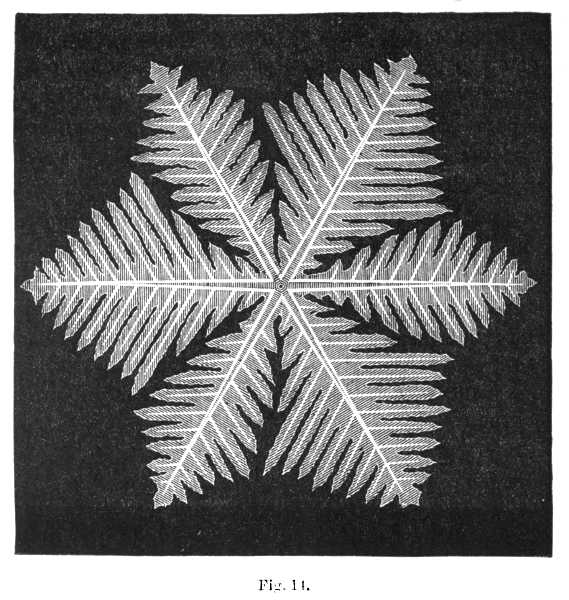
Fig. 15. Snow Crystals.
We completed the measurement of the first line before eleven o'clock, and I felt great satisfaction in the thought that I possessed something of which the weather could not deprive me. As I closed my note-book and shifted the instrument to the second station, I felt that my expedition was already a success.
At a quarter past eleven I had my theodolite again fixed, and ranging the telescope along the line of pickets, I saw them all standing. Crossing the ice wilderness, and suggesting the operation of intelligence amid that scene of desolation, their appearance was pleasant to me. Just before I commenced, a solitary jay perched upon the summit of an adjacent pine and watched me. The air was still at the time, and the snow fell heavily. The flowers moreover were magnificent, varying from about the twentieth of an inch to two lines in diameter, while, falling through the quiet air, their forms were perfect. Adjacent to my theodolite was a stump of pine, from which I had the snow removed, in order to have something to kick my toes against when they became cold; and on the stump was placed a blanket to be used as a screen in case of need. While I remained at the station a layer of snow an inch thick fell upon this blanket, the whole layer being composed of these exquisite flowers. The atmosphere also was filled with them. From the clouds to the earth Nature was busy marshalling her atoms, and putting to shame by the beauty of her structures the comparative barbarities of Art.
SOUND THROUGH THE SNOW-STORM. 1859.
My men at length reached the first station, and the measurement commenced. The storm drifted up the valley, thickening all the air as it approached. Denser and denser the flakes fell; but still, with care and tact I was able to follow my party to a distance of 800 yards. I had not thought it possible to see so far through so dense a storm. At this distance also my voice could be heard, and my instructions understood; for once, as the man who took up the line stood behind his bâton and prevented its projection against the white snow, I called out to him to stand aside, and he promptly did so. Throughout the entire measurement the snow never ceased falling, and some of the illusions which it produced were extremely singular. The distant boundary of the glacier appeared to rise to an extraordinary height, and the men wading through the snow appeared as if climbing up a wall. The labour along this line was still greater than on the former; on the steeper slopes especially the toil was great; for here the effort of the leader to lift his own body added itself to that of cutting his way through the snow. His footing I could see often yielded, and he slid back, checking his recession, however, by still plunging forward; thus, though the limbs were incessantly exerted, it was, for a time, a mere motion of vibration without any sensible translation. At the last stake the men shouted, "Nous avons finis!" and I distinctly heard them through the falling snow. By this time I was quite covered with the crystals which clung to my wrapper. They also formed a heap upon my theodolite, rising over the spirit-levels and embracing the lower portion of the vertical arc. The work was done; I struck my theodolite and ascended to the hotel; the greatest depth of snow through which I waded reaching, when I stood erect, to within three inches of my breast.
SWIFT DESCENT. 1859.
The men returned; dinner was prepared and consumed; the disorder which we had created made good; the rooms were swept, the mattresses replaced, and the shutters fastened, where this was possible. We locked up the house, and with light hearts and lithe limbs commenced the descent. My aim now was to reach the source of the Arveiron, to examine the water and inspect the vault. With this view we went straight down the mountain. The inclinations were often extremely steep, and down these we swept with an avalanche-velocity; indeed usually accompanied by an avalanche of our own creation. On one occasion Balmat was for a moment overwhelmed by the descending mass: the guides were startled, but he emerged instantly. Tairraz followed him, and I followed Tairraz, all of us rolling in the snow at the bottom of the slope as if it were so much flour. My practice on the Finsteraarhorn rendered me at home here. One of the porters could by no means be induced to try this flying mode of descent. Simond carried my theodolite box, tied upon a crotchet on his back; and once, while shooting down a slope, he incautiously allowed a foot to get entangled; his momentum rolled him over and over down the incline, the theodolite emerging periodically from the snow during his successive revolutions. A succession of glissades brought us with amazing celerity to the bottom of the mountain, whence we picked our way amid the covered boulders and over the concealed arms of the stream to the source of the Arveiron.
The quantity of water issuing from the vault was considerable, and its character that of true glacier water. It was turbid with suspended matter, though not so turbid as in summer; but the difference in force and quantity would, I think, be sufficient to account for the greater summer turbidity. This character of the water could only be due to the grinding motion of the glacier upon its bed; a motion which seems not to be suspended even in the depth of winter. The temperature of the water was the tenth of a degree Centigrade above zero; that of the ice was half a degree below zero: this was also the temperature of the air, while that of the snow, which in some places covered the ice-blocks, was a degree and a quarter below zero.
VAULT OF THE ARVEIRON. 1859.
The entrance to the vault was formed by an arch of ice which had detached itself from the general mass of the glacier behind: between them was a space through which we could look to the sky above. Beyond this the cave narrowed, and we found ourselves steeped in the blue light of the ice. The roof of the inner arch was perforated at one place by a shaft about a yard wide, which ran vertically to the surface of the glacier. Water had run down the sides of this shaft, and, being re-frozen below, formed a composite pillar of icicles at least twenty feet high and a yard thick, stretching quite from roof to floor. They were all united to a common surface at one side, but at the other they formed a series of flutings of exceeding beauty. This group of columns was bent at its base as if it had yielded to the forward motion of the glacier, or to the weight of the arch overhead. Passing over a number of large ice-blocks which partially filled the interior of the vault, we reached its extremity, and here found a sloping passage with a perfect arch of crystal overhead, and leading by a steep gradient to the air above. This singular gallery was about seventy feet long, and was floored with snow. We crept up it, and from the summit descended by a glissade to the frontal portion of the cavern. To me this crystal cave, with the blue light glistening from its walls, presented an aspect of magical beauty. My delight, however, was tame compared with that of my companions.
MAJESTIC SCENE. 1859.
Looking from the blue arch westwards, the heavens were seen filled by crimson clouds, with fiery outliers reaching up to the zenith. On quitting the vault I turned to have a last look at those noble sentinels of the Mer de Glace, the Aiguille du Dru, and the Aiguille Verte. The glacier below the mountains was in shadow, and its frozen precipices of a deep cold blue. From this, as from a basis, the mountain cones sprang steeply heavenward, meeting half way down the fiery light of the sinking sun. The right-hand slopes and edges of both pyramids burned in this light, while detached protuberant masses also caught the blaze, and mottled the mountains with effulgent spaces. A range of minor peaks ran slanting downwards from the summit of the Aiguille Verte; some of these were covered with snow, and shone as if illuminated with the deep crimson of a strontian flame. I was absolutely struck dumb by the extraordinary majesty of this scene, and watched it silently till the red light faded from the highest summits. Thus ended my winter expedition to the Mer de Glace.
Next morning, starting at three o'clock, I was driven by my two guides in an open sledge to Sallenches. The rain was pitiless and the road abominable. The distance, I believe, is only six leagues, but it took us five hours to accomplish it. The leading mule was beyond the reach of Simond's whip, and proved a mere obstructive; during part of the way it was unloosed, tied to the sledge, and dragged after it. Simond afterwards mounted the hindmost beast and brought his whip to bear upon the leader, the jerking he endured for an hour and a half seemed almost sufficient to dislocate his bones. We reached Sallenches half an hour late, but the diligence was behind its time by this exact interval. We met it on the Pont St. Martin, and I transferred myself from the sledge to the interior. This was the morning of the 30th of December, and on the evening of the 1st of January I was in London.
MY ASSISTANTS. 1859.
I cannot finish this recital without saying one word about my men. Their behaviour was admirable throughout. The labour was enormous, but it was manfully and cheerfully done. I know Simond well; he is intelligent, truthful, and affectionate, and there is no guide of my acquaintance for whom I have a stronger regard. Joseph Tairraz is an extremely intelligent and able guide, and on this trying occasion proved himself worthy of my highest praise and commendation. Their two companions upon the glacier, Edouard Balmat (le Petit Balmat) and Joseph Simond (fils d'Auguste), acquitted themselves admirably; and it also gives me pleasure to bear testimony to the willing and efficient service of François Ravanal, who attended upon me during the observations.