PROBLEM XVI.
Reading edition
PROBLEM XVI.
TO FIND THE VANISHING-POINT OF A GIVEN INCLINED LINE.
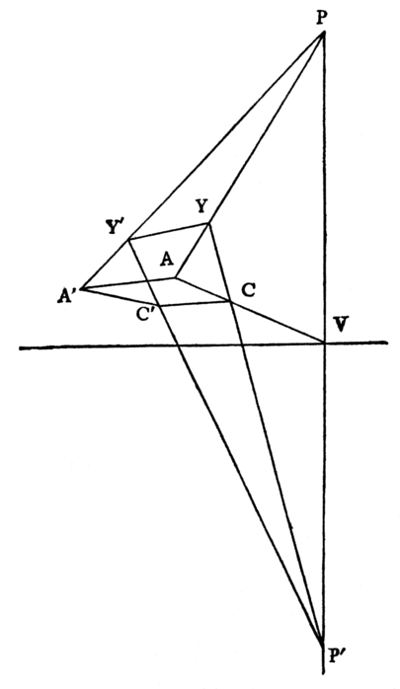
If, in Fig. 43. or Fig. 44., the lines A Y and A′ Y′ be produced, the student will find that they meet.
Let P, Fig. 45., be the point at which they meet.
From P let fall the vertical P V on the sight-line, cutting the sight-line in V.
Complete the rectangle of the base A C′, by drawing A′ C′ to V, and C C′ to the vanishing-point of A A′.
Join Y′ C′.
Now if Y C and Y′ C′ be produced downwards, the student will find that they meet.
Let them be produced, and meet in P′.
Produce P V, and it will be found to pass through the point P′.
Therefore if A Y (or C Y), Fig. 45., be any inclined line drawn in perspective by Problem XV., and A C the relative horizontal (A C in Figs. 39, 40.), also drawn in perspective.
Through V, the vanishing-point of A V, draw the vertical P P′ upwards and downwards.
Produce A Y (or C Y), cutting P P′ in P (or P′).
Then P is the vanishing-point of A Y (or P′ of C Y).
Fig. 45.
The student will observe that, in order to find the point P by this method, it is necessary first to draw a portion of the given inclined line by Problem XV. Practically, it is always necessary to do so, and, therefore, I give the problem in this form.
Theoretically, as will be shown in the analysis of the problem, the point P should be found by drawing a line from the station-point parallel to the given inclined line: but there is no practical means of drawing such a line; so that in whatever terms the problem may be given, a portion of the inclined line (A Y or C Y) must always be drawn in perspective before P can be found.