PROBLEM V.
Reading edition
PROBLEM V.
TO DRAW A HORIZONTAL LINE, GIVEN IN POSITION AND MAGNITUDE, BY MEANS OF ITS SIGHT-MAGNITUDE AND DIVIDING-POINTS.
Fig. 16.
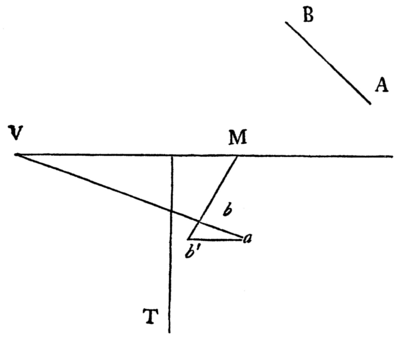
Let A B (Fig. 16.) be the given line.
Find the position of the point A in a.
Find the vanishing-point V, and most convenient dividing-point M, of the line A B.
Join a V.
Through a draw a horizontal line a b′ and make a b′ equal to the sight-magnitude of A B. Join b′ M, cutting a V in b.
Then a b is the line required.
COROLLARY I.
Fig. 17.
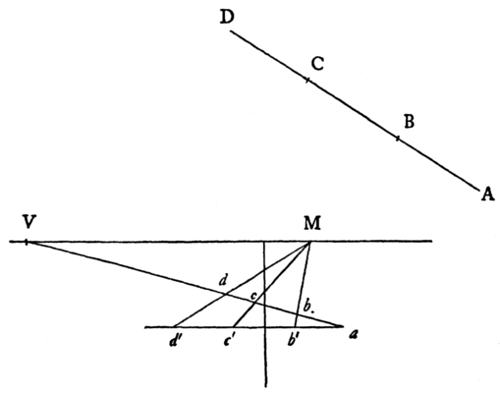
Supposing it were now required to draw a line A C (Fig. 17.) twice as long as A B, it is evident that the sight-magnitude a c′ must be twice as long as the sight-magnitude a b′; we have, therefore, merely to continue the horizontal line a b′, make b′ c′ equal to a b′, join c M′, cutting a V in c, and a c will be the line required. Similarly, if we have to draw a line A D, three times the length of A B, a d′ must be three times the length of a b′, and, joining d′ M, a d will be the line required.
The student will observe that the nearer the portions cut off, b c, c d, etc., approach the point V, the smaller they become; and, whatever lengths may be added to the line A D, and successively cut off from a V, the line a V will never be cut off entirely, but the portions cut off will become infinitely small, and apparently “vanish” as they approach the point V; hence this point is called the “vanishing” point.
COROLLARY II.
It is evident that if the line A D had been given originally, and we had been required to draw it, and divide it into three equal parts, we should have had only to divide its sight-magnitude, a d′, into the three equal parts, a b′, b′ c′, and c′ d′, and then, drawing to M from b′ and c′, the line a d would have been divided as required in b and c. And supposing the original line A D be divided irregularly into any number of parts, if the line a d′ be divided into a similar number in the same proportions (by the construction given in Appendix I.), and, from these points of division, lines are drawn to M, they will divide the line a d in true perspective into a similar number of proportionate parts.
The horizontal line drawn through a, on which the sight-magnitudes are measured, is called the “Measuring-line.”
And the line a d, when properly divided in b and c, or any other required points, is said to be divided “IN PERSPECTIVE RATIO” to the divisions of the original line A D.
If the line a V is above the sight-line instead of beneath it, the measuring-line is to be drawn above also: and the lines b′ M, c′ M, etc., drawn down to the dividing-point. Turn Fig. 17. upside down, and it will show the construction.