PROBLEM XI.
Reading edition
PROBLEM XI.
TO DRAW ANY CURVE IN A HORIZONTAL OR VERTICAL PLANE.
Fig. 28.
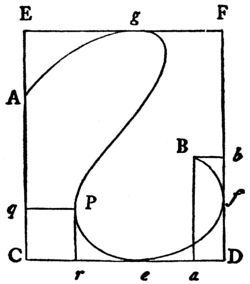
Let A B, Fig. 28., be the curve.
Inclose it in a rectangle, C D E F.
Let C D E F, Fig. 29., be the rectangle so drawn.
Fig. 29.
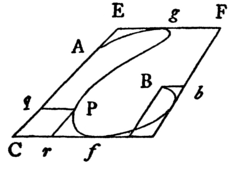
If an extremity of the curve, as A, is in a side of the rectangle, divide the side C E, Fig. 29., so that A C shall be (in perspective ratio) to A E as A C is to A E in Fig. 28. (Prob. V. Cor. II.)
Similarly determine the points of contact of the curve and rectangle e, f, g.
If an extremity of the curve, as B, is not in a side of the rectangle, let fall the perpendiculars B a, B b on the rectangle sides. Determine the correspondent points a and b in Fig. 29., as you have already determined A, B, e, and f.
Determine any other important point in the curve, as P, in the same way, by letting fall P q and P r on the rectangle’s sides.
COROLLARY.
If the curve required be a circle, Fig. 30., the rectangle which incloses it will become a square, and the curve will have four points of contact, A B C D, in the middle of the sides of the square.
Fig. 30.
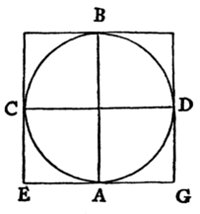
Draw the square, and as a square may be drawn about a circle in any position, draw it with its nearest side, E G, parallel to the sight-line.
Let E F, Fig. 31., be the square so drawn.
Draw its diagonals E F, G H; and through the center of the square (determined by their intersection) draw A B to the vanishing-point of G F, and C D parallel to E G. Then the points A B C D are the four points of the circle’s contact.
Fig. 31.
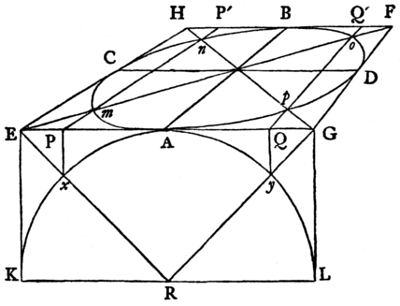
On E G describe a half square, E L; draw the semicircle K A L; and from its center, R, the diagonals R E, R G, cutting the circle in x, y.
From the points x y, where the circle cuts the diagonals, raise perpendiculars, P x, Q y, to E G.
From P and Q draw P P′, Q Q′, to the vanishing-point of G F, cutting the diagonals in m, n, and o, p.
Then m, n, o, p are four other points in the circle.
Through these eight points the circle may be drawn by the hand accurately enough for general purposes; but any number of points required may, of course, be determined, as in Problem XI.
The distance E P is approximately one-seventh of E G, and may be assumed to be so in quick practice, as the error involved is not greater than would be incurred in the hasty operation of drawing the circle and diagonals.
It may frequently happen that, in consequence of associated constructions, it may be inconvenient to draw E G parallel to the sight-line, the square being perhaps first constructed in some oblique direction. In such cases, Q G and E P must be determined in perspective ratio by the dividing-point, the line E G being used as a measuring-line.
[Obs. In drawing Fig. 31. the station-point has been taken much nearer the paper than is usually advisable, in order to show the character of the curve in a very distinct form.
If the student turns the book so that E G may be vertical, Fig. 31. will represent the construction for drawing a circle in a vertical plane, the sight-line being then of course parallel to G L; and the semicircles A D B, A C B, on each side of the diameter A B, will represent ordinary semicircular arches seen in perspective. In that case, if the book be held so that the line E H is the top of the square, the upper semicircle will represent a semicircular arch, above the eye, drawn in perspective. But if the book be held so that the line G F is the top of the square, the upper semicircle will represent a semicircular arch, below the eye, drawn in perspective.
If the book be turned upside down, the figure will represent a circle drawn on the ceiling, or any other horizontal plane above the eye; and the construction is, of course, accurate in every case.]