PROBLEM XIV.
Reading edition
PROBLEM XIV.
TO DRAW A TRUNCATED CIRCULAR CONE, GIVEN IN POSITION AND MAGNITUDE, THE TRUNCATIONS BEING IN HORIZONTAL PLANES, AND THE AXIS OF THE CONE VERTICAL.
Let A B C D, Fig. 37., be the portion of the cone required.
Fig. 37.
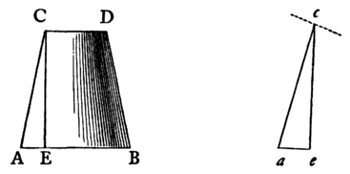
And as it is given in position, the center of its base must be given.
Fig. 38.
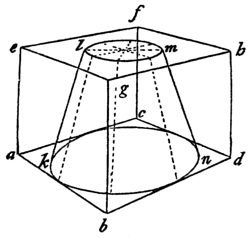
In the square of its base, a b c d, inscribe a circle, which therefore is of the diameter of the base of the cone, A B.
In the square of its top, e f g h, inscribe concentrically a circle whose diameter shall equal C D. (Coroll. Prob. XIII.)
Join the extremities of the circles by the right lines k l, n m. Then k l n m is the portion of cone required.
COROLLARY I.
If similar polygons be inscribed in similar positions in the circles k n and l m (Coroll. Prob. XII.), and the corresponding angles of the polygons joined by right lines, the resulting figure will be a portion of a polygonal pyramid. (The dotted lines in Fig. 38., connecting the extremities of two diameters and one diagonal in the respective circles, occupy the position of the three nearest angles of a regular octagonal pyramid, having its angles set on the diagonals and diameters of the square a d, inclosing its base.)
If the cone or polygonal pyramid is not truncated, its apex will be the center of the upper square, as in Fig. 26.
COROLLARY II.
If equal circles, or equal and similar polygons, be inscribed in the upper and lower squares in Fig. 38., the resulting figure will be a vertical cylinder, or a vertical polygonal pillar, of given height and diameter, drawn in position.
COROLLARY III.
If the circles in Fig. 38., instead of being inscribed in the squares b c and f g, be inscribed in the sides of the solid figure b e and d f, those sides being made square, and the line b d of any given length, the resulting figure will be, according to the constructions employed, a cone, polygonal pyramid, cylinder, or polygonal pillar, drawn in position about a horizontal axis parallel to b d.
Similarly, if the circles are drawn in the sides g d and e c, the resulting figures will be described about a horizontal axis parallel to a b.