PROBLEM VIII.
Reading edition
PROBLEM VIII.
TO DRAW A SQUARE, GIVEN IN POSITION AND MAGNITUDE, IN A HORIZONTAL PLANE.
Fig. 20.
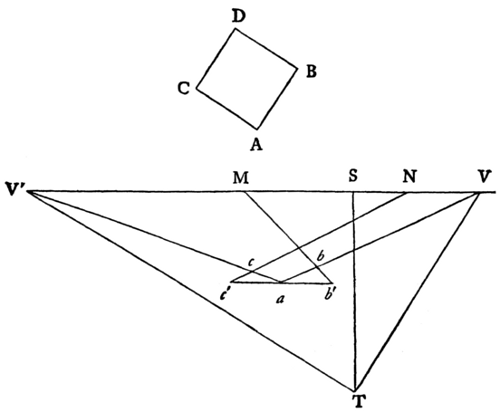
Let A B C D, Fig. 20., be the square.
As it is given in position and magnitude, the position and magnitude of all its sides are given.
Fix the position of the point A in a.
Find V, the vanishing-point of A B; and M, the dividing-point of A B, nearest S.
Find V′, the vanishing-point of A C; and N, the dividing-point of A C, nearest S.
Draw the measuring-line through a, and make a b′, a c′, each equal to the sight-magnitude of A B.
(For since A B C D is a square, A C is equal to A B.)
Draw a V′ and c′ N, cutting each other in c.
Draw a V, and b′ M, cutting each other in b.
Then a c, a b, are the two nearest sides of the square.
Now, clearing the figure of superfluous lines, we have a b, a c, drawn in position, as in Fig. 21.
Fig. 21.
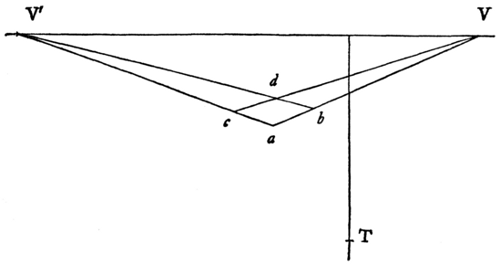
And because A B C D is a square, C D (Fig. 20.) is parallel to A B.
And all parallel lines have the same vanishing-point. (Note to Problem III.)
Therefore, V is the vanishing-point of C D.
Similarly, V′ is the vanishing-point of B D.
Therefore, from b and c (Fig. 22.) draw b V′, c V, cutting each other in d.
Then a b c d is the square required.
COROLLARY I.
It is obvious that any rectangle in a horizontal plane may be drawn by this problem, merely making a b′, on the measuring-line, Fig. 20., equal to the sight-magnitude of one of its sides, and a c′ the sight-magnitude of the other.
COROLLARY II.
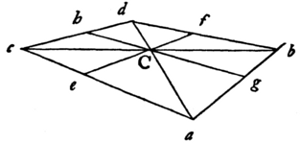
Let a b c d, Fig. 22., be any square drawn in perspective. Draw the diagonals a d and b c, cutting each other in C. Then C is the center of the square. Through C, draw e f to the vanishing-point of a b, and g h to the vanishing-point of a c, and these lines will bisect the sides of the square, so that a g is the perspective representation of half the side a b; a e is half a c; c h is half c d; and b f is half b d.
Fig. 22.
COROLLARY III.
Since A B C D, Fig. 20., is a square, B A C is a right angle; and as T V is parallel to A B, and T V′ to A C, V′ T V must be a right angle also.
As the ground plan of most buildings is rectangular, it constantly happens in practice that their angles (as the corners of ordinary houses) throw the lines to the vanishing-points thus at right angles; and so that this law is observed, and V T V′ is kept a right angle, it does not matter in general practice whether the vanishing-points are thrown a little more or a little less to the right or left of S: but it matters much that the relation of the vanishing-points should be accurate. Their position with respect to S merely causes the spectator to see a little more or less on one side or other of the house, which may be a matter of chance or choice; but their rectangular relation determines the rectangular shape of the building, which is an essential point.