PROBLEM III.
Reading edition
PROBLEM III.
TO FIND THE VANISHING-POINT OF A GIVEN HORIZONTAL LINE.
Fig. 9.
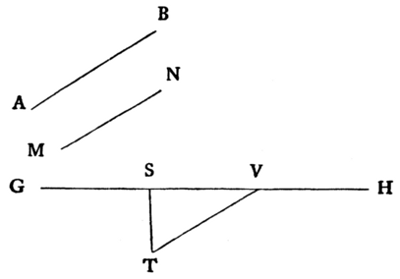
Let A B, Fig. 9., be the given line.
From T, the station-point, draw T V parallel to A B, cutting the sight-line in V.
COROLLARY I.
As, if the point b is first found, V may be determined by it, so, if the point V is first found, b may be determined by it. For let A B, Fig. 10., be the given line, constructed upon the paper as in Fig. 8.; and let it be required to draw the line a b without using the point C′.
Fig. 10.
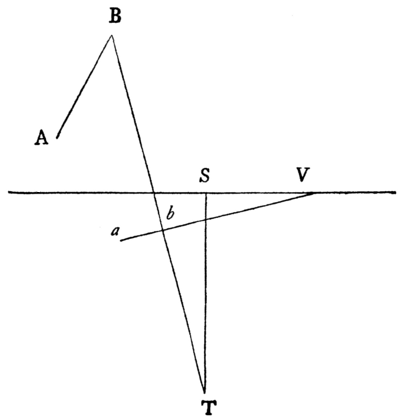
Find the position of the point A in a. (Problem I.)
Find the vanishing-point of A B in V. (Problem III.)
Join a V.
Join B T, cutting a V in b.
COROLLARY II.
We have hitherto proceeded on the supposition that the given line was small enough, and near enough, to be actually drawn on our paper of its real size; as in the example given in Appendix I. We may, however, now deduce a construction available under all circumstances, whatever may be the distance and length of the line given.
Fig. 11.
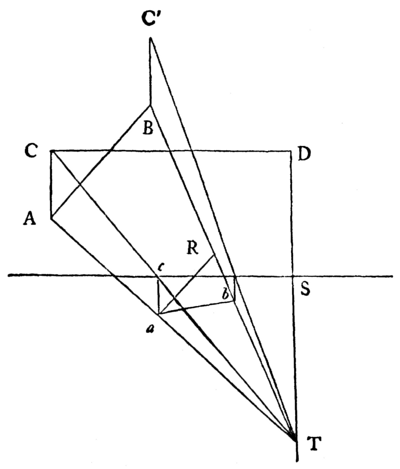
From Fig. 8. remove, for the sake of clearness, the lines C′ D′, b V, and T V; and, taking the figure as here in Fig. 11., draw from a, the line a R parallel to A B, cutting B T in R.
Then a R is to A B as a T is to A T.
Then — is to — as c T is to C T.
Then — is to — as T S is to T D.
Fig. 12.
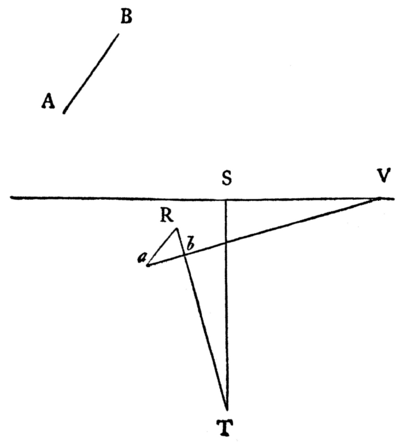
Therefore, when the position of the point A is fixed in a, as in Fig. 12., and a V is drawn to the vanishing-point; if we draw a line a R from a, parallel to A B, and make a R equal to the sight-magnitude of A B, and then join R T, the line R T will cut a V in b.
So that, in order to determine the length of a b, we need not draw the long and distant line A B, but only a R parallel to it, and of its sight-magnitude; which is a great gain, for the line A B may be two miles long, and the line a R perhaps only two inches.
COROLLARY III.
In Fig. 12., altering its proportions a little for the sake of clearness, and putting it as here in Fig. 13., draw a horizontal line a R′ and make a R′ equal to a R.
Fig. 13.
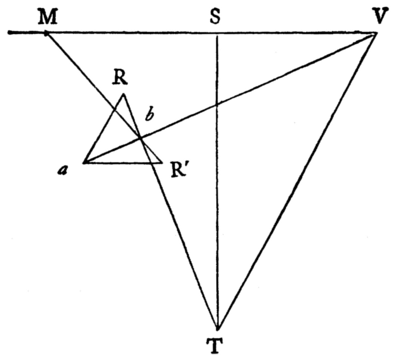
Hence it follows that, if from the vanishing-point V we lay off on the sight-line a distance, V M, equal to V T; then draw through a a horizontal line a R′, make a R′ equal to the sight-magnitude of A B, and join R′ M; the line R′ M will cut a V in b. And this is in practice generally the most convenient way of obtaining the length of a b.
COROLLARY IV.
Removing from the preceding figure the unnecessary lines, and retaining only R′ M and a V, as in Fig. 14., produce the line a R′ to the other side of a, and make a X equal to a R′.
Join X b, and produce X b to cut the line of sight in N.
Fig. 14.
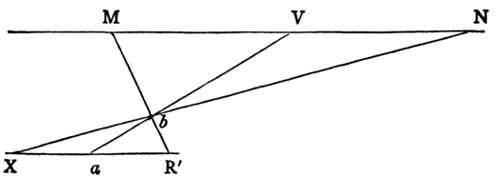
Then as X R′ is parallel to M N, and a R′ is equal to a X, V N must, by similar triangles, be equal to V M (equal to V T in Fig. 13.).
Therefore, on whichever side of V we measure the distance V T, so as to obtain either the point M, or the point N, if we measure the sight-magnitude a R′ or a X on the opposite side of the line a V, the line joining R′ M or X N will equally cut a V in b.
The points M and N are called the “Dividing-Points” of the original line A B (Fig. 12.), and we resume the results of these corollaries in the following three problems.
The construction will be seen to be founded on the second Corollary of the preceding problem.
It is evident that if any other line, as M N in Fig. 9., parallel to A B, occurs in the picture, the line T V, drawn from T, parallel to M N, to find the vanishing-point of M N, will coincide with the line drawn from T, parallel to A B, to find the vanishing-point of A B.
Therefore A B and M N will have the same vanishing-point.
Therefore all parallel horizontal lines have the same vanishing-point.
It will be shown hereafter that all parallel inclined lines also have the same vanishing-point; the student may here accept the general conclusion—“All parallel lines have the same vanishing-point.”
It is also evident that if A B is parallel to the plane of the picture, T V must be drawn parallel to G H, and will therefore never cut G H. The line A B has in that case no vanishing-point: it is to be drawn by the construction given in Fig. 7.
It is also evident that if A B is at right angles with the plane of the picture, T V will coincide with T S, and the vanishing-point of A B will be the sight-point.] Return to text