PROBLEM II.
Reading edition
PROBLEM II.
TO DRAW A RIGHT LINE BETWEEN TWO GIVEN POINTS.
Fig. 6.
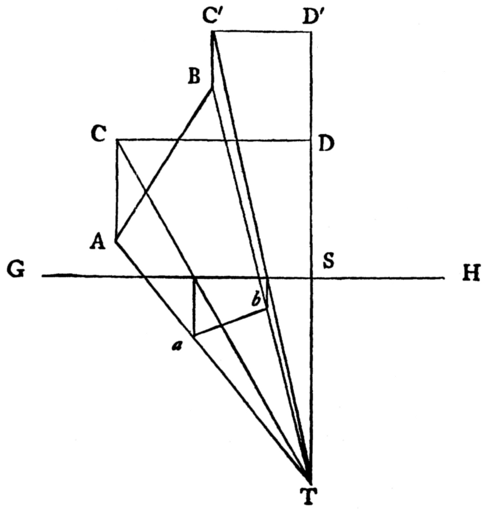
Let A B, Fig. 6., be the given right line, joining the given points A and B.
Let the direct, lateral, and vertical distances of the point A be T D, D C, and C A.
Let the direct, lateral, and vertical distances of the point B be T D′, D C′, and C′ B.
Then, by Problem I., the position of the point A on the plane of the picture is a.
And similarly, the position of the point B on the plane of the picture is b.
Join a b.
Then a b is the line required.
COROLLARY I.
If the line A B is in a plane parallel to that of the picture, one end of the line A B must be at the same direct distance from the eye of the observer as the other.
Therefore, in that case, D T is equal to D′ T.
Fig. 7.
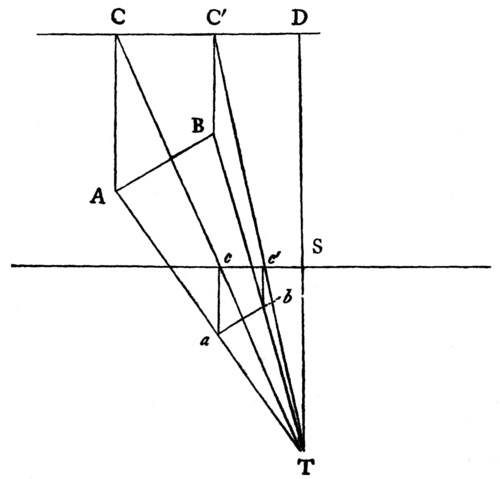
And that a b is to A B as T S is to T D.
Therefore, to draw any line in a plane parallel to that of the picture, we have only to fix the position of one of its extremities, a or b, and then to draw from a or b a line parallel to the given line, bearing the proportion to it that T S bears to T D.
COROLLARY II.
If the line A B is in a horizontal plane, the vertical distance of one of its extremities must be the same as that of the other.
Therefore, in that case, A C equals B C′ (Fig. 6.).
And the construction is as in Fig. 8.
Fig. 8.
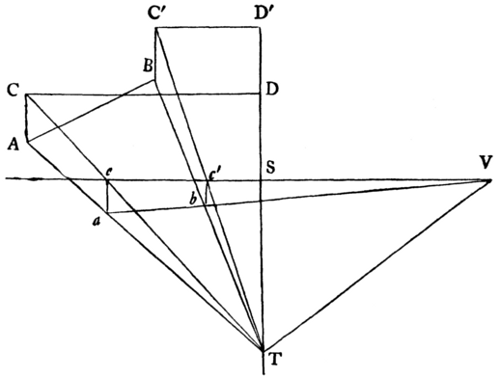
In Fig. 8. produce a b to the sight-line, cutting the sight-line in V; the point V, thus determined, is called the Vanishing-Point of the line A B.
COROLLARY III.
If the line A B produced would pass through some point beneath or above the station-point, C D is to D T as C′ D′ is to D′ T; in which case the point c coincides with the point c′, and the line a b is vertical.