THE SIX LITTLE GLOW-WORMS
Mary J. (Mary Joanna) Safford translation
During the June nights the meadow at the edge of the forest was as merry as a peasant wedding or a country fair. The nightingales sang, the crickets chirped, the plover drummed, the night wind whistled, old May and young June bugs lay in their taverns in the grass, the bushes, and the foliage of the trees, and drank dew till they were full, and even the sober ladybugs, which usually lead no gay lives, were persuaded to share the lively meetings of the idlers. As soon as it grew dark, the six little glow-worms that lived in the meadow crept out of their tiny room in the earth and lighted their lanterns, so that the place was brightly illuminated by their shining, bluish white light. So, when the revellers broke up at as late an hour as possible, thanks to their living lamps, they found their way as easily and safely as if it had been noonday, without striking against roots and stones, or falling into moleburrows. Then, standing in front of the glow-worms, they cheered them with their hoarse throats, and sang this little verse:—
“Little worm, that kindly lights
The reveller’s steps in the dark nights,
As to his home he gropes his way,
Our thanks we pay! Our thanks we pay!”
The little glow-worms said nothing, only let their light shine softly. They were indulgent to the harmless gayety of the revellers, and enjoyed the merry life which surrounded them during the short festival season of the year.
Not far from the meadow, where there were such gay doings, stood an old castle with a lofty tower. Here lived an aristocratic owl family, with a numerous colony of bats for servants. The mistress of the house, an owl of mature years, was a very learned lady, who had one son, whom she urged to study. But the young gentleman was an idler and sluggard, who would rather wander about than learn. Whenever he could, he stole away from his books and slipped out of the tower, to rob nests, catch birds, or, with the young noblemen from the owl-eyries in the neighborhood, join in hunting hares and marmots.
This troubled his mother greatly, and she remonstrated earnestly with him.
“The examination is close at hand, and you are not preparing yourself. Do you mean to disgrace me by failing?”
The young owl obstinately remained silent and looked sulky.
“Answer me, you unmannerly scapegrace!” cried the owl, angrily. “What am I to do with you? All your ancestors are lights of learning and members of the academy. You alone wish to remain an idle, ignorant blockhead. Are not you ashamed of yourself?”
“It isn’t my fault,” replied the owl nobleman, defiantly.
“Not your fault?” asked the owl in astonishment. “Whose fault is it, then?”
“Why, Mamma,” cried the youth, boldly, “do have some consideration. When am I really to study? During the day, as a member of a respectable owl family, I must sleep, and at night it is so dark in this confounded lumber room that I can’t see a line. I’m near-sighted already. If I must strain my eyes over my books in this pitch-black darkness, I shall be blind entirely.”
“What nonsense are you talking?” replied the owl, sternly. “We have lived here a hundred years and more, and no one ever complained of our home before. They all found it comfortable. On moonlight nights, it is almost too light and, when the moon doesn’t shine, you have our roof cat, by whose eyes you can read easily.”
The youth remained obstinate. “Pardon me, Mamma,” he said defiantly. “There are so few clear moonlight nights that they don’t count, and our cat’s eyes may have been enough for our ancestors, but in our days of electricity it is no light at all. Besides, we have so much more to learn now than you did in old times. So either give me some decent light, or don’t complain if I cannot prepare for my examinations.”
And, without waiting for his mother’s answer, the rude youth vanished through the tower window, to amuse himself with his companions in the usual way and let study alone.
The owl called the oldest of her bats, and said anxiously: “There is no living with the young people any longer. Hasn’t my good-for-nothing son taken it into his head that it isn’t light enough here, and therefore he cannot study?”
“Foolish talk, Mrs. Professor,” squeaked the bat.
“I know that just as well as you do,” answered the owl; “but I must not let him have the excuse for his idling. What shall we do to get a better light for the lazy fellow?”
“Our roof cat—” began the bat.
“Isn’t enough,” interrupted the owl. “Between ourselves: it really is a dim light, and I wonder whether our eyes are not constantly growing worse because, up to this time, we have been satisfied with our cat’s light. We must find something else.”
The bat reflected a little while, then she said: “How would it do to try glow-worms, Mrs. Professor? They give a good, steady light, do not heat the head, and are not dangerous on account of fire.”
“A clever idea,” said the owl. “Bring some here as soon as possible.”
The bat obediently flew away and hurried to the meadow on the edge of the forest, where the spring festival was in full course. From all the tree-tops, bushes, and grasses echoed the notes of fiddles, the sound of flutes, and merry drinking songs; everywhere there was dancing, playing, and dew drinking, and the little glow-worms, with quiet pleasure, held the light for these gay doings. Without troubling herself in the least about the company, the owl’s faithful servant seized one of the glow-worms with her teeth, and carried it in a swift flight to the tower, where she put it on a beam. It was trembling in every limb with fright, and in its terror almost let its lantern go out.
The owl looked at the little creature closely, and said discontentedly, “This light, too, is not enough.”
“No, Mrs. Professor,” replied the bat; “it shone far more brightly in the meadow outside. These glow-worms are queer creatures. Alone they are not good for much. There must be several of them together. Then the rascals want to outshine one another, each tries to do his best, and the result is something very acceptable.”
“Then get several,” ordered the owl.
The bat called her relatives, they went to the meadow together and brought away the other five glow-worms. When all six sat side by side on the beam in the tower, they were so glad that no harm had happened to them, and that they were together again, that they quickly forgot their fright, and let their lanterns shine with full brilliancy. The walls of the tower chamber glittered and sparkled as if they were hung with silver cloth and adorned for a royal festival. It was a very beautiful sight, which pleased even the bat, though usually she cared little for wealth and magnificence.
“Wonderfully pretty,” she said; “but too dazzling. I could not bear it long.”
“Nor I, either,” answered the owl, sighing. “But what can we do? The young folks will have it so.”
The six little glow-worms shone conscientiously until the approach of dawn, then they turned off their light, crept close to one another on the beam, fell asleep, tired out, and dreamed of the merry fair, from which they had been stolen to serve in the owl tower.
When the first flush of dawn was appearing in the sky, the young owl returned, laid a hare at his mother’s feet, and wished her a pleasant sleep.
“Very well, you idler,” she muttered before she went to her bed. “You shall have a surprise to-night.”
In fact, when darkness came, the owl went to the lie-a-bed and shouted into his ear: “Get up, you sluggard. Up with you quick, and go to work!”
The young owl opened his eyes, but instantly shut them again to escape the glare which met him. The six little glow-worms had lighted their lanterns, and were shining as brightly as they could.
“Now you can no longer tell me that you cannot see plainly enough,” the owl went on. “I have given you a light which will make your eyes water. Now bring your books, and study steadily.”
The young owl was obliged to get up, whether he liked it or not. He made his toilet, ate something, and sat down with his books. But he had no love for study, and only waited until his mother, accompanied by two young bats, flew away to attend to some business. Then he went quickly to the little glow-worms, and said in a subdued voice, yet very impressively: “You vagabond lantern-bearers, what do you want here? Who sent for you? If you don’t put out your worthless eye-spoilers, I’ll break your bones for you.”
The little glow-worms were terribly frightened, and lowered their light almost entirely, so that it only glimmered very faintly. But the bat, who, in her corner, had seen and heard all this, shot out, hissing: “Just wait, sir, I will tell your mother about this. And you glow-worms will turn up your light again at once, or you’ll have to deal with me.”
The little glow-worms did not know what to do. The young owl threatened their lives if they shone, and the bat if they put their light out. But they understood that the young owl had more authority here than the bat, and the bravest of them summoned courage to say to him, as he stood before them with angry eyes and ruffled feathers: “My young lord, we should be very glad to obey you, if we only could. We did not come here voluntarily. Your servants dragged us by force from our home and family. We would like nothing better than to return to our own people. But how are we to get out of this terrible high tower, and reach the earth? We can never do it alone. Help us, my young lord, and we will be grateful to you all our lives.”
The young owl was a rough fellow, yet he had a kind heart. He pitied the frightened glow-worms, and did not want to throw them out of the tower window. Besides, he was afraid of his mother, who would certainly ask where they were.
He drove the old bat rudely back into her corner, and said softly to the trembling little glow-worms: “Now pay attention to me. When my mother comes home, summon up your courage and declare a strike. My mamma is a little severe in her language, but she will do you no harm. She doesn’t eat things like you. I hope she will drive you away, and then I will carry you home.”
Things happened just as the sly fellow had planned. When the owl came back, she found the room perfectly dark, and the six little glow-worms were visible only as faint, bluish sparks.
“What does this mean?” shrieked the owl, angrily. The bat was rushing out of her corner, but the young owl flow to her side and whispered fiercely, “Hold your tongue, or it will cost you your life!” then, hurrying back to the glow-worms, he hissed: “Go on now! Be brave!”
The glow-worm which had spoken before again began, “Pardon us, Baroness, we cannot shine.”
“Why not, you lazy rabble?” cried the owl, fiercely.
“Because we get nothing to eat and drink,” replied the glow-worm, boldly.
“H’m,” said the owl rather perplexed. She had not thought of that before, and could not deny that the glow-worm was right. “What do you want?”
“Four meals a day, at each meal twelve fat plant-lice and a pint of fresh dew. That is what we are used to. Then a soft moss bed with thyme in the pillows, and permission to go out twice a week—or we can do nothing.”
“You shall be choked first, you gluttons,” cried the owl, in the greatest rage. “Here, Bat, break these blockheads’ necks! Eat them all.”
“Out with your lights!” whispered the young owl to them quickly, while the bat was flying as fast as possible to obey her mistress’s orders.
The little glow-worms instantly put out their lanterns, and were now perfectly invisible in the dark room, so that even a sharper-sighted creature than the half-blind bat could not have found them.
“Quick! Sit on my claws, each on one toe,” said the young owl, very softly. They crawled and crept, as fast as they could, upon the owl’s feet, which he had placed on the beam, and when he felt that they were all clinging fast with their little thin, weak legs, he sailed noiselessly out of the tower window.
Outside in the open air, when they knew that they were out of danger, all the glow-worms lighted their lanterns and shone with all their power, so that the young owl, in his flight, looked like a wonderful shining constellation. On reaching the meadow at the edge of the forest, the rough fellow shook his travelling companions from his claws with a sudden movement, because it was disagreeable to him to feel their little thin legs on his toes, and went off without any word of farewell.
The glow-worms fell to the ground from a considerable distance, and were somewhat bruised. But the pleasure of being again at home with their relatives was greater than the pain. They were greeted with universal rejoicing, for it had been very dull on the meadow since the bats had carried away their living lanterns. The night festival had been interrupted, all the revellers wanted to hurry home and, in doing so, some had fallen into pools and were drowned, others had stumbled over roots and stones, and broken their legs or even their necks, and cries of pain and groans had followed the merry songs. When the revellers now had their usual light once more, the fiddles and flutes sounded gayly, old and young May and June beetles, crickets, and grasshoppers, and even the sober ladybugs, danced around the six little glow-worms, singing joyously:—
“How we have missed your shining spark,
When, wand’ring through the nights so dark,
We’ve broken limbs on paths astray,
And drowned in pools beside the way,
But now we have you here once more—
‘Hurrah! hurrah! hurrah!’ we roar!”
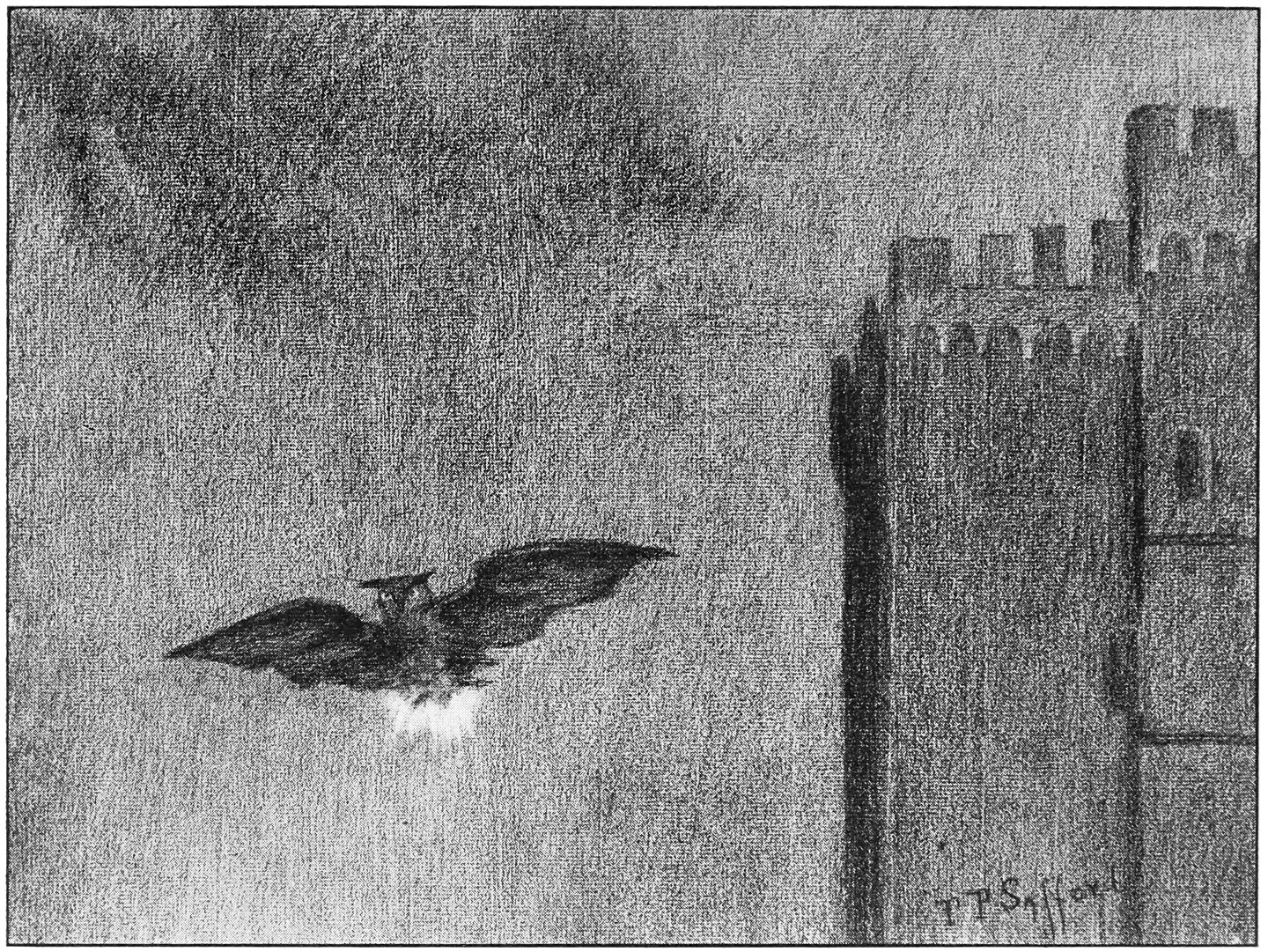
“The young owl, in his flight, looked like a wonderful shining constellation.”
After this trial the owl gave up her effort to make her son a learned man. She let him become a hunter, and in this career, for which he had inclination and talent, he advanced so far that his mother, after all, was satisfied with him.