THE RICH DOG AND THE POOR DOG
Mary J. (Mary Joanna) Safford translation
He was called Rough-leg, and he deserved the name.
He was probably the very ugliest dog that ever was seen: long-legged, rough-haired, with pointed ears lopping down a little at the ends, a long nose, and yellow eyes. Nobody could have told to what breed he belonged. He had the head of a wolf, the legs of a hound, the body of a bull-dog, the hair of a Spitz, the bushy tail of a setter, and the color of a badger dog. He was thin as a herring, and as dirty as a sewer cleaner. Matted tufts of hair hung from his body like the rags of a tramp. His torn ears told tales of many a fierce fight. The violence and perseverance with which he bit and scratched showed what an unpleasant multitude of hopping brown guests he had in his dirty hide.
But under this ugly hide Rough-leg had excellent qualities. He was as strong as a bear and as brave as a lion, but he was also faithful as a good dog ought to be, and good-natured, even though he fared very badly, and had every reason to complain of his fate.
Fortune certainly did not favor him. He belonged to an old scissors-grinder, who went with his cart from village to village. He had to help drag the things for him, and his master gave him very little to eat, because he usually had nothing himself, but plenty of kicks and blows when he wanted to vent on somebody his rage for earning so little.
Yet Rough-leg always forgave his master for everything. When the old fellow was drunk,—and that happened every time he had a few pennies to buy a drop of something strong,—he was kind to Rough-leg, patted him, and talked to him like a sensible, beloved companion. And when he had poured out his heart to him, he lay down wherever he was, in the grass, the moss in the forest, or in the ditch by the road, and began to snore, while Rough-leg stretched himself beside him, and watched his sleep and the cart, which was everything in the world that his master could call his own.
One evening the old scissors-grinder, after a carouse, again fell asleep in the ditch, and did not wake any more, for he was dead. Rough-leg perceived that there was something strange about his master, when he no longer heard him snore. He snuffed at him, licked his face, pushed him with his muzzle, scratched his breast with his paws, and when the old man, in spite of everything, still lay silent and motionless and began to grow cold, Rough-leg set up such a terrible howling that all the dogs for miles around answered, and very early in the morning people came running up, who saw that the old man had died in the night.
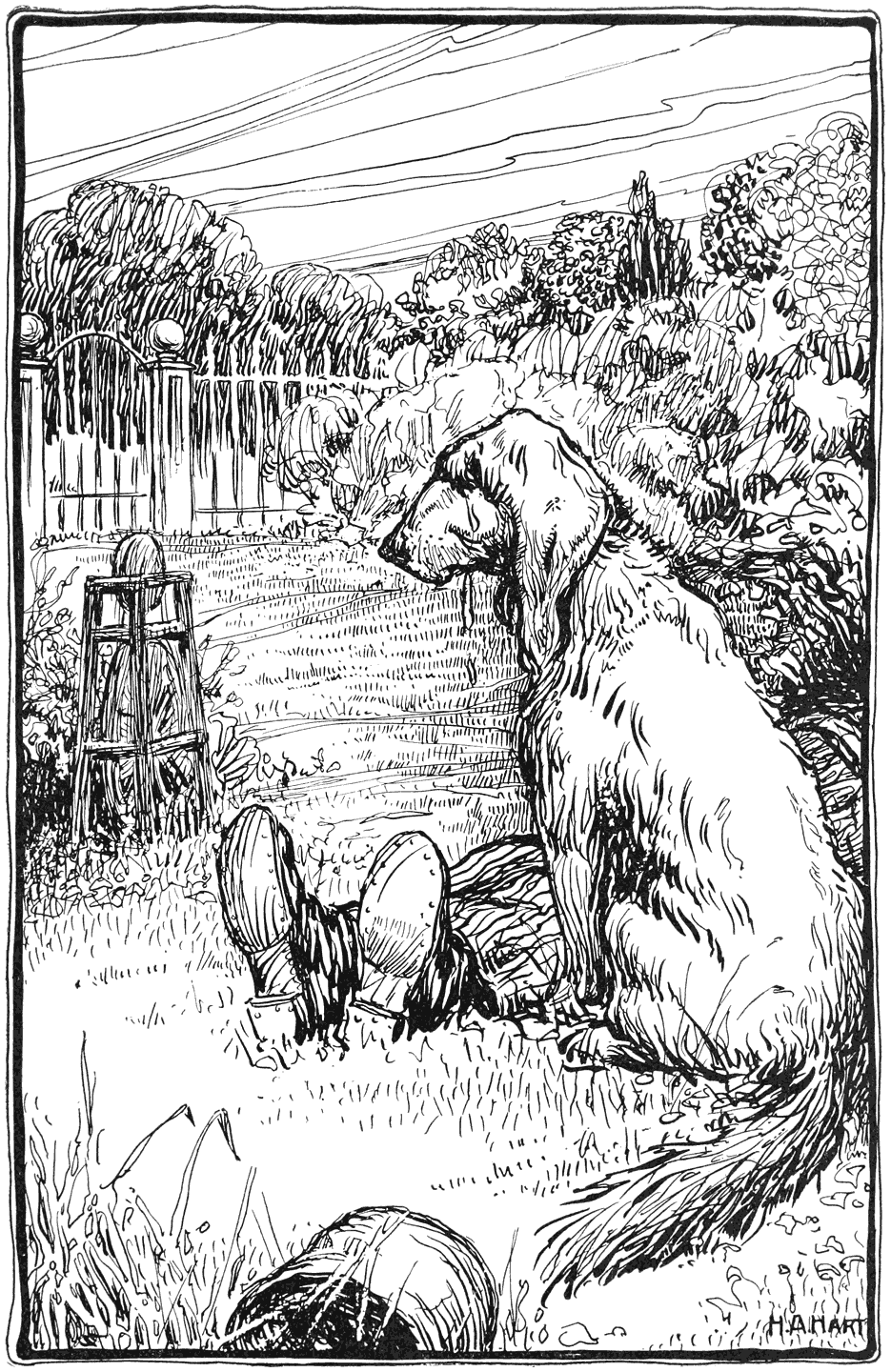
“Rough-leg perceived that there was something strange about his master.”
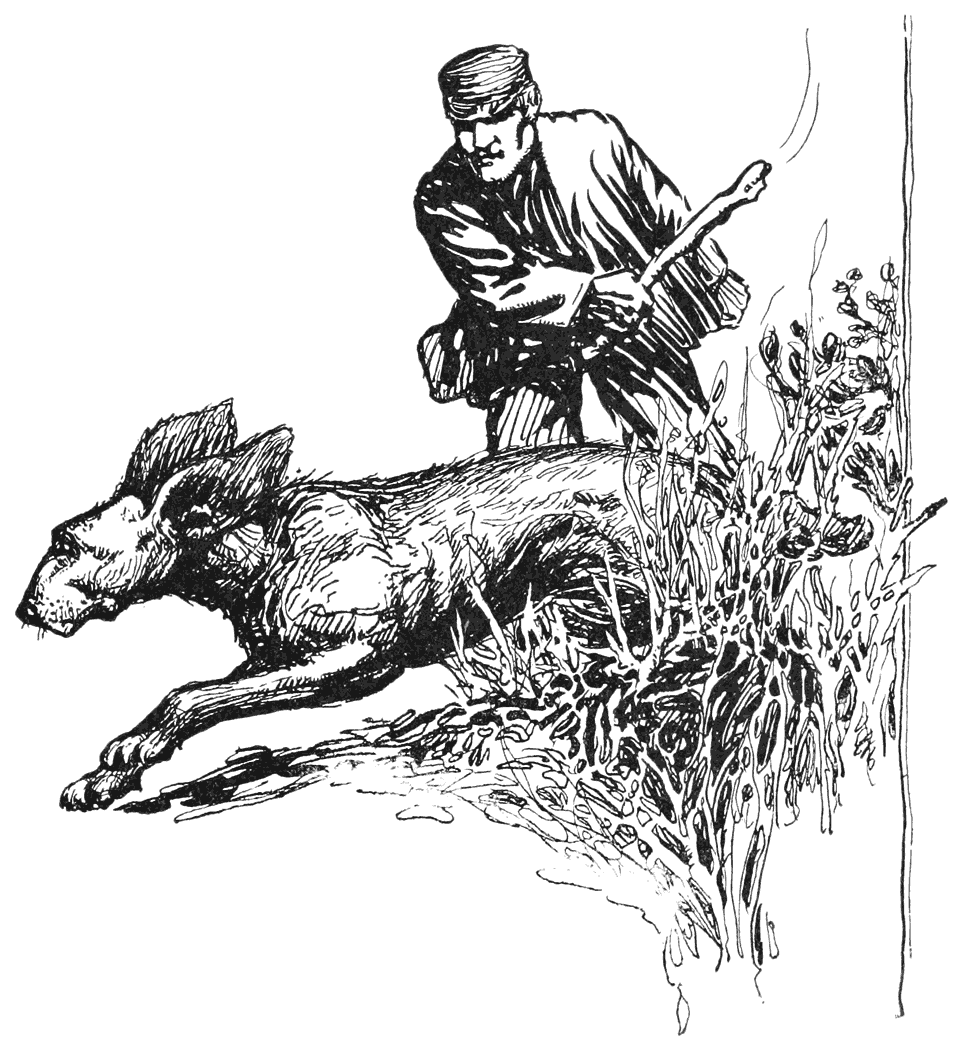
They wanted to take away the body and the cart, but Rough-leg thought he must not allow it, and rushed furiously at everybody who came near. The constable drew his sword, and would certainly have killed him if he had not jumped away from his blows and thrusts. But he did not escape the sticks and stones of the peasants, who beat him unmercifully until he saw that he could do nothing against them. So he no longer tried to prevent their taking the body away, and dragged himself off a short distance, badly hurt, whining and moaning as they carried his master to the village churchyard.
There was not much ceremony over the poor scissors-grinder. After a few official inquiries, and a little writing, he was put into a grave, and then nobody thought any more about him. Rough-leg had dragged himself to the churchyard, and watched behind a tombstone, as they laid his master in the earth and filled up the grave. When all the people had gone, he crept out of his hiding place, went to the fresh mound, and began with the greatest energy to dig his master out. He had already made quite a large hole when the grave-digger saw him and ran forward with uplifted shovel and loud shouts. Rough-leg saw that he could do nothing against the angry armed man, so he limped out of the churchyard, and the grave-digger locked it. It was impossible to jump over the wall again, it was too high. He could not stay with his master’s body, so he went back to the place where he had died, and lay down on the edge of the ditch, determined not to leave the spot.
Near by was a castle with a large garden in front, separated from the road by a fence. Here, surrounded by her servants, lived an old countess, who had a pug-dog, of which she was extravagantly fond. His name was Darling; he was yellow, with a black face, and a little short, stubby figure. He was a very aristocratic dog. His hair looked well kept, for he was bathed, perfumed, brushed, and combed every day. On his left forepaw he wore a gold bracelet, around his neck a white collar with a light blue border, and when he went out, he had a fine cloth blanket with a silk lining, on one corner of which a coronet was embroidered. If it had rained before his walk, he wore rubber shoes to keep his paws from being wet or muddy.
He was very handsome in his rich clothes and costly jewelry, but all these fine things gave him no pleasure. They were only troublesome. How gladly he would have run barefoot through the puddles, and trotted along in the dust. How gladly he would have shaken off the heavy clothes and, with nothing but his smooth skin, raced about like the other dogs, whom he envied when he watched them through the fence of the castle courtyard running, jumping, rolling, and romping with each other to their hearts’ content. He was not allowed to join them. A servant of his own constantly watched to prevent his having any acquaintance with strange dogs. His prison was his mistress’s room. Only twice a day would she let him go out a short time in the castle yard, under the care of a man, usually on a leash, to get a little exercise, breathe the fresh air, etc. These walks were so tiresome that he preferred to stay with the old countess. From lack of exercise, and an oversupply of dainties and rich food, he became a shapeless lump of fat, grew short-breathed, gouty, and had a perpetual itching of the skin, so that, though he was kept so clean, he was obliged to scratch as often and as hard as poor Rough-leg, who had never made acquaintance with brush and comb, warm bath or soap.
The discovery of the dead scissors-grinder in the ditch had brought a great crowd before the castle fence, and the castle servants had also run out to look. Darling was there, too, pressing his black face, with its snub nose and short muzzle, against the rails to see what was going on. When the people set upon Rough-leg with clubs and swords, and almost broke his bones, the pug was furious, and barked as loud as his short breath would permit. The human beings did not understand, but he knew Rough-leg’s faithful heart, and would have gone to help the dead man’s friend, whom they so unjustly abused, if he had only been able.
Lying on his dark blue velvet cushion in his mistress’s room, he thought all day long of the scene which he had witnessed the day before. The dog outside there was shamefully abused; he was apparently of the most humble origin, he was certainly ill-bred, rough, not even clean; he was dirty and ragged. But he was much better than he, the aristocratic pug, the trained and wealthy pet.
The strange fellow owed his master nothing, for he had not even fed him, his leanness showed that. And yet he was faithful to him unto death; he would not leave his lifeless body; he would rather endure the most cruel treatment than to neglect his duty as guard. Would he, Darling, have been capable of such heroic steadfastness? He perceived with shame that it was doubtful. His mistress spoiled him. She was rich and titled. Her rank made every one treat her with respect, and on her account he, too, received the honor due to the pug of a lady of quality. She fed him with cake and roast beef. And yet, if she should die, he would not show his teeth at everybody who came near, and he would not expose himself to any special danger of being beaten with swords and clubs. These thoughts filled him with self-reproach and, at the same time, with admiration for the ugly cur on the high-road, who seemed to him a model of faithful duty.
When Darling, attended by his servant, was allowed to go out again into the castle courtyard that evening, he waddled to the fence as fast as his fat and shortness of breath would let him. He at once saw Rough-leg, who had returned from the churchyard, and was lying in the ditch with closed eyes, his nose between his forepaws, moaning.
“Here! You! Come over to the fence!” called Darling. Rough-leg took no notice.
“You are a brave dog! You have my full respect and friendship!” Darling went on. “I must have a chance to press your paw. Unluckily I can’t get out to you.”
He was so unused to talking loud, that it made him cough and at the same time the itching began, which tortured him so much that he fairly writhed, because his fine blanket and handsome collar and harness prevented him from scratching to his heart’s content.
Rough-leg now raised his head, opened his eyes, and blinked at him. “Does anything ail you?” he asked in his hoarse voice.
“Oh, dear, I am so miserable!” replied Darling, piteously, when he had recovered his breath. He took no offence at plebeian Rough-leg’s familiarity. “But don’t let us talk about me, but you. I suppose you loved your master very much?”
“I had no one but him, and he had no one but me in the whole world. I will not outlive him.”
“Listen to reason, my dear fellow,” cried Darling, in horror. “Surely you don’t mean to kill yourself?”
Rough-leg made no answer.
“Your master was a poor tramp,” Darling continued.
“Like me,” interrupted Rough-leg, growling.
“Well, then, surely you owe him nothing. He has not been able to do anything for you. He is dead. You can’t change that. Now think of yourself. What are you going to do?”
“Nothing. I shall stay here.”
“In the night? On the bare ground? Under the open sky?”
“I’m used to it.”
“You have no rheumatism and no asthma, like me. I should die. And who will give you your food?”
“Nobody. I want to starve to death.”
Darling pitied the despairing fellow more and more. “Be sensible, dear friend and cousin,” he said. “We must learn how to find comfort. What would become of us if people took everything so much to heart? I pity you. I’ll do what I can for you. Wait, I’ll bring you something to eat presently.” He waddled away from the fence, back into the castle, and up to his old countess, from whom he begged. She gave him, as usual, with many pats and loving words, a piece of nice cake. He scarcely thanked her by a hasty lick of the hand and a quick wag of the tail, and hurried back to the fence, which he reached panting for breath.
“Here, friend, I have something good for you. But you must come into the courtyard to me. I can’t get out,” he called to Rough-leg, who was still lying just where he had left him.
Rough-leg rose and came slowly forward. Darling’s sympathy cheered him a little in his loneliness. When he reached the fence, Darling pushed the bit of cake under it and wagged his tail eagerly. He was rejoicing to think how nice the dainty would taste to the poor, starved fellow. Rough-leg drew it out with his paw, snuffed at it, and then left it.
“Who can eat such stuff as that?” he growled.
“But that’s cake, my dear fellow!” cried Darling, in astonishment; “that’s the very nicest thing there is!”
“I don’t know anything about it. It’s not fit for sensible dogs. If you have a bone, I should like it. If not, leave me alone.”
Darling shook his head, but went back into the castle, looked into the garbage pail, which he usually was not allowed to meddle with, and found a big bone, which he dragged to the fence. “Here is a bone, since you want it,” he said; “but I can’t understand how you can do anything with this dry, hard thing.”
Rough-leg made no reply. He raked the bone out from under the fence with his strong paws, broke it in two with one bite, cracked and splintered it, and, in the shortest possible time, reduced it to very small pieces and swallowed it. Darling watched the work of his new friend’s powerful wolf jaws with mingled admiration and horror. When the latter had finished, he turned toward the fence, licked Darling’s muzzle with his big tongue, and muttered: “Thank you. You are a good fellow.”
Darling’s heart leaped with joy. “Ah, if I could only get out to you!”
“Come, then,” answered Rough-leg.
“I dare not,” whined Darling, looking round anxiously for his servant who, luckily for him, was just talking with one of the countess’s coachmen, without noticing the pug placed in his care.
“Are you not ashamed to be such a timid fellow?” cried Rough-leg. “The idea of a dog’s allowing himself to be forbidden a little run.” He turned as if to go away.
“Don’t go,” called Darling. “I will try to slip out.”
He went cautiously to the gate, which was only ajar, and, seeing that the servant was still talking, he ventured to steal out.
“Now run,” said Rough-leg, breaking into a long, swift trot. Darling tried with all his might to keep up with him. But he could not do it. After a few minutes he fell breathless on the ground and writhed there panting and moaning. Rough-leg looked at him a moment scornfully, and yet compassionately, seized him by the skin of the neck, and carried him along in his mouth, as a mother dog does her puppies. It seemed to give him no more trouble than if Darling had been a feather. He ran on until the castle was entirely out of sight, then set him on the ground and wagged his tail kindly.
“How good you are,” sighed Darling, who had recovered his breath while in his friend’s mouth. But now the excitement brought on the itching again, and he scratched piteously, yet without success, on account of the cloth blanket and other things he had on his body.
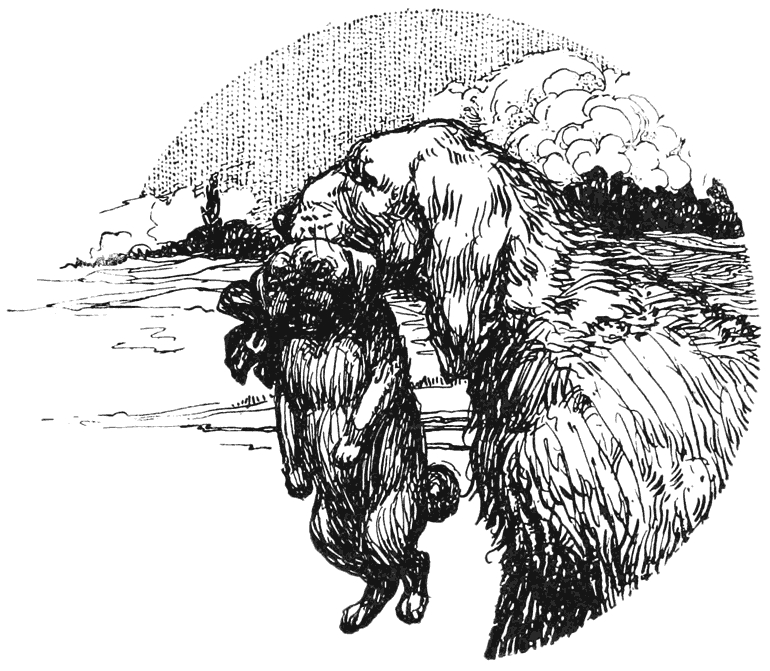
“Booby,” growled Rough-leg, after watching him awhile.
He rushed upon Darling so violently that he frightened him and, with a few bites, tore the fine blanket and collar from his body in ribbons, broke the bracelet from his paw with one snap, and said, “There, now you look like a decent dog again, and I need not be ashamed of being seen in your company.”
Darling had never felt so comfortable since he could remember. He could scratch himself to his heart’s content, and already the itching was less because he was entirely undressed and the fresh air blew freely all around him. Yet, glad as he was, he thought with a few pangs of conscience of his old mistress, and murmured—“What will they say at the castle?”
“You can go back there, if you repent,” replied Rough-leg, harshly, moving as if he were going to trot along.
“Don’t go away,” Darling begged anxiously. “Don’t leave me alone, I shall be lost without you.”
“Then hold your tongue, and come.”
It had grown dark. Rough-leg’s bones still ached from the beating he had had, he was tired out, and he saw that his companion was exhausted. So leading him to a hay-rick in a ploughed field, he said, “We’ll spend the night here.” He dug out a hole in the hay, pushed the tender Darling in, and lay down before him. Darling slept better than he had ever done before. It was very different lying on the hay from being on a velvet cushion in a curtained, closed apartment. He scarcely felt even the pains in his limbs, because his friend had warmed him with his big, strong body.
When he woke early in the morning, he felt like another dog. “You are a wonderful fellow, Rough-leg,” he said, licking his long, rough muzzle gratefully. “But I don’t know what ails me—I feel so queer around my stomach—”
“You are hungry, simpleton, and so am I,” replied Rough-leg.
Hungry! That was a feeling which Darling had never known, or had forgotten long ago. It gnawed very sharply, but it was far, far pleasanter than the repugnance which his rich, costly food at the castle had inspired.
“Where shall we find anything to eat?” asked Darling.
“You must go and look,” was the short answer. He snuffed a little around the hay-rick, then suddenly made a spring and drew out of a hidden sparrow’s nest a peeping young bird, which he killed with one bite and tossed to the wondering Darling.
“There, eat it,” he cried, and himself devoured the rest of the brood, which still remained in the nest.
Then the two went to a neighboring farm-house, and Rough-leg began to rummage in the dung-heap.
Darling was just going to follow his example, when out rushed the house dog, barking furiously, and threw himself on the pug, which with a cry of terror, fell on the ground under the shock. In an instant Rough-leg was by his side, and a fierce fight began, in which the farm dog was soon beaten. Off he ran with bleeding ears and lips, howling piteously.
“You have saved my life,” groaned Darling, as they hurried out of the yard.
“Nonsense!” said Rough-leg, but he ran his tongue tenderly over the pug’s black face.
A new life, which he had never known before, began for Darling. He could do just as he pleased, he was always in the open air, he trotted until he was tired, and lay down to rest wherever he happened to be. He often fared badly in regard to food. He had to take just what he could get! in the best case boiled turnips some cow had dropped from her trough; in the worst, bones picked up on some dung-heap. But this poor and scanty living, from which he would formerly have turned aside with loathing, seemed excellent, and even dainty, because he saw how much Rough-leg enjoyed it. The two friends were often obliged to fight the village curs; but this no longer frightened Darling, for he knew that he could depend on Rough-leg. His health daily improved. His rheumatism and the intolerable itching disappeared, he lost flesh, and, with the extra flesh, his shortness of breath vanished; he could vie with Rough-leg in running, and soon made such progress that, to his joyful surprise, he could help a shepherd, who was driving a flock of sheep over a cross-road, as well as his nimble Pomeranian, which could not manage the work alone. The shepherd wanted to keep him, but this did not suit Darling. “When I want to enter service, I will go back to my mistress,” he said, and went off with Rough-leg. In the castle the people were inconsolable over Darling’s disappearance, the servant who had not watched him properly was dismissed at once, and the countess advertised that she would pay a large reward to any one who returned her pug. But no one brought him, because he was not recognized from the description which mentioned his fine blanket, collar, and bracelet. But Darling thought of the old countess, and Rough-leg of his dead master, and, after about a fortnight, the pug said one morning, “Suppose we should go and see how things are at the castle.”
“Very well,” Rough-leg answered, and the two trotted straight toward the castle. They were obliged to run many hours before they reached it. When they arrived, the gate stood open, and Darling walked boldly in. The servants did not recognize him, for he was as slender and active as a greyhound, and as dirty as a pig which had just come out of the mire. But his eyes were bright, his nose was moist, and his bark was as loud and long as the alarm bell in the steeple. They tried to drive him away, but he rushed upstairs to the old countess’s room and scratched at her door. When she heard the familiar sound, she uttered a cry of joy, started up, and opened it as quick as she could. Darling jumped up on her and, barking loudly in his delight, licked her face. But she pushed him away in horror, for he smelled so badly and was so terribly neglected. She called for perfume and a warm bath, but Darling ran swiftly away. He would not have them any more, nor his fine clothes, gingerbread, and velvet cushions.
Rough-leg was lying outside in the ditch, waiting to see whether his rich friend would forget him or come back to him. In a few minutes Darling returned. “Won’t you go into the castle with me?” he cried joyously.
“Yes, so that they can break my limbs or chain me up,” growled Rough-leg.
“They must kill me first,” answered Darling, urging him along.
At first the people in the courtyard wanted to ill-treat the ugly tramp dog. But Darling covered him with his body, and they saw that he was his friend. The case was reported to the countess, who looked out of her window at the ugly, strong, strange dog; the affection her pug showed him touched her, and she ordered the servants to let him stay with Darling. The pug was obliged to allow himself to be thoroughly cleaned, but he would not lead his former life. So he was permitted to wander about the courtyard and high-road with Rough-leg, and only came for a quarter of an hour every morning and evening to the countess, who, however, could not bear his smell, and in spite of his caresses, was glad when he went away again. Darling and Rough-leg always remained the best of friends, and the former often said: “I, the insolent rich dog, owe to you, the poor fellow, health and life. If the rich would only always make the poor their friends!”
“It would be a good thing for both,” growled Rough-leg, in his deep voice.