THE ELF CHILD
Mary J. (Mary Joanna) Safford translation
Once upon a time there was a large clearing in the midst of a thick beechwood, and in the middle of this clearing was a big, deep pond, on whose shores grew rushes, and on whose surface floated water-lilies. In this pond lived many elves, who slept all through the day on a bed of fine sand and soft plants, but in the evening came up to breathe the air of the upper world. Then they sat down on the grass in the glade, parted and braided their golden hair, wrapped themselves in rainbow-colored veils, adorned themselves with pearls and precious stones from little mother-of-pearl caskets, ate fruit and honey, drank dew and sweet flower juices, and played forfeits and blindman’s-buff. During the weeks when the nightingale sang and also at other times, when there was a full moon, they formed into a large ring and danced until the cock crowed. The gnomes, too, often came from the neighboring mountains, and if they were very well behaved, and the elves were in a good humor, they were allowed to dance and play with them until the gray dawn drove them home, too. In the meadow where the elves held their summer festivals, the grass grew more luxuriantly and more beautiful, flowers bloomed in the places where their silver-white feet had floated in dancing. The inhabitants of the wood knew that the glade was used by the elves of the pond for a playground, and timidly avoided it; for they were aware that the beautiful water women, though they did not usually trouble themselves about mortals, and did them no harm, grew very angry if they were impertinently watched, or even surprised by accident at their games.
Now it happened that there lived in the village at the edge of the wood a young fellow, who thought of nothing but mischievous tricks and practical jokes. When he was a little boy he used to let loose in the school-room and church, beetles, to whose legs he had tied bits of paper with pieces of thread. When he grew larger, he sawed the back legs of the schoolmaster’s chair three-quarters through, so that it broke down when the teacher sat in it. When he was a half-grown lad, he tied dogs and cats together by their tails, and laughed maliciously when the poor animals fought furiously with one another. Of course such a fellow always robbed birds’ nests, and stole fruit from the trees. This rascal had often heard of the elves of the pond in the forest meadow, their dances in the moonlight summer nights, and their sports with the gnomes, and he could not rest until he had seen the merry pastime with his own eyes. One warm June evening, when the moon was full, he stole through the forest and across the glade to a spot on the shore of the pond, where the rushes grew thick, and, hidden among them, waited with some little anxiety for what would happen.
During the first hours after sunset he heard nothing except the croaking of the frogs near by, and the bell-like tones of the more distant bullfrogs, and saw in the twilight owls and bats flying noiselessly hither and thither. Just after midnight the moon rose, the pond and the woodland meadow were lighted almost as brilliantly as day, and suddenly the impudent scoundrel cowering among the rushes started, almost frightened to death. Close beside his hiding place a silvery laugh rang out and, at the same moment, a young elf rose from the water and clapped her hands loudly. Instantly dozens of other elves appeared in the pond, surrounded the first one, shouted joyously, splashed the water till it foamed, dashed drops and streams into one another’s faces, and at last swam swiftly, in a long line, to the shore. There they had apparently concealed clothes and jewels in the bushes, or in holes in the ground, for in a short time they glided out of the reeds, clad in shimmering, floating veils, and glittering with gems, and frolicked about on the meadow.
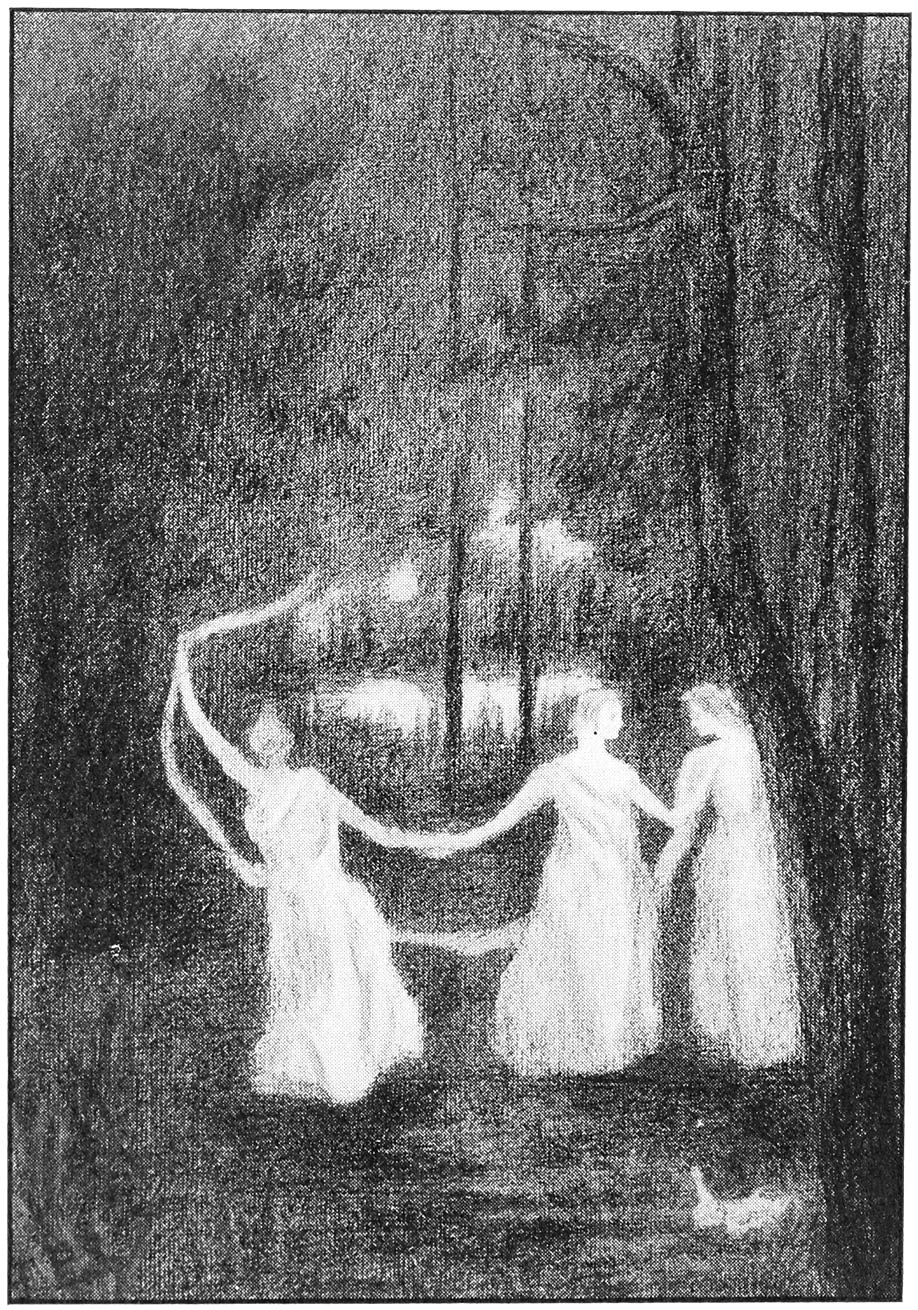
The first elves were young girls. After them came young mothers with little elf children, many of whom could already walk alone; others fell down when they tried to stand on their small fat legs, and not a few were still on pillows. The mothers who had children at the breast nursed them, rocked them in their arms till they fell asleep, laid them in the tall grass on the shore, and hurried back to their companions to join their games and ring dancing. One baby in long clothes was laid by its mother among the rushes so near the spy that he could almost touch it with his outstretched hand. It was as beautiful as the angels in the pictures of Paradise, more beautiful than any mortal child he had ever seen. But he did not look at it long, for the scene in the meadow attracted his attention far more strongly. Some were playing blindman’s-buff, others tag, others still were dancing or striking shuttlecocks, then they all joined in songs with choruses, which sounded so sweet that even the hardened rascal in the reeds felt his eyes fill with tears, and finally they sat down in the grass and amid jests and laughter began to feast. At this part of the nocturnal festival the gnomes appeared, queer little men with long beards, who came tripping along laden with all sorts of dainties, and were received by the elves with shouts of joy. They were allowed to sit on the grass beside them and share their banquet, to which they contributed sweet fruit juices and delicious fruit. The water and mountain folk talked together for several hours, during which time an elf mother ran once or twice to the baby that lay near the rascal, to see if it was sleeping. Then the gnomes turned up their noses, beckoned to each other, pointed to the sky, where the first dim light of dawn was appearing in the east, took leave of the elves with many bows, and skipped hastily off to the forest, in which they vanished. The elves, too, felt the morning air and prepared to depart. Just at that moment the young rascal was possessed by the idea that he would play them a trick. At first he had had such a dread and horror of them that it almost stifled his breath. But after he had watched them awhile, and found them so beautiful and merry, so delicate and dainty, all fear had vanished and he did not believe that they could do him any harm. So, yielding to his natural spitefulness, he crept gently to the elf child, which was sleeping sweetly near him with its little fists tightly shut, hastily picked it up, and ran with it as fast as he could out of the rushes, across the clearing to the edge of the wood.
The elves saw him as soon as he stood up, and uttered a loud cry. Some sprang nimbly into the pond, others hastened to their children to protect them. A shriek of horror told the fugitive that the young elf mother had discovered the theft of her child. He turned his head and saw that several elves were pursuing him. Laughing scornfully, he increased his speed in order to reach the forest. Then there was a rushing noise in the air, fierce shouts echoed through the glade and across the pond, a strange whistling and hissing were heard, the rascal looked back again, and now he saw a large number of terrible serpents, which dashed out of the water and chased him with tremendous bounds. Terror seized him, he dropped the stolen child, and ran as if Satan and all his imps were at his heels.
Though the little elf fell softly on the moss, it was waked by the shock, and began to cry piteously. At the same moment a lively cock began to crow in the distant village, a heart-rending shriek answered him from the woodland meadow, then all was still. The wicked youth ran on with all his might, and did not stop until he had come out of the forest and saw his village before him. He was glad that he had escaped from the serpents, and did not trouble himself at all about the elf child whom he had left in the woods.
The cock’s crow had risen on the morning air before the mother had reached it, and the elf, in spite of her despair, was obliged to return to the pond without her child. The baby remained all alone on its bed of moss, weeping loudly, the forest animals came running from every direction to guard it, warm it, and lull it to sleep again. The hares sat close about it, the roes surrounded it in close ranks, the squirrels fanned the flies away from it, even a few lynxes which were left in the wood forgot their usual bloodthirstiness against the other forest creatures, passed their rough tongues tenderly over the child’s little face, that they might not hurt its silken-soft skin, and kept guard against foxes and badgers, which they would not allow to come near the infant. A hind gave the little elf its milk to drink, and after it was satisfied, it fell asleep.
The sky gradually brightened and began to glow with the hues of dawn, as two dogs, barking violently, ran up to the slumbering child. The animals that were lying and standing around it ran away from the baying, and were pursued for some distance by the dogs, until a shout brought them to a stand. A young forester, who had come into the wood with them before daybreak, called them back, for it was mating time and against the law to hunt game. The dogs returned and found the elf child, before which they stood a long time, snuffing it, and then, with uplifted forepaw, from time to time, giving a loud “wuff.”
The forester thought that they had found some kind of game, hurried to them, and was greatly surprised to see a sleeping child in the moss. He hoped at first that its mother was near, and had the neighborhood searched by his dogs. But, after circling around for a long distance, the intelligent animals returned without having discovered any human creature, so the forester took the child in his arms and carried it carefully to the forest house, five miles away.
“What sort of prey are you bringing there?” cried the chief forester in astonishment, when his assistant entered his room with the child. The young man told him that he had found it in the forest, near the elf pond, and asked what he should do with the foundling.
The chief forester, who had a sickly wife, numerous children, and a small house, looked troubled, and said: “It is certainly a beautiful baby, and I would gladly rear it, but that won’t do; there are plenty of us here already. The child must be taken to the orphan asylum.”
As soon as he spoke, he had his carriage brought, drove to the city with the child, and left it at the asylum. He had not looked at it on the way, that his heart might not be too heavy when he was obliged to part with it.
At the orphan asylum they found that the baby was a little girl. Everybody admired its beautiful little face, its dainty limbs, its fine coverlet, pillow, and clothes, and supposed it belonged to an aristocratic family. No distinction was made between the children in the institution, all were treated alike. The elf child was named Irene, for the saint of the day on which she was found, the garments which looked as if they had been woven from moonbeams were taken from it, a little shirt and jacket made of coarse, brownish yellow cloth, woollen socks, and a small cap were put on, and she was laid in a very hard bed with another child.
Irene felt the harsh touch of the coarse clothes on her tender skin, and began to cry violently. But no one came to her. The children were allowed to cry until they were tired and fell asleep. So Irene soon saw that it was useless to grieve, and gradually became used to the rubbing of the hard cloth. She was obliged to grow used to many other things besides: to the bottle which she received, instead of her mother’s breast, to being washed rarely and not thoroughly, to being left alone for hours, to having no loving arms clasp, carry, and rock her, or tender glances meet her blue eyes, when she gazed around seeking something, she herself did not know what.
Weeks, months, and years passed away. Irene grew in the usual way. She could soon stand, walk, and run, in doing which she often fell down, bumped her forehead, and made her little nose bleed. She learned to talk, and to make dolls out of rags and shavings; for there were no playthings in the orphan asylum, and, before she was five years old, she was obliged to do regularly light tasks, such as picking over coffee beans, shelling peas, and washing vegetables.
The nurses, teachers, and children in the asylum had always noticed that Irene’s eyes sparkled strangely, as if blue flames were blazing in them; but they thought it was a disease, and had the oculist of the institution examine them. He gazed a long time into the shining blue eyes, shook his head, prescribed a harmless eye wash and said it would pass away in time; the child would outgrow the trouble.
Irene, of course, had not the slightest remembrance of her origin; for she had been too small when the wicked rascal dragged her away. She did not know what it was to rest on a mother’s breast, to be embraced by a mother’s arms, to feel the kisses of a mother’s lips. But when on fine days, at recess, she was in the courtyard of the orphan asylum, and went to the fence which separated it from the street, she saw little girls passing by holding their mothers’ hands, and such a longing seized upon her that her little heart quivered, and tears ran down her cheeks. The other children who were there called her a cry-baby, and the matron threatened not to let her go outdoors any more if she wept in that way without any reason; for people in the street would think that the orphan children were badly treated, and the institution would get an ill name.
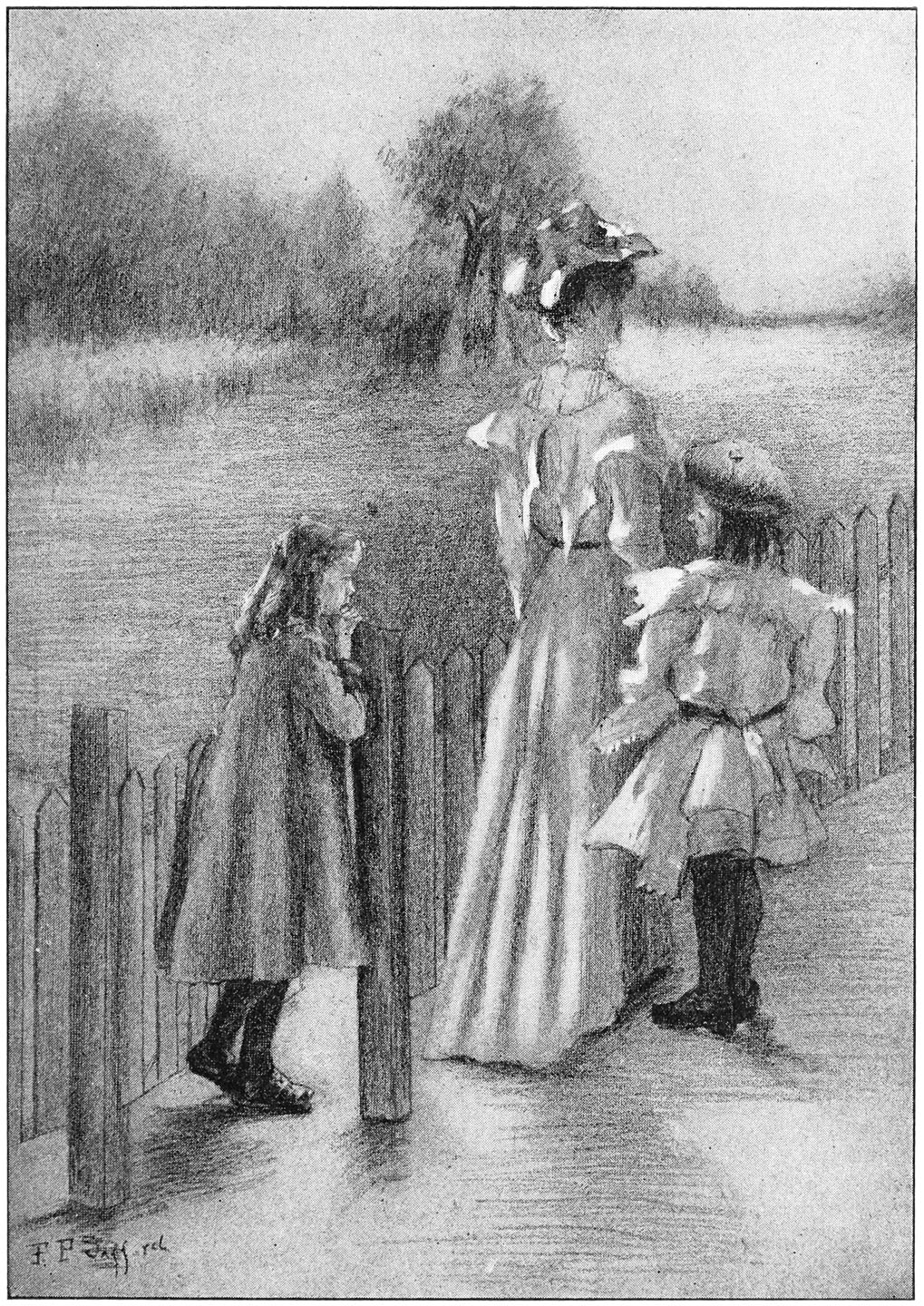
“She saw little girls passing by holding their mothers’ hands.”
Something else was noticed, which brought many scoldings and even punishment upon Irene. As soon as she went outside of the door, either to breathe the fresh air in the courtyard or to walk in a long, dreary line with the other orphans, the birds of the sky flew from every direction,—sparrows, swallows, doves, singing birds, crows, even the most timid little birds of prey, such as hawks, sparrow-hawks, and kites, fluttered around her head with low cries, swept past her ears as if they wanted to whisper something quickly to her in their flight, and would not be driven away from her. The throng of birds frightened the other children, so that they scattered screaming. The matron reproved Irene for the disturbance, for she was certain that the child did something to draw the birds, and did not believe her when she protested that it was not her fault. She was considered a sneak and a liar, who, in some unknown way, had learned sly, secret arts; and one day the superintendent of the institution said that Irene was probably a gypsy’s child, who was obeying the promptings of her nature; they must keep a sharp eye on her, or she would never amount to anything good; the teachers distrusted her, the children shyly avoided her and, in spite of her gentle disposition and her beauty, she was eyed askance by everybody in the institution and always left to herself.
Lonely, unhappy, and silent, she had nearly reached her eighth year when one day a little girl of her own age, who in a great railway accident had lost father, mother, brothers, and sisters, and was the only one of her family left, was brought to the asylum.
Little Elizabeth—this was the poor child’s name—was already wise enough to understand fully her cruel fate. She had been the spoiled darling of her parents, and now she met with nothing but indifference. She had lived in comfort, and now learned the meaning of poverty. Instead of her pretty clothes, she wore the coarse, shapeless uniform of the institution. Instead of being dressed and undressed by her loving mother, she was obliged to do this for herself, and was scolded if she was clumsy at it. She wept quietly and constantly, until it almost broke Irene’s heart. Timid and reserved as she was to others, she went to little Elizabeth, spoke gently to her, and begged her to cheer up. But Elizabeth only shook her head, sobbing: “Oh, I cannot, I cannot! Why wasn’t I killed, too? Then I would now be with my mother. I cannot live without my mother.”
“Yes, you can,” replied Irene; “see, I have never known my mother; I believe I never had any. Yet I live.”
“If you have had no mother,” said Elizabeth, through her streaming tears, “then you do not know what it is to lie in her arms, or how it feels when she is gone.”
“No, I do not know,” replied Irene, sadly.
“But I know,” cried Elizabeth, with a fresh outburst of grief, “and I cannot live without my mother. What is the use of living, if nobody loves me?”
“I will love you,” said Irene, earnestly. Elizabeth looked at her with her wet eyes, and threw herself impetuously into her arms.
This had happened in the dormitory, before the children went to bed. Others had seen how the two hugged each other, and the next day at recess they went to Elizabeth, took her aside, and warned her against intimate friendship with Irene. Some called her the little girl with the diseased eyes, others the bird witch, a third the gypsy child. All said that she was a queer, unsocial creature, whom the teachers and matron did not like. Elizabeth, it is true, did not allow herself to be misled by the little slanderers, but she repeated everything to her new friend. Irene took the evil gossip and the enmity of her companions so much to heart that she could neither eat nor sleep, and was constantly in tears, which prevented her from doing neatly the sewing on which she was now engaged. In punishment the matron locked her up in a dark room. Elizabeth would not be separated from her, and wept and screamed so violently that she was whipped and also locked up in a room. When she was let out again, she was forbidden to walk or talk with Irene in the future, and threatened with severe punishment if she did not obey.
Irene met Elizabeth for the first time after her release from the dark room in the dormitory. When she rushed up to her and threw herself into her arms, Elizabeth whispered in her ear: “We must take care, the teacher has forbidden me to talk or walk with you or I shall be punished. But I will not give you up, even if I am.”
“You shall not be punished on my account,” said Irene, and went away from her, weeping silently. Both children were unable to sleep that night from sorrow. When all the others were in a sound slumber, Elizabeth rose softly from her hard bed, stole to Irene’s, and saw that she, too, was lying awake.
“I can bear it no longer,” said Elizabeth, in a low tone.
“Nor I,” replied Irene, in the same voice.
“Irene, let us get up and go away.”
“But where, Elizabeth?”
“Wherever our feet may carry us, sister; any place is better than this.”
“Now? This very moment? In the dark night?”
“No. The house is locked now. We cannot get out. But early to-morrow morning when we are dressed. Then it will be light, and the door will be opened and we can run away. Directly after breakfast. Will you, Irene?”
“I will, Elizabeth,” said Irene. The two children hugged each other affectionately. Elizabeth went back to bed comforted; Irene was somewhat consoled, too, and both fell asleep.
Little attention was paid in the morning to the children who were large enough to dress themselves alone, so it was not difficult for Irene and Elizabeth to slip unnoticed out of the wash room, beside the dormitory, into the courtyard, and from there into the street. When they were outside, they began to run, and kept on straight ahead until they were completely out of breath. Dogs chased them barking; but when they reached Irene, they snuffed at her, wagged their tails, and turned back. The two little girls had left the city behind them, and found themselves in the open fields. Seeing that no one was pursuing them, they went more slowly in order to recover their breath.
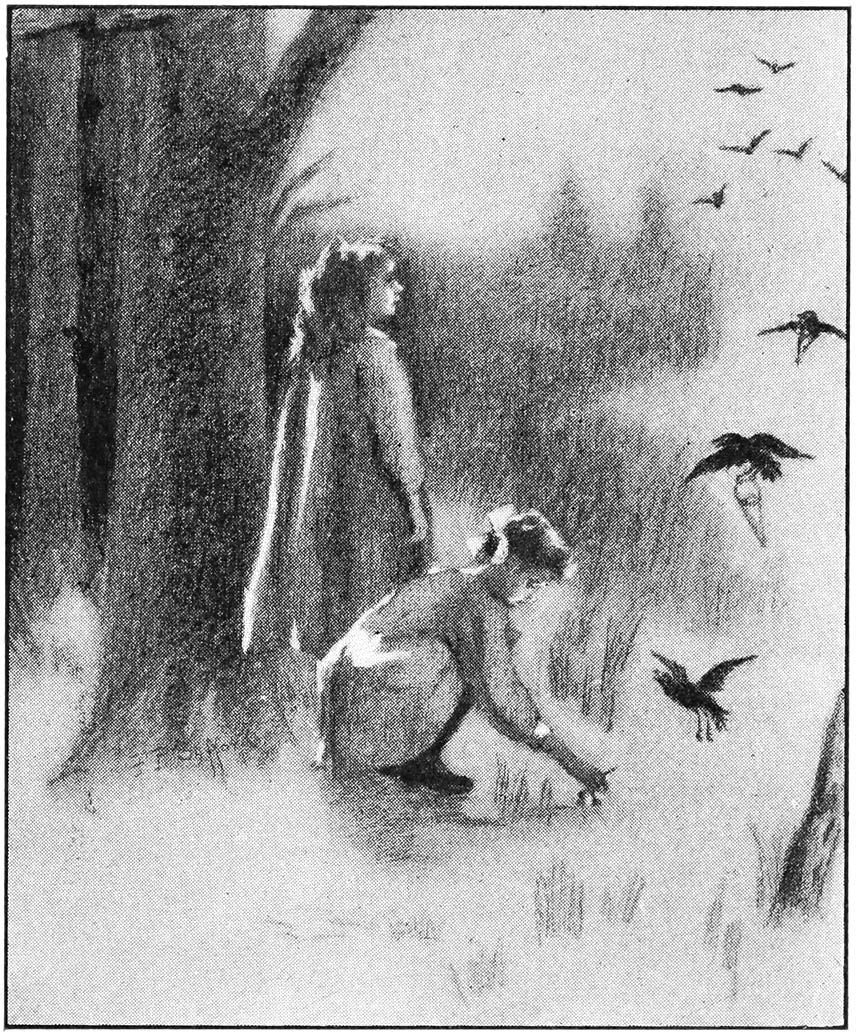
“Oh, dear Irene,” said Elizabeth, “how hungry I am!”
“I cannot give you your breakfast, sister,” replied Irene, sadly.
They were just under a tall tree, where many crows had built their nests. Irene had scarcely spoken when the whole flock of crows flew up screaming and vanished in the direction of the city. The children had not gone much farther when they heard above them a great rustling of wings and loud bird calls. It was the crows, which, returning from the city, dropped all sorts of things before the children and flew back to their tree again with the speed of lightning. Elizabeth stooped and picked up in paper horns small cakes and juicy cherries. She did not stop long to wonder, but divided lovingly with Irene, and both ate till they were satisfied. Then they walked on and on, the sun rose higher in the heavens, it was almost noon, and Elizabeth again began to complain, “Oh, dear Irene, I am so warm!”
“So am I, sister,” answered Irene.
“And I am so hungry and tired!” Elizabeth went on.
“So am I,” answered Irene.
“I can go no farther, Irene.”
“I see a wood over there, Elizabeth; let us go to it. We shall find shade, and can rest a little while.”
Irene held out her hand to her little friend and, with her help, she dragged herself to the edge of the wood, where they threw themselves down in the soft moss under the shade of the first tree. Irene sat down by her side, exclaiming, “If the crows would only come back now, and bring us more little horns of cakes and cherries!”
She had hardly spoken the words when there was a cracking and rustling in the underbrush, the bushes parted, and a hind sprang out and stood beside Elizabeth. The child started up with a cry of terror; but Irene said soothingly: “Don’t be frightened, sister, the animals will do us no harm. They have kinder hearts than human beings.”
In truth, the hind licked Elizabeth’s face with her big tongue, lay down by her side on the ground, and showed her full udder, from which drops of milk were trickling. Then Elizabeth understood that the kind animal wanted to feed her, and she began to suck the teat. When she was satisfied, Irene followed her example. Refreshed by the milk, and wearied by the unusually long walk, the heat, and the wakeful night, the two children lay down on the moss, and in a few minutes were sound asleep.
When they opened their eyes again, they saw the hind, which had kept faithful watch beside them all the time, and now knelt before Irene, turned her head toward her, and seemed to be inviting her to get upon her back.
“The dear friend wants to carry us,” said Irene; “we will ride a little, Elizabeth.” She helped the little girl to mount the hind. Irene climbed up behind her, and when the animal felt the children on its back, it rose and trotted carefully, that they might not lose their balance, into the forest.
“Oh, this is nice,” said Elizabeth, sighing; “I could not have walked any farther. My legs ache so, and my feet are so sore.”
They had slept many hours without knowing it, and now the sun was low, and the summer day was drawing to a close. The hind pressed farther and farther into the forest, the air grew cooler, the shadows became darker, and suddenly the children reached the wide clearing, where lay the broad pond as smooth as a mirror. The hind knelt down on the shore, shook herself a little, so that the children could not help sliding gently from her back into the grass, then sprang up, and in a few bounds was again in the forest, where she vanished.
“What shall we do now?” asked Elizabeth, anxiously.
“I don’t know,” replied Irene, softly.
“I am so frightened,” Elizabeth added, hiding her face on her little friend’s breast.
“Why?” asked Irene, stroking her hair caressingly.
“It’s so still and lonely here, and the mists are rising from the water. Night will soon come, and then we shall be all alone in the wild woods. What will become of us? Who will give us anything to eat to-morrow? And where shall we find a house and a bed?”
“Don’t be troubled, sister. Perhaps I am really a gypsy child, as our naughty companions called me. I am not afraid in the forest. We shall find our way through it, and the kind animals will help us do so.”
But Elizabeth shuddered and began to cry. “I am too miserable, sister,” she said, “and life is too hard. I wish I was with my mother.”
“Where you want to be, I want to be, too,” replied Irene, embracing her warmly.
Owls and bats began to fly noiselessly over the children, and the bell-like tones of the bullfrogs were heard.
“Irene,” said Elizabeth, “I will not suffer any longer. Look, the water before us is deep and cool. I shall sleep well at the bottom. I want to go down there.”
“Then I will go with you,” answered Irene.
The two little girls rose, kissed each other, clasped hands, and let themselves slip from the shore into the pond.
Just at this moment the sun set, and at the same time countless elves rose with loud shouts from the still water, caught the two children in their arms, and carried them to the shore.
“An elf child!” cried one, when she had looked into the sparkling eyes of Irene, who was gazing at her in timid surprise. “Your lost little one, Woglinde,” exclaimed a second. Then Woglinde, with a piercing cry, rushed forward, cast one glance at Irene, clasped her impetuously in her arms, and, laughing and weeping, covered her with a thousand kisses.
Irene now learned for the first time how a child feels in its mother’s arms. It was so warm! It was so soft! It was so happy! And it was so sweet to feel her mother’s kisses on cheeks and lips, eyes and hair, and to return them. She understood poor little Elizabeth’s grief at losing this joy, after she had once known it; and after the first exchange of caresses with her new-found mother, she gently released herself from her arms, saying, “Beautiful mother, let me go to my sister Elizabeth, she is all alone.”
The child was sitting on the shore, dripping wet and trembling, weeping quietly. Several elves were standing near, staring at her, and not knowing exactly what to do with the little girl. Irene made her way between them, hurried to Elizabeth, embraced her, and said, “Ah, Elizabeth, I am so happy; just think, I have found my mother in the water.”
“Why did not I, too?” wailed Elizabeth, weeping still more violently.
“Be calm, sister,” replied Irene, trying to comfort her. “My mother will take you, too, and then she will have two children.”
The elf Woglinde smiled, patted the wet cheeks of the mortal child, and was preparing to take off her dripping garments, as well as her Irene’s, clothe them in the glittering elf veils, adorn them with pearls and rubies, and refresh them with sweet juices. The nightingales were singing, the crickets chirped, the elves stood watching curiously, and the gnomes also came up, shaking their bearded heads in astonishment and dissatisfaction at this strange adventure.
Meanwhile the elf queen had also risen from the pond with her little gold crown in her hair, and while her subjects were dressing her and adorning her with jewels, they told her that Woglinde’s stolen child had returned and, with her, a little mortal.
The queen ordered the two little girls to be brought before her, kissed Irene kindly, and said to her in her silver-toned voice: “Welcome to your home, little daughter. We will keep you in the palace below until you have lost the unpleasant human odor. But you must send this little mortal child back to her relatives; for we will have no human beings with us.”
When Elizabeth heard this, she clung to Irene and whispered in her ear: “I will go back into the water again. That is the best place for me.”
But Irene threw her arm around her neck, and said to the queen: “I will not leave my Elizabeth. If she cannot stay here, I will go with her. And you will come with us, won’t you, beautiful Mother?”
Woglinde flushed and paled, struggled with herself, and suddenly threw herself at the elf queen’s feet. “Queen Mother,” she entreated, “be gracious, make an exception for once. Permit the mortal child to live among us.”
“That I cannot do,” replied the queen, raising Woglinde. “It is against the law of nature, which is our law. No mortal can live among us. Your little daughter has the choice of parting from her playmate, or giving up her elfin rank.”
“I will give it up,” cried Irene, firmly.
“And so will I,” said Woglinde, clasping both children in her arms.
A great wailing and lamenting arose among the elves, and a murmur of disapproval among the gnomes. No one thought that night of dancing, games, and banquets. The elf queen tried to change Woglinde’s resolution; but when she saw that the elf would not lose her child for the second time, she ordered the gnomes to provide her with an outfit. They obediently hurried away, and instantly returned with a large quantity of gold and gems, handsome new mortal clothes, a carriage, and two splendid horses. The treasures were packed on the carriage, Woglinde entered it with the two children, the elf queen, after having taken leave of her, gave her permission to come to her sisters’ summer night festivals, but without the mortal child, and, just before dawn, all the elves kissed Woglinde and Irene for the last time, and went sorrowfully back into the pond. At the first cock crow the wise horses started, and, when the sun rose, they were outside of the wood with the carriage and its inmates. They needed neither curb nor whip, but trotted straight to the city and stopped in front of a beautiful house, with a fine garden, which was just for sale. Woglinde bought it with her gold, and, when she moved into it, all the birds in the garden flew up and greeted her as their mistress. The kitchen tenants, too,—the mice and other vermin,—came timidly and wanted to pay their respects to her; but as Elizabeth was afraid of these creeping, swarming creatures, Woglinde ordered them to leave the house, which they humbly did at once.
The gnomes’ treasures had made Woglinde a rich lady and, as she was so beautiful and looked so aristocratic, the neighbors thought she was some foreign countess who had moved to their city, invited her to their houses and tried to become acquainted with her. She was soon the most courted lady in the city, was presented at court, and one of the king’s courtiers wanted to marry her. But she only smiled at it, and replied that she did not wish to marry again, but desired to devote herself to the education of her children.
She used her connections and her influence, however, to discover the malicious rascal, who, years before, had stolen her child. And she succeeded. The youth, meantime, had grown to manhood, and continued to do all the mischief that was possible in the village. Woglinde determined to punish him as he deserved. Going alone to the forest meadow one night, she begged the queen for more gold. The gnomes again brought a load of it, and Woglinde placed it in the garden of a widow, who was said to be the most spiteful, quarrelsome, shrewish woman in the village. This hateful creature found the treasure in the morning, and rejoiced loudly over it. Everybody learned, with the speed of lightning, that she had grown enormously rich in a single night, and several fearless young men hastened, in spite of her evil reputation, to sue for her hand. Among them was the good-for-nothing, who thought, “I can probably manage you.” She preferred him to the others, married him, and then he was soon made to see that he could not cope with her. She ruled the house, kept him under strict discipline, beat him with fists and cane, and tormented him day and night till he was often tired of life. This was his punishment for all the miserable tricks which he had played in his youth.
But Irene and Elizabeth grew up into beautiful girls, and, when they were twenty years old, the elf child married a great artist and Elizabeth a prince, and though Woglinde often longed for the fairy palace at the bottom of the pond, she was on the whole happy in the happiness of her children, both of whom had become equally dear to her.