THE PROUD DOLL
Mary J. (Mary Joanna) Safford translation
Once upon a time there was a little girl named Aennchen. She was very pretty and good-natured, but a little spoiled, and therefore capricious and quick-tempered; for she was the only child of wealthy people, and her parents gave her her own way in everything. From the time Aennchen was a year old, she had been loaded with presents of all kinds at every opportunity. First there were india-rubber animals, then little houses and gardens with green trees, then small pails, sieves, cake shapes, and shovels to work in the sand, then rocking-horses and big donkeys on wheels, and finally dolls, small and large, fair and dark, unbreakable wooden ones and very fragile china ones, simply and richly dressed. But the one which was given to her by her aunt, on her fifth birthday, was more beautiful than any she had ever had before.
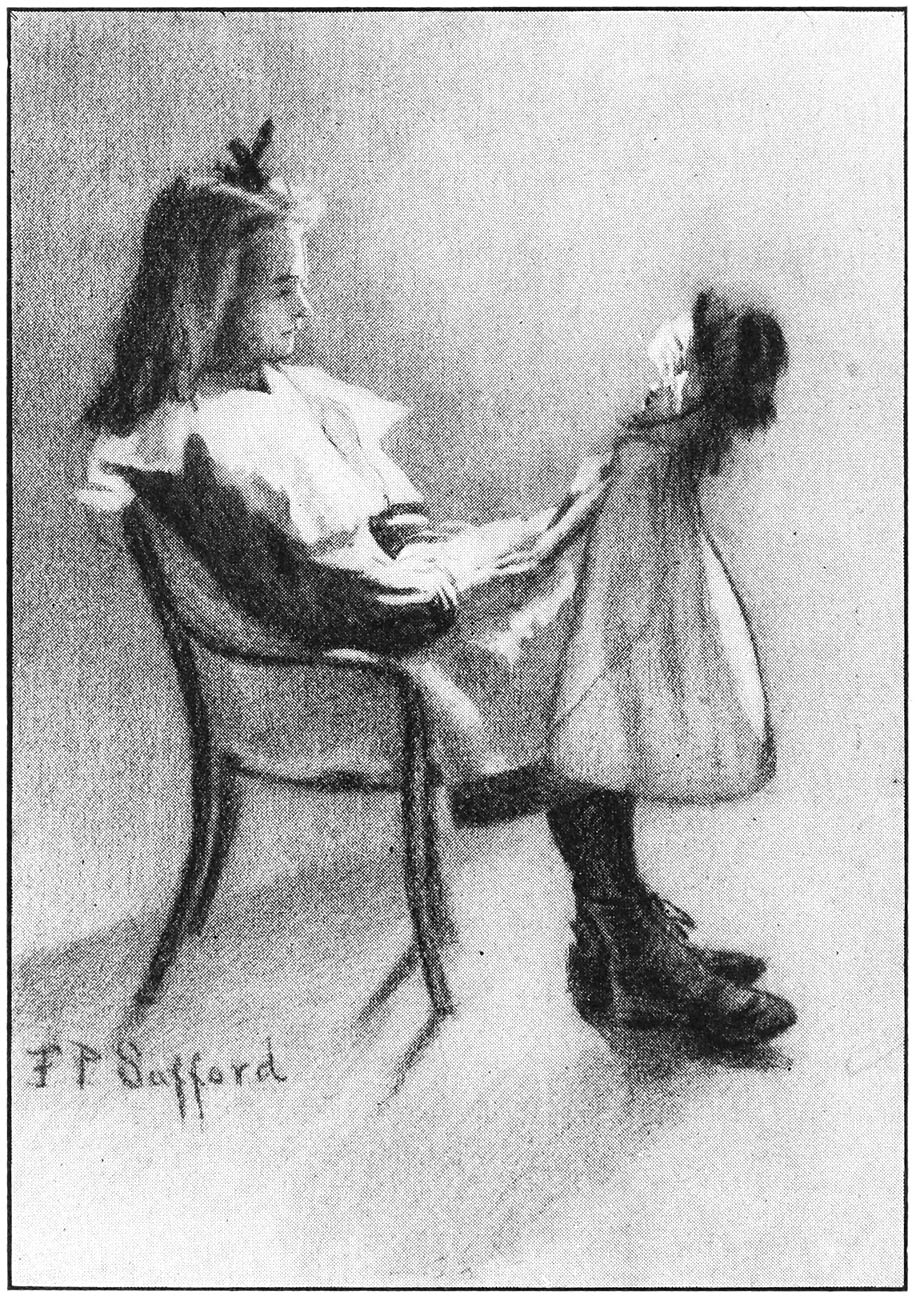
This was a very aristocratic lady, almost as large as Aennchen herself, and dressed like a princess. She had a satin cloak, a silk gown with several flounces, gold buckles at her little waist, white leather shoes, embroidered underclothes, and a magnificent velvet and lace hat, with an ostrich plume. A mother-of-pearl fan hung from her belt, and she carried in her hand a dainty sunshade. She wore bracelets, a necklace, and earrings, the only things which Aennchen did not like; for her mother had told her that only savages bore holes in the ears, nose, and lips to hang jewels in them. The doll had long, silky light hair, which was waved, braided, and artistically arranged with hairpins and little tortoise-shell combs. When she was laid down, she instantly shut her big blue eyes, and fell asleep. When she was lifted up, she opened her eyes and was awake again at once. She could say Papa, Mamma, and many other things distinctly, but usually maintained a well-bred silence, and spoke only when she was invited to do so by a pressure on her body. She did not come to Aennchen like a person who has nothing except what she carries on her back, but brought with her a magnificent outfit, a chest of clothes, a bureau full of under linen, a sideboard supplied with china, glass, and metal dishes, and table damask. At first Aennchen felt really embarrassed when her new playmate was introduced to her. She could not take her in her arms and carry her about, she was too large and too heavy. She was told that she must not undress and dress her, lest she should spoil her beautiful clothes, and undressing and dressing her doll is the greatest pleasure a little girl takes in it. Aennchen admired her, but she did not really love her, and did not grow intimate enough with her to speak to her familiarly. When she first became better acquainted with her, she discovered a very serious fault—the new doll was extremely proud.
Aennchen had wanted to call her Minna. This was the name of her nurse, whom her parents had kept in the house after the child outgrew milk, and to whom Aennchen was deeply attached. But the doll would not have the name. She did not hear it. She did not turn her head, when Aennchen called her by it, but remained sitting as stiffly as if she was made of wood. And yet she had been manufactured of the finest, most pliable kid and china, and her limbs moved at every joint. This obstinacy provoked Aennchen so much that she struck the doll. Then the latter said dryly: “Pardon me. People do not strike me.”
“If you don’t want to be struck,” replied Aennchen, angrily, “answer when you are called by name.”
“Minna is no name for me,” replied the doll, coldly.
“What do you want to be called, then?” asked Aennchen, bewildered.
“At least Kunigunde,” answered the haughty doll.
At first Aennchen was greatly inclined to box her ears, and say: “A name that is good enough for my dear nurse is far too good for a stupid, puffed-up thing like you,” but the doll’s cool audacity awed her. She yielded, and the doll received the name of Kunigunde.
Aennchen had trouble with Kunigunde in another way. She had three favorite dolls. They were small and easily handled, simply dressed, and very dear to the little girl, because she had had them a long time, and because she was allowed to dress and undress them as much as she wished. Their clothes were no longer perfectly fresh, and showed here and there a ripped seam, a loose button, or even a rent, and their faces and hands could not be considered exactly models of cleanliness, though Aennchen, who was very fond of splashing in the water, often scrubbed them with soap, sponge, and brushes.
She wanted to make Kunigunde acquainted with these three older dolls, and invited her to a coffee party. She put Kunigunde’s handsomest table-cloth on the table, set out her beautiful dishes, and brought out the three dolls. When Kunigunde saw the little shabby figures, she sat up as straight as a dart, and stared into vacancy with her big blue eyes, taking no more notice of the three dolls than if they had been empty air. Aennchen put her three friends into little chairs, and was going to do the same for Kunigunde. But the latter refused to take the place. “I am not used to sitting at the same table with common people,” she said.
“May I at least have the honor of drinking coffee in your lofty society?” asked Aennchen, scornfully.
“Yes,” replied Kunigunde, condescendingly, pretending not to notice the jeer.
This was too much for Aennchen. Seizing Kunigunde violently, she was going to press her by force into the chair. The conceited doll made herself perfectly rigid, and said in a defiant, rattling voice, “You can break me, if you are strong enough, but you cannot compel me to sit at the same table with these people.”
“We will not force our company upon the lady,” said the three modest dolls, rising at the same moment.
“Oh, nonsense,” cried Aennchen, “stay quietly here, children, we won’t trouble ourselves any further about this puffed-up creature.” Grasping Kunigunde by the arm, she threw her into the corner so hard that she bounced.
“I thank you for your courteous treatment,” Kunigunde’s voice was heard saying, after she had recovered a little from the fall. “I beg you not to feel under the slightest restraint, but to use my coffee set just as if it belonged to you.”
This was strong, so strong that it almost took away the three modest dolls’ breath. No doll had ever before ventured to speak to her mistress in such a way. Aennchen could not allow such lack of respect. She hastened to Kunigunde, screaming: “Now my patience is gone. Your coffee set belongs to me, and you belong to me, and if you don’t keep quiet at once, you’ll fly out of the window. Then you can hunt in the gutter for society that is good enough for you.”
Kunigunde now remained silent, but though she did not speak, she shut her eyes to show that she wished to have nothing to do with anything that was going on around her. Aennchen did not take any notice of her defiant sulking, left her lying in the corner, and entertained the three modest dolls with coffee and cakes, which they enjoyed, while Kunigunde received neither drop nor crumb.
Just at that time Aennchen’s foster sister, her old nurse’s daughter, had been very ill and was beginning to recover. While the sickness was serious, Aennchen had not been allowed to see her. Now, after several weeks, she was permitted to go into the sick room for the first time. The two little girls threw their arms around each other’s necks, and rejoiced that they could be together again.
The foster sister had heard, from her mother, that Aennchen had had a wonderful doll on her birthday, and she was very curious to see it. Aennchen instantly ran to her room and, with some difficulty, dragged Kunigunde to the bedside. At the sight of her, the foster sister uttered a little cry, exclaiming: “Oh, she really is too beautiful! I never thought there were such lovely dolls.”
“Do you admire her so much?” asked Aennchen.
“More than I can tell,” replied her foster sister, her eyes wandering from Kunigunde’s velvet and lace hat to her satin cloak, and from her silk gown to her necklace.
“Would you like to have her?” Aennchen went on.
The foster sister did not dare to answer.
“Say whether you want her,” Aennchen urged.
“Oh,” replied the child in the bed softly, “surely you are not in earnest. She is too elegant for me. And your mother will not let you.”
“My mamma lets me do everything I ask her,” cried Aennchen, and ran off as fast as she could go to her mother, to tell her that she wanted to give Kunigunde to her foster sister for a present on her recovery.
She received permission and, highly delighted, returned to the little girl to give her the beautiful doll for her very own.
“You know,” she said, “she can open and shut her eyes, and say Papa and Mamma, and all sorts of other things.” And she wanted to show her the doll’s skill. But Kunigunde kept her eyes obstinately shut, and did not utter a sound.
“Have you suddenly grown deaf and dumb?” cried Aennchen, impatiently, after she had vainly laid her down and sat her up again, shaken and jerked her, squeezed and thumped her.
Kunigunde groaned under this rough treatment, and at last made up her mind to utter the words, “I am not to be given to any servant’s child.”
This provoking answer made Aennchen furious. “I’ll teach you to insult my foster sister,” she cried, and threw the haughty doll on the floor with all her strength. There was a rattling sound, the child in bed screamed, Kunigunde squeaked, “Mamma!” The worst had happened. The doll’s head was broken; small pieces, to which her beautiful fair hair still clung, were lying on the floor, and the back of Kunigunde’s head showed a large, gaping hole.
Aennchen was obliged to tell her mother of the misfortune. Her mother was very angry and scolded her little daughter for her quick temper. As a punishment, she should have no dessert that evening. Aennchen cried, and was still more enraged against Kunigunde, on whose account she was now punished. Her mother spoke of sending the severely wounded doll to a doll surgeon for treatment, and having a new head put on. But Aennchen would not hear of it. “Throw her away,” she said; “I don’t want to see her any more.”
“It will be better so,” muttered Kunigunde, who, though stunned, had heard everything. “I have nothing to expect here except vulgar abuse.”
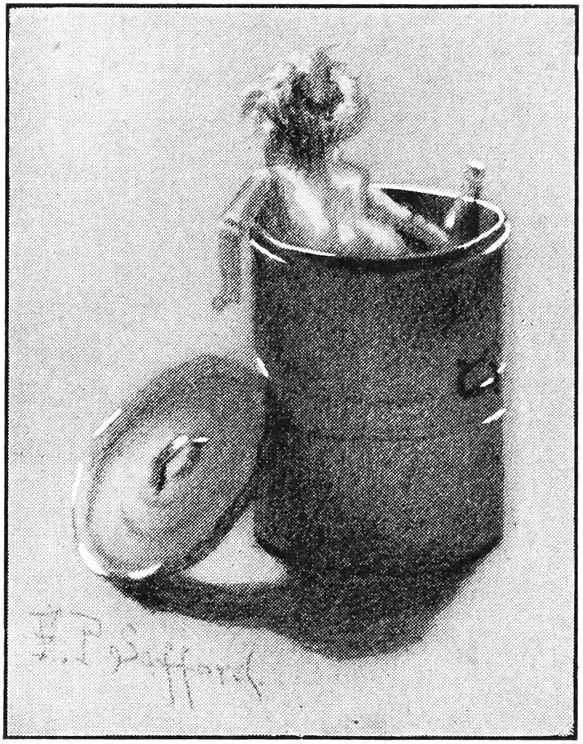
Aennchen perceived that even the hole in her head had not yet taught Kunigunde modesty. Instead of answering, she took her up, stripped off her ornaments, her hat, her rich garments, and her underclothes and, when the doll lay perfectly naked, she called her nurse and said, “Throw this thing into the garbage can.”
The nurse hesitated, but Aennchen stamped her feet and screamed, “Throw her into the garbage can, I tell you.” Then the nurse yielded to her foster child’s whim and carried the doll out of her sight.
When Kunigunde again opened her eyes, which until then she had obstinately kept closed, she found herself in a corner of the kitchen, in the deep garbage can, among bones, refuse, and sweepings. This humiliation gave her more pain than the hole in her head, and filled her with great bitterness. She was certain that sharp injustice, a terrible wrong, had been done her. She had been severely injured, robbed of all her property, and thrown into the dirt. And why? Because she would not give up her self-respect. “Very well,” she murmured, “you can commit every violence and every crime upon me, for you are stronger than I; but you have not yet been able to force me to associate with people who are beneath me in rank.”
The next morning, before the garbage wagon drove by, the rag-picker and his wife came, as usual, to rummage in the can. “Look here!” he exclaimed, when he saw the big doll; “she is dirty and broken, it is true, but the dealer will give something for her.”
His wife turned Kunigunde round, and then said: “What we can get for her isn’t worth talking about. We’ll take the thing to our little one.” They did so. Kunigunde was quickly thrown into the sack which the woman carried on her back, and taken to the rag-picker’s hut. The bag, as usual, was emptied on the floor, and the little daughter peeped curiously at the contents. Kunigunde, it is true, felt the deepest aversion to the people who had picked her out of the garbage can, the horribly dirty hut in which she found herself, and the ragged, greasy child, to whom she was now to be given; yet in her conceit she imagined that the little girl would be so astonished and delighted at the sight of her that she would not dare to come near her, and this thought flattered her. So she was deeply offended and humbled, when she was soon forced to see that she made no impression on the rag-picker’s child at all. The little girl picked her up, turned her over and over, noticed the hole in her head and the sweepings in the tangled hair which still remained, and only said contemptuously, “I don’t care,” when her mother asked if she would like to have the doll.
“How much prettier you are! I love you far, far better.”
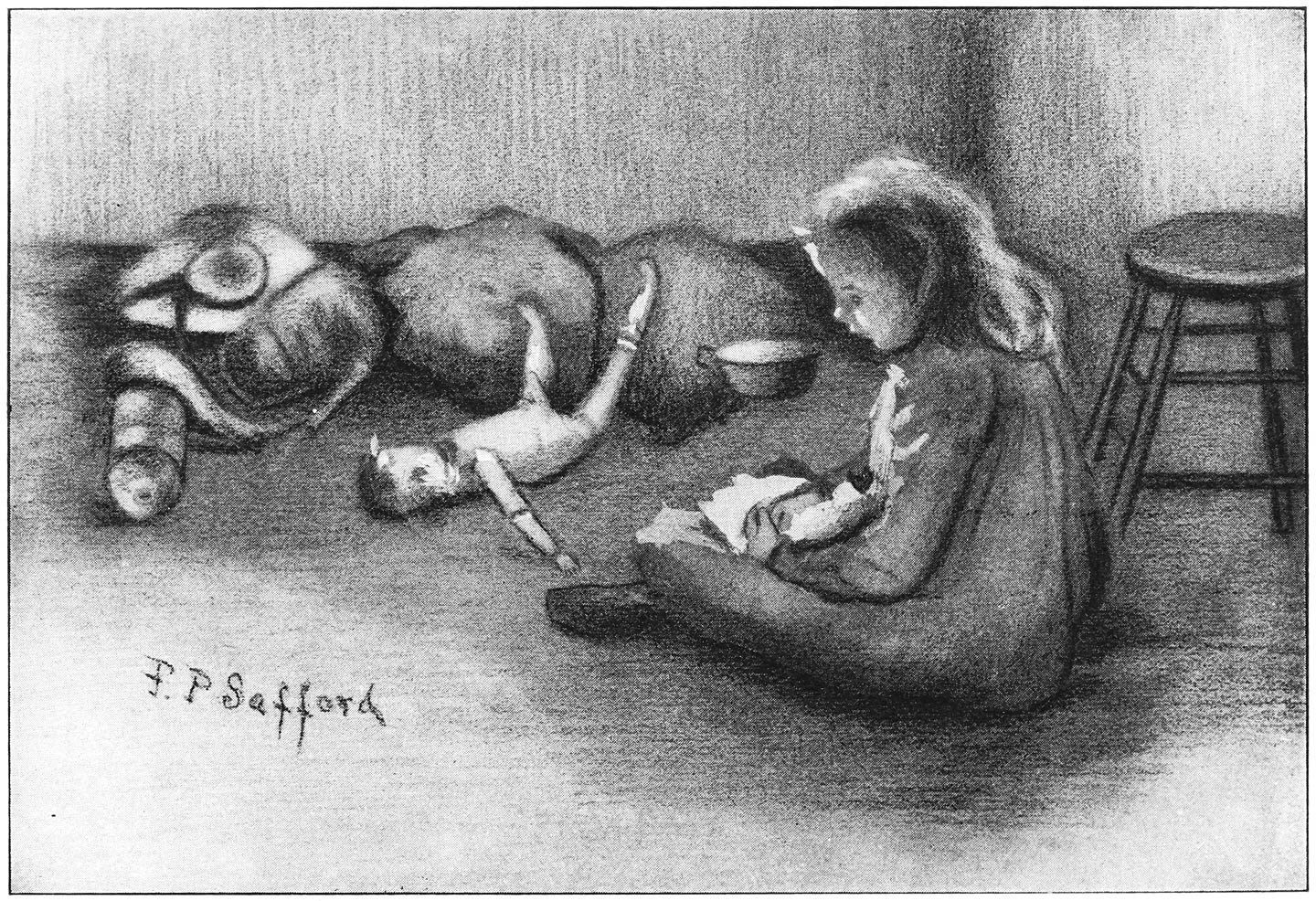
The child owned one doll, which she had made herself, certainly a very odd one. It was a long cork from a claret bottle, which the little girl had dressed in several pieces of cotton rags and scraps of newspaper, tied on with a bit of string. On the piece which appeared above the paper and the rags she had marked, with a lead pencil, two eyes, a nose, and a mouth. This little monster she loved and petted, talked tenderly to it, and pressed it to her heart. When she retired with Kunigunde to a corner of the hut, she laid her on the floor, took out her own cork-stopper doll, kissed it, and said: “Look at this long string of a doll! How much prettier you are! I love you far, far better. I’ll tell you what, I’ll give her to you for a servant. She is big and strong. She shall carry you out to walk, and do everything that you order her.”
She put Kunigunde down, and laid the little scarecrow in her arms. But now it did not suit her that her darling’s servant should be naked, and she prepared to dress her. She searched for rags and paper, but all the scraps she found were far too small for the huge Kunigunde. After she had worked in vain for a long time, she grew impatient and cried, “There’s nothing to be done with the stupid thing.” As she spoke, she struck her so violently against the wall that she broke both of her legs. The child stared at her a moment, then she said: “Now she is dead. We will bury her.”
Kunigunde thought that her last hour had come, and she was glad. “I would rather lie under the ground than to be the maid of a horrible cork-stopper,” she said to herself. She closed her eyes, that she might not see the dirt and wretchedness surrounding her, and sought consolation for her terrible fate in the remembrance of her former beauty, the wealth of which she had been robbed, and her aristocratic origin, which had really destined her to be the playmate of a princess.
Meantime, the rag-picker’s cruel child was preparing to dig a hole in a heap of rubbish behind the hut with the sharp edge of an old sardine box. Her older brother found her busy at this work, and when, in reply to his question, he learned that she was making a grave for the ill-treated doll, which lay with closed eyes and broken limbs, he said: “You can’t dig so large a grave as this big creature needs. Come, we’ll throw the ugly wretch into the water.”
They at once set off together for the bridge which crossed the river near by. “One, two, three,” cried the boy, and flung Kunigunde far over the railing. The little girl looked after her, pressed her cork-stopper doll to her heart, and said lovingly, “I don’t want any doll except you.”
Kunigunde had considered it a last happiness that she was not to be buried alive, but drowned, for this seemed to her a quicker and painless end. “Now all will be over. These good-for-nothing human beings were not worthy to possess so noble a creature as I,” she thought, as she fell into the water and sank nearly to the bottom.
But all was not over. She did not drown, but was borne to the surface again and floated gently down the stream. She opened her eyes and, in spite of the hole in her head, in spite of her broken limbs, in spite of her beggary, her courage revived. Then she suddenly felt sharp teeth seize her. A large water rat caught her by one foot and dragged her to its nest, which was on the shore, close beside the water. In it was a litter of young rats, who wanted to play with the doll drifting in the river. They all came out of the hole and swarmed around the doll which their mother had brought. The thought darted through Kunigunde’s broken head, “I would not play with a servant’s child, and now I must serve these vermin for a toy!” This thought gave her such anguish that she grew unconscious and died.
Death came at the right time to spare her the worst suffering. The young rats wanted to drag her into their hole, the entrance was too small, and when the horrible animals had pulled her to and fro a long time in vain, they grew angry and began to tear her to pieces with their teeth. They ate all the parts of her which were made of kid and filled with bran, and the china portions found their last resting place on the bottom of the river.
This was the sorrowful end of the proud Kunigunde. Aennchen’s three modest dolls, on the contrary, fared well with their friend. They stayed with her until Aennchen became a tall, beautiful young lady, and when she married and had a little girl herself, she gave her her three faithful playmates, that they might afford the child as much pleasure as they had the mother.