THE NAUGHTY BROTHER AND THE CLEVER SISTER
Mary J. (Mary Joanna) Safford translation
Once upon a time there were two children, a little boy and a little girl, who belonged to poor people, a locksmith, who worked in a machine-shop, and his wife, who attended to her housekeeping and took in washing. The father was never at home, except on Sundays and holidays, and the mother had too much to do to look after the children. So they were usually left to themselves, and grew up like nettles on a refuse heap. The boy was wild and careless, and would not do as he was told. He wandered far outside of the city, and did not come home at meal times. He climbed trees and tore his trousers. He joined street urchins, fought with them, and came back with his nose bleeding and his body covered with black-and-blue spots. Who knows what might have happened to him, how often village curs would have bitten him, gypsies stolen him, or automobiles run over him, if he had not had his little sister.
True, she was a year younger than he, but she was far more sensible, always stayed with him, and prevented him from doing too much mischief. As he loved her dearly, he usually obeyed her, though not always, and thus was saved from worse injuries.
One summer day the brother again invited his little sister to ramble with him through the fields and woods. The little sister did not want to go, because their mother had forbidden them to stray far from home. “Well, if you won’t come with me, I’ll go alone,” said the sly fox, pretending to set off. He knew very well that she would not let him.
“You are a regular ne’er-do-weel,” she replied, but she went with him.
They walked gayly along, soon left the city behind them and were on the high-road, among farms and hedges, running in the meadows through the tall grass and clover, picking cherries, gathering flowers, and catching white and blue butterflies. So, still playing and walking happily on, they reached a wood, passed through it, and at last came to the bank of a rushing river, where they could walk no farther.
“Now we will turn back,” said the little sister.
“No,” replied the brother; “it is too beautiful here.” He took his little sister by the hand, and drew her along by the water. At a bend in the shore he suddenly saw a little boat, tied to an old willow. Shouting with delight, he instantly sprang into the skiff, which began to rock dangerously.
“You must get out at once,” screamed the little girl in terror.
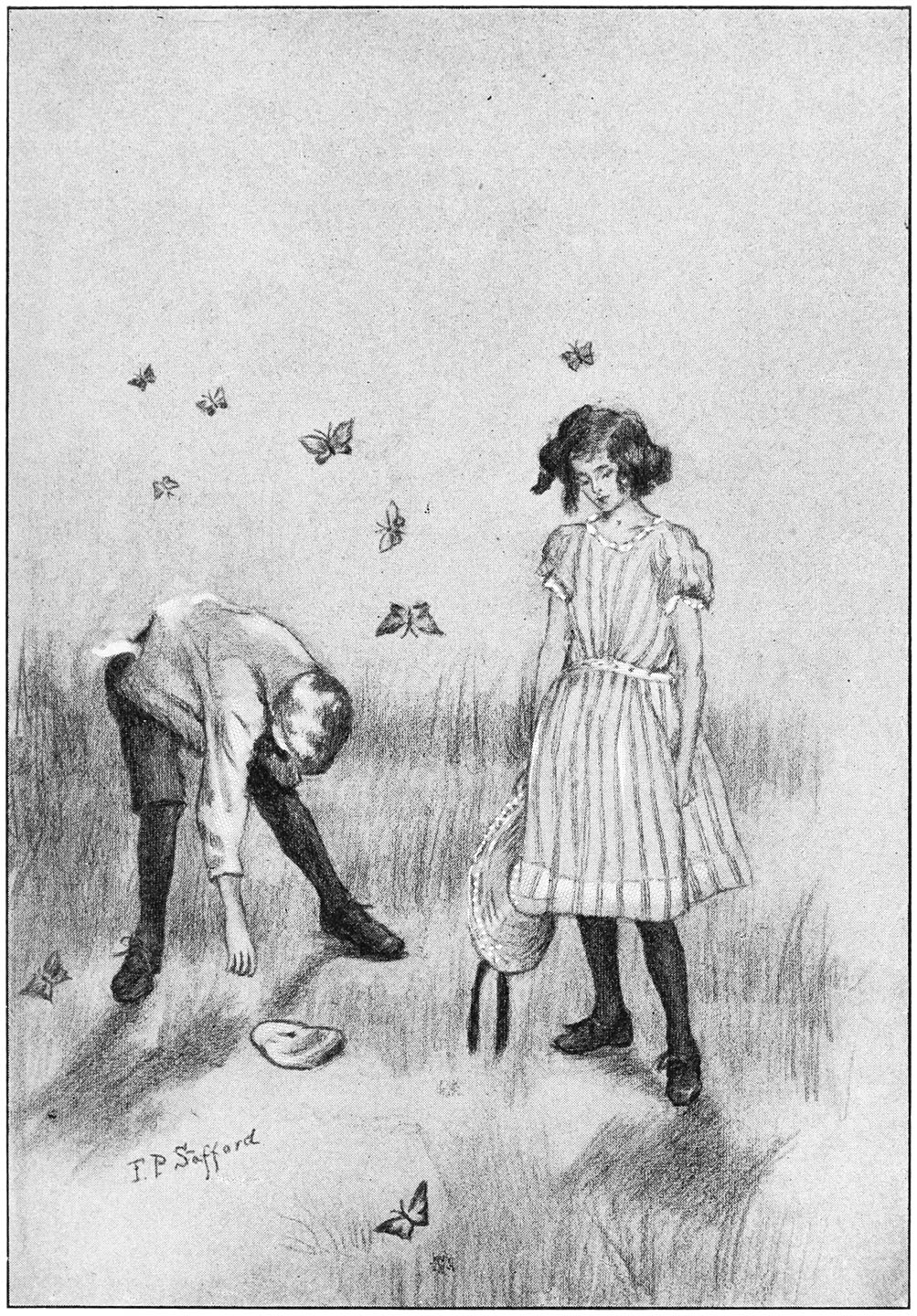
“They walked gayly along, gathering flowers, and catching white and blue butterflies.”
“I’ve no idea of it,” replied the rascal; “it rocks so gloriously that I feel like a bird in the air. Jump in quick, little sister, we will have a row.”
“I won’t do it,” said the little girl; “the boat doesn’t belong to us. If the owner catches you, he will box your ears. And mother always forbids us to go on the water.”
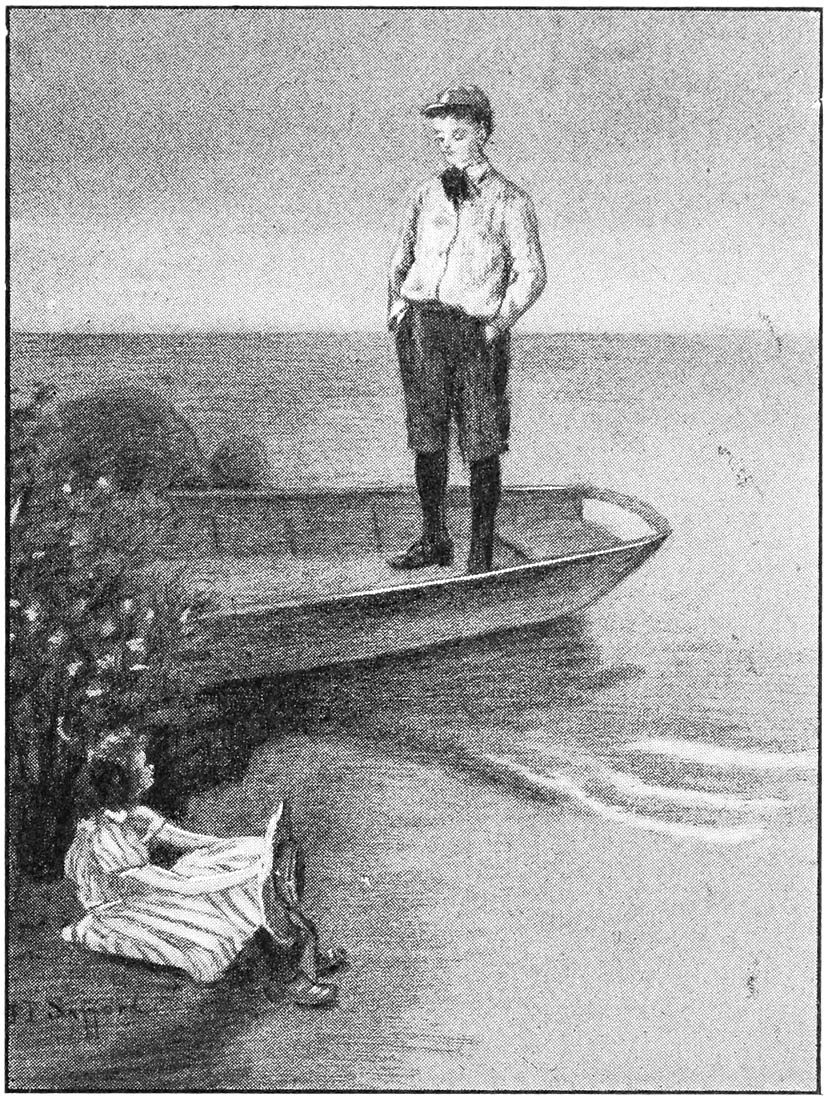
“Mother won’t see; come with me, come,” said the naughty boy, untying the boat. Unless the little sister wanted to stay alone on the bank, she was obliged to follow him, whether she liked it or not.
She timidly put first one foot and then the other in the boat, trembling a little as it rocked. Her brother laughed at her, pulled her down on the seat, and pushed the oar against the shore. The skiff moved off, at first slowly, then faster and faster. Before the children were aware of it, they were in the middle of the river, where the current was the strongest, shooting along with the utmost speed. The banks fairly flew past them. Each bend in the stream showed them new pictures: at first flowery meadows, then dark woods, finally lofty mountains, which constantly drew nearer together and cast gloomier shadows over the surface of the water. The stream flowed with tremendous force through a narrow ravine between high cliffs, its waves dashing against the rocks with a thundering roar.
“It frightens me,” said the little sister, softly.
“I’m not afraid,” replied the brother; “it is so wild here, and the water sings so merrily.”
“But where are we going?” asked the little sister.
“I don’t know, and that’s just the beautiful part of it,” the boy answered; “we will shut our eyes and let ourselves go—we shall land somewhere.”
The little girl did so, for she was afraid of the mountains, towering so close at hand, and the raging river. Again the stream curved sharply around a projecting cliff, and both brother and sister screamed with fright. They had felt a violent shock, and were flung headlong into the bottom of the boat.
Opening their eyes quickly, they saw that an invisible power had jerked their boat out of the water and was lifting it high in the air. They raised themselves as well as they could, and now saw that the boat was in a huge net as thick as one’s arm, hanging from a pole as big as a tree. This pole was held by a terrible giant, who sat on the top of one of the high, steep cliffs that lined the shore, dangling legs ten times as long as a man’s. In a trice the net was drawn up and thrown on the rock so roughly that every seam in the boat creaked. A hand so large that there was plenty of room in the palm for the little skiff reached in for it, disentangled it from the confusion of meshes, and held it before two eyes as big as cart wheels. A mouth like a barn-door opened, and a voice which echoed through the river valley like thunder said: “A good catch at last! My old woman will be pleased with it.” The hand closed around the boat, and the two children saw between the fingers, as if looking through the chinks in the rafters of a steeple, that the giant rose, shouldered his net, and began to walk away. His head towered above the tallest trees, and his walk was faster than the swiftest railroad train.
The brother was half dead with fright, he howled at the top of his lungs and stammered almost unintelligibly: “Oh, dear! Oh, dear! It’s all over with us.”
The little sister, too, did not feel very comfortable; but she kept up her courage and reproached her brother for his useless whining. “You have brought us into the scrape,” she said, “now at least keep quiet. Perhaps all giants do not eat human beings.”
“Why did he fish us out of the water, unless he meant to eat us?” wailed the boy.
“He is carrying us home to his wife,” said the little sister, soothingly; “we will beg the giantess very prettily to let us go home to our mother. I don’t believe a woman would do children any harm, even if she is a giantess.”
The brother was only half comforted; he nestled close to his sister, threw both arms around her neck, and sobbed: “Oh, little sister, help just this time. I will never be naughty again.”
It was not long before the giant reached his house, built on a high, wooded mountain, and larger than the largest church that the children had ever seen. Before the door stood the giantess, smiling at her husband.
“I’m bringing you something!” he shouted in his thundering voice, while still at a long distance, waving the hand that held the boat to and fro before his face, till the children grew dizzy.
“What can it be?” asked the giantess, curiously, and went quickly into the sitting room.
The giant followed her, set the boat on the table, took the boy between his thumb and forefinger, and held him up before his wife’s face: “Just look at this little Hop-o’-my-Thumb! He was floating along very happily with this other pygmy on our water, in a little nutshell, and I fished out the whole cargo of food.”
The boy struggled with all his might in the fingers that held him, roared as if he were being put on the spit, and twisted his face into such ugly shapes that his little sister cried out, “Don’t behave so, little brother, the master and mistress are not eating you yet.”
“Not yet, little Miss Pert, not yet,” said the giant, and began to laugh loudly.
The giantess took the struggling boy out of his hand, put him on the table, where he again fell on his little sister’s neck and hid his face in her bosom, and scrutinized the little pair. Her eyes, in spite of their size, looked kind, and her face was mild and gentle, which the little sister noticed very plainly. The giantess had no children herself, and her heart grew soft when she saw these two little human creatures so near her.
“I haven’t tasted any human flesh for a long time,” cried the giant. “Prepare the little ones for my supper. I’ll have them baked.”
“No,” replied the giantess, quickly, covering the children with her hand. “They are too small. Both wouldn’t make you a mouthful. We must fatten them first. We have four roebucks for to-night, besides two pecks of potatoes and a hundred weight of cherries. Let me have the children awhile for playthings.”
“Well, for aught I care,” growled the giant, and went out to put away his fishing tackle.
The giantess, when she was left alone with the children, sat down before the table, looked at the two a long time in silence, then as the boy was the larger, leaned nearer to him, and said in a voice which she tried to make very gentle: “Don’t be frightened, little mouse. I will do you no harm if you are very good and sensible. Will you be?”
“Oh, Lady Giantess,” replied the boy, whining, and trembling from head to foot, “I’ll do my best. But my sister is much nicer and more sensible than I am.”
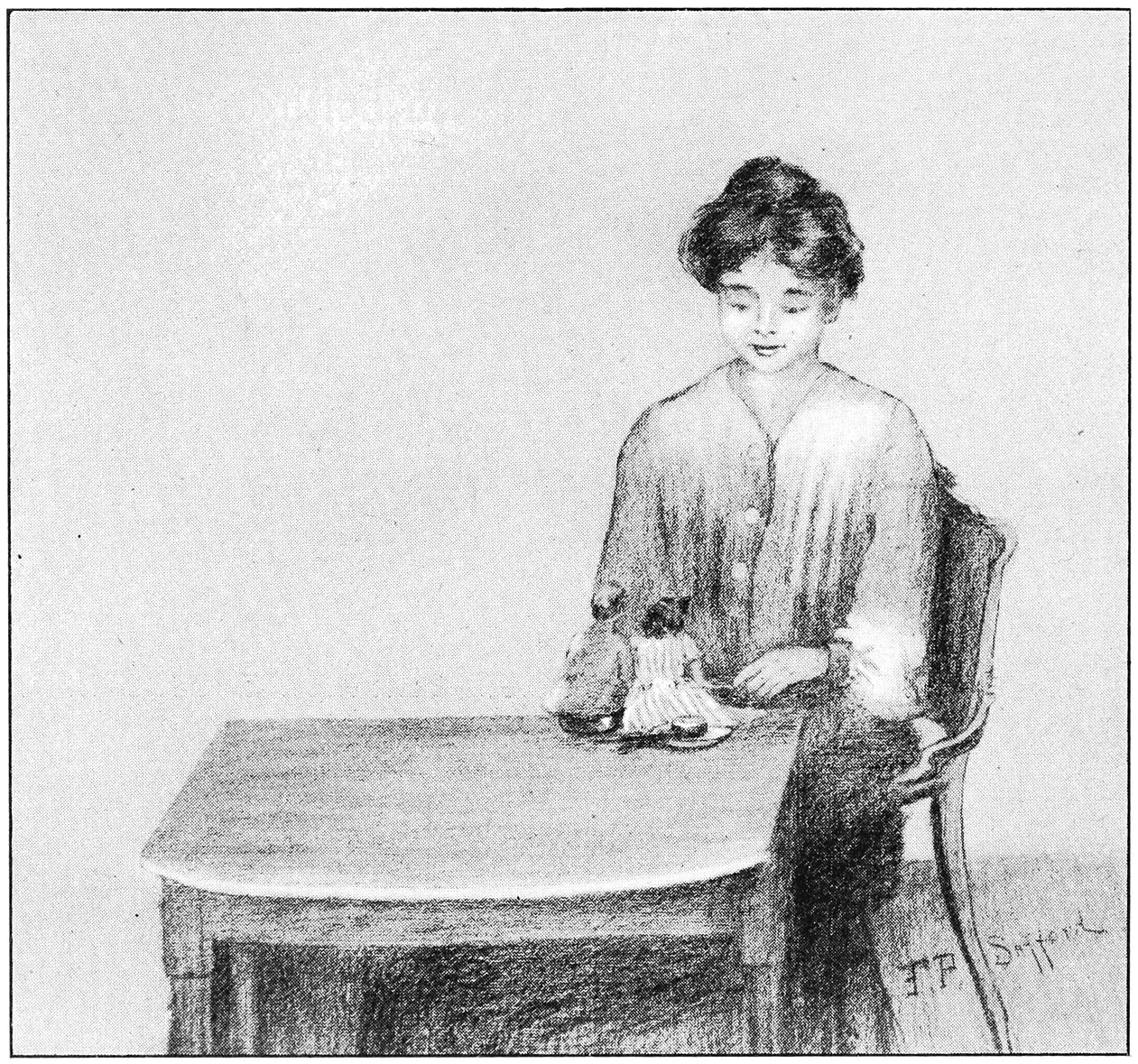
“Is this true, little one?” asked the giantess.
“We ought not to praise ourselves, Lady Giantess,” answered the little sister, making a pretty courtesy.
The reply and the little girl’s manner greatly pleased the giantess. She smiled and said: “We will see presently which of you two is the smarter. I will ask you three questions, and if you answer them correctly, you shall have your liberty.”
The little sister clapped her hands, and, taking one of the huge fingers of the kind giantess, pressed a kiss on the tip. True, it seemed as if she had kissed the end of a log, but it pleased the giantess.
“Now pay attention,” she said. “You too, boy. Why do we eat fruit for dessert, and not at the beginning of the meal?”
“Because fruit is so good,” replied the brother, quickly.
The giantess shook her head. “The fruit is just as good at the beginning of the meal as it is at dessert. A bad answer. Do you know any better, little one?”
The little sister nodded, saying, “Because we could eat nothing more if the fruit did not give us fresh appetite.”
“There’s something in that,” said the giantess. “So go on. Why is there a cock instead of a hen on the top of the church steeple?”
“Because the cock is bigger,” replied the boy, “so it can be seen better.”
The giantess shook her head again. “The hen can be made as large as we desire. A bad answer. Do you know a better one, little girl?”
The little sister said without hesitation: “A hen cannot be on the top of the steeple. If she lays eggs, they would fall down, and be broken into a thousand pieces.”
“Rather good,” said the giantess. “Now for the third question. Collect your thoughts, boy. Why do women have long hair and men short, or none at all?”
“I needn’t collect my thoughts much for that,” replied the boy, boldly; “because the men have their hair cut, and the women don’t.”
The giantess shook her head for the third time. “You would have done wisely to think the matter over. Why do not women have their hair cut? That is just the question. You have answered badly. We will see whether your sister can do better.”
The little sister remembered an exclamation which she had often heard from her sorely tried mother, and said precociously, “Women must have long hair so that they can tear it out when the men commit follies.”
The giantess burst into a loud laugh, ran to her husband, called him in, and told the little girl to repeat her answer. The little sister did so bravely, and now the giant laughed, too, till he had to hold his sides. “A woman will be a woman,” he shouted, “whether she is as small as a mouse or as big as a house.”
When the kind giantess saw that her husband was in a good humor, she said, “We will let the little ones go; there is really nothing to them yet.”
“I caught them for you; do what you please with them,” replied the giant, shrugging his shoulders, and he went back to his work.
He had scarcely left the room when the giantess took the brother and little sister by the hand, went quickly out of the house and into the wood with them, and when she had reached the foot of the mountain she put them on the ground, saying: “Get away before my husband changes his mind. And since you are such a clever child, little girl, I will give you something.”
Drawing out of her pocket a small silk purse, she handed it to the little sister. “Take this, and keep it carefully. Whenever you have a clever idea, you will find a gold piece in it. I think you will be a rich girl.”
The little sister wanted to thank her, but the giantess hurried off with her huge strides and was out of sight in an instant.
The children were now free; that was certainly delightful, but they were all alone in the deep forest, saw no path, and did not know where they were or which way they ought to go. The brother sat down in the moss, and again began to weep bitterly. “Oh, dear, little sister, what is to become of us! How shall we ever get home to mother!”
The little sister sat down by his side and tried to encourage him; but she herself was on the point of crying, and was wondering whether the wolves might not eat them, now that they had so fortunately escaped from the giants.
Just at this moment she saw a stork flying high above them. “Stork! Hey! Stork!” she called as loud as she could, started up, and beckoned with all her might. An idea had flashed through her brain. At the same moment she felt something hard in the soft little purse which she held in her hand. She opened it, a glittering gold coin shone before her. So she had had a good idea.
The stork flew slowly down, alighted on the bough of a neighboring tree, and clapped: “What is it? What do you want?”
“Stork,” said the little sister, “you have already brought us to our mother once. Take us to her again. We are lost and cannot find our way home.”
“We never take a child to its mother twice,” clattered the bird, preparing to fly away.
“But surely you will not leave us here to die,” screamed the little sister in terror. “Please, please, be kind, we will love, you very, very dearly.”
The stork reflected, as is its custom, then it said: “You are too heavy for me. I’ll bring a companion.”
Off it flew with the speed of an arrow, but in a few minutes the children heard a great rustling in the air, and saw seven storks, which swooped straight down to them. Four seized the brother by the arms and legs, three took the little sister by the sleeves and belt, and away they went, up and down, through the blue air, over forest, and field, mountain and valley, so swiftly that the children closed their eyes, that they might not grow dizzy. This lasted for some time; the children did not know how long, then suddenly there was a crashing, a fall, a rushing noise. They opened their eyes quickly and found themselves lying in their mother’s bed, while the storks were soaring out of the open window.
Their mother, who had been very anxious about them, screamed with joy when she saw them, and forgot to punish them as she had intended when they did not come home to dinner. She forgave them fully when the little girl told her about the giants and showed her the giantess’s costly gift, and the gold piece which had rewarded her first bright idea.
“Now we shall be rich,” said the boy, who admired his little sister more than ever; “you will have lots of good ideas every day.”
“I think so, too,” replied the little sister, with a touch of conceit. She now devoted herself to finding good ideas. She made all sorts of smart, affected speeches, which seemed to her very clever; and whenever she thought she had said something extremely bright, she secretly felt for the little silk purse in her pocket. Only, to her surprise and anger, she found no gold piece there, and she consoled herself by thinking that the giantess had fooled her. Yet she had once found a gold piece in the purse, so it could not be a mere hoax on the part of the giantess. She thought about the matter a long time, and suddenly the idea darted through her head, “What if all the smart sayings, of which I have been so vain, were not clever ideas at all, but stupid nonsense?”
At the same moment she felt something hard in her pocket, opened the purse with a trembling hand, and there was another beautiful glittering gold piece. So this was her first good idea since the one with the stork. From this she learned to be modest and natural, no longer struggled to force herself to think up bright ideas, which, however, now came of themselves,—sometimes many, sometimes only a few,—but always some, so she never lacked shining gold coins; and her father no longer had to go to the machine-shop, but could build a factory of his own; and her mother no longer needed to take in washing; and her brother became a fine, well-educated young fellow, and they were all happy and remained so as long as they lived.