LIKE SEEKS LIKE
Mary J. (Mary Joanna) Safford translation
One birthday, a little girl, besides many other beautiful presents, received from an uncle who always had queer ideas, the gift of a white mouse. It was a dear little thing, with soft fur which shone like silver, eyes like rubies, and a fine stiff mustache. It lived in a pretty, roomy cage, where it had a soft, white cotton-wool bed, the very best food,—that is, large grains of wheat and peeled hazel nuts in two glass dishes,—and a wheel which could be turned from the inside or outside, and on whose spokes it could ride.
The little girl was very much pleased with the white mouse, for she loved all harmless animals. She was not even afraid of it, like other children, who scream when they see a poor little mouse run across the floor, but took it bravely in her hand and stroked it. The mouse was forced to permit this, but seemed to find no pleasure in it, for the little creature trembled in every limb, and its heart beat so quickly with fright that one could not count the throbs.
“Come, don’t be afraid,” said the little girl. “I’m not a cat, and I won’t eat you.” She put it back into the cage. “You are still shy, but you’ll get used to me. I’ll love you dearly and treat you well; then you will love me, too, and be my grateful little friend.”
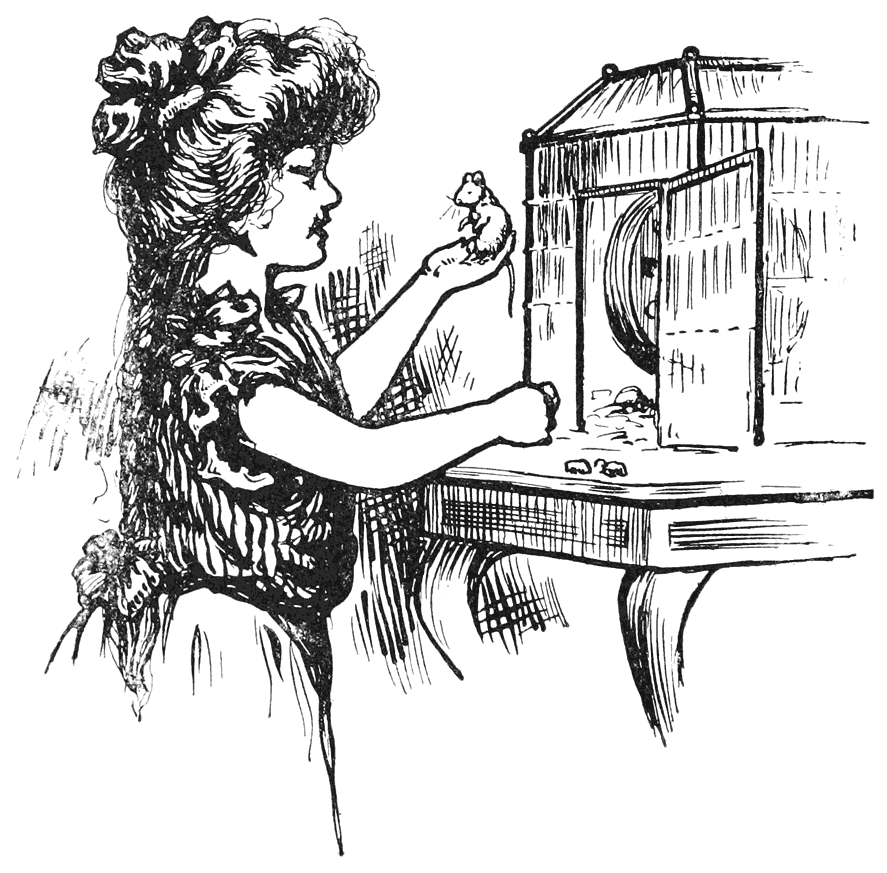
She insisted upon taking care of her little mouse herself. Every day she cleaned its cage, changed the cotton-wool, filled the glass dishes, and, during the warm hours of the day, placed the cage on the window-sill, covering the outside with a piece of green cloth so that the sunshine should not make the mouse’s red eyes ache. While doing this, she said all sorts of soothing words to it in a sweet, coaxing voice. “You are well off, my little mouse,” she told it. “You need not creep into small, dark holes, where it must be dirty and cold, and where bugs and roaches live. Brrr!” She shivered with fear at the bare thought. “You have a beautiful house; you are kept as warm and clean as a princess; I give you dainties which you could not have unless you stole them at the risk of your life—sweet grapes, raisins, nuts, milk-bread, and bits of bacon. No cat can harm you. You need not be afraid of any trap. You are a real favorite of fortune among the mice.”
But the mouse did not think so. It remained sulky, and showed no gratitude for its mistress’s care and affection. When it thought no one was looking, it played happily enough with the wheel or the cotton-wool in its nest, or combed and brushed itself with its handlike fore paws as carefully as a soldier before parade. But as soon as the little girl went to its cage, it suddenly stopped its cleaning or its play, and crept under the cotton-wool. When its mistress put her hand in the cage to take it out and pet it, the mouse darted into every corner of its house to escape the searching hand, and when it was caught, uttered a terrified squeaking, and struggled as violently as its feeble strength would permit.
“Foolish thing,” said the little girl, but she did not lose patience. “You will see in time how kindly I mean by you.”
Whether the mouse really did see this, is hard to say. Perhaps it only found out that it was of no use to resist. It struggled less when its mistress touched it, and therefore seemed tamer. But it did not answer to the name of Snow-White which the little girl had given it, obeyed no call, and pressed close against the back of the cage if any one looked through the grating of its house. In time it even lost its appetite, so that it grew thin and miserable. At last it also gave up turning in its wheel, crouched sadly in one corner, and became so weak that it could scarcely drag itself about.
This grieved the little girl to the heart. She ran to her mother, saying: “Oh, mamma, come and see what is the matter with Snow-White. It doesn’t eat, it doesn’t play, and it is always cross. I can’t cheer it up at all.”
Her mother smiled. “What do you do to cheer it up?”
“I stroke it, I talk to it, I even sing my prettiest songs, for which you all kiss me. But Snow-White doesn’t take any notice of them at all. The little thing is certainly ill. We must give it something.”
“That would do no good,” her mother answered. “I think your little mouse is tired because it is always alone.”
“But it has me,” cried the little girl.
“You are not enough, apparently. It wants another mouse for company.”
The eccentric uncle was told how matters stood, and he immediately brought a second mouse, which was put into little Snow-White’s house.
Snow-White received the newcomer in the most generous way. It made a broad, comfortable place for the stranger in the very middle of the cotton-wool nest, where it was softest and warmest, while mousie itself was content with the narrowest edge; brought out the most delicious dainties; and after the guest was rested and refreshed, went through the house, showing everything, even the wheel, on which it performed its tricks outside and inside; then, sitting down by the visitor, nosed and licked it, as dogs nurse their puppies. Snow-White seemed completely changed, no longer dull, but excited, moving about as swiftly and busily as a housekeeper who suddenly receives a welcome guest.
The little girl watched the pair happily, and, after a while, wanted to join the two mice. As usual, she put her hand into the cage to catch them. But the newcomer leaped out of the nest with one bound and sought shelter in the wheel, and Snow-White was extremely angry, squeaked furiously, and snapped at the hand. If the little girl had not drawn it back quickly, the mouse would certainly have bitten her. At first the child wanted to punish Snow-White. She had already seized her penholder to beat the little creature’s white fur with it, but she controlled her temper, let the animal run, and put down the stick which she had already lifted for the first blow.
“Go, I’ll do you no harm,” she said. “You know no better. You are a naughty, ungrateful thing, but that is probably only your stupidity, so I’ll forgive you.”
She had scarcely uttered these words in a very low tone, when she suddenly saw a wonderfully beautiful woman with fair hair and blue eyes, in a light blue dress, on which glittered a great number of silver stars. She had no time to wonder how the lovely lady could have come in unseen, for she said to her in a voice like sweet music: “That was right, dear child. We must always be kind and indulgent to the weak. As a reward, you shall understand the language of the white mice.”
“I suppose you are a fairy?” asked the little girl, timidly.
“Perhaps so,” replied the lovely lady, smiling. Then, bending down, she kissed the child gently on the forehead, and suddenly disappeared, though the little girl did not see her pass through the door. The child thought she had been dreaming, but a delicious fragrance of roses, which remained in the room, proved that she was awake, and really had talked with the fairy.
She turned quickly to the cage to find out whether she actually did understand the language of the mice. At first she heard nothing except a very low humming, like the distant buzzing of flies, in which she could catch no words. But when she listened longer and more intently, her ears became accustomed to the faint noise, and, yes—after a few minutes she heard more and more distinctly two little voices talking to each other.
“My poor, poor friend!” said one voice.
“You are right to pity me,” replied the other. “I have had a hard time, I can tell you; I’ve led a life here which I would not wish my worst enemy.”
“Yet the food and lodging seem to be very good,” answered the first voice.
“There is no reason to complain of them,” remarked the second, “if one could only enjoy one’s life. But how is that possible, when one is constantly tormented, and frightened, and abused?”
The little girl listened intently. Who could have tortured and frightened and abused Snow-White?
The delicate little voice went on: “There is a frightful monster here, even more terrible than a cat. Whenever this horrible creature comes near my house, I think that my last hour has come. It is as big as a mountain. You can’t even imagine it. It has paws in which we two, and three or four sisters and cousins, would have plenty of room. Each toe is as long as I am from my nose to my tail. The claws are as wide and thick as the doors of a house. The monster grasps me with these huge toes, so that I grow faint, and cannot help screaming with pain and terror. But what is the use of my moaning? The monster has no heart. It enjoys my suffering. It passes its huge paw down my back, and then I feel as if a heavy wagon were rolling over me. I don’t understand how a single bone in my body remains whole under this cruel torture. The monster raises me to its head, which is misshapen,—round, and perfectly flat in front, without a sign of a muzzle. It has no mustache, either, only on the upper part of the skull a forest of thick yellow hair. Its eyes are as big as my head. I really don’t exaggerate. And when it has me close to these fierce, pitiless eyes, it opens a huge mouth, and utters such a terrible roar that I feel as if the world were going to ruin. After this torture, the monster puts me back in my house again, but then I am more dead than alive, as you may suppose, and it is a long time before I can recover. In a little while, the bone-breaking, the thundering roar, and the terrible staring with the enormous eyes begin once more, and I spend my life, with aching limbs, remembering the last attack, and trembling at the thought of the next one.”
“But what does this monster want of you?” asked the first voice. “Does it want to eat you?”
“I don’t think so,” answered the other, “or it would have done it before now. It only wants to play with me. It takes a cruel pleasure in tormenting me, in killing me by slow torture.”
“Oh, sister, how you frighten me!” said the first voice. “Must this be my fate, too?”
“I don’t know,” replied the other; “but, at any rate, I now have you, and you have me, and we can bear our misery more easily together.”
The little girl wanted to hear no more. Deeply grieved, she ran to her mother, told her everything, complained of Snow-White’s ingratitude, and exclaimed, “If I am a monster, if my fingers are like posts, and my voice is a roar, I won’t trouble myself about her any longer.”
“That will be the best way,” said her mother. “Content yourself with feeding the little creature. A mouse, even if it is a white one, cares nothing for your society and your love. A mouse is always a mouse, and people can be happy only with their equals.”