Chapter V · THE SEARCH FOR THE INDIES. WESTWARD OR SPANISH ROUTE.
Reading edition
Some time after the receipt of this letter Columbus wrote again to Toscanelli, apparently sending him either some charts of his own, or some notes, or something bearing upon the subject in hand. No such letter is preserved, but Toscanelli replied as follows:—
These letters are intensely interesting, especially the one to Martinez, which reveals the fact that as early as 1474 the notion that a westward route to the Indies would be shorter than the southward route had somehow been suggested to Alfonso V.; Who first suggested the feasibleness of a westward route? Was it Columbus? and had, moreover, sufficiently arrested his attention to lead him to make inquiries of the most eminent astronomer within reach. Who could have suggested this notion to the king of Portugal? Was it Columbus, the trained mariner and map-maker, who might lately have been pondering the theories of Ptolemy and Mela as affected by the voyage of Santarem and Escobar, and whose connection with the Moñiz and Perestrelo families would now doubtless facilitate his access to the court? On some accounts this may seem probable, especially if we bear in mind Columbus's own statement implying that his appeals to the crown dated almost from the beginning of his fourteen years in Portugal.
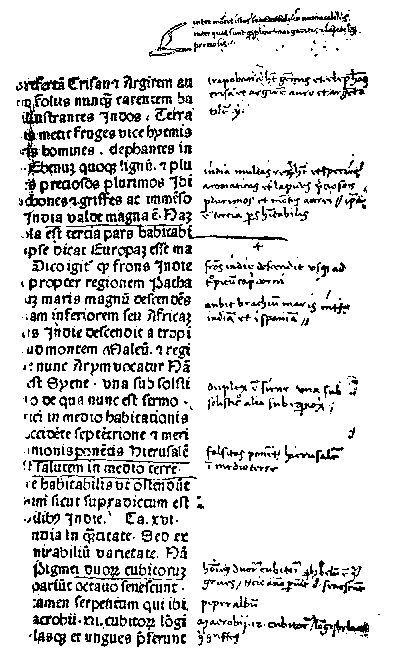
Annotations by Columbus.
I have already given an explanation of the process by which Columbus arrived at the firm belief that by sailing not more than about 2,500 geographical miles due west from the Canaries he should reach the coast of Japan. Every step of that explanation is sustained by documentary evidence, and as his belief is thus completely accounted for, the hypothesis that he may have based it upon information obtained in Iceland is, to say the least, superfluous. We do not need it in order to explain his actions, and accordingly his actions do not afford a presumption in favour of it. That hypothesis has no evidence in its favour. There is otherwise no reason, of course, for refusing to admit that he might have obtained information in Iceland, were there any evidence that he did. But not a scrap of such evidence has ever been produced. Every step in the Scandinavian hypothesis is a pure assumption.
But to hear about Vinland was one thing, to be guided by it to Japan was quite another affair. It was not the mention of timber and peltries and Skrælings that would fire the imagination of Columbus; his dreams were of stately cities with busy wharves where ships were laden with silks and jewels, and of If he had heard it, he would probably have classed it with such tales as that of St. Brandan's isle. Oriental magnates decked out with "barbaric pearl and gold," dwelling in pavilions of marble and jasper amid flowery gardens in "a summer fanned with spice." The mention of Vinland was no more likely to excite Columbus's attention than that of St. Brandan's isle or other places supposed to lie in the western ocean. He was after higher game.
Furthermore, this silence is in harmony with the fact that in none of his four voyages across the Atlantic did Columbus betray any consciousness that there was anything for him to gain by steering toward the northwest. If he could correctly have conceived the position of Vinland he surely would not have conceived it as south of the fortieth parallel. On his first voyage he steered due west in latitude No trace of a thought of Vinland appears in the voyages of Columbus. 28° because Toscanelli placed Japan opposite the Canaries. When at length some doubts began to arise and he altered his course, as we shall hereafter see, the change was toward the southwest. His first two voyages did not reveal to him the golden cities for which he was looking, and when on his third and fourth voyages he tried a different course it was farther toward the equator, not farther away from it, that he turned his prows. Not the slightest trace of a thought of Vinland appears in anything that he did.
Finally it may be asked, if the memory of Vinland was such a living thing in Iceland in 1477 that a visitor would be likely to be told about it, why was it not sufficiently alive in Why did not Norway or Iceland utter a protest in 1493? 1493 to call forth a protest from the North? When the pope, as we shall presently see, was proclaiming to the world that the Spanish crown was entitled to all heathen lands and islands already discovered or to be discovered in the ocean west of the Azores, why did not some zealous Scandinavian at once jump up and cry out, "Look here, old Columbus, we discovered that western route, you know! Stop thief!" Why was it necessary to wait more than a hundred years longer before the affair of Vinland was mentioned in this connection?
The negotiations were broken off, and the indomitable enthusiast once more prepared to go to France. He had actually started on his mule one fine winter day, when Interposition of Luis de Santangel. Luis de Santangel rushed into the queen's room and spoke to her with all the passionate and somewhat reproachful energy of one who felt that a golden opportunity was slipping away forever. His arguments were warmly seconded by Quintanilla, who had followed him into the room, as well as by the queen's bosom friend Beatriz de Bobadilla, Marchioness of Moya, who happened to be sitting on the sofa and was a devoted admirer of Columbus. An impulse seized Isabella. A courier was sent on a fleet horse, and overtook Columbus as he was jogging quietly over the bridge of Pinos, about six miles out from Granada. The matter was reconsidered and an arrangement was soon made. It was agreed:—
"1. That Columbus should have, for himself, during his life, and for his heirs and successors forever, the Agreement between Columbus and the sovereigns. office of admiral in all the islands and continents which he might discover or acquire in the ocean, with similar honours and prerogatives to those enjoyed by the high admiral of Castile in his district.
"2. That he should be viceroy and governor-general over all the said lands and continents; with the privilege of nominating three candidates for the government of each island or province, one of whom should be selected by the sovereigns.
"3. That he should be entitled to reserve for himself one tenth of all pearls, precious stones, gold, silver, spices, and all other articles and merchandises, in whatever manner found, bought, bartered, or gained within his admiralty, the costs being first deducted.
"4. That he, or his lieutenant, should be the sole judge in all causes and disputes arising out of traffic between those countries and Spain, provided the high admiral of Castile had similar jurisdiction in his district.
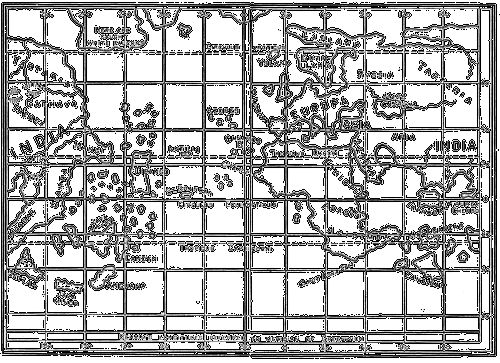
At length, on the 6th of September, they set sail from Columbus starts for Japan, Sept. 6, 1492. Gomera, but were becalmed and had made only thirty miles by the night of the 8th. The breeze then freshened, and when next day the shores of Ferro, the last of the Canaries, sank from sight on the eastern horizon, many of the sailors loudly lamented their unseemly fate, and cried and sobbed like children. Columbus well understood the difficulty of dealing with these men. He provided against one chief source of discontent by keeping two different reckonings, a true one for himself and a false one for his officers and crews. He was shrewd enough not to overdo it and awaken distrust. Thus after a twenty-four hours' run of 180 miles on September 10, he reported it as 144 miles; next day the run was 120 miles and he announced it as 108, and so on. But for this prudent if somewhat questionable device, it is not unlikely that the first week of October would have witnessed a mutiny in which Columbus would have been either thrown overboard or forced to turn back.
The weather was delicious, and but for the bug-a-boos that worried those poor sailors it would have been a most pleasant voyage. Chief among the imaginary terrors were three which deserve especial mention. At nightfall on September 13 the ships had crossed the magnetic line of no variation, and Columbus was astonished to see that the compass-needle, instead of Deflection of the needle. pointing a little to the right of the pole-star, began to sway toward the left, and next day this deviation increased. It was impossible to hide such a fact from the sharp eyes of the pilots, and all were seized with alarm at the suspicion that this witch instrument was beginning to play them some foul trick in punishment of their temerity; but Columbus was ready with an ingenious astronomical explanation, and their faith in the profundity of his knowledge prevailed over their terrors.
On September 22 the journal reports "no more grass." They were in clear water again, and more than 1,400 geographical miles from the Canaries. A third source of alarm had already begun to disturb the sailors. They were discovering much more than they had bargained for. The trade wind. They were in the belt of the trade winds, and as the gentle but unfailing breeze wafted them steadily westward, doubts began to arise as to whether it would ever be possible to return. Fortunately soon after this question began to be discussed, the wind, jealous of its character for capriciousness even there, veered into the southwest.
By September 25 the Admiral's chief difficulty had come to be the impatience of his crews at not finding land. Impatience of the crews. On that day there was a mirage, or some such illusion, which Columbus and all hands supposed to be a coast in front of them, and hymns of praise were sung, but at dawn next day they were cruelly undeceived. Flights of strange birds and other signs of land kept raising hopes which were presently dashed again, and the men passed through alternately hot and cold fits of exultation and dejection. Such mockery seemed to show that they were entering a realm of enchantment. Somebody, perhaps one of the released jail-birds, hinted that if a stealthy thrust should happen some night to push the Admiral overboard, it could be plausibly said that he had slipped and fallen while star-gazing. His situation grew daily more perilous, and the fact that he was an Italian commanding Spaniards did not help him. Perhaps what saved him was their vague belief in his superior knowledge; they may have felt that they should need him in going back.
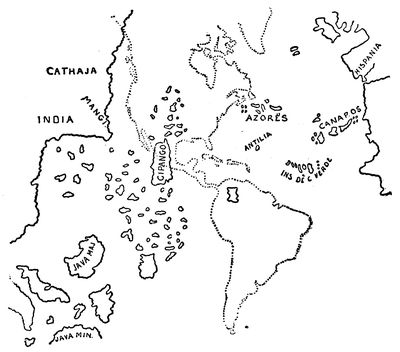
Martin Behaim's Atlantic Ocean (with outline of American continent superimposed).
At daybreak the boats were lowered and Columbus, with a large part of his company, went ashore. Upon every side were trees of unknown kinds, and the landscape seemed exceedingly beautiful. The crews go ashore. Confident that they must have attained the object for which they had set sail, the crews were wild with exultation. Their heads were dazed with fancies of princely fortunes close at hand. The officers embraced Columbus or kissed his hands, while the sailors threw themselves at his feet, craving pardon and favour.
A cruise of ten days among the Bahamas, with visits to four of the islands, satisfied Columbus that he was in the ocean just east of Cathay, for Groping for Cipango and the route to Quinsay. Marco Polo had described it as studded with thousands of spice-bearing islands, and the Catalan map shows that some of these were supposed to be inhabited by naked savages. To be sure, he could not find any spices or valuable drugs, but the air was full of fragrance and the trees and herbs were strange in aspect and might mean anything; so for a while he was ready to take the spices on trust. Upon inquiries about gold the natives always pointed to the south, apparently meaning Cipango; and in that direction Columbus steered on the 25th of October, intending to stay in that wealthy island long enough to obtain all needful information concerning its arts and commerce. Thence a sail of less than ten days would bring him to the Chinese coast, along which he might comfortably cruise northwesterly as far as Quinsay and deliver to the Great Khan a friendly letter with which Ferdinand and Isabella had provided him. Alas, poor Columbus—unconscious prince of discoverers—groping here in Cuban waters for the way to a city on the other side of the globe and to a sovereign whose race had more than a century since been driven from the throne and expelled from the very soil of Cathay! Could anything be more pathetic, or better illustrate the profound irony with which our universe seems to be governed?
Columbus seems now to have become perplexed, and to have vacillated somewhat in his purposes. If this was the continent of Columbus turns eastward; Pinzon deserts him. Asia it was nearer than he had supposed, and how far mistaken he had been in his calculations no one could tell. But where was Cipango? He gathered from the natives that there was a great island to the southeast, abounding in gold, and so he turned his prows in that direction. On the 20th of November he was deserted by Martin Pinzon, whose ship could always outsail the others. It seems to have been Pinzon's design to get home in advance with such a story as would enable him to claim for himself an undue share of credit for the discovery of the Indies. This was the earliest instance of a kind of treachery such as too often marred the story of Spanish exploration and conquest in the New World.
This catastrophe brought home, with startling force, to the mind of Columbus, the fact that the news of his discovery of land was not yet known in Europe. As for the Pinta and her insubordinate commander, none could say Columbus decides to go back to Spain. whether they would ever be seen again or whether their speedy arrival in Spain might not portend more harm than good to Columbus. His armament was now reduced to the little undecked Niña alone, such a craft as we should deem about fit for a summer excursion on Long Island Sound. What if his party should all perish, or be stranded helpless on these strange coasts, before any news of their success should reach the ears of friends in Europe! Then the name of Columbus would serve as a by-word for foolhardiness, and his mysterious fate would simply deter other expeditions from following in the same course. Obviously the first necessity of the situation was to return to Spain immediately and report what had already been done. Then it would be easy enough to get ships and men for a second voyage.
This decision led to the founding of an embryo colony upon Hispaniola. There was not room enough for all the party to go in the Nina, and quite a number begged to be left behind, because they found life upon the island lazy and the natives, especially the women, seemed well-disposed toward them. So a blockhouse was built out of the Building of the blockhouse, La Navidad. wrecked ship's timbers and armed with her guns, and in commemoration of that eventful Christmas it was called Fort Nativity (La Navidad). Here forty men were left behind, with provisions enough for a whole year, and on January 4, 1493, the rest of the party went on board the Niña and set sail for Spain. Two days later in following the northern coast of Hispaniola they encountered the Pinta, whose Meeting with Pinzon. commander had been delayed by trading with the natives and by finding some gold. Pinzon tried to explain his sudden disappearance by alleging that stress of weather had parted him from his comrades, but his excuses were felt to be lame and improbable. However it may have been with his excuses, there was no doubt as to the lameness of his foremast; it had been too badly sprung to carry much sail, so that the Pinta could not again run away from her consort.
On this return voyage the Admiral, finding the trade winds dead against him, took a northeasterly course until he had passed the thirty-seventh parallel and then headed straight toward Spain. On the Terrible storm in mid-ocean, Feb., 1493. 12th of February a storm was brewing, and during the next four days it raged with such terrific violence that it is a wonder how those two frail caravels ever came out of it. They were separated this time not to meet again upon the sea. Expecting in all likelihood to be engulfed in the waves with his tiny craft, Columbus sealed and directed to Ferdinand and Isabella two brief reports of his discovery, written upon parchment. Each of these he wrapped in a cloth and inclosed in the middle of a large cake of wax, which was then securely shut up in a barrel. One of the barrels was flung into the sea, the other remained standing on the little quarter-deck to await the fate of the caravel. The anxiety was not lessened by the sight of land on the 15th, for it was impossible to approach it so as to go ashore, and there was much danger of being dashed to pieces.
Thus nobody had the faintest suspicion of what had been done. In the famous letter to Santangel there is of course not a word about a New World. The grandeur of the achievement was quite beyond the ken of the generation that witnessed it. This voyage was an event without any parallel in history. For we have since come to learn that in 1492 the contact between the eastern and the western halves of our planet was first really begun, and the two streams of human life which had flowed on for countless ages apart were thenceforth to mingle together. The first voyage of Columbus is thus a unique event in the history of mankind. Nothing like it was ever done before, and nothing like it can ever be done again. No worlds are left for a future Columbus to conquer. The era of which this great Italian mariner was the most illustrious representative has closed forever.[Back to Contents]