Chapter IV · THE SEARCH FOR THE INDIES. EASTWARD OR PORTUGUESE ROUTE.
Reading edition
As it dawned upon men's minds that to find some oceanic route from Europe to the remote shores of Question as to whether Asia could be reached by sailing around Africa. Asia was eminently desirable, the first attempt would naturally be to see what could be done by sailing down the western coast of Africa, and ascertaining whether that continent could be circumnavigated. It was also quite in the natural order of things that this first attempt should be made by the Portuguese.
In the general history of the Middle Ages the Spanish peninsula had been to some extent cut off from the main currents of thought and feeling which actuated the rest of Europe. Its people had never joined the other Christian nations in the Crusades, for the good reason that they always had quite enough to occupy them in their own domestic struggle with the Moors. From the throes of this prolonged warfare Portugal emerged somewhat sooner than the Spanish kingdoms, and thus had somewhat earlier a surplus of energy released for work of another sort. It was not strange that the Portuguese should be the first people since the old Northmen to engage in distant maritime adventure upon a grand scale. Nor was it strange that Portuguese seamanship should at first have thriven upon naval warfare with Mussulmans. It was in attempting to suppress the intolerable nuisance of Moorish piracy that Portuguese ships became accustomed to sail a little way down the west coast of Africa; and such voyages, begun for military purposes, were kept up in the interests of commerce, and presently served as a mighty stimulus to geographical curiosity. We have now to consider at some length how grave was the problem that came up for immediate solution.
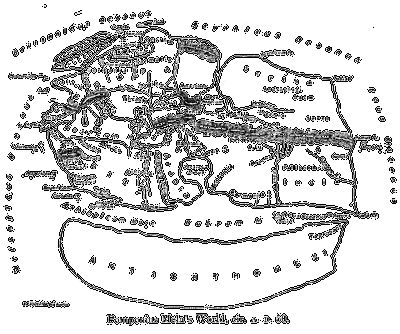
Pomponius Mela's World, cir. A. D. 50.
To such notions as these, which were supposed to have some sort of scientific basis, we must add the wild superstitious fancies that clustered about all remote and unvisited corners of the world. In maps made in the fifteenth and sixteenth centuries, in such places as we should label "Unexplored Region," there were commonly depicted uncouth shapes of "Gorgons and Hydras and Chimæras dire," furnishing eloquent testimony to the feelings with which the unknown was regarded. Superstitious fancies. The barren wastes of the Sea of Darkness awakened a shuddering dread like that with which children shrink from the gloom of a cellar. When we remember all these things, and consider how the intelligent purpose which urged the commanders onward was scarcely within the comprehension of their ignorant and refractory crews, we can begin to form some idea of the difficulties that confronted the brave mariners who first sought an ocean route to the far-off shores of Cathay.
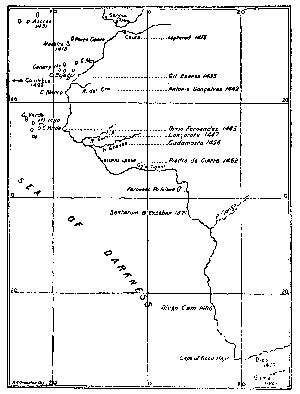
Portuguese voyages on the coast of Africa.
These voyages into the southern hemisphere dealt a damaging blow to the theory of an impassable fiery zone; but as to the circumnavigability of the African continent, the long stretch of coast beyond the equator seemed more in harmony with Ptolemy's views than with those of Mela. Effect of these discoveries upon the theories of Ptolemy and Mela. The eastward trend of the Guinea coast was at first in favour of the latter geographer, but when Santarem and Escobar found it turning southward to the equator the facts began to refute him. According to Mela they should have found it possible at once to sail eastward to the gulf of Aden. What if it should turn out after all that there was no connection between the Atlantic and Indian oceans? Every added league of voyaging toward the tropic of Capricorn must have been fraught with added discouragement, for it went to prove that, even if Ptolemy's theory was wrong, at any rate the ocean route to Asia was indefinitely longer than had been supposed. But was it possible to imagine any other route that should be more direct? To a trained mariner of original and imaginative mind, sojourning in Portugal and keenly watching the progress of African discovery, the years just following the voyage of Santarem and Escobar would be a period eminently fit for suggesting such a question. Let us not forget this date of 1471 while we follow Prince Henry's work to its first grand climax.
About the time that Diego Cam was visiting the tribes on the Congo, the negro king of Benin, a country by the mouth of the Niger, sent an embassy to John II. of Portugal (Prince Henry's nephew), with a request that missionary priests might be sent to Benin. It has been thought that the woolly-haired chieftain was really courting an alliance with the Portuguese, or perhaps he thought their "medicine men" might have the knack of confounding his foes. The negro envoy told King John that a thousand miles or so east of Benin there was an august sovereign who ruled over many subject peoples, and at whose court there was an order of chivalry whose badge or emblem was a brazen cross. Such, at least, was the king's interpretation of the negro's words, and forthwith he jumped to the conclusion that this News of Prester John. African potentate must be Prester John, whose name was redolent of all the marvels of the mysterious East. To find Prester John would be a long step toward golden Cathay and the isles of spice. So the king of Portugal rose to the occasion, and attacked the problem on both flanks at once. He sent Pedro de Covilham by way of Egypt to Aden, and he sent Bartholomew Dias, with three fifty-ton caravels, to make one more attempt to find an end to the Atlantic coast of Africa.
This voyage of Bartholomew Dias was longer and in many respects more remarkable than any that is known to have been made before that time. From Lisbon back to Lisbon, reckoning the sinuosities of the coast, but making no allowance for tacking, the distance run by those tiny craft was not less than thirteen thousand miles. Some effects of the discovery. This voyage completed the overthrow of the fiery-zone doctrine, so far as Africa was concerned; it penetrated far into the southern temperate zone where Mela had placed his antipodal world; it dealt a staggering blow to the continental theory of Ptolemy; and its success made men's minds readier for yet more daring enterprises. Among the shipmates of Dias on this ever memorable voyage was a Bartholomew Columbus. well-trained and enthusiastic Italian mariner, none other than Bartholomew, the younger brother of Christopher Columbus. There was true dramatic propriety in the presence of that man at just this time; for not only did all these later African voyages stand in a direct causal relation to the discovery of America, but as an immediate consequence of the doubling of the Cape of Good Hope we shall presently find Bartholomew Columbus in the very next year on his way to England, to enlist the aid of King Henry VII. in behalf of a scheme of unprecedented boldness for which his elder brother had for some years been seeking to obtain the needful funds. Not long after that disappointing voyage of Santarem and Escobar in 1471, this original and imaginative sailor, Christopher Columbus, had conceived (or adopted and made his own) a new method of solving the problem of an ocean route to Cathay. We have now to sketch the early career of this epoch-making man, and to see how he came to be brought into close relations with the work of the Portuguese explorers.[Back to Contents]