Chapter III · EUROPE AND CATHAY.
Reading edition
The question has sometimes been asked, Why did the knowledge of the voyages to Vinland so long remain confined to the Scandinavian people or a portion of them, and then lapse into oblivion, insomuch that it did not become a matter of notoriety in Europe until after the publication of the celebrated book of Why the voyages of the Northmen were not followed up. Thormodus Torfæus in 1705? Why did not the news of the voyages of Leif and Thorfinn spread rapidly over Europe, like the news of the voyage of Columbus? and why was it not presently followed, like the latter, by a rush of conquerors and colonizers across the Atlantic?
Such questions arise from a failure to see historical events in their true perspective, and to make the proper allowances for the manifold differences in knowledge and in social and economic conditions which characterize different periods of history. In the present case, the answer is to be found, first, in the geographical ignorance which prevented the Northmen from realizing in the smallest degree what such voyages really signified or were going to signify to posterity; and, secondly, in the political and commercial condition of Europe at the close of the tenth century.
In the first place the route which the Norse voyagers pursued, from Iceland to Greenland and thence to Vinland, was not such as to give them, in their ignorance of the shape of the earth, and with their imperfect knowledge of latitude and longitude, any adequate gauge wherewith to measure their achievement. Ignorance of geography. The modern reader, who has in his mind a general picture of the shape of the northern Atlantic ocean with its coasts, must carefully expel that picture before he can begin to realize how things must have seemed to the Northmen. None of the Icelandic references to Markland and Vinland betray a consciousness that these countries belong to a geographical world outside of Europe. There was not enough organized geographical knowledge for that. They were simply conceived as remote places beyond Greenland, inhabited by inferior but dangerous people. The accidental finding of such places served neither to solve any great commercial problem nor to gratify and provoke scientific curiosity. It was, therefore, not at all strange that it bore no fruit.
Secondly, even if it had been realized, and could have been duly proclaimed throughout Europe, that across the broad Atlantic a new world lay open for colonization, Europe could not have taken advantage of the fact. Now and then a ship might make its way, or be blown, Lack of instruments for ocean navigation. across the waste of waters without compass or astrolabe; but until these instruments were at hand anything like systematic ocean navigation was out of the question; and from a colonization which could only begin by creeping up into the Arctic seas and taking Greenland on the way, not much was to be expected, after all.
But even if the compass and other facilities for oceanic navigation had been at hand, the state of Europe in the days of Eric the Red was not such as to afford surplus energy for distant enterprise of this sort. Let us for a moment recall what was going on in Europe in the year of grace 1000, just enough to get a suggestive picture of the time. In England the Danish invader, fork-bearded Swend, father of the great Cnut, was wresting the kingship from the feeble grasp of Ethelred the Redeless. Europe in the year 1000. In Gaul the little duchy of France, between the Somme and the Loire, had lately become the kingdom of France, and its sovereign, Hugh Capet, had succeeded to feudal rights of lordship over the great dukes and counts whose territories surrounded him on every side; and now Hugh's son, Robert the Debonair, better hymn-writer than warrior, was waging a doubtful struggle with these unruly vassals. It was not yet in any wise apparent what the kingdoms of England and France were going to be. In Germany the youthful Otto III., the "wonder of the world," had just made his weird visit to the tomb of his mighty predecessor at Aachen, before starting on that last journey to Rome which was so soon to cost him his life. Otto's teacher, Gerbert, most erudite of popes,—too learned not to have had dealings with the Devil,—was beginning to raise the papacy out of the abyss of infamy into which the preceding age had seen it sink, and so to prepare the way for the far-reaching reforms of Hildebrand. The boundaries of Christendom were as yet narrow and insecure. With the overthrow of Olaf Tryggvesson in this year 1000, and the temporary partition of Norway between Swedes and Danes, the work of Christianizing the North seemed, for the moment, to languish. Upon the eastern frontier the wild Hungarians had scarcely ceased to be a terror to Europe, and in this year Stephen, their first Christian king, began to reign. At the same time the power of heretical Bulgaria, which had threatened to overwhelm the Eastern Empire, was broken down by the sturdy blows of the Macedonian emperor Basil. In this year the Christians of Spain met woful defeat at the hands of Almansor, and there seemed no reason why the Mussulman rule over the greater part of that peninsula should not endure forever.
It hardly need be argued that a period like this, in which all the vital energy in Europe was consumed in the adjustment of affairs at home, was not fitted for colonial enterprises. Before a people can send forth colonies it must have solved the problem of political life so far as to ensure stability of trade. The condition of things was not such as to favour colonial enterprise. It is the mercantile spirit that has supported modern colonization, aided by the spirit of intellectual curiosity and the thirst for romantic adventure. In the eleventh century there was no intellectual curiosity outside the monastery walls, nor had such a feeling become enlisted in the service of commerce. Of trade there was indeed, even in western Europe, a considerable amount, but the commercial marine was in its infancy, and on land the trader suffered sorely at the hands of the robber baron. In those days the fashionable method of compounding with your creditors was, not to offer them fifty cents on the dollar, but to inveigle them into your castle and broil them over a slow fire.
In so far as the attention of people in Europe was called to any quarter of the globe outside of the seething turbulence in which they dwelt, it was directed toward Asia. Until after 1492, Europe stood with her back toward the Atlantic. What there might be out beyond that "Sea of Darkness" (Mare Tenebrosum), as it used commonly to be called, was a question of little interest and seems to have excited no speculation. The outlook of Europe was toward Asia. In the view of mediæval Europe the inhabited world was cut off on the west by this mysterious ocean, and on the south by the burning sands of Sahara; but eastward it stretched out no one knew how far, and in that direction dwelt tribes and nations which Europe, from time immemorial, had reason to fear. As early as the time of Herodotus, the secular antagonism between Europe and Asia had become a topic of reflection among the Greeks, and was wrought with dramatic effect by that great writer into the structure of his history, culminating in the grand and stirring scenes of the Persian war. A century and a half later the conquests of Alexander the Great added a still more impressive climax to the story. The struggle was afterward long maintained between Roman and Parthian, but from the fifth century after Christ onward through the Middle Ages, it seemed as if the Oriental world would never rest until it had inflicted the extremities of retaliation upon Europe. Whether it was the heathen of the steppes who were in question, from Attila in the fifth century to Batu Khan in the thirteenth, or the followers of the Prophet, who tore away from Christendom the southern shores of the Mediterranean, and held Spain in their iron grasp, while from age to age they exhausted their strength in vain against the Eastern Empire, the threatening danger was always coming with the morning sun; whatever might be the shock that took the attention of Europe away from herself, it directed it upon Asia. This is a fact of cardinal importance for us, inasmuch as it was directly through the interest, more and more absorbing, which Europe felt in Asia that the discovery of the western hemisphere was at last effected.
In the fourth and following centuries, Nestorian missionaries were very active in Asia, The Nestorians. and not only made multitudes of converts and established metropolitan sees in such places as Kashgar and Herat, but even found their way into China. Their work forms an interesting though melancholy chapter in history, but it does not seem to have done much toward making Asia better known to Europe. As declared heretics, the Nestorians were themselves almost entirely cut off from intercourse with European Christians.
Such a development of wealth in Venice and Genoa implies a large producing and consuming area behind them, able to take and pay for the costly products of India and China. Centres and routes of mediæval trade. Before the end of the thirteenth century the volume of European trade had swelled to great proportions. How full of historic and literary interest are the very names of the centres and leading routes of this trade as it was established in those days, with its outlook upon the Mediterranean and the distant East! Far up in the North we see Wisby, on the little isle of Gothland in the Baltic, giving its name to new rules of international law; and the merchants of the famous Hansa towns extending their operations as far as Novgorod in one direction, and in another to the Steelyard in London, where the pound of these honest "Easterlings" was adopted as the "sterling" unit of sound money. Fats and tallows, furs and wax from Russia, iron and copper from Sweden, strong hides and unrivalled wools from England, salt cod and herring (much needed on meagre church fast-days) from the North and Baltic seas, appropriately followed by generous casks of beer from Hamburg, were sent southward in exchange for fine cloths and tapestries, the products of the loom in Ghent and Bruges, in Ulm and Augsburg, with delicious vintages of the Rhine, supple chain armour from Milan, Austrian yew-wood for English long-bows, ivory and spices, pearls and silks from Italy and the Orient. Along the routes from Venice and Florence to Antwerp and Rotterdam we see the progress in wealth and refinement, in artistic and literary productiveness. We see the early schools of music and painting in Italy meet with prompt response in Flanders; in the many-gabled streets of Nuremberg we hear the voice of the Meistersinger, and under the low oaken roof of a Canterbury inn we listen to joyous if sometimes naughty tales erst told in pleasant groves outside of fever-stricken Florence.
In the middle of the thirteenth century, some members of the The Polo brothers. Polo family, one of the aristocratic families of Venice, had a commercial house at Constantinople. Thence, in 1260, the brothers Nicolò and Maffeo Polo started on a trading journey to the Crimea, whence one opportunity after another for making money and gratifying their curiosity with new sights led them northward and eastward to the Volga, thence into Bokhara, and so on until they reached the court of the Great Khan, in one of the northwestern provinces of Cathay. The reigning sovereign was the famous Kublai Khan, grandson of the all-conquering Jenghis. Kublai was an able and benevolent despot, earnest in the wish to improve the condition of his Mongol kinsmen. He had never before met European gentlemen, and was charmed with the cultivated and polished Venetians. He seemed quite ready to enlist the Roman Church in aid of his civilizing schemes, and entrusted the Polos with a message to the Pope, asking him for a hundred missionary teachers. The brothers reached Kublai Khan's message to the Pope. Venice in 1269, and found that Pope Clement IV. was dead and there was an interregnum. After two years Gregory X. was elected and received the Khan's message, but could furnish only a couple of Dominican friars, and these men were seized with the dread not uncommonly felt for "Tartareans," and at the last moment refused to go. Nicolò and his brother then set out in the autumn of 1271 to return to China, taking with them Nicolò's son Marco, a lad of seventeen years. From Acre they went by way of Bagdad to Hormuz, at the mouth of the Persian gulf, apparently with the intention of proceeding thence by sea, but for some reason changed their course, and travelled through Kerman, Khorassan, and Balkh, to Kashgar, and thence by way of Yarkand and Khotan, and across the desert of Gobi into northwestern China, where they arrived in the summer of 1275, and found the Khan at Kaipingfu, not far from the northern end of the Great Wall.
Three years afterward, in 1298, Marco commanded a galley in the great naval battle with the Genoese near Curzola. The Venetians were totally defeated, and Marco was one of the 7,000 prisoners taken to Genoa, where he was kept in durance for about a year. Marco Polo's book written in prison at Genoa, 1299. One of his companions in captivity was a certain Rusticiano, of Pisa, who was glad to listen to his descriptions of Asia, and to act as his amanuensis. French was then, at the close of the Crusades, a language as generally understood throughout Europe as later, in the age of Louis XIV.; and Marco's narrative was duly taken down by the worthy Rusticiano in rather lame and shaky French. In the summer of 1299 Marco was set free and returned to Venice, where he seems to have led a quiet life until his death in 1324.
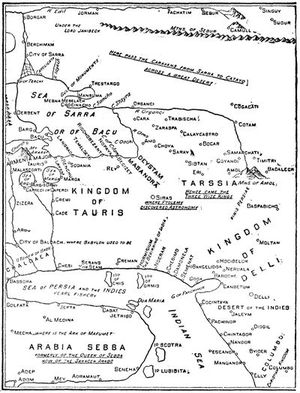
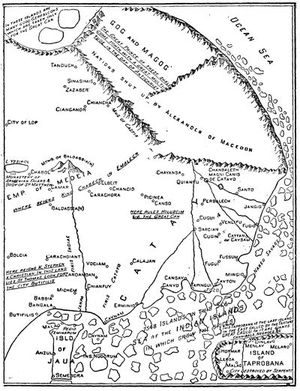
Two sheets of the Catalan Map, 1375.
Thus, for just a century,—from Carpini and Rubruquis to Marignolli,—while China was open to strangers as never before or since, a few Europeans had availed themselves of the opportunity in such wise as to mark the beginning of a new era in the history of geographical knowledge. Though the discoveries of Marco Polo were as yet but imperfectly appreciated, one point, and that the most significant of all, was thoroughly established. It was shown that the continent of Asia did not extend indefinitely eastward, nor was it bounded and barricaded on that side, as Ptolemy had imagined, by vast impenetrable swamps. On the contrary, its eastern shores were perfectly accessible through an open sea, and half a dozen Europeans in Chinese ships had now actually made the voyage between the coast of China and the Persian gulf. Moreover, some hearsay knowledge—enough to provoke curiosity and greed—had been gained of the existence of numerous islands in that far-off First rumours of the Molucca islands and Japan. eastern ocean, rich in the spices which from time immemorial had formed such an important element in Mediterranean commerce. News, also, had been brought to Europe of the wonderful island kingdom of Japan (Cipango or Zipangu) lying out in that ocean some hundreds of miles beyond the coast of Cathay. These were rich countries, abounding in objects of lucrative traffic. Under the liberal Mongol rule the Oriental trade had increased enough for Europe to feel in many ways its beneficial effects. Now this trade began to be suddenly and severely checked, and while access to the interior of Asia was cut off, European merchants might begin to reflect upon the value of what they were losing, and to consider if there were any feasible method of recovering it.
It was not merely the shutting up of China by the first Ming emperor, in 1368, that checked the intercourse between Europe and Asia. A still more baleful obstacle to all such intercourse had lately come upon the scene. In Asia Minor the The accustomed routes of Oriental trade cut off by the Ottoman Turks. beastly Turk, whose career had been for two centuries arrested by the Crusades, now reared his head again. The Seljukian had been only scotched, not killed; and now he sprang to life as the Ottoman, with sharper fangs than before. In 1365 the Turks established themselves in the Balkan peninsula, with Adrianople as their capital, and began tightening their coils about the doomed city of Constantine. Each point that they gained meant the strangling of just so much Oriental trade; for, as we have seen, the alliance of Constantinople with Genoa since 1261 had secured to the latter city, and to western Europe, the advantages of the overland routes from Asia, whether through the Volga country or across Armenia. When at length, in 1453, the Turks took Constantinople, the splendid commercial career of Genoa was cut with the shears of Atropos. At the same time, as their power was rapidly extending over Syria and down toward Egypt, threatening the overthrow of the liberal Mameluke dynasty there, the commercial prosperity of Venice also was seriously imperilled. Moreover, as Turkish corsairs began to swarm in the eastern waters of the Mediterranean, the voyage became more and more unsafe for Christian vessels. It was thus, while the volume of trade with Asia was, in the natural course of things, swelling year by year, that its accustomed routes were being ruthlessly cut off. It was fast becoming necessary to consider whether there might not be other practicable routes to Necessity for finding an "outside route to the Indies." "the Indies" than those which had from time immemorial been followed. Could there be such a thing as an "outside route" to that land of promise? A more startling question has seldom been propounded; for it involved a radical departure from the grooves in which the human mind had been running ever since the days of Solomon. Two generations of men lived and died while this question was taking shape, and all that time Cathay and India and the islands of Spices were objects of increasing desire, clothed by eager fancy with all manner of charms and riches. The more effectually the eastern Mediterranean was closed, the stronger grew the impulse to venture upon unknown paths in order to realize the vague but glorious hopes that began to cluster about these remote countries. Such an era of romantic enterprise as was thus ushered in, the world has never seen before or since. It was equally remarkable as an era of discipline in scientific thinking. In the maritime ventures of unparalleled boldness now to be described, the human mind was groping toward the era of enormous extensions of knowledge in space and time represented by the names of Newton and Darwin. It was learning the right way of putting its trust in the Unseen.[Back to Contents]