Chapter II · PRE-COLUMBIAN VOYAGES.
Reading edition
There is something solemn and impressive in the spectacle of human life thus going on for countless ages in the Eastern and Western halves of our planet, each all unknown to the other and uninfluenced by it. The contact between the two worlds practically begins in 1492.
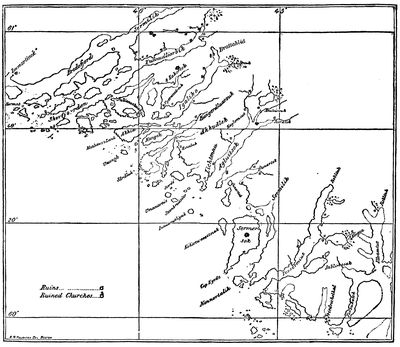
The East Bygd, or Eastern Settlement of the Northmen in Greenland.
This colonization of Greenland by the Northmen in the tenth century is as well established as any event that occurred in the Middle Ages. For four hundred years the fortunes of the Greenland colony formed a part, albeit a very humble part, of European history. Geographically speaking, Greenland is reckoned as a part of America, of the western hemisphere, and not of the eastern. The Northmen who settled in Greenland had, therefore, in this sense found their way to America. Nevertheless one rightly feels that in the history of geographical discovery an arrival of Europeans in Greenland is equivalent merely to reaching the vestibule or ante-chamber of the western hemisphere. It is an affair begun and ended outside of the great world of the red men.
But the story does not end here. Into the world of the red men the voyagers from Iceland did assuredly come, as indeed, after once getting a foothold upon Greenland, they could hardly fail to do. Let us pursue the remainder of the story as we find it in our Icelandic sources of information, and afterwards it will be proper to inquire into the credibility of these sources.
Among Karlsefni's companions on this memorable expedition was one Thorvard, with his wife Freydis, a natural daughter of Eric the Red. About the time of their return to Greenland in the summer of 1010, a ship arrived from Norway, commanded by two brothers, Helgi and Finnbogi. During the winter a new expedition was planned, and in the summer of 1011 Freydis, and her evil deeds in Vinland, 1011-12. two ships set sail for Vinland, one with Freydis, Thorvard, and a crew of 30 men, the other with Helgi and Finnbogi, and a crew of 35 men. There were also a number of women. The purpose was not to found a colony but to cut timber. The brothers arrived first at Leif's huts and had begun carrying in their provisions and tools, when Freydis, arriving soon afterward, ordered them off the premises. They had no right, she said, to occupy her brother's houses. So they went out and built other huts for their party a little farther from the shore. Before their business was accomplished "winter set in, and the brothers proposed to have some games for amusement to pass the time. So it was done for a time, till discord came among them, and the games were given up, and none went from one house to the other; and things went on so during a great part of the winter." At length came the catastrophe. Freydis one night complained to her husband that the brothers had given her evil words and struck her, and insisted that he should forthwith avenge the affront. Presently Thorvard, unable to bear her taunts, was aroused to a deed of blood. With his followers he made a night attack upon the huts of Helgi and Finnbogi, seized and bound all the occupants, and killed the men one after another in cold blood. Five women were left whom Thorvard would have spared; as none of his men would raise a hand against them, Freydis herself took an axe and brained them one and all. In the spring of 1012 the party sailed for Brattahlid in the ship of the murdered brothers, which was the larger and better of the two. Freydis pretended that they had exchanged ships and left the other party in Vinland. With gifts to her men, and dire threats for any who should dare tell what had been done, she hoped to keep them silent. Words were let drop, however, which came to Leif's ears, and led him to arrest three of the men and put them to the torture until they told the whole story. "'I have not the heart,' said Leif, 'to treat my wicked sister as she deserves; but this I will foretell them [Freydis and Thorvard] that their posterity will never thrive.' So it went that nobody thought anything of them save evil from that time."
We may now observe that, while it is idle to attempt to determine accurately the length of the winter day, Length of the winter day. as given in our chronicles, nevertheless since that length attracted the attention of the voyagers, as something remarkable, it may fairly be supposed to indicate a latitude lower than they were accustomed to reach in their trading voyages in Europe. Such a latitude as that of Dublin, which lies opposite Labrador, would have presented no novelty to them, for voyages of Icelanders to their kinsmen in Dublin, and in Rouen as well, were common enough. Halifax lies about opposite Bordeaux, and Boston a little south of opposite Cape Finisterre, in Spain, so that either of these latitudes would satisfy the conditions of the case; either would show a longer winter day than Rouen, which was about the southern limit of ordinary trading voyages from Iceland. At all events, the length of day indicates for Vinland a latitude south of Cape Breton.
It would be hard to find anything more unlike such writings than the class of Icelandic sagas to which that of Eric the Red belongs. The Saga of Eric the Red is not folk-lore. Here we have quiet and sober narrative, not in the least like a fairy-tale, but often much like a ship's log. Whatever such narrative may be, it is not folk-lore. In act and motive, in its conditions and laws, its world is the every-day world in which we live. If now and then a "uniped" happens to stray into it, the incongruity is as conspicuous as in the case of Hudson's mermaid, or a ghost in a modern country inn; whereas in the Homeric fabric the supernatural is warp and woof. To assert a likeness between two kinds of literature so utterly different is to go very far astray.
Now I do not suppose it will occur to any rational being to suggest that Hauk may have written down his version of Eric the Red's Saga from an oral tradition nearly three centuries old. The narrative could not have been so long preserved in its integrity, with so little extravagance of statement and so many marks of truthfulness in details foreign to ordinary Icelandic experience, if it had been entrusted to oral tradition alone. The story is not likely to have been preserved to Hauk's time by oral tradition only. One might as well try to imagine Drake's "World Encompassed" handed down by oral tradition from the days of Queen Elizabeth to the days of Queen Victoria. Such transmission is possible enough with heroic poems and folk-tales, which deal with a few dramatic situations and a stock of mythical conceptions familiar at every fireside; but in a simple matter-of-fact record of sailors' observations and experiences on a strange coast, oral tradition would not be long in distorting and jumbling the details into a result quite undecipherable. The story of the Zeno brothers, presently to be cited, shows what strange perversions occur, even in written tradition, when the copyist, instead of faithfully copying records of unfamiliar events, tries to edit and amend them. One cannot reasonably doubt that Hauk's vellum of Eric the Red's Saga, with its many ear-marks of truth above mentioned, was copied by him—and quite carefully and faithfully withal—from some older vellum not now forthcoming.
As we have no clue, however, beyond the internal evidence, to the age or character of the sources from which Hauk copied, Allusions to Vinland in other documents. there is nothing left for us to do but to look into other Icelandic documents, to see if anywhere they betray a knowledge of Vinland and the voyages thither. Incidental references to Vinland, in narratives concerned with other matters, are of great significance in this connection; for they imply on the part of the narrator a presumption that his readers understand such references, and that it is not necessary to interrupt his story in order to explain them. Such incidental references imply the existence, during the interval between the Vinland voyages and Hauk's manuscript, of many intermediate links of sound testimony that have since dropped out of sight; and therefore they go far toward removing whatever presumption may be alleged against Hauk's manuscript because of its distance from the events.
The testimony of Adam of Bremen brings us yet one generation nearer to the Vinland voyages, and is very significant. Adam of Bremen. Adam was much interested in the missionary work in the north of Europe, and in 1073, the same year that Hildebrand was elected to the papacy, he published his famous "Historia Ecclesiastica" in which he gave an account of the conversion of the northern nations from the time of Leo III. to that of Hildebrand's predecessor. In prosecuting his studies, Adam made a visit to the court of Swend Estridhsen, king of Denmark, nephew of Cnut the Great, king of Denmark and England. Swend's reign began in 1047, so that Adam's visit must have occurred between that date and 1073. The voyage of Leif and Thorfinn would at that time have been within the memory of living men, and would be likely to be known in Denmark, because the intercourse between the several parts of the Scandinavian world was incessant; there was continual coming and going. Adam learned what he could of Scandinavian geography, and when he published his history, he did just what a modern writer would do under similar circumstances; he appended to his book some notes on the geography of those remote countries, then so little known to his readers in central and southern Europe. After giving some account of Denmark, Sweden, and Norway, he describes the colony in Iceland, and then the further colony in Greenland, and concludes by saying that out in that ocean there is another country, or island, which has been visited by many persons, and is called Vinland because of wild grapes that grow there, out of which a very good wine can be made. Either rumour had exaggerated the virtues of fox-grape juice, or the Northmen were not such good judges of wine as of ale. Adam goes on to say that corn, likewise, grows in Vinland without cultivation; and as such a statement to European readers must needs have a smack of falsehood, he adds that it is based not upon fable and guess-work, but upon "trustworthy reports (certa relatione) of the Danes."
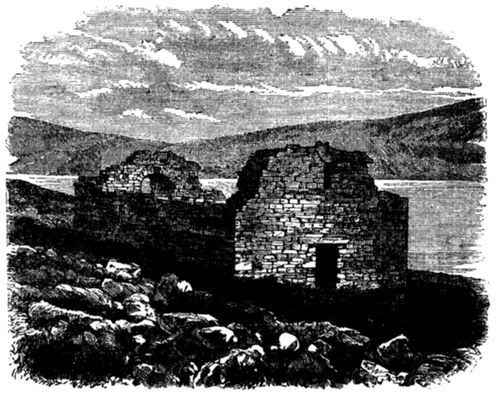
Ruins of the church at Kakortok.
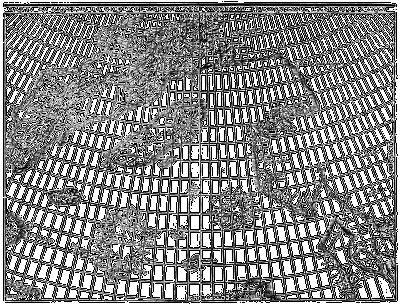
Zeno Map, cir. 1400—western half & eastern half.
The narrative, however, not only sets up no such claim, but nowhere betrays a consciousness that its incidents entitle it to make such a claim. The narrative nowhere makes a claim to the "discovery of America." It had evidently not occurred to young Nicolò to institute any comparison between his ancestors' voyages to Greenland and the voyages of Columbus to the western hemisphere, of which we now know Greenland to be a part. The knowledge of the North American coast, and of the bearing of one fact upon another fact in relation to it, was still, in 1558, in an extremely vague and rudimentary condition. In the mind of the Zeno brothers, as the map shows, Greenland was a European peninsula; such was the idea common among mediæval Northmen, as is nowhere better illustrated than in this map. Neither in his references to Greenland, nor to Estotiland and Drogio, presently to be considered, does young Nicolò appear in the light of a man urging or suggesting a "claim." He appears simply as a modest and conscientious editor, interested in the deeds of his ancestors and impressed with the fact that he has got hold of important documents, but intent only upon giving his material as correctly as possible, and refraining from all sort of comment except such as now and then seems needful to explain the text as he himself understands it.
Thus far, in dealing with the places actually visited by Nicolò or Antonio, or by both brothers, we have found the story consistent and intelligible. But in what relates to countries beyond Greenland, countries which were not visited by either of the brothers, but about which Antonio heard reports, it is quite a different thing. We are introduced to a jumble very unlike the clear, business-like account of Vinland voyages in the Hauks-bók. Yet in this medley there are some statements curiously suggestive of things in North America. It will be remembered that Antonio's voyage with Sinclair (somewhere about 1400) was undertaken in order to verify certain reports of the existence of land more than a thousand miles west of the Færoe islands.
There is nothing so far in this vague description to show that Estotiland was an American country, except its western direction and perhaps its trading with Greenland. The points of unlikeness are at least as numerous as the points of likeness. But in what follows there is a much stronger suggestion of North America.
Whither the Fisherman was first carried in these boats or vessels, Antonio's letter does not inform us. We are only told that he engaged in some prosperous voyages, and at length returned to the The Fisherman's return to "Frislanda." Færoes after these six and twenty years of strange adventures. It was apparently the Fisherman's description of Estotiland as a very rich country (paese ricchissimo) that led Sinclair to fit out an expedition to visit it, with Antonio as his chief captain. As we have already seen, the Fisherman died just before the ships were ready to start, and to whatever land they succeeded in reaching after they sailed without him, the narrative leaves us with the impression that it was not the mysterious Estotiland.
To attempt to identify that country from the description of it, which reads like a parcel of ill-digested sailors' yarns, would be idle. The most common conjecture has identified it with Newfoundland, from its relations to other points mentioned in the Zeno narrative, as indicated, with fair probability, on the Zeno map. To identify it with Newfoundland is to brand the description as a "fish story," but from such a conclusion there seems anyway to be no escape.
With Drogio, however, it is otherwise. The description of Was the account of Drogio woven into the narrative by the younger Nicolò? Drogio and the vast country stretching beyond it, which was like a "new world," is the merest sketch, but it seems to contain enough characteristic details to stamp it as a description of North America, and of no other country accessible by an Atlantic voyage. It is a sketch which apparently must have had its ultimate source in somebody's personal experience of aboriginal North America. Here we are reminded that when the younger Nicolò published this narrative, in 1558, some dim knowledge of the North American tribes was beginning to make its way into the minds of people in Europe. The work of Soto and Cartier, to say nothing of other explorers, had already been done. May we suppose that Nicolò had thus obtained some idea of North America, and wove it into his reproduction of his ancestors' letters, for the sake of completeness and point, in somewhat the same uncritical mood as that in which the most worthy ancient historians did not scruple to invent speeches to put into the mouths of their heroes? It may have been so, and in such case the description of Drogio loses its point for us as a feature in the pre-Columbian voyages to America. In such case we may dismiss it at once, and pretty much all the latter part of the Zeno narrative, relating to what Antonio heard and did, becomes valueless; though the earlier part, relating to the elder Nicolò, still remains valid and trustworthy.
But suppose we take the other alternative. As in the earlier part of the story we feel sure that young Nicolò must have reproduced the ancestral documents faithfully, because it shows knowledge that he could not have got in any other way; let us now suppose that in the latter part also he added nothing of himself, but was simply a faithful editor. Or does it represent actual experiences in North America? It will then follow that the Fisherman's account of Drogio, reduced to writing by Antonio Zeno about 1400, must probably represent personal experiences in North America; for no such happy combination of details characteristic only of North America is likely at that date to have been invented by any European. Our simplest course will be to suppose that the Fisherman really had the experiences which are narrated, that he was bandied about from tribe to tribe in North America, all the way, perhaps, from Nova Scotia to Mexico, and yet returned to the Færoe islands to tell the tale! Could such a thing be possible? Was anything of the sort ever done before or since?
Now if the younger Nicolò had been in the mood for adorning his ancestors' narrative by inserting a few picturesque incidents out of his own hearsay knowledge of North America, it does not seem likely that he would have known enough to hit so deftly upon one of the peculiarities of the barbaric mind. Here, again, we seem to have come upon one of those incidents, inherently probable, but too strange to have been invented, that tend to confirm the story. Without hazarding anything like a positive opinion, it seems to me likely enough that this voyage of Scandinavian fishermen to the coast of North America in the fourteenth century may have happened.
As these pre-Columbian voyages produced no effect in the eastern hemisphere, except to leave in Icelandic literature a scanty but interesting record, so in the western hemisphere they seem to have produced no effect beyond cutting down a few trees and killing a few Indians. In the outlying world of Greenland it is not improbable that the blood of the Eskimos may have received some slight Scandinavian infusion. But upon the aboriginal world of the red men, from Davis strait to Cape Horn, it is not likely that any impression of any sort was ever made. It is in the highest degree probable that Leif Ericsson and his friends made a few voyages to what we now know to have been the coast of America; but it is an abuse of language to say that they "discovered" America. In no sense was any real contact established between the eastern and the western halves of our planet until the great voyage of Columbus in 1492.[Back to Contents]