Chapter I · ANCIENT AMERICA.
Reading edition
When the civilized people of Europe first became acquainted with the continents of North and South America, they found them inhabited by a race of men quite unlike any of the races with which they were familiar in the Old World. The American aborigines. Between the various tribes of this aboriginal American race, except in the sub-arctic region, there is now seen to be a general physical likeness, such as to constitute an American type of mankind as clearly recognizable as those types which we call Mongolian and Malay, though far less pronounced than such types as the Australian or the negro. The most obvious characteristics possessed in common by the American aborigines are the copper-coloured or rather the cinnamon-coloured complexion, along with the high cheek-bones and small deep-set eyes, the straight black hair and absence or scantiness of beard. With regard to stature, length of limbs, massiveness of frame, and shape of skull, considerable divergencies may be noticed among the various American tribes, as indeed is also the case among the members of the white race in Europe, and of other races. With regard to culture the differences have been considerable, although, with two or three apparent but not real exceptions, there was nothing in pre-Columbian America that could properly be called civilization; the general condition of the people ranged all the way from savagery to barbarism of a high type.
Whatever may be the final outcome of the Calaveras controversy, there can be no doubt as to the existence of man in North America far back in early Pleistocene times. The men of the River-drift, who long dwelt in western Europe during the milder intervals of the Glacial period, but seem to have become extinct toward the end of it, are well known to palæontologists through their bones and their rude tools. Contemporaneously with these Europeans of the River-drift there certainly lived some kind of men, of a similar low grade of culture, in the Mississippi valley and on both the Atlantic and Pacific slopes of North America. Pleistocene men and mammals. Along with these ancient Americans lived some terrestrial mammals that still survive, such as the elk, reindeer, prairie wolf, bison, musk-ox, and beaver; and many that have long been extinct, such as the mylodon, megatherium, megalonyx, mastodon, Siberian elephant, mammoth, at least six or seven species of ancestral horse, a huge bear similar to the cave bear of ancient Europe, a lion similar to the European cave lion, and a tiger as large as the modern tiger of Bengal.
There have therefore been abundant opportunities for men to get into America from the Old World without crossing salt water. Probably this was the case with the ancient inhabitants of the Delaware and Little Miami valleys; it is not at all likely that men who used their kind of tools knew much about going on the sea in boats.
Familiarity with innumerable facts of this sort, concerning the complicated migrations and distribution of plants and animals, has entirely altered our way of looking at the question as to the origin of the American Indians. As already observed, we can hardly be said to possess sufficient data for determining whether they are descended from the Pleistocene inhabitants of America, or have come in some later wave of migration from the Old World. Nor can we as yet determine whether they were earlier or later comers than the Eskimos. But since we have got rid of that feeling of speculative necessity above referred to, for bringing the red men from Asia within the historic period, it has become more and more clear that they have dwelt upon American soil for a very long time. The aboriginal American, as we know him, with his language and legends, his physical and mental peculiarities, his social observances and customs, is most emphatically a native and not an imported article. He belongs to the American continent as strictly as its opossums and armadillos, its maize and its golden-rod, or any members of its aboriginal fauna and flora belong to it. There was probably no connection or intercourse by water between ancient America and the Old World. In all probability he came from the Old World at some ancient period, whether pre-glacial or post-glacial, when it was possible to come by land; and here in all probability, until the arrival of white men from Europe, he remained undisturbed by later comers, unless the Eskimos may have been such. There is not a particle of evidence to suggest any connection or intercourse between aboriginal America and Asia within any such period as the last twenty thousand years, except in so far as there may perhaps now and then have been slight surges of Eskimo tribes back and forth across Bering strait.
To prevent any possible misconception of my meaning, a further word of explanation may be needed at this point. Different senses in which the word "race" is used. The word "race" is used in such widely different senses that there is apt to be more or less vagueness about it. The difference is mainly in what logicians call extension; sometimes the word covers very little ground, sometimes a great deal. We say that the people of England, of the United States, and of New South Wales belong to one and the same race; and we say that an Englishman, a Frenchman, and a Greek belong to three different races. There is a sense in which both these statements are true. But there is also a sense in which we may say that the Englishman, the Frenchman, and the Greek belong to one and the same race; and that is when we are contrasting them as white men with black men or yellow men. Now we may correctly say that a Shawnee, an Ojibwa, and a Kickapoo belong to one and the same Algonquin race; that a Mohawk and a Tuscarora belong to one and the same Iroquois race; but that an Algonquin differs from an Iroquois somewhat as an Englishman differs from a Frenchman. No doubt we may fairly say that the Mexicans encountered by Cortes differed in race from the Iroquois encountered by Champlain, as much as an Englishman differs from an Albanian or a Montenegrin. But when we are contrasting aboriginal Americans with white men or yellow men, it is right to say that Mexicans and Iroquois belong to the same great red race.
At this point, in order to prepare ourselves the more clearly to understand sundry facts with which we shall hereafter be obliged to deal, especially the wonderful experiences of the Spanish conquerors, Grades of culture. it will be well to pause for a moment and do something toward defining the different grades of culture through which men have passed in attaining to the grade which can properly be called civilization. Unless we begin with clear ideas upon this head we cannot go far toward understanding the ancient America that was first visited and described for us by Spaniards. The various grades of culture need to be classified, and that most original and suggestive scholar, the late Lewis Morgan of Rochester, made a brilliant attempt in this direction, to which the reader's attention is now invited.
But within each of these two stages Mr. Morgan distinguishes three subordinate stages, or Ethnic Periods, which may be called either lower, middle, and upper status, or older, middle, and later periods. Lower status of savagery. The lower status of savagery was that wholly prehistoric stage when men lived in their original restricted habitat and subsisted on fruit and nuts. To this period must be assigned the beginning of articulate speech. All existing races of men had passed beyond it at an unknown antiquity.
The invention of the bow and arrow, which marks the upper status of savagery, was not only a great advance in military art, Upper status of savagery. but it also vastly increased men's supply of food by increasing their power of killing wild game. The lowest tribes in America, such as those upon the Columbia river, the Athabaskans of Hudson's Bay, the Fuegians and some other South American tribes, are in the upper status of savagery.
Let us now observe some characteristics of this extremely interesting middle period. Middle status of barbarism. It began, we see, in the eastern hemisphere with the domestication of other animals than the dog, and in the western hemisphere with cultivation by irrigation and the use of adobe-brick and stone for building. It also possessed another feature which distinguished it from earlier periods, in the materials of which its tools were made. In the periods of savagery hatchets and spear-heads were made of rudely chipped stones. In the lower period of barbarism the chipping became more and more skilful until it gave place to polishing. In the middle period tools were greatly multiplied, improved polishing gave sharp and accurate points and edges, and at last metals began to be used as materials preferable to stone. In America the metal used was copper, and in some spots where it was very accessible there were instances of its use by tribes not in other respects above the lower status of barbarism,—as for example, the "mound-builders." In the Old World the metal used was the alloy of copper and tin familiarly known as bronze, and in its working it called for a higher degree of intelligence than copper.
Toward the close of the middle period of barbarism the working of metals became the most important element of progress, Working of metals. and the period may be regarded as ending with the invention of the process of smelting iron ore. According to this principle of division, the inhabitants of the lake villages of ancient Switzerland, who kept horses and oxen, pigs and sheep, raised wheat and ground it into flour, and spun and wove linen garments, but knew nothing of iron, were in the middle status of barbarism. The same was true of the ancient Britons before they learned the use of iron from their neighbours in Gaul. In the New World the representatives of the middle status of barbarism were such peoples as the Zuñis, the Aztecs, the Mayas, and the Peruvians.
The difficulty which people usually find in realizing the true position of the ancient Mexican culture arises partly from the misconceptions which have until recently distorted the facts, and partly from the loose employment of terms above noticed. Loose use of the words "savagery" and "civilization". It is quite correct to speak of the Australian blackfellows as "savages," but nothing is more common than to hear the same epithet employed to characterize Shawnees and Mohawks; and to call those Indians "savages" is quite misleading. So on the other hand the term "civilization" is often so loosely used as to cover a large territory belonging to "barbarism." One does not look for scientific precision in newspapers, but they are apt to reflect popular habits of thought quite faithfully, and for that reason it is proper here to quote from one. In a newspaper account of Mr. Cushing's recent discoveries of buried towns, works of irrigation, etc., in Arizona, we are first told that these are the remains of a "splendid prehistoric civilization," and the next moment we are told, in entire unconsciousness of the contradiction, that the people who constructed these works had only stone tools. Now to call a people "civilized" who have only stone tools is utterly misleading. Nothing but confusion of ideas and darkening of counsel can come from such a misuse of words. Such a people may be in a high degree interesting and entitled to credit for what they have achieved, but the grade of culture which they have reached is not "civilization."
With "savagery" thus encroaching upon its area of meaning on the one side, and "civilization" encroaching on the other, the word "barbarism," as popularly apprehended, is left in a vague and unsatisfactory plight. If we speak of Montezuma's people as barbarians one stage further advanced than Mohawks, we are liable to be charged with calling them "savages." Value and importance of the term "barbarism." Yet the term "barbarism" is a very useful one; indispensable, indeed, in the history of human progress. There is no other word which can serve in its stead as a designation of the enormous interval which begins with the invention of pottery and ends with the invention of the alphabet. The popular usage of the word is likely to become more definite as it comes to be more generally realized how prodigious that interval has been. When we think what a considerable portion of man's past existence has been comprised within it, and what a marvellous transformation in human knowledge and human faculty has been gradually wrought between its beginning and its end, the period of barbarism becomes invested with most thrilling interest, and its name ceases to appear otherwise than respectable. It is Mr. Morgan's chief title to fame that he has so thoroughly explored this period and described its features with such masterly skill.
Between the Rocky Mountains and the Atlantic coast the aborigines, at the time of the Discovery, might have been divided into six or seven groups, of which three were situated mainly to the east of the Mississippi river, the others mainly to the west of it. The Dakota family of tribes. All were in the lower period of barbarism. Of the western groups, by far the most numerous were the Dakotas, comprising the Sioux, Poncas, Omahas, Iowas, Kaws, Otoes, and Missouris. From the headwaters of the Mississippi their territory extended westward on both sides of the Missouri for a thousand miles. One of their tribes, the Winnebagos, had crossed the Mississippi and pressed into the region between that river and Lake Michigan.
But none of the characteristics of barbarous society above specified will carry us so far toward realizing the gulf which divides it from civilized society as the imperfect development of its domestic relations. The importance of this subject is such as to call for a few words of special elucidation.
Thirty years ago, when Sir Henry Maine published that magnificent treatise on Ancient Law, which, when considered in all its potency of suggestiveness, has perhaps done more than any other single book of our century toward placing the study of history upon a scientific basis, Ancient Law. he began by showing that in primitive society the individual is nothing and the state nothing, while the family-group is everything, and that the progress of civilization politically has consisted on the one hand in the aggregation and building up of family-groups through intermediate tribal organizations into states, and on the other hand in the disentanglement of individuals from the family thraldom. In other words, we began by having no political communities larger than clans, and no bond of political union except blood relationship, and in this state of things the individual, as to his rights and obligations, was submerged in the clan. We at length come to have great nations like the English or the French, in which blood-relationship as a bond of political union is no longer indispensable or even much thought of, and in which the individual citizen is the possessor of legal rights and subject to legal obligations. No one in our time can forget how beautifully Sir Henry Maine, with his profound knowledge of early Aryan law and custom, from Ireland to Hindustan, delineated the slow growth of individual ownership of property and individual responsibility for delict and crime out of an earlier stage in which ownership and responsibility belonged only to family-groups or clans.
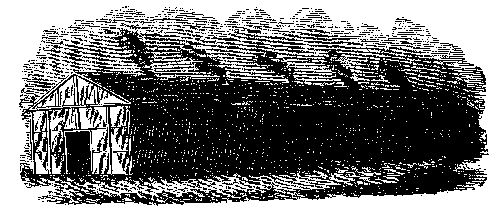
Seneca-Iroquois long house.

Ground-plan of long house.
Though there was but one freshly-cooked meal, taken about the middle of the day, any member of the household when hungry could be helped from the common stock. Hospitality was universal. If a person from one of the other communal households, or a stranger from another tribe (in time of peace), Hospitality. were to visit the house, the women would immediately offer him food, and it was a breach of etiquette to decline to eat it. This custom was strictly observed all over the continent and in the West India Islands, and was often remarked upon by the early discoverers, in whose minds it was apt to implant idyllic notions that were afterward rudely disturbed. The prevalence of hospitality among uncivilized races has long been noted by travellers, and is probably in most cases, as it certainly was in ancient America, closely connected with communism in living.
I. Wolf Phratry. Clans: 1. Wolf, 2. Bear, 3. Dog, 4. Opossum.
II. Turtle Phratry. Clans: 5. Little Turtle, 6. Mud Turtle, 7. Great Turtle, 8. Yellow Eel.
III. Turkey Phratry. Clans: 9. Turkey, 10. Crane, 11. Chicken.
The Indian tribe was a group of people distinguished by the exclusive possession of a dialect in common. Structure of the tribe. It possessed a tribal name and occupied a more or less clearly defined territory; there were also tribal religious rites. Its supreme government was vested in the council of its clan-chiefs and sachems; and as these were thus officers of the tribe as well as of the clan, the tribe exercised the right of investing them with office, amid appropriate solemnities, after their election by their respective clans. The tribal-council had also the right to depose chiefs and sachems. In some instances, not always, there was a head chief or military commander for the tribes, elected by the tribal council. Such, was the origin of the office which, in most societies of the Old World, gradually multiplied its functions and accumulated power until it developed into true kingship. Nowhere in ancient North America did it quite reach such a stage.
The communal household and the political structure built upon it, as above described in the case of the Iroquois, seem to have existed all over ancient North America, with agreement in fundamental characteristics and variation in details and degree of development. There are many corners as yet imperfectly explored, but hitherto, in so far as research has been rewarded with information, it all points in the same general direction. Among the tribes above enumerated as either in savagery or in the lower status of barbarism, so far as they have been studied, there seems to be a general agreement, as to the looseness of the marriage tie the clan with descent in the female line, the phratry, the tribe, the officers and councils, the social equality, the community in goods (with exceptions already noted), and the wigwam or house adapted to communal living.
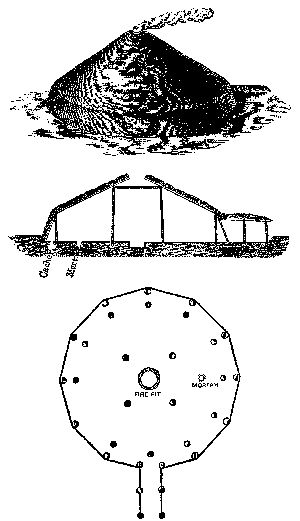
View, Cross-section, and Ground-plan of Mandan round house.
We are now prepared to understand some essential points in the life of the groups of Indians occupying the region of the Cordilleras, both north and south of the Isthmus of Darien, all the way from Zuñi to Quito. The Indians of the pueblos,—in the middle status of barbarism. The principal groups are the Moquis and Zuñis of Arizona and New Mexico, the Nahuas or Nahuatlac tribes of Mexico, the Mayas, Quichés, and kindred peoples of Central America; and beyond the isthmus, the Chibchas of New Granada, and sundry peoples comprised within the domain of the Incas. With regard to the ethnic relationships of these various groups, opinion is still in a state of confusion; but it is not necessary for our present purpose that we should pause to discuss the numerous questions thus arising. Our business is to get a clear notion in outline of the character of the culture to which these peoples had attained at the time of the Discovery. Here we observe, on the part of all, a very considerable divergence from the average Indian level which we have thus far been describing.
This divergence increases as we go from Zuñi toward Cuzco, reaching its extreme, on the whole, among the Peruvians, though in some respects the nearest approach to civilization was made by the Mayas. All these peoples were at least one full ethnical period nearer to true civilization than the Iroquois,—and a vast amount of change and improvement is involved in the conception of an entire ethnical period. According to Mr. Morgan, one more such period would have brought the average level of these Cordilleran peoples to as high a plane as that of the Greeks described in the Odyssey. Let us now observe the principal points involved in the change, bearing in mind that it implies a considerable lapse of time. While the date 1325, at which the city of Mexico was founded, is the earliest date in the history of that country which can be regarded as securely established, it was preceded by a long series of generations of migration and warfare, the confused and fragmentary record of which historians have tried—hitherto with scant success—to unravel. To develop such a culture as that of the Aztecs out of an antecedent culture similar to that of the Iroquois must of course have taken a long time.
It will be remembered that the most conspicuous distinctive marks of the grade of culture attained by the Cordilleran peoples were two,—the Horticulture with irrigation, and architecture with adobe. cultivation of maize in large quantities by irrigation, and the use of adobe-brick or stone in building. Probably there was at first, to some extent, a causal connection between the former and the latter. The region of the Moqui-Zuñi culture is a region in which arid plains become richly fertile when water from neighbouring cliffs or peaks is directed down upon them. It is mainly an affair of sluices, not of pump or well, which seem to have been alike beyond the ken of aboriginal Americans of whatever grade. The change of occupation involved in raising large crops of corn by the aid of sluices would facilitate an increase in density of population, and would encourage a preference for agricultural over predatory life. Such changes would be likely to favour the development of defensive military art. The Mohawk's surest defence lay in the terror which his prowess created hundreds of miles away. One can easily see how the forefathers of our Moquis and Zuñis may have come to prefer the security gained by living more closely together and building impregnable fortresses.
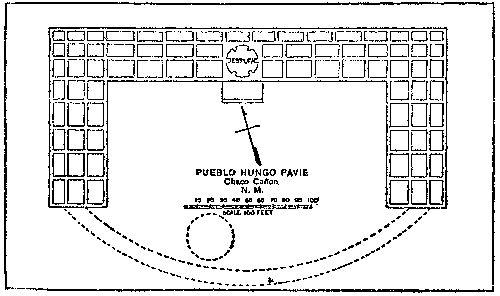
Pueblo Hungo Pavie. Chaco Cañon N. M.
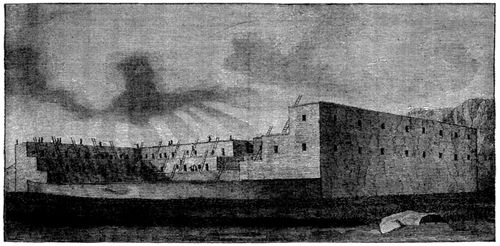
Restoration of Pueblo Hungo Pavie.
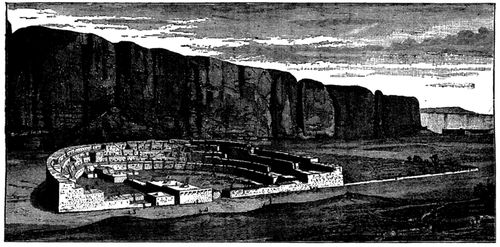
Restoration of Pueblo Bonito.
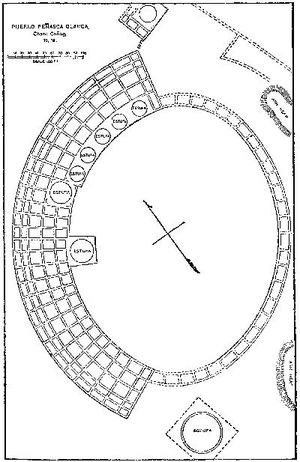
Pueblo Peñasca Blanca.
The pueblo of Zuñi is a more extensive and complex structure than the ruined pueblos on the Chaco river. It is not so much an enormous communal house as a small town formed of a number of such houses crowded together, with access from one to another along their roof-terraces. Pueblo of Zuñi. Some of the structures are of adobe brick, others of stone embedded in adobe mortar and covered with plaster. There are two open plazas or squares in the town, and several streets, some of which are covered ways passing beneath the upper stories of houses. The effect, though not splendid, must be very picturesque, and would doubtless astonish and bewilder visitors unprepared for such a sight. When Coronado's men discovered Zuñi in 1540, although that style of building was no longer a novelty to them, they compared the place to Granada.
But when Cortes described Tlascala as "quite as well built" as Granada, it is not at all likely that he was thinking about that exquisite Moorish architecture which in the mind of Mr. Prescott or any cultivated modern writer is the first thing to be suggested by the name. The Spaniards of those days did not admire the artistic work of "infidels;" they covered up beautiful arabesques with a wash of dirty plaster, and otherwise behaved very much like the Puritans who smashed the "idolatrous" statues in English cathedrals. When Cortes looked at Tlascala, and Coronado looked at Zuñi, and both soldiers were reminded of Granada, they were probably looking at those places with a professional eye as fortresses hard to capture; and from this point of view there was doubtless some justice in the comparison.
The tributary pueblos were also liable to be summoned to furnish a contingent of warriors to the war-parties of the confederacy, under the same penalties for delinquency as in the case of refusal of tribute. In such cases it was quite common for the confederacy to issue a peremptory summons, followed by a declaration of war. When a pueblo was captured, the only way in which the vanquished people could stop the massacre was by holding out signals of submission; a parley then sometimes adjusted the affair, and the payment of a year's tribute in advance induced the conquerors to depart, but captives once taken could seldom if ever be ransomed. If the parties could not agree upon terms, the slaughter was renewed, and sometimes went on until the departing victors left nought behind them but ruined houses belching from loop-hole and doorway lurid clouds of smoke and flame upon narrow silent streets heaped up with mangled corpses.
The members of the clan were reciprocally bound to aid, defend, and avenge one another; but wergild was no longer accepted, and the penalty for murder was death. The clan exercised the right of naming its members. Such names were invariably significant (as Nezahualcoyotl, "Hungry Coyote," Axayacatl, "Face-in-the-Water," etc.), Rights and duties of the clan. and more or less "medicine," or superstitious association, was attached to the name. The clans also had their significant names and totems. Each clan had its peculiar religious rites, its priests or medicine-men who were members of the clan council, and its temple or medicine-house. Instead of burying their dead the Mexican tribes practised cremation; there was, therefore, no common cemetery, but the funeral ceremonies were conducted by the clan.
The general similarity of the Aztec confederacy to that of the Iroquois, in point of social structure, is thus clearly manifest. Aztec and Iroquois confederacies contrasted. Along with this general similarity we have observed some points of higher development, such as one might expect to find in traversing the entire length of an ethnical period. Instead of stockaded villages, with houses of bark or of clay supported upon a wooden framework, we have pueblos of adobe-brick or stone, in various stages of evolution, the most advanced of which present the appearance of castellated cities. Along with the systematic irrigation and increased dependence upon horticulture, we find evidences of greater density of population; and we see in the victorious confederacy a more highly developed organization for adding to its stock of food and other desirable possessions by the systematic plunder of neighbouring weaker communities. Naturally such increase in numbers and organization entails some increase in the number of officers and some differentiation of their functions, as illustrated in the representation of the clans (calpulli) in the tribal council (tlatocan), by speakers (tlatoani) chosen for the purpose, and not by the official heads (calpullec) of the clan. Likewise in the military commander-in-chief (tlacatecuhtli) we observe a marked increase in dignity, and—as I have already suggested and hope to maintain—we find that his office has been clothed with sacerdotal powers, and has thus taken a decided step toward kingship of the ancient type, as depicted in the Homeric poems.
It is at this point, I think, that a judicious critic will begin to part company with Mr. Morgan. As regards the outward aspect of the society which the Spaniards found in Mexico, Mr. Morgan's rules. that eminent scholar more than once used arguments that were inconsistent with principles of criticism laid down by himself. At the beginning of his chapter on the Aztec confederacy Mr. Morgan proposed the following rules:—
"The histories of Spanish America may be trusted in whatever relates to the acts of the Spaniards, and to the acts and personal characteristics of the Indians; in whatever relates to their weapons, implements and utensils, fabrics, food and raiment, and things of a similar character.
Perhaps it would have been better if the second of these rules had been somewhat differently worded; for even with regard to the strange society and government, the Spanish writers have recorded an immense number of valuable facts, without which Mr. Bandelier's work would have been impossible. It is not so much the facts as the interpretations of the Spanish historians that are "nearly worthless," and even their misinterpretations are interesting and instructive when once we rightly understand them. Sometimes they really help us toward the truth.
In truth, the middle period of barbarism was one of the most important periods in the career of the human race, and full of fascination to the student, Importance of the middle period of barbarism. as the unfading interest in ancient Mexico and the huge mass of literature devoted to it show. It spanned the interval between such society as that of Hiawatha and such as that of the Odyssey. One more such interval (and, I suspect, a briefer one, because the use of iron and the development of inheritable wealth would accelerate progress) led to the age that could write the Odyssey, one of the most beautiful productions of the human mind. If Mr. Morgan had always borne in mind that, on his own classification, Montezuma must have been at least as near to Agamemnon as to Powhatan, his attitude toward the Spanish historians would have been less hostile. A Moqui pueblo stands near the lower end of the middle period of barbarism; ancient Troy stood next the upper end. Mr. Morgan found apt illustrations in the former; perhaps if he had lived long enough to profit by the work of Schliemann and Bandelier, he might have found equally apt ones in the latter. Mr. Bandelier's researches certainly show that the ancient city of Mexico, in point of social development, stood somewhere between the two.
How that city looked may best be described when we come to tell what its first Spanish visitors saw. Let it suffice here to say that, upon a reasonable estimate of their testimony, pleasure-gardens, menageries and aviaries, fountains and baths, tessellated marble floors, finely wrought pottery, exquisite featherwork, brilliant mats and tapestries, silver goblets, dainty spices burning in golden censers, varieties of highly seasoned dishes, dramatic performances, jugglers and acrobats, ballad singers and dancing girls,—such things were to be seen in this city of snake-worshipping cannibals. It simulated civilization as a tree-fern simulates a tree.
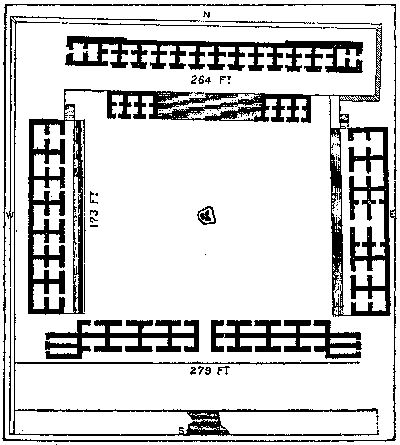
Ground-plan of so-called "House of the Nuns" at Uxmal.
The Mexicans and Mayas believed themselves to be akin to each other, they had several deities and a large stock of traditional lore in common, Maya culture very closely related to Mexican. and there was an essential similarity in their modes of life; so that, since we are now assured that such cities as Izamal and Chichen-Itza were contemporary with the city of Mexico, we shall probably not go very far astray if we assume that the elaborately carved and bedizened ruins of the former may give us some hint as to how things might have looked in the latter. Indeed this complicated and grotesque carving on walls, door-posts, and lintels was one of the first things to attract the attention of the Spaniards in Mexico. They regarded it with mingled indignation and awe, for serpents, coiled or uncoiled, with gaping mouths, were most conspicuous among the objects represented. The visitors soon learned that all this had a symbolic and religious meaning, and with some show of reason they concluded that this strange people worshipped the Devil.
We have now passed in review the various peoples of North America, from the Arctic circle to the neighbourhood of the isthmus of Darien, and can form some sort of a mental picture of the continent at the time of its discovery by Europeans in the fifteenth century. Much more might have been said without going beyond the requirements of an outline sketch, but quite as much has been said as is consistent with the general plan of this book. I have not undertaken at present to go beyond the isthmus of Darien, because this preliminary chapter is already disproportionately long, and after this protracted discussion the reader's attention may be somewhat relieved by an entire change of scene. Enough has been set forth to explain the narrative that follows, and to justify us henceforth in taking certain things for granted. The outline description of Mexico will be completed when we come to the story of its conquest by Spaniards, and then we shall be ready to describe some principal features of Peruvian society and to understand how the Spaniards conquered that country.
If this view, which is steadily gaining ground, be correct, our imaginary race of "Mound-Builders" is broken up and vanishes, and henceforth we may content ourselves with speaking of the authors of the ancient earthworks as "Indians." There were times in the career of sundry Indian tribes when circumstances induced them to erect mounds as sites for communal houses or council houses, medicine-lodges or burial-places; somewhat as there was a period in the history of our own forefathers in England when circumstances led them to build moated castles, with drawbridge and portcullis; and there is no more occasion for assuming a mysterious race of "Mound-Builders" in America than for assuming a mysterious race of "Castle-Builders" in England.
Thus, at whatever point we touch the subject of ancient America, we find scientific opinion tending more and more steadily toward the conclusion that its people and their culture were indigenous. Society in America at the time of the Discovery had reached stages similar to stages reached by eastern Mediterranean peoples fifty or sixty centuries earlier. One of the most important lessons impressed upon us by a long study of comparative mythology is that human minds in different parts of the world, but under the influence of similar circumstances, develop similar ideas and clothe them in similar forms of expression. It is just the same with political institutions, with the development of the arts, with social customs, with culture generally. To repeat the remark already quoted from Sir John Lubbock,—and it is well worth repeating,—"Different races in similar stages of development often present more features of resemblance to one another than the same race does to itself in different stages of its history." When the zealous Abbé Brasseur found things in the history of Mexico that reminded him of ancient Egypt, he hastened to the conclusion that Mexican culture was somehow "derived" from that of Egypt. It was natural enough for him to do so, but such methods of explanation are now completely antiquated. Mexican culture was no more Egyptian culture than a prickly-pear is a lotus. It was an outgrowth of peculiar American conditions acting upon the aboriginal American mind, and such of its features as remind us of ancient Egypt or prehistoric Greece show simply that it was approaching, though it had not reached, the standard attained in those Old World countries. From this point of view the resemblances become invested with surpassing interest. Ancient America, as we have seen, was a much more archaic world than the world of Europe and Asia, and presented in the time of Columbus forms of society that on the shores of the Mediterranean had been outgrown before the city of Rome was built. Hence the intense and peculiar fascination of American archæology, and its profound importance to the student of general history.[Back to Contents]