Volume 4 — ALA AL-DIN ABU AL-SHAMAT.”[24]
Richard Francis Burton translation
ALA AL-DIN ABU AL-SHAMAT.”[24]
“What is that?” asked he, and she said, It hath reached me that there lived, in times of yore and years and ages long gone before, a merchant of Cairo[25] named Shams al-Din, who was of the best and truest-spoken of the traders of the city; and he had eunuchs and servants and negro-slaves and handmaids and Mamelukes and great store of money. Moreover, he was Consul[26] of the Merchants of Cairo and owned a wife, whom he loved and who loved him; except that he had lived with her forty years, yet had not been blessed with a son or even a daughter. One day, as he sat in his shop, he noted that the merchants, each and every, had a son or two sons or more sitting in their shops like their sires. Now the day being Friday; he entered the Hammam-bath and made the total ablution: after which he came out and took the barber’s glass and looked in it, saying, “I testify that there is no god but the God and I testify that Mohammed is the Messenger of God!” Then he considered his beard and, seeing that the white hairs in it covered the black, bethought himself that hoariness is the harbinger of death. Now his wife knew the time of his coming home and had washed and made herself ready for him, so when 30he came in to her, she said, “Good evening,” but he replied “I see no good.” Then she called to the handmaid, “Spread the supper-tray;” and when this was done quoth she to her husband, “Sup, O my lord.” Quoth he, “I will eat nothing,” and pushing the tray away with his foot, turned his back upon her. She asked, “Why dost thou thus? and what hath vexed thee?”; and he answered, “Thou art the cause of my vexation.”——And Shahrazad perceived the dawn of day and ceased saying her permitted say.
Now when it was the Two Hundred and Fiftieth Night,
She said, It hath reached me, O auspicious King, that Shams al-Din said to his wife, “Thou art the cause of my vexation.” She asked, “Wherefore?” and he answered, “When I opened my shop this morning, I saw that each and every of the merchants had with him a son or two sons or more, sitting in their shops like their fathers; and I said to myself:—He who took thy sire will not spare thee. Now the night I first visited thee,[27] thou madest me swear that I would never take a second wife over thee nor a concubine, Abyssinian or Greek or handmaid of other race; nor would lie a single night away from thee: and behold, thou art barren, and having thee is like boring into the rock.” Rejoined she, “Allah is my witness that the fault lies with thee, for that thy seed is thin.” He asked, “And what showeth the man whose semen is thin?” And she answered, “He cannot get women with child, nor beget children.” Quoth he, “What thickeneth the seed? tell me and I will buy it: haply, it will thicken mine.” Quoth she, “Enquire for it of the druggists.” So he slept with her that night and arose on the morrow, repenting of having spoken angrily to her; and she also regretted her cross words. Then he went to the market and, finding a druggist, saluted him; and when his salutation was returned said to him, “Say, hast thou with thee a seed-thickener?” He replied, “I had it, but am out of it: enquire thou of my neighbour.” Then Shams al-Din made the round till he had asked every one, but they all laughed at him, and presently he returned to his shop and sat down, sore 31troubled. Now there was in the bazar a man who was Deputy Syndic of the brokers and was given to the use of opium and electuary and green hashísh.[28] He was called Shaykh Mohammed Samsam and being poor he used to wish Shams al-Din good morrow every day. So he came to him according to his custom and saluted him. The merchant returned his salute, but in ill-temper, and the other, seeing him vexed, said, “O my lord, what hath crossed thee?” Thereupon Shams al-Din told him all that occurred between himself and his wife, adding, “These forty years have I been married to her yet hath she borne me neither son nor daughter; and they say:—The cause of thy failure to get her with child is the thinness of thy seed; so I have been seeking a something wherewith to thicken my semen but found it not.” Quoth Shaykh Mohammed, “O my lord, I have a seed-thickener, but what wilt thou say to him who causeth thy wife to conceive by thee after these forty years have passed?” Answered the merchant, “If thou do this, I will work thy weal and reward thee.” “Then give me a dinar,” rejoined the broker, and Shams al-Din said, “Take these two dinars.” He took them and said, “Give me also yonder big bowl of porcelain.” So he gave it to him and the 32broker betook himself to a hashish-seller, of whom he bought two ounces of concentrated Roumi opium and equal parts of Chinese cubebs, cinnamon, cloves, cardamoms, ginger, white pepper and mountain skink[29]; and, pounding them all together, boiled them in sweet olive-oil; after which he added three ounces of male frankincense in fragments and a cupful of coriander-seed; and, macerating the whole, made it into an electuary with Roumi bee-honey. Then he put the confection in the bowl and carried it to the merchant, to whom he delivered it, saying, “Here is the seed-thickener, and the manner of using it is this. Take of my electuary with a spoon after supping, and wash it down with a sherbet made of rose conserve; but first sup off mutton and house-pigeon plentifully seasoned and hotly spiced.” So the merchant bought all this and sent the meat and pigeons to his wife, saying; “Dress them deftly and lay up the seed-thickener until I want it and call for it.” She did his bidding and, when she served up the meats, he ate the evening meal, after which he called for the bowl and ate of the electuary. It pleased him well, so he ate the rest and knew his wife. That very night she conceived by him and, after three months, her courses ceased, no blood came from her and she knew that she was with child. When the days of her pregnancy were accomplished, the pangs of labour took her and they raised loud lullilooings and cries of joy. The midwife delivered her with difficulty, by pronouncing over the boy at his birth the names of Mohammed and Ali, and said, “Allah is Most Great!”; and she called in his ear the call to prayer. Then she 33wrapped him up and passed him to his mother, who took him and gave him the breast; and he sucked and was full and slept. The midwife abode with them three days, till they had made the mothering-cakes of sugared bread and sweetmeats; and they distributed them on the seventh day. Then they sprinkled salt against the evil eye and the merchant, going in to his wife, gave her joy of her safe delivery, and said, “Where is Allah’s deposit?” So they brought him a babe of surpassing beauty, the handiwork of the Orderer who is ever present and, though he was but seven days old, those who saw him would have deemed him a yearling child. So the merchant looked on his face and, seeing it like a shining full moon, with moles on either cheek, said he to his wife, “What hast thou named him?” Answered she, “If it were a girl I had named her; but this is a boy, so none shall name him but thou.” Now the people of that time used to name their children by omens; and, whilst the merchant and his wife were taking counsel of the name, behold, one said to his friend, “Ho my lord, Ala al-Din!” So the merchant said, “We will call him Ala al-Din Abú al-Shámát.”[30] Then he committed the child to the nurse, and he drank milk two years, after which they weaned him and he grew up and throve and walked upon the floor. When he came to seven years old, they put him in a chamber under a trap-door, for fear of the evil eye, and his father said, “He shall not come out, till his beard grow.” So he gave him in charge to a handmaid and a blackamoor; the girl dressed him his meals and the slave carried them to him. Then his father circumcised him and made him a great feast; after which he brought him a doctor of the law, who taught him to write and read and repeat the Koran, and other arts and sciences, till he became a good scholar and an accomplished. One day it so came to pass that the slave, after 34bringing him the tray of food went away and left the trap-door open: so Ala al-Din came forth from the vault and went in to his mother, with whom was a company of women of rank. As they sat talking, behold, in came upon them the youth as he were a white slave drunken[31] for the excess of his beauty; and when they saw him, they veiled their faces and said to his mother, “Allah requite thee, O such an one! How canst thou let this strange Mameluke in upon us? Knowest thou not that modesty is a point of the Faith?” She replied, “Pronounce Allah’s name[32] and cry Bismillah! this is my son, the fruit of my vitals and the heir of Consul Shams al-Din, the child of the nurse and the collar and the crust and the crumb.”[33] Quoth they, “Never in our days knew we that thou hadst a son”; and quoth she, “Verily his father feared for him the evil eye and reared him in an under-ground chamber;”——And Shahrazad perceived the dawn of day and ceased saying her permitted say.
Now when it was the Two Hundred and Fifty-first Night,
She said, It hath reached me, O auspicious King, that Ala-al-Din’s mother said to her lady-friends, “Verily his father feared for him the evil eye and reared him in an under-ground chamber; and haply the slave forgot to shut the door and he fared forth; but we did not mean that he should come out, before his beard was grown.” The women gave her joy of him, and the youth went out from them into the court yard where he seated himself in the open sitting-room; and behold, in came the slaves with his father’s she-mule, and he said to them, “Whence cometh this mule?” Quoth they, “We escorted thy father when riding her to the shop, and we have brought her back.” He asked, “What may be my father’s trade?”; and they answered, “Thy father is Consul of the merchants in the land of Egypt and Sultan of the Sons of the Arabs.” Then he went in to his mother and said to her, “O my mother, what is my father’s trade?” Said she, “O my son, thy sire is a merchant and Consul of the merchants in the land of 35Egypt and Sultan of the Sons of the Arabs. His slaves consult him not in selling aught whose price is less than one thousand gold pieces, but merchandise worth him an hundred and less they sell at their own discretion; nor doth any merchandise whatever, little or muchel, leave the country without passing through his hands and he disposeth of it as he pleaseth; nor is a bale packed and sent abroad amongst folk but what is under his disposal. And Almighty Allah, O my son, hath given thy father monies past compt.” He rejoined, “O my mother, praised be Allah, that I am son of the Sultan of the Sons of the Arabs and that my father is Consul of the merchants! But why, O my mother, do ye put me in the under-ground chamber and leave me prisoner there?” Quoth she, “O my son, we imprisoned thee not save for fear of folks’ eyes: ‘the evil eye is a truth,’[34] and most of those in their long homes are its victims.” Quoth he, “O my mother, and where is a refuge-place against Fate? Verily care never made Destiny forbear, nor is there flight from what is written for every wight. He who took my grandfather will not spare myself nor my father; for, though he live to-day he shall not live to-morrow. And when my father dieth and I come forth and say:—I am Ala al-Din, son of Shams al-Din the merchant, none of the people will believe me, but men of years and standing will say:—In our lives never saw we a son or a daughter of Shams al-Din. Then the public Treasury will come down and take my father’s estate, and Allah have mercy on him who said:—The noble dieth and his wealth passeth away, and the meanest of men take his women. Therefore, O my mother, speak thou to my father, that he carry me with him to the bazar and open for me a shop; so may I sit there with my merchandise and teach me to buy and sell and take and give.” Answered his mother, “O my son, as soon as thy sire returneth I will tell him this.” So when the merchant came home, he found his son Ala al-Din Abu al-Shamat sitting with his mother and said to her, “Why hast thou brought him forth of the under-ground chamber?” She replied, “O son of my uncle, it was not I that brought him out; but the servants forgot to shut the door and left it open; so, as I sat with a company of women of rank, behold, he came forth and walked in to me.” Then she went on to repeat to him his son’s words; so he said, “O my son, to-morrow, 36Inshallah! I will take thee with me to the bazar; but, my boy, sitting in markets and shops demandeth good manners and courteous carriage in all conditions.” Ala al-Din passed the night rejoicing in his father’s promise and, when the morrow came, the merchant carried him to the Hammam and clad him in a suit worth a mint of money. As soon as they had broken their fast and drunk their sherbets, Shams al-Din mounted his she-mule and putting his son upon another, rode to the market, followed by his boy. But when the market-folk saw their Consul making towards them, foregoing a youth as he were a slice of the full moon on the fourteenth night, they said, one to other, “See thou yonder boy behind the Consul of the merchants; verily, we thought well of him, but he is, like the leek, gray of head and green at heart.”[35] And Shaykh Mohammed Samsam, Deputy Syndic of the market, the man before mentioned, said to the dealers, “O merchants, we will not keep the like of him for our Shaykh; no, never!” Now it was the custom anent the Consul when he came from his house of a morning and sat down in his shop, for the Deputy Syndic of the market to go and recite to him and to all the merchants assembled around him the Fátihah or opening chapter of the Koran,[36] after which they accosted him one by one and wished him good morrow and went away, each to his business-place. But when Shams al-Din seated himself in his shop that day as usual, the traders came not to him as accustomed; so he called the Deputy and said to him, “Why come not the merchants together as usual?” Answered Mohammed Samsam, “I know not how to tell thee these troubles, for they have agreed to depose thee from 37the Shaykh-ship of the market and to recite the Fatihah to thee no more.” Asked Shams al-Din, “What may be their reason?”; and asked the Deputy, “What boy is this that sitteth by thy side and thou a man of years and chief of the merchants? Is this lad a Mameluke or akin to thy wife? Verily, I think thou lovest him and inclinest lewdly to the boy.” Thereupon the Consul cried out at him, saying, “Silence, Allah curse thee, genus and species! This is my son.” Rejoined the Deputy, “Never in our born days have we seen thee with a son,” and Shams al-Din answered, “When thou gavest me the seed-thickener, my wife conceived and bare this youth; but I reared him in a souterrain for fear of the evil eye, nor was it my purpose that he should come forth, till he could take his beard in his hand.[37] However, his mother would not agree to this, and he on his part begged I would stock him a shop and teach him to sell and buy.” So the Deputy Syndic returned to the other traders and acquainted them with the truth of the case, whereupon they all arose to accompany him; and, going in a body to Shams al-Din’s shop, stood before him and recited the “Opener” of the Koran; after which they gave him joy of his son and said to him, “The Lord prosper root and branch! But even the poorest of us, when son or daughter is born to him, needs must cook a pan-full of custard[38] and bid his friends and kith and kin; yet hast thou not done this.” Quoth he, “This I owe you; be our meeting in the garden.”——And Shahrazad perceived the dawn of day and ceased to say her permitted say.
Now when it was the Two Hundred and Fifty-second Night,
Her sister Dunyazad said to her, “Pray continue thy story for us, an thou be awake and not inclined to sleep.” Quoth she:—With pleasure and goodwill: it hath reached me, O auspicious King, that the Consul of the merchants promised them a banquet and said “Be our meeting in the garden.” So when morning dawned he despatched the carpet-layer to the saloon of the garden-pavilion 38and bade him furnish the two. Moreover, he sent thither all that was needful for cooking, such as sheep and clarified butter and so forth, according to the requirements of the case; and spread two tables, one in the pavilion and another in the saloon. Then Shams al-Din and his boy girded themselves, and he said to Ala al-Din “O my son, whenas a greybeard entereth, I will meet him and seat him at the table in the pavilion; and do thou, in like manner, receive the beardless youths and seat them at the table in the saloon.” He asked, “O my father, why dost thou spread two tables, one for men and another for youths?”; and he answered, “O my son, the beardless is ashamed to eat with the bearded.” And his son thought this his answer full and sufficient. So when the merchants arrived, Shams al-Din received the men and seated them in the pavilion, whilst Ala al-Din received the youths and seated them in the saloon. Then the food was set on and the guests ate and drank and made merry and sat over their wine, whilst the attendants perfumed them with the smoke of scented woods, and the elders fell to conversing of matters of science and traditions of the Prophet. Now there was amongst them a merchant called Mahmúd of Balkh, a professing Moslem but at heart a Magian, a man of lewd and mischievous life who loved boys. And when he saw Ala al-Din from whose father he used to buy stuffs and merchandise, one sight of his face sent him a thousand sighs and Satan dangled the jewel before his eyes, so that he was taken with love-longing and desire and affection and his heart was filled with mad passion for him. Presently he arose and made for the youths, who stood up to receive him; and at this moment Ala al-Din being taken with an urgent call of Nature, withdrew to make water; whereupon Mahmud turned to the other youths and said to them, “If ye will incline Ala al-Din’s mind to journeying with me, I will give each of you a dress worth a power of money.” Then he returned from them to the men’s party; and, as the youths were sitting, Ala al-Din suddenly came back, when all rose to receive him and seated him in the place of highest honour. Presently, one of them said to his neighbour, “O my lord Hasan, tell me whence came to thee the capital whereon thou tradest.” He replied, “When I grew up and came to man’s estate, I said to my sire:—O my father, give me merchandise. Quoth he:—O my son, I have none by me; but go thou to some merchant and take of him money and traffic with it; and so learn to buy and sell, give and take. 39So I went to one of the traders and borrowed of him a thousand dinars, wherewith I bought stuffs and carrying them to Damascus, sold them there at a profit of two for one. Then I bought Syrian stuffs and carrying them to Aleppo, made a similar gain of them; after which I bought stuffs of Aleppo and repaired with them to Baghdad, where I sold them with like result, two for one; nor did I cease trading upon my capital till I was worth nigh ten thousand ducats.” Then each of the others told his friend some such tale, till it came to Ala al-Din’s turn to speak, when they said to him, “And thou, O my lord Ala al-Din?” Quoth he, “I was brought up in a chamber under-ground and came forth from it only this week; and I do but go to the shop and return home from the shop.” They remarked, “Thou art used to wone at home and wottest not the joys of travel, for travel is for men only.” He replied, “I reck not of voyaging and wayfaring doth not tempt me.” Whereupon quoth one to the other, “This one is like the fish: when he leaveth the water he dieth.” Then they said to him, “O Ala al-Din, the glory of the sons of the merchants is not but in travel for the sake of gain.” Their talk angered him; so he left them weeping-eyed and heavy-hearted and mounting his mule returned home. Now his mother saw him in tears and in bad temper and asked him, “What hath made thee weep, O my son?”; and he answered, “Of a truth, all the sons of the merchants put me to shame and said:—Naught is more glorious for a merchant’s son than travel for gain and to get him gold.”——And Shahrazad perceived the dawn of day and ceased saying her permitted say.
Now when it was the Two Hundred and Fifty-third Night,
She said, It hath reached me, O auspicious King, that Ala al-Din said to his mother, “Of a truth all the sons of the merchants put me to shame and said:—Naught is more honourable for a merchant’s son than travel for gain.” “O my son, hast thou a mind to travel?” “Even so!” “And whither wilt thou go?” “To the city of Baghdad; for there folk make double the cost price on their goods.” “O my son, thy father is a very rich man and, if he provide thee not with merchandise, I will supply it out of my own monies.” “The best favour is that which is soonest 40bestowed; if this kindness is to be, now is the time.” So she called the slaves and sent them for cloth-packers; then, opening a store-house, brought out ten loads of stuffs, which they made up into bales for him. Such was his case; but as regards his father, Shams al-Din, he looked about and failed to find Ala al-Din in the garden and enquiring after him, was told that he had mounted mule and gone home; so he too mounted and followed him. Now when he entered the house, he saw the bales ready bound and asked what they were; whereupon his wife told him what had chanced between Ala al-Din and the sons of the merchants; and he cried, “O my son, Allah’s malison on travel and stranger-hood! Verily Allah’s Apostle (whom the Lord bless and preserve!) hath said:—It is of a man’s happy fortune that he eat his daily bread in his own land; and it was said of the ancients:—Leave travel, though but for a mile.” Then quoth he to his son, “Say, art thou indeed resolved to travel and wilt thou not turn back from it?” Quoth the other, “There is no help for it but that I journey to Baghdad with merchandise, else will I doff clothes and don dervish gear and fare a-wandering over the world.” Shams al-Din rejoined, “I am no penniless pauper but have great plenty of wealth;” then he showed him all he owned of monies and stuffs and stock-in-trade and observed, “With me are stuffs and merchandise befitting every country in the world.” Then he showed him among the rest, forty bales ready bound, with the price, a thousand dinars, written on each, and said, “O my son take these forty loads, together with the ten which thy mother gave thee, and set out under the safeguard of Almighty Allah. But, O my child, I fear for thee a certain wood in thy way, called the Lion’s Copse,[39] and a valley hight the Vale of Dogs, for there lives are lost without mercy.” He said, “How so, O my father?”; and he replied, “Because of a Badawi bandit named Ajlán.” Quoth Ala al-Din, “Such is Allah’s luck; if any share of it be mine, no harm shall hap to me.” Then they rode to the cattle-bazar, where behold, a cameleer[40] alighted from his she-mule and kissing the Consul’s hand, said to him, “O my lord, it is long, by 41Allah, since thou hast employed us in the way of business.” He replied, “Every time hath its fortune and its men,[41] and Allah have ruth on him who said:—
And the old man crept o’er the worldly ways ✿ So bowed, his beard o’er his knees down flow’th:
Quoth I:—What gars thee so doubled go? ✿ Quoth he (as to me his hands he show’th)
My youth is lost, in the dust it lieth; ✿ And see, I bend me to find my youth.”[42]
Now when he had ended his verses, he said, “O chief of the caravan, it is not I who am minded to travel, but this my son.” Quoth the cameleer, “Allah save him for thee.” Then the Consul made a contract between Ala al-Din and the man, appointing that the youth should be to him as a son, and gave him into his charge, saying, “Take these hundred gold pieces for thy people.” Moreover he bought his son threescore mules and a lamp and a tomb-covering for the Sayyid Abd al-Kadir of Gílán[43] and said to him, “O my son, while I am absent, this is thy sire in my stead: whatsoever he biddeth thee, do thou obey him.” So saying, he returned home with the mules and servants and that night they made a Khitmah or perlection of the Koran and held a festival in honour of the Shaykh Abd al-Kadir al-Jiláni. And when the morrow dawned, the Consul gave his son ten thousand dinars, saying, “O my son, when thou comest to Baghdad, if thou find stuffs easy of sale, sell them; but if they be dull, spend of these dinars.” Then they loaded the mules and, taking leave of one another, all the wayfarers setting out on their journey, marched forth from the city. Now Mahmud of Balkh had made ready his own venture for Baghdad and had moved his bales and set up his tents without the walls, saying in himself, “Thou shalt not enjoy this youth but in the desert, where there is neither spy nor marplot to trouble thee.” It chanced that he had in hand a thousand 42dinars which he owed to the youth’s father, the balance of a business-transaction between them; so he went and bade farewell to the Consul, who charged him, “Give the thousand dinars to my son Ala al-Din;” and commended the lad to his care, saying, “He is as it were thy son.” Accordingly, Ala al-Din joined company with Mahmud of Balkh——And Shahrazad perceived the dawn of day and ceased to say her permitted say.
Now when it was the Two Hundred and Fifty-fourth Night,
She said, It hath reached me, O auspicious King that Ala al-Din joined company with Mahmud of Balkh who, before beginning the march, charged the youth’s cook to dress nothing for him, but himself provided him and his company with meat and drink. Now he had four houses, one in Cairo, another in Damascus, a third in Aleppo and a fourth in Baghdad. So they set out and ceased not journeying over waste and wold till they drew near Damascus, when Mahmud sent his slave to Ala al-Din, whom he found sitting and reading. He went up to him and kissed his hands, and Ala al-Din having asked him what he wanted, he answered, “My master saluteth thee and craveth thy company to a banquet at his place.” Quoth the youth, “Not till I consult my father Kamál al-Din, the captain of the caravan.” So he asked advice of the Makaddam,[44] who said, “Do not go.” Then they left Damascus and journeyed on till they came to Aleppo, where Mahmud made a second entertainment and sent to invite Ala al-Din; but he consulted the Chief Cameleer who again forbade him. Then they marched from Aleppo and fared on, till there remained between them and Baghdad only a single stage. Here Mahmud prepared a third feast and sent to bid Ala al-Din to it: Kamal al-Din once more forbade his accepting it, but he said, “I must needs go.” So he rose and, slinging a sword over his shoulder, under his clothes, repaired to the tent of Mahmud of Balkh, who came to meet him and saluted him. Then he set before him a sumptuous repast and they ate and drank and washed hands. At last Mahmud bent towards Ala al-Din to snatch a kiss from him, but the youth 43received the kiss on the palm of his hand and said to him, “What wouldest thou be at?” Quoth Mahmud, “In very sooth I brought thee hither that I might take my pleasure with thee in this jousting-ground, and we will comment upon the words of him who saith:—
Say, canst not come to us one momentling, ✿ Like milk of ewekin or aught glistening,
And eat what liketh thee of dainty cate, ✿ And take thy due of fee in silverling,
And bear whatso thou wilt, without mislike, ✿ Of spanling, fistling or a spanlong thing?”
Then Mahmud of Balkh would have laid hands on Ala al-Din to ravish him; but he rose and baring his brand, said to him, “Shame on thy gray hairs! Hast thou no fear of Allah, and He of exceeding awe?[45] May He have mercy on him who saith:—
Preserve thy hoary hairs from soil and stain, ✿ For whitest colours are the easiest stained!”
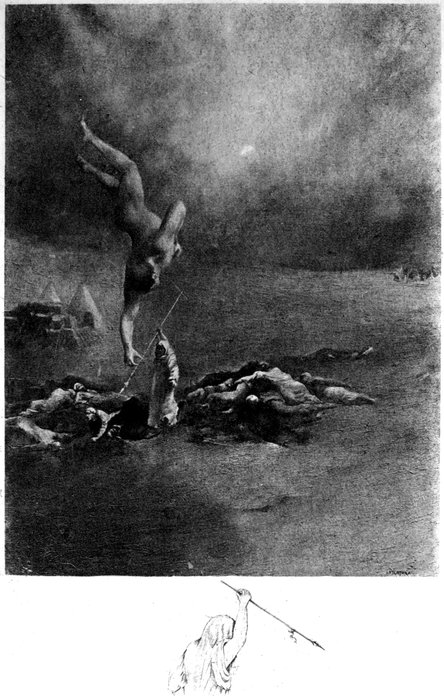
And when he ended his verses he said to Mahmud of Balkh, “Verily this merchandise[46] is a trust from Allah and may not be sold. If I sold this property to other than thee for gold, I would sell it to thee for silver; but by Allah, O filthy villain, I will never again company with thee; no, never!” Then he returned to Kamal al-Din the guide and said to him, “Yonder man is a lewd fellow, and I will no longer consort with him nor suffer his company by the way.” He replied, “O my son, did I not say to thee:—Go not near him? But if we part company with him, I fear destruction for ourselves; so let us still make one caravan.” But Ala al-Din cried, “It may not be that I ever again travel with him.” So he loaded his beasts and journeyed onwards, he and his company, till they came to a valley, where Ala al-Din would have halted, but the Cameleer said to him, “Do not halt here; rather let us fare forwards and press our pace, so haply we make Baghdad before the gates are closed, for they open and shut 44them with the sun, in fear lest the Rejectors[47] should take the city and throw the books of religious learning into the Tigris.” But Ala al-Din replied to him, “O my father, I came not forth from home with this merchandise, or travelled hither for the sake of traffic, but to divert myself with the sight of foreign lands and folks;” and he rejoined, “O my son, we fear for thee and for thy goods from the wild Arabs.” Whereupon the youth answered, “Harkye, fellow, art thou master or man? I will not enter Baghdad till the morning, that the sons of the city may see my merchandise and know me.” “Do as thou wilt,” said the other; “I have given thee the wisest advice, but thou art the best judge of thine own case.” Then Ala al-Din bade them unload the mules and pitch the tent; so they did his bidding and abode there till the middle of the night, when he went out to obey a call of nature and suddenly saw something gleaming afar off. So he said to Kamal al-Din, “O captain, what is yonder glittering?” The Cameleer sat up and, considering it straitly, knew it for the glint of spear-heads and the steel of Badawi weapons and swords. And lo and behold! this was a troop of wild Arabs under a chief called Ajlán Abú Náib, Shaykh of the Arabs, and when they neared the camp and saw the bales and baggage, they said one to another, “O night of loot!” Now when Kamal al-Din heard these their words he cried, “Avaunt, O vilest of Arabs!” But Abu Naib so smote him with his throw-spear in the breast, that the point came out gleaming from his back, and he fell down dead at the tent-door. Then cried the water-carrier,[48] “Avaunt, O foulest of Arabs!” and one of them smote him with a sword upon the shoulder, that it issued shining from the tendons of the throat, and he also fell down dead. (And all this while Ala al-Din stood looking on.) Then the Badawin surrounded and charged the caravan from every side and slew all Ala al-Din’s company without sparing a man: after which they loaded the mules with the spoil and made off. Quoth Ala al-Din to himself, “Nothing will slay thee save thy mule and thy dress!”; so he arose and put off his gown and threw it over the back of a mule, remaining in his shirt and bag-trousers only; after which he looked towards the tent-door and, seeing there a pool of gore flowing from the slaughtered, wallowed in it with his remaining clothes till he was as a slain man drowned in his own blood. Thus it fared with him; but as regards the Shaykh of the wild Arabs, Ajlan, he said to his banditti, “O Arabs, was this caravan bound from Egypt for Baghdad or from Baghdad for Egypt?”——And Shahrazad perceived the dawn of day and ceased saying her permitted say.
45
Now when it was the Two Hundred and Fifty-fifth Night,
She said, It hath reached me, O auspicious King that when the Badawi asked his banditti, “O Arabs, was this caravan bound from Egypt for Baghdad or from Baghdad for Egypt?”; they answered, “’Twas bound from Egypt for Baghdad;” and he said, “Return ye to the slain, for methinks the owner of this caravan is not dead.” So they turned back to the slain and fell to prodding and slashing them with lance and sword till they came to Ala al-Din, who had thrown himself down among the corpses. And when they came to him, quoth they, “Thou dost but feign thyself dead, but we will make an end of thee,” and one of the Badawin levelled his javelin and would have plunged it into his breast when he cried out, “Save me, O my lord Abd al-Kadir, O Saint of Gilan!” and behold, he saw a hand turn the lance away from his breast to that of Kamal al-Din the cameleer, so that it pierced him and spared himself.[49] Then the Arabs made off; and, when Ala al-Din saw that the birds were flown with their god-send, he sat up and finding no one, rose and set off running; but, behold Abu Náib the Badawi looked back and said to his troop, “I see somewhat moving afar off, O Arabs!” So one of the bandits 46turned back and, spying Ala al-Din running, called out to him, saying, “Flight shall not forward thee and we after thee;” and he smote his mare with his heel and she hastened after him. Then Ala al-Din seeing before him a watering tank and a cistern beside it, climbed up into a niche in the cistern and, stretching himself at full length, feigned to be asleep and said, “O gracious Protector, cover me with the veil of Thy protection which may not be torn away!” And lo! the Badawi came up to the cistern and, standing in his stirrup-irons put out his hand to lay hold of Ala al-Din; but he said, “O my lady Nafísah[50]! Now is thy time!” And behold, a scorpion stung the Badawi in the palm and he cried out, saying, “Help, O Arabs! I am stung;” and he alighted from his mare’s back. So his comrades came up to him and mounted him again, asking, “What hath befallen thee?” whereto he answered, “A young scorpion[51] stung me.” So they departed, with the caravan. Such was their case; but as regards Ala al-Din, he tarried in the niche, and Mahmud of Balkh bade load his beasts and fared forwards till he came to the Lion’s Copse where he found Ala al-Din’s attendants all lying slain. At this he rejoiced and went on till he reached the cistern and the reservoir. Now his mule was athirst and turned aside to drink, but she saw Ala al-Din’s shadow in the water and shied and started; whereupon Mahmud raised his eyes and, seeing Ala al-Din lying in the niche, stripped to his shirt and bag-trousers, said to him, “What man this deed to thee hath dight and left thee in this evil plight?” Answered Ala al-Din, “The Arabs,” and Mahmud said, “O my son, the mules and the baggage were thy ransom; so do thou comfort thyself with his saying who said:—
If thereby man can save his head from death, ✿ His good is worth him but a slice of nail!
But now, O my son, come down and fear no hurt.” Thereupon he 47descended from the cistern-niche and Mahmud mounted him on a mule, and they fared on till they reached Baghdad, where he brought him to his own house and carried him to the bath, saying to him, “The goods and money were the ransom of thy life, O my son; but, if thou wilt hearken to me, I will give thee the worth of that thou hast lost, twice told.” When he came out of the bath, Mahmud carried him into a saloon decorated with gold with four raised floors, and bade them bring a tray with all manner of meats. So they ate and drank and Mahmud bent towards Ala al-Din to snatch a kiss from him; but he received it upon the palm of his hand and said, “What, dost thou persist in thy evil designs upon me? Did I not tell thee that, were I wont to sell this merchandise to other than thee for gold, I would sell it thee for silver?” Quoth Mahmud, “I will give thee neither merchandise nor mule nor clothes save at this price; for I am gone mad for love of thee, and bless him who said:—
Told us, ascribing to his Shaykhs, our Shaykh ✿ Abú Bilál, these words they wont to utter:[52]
Unhealed the lover wones of love desire, ✿ By kiss and clip; his only cure’s to futter!”
Ala al-Din replied, “Of a truth this may never be, take back thy dress and thy mule and open the door that I may go out.” So he opened the door, and Ala al-Din fared forth and walked on, with the dogs barking at his heels, and he went forwards through the dark when behold, he saw the door of a mosque standing open and, entering the vestibule, there took shelter and concealment; and suddenly a light approached him and on examining it he saw that it came from a pair of lanthorns borne by two slaves before two merchants. Now one was an old man of comely face and the other a youth; and he heard the younger say to the elder, “O my uncle, I conjure thee by Allah, give me back my cousin!” The old man replied, “Did I not forbid thee, many a time, when the oath of divorce was always in thy mouth, as it were Holy Writ?” Then he turned to his right and, seeing Ala al-Din as he were a slice of the full moon, said to him, “Peace be with thee! who art thou, O my son?” Quoth he, returning the salutation of peace, “I am Ala al-Din, son of Shams al-Din, Consul of the merchants 48for Egypt. I besought my father for merchandise; so he packed me fifty loads of stuffs and goods,”——And Shahrazad perceived the dawn of day and ceased to say her permitted say.
Now when it was the Two Hundred and Fifty-sixth Night,
She said, It hath reached me, O auspicious King, that Ala al-Din continued, “So he packed me fifty loads of goods and gave me ten thousand dinars, wherewith I set out for Baghdad; but when I reached the Lion’s Copse, the wild Arabs came out against me and took all my goods and monies. So I entered the city knowing not where to pass the night and, seeing this place, I took shelter here.” Quoth the old man, “O my son, what sayest thou to my giving thee a thousand dinars and a suit of clothes and a mule worth other two thousand?” Ala al-Din asked, “To what end wilt thou give me these things, O my uncle?” and the other answered, “This young man who accompanieth me, is the son of my brother and an only son; and I have a daughter called Zubaydah[53] the lutist, an only child who is a model of beauty and loveliness, so I married her to him. Now he loveth her, but she loatheth him; and when he chanced to take an oath of triple divorcement and broke it, forthright she left him. Whereupon he egged on all the folk to intercede with me to restore her to him; but I told him that this could not lawfully be save by an intermediate marriage, and we have agreed to make some stranger the intermediary[54] in order that none may taunt and shame him with this affair. So, as thou art a stranger, come with us and we will marry thee to her; thou shalt lie with her to-night and on the morrow divorce her and we will give thee what I said.” Quoth Ala al-Din 49to himself, “By Allah, to bide the night with a bride on a bed in a house is far better than sleeping in the streets and vestibules!” So he went with them to the Kazi whose heart, as soon as he saw Ala al-Din, was moved to love him, and who said to the old man, “What is your will?” He replied, “We wish to make this young man an intermediary husband for my daughter; but we will write a bond against him binding him to pay down by way of marriage-settlement ten thousand gold pieces. Now if after passing the night with her he divorce her in the morning, we will give him a mule and dress each worth a thousand dinars, and a third thousand of ready money; but if he divorce her not, he shall pay down the ten thousand dinars according to contract.” So they agreed to the agreement and the father of the bride to be received his bond for the marriage-settlement. Then he took Ala al-Din and, clothing him anew, carried him to his daughter’s house and there he left him standing at the door, whilst he himself went in to the young lady and said, “Take the bond of thy marriage-settlement, for I have wedded thee to a handsome youth by name Ala al-Din Abu al-Shamat: so do thou use him with the best of usage.” Then he put the bond into her hands and left her and went to his own lodging. Now the lady’s cousin had an old duenna who used to visit Zubaydah, and he had done many a kindness to this woman, so he said to her, “O my mother, if my cousin Zubaydah see this handsome young man, she will never after accept my offer; so I would fain have thee contrive some trick to keep her and him apart.” She answered, “By the life of thy youth,[55] I will not suffer him to approach her!” Then she went to Ala al-Din and said to him, “O my son, I have a word of advice to give thee, for the love of Almighty Allah and do thou accept my counsel, as I fear for thee from this young woman: better thou let her lie alone and feel not her person nor draw thee near to her.” He asked, “Why so?”; and she answered, “Because her body is full of leprosy and I dread lest she infect thy fair and seemly youth.” Quoth he, “I have no need of her.” Thereupon she went to the lady and said the like to her of Ala al-Din; and she replied, “I have no need of him, but will let him lie alone, and on the morrow he shall gang his gait.” Then she called a slave-girl and said to her, “Take the tray of food and set it before him that he may sup.” So the handmaid carried him the tray of food and 50set it before him and he ate his fill: after which he sat down and raised his charming voice and fell to reciting the chapter called Y. S.[56] The lady listened to him and found his voice as melodious as the psalms of David sung by David himself,[57] which when she heard, she exclaimed, “Allah disappoint the old hag who told me that he was affected with leprosy! Surely this is not the voice of one who hath such a disease; and all was a lie against him.”[58] Then she took a lute of India-land workmanship and, tuning the strings, sang to it in a voice so sweet its music would stay the birds in the heart of heaven; and began these two couplets:—
I love a fawn with gentle white-black eyes, ✿ Whose walk the willow-wand with envy kills:
Forbidding me he bids for rival mine, ✿ Tis Allah’s grace who grants to whom He wills!
And when he heard her chant these lines he ended his recitation of the chapter, and began also to sing and repeated the following couplet:—
My Salám to the Fawn in the garments concealed, ✿ And to roses in gardens of cheek revealed.
The lady rose up when she heard this, and her inclination for him redoubled and she lifted the curtain; and Ala al-Din, seeing her, recited these two couplets:—
She shineth forth, a moon, and bends, a willow-wand, ✿ And breathes out ambergris, and gazes, a gazelle.
Meseems as if grief loved my heart and when from her ✿ Estrangement I abide possession to it fell.[59]
Thereupon she came forward, swinging her haunches and gracefully swaying a shape the handiwork of Him whose boons are hidden; and each of them stole one glance of the eyes that cost them 51a thousand sighs. And when the shafts of the two regards which met rankled in his heart, he repeated these two couplets:—
She ‘spied the moon of Heaven, reminding me ✿ Of nights when met we in the meadows li’en:
True, both saw moons, but sooth to say, it was ✿ Her very eyes I saw, and she my eyne.
And when she drew near him, and there remained but two paces between them, he recited these two couplets:—
She spread three tresses of unplaited hair ✿ One night, and showed me nights not one but four;
And faced the moon of Heaven with her brow, ✿ And showed me two-fold moons in single hour.
And as she was hard by him he said to her, “Keep away from me, lest thou infect me.” Whereupon she uncovered her wrist[60] to him, and he saw that it was cleft, as it were in two halves, by its veins and sinews and its whiteness was as the whiteness of virgin silver. Then said she, “Keep away from me, thou! for thou art stricken with leprosy, and may be thou wilt infect me.” He asked, “Who told thee I was a leper?” and she answered, “The old woman so told me.” Quoth he, “’Twas she told me also that thou wast afflicted with white scurvy;” and so saying, he bared his forearms and showed her that his skin was also like virgin silver. Thereupon she pressed him to her bosom and he pressed her to his bosom and the twain embraced with closest embrace, then she took him and, lying down on her back, let down her petticoat-trousers, and in an instant that which his father had left him rose up in rebellion against him and he said, “Go it, O Shaykh Zachary[61] of shaggery, O father of veins!”; and putting both hands to her flanks, he set the sugar-stick[62] to the mouth of the cleft and thrust on till he came to the wicket called “Pecten.” His passage was by the Gate of Victories[63] and therefrom he entered 52the Monday market, and those of Tuesday and Wednesday and Thursday,[64] and, finding the carpet after the measure of the daïs-floor,[65] he plied the box within its cover till he came to the end of it. And when morning dawned he cried to her, “Alas for delight which is not fulfilled! The raven[66] taketh it and flieth away!” She asked, “What meaneth this saying?”; and he answered, “O my lady, I have but this hour to abide with thee.” Quoth she, “Who saith so?” and quoth he, “Thy father made me give him a written bond to pay ten thousand dinars to thy wedding-settlement; and, except I pay it this very day, they will imprison me for debt in the Kazi’s house; and now my hand lacketh one half-dirham of the sum.” She asked, “O my lord, is the marriage-bond in thy hand or in theirs?”; and he answered, “O my lady, in mine, but I have nothing.” She rejoined, “The matter is easy; fear thou nothing. Take these hundred dinars: an I had more, I would give thee what thou lackest; but of a truth my father, of his love for my cousin, hath transported all his goods, even to my jewellery, from my lodging to his. But when they send thee a serjeant of the Ecclesiastical Court,”——And Shahrazad perceived the dawn of day and ceased to say her permitted say.
Now when it was the Two Hundred and Fifty-seventh Night,
She said, It hath reached me, O auspicious King, that the young lady rejoined to Ala al-Din, “And when they send thee at an early hour a serjeant of the Ecclesiastical Court, and the Kazi and my father bid thee divorce me, do thou reply, By what law is it lawful 53and right that I should marry at nightfall and divorce in the morning? Then kiss the Kazi’s hand and give him a present, and in like manner kiss the Assessors’ hands and give each of them ten gold pieces. So they will all speak with thee, and if they ask thee, Why dost thou not divorce her and take the thousand dinars and the mule and suit of clothes, according to contract duly contracted? do thou answer, Every hair of her head is worth a thousand ducats to me and I will never put her away, neither will I take a suit of clothes nor aught else. And if the Kazi say to thee, Then pay down the marriage settlement, do thou reply, I am short of cash at this present; whereupon he and the Assessors will deal in friendly fashion with thee and allow thee time to pay.” Now whilst they were talking, behold, the Kazi’s officer knocked at the door; so Ala al-Din went down and the man said to him, “Come, speak the Efendi,[67] for thy father-in-law summoneth thee.” So Ala al-Din gave him five dinars and said to him, “O Summoner, by what law am I bound to marry at nightfall and divorce next morning?” The serjeant answered, “By no law of ours at all, at all; and if thou be ignorant of the religious law, I will act as thine advocate.” Then they went to the divorce-court and the Kazi said to Ala al-Din, “Why dost thou not put away the woman and take what falleth to thee by the contract?” Hearing this he went up to the Kazi; and, kissing his hand, put fifty dinars in it and said, “O our lord the Kazi, by what law is it lawful and right that I should marry at nightfall and divorce in the morning in my own despite?” The Kazi answered, “Divorce on compulsion and by force is sanctioned by no school of the Moslems.” Then said the young lady’s father, “If thou wilt not divorce, pay me the ten thousand dinars, her marriage-settlement.” Quoth Ala al-Din, “Give me a delay of three days;” but the Kazi said, “Three days is not time enough; he shall give thee ten.” So they agreed to this and bound him after ten days either to pay the dowry or to divorce her. And after consenting he left them and taking meat and rice and clarified butter[68] and what else of food he needed, returned to the house and told the young woman all that had passed; whereupon she said, “’Twixt night and day, wonders may display; and Allah bless him for his say:—
54Be mild when rage shall come to afflict thy soul; ✿ Be patient when calamity breeds ire;
Lookye, the Nights are big with child by Time, ✿ Whose pregnancy bears wondrous things and dire.”
Then she rose and made ready food and brought the tray, and they two ate and drank and were merry and mirthful. Presently, Ala al-Din besought her to let him hear a little music; so she took the lute and played a melody that had made the hardest stone dance for glee, and the strings cried out in present ecstacy, “O Loving One!”;[69] after which she passed from the adagio into the presto and a livelier measure. As they thus spent their leisure in joy and jollity and mirth and merriment, behold, there came a knocking at the door and she said to him; “Go see who is at the door.” So he went down and opened it and finding four Dervishes standing without, said to them, “What want ye?” They replied, “O my lord, we are foreign and wandering religious mendicants, the viands of whose souls are music and dainty verse, and we would fain take our pleasure with thee this night till morning doth appear, when we will wend our way, and with Almighty Allah be thy reward; for we adore music and there is not one of us but knoweth by heart store of odes and songs and ritornellos.”[70] He answered, “There is one I must consult;” and he returned and told Zubaydah who said, “Open the door to them.” So he brought them up and made them sit down and welcomed them; then he fetched them food, but they would not eat and said, “O our lord, our meat is to repeat Allah’s name in our hearts and to hear music with our ears: and bless him who saith:—
Our aim is only converse to enjoy, ✿ And eating joyeth only cattle-kind.[71]
And just now we heard pleasant music in thy house, but when we entered, it ceased; and fain would we know whether the player was a slave-girl, white or black, or a maiden of good family.” He answered, “It was this my wife,” and told them all that had befallen him, adding, “Verily my father-in-law hath 55bound me to pay a marriage settlement of ten thousand dinars for her, and they have given me ten days’ time.” Said one of the Dervishes, “Have no care and think of naught but good; for I am Shaykh of the Convent and have forty Dervishes under my orders. I will presently collect from them the ten thousand dinars and thou shalt pay thy father-in-law the wedding settlement. But now bid thy wife make us music that we may be gladdened and pleasured; for to some folk music is meat, to others medicine and to others refreshing as a fan.” Now these four Dervishes were none other than the Caliph Harun al-Rashid, his Wazir Ja’afar the Barmecide, Abu al-Nowás al-Hasan son of Háni[72] and Masrur the sworder; and the reason of their coming to the house was that the Caliph, being heavy at heart, had summoned his Minister and said, “O Wazir! it is our will to go down to the city and pace its streets, for my breast is sore straitened.” So they all four donned dervish-dress and went down and walked about, till they came to that house where, hearing music, they were minded to know the cause. They spent the night in joyance and harmony and telling tale after tale until morning dawned, when the Caliph laid an hundred gold pieces under the prayer-carpet and all taking leave of Ala al-Din, went their way. Now when Zubaydah lifted the carpet she found beneath it the hundred dinars and she said to her husband, “Take these hundred dinars which I have found under the prayer-carpet; assuredly the Dervishes when about to leave us laid them there, without our knowledge.” So Ala al-Din took the money and, repairing to the market, bought therewith meat and rice and clarified butter and all they required. And when it was night, he lit the wax-candles and said to his wife, “The mendicants, it is true, have not brought the ten thousand dinars which they promised me; but indeed they are poor men.” As they were talking, behold, the Dervishes knocked at the door 56and she said, “Go down and open to them.” So he did her bidding and bringing them up, said to them, “Have you brought me the ten thousand dinars you promised me?” They answered, “We have not been able to collect aught thereof as yet; but fear nothing: Inshallah, to-morrow we will compound for thee some alchemical cookery. But now bid thy wife play us her very best pieces and gladden our hearts for we love music.” So she took her lute and made them such melody that had caused the hardest rocks to dance with glee; and they passed the night in mirth and merriment, converse and good cheer, till morn appeared with its sheen and shone, when the Caliph laid an hundred gold pieces under the prayer-carpet and all, after taking leave of Ala al-Din, went their way. And they ceased not to visit him thus every night for nine nights; and each morning the Caliph put an hundred dinars under the prayer-carpet, till the tenth night, when they came not. Now the reason of their failure to come was that the Caliph had sent to a great merchant, saying to him, “Bring me fifty loads of stuffs, such as come from Cairo,”——And Shahrazad perceived the dawn of day and ceased saying her permitted say.
Now when it was the Two Hundred and Fifty-eighth Night,
She said, It hath reached me, O auspicious King, that the Prince of True Believers said to that merchant, “Bring me fifty loads of stuffs such as come from Cairo, and let each one be worth a thousand dinars, and write on each bale its price; and bring me also a male Abyssinian slave.” The merchant did the bidding of the Caliph who committed to the slave a basin and ewer of gold and other presents, together with the fifty loads; and wrote a letter to Ala al-Din as from his father Shams al-Din and said to him, “Take these bales and what else is with them, and go to such and such a quarter wherein dwelleth the Provost of the merchants and say:—Where be Ala al-Din Abu al-Shamat? till folk direct thee to his quarter and his house.” So the slave took the letter and the goods and what else and fared forth on his errand. Such was his case; but as regards Zubaydah’s cousin and first husband, he went to her father and said to him, “Come let us go to Ala al-Din and make him divorce the daughter of my uncle.” So they set out both together and, when they came to the street 57in which the house stood, they found fifty he-mules laden with bales of stuffs, and a blackamoor riding on a she-mule. So they said to him, “Whose loads are these?” He replied, “They belong to my lord Ala al-Din Abu al-Shamat; for his father equipped him with merchandise and sent him on a journey to Baghdad-city; but the wild Arabs came forth against him and took his money and goods and all he had. So when the ill news reached his father, he despatched me to him with these loads, in lieu of those he had lost; besides a mule laden with fifty thousand dinars, a parcel of clothes worth a power of money, a robe of sables[73] and a basin and ewer of gold.” Whereupon the lady’s father said, “He whom thou seekest is my son-in-law and I will show thee his house.” Meanwhile Ala al-Din was sitting at home in huge concern, when lo! one knocked, at the door and he said, “O Zubaydah, Allah is all-knowing! but I fear thy father hath sent me an officer from the Kazi or the Chief of Police.” Quoth she, “Go down and see what it is.” So he went down; and, opening the door, found his father-in-law, the Provost of the merchants with an Abyssinian slave, dusky-complexioned and pleasant of favour, riding on a mule. When the slave saw him he dismounted and kissed his hands; and Ala al-Din said, “What dost thou want?” He replied, “I am the slave of my lord Ala al-Din Abu al-Shamat, son of Shams al-Din, Consul of the merchants for the land of Egypt, who hath sent me to him with this charge.” Then he gave him the letter and Ala al-Din opening it found written what followeth:[74]—
Ho thou my letter! when my friend shall see thee, ✿ Kiss thou the ground and buss his sandal-shoon:
Look thou hie softly and thou hasten not; ✿ My life and rest are in those hands so boon.
“After hearty salutions and congratulations and high estimation from Shams al-Din to his son, Abu al-Shamat. Know, O my son, that news hath reached me of the slaughter of thy men and the plunder of thy monies and goods; so I send thee herewith fifty loads of Egyptian stuffs, together with a suit of clothes and a robe 58of sables and a basin and ewer of gold. Fear thou no evil and the goods thou hast lost were the ransom of thy life; so regret them not and may no further grief befal thee. Thy mother and the people of the house are doing well in health and happiness and all greet thee with abundant greetings. Moreover, O my son, it hath reached me that they have married thee, by way of intermediary, to the lady Zubaydah the Lutist and they have imposed on thee a marriage-settlement of ten thousand dinars; wherefore I send thee also fifty thousand dinars by the slave Salím.”[75] Now when Ala al-Din had made an end of reading the letter, he took possession of the loads and, turning to the Provost, said to him, “O my father-in-law, take the ten thousand dinars, the marriage-settlement of thy daughter Zubaydah, and take also the loads of goods and dispose of them, and thine be the profit; only return me the cost-price.” He answered, “Nay, by Allah, I will take nothing; and, as for thy wife’s settlement, do thou settle the matter with her.” Then, after the goods had been brought in, they went to Zubaydah and she said to her sire, “O my father, whose loads be these?” He said, “These belong to thy husband, Ala al-Din: his father hath sent them to him instead of those whereof the wild Arabs spoiled him. Moreover, he hath sent him fifty thousand dinars with a parcel of clothes, a robe of sables, a she-mule for riding and a basin and ewer of gold. As for the marriage-settlement that is for thy recking.” Thereupon Ala al-Din rose and, opening the money-box, gave her her settlement and the lady’s cousin said, “O my uncle, let him divorce to me my wife;” but the old man replied, “This may never be now; for the marriage-tie is in his hand.” Thereupon the young man went out, sore afflicted and sadly vexed and, returning home, fell sick, for his heart had received its death-blow; so he presently died. But as for Ala al-Din, after receiving his goods he went to the bazar and buying what meats and drinks he needed, made a banquet as usual against the night, saying to Zubaydah, “See these lying Dervishes; they promised us and broke their promises.” Quoth she, “Thou art the son of a Consul of the merchants, yet was thy hand short of half a dirham; how then should it be with poor Dervishes?” Quoth he, “Almighty Allah hath enabled us to do without them; but if they come to us never again will I open the door to them.” She asked, “Why so, whenas their coming footsteps brought us good 59luck; and, moreover, they put an hundred dinars under the prayer-carpet for us every night? Perforce must thou open the door to them an they come.” So when day departed with its light and in gloom came night, they lighted the wax candles and he said to her, “Rise, Zubaydah, make us music;” and behold, at this moment some one knocked at the door, and she said, “Go and look who is at the door.” So he went down and opened it and seeing the Dervishes, said, “Oh, fair welcome to the liars! Come up.” Accordingly they went up with him and he seated them and brought them the tray of food; and they ate and drank and became merry and mirthful, and presently said to him, “O my lord, our hearts have been troubled for thee: what hath passed between thee and thy father-in-law?” He answered, “Allah compensated us beyond and above our desire.” Rejoined they, “By Allah, we were in fear for thee”——And Shahrazad perceived the dawn of day and ceased to say her permitted say.
Now when it was the Two Hundred and Fifty-ninth Night,
She said, It hath reached me, O auspicious King, that the Dervishes thus addressed Ala al-Din, “By Allah, we were in fear for thee and naught kept us from thee but our lack of cash and coin.” Quoth he, “Speedy relief hath come to me from my Lord; for my father hath sent me fifty thousand dinars and fifty loads of stuffs, each load worth a thousand dinars; besides a riding-mule, a robe of sables, an Abyssinian slave and a basin and ewer of gold. Moreover, I have made my peace with my father-in-law and my wife hath become my lawful wife by my paying her settlement; so laud to Allah for that!” Presently the Caliph rose to do a necessity; whereupon Ja’afar bent him towards Ala al-Din and said, “Look to thy manners, for thou art in the presence of the Commander of the Faithful.” Asked he, “How have I failed in good breeding before the Commander of the Faithful, and which of you is he?” Quoth Ja’afar, “He who went out but now to make water is the Commander of the Faithful, Harun al-Rashid, and I am the Wazir Ja’afar; and this is Masrur the executioner and this other is Abu Nowas Hasan bin Hani. And now, O Ala al-Din, use thy reason and bethink thee how many days’ journey it is between Cairo and Baghdad.” He replied, “Five-and-forty days’ journey;” and Ja’afar rejoined, “Thy baggage was stolen only ten 60days ago; so how could the news have reached thy father, and how could he pack thee up other goods and send them to thee five-and-forty days’ journey in ten days’ time?” Quoth Ala al-Din, “O my lord and whence then came they?” “From the Commander of the Faithful,” replied Ja’afar, “of his great affection for thee.” As they were speaking, lo! the Caliph entered and Ala al-Din rising, kissed the ground before him and said, “Allah keep thee, O Prince of the Faithful, and give thee long life; and may the lieges never lack thy bounty and beneficence!” Replied the Caliph, “O Ala al-Din, let Zubaydah play us an air, by way of house-warming[76] for thy deliverance.” Thereupon she played him on the lute so rare a melody that the very stones shook for glee, and the strings cried out for present ecstasy, “O Loving One!” They spent the night after the merriest fashion, and in the morning the Caliph said to Ala al-Din, “Come to the Divan to-morrow.” He answered, “Hearkening and obedience, O Commander of the Faithful; so Allah will and thou be well and in good case!” On the morrow he took ten trays and, putting on each a costly present, went up with them to the palace; and the Caliph was sitting on the throne when, behold, Ala al-Din appeared at the door of the Divan, repeating these two couplets:—
Honour and Glory wait on thee each morn! ✿ Thine enviers’ noses in the dust be set!
Ne’er cease thy days to be as white as snow; ✿ Thy foeman’s days to be as black as jet!
“Welcome, O Ala al-Din!” said the Caliph, and he replied, “O Commander of the Faithful, the Prophet (whom Allah bless and assain!)[77] was wont to accept presents; and these ten trays, with what is on them, are my offering to thee.” The Caliph accepted his gift and, ordering him a robe of honour, made him Provost of the merchants and gave him a seat in the Divan. And as he was sitting behold, his father-in-law came in and, seeing 61Ala al-Din seated in his place and clad in a robe of honour, said to the Caliph, “O King of the age, why is this man sitting in my place and wearing this robe of honour?” Quoth the Caliph, “I have made him Provost of the merchants, for offices are by investiture and not in perpetuity, and thou art deposed.” Answered the merchant, “Thou hast done well, O Commander of the Faithful, for he is ours and one of us. Allah make the best of us the managers of our affairs! How many a little one hath become great!” Then the Caliph wrote Ala al-Din a Firman[78] of investiture and gave it to the Governor who gave it to the crier,[79] and the crier made proclamation in the Divan saying, “None is Provost of the merchants but Ala al-Din Abu al-Shamat, and his word is to be heard, and he must be obeyed with due respect paid, and he meriteth homage and honour and high degree!” Moreover, when the Divan broke up, the Governor went down with the crier before Ala al-Din and the crier repeated the proclamation and they carried Ala al-Din through the thoroughfares of Baghdad, making proclamation of his dignity. Next day, Ala al-Din opened a shop for his slave Salim and set him therein, to buy and sell, whilst he himself rode to the palace and took his place in the Caliph’s Divan.——And Shahrazad perceived the dawn of day and ceased saying her permitted say.
Now when it was the Two Hundred and Sixtieth Night,
She said, It hath reached me, O auspicious King, that Ala al-Din rode to the palace and took his place in the Caliph’s Divan. Now it came to pass one day, when he sat in his stead as was his wont, behold, one said to the Caliph, “O Commander of the Faithful, may thy head survive such an one the cup-companion!; for he is gone to the mercy of Almighty Allah, but be thy life prolonged!”[80] Quoth the Caliph, “Where is Ala al-Din Abu al-Shamat?” So he went up to the Commander of the Faithful, who at once clad him in a splendid dress of honour and made him his boon-companion; appointing him a monthly pay and allowance of a thousand dinars. He continued to keep him company till, one day, as he 62sat in the Divan, according to his custom attending upon the Caliph, lo and behold! an Emir came up with sword and shield in hand and said, “O Commander of the Faithful, may thy head long outlive the Head of the Sixty, for he is dead this day;” whereupon the Caliph ordered Ala al-Din a dress of honour and made him Chief of the Sixty, in place of the other who had neither wife nor son nor daughter. So Ala al-Din laid hands on his estate and the Caliph said to him, “Bury him in the earth and take all he hath left of wealth and slaves and handmaids.”[81] Then he shook the handkerchief[82] and dismissed the Divan, whereupon Ala al-Din went forth, attended by Ahmad al-Danaf, captain of the right, and Hasan Shúmán, captain of the left, riding at his either stirrup, each with his forty men.[83] Presently, he turned to Hasan Shuman and his men and said to them, “Plead ye for me with the Captain Ahmad al-Danaf that he please to accept me as his son by covenant before Allah.” And Ahmad assented, saying, “I and my forty men will go before thee to the Divan every morning.” Now after this Ala al-Din continued in the Caliph’s service many days; till one day it chanced that he left the Divan and returning home, dismissed Ahmad al-Danaf and his men and sat down with his wife Zubaydah, the lute-player, who lighted the wax candles and went out of the room upon an occasion. Suddenly he heard a loud shriek; so he rose up and running in haste to see what was the matter, found that it was his wife who had cried out. She was lying at full length on the ground and, when he put his hand to her breast, he found her dead. Now her father’s house faced that of Ala al-Din, and he, hearing the shriek, came in and said, “What is the matter, O my lord Ala al-Din?” He replied, “O my father, may thy head outlive thy daughter Zubaydah! But, O my father, honour to the dead is burying them.” So when the morning dawned, they buried her in the earth and her husband and father condoled with and mutually consoled each other. Thus far concerning her; but as regards Ala al-Din, he donned mourning dress and declined the Divan, abiding tearful-eyed and heavy-hearted at home. After a while, the Caliph said to Ja’afar, “O Wazir, what is the cause of 63Ala al-Din’s absence from the Divan?” The Minister answered, “O Commander of the Faithful, he is in mourning for his wife Zubaydah; and is occupied in receiving those who come to console him;” and the Caliph said, “It behoveth us to pay him a visit of condolence.” “I hear and I obey,” replied Ja’afar. So they took horse, the Caliph and the Minister and a few attendants, and rode to Ala al-Din’s house and, as he was sitting at home, behold, the party came in upon him; whereupon he rose to receive them and kissed the ground before the Caliph, who said to him, “Allah make good thy loss to thee!” Answered Ala al-Din, “May Allah preserve thee to us, O Commander of the Faithful!” Then said the Caliph, “O Ala al-Din, why hast thou absented thyself from the Divan?” And he replied, “Because of my mourning for my wife, Zubaydah, O Commander of the Faithful.” The Caliph rejoined, “Put away grief from thee: verily she is dead and gone to the mercy of Almighty Allah and mourning will avail thee nothing; no, nothing.” But Ala al-Din said “O Commander of the Faithful, I shall never leave mourning for her till I die and they bury me by her side.” Quoth the Caliph, “In Allah is compensation for every decease, and neither device nor riches can deliver from death; and divinely gifted was he who said:—
All sons of woman, albe long preserved, ✿ Are borne upon the bulging bier some day.[84]
How then shall ‘joy man joy or taste delight, ✿ Upon whose cheeks shall rest the dust and clay?”
When the Caliph had made an end of condoling with him, he charged him not to absent himself from the Divan and returned to his palace. And Ala al-Din, after a last sorrowful night, mounted early in the morning and, riding to the court, kissed the ground before the Commander of the Faithful who made a movement 64as if rising from the throne,[85] to greet and welcome him; and bade him take his appointed place in the Divan, saying, “O Ala al-Din, thou art my guest to-night.” So presently he carried him into his serraglio and calling a slave-girl named Kút al-Kulúb, said to her, “Ala al-Din had a wife called Zubaydah, who used to sing to him and solace him of cark and care; but she is gone to the mercy of Almighty Allah, and now I would have thee play him an air upon the lute,”——And Shahrazad perceived the dawn of day and ceased saying her permitted say.
Now when it was the Two Hundred and Sixty-first Night,
She said, It hath reached me, O auspicious King, that the Caliph said to the damsel Kut al-Kulub, “I would have thee play him upon the lute an air, of fashion sweet and rare, that he may be solaced of his cark and care.” So she rose and made sweet music; and the Caliph said to Ala al-Din, “What sayst thou of this damsel’s voice?” He replied, “Verily, O Commander of the Faithful, Zubaydah’s voice was the finer; but she is skilled in touching the lute cunningly and her playing would make a rock dance with glee.” The Caliph asked, “Doth she please thee?” and he answered, “She doth, O Commander of the Faithful;” whereupon the King said, “By the life of my head and the tombs of my forefathers, she is a gift from me to thee, she and her waiting-women!” Ala al-Din fancied that the Caliph was jesting with him; but, on the morrow, the King went in to Kut al-Kulub and said to her, “I have given thee to Ala al-Din;” whereat she rejoiced, for she had seen and loved him. Then the Caliph returned from his serraglio-palace to the Divan; and, calling porters, said to them, “Set all the goods of Kut al-Kulub and her waiting-women in a litter, and carry them to Ala al-Din’s home.” So they conducted her to the house and showed her into the pavilion, whilst the Caliph sat in the hall of audience till the close of day, when the Divan broke up and he retired to his harem. Such was his case; but as regards Kut al-Kulub, when she had taken up her lodging in Ala al-Din’s mansion, she and her women, forty in all, besides the eunuchry, she called two of these caponised slaves and said to them, “Sit ye on stools, one on 65the right and another on the left hand of the door; and, when Ala al-Din cometh home, both of you kiss his hands and say to him, “Our mistress Kut al-Kulub requesteth thy presence in the pavilion, for the Caliph hath given her to thee, her and her women.”” They answered, “We hear and obey;” and did as she bade them. So, when Ala al-Din returned, he found two of the Caliph’s eunuchs sitting at the door and was amazed at the matter and said to himself, “Surely, this is not my own house; or else what can have happened?” Now when the eunuchs saw him, they rose to him and, kissing his hands, said to him, “We are of the Caliph’s household and slaves to Kut al-Kulub, who saluteth thee giving thee to know that the Caliph hath bestowed her on thee, her and her women, and requesteth thy presence.” Quoth Ala al-Din, “Say ye to her:—Thou art welcome; but so long as thou shalt abide with me, I will not enter the pavilion wherein thou art, for what was the master’s should not become the man’s; and furthermore ask her:—What was the sum of thy day’s expenditure in the Caliph’s palace?” So they went in and did his errand to her, and she answered, “An hundred dinars a day;” whereupon quoth he to himself, “There was no need for the Caliph to give me Kut al-Kulub, that I should be put to such expense for her; but there is no help for it.” So she abode with him awhile and he assigned her daily an hundred dinars for her maintenance; till, one day, he absented himself from the Divan and the Caliph said to Ja’afar, “O Wazir, I gave not Kut al-Kulub unto Ala al-Din but that she might console him for his wife; why, then, doth he still hold aloof from us?” Answered Ja’afar, “O Commander of the Faithful, he spake sooth who said:—Whoso findeth his fere, forgetteth his friends.” Rejoined the Caliph, “Haply he hath not absented himself without excuse, but we will pay him a visit.” Now some days before this, Ala al-Din had said to Ja’afar, “I complained to the Caliph of my grief and mourning for the loss of my wife Zubaydah and he gave me Kut al-Kulub;” and the Minister replied, “Except he loved thee, he had not given her to thee. Say hast thou gone in unto her, O Ala al-Din?” He rejoined, “No, by Allah! I know not her length from her breadth.” He asked “And why?” and he answered, “O Wazir, what befitteth the lord befitteth not the liege.” Then the Caliph and Ja’afar disguised themselves and went privily to visit Ala al-Din; but he knew them and rising to them kissed the hands of the Caliph, who looked at him and saw signs of sorrow in 66his face. So he said to him, “O Ala al-Din, whence cometh this sorrow wherein I see thee? Hast thou not gone in unto Kut al-Kulub?” He replied, “O Commander of the Faithful, what befitteth the lord befitteth not the thrall. No, as yet I have not gone in to visit her nor do I know her length from her breadth; so pray quit me of her.” Quoth the Caliph, “I would fain see her and question her of her case;” and quoth Ala al-Din, “I hear and I obey, O Commander of the Faithful.” So the Caliph went in——And Shahrazad perceived the dawn of day and ceased to say her permitted say.
Now when it was the Two Hundred and Sixty-second Night,
She said, It hath reached me, O auspicious King, that the Caliph went in to Kut al-Kulub, who rose to him on sighting him and kissed the ground between his hands; when he said to her, “Hath Ala al-Din gone in unto thee?” and she answered, “No, O Commander of the Faithful, I sent to bid him come, but he would not.” So the Caliph bade carry her back to the Harim and saying to Ala al-Din, “Do not absent thyself from us,” returned to his palace. Accordingly, next morning, Ala al-Din mounted and rode to the Divan, where he took his seat as Chief of the Sixty. Presently the Caliph ordered his treasurer to give the Wazir Ja’afar ten thousand dinars and said when his order was obeyed, “I charge thee to go down to the bazar where handmaidens are sold and buy Ala al-Din a slave-girl with this sum.” So in obedience to the King Ja’afar took Ala al-Din and went down with him to the bazar. Now as chance would have it, that very day, the Emir Khálid, whom the Caliph had made Governor of Baghdad, went down to the market to buy a slave-girl for his son and the cause of his going was that his wife, Khátún by name, had borne him a son called Habzalam Bazázah,[86] and the same was foul of favour and had reached the age of twenty, without learning to mount horse; albeit his father was brave and bold, a doughty 67rider ready to plunge into the Sea of Darkness.[87] And it happened that on a certain night he had a dream which caused nocturnal pollution, whereof he told his mother who rejoiced and said to his father, “I want to find him a wife, as he is now ripe for wedlock.” Quoth Khalid, “The fellow is so foul of favour and withal so rank of odour, so sordid and beastly that no woman would take him at a gift.” And she answered, “We will buy him a slave-girl.” So it befel, for the accomplishing of what Allah Almighty had decreed, that on the same day Ja’afar and Ala al-Din, the Governor Khalid and his son went down to the market and behold, they saw in the hands of a broker, a beautiful girl lovely-faced and of perfect shape, and the Wazir said to him, “O broker, ask her owner if he will take a thousand dinars for her.” And as the broker passed by the Governor with the slave, Habzalam Bazazah cast at her one glance of the eyes which entailed for himself one thousand sighs; and he fell in love with her and passion got hold of him and he said, “O my father, buy me yonder slave-girl.” So the Emir called the broker, who brought the girl to him, and asked her her name. She replied, “My name is Jessamine;” and he said to Habzalam Bazazah, “O my son, an she please thee, do thou bid higher for her.” Then he asked the broker, “What hath been bidden for her?” and he replied, “A thousand dinars.” Said the Governor’s son, “She is mine for a thousand pieces of gold and one more;” and the broker passed on to Ala al-Din who bid two thousand dinars for her; and as often as the Emir’s son bid another dinar, Ala al-Din bid a thousand. The ugly youth was vexed at this and said, “O broker! who is it that outbiddeth me for the slave-girl?” Answered the broker, “It is the Wazir Ja’afar who is minded to buy her for Ala al-Din Abu al-Shamat.” And Ala al-Din continued till he brought her price up to ten thousand dinars, and her owner was satisfied to sell her for that sum. Then he took the girl and said to her, “I give thee thy freedom for the love of Almighty Allah;” and forthwith wrote his contract of marriage with her and carried her to his house. Now when the broker returned, after having received his brokerage, the Emir’s son summoned him and said to him, “Where is the girl?” Quoth he, “She was bought for ten thousand dinars by Ala al-Din, who hath set her free and married her.” At this the young man was 68greatly vexed and cast down and, sighing many a sigh, returned home, sick for love of the damsel; and he threw himself on his bed and refused food, for love and longing were sore upon him. Now when his mother saw him in this plight, she said to him, “Heaven assain thee, O my son! What aileth thee?” And he answered, “Buy me Jessamine, O my mother.” Quoth she, “When the flower-seller passeth I will buy thee a basketful of jessamine.” Quoth he, “It is not the jessamine one smells, but a slave-girl ‘named Jessamine, whom my father would not buy for me.” So she said to her husband, “Why and wherefore didst thou not buy him the girl?” and he replied, “What is fit for the lord is not fit for the liege and I have no power to take her: no less a man bought her than Ala al-Din, Chief of the Sixty.” Then the youth’s weakness redoubled upon him, till he gave up sleeping and eating, and his mother bound her head with the fillets of mourning. And while in her sadness she sat at home, lamenting over her son, behold, came in to her an old woman, known as the mother of Ahmad Kamákim[88] the arch-thief, a knave who would bore through a middle wall and scale the tallest of the tall and steal the very kohl off the eye-ball.[89] From his earliest years he had been given to these malpractices, till they made him Captain of the Watch, when he stole a sum of money; and the Chief of Police, coming upon him in the act, carried him to the Caliph, who bade put him to death on the common execution-ground.[90] But he implored protection of the Wazir whose intercession the Caliph never rejected; so he pleaded for him with the Commander of the Faithful who said, “How canst thou intercede for this pest of the human race?” Ja’afar answered, “O Commander of the Faithful, do thou imprison him; whoso built the first jail was a sage, seeing that a jail is the grave of the living and a joy for the foe.” So the Caliph bade lay him in bilboes and write thereon, “Appointed to remain here until death and not to be loosed but on the corpse-washer’s bench;” and they cast him fettered into limbo. Now his mother was a frequent visitor to the house of the Emir Khalid, who was Governor and Chief of Police; and she used to go in to her son in jail and say to him, “Did I not warn thee to turn from 69thy wicked ways?”[91] And he would always answer her, “Allah decreed this to me; but, O my mother, when thou visitest the Emir’s wife make her intercede for me with her husband.” So when the old woman came into the Lady Khatun, she found her bound with the fillets of mourning and said to her, “Wherefore dost thou mourn?” She replied, “For my son Habzalam Bazazah;” and the old woman exclaimed, “Heaven assain thy son!; what hath befallen him?” So the mother told her the whole story, and she said, “What wouldst thou say of him who should achieve such a feat as would save thy son?” Asked the lady, “And what feat wilt thou do?” Quoth the old woman, “I have a son called Ahmad Kamakim, the arch-thief, who lieth chained in jail and on his bilboes is written:—Appointed to remain till death; so do thou don thy richest clothes and trick thee out with thy finest jewels and present thyself to thy husband with an open face and smiling mien; and when he seeketh of thee what men seek of women, put him off and baulk him of his will and say:—By Allah, ‘tis a strange thing! When a man desireth aught of his wife he dunneth her till she doeth it; but if a wife desire aught of her husband, he will not grant it to her. Then he will say:—What dost thou want?; and do thou answer:—First swear to grant my request. If he swear to thee by his head or by Allah, say to him:—Swear to me the oath of divorce, and do not yield to him, except he do this. And whenas he hath sworn to thee the oath of divorce, say to him:—Thou keepest in prison a man called Ahmad Kamakim, and he hath a poor old mother, who hath set upon me and who urgeth me in the matter and who saith, Let thy husband intercede for him with the Caliph, that my son may repent and thou gain heavenly guerdon.” And the Lady Khatun replied, “I hear and obey.” So when her husband came into her——And Shahrazad perceived the dawn of day and ceased saying her permitted say.
Now when it was the Two Hundred and Sixty-third Night,
She said, It hath reached me, O auspicious King, that the Governor came in to his wife, who spoke to him as she had been 70taught and made him swear the divorce-oath before she would yield to his wishes. He lay with her that night and, when morning dawned, after he had made the Ghusl-ablution and prayed the dawn-prayer, he repaired to the prison and said, “O Ahmad Kamakim, O thou arch-thief, dost thou repent of thy works?”; whereto he replied, “I do indeed repent and turn to Allah and say with heart and tongue:—I ask pardon of Allah.” So the Governor took him out of jail and carried him to the Court (he being still in bilboes) and, approaching the Caliph kissed ground before him. Quoth the King, “O Emir Khalid, what seekest thou?”; whereupon he brought forward Ahmad Kamakim, shuffling and tripping in his fetters, and the Caliph said to him, “What! art thou yet alive, O Kamakim?” He replied, “O Commander of the Faithful, the miserable are long-lived.” Quoth the Caliph to the Emir, “Why hast thou brought him hither?”; and quoth he, “O Commander of the Faithful, he hath a poor old mother cut off from the world who hath none but this son and she hath had recourse to thy slave, imploring him to intercede with thee to strike off his chains, for he repenteth of his evil courses; and to make him Captain of the Watch as before.” The Caliph asked Ahmad Kamakim, “Dost thou repent of thy sins?” “I do indeed repent me to Allah, O Commander of the Faithful,” answered he; whereupon the Caliph called for the blacksmith and made him strike off his irons on the corpse-washer’s bench.[92] Moreover, he restored him to his former office and charged him to walk in the ways of godliness and righteousness. So he kissed the Caliph’s hands and, being invested with the uniform of Captain of the Watch, he went forth, whilst they made proclamation of his appointment. Now for a long time he abode in the exercise of his office, till one day his mother went in to the Governor’s wife, who said to her, “Praised be Allah who hath delivered thy son from prison and restored him to health and safety! But why dost thou not bid him contrive some trick to get the girl Jessamine for son Habzalam Bazazah?” “That will I,” answered she and, going out from her, repaired to her son. She found him drunk with wine and said to him, “O my son, no one caused thy release from jail but the wife of the Governor, and she would have thee find some means to slay Ala al-Din Abu al-Shamat and get his slave-girl Jessamine for her son Habzalam Bazazah.” He answered, 71“That will be the easiest of things; and I must needs set about it this very night.” Now this was the first night of the new month, and it was the custom of the Caliph to spend that night with the Lady Zubaydah, for the setting free of a slave-girl or a Mameluke or something of the sort. Moreover, on such occasions he used to doff his royal habit, together with his rosary and dagger-sword and royal signet, and set them all upon a chair in the sitting-saloon: and he had also a golden lanthorn, adorned with three jewels strung on a wire of gold, by which he set great store; and he would commit all these things to the charge of the eunuchry, whilst he went into the Lady Zubaydah’s apartment. So arch-thief Ahmad Kamakim waited till midnight, when Canopus shone bright, and all creatures to sleep were dight whilst the Creator veiled them with the veil of night. Then he took his drawn sword in his right and his grappling-hook in his left and, repairing to the Caliph’s sitting-saloon planted his scaling ladder and cast his grapnel on to the side of the terrace-roof; then, raising the trap-door, let himself down into the saloon, where he found the eunuchs asleep. He drugged them with hemp-fumes;[93] and, taking the Caliph’s dress, dagger, rosary, kerchief, signet-ring and the lanthorn whereupon were the pearls, returned whence he came and betook himself to the house of Ala al-Din, who had that night celebrated his wedding festivities with Jessamine and had gone in unto her and gotten her with child. So arch-thief Ahmad Kamakim climbed over into his saloon and, raising one of the marble slabs from the sunken part of the floor,[94] dug a hole under it and laid the stolen things therein, all save the lanthorn, which he kept for himself. Then he plastered down the marble slab as it before was, and returning whence he came, went back to his own house, saying, “I will now tackle my drink and set this lanthorn before me and quaff the cup to its light.”[95] Now as soon as it was dawn of day, the Caliph went out into the sitting-chamber; and, seeing the eunuchs drugged with hemp, aroused them. Then he put his hand to the chair and found neither dress nor signet nor rosary nor dagger-sword nor 72kerchief nor lanthorn; whereat he was exceeding wroth and donning the dress of anger, which was a scarlet suit,[96] sat down in the Divan. So the Wazir Ja’afar came forward and kissing the ground before him, said, “Allah avert all evil from the Commander of the Faithful!” Answered the Caliph, “O Wazir, the evil is passing great!” Ja’afar asked, “What has happened?” so he told him what had occurred; and, behold, the Chief of Police appeared with Ahmad Kamakim the robber at his stirrup, when he found the Commander of the Faithful sore enraged. As soon as the Caliph saw him, he said to him, “O Emir Khalid, how goes Baghdad?” And he answered, “Safe and secure.” Cried he, “Thou liest!” “How so, O Prince of True Believers?” asked the Emir. So he told him the case and added, “I charge thee to bring me back all the stolen things.” Replied the Emir, “O Commander of the Faithful, the vinegar worm is of and in the vinegar, and no stranger can get at this place.”[97] But the Caliph said, “Except thou bring me these things, I will put thee to death.” Quoth he, “Ere thou slay me, slay Ahmad Kamakim, for none should know the robber and the traitor but the Captain of the Watch.” Then came forward Ahmad Kamakim and said to the Caliph, “Accept my intercession for the Chief of Police, and I will be responsible to thee for the thief and will track his trail till I find him; but give me two Kazis and two Assessors for he who did this thing feareth thee not, nor doth he fear the Governor nor any other.” Answered the Caliph, “Thou shalt have what thou wantest; but let search be made first in my palace and then in those of the Wazir and the Chief of the Sixty.” Rejoined Ahmad Kamakim, “Thou sayest well, O Commander of the Faithful; belike the man that did this ill-deed be one who hath been reared in the King’s houshold or in that of one of his officers.” Cried the Caliph, “As my head liveth, whosoever shall have done 73the deed I will assuredly put him to death, be it mine own son!” Then Ahmad Kamakim received a written warrant to enter and perforce search the houses;——And Shahrazad perceived the dawn of day and ceased to say her permitted say.