BOOK II. THE PURITAN MIGRATION.
Reading edition
CHAPTER THE FIRST. RISE AND DEVELOPMENT OF PURITANISM.
I.
The age of the drama. A passionate love of the theater was inevitable in such a time. The best poetry then took a dramatic form; even history was taught from the stage; and satire and polemics felt the attraction and were often put into imaginary dialogues. It was Shakespeare's good fortune that he happened to live among a people fond of show and in an age dramatic as well as poetic to its very core. Genius is nourished by sympathy, and supremely great performance is rendered possible only by the rare coincidence of the great man and a fitting environment.
II.
Observance of ceremonies. Along with a love for external show went a scrupulous observance of decorous and often pompous ceremonies. Englishmen in the sixteenth and the early part of the seventeenth century never omitted to observe proper formality, no matter how dire the emergency. One may see this exemplified by reverting to some of the earliest events in American history. Compare supra, p. 41. When Gates arrived at Jamestown near the close of the "starving time," he found only the gaunt ghosts of men clamoring to be taken from the scene of so many horrible miseries. Instead of giving immediate attention to the sufferings of the people, he caused the little church bell to be rung. Such of the inhabitants as could drag themselves out of their huts repaired once more to the now ruined and unfrequented church with its roof of sedge and earth supported by timbers set in crotches. Here the newly arrived chaplain offered a sorrowful prayer, and then George Percy, the retiring governor, delivered up his authority to Sir Thomas Gates, who thus found himself in due and proper form installed governor of death, famine, and desperation. When Gates abandoned the wrecked town with his starving company he fired a "peale of small shott," in order not to be wanting in respect for a royal fort; and when De la Warr arrived, a few days later, he made his landing with still greater pomp than that of Gates. There was a flourish of trumpets on shipboard before he struck sail in front of Jamestown. A gentleman of his party bore the colors of the governor before him. The governor's first act when he set foot on American soil was to fall on his knees and offer a long, silent prayer, which was probably sincere though theatrical, after the manner of the age. He rose at length and marched up into the ruined town. As he passed into the stockade by the water gate, which was shabbily off its hinges, the color bearer dropped down before him and allowed the colors to fall at the feet of his lordship, who proceeded to the tumble-down chapel, under the earthen roof of which the authority over the colony was duly transferred to his hands with such solemnities as were thought proper. Whenever Lord De la Warr went to church at Jamestown he was attended by the councilors, captains, and gentlemen, and guarded by fifty men with halberds, wearing De la Warr's livery of showy red cloaks. Strachey, in Purchas, iv, 17-54. The governor's seat was a chair covered with green velvet. De la Warr's letter, in Strachey's Virginia, p. xxix. It was in the choir of the now reconstructed little church, and a velvet cushion lay on the table before him to enable him to worship his Maker in a manner becoming the dignity of a great lord over a howling wilderness. More than a quarter of the able-bodied men in Virginia were needed to get the governor to church and back again aboard the ship where he dwelt.
Formality at Plymouth. Even at a later date in the rather hungry little Pilgrim colony at Plymouth almost as much ceremony was observed, though the people were extreme Puritans without rank. At beat of drum on Sunday morning the men came to Captain Standish's door with their cloaks on, each bearing a musket or matchlock. They proceeded to church three abreast, led by a sergeant. In the rear walked the governor, in a long robe. On his right was Elder Brewster, wearing a cloak. De Rasieres's letter, 2d N. Y. Hist. Coll., ii, 352. On the governor's left was Captain Miles Standish, who also wore a cloak and side arms, and carried a small cane as a sort of baton of authority perhaps. Thus "they march in good order, and each sets his arms down near him."
Puritanism an outgrowth of the time. It was only in an age such as this that resistance to the celebration of rites and the observance of forms could be made a capital article of faith by the Puritan, and later by the Quaker. The wearing of a surplice, the propriety of doffing the hat on certain occasions, was a matter for scruple and violent debate, for the grave consideration of the lawgiver and magistrate, and for severe penalties.
III.
Origin of the Puritan movement. Fuller's Ch. Hist., book v, sec. iv, 27, 28. In the brief Protestant reign of Edward VI there were those who objected to "the vestments," and one may even find what were afterward called Puritan opinions condemned among current errors in the twenty-eighth year of Henry VIII; but Puritanism—as a party protest against pomp and ceremonialism in religious worship—had its origin in the persecution of Queen Mary's time. 1536. The English Protestants who fled from that fiery ordeal found refuge chiefly in Protestant cities of the Continent. Strasburg, Frankfort, Basel, Zurich, and Geneva were the places to which these English exiles mainly resorted. Zurich and Strasburg became cities of refuge for many of those who were to become leaders of the Anglican or Conservative party, while others who tended to what were afterward called Puritan views went sooner or later to Geneva, where Calvin was the dominant influence.
A. D. 1553. In the cities in which they found safety the exiles organized English churches. The English exiles. More remarkable religious communities were never gathered into single congregations. Five bishops and five deans of the English Church, and more than fifty eminent doctors of divinity, with younger men who were destined to play a leading part in the future, were comprised in these little churches. Such communities soon became centers of animated discussion and debate.
Outbreak of dissension. During the preceding reign of King Edward VI, English Protestantism had been forced into many compromises within itself. No form of religious life can become national without exacting of its advocates of differing shades of opinion many sacrifices for the sake of unity; but now that the leaders of English Protestantism were in exile they found themselves in a measure freed from motives of policy and with leisure to develop and apply their theories. A passion for the ideal thus suddenly unchained easily becomes rampant. There sprang up swiftly a dispute between the church in Strasburg and the church in Frankfort on matters of government. The reformatory spirit is rarely conciliatory, and in its excess and overflow it is wont to be pragmatic and impertinent. Some of the reformers of Strasburg felt bound to go over to Frankfort and re-reform the reformed English church there; and the little English community in Frankfort was soon torn asunder between the followers of Richard Cox and those of John Knox—the same who was afterward so famous in the Scottish reformation.
Character of the debates at Frankfort. This dispute in Frankfort between the Coxans and the Knoxans, as they were called, had all the characteristics that render church quarrels odious. One finds in it the bitterness of slanderous violence—the little deceptions and unmanly treacheries that characterize such debates and disclose the sorry threadbareness of human saintship even in exiles and martyrs for conscience' sake. But, petty as were these squabbles at Frankfort, they produced results of the first magnitude. Small things change the whole course of history when they lie near the fountain head of a great current. From the conflicting factions in the church of the exiles at Frankfort were evolved the opposing parties that were to give character to English Protestantism, and to modify profoundly the history of England and as profoundly the history of the United States.
Return of the exilies, 1558. After the death of Mary and the accession of Elizabeth the English Protestants returned to their own country. The two great parties that were to divide the English church had already begun to crystallize. Those who had settled at Strasburg and Zurich came back hoping to re-establish the Anglican Church on the conservative basis of the Prayer Book of Edward VI. Those who returned from Basel and Geneva had caught the spirit of the Calvinistic churches, and wished to push the reformation to a more logical extreme; while the Frankfort church, or what remained of it, had been storm-driven well-nigh to a theory of congregational independence in church government.
Results. The petty squabbles of the English exiles, transplanted to England, grew into bitter feuds and brought forth persecutions and political struggles. The settlement of New England, the battles of Marston Moor and Naseby, the temporary overthrow of the English monarchy, the growth of non-conformity, the modification of the English Constitution and of all English life, were germinally present in the differences between the exiles at Zurich and those at Geneva, and in the squabbles of Cox and Knox, of Whithead and Horne at Frankfort-on-the-Main about gowns and litanies and the authority of the priest. It is not often that a great historical movement can be traced through a single rill to its rise at the fountain head.
IV.
The Puritan debate. The theological debates that fill so large a place in the history of the first half of the sixteenth century in Europe were mainly concerned with speculative dogmas. However futile controversies may seem that seek to reduce to formulas the relations between God and man, they have at least a topical dignity. But the debates about ceremonies and vestments which the exiles brought back to England from the Continent, and which held first place there during the reign of Elizabeth and James, were bitter without being serious. A life-and-death struggle concerning the wearing of "white surplices" or the making of the sign of the cross in baptism can not but seem frivolous to the modern mind. Certayne Qvestions concerning silk or vvool in the high priest's ephod, 1605. Learned scholars like Broughton and Ainsworth thought it not beneath them to write tractates discussing the material of which the ephod of a Jewish high priest was made. It was learnedly demonstrated that the ephod was of silk, and there were sober essays on the linsey-woolsey side of that controversy. To the fine-spun mind of that time the character of the Jewish ephod was thought to settle the propriety of the Christian surplice. To the modern reader the whole debate about vestments and liturgies would be amusing if it were not so tedious. It is necessary to steady one's judgment of that age by remembering that deeper things sometimes lay concealed under these disputes regarding the contemptible mint and cumin of ecclesiasticism. Puritanism at its rise was an effort to escape from formalism, the outgrowth of an aspiration for greater spirituality in worship; but it gradually passed into an opposite formalism as rigid as that from which it had escaped.
Uniformity not possible. It was in vain that Elizabeth tried to compel uniformity. The difference between the radical and the conservative is constitutional, and is manifest in every period of agitation. Neither the mediation of moderate men nor the compulsion of authority can bring these two sempiternal divisions of the human race into agreement. The conservative English churchman limited his Protestantism to the rejection of the pope's authority, and to certain moderate reforms in church government and ritual. He shuddered with alarm at every proposal to reconstruct religious institutions which were moss-grown with ancient sentiment. The extreme Puritan, on the other hand, went about his work in the spirit of a Jehu. He saved all his reverence for the precepts of the Bible, now becoming common in the vulgar tongue. He applied biblical phraseology to the affairs of life in a way that would have been impossible had he possessed any sense of humor. He felt himself impelled by the call of God to carry out in England the changes that had taken place in the Calvinistic churches of the Continent, and to go even further. He would have no surplices, no sign of the cross, no liturgy, no church holy days. Away with these rags of Antichrist, was his cry. Let us get back to the simplicity of the primitive ages. The Anglican, on the other hand, felt himself an Englishman above all, and without a stately liturgy, great bishops in square caps and lawn sleeves, Christmas feasts, solemn Good Fridays, and joyous Easters, there would have remained for him no merry England.
V.
Growth of party spirit. The party line between Anglican and Puritan was not at once sharply drawn. It was only after debates growing ever more acrimonious, after persecutions and numberless exasperations, that the parties in the Church of England fell into well-defined and hostile camps. If there had been some relaxation of the requirements of uniformity, if a conciliatory policy had been pursued by the government, the ultimate division might have been postponed until party spirit had cooled; but in that day blows took the place of words, and words had the force of blows. The queen herself could write to a bishop who scrupled to do what she desired, "By God, I will unfrock you!" and moderation in debate was not to be expected from lesser folk.
VI.
Widening the field of protest. Puritanism also progressively widened its field of protest. Beliefs that Protestants rejected were symbolized by the vestments of bishop and clergy. Advanced Protestants insisted that the shadows should be banished with the substance, that the symbol should disappear with the dogma. We have seen that in Frankfort the inchoate Puritan party wished to abolish the litany and purge the service book of all the remains of the old religion. This controversy raged in England, and the Puritan side did not at first lack support even among the bishops. But Elizabeth, the real founder of Anglicanism, molded the church to her will, putting down Catholics and Puritans with a hard hand. The more advanced of the party came at length to believe that all "stinted" prayers "read out of a book" were contrary to the purity and simplicity of Christian worship. The hostility of the bishops to that which the Puritans believed to be the cause of God no doubt helped to convince the persecuted party that the episcopal office itself was contrary to Scripture.
VII.
Anglicanism becomes dogmatic. A corresponding change began to take place in the Episcopal party. The earlier defenders of Elizabeth's establishment argued, somewhat as Hooker did later, that the "practice of the apostles" was not an "invariable rule or law to succeeding ages, because they acted according to the circumstances of the church in its infant and persecuted state." Episcopal government they held to be allowable, and maintained the attitude of prudent men who justify their compromise with history and the exigency of the time, and advocate, above all, submission to civil authority. But the tendency of party division is to push both sides to more positive ground. There arose in the last years of Elizabeth a school of High-churchmen led by Bancroft, afterward primate, who turned away from Hooker's moderation and assumed a more aggressive attitude. Like the Presbyterians and the Independents and the Catholics, these in turn maintained that their favorite system of church economy was warranted by divine authority, and that all others were excluded.
Failure of Elizabeth's policy. When the High-church leaders had reached the dogmatic assertion of apostolic succession and a divinely appointed episcopal form of government as essentials of a Christian church, the fissure between the two ecclesiastical parties in England was complete. Each had settled itself upon a supposed divine authority; each regarded the other as teaching a theory contrary to the divine plan. Elizabeth's policy of repression had produced a certain organic uniformity, but the civil war of the seventeenth century was its ultimate result.
VIII.
Bitterness of the debate. The controversy between the two Protestant parties naturally grew more bitter as time went on. The silencing of ministers, the Fleet Prison, the inquisitorial Ecclesiastical Commission, and other such unanswerable arguments did not sweeten the temper of the Puritans. The bitterness of the controversy reached its greatest intensity in 1588, when there appeared a succession of anonymous tracts, most of them signed Martin Marprelate. They seem to have been written mainly by the same hand, but their authorship has been a matter of debate to this day.
The Marprelate tracts. The sensation produced by these violent assaults is hardly conceivable now. There were no newspapers then, and there was but little popular literature. 1588. Here were little books printed no one knew where, written by no one knew whom, concerning a religious controversy of universal interest. They were couched in the phrase of the street, in the very slang and cant of the populace, and were violent and abusive, sometimes descending to sheer blackguardism. Marprelate went gunning for large game; his deadliest abuse he let fly as from a blunderbuss at the very heads of the English church. The Dean of Salisbury he calls "Doctor of Diviltrie and Deane of Sarum." It was the first time in the history of polemics that any one had addressed a high dignitary of the church with such irreverent titles as "You grosse beaste!" "You block, you!" Sometimes Martin bends his knees with mock reverence, as when he calls the clergy "right poysond, persecuting and terrible priests." He blurts out epithets against "the sinful, the unlawful, the broken, the unnatural, false, and bastardly governours of the church; to wit, archbishops and bishops"; and addresses them as "you enemies to the state, you traytors to God and his worde, you Mar-prince, Mar-land, Mar-magestrate, Mar-church, and Mar-commonwealth." The Marprelate tracts in Lenox Library. The spice of the books, that which gave them their popularity, was doubtless their rollicking impudence. "Wo—ho, now, Brother London!" he cries to the Bishop of London. "Go to, you Asse!" is a kind of kennel eloquence relished by the populace. Martin seems even to giggle and sneer and hiss in type in such expressions as "tse, tse, tse."
An Admonition to the People of England, p. 25. The little books went everywhere. The Bishop of Winchester sadly confessed that these "slanderous pamphlets, freshe from the presse," were "in men's hands and bosoms commonly." The queen and courtiers read them, and students had nothing better to laugh at. Who will not stop in the street to hear one clown rail cleverly at another? But to see the bishops collectively and the primate and others severally put into a pillory and pelted in this daring fashion by a man who knew that his life would pay the forfeit for his libel if he could by any means be discovered, was livelier sport than bull-baiting.
Dr. Cooper, Bishop of Winchester, replied to the first pamphlet somewhat ponderously, as became a bishop who feels that the proprieties forbid his being too interesting. Marprelate wanted nothing better than a bishop for an antagonist; and while the whole constabulary force of the kingdom was hunting him for his life, the nimble Martin was chuckling over the excitement made by a new tract of his, headed with the well-known street cry of a tub-mender, which played derisively on Bishop Cooper's name, "Hay any worke for Cooper?" This tract professed to be "printed in Europe not farre from some of the Bounsing priestes." Nugæ Antiquæ, ii, 89, 90. In this paper Martin shows to what depth a religious debate in Elizabeth's time could descend; he stoops to make the bishop ridiculous by twitting him with the infidelity of his wife, a scandal which the unfortunate prelate had treated with "Socratical and philosophical patience."
Lenox Collection, N. Y. Pub. Library. There were not wanting many imitators of Martin's grossness on the other side of the controversy, who were just as libelous but for the most part less clever. One of the tracts in reply was called An Almond for a Parrat. The author says he had heard that Martin was dead, or, as he expressed it, "that your grout-headed holinesse had turned uppe your heeles like a tired jade in a medow and snorted out your sorrowefull soule, like a mesled hogge on a mucke-hille." This is beastly without being vivacious. Comp. Bacon's An Advertisement touching Controversies, etc. While the press and the stage were occupied with coarse retorts on Martinism, there appeared tracts in favor of peace. There are other evidences of the existence of a moderate party that lamented the excesses of both sides in this debate.
IX.
Advance of Puritan opinions. Puritanism was evolutionary from the beginning. Its earlier disputes about vestments and litanies grew by degrees to a rejection of all liturgies as idolatrous. Even the reading of the Bible as a part of the service came at last to be reprehended by extremists, and the repetition of the Lord's Prayer was thought dangerously liturgical. The advanced Puritans sought to exclude from Christian worship everything pleasing to the æsthetic sense, confounding bareness with simplicity. Compromises continued to be made inside the church, but in the ultimate ideal of Puritan worship there remained, besides the sermon, nothing but long extemporary prayers and the singing by the untrained voices of the congregation of literal versions of the Hebrew Psalms—doggerel verse in cobblestone meters.
X.
Opposition to May-poles. In its early stages Puritanism was a crusade against idolatry, and drew its inspiration in this, as in nearly everything else, from the Old Testament. To the word "idolatry" it gave an inclusiveness not found in the Jewish Scriptures, and puzzling to a mind accustomed to modern ways of thinking. There was hardly any set observance of the church in which constructive idolatry did not lie concealed. All holy days except Sunday were abhorred as things that bore the mark of the Beast. Even in the reign of Edward VI, long before the name of Puritanism was known, the May-poles round which English people made merry once a year were denounced as idols in a sermon preached at Paul's Cross by Sir Stephen—the "Sir" being a polite prefix to a clergyman's name. This Stephen, curate of St. Catherine Cree, was a forerunner of Puritanism, who sometimes defiantly preached from an elm tree in the chuchyard and read the service standing on a tomb on the north side of the church. He wanted the saintly names of churches and the heathen names of days of the week changed, so keen was his scent for idolatry. The parish of St. Andrew Undershaft had received its distinctive name from a very tall May-pole that overtopped the church steeple. This pole was erected annually, and it rested from one May to another on hooks under the eaves of a row of houses and stalls. In the newborn Protestant zeal against idols Sir Stephen denounced especially the lofty shaft of St. Andrew. 1549. The people in their rage took it from the hooks and sawed it in pieces, and its sections were appropriated by the several householders who had given it shelter and who presently heaped its parts upon one great bonfire. Puritanism kept up its Don Quixote battle against May-poles until there was hardly one standing to seduce the people to idolatry. Rushworth, Pt. III, vol. ii, 749. A. D. 1644. When the Puritan party came into power, nearly a hundred years after the days of Sir Stephen of St. Catherine Cree, one of its earliest laws ordered that all May-poles—"an heathenish vanity generally abused to superstition and wickedness"—be taken down.
XI.
Austerity in morals. From denouncing constructive idolatry in organ music, litanies, and May-poles, the transition to attack on the more real and substantial evils in ordinary conduct was inevitable. History has many examples of this pervasiveness of scrupulosity. The Puritan conscience had been let loose to tear in pieces the remnants of old superstitions. It was certain to break over into the field of conduct. Having set out to reform the church, it took the world by the way.
As early as 1583 Philip Stubbes, a Puritan lawyer, issued his hot little book, The Anatomie of Abuses. It deals with the immoralities and extravagances of the time. Stubbes repeats the early Puritan objection to the May-pole: it is a "stinckyng idol," he declares, which the people bring from the woods, "followyng it with greate devotion." And when they have set it up they "leape and daunce aboute it, as the heathen people did at the dedication of their idolles." But Stubbes takes a step forward and objects to the all-night May frolics on account of their immorality. He says, "I have heard it credibly reported by men of great gravitie, credite and reputation, that of fourtie, three score, or a hundred maides goyng to the woods over night, there have scarcely the third parte of them returned home againe undefiled." Pickering's ed., p. 172. As men of "great gravitie, credite and reputation" were not likely to know the facts in this case, some of the immorality with which Stubbes charges the young people may have been as fanciful as the heathenism attributed to them. Imputed unrighteousness was a part of the Puritan system. He denounces the wild excesses in dress and the other follies of the time with a lack of a sense of proportion which already foreshadows later Puritanism.
This secondary development of Puritanism by which its energies were turned toward the regulation of conduct, as the disputes of the Reformation period lost their violence, gave to the name Puritan a new and higher sense. It is a phase of its history more important than all its primary contentions over gowns and liturgies and hierarchies, or its later debates about the five points of Calvinism and a sabbatical Sunday. One may easily forget its austerity and extravagance, for by the reform of manners this movement made the English race its debtor. In no succeeding reaction have English morals reverted to the ante-Puritan level. It is only by the religious ferments infused successively by new sects and movements, of preaching friars, Lollards, Puritans, Quakers, Methodists, Salvationists, that the great unleavened mass of men is rendered gradually less sodden.
XII.
Puritan decline. The last years of Elizabeth's long reign were years of apparent Puritan decline. The old bugbear of popery was receding into the past, and a new generation had come on the stage that had no memory of the struggles of the reigns of Henry and Edward and Mary. The danger from the Armada had brought English patriotism to the point of fusion. Even the persecuted Catholics rallied to the support of the queen against Philip. The government of Elizabeth rose to the zenith of its popularity on the overthrow of the Armada. It was just at this inopportune moment, when the nation had come to feel that the England of Elizabeth was the greatest England the ages had known, that there came forth from a small coterie of the oppressed ultra-Puritans the Martin Marprelate tracts. Supra, page 115. However effective these may have been at first in making the bishops ridiculous, there followed a swift reaction. The Puritans were dubbed Martinists, and henceforth had to bear the odium of the boisterous vulgarity and libelous exaggeration of the Marprelate lampoons. The queen's government, stronger now than ever in the affection of the people, put in force severe ecclesiastical measures against nonconformists in the church, and sent Brownists, or Separatists, to die by the score in loathsome prisons. Half a dozen of their leaders were dispatched by the shorter road of the gallows. The long reign of the queen had by this time discouraged those who hoped for a change of policy at her death. Hooker's masterful and delightful prose, informed by a spirit of winning moderation, was arrayed on the side of the Anglicans by the publication of parts of his Ecclesiastical Polity in 1594 and 1597. But Puritanism suffered most from the persistence of Archbishop Whitgift and others in efforts to suppress all nonconformity in the church. Rogers's Pref. to the 39 Articles. These champions of Anglicanism, in the swaggering words of one of them, "defended the prelacy, stood for the power of the state, put the new doctors to the foil, profligated the elders, set upon the presbytery, and so battered the new discipline as hitherto they could never nor hereafter shall ever fortify and repair the decay thereof." The presbyteries which Cartwright and his friends had formed within the Church of England were swept out utterly by the archbishop's broom. The Puritan movement which had begun almost simultaneously with Elizabeth's reign seemed to be doomed to languish and die with the old queen who had been its resolute and lifelong antagonist.
XIII.
XIV.
The Puritan Sabbath. The great reformers of the sixteenth century had sought to strip from the Christianity of their time what they deemed the second-hand garments of Judaism. Along with the theory of a priesthood they declared also against a doctrine known in the church at least from the fifth century, that the fourth commandment enforced on Christians the keeping sacred in some sense of Sundays and other church holy days. Luther maintained that a commandment to keep the Sabbath "literally understood does not apply to Christians, for it is entirely outward, like other ordinances of the Old Testament." He thought a festival day important for rest and for attending religious worship; but with characteristic oppugnancy he says: "If anywhere the day is made holy for the mere day's sake, ... then I order you to dance on it, and feast on it, to do anything that shall remove this encroachment on Christian liberty." The Augsburg Confession makes a similar statement of the Protestant position. Calvin considered the fourth commandment binding on Christians only in a sense mystical and highly Calvinistic. It signified that "we should rest from our own works" under the Christian dispensation. He even suggested that some other day of the week might be chosen as a day of rest and worship at Geneva for an exhibition of Christian liberty in this regard. His practice was conformed to his theory. It is incidentally related that when John Knox once visited the Genevan reformer on Sunday, he found him playing at bowls. Knox was not more a sabbatarian than Calvin.
XV.
XVI.
The word Sabbath does not occur in these early entries. But in the troubles among the Marian exiles at Frankfort, where so many other traits of Puritanism first came above the horizon, it is significant that one finds Sunday called the Sabbath. Sabbath as applied to Sunday occurs first in literature, perhaps, in 1573, and then it is considered necessary to explain it. Bullein's Dialogue against the Fever Pestilence, a work of considerable popularity, first appeared as early as 1564. In the edition of 1573 there was inserted a new passage not found in the earlier issue. Supra, page 16. Mendax is relating incredible tales of travel in lands unknown, after the manner of David Ingram and other returned adventurers. Up to this point all is pure lying merely for the fun of the thing, or perhaps to ridicule the exaggerations of travelers. But the interpolated passage is not of a piece with the old garment into which it is patched. It is less grotesque and humorous, and it smacks of incipient Puritanism in several flavors. It treats first of all of the "Kepyng of the Saboth Daie," "whiche is the seventh daie, that is sondaie," in the imaginary city of "Nodnol," an anagram of London. The gates are shut, and nobody is allowed to "goe, neither ride forth of the Citie duryng that daie, except it be after the euenyng praier; then to walke honestlie into the sweete fieldes, and at every gate in the time of service there are warders." "What so ever hee be he muste kepe hollie the Sabboth daie, and come to the churche both man, woman, young and olde." Early English Text Society Reprint, 106, 107, 108. "There were no people walking abroad in the service tyme; no, not a Dogge or catte in the streate, neither any Taverne doore open that daie, nor wine bibbyng in them, but onely almose, fasting and praier." This is perhaps the oldest extant statement of an early Puritan ideal of Sabbath-keeping.
XVII.
Cox's Literature of the Sabbath Question, sub anno. Scruples regarding recreations on Sunday come distinctly into view in the title of a sermon preached at Paul's Cross in 1576. In 1580 the magistrates of London secured from the queen a prohibition of the performance of plays within the limits of the city on Sundays. Robert's Southern Counties, pp. 238, 239. In other municipalities—Brighton, Yarmouth, and Lyme—ordinances were made about this time against such offenses as the prosecution on Sunday of the herring fisheries, cloth working, and other labors, and even against the Sunday practice of archery, formerly thought a patriotic exercise. There are other evidences of a movement, especially in the south of England, in favor of a stricter Sabbath in these and the following years. 1583. Stubbes does not fail to denounce "heathnicall exercises upon the Sabbaoth day, which the Lorde would have consecrated to holy uses." The Puritan mode of Sabbath-keeping already existed among the chosen few. "The Sabboth daie of some is well observed," says Stubbes, "namely, in hearing the blessed worde of God read, preached, and interpreted; in private and publique praiers; in reading of godly psalmes; in celebrating the sacraments; and in collecting for the poore and indigent, which are the true uses and endes whereto the Sabbaoth was ordained." He records the opposite belief of his opponents that Sunday was ordained "onely to use what kinde of exercises they thinke good themselves." In practice this was the rule of the English people at large. 1588. These opposite opinions come into view when Martin Marprelate a few years later berates the Bishop of London for playing at bowls on Sunday.
XVIII.
XIX.
Spread of Bownd's opinions. Such rigor fell in with the passion of that age for formal observance and with the exigent temper of the Puritans by whom Bownd's views were rapidly and universally accepted. Cartwright's Admonition to Parliament, 1572. Robert's Southern Counties, pp. 37, 38. The stricter divines might well be glad of a new lever for reforming the old English Sunday, which was devoted, out of service time, to outdoor games, to the brutally cruel sports of bull and bear baiting, to merry morris-dances, in which the performers were gayly decked and hung with jingling bells in different keys, as well as to coarse farces called interludes, which were played on stages under booths and sometimes in the churches. As an austere reaction against frivolity, Puritanism pushed Sabbath-keeping to its extreme, reprobating even the most innocent and domestic recreations, and changing a day of rest and refreshment into one of alternate periods of application to religious devotion and of scrupulous vacuity. Bownd's rather ultra propositions were carried yet further when reproduced by high-strung preachers. It is said that some of these declared that the ringing of more than one bell to call people to church on the Sabbath was as great a sin as murder, adultery, or parricide. The lack of a sense of proportion is the specific distinction of the zealot and the polemic. This lack was not peculiar to the Puritans, however. Joseph Hall, afterward a well-known bishop, could address men so worthy as John Robinson and his colleague in such words as these: "Your souls shall find too late ... that even whoredoms and murders shall abide an easier answer than separation." Perhaps one may rather say that a lack of the sense of proportion in morals was a trait of that age, an age of zealots and polemics.
XX.
Prevalence of the strict Sabbath. In such a time Dr. Bownd's book easily captivated the religious public, and there arose a passion for a stricter Sabbath. According to Fuller, the Lord's Day, especially in towns, "began to be precisely kept, people becoming a law to themselves, forbearing such sports as yet by statute permitted; yea, many rejoicing at their own restraint herein. On this day the stoutest fencer laid down the buckler; the most skillful archer unbent the bow, counting all shooting beside the mark; May-games and morris-dancers grew out of request; and good reason that bells should be silenced from jingling about men's legs, if their very ringing in steeples were adjudged unlawful." Fuller's Ch. Hist. of Britain, book ix, sect. viii, 20, 21. Some learned scholars were impressed by Bownd's argument, and others who did not agree with his conclusions thought it best not to gainsay them, "because they tended to the manifest advance of religion." And indeed the new zeal for Sabbath-keeping must have incidentally promoted morals and good order in so licentious an age.
XXI.
Effect on Puritanism. The Puritans protesting against Hebraism in vestments, in priesthood, in liturgy, and in festivals, fell headlong into the Pharisaism of the rigid Sabbath. History records many similar phenomena. To escape from the spirit of one's age is difficult for an individual, impossible perhaps for a sect or party. Nevertheless, the Sabbath agitation had given a new impulse to the Puritan movement—had, indeed, given it a positive party cry, and had furnished it with a visible badge of superior sanctity.
The new Puritanism. The Calvinistic controversy which broke out almost simultaneously with that about the Sabbath and prevailed throughout the reign of James I, added yet one more issue, by making Puritanism the party of a stern and conservative orthodoxy, as opposed to the newer Arminianism which spread so quickly among the High-Church clergy. From all these fresh developments Puritanism gained in power and compactness, if it lost something of simplicity and spirituality. Standing for ultra-Protestantism, for good morals, for an ascetic Sabbath, for a high dogmatic orthodoxy, Puritanism could not but win the allegiance of the mass of the English people, and especially of the middle class. It was this new, compact, austere, dogmatic, self-confident Puritanism, when it had become a political as well as a religious movement, that obliterated Laud and Charles and set up the Commonwealth. And in studying the evolution of this later Puritanism we have been present at the shaping of New England in Old England.
Elucidations.
Note 1, page 99. Evelyn's Diary, pp. 4, 5; date, 1634: "My father was appointed Sheriff for Surrey and Sussex before they were disjoyned. He had 116 servants in liverys, every one livery'd in greene sattin doublets. Divers gentlemen and persons of quality waited on him in the same garbe and habit, which at that time (when 30 or 40 was the usual retinue of a High Sheriff) was esteem'd a great matter.... He could not refuse the civility of his friends and relations who voluntarily came themselves, or sent in their servants." Compare Chamberlain's remarks about Sir George Yeardley, whom he styles "a mean fellow," and says that the king had knighted him when he was appointed Governor of Virginia, "which hath set him up so high that he flaunts it up and down the streets in extraordinary bravery with fourteen or fifteen fair liveries after him." Domestic Correspondence, James I, No. 110, Calendar, p. 598. The propriety of keeping so many idle serving men is sharply called in question in a tract entitled Cyuile and Vncyuile Life, 1579, and an effort is made to prove the dignity of a serving man's position, while its decline is confessed in A Health to the Gentlemanly Profession of Servingmen, 1598. Both of these tracts are reprinted in Inedited Tracts, etc., Roxburghe Library, 1868. The serving man was not a menial. He rendered personal services to his master or to guests, he could carve on occasion, and as a successor to the military retainers of an earlier time he was ready to fight in any of his master's quarrels; but his principal use was to lend dignity to the mansion and to amuse the master or his guests with conversation during lonely hours in the country house. Among the first Jamestown emigrants were some of these retainers, as we have seen.
Note 2, page 100. The Anatomie of Abuses, by Philip Stubbes, 1583, Pickering's reprint, pages 16, 17: "It is lawfull for the nobilitie, the gentrie and magisterie to weare riche attire, euery one in their callyng. The nobility and gentrie to innoble, garnish, and set forth birthes, dignities, and estates. The magisterie to dignifie their callynges.... But now there is suche a confuse mingle mangle of apparell, and suche preposterous excesse thereof, as euery one is permitted to flaunt it out in what apparell he lusteth himself, or can get by any kinde of meanes. So that it is very hard to know who is noble, who is worshipfull, who is a gentleman, who is not; for you shal haue those which are neither of the nobilitie, gentilitie nor yeomanrie ... go daiely in silkes, veluettes, satens, damaskes, taffaties and suche like; notwithstanding that they be bothe base by birthe, meane by estate, and seruile by callyng. And this I compte a greate confusion, and a generall disorder in a Christian common wealth."
Note 3, page 106. A Brieff Discourse of the Troubles begun at Frankfort, 1564, is the primary authority. It is almost beyond doubt that Whittingham, Dean of Durham, a participant in the troubles, wrote the book. The Frankfort struggles have been discussed recently in Mr. Hinds's The Making of the England of Elizabeth, but, like all writers on the subject, Hinds is obliged to depend almost solely on Whittingham's account. The several volumes of letters from the archives of Zurich, published by the Parker Society, give a good insight into the forces at work in the English Reformation. See, for example, in the volume entitled Original Letters, 1537-1558, that of Thomas Sampson to Calvin, dated Strasburgh, February 23, 1555, which shows the Puritan movement half fledged at this early date when Calvin's authoritative advice is invoked. "The flame is lighted up with increased vehemence amongst us English. For a strong controversy has arisen, while some desire the book of reformation of the Church of England to be set aside altogether, others only deem some things in it objectionable, such as kneeling at the Lord's Supper, the linen surplice, and other matters of this kind; but the rest of it, namely, the prayers, scripture lessons and the form of the administration of baptism and the Lord's Supper they wish to be retained."
Note 4, page 106. There are many and conflicting accounts of the origin of the name. In the Narragansett Club Publications, ii, 197-199, there is an interesting statement of some of these by the editor of Cotton's Answer to Roger Williams, in a note.
Note 5, page 111. That the Puritans early made common cause with the suffering tenantry is not a matter of conjecture. Philip Stubbes, in 1583, in the Anatomie of Abuses, pp. 126, 127, writes: "They take in and inclose commons, moores, heathes, and other common pastures, where out the poore commonaltie, were wont to haue all their forrage and feedyng for their cattell, and (whiche is more) corne for themselves to liue vpon; all which are now in most places taken from them, by these greedie puttockes to the great impouerishyng and vtter beggeryng of many whole townes and parishes.... For these inclosures bee the causes why riche men eate vpp poore men, as beastes dooe eate grasse." One might cite recent economic writers on the effect of inclosures, but the conservative laments of the antiquary Aubrey, in his Introduction to the Survey of Wiltshire, written about 1663, give us a nearer and more picturesque, if less philosophical, view. He says: "Destroying of Manours began Temp. Hen. VIII., but now common; whereby the mean People live lawless, no body to govern them, they care for no body, having no Dependance on any Body. By this Method, and by the Selling of the Church-Lands, is the Ballance of the Government quite alter'd and put into the Hands of the common People." Writing from what he had heard from his grandfather, he says: "Anciently the Leghs i. e. Pastures were noble large Grounds.... So likewise in his Remembrance was all between Kington St. Michael and Dracot-Ferne common Fields. Then were a world of labouring People maintained by the Plough.... There were no Rates for the Poor in my Grandfather's Days ... the Church-ale at Whitsuntide did the Business.... Since the Reformation and Inclosures aforesaid these Parts have swarm'd with poor People. The Parish of Caln pays to the Poor 500£ per annum.... Inclosures are for the private, not for the publick Good. For a Shepherd and his Dog, or a Milk-Maid, can manage Meadow-Land, that upon arable, employ'd the Hands of several Scores of Labourers." Miscellanies on Several Curious Subjects, now first published, etc., 1723, pp. 30-33. It will fall within the province of another volume of this series to treat of the systems of landholding brought from England, and I shall not go further into the subject of inclosures here. A portion of the agricultural population seemed superfluous in consequence of inclosures, and colonization was promoted as a means of ridding the country of the excess of its population.
Note 6, page 112. In the matter of Church government Puritanism passed through three different periods. In the reign of Elizabeth the Church-Puritan was mainly Presbyterian under Cartwright's lead. But there was even then a current that set toward Independency. Separatism was the outward manifestation of this tendency, and according to Ralegh's estimate, cited in the text, there were about twenty thousand declared Separatists in England in 1593. After the suppression of the presbyteries within the Church in the last years of Elizabeth, and the crushing out of the Separatists by rigorous persecutions, questions of the particular form of Church government fell into abeyance among the Puritans for about forty years. "Indiscriminate anti-prelacy was the prevailing mood of the English people," says Masson, "and the distinction between Presbyterianism and Independency was yet caviare to the general." Life of Milton, ii, 590. Richard Baxter, the Puritan divine (as quoted by Masson), confesses in 1641 that until that year he had never thought what Presbytery or Independency was, or ever spoke with a man who seemed to know it. See also Hanbury's Memorials, ii, 69. Writers on this period do not seem to recognize the fact that the two views were in some rivalry among the early Puritans, and that the theory of the independence of the local church seems to have been at least foreshadowed in the opinions at Frankfort. But there was a long generation in which these differences among the Puritans were forgotten in their life-and-death conflict with the Episcopal party. Then, as Puritanism came into power, the example of other Protestant European countries drew England toward Presbyterianism, while the voice of New England came from over the sea pleading for Congregationalism.
Note 7, page 123. A letter of Sandys, afterward Archbishop of York, to Bullinger, quoted by Marsden, Early Puritans, 57, shows that though Puritanism by 1573 had become something other than it was at Frankfort, it was still mainly negative. Sandys writes: "New orators are rising up from among us; foolish young men who despise authority and admit of no superior. They are seeking the complete overthrow and uprooting of the whole of our ecclesiastical polity; and striving to shape out for us I know not what new platform of a church." He gives a summary under nine heads. The assertion that each parish should have its own "presbytery" and choose its own minister, and that the judicial laws of Moses were binding, are the only positive ones. No authority of the magistrate in ecclesiastical matters, no government of the Church except by ministers, elders, and deacons, the taking away of all titles, dignities, lands, and revenues of bishops, etc., from the Church, the allowing of no ministers but actual pastors, the refusal of baptism to the children of papists, fill the rest of this summary. One misses from this skeleton the insistence on Sabbath-keeping, church-going, "ordinances," and ascetic austerity in morals that afterward became distinctive traits of the party.
Note 8, page 125. Augustine and other early doctors of the Church held to a Sunday-Sabbath in the fifth century, basing it largely on grounds that now seem mystical. Compare Coxe on Sabbath Laws and Sabbath Duties, 284, note, and Cook's Historical and General View of Christianity, ii, 301, cited by Coxe. The question was variously treated during the middle ages, St. Thomas Aquinas and other schoolmen taking the prevalent modern view that the fourth commandment was partly moral and partly ceremonial. There is a curious story, for which I do not know the original authority, of Eustachius, Abbot of Hay, in the thirteenth century, who on his return from the Holy Land preached from city to city against buying and selling on Sundays and saints' days. He had with him a copy of a document dropped from heaven and found on the altar of St. Simon, on Mount Golgotha. This paper threatened that if the command were disobeyed it should rain stones and wood and hot water in the night, and, as if such showers were not enough, wild beasts were to devour the Sabbath-breakers. That there was a difference of opinion in that age is shown by the fact that Roger Bacon, later in the thirteenth century, thought it worth while to assert that Christians should work and hold fairs on Sunday, while Saturday was the proper day for rest. He showed no document from heaven, but, like a true philosopher of that time, the learned friar appealed to arguments drawn from astrology. Hearne's Remains, ii, 177, cites Mirandula. Legislation by Parliament regarding Sunday observance was rare before the Reformation. A statute of 28 Edward III incidentally excepts Sunday from the days on which wool may be shorn, and one of 27 Henry VI forbids the keeping of fairs and markets on Sundays, Good Fridays, and principal festivals except four Sundays in harvest. In 4 Edward IV a statute was passed forbidding the sale of shoes on Sundays and certain festivals.
Note 9, page 125. In the "Injunctions by King Edward VI," 1547, Bishop Sparrow's Collection, edition of 1671, p. 8, there is a remarkable statement of what may be called the Edwardean view of Sunday as distinguished from the opinions and practice that had come down from times preceding the Reformation: "God is more offended than pleased, more dishonoured than honoured upon the holy-day because of idleness, pride, drunkenness," etc. The religious and moral duties to which the "holy-day," as it is called, should be strictly devoted are there specified. But, true to the position of compromise, halfwayness, and one might add paradox, which the English Reformation took from the beginning, there is added in the same paragraph the following: "Yet notwithstanding all Parsons, Vicars, and Curates, shall teach and declare unto their Parishioners, that they may with a safe and quiet conscience, in the time of Harvest, labour upon the holy and festival days and save that thing which God hath sent. And if for any scrupulosity, or grudge of conscience, men should superstitiously abstain from working upon those days, that then they should grievously offend and displease God." See also "Thacte made for thabrogacion of certayne holy-dayes," in the reign of Henry VIII, 1536, in the same black-letter collection, p. 167. In this act "Sabboth-day" occurs, but apparently with reference to the Jewish Sabbath only. "Sonday" is used for Sunday.
Note 10, page 129. Dr. Bownd's Sabathum Veteris et Novi Testamenti is exceedingly rare. There is a copy in the Prince Collection of the Boston Public Library. It is the only one in this country, so far as I can learn. I am under obligations in several matters to Cox's Literature of the Sabbath Question, to the same author's Sabbath Laws and Sabbath Duties, and to Hessey's Bampton Lectures for 1860.
Note 11, page 131. It is Thomas Rogers, the earliest opponent of the doctrine of Greenham and Bownd, who sees a deep-laid plot in the publication of their books. "What the brethren wanted in strength they had in wiliness," he says. "For while these worthies of our church were employing their engines and forces partly in defending the present government ecclesiastical, partly in assaulting the presbytery and new discipline, even at that very instant the brethren ... abandoned quite the bulwarks which they had raised and gave out were impregnable: suffering us to beat them down, without any or very small resistance, and yet not careless of affairs, left not the wars for all that, but from an odd corner, and after a new fashion which we little thought of (such was their cunning), set upon us afresh again by dispersing in printed books (which for ten years' space before they had been in hammering among themselves to make them complete) their Sabbath speculations and presbyterian (that is more than kingly or popely) directions for the observance of the Lord's Day." Preface to Thirty-nine Articles, paragraph 20. He also says, with some wit, "They set up a new idol, their Saint Sabbath."
Note 12, page 132. The doctrine of a strict Sabbath appears to have made no impression in Scotland until the seventeenth century was well advanced. In the printed Burgh Records of Aberdeen from 1570 to 1625 there is no sabbatarian legislation in the proper sense; but there are efforts to compel the people to suspend buying and selling fish and flesh in the market, the playing of outdoor games and ninepins, and the selling of liquors during sermon time only. Take as an example the following ordinance—as curious for its language as its subject—dated 4th October, 1598, twenty-four years after Knox's death:
"Item, The prouest, bailleis, and counsall ratefeis and approves the statute maid obefoir, bering that na mercatt, nather of fische nor flesche salbe on the Sabboth day in tyme cumming, in tyme of sermone, vnder the pane of confiscatioun of the same; and lykvayes ratefeis the statute maid aganis the playeris in the linkis, and at the kyillis, during the time of the sermones; ... and that na tavernar sell nor went any wyne nor aill in tyme cumming in tyme of sermone, ather on the Sabboth day or vlk dayes, under the pane of ane vnlaw of fourtie s., to be vpliftit of the contravenar als oft as they be convict."
Note 13, page 132. New England Puritanism took a position more ultra even than that of Bownd. Thomas Shepard, of Cambridge, Mass., developed from some Sermons on the Subject a work with the title, Theses Sabbaticæ, or the Doctrine of the Sabbath. After a considerable circulation in manuscript among New England students of divinity, it was printed at London in 1650 by request of all the elders of New England. From the time of Augustine the prevailing theory of advocates of a Sunday-Sabbath has been that the fourth commandment is partly moral, partly ceremonial; but Shepard, who does not stick at small logical or historical difficulties, will have it wholly moral, by which means he avoids any option regarding the day. The rest of the Sabbath, according to this authoritative New England treatise, is to be as strict as it ever was under Jewish law, and is to be rigidly enforced on the unwilling by parents and magistrates. In the spirit of a thoroughpaced literalist Shepard argues through fifty pages that the Sabbath begins in the evening. He admits that only "servile labour" is forbidden, but he reasons that as "sports and pastimes" are ordained "to whet on worldly labour," they therefore partake of its servile character and are not tolerable on the Sabbath. It appears from his preface that there were Puritans in his time who denied the sabbatical character of Sunday and spiritualized the commandment.
CHAPTER THE SECOND. SEPARATISM AND THE SCROOBY CHURCH.
I.
Importance of the Separatists. To the great brotherhood of Puritans who formed a party within the church there was added a little fringe of Separatists or "Brownists," as they were commonly called, who did not stop with rejecting certain traits of the Anglican service, but spurned the church itself. Upon these ultraists fell the merciless hand of persecution. They were imprisoned, hanged, exiled. They were mostly humble people, and were never numerous; but by their superior boldness in speech and writing, by their attempts to realize actual church organizations on apostolic models, they rendered themselves considerable if not formidable. From this advance guard and forlorn hope of Puritanism, inured to hardship and the battle front, came at length the little band of New England pioneers who made a way into the wilderness over the dead bodies of half their company. The example of these contemned Brownists led to the Puritan settlement of New England. Their type of ecclesiastical organization ultimately dominated the Congregationalism of New England and the nonconformity of the mother country. For these reasons, if for no other, Brownism, however obscure it may have been, is not a negligible element in history.
II.
Nonconformity in the Church. The great body of the Puritans seem to have agreed with Bishop Hall that it was "better to swallow a ceremony than to rend a church," and they agreed with him in regarding Separatism as criminal. They were, indeed, too intent on reforming the Church of England to think of leaving it. They made no scruple of defying ecclesiastical regulations when they could, but in the moral code of that day schism was the deadliest of sins.
In the early part of Elizabeth's reign, before the beginning of the rule of Whitgift and the High Commission Courts, Puritan divines slighted or omitted the liturgy in many parishes. This became more common after the rise of Cartwright and the Presbyterian movement, about 1570. Scrambler, Bishop of Peterborough, to Burghley, 13th April, 1573, in Wright's Elizabeth and her Times. For example, in the town of Overston, in 1573, there was no divine service according to the Book of Common Prayer, "but insteade thereof two sermons be preached" by men whom the bishop had refused to license. The village of Whiston was also a place of Puritan assemblage, "where it is their joye," writes the Bishop of Peterborough, "to have manie owte of divers parishes, principallie owte of Northampton towne and Overston aforesaid, with other townes thereaboute, there to receive the sacramentes with preachers and ministers to their owne liking, and contrarie to the forme prescribed by the publique order of the realme." Rogers's Preface to Articles. Parker Soc. ed., p. 10. Thomas Rogers says, "The brethren (for so did they style them-selves) would neither pray, nor say service, nor baptize, nor celebrate the Lord's Supper, nor marry, nor bury, nor do any other ecclesiastical duty according to law."
At this time some of the Puritan divines held high positions in the church. Whittingham, who had been on the Puritan side of the quarrels in Frankfort, and who had received only a Genevan ordination, succeeded in holding his deanery of Durham until his death, in 1579. In 1563 Dr. Turner was sneering at bishops as "white coats" and "tippett gentlemen," while himself Dean of Durham.
The Semi-Separatists. But Elizabeth after a while filled the bishoprics with men to her liking, whose heavy hands made the lot of Puritans in the church harder and harder. Many ministers were silenced, but there were many who, by evasion or by straining their consciences, held their benefices. Bancroft in Barlowe's Svmme and Svbstance. Some Puritan clergymen, when they were to preach, preferred "to walk in the church-yard until sermon time rather than to be present at public prayer." Some Puritan laymen had their own way of conforming to the church. Heresiography, p. 82. "There is a sort of Semi-Separatist," says Pagitt, as late as 1646, "that will heare our Sermons but not our Common-prayers; and of these you may see every Sunday in our streets sitting and standing about our doores; who, when Prayers are done, rush into our Churches to hear our Sermons."
III.
Causes of Separatism. The growth of Separatist churches was due to two causes. An almost incredible reverence for the letter of the Scriptures had taken the place of older superstitions. There was a strong tendency to revert to the stern spirit of the Old Testament and to adopt the external forms of the New. Religious idealists saw a striking contrast between the discipline of the primitive and almost isolated bands of enthusiastic believers in the apostolic time and the all-inclusive parishes of the hierarchical state church. And in that age of externalism the difference in organic form between the Anglican church and the little synagogues of Christian seceders founded by Paul in the Levant weighed heavily upon the minds of earnest people. It did not occur to them that this primitive organization was probably brought over from the neighboring Jewish congregations from which the converts had withdrawn, and that there might not be any obligation to imitate it under different skies and in a remote age. Thomas Scott in Pagitt, 80. The Separatist was an idealist. "He lives by the aire," said an opponent, "and there he builds Castles and Churches; none on earth will please him; ... he must finde out Sir Thomas More's Utopia, or rather Plato's Community, and bee an Elder there." But Separatism was undoubtedly promoted by persecution. Bradford says that the sufferings inflicted on them by the bishops helped some of the Puritans "to see further into things by the light of the word of God. Plimoth Plantation, p. 8. How not only these base and beggerly ceremonies were unlawfull, but also that the lordly and tiranous power of the prelats ought not to be submitted unto." Drawn thus by the letter of the biblical record, while stung by cruel oppression and galled by the opposition of the constituted authorities to what they deemed the truth divine, it is not strange that religious enthusiasts began to long for societies organized like those of the apostolic age, from which the profane should be excluded by a strict discipline.
IV.
It seems that their rise in London came from the devout meetings of those who had begun to repudiate the Church of England as antichristian. Without any officers or organization apparently, these people, when we first get sight of them, were wont to assemble in the summer time in the fields about London, sitting down upon a bank while the Bible was expounded now by one and now by another of the company. In the winter it was their custom to spend the whole Sunday together from five o'clock in the morning, eating dinner in company and paying for it by a collection. They responded in prayer only by spontaneous groans or sobs, much after the fashion of the early Quakers, Methodists, and other enthusiasts of a later time. H. M. Dexter's Congregationalism, 255-257. If one of their members returned to a parish assembly, they pronounced him an apostate and solemnly delivered him over to Satan until he should repent.
V.
Barrowism. When they began to organize themselves formally into a church the London Separatists in their turn resorted to the apostolic epistles. These had already been treated like the magician's bottle that is made to yield white wine or red at pleasure. From them whatsoever form of discipline was desired by Anglican, Presbyterian, or Brownist had been derived, and now a still different discipline was deduced, a mean betwixt Presbyterian and Brownist theories. This is known now as Barrowism. It was the form of church government brought by the Pilgrims to Plymouth, and substantially that which prevailed in New England throughout the seventeenth century.
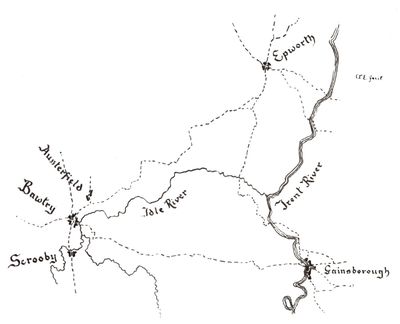
The London Separatists suffered miserably from persecution. Many of them languished and died in prison. Barrow and Greenwood, their leaders, were hanged at Tyburn. A part of them migrated to Amsterdam, while the rest maintained a furtive church in London. Separatists in Amsterdam, 1593. Those in Amsterdam, having no lingering abuses of the English church to reform, set every man's conscience to watch his neighbor's conduct. Having seceded from the communion of the Church of England on account of scandals, they were scandalized with the least variation from their rigorous standard by any of their own church members, and they were soon torn asunder with dissensions as the result of this vicariousness of conscience. The innocent vanity of the pastor's wife who could never forego a "toppish" hat and high-heeled shoes was the principal stumbling-block.
Though Separatism had been almost extirpated from England by the close of Elizabeth's reign, there remained even yet one vigorous society in the north which was destined to exert a remarkable influence on the course of history.
VI.
The cradle of the Pilgrims. On the southern margin of Yorkshire the traveler alights to-day at the station of Bawtry. It is an uninteresting village, with a rustic inn. More than a mile to the southward, in Nottinghamshire, lies the pleasant but commonplace village of Scrooby. About a mile to the north of Bawtry is Austerfield, a hamlet of brick cottages crowded together along the road. It has a picturesque little church built in the middle ages, the walls of which are three feet thick. This church will seat something more than a hundred people nowadays by the aid of a rather modern extension. In the seventeenth century it was smaller, and there was no ceiling. Then one could see the rafters of the roof while shuddering with cold in the grottolike interior. The country around is level and unpicturesque.
But one is here in the cradle of great religious movements. In Scrooby and in Austerfield were born the Pilgrims who made the first successful settlement in New England. A little to the east lies Gainsborough, from which migrated to Holland in 1606 the saintly Separatist John Smyth, who gave form to a great Baptist movement of modern times. A few miles to the northeast of Bawtry, in Lincolnshire, lies Epworth, the nest from which the Wesleys issued more than a hundred years later to spread Methodism over the world. Hunter's Founders of New Plymouth, 24, 25. Religious zeal seems to have characterized the people of this region even before the Reformation, for the country round about Scrooby was occupied at that time by an unusual number of religious houses.
The little Austerfield church and the old church at Scrooby are the only picturesque or romantic elements of the environment, and on these churches the Pilgrims turned their backs as though they had been temples of Baal. In the single street of Austerfield the traveler meets the cottagers of to-day, and essays to talk with them. They are heavy and somewhat stolid, like most other rustic people in the north country, and an accent to which their ears are not accustomed amuses and puzzles them. No tradition of the Pilgrims lingers among them. They have never heard that anybody ever went out of Austerfield to do anything historical. They listen with a bovine surprise if you speak to them of this exodus, and they refer you to the old clerk of the parish, who will know about it. The venerable clerk is a striking figure, not unlike that parish clerk painted by Gainsborough. This oracle of the hamlet knows that Americans come here as on a pilgrimage, and he tells you that one of them, a descendant of Governor Bradford, offered a considerable sum for the disused stone font at which Bradford the Pilgrim was baptized. But the traveler turns away at length from the rustic folk of Austerfield and the beer-drinkers over their mugs in the inn at Bawtry, and the villagers at Scrooby, benumbed by that sense of utter common-placeness which is left on the mind of a stranger by such an agricultural community. The Pilgrims, then, concerning whom poems have been written, and in whose honor orations without number have been made, were just common country folk like these, trudging through wheat fields and along the muddy clay highways of the days of Elizabeth and James. They were just such men as these and they were not. They were such as these would be if they were vivified by enthusiasm. We may laugh at superfluous scruples in rustic minds, but none will smile at brave and stubborn loyalty to an idea when it produces such steadfast courage as that of the Pilgrims.
And yet, when the traveler has resumed his journey, and recalls Scrooby and Bawtry and Austerfield, the stolid men and gossiping women, the narrow pursuits of the plowman and the reaper, and remembers the flat, naked, and depressing landscape, he is beset by the old skepticism about the coming of anything good out of Nazareth. Magnalia, Book II, chap. i, p. 2. Nor is he helped by remembering that at the time of Bradford's christening at the old stone font the inhabitants of Austerfield are said to have been "a most ignorant and licentious people," and that earlier in that same century John Leland speaks of "the meane townlet of Scrooby."
VIII.
Elder Brewster. But Leland's description of the village suggests the influence that caused Scrooby and the wheat fields thereabout to send forth, in the beginning of the seventeenth century and of a new reign, men capable of courage and fortitude sufficient to make them memorable, and to make these three townlets places of pilgrimage in following centuries.
Itinerary, i, 36, in Hunter's Founders, p. 20. "In the meane townlet of Scrooby, I marked two things"—it is Leland who writes—"the parish church not big but very well builded; the second was a great manor-place, standing within a moat, and longing to the Archbishop of York." This large old manor-place he describes with its outer and inner court. In this manor-place, about half a century after Leland saw it, there lived William Brewster. He was a man of education, who had been for a short time in residence at Cambridge; he had served as one of the under secretaries of state for years; had been trusted beyond all others by Secretary Davison, his patron; and, when Elizabeth disgraced Davison, in order to avoid responsibility for the death of Mary of Scotland, Brewster had been the one friend who clung to the fallen secretary as long as there was opportunity to do him service. Making no further effort to establish himself at court, Brewster went after a while "to live in the country in good esteeme amongst his freinds and the good gentle-men of those parts, espetially the godly and religious." Bradford, 410. His abode after his retirement was the old manor-place now destroyed, but then the most conspicuous building at Scrooby. It belonged in his time to Sir Samuel Sandys, the elder brother of Sir Edwin Sandys, whose work as the master spirit in the later history of the Virginia Company has already been recounted. Supra, Book I, chap. ii, iii. At Scrooby Brewster succeeded his father in the office of "Post," an office that obliged him to receive and deliver letters for a wide district of country, to keep relays of horses for travelers by post on the great route to the north, and to furnish inn accommodations. In the master of the post at Scrooby we have the first of those influences that lifted a group of people from this rustic region into historic importance. He had been acquainted with the great world, and had borne a responsible if not a conspicuous part in delicate diplomatic affairs in the Netherlands. At court, as at Scrooby, he was a Puritan, and now in his retirement his energies were devoted to the promotion of religion. He secured earnest ministers for many of the neighboring parishes. But that which he builded the authorities tore down. Whitgift was archbishop, and the High Commission Courts were proceeding against Puritans with the energy of the Spanish Inquisition. "The godly preachers" about him were silenced. The people who followed them were proscribed, and all the pains and expense of Brewster and his Puritan friends in establishing religion as they understood it were likely to be rendered futile by the governors of the church. Plimoth Plantations, 411. "He and many more of those times begane to looke further into things," says Bradford. Persecution begot Separatism. The theory was the result of conditions, as new theories are wont to be.
IX.
The Scrooby Church. Here, as elsewhere, the secession appears to have begun with meetings for devotion. By this supposition we may reconcile two dates which have been supposed to conflict, conjecturing that in 1602, when Brewster had lived about fifteen years in the old manor-house, his neighbors, who did not care to attend the ministry of ignorant and licentious priests, began to spend whole Sundays together, now in one place and now in another, but most frequently in the old manor-house builded within a moat, and reached by ascending a flight of stone steps. Magnalia, Book ii, c. i, 2. Here, Brewster's hospitality was dispensed to them freely. They may or may not have been members of the Separatist church at Gainsborough, as some have supposed. It was not until 1606 that these people formed the fully organized Separatist church of Scrooby. It was organized after the Barrowist pattern that had originated in London—it was after a divine pattern, according to their belief. Brewster, the nucleus of the church, became their ruling elder.
The ruling elder. It was in these all-day meetings at the old manor-house that the Separatist rustics of Scrooby were molded for suffering and endeavor. The humble, modest, and conscientious Brewster was the king-post of the new church—the first and longest enduring of the influences that shaped the character of these people in England, Holland, and America. Bradford's Plimoth Plantation, 408-414. Hunter's Founders, passim. Winsor's Elder William Brewster, a pamphlet. F. B. Dexter in Narrative and Crit. Hist., iii, 257-282. Brewster could probably have returned to the court under other auspices after Davison's fall, but as master of the post at Scrooby, then as a teacher and as founder of a printing office of prohibited English books in Leyden, and finally as a settler in the wilderness, inuring his soft hands to rude toils, until he died in his cabin an octogenarian, he led a life strangely different from that of a courtier. But no career possible to him at court could have been so useful or so long remembered.
X.
Shall we say that when subjected to this great man's influence the rustics of Scrooby and Bawtry and Austerfield were clowns no longer? Perhaps we shall be truer to the probabilities of human nature if we conclude that Robinson was able to mold a few of the best of them to great uses, and that these became the significant digits which gave value to the ciphers.
Elucidations.
Note 1, page 146. The eccentricities, moral and mental, of Browne were a constant resource of those who sought to involve all Separatists in his disgrace. Odium has always been a more effective weapon than argument in a theological controversy. Browne's enemies alleged that even while on the gridiron of persecution his conduct had not been free from moral obliquity. I have not been able to see Bernard's charges on this score, but John Robinson, in his Justification, etc. (1610), parries the thrust in these words: "Now as touching Browne, it is true as Mr. B[ernard] affirmeth, that as he forsook the Lord so the Lord forsook him in his way; ... as for the wicked things (which Mr. B. affirmeth) he did in the way it may well be as he sayeth, ... as the more like he was to returne to his proper centre the Church of England, where he should be sure to find companie ynough in any wickednesse." Edition of 1639, p. 50. One of the most learned accounts of Browne is to be found in H. M. Dexter's Congregationalism, the lecture on Robert Browne. It is always easy to admire Dr. Dexter's erudition, but not so easy to assent to his conclusions. See also Pagitt's Heresiography, p. 56 and passim; Fuller's Church History, ix, vi, 1-7; and Hanbury's Memorials, p. 18 and following.
Note 2, page 146. John Robinson, in Justification of Separation from the Church of England, p. 50, edition of 1639, says: "It is true that Boulton was (though not the first in that way) an elder of a Separatist church in the beginning of Queen Elizabeth's dayes, and falling from his holy profession recanted the same at Paul's Crosse and afterwards hung himself as Judas did." Compare Cotton's The Way of the Congregationall Churches Cleared, p. 4, and various intimations in Hanbury's Memorials, which imply the existence of Independent congregations in London and elsewhere in the early years of Elizabeth's reign. But Hanbury's handling of the valuable material he collected with commendable assiduity is sometimes so clumsy that the reader is obliged to grope for facts bearing upon most important questions. One gets from Hanbury's notes and some older publications a vague notion that the Flemish Protestants, recently settled in England in great numbers, exerted an influence in favor of Independency. Robert Browne began his secession in Norwich, a place where the people from the Low Countries were nearly half the population, and Browne was even said to have labored among the Dutch first. Fuller, ix, sec. vi, 2.
Note 3, page 156. Robinson's character may be judged from his works. His good qualities are very apparent in the wise and tender letters addressed to the Pilgrims when they were leaving England and after their arrival at Plymouth, which will be found in Bradford's Plimoth Plantations, 63, 64, 163. See Bradford's character of him, ibid., 17-19. See also Young's Chronicles of the Pilgrims, 473-482. Ainsworth's tribute is in Hanbury's Memorials, 95. See also Winslow's Brief Narration in Young's Chronicles, 379. George Sumner, in 3d Massachusetts Historical Collections, ix, has a paper giving the result of his investigations in Leyden. He quotes Hornbeeck as saying, twenty-eight years after Robinson's death, that he was the best of all the exiles as well as the most upright, learned, and most modest. Hornbeeck's words are: "Optimus inter illos." "Vir supra reliquos probus atque eruditus." "Doctissimi ac modestissimi omnium separatistorum."
CHAPTER THE THIRD. THE PILGRIM MIGRATIONS.
I.
Accession of James I. The accession of James of Scotland to the English throne in 1603 raised the hopes of the Puritans. James had said, in 1590: "As for our neighbour kirk of England, their service is an ill-said masse in English; they want nothing of the masse but the liftings." Neal, ii, 28. Compare Burns's Prel. Diss. to Wodrow, lxxiv. Later, when the prospect of his accession to the English throne was imminent, James had spoken with a different voice, but the Puritans remembered his lifelong familiarity with Presbyterian forms, and his strongly expressed satisfaction with the Scottish Kirk. They met him on his way to London with a petition for modifications of the service. This was known as the Millinary Petition, because it was supposed to represent the views of about one thousand English divines.
Hampton Court conference. In January, 1604, the king held a formal conference at Hampton Court between eleven of the Anglican party on one side, nine of them being bishops, and four Puritan divines, representing the petitioners. Assuming at first the air of playing the arbiter, James, who dearly loved a puttering theological debate, could not refrain from taking the cause of the churchmen out of their hands and arguing it himself. Svmme and Svbstance, passim. The reports of the conference are most interesting as showing the paradoxical qualities of James, who, by his action at this meeting, unwittingly made himself a conspicuous figure in the history of America. The great churchmen were surprised at the display made by the king of dialectic skill. They held Scotch learning in some contempt, and were amazed that one bred among the "Puritans" should know how to handle questions of theology so aptly. Prel. Diss. to Wodrow, lxxiv. James, though he had declared the Church of Scotland "the sincerest kirk in the world" because it did not keep Easter and Yule as the Genevans did, now had the face to assure the prelates that he had never believed after he was ten years old what he was taught in Scotland. His speeches in the conference are marked by ability, mingled with the folly which vitiated all his qualities. Quick at reply and keen in analysis, he even shows something like breadth of intelligence, or at least intellectual toleration, but without ever for a moment evincing any liberality of feeling. His manifest cleverness is rendered futile by his narrow and ridiculous egotism, his arrogance in the treatment of opponents, and his coarse vulgarity in expression. Ch. Hist., x, vii, 30. "In common speaking as in his hunting," says Fuller, "he stood not on the cleanest but nearest way." The Puritans were no more able to answer the arguments of the king than was Æsop's lamb to make reply to the wolf. Laying down for his fundamental maxim "No bishop, no king," he drew a picture of the troubles that would beset him when "Jack and Tom and Will and Dick" should meet and censure the king and his council. He would have no such assemblage of the clergy until he should grow fat and pursy and need trouble to keep him in breath, he said. It could not occur to his self-centered mind that so grave a question was not to be settled merely by considering the ease and convenience of the sovereign. "He rather usede upbraidinges than argumente," says Harrington, who was present. Nugæ Antiquæ., i, 181. He bade the Puritans "awaie with their snivellinge," and, in discussing the surplice, made an allusion that would be deemed a profanation by reverent churchmen of the present time.
Results. Svmme and Svbstance, 35. When James rose from his chair at the close of the debate on the second day he said, "I shall make them conform themselves, or I will harry them out of this land, or else do worse"; and he wrote to a friend boasting that he had "peppered the Puritans soundly." Compare Bacon's Certain Considerations touching the better Pacification of the Church of England. But the king had missed, without knowing it, the greatest opportunity of his reign—an opportunity for conciliating or weakening the Puritan opposition, and consolidating the church and his kingdom. James could think of nothing but his own display of cleverness and browbeating arrogance in a dispute with great divines like Reynolds and Chaderton. The conference had been for him a recreation not much more serious than stag-hunting. That it was pregnant with vast and far-reaching results for good and evil in England and the New World he, perhaps, did not dream. By his narrow and selfish course at this critical moment he may be said to have sealed the fate of his son, if not the doom of his dynasty; and his clever folly gave fresh life to the bitter struggle between Anglican and Puritan which resulted in the peopling of New England a quarter of a century afterward.
II.
The storm of persecution. Every proscription of the Puritans within the church was accompanied by a crusade against the Brownists without, who were counted sinners above all other men. Though Ralegh in 1593 had estimated the Brownists at twenty thousand, they were by this time in consequence of oppression "about worn out," as Bacon said. Bacon's Observation on a Libel. Upon those who remained the new persecution broke with untempered severity. Badgered on every side by that vexatious harrying which King James and his ecclesiastics kept up according to promise, the little congregation at Scrooby in 1607 resolved to flee into Holland, where they would be strangers to the speech and to the modes of getting a living, but where they might worship God in extemporary prayers under the guidance of elders of their own choice without fear of fines and prisons.
Toleration in the Low Countries. That which is most honorable to the Low Countries, from a historical point of view, namely, that their cities were places of refuge for oppressed consciences, was esteemed odious and highly ridiculous in the seventeenth century. In one of the plays of that time there is a humorous proposition to hold a consultation about "erecting four new sects of religion in Amsterdam." The Dutch metropolis was called a cage of unclean birds, and a French prelate contemned it as "a common harbor of all opinions and heresies." At a later period Edward Johnson, the rather bloodthirsty Massachusetts Puritan, inveighs against "the great mingle mangle of religion" in Holland, and like a burlesque prophet shrieks, "Ye Dutch, come out of your hodge podge!" Errours and Induration, p. 27. Robert Baylie, in a sermon before the House of Lords as late as 1645, says of the toleration by the Dutch, that "for this one thing they have become infamous in the Christian world."
Flight of the Pilgrims. To the asylum offered by the Low Countries the Scrooby Separatists resolved to flee. The pack of harriers let loose by James and Bancroft were in full cry. The members of the Scrooby church found themselves "hunted and persecuted on every side," having their houses watched night and day, so that all their sufferings in times past "were but as flea bitings in comparison." But the tyranny that made England intolerable did its best to render flight impossible. In various essays to escape, the Separatists were arrested and stripped of what valuables they had, while their leaders were cast into prison for months at a time.
The Pilgrims in Amsterdam. At length by one means or another the members of this battered little community got away and met together in Amsterdam. To plain north country folk this was indeed a strange land, and one can see in the vivid and eloquent language of Bradford of Austerfield, who was a young man when he crossed the German Ocean, the memory of the impressions which these cities of the Low Countries made on their rustic minds. Bradford's Plimoth Plantation 16. But "it was not longe before they saw the grimme and grisly face of povertie coming upon them like an armed man, with whom they must bukle and incounter."
III.
Removal to Leyden. Robinson discovered that he was not of a piece with those Separatists who had preceded him to Amsterdam. In one division of these, questions of whalebone in bodices, of high-heeled shoes and women's hats, distracted scrupulous minds. In the other, which came from the same part of England as Robinson's church, the agitations were of a theological nature. Questions about the baptism of infants and the inherent righteousness of man and the portion of his nature that Christ derived from his mother, with discussions of the right of a man to be a magistrate and a church member at the same time, were seething in the heated brain of the scrupulous but saintly pastor. Robinson saw that these controversies would involve the Scrooby church if it remained in Amsterdam. In Robinson the centrifugal force of Separatism had already spent itself, and his practical wisdom had set bounds to the course of his logic. To leave the Dutch metropolis for a smaller place was to reduce the Scrooby exiles to still deeper poverty, but nevertheless the Pilgrims fled from discord as they had fled from persecution, and removed to the university city of Leyden, called by its admirers "the Athens of the Occident." After their departure English Separatism in Amsterdam went on tearing itself to pieces in a sincere endeavor to find ultimate theological truth, but Robinson's people in spite of their poverty were united, and were honored by those among whom they sojourned. Bradford's Plimouth Plantation. Winslow's Relations. Others, hearing of their good report, came to them from England, and the exiled church of Leyden was fairly prosperous.
IV.
Danger of extinction. But when ten years of exile had passed the outlook was not a pleasant one. The life in Leyden was so hard that many chose to return to their own land, preferring English prisons to liberty at so dear a rate. The "tender hearts of many a loving father and mother" were wounded to see children growing prematurely decrepit under the weight of hard and incessant toil; "the vigor of Nature being consumed in the very bud as it were." Some of the young people were contaminated by the dissoluteness of the city, others joined the Dutch army or made long voyages at sea, acquiring habits very foreign to the strictness of their parents. The result of a contest between the rigid Puritanism of the little church and the laxity prevalent in Holland was not to be doubted. Human nature can not remain always at concert pitch. Intermarriages with the Dutch had already begun, and all that was peculiar in the English community was about to be swallowed up and lost forever in the great current of Dutch life which flowed about it.
Emigration planned. Puritanism was in its very nature aggressive, even meddlesome. It was not possible for a Puritan church, led by such men as Robinson, and Brewster, and Carver, and Bradford, and Winslow, to remain content where national prejudices and a difference in language barred the way to the exertion of influence on the life about them. Compare Winslow in Young, 387. With destruction by absorption threatening their church, these leaders conceived the project of forming a new state where they "might, with the liberty of a good conscience, enjoy the pure Scripture worship of God without the mixture of human inventions and impositions; and their children after them might walk in the holy ways of the Lord."
V.
Alternatives. To European eyes all America was one; even to-day the two Americas are hardly distinguished by most people in Europe. The glowing account of Guiana given by Ralegh helped to feed the new desire for an American home; and it was only after serious debate that North America was chosen, as more remote from the dreaded Spaniard and safer from tropical diseases. One can hardly imagine what American Puritanism would have become under the skies of Guiana. Not only did the Pilgrims hesitate regarding their destination, but there was a choice of nationalities to be made. England had not been a motherly mother to these outcast children, and there was question of settling as English subjects in America, or becoming Dutch colonists there.
VI.
Application to Sandys. The Pilgrims preferred to be English, notwithstanding all. But they wished to stipulate with England for religious liberty. In this matter they had recourse to Sir Edwin Sandys, the one man who would probably be both able and willing to help them. Brewster had lived, as we have seen, in an old episcopal manor at Scrooby. Hunter's Founders of New Plymouth, pp. 22, 23. Sandys, Archbishop of York, had transferred this manor by a lease to his eldest son, Sir Samuel Sandys, who was Brewster's landlord and brother of Sir Edwin Sandys. Of Sir Edwin the great liberal parliamentary statesman, Fuller says, "He was right-handed to any great employment." In 1617 he was already the most influential of the progressive leaders of the Virginia Company, its acting though not yet its nominal head, and in 1619 he was elected governor of the Company. Brewster's fellow-secretary under Davison was a chosen friend of Sandys, and, in view of both these connections, we may consider it almost certain that the two were not strangers. To Sir Edwin Sandys was due much of the new interest in Virginia. He and his group seem to have been already striving to shape the colony into a liberal state.
Failure to secure formal toleration. To meet the views of the Leyden people, Sandys endeavored by the intervention of a more acceptable courtier to gain assurance from the king, under the broad seal, that their religion should be tolerated if they migrated to Virginia. But James's peculiar conscience recoiled from this. He intimated that he would wink at their practices but he would not tolerate them by public act. And, indeed, the Pilgrims reflected afterward that "a seale as broad as the house flore would not serve the turne" of holding James to his promise. At the king's suggestion the archbishops were applied to, but neither would they formally approve such an arrangement. Nor can one wonder at their unwillingness, since the most profound, liberal, and far-seeing thinker of that age, Lord Bacon himself, was so far subject to the prejudices of his time that he could protest against allowing heretics to settle a colony, and could support his position by a mystical argument fit to be advanced by the most fantastic theologian. "It will make schism and rent in Christ's coat, which must be seamless," he says. Bacon's Advice to Villiers. He even goes so far as to group Separatists with outlaws and criminals, and to advise that if such should transplant themselves to the colonies they should be "sent for back upon the first notice," for "such persons are not fit to lay the foundation of a new colony." Much more fit than is a speculative philosopher to draw the lines on which practical undertakings are to be carried forward. The transplanting of English speech and institutions to America would have languished as French colonization did, if none but orthodox settlers had been allowed to fell trees and build cabins in the forest. Ever since the age of stone hatchets colony planters have been drawn from the ranks of the uneasy. Archdale's Carolina, 26. An early Quaker governor of South Carolina puts the matter less elegantly but more justly than Bacon when he says: "It is stupendious to consider, how passionate and preposterous zeal, not only vails but stupefies oftentimes the Rational Powers: For cannot Dissenters kill Wolves and Bears as well as Churchmen?"
VII.
Relations with the Virginia Company. The liberal and practical mind of Sir Edwin Sandys harbored none of the scruples of Bacon, and his more wholesome conscience knew nothing of the fine distinctions of James and the archbishops between formal toleration and a mere winking at irregularities. He embraced the cause of the Pilgrims and became their steadfast friend, passing through the Virginia Company successively two charters in their behalf, and the general order which allowed the leaders of "particular plantations"—that is, of such plantations as the Leyden people and others at that time proposed to make—to associate the sober and discreet of the plantation with them to make laws, orders, and constitutions not repugnant to the laws of England. MS. Rec. Va. Co., Feb. 2, 1620. This was a wide door opening toward democratic government. The patent given to the Pilgrims was also a liberal one, and it was even proposed to put into their hands a large sum of money contributed anonymously for the education of Indian children, but to this it was objected that the newcomers would lack the confidence of the savages. One of the Virginia Company, possibly Sandys himself, lent to the Leyden people three hundred pounds without interest for three years. Winslow's Briefe Narration, Young, 383. When we consider that the Pilgrims had to pay in their first year of settlement thirty and even fifty per cent, interest on their debts, and that this three hundred pounds, the use of which they received without interest, would be equal in purchasing power to five or six thousand dollars of our money, we may readily believe that this loan and the semi-independence offered them under their "large patent" from the company, were the considerations that decided them in favor of emigration after the English Government had refused a guarantee of toleration, and the Dutch Government had declined to assure them of protection against England.