BOOK III. CENTRIFUGAL FORCES IN COLONY-PLANTING.
Reading edition
CHAPTER THE FIRST. THE CATHOLIC MIGRATION.
I.
Centrifugal forces. At every new stage in the history of the American settlement, we are afresh reminded that colonies are planted by the uneasy. The discontent that comes from poverty and financial reverse, that which is born of political unrest, and that which has no other cause than feverish thirst for novelty and hazardous adventure, had each a share in impelling Englishmen to emigrate. But in the seventeenth century religion was the dominant concern—one might almost say the dominant passion—of the English race, and it supplied much the most efficient motive to colonization. Not only did it propel men to America, but it acted as a distributing force on this side of the sea, producing secondary colonies by expelling from a new plantation the discontented and the persecuted to make fresh breaks in the wilderness for new settlements. Connecticut and Rhode Island were secondary plantings of this kind. Religious differences also made twain the Chesapeake region, the first home of the English in America, one of the two rival colonies being intolerantly Protestant, the other a home for Catholic refugees.
II.
Character of George Calvert. George Calvert, the first Baron Baltimore, who projected the Maryland colony and left it to his son to carry forward, belonged to the order of men who are shrewd without being creative—men of sagacity as differentiated from men of ideas. The man in whose mind there is a ferment of original ideas has theories to promulgate or expound. Sagacity has small necessity for speech—its very reticence gives an advantage in the conduct of affairs. The parliamentary antagonist and political rival who confronted Calvert was no other than our old acquaintance Sir Edwin Sandys, of the Virginia Company. Calvert and Sandys were alike men of rare accomplishments, and both were interested in schemes for colonization; otherwise they were antipodal. Sandys was a statesman of advanced ideas, creative, liberal, and original, fitted to be the founder of representative government in the English colonies. In that age of worn and brittle institutions it was not deemed wholly safe to suffer so robust a thinker as Sandys to be always at large, and it was one of Calvert's most difficult duties, as the king's secretary and chosen intermediary, to explain to Parliament why its leader was under restraint. Sandys, as we have already said, was described as "right-handed to every great employment"; when Calvert came upon the scene, he was aptly characterized as "a forward and knowing person in matters relating to the state." The phrase denotes, perhaps, clever adroitness within the limits of that mediocrity which in those perilous times was a safeguard to the man who ventured into politics. After having started well at court, Sandys had fallen into irretrievable disfavor by his resolute advocacy of the liberties of his countrymen. The message to the Virginia Company, already recited, "Choose the devil, but not Sir Edwin Sandys," expressed the depth of the king's antipathy. But if Sandys seemed to the king a devil, Calvert became for him a convenient angel. Notions about human rights and the liberty of Parliament did not obstruct Calvert's career. Not that he was a man to prove unfaithful to his convictions, as did his bosom friend Wentworth, or to suppress liberal opinions in order to smooth an ascending pathway, as did his great contemporary Bacon. Calvert played a far simpler part and one less dishonorable. It was his fortune to be a man of facile mind, naturally reverential toward authority. The principles enunciated by his sovereign and the measures by which those in power sought to attain the end in view were pretty sure to seem laudable or at least excusable to him. Such a mind can not be called scrupulous, neither is it consciously dishonest. The quality most highly esteemed at the court of James was fidelity, unswerving devotion to the interests of the king and of one's friends. And this, the dominant virtue of his time and of his class—this honor of a courtier—Calvert possessed in a high degree; it is a standard by which he has a right to be judged. To a French ambassador he seemed an honorable, sensible, courteous, well-intentioned man, devoted to the interests of England, but without consideration or influence.
III.
IV.
V.
Calvert's conversion. Calvert's conversion was almost inevitable. He favored the project for the Spanish match, and he was, like some other courtiers, under the influence of Gondomar, a consummate master of intrigue. He was bound by ties of friendship, and later by the marriage of his son, to Lord Arundel of Wardour, a Catholic, and the constitution of his mind and all the habits of a lifetime made him a lover of authority in church and state. Under favoring circumstances such a man becomes a Roman Catholic by gravitation and natural affinity.
There was a Catholic revival in England at this time, especially among the courtiers and upper classes. In 1623 there was a large influx to England of priests and Jesuits. English Romanists flocked to the vicinage of London, and resorted in great numbers to the mass in the houses of foreign ambassadors; and in many English country houses the mass was openly celebrated in defiance of law. Petition in Rushworth, Part I, i, 141. Compare Neal, Part II, c. ii. The Commons, in alarm, adopted what James fitly called "a stinging petition against the papists."
VI.
VII.
Sails to Virginia. He knew the conditions of that colony and the opportunities it afforded. A member of the Virginia Company during nearly all the years of its stormy existence, he had been made one of the fifty-six councilors that took over its effects at its demise, and he was one of the eight who constituted the quorum, and who probably transacted the business of this Council for Virginia. Rymer's Fœdera, tom. vii, iv, 147. Even under the government of the Company there had been precedents for the establishment of a "precinct" within Virginia independent of the Jamestown government. Such a plantation had been that of Captain Martin and that proposed by Rich and Argall, and a charter for such had been given to the Leyden pilgrims. Baltimore wrote to ask for a precinct, pleading the king's promise already made that he might choose a part of Virginia. Here he would still be the head of a little independent state—a state in which the mass might be said without molestation. Before another winter set in he abandoned Avalon to fishermen and such hardy folk, and took ship for the James River, where he arrived in October, 1629.
VIII.
Character of the early Virginians. The Virginians, after all their sufferings, were now prosperous in a gross way, reaping large profits from tobacco, and living in riotous profusion after the manner of men beginning to emerge from the hardships and perils of a pioneer condition into sudden opulence. Leah and Rachel, and De Vries Voyages, passim. Their rude living did not at all prevent the colonists from being fastidious about their religion—it was the seventeenth century. Most of the Virginia clergy at this period were as reckless in life as the people, but the Protestantism of the colony was incorruptible. Some of the rabble even showed their piety by railing at the newly arrived papist nobleman.
Expulsion of Baltimore. A weapon of defense against Baltimore was ready to hand. Three years before his coming instructions had been sent from England to Yeardley to proffer the oath of supremacy "to all such as come thither with an intention to plant and reside, which, if any shall refuse, he is to be retorned or shipped from thence home." This order may not have been intended for so great a personage as a nobleman of the Court. It may have been meant only to head off humble Irishmen like those who settled Montserrat, or it may have been merely a fence against Separatists. But it served the turn of the alarmed colonists. Pott and Mathews, Claiborne and Roger Smyth, who led the opposition, offered the oath to Baltimore. Baltimore had sacrificed his place in the Privy Council rather than take this oath so contrary to his conscience, and he now again stood by his religious convictions, and took ship for England as ordered by the Virginia Council. He was disappointed and already shaken in health. The members of the council, appalled at their own boldness, perhaps, wrote to the king in self-defense. There is still extant an old manuscript record book of the seventeenth century which contains the instructions to Yeardley. MS. Book of Instructions, Library of Congress, folio 136. Immediately following, as if to put it under the shelter of royal authority, is the report of the council, without date or signature, that the oath had been offered to Baltimore and refused.
IX.
Baltimore's seal. Baltimore's hardships during two voyages to Newfoundland, and a winter in the rude abodes of pioneers there, his illness during that winter, the constant spectacle of sickness and death about him, and the disappointment caused by his rude reception in Virginia, were enough, one would think, to have broken his resolution. He went back to England "much decayed in his strength," as he confessed; but, strangely enough, this accomplished man of the world, whose career had been that of a courtier, was far from living in ease and quietness as his friends had expected him to do. He was possessed of a passion for peopling the wilderness. He had written to the king from America that he was resolved to spend "the poore remaynder" of his days in colony-planting, his "inclinations carrying him naturally" to such work. To what extent he was prompted by a desire to leave to his heir the semi-sovereignty of a principality, and how far he was carried by a naturally adventurous temper hitherto latent, we have no means of deciding; but one can hardly resist the conclusion that a fervent religious zeal was the underlying spring of a resolution so indomitable. Like many another man of that time, Calvert was lifted from worldliness to high endeavor by religious enthusiasm. The king felt obliged to interpose his authority; he forbade Baltimore's risking his life in another voyage, but he granted him a charter for a new palatinate on the north side of the Potomac.
Death of the first Lord Baltimore. Lord Baltimore was doomed never to see the desire of his eyes. He died on the 15th of April, 1632, before the charter had passed, leaving the planting of Maryland to be carried forward by his son and heir, Cecilius. The charter of Maryland passed the seals on the 22d of the following June in favor of Cecilius, the second Lord Baltimore.
X.
XI.
Condition of English Catholics. When George Calvert projected his new southern colony he had every reason to suppose that it would be quickly supplied with settlers from the discontented English and Irish Catholics. The statute enacted in the third year of James, soon after the Gunpowder Plot, put those who adhered to the Roman communion in a precarious and exasperating situation. For the first year that a Catholic wholly neglected the sacraments of the English church he must pay twenty pounds. This was raised to forty the second year, and to sixty for every year of conscientious abstention thereafter. An act for the better discovering and repressing of popish recusants. Also, An act to prevent, etc., 3 Jac. I, chaps. iv and v. If he did not attend the parish church at all, the luxury of a conscience cost him twenty pounds a month, which, as money then went, was a large sum. If he were a rich landholder, the king might take the use or rentals of two thirds of his land until he should conform. The oath of allegiance by which he was to be tested was made ingeniously offensive to a Catholic conscience. If a Romanist should persuade a Protestant to accept his own faith he was guilty of treason, as was also his convert. The man who harbored a Roman Catholic neglecting to attend the parish church was to be fined ten pounds a month. Marriage by a Romish priest invalidated accruing land tenures. The Catholic was not suffered to send his children beyond seas for an education, nor yet to keep a schoolmaster of his own faith; he could not serve as an executor; he might not have the charge of any child; his house might be searched for Catholic books; he was not allowed to keep weapons; and when at last his vexed and troubled life was over, his dead body might not be buried among the graves of his forefathers in the parish churchyard.
Administration of the law. The administration of this law was attended by many aggravations. The pursuivants took the very cattle and household goods of the poor; from the rich they exacted large payments, failing which, they pounced on valuable plate and jewels, which they seized under pretense that these were articles of superstition or the concealed property of Jesuits. Lingard, viii, 189, cites Rymer, xxii, 13; Hardwicke Papers, 1446, and a private letter. It is said that James derived a revenue of thirty-six thousand pounds a year from the fines of lay Catholics. To the several Scotch favorites of the king were assigned certain rich recusants from whom they might squeeze whatever could be got by the leverage of the law.
Influence of foreign policy. Very embarrassing to the foreign policy of England was the severity of English laws against Catholics, and Lord Treasurer Burleigh found it needful to publish in Elizabeth's time, for circulation in all the courts of Europe, a treatise on The Execution of Justice in England and the Maintenance of Public Order and Christian Peace; and in the following reign James himself turned pamphleteer and published an Apologie for the Oath of Allegiance. 1583, reprinted 1688. 1609, sm. 4to, pp. 112. There were periods when pressure from abroad softened the administration of the law. But it was only irregularly and intermittently that the Government could be brought to grant indulgences that roused the pious wrath of Puritans and reduced the revenue of the king and his favorites. If Spain, and afterward France, made it a condition precedent to a marriage treaty that the penal laws against English recusants should be relaxed, Parliament, resenting foreign dictation, demanded of the king a renewal of the severities against papists. Ellis Collection, first series, iii, 128. Twenty-four Catholics suffered capitally in James's reign, before 1618; and when in 1622 it was necessary to condone Catholicism in order to conciliate Spain, it is said that four hundred Jesuits and priests were set free on bail at one time. Neal, ii, ch. ii. Rapin, 215, 2d ed. The number of Catholics, lay and cleric, released in this year is put at four thousand, but this may be an exaggeration.
XII.
Catholic emigration small. In 1627, and again in 1628, Lord Baltimore took Catholics with him to Newfoundland and settled priests there. The English court was just then sailing on a Protestant tack, and England had allied itself with the Huguenots of La Rochelle. Another of the good works by which the government of Charles and Buckingham was endeavoring to prove its sanctification was the enforcement of the penal statutes against Roman Catholics. It is notable that Baltimore sailed with the first Catholic emigrants to Avalon about the time of the setting in of the movement toward Massachusetts which swelled at length into the great Puritan exodus. The five years of delay caused by the change from Avalon to Maryland, and also perhaps by the exhaustion of Baltimore's resources and his death, was unfavorable to the project of a Catholic province. The English government by 1634 had grown more lenient toward Romanists, the co-religionists of the queen. The work at which Laud kept all hands busy just then was the suppression of Puritanism, and thousands of Puritans were by this time shaking the dust of England from their feet and seeking a home in the western wilderness, persuaded that the Church of England under Laud had all sails set for Rome. Harl. Miscell., ii, 492, and following, where passages from contemporary writers are quoted. This illusion regarding the purposes of the archbishop and his party, which alarmed the Puritans, heartened the Catholics, who naturally preferred to stay at home where a flood tide seemed to be setting toward Catholicism. The small Catholic migration to Maryland was not to be compared with that stream of Puritan emigration that about this time poured into New England twenty thousand people in a decade. The fall of Laud and the rise of the Puritans to power put a complete stop to the New England migration, but it failed to quicken the Catholic movement, for Maryland herself had become sadly involved in the civil commotions of the time.
XIII.
The religious aim. "The first and most important design of the Most Illustrious Baron, which ought also to be the aim of the rest, who go in the same ship, is, not to think so much of planting fruits and trees in a land so fertile, as of sowing the seeds of religion and piety." This was Lord Baltimore's authoritative declaration, and because it varies in form from the stock phrases so common at the time, it bears an air of some sincerity, though it is diplomatically ambiguous.
XIV.
Toleration a policy. Cecilius gave positive instruction that on shipboard acts of the Roman Catholic religion should be performed with as much privacy as possible, so as not to offend the Protestant passengers "whereby any just complaint may hereafter be made by them in Virginia or in England." There is no pretense of theory here; all is based on the exigency of the situation and sound policy. The policy was George Calvert's, whose school was the court of James, and whose whole career shows that he entertained no advanced views of human liberty. Had he held toleration as a theory of government, his doctrine would have been more liberal than that of Ralegh and Bacon and far in advance of that of contemporary Puritan leaders. They quite misunderstand the man who regard him as a progressive thinker; he was a conservative opportunist. Still less was Cecilius a man likely to act on general principles.
XV.
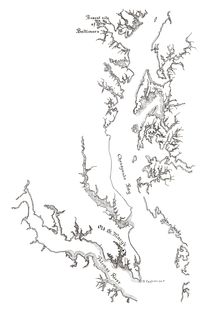
The arrival. The Puritans when using a geographical name that began with the word "saint" scrupulously uncanonized it by leaving off the prefix. But these devout pilgrims of the Roman faith, when once the saints and guardian angels of Maryland had piloted them safe in spite of the malice of storm spirits and evil genii into landlocked waters and the bounds of Lord Baltimore's grant, proceeded to sanctify the whole region by sprinkling it with the names of saints and angels from Michael the archangel downward. The ancient Indian designations were marks of a heathenism they purposed to overthrow, and they began by trying to get rid of the whole "bead roll of unbaptized names." No convenient island, creek, river, bay, or cape escaped Christian baptism. On Annunciation Day, 1634, they landed on Heron Island, in the Potomac, which they named appropriately for St. Clement, who was martyred by being thrown into the sea attached to an anchor, and here the sacrifice of the mass was celebrated, the worshipers reflecting that "never before had this been done in this part of the world." After the mass they took upon their shoulders a great cross hewn out of a tree and advanced in order to the place appointed, where the governor and his assistants took part in its erection. The Catholics of the party, seeing this symbol of the faith erected in a new land, knelt upon the ground and recited the litanies of the cross in a kind of religious ecstasy. Here in another form was that tender attachment to their faith that one finds among the more devout Protestant exiles, and in the nobler natures there was doubtless that element of the heroic and the saintly often evolved in the religious sufferings and activities of that day—a relief to the pettiness of the debates and the irksomeness of the bigotries of the age.
XVI.
A Catholic colony. The colony had been named Maryland by King Charles in honor of his wife Henrietta Maria; at least there was assigned to the king responsibility for a name that, like nearly everything else about Maryland, was ambiguous. But the phrase Terra Mariæ in the charter, though represented there to be the equivalent of Maryland, was significant to a devout Catholic of something better than a compliment to a Catholic queen. Compare Clarke's Gladstone and Maryland Toleration. The Indian village which with its gardens and cornfields had been bought for the germinal settlement and capital, took the name of St. Mary's, and the whole infant colony is called the Colony of St. Maries, by its own Legislative Assembly in 1638, as though by Maryland were intended the land of Mary. Maryland Archives, i, 23. Notwithstanding the manifest care of the second Lord Baltimore to hold the missionaries within the limits of worldly prudence, the zealous fathers lived and labored in a spirit of other-worldliness. They set themselves first of all to convert those sheep without a shepherd, the Protestants of Maryland. Some of these appear to have been men of reckless and immoral lives, who were greatly bettered by an acceptance of religious restraint. Those non-Catholics who were ill, and those who found themselves languishing and dying in the wilderness without the consolations of their own religion, were zealously visited and converted in extremis by the Jesuits. The servants and mechanics employed by or apprenticed to the missionaries were brought under their constant influence and were readily won. Nearly all the Protestants who arrived in 1638 were swiftly brought over to the faith of the missionaries, and twelve converts were joyously reckoned as fruits of the Jesuit labors in 1639. There was more than one instance of the miraculous, or at least of the marvelous, to help on this work. One man of noble birth, who had by dissipation brought himself to desperate straits, and then sunk until he became at length a bond servant in Maryland, embraced Catholicism. After the death of this convert a very bright light was sometimes seen burning about his place of burial, and even those who were not Catholics were permitted to see this wonder. Excerpta de Diversis Literis, etc., 56-60. The horrible punishments that resulted from the Divine wrath against those who scoffingly rejected the Catholic faith in Maryland remind one of the equal calamities that befell those who were unfaithful to Puritanism in New England. Seventeenth-century Englishmen with sky-wide differences in opinion were one in the traits that belonged to their age. Father White was sure that the destruction of Indians in Maryland was specially ordered by God to provide an opening "for His own everlasting law and light"; but not more sure than were the Puritans that the cruel plague which exterminated whole villages on the Massachusetts coast was sent to open a way for the planting of Calvinistic churches. Each division of Christians in turn reduced the Almighty Creator to the level of a special tutelary divinity, sometimes to that of a rather vindictive genius of the place.
XVII.
Opposition to Maryland. George Calvert, the first Baron Baltimore, molded the Maryland enterprise until the drafting of the charter, and his spirit was felt in it after his death. Cecilius, his son, was a man of a somewhat different sort, and his traits became more apparent as time went on. He was strongly supported at court by Strafford, his father's most devoted and obliged friend, and no doubt also by the queen, who was godmother to Maryland. The opposition to Maryland was probably embittered by the hatred to Strafford and the jealousy of a Catholic queen.
XVIII.
Cautious policy of Baltimore. Intolerance on the part of the authorities of Maryland directed toward Protestants might have brought a swift overthrow of the whole project. The instructions given for the first voyage already cited show throughout the need for extreme caution in the face of extreme peril. It is required of the governor and commissioners that "they be very careful to preserve the peace amongst all the passengers on shipboard, and that they suffer no scandal nor offense to be given to any of the Protestants." Baltimore's instructions, 15 Nov., 1633, Calvert Papers. The rulers are to instruct the Catholics to be silent "upon all occasions of discourse concerning matter of religion," and those in authority are to "treat the Protestants with as much mildness and favor as justice will permit." These instructions were to hold good after landing, and in one notable case of religious dissension after the arrival in Maryland, justice was meted out against the Catholic offender in a way that showed a disposition to observe this policy of conciliation toward Protestants at the expense of some unfairness toward Catholics. Very early a proclamation was issued for the suppression of all religious disputes, and Copley, the business administrator of the Jesuits, thought they ought to be put down for fear the writings should be sent to the governor of Virginia.
XIX.
Puritans from Virginia. Though Puritans could not be induced to move from New England, it happened that the Puritans living in Virginia were persecuted in this same year by that stanch cavalier and retrograde churchman, Sir William Berkeley, who wanted his parsons to read prayers, but did not like preaching ministers of any sort. 1643. He was new to his government, and had brought over with him plenty of hostility to the party that had affronted his royal master in England. Virginia Puritans had no choice but to suffer or depart, and Maryland was convenient. They began soon after this to seek a refuge under the protection of a proprietary who was a papist and who practiced toleration—two things almost equally hateful to the Puritans. Mr. James, a Puritan minister, tarried in Maryland a short time, as early as 1643; he was probably the only Protestant minister that set foot on Maryland soil before 1650. But the Puritan was never easy unless he was uneasy, and he was sure to be uneasy within when there was none to molest from without. To take an oath of fidelity to a papist was to him swearing fealty to antichrist; but so desirous was Baltimore of Puritan settlers that even the Maryland oath of fidelity was modified, and a saving clause was inserted for the ease of the Puritan conscience. The coming of Puritans who were in sympathy with the Parliament in England and who abhorred a tolerant papist, contributed something to the multifarious turmoils of the following years.
XX.
XXI.
Vicissitudes of toleration. And yet it was toleration, and the law was all the more influential as an example, perhaps, because it was only practical and quite incongruous. It was eminently prudent and statesmanlike. That it was not perpetually effective was the fault not of Baltimore but of the times. Puritan ideas were rampant. The government of the proprietary was overthrown; the Jesuits fled to the inhospitable Virginia, where they lived concealed in a low hut like a cistern or a tomb, not lamenting their physical privations so much as the lack of wine which deprived them of the consolation of the sacrament. The new government of Maryland, five years after Baltimore's famous "act concerning Religion," passed a new act with the same title—an act brusque and curt, a law with its boots and spurs on. "That none profess and exercise the papist religion" is its rude forbidding. The tables are turned; it is no longer the nonresident Jew and the hypothetical Unitarian who are excepted. But the wheels rolled swiftly once more, and in three years Cecilius, absolute lord and proprietary, was again master of Maryland, and the beneficent act of 1649 resumed its sway. It protected the Catholic element, which, though always rich and influential, came to be in latter colonial times but about a twelfth of the population. Toleration also served to make Maryland an early dwelling place for abounding Quakers and others holding religious views not relished in colonies less liberal.
Elucidations.
Note 1, page 223. "Voto a Dios que la Corte d'Inglatierra es como un libro de cavalleros andantes." Quoted by Chamberlain in Birch, i, 413. In view of the swift mutations of fortune among courtiers, Dudley Carleton the younger wrote on December 18, 1624, "He is happiest who has least to do at court"—a truth which Calvert probably had come to appreciate by that time.
Note 2, page 224. "The third man who was thought to gain by the Spaniard was Secretary Calvert; and as he was the only secretary employed in the Spanish match, so undoubtedly he did what good offices he could therein for religion's sake, being infinitely addicted to the Roman Catholic faith, having been converted thereunto by Count Gondomar and Count Arundel.... Now this man did protest to a friend of his own that he never got by the Spaniards so much as a pair of pockets; which it should seem is a usual gift among them, being excellently perfumed, and may be valued at twenty nobles or ten pounds price." Goodman's Court of King James, i, 376, 377.
Note 3, page 225. Whitbourne gives these names. Those who believe that Calvert was already actuated by religious zeal, remind us that Glastonbury (by a curious legendary confusion of names) was also called Avalon, and that in the Christian legend Joseph of Arimathea began at Glastonbury the planting of the Christian religion in Britain. See Anderson's Church of England in the Colonies, second edition, i, 325, 326. This interpretation of Calvert's intention in naming his colony was early given. British Museum, Sloane MSS. XXG. 3662, folio 24, date 1670. When Calvert's first colony was sent out the Scotch settlement in Newfoundland was of twelve years' standing, while the Bristol colony had been seated there five years. Calvert's enterprise seems to have been pushed with more energy and with a more liberal expenditure than its predecessors. Compare Whitbourne passim with the statement of Sir William Alexander in his Encouragement to Colonies, 1624, p. 25.
Note 4, page 225. Among the papers at Landsdowne House which I was permitted to examine by the kindness of Lord Edmund Fitzmaurice, there is an unpublished work by James Abercromby, written in 1752. It discusses with acuteness the nature of the several colonial governments. I shall refer to it hereafter under the title of Abercromby's Examination, Landsdowne House, 47. Abercromby was, so far as I know, the first to point out the apparently intentional ambiguity of the passages in the Maryland charter that have to do with religion.
Note 5, page 226. It is interesting that in 1622, the year preceding the division of New England by lot, three shares were laid off and no more. They were at the extreme north of the territory divided the next year, and were assigned respectively to the Duke of Lenox, the Earl of Arundel, and Sir George Calvert. A "grand patent" was then in preparation for a colony on the coast of Maine to be called Nova Albion. Calendar Colonial Documents, July 24, 1622. It seems probable, from the charter of Avalon, that Calvert intended it to be a colony that should harbor Catholics, but on the other hand the first settlers were chiefly Protestants, with a clergyman of their own faith, and there seem to have been few Romanists or none in Avalon until the arrival of a company with the lord proprietary in 1627.
Note 6, page 228. Fuller's oft-quoted account of the circumstances of Calvert's resignation, Worthies, Nuttall's edition, iii, 417, 418, gives probably the commonly received story, and shows that the religious motive was popularly accepted as the reason for his leaving office. Archbishop Abbot was better informed though less impartial. His letter is in the curious work entitled "The Negotiations of Sir Thomas Roe in his Embassy to the Ottoman Porte from the Year 1621 to 1628," etc., published in 1740. Abbot says: "Mr. secretary Calvert hath never looked merily since the prince his coming out of Spaine: it was thought hee was muche interested in the Spanishe affaires: a course was taken to ridde him of all imployments and negotiations. This made him discontented; and, as the saying is, Desperatio facit monachum, so hee apparently did turne papist, whiche hee now professeth, this being the third time that hee hath bene to blame that way. His Majesty to dismisse him, suffered him to resigne his Secretaries place to Sir Albertus Moreton, who payed him three thousand pounds for the same; and the kinge hath made him baron of Baltimore in Ireland; so hee is withdrawn from vs, and having bought a ship of 400 tuns, hee is going to New England, or Newfoundlande, where hee hath a colony." Page 372. The letters preserved among the state papers are the main authority, especially those addressed to Sir Dudley Carleton, who desired to buy Calvert's place. See, passim, the Calendar of Domestic Papers for 1624 and 1625 to February 12th. The circumstantial account given in the Salvetti correspondence, though cited as authority by Mr. Gardiner, has never been printed, for which reason it is here given in the original from the British Museum Additional MSS. 27962 C.: "Il Signor Cavalier Calvert primo Segretario et Consigliero di Stato, credendosi, doppo la rottura de' trattati, che si haveva con Spagna, (che per comandamento di sua Maestà haveva lui solo maneggiati,) d'essere eclipsato nell' oppinione del Sigr. Principe et Signor Duca, et di non essere più impiegato con quella confidenza, che solevano ricorse pochi giorni sono dal Signor Duca di Buchingam per fargli intendere la sua risolutione, la quale era, che vedendo di non potere godere della buona grazia dell' Eccellenza sua nella medesima forma che godeva avanti della sua andata in Spagna era risoluto di rittrarsi dalla Corte, et di mettere in sua mano, come di presente faceva, la sua carica, perchè ne disponasse ovonque le piacesse con molte altre parole tutte piene di valore et magnanimita: soggiugnendoli di più come dicono, che essendo risoluto per l'avvenire di vivere et morire Cattolicamente, conosceva di non poterlo fare nel servizio dove era senza gelosia dello stato et pericolo del Parlamento. Il Signor Duca ancorche non amasse questo Cavaliero, ne nessuno altro che ha hauto le mani nel parentado di Spagna, con tutto ciò vedendo un atto cosi honorato, gli rispose: che non potera negare che non gli fusse stato da non so che tempo in qua nemico; ma che hora vedendo la franchezza et nobiltà d'animo, col rispetto che gli haveva mostrato, l'abracciava per amico, per mostrargliene gli effeti, sempre che ne havesse occasione, con assicuratione de più che operrebbe con sua Maesta gli fusse confermato le suoi pensioni, et di più dato honorevole ricompensa per la sua carica di segretario. Et che quanto alla sua religione egli l'havrebbe protetto quanto fusse mai stato possibile," etc. Salvetti, Correspondence, iii, February 6, 1624-'25.
The letter of the 28th February (O.S.) in the same volume gives an account of the formal resignation to the king, and states that the greater part of the money paid to Calvert was from his successor, and that it was paid denari contanti, "cash down," and adds sympathetically that "this good lord will be able to live easily and quietly" hereafter.
Note 7, page 229. Calvert attributes his deception to interested letters. The principal motives to settle in Newfoundland may be seen by the reader who has patience enough to thread his way through the jumble of mythology, allegory, political economy of a certain sort, verse in English and Latin, theology, satire, and an incredible number of what-nots besides "for the generall and perpetuall good of Great Britain," found in Vaughan's Golden Fleece, published in 1626. The nearness of Newfoundland to Ireland and the comparative cheapness of transportation thither, but especially the well-established value of its fisheries and the market they afforded for the produce of the colony, were the most plausible reasons for settling a colony there. Probably there was a lurking purpose to turn the shore fishery into a monopoly such as was contemplated by projectors for the New England coast. The fact was insisted upon that part of Newfoundland was "equal in climate," or at least in latitude, to "Little Britain in France," or Brittany. Then, too, Newfoundland is an island, and Vaughan at least persuaded himself that "Ilanders should dwel in Ilands." As some of the apostles were fishermen, "Newfoundland the grand port of Fishing was alloted to Professors of the Gospell." Golden Fleece, Part Third, pp. 5 and 6 and passim.
Note 8, page 230. Lord Baltimore may have had the governorship of Virginia in view. Cecilius, his son, sought to have himself made governor in 1637. Colonial Papers, ix, 45, Record Office. See an earlier communication on the same subject in Sainsbury, 246, under the date of February 25, 1637. It is almost the only petition of the second Lord Baltimore that was not granted. See also section xvii of the present chapter, and note 21 below.
Note 9, page 231. I have ventured to conjecture so much on evidence not complete. Father White, who was cordially entertained by the Governor of St. Kitts in 1634, speaks of the people of Montserrat as "pulsos ab anglis Virginiæ ob fidei Catholicæ professionem." White's choice of words does not necessarily imply, I suppose, an actual banishment from Virginia, but at least a refusal of permission to come. Neither Edwards nor Oldmixon mention this fact; but as White visited St. Kitts only two years after the settlement at Montserrat, which was made immediately from St. Kitts (according to Edwards) and was subject to the same governor, his information was doubtless correct. There seems to have been another project to plant Catholics in Virginia about this time, unless, as is rather probable, we meet the same plan in another form. Sir Pierce Crosby offered to plant ten companies "of the Irish Regiment into a fruitful part of America not yet inhabited." To make the proposal acceptable, it was stated, somewhat diplomatically perhaps, that the major part of the officers and many of the soldiers were Protestants. Sainsbury's Calendar, p. 95, where the conjectural date is 1628.
Note 10, page 235. The translation quoted is that published by Cecilius Calvert in the Relation of 1635. The original reads: "Unacum licencia et facultate Ecclesias Capellas et Oratoria in locis infra premissa congruis et idoneis Extruendi et fundandi eaque dedicari et sacrari juxta leges Ecclesiasticas regni nostri Anglie facendas." Maryland Archives.
Note 11, page 235. Sir Edward Northey, Attorney-General of England in the following century, gave this decision: "As to the said clause in the grant of the province of Maryland, I am of opinion the same doth not give him power to do anything contrary to the ecclesiastical laws of England." This is as ingeniously ambiguous as the clause itself. The attorneys-general and solicitors-general during the eighteenth century set themselves to the task of subordinating colonial government to parliamentary authority by a series of opinions in which they make rather than explain law. In the present instance Northey was more modest than usual, for he reaches a purely negative and impotent conclusion, which Neill turns into a positive one in his text. Founders of Maryland, 99. There is a collection of opinions on colonial subjects rendered by the attorneys and solicitors-general in the first half of the eighteenth century, in a volume at Landsdowne House which I have examined. This collection was made, or at least furnished, for the use of Lord Shelburne. Before Northey's opinion was given the English Parliament had assumed power to override some provisions of the Maryland charter, as is pointed out in Abercromby's Examination, MS. at Landsdowne House, 47. How slowly the Church of England grew in the colony may be inferred from the statement made in 1677, that four clergymen have plantations and settled "beings" of their own—a phrase sufficiently obscure. Others were sustained by voluntary contributions. Colonial Papers, No. 49, Record Office, folios 54, 55. This is Baltimore's reply to the paper at folio 56, the order of which is evidently reversed. The population of the province, it is stated, was composed at that time chiefly of dissenters of various sects, Catholics and Anglicans being the smallest bodies.
Note 12, page 236. As early as 1752 it was remarked that the Maryland charter contained "the most extensive power of any charter in British America." Abercromby's Examination, MS., Landsdowne House. In Collier's Ecclesiastical History of Great Britain, vol. ix, is the writ of Edward III, A. D. 1327, by which the regalities of the bishopric of Durham are confirmed after a trial in parliament.
Note 13, page 240. Cecilius, Lord Baltimore, wrote to Strafford, 10 January, 1633-'34, that he had sent "a hopeful colony into Maryland with a fair and probable Expectation of Success, however without Danger of any great prejudice unto myself, in Respect that many others are joined with me in the Adventure"—that is, in the financial risk. Strafford Papers, i, 179. Twenty years later Cromwell writes to Bennet, Governor of Virginia, "We have therefore at the request of Lord Baltimore and of divers other persons of quality here who are engaged in great adventures in his interest," etc. Thurloe, i, 724. A tradition of this co-operation may have remained in Maryland a century later, for in 1755 or 1756 there was presented to the Lord Baltimore of that day, who was a Protestant, a petition from Roman Catholic residents of Maryland in which this assertion occurs: "The money and persons of this persuasion contributed chiefly to the settling and peopling of this colony." British Museum MS. 15,489.
Note 14, page 242. The statement of Father Henry More, in 1642, that "in leading the colony to Maryland by far the greater number were heretics," is not conclusive, though it is relied on by General Bradley T. Johnson and others. More was Provincial of the Jesuits in England, and he is no doubt repeating loosely the information contained in Father White's letter of the year before, which says, "Whereas three parts of the people in four at least are heretics"—a statement true, no doubt, in 1641, when the Kent Islanders and newcomers were counted, but not true, probably, of the company of 1634, as Bancroft seems to say.
Note 15, page 242. The original document is in the Stoneyhurst MSS., Anglia, vol. iv. It is reprinted in full in General Bradley T. Johnson's "The Foundation of Maryland." It tends to show that the emigration of many recusants was confidently expected.
Note 16, page 243. "Nubes, terrificum in morem excresentes, terrori erant intuentibus antequam discinderentur: et opinionem faciebant prodiisse adversùm nos in aciem, omnes spiritus tempestatum maleficas, et malos genios omnes Marylandiæ." Relatio Itineris, 15.
Note 17, page 247. See passim, Letters of Missionaries. A letter of Copley, the Jesuit, to Lord Baltimore, in Calvert Papers, p. 165, implies the possibility of Catholic incumbents of Maryland parishes. He is complaining of the law of the Assembly of 1638 relating to glebe land: "In euery Mannor 100 acres must be laid out for Gleabe lande, if then the intention to bind them to be pastors who enjoy it, we must either by retaining so much euen of our owne land undertake the office of pastors or lesse euen in our owne Mannor maintaine pastors, both which to us would be uery Inconuenient."
Note 18, page 248. Letters of Missionaries, p. 77. "The Catholics who live in the colony are not inferior in piety to those who live in other countries; but in urbanity of manners, according to the judgment of those who have visited the other colonies, are considered far superior to them." More than a hundred years later the Catholics retained a superiority, according to Updike's Appendix to McSparran, 1752: "The Catholics, having the start in point of time of the after settlers, are also to this day ahead of them in wealth and substance; by which means the first and best families are for the most part still of the Roman communion," p. 492.
Note 19, page 248. The act passed in 1704 was renewed in 1715 and still in force in 1749. I cite from Ogle's Account of Maryland, of the latter date, a manuscript at Landsdowne House, numbered 45, folio 199. In No. 61 at Landsdowne House is a decision of the Attorney-General in England in 1605 that Jesuits may be expelled from Maryland by order of the queen if aliens, but not if they are subjects. The various eighteenth-century enactments against Catholics will be found in Bacon's Laws of Maryland, passim. MS. 15,489, British Museum, cites some of these severe laws and the proceedings taken under them. Strong petitions against these measures were signed by Charles Carroll and others.
Note 20, page 249. Gabriel Hawley, Robert Evelin, and Jerome Hawley, appointed to places in Virginia, appear to have been Catholics and partisans of Baltimore. Aspinwall Papers, i, page 101, note.
Note 21, page 250. Baltimore's letter bears date February 25, 1637, and is in the Record Office, Colonial Papers, xiv, No. 42. The memorial apparently sent with it is No. 49 in the same volume. Baltimore proposes to reward Windebank for his assistance, and he sets down the very manner in which the secretary is to approach the king with a diplomatic falsehood. Both the letter and memorial are printed in Maryland Archives, Council Proceedings, pp. 41, 42.
Note 22, page 251. The act was one of those that for some reason of expediency was never read a third time, but was condensed into what would now be called an omnibus bill. The act is given in Bacon's Laws, and is compared by Bozman with Magna Charta. Bozman regards this law of 1639 as an attempt to establish the Roman Catholic religion.
Note 23, page 252. A copy of the ordinance as printed separately at the time is in the Lenox Library. It is reprinted in Churchill's Voyages, viii, 776.
Note 24, page 254. It is extremely curious that, in the letters of one of the Jesuits reporting the attack upon them in 1645, he should have used an expressive word hitherto supposed to be very modern and American. He says that the assault was made "by a party of 'rowdies' or marauders." From the way in which the sentence is printed in the Records of the Society of Jesus, iii, 387, I suppose that in the original manuscript the English word "rowdies" is given and explained by a Latin equivalent.
Note 25, page 256. Charles, the third Lord Baltimore, writes in defense of the Maryland policy of toleration under date of March 26, 1678: "That at the first planteing of this Provynce of my ffather—Albeit he had an absolute Liberty given to him and his heires to carry thither any Persons out of any the Dominions that belonged to the Crown of England that should be found Wylling to goe thither, yett when he comes to make use of this Liberty He found very few who were inclyned to goe and seat themselves in those parts But such as for some Reasons or other could not Lyve with ease in other places, And of these a great parte were such as could not conforme in all particulars to the severall Lawes of England relateing to Religion. Many there were of this sort of people who declared their Wyllingness to goe and Plant themselves In this Provynce soe as they might have a generall toleračon settled there by a Lawe by which all of all sorts that professed Christianity in Generall might be at liberty to worship God in such manner as was most agreeable with their respective Judgments and Consciences without being Subject to any Penaltyes whatever for their soe doing." Colonial Papers, vol. xlix, Record Office. Compare Leah and Rachel, p. 23, where the author also implies that the Act of Toleration was a concession to Puritan demands.
CHAPTER THE SECOND. THE PROPHET OF RELIGIOUS FREEDOM.
I.
Centrifugal forces in Massachusetts. The centrifugal force of religious differences acted with disastrous results in Maryland, because the Catholic party, which had always a controlling negative there through the proprietary, was in the minority. The Massachusetts people, on the other hand, were fairly homogeneous in religious opinion, and their government was admirably compacted. In Massachusetts religious sentiment was a powerful centripetal force. Magistrates and ministers were nicely poised, and each order relied upon the other to maintain existing conditions. If the magistrates were perplexed or were seriously opposed, the elders were called in to advise or to lend a powerful ecclesiastical sanction to the rulers. When any disturbance of church order was threatened, the magistrates came to the front and supported the clergy with the sharp smiting of the secular arm. In the magistracy and in the ranks of the clergy were men of unusual prudence and ability. If the little Puritan commonwealth seemed a frail canoe at first, it was navigated—considering its smallness one might rather say it was paddled—most expertly. But in Massachusetts, as well as in Maryland, religious opinion was the main source of disturbance. The all-pervading ferment of the time could not be arrested, and more than once it produced explosion. Now one and now another prophet of novelty or prophet of retrogression arose to be dealt with for religious errors; there were divergences from the strait path of Puritanism in the direction of a return to Church of England usage, divergences in the direction of extreme Separatism, in the direction of the ever-dreaded "Anabaptism," in the direction of Arianism, and of so-called Antinomianism. In the case of the Antinomians, the new movement was able to shelter itself under the authority of the younger Vane, then governor, and for a while under the apparent sanction of the powerful Cotton. But no other religious disturbance was ever allowed to gather head enough to become dangerous to the peace and unity of the little state. Dislike as we may the principles on which uniformity was enforced, we must admire the forehanded statesmanship of the Massachusetts leaders in strangling religious disturbances at birth, as Pharaoh's midwives did infant Hebrews.
II.
III.
Flight of Williams from England. Laud succeeded in hunting the non-conforming Puritans from their lectureships and chaplaincies. It became with Williams no longer a question of refusing preferments on both hands with lavish self-denial, but of escaping the harsh penalties reserved for such as he by the Courts of High Commission and the Star Chamber. There was nothing left but to betake himself to New England for safety. Williams's letter to Mrs. Sadleir, as above. He fled hurriedly across country on horseback, feeling it "as bitter as death" that he dared not even say farewell to his great patron Sir Edward Coke, who detested schism.
IV.
Williams at Plymouth. At Plymouth the young idealist "prophesied" in his turn, but did not take office in the church, which already had a pastor in Ralph Smith, the Separatist, who had been suffered to come over in a Massachusetts ship only on his giving a promise not to preach in that jurisdiction without leave. The congregation at Plymouth was poor, and Roger Williams mainly supported himself by hard toil "at the hoe and the oar"—that is, perhaps, in farming and fishing. His body seems to have been vigorous, and no physical fatigue abated anything of his mental activity. The Pilgrims had passed more than twelve years in Holland, and almost every adult in Plymouth must have known Dutch. Those of Roger Williams's own age, who were children when they migrated to Leyden and men when they left, probably spoke it as well as they did their mother tongue. Maverick's Description of New England, 25. The Plymouth people, indeed, were styled "mungrell Dutch" a quarter of a century later. It is probable that Williams, with his usual eagerness to acquire knowledge, now added Dutch to his stock of languages; it is certain that he afterward taught Dutch to John Milton. But he was still more intent on learning the language of the natives, that he might do them good. He resolved not to accept office as pastor or teacher, but to give himself to work among the Indians. Williams to Winthrop, 1632. Perhaps his tendency to individualism made this prospect pleasing to him. He may have begun already to realize in a half-conscious way that there was scant room in any organization for such as he. The learning of the Indian language was an arduous toil in more ways than one. "God was pleased to give me a painful patient spirit," wrote Williams long after, "to lodge with them in their filthy, smoky holes to gain their tongue." He afterward wrote an excellent treatise on the dialect of the New England Indians.
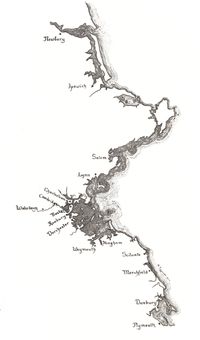
Writes against the royal patents. At Plymouth Williams spoke, as he had at Salem, without restraint from any motive of expediency or even of propriety. Separatist Plymouth, whose days of advance were over, was a little disturbed by his speech. In his own sweet, reckless way he sometimes sharply rebuked even the revered Bradford when he thought him at fault. And in the interest of the aborigines and of justice Williams laid before Governor Bradford a manuscript treatise which argued that the king had no right to give away, as he had assumed to do in his grants and charters, the lands of the Indians merely because he was a Christian and they heathen. That it was right to wrong a man because he was not orthodox in belief could find no place in the thoughts of one whose conscience was wholly incapable of sophistication. Bradford accepted candidly the rebukes of Williams and loved him for his "many precious parts." Bradford, 310. But as governor of a feeble colony he was disturbed by Williams's course. In spirituality, unselfish fearlessness, and a bold pushing of Separatist principles to their ultimate logical results, Roger Williams reminded the Pilgrims of the amiable pastor of the Separatist church in Amsterdam whose change step by step to "Anabaptism," the great bugbear of theology in that time, had been a tragedy and a scandal to the Separatists of Leyden. Knowles's Life of Williams, 53. Elder Brewster feared that Williams would run the same course. Williams wished to return to Salem, where he might still devote himself to the neighboring Indians, and assist Skelton, now declining in health. Brewster persuaded the Plymouth church to give him a letter of dismissal. Williams returns to Salem. The leading Pilgrims felt bound to send "some caution" to the Salem church regarding the extreme tendencies of Williams. On the other hand, some of the Plymouth people were so captivated by his teachings and his personal character that they removed with him. This following of an approved minister was common among Puritans; an acceptable preacher was of as much value to a town as good meadows, broad pastures, and pure water.
V.
Life in the Massachusetts settlements. This community of scattered communes was cut off from frequent intercourse with the world, for the sea was far wider and more to be feared in that day of small ships and imperfect navigation than it is now. 1630 to 1640. The noise of the English controversies in which the settlers had once borne a part reached them at long intervals, like news from another planet. But most of the time these lonesome settlements had no interest greater than the petty news and gossip of little forest hamlets. The visitor who came afoot along Indian trails, or by water, paddling in a canoe, to Boston on lecture day, might bring some news of sickness, accident, or death. Sometimes the traveling story was exciting, as that wolves had slaughtered the cattle at a certain place, while yet cattle were few and precious. Or still more distressing intelligence came that the ruling elder of the church at Watertown had taken the High-church position that Roman churches were Christian churches, or that democratic views had been advanced by Eliot of Roxbury. A new and far-fetched prophetical explanation of a passage in the Book of Canticles, and a tale of boatmen wrecked in some wintry tempest, might divide the attention of the people. Stories of boats capsized, of boatmen cast on islands where there was neither shelter nor food, of boats driven far to sea and heard of no more, were staples of excitement in these half-aquatic towns; and if the inmates of a doomed boat had been particularly profane, these events were accounted edifying—divine judgments on the ungodly. When the governor wandered once and lost himself in the forest, passing the night in a deserted wigwam, there was a sensation of a half-public character. That a snake and a mouse had engaged in a battle, and that the puny mouse had triumphed at last, was in one budget of traveling news that came to Boston. To this event an ominous significance was given by John Wilson, pastor of the Boston church, maker of anagrams, solemn utterer of rhyming prophecies which were sometimes fulfilled, and general theological putterer. Wilson made the snake represent the devil, according to all sound precedents; the mouse was the feeble church in the wilderness, to which God would give the victory over Satan. Thus enhanced by an instructive interpretation from the prophet and seer of the colony, the story no doubt took up its travels once more, and now with its hopeful exegesis on its back. The Massachusetts mouse was an auspicious creature; it is recorded by the governor, and it was no doubt told along the coast, that one got into a library and committed depredations on a book of common prayer only, nibbling every leaf of the liturgy, while it reverently spared a Greek Testament and a Psalter in the same covers.
In a petty state with a range of intellectual interests so narrow, the conflict between Williams and the General Court took place.
VI.
VII.
Salem refractory. Salem, the oldest town of the commonwealth, was the most ready to pursue an independent course and it was attached to Williams, whose ability attracted new settlers and who maintained a position of independence toward Cotton and the authorities at Boston. To subdue the refractory Salem was no doubt one of the secondary purposes of the proceedings against Williams. There seems to have been no personal animosity toward Williams himself; his amiable character and his never-doubted sincerity were main obstacles to his punishment.
Collision inevitable. The return of Roger Williams to such a place as Salem was naturally a matter of alarm to the ministers and magistrates of Massachusetts. Collision was not a matter of choice on either side. The catastrophe was like one that comes from the irresistible action of physical forces. In a colony planted at great cost to maintain one chosen form of worship and subordinating all the powers of government to this purpose, a preacher who asserted the necessity for a complete separation of religion and government in the interest of soul liberty had no place. His ideal was higher than the prevailing one, but that age could not possibly rise to it.
VIII.
An abstract principle. It is probable that most of the land of the colony had been secured from the natives by purchase or by treaty of some sort; at least the Indians were content, and the little quarto had at that time no practical bearing whatever, but that did not matter to Williams. The more abstract a question of right and wrong, the more he relished a discussion of it. It was of a piece with his exquisite Separatism, a mere standing up in the face of heaven and earth for an abstract principle. His purpose was not to right a specific and concrete wrong, for there had been none, but to assert as a broad principle of everlasting application that a Christian king may not dispose of the land owned by heathens merely because of his Christianity. Williams was not a judge or a lawgiver; he was a poet in morals, enamored of perfection, and keeping his conscience purer than Galahad's.
IX.
The alarm. It was in the winter of 1633-'34 that the book about the patent was called in question. Skelton, pastor of Salem, died in the following August, and the Salem people, in spite of an injunction from the magistrates, made Williams their teacher in his stead. 1634. The country was now full of alarm at news from England that the charter was to be revoked, that a general governor of New England was to be appointed, and that a force was to be sent to support his authority. Laud was put at the head of a commission for the government of the colonies in April, 1634. There could be no doubt of the meaning of this measure. For more than a year the alarm in Massachusetts continued. The ministers were consulted regarding the lawfulness of resistance to force. A platform was constructed on the northeast side of Castle Island, and a fortified house was proposed to defend the platform. The trainbands were drilled, muskets, "bandeleroes" or cartridge belts, and rests were distributed to the several towns, and pikemen were required to learn to use the cumbrous musket of the time. Puritans in England, angry that Laud, the new archbishop and old persecutor, should stretch a long arm to America, sent powder and cannon to their co-religionists, the object of whose military vigilance could easily be covered by dangers from the savages, from the French, or from the Spaniards.
Debates not appeased. But these assiduous preparations, under the supervision of a military commission which had "power of life and limb," did not abate in the least the discussion of questions of doctrine and casuistry. Refinements of theology were quite as real and substantial to the Puritan mind as trainbands and fortifications. Sound doctrine and a scrupulous observance of the "ordinances" conciliated God; they were indeed more important elements of public safety than drakes and demi-culverins.
Reform in dress. The General Court of September, 1634, undertook to provide for the public safety in both respects. Mass. Records, 3d September, 1634. Along with regulations and provisions of a military nature, it set out to remove those flagrant sins that had provoked the divine wrath. The wearing of silver, gold, and rich laces, girdles, and hatbands was forbidden; slashed clothes were also abolished, "other than one slash in each sleeve and another in the back"; ruffs and beaver hats, which last were apparently a mark of dudishness, were not to be allowed. Long hair and other fashions "prejudicial to the general good" were done away with in this hour of penitence. Compare Ward's Simple Cobbler, passim. Men and women might wear out the clothes they had, except their "immoderate great sleeves, slashed apparel, immoderate great rayles, long wings," which were to go at once without reprieve or ceremony. The use of tobacco, socially and in public, or before strangers was made an offense. If taken secretly or medicinally, the Court did not take cognizance of it.
X.
The fast-day sermon. Seeing that the millinery sins recounted in this act had cried to Heaven, and that, beside the danger from England, there was the desire of Hooker's party to remove to the Connecticut, and a dissension concerning the power of the Upper House that threatened trouble, the Court appointed the 18th of September a solemn fast-day, hoping by repentance, prayer, and the penance of hunger to avert the manifold disasters that threatened them. 1634. Roger Williams was sure to speak like a prophet on such an occasion. He did not stop at slashed garments, great sleeves, and headdresses with long wings; he preached on eleven "public sins" that had provoked divine wrath. We have no catalogue left us. The list may have included some of those amusing scruples that he held in common with other Puritans, or some of those equally trivial personal scruples that Williams cherished so fondly. But no sermon of his on public sins could fail to contain a declaration of his far-reaching and cherished principle of religious freedom, including perhaps a round denunciation of the petty inquisition into private opinion which had been set up in Massachusetts. The Sabbath law, the law obliging men to pay a tax to support religious worship, the requirement that all should attend religious worship under penalty, and the enforcement of a religious oath on irreligious and perhaps unwilling residents, the assumption of the magistrate to regulate the orthodoxy of a church under the advice of the ministers, were points of Massachusetts law and administration that he denounced at various times; and some of them, if not all, were no doubt put in pillory in this fast-day sermon in the early autumn of 1634. Judged by modern standards, the sermon may have had absurdities enough, but it was no doubt a long way in advance of the General Court's mewling about lace, and slashes, and long hair, and other customs "prejudicial to the general good." To this sermon, whatever it was, Williams afterward attributed the beginning of the troubles that led to his banishment.
XI.
The governor's verse. It was, perhaps, when his desire to act promptly against the Salem heretic was thus foiled by Cotton's prudent and intricate orderliness in procedure that Dudley relieved his emotions by what is happily the only example of his verse that has survived:
Eliot's New England Biography, 156, 157.
Let men of God in courts and churches watch O'er such as do a toleration hatch, Lest that ill egg bring forth a cockatrice To poison all with heresy and vice. If men be left and otherwise combine, My epitaph's I die no libertine.
XII.
Scruples small and great. During the year following Williams was several times "convented" before the Court. He was charged with having broken his promise not to speak about the patent, with opposing the residents' oath, with maintaining certain scruples in opposition to the customs of the times, as that a man should not return thanks after a meal, or call on an unregenerate child to give thanks for his food. These were not more trivial certainly than half a hundred scruples then prevalent, but they chanced to be unfashionable—a damning fault in a scruple. The sense of proportion was feeble in religionists of that day, and neither Williams nor his opponents understood the comparative magnitude of his greater contentions, and the triviality of those petty scruples about which, like the whole Puritan world, he was very busy. Religious freedom and the obligation of grace after meat could then be put into the same category. As years went by, although the mind of Williams was never disentangled from scrupulosity, he came to see clearly what was the real battle of his life. No better fortune can befall a great spirit than such a clarification of vision. The extended works of Williams's later life are written mainly to overthrow the "bloody tenent of persecution." It was this championship of soul liberty as the weightiest matter of the law that lifted him above all others who paid tithes of their little garden herbs.
Williams inflexible. Williams was certainly incorrigible. Richard Brown, the ruling elder of the church at Watertown, seems to have submitted to the remonstrance of the magistrates against his too charitable judgment of the Roman churches. Savage's Winthrop's Journal, i, 81. Eliot, of Roxbury, afterward the Indian apostle, advanced peculiar opinions also, but he was overborne and convinced. Mass. Rec., i, 135, 136. Stoughton, who had denied that the "assistants" of a corporation were scriptural magistrates, was brought to book about this time, and he retracted. Salem itself was forced to bend its stiff neck at last. The town had been refused its land on Marble Neck because of its ordination of Williams, and having, under Williams's leadership, protested in a letter to the churches against the injustice of spiritual coercion by financial robbery, the deputies of Salem were now summarily turned out of the court. Endecott, with characteristic violence, protested further against the double injustice to Salem. Mass. Rec., i, 156, 157. Winthrop's Journal, i, 194. He was promptly put under arrest, and this severity brought swift conviction to his mind, so that he humbly apologized and submitted the same day. The only bond of unity between the rash Salem leader and Williams was a common tendency to go to extremes. In spirit, the heroic, long-suffering Williams, who rested in what he called the "rockie strength" of his opinions in spite of penalties and majorities, was far removed from a leader who bent before the first blast, and who became in later life the harshest persecutor in the commonwealth.
XIII.
XIV.
Escape to the Indians. The hardships of such a voyage in midwinter in his state of health might prove fatal, and his arrival in England would almost certainly deliver him into the hands of Laud. But what is justice or mercy when the welfare of churches and the rescue of imperiled souls is to be considered? A warrant was dispatched ordering him to Boston within a certain time. Probably knowing what was in store for him, he protested that it would be dangerous for him, in view of his health, to make the journey, and some of the Salem people went to Boston in his behalf, and, as was natural in the circumstances, made exaggerated representations regarding his physical condition. But the magistrates had other information. They sent the valiant and notorious Captain Underhill, in whom were mingled about equally devoutness, military courage, and incorrigible lewdness, to bring Williams by sea in a shallop. Williams was probably informed of their purpose, for, while Underhill in his little craft was beating up to Salem in wintry seas on an errand so congenial, expecting perhaps to come upon his quarry unawares, Williams was fleeing from one hamlet of bark wigwams to another. Here among the barbarians he was sure of faithful friends and secure concealment. Underhill found on his arrival that the culprit had disappeared three days before he got there, and nobody in Salem, that could, would tell whither the fugitive had gone.
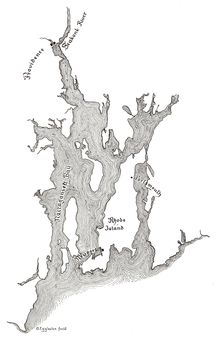
Williams founds Providence. Meantime Williams was, to use his own figure of speech, "steering his course" "in winter snow" toward Narragansett Bay. "I was sorely tossed for one fourteen weeks in a bitter winter season," he says, in his vivid and hyperbolic fashion of speech, "not knowing what bed or bread did mean." He began one settlement on the eastern bank of the Seekonk River after getting land from the Indians, but his old enemies the royal patents now had their revenge. Winslow, governor of Plymouth, a kind-hearted, politic man, the one born diplomatist of New England, warned him that he was within the bounds of Plymouth, and asked him to remove to the other side of the water, because they "were loath to displease the Bay." It was not enough to drive a heretic from the bounds of Massachusetts; the pragmatic Puritanism of the time would have expelled him from the continent had its arm been long enough. Williams had already begun to build and to plant, but he removed once more to the place which he named Providence. He planted the germinal settlement of the first state in the world that founded religious liberty on the widest possible basis, reserving to the law no cognizance whatever of religious beliefs or conduct where the "civil peace" was not endangered.
XV.
XVI.
XVII.
The Seekers. Here again is a probable influence from Holland. The Seekers had appeared there long before. Many Baptists had found that their search for primitivism, if persisted in, carried them to this negative result; for it seemed not enough to have apostolic rites in apostolic form unless they were sanctioned by the "gifts" of the apostolic time. The Seekers appeared in England as early as 1617, and during the religious turmoils of the Commonwealth period the sect afforded a resting place for many a weatherbeaten soul. As the miraculous gifts were lost, the Seekers dared not preach, baptize, or teach; they merely waited, and in their mysticism they believed their waiting to be an "upper room" to which Christ would come. It is interesting to know that Williams, the most romantic figure of the whole Puritan movement, at last found a sort of relief from the austere externalism and ceaseless dogmatism of his age by traveling the road of literalism until he had passed out on the other side into the region of devout and contented uncertainty.
XVIII.
Moral elevation of Williams In all this Williams was the child of his age, and sometimes more childish than his age. But there were regions of thought and sentiment in which he was wholly disentangled from the meshes of his time, and that not because of intellectual superiority—for he had no large philosophical views—but by reason of elevation of spirit. Even the authority of Moses could not prevent him from condemning the harsh severity of the New England capital laws. He had no sentimental delusions about the character of the savages—he styles them "wolves endued with men's brains"; but he constantly pleads for a humane treatment of them. All the bloody precedents of Joshua could not make him look without repulsion on the slaughter of women and children in the Pequot war, nor could he tolerate dismemberment of the dead or the selling of Indian captives into perpetual slavery. From bigotry and resentment he was singularly free. On many occasions he joyfully used his ascendency over the natives to protect those who kept in force against him a sentence of perpetual banishment. And this ultra-Separatist, almost alone of the men of his time, could use such words of catholic charity as those in which he speaks of "the people of God wheresoever scattered about Babel's banks either in Rome or England."
Superior to the age. Of his incapacity for organization or administration we shall have to speak hereafter. But his spiritual intuitions, his moral insight, his genius for justice, lent a curious modernness to many of his convictions. In a generation of creed-builders which detested schism he became an individualist. Individualist in thought, altruist in spirit, secularist in governmental theory, he was the herald of a time yet more modern than this laggard age of ours. If ever a soul saw a clear-shining inward light not to be dimmed by prejudices or obscured by the deft logic of a disputatious age, it was the soul of Williams. In all the region of petty scrupulosity the time-spirit had enthralled him; but in the higher region of moral decision he was utterly emancipated from it. His conclusions belong to ages yet to come.
His prophetic character. This union of moral aspiration with a certain disengagedness constitutes what we may call the prophetic temperament. Bradford and Winthrop were men of high aspiration, but of another class. The reach of their spirits was restrained by practical wisdom, which compelled them to take into account the limits of the attainable. Not that they consciously refused to follow their logic to its end, but that, like other prudent men of affairs, they were, without their own knowledge or consent, turned aside by the logic of the impossible. Precisely here the prophet departs from the reformer. The prophet recks nothing of impossibility; he is ravished with truth disembodied. From Elijah the Tishbite to Socrates, from Socrates to the latest and perhaps yet unrecognized voice of our own time, the prophetic temperament has ever shown an inability to enter into treaty with its environment. In the seventeenth century there was no place but the wilderness for such a John Baptist of the distant future as Roger Williams. He did not belong among the diplomatic builders of churches, like Cotton, or the politic founders of states, like Winthrop. He was but a babbler to his own time, but the prophetic voice rings clear and far, and ever clearer as the ages go on.
Elucidations.
Note 1, page 268. Sir William Martin, an early friend of Williams, describes him as passionate and precipitate, but with integrity and good intentions. Hutchinson Papers, 106. See also, for example, the two letters of Williams to Lady Barrington, in New England Genealogical Register, July, 1889, pp. 316 and following.
Note 2, page 269. Letter to John Cotton the younger, 25th March, 1671. "He knows what gains and preferments I have refused in universities, city, country and court," etc. Williams's enthusiastic nature gave a flush of color to his statement of ordinary fact, the general correctness of which, however, there is never reason to doubt.
Note 3, page 270. Letter to John Cotton the younger, Narragansett Club Publications, vi, 356. There is no account of this event elsewhere, but the church records of that early date are imperfect, and there is every reason to accept the circumstantial statement of Williams. That he refused to enter into membership with the church is confirmed by Winthrop's Journal, 12th April, 1631, and such refusal must have had some such occasion.
Note 4, page 271. "We have often tried your patience, but could never conquer it," were Winthrop's words to Williams, who gave to Massachusetts lifelong service in return for its lifelong severity toward him. The sentence is quoted in Williams's letter to the younger Cotton, cited above, which is itself a fine example of his magnanimity of spirit. Narragansett Club Publications, vi, 351-357.
Note 5, page 272. There is difference of opinion on this point, but certain words of Williams himself seem to bear on it. After his retirement from Salem to Plymouth he received a letter from Winthrop, which appears to have intimated that no man under twenty-five ought to be ordained. Williams explains in reply that he is "nearer upwards of thirty than twenty-five," but avers, "I am no elder in any church ... nor ever shall be, if the Lord please to grant my desires that I may intend what I long after, the natives souls." Williams's Letter, Narragansett Club Publications, vi, 2. Of course, these words might have been written if he had resigned the eldership before leaving Salem, but they would have had much less pertinency.
Note 6, page 276. Mr. Straus, in his Life of Roger Williams, says aptly that Massachusetts was under a government of congregations rather than of towns, since only church members could vote. A fuller discussion of the source and evolution of the town system is deferred to a later volume of this series.
Note 7, page 278. David Pieterzen de Vries, in his Voyages, reports this feeling of superiority as freely expressed at Hartford in 1639. There is a quaint humor in what he says of it that is enhanced by the naïve Dutch phrase in which it is set down: "Dit Volck gaven haer uyt det sy Israëliten waren, ende dat wy aen onse colonie Egyptenaren waren, end' Engelsen inde Vergienies waren mede Egyptenaren," p. 151.
Note 8, page 279. "And such was the authority ... Mr. Cotton had in the hearts of the people, that whatever he delivered in the pulpit was soon put into an Order of Court, if of a civil, or set up as a practice in the church, if of an ecclesiastical concernment." Hubbard, History of Massachusetts, 182.
Note 9, page 281. Knowles's Life of Williams, 58, note, quotes from a letter of Coddington's appended to Fox's reply to Williams, in which Coddington, who was one of the magistrates that examined the treatise, charges Williams with having "written a quarto against the King's patent and authority."
Note 10, page 288. Cotton's Answer to Williams's Examination, 38. I have followed Cotton implicitly here, but without feeling sure that his memory can ever be depended on where his polemical feeling is concerned. On the next page he is guilty of a flagrant but no doubt unconscious suppression of an important fact. "It pleased the Lord to open the hearts of the Church to assist us," etc., he says, putting out of sight the sharp dealing by which the Salem church was brought to ignominious subjection.
Note 11, page 289. Cotton's Answer to Williams, 29. Compare also Massachusetts Records of 4th March, 1633, where a mercenary inducement to take the oath is offered by making the regulations for recording the lands of freemen apply also to the lands of "residents" presumably not church members and ineligible to the franchise, but only to the residents "that had taken or shall hereafter take their oathes." Backus supposes that Williams saw some incidental result from the oath that would be prejudicial to religious freedom. This is to suppose that Williams needed a practical consideration to stir him to action—it is to suppose that Williams was not Williams. Practical men were afraid the independence of Massachusetts would be lost; Roger Williams was only afraid that Massachusetts would commit a public sin in trying to escape the impending evil. A conscience undefiled was his objective point in private and public life; safety, public or private, was secondary.
Note 12, page 292. There has been much ingenious and rather uncandid effort by Cotton first of all, and by other defenders of the General Court since, to prove that Williams's views on toleration were not a cause of his banishment. If those views had been the sole cause, the decree would have been more comprehensible and defensible in view of the opinions of the age. But the question about the validity of the patent, the question of the protest written against the course of the magistrates in blackmailing Salem into a refusal to support him, the question of the freeman's oath, and, what seems to have been deemed of capital importance, the question of grace after meat, are all involved at one time or another. The formal charges in what may be considered the beginning of the banishment proceedings, the trial in July, as given by Winthrop, our most trustworthy authority, are: 1. That the magistrates ought not to punish for a religious offense—"the breach of the first table"—except where it disturbed the civil peace. 2. That the magistrate ought not to tender an oath to an unregenerate man. 3. That a man ought not to pray with an unregenerate person. 4. That thanks were not to be given after the sacrament and after meat. Savage's Winthrop, i, 193, 194. In the final proceedings in October, the letters growing out of the refusal to confirm to Salem its outlying land entered into and embittered the controversy. Winthrop, i, 204. The recorded verdict makes the divulging "of dyvers newe and dangerous opinions against the aucthoritie of the magistrate" the first offense, and the "letter of defamacion" the second. Williams says that a magistrate, who appears to have been Haynes, the governor, summed up his offenses at the conclusion of the trial under four heads: 1. The denial of the authority of the patent. 2. The denial of the lawfulness of requiring a wicked person to take an oath or pray. 3. The denial of the lawfulness of hearing the parish ministers in England. 4. The doctrine "that the Civill Magistrates' power extends only to the Bodies and Goods and outward State of men." Against the evidence of Williams, Winthrop, and the records, I can not attach any importance to the halting accounts given years afterward, for controversial purposes, by Cotton, from what he thought was his memory.
Note 13, page 292. "Whereas Mr. Roger Williams, one of the elders of the church at Salem, hath broached and dyvulged dyvers newe and dangerous opinions, against the aucthoritie of magistrates, as also writt letters of defamacion both of the magistrates & Churches here, & that before any conviccion, & yet maintaineth the same without retraccion, it is therefore ordered that the said Mr. Williams shall departe out of this jurisdiccion within sixe weekes now nexte ensueing, which if hee neglect to performe it shall be lawfull for the Gouernour & two of the magistrates to send him to some place out of this jurisdiccion, not to returne any more without license from the Court." Massachusetts Records, i, 161.
Note 14, page 293. Neal's History of New England, i, 143. "Sentence of banishment being read against Mr. Williams, the whole town of Salem was in an uproar; for such was the Popularity of the Man and such the Compassion of the People ... that he would have carried off the greatest part of the Inhabitants of the Town if the Ministers of Boston had not interposed." Neal appears to derive these facts, which wear a countenance of probability, from an authority not now known.
Note 15, page 293. The phrase occurs in Williams's noble letter to Major Mason, 1st Massachusetts Historical Society Collections, i, 275 and following. The magnanimity shown toward those opposed to him in this letter is probably without a parallel in his age; it has few in any age.
Note 16, page 294. "The increase of the concourse of people to him on the Lord's days in private, to the neglect or deserting of publick Ordinances and to the spreading of the Leaven of his corrupt imaginations, provoked the Magistrates rather than to breed a winters Spirituale plague in the Countrey, to put upon him a winter's journey out of the Countrey." Master John Cotton's Answer to Master Roger Williams, 57.
Note 17, page 297. The main original authorities on the banishment of Williams are Winthrop's Journal and the Massachusetts Records of the period. Some facts can be gathered from the writings of Williams, whose autobiographical passages always have an air of truth while they are sometimes vague and often flushed by his enthusiastic temper. Cotton's memory is less to be trusted; some of his statements are in conflict with better authorities. He no doubt believed himself to be truthful, but his ingenious mind was unable to be precise without unconscious sophistication. Hubbard was of Presbyterian tendencies and totally opposed to all forms of Separatism. He appears to have recorded every exaggerated rumor cherished by Williams's antagonists to his discredit. Neither in this nor in other matters can we rely much on Hubbard's testimony. No critical student of history puts unquestioning confidence in Cotton Mather. His strange mind could never utter truth unvarnished. In a case like this, where family pride, local feeling, and sectarian prejudice were all on one side, and where he had a chance to embroider upon traditions already two generations old, it is better to disregard the author of the Magnalia entirely. Bentley's Historical Account of Salem, in 1st Massachusetts Historical Society Collections, vi, is a paper that excites admiration for its broadmindedness. It contains information not elsewhere to be found, but it is impossible to tell how far Bentley depended upon sources not now accessible and how far he relied on ingenious inferences drawn from his large knowledge of local history. The publications of the Narragansett Club contain the whole controversy between Cotton and Williams and all the letters of the latter now known to be extant. I have in some cases referred to the originals, in others I have used these careful reprints. Williams has been rather fortunate in his biographers. Mr. Oscar S. Straus, approaching the subject from a fresh standpoint, has produced the latest Life of Williams, written in a judicial temper and evincing a rare sympathy with its subject. The character of Williams has never been better drawn than by Mr. Straus, pp. 231-233. The life by T. D. Knowles is perhaps the best of the older biographies, Arnold's History of Rhode Island contains a sketch of Williams, and Elton's brief biography has a value of its own. Gammell's Life in Sparks's Biography is generally fair. "As to Roger Williams," by the late Dr. Henry Martyn Dexter, is, what it pretends to be, a partisan statement of the case against Williams. It shows characteristic thoroughness of research, it clears up many minor points, and is as erudite as it is one-sided.
Note 18, page 298. Baylie's Sermon before the House of Lords, on Errours and Induration, accuses the Dutch of mere worldly policy in toleration. Williams alludes to the charge, Bloudy Tenent yet more Bloudy, p. 8. But the toleration of Holland may rather be traced to that decay of bigotry and that widening of view which are beneficent results of an extended trade. Williams in the Bloudy Tenent yet more Bloudy, p. 10, complains of the exclusion of Catholics and Arminians from toleration in the Netherlands. It would carry us beyond the range of the present work to inquire how far the toleration of Amsterdam was related to that "meridian glory" which Antwerp reached as early as 1550 by making itself a place of refuge for the persecuted of England, France, and Germany. The Articles of Union, adopted at Utrecht in 1579, which have been often called the Magna Charta of the Dutch, go to show that political and commercial considerations counted in favor of toleration, but they also show that some notion of the sacredness of the free conscience had been adopted among the Dutch. Article XIII of the Union provides that the states of Holland and Zealand shall conduct their religious affairs as they think good. More qualified arrangements are made for the other states, as that they may restrict religious liberty as they shall find needful for the repose and welfare of the country. But this significant provision is added, that every man shall have freedom of private belief without arrest or inquisition: "Midts dat een yder particulier in syn Religie vry zal moghen blyven, ende dat men niemandt, ter cause van de Religie, zal moghen achterhalen, ofte ondersoecken." Pieter Paulus Verklaring der Unie van Utrecht, i, 229, 230. Compare Van Meteren, Nederlandsche Historie etc., iii, 254, 255, and Hooft Nederlandsche Historie, etc., Book IX, where the full text of Article XIII is given.
Note 19, page 298. Barclay, in his Inner Life of the Religious Societies of the Commonwealth, p. 97, cites Peter John Zwisck, a Mennonite of West Frisia, as the author, in 1609, of The Liberty of Religion, in which he maintains that men are not to be converted by force. In 1614 one Leonard Busher petitioned James I in favor of liberty of conscience, and Barclay conjectures that he was a member of that Separatist or General Baptist church returned from Holland, of which Helwyss had been pastor. In 1615 this obscure and proscribed congregation professed a great truth, yet hidden from the wise and prudent, namely, that "earthly authority belonged to earthly kings, but spiritual authority belonged to that one Spiritual king who is king of kings." In more than one matter Roger Williams showed himself attracted to the doctrines of the Mennonites and their offshoot the English General Baptist body. Whether directly through his reading of Dutch theological works or indirectly through English followers of Dutch writers, Williams probably derived his broadest principles, in germ at least, from the Mennonites or Anabaptists of the gentler sort, as he did also some of his minor scruples. For the connection between the Mennonites of the Continent and the English cognate sects the reader is referred to Barclay's Inner Life, a valuable work of much research. See also the petition of the Brownists, 1641, cited in Barclay, p. 476, from British Museum, E 34-178, tenth pamphlet.
Note 20, page 299. Another delightful example of the far-fetchedness of Cotton's logic is his justification of the sentence of banishment against Williams by citing Proverbs xi, 26: "He that withholdeth corn, the people shall curse him." This text, says Cotton, "I alledged to prove that the people had much more cause to separate such from amongst them (whether by Civill or church-censure) as doe withhold or separate them from the Ordinances or the Ordinances from them, which are the bread of life." Reply to Williams's Examination, 40. The reference in the text is to the same work, 37. "Much lesse to persecute him with the Civill Sword till it may appeare, even by just and full conviction, that he sinneth not out of conscience but against the very light of his own conscience." But in Cotton's practice those who labored with the heretic were judges of how much argument constituted "just and full conviction." This logic would have amply sheltered the Spanish Inquisition.
Note 21, page 300. Cotton's Answer to Williams's Examination, 38, 39. Cotton confesses to having had further conversation of a nature unfavorable to Williams, but he is able to deny that he counseled his banishment. Even Cotton could hardly have prevented it, and he confesses that he approved the sentence. The only interest in the question is the exhibition of Cotton's habitual shrinking from responsibility and his curious sinuosity of conscience.
Note 22, page 301. In an unpublished work by Mr. Lindsay Swift, of the Boston Public Library, which I have been kindly permitted to read, and which is a treatise on the election sermons mostly existing only in manuscript, the author says: "The early discourses were full of ecclesiasticism, a great deal of theology, some politics; ... but of humanity, brotherly kindness, and what we understand by Christianity in the human relations, I have been able to discern very little."
Note 23, page 302. Many of Roger Williams's scruples were peculiar, but his scrupulosity was not. Cotton takes pains to call pulpits "scaffolds," to show that they had no sacredness. The scruple about the heathen names of days of the week was felt by many other Puritans. It is evident in Winthrop, and it did not wholly disappear from Puritan use until about the end of the seventeenth century.
Note 24, page 303. Barclay, Inner Life, etc., 410, 411, cites Sebastian Franck's Chronica of 1536, from which it appears that the Seekers in fact if not in name existed about a century before Williams adopted their views. "Some desire to allow Baptism and other ceremonies to remain in abeyance till God gives another command—sends out true laborers into the harvest.... Some others agree with those who think the ceremonies since the death of the Apostles, are equally departed, laid waste and fallen—that God no longer heeds them, and also does not desire that they should be longer kept, on which account they will never again be set up but now are to proceed entirely in Spirit and in Truth and now in an outward manner." The relation of Seekerism to Quakerism is manifest. "To be a Seeker is to be of the best Sect next to a finder," wrote Cromwell in 1646.
CHAPTER THE THIRD. NEW ENGLAND DISPERSIONS.
I.
Importance of the Rhode Island colony. The removal of Roger Williams and his friends was the beginning of dispersions from the mother colony on Massachusetts Bay. The company that settled Providence was too small in number at first to be of great importance. The emigration of Williams and his followers to the Narragansett country was an example that may have turned the scale with Hooker and his party in favor of a removal to the Connecticut instead of to some place in the Massachusetts wilderness. Williams certainly prepared a harbor for most of the Hutchinsonians, and pointed the way to Gortonists, Baptists, Quakers, and all others of uneasy conscience. Providence Plantation, and at times all Rhode Island, fell into disorders inevitable in a refuge for scruplers and enthusiasts established by one whose energies were centrifugal and disintegrating. But when at length it emerged from its primordial chaos the community on Narragansett Bay became of capital importance as an example of the secularization of the state, and of the congruity of the largest liberty in religion with civil peace. The system which the more highly organized and orderly commonwealths of Massachusetts and Connecticut labored so diligently to establish—a state propping and defending orthodoxy and church uniformity—was early cast into the rubbish heap of the ages. The principle on which the heterogeneous colony of religious outcasts on Narragansett Bay founded itself, was stone rejected that has become the head of the corner.