BOOK III. CENTRIFUGAL FORCES IN COLONY-PLANTING. (continued 2)
Reading edition
II.
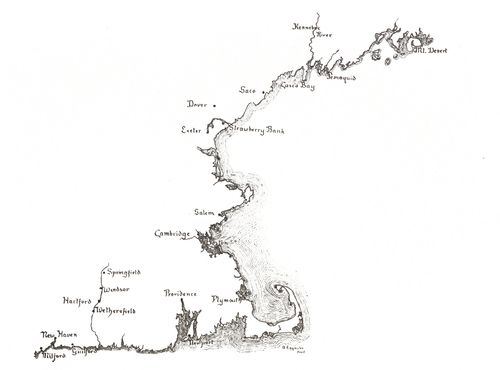
The Connecticut migration. The emigration to the Connecticut River was already incubating when Williams sat down with his radical seceders in the Narragansett woods. The Connecticut settlement was impelled by more various and complicated motives than that of Williams, and its origins are not so easy to disentangle. But it, too, has an epic interest; one dominant personality overtops all others in this second of venturesome westward migrations into the wilderness.
Early life of Hooker. We can trace nothing of Hooker to his birthplace, a little hamlet in Leicestershire, except that the imagery of his discourses in after life sometimes reflected the processes of husbandry he had known in childhood. But that he passed through Emmanuel College, Cambridge, while Chaderton was master, is more significant, for Emmanuel was the cradle of Puritan divines, the hatching-place of Puritan crotchets, the college whose chapel stood north and south that it might have no sacred east end, a chapel in which "riming psalms" were sung instead of the hymns, and where lessons different from those appointed in the calendar were read. Hooker was presented to the living of Chelmsford, in Essex. Here his eloquence attracted wide attention, and unhappily attracted at the same time the notice of his diocesan Laud, then Bishop of London, who drove the preacher from his pulpit. Hooker engaged in teaching a school four miles from Chelmsford, where Eliot, afterward the Indian apostle, became his usher and disciple. But Laud had marked him as one to be brought low. 1630. He was cited before the Court of High Commission, whose penalties he escaped by fleeing to Holland. Thus early in his career Laud unwittingly put in train events that resulted in the founding of a second Puritan colony in New England.
III.
Hooker's company. The persecution of Hooker made a great commotion in Essex, dividing attention with the political struggle between the king and the people about tonnage and poundage. Walker's First Church in Hartford, 40. Dudley's Letter to Countess of Lincoln, Young's Chron. of Mass., 320. While Hooker was an exile in Holland a company of people from Braintree and other parts of Essex, near his old parish of Chelmsford, emigrated to New England, chiefly, one may suppose, for the sake of good gospel, since they came hoping to tempt Hooker to become their pastor. Mass. Records, 14 June, 1631, and 3 February, 1632. This company settled at Newtown, now Cambridge, which had been projected for a fortified capital of the colony, that should be defensible against Indians and out of reach if a sea force should be sent from England to overthrow the government. Holmes's Hist. Cambridge, 1st Mass. Hist. Coll., vii, 6-8. Newtown was palisaded and otherwise improved at the expense of the whole colony. Hooker's company were perhaps ordered to settle there because no place was appropriate to the great divine but the new metropolis.
IV.
Failure of Newtown as a metropolis. But a metropolis can not be made at will, as many a new community has discovered. It had been arranged that all the "assistants" or ruling magistrates of Massachusetts should live within the palisades of Newtown, but Winthrop, after the frame of his house was erected, changed his mind and took down the timbers, setting them up again at Boston. Savage's Winthrop, i, 98, 99. 1632. This was the beginning of unhappiness at Newtown, and the discontent had to do, no doubt, with the rivalry between that place and Boston. It is probable that there was a rise in the value of Boston home lots about the time of the removal of the governor's house. Trade runs in the direction of the least resistance, and peninsular Boston was destined by its situation to be the metropolis of New England in spite of the forces that worked for Salem and Newtown.
Wonder-working Providence, ch. xxviii. Newtown, or Cambridge, to call it by its later name, was a long, narrow strip of land, "in forme like a list cut off from the Broad-cloath" of Watertown and Charlestown. Wood's N. E. Prospect, 1634. Young, 402. The village was compactly built, as became an incipient metropolis, and the houses were unusually good for a new country. In one regard it was superior to Boston. No wooden chimneys or thatched roofs were allowed in it. To this town came Hooker, and if it had continued to be the capital, Hooker and not Cotton might have become the leading spirit of the colony. October, 1632. But a capital at a place to which only small vessels could come up, was not practical, and the magistrates in the year before Hooker's arrival decided by general consent that Boston was the fittest place in the bay for public meetings.
Hooker's arrival, 1633. The hopes of Newtown were perhaps not wholly extinct for some time after. The arrival of Hooker must have been a great encouragement to the people. But Boston was on the alert. That town had neither forest nor meadow land. Hay, timber, and firewood were brought to its wharf in boats. Wood's N. E. Prospect. From the absence of wood and marsh came some advantages—it was plagued with neither mosquitoes nor rattlesnakes, and what cattle there were on the bare peninsula were safe from wolves. Young, 397, 398. Not to be behind in evangelical attractions it secured Cotton to balance Newtown's Hooker, when both arrived in the same ship. That Boston was now recognized as the natural metropolis was shown in the abortive movement to pay a part of Cotton's stipend by a levy on the whole colony.
V.
Discontent at Newtown. "Ground, wood, and medowe" were matters of dispute between Newtown and its neighbors as early as 1632, and the frequent references to questions regarding the boundary of Newtown go to show dissatisfaction in the discarded metropolis, the number of whose people was out of proportion to its resources. Mass. Rec., passim. Cattle were scarce in the colony. Each head was worth about twenty-eight pounds, the equivalent of several hundred dollars of money in our time. Wonder-working Providence, ch. xxxiii. The Newtown people saw no prospect of foreign trade, and found the plowable plains of Cambridge dry and sandy. They had given up trying to coax fortunes from the stony hill land of the town with hand labor, and turned their attention to the more profitable pursuit of cattle-raising. They took unusual pains to protect their valuable herd from the wolves by impaling a common pasture. Compare Holmes's History of Cambridge, 1 Mass. Hist. Coll., vii, pp. 1, 2. Natural meadow was the only resource for hay in the English agriculture of the seventeenth century, and the low grounds of Cambridge yielded a poor grass. 2d Mass., vii, 127. Shrewd men in Newtown already saw that as an agricultural colony Massachusetts was destined to failure, and one Pratt, a surgeon there, was called to account for having written to England that the commonwealth was "builded on rocks, sands, and salt marshes."
VI.
Cotton and Hooker. There is good authority for believing that a rivalry between Hooker and Cotton had quite as much to do with the discontent as straitened boundaries and wiry marsh grass. Hooker was the greatest debater, perhaps, in the ranks of the Puritans. His theology was somewhat somber, his theory of Christian experience of the most exigent type. To be saved, according to Hooker, one must become so passive as to be willing to be eternally damned. Compare Walker's First Church of Hartford, 129-132. In other regards he was a Puritan of a rather more primitive type than Cotton. He knew no satisfactory evidence of a man's acceptance with God but his good works. Cotton was less logical but more attractive. His Puritanism grew in a garden of spices. He delighted in allegorical interpretations of the Canticles, his severe doctrines were dulcified with sentiment, and his conception of the inward Christian life was more joyous and mystical and less legal and severe than Hooker's. He was an adept in the windings of non-committal expression, and his intellectual sinuosity was a resource in debate or difficulty. Hooker, on the other hand, had a downrightness not to be mistaken. With an advantage in temperament and the additional advantage of position in the commercial and political center, it is not surprising that Cotton's ideals eloquently and deftly presented soon dominated the colony and that he became the Delphic oracle whose utterances were awaited by the rulers in emergencies.
VII.
Attractions of Connecticut. One other potent motive there was. Stories of the fertility of the "intervale" land on the Connecticut River came by the mouth of every daring adventurer who had sailed or tramped so far. There one might find pasture for the priceless cattle and hay to last the long winter through, and in that valley one might cultivate plains of great fertility.
VIII.
Obstacles to removal. There were dangerous Pequots on the Connecticut, it is true, and the Dutch had already planted a trading house and laid claim to the territory. The Plymouth people who traded there were also claimants. And, more than all, leaving Massachusetts in a time of danger from the machinations of Laud would seem desertion. The government of the Massachusetts Bay colony was anomalous; it partook of the character of the commercial company from which it sprang, yet it had traits of a religious or at least a voluntary society. It was the accepted opinion that those who had taken the freeman's oath were "knit" together "in one body," and that none of them ought to leave the colony without permission. Hooker's party gained the consent of a majority of the representative members of the General Court, but not of a majority of the assistants. Savage's Winthrop, i, 167, 168. This precipitated a debate in the colony on the constitutional question of the right of the assistants, or magistrates, to form an upper house and veto a decision of the chosen deputies of the towns.
IX.
Attempts to prevent removal. It is no part of our purpose to unravel the tangle of ecclesiastical and civil politics in which the proposed emigration had now become involved. The Dorchester church and a part of that of Watertown were ready to follow the lead of Hooker and Newtown. Days of fasting and prayer were appointed to prevent the removal of these "candlesticks," as the churches were called, out of their places; but in spite of humiliations and of Cotton's persuasive eloquence, which at one time almost charmed away the discontent, the emigration set in, stragglingly at first.
Explorers and pioneers. John Oldham, an adventurous man of a rather lawless temper—one of those half-ruffians that are most serviceable on an Indian frontier—had been expelled from Plymouth. 1633. He was now a resident of Watertown, one of the centers of discontent and next neighbor to Newtown. He had gone with three others on a trading expedition to the westward overland. Walking along trails from one Indian village to another they discovered a large river, which they found to be the Fresh River of the Dutch and the Connecticut of the Plymouth traders. They probably brought back to Watertown accounts that produced a fever for removal. Oldham was not a man to stand on the manner of his emigration. Waiting for nobody's consent, he led out a small company from Watertown the next year. These settled at what is now Wethersfield. From Dorchester, which had no alewife fishery with which to enrich its fields, settlers removed in 1634 to the Connecticut, where the soil did not need to be "fished." In 1635 the number of emigrants was larger, and there was much suffering during the following winter and many of the cattle perished.
X.
XI.
The new government. The Connecticut rulers acted at first as a government subordinate to Massachusetts; but the settlements, except that of people from Roxbury at Springfield, were south of the line of the Massachusetts colony, and it was not in the nature of things that Hooker and Haynes should subordinate themselves to Cotton and Winthrop. There was indeed no little exasperation between the two colonies. An independent constitution was adopted in Connecticut, on principles which Hooker thought he found in the first chapter of Deuteronomy, and which were not exactly those that Cotton had managed to deduce from Scripture in his Model of Moses his Judicials. Conn. Hist. Soc. Coll., i, 20, 21. The Massachusetts people, whose government aspired to dominate all New England, seem to have been angered by Hooker's secession and by his refusal to subordinate the new state to their own. Massachusetts asserted its authority over Springfield, which was within its limits, and every effort possible was made to prevent new emigrants who landed at Boston from going to the west. Conn. Hist. Soc. Coll., i, 3, and ff. Even in England accounts adverse to Connecticut were circulated. Hooker, the real head of the new state, resented this in a letter of great vigor and some passion.
XII.
Instability of a theocracy. In its early years Massachusetts had no rest. Three profound disturbances—the expulsion of Williams, the secession of Hooker and his followers, and the Hutchinsonian convulsion—followed one another in breathless succession, and a dangerous Indian war ran its course at the same time. That the early settlements were founded on "rocks and sands and salt marshes" was not the chief misfortune of the Bay colony. Its ecclesiastical politics proved explosive, to the consternation of its pious founders, who like other settlers in Utopia had neglected to reckon with human nature.
XIII.
Severity of Puritanism. It has been the habit of modern writers on the subject to dismiss the Hutchinsonian controversy as a debate about meaningless propositions in an incomprehensible jargon. Yet there was in it but the action of well-known tendencies in human nature which might almost have been predicted from the antecedent circumstances. Puritanism had wrapped itself in the haircloth of austerity, it took grim delight in harsh forbiddings, and heaped up whole decalogues of thou-shalt-nots. Nor did it offer, as other intense religious movements have done, the compensation of internal joys for the gayety it repressed. Theoretically Calvinist, it was practically an ascetic system of external duties and abstentions, trampling on the human spirit without ruth.
XIV.
Cotton's revivalism. Cotton professed that he loved to sweeten his mouth with a piece of Calvin before he went to sleep. Winthrop's Journal, i, 144. His emotional rendering of Calvinistic doctrines wrought strongly on the people of the new Boston, and his advent was followed by widespread religious excitement. More people were admitted to the church in Boston in the earlier months of Cotton's residence than to all the other churches in the colony. Report of Record Com. ii, 5. Boston Town Records, 1635. Hutchinson Papers, p. 88. Boston seems to have become religious in a pervasive way, and in 1635 measures were taken to prevent persons who were not likely to unite with the church from settling in the town. In this community, which had no intellectual interest but religion, and from which ordinary diversions were banished, there were sermons on Sunday and religious lectures on week days and ever-recurring meetings in private houses. The religious pressure was raised to the danger point, and an explosion of some sort was well-nigh inevitable. Cotton's enthusiasms were modulated by the soft stop of a naturally placid temper, but when communicated to others they were more dangerous.
XV.
XVI.
Mrs. Hutchinson's doctrines. In these meetings she emphasized Cotton's favorite doctrine of "a covenant of grace." Her sensitive woman's nature no doubt had beat its wings against the bars of legalism. Compare Whelewright's Sermon in Proc. Mass. Hist. Soc., 1866, 265. Cotton's Sermon on the Churches Resurrection, 1642. She was not a philosopher, but nothing could be more truly in accord with the philosophy of character than her desire to give to conduct a greater spontaneity. Cotton himself preached in the same vein. In addition to the Reformation, of which Puritans made so much, he looked for something more which he called, in the phrase of the Apocalypse, "the first resurrection." Mrs. Hutchinson, who was less prudent and more virile than Cotton, did not hesitate to describe most of the ministers in the colony as halting under a "covenant of works." Her doctrine was, at bottom, an insurrection against the vexatious legalism of Puritanism. She carried her rebellion so far that she would not even admit that good works were a necessary evidence of conversion. It was the particular imbecility of the age that thought of almost every sort must spin a cocoon of theological phrases for itself. Spontaneity of religious and moral action represented itself to Mrs. Hutchinson and her followers as an indwelling of the Holy Ghost in the believer and as a personal union with Christ whom they identified with the "new creature" of Paul. Such a hardening of metaphor into dogma is one of the commonest phenomena of religious thought.
XVII.
Vane's arrival, 1635. Sir Henry Vane the younger, who had become an ardent Puritan in spite of his father, landed in Boston in October, 1635. He had already shown those gifts which enabled him afterward to play a considerable part in English history. His election as governor, 1636. His high connections made him an interesting figure, and though only about twenty-six years of age he was chosen governor in May, 1636. Ardent by nature, and yet in his youth when he "forsook the honors and preferments of the court to enjoy the ordinances of Christ in their purity," nothing was more natural than that he should be captivated by the seraphic Cotton and that he should easily adopt the transcendental views of Mrs. Hutchinson. Winthrop, the natural leader of the colony, having given place in 1635 to Haynes, perhaps in order that Hooker's party might be conciliated and the Connecticut emigration avoided, was a second time thrust aside that a high-born youth might be honored. Winthrop was utterly opposed to Mrs. Hutchinson, in whose teachings his apprehensive spirit saw full-fledged Antinomianism, and, by inference, potential anabaptism, blasphemy, and sedition. The Hutchinsonians were partisans of Vane, who adhered to their doctrine. The ministers other than Cotton and Whelewright, stung by the imputation that they were under "a covenant of works," rallied about Winthrop. Political cleavage and religious division unfortunately coincided.
XVIII.
Arrogance of the Hutchinson party. Supported by the prestige of the young governor and of some conspicuous citizens and inspired by Cotton's metaphorical and mystical preaching, which was interpreted with latitude, the enthusiasm of the Hutchinsonians tended to become fanaticism. We have to depend mainly on the prejudiced account of their enemies, but there is little reason to doubt that the advocates of "a covenant of grace" assumed the airs of superiority usually seen in those who have discovered a short cut to perfection. The human spirit knows few greater consolations than well-disguised self-righteousness. The followers of Mrs. Hutchinson, if we may believe the witnesses, sometimes showed their sanctity by walking out of meeting when a preacher not under "a covenant of grace" entered the pulpit. They even interrupted the services with controversial questions addressed to the minister. Wilson, pastor of the Boston church, was condemned by them as being under "a covenant of works," and also incidentally criticised for his "thick utterance." Nor can one find that Cotton interposed his authority to protect his less gifted colleague. It is quite conceivable that he looked with some satisfaction on the progress of affairs in Boston. 1636. The heavenly minded young governor who had chosen to suffer reproach with the people of God was his disciple. The brilliant woman who was easily the leader of the town was the very apostle of his doctrine. The superiority of his opinions on a union with Christ that preceded active faith as compared with those of Hooker and the lesser divines was enthusiastically asserted by the great majority of the Boston church, led by Mrs. Hutchinson. Seeing so much zeal and sound doctrine he may have felt that the first or spiritual resurrection of which he was wont to prophesy from the Apocalypse, had already begun in his own congregation, and that among these enthusiasts were those who had learned to "buy so as though they bought not"—those who had been lifted into a crystalline sphere where they had "the Moone under their feet. Cotton's Churches Resurrection, p. 27. And if we have the Moone under our feete, then wee are not eclipsed when the Moone is Eclipsed." Thus did Cotton's imagination revel in cosmical imagery.
XIX.
Bitterness of the debate. The arrogance of the elect is hard to bear, and it is not wonderful that the debate waxed hot. The concentrated religiousness of a town that sought to shut out unbelieving residents made the dispute dangerous. In the rising tempest a ballast of ungodly people might have been serviceable. But in Boston there were few even of the indifferent to be buffers in the religious collision. While the covenant-of-grace people made themselves offensive, their opponents,—Winthrop, the slighted ex-governor, Wilson, the unpopular pastor, and the ministers accused of being under a covenant of works—resorted to the favorite weapons of polemics. They hatched a brood of inferences from the opinions Mrs. Hutchinson held, or was thought to hold, and then made her responsible for the ugly bantlings. They pretended to believe, and no doubt did believe, that Mrs. Hutchinson's esoteric teaching was worse than what she gave out. They borrowed the names of ancient heresies, long damned by common consent, to give odium to her doctrine. That the new party should be called Antinomian was plausible; the road they had chosen for escape from Puritan legalism certainly lay in that direction. But Antinomianism had suffered from an imputation of immorality, and no such tendency was apparent, unless by logical deduction, in the doctrines taught in Boston. The hearers of Mrs. Hutchinson were also accused of having accepted the doctrines of the so-called Family of Love which had of old been accused of many detestable things, and was a common bugaboo of theology at the time. The whole town of Boston and the whole colony of Massachusetts was set in commotion by the rude theological brawl. Overthrow of Vane, 1637. Such was the state of combustion in Boston that it was thought necessary by the opponents of Vane and Mrs. Hutchinson to hold the court of elections at the former capital, Newtown. The excitement at this court was so great that the church members, who only could vote, were on the point of laying violent hands on one another in a contest growing out of a question relating to the indwelling of the Holy Ghost. Vane was defeated, and Winthrop again made governor.
XX.
The Synod of 1637. A great synod of elders from all the New England churches was assembled. All the way from Ipswich and Newbury on the east and from the Connecticut on the west the "teaching elders" made their way by water or by land, at public expense, that they might help the magistrates of Massachusetts to decide on what they should compel the churches to believe. Short Story of the Rise, Reign, etc., passim. For more than three weeks the synod at Cambridge wrestled with the most abstruse points of doctrine. Winthrop's Journal, i, 284, and following. The governor frequently had to interpose to keep the peace; sometimes he adjourned the assembly, to give time for heats to cool. Cotton's Way of the Churches Cleared, passim. A long list of errors, most of which were not held by anybody in particular, were condemned. A nearly unanimous conclusion on certain fine-spun doctrines was reached at length by means of affirmations couched in language vague or ambiguous. Cotton, who had been forced after debate to recant one opinion and modify others, assented to the inconclusive conclusions, but with characteristic non-committalism he qualified his assent and withheld his signature.
XXI.
The persecution. The field was now cleared for the orderly persecution of the dissentients. Whelewright, Mrs. Hutchinson's brother-in-law, had been convicted of sedition in the preceding March on account of an imprudent sermon preached on a fast day. But his sentence had been deferred from court to court, apparently until after the synod. Mass. Rec., i, 207. At the November court following the synod Whelewright was banished, and those who had signed a rather vigorous petition in his favor many long months before were arraigned and banished or otherwise punished. The banished included some of the most intelligent and conspicuous residents. Not until this November court had her opponents ventured to bring Mrs. Hutchinson to trial. Whelewright, standing by his hot-headed sermon, had just been sentenced; the abler but more timid Cotton had already been overborne and driven into a safe ambiguity by the tremendous pressure of the great synod. Vane had left the colony, and the time was ripe to finish the work of extirpation. The elders were summoned to be present and advise.
XXII.
XXIII.
Omens and auguries. Mrs. Hutchinson and most of her party settled on Rhode Island, where they sheltered themselves at first in caves dug in the ground. Here she again attracted attention by the charm of her eloquent teaching, and some came from afar to hear the "she Gamaliel," as her opponents called her. Such gifts in a woman, and in one who had been excommunicated by the authority vested in the church, could be accounted for only by attributing her power to sorcery. Savage's Winthrop's Journal, i, 313, 316; ii, 11, and Short Story of Rise and Reign of Antinomianism. Winthrop sets down the evidence that she was a witch, which consisted in her frequent association with Jane Hawkins, the midwife, who sold oil of mandrakes to cure barrenness, and who was known to be familiar with the devil. At length "God stepped in," and by his "casting voice" proved which side was right. Mary Dyer, one of the women who followed Mrs. Hutchinson, had given birth to a deformed stillborn child. Winthrop, i, 316. This fact became known when Mrs. Dyer left the church with the excommunicated Mrs. Hutchinson. Winthrop had the monstrosity exhumed after long burial had rendered its traits difficult to distinguish. He examined it personally with little result, but he published in England incredible midwife's tales about it. God stepped in once more, and Mrs. Hutchinson herself, after she went to Rhode Island, suffered a maternal misfortune of another kind. The wild reports that were circulated regarding this event are not fit to be printed even in a note; the first editor of Winthrop's journal felt obliged to render the words into Latin in order that scholars might read them shamefacedly. Savage's Winthrop, i, 326. But Cotton, who was by this time redeeming himself by a belated zeal against the banished sectaries, repeated the impossible tale, which was far worse than pathological, to men and women, callow youths, young maidens, and innocent children "in the open assembly at Boston on a lecture day," explaining the divine intent to signalize her error in denying inherent righteousness. The governor, who was more cautious, wrote to the physician and got a correct report, from which the divine purpose was not so evident, and Cotton made a retraction at the next lecture. We are now peering into the abyss of seventeenth-century credulity. Death of Mrs. Hutchinson. Here are a grave ruler and a divine once eminent at the university, and now renowned in England and in America, wallowing in a squalid superstition in comparison with which the divination of a Roman haruspex is dignified.
XXIV.
Results of ecclesiastical government. This famous controversy lets in much light upon the character of the age and the nature of Puritanism. It is one of many incidents that reveal the impracticability of the religious Utopia attempted in New England. The concentration of religious people undoubtedly produced a community free from the kind of disorders that are otherwise inseparable from a pioneer state and that were found abundantly in New Netherland, in Maryland, and in Virginia and on the eastward fishing coast. "These English live soberly," said a Dutch visitor to Hartford in 1639, "drinking but three times at a meal, and when a man drinks to drunkenness they tie him to a post and whip him as they do thieves in Holland." But while some of the good results to be looked for in an exclusively Puritan community were attained, it was at the cost of exaggerating the tendency to debate and fanaticism and developing the severity, the intolerance, and the meddlesome petty tyranny that inheres in an ecclesiastical system of government. During the lifetime of one generation Massachusetts suffered all these, and it is doubtful whether regularity of morals was not purchased at too great a sacrifice of liberty, bodily and spiritual, and of justice. Certainly the student of history views with relief the gradual relaxation that came after the English Restoration and the disappearance from the scene of the latest survivors of the first generation of New England leaders.
XXV.
The New Haven colony. During the period of the greatest excitement over the Hutchinson case John Davenport, a noted Puritan minister of London, had been in Massachusetts. Like many other emigrant divines of the time he brought a migrant parish with him seeking a place to settle. Davenport arrived in June, 1637, and took part against the Antinomians in the synod. After examining every place offered them in Massachusetts, he and his friends refused all and resolved to plant a new colony. The people were Londoners and bent on trade, and Massachusetts had no suitable place for their settlement left. The bitterness of the Hutchinson controversy may have had influence in bringing them to this decision, and the preparations of Laud to subject and control Massachusetts perhaps had weight in driving them to seek a remoter settlement. Davenport had ideals of his own, and the earthly paradise he sought to found was not quite Cotton's nor was it Hooker's. He and his followers planted the New Haven colony in 1638. In this little colony church and state were more completely blended than in Massachusetts. The government was by church members only, to the discontent of other residents, and in 1644 New Haven adopted the laws of Moses in all their rigor. The colony was united with Connecticut by royal charter at the Restoration, after which the saints no longer sat upon thrones judging the tribes of Israel.
CONCLUSION.
Later English emigrations to New England. The emigration to New England from the mother country was quickened by the troubles that preceded the civil war. In 1638 it reached its greatest height, having been augmented perhaps by agricultural distress. Fourteen ships bound for New England lay in the Thames at one time in the spring of that year. There was alarm at the great quantity of corn required for the emigrants, lest there should not be enough left in London to last till harvest. "Divers clothiers of great trading" resolved to "go suddenly," in which we may see, perhaps, evidence of bad times in the commercial world. Some parishes it was thought would be impoverished. Lord Maynard to Laud, 17 March, 1638, in Sainsbury. Laud was asked to put a stop to the migration; but the archbishop was busy trying to compel the Scots to use the prayer book. Savage's Winthrop's Journal, i, 319, 320, 322. Most of the lords of the Council were favorable to New England; the customs officers purposely neglected to search for contraband goods, and the ships, twenty in all, got away with or without license, and brought three thousand passengers to Boston. Rushworth, i, Part II, 409, 718. But the tide spent itself about this time, and by 1640 emigration to the New England colonies had entirely ceased. Josselyn's Rarities, 108. About twenty-one thousand two hundred people had been landed in all.
Cavalier emigration to Virginia. The swing of the political pendulum in England that served to check the Puritan exodus gave impetus to a new emigration to Virginia and Maryland. During the ten years and more before 1640 few had gone to that region but bond servants. There were in that year not quite eight thousand people in Virginia. It is the point of time at which the native Virginians began to rear a second generation born on the soil. Petition to House of Lords, 15 Aug., 1648. Royal Hist. MS., Com. Rept., vii, 45. The waning fortunes of the king sent to the colony in the following years a large cavalier emigration, and the average character of the colonists was raised. Better ministers held the Virginia parishes and better order was observed in the courts. Sainsbury, 360. In 1648 four hundred emigrants lay aboard ships bound for Virginia at one time, and in 1651 sixteen hundred royalist prisoners seem to have been sent in one detachment.
Prospective ascendency of the English colonies. By the middle of the seventeenth century the English on the North American continent were in a fair way to predominate all other Europeans. From the rather lawless little fishing villages on the coast of Maine to the rigorous Puritan communes of the New Haven colony that stretched westward to pre-empt, in advance of the Dutch, land on the shores of Long Island Sound, the English held New England. English settlers "seeking larger accommodations" had crossed to Long Island and were even pushing into the Dutch colony. The whole Chesapeake region was securely English. Already there were Virginians about to break into the Carolina country lying wild between Virginia and the Spanish colony in Florida. The French and the Dutch and the Spaniards excelled the English in far-reaching explorations and adventurous fur-trading. But the English had proved their superior aptitude for planting compact agricultural communities. A sedentary and farming population where the supply of land is not limited reaches the highest rate of natural increase. At a later time, Franklin estimated that the population of the colonies doubled every twenty-five years without including immigrants. The compactness of English settlement and the prolific increase of English people decided the fate of North America. The rather thin shell of Dutch occupation was already, by the middle of the seventeenth century, feeling the pressure under stress of which it was soon to give way. A century later collision with the populous and ever-multiplying English settlements brought about the collapse of the expanded bubble of New France.
Elucidations.
Note 1, page 321. There is a paper on this debate in the British Record Office indorsed by Archbishop Laud, "Rec: Octob: 7. 1637," "Propositions wch have devided Mr. Hooker & Mr. Cotton in Newe England. 1. That a man may prove his justification by his works of sanctification, as the first, best, and only cheife evidence of his salvation. 2. Whither fayth be active or passive in justification. 3. Whither there be any saving preparation in a Christian soule before his unyon with Christ. This latter is only Hooker's opinion, the rest of the ministers do not concurr with him: Cotton and the rest of the contrary opinion are against him and his party in all." Colonial Papers, ix, 71. In the next paper in the same volume, also indorsed by Laud, the controversy is more fully set forth. Copies of both are in the Bancroft collection of the New York Public Library. Laud indorsed these papers respectively October 7 and 15, 1637. The Cambridge Synod, which met August 30th, had adjourned late in September, and the debates which divided the two divines must have preceded it, and perhaps preceded the migration of Hooker to Connecticut in 1636. When Haynes was Governor of Massachusetts he had pronounced the sentence of banishment against Williams. But some years later, while Governor of Connecticut, he relented a little and wrote to Williams: "I think, Mr. Williams, I must now confesse to you, that the most wise God hath provided and cut out this part of his world for a refuge and receptacle for all sorts of consciences. I am now under a cloud, and my brother Hooker, with the bay, as you have been, we have removed from them thus far, and yet they are not satisfied." Quoted by Williams in a letter to Mason, 1st Massachusetts Historical Collections, i, 280.
Note 2, page 322. The abstract of Hooker's sermon of May 31, 1638, as deciphered and published by Dr. J. Hammond Trumbull, is in the Collections of the Connecticut Historical Society, i, 20, 21, and the Fundamental Laws of 1639 are in Hinman's Antiquities, 20, and ff., and in Trumbull's Blue Laws, 51. Compare also the remarkable letter of Hooker to Winthrop in Connecticut Historical Society Collections, i, 3-15. Hooker objects strongly to the right of arbitrary decisions by the magistrate: "I must confess, I ever looked at it as a way which leads directly to tyranny, and so to confusion, and must plainly profess, if it was in my liberty, I would choose neither to live nor leave my posterity under such government." This letter exhibits Hooker's intellect to great advantage. One is inclined to rank him above most of his New England contemporaries in clearness and breadth of thought.
Note 3, page 325. The selling of half-developed homesteads to newcomers by older settlers was of constant occurrence in all the colonies during the colonial period. It was a notable practice on the frontiers of Pennsylvania down to the Revolution, and perhaps later. Hubbard thus describes what went on in every New England settlement: "Thus the first planters in every township, having the advantage of the first discovery of places, removed themselves into new dwellings, thereby making room for others to succeed them in their old." General History of New England, 155.
Note 4, page 328. The existence in England of a doctrine resembling that of the followers of Cotton and Mrs. Hutchinson is implied in Welde's preface to the Short Story of the Rise, Reign, and Ruine of Antinomianism. "And this is the very reason that this kind of doctrine takes so well here in London and other parts of the kingdome, and that you see so many dance after this pipe, running after such and such, crowding the Churches and filling the doores and windowes."
Note 5, page 328. Giles Firmin's Review of Davis's Vindication, 1693, quotes from a letter of Shepard of Cambridge, Massachusetts: "Preach Humiliation, labor to possess Men with a Sence of Misery and wrath to come. The Gospel Consolations and Grace which some would have only disht out as the Dainties of the times and set upon the Ministry's Table may possibly tickle and ravish some and do some good to some which are Humbled and Converted already. But if Axes and Wedges be not used withal to hew and break this rough unhewn bold but professing age, I am Confident the Work and Fruit ... will be but meer Hypocrisie."
Note 6, page 330. Notwithstanding his early imprudence during the partisan excitement in Boston, Whelewright was a man of sound judgment, and his testimony regarding his sister-in-law is the most important we have. "She was a woman of good wit and not onely so, ... but naturally of a good judgment too, as appeared in her civill occasions; In spirituals indeed she gave her understanding over into the power of suggestion and immediate dictates, by reason of which she had many strange fancies, and erroneous tenents possest her, especially during her confinement ... attended by melancholy." Mercurius Americanus, p. 7.
Note 7, page 338. Hugh Peter, after his return to England, adopted the views in favor of toleration beginning to prevail there. Nine years after he had obtruded himself so eagerly to testify against Mrs. Hutchinson, he was writing to New England earnest remonstrances against persecution. 4 Massachusetts Historical Collections, vi, where the letters are given.
Note 8, page 338. There were those who wished to give time for a second admonition before excommunication, but they were overruled, probably by Wilson. Winthrop, i, 310. It would, perhaps, have been in better form to take the other and less eager course. There is a Latin paper in the British Public Record Office, dated 3 March, 1635, which professes to give a brief and orderly digest of the canons of government constituted and observed in the reformed New England churches. I am unable to trace its authority. From this I quote; "Qui pertinacitur consistorii admonitiones rejecerit a cœna domini suspendatur. Si suspensus, post iteratus admonitiones nulla pœnitentiæ signum dederit ad excomunicationem procedat Ecclesia."
Note 9, page 341. It would be a waste of time to controvert the ingenious apologies which have been written to prove that an inexorable necessity compelled the banishment of the Antinomians. The Massachusetts government was in its very nature and theory opposed to religious toleration, as we may see by the reference of the case of Gorton and his companions to the elders, and their verdict that these men, not residents of the jurisdiction, ought to be put to death for constructive blasphemy, a decision that the magistrates by a majority vote would have put in execution if the "deputies" or representative members of the assembly had not dissented. Savage's Winthrop's Journal, ii, 177. The doctrine of intolerance is ingeniously set forth in Cotton's "The Powring Ovt of the Seven Vials, ... very fit and necessary for this Present Age," published in 1642. Cotton compares Jesuits and heretics to wolves, and says, "Is it not an acceptable service to the whole Country to cut off the ravening Wolves?" The Puritans of New England from their very circumstances were slower to accept the doctrine of religious liberty than their coreligionists in England.
INDEX
Abbot, Abp., on Calvert's resignation, 259, n. 6. Abercromby's Examination, 258, n. 4; 262, n. 11; 263, n. 12. Aberdeen Burgh Records, no Sabbatarian legislation in, 140, n. 12; quaint ordinance from, 140, n. 12. Accidents, New England hung on a chain of slender, 176. Act, for Church Liberties, 1639, 251; 265, n. 22; for discovering popish recusants, 237, m.; of Toleration, 1649, 255, 256; act to prevent, etc., 237, m. Activity, intellectual, men excited to unwonted, 1. Adam's needle and thread, garments woven of fiber of, 79; efforts to cultivate, 80. Admonition to the People of England, 115, m. Advertisements for Planters of New England, 27, m. Age of romance and adventure, an, 1, 20; of colony beginnings, 92; dramatic and poetic to its core, 100. Agrarian and industrial disturbance aids the Puritan movement, 111. Ainsworth wrote tractate on the Jewish ephod, 108. Alexander, William, Encouragement to Colonies, 258, n. 3. Alleghanies deemed almost impassable, 11. Almond, an, for a Parrat, 116. America excited the most lively curiosity, 2; notion that it was an Asiatic peninsula, 3; search for a route through, lasted one hundred and fourteen years, 8; a Mediterranean Sea sought in the heart of, 11; fact and fable about, 14; excepted from the Deluge, 20; treasure from flowing into Spanish coffers, 74; Hakluyt spreading sails for, in every breeze, 76; all one to European eyes, 169. Amer. Antiqu. Soc. Trans., 22, n. 4. Amsterdam, Separatists migrated to, 148; called a common harbor of all opinions, 164. Anabaptism, divergencies in direction of, in Mass., 267. Anarchy and despotism the inevitable alternatives of communism, 26. Anderson's Church of England in the Colonies, 258, n. 3. Anderson's Commerce, 22, n. 5; 75, m.; 76, m.; 95, n. 3. Anglican and Puritan party lines not sharply drawn at first, 110. Anglican Church party, leaders at Zurich and Strasburg, 104; held to the antique ritual, 106; content with moderate reforms, 109; must have a stately liturgy and holy days, 110; becomes dogmatic, 113; aided by Hooker's Ecclesiastical Polity, 122. Anglican zeal founded a nation of dissenters, 91. Animals, notions about American, 18; too many kinds for Noah's ark, 20. Animals for breeding, stock of, 48; sold by Argall, 50. Antinomianism, divergencies in direction of, in Mass., 287; found by Winthrop in Mrs. Hutchinson's teachings, 332. Antinomians sheltered by Vane and Cotton, 267; Davenport took part against, in the synod, 343; banishment of the, 349, n. 9. See also Hutchinson, Mrs. Anne, and Hutchinsonian Controversy. Antwerp, a place of refuge for the persecuted, 312, n. 18. Apocalypse of John, the, received hearty consideration from the New England Puritans, 301. Apostolic primitivism, aim of the Puritan, 303; goal of the Separatist, 303. Apostolic succession asserted as essential, 113. Archdale's Carolina, 171, m. Archer, Gabriel, wounded by the Indians, 28; hostile to Smith, 37; character of, 64, n. 3; a ringleader in disorders, 63, n. 3; a paper on Virginia by, 96, n. 7. Archery on Sunday prohibited, 127. Arctic continent, an, 2. Argall, Captain, the first Englishman to see the bison, 24, n. 10, 50; sent to the Bermudas, went to the fishing-banks for food, 42; to Mt. Desert for plunder, 47; bad record and government, 50; robbed Company and colonists, 50, 52; fitted out a ship for piracy, 51; charter procured for a new plantation to protect, 51, 68, n. 13; escaped in nick of time, 52. Argonauts of the New World set sail, 25. Arianism, divergencies in direction of, in Massachusetts, 267. Ark, The, and The Dove, efforts to prevent departure of, 241; no Protestant minister or worship on board, 242. Armada, the Spanish, patriotism aroused by the danger from, 121. Armenian silk-raisers brought to Virginia, 78. Arminian Nunnery, 93, m. Arminianism spreads among the High-Church clergy, 133, 192. Arminians and Calvinists, Laud attempts to suppress debate between, 194. Arminians excluded from toleration in the Netherlands, 298, 312, n. 18. Arnold's History of Rhode Island, 311, n. 17. Articles of Union, the, provided for freedom of private belief, 312, n. 18. Arundel, Lord, a friend of Sir George Calvert, 226; territory assigned to, 259, n. 5. Asher's History of West India Company, 177, m. Asia, efforts to reach, 3. Aspinwall Papers, 56, m.; 70, n. 15; 264, n. 20. Aubrey's Survey of Wiltshire, 136, n. 5. Augustine on the Sunday-Sabbath, 137, n. 8; 140, n. 13. Austerfeld, a cradle of the Pilgrims, 149; the stolid rustics of, 150; the font at which Bradford was baptized, 151; inhabitants at Bradford's birth a most ignorant people, 152. Austerity in morals a Puritan characteristic, 119. Auxiliary societies formed, 53. Avalon, Calvert's province in Newfoundland called, 224, 258, n. 3; charter of, 225, 234; primary design of the colony, 225; 259, n. 5; troubles of Baltimores and Puritans in, 228; abandoned by Calvert, 230; Catholic emigrants to, 239.
Bacon, Lord, objects to heretics settling a colony, 171. Bacon's Lord, An Advertisement touching Controversies, 117, m.; Advice to Villiers, 171, m.; Certain Considerations, 162, m.; Essay on Plantations, 27, m.; Observation on a Libel, 163, m.; Speech in reply to the Speaker, 25, m. Bacon's Laws of Maryland, 264, n. 19; 265, n. 22. Bacon, Nathaniel, 60, n. 1. Bacon, Roger, on the Sunday question, 138, n. 8. Baillie, Robert, on John Robinson, 156. Baltimore, first Baron. See Calvert, George. Baltimore, Letters to Wentworth, 241, m. Baltimore, second Baron. See Calvert, Cecilius. Bancroft, Richard, Bishop of London, theatrical adulation of King James, 161; as primate persecutes the Puritans, 162; stops emigration to Virginia, 168, 183, n. 2. Baptist Church, the General, on earthly and spiritual authority, 312, n. 19. Baptists, Williams and his followers become, 303. Barclay's Inner Life, 146, m.; 186, n. 6; 312, n. 19; 314, n. 24. Barlow's Svmme and Svbstance, 143, m.; 160, m.; 162, m.; 182, n. 1. Barrow hanged at Tyburn, 148. Barrowism a mean between Presbyterianism and Brownism, 148; the model for the church at Scrooby, 154. Bawtry, the station near Scrooby, 149, 150, 151. Baylie, Robert, condemns the toleration of the Dutch, 164, 311, n. 18. Baylie's Errours and Induration, 164, m.; 311, n. 18. Bell, ringing of only one, to call people to church, 129; of more than one a sin, 130. Bentley's Description of Salem, 200, m.; Historical Account of Salem, 311, n. 17. Berkeley, Sir William, persecution of Puritans in Virginia by, 252. Bermudas, Gates and Somers shipwrecked on the, 40; birds and wild hogs at the, 41, 65, n. 6; marvelous escape from the, 41, 65, n. 6. Beste, George, 2, m.; 4; on the New World, 21, n. 2. Biard on Dale's severity to French prisoners, 66, n. 9. Bible, reading the, as part of the service, reprehended by the extremists, 117. Birch's Court of James I, 68, n. 10; 69, n. 14; 72, n. 19; 258, n. 1. Bishoprics filled by Elizabeth, 143. Bishops, effect of the hostility of the, to the Puritans, 112; attacked by the Mar-Prelate tracts, 115; reaction in favor of, 121; had become Protestant to most people, 123. Bison found near the Potomac, 50. Blackstone, William, first settler at Boston, 190. Blake's Annals of Dorchester, 219, n. 9. Boston chosen as fittest place for public meetings, 319; secured Cotton to balance Newton's Hooker, 319. Boston church, Roger Williams refused to become a minister of, 270. Boston Town Records, 329, m. Boulton, a Separatist, recanted and hung himself, 157, n. 2. Bowling in the streets the daily work at Jamestown, 44. Bowls, Calvin playing at, on Sunday, 124; Mar-Prelate berates the Bishop of London for playing, 128. Bownd's, Dr., Sabbath of the Old and the New Testament, 124, 128; views rapidly accepted, 129; ultra-propositions exceeded, 130; captivated the religious public, 130; opposition to, 131; new edition published, 132, 139, n. 10. Bozman, 265, n. 22. Bradford, William, a silk-weaver in Leyden, 169; chosen governor at Plymouth, 179; abolishes communism, 180; of high aspiration restrained by practical wisdom, 306. Bradford's Dialogue of 1593, 146, m.; Plimoth Plantation, 145, m.; 153, m.; 154, m.; 155, m.; 158, n. 3; 165, m.; 166, m.; 175, m.; 184, n. 4; 186, n. 9; 274, m. Brewster, William, at court, 152; master of the post at Scrooby, 153; secured ministers for neighboring parishes who were silenced, 153; the host and ruling elder of the Scrooby church, 154; useful career of, 155; project of forming a new state, 167; books owned by, 168. Briefe Declaration, MS., 27, m.; 40, m.; 43, m.; 44, m.; 45, m.; 46, m.; 47, m.; 66, n. 9. Brieff Discourse of the Troubles begun at Frankfort, 135, n. 3. Briggs, Henry, on the nearness of the Pacific, 10, 22, n. 6. Bristol colony in Newfoundland, 258, n. 3. British Museum, MS., 42, m.; 44, m. Broughton wrote a tractate on the Jewish ephod, 108. Brown, Richard, submitted to remonstrance, 290. Browne, John and Samuel, sent back to England by Endecott, 200. Browne, Robert, leader of the Separatists, 145; despised for recanting, died in prison, 146; career lasted only four or five years, 147; John Robinson's justification of, 157, n. 1; authorities on, 157, n. 1; 158, n. 2. Brownists. See Separatists. Brown's Genesis of the United States, 94, n. 1; 183, n. 3. Bruce's Economic History of Virginia, 95, n. 3. Buckingham dominant at court, 193; consents to sale of Calvert's secretaryship, 227. Bull and bear baiting on Sunday, 129. Bullein's Dialogue against the Fever Pestilence, 23, n. 8; 126. Burgesses, House of, in Virginia, 55. Burk's History of Virginia, 69, n. 13. Burleigh, Lord Treasurer, treatise on Execution of Justice in England published by, 238. Burns's Prel. Diss. to Woodrow, 159, m.; 160, m. Busher, Leonard, petitioned James I for liberty of conscience, 312, n. 19.
Cabins at Jamestown, 29. Cabot, John, discovers America, 3; his ships retarded by codfish, 18; Deane's voyages of, 21, n. 1; Harrisse on, 21, n. 1. Cabot, Sebastian, not a discoverer, 21, n. 1; a doubtful authority, 24, n. 9. Calendar of Colonial Documents, 70, n. 15; 96, n. 5; 259, n. 5. Calendar of Domestic Papers, 259, n. 6. Calendar of Domestic State Papers James I, 77, m. Calendar of State Papers America, 224, m. Caliban suggested by popular interest in savages, 17. Calvert, Cecilius, second Lord Baltimore, son of George Calvert, 234; expected large Catholic migration, 240; religious aim of, 240; partners in financial risks, 240, 263, n. 13; policy of toleration, 242; orders the Catholic service to be conducted privately on shipboard, 242; a conservative opportunist, 243; supported at court by Strafford, 249; schemes against Virginia, 249, 264, n. 21; seeks to be governor, 250; offer to New England people, 252; had Maryland oath of fidelity modified for Puritans, 253; yielded office of governor to Protestant, 254; again master of Maryland, 257. Calvert, George, character of, 221; his rise in power, 223; denied being bribed by Spain, 223, 258, n. 1; member of Virginia Company, 1609, 224, 229; councilor for New England, 224; establishes colony in Newfoundland, 224, 239; his conversion to Catholicism, 226; intractable, 225; resigned secretaryship and made Baron Baltimore, 228, 259, n. 6; in Newfoundland, 228, 229; sails to Virginia, 229; not received hospitably, 230; refuses to take oath of supremacy, and leaves Virginia, 232; religious enthusiasm, 233, 258, n. 3; passion for planting colonies, 233; death of, 233. Calvert Papers, 250, m.; 264, n. 17. Calvin, John, the dominant influence at Geneva, 104; on the Sabbath, 124; Cotton a follower of, 329. Calvinism, materials for subjective joys provided by, 327. Calvinistic churches, efforts to assimilate the Church of England to the, 112; controversy adds another issue, 133; doctrines popular, 328, 329, 347, n. 4. Calvinists and Arminians, Laud's attempt to suppress debates between, 194. Cambridge settled under the name of Newtown, 317. Cambridge pledge, the, of Winthrop and others, 209. Camden's Elements of New England, 177, m. Canada, Brownists ask leave to settle in, 167. Cannibalism at Jamestown, 39; denied by Gates, 65, n. 5. Cape Anne, failure of Dorchester Company's colony on, 189, 199. Cape Cod shoals turn back the Mayflower, 177, 186, n. 7. Carlisle's treatise, 75, m. Cartwright, leader of the Presbyterians, 112, 136, n. 6. Cartwright's Admonition to Parliament, 129, m. Carver, John, chosen governor, 173, 184, n. 4. Castle Island, platform constructed on, 284. Catholic conscience, oath made offensive to the, 237. Catholic migration, the, 220; revival in England, 226; settlers in Newfoundland, 228, 239; Baltimore family openly, 228, 235; migration to Maryland small, 240; pilgrims very religious, 243, 244, 245; tax on Catholic servants in Maryland, 248; colony in Maryland until after 1640, 247; at peace with Puritans in Maryland, 254; element protected in Maryland, 257; party in minority in Maryland, 266. Catholicism condoned, to conciliate Spain, 238; tide toward, in England, 240. Catholics, Irish, not allowed to settle in Virginia, 231; Baltimore's party of, repelled from Virginia, 231; harsh laws in England against, 236, 237, 238; enforcement of penal statutes against, 239; co-religionists of queen, 239; toleration and protection to English Catholics in Maryland, 242; no perfect security for, in Maryland, 248; rich and influential families of, in Maryland, 264, n. 18; conciliation to Protestants at expense of fairness toward, 251; papist religion forbidden, 257; excluded from toleration in the Netherlands, 298, 312, n. 18. Catlet, Colonel, reaches the Alleghanies, 11. Cattle, scarce in Massachusetts colony, 320; perished in Connecticut, 324. Cavalier emigration to Virginia, 345. Cedar timber exported, 45. Ceremonies, observance of pompous, 101; bitter debates about, 108; ceased to be abhorrent, 123. Certayne Qvestions concerning the high priest's ephod, 108, m. Chapman, Jonson and Marston's Eastward, Ho! 23, n. 8. Charles I, coronation robe of silk for, from Virginia, 78; obliterated by Puritanism, 133. Charles II wore silk raised in Virginia, 78. Charter, the Great, granted by the Virginia Company, 55, 173, 206; only information concerning, 70, n. 15. Charter for a private plantation obtained by Warwick, 51, 68, n. 13. Charter of New England, 1620, 173; of the Massachusetts Company, 210, 218, n. 7; of Avalon, April 7, 1623, 225; for precinct in Virginia granted to Leyden pilgrims, 229; for new palatinate on north side of the Potomac granted to Baltimore, 233; of Maryland passed, 234; terms of the, 234, 235, 236; compared with those of Avalon, 234; ambiguous, 251. Charter-House School founded by legacy as Sutton's Hospital, 268; attended by Roger Williams, 268. Chesapeake Bay mapped by Captain John Smith, 36. Chesapeake region securely English, 345. Chimes not in accord with a severe Sabbath, 129. Church, a "particular," Puritans desire to found, 197; the unit of New England migration, 325. Church at Jamestown enlarged, 42, 65, n. 7. Church economy, each system of, claimed divine authority, 113. Church, English, Laud sought to make Catholic, 193. Church government, three periods of, 112, 136, n. 6; questions of, fell into abeyance, 137, n. 6; Barrowism, the form of, brought to New England, 148; Puritans desire to make real their ideal of, 198; Puritan passion for, 212. Church of England repudiated as antichristian, 147; divergencies in direction of, in Massachusetts, 267. Church of the exiles at Frankfort, the factions in developed into two great parties, 105. Church quarrels at Strasburg and Frankfort, 105; reform, no hope of securing, 196, 197. Churches of Massachusetts formed on model of Robinson's Independency, 213; lack of uniformity in the early, 215; borrowed discipline and form of government from Plymouth, 215. Churchill's Voyages, 265, n. 23. Churchmen, High, aggressive, 113. Cities of refuge on the Continent, 104; English churches organized in, 104. Civet cat, Hariot thought, would prove profitable, 19. Claiborne, claim of, to Kent Island, 253. Clap's, Roger, Memoirs, 213, m. Clarendon Papers, 67, n. 9. Clarke's Gladstone and Maryland Toleration, 245, m. Clergymen most active writers in favor of colonization, 91; some preach sermons but stay away from public prayer, 143; supported by magistrates in Massachusetts if church order was disturbed, 266; men of unusual prudence in ranks of, 266. Climate of Great Britain not favorable to raising products of the Mediterranean, 75. Coddington's Letter, 308, n. 9. Code of Lawes, Divine, Morall, and Martiall, by Sir Thomas Smyth, 70, n. 16; 132. Codfish, multitude of, on coast of Newfoundland, 18. Coxe, Sir Edward, defended legacy which founded Charter-House School, 268; appointed Roger Williams to a scholarship, 268; schism detested by, 270. College proposed and endowed, 91. Collier's Ecclesiastical History of Great Britain, 263, n. 12. Colonial Constitution of Virginia modified for the worse, 249. Colonial Papers, 68, n. 11; 71, n. 18; 262, n. 11; 264, n. 21; 265, n. 25; 346, n. 1. Colonial proprietors, 70, n. 15. Colonial Records of Virginia, 70, n. 15. Colonies, secondary, 220. Colonists, efforts of friends to succor, thwarted, 47; loss of life among, in Virginia, 58. Colonization, English, the fate of, settled by the experiments on the James River, 58; promoted, to get rid of excess of population, 136, n. 5; unwise management ruined many projects for, 178. Colony, English, rise of the first, 1; motives for founding, 73. Colony government, primary and secondary forms of, 218, n. 7. Colony of St. Maries, 245. Colony-planters drawn from the ranks of the uneasy, 171, 220. Colony-planting, Hakluyt's tireless advocacy of, 5; John Smith on, 37; spurred by three motives, 74; kept alive by delusions, 74; first principles of, not understood, 76; an economic problem, 84; the religious motive most successful in, 189, 220; centrifugal forces in, 220, 266. Commandment, the fourth, held to be partly moral, partly ceremonial, 138, n. 8; 140, n. 13; Shepard holds it to be wholly moral, 140, n. 13. Commerce with the Orient, the hope of, retarded settlement, 4. Commissions, forged, to "press" maidens, 72, n. 19. Commodities, sixteen staple, exhibited from Virginia, 49; production of, the main hope of wealth for Virginia, 75, 97, n. 9. Commons inclosed, 111, 135, n. 5. Commons Journal, 71, n. 18. Communion, withdrawal of, a fundamental principle of Separatism, 271. Communism at Jamestown, 26, 42; abolished, 56; attempted at Plymouth, 169, 185, n. 4; abolished by Bradford, 180; evils of, 186, n. 9. Compact, the, of the Pilgrims, 173, 183, n. 4; 185, n. 5. Company's Chief Root of Differences, the, 52, m.; authors of, 69, n. 13. Congregationalism, rise of, in New England, 214. Connecticut, a secondary colony, 220; the migration to, has an epic interest, 316; independent constitution adopted by, 325; accounts adverse to, circulated in England, 326. Connecticut Historical Society Collections, 326, m.; 347, n. 2. Connecticut River, stories of the fertility of the intervale land on the, 322; dangerous Pequots on the, 323; soil did not need to be "fished," 324. Consciences, oppressed, places of refuge for, in the Low Countries, 163. Conservative and radical, difference between constitutional, 109; churchman limited his Protestantism, 109. Constitutional government, starting point of, in the New World, 55. Continent, an arctic and antarctic, 2; crossed by Ingram in a year, 14. Controversie concerning Liberty of Conscience, 300, m. Conversion of the Indians, desired for the sake of trade, 16, 90, 216, n. 4; orders for the, 42; interest in, becomes secondary, 204, 209; authorities on the, 216, n. 4; by the Catholics, 247. Convicts asked for by Dale, 47. Cook's Historical View of Christianity, 138, n. 8. Cooper, Dr., Bishop of Winchester, answered first Mar-Prelate tract, 116. Copley, business administrator of Jesuits, 251, 264, n. 17. Corn not planted at proper season, 44, 60, n. 2; ground for, cleared, 48; more raised by private than by public labor, 49. Cotton, John, apparent sanction of Antinomianism by, 267; one of the greatest luminaries of the Puritans and one of the lights of New England, 269; apostle of theocracy, shaped ecclesiastical affairs in New England, 279, 308, n. 8; his rivals left Massachusetts, 280; virtually attained a bishop's authority, 280; on Williams's book, 282; complete system of church-state organization, 287; verbal legerdemain on Williams's banishment, 297; casuistry of, 299, 313, n. 20; 321; attitude toward Williams's banishment, 299, 300, 313, n. 21; source of his intolerance, 300; belongs among the diplomatic builders of churches, 306; uncandid and halting accounts of Williams's trial, 309, 310, n. 12; 311, n. 17; curious sinuosity of conscience, 313, n. 21; secured by Boston to balance Newtown's Hooker, 319; rivalry with Hooker, 320; Puritanism of, grew in a garden of spices, 321; of a sanguine temperament, 328; his advent followed by widespread religious excitement, 329; theological differences between his teachings and those of Hooker, 346, n. 1; Model of Moses his Judicials, 326; opinions recanted and modified by, 336; defends Mrs. Hutchinson, 337; persuades her to recant, 339; disfranchises her sons, 339; belated zeal of, against the sectaries, 341; wallows in superstition, 341. Cotton planted, 29. Cotton's Answer to Williams's Examination, 308, n. 10, 11; 310, n. 16; 313, n. 20, 21; Fountain of Life, 328, m.; Sermon on the Church's Resurrection, 331, m.; 334, m.; Way of Congregational Churches, 157, n. 2; 219, n. 10; 330, m.; 336, m. Council for New England grants a patent to the Massachusetts projectors, 199, 207. Councilors of estate in Virginia, 55. Counter-Blaste to Tobacco, 84, m. Country, a barren, a great whet to industry, 177. Courtier, the honor of a, possessed by Calvert, 223; the happiest has least to do at court, 258, n. 1. Courts of High Commission, penalties of, 270. Covenant of grace vs. covenant of works, 331, 334, 335. Cox, Richard, followers of, dispute with those of John Knox, 105. Cox's Literature of the Sabbath Question, 127, m.; 138, n. 8; 139, n. 10. Cradock, Mathew, Governor of the Massachusetts Company, proposes transfer of the government, 206, 208, 209; resigned his governorship, 210; denounced by Laud, 211; letter to Endecott, 216, n. 4. Credulity about America, 2, 20; abyss of seventeenth century, 341. Customs, low, advocated by Captain John Smith, 37. Cyuile and Vncyuile Life, 134, n. 1.
Dainties, preachers who spread a table of, complained of, 328, 348, n. 5. Dainty, Argall's voyage in the, 50. Dale, Sir Thomas, sent to Virginia, 43; tyranny of, 45- 47; horrible cruelties of, 46; services, 47; theatrical return, 48, 68, n. 10; glowing reports of the country, 49, 168; cruelties of, proved, 66, n. 9; his severity, 67, n. 9; various authorities on, 67, n. 9. Danvers, Sir John, interested in the Virginia Company, 54; in power, 71, n. 17; one of the fathers of representative government in America, 173. Darien, Isthmus of, 6. Davenport, John, took part in the synod, 343; with his followers planted the New Haven colony, 343. Days of the week, scruples about the heathen names of the, 302, 314, n. 23. Days of fasting and prayer appointed, 324. De Costa, in Mag. of Amer. Hist., 23, n. 8. De la Warr, Lady, plundered by Argall, 50. De la Warr, Lord, sends expedition for gold, 13; arrival of, regretted by the old settlers, 41; governor at Jamestown, 41; resides at the falls of the James, 43; flight of, from the colony, 43; nominally governor, 44; ceremonious landing at Jamestown, 101; escorted to church by gentlemen and guards, 102. Deane, Charles, Voyages of Cabot, 21, n. 1; misunderstood a statement by Bradford, 184, n. 4. Debate, the Puritan, 108; bitterness of the, 114; new issues, 123; advantage of new ground of, to the Puritan, 131. Debates, theological, concerned with speculative dogmas, 108. Declaration of Virginia, 95, n. 3. Delft Haven, the parting at, 175. Delusions in colony-planting, 74. Deptford, gold-refining works at, 13. De Rasieres's letter, 103, m. Dermer, seeking the Pacific, is driven into Long Island Sound, 9. Description of the Now-discovered river and Country of Virginia, 96, n. 7. Desertion, Dale's punishment for, 46. Devil worship, Indian, belief in, 16. De Vries's Voyages, m., 231. Dexter, F. B., in Winsor's Narrative and Critical History, 155, m. Dexter's H. M., Congregationalism, 147, m.; 157, n. 1; 185, n. 6; "As to Roger Williams," as erudite as it is one-sided, 311, n. 17. Discontent, numerous causes for, 111, 135, n. 5. Discourse of the Old Virginia Company, 54, m.; 66, n. 9; 68, n. 11; 70, n. 16. Discovery, the pinnace, 25. Dispersions from the mother colony, 315. Display, love of, in Elizabeth's time, 98; greatness declared itself by, 100, 134, n. 2. Dissension, outbreak of, among the English Protestant exiles, 104. Dividends, Dale's aim to make the colony pay, 45. D'Ogeron supplied buccaneers with wives, 71, n. 18. Dogs as food, 8. Domestic Correspondence, James I, 134, n. 1. Dorchester Company, failure of colony of, on Cape Ann, 189, 199. Dorchester, Mass., church covenant, 219, n. 9; ready to follow the lead of Hooker, 323; settlers remove from to Connecticut, 324; church emigrated bodily, 325. Drama, the age of the, 99. Dress, inordinate display in, 134, n. 2; laws to repress, 100; excesses in, denounced, 120; regulations against, in Massachusetts, 285. Drunkenness, punishment for, 342. Dudley, a zealous advocate of religious intolerance, 287; impatient to snuff out Williams, 288; verse by, 288; rude and overbearing, 338. Dudley to the Countess of Lincoln, 174, 317, m. Durham, legal power of Bishops of, given to proprietor of Maryland, 236, 263, n. 12. Dutch Government declined to assure the Pilgrims of protection against England, 173; made tempting offers to the Independents, 176; despised for showing toleration, 298, 311, n. 18; laid claim to the Connecticut, 323; occupation giving way, 346. Duties, heavy, on tobacco, 85, 96, n. 8. Dyer, Mary, misfortune of, 340.
East India Company's agents, cruelty of, 67, n. 9. East Indies, desire for a short passage to the, 3, 4, 5, 12, 22, n. 5. Eastward, Ho! the play of, 23. Ecclesiastical Commission, the inquisitorial, 114. Ecclesiastical extension desired by the English Church, 90; organization of the Brownists dominant, 141; politics explosive in Massachusetts, 326; system of government, petty tyranny that inheres in, 342. Economic success of the Virginia colony assured, 49; adverse conditions more deadly than an ungenial climate, 78; problems solved by homely means, 84. Edwards, T., Antapologia, 217, n. 4. Eliot, Sir John, confined in the Tower, 203. Eliot, John, convinced of error, 290, 291; usher and disciple of Hooker, 317. Eliot's Biography, 201, m.; 288, m. Elizabeth, Queen, jeweled dresses of, 98; gorgeous progresses of, 99; could not compel uniformity, 109; threatens to unfrock a bishop, 110; molded the church to her will, 112; her policy of repression resulted in the civil war, 114; greatest popularity in last years of her reign, 121. Elizabethan age, the, 1; prodigal of daring adventure, 20. Ellis Letters, The, 182, n. 1. Ellis collection, first series, 238, m. Elton's brief biography of Roger Williams, 311, n. 17. Emigrants sail for Virginia, 25; bad character of the, 27, 59. Emigration to New England quickened by troubles that preceded the civil war, 344; reached greatest height in 1638, 344; ceased entirely in 1640, 344; to Virginia and Maryland, received impetus from check of Puritan exodus, 344, 345. Emmanuel College, Cambridge, the cradle of Puritan divines, 316. Endecott, John, leadership and character of, 200; cut arm of cross from English colors, 201; put Quakers to death, 202; impetuous radicalism of, 271; protested against the double injustice to Salem, 291; arrested, apologized, and submitted, 291; witnesses for Mrs. Hutchinson browbeaten by, 338. England, danger from, feared in Massachusetts, 284, 285. English, character of the, at the period of Elizabeth and James, 20; sober living of, 342; superior aptitude of, for planting agricultural communities, 346; compactness of settlement and increase of, decided the fate of North America, 346. English knowledge and notions of America, 1; first protest against oppression, 56; jealousy of Spain, 74, 94, n. 1; ecclesiastics reproached by Roman Catholics, 90, 97, n. 11; Church leaders not content while Spanish priests converted infidels, 90; eminent clergy among the exiled, 104; churches organized in cities of refuge, 104; beginning of two parties in the Church, 107; heads of the Church attacked by Mar-Prelate, 115; laws against Catholics embarrass the foreign policy, 238; rise of the first of the colonies, 1; prospective ascendency of the colonies, 345. English Protestantism. See Protestantism, English. Ephod of Jewish high priest, discussion of material of, 108. Epworth, the nest of Methodism, 150. Esquimaux kidnapped by Frobisher, 17. Eustachius and his document dropped from heaven, 138, n. 8. Evans, Owen, accused of "pressing" maidens, 72, n. 19. Evelyn's Diary, 18, m.; 134, n. 1. Excerpta de Diversis Literis, 246, m. Excommunication dreaded by the Puritans, 339. Exiles, the English, 104; return of, 107; results of their squabbles, 107. Exploration, American, the history of, a story of delusion and mistake, 3; retarded settlement, 4. Extravagance of Indian tales, 8.
Factions at Jamestown, 36, 64, n. 4. Fairs and markets on Sundays, 138, n. 8. Faith, devotion to, 245. Families, the colony a camp of men without, 42; a plantation can never flourish without, 57; some, sent to Virginia with De la Warr, 65, n. 8. Family of Love, Anne Hutchinson accused of accepting the doctrines of the, 335. Famine at Jamestown, 38, 65, n. 5. Fast day, a, appointed in Massachusetts, 286. Ferrar, John, election of, 71, n. 17; deputy governor, 91. Ferrar, Nicholas, Jr., deputy governor of Virginia Company, 91; established a religious community at Little Gidding, 92; austere discipline of, 93; mediæval enthusiasm of, 194. Ferrar, Nicholas, Sr., courts of Virginia Company held at house of, 91; gave money for educating infidels in Virginia, 91. Ferrars, the, among the founders of liberal institutions in America, 173. Firearms, sale of, to the savages, 191, 216, n. 1. Firmin's, Giles, Review of Davis's Vindication, 348, n. 5. Fisheries, American, importance of, foreseen, by Capt. John Smith, 37; of Newfoundland, 261, n. 7. Fishing on Sunday, ordinances against, 127. Fishing seasons in the James River learned, 49. Fleet, Henry, only survivor of Spelman's party, 22, n. 7. Fleet's Journal, 23, n. 7. Flemish Protestants favored independency, 158, n. 2. Font, the stone, at which Bradford was baptized, 151. Food, bad and insufficient, 45, 46. Force, men not to be converted by, 312, n. 19. Formalities, proper, never omitted, 41, 101; at Plymouth, 102. Founding of a state a secondary end, 73. Fox, Luke, sails to the northwest, 10. Franck's, Sebastian, Chronica, 314, n. 24. Frankfort, disputes in the church at, produced great results, 105; character of debates at, 105; rapid changes produced by the, 106, 135, n. 3. Freemen's oath extended to residents, 289, 308, n. 11; opposed by Williams, 289, 309, n. 12. Fresh River of the Dutch, the Connecticut, 324. Frobisher's, Sir Martin, voyages, 2, 4, n. 1; brilliant failure, 5; attempt to plant a colony, 7; finds "gold eure," 13; Voyages, 21, n. 1. Fuller, Thomas, judgment of Captain John Smith, 63, n. 3. Fuller's Church History, 103, m.; 131, m.; 157, n. 1; 160, m.; Worthies, 259, n. 6.
Gainsborough, the hamlet of, 150. Gammell's Life of Roger Williams, 311, n. 17. Gardens, private, apportioned in Virginia, 48, 49, 68, n. 12. Gates, Sir Thomas, wrecked on the Bermudas, 40; abandoned the wreck of Jamestown, 41, 101; sent to England for cattle, 41; denied that human flesh was eaten, 65, n. 5; installed governor in proper form, 101. General Court of Massachusetts protested against selection of Williams as a minister of the Salem church, 271; prevented his ordination, 272, 307, n. 5; makes regulations for dress, 285; appointed a fast day, 286; promulgated a new resident's oath, 289; "convented" Williams several times, 289; forced Salem into submission, 291, 293; tried and banished Williams, 292; fearing his settlement at Narragansett Bay, agreed to send him to England, 294; banished scores for their opinions, 297; the real extenuation for the conduct of the, 297; character of the age forbids condemnation of, 300. Geneva, the city of refuge for the Puritans, 104; differences between exiles at, and those at Zurich, 107. Gibbons, Captain, of Boston, commission sent to, 252. Gilbert, Sir Humphrey, on a northwest passage, 5; attempt to plant a colony, 7. Glass-blowers ran away to the Indians, 83. Glass, window, not used in the colony, 65, n. 7. Glass-works established near Jamestown, 83, 95, n. 5. Glastonbury, also called Avalon, 258, n. 3. Glover in Phil. Trans., 11, m. Godspeed, The, 25. Gold and silver, exportation of, restrained by law, 75. Gold, belief in finding, in North America, 12, 14, 22, n. 7; 75. Gold-hunting, 7, 12; in Virginia, 13, 23, 42. Gold mines of the Hudson River, 23. Gondomar's spies in the Virginia Company, 87; influence over Calvert, 226, 258, n. 2. Goodman's Court of King James, 258, n. 2. Goodwin, Thomas, and others, Apologetical Narrative, 185, n. 6. Gorges's Briefe Narration, 196, m. Gowns and litanies, squabbles about, 107. Gosnold, agitating for a new colony, 33; failure of colony in Buzzard's Bay established by, 178. Government, democratic, established by the Pilgrims before sailing, 185, n. 5; three primary steps for, in America, due to Englishmen who did not cross the sea, 205. Government, representative form of, established, 55, 89; faint promise of, in Maryland charter, 234. Governmental functions exercised by commercial corporations, 218, n. 8. Grace after meat opposed by Williams, 289, 290, 292, 309, n. 12. Greenham's, Richard, MS. on the Sabbath, 128. Greenwood, leader of the Separatists, hanged at Tyburn, 148. Grenville, Sir Richard, sent to Virginia by Ralegh, 21, n. 3. Guiana or North America, Pilgrims choose between, 169. Guicciardini on use of spices, 22, n. 5. Guilds, dissolution of the, 111.
Haies in Hakluyt's Voyages, 5, m. Hakluyt, Richard, a forerunner of colonization, 5; belief of, in a passage to the Pacific, 6; stories of gold, 12; of mulberry trees, 76. Hakluyt's Discourse on Western Planting, 6, m.; 94, n. 1; 97, n. 11; Voyages, 2, 5, m.; 8, m.; 12, m.; 23, n. 8. Hamor, Raphe, secretary under Dale, a signer of the Tragicall Relation, 66, n. 9; True Discourse, 66, n. 9; 68, n. 12; 70, n. 16; 95, n. 3. Hampton Court conference, 159; authorities on the, 182, n. 1. Hanbury's Memorials, 157, n. 1, n. 2; 158, n. 3. Hancock, Thomas, the Luther of England, 125. Hanging clemency, 46; preferred to transportation to Virginia, 54; and to the old tyranny, 56. Hardwicke Papers, 238, m. Hariot's Briefe and True Report, 80, m. Harleian Miscellany, 240, m. Harrington's Nugæ Antiquæ, 116, m.; 161, m.; 162, m.; 182, n. 1. Harrisse's, Henry, John Cabot, the Discoverer of America, 21, n. 1. Hartlib's Reformed Virginia Silkworm, 79. Harvey, Sir John, sends expedition for gold, 13; Governor of Virginia, 249; quarreled with Virginians, 249; counter-revolution, 249. Hawkins, Jane, Mrs. Hutchinson an associate of, 340. Hawkins, Sir John, lands luckless seamen in Mexico, 14. Haynes, Governor of Massachusetts, 332; pronounced sentence against Williams, 347, n. 1; letter to Williams while Governor of Connecticut quoted, 347, n. 1. Health to the Gentlemanly Profession of Servingmen, 134, n. 1. Hearne's Langtoft's Chronicle, 93, m. Hening's Statutes, 78, m.; 79, m.; 97, n. 9. Henrietta Maria, Maryland named for, 245; godmother to Maryland, jealous of Calvert, 249. Henry, Prince, interested in Virginia colony, 43. Henry, William Wirt, Address, 63, n. 3. Hessey's Bampton Lectures, 139, n. 10. Hind's Making of the England of Elizabeth, 135, n. 3. Hinman's Antiquities, 347, n. 2. Hogs, brood, of the colony eaten, 38; wild, in the Bermudas, 41, 65, n. 6. Holinshed's Chronicles, 22, n. 5. Holland, the "mingle mangle of religions" in, 164. Holmes's History of Cambridge, 318, m.; 320, m. Home, Virginia for the first time a, 58. Home-makers sent to Virginia, 57, 58. Homesteads at Newtown sold to newcomers, 325, 347, n. 3. Hooft, Nederlandsche Historie, 312, n. 18. Hooker, Thomas, one of the greatest luminaries of the Puritans, 269; desire of his party to move to Connecticut, 285, 315; set to dispute with Williams, 292; early life of, 316; driven from his pulpit by Laud, 317; fled to Holland, 317; a company of his people settled at Newtown, 317; arrival at Newtown, 319; rivalry with Cotton, 320; somber theology of, 320; difference between his teachings and those of Cotton, 321, 346, n. 1; theories of civil government more liberal than Cotton's, 322; limited the power of the magistrate, 322, 347, n. 2; the real founder of Connecticut, 325. Hornbeck on John Robinson, 158, n. 3. Horses eaten, 38. Houses burned for firewood, 40. Hubbard's History of Massachusetts, 308, n. 8; History of New England, 207, m.; 215, m.; 347, n. 3; testimony of, unreliable, 311, n. 17. Hudson, Henry, influenced by Captain John Smith, seeks the South Sea, 9. Hudson River gold, 23, n. 7. Huguenots of La Rochelle, England allied with, 239. Humming birds exported, 18. Hundreds or plantations, 54, 55. Hunt, Robert, first minister in Virginia, 90. Hunter, Rev. Joseph, on Shakespeare's Tempest, 65, n. 6. Hunter's Founders of New Plymouth, 150, m.; 152, m.; 155, m.; 170, m. Hutchinson, Mrs. Anne, an ardent disciple of Cotton in old Boston, 329; character of, 329, 330; "masterpiece of womens wit," 330; meetings for women opened by, 330; doctrines of, 331; the very apostle of Cotton's doctrine, 333; brought to trial by her opponents, 337; adroit defense, 338; condemned by the General Court, 338; sentenced to banishment, 339; recanted, but was excommunicated, 339, 348, n. 8; her sons disfranchised, 339; settled in Rhode Island with her party, 340; accused of witchcraft by Winthrop, 340; wild reports about, 340, 341; massacred by Indians at New Netherland, 341. Hutchinson on the Virginia Colony, 186, n. 8. Hutchinson Papers, 215, m.; 299, m.; 307, m.; 329, n. 1. Hutchinson party partisans of Vane, 332; arrogance of the, 333; Pastor Wilson condemned by, 333. Hutchinson's History of Massachusetts Bay, 211, m.; 337, m. Hutchinsonian controversy, the, 326, 327; the debate waxed hot, 334. Hypocrites better than profane persons, 299.
Idolatry, Puritanism a crusade against, 118. Illusions of discoverers, 3, 75. Inclosures, effects of, 135, n. 5; for private not the publick good, 136, n. 5. Independency, tendency toward, 112, 136, n. 6; foreshadowed at Frankfort, 137, n. 6; dated back to reign of Mary, 146; favored by Flemish Protestants, 158, n. 2; Robinsonian, the established religion in New England, 215. Independents in early years of Elizabeth's reign, 158, n. 2. Indian children, rewards to colonists for educating, 91. Indian conjurers laid spell on the coast, 178. Indian exhumed and eaten at Jamestown, 39. Indians plot destruction of the colonists, 8; curiosity regarding the, 15; desire to convert, 16, 90; kidnapped and exhibited, 17; attack those first landing in Virginia, 28; constant fear of attack from, 30; supply food to Jamestown, 31, Smith trades with, 34, 36; devilish ingenuity in torturing, 38; outrage the dead, 38, 64, n. 4; slay gold hunters, 43; no danger from, while Dale was in charge, 47; taken to England by Dale, 49, 68, n. 10; unnecessary cruelty to, 64, n. 4; reverence for their sacred house, 64, n. 4; endowed school established for, 83, 91; schemes for educating obliterated, 92; treachery of, emulated by the settlers, 92; destruction of, in Maryland and in Massachusetts divinely ordered, 247; right of the king to give away lands of, questioned, 274, 282, 283; land secured from, by purchase, 283. Industrial disturbance aids the Puritan movement, 111. Infallibility of "godly" elders, 301. Ingram, Davy, crosses the continent, 14; statement, 14, 23, n. 8. Injunctions by King Edward VI, 138, n. 9. Interludes sometimes played in churches, 129. Intolerance sanctioned by logic, 299. Iron works established at Falling Creek, 83; failure of, 96, n. 6. Isthmus in latitude 40°, belief in an, 10.
James I framed code of laws and orders for the Virginia colony, 26; Covnter-Blaste to Tobacco, 84; obstinacy of, 87; his accession raised the hopes of the Puritans, 159; paradoxical qualities of, 160; dialectic skill at Hampton Court conference, 160; refutes the hapless Puritans, 161; boasts that he had peppered the Puritans, 162, 182, n. 1; results of his folly, 162; would wink at but not publicly tolerate the Pilgrims, 170; refused guarantee of toleration, 173; friendship with George Calvert, 223; revenue from fines of lay Catholics, 238; Apologie for the Oath of Allegiance, 238. James, Puritan minister in Maryland, 253. James River discovered by the accident of a storm, 27; settlement near the falls of the, 37. James River experiments, the, 25; their story the overture to the history of life in the United States, 58. Jamestown, causes of suffering at, 13; founded, 29; at first a peninsula, 29; abandoned, 41; population in 1616, 49; in 1889, 59, n. 1; some drawings of, 60, n. 1. Jamestown Company, the. See Virginia Company, The. Jamestown emigrants instructed to explore rivers to the northwest, 9. Jesuits flock to England, 226; set free, 239; interested in migration to Maryland, 240; the provincial of the Society of Jesus favored toleration, 242; religious observances of, at sea, 243; conversion of non-Catholics in Maryland by, 246; fled to Virginia, 257. Jesus, the humane pity of, unknown to the laws and sermons of the time, 301, 313, n. 22. Johnson, Bradley T., Foundation of Maryland, 263, n. 15. Johnson, Edward, the bloodthirsty Massachusetts Puritan, 164; his Wonder-working Providence, 318, m.; 320, m.; 330, m. Johnson, Francis, voyage of, to America, 167; pastor at Amsterdam, 168. Johnston, Isaac, of Winthrop's company, death of, 212. Jones, captain of The Mayflower, conduct of, 177; identified with Jones of The Discovery, 186, n. 7. Jones's, Rev. Hugh, Present State of Virginia, 183, n. 3. Josselyn's Rarities, 344, m. Judgment, present, not a binding law, 185, n. 6. Judgments, divine, fear of, 198.
Kent Island, Claiborne's claim to, 254. Knowles's Life of Williams, 274, m.; 308, n. 9; the best of the older biographies, 311, n. 17. Knox, John, followers of, dispute with the Coxans at Frankfort, 105; not more a sabbatarian than Calvin, 124.
Labor, common-stock system of, at Jamestown, 26; abolished by distribution of land, 56; failure of, at Plymouth, 179; evils of, 186, n. 9. Labor, private, more productive than common-stock system, 49; prohibited on Sundays, 127. Laborers, twelve so-called, in the Virginia colony, 27. Land, division of, in Virginia, 48, 49, 56, 68, n. 12. Land grants, various, in Virginia, based on the Grand Charter, 56, 70, n. 15. Lane, Ralph, governor of Ralegh's first colony, 7, 21, n. 3; seeks gold and the South Sea, 8; account in Hakluyt, iii, 8, m.; hopes for his Roanoke colony, 74; to Sydney and Walsingham, 74, m. Latitude of 40°, belief of a westward passage in, 9, 10. Laud, Archbishop, obliterated by Puritanism, 133; one great service of, to the world, 193; character of, 193; fearless in peril, 195; dubbed "the father of New England," 196; Letter to Selden, 196; Abbott's account of Laud's rise, 216, n. 2; fails to crush the Massachusetts Company, 211; suppressing Puritanism, 239; fall of, 240; non-conforming Puritans hunted from lectureships and chaplaincies by, 270; drove John Cotton to New England, 279; moving to vacate the Massachusetts charter, 282; made head of a commission to govern the colonies, 284; drove Hooker from his pulpit at Chelmsford, 317; preparations to control Massachusetts made by, 343; asked to stop emigration to New England, 344; tries to compel Scots to use prayer book, 344. Laws, divine, moral, and martial, under which Dale oppressed Virginia, 45, 70, n. 16; 132. Leah and Rachel, 79, m.; 265, n. 25. Lederer, voyage of, from Virginia, 11, m. Legislative body established by the Great Charter, 55. Leland, John, Itinerary, 152, m. Lenox, Duke of, territory assigned to, 259, n. 5. Letters of complaint intercepted, 47. Letters of Missionaries, 264, n. 17, n. 18. Leyden, Scrooby exiles remove to, 166; Pilgrims set out from, 174. Liberty in religion congruous with civil peace, 315. Lingard, 238, m. Little Gidding, Ferrar's community at, 92; devastated by the Puritans, 93. Liturgy, a, purified of human tradition, 106; omitted in many parishes, 142. London Separatists, 147; organize a church, 148; miserably persecuted, some flee to Amsterdam, 148. Long Island Sound, Dermer storm-driven into, 9. Long Island, English settlers on, 345. Lord's Prayer, repetition of the, thought dangerously liturgical, 117. Lotteries of the Virginia Company, 69, n. 14; abolished, 53, 70, n. 14. Low Countries, toleration in the, 163; condemned by Baylie, 164. Luther, Martin, on the Sabbath, 124.
Machyn's Diary, 99, m. Magellan's Strait, 2, 9. Magistrates aided by clergy in Massachusetts, 266; men of unusual ability, 266; right of, to punish for a religious offense, denied by Williams, 272, 286; or to regulate the orthodoxy of churches and the belief of individuals, 292, 309, n. 12; 310, n. 13. Magna Charta, the, of America, 55. Maids by the shipload sent to Jamestown, 57; not coerced into going, 72, n. 19. Maine, French driven out of, 50; first English colony in, 189; fishing villages of, 345. Manchester, Duke of, papers, 71, n. 18; 174, m.; 184, n. 5. Manuscript Book of Instructions, 71, n. 18; 72, n. 19; 80, m.; 96, n. 6; 97, n. 9; 232, m. Manuscript Records, Virginia Company, 52, m.; 61, n. 3; 67, n. 9; 69, n. 13, 14; 70, n. 15; 71, n. 18; 72, n. 19; 81, m.; 82, m.; 95, n. 3; 97, n. 9, 10; 172, m.; 184, n. 4. Mar-Prelate tracts, the, 114; answers to the, 116; effects of the reaction against, 121. Marriage by a Roman priest invalidated accruing land tenures, 237. Marsden's Early Puritans, 125. Martial law under Dale, 45; Smyth's code of, 70, n. 16; 132. Martin, Sir William, on Roger Williams, 307, n. 1. Martyr, Peter, Decade III, 24, n. 9. Maryland, Baltimore's projected colony in, 236; change to, from Avalon, 239; small migration to, 240; policy of toleration in, 242, 250, 265, n. 25; committed to guardian angels, 243; arrival of the Catholic pilgrims, 244; ceremonies of the landing in, 244; said to have been named by King Charles, 245; called Colony of St. Maries, 245; efforts to convert the Protestants in, 246; openly a Catholic colony, 247, 264, n. 17; import tax on Catholic servants and convicts, 248, 264, n. 19; opposition to Maryland, 249; Puritan settlers invited, 252; civil wars of, 253, 254; Act of Toleration passed, 255; again a proprietary government under Calvert, 257; disastrous results of religious differences in, 266. Maryland Archives, 245, m.; 262, n. 10; 265, n. 21. Maryland Assembly too cunning to be trapped by Baltimore, 255. Maryland charter, ambiguity of the, designed, 225, 236, 251, 259, n. 4; 262, n. 11; compared with charter of Avalon, 234; provisions of, 235, 236; extensive powers granted by, 236, 263, n. 12. Mass celebrated in defiance of law, 226; abhorred by the Puritans in Avalon, 228. Massachusetts Bay, failure of commercial settlements on, 189; patent to lands in, granted to the Massachusetts Company, 207. Massachusetts charter, Laud's effort to vacate the, 282, 284. Massachusetts colony, government under Endecott, 217, n. 7; people homogenous in religious affairs, 266; religious opinion, main source of disturbance in, 266, 267; self-consciousness of the, 278; preparations for resistance in, 284; failure as an agricultural colony, 320; three profound disturbances in, 326; in commotion over the Hutchinson controversy, 335. Massachusetts Company, rise of the, 199, 207; first colony of, under John Endecott, 199, 207; second company of emigrants, 203; fear that the charter might be revoked, 208; company and colony to be merged in one, 209; transfers its government and charter to Massachusetts Bay, 210; the commercial corporation becomes a colonial government, 211; the colonists believed they were founding a new church, 212. Massachusetts government, evolution of the, 207; first court of, at Charlestown, 210; later became representative, 211; relieved from strain by the borough system, 276; a government of congregations, 308, n. 6; theocratical, 279; religious intolerance of the, 297, 349, n. 9; anomalous in character, 323; angered by Hooker's secession, 326. Massachusetts Historical Collections, 310, n. 15; 318, m.; 320, m.; 347, n. 1; 348, n. 7. Massachusetts Records, 206, m.; 285, m.; 290, m.; 291, m.; 308, n. 11; 310, n. 13, 17; 317, m.; 320, m.; 337, m. Massacre by the Indians put an end to all projects, 84, 92. Masson's Life of Milton, 137, n. 6. Mather's Magnalia, 152, m.; 154, m.; 217, n. 5; 328, m.; authority to be disregarded, 311, n. 17. Maverick, Samuel, on Noddle's Island, 190; Description of New England, 273, m. Maydstown laid off in Virginia, 72, n. 19. Mayflower, conduct of the captain of the, 177. Maynard to Laud, 344, m. May-poles, opposition to, 118; pole of St. Andrew Undershaft sawed up, 119; law against May-poles, 119; the frolics around charged with immorality, 120; Morton's, at Merrymount, 190, 201. Mediterranean Sea, a, looked for in the heart of America, 11. Meeting, last all-night, in Pastor Robinson's house, 175. Mennonites, Williams attracted to the doctrines of the, 312, n. 19; derived his broadest principles from the, 313, n. 19. Mercurius Americanus, 348, n. 6. Merrymount, Morton's dangerous settlement at, 190, 201, 216, n. 1. Metals, the precious, the only recognized riches, 75. Mica mistaken for gold, 13, 30, 75. Migration, the great, to New England, 196, 203. Millinary Petition, the, 159. Millinery sins, regulations against, 285. Mills's British India, 67, n. 9. Milton, John, learned Dutch from Roger Williams, 273. Mines, Mexican, reports of wealth of, brought support to Ralegh's undertaking, 74. Ministerial office never so reverenced as by Puritans, 338. Ministers, two, over one church, 106; might prophesy, but not a woman, 338. Missionary impulse, first, in the English Church, 89, 94, n. 1. Monatesseron, the earliest English, 93. Montserrat, island of, settled by Catholics, 231, 232, 261, n. 9. Months, scruples about the heathen names of the, 302. Morals, austerity in, 119; advance of, under Puritan influence, 121; lack of sense of proportion is a trait of the age, 130; regularity of, purchased at a great sacrifice, 342. More, Father Henry, 263, n. 14. Morton, Thomas, and his deviltry, 190, 201, 216, n. 1; Memorial, 177, m.; New English Canaan, 216, n. 1. Motives for founding English colonies, 73; commercial and sentimental, 86; religious, 89, 189. Mount Desert, Jesuit settlement at, plundered, 47, 50. Mourt's Relation, 184, n. 4. Mouse and snake, battle between, 277; interpretation of, by Pastor John Wilson, 277. Mouse nibbles a Book of Common Prayer, 278. Movements, significant, usually cradled in rustic mangers, 146. Mulberries first planted in England, 76; law for promoting the raising of, in Virginia, 77; repealed, 79. Muskrat skins valued for their odor, 19.
Names, fanciful, of the Newfoundland coast, 225, 229. Names, Indian, of places changed, 244. Nansemond, settlement at, 37; settlers driven from, 38. Narragansett Bay recommended to Williams by Winthrop, 293; proposal to remove to, alarmed the magistrates, 294; colony on, founded on the true principle, 316. Narragansett Club Publications, 135, n. 4; 268, m.; 307, n. 3, 4, 5; 311, n. 17. Naval stores, Virginia expected to produce, 82; efforts to procure, in Elizabeth's time, 95, n. 4. Neal's History of New England, 310, n. 14; History of the Puritans, 159, m.; 226, m.; 239, m. Neill, E. D., on the social compact, 183, n. 4; Founders of Maryland, 262, n. 11; Virginia Company, 67, n. 9; 183, n. 2. Netherlands, indirect interest of the, in the Virginia colony, 44. New England, coast of, explored by Capt. John Smith, 37; shaped in Old England by Puritanism, 133; pioneers of, came from the Separatists, 141, 146; existence of, hung on a chain of accidents, 176; elements of, 177; early attempts to colonize, 178; early settlements in, 189; great migration to, 196, 203; capital laws of, condemned by Williams, 304. New England charter of 1620, 173. New England colonists deemed themselves a chosen people, 278; accounted other colonists the Egyptians of the New World, 278, 308, n. 7; held to an intolerant theocracy, 279; dispersions of the, 315; relief at disappearance of the last of the leaders, 342. New England Firebrand Quenched, 301, m. New England Historical Gen. Reg., 267, 307, n. 1. New England Puritanism more ultra than Bownd, 132, 140, n. 3. New England traits due to special causes, 178. Newfoundland, failure of colony at, 223, 224; Capt. Whitbourne's pamphlet on, 224; fanciful names in, 225; not a paradise in winter, 229, 260, n. 7; value of the fisheries, 261, n. 7. New France bubble ready to collapse, 346. New Haven, Davenport and his company planted colony at, 343; colony united with Connecticut by royal charter at the Restoration, 343; stretching westward, 345. New Life of Virginea, 63, n. 3. New Plymouth, Sandys's plans for the foundation of, 88. Newport, Vice-Admiral, reporter of Virginia affairs, 44; threatened with the gallows by Dale, 44; warned against Archer, 64. Newtown, Hooker's company settled at, 317; intended for capital and palisaded, 318; superior to Boston in one regard, 318; discontent at, 318, 319, 320; questions regarding boundary, 319; cattle-raising at, 320; the church at, emigrated bodily to Connecticut, 325; court of elections held at, 335. New World, mirages of the, 2; discovered because it lay between Europe and the East Indies, 3; grotesque and misleading glimpses of the, 20. New York Colonial Documents, 6, m., 43, m. New York Hist. Soc. Coll., 23, n. 7; second series, 70, n. 15; 80, m. Nichols's, Josias, Plea for the Innocent, 146, m. Nonconformists, severe measures against, 122; in the Church, 142. North Carolina, coast of, called Wingandacon, 21, n. 3. Northey, Sir Edward, decision on the Maryland charter, 262, n. 11. Northwest passage, search for a, 4, 5, 9, 10. Nova Albion, 259, n. 5. Nova Brittania, 82, m.
Oath of allegiance, 241; emigration oath refused by Williams, 270; new oath for residents opposed by Williams, 289; magistrates unable to enforce, 289. Ogle's Account of Maryland, 264, n. 19. Oil to be distilled from walnuts, 83. Oldham, John, an adventurous man of lawless temper expelled from Plymouth, 324; led a small company from Watertown, 324. Opossum, the, described by Purchas, 18. Opposition, Puritanism the party of, 110. Original Records of Colony of Virginia, 78, m. Overston, sermons preached in, by unlicensed men, 142.
Pacific Ocean, discovery of the, 3; belief in a passage to the, 4, 6; nearness to Florida, 6; sought via the James River, 8; in latitude 40°, 9, 10; via the Delaware, 10; proximity of, to Virginia, 10, 22, n. 6; to North Carolina, 11. Pagitt's Heresiography, 143, m.; 144, m.; 157, n. 1. Palfrey's History of New England, 211, m.; 218, n. 8. Palisades burned for firewood, 40. Paradox, the, of colonial religious organization, 280. Parkinson, Marmaduke, explorer, 10. Parliamentary freedom, struggle for, 87. Parties, the two great, of Protestantism, rise of, 106; results, 107; lines between, not sharply drawn at once, 110; controversy between, grew more bitter, 114. Party, a moderate, lamented the excesses of the extremists, 117. Passage to the Pacific Ocean sought, 3, 4, 9, 10, 22, n. 5; 73, 74. See also Northwest Passage and Pacific Ocean. Patent, royal, validity of, questioned by Williams, 274, 281, 289, 308, n. 9; 309, n. 12. Patience, the, pinnace, built wholly of wood, 41. Paulus, Pieter, Verklaring der Unie van Utrecht, 312, n. 18. Pearce, Mistress, "near twenty years" in Virginia, 71, n. 18. Pearl fisheries in Virginia waters, 95, n. 3. Peckard's Life of Ferrar, 65, n. 5; 87, m.; 93, m.; account of, 97, n. 10; 100, m. Peirce, John, received a grant from the Virginia Company, 184, n. 4. Pequot war, Williams denounced slaughter of women and children in, 305; plan of campaign changed through a revelation, 338. Pequots dangerous on Connecticut River, 323. Percy, George, on the arrival at Virginia, 28; on the sufferings at Jamestown, 30; increased the hostility of the Indians, 38, 64, n. 4; inefficiency as governor, 44, 60, n. 2; succeeded by Gates, 101. Percy to Northumberland, 46, m.; Trewe Relacyon, 40, m.; 60, n. 2; 64, n. 4; 65, n. 5. Perfect Description of Virginia, 11, m. Perfume to be extracted from the muskrat, 95, n. 3. Persecution in Queen Mary's time, 103; spirit of, pervaded every party, 113; of the Separatists, 141; begot Separatism, 154, 155; new storm of, 163, 182, n. 1; starts agitation for emigration to Virginia, 168, 183, n. 2. Peter, Hugh, rebuked Cotton for defending Mrs. Hutchinson, 337; browbeat Mrs. Hutchinson's witnesses, 338; returned to England and favored toleration, 348, n. 7. Petition to House of Lords, 345, m. Pharisaism of the rigid Sabbath, 132. Philosophical Transactions, 78, m.; 79, m. Pilgrims brought Barrowism to New England, 148; Scrooby and Austerfeld cradles of the, 149; no tradition of, lingers at Scrooby, 150; common country folk, 151; flee to Amsterdam, 164; theological agitations drive them to Leyden, 165; danger of extinction, 166; intermarriages with the Dutch, 167; emigration to Virginia under consideration, 168, 182, n. 2; questioned whether to be Dutch or English colonists, 169; ask aid of Edwin Sandys, in securing religious liberty, 169; receive two charters, a general order, and a liberal patent from the Virginia Company, 172; their Compact under the general order, 173; departure from Leyden, 174; forced to land, select Plymouth, 177; suffered for their ignorance of colony-planting, 178; honor due, 186, n. 8; "stepping stones to others," 188; slender success of, stimulated commercial settlements, 189; the "large patent" granted to the, through influence of Sandys, 206; influence on the Massachusetts colony, 212. Piscataqua, settlement on the, 189. Plaine Declaration of Barmudas, 65, n. 6. Planting, the first, at Jamestown, 29. Plants of every clime believed to grow in Virginia, 82. Plays, performance of, on Sundays prohibited, 127. Pledge signed at Cambridge by Winthrop's party, 209. Plymouth, ceremony observed at, 103; the landing at, 177; horrors of Jamestown repeated at, 179; the second step in the founding of a great nation, 181; Roger Williams "prophesied" at, 272; people styled "mungrell Dutch," 273; disturbed by Williams, 274; gives him a letter of dismissal to Salem, 275. Pocahontas, 33, 35, 37; converted and wedded to Rolfe, 49; taken to England, 49, 68, n. 10; captured by Argall, 50; dies leaving an infant son, 52. Pocahontas story, the, 63, n. 3. Pomp and display at the court of Elizabeth, 98; imitation of, objected to by the Puritans, 100, 134, n. 2. Popham, Captain George, attempt of, to colonize in Maine, 178. Port Royal, map showing strait near, 8, 21, n. 4. Pory's Report, 70, n. 15; 77, m. Pots and Phettiplace, narrative, 35, 61, n. 2. Powhatan releases Captain Smith, 33, 34, 35. Precinct in Virginia asked for by Calvert, 229. Presbyterianism developed under Cartwright, 112, 136, n. 6; swept out by Whitgift, 122; hoped for in New England, 213. Price of commodities, rise of, promoted voyages, 22, n. 5. Private interest, even a slave's patch of, put life into Virginia, 48. Proceedings Mass. Hist. Soc., Wheelwright's sermon in, 331, m. Proceedings of Virginia Assembly, 80, m. Property, community of. See Communism; Labour. Prophet, the, and the reformer, 306. Proportion, lack of sense of, peculiar to zealots and polemics, 130. Protestant colonists at St. Christopher's oppose Catholic fellow-colonists, 231; no Protestant minister or worship on ships coming to Maryland, 242. Protestant Nunnery, Ferrar's community at Little Gidding called the, 93. Protestantism, English, rise of the two great parties of, 106, 107; controversy grew more bitter, 114; incorruptible in Virginia, 231. Protestantism on the Continent nearly wrecked, 198. Protestants, English, find refuge on the Continent, 104; compromises at home, dissensions in exile, 104; the ultra wing tended to democratic church government, 106; return after death of Mary, 107; their petty squabbles develop into bitter feuds and struggles, 107; widespread results, 107; Baltimore orders no scandal nor offense to be given to, 250; his policy of conciliation toward, in Maryland, 251. Protestants on the Continent become Roman Catholics, 198. Providence Plantation founded by Williams, 296; fell into inevitable disorders, 315; an example of the largest liberty in religion congruous with civil peace, 315. Provincetown Harbor, the Mayflower in, 177. Public Records Office Colonial Papers, 54, m. Pullein's Culture of Silk, 95, n. 2. Punishments, various, inflicted by Dale, 46. Purchas his Pilgrimes, 2, 12, m.; 18, 22, n. 6; 24, n. 9, n. 10; 28, m.; 29, m.; 30, m.; 64, n. 3; 65, n. 6; 69, n. 14; 80, m.; 95, n. 3; 96, n. 6; 97, n. 9; 102, m. Purchas's stories of silver and gold, 12. Puritan, the, never easy unless he was uneasy, 253. Puritan community, cost of the good results attained in a, 342. Puritan conscience, the, let loose against old superstitions, 119. Puritan divines in high church positions, 143. Puritan exodus, the great, 188, 239. Puritan opinions condemned, 103. Puritan pietists, a new school of, 327. Puritanism, rise and development of, 98; an outgrowth of the time, 103; an effort to escape from formalism, 109; gathered strength as the leading opposition, 111; becomes dogmatic, 112; evolutionary, 117; importance of secondary development of, 120; apparent decline of, 121; begun with Elizabeth, seemed doomed to die with her, 122; evolves new issues, 123, 137, n. 7; opposed to Arminianism, 133; set up the Commonwealth, 133; threatened destruction of, at Leyden, 167; under James I the party of opposition, 191; conservative under Charles I, 192; unamiable traits of, manifested in Endecott, 202; course of events in England adverse to, 203; suppression of, by Laud, 239; divergencies from, in Massachusetts, 267; existed and grew through prudent compromises, 268, 269; Salem, north pole of, 271; condemned by its false and harsh ideals, 300; character of, 300, 301, 342; an ascetic system of external duties and abstentions, 327. Puritans, why so called, 106, 135, n. 4. Puritans, English, contempt of the, for æsthetic considerations, 94; reverence for Bible precepts, 109; would have no surplices, no liturgy, 109; banished the symbol with the dogma, 111; importance of efforts toward the regulation of conduct, 120; dubbed Martinists, 121; differences forgotten in the conflict with the Episcopal party, 137, n. 6; omitted the liturgy, 142; present Millinary Petition to James I, 159; at the Hampton Court conference, 160, 181, n. 1; not eager to join Separatist settlers, 188; a powerful party, 192; motives for emigration, 197; fear of divine judgments, 198; barred from all public action, 203; plan for a Puritan church in America, 204; carried out through the Massachusetts Company, 212; differences among the, 213; exhilarating effect of freedom from constraints, 213; raging against indulgence to Romanists, 235, 238; believed the church under Laud would become Roman Catholic, 239; dropped "saint" from geographical names, 244; rise of, to power, 240; dominant in Parliament, 252; could not be induced to leave New England for Maryland, 252; persecuted in Virginia, leave there for Maryland, 253; at peace with Catholics in Maryland, 254; their ideas rampant in Maryland, 257; send munitions of war to New England, 284; conceived of religion as difficult of attainment, 328. Puritans of the Massachusetts colony not Separatists, 212; pathetic farewell to the Church of England, 213; persuaded to the Plymouth view of church government, 215; leaving England, 239; emigration to New England, 240.