BOOK I. RISE OF THE FIRST ENGLISH COLONY.
Reading edition
CHAPTER THE FIRST. ENGLISH KNOWLEDGE AND NOTIONS OF AMERICA AT THE PERIOD OF SETTLEMENT.
I.
The Elizabethan age. The age of Elizabeth and James—the age of Spenser, of Shakespeare, and of Bacon—was a new point of departure in the history of the English race. All the conditions excited men to unwonted intellectual activity. The art of printing was yet a modern invention; the New World with its novelties and unexplained mysteries was a modern discovery; and there were endless discussions and agitations of spirit growing out of the recent reformation in religion. Imagination was powerfully stimulated by the progress of American exploration, by the romantic adventures of the Spaniards in the West Indies, and their dazzling conquest of new-found empires in Mexico and Peru. It was an age of creation in poetry, in science, and in religion, and men of action were everywhere set on deeds of daring. The world had regained something of the vigor and spontaneity of youth, but the credulity and curiosity of youth were not wanting. The mind of the time accepted and reveled in marvelous stories. The stage plays of that drama-loving age reflected the interest in the supernatural and the eager curiosity about far-away countries. Books of travel fitted the prevailing taste. He who could afford to buy them regaled himself with the great folios of Hakluyt's Voyages and Purchas his Pilgrimes. General readers delighted in little tracts and pamphlets relating incidents of far-away travels, or describing remote countries and the peoples inhabiting them, or the "monstrous strange beasts" found in lands beyond the bounds of Christendom.
Credulity about America. America excited the most lively curiosity as a world by itself and the least known of all the "four parts" into which the globe was then divided. There were those, indeed, who made six parts of the world by adding an arctic continent, which included Greenland and a vast southern land supposed to stretch from Magellan's Strait southward to the pole. George Beste, First Voyage of Sir Martin Frobisher. It was easy to believe in these two superfluous continents; they were mirages of the New World. Every great discovery excites expectation of others like it. And in a time when vague report or well-worn tradition counted for more than observation or experimental knowledge, it was inevitable that current information about America should be distorted and mixed with fable. In that age, still pre-Baconian, men had few standards by which to measure probabilities, and to those shut in by the narrow limits of mediæval knowledge the mere uncovering of a new continent whose existence contravened the fixed beliefs of the ages was so marvelous that nothing told about it afterward seemed incredible.
II.
Frobisher. Adventure by sea became a favorite road to renown for ambitious Englishmen in the time of Elizabeth, and the belief in a passage through or round North America grew into a superstition. The discovery of this strait seemed, in the phrase of George Beste, a writer of the time, "the onely thing of the world that was left undone whereby a notable mind might be made famous and fortunate." Sir Martin Frobisher, who is reckoned by Camden "among the famousest men of our age for counsell and glory gotten at sea," made three voyages in 1576 and the following years to that part of the American coast almost under the arctic circle. Frobisher's Voyages, Hakl. Soc., passim. He desisted from the attempt to get to China by an arctic channel only when he had involved the "venturers" or stockholders associated with him in heavy debts, and spent the fortune of his wife and stepchildren, to whom "glory gotten at sea" must have been insufficient compensation. "Sir Martin Frobisher whome God forgive" is the phrase in which he is spoken of by his wife.
Gilbert. In the year of Frobisher's first voyage, Sir Humphrey Gilbert issued a treatise to prove that there was a way to the East Indies round North America. This he demonstrated by a hydra-headed argument constructed after the elaborate fashion of that unscientific age, proving the existence of a northwest passage, first by authority, secondly by reason, thirdly by experience of sundry men's travels, and fourthly by circumstance. Voy., 184-227. Not content with getting to China by logic, and nothing daunted by Frobisher's brilliant failure, Gilbert mortgaged his estate that he might engage in attempts yet more disastrous than Frobisher's, and lost his life during his second voyage, in 1584.
Hakluyt. About this time there appeared on the scene the famous geographer, Richard Hakluyt, one of those men that exert a marked influence in favor of a new movement mainly by ardor and industry. Hakluyt's fervor was akin to enthusiasm, his belief of every story favorable to projects for colonization, and his unwavering faith in the projects themselves bordered on flat credulity. To men of his own time his tireless advocacy of American exploration and colony-planting must have seemed irksome hobby-riding. But he was the indispensable forerunner of colonization. "Your Mr. Hakluyt hath served for a very good trumpet," says Sidney. Believing in everything American as unwaveringly as if his soul's salvation depended on his faith, he believed in nothing more sublimely than in a passage to the "South Sea" or Pacific Ocean. He seized on every vague intimation of ignorant map-makers, on every suspicion of an explorer, on every fond tale of an Indian that tended to lend support to the theory in hand. All evidence was of equal weight in his scales, provided it lay on the affirmative side of the balance. It mattered little to him where his witnesses placed this elusive passage. In Hakluyt's mind it was ubiquitous. The Pacific is now "on the backside" of Montreal Island, and the great Laurentian lakes suffer a sea change; now it is reached by a river flowing three months to the southward—that is, the Mississippi. Then the much-sought strait is carried northward on the authority of an old map—"a great old round carde"—shown him "by the King of Portingall." But he had also seen "a mightie large old mappe in parchment" which showed, as far south as latitude 40°, a little neck of land "much like the streyte neck or Isthmus of Darienna." Hakl. Disc. on Western Planting. He had seen the same isthmus on another old map "with the sea joynninge hard on both sides as it doth on Panama." In a paper meant for private use, he expresses solicitude that the nearness of the Pacific to Florida shall not become known too commonly. N. Y. Col. Docs. I, 16. Many years later an injunction was granted in Holland forbidding a publisher to insert in a map the newly discovered channel into the South Sea.
III.
Ralegh. Both Frobisher and Gilbert made ineffectual attempts to plant colonies in the new lands, but colony-planting held a place in their minds quite secondary to the search for the South Sea in the north and the finding of gold. It was only when the large and lucid mind of Sir Walter Ralegh took up the subject seriously that the settlement of an agricultural colony became for a while the real object of American voyages. Ralegh sent no men to the arctic or to the wintry shores of Newfoundland, as Frobisher and Gilbert had done. He turned to milder latitudes, and dispatched his explorers in 1584, and his colonists in 1585, to the coast of what is now North Carolina.
IV.
Seeking the Pacific on James River. Twenty years after the return of Ralegh's first colonists the Jamestown company was sent to plant the germ of an English-speaking nation in North America. Beginning with the first voyage of Columbus, the search for a route through America had lasted a hundred and fourteen years. No passage north of Magellan's Strait had been found, yet a belief in the existence of such a water-way remained a part of the geographical creed of the time. The Jamestown emigrants were officially instructed to explore that branch of any river that lay toward the northwest, perhaps because the charmed latitude of 40° might thus be reached. It was in carrying out this instruction that Captain John Smith came to grief at the hands of the Indians while looking for the Pacific in the swamps of the Chickahominy. Smith rarely mixed his abounding romance with his geography; he is as sober and trustworthy in topographical description and in map-making as he is imaginative in narration. But Smith was at this time under the influence of the prevailing delusion, and he hoped that his second voyage up the Chesapeake would lead him into the Pacific. Hudson. His belief in a passage to the westward in latitude 40°, just beyond the northward limit of his own explorations, he communicated to his friend Henry Hudson, who was so moved by it that he sailed to America in 1609 in violation of his orders, and in seeking the strait to the South Sea penetrated the solitudes of the picturesque river that bears his name. Dermer. The explorer Dermer was intent on winning immortality by finding a passage to the Pacific when, in 1619, he was storm-driven into Long Island Sound. At Manhattan Island, or thereabout, he got information from the obliging Indians that made plain his way to the Orient. He was very secretive about this route, which, however, seems to have lain through Delaware Bay.
V.
Gold-hunting. As the mistake made by Columbus had left for heritage an almost ineradicable passion for the discovery of a westward sea way to Japan and China, so the vast treasure of gold and silver drawn by the Spaniards from Mexico and Peru produced a belief in the English mind that a colony planted at any place on the American coast might find gold. Here, again, the undoubting Hakluyt and other writers after him were ready with learned conclusions balancing on the tight rope of very slender premises. If an Indian had been seen wearing a piece of copper that "bowed easily," this flexibility proved it to be tarnished gold. If a savage seemed to say in his idiom, or by gestures and other signs, something which the puzzled newcomers took to signify that in a country farther on the copper was too soft for use, or that it was yellow, or that it had a good luster, what further evidence could an ingenious writer desire of the existence of the precious metal in that country? Hakluyt. Pref. to Va., magnified. Purchas, the successor of Hakluyt in geographical research, explains the divine purpose in thus endowing a heathen land with gold, which is that the Indian race "as a rich bride, though withered and deformed, ... might find many suitors for love of her portion," and thus the pagans be converted. Pilgrimage, 795. But Purchas filches both the simile and the pious thought from Herrera, who in turn probably pilfered it with many better things from the good Las Casas. Purchas also speaks with more optimism than elegance of the "silver bowels and golden entrails of the hills," as though one had but to dig into the first mountain to be enriched.
VI.
Indian devil-worship. The interest in America was heightened by popular curiosity regarding the Indians. The American savages were sometimes treated as sun-worshipers, but they were more commonly thought to be worshipers of devils. The prevailing belief in witchcraft, divination, and abounding evil spirits rendered it easy for Europeans to accept the Indian deities as supernatural beings, and to credit the pretensions of the powwows, or Indian priests, to give knowledge of distant or future events, to heal the sick, and even to bring rain in time of drought. But it was observed at Plymouth that when the Pilgrims prayed for rain it fell gently, and that the rain procured by the Indian conjurers was violent and destructive—a rain with something devilish about it. According to writers of the time, the demons worshiped by the savages were able to materialize themselves on great occasions, appearing to their votaries in some beastly form. This belief in Indian devil-worship fitted well with the religious faith of the period, which can hardly be described as anything but a sort of Manichæism dividing the government of the universe almost equally between good and evil powers. Religionists of all schools desired to convert these subjects of Satan, not from those philanthropic motives that are main considerations in modern propagandism, but because their conversion would glorify God, and yet more because it would despite the devil. Sometimes the religious motive was incongruously supported by hopes of commercial advantage. The navigator Davis wrote to Secretary Walsingham that if the Indians "were once brought over to the Christian faith they might soon be brought to relish a more civilized kind of life and be thereby induced to take off great quantities of our coarser woolen manufactures."
Indians exhibited. The early explorers made a practice of kidnapping Indians and transporting them to England, where the sight of barbarians without doublet or hose quickened the interest in projects for colonization and adventure. In our age of commercial activity and extended geographical knowledge one can form but a weak conception of the excitement produced by the sight of "the Indian man and woman," no doubt Esquimaux, brought by Frobisher. Portraits of these rarities were made for the king and queen and others. In 1605 Weymouth brought from the coast of Maine five kidnapped Indians, "with all their bows and arrows" and two beautiful birch-bark canoes. Rosier's True Relation. "This accident," exclaimed Sir Ferdinando Gorges, "hath been the means of putting life into all our plantations." Some of the savages captured at various times were exhibited for money, and one perhaps was shown after he was dead; at least we may venture to conjecture so much from Shakespeare's jeer in The Tempest at the idle curiosity of the crowd. In England, says Trinculo, "any strange beast makes a man. Tempest, ii, 2. When they will not give a doit to relieve a lame beggar, they will lay out ten to see a dead Indian." This interest in outlandish savages no doubt suggested to the poet the creation of the monster Caliban, who probably seemed a realistic figure to the imagination of that age.
VII.
The humbird for some queen's rich cage more fit Than in the vacant wilderness to sit.
Wood's New Eng. Prospect, p. 23. Flying squirrels, when brought into English parks in 1608, were the occasion of much wondering excitement. King James begged for one of them, like a spoiled child. The skins of muskrats were esteemed for their odor and were brought to England "as rich presents." It was thought that musk might be extracted from this animal. Hariot, the learned man of Ralegh's first colony, fancied that the civet cat would prove profitable to settlers in America, but his words indicate that he had been misled by traces of the skunk, whose perfume has never yet come into request. De Bry's Hariot, p. 10. Speaking of the "civet catte," he says, "in our travails there was found one to have been killed by a salvage or inhabitant; and in many places the smell where one had lately beene before."
VIII.
Thus grotesque and misleading were many of the glimpses that Europe got of the New World as the mists of ignorance slowly lifted from it. An age of romance and adventure. These erratic notions regarding America give one an insight into the character of the English people at the period of discovery and colony-planting. Credulity and the romantic spirit dwell together. The imagination in such an age usurped the place of discrimination, and the wonderful became the probable. The appetite for the marvelous fostered exaggeration; every man who had sailed in foreign seas thought it shame not to tell of wonders. The seventeenth century indeed betrayed a consciousness of its own weakness in a current proverb, "Travelers lie by license." History and fiction had not yet been separated. Like every other romantic age, the period of Elizabeth and James was prodigal of daring adventure; every notable man aspired to be the hero of a tale. English beginnings in America were thus made in a time abounding in bold enterprises—enterprises brilliant in conception, but in the execution of which there was often a lack of foresight and practical wisdom.
Elucidations.
Note 1, page 3. See the careful and learned discussion of the Voyages of Cabot by the late Charles Deane, in Winsor's Narrative and Critical History of America, vol. iii. Mr. Deane effectually destroys the delusion which so long gave the credit of this discovery, or a part of it, to Sebastian Cabot, the son of the real discoverer. Mr. Henry Harrisse, in John Cabot, the Discoverer of America, and in an earlier work, Jean et Sebastien Cabot, etc., reaches the same conclusion. He even doubts Sebastian's presence in the expeditions of his father, John Cabot, etc., p. 48.
Note 2, page 4. Yet George Beste, who sailed with Frobisher, says: "Now men neede no more contentiously strive for roume to build an house on, or for a little turffe of ground, ... when great countreys and whole worldes offer and reache out themselves to them that will first voutsafe to possesse, inhabite, and till them." These countries, he says, "are fertile to bring forth all manner of corne and grayne, infinite sortes of land cattell, as horse, elephantes, kine, sheepe, great varietie of flying fowles of the ayre, as phesants, partridge, quayle, popingeys, ostridges, etc., infinite kinds of fruits, as almonds, dates, quinces, pomegranats, oringes, etc., holesome, medicinable, and delectable" (Frobisher's Voyages, Hakluyt Society, p. 38).
Note 3, page 8. Ralegh, in his History of the World, book i, chap, viii, sec. xv, has an interesting digression on the danger of trusting such communications, and he relates an anecdote of misapprehension by this very party sent under Grenville and Lane: "The same happened among the English, which I sent under Sir Richard Greeneville to inhabit Virginia. For when some of my people asked the name of that country, one of the savages answered, 'Wingandacon,' which is as much as to say, as, 'You wear good cloaths,' or gay cloaths." From this answer it came that the coast of North Carolina was called "Wingandacon," or, in its Latinized form, Wingindacoa, while the chief, or "king," of the country appears in the narratives of the time as Wingina. Ralegh says that Yucatan means merely "What say you?" and that Peru got its name from a similar mistake.
Note 4, page 8. I found the original of this map among the drawings made by John White in the Grenville Collection in the British Museum. It was reproduced to accompany a paper of mine on the Virginia Colony in the Century Magazine of November, 1882. It excited interest among scholars, as it was supposed to have been previously unknown. A copy was afterward found, however, in the collection made by Dr. Kohl for the State Department at Washington. The drawings in the Sloane MSS., British Museum, attributed to John White by Dr. E. E. Hale, in the Transactions of the American Antiquarian Society, iv, 21, are not White's originals. The latter are in the Grenville Collection. See my comparison of the two in The Nation of April 23, 1891.
Note 5, page 10. As late as December 5, 1621, in a letter from the Virginia Company to Governor Wyatt, these words occur: "The Conjectures of the Southwest Passage and the piece of copper which you sent us gladly saw and heard." This long-surviving desire for a short passage to the East Indies is traceable to the passion that existed in Europe in the fifteenth and sixteenth centuries for spices, and this no doubt came from the gross forms of cookery in that time. Anderson's Commerce, sub anno 1504, cites Guicciardini on the great quantities of spices used, and adds: "For in those days the people of Europe were much fonder of spices in their cookery, etc., than they have been in later times." The rise in the price of commodities in Elizabeth's time may have been only apparent, but it promoted voyages looking to the extension of commerce. Compare Holinshed, i, 274.
Note 6, page 10. Waterhouse's Declaration of Virginia, 1622, a rare tract. Also Purchas, iii, 892, 893, where these words are quoted from Briggs: "The Indian Ocean, which we commonly call the South Sea, which lyeth on the West and Northwest Side of Virginia, on the other side of the mountains beyond our Falls [of James River] and openeth a free and faire passage, not only to China, Japan, and the Moluccas, but also to New Spaine, Peru, and Chili, and those rich countries of Terra Australis not as yet discovered." It is one of many marks of practical sagacity in Captain John Smith that after his experience on the American coast he was able to form views of the geography of the continent almost a century in advance of the opinions held in his time. He speaks of "those large Dominions which doe stretch themselves into the main God knoweth how many thousand miles" (Generall Historie, book vi).
Note 7, page 14. So late as 1626, Fleet, the only survivor of the massacre of Spelman's party, after spending five years in captivity among the Virginia Indians, persuaded a London merchant to intrust him with a vessel for the Indian trade by his stories of the "powder of gold" with which the savages made a paint for their faces. To this story he added a statement that he had often been in sight of the South Sea or Pacific Ocean. Fleet's Journal may be found in Scharf's History of Maryland, i, 13, etc. Van der Donck relates, in his description of New Netherland, that Kieft, the director of New Netherland, and Van der Donck, found an Indian painting himself and bought the pigment, which being burned in a crucible yielded two pieces of gold. (See the translation in New York Historical Society Collection, ii, 161, 162.) A bag of specimens of the precious ores of the Hudson River region was sent to Holland by the ill-fated ship that sailed out of New Haven in 1645. The ship was seen no more except by the New Haven people, who beheld its specter in the sky. Of the Hudson River gold mines no specter has ever been seen in earth or sky.
Note 8, page 15. I have quoted from Mr. Sainsbury's abstract of the fragment in the British Public Record Office, but a similar statement by Ingram was inserted in Hakluyt's Divers Voyages in 1589. It was omitted in the later edition as too incredible even for Hakluyt. See also a paper by Dr. De Costa, in the Magazine of American History, March, 1883, on the copy of Ingram's Statement preserved in the Bodleian Library. Ingram's story, and others like it, seem to be satirized in the play of Eastward, Ho! by Chapman, Jonson, and Marston. The assertion of Seagull, in the play, that "they have in their houses scowpes, buckets, and diverse other vessels of massie silver," would seem at first sight to be an unmistakable allusion to the extravagance of Ingram's narrative. But in the second edition of Bullein's A Dialogue against the Fever Pestilence, which was published in 1573, one Mendax, describing an unknown land, declares that "their pottes, panns, and all vessells are cleane gold garnished with diamondes." This shows that Ingram's story had probably absorbed certain traits from what I have ventured to call European folklore tales about America—folk tales originally applied to the Orient, no doubt; echoes of Sir John Mandeville and Marco Polo, perhaps. Of course it is just possible, but not probable, that Bullein had heard the tales of Ingram, who had returned three years or more before he printed his second edition. The authors of Eastward, Ho! probably enlarged on Bullein.
Note 9, page 18. "Unguibusque inter squamas immissis," Decade III, book vi. These details are probably given on the authority of Sebastian Cabot, whose veracity is not above suspicion.
Note 10, page 19. Some of the early writers speak of "apes." Strachey calls what appears to be a raccoon a monkey, and Brickell, as late as 1743, uses the same word. The peccaries are recorded as in the text by the marvel-loving Purchas, p. 805. One finds unicorns in Speed's Prospect, Description of New York. Speed also lets us know that the buffalo was accustomed to defend himself by vomiting "a hot scalding liquor" on the dogs that chased it. Argall was the first Englishman to see the bison, in 1613. Citing his letter, Purchas says, p. 943, "In one voyage ... they found a slow kind of cattell as bigge as kine, which were good meate."
CHAPTER THE SECOND. JAMES RIVER EXPERIMENTS.
I.
Departure of the emigrants. In December, 1606, there lay at Blackwall, below London, the Susan Constant, of one hundred tons, the Godspeed, of forty tons, and the little pinnace Discovery, of but twenty tons—three puny ships to bear across the wintry Atlantic the beginners of a new nation. The setting forth of these argonauts produced much excitement in London. Patriotic feeling was deeply stirred, public prayers were offered for the success of the expedition, sermons appropriate to the occasion were preached, and the popular feeling was expressed in a poem by Michael Drayton. Even those who were too sober to indulge the vain expectations of gold mines and spice islands that filled the imaginations of most Englishmen on this occasion could say, as Lord Bacon did later: "It is with the kingdoms on earth as it is with the kingdom of heaven: sometimes a grain of mustard seed proves a great tree. Who can tell?" Ld. Chancellor's Speech in reply to the Speaker. On the 19th of that most tempestuous December the little fleet weighed anchor and ran down on an ebb tide, no doubt, as one may nowadays see ships rush past Blackwall toward the sea. Never were men engaged in a great enterprise doomed to greater sorrows. A. D. 1606. From the time they left the Thames the ships were tossed and delayed by tempests, while the company aboard was rent by factious dissensions.
II.
The laws and orders. Those who shaped the destinies of the colony had left little undone that inventive stupidity could suggest to assure the failure of the enterprise. King James, who was frivolously fond of puttering in novel projects, had personally framed a code of unwise laws and orders. The supremacy of the sovereign and the interests of the Church were pedantically guarded, but the colony was left without any ruler with authority enough to maintain order. The private interest of the individual, the most available of all motives to industry, was merged in that of the commercial company to which Virginia had been granted. All the produce of the colony was to go into a common stock for five years, and the emigrants, men without families, were thrown into a semi-monastic trading community like the Hanseatic agencies of the time, with the saving element of a strong authority left out. Better devices for promoting indolence and aggravating the natural proneness to dissension of men in hard circumstances could scarcely have been hit upon. Anarchy and despotism are the inevitable alternatives under such a communistic arrangement, and each of these ensued in turn.
III.
Character of the emigrants. The people sent over in the first years were for the most part utterly unfit. Smith's Gen. Hist., iii, c. i and c. xii. Of the first hundred, four were carpenters, there was a blacksmith, a tailor, a barber, a bricklayer, a mason, a drummer. There were fifty-five who ranked as gentlemen, and four were boys, while there were but twelve so-called laborers, including footmen, "that never did know what a day's work was." Advertisements for Planters of New Eng., p. 5. The company is described by one of its members as composed of poor gentlemen, tradesmen, serving men, libertines, and such like. Comp. Briefe Declaration in Pub. Rec. Off., Sainsbury i, 66; and New Life of Va. "A hundred good workmen were better than a thousand such gallants," says Captain Smith. Of the moral character of the first emigrants no better account is given. Essay on Plantations. It was perhaps with these men in view that Bacon declared it "a shameful and unblessed thing" to settle a colony with "the scum of the people."
IV.
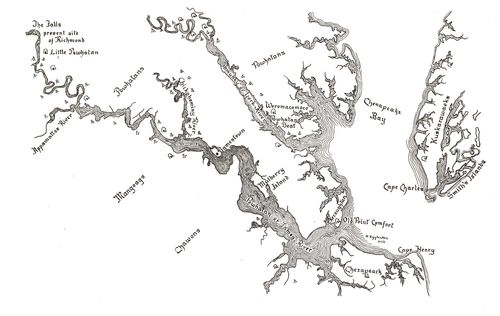
The arrival. The ships sailed round by the Canaries, after the fashion of that time, doubling the distance to Virginia. They loitered in the West Indies to "refresh themselves" and quarrel, and they did not reach their destination until seedtime had well-nigh passed. They arrived on the 6th of May, according to our style. Driven into Hampton Roads by a storm, they sailed up the wide mouth of a river which they called the James, in honor of the king. A. D. 1607. At that season of the year the banks must have shown masses of the white flowers of the dogwood, mingled with the pink-purple blossoms of the redbud against the dark primeval forest. Percy, in Purchas, p. 1689. Wherever they went ashore the newcomers found "all the ground bespread with many sweet and delicate flowers of divers colors and kinds." The sea-weary voyagers concluded that "heaven and earth had never agreed better to frame a place for man's habitation."
The first meetings with Indians. They were like people in an enchanted land—all was so new and strange. On the first landing of a small party they had a taste of savage warfare. "At night, when wee were going aboard, there came the savages creeping from the Hills like Beares, with their Bowes in their Mouthes, charged us very desperately, hurt Captain Gabrill Archer in both hands, and a Sayler in two places of the body very dangerous. Percy, in Purchas iv, pp. 1685, 1686. After they had spent their arrowes, and felt the sharpness of our shot, they retired into the Woods with a great noise and so left us."
But the newly arrived did not find all the Indians hostile. The chief of the Rappahannocks came to welcome them, marching at the head of his train, piping on a reed flute, and clad in the fantastic dress of an Indian dandy. He wore a plate of copper on the shorn side of his head. The hair on the other side was wrapped about with deer's hair dyed red, "in the fashion of a rose." Two long feathers "like a pair of horns" were stuck in this rosy crown. His body was stained crimson, his face painted blue and besmeared with some glistering pigment which to the greedy eyes of the English seemed to be silver ore. A. D. 1607. He wore a chain of beads, or wampum, about his neck, and his ears were "all behung with bracelets of pearls." There also depended from each ear a bird's claw set with copper—or "gold," adds the narrator, indulging a delightful dubiety.
Purchas i, 686 and following. During the period of preliminary exploration every trait of savage life was eagerly observed by the English. The costume, the wigwams, and most of all the ingenious weapons of wood and stone, gave delight to the curiosity of the newcomers.
V.
The winter of misery. They took up their abode in hastily built cabins roofed with sedge or bark, and in ragged tents. The poorer sort were even fain to shelter themselves in mere burrows in the ground. A. D. 1607. Ill provided at the start, the greater part of their food was consumed by the seamen, who lingered to gather comminuted mica for gold. In this hard environment, rent by faction, destitute of a competent leader and of any leader with competent authority, the wonder is that of this little company a single man survived the winter. Purchas, p. 1690. "There never were Englishmen left in any foreign country in such misery as we were in this new-discovered Virginia," says George Percy, brother to the Earl of Northumberland. A pint of worm-eaten barley or wheat was allowed for a day's ration. This was made into pottage and served out at the rate of one small ladleful at each meal. "Our drink was water, our lodgings castles in the air," says Smith. The misery was aggravated by a constant fear of attack from the Indians, who had been repulsed in an energetic assault made soon after the landing of the English. It was necessary for each man to watch every third night "lying on the cold, bare ground," and this exposure in a fever swamp, with the slender allowance of food of bad quality and the brackish river water, brought on swellings, dysenteries, and fevers. Sometimes there were not five men able to bear arms. "If there were any conscience in men," says Percy, "it would make their hearts bleed to hear the pitiful murmurings and outcries of our sick men without relief every day and night for the space of about six weeks." The living were hardly able to bury the dead, whose bodies were "trailed out like dogs." Half of the hundred colonists died, and the survivors were saved by the Indians, who, having got a taste of muskets and cannon in their early attack on Jamestown, now brought in supplies of game, corn, persimmons, and other food, to trade for the novel trinkets of the white men.
VI.
Emergence of Captain John Smith. Peril and adversity bring the capable man to the front. The colony proceeded, by means of the technicalities habitually used in those days, to rid itself of its president, Wingfield, a man of good intentions but with no talents suitable to a place of such difficulty. Slowly, by one change and then another, the leadership fell into the hands of Captain John Smith. During the voyage he had drawn upon himself the jealousy of the others, probably by his boastful and self-asserting habit of speech. When the list of councilors, till then kept secret, was opened at Jamestown and his name was found in it, he was promptly excluded by his associates. It was only on the intercession of the clergyman, Hunt, that he was at length admitted to the Council.
His paradoxical character has been much misunderstood. Those who discredit the historical accuracy of Captain Smith's narratives consider his deeds of no value. It is the natural result and retribution of boasting that the real merit of the boaster is cast into the rubbish heap of contempt along with his false pretensions. On the other hand, those who appreciate Smith's services to the colony in its dire extremities believe that the historical authority of such a man must be valid.
His romantic tendencies. His character, double and paradoxical as it is, presents no insoluble enigma if we consider the forces of nature and of habit underlying its manifestations. According to his own highly colored narrative, he had fed his fervid imagination on romances of chivalry. The first natural result in a youth so energetic as he, was that he should set out to emulate the imaginary heroes of whom he had read. It was equally a matter of course that a man of his vanity should exaggerate his own adventures to the size of those that had excited his admiration. The same romantic turn of the imagination that sent him a-wandering after exploits in Flanders and in the wars with the Turks, in Barbary, and in Ireland, made his every adventure seem an exploit of heroic size. Such a man is valuable when boldness and aggressive action are in request; to relate facts where autobiography is involved he is little fitted.
His story of his own life. According to Smith's own narrative, he was robbed and shipwrecked at sea; he slew three infidel champions in single combat and cut off their heads, just for the amusement of the ladies; he was made captive by the Turks and escaped by slaying his master with a flail; he encountered pirates; in the plunder of a ship he secured by the grace of God a box of jewels; and, to round off his story, he was beloved in romance fashion by a fair Turkish lady, one Tragabigzanda; befriended by a Russian lady, the good Calamata; and, later, was snatched from the open jaws of death by the devotion of the lovely Princess Pocahontas, daughter of King Powhatan, of Virginia. What more could one ask? Here are the elements of all the romances. But, to crown all, he emulated the misadventure of the prophet Jonah, and he even out-Jonahed Jonah. He got ashore by mere swimming without the aid of a whale, when cast overboard by Catholic pilgrims to appease a tempest. Never any other wanderer since the safe return of Ulysses passed through such a succession of marvelous escapes as this young John Smith. His accidents and achievements, even without exaggeration, were fairly notable, doubtless, but they are forever obscured by his vices of narration.
Interest in colonization. By the time he was twenty-eight years old this knight-errant had pretty well exhausted Europe as a field for adventure. Soon after his return to his own land he found the navigator Gosnold agitating for a new colony in Virginia, the scene of Ralegh's failures. That being the most difficult and dangerous enterprise then in sight, nothing was more natural than that Smith should embark in it. From this time to the end of his life this really able man gave his best endeavors to the advancement of American colonization. His character. In counsel he was accounted wise, and his advice was listened to with more than common deference in the assemblies of the Virginia Company as long as the company lasted. In labor he was indefatigable, in emergencies he proved himself ready-witted and resourceful. His recorded geographical observations are remarkably accurate considering his circumstances, and his understanding of Indian life shows his intelligence. His writings on practical questions are terse, epigrammatic, and wise beyond the wisdom of his time. But where his own adventures or credit are involved he is hardly more trustworthy than Falstaff. His boasting is one of the many difficulties a historian has to encounter in seeking to discover the truth regarding the events of an age much given to lying.
VII.
Smith's exploration and trading. On Smith principally devolved the explorations for a passage to the Pacific and the conduct of the Indian trade. He was captured by the Indians in the swamps of the Chickahominy and carried from village to village in triumph. Contriving to secure his release from the head chief, Powhatan, he returned to Jamestown. Nothing could have suited better his bold genius and roving disposition than the life he thereafter led in Virginia. A. D. 1607, 1608. He sailed up and down the bays and estuaries, discovering and naming unknown islands, ascending great unknown rivers, cajoling or bullying the Indians, and returning to his hungry countrymen at Jamestown laden with maize from the granaries of the savages. Oxford Tract, passim. Smith and his companions coasted in all seasons and all weather in an open boat, exercising themselves in morning psalm-singing and praying, in manœuvring strange Indians by blustering or point-blank lying, and in trying to propagate the Christian religion among the heathen—all in turn as occasion offered, like true Englishmen of the Jacobean time. Gen. Hist passim.
His narrative. Captain Smith's earlier accounts of these achievements in Virginia seem to be nearer the truth than his later Generall Historie. As years rolled on his exploits gained in number and magnitude in his memory. The apocryphal story of his expounding the solar system by means of a pocket compass to savages whose idiom he had had no opportunity to learn is to be found only in his later writings. He is a prisoner but a month in the narrative of the Oxford Tract of 1612, which was written by his associates and published with his authority, but his captivity had grown to six or seven weeks in the Generall Historie of 1624. His prosaic release by Powhatan had developed into a romantic rescue by Pocahontas. Two or three hundred savages in the earlier account become four or five hundred in the later. Certain Poles assist him in the capture of an Indian chief in the authorized narrative of Pots and Phettiplace. In the later story our hero performs this feat single-handed. A mere cipher attaches itself sometimes to the figure representing the number of his enemies, who by this simple feat of memory become ten times more redoubtable than before.
His service to the colony. But it does not matter greatly whether the "strangely grimmed and disguised" Indians seen by Smith at one place on the Potomac, who, according to the story, were shouting and yelling horribly, though in ambuscade, numbered three or four hundred as in one account, or three or four thousand as in his later story. Oxf. Tract, p. 32. Gen. Hist., bk. iii, ch. v. To Captain Smith remains the credit of having been the one energetic and capable man in those first years—the man who wasted no time in a search for gold, but won from the Indians what was of infinitely greater value—the corn needed to preserve the lives of the colonists. In an open boat, with no instrument but a compass, he explored and mapped Chesapeake Bay so well that his map was not wholly superseded for a hundred and forty years. Historie of Travaile into Virginia, p. 41. Even Wingfield, who had reason to dislike Smith, recognizes the value of his services; and Strachey, who had every means of knowing, says that "there will not return from" Virginia "in hast any one who hath bene more industrious or who hath had (Captain Geo. Percie excepted) greater experience amongst them, however misconstruction maye traduce here at home."
VIII.
IX.
De la Warr's arrival, 1610. With all the formalities thought necessary at that time, De la Warr took possession of Jamestown, now become a forlorn ruin full of dead men's bones. Gates was sent to England for a new stock of cattle, while the brave old Sir George Somers once more embarked for the Bermudas in the Patience, the little cedar pinnace which he had built wholly of the wood of that island without a particle of iron except one bolt in the keel. Smith's Oxford Tract, so called. In this boat he sailed up and down until he found again "the still vexed Bermoothes," where he hoped to secure provisions. He died in the islands. Argall was also sent to the Bermudas, but missed them, and went north to the fishing banks in search of food.
Flight of De la Warr. A new town was begun at the falls, in the fond belief that two mines were near, and De la Warr took up his residence there. Jamestown, drawing its water from a shallow and probably polluted well, became the seat of a fresh epidemic. In the month of March following his arrival the governor fled from the colony to save his own life, leaving Virginia more than ever discredited.
X.
Sir Thomas Dale, 1611. As the hope of immediate profit from Virginia died away, the colony would have been abandoned if there had not arisen in its favor a patriotic enthusiasm which gave it a second lease of life. Many of the great noblemen were deeply engaged in this new agitation in favor of the unlucky colony, and none more deeply, perhaps, than Prince Henry, the heir apparent. Docs. Rel. to Col. Hist. N. Y., i, pp. 1, 2, 3, 9, 10, 16-21. At Henry's request, Sir Thomas Dale, an officer who had been employed about the prince's person, and who with other English officers was now in the service of the Netherlands, was granted leave of absence to go to Virginia. Since the colony was a check to Spain, the Netherlands were supposed to have an indirect interest in the enterprise and were persuaded to continue Captain Dale's pay. De la Warr, who remained in England, was nominally governor; Gates, when present in Virginia, was the ranking officer; but for five years Dale appears to have been the ruling spirit in the colony.
The heavy hand of Dale, 1611-1616. To induce him to go, Dale had been deceived regarding the condition of the plantation, as had been everybody else that had gone to Jamestown after the first ships sailed. The vice-admiral, Newport, was the principal reporter of Virginia affairs in England and the principal agent of the company in this deception. Dale's rough temper was already well known. It was for this, no doubt, that he had been chosen to do a rude piece of work. A Briefe Declaration of the Plantation of Virginia, 1624, MS., Pub. Rec. Off. On his arrival he saw the desperate state of the undertaking. He pulled Vice-Admiral Newport's beard and threatened him with the gallows, demanding "whether it weare meant that people heere in Virginia shoulde feed uppon trees."
Under the inefficient government of George Percy, who had again been placed in charge, the seedtime of 1611 was allowed to pass without the planting of corn. The Jamestown people were found by Dale "at their daily and usual work bowling in the streets." Brit. Museum, MS., 21,993, f. 174. But the days of unthrifty idleness were at an end. "The libertyes, ffranchises, and immunityes of free denizens and natural-born subjects of any our other dominions" promised to the colonists, were also at an end from the moment of the arrival of this sharp-set soldier and disciplinarian. Dale's pitiless use of martial law turned Virginia not exactly into a military camp, but rather into a penal settlement where men suffered for the crime of emigration. The men taken to Virginia in Dale's own company were hardly fit for anything else, and were so "diseased and crazed in their bodies" that at one time not more than sixty out of three hundred were capable of labor. Briefe Declaration. The food sent with Sir Thomas Dale by the corrupt contractors was "of such qualitie as hoggs refused to eat." Sir Thomas Gates afterward made oath to its badness before the Chief Justice in London.
XI.
The years of slavery. Dale regarded himself as an agent of the company. His aim was by hook or crook to make the hitherto unprofitable colony pay dividends to the shareholders, who were his employers. His relation to the emigrants was that of a taskmaster; one might, perhaps, more fitly call him a slave-driver. Instead of seeking to render the colony self-supporting by clearing corn ground, he gave his first attention to lading vessels with sassafras root, then much prized as a medicine, and cedar timber, valued especially for its odor.
During a part of Dale's time eight or nine ounces of meal and half a pint of peas was the daily ration. Briefe Declaration. Percy to Northumberland, Hist. MS., Commission, Rept., iii, 53, 54. In their declaration, made some years afterward, the surviving colonists aver that both the meal and the peas were "moldy, rotten, full of cobwebs and maggots, loathsome to man and unfit for beasts." Better men than these might have been driven to mutiny by the enforced toil and bad food. And mutiny and desertion were usually but other names for suicide under the rule of the pitiless high marshal. Some fled to the woods, hoping to reach a mythical Spanish settlement believed to be not very far away. Dale set the Indians on them, and they were brought back to be burned at the stake. Others, who in desperation or deadly homesickness resolved to venture their lives in a barge and a shallop "for their native country," suffered in various ways for their temerity. Death by shooting or hanging was clemency. One offender was put to death by the awful torture of breaking on the wheel, a penalty that Dale may have learned during his stay on the Continent. Taylor, the water poet, has left us the sickening details of such an execution in Germany in 1616. Observations and Travel from London to Hamburgh, p. 13. One need not waste any sympathy on those who were hanged for stealing to satisfy hunger; death is more merciful than life to men in such a case. But one poor rogue, who thought to better his rations by filching two or three pints of oatmeal, had a bodkin run through his tongue and was chained to a tree until he perished of hunger. Though these things were twice attested by the best men in the colony, one prefers to make some allowance for their passionate resentment, and to hope that some of the horrors related are exaggerated. It is hard to believe, for example, that men unable to work were denied food, and left to creep away into the wretched burrows in the ground used for shelter, there to die unregarded in the general misery.
In 1612 a company of ten men sent out to catch fish braved the perils of the ocean in a little bark and got back to England. It was the only escape from Dale's tyranny, pitiless and infernal. "Abandon every hope who enter here" was almost as appropriate to the mouth of the James River as to the gate of Dante's hell. All letters of complaint sent to England were intercepted, and all efforts of friends of the colonists in England to succor or rescue them were thwarted by the company in London. Briefe Declaration. The king's pass to one of the colonists authorizing him to leave Virginia was sent to him by his friends closely made up in a garter, to avoid the vigilance of Sir Thomas Dale.
XII.
XIII.
XIV.
Revival of interest, 1618. But there set in once more a widespread patriotic movement in its behalf. Such movements were characteristic of that vital age when love of country was fast coming to count for more as a motive to action than loyalty to the person of a prince. "Divers lords, knights, gentlemen, and citizens, grieved to see this great action fall to nothing," came to its rescue with one final effort which resulted after some years in putting the enterprise well beyond the danger of failure. They formed auxiliary societies within the Virginia Company, after the custom of corporations in that day. Each of these undertook to plant a settlement or "hundred." In one year the population rose from less than four hundred to about a thousand. The newly active element infused a more liberal spirit into the company, and set about correcting the abuses in its management.
XV.
XVI.
XVII.
XVIII.
The struggle ended, 1624. It is not the Virginia colony alone that we have seen in the crucible. The fate of English colonization was no doubt settled by the experiments made during the first years on the James River, and the story told in this chapter is but the overture to the whole history of life in the United States. In our colonizing age a settlement might be made in the heart of Africa with a far smaller loss of life than was incurred in the first sixteen years in Virginia. From 1607 to 1623 there were landed in Virginia more than six thousand people. The number that returned to England was inconsiderable, but in the year 1624, when the colony passed under a royal government, there remained alive in the colony only twelve hundred and seventy-five. Of those who came in these early years four fifths perished. A part of this loss was due to radically wrong conceptions of the nature, end, and proper methods of colonization, a part to corrupt and incompetent management in the London Company. The bad character of many of the earliest emigrants was one cause of difficulty. The writers of the time probably exaggerated this evil in order to excuse the severity of the government and the miseries into which the settlers fell. But the loss of many of the early comers must be accounted a distinct gain to Virginia. Unfitted for their environment, they were doomed to extinction by that pitiless law which works ever to abolish from the earth the improvident, the idle, and the vicious.
Elucidations.
Note 1, page 29. In 1889, when I visited Jamestown, there was no apparent trace of Sandy Beach which had connected the island with the mainland. This bit of sand, in the antique phrase of one of the early colonists, was "no broader than a man may well quaite a tileshard." Strachey, in Purchas, p. 1752. Jamestown is now a farm; the ruins of the church and many of the tombs in the eighteenth-century churchyard remain; but the upper end of the island is wearing away, and I picked out of the crumbling sand, far from the later burying place, human bones of earlier burials, possibly of the victims of the famines and epidemics. The walls of the magazine had been exposed by erosion. I brought away wrought nails, bits of glass grown iridescent from long burial, and an exploded bombshell of so small a caliber as to mark its antiquity. By the aid of a negro youth living on the farm I found the hearth bricks turned up in various places by the plow, and the arrangement, or rather lack of arrangement, of the town could thus be made out. My guide volunteered the information that Jamestown was "the first place discovered after the Flood." Some drawings made at the time were reproduced with an article on Nathaniel Bacon in the Century Magazine for July, 1890.
Note 2, page 37. Whether Smith was injured by gunpowder and required treatment, as he asserts, or was sent home under charges, has been matter of dispute. Both accounts are correct, as is shown by the testimony of an important manuscript at Petworth House, in Surrey, which I was allowed to examine by the courtesy of Lord Leconsfield. It is from the pen of George Percy, a brother of the Earl of Northumberland, who was chosen to succeed Smith on his departure from the colony. It is not the narrative from which Purchas makes extracts, but a sequel to it. The title is "A Trewe Relacyon of the pceedinge and Ocvrrentes of momente wch have hapned in Virginia from the Tyme Sr Thomas Gates was shipwrackde vpon the Bermudes Ano. 1609 vntill my depture ovtt of the country wch was in Ano Dni 1612." It is a quarto of forty-one pages. Percy was a man of courage, but his own narrative in this little book shows that he had no qualification for the office of governor except the rank of his family. His ill health is made an excuse for his inefficiency, but Dale's letter of May 25, 1611, shows that even the horrible events of Percy's first government had not taught him to plant corn when again left in charge. Percy naturally resents Smith's boastfulness, and bluntly accuses him of laying claim to credit that was not his. The charge that Smith, unable to control the unruly settlers at the Falls under West, advised the Indians to attack them, is supported by Percy; and a very different charge, that he stirred up the Indians to assassinate West himself, appears at a later time in Spelman's Relation, a tract that bears abundant internal evidence of the writer's mental inability to speak the truth. Percy himself relates that the Indians were already hostile to West's party, and that they had wounded and killed some of West's men in resentment of their wanton outrages. See also the account in the Oxford Tract, with the signatures of Pots and Phettiplace, for Smith's version of the affair. "Bloody-mindedness" seems not to have been a trait of Smith. But the exigency was a terrible one, for death by starvation was already impending, and only the restoration of discipline at any cost could have saved the colony from the horrible fate it met. Such a course would not have done much violence to the notions of the time, and would have found precedents in the various plots against the lives of Smith, Wingfield, and others in the colony. It is quite probable, however, that there is no truth in the story. The violent hatred of the factions will account for the suspicion.
Note 3, page 38. Captain Smith's True Relation was sent from Virginia and was printed in London in 1608. In 1612 he published what is commonly referred to as the Oxford Tract. Its proper title is very long. The first part of it is as follows: "Map of Virginia, with a description of the Covntry, the Commodities, People, Government, and Religion. Written by Captain Smyth, sometime Governor of the Covntry. And wherevnto is annexed the proceedings of those colonies since their first departure from England," etc. The second part of the book professes to be taken from the writings of eight of the colonists, whose names are given, and to have been edited by W. S.—that is, the Reverend Dr. Symonds. The Generall Historie was first proposed in a well-considered and rather elegant speech by Captain Smith at a meeting of the Virginia Company, April 12, 1621, while the new patent which was to be submitted to Parliament was under discussion. He suggested the writing of a history to preserve the memory of the worthies of Virginia, dead and living, and gave it as his opinion that no Spanish settlement of the same age afforded matter more interesting. "Which worthy speech," says the record, "had of the whole court a very great applause as spoken freely to a speciall purpose, and therefore thought fitt to be considered and put in practice in his due time. And for which also Mr. Smyth as preferring allwaies mocions of speciall consequence was exceedingly commended." MS. Records of the Virginia Company, i, 197-200. A first edition of the Generall Historie appeared in 1624, the last two editions in 1632. The book is a compilation of Smith's earlier works, somewhat expanded, not to say inflated. The later portions are mostly made up from the official and quasi-official pamphlets. Just what was Dr. Symonds's part in the preparation of the Oxford Tract and the Generall Historie it would be interesting to know. The latter work was in some sense by authority of the company, and liable to the peculiar suspicion that hangs about writings designed to advance the colony and not primarily to record history. Its descriptive portions are of high value, and we are now able to control its historical errors to a certain extent. Besides these three works on Virginia, Smith published a Description of New England, 1616, New England's Trials, 1620, and Advertisements for the Unexperienced Planters of New England or Elsewhere, in 1631, the year of his death. These all contain valuable matter relating to Virginia. He also published in 1627 two works on seamanship, a Sea Grammar, and the Accidence or Pathway to Experience necessary for a Young Seaman. In 1630 he published his True Travels, a book which contains an account of his own adventures previous to his going to Virginia. More than a quarter of a century had elapsed between the occurrence of these adventures and their publication. Smith's vivid imagination had meantime no doubt greatly magnified his own exploits. It is quite impossible at this day to sift what truth there is in the True Travels from the exaggerations. Travelers in that time were not held to a very rigid account, and their first obligation seems to have been to amuse their readers. No distinct line had yet been drawn in literature between fact and fiction.
Many years ago, before I had had an opportunity to examine and compare all his writings, I rashly printed a brief argument in favor of the trustworthiness of Captain John Smith and the credibility of the Pocahontas story. I believe no person of critical judgment can make a thorough comparison of Smith's successive books without being convinced of the ineradicable tendency of his mind to romance in narrating adventure, especially his own adventure. Even his style where his vanity speaks loses something of its native directness and force. His practical writings on navigation and on the proper conduct of colonization, and his descriptions of the country and the savages, are plain, direct, and lucid. His speeches in the Virginia Company appear to have been exceedingly wise, and to have impressed his hearers. Note, for example, his proposals (Records, i, 197) that colonial governors should be liable to trial in England; his proposal to reduce the fee for sending a child to Virginia from five pounds to five marks, the cost of apprenticing to a trade (i, 174); and his preference for a governor well paid to one working "for love" (February 4, 1623). His personal morals were probably unexceptionable. One of his associates certifies to his freedom from tobacco, wines, dice, debts, and oaths. But a comparison between the statements made in the Oxford Tract and those in the Generall Historie leaves upon the mind of the critic a distinct impression of the very processes by which his adventures were exaggerated in his own memory as time elapsed. The three or four hundred savages on the Potomac (Oxford Tract, p. 32, a sufficiently marvelous story) rise to three or four thousand in the Generall Historie. Pocahontas becomes the central figure in incidents as told in 1624 in which she had no place in 1612. There is but one allusion to Pocahontas in the entire Oxford Tract (p. 103), and that has to do with the charge that Smith intended to marry her. A just and witty judgment of Captain Smith was made almost in his own time by Thomas Fuller. He says: "Such his perils, preservations, dangers, deliverances, they seem to most men beyond belief, to some beyond truth. Yet we have two witnesses to attest them, the prose and the pictures, both in his own book; and it soundeth much to the diminution of his deeds that he alone is the herald to publish and proclaim them.... However, moderate men must allow Captain Smith to have been very instrumental in settling the plantation in Virginia, whereof he was Governor, as also admiral of New England." Fuller's Worthies, edition of 1840, i, 276. Those who desire to see an ingenious and learned defense of Captain Smith, particularly in the matter of the Pocahontas story, will find it in an address by Mr. William Wirt Henry, published by the Virginia Historical Society. Prof. Arber's discussion of the subject in his edition of Smith's Works is sentimental rather than critical. Compare Deane's Wingfield for the other side. Unnecessary heat has characterized some of the debates about John Smith. History pitched in a shrill polemical key is not instructive and is something less than amusing. These debates center themselves on the Pocahontas story, which is of little historical importance except as it involves the trustworthiness of Smith's narrative.
The conduct of Captain Smith in the Virginia colony will be better understood if we appreciate the character of his principal opponent, Gabriel Archer. Archer's return to Virginia in 1609 and his agency in overthrowing Captain Smith are alluded to apparently in a passage in the New Life of Virginea, 1612, "In which distemper that envious man stept in, sowing plentifull tares in the hearts of all," etc. One of Archer's schemes seems to have been to establish a parliament and a complicated government at the beginning. Purchas and Strachey both take sides against Archer in his controversy with Smith. Purchas, iv, p. 1749, Oxford Tract, 22. Wingfield warned Newport of the danger of disturbance from Archer, who was "troubled with an ambitious spirit." Wingfield's Discourse, 77, 94, 95. Wingfield also says, "In all their disorders was Mr. Archer a ringleader." He adds that Ratcliffe "did wear no other eies or eares than grew on Mr. Archer's head." For a bibliographical account of Smith's works the reader is referred to the valuable notes in Mr. Winsor's Narrative and Critical History of America, vol. iii, passim.
Note 4, page 38. A Trewe Relacyon, etc., at Petworth House, as above. The Indians in sheer wantonness scraped out the brains of their dead victims with mussel shells. Percy seems to have retaliated in a way to exasperate without disabling the savages. He "burned their hawses, Ransacked their Temples, tooke downe the corpses off their deade Kings from off their Toambes [that is, the scaffold on which their well-dried remains were deposited], and caryed away their pearles, caps, and bracelets wherewith they doe decore their Kings fvneralls." (For this sacred house thus desecrated by Percy the Indians had such reverence that none but priests and chiefs were allowed to enter, and the Indians never ventured to pass it without casting some offering of tobacco, wampum, copper, or puccoon root into the water.—Strachey, 90.) When Percy had captured a chief's wife and children, the soldiers in revengeful wantonness, according to Percy's account, threw the children out of the boat and shot them in the water. The inefficient Percy was able to save the life of the "queen" or chief's wife with difficulty. West and Ratcliffe, who had overthrown Smith, are accused by Percy of unnecessary cruelty to the savages. West sailed away in the ship, leaving Jamestown to its fate. Ratcliffe was put to death with exquisite tortures. There is no doubt some truth, as there is certainly jealousy, in Percy's charge that Captain Smith was "an ambitious, unworthy, and vainglorious fellow, attempting to take all men's authorities from them," but he was neither weak, like Percy and Ratcliffe, nor visionary, like the gold-hunting Martin and the doctrinary and demagogical Archer, nor treacherous and cruel, like West. With all his faults he only was master of the situation in these early years. Percy admits that the lawful authority was that of Smith. The history of the government of Percy and his supporters seems to justify Smith's refusal to share his lawful power with incompetent factionaries.
Note 5, page 39. So far the State Papers, but Percy, in his A Trewe Relacyon, adds that he caused the man to be tortured till he confessed, and he relates repulsive details of the crime. The effrontery of an official publication went so far as to deny (True Declaration, 1610), on the authority of Sir Thomas Gates, this fact so circumstantially and abundantly attested. In Peckard's Life of Ferrar, p. 158, a petition from the Virginia colony to the king is preserved in which occur these words: "To tell how great things many of us have suffered through hunger alone would be as incredible as horrible for us to repeat to your sacred ears."
Note 6, page 41. See, among other authorities, A Plaine Declaration of Barmudas, in black letter, 1613, written by one of the party. Myriads of birds nested on the island. How the hogs came to be there is matter of conjecture. The writer of the Plaine Declaration makes old Sir George Somers the resourceful hero of their marvelous escape, and it was from him that the islands took the name of Somers or Summer Islands. For want of pitch, the seams of the vessels were paid with "a kind of hard lime" and some "wax cast up by the sea." Strachey's A True Reportory of the Wracke and Redemption of Sir Thomas Gates, Knight, etc., Purchas, iv, p. 1734, is also by one of the shipwrecked party. The Rev. Joseph Hunter has written with much learning, patient research, and fatiguing prolixity to disprove the theory that Shakespeare's Tempest was suggested by the wreck of Gates and Somers. He succeeds in showing its relation to another occurrence, but works of imagination do not usually have their origin in a single fact, and it is hard to resist the conviction that the Tempest, as we have it, contains more than one allusion to the wreck upon "the still vexed Bermoothes."
Note 7, page 42. The beauty of the wood of certain American trees had already been noted. The communion table in Jamestown in De la Warr's time was made of black walnut. The pews were of cedar, and there were "fair, broad windows," with shutters of cedar, "to shut and open as the weather shall occasion," but there appears to have been no glass. Window glass was little used at that time, and there probably was not a glazed window in the colony. The pulpit was of cedar, and the font was "hewen hollow like a canoa." Strachey, in Purchas, p. 1755.
Note 8, page 42. Some families appear to have gone to Virginia with De la Warr. The purpose to send families of wives and children and servants is expressed in A True Declaration, which was dated 1610, but, as Mr. Alexander Brown points out, issued in December, 1609.
Note 9, page 48. The Tragicall Relation of 1623, and the Briefe Declaration of 1624, manuscripts in the British Public Record Office, are the most important authorities for the facts given in the text. The Briefe Declaration is rather the fuller, but the earlier paper supplies some particulars. These two formal documents are not from the same hand, and the slight difference between them in details tends rather to confirm than to shake the reader's confidence in their testimony. The names of Sir Francis Wyatt, George Sandys, and other prominent colonists appended to the Tragicall Relation are a guarantee of its good faith. It is curious to note that Raphe Hamor, whose relation is so favorable to Dale, and who held the post of secretary under Dale and that of vice-admiral under Argall, signs this paper, which is a severe impeachment of Sir Thomas Smythe's administration of the affairs of the company before 1619. Hamor's True Discourse has heretofore usually been taken as an authority, but after reading the documents in the Public Record Office one is compelled to believe that Hamor, or perhaps one might say Dale, under cover of his secretary, misrepresents the state of the colony, and makes promises to those who may emigrate that it was hardly possible to carry out. The Discourse of the old Virginia Company (Colonial Papers, iii, 40), and other papers in the Public Record Office relating to the strife between the company and the Court, throw light on this period. The half-apologies for Dale's cruelties in Smith's Generall Historie, book iv, prove their existence. "For amongst them, so hardened in evil," says this writer, "the fear of a cruel, painful, and unusual death more restrains them than death itself." See also Hamor, p. 27. There is a letter from Whitaker appended to Hamor's Discourse. Though apparently an incidental letter, it bears marks of having been procured for purposes of vindication. Its defensive tone goes to show that the character of Dale's tyranny had transpired in England. Whitaker praises Sir Thomas Dale mainly for being religious and valiant, and says that he had "great knowledge in Divinity and good conscience in all his doings; both which bee rare in a martiall man." In Whitaker's Good Newes of Virginia, 1613, there is no praise of Sir Thomas Dale. That Dale was famous for his severity before he left Europe is manifest from the phrase used by the Jesuit Biard, "Le Mareschal Thomas Deel que vous auez ouy estre fort aspre en ses humeurs." Relation, chap. xxxiii. See in this and the preceding chapter the whole account of his savage temper toward his French prisoners, etc. It has been the custom of our older writers to speak of Dale's administration only in praise, but careful weighing of the original authorities shows that Dale was utterly pitiless in the cruelty of his discipline and unjust in his detention of the old planters, and that when he left the colony he was more generally execrated than any other man that ruled in these early days, not even excepting his successor, Argall. Dale's severity was serviceable in carrying the enterprise through straits, but the reports of his harshness brought the colony into disrepute and checked immigration. The detestation of Dale was shared by the best men in Virginia, yet it is to be remembered that the savagery of Dale's government was due not wholly to the brutal temper of the man, but partly to the age and the school in which he had been bred. Legal torture was in use long after this. The Clarendon Papers, quoted by Southey, state that at Henley-on-Thames, as late as 1646, it was ordered that a woman's tongue should be nailed to a tree for complaining of the tax levied by Parliament. The cruel practices of the agents of the Virginia Company are paralleled by those of the East India Company at the same time. "Before they were intrusted with martial law they made it a rule to whip to death or starve to death those of whom they wished to get rid." Mills, British India, i, 38. Even that champion of popular liberty, Sir Edwin Sandys, found it in his heart to approve of Dale's course while admitting its harshness. He said to the court of the Virginia Company of the 17th of November, 1619, that "Sir Thomas Dale, building upon these foundations with great and constant severity, reclaymed almost miraculously those idle and disordered people, and reduced them to labor and an honest fashion of life." MS. Records of the Virginia Company. Compare also Sir Thomas Smythe's defense, note to Aspinwall Papers in IV Massachusetts Historical Collections, ix, p. 1. My citations from the Tragicall Relation and Briefe Declaration are partly from the originals in the British Public Record Office, which I carefully examined in 1885, but the first of these is printed in Neill's Virginia Company, and the Briefe Declaration was published by the State of Virginia in 1874 in a Senate document entitled Colonial Records of Virginia. Very good abstracts of both papers appear in Sainsbury's Calendar. I cite the Discourse of the Old Virginia Company from the MS. in the British Public Record Office. I do not remember to have seen it in print.
Note 10, page 49. Birch's Court of James I, i, 415. Chamberlain to Carleton, June 22, 1616: "Sir Thomas Dale is arrived from Virginia, and brought with him some ten or twelve old and young of that country, among whom is Pocahuntas, daughter of Powhatan, married to one Rolfe, an Englishman. I hear not of any other riches or matter of worth, but only some quantity of sassafras, tobacco, pitch, tar, and clapboard, things of no great value unless there were plenty, and nearer hand. All I can hear of it is, that the country is good to live in, if it were stored with people, and might in time become commodious. But there is no present profit to be expected."
Note 11, page 49. The Discourse of the Old Virginia Company, an exceedingly interesting manuscript in the British Record Office, makes it appear that as late as 1618 the colonists had no thought of staying in Virginia, and even the directors at home were interested only in making money out of tobacco and sassafras, with little or no care to plant a permanent colony. Some allowance must be made, perhaps, for the ex-parte nature of this paper, but its tone and the high character of those who offered it give reason to trust it. Colonial Papers, iii, 40. Answer of the Virginia Company to Queries of the Privy Council in 1625.
Note 12, page 49. We may trust Hamor's True Discourse, p. 17, for some of these details, though the book generally is discredited by the account given in the Tragicall Relation, which Hamor himself signed with others in 1623. A comparison of all these authorities makes it evident that only eighty-one who were ranked as "farmers" derived any benefit from Dale's three-acre division, while about two hundred others were probably left in unmitigated bondage.
Note 13, page 51. "And to protect Captain Argall from being called to an account for his government under shew of a new plantation to be set up in Virginia by Captain Argall and his partners, whereof the said earl (Warwick) hath since appeared to be one (which yet to this day hath had no beginning), there was procured a patent to the said captain and his associates for the said new plantation; whereby he and his Company, their heirs and assigns (save only in time of defence by war), were exempted from all power, authority, and jurisdiction to be from hence derived or there established, that so he might reign there as great and absolute master, without law or controulment, and without the fear of ever being called to any future reckoning.... Whatsoever was remaining at that time in the colony belonging to the public ... he converted it in a manner wholly to his own private use and possession, the very public lands cultivated, the Company's tenants and servants, their rents, corn and tributes of corn, their kine and other cattle, their stores and other provisions; whereby the company, being disabled in all appearance of ever setting up the same again or to bear the great burden of public charge both at home and abroad, being thus stripped of all revenue, the said Company must have failed and decayed and the whole colony have fallen in time into the hands of the said captain and his association to be there established, which seemeth to have been his prime and original desire.... This course of depredation and roving not sufficing as likely to receive encounter and check from hence, new engines were used, some to dishearten and some to disgrace the Company, that so as it seemeth they might in time obtain the plantation and leave it as a prey to the said captain, his friends and followers, etc." Burk's History of Virginia, Appendix, vol. i. The extract is from the document known as The Company's Chief Root of Differences, etc. I have compared this copy with that in the MS. Records of the Virginia Company, Library of Congress, and find only slight verbal differences. At the instance of Warwick the authors of this paper—Lord Cavendish, Sir Edwin Sandys, and John and Nicholas Ferrar—were put under arrest in their own houses for this "impertinent declaration." The Warwick party had made "threats of blood" to deter Southampton from complaining to the king.
Note 14, page 53. Birch's Court and Times of James the First, i, 311. Chamberlain to Carleton, May 16, 1614: "Sir Thomas Gates is come from Virginia, and brings word that plantation will fall to the ground if it be not presently supplied. He speaks of wonderful commodities that are to be had there if we could but have patience and would be at the cost to bring them to perfection." Out of this necessity for some present support came the great lottery. It was recommended by the Privy Council to the Mayor of Canterbury, February 22, 1615. There was a "running lottery" of smaller adventures in Paul's Churchyard before the "great standing lottery" was instituted, and then there were other "running lotteries" "in many other places after." Purchas, p. 1773. No doubt there were corruptions and abuses in these lotteries. The merchants prospered while Virginia languished. Its unpopularity is attributed to "malignant tongues," in the MS. Records of the Virginia Company, i, 158, and the overthrow of the lottery may have been part of the plot of those who sought soon after to wreck the company itself.
Note 15, page 55. My attention was first attracted to the date of the Great Charter of November 13, 1618, by a minute in the handwriting of Secretary Williamson in the Public Record Office, as follows: "Those Adventurers & Planters by Vertue of ye sd Lettrs Patent of Incorporačon &c. made a Great charter of Lawes & Ordrs for ye govermnt of the Country. It bore date at London, Nov. 13th 1618." Col. Pprs, i, 11. The proceedings of the first Assembly in Virginia are preserved in the Public Record Office in Pory's Report. This report gives the only information we have regarding the provisions of this long-lost charter. An abstract of these proceedings is printed in the Calendar of Colonial Documents, and the whole document was reprinted in the New York Historical Society Collections, second series, vol. iii, and yet more carefully in the Colonial Records of Virginia, 1874. There is an allusion to this charter in the Briefe Relation, 1624. Various Virginia land grants deduce their authority from the Great Charter of Laws and Orders of November 13, 1618, as we learn from a note in the Aspinwall Papers, p. 14. There are many allusions to the charter of 1618 in the Manuscript Records of the Virginia Company in the Library of Congress.
Note 16, page 56. The Code of Lawes, Divine, Morall and Martiall, by which Dale reigned was edited and published by Strachey in 1612, and reprinted in Force's Tracts, vol. iii. This code appears to have had no other sanction than the approval of Sir Thomas Smythe, the governor of the company. The beneficial effect of these laws is maintained in Hamor's Discourse, in Rolfe's Relation, and in certain letters of Dale in the Record Office. It was not, indeed, the government by martial law, but Dale's abuse of his power, that wrought the mischief. After the emancipation the old settlers lived in perpetual terror lest some turn of the wheel should put them once more in the power of Sir Thomas Smythe and his divine and martial laws. See especially the Additional Statement appended to the Discourse of the Old Virginia Company. On the long and bitter dissension that resulted in the overthrow of the company, see Arthur Woodnoth's Short Collection of the most remarkable Passages from the Original to the Dissolution of the Virginia Company, a rare work of great value to the historian of this period.
Note 17, page 56. Rolfe's Relation has it that the ship which brought Yeardley brought also the news of the election of Sandys and John Ferrar. But Yeardley arrived in Virginia on the 18th of April (O.S.), and Sir Thomas Smythe's resignation did not take place until ten days later. Manuscript Records of the Virginia Company. The news that Sir George Yeardley did bring was no doubt that the power of Sir Thomas Smythe and his party was broken, and that the actual control of affairs was in the hands of such men as Sandys, Southampton, Cavendish, Danvers, and the two Ferrars. The whole policy of the company indicates that the new party was really in power, and the appointment of such a man as Yeardley was probably the work of the rising party. The records before the resignation of Sir Thomas Smythe were probably destroyed for purposes of concealment.
Note 18, page 57. Manuscript Book of Instructions, etc., Library of Congress. Letter to the Governor and Council by the ship Marmaduke, August 12, 1621. A proposal to send women had been made seven years earlier. Commons Journal, 1, 487, May 17, 1614. Extract from Martyn's Speech (for which he was reprimanded): "That they require but a few honest Labourers burthened with Children.—Moveth, a committee may consider of the means for this, for Seven Years; at which some of the Company may be present." On November 17, 1619, Sir Edwin Sandys pointed out in the court of the company that the people of Virginia "were not settled in their mindes to make it their place of rest and continuance." "For the remedying of the Mischiefe and for establishing a perpetuitie of the Plantation," he proposed the sending of "one hundred young maides to become wives." Manuscript Records of the Virginia Company, i, 44, 45. Two women, the first in the colony, had arrived in September, 1608. Oxford Tract, 47. There were women in Gates's party in 1610. It was even reported that some English women had intermingled with the natives. Calendar Colonial Papers, i, 13. An allowance of food to women in De la Warr's time is proof that women were there. In 1629 there was living Mistress Pearce, "an honest, industrious woman," who had been in Virginia "near twenty years." Rolfe (a copy of whose Relation is among the Duke of Manchester's MSS. now in the British Public Record Office) sets down a remainder of seventy-five of the three hundred and fifty-one persons in the colony at Dale's departure, as women and children. It is worth recalling here that D'Ogeron, who governed Santo Domingo in 1663 and after, supplied the buccaneers with wives brought from France; and the plan was also put into practice in Louisiana about a century later than the Virginia experiment, and the same expedient, as is well known, was resorted to in Canada. In Virginia more pains were taken to have all the women thus imported of a good character than in some of the French colonies.
Note 19, page 58. The belief that these maids were "pressed" or coerced into going is probably erroneous (see the speech of Sandys, July 7, 1620, Manuscript Records of the Virginia Company). He says, "These people (including the maids) are to be provided as they have formerly beene, partlie by printed publication of the supplies indicated, together with the conditions offered to these publique tennants, partlie by help of such noble friends and others in remote parts as have formerlie given great assistance." The notion that some of the maidens were pressed seems to have had its rise in the counterfeiting of the great seal and the issuing of forged commissions to press maidens for "breeders for the King" in the Bermudas and Virginia in order to extort money. One Owen Evans was accused of such practices in October, 1618 (Sainsbury, p. 19), and one Robinson was hanged, drawn, and quartered for this or similar offences in November of the same year (Birch's Court of James I, 108). In order to encourage the adventurers or shareholders to subscribe to the sending of maids, a town was laid off in Virginia to be called Maydstown. The subscribers were to be allowed shares in this town. Manuscript Records, May 20, 1622, on the general subject; also Records under date of November 3, 1621, and the 17th of the same month, June 11, and November 21, 1621, and the manuscript book in the Library of Congress, which I refer to in these notes as Manuscript Book of Instructions, pp. 76 and 89. I may remark here that this book has not been in use in recent times for reference. Its origin is uncertain, nor can the authorities of the library tell where it came from. It was compiled in the latter part of the seventeenth century, judging from internal evidence, and was perhaps kept among the records of the colony for reference on what we should call constitutional questions. I found a loose memorandum laid in its pages in the handwriting of Thomas Jefferson, to whom the book probably once belonged.
CHAPTER THE THIRD. THE PROCESSION OF MOTIVES.
I.
The chief mistake. The cause of the sorrows of Virginia will be more plainly seen if we turn again to the motives that propelled Englishmen to plant a colony. The chief mistake lay in the main purpose. If the founding of a state had been other than a secondary and remote end, the managers might have sent at first families and not bachelors, farmers and not gentlemen, laborers and not riff-raff. But more visionary motives dominated the action. A state was planted, but something else was mainly intended by the first projectors. The work seemed continuous, but the end in view shifted and the actors gradually changed. The only motive that held from first to last, and ran through all the rest, was the rivalry with Spain.
II.
Delusions in colony-planting. The prolonged movement for a colonial establishment, which extended over the latter half of the reign of Elizabeth and almost the whole of the reign of James I, was kept alive by delusions. The ultimate ends for which colonies were proposed and planted in the last quarter of the sixteenth and the first quarter of the seventeenth century were none of them attained. The movable passage through North America to the Pacific was still leading explorers a merry dance when the first Jamestown emigrants sailed in 1606, and gold mines of comminuted mica, of iron pyrites, of Indian mineral paints, and of pure fable were potent attractions for some time after. The gradual increase of geographical knowledge caused the "South Sea" to take shelter in the unknown region behind the mountains, and the gold mines reported by Indians and discovered by sanguine prospectors were somehow lost in the interminable forests. In this exigency the first colony must have perished for want of support if new hopes as illusive as the old had not moved the English people to avert such a calamity.
Commodities. The production of commodities which the ungenial climate of the British Islands refused to grow was thought of from the beginning, and they became after 1616 the main hope of wealth from Virginia. For example, Carlisle's treatise, Anderson's Commerce, year 1583. It seemed grievous that England should spend her money in buying wine and silk from southern Europe and naval stores from the Baltic. The only maxim of political economy generally accepted in that day was that a nation is enriched by getting money from abroad and keeping it at home. The precious metals constituted the only recognized riches. Laws were made to restrain the exportation of gold and silver, and sumptuary laws to discourage the consumption of those things that must be bought of the foreigner. Efforts to raise in Great Britain the products of the Mediterranean region would have proved successful if the climate had been half as favorable to such enterprises as the government. Wine. The arguments advanced in favor of the possibility of producing wine in England did much, no doubt, to secure the sunshine of royal favor for experiments made to that end, but climatic conditions were inexorable. King James busied himself to no profit in raising mulberry trees and nursing a private stock of silkworms, in imitation of Henry IV, the reigning King of France, who succeeded in producing cocoons in the Tuileries but not in making silk culture profitable in the north of France. Silk. Anderson on the year 1589. Mulberries were first planted in England in 1608, two years after the sailing of the Virginia argonauts. James sent circulars to persons of influence among his subjects asking them to cultivate mulberry trees, and, in the years immediately following, the silk fever ran its course alongside the excitement about the great lottery in behalf of the Virginia colony. 1609. Hakluyt, spreading sails for America in every breeze, hastened to announce at the first mention of silk culture that mulberry trees, "apt to feed silke wormes to make silke," were a "chiefe commoditie" of Virginia.
The first principles that govern colony-planting were not yet understood. It was proposed to force everything from a forlorn camp of men dwelling under roofs of bark and sedge, environed by treacherous foes and in constant peril of starvation. The raising of silkworms was begun in Virginia in 1613, and before the colony was nine years old it was able to send to England silk that doubtless had cost more than a hundred times its market value. The experiment came to nothing. It could not have happened otherwise amid the miseries of those early years. The rats, which opportunely destroyed the eggs of the silk moth, were made to bear the responsibility for the failure.
Hening ii, 242. By 1666 the silk delusion had passed, and the Virginia Assembly repealed all acts for the encouragement of mulberry trees. Ten years later, Glover, the botanist, found many of these trees still standing as melancholy witnesses to the waste of energy by the earlier promoters and settlers of the colony. Phil. Trans. XI, 628. Almost every other American colony made the same experiment for itself, and Virginia renewed its endeavors from time to time, each generation forgetting what its fathers had learned.
III.
Silk-grass. Along with the silk fever went the silk-grass craze. 1585. Ralegh's people had seen the Indians wearing garments woven of the fiber of the Yucca filamentosa, the "Adam's needle and thread" of our popular speech. A Briefe and True Report of the New Found Land of Virginia. Hariot, in his account of it, declares that "the like grows in Persia," and that much of the "silk-works" coming thence to Europe was made of this fiber. He probably confounded the yucca with the ramie plant of the East, of which grass cloth is made. Of the yucca fiber taken to England in 1585, "a piece of silk grogram" was made, and of course pronounced "excellent good"; it was even presented to the queen. The coarse and rather brittle fiber of this plant was exalted by enthusiasts into something nearly equal to silk. Ordinances for planting it were sent from England; at least one legislative act in its favor was passed by the Virginia Assembly, and the most foolish hopes were entertained regarding the profit to be had from it. Proceedings of Va. Assembly, 1619. 2d N. Y. Hist. Society Coll. iii, 348. By 1619 it had come to be called "silk flax," and it was then advocated for homelier uses, such as cordage and linen, and every householder was compelled by law to set a hundred plants; the governor himself set five thousand. In 1624 it is spoken of as "a commoditie of speciall hope and much use." Purchas IV, p. 1777. There were by this time those who ventured to say that the silk-grass enterprise was "full of difficultie"; but the managers in England easily got rid of this objection by attributing the difficulty to "negligence and want of experience." Instr. of 24 July, 1624. MS. Bk. of Instr. Libr. of Cong. They were just then intent on finding some commodity that would take the place of tobacco, which was frowned upon by both court and Parliament. In spite of all discouragement, the hope of good results from the yucca fiber outlasted that generation, and was in full vigor in 1649, sixty-four years after Hariot's mistake.
IV.
Wine. It was also proposed to produce wine in Virginia for English consumption. No more gold and silver should go out of the realm to buy port and canary to the profit of foreigners and the impoverishment of the good and loyal subjects of his Majesty. The instructions on this point were clear, and before the Virginia exiles had secured bread to stay their hunger they had made wine of the sour wild grapes of the country. French vine-dressers were sent over a little later and were forbidden to plant tobacco, but were compelled to employ themselves about vines, with the care of silkworms for variety. MS. Rec. Va. Co. i, 343. In 1621 these Frenchmen sent to England a cask of wine, the arrival of which was duly celebrated. Other experimental casks of wine were afterward sent to England from America at long intervals, but without decreasing the profits of wine growers in the Old World.
All the commodities sought from Virginia were unsuited to conditions in a new country. Other products sought. To the folly of making such experiments at all where living itself was an experiment, the managers added the folly of crowding a multiplicity of problematic enterprises on the colony at the same time. With a virgin continent in which to produce novelties, all things seemed possible in an age so hopeful. Plants of every clime grew rank in the imagination of projectors. Virginia was a wonderland, and it was readily believed without evidence that the "soyle and clymate" were "very apt and fit for sugar canes"; "also linseed and rapeseeds to make oiles," as a black-letter pamphlet of 1609 expresses it. Nova Brittania. Along with "orenges, limons, and almonds," this official writer proposes to plant "anniseeds, rice, cummin, cottonwool, carroway seeds, ginger, madder, olives, oris, sumacke," and, as if this breathless list were not enough for one new land, he adds, "and many such like that I can not now name." If we may trust the publications of the company, various West India plants were tried in the very first days of the colony, while the threefold peril of death from famine, pestilence, and savage war was imminent.