BOOK II. THE PURITAN MIGRATION. (continued 2)
Reading edition
VIII.
The farewell to Europe. "Small things," wrote Dudley to the Countess of Lincoln in the first months of the Massachusetts settlement—"small things in the beginning of natural or politic bodies are as remarkable as greater in bodies full grown." The obscure events we have recited above are capital because they had a deciding influence on the fate of the Pilgrim settlement. It is not within our purpose to tell over again the pathetic story of that brave departure of the younger and stronger of the Pilgrims from Leyden to make the first break into the wilderness, but courage and devotion to an idea are not common; courage and devotion that bring at last important results are so rare that the student of history, however little disposed to indulge sentiment, turns in spite of himself to that last all-night meeting in Pastor Robinson's large house in the Belfry Lane at Leyden. Plimoth Plantation, 59. "So," says Bradford, as if penning a new holy scripture, "they lefte that goodly and pleasante citie, which had been ther resting place near 12 years; but they knew they were pilgrimes and looked not much on those things, but lift up their eyes to the heavens, their dearest cuntrie and quieted their spirits." Nor is it easy to pass over the solemn parting on the quay at Delft Haven, where, as the time of the tide forced the final tearful separation, while even the Dutch spectators wept in sympathy, the voice of the beloved Robinson in a final prayer was heard and the whole company fell upon their knees together for the last time.
Admirable man! Free from pettiness and egotism. Fortunate man, who, working in one of the obscurest and dustiest corners of this noisy and self-seeking world, succeeded in training and sending out a company that diffused his spirit and teachings into the institutions and thoughts of a great people!
IX.
Elements of New England. Camden has preserved to us an old English saying accepted in the days of the Pilgrims, to the effect that "a barren country is a great whet to the industry of a people." It was the wedding of an austere creed to an austere soil under an austere sky that gave the people of New England their marked character, and the severe economic conditions imposed by the soil and climate were even more potent than Puritanism in producing the traits that go to make up the New England of history.
X.
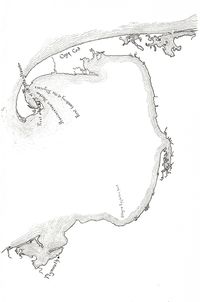
Earlier attempts to colonize New England. The unwise management that ruined nearly all projects for colonization in that age and that produced such disasters in Virginia, had defeated every earlier attempt to plant English people on the New England coast. Gosnold had taken a colony to Elizabeth Island in Buzzard's Bay in 1602, but the men went back in the ship in order to share the profit of a cargo of sassafras. Captain George Popham was the head of a party that undertook to colonize the coast of Maine in 1607, but having suffered "extreme extremities" during the winter, the colonists returned the following year. In 1615 Captain John Smith himself set out with sixteen men, only to be taken by a French privateer. These and other attempts ending in failure, and many disastrous trading voyages, led to a belief that the Indian conjurers, who were known to be the devil's own, had laid a spell on the northern coast to keep the white people away. This enchanted land might long have lain waste if Captain Jones of the Mayflower, sailing to Hudson River or the region south of it, had not run foul of the shoals of Cape Cod.
XI.
Sufferings at Plymouth. The Pilgrims suffered, like their predecessors, from the prevailing unskillfulness in colony-planting. They had escaped from the horrors of the Mayflower, but how much better was the wild land than the wild sea; the rude, overcrowded forest cabins than the too populous ship? "All things stared upon them with a weather-beaten face," says Bradford. The horrors of the first winter in Virginia were repeated; here, as at Jamestown, nearly all were ill at once, and nearly half of the people died before the coming of spring. The same system of partnership with mercenary shareholders or "adventurers" in England that had brought disaster in Virginia was tried with similar results at Plymouth, and a similar attempt at communism in labor and supply was made, this time under the most favorable conditions, among a people conscientious and bound together by strong religious enthusiasm. It resulted, as such sinking of personal interest must ever result, in dissensions and insubordination, in unthrift and famine.
Bradford. The colony was saved from the prolonged misery that makes the early history of Virginia horrible by the wise head and strong hand of its leader. William Bradford, who had been chosen governor on the death of Carver, a few months after the arrival at Plymouth, had been a youth but eighteen years old when he fled with the rest of the Scrooby church to Holland. He was bred to husbandry and had inherited some property. In Holland he became a silk worker and on attaining his majority set up for himself in that trade. He was still a young man when first chosen governor of the little colony, and he ruled New Plymouth almost continuously till his death—that is, for about thirty-seven years. He was of a magnanimous temper, resolute but patient, devotedly religious, but neither intolerant nor austere. He had a genius for quaintly vivid expression in writing that marked him as a man endowed with the literary gift, which comes as Heaven pleases where one would least look for it.
XII.
XIII.
Significance of Plymouth. Why should the historian linger thus over the story of this last surviving remnant of the "Brownists"? Why have we dwelt upon the little settlement that was never very flourishing, that consisted at its best of only a few thousand peaceful and agricultural people, and that after seventy years was merged politically in its more vigorous neighbor the colony of Massachusetts Bay? Historical importance does not depend on population. Plymouth was the second step in the founding of a great nation. When Bradford and the other leaders had at last successfully extricated the little settlement from its economical difficulties, it became the sure forerunner of a greater Puritan migration. This tiny free state on the margin of a wilderness continent, like a distant glimmering pharos, showed the persecuted Puritans in England the fare-way to a harbor.
Elucidations.
Note 1, page 162. Sir John Harington says: "The bishops came to the Kynge aboute the petition of the puritans; I was by, and heard much dyscourse. The Kynge talked muche Latin, and disputed wyth Dr. Reynoldes, at Hampton, but he rather usede upbraidinges than argumente; and tolde the petitioners that they wanted to strip Christe againe, and bid them awaie with their snivellinge: moreover, he wishede those who woud take away the surplice mighte want linen for their own breech. The bishops seemed much pleased and said his Majestie spoke by the power of inspiration. I wist not what they mean; but the spirit was rather foule mouthede." Nugæ Antiquæ, i, 181, 182. James took pains to put an example of his bad taste on paper. In a letter on the subject he brags in these words: "We haue kept suche a reuell with the Puritainis heir these two dayes as was neuer harde the lyke, quhaire I haue pepperid thaime as soundlie as ye haue done the papists thaire.... I was forcid at the last to saye unto thaime, that if any of thaim hadde bene in a colledge disputing with their skollairs, if any of their disciples had ansoured thaim in that sorte they wolde haue fetched him up in place of a replye, and so shoulde the rodde haue plyed upon the poore boyes buttokis." Ellis Letters, Third Series, iv, 162. The principal authorities on the Hampton Court Conference are, first, "The Svmme and Svbstance of the Conference, which it pleased his excellent Majestie to have," etc., "Contracted by William Barlovv, ... Deane of Chester"; second, Dr. Montague's letter to his mother, in Winwood's Memorials, ii, 13-15; third, the letter of Patrick Galloway to the Presbytery of Edinburgh, in Calderwood, vi, 241, 242; and, fourth, a letter from Tobie Mathew, Bishop of Durham, to Hutton, Archbishop of York, in Strype's Whitgift appendix, xlv. Compare Nugæ Antiquæ, 181, 182, and the king's letter to Blake, in Ellis's Letters, third series, iv, 161, which are both cited above. Mr. Gardiner has shown (History of England, i, 159) that this letter is addressed to Northampton. There are several documents relating to the conference among the state papers calendared by Mrs. Greene under dates in January, 1604. Of the vigorous action taken against the Puritans after the conference, some notion may be formed by the letter of protest from the aged Matthew Hutton, Archbishop of York, to Lord Cranborne, in Lodge's Illustrations of British History, iii, 115, and Cranborne's reply, ibid., 125.
Note 2, page 168. Stith has not the weight of an original authority, but he is justly famous for accuracy in following his authorities, and he had access to many papers relating to the history of Virginia which are now lost. Under the year 1608 he says: "Doctor Whitgift, Arch-Bishop of Canterbury, ... having died four Years before this, was succeeded to that high Preferment by Dr. Richard Bancroft.... He had very high Notions with Relation to the Government of both Church and State; and was accordingly a great Stickler for, and Promoter of, the King's absolute Power, and failed not to take all Occasions, to oblige the Puritans to conform to the Church of England. This Prelate's Harshness and Warmth caused many of that People to take the Resolution this Year of settling themselves in Virginia, and some were actually come off for that Purpose. But the Arch-bishop, finding that they were preparing in great Numbers to depart, obtained a Proclamation from the King, forbidding any to go, without his Majesty's express Leave." History of Virginia, 1747, p. 76.
Note 3, page 168. For Whitaker's filiation, Neill's Virginia Company, 78. Whitaker's Good Newes from Virginia is no doubt intended by the entry in the inventory of Brewster's goods, "Newes from Virginia." I know no other book with such a title. That Alexander Whitaker was himself touched with Puritanism, or at least was not unwilling to have Puritan ministers for colleagues, is rendered pretty certain from passages in his letters. For instance, he writes to Crashaw from Jamestown, August 9, 1611, desiring that young and "godly" ministers should come, and adds, "We have noe need either of ceremonies or bad livers." British Museum, Additional MSS., 21,993. (The letter is printed in Browne's Genesis, 499, 500.) In a letter given in Purchas and in Neill, 95, dated June 18, 1614, he says that neither subscription nor the surplice are spoken of in Virginia. It has escaped the notice of church historians that Whitaker's semi-Puritanism seems to have left traces for many years on the character and usage of the Virginia church. The Rev. Hugh Jones writes as late as 1724 in his Present State of Virginia, p. 68, that surplices were only then "beginning to be brought in Fashion," and that the people in some parishes received the Lord's Supper sitting.
Note 4, page 173. The late Dr. Neill was the first, I believe, to call attention to this fact, though he did not state it quite so strongly as I have put it in the text. It is worth while transferring Neill's remarks from the New England Genealogical Register, vol. XXX, 412, 413: "The action of the passengers of the Mayflower in forming a social compact before landing at Plymouth Rock seems to have been in strict accordance with the policy of the London Company, under whose patent the ship sailed. On June 9, 1619, O.S., John Whincop's patent was duly sealed by the Company, but this which had cost the Puritans so much labor and money was not used. Several months after, the Leyden people became interested in a new project. On February 2, 1619-'20, at a meeting at the house of Sir Edwin Sandys in Aldersgate, he stated to the Company that a grant had been made to John Peirce and his associates. At the same quarterly meeting it was expressly ordered that the leaders of particular plantations, associating unto them divers of the gravest and discreetest of their companies, shall have liberty to make orders, ordinances, and constitutions for the better ordering and directing of their business and servants, provided they be not repugnant to the laws of England." Bradford, in his Plimouth Plantation, 90, says they "chose or rather confirmed Mr. John Carver, ... their Governour for that year"—that is, for 1620. Mr. Deane, the editor of Bradford, has lost the force of this by misunderstanding a statement in Mourt's Relation, so called. See Deane's note, page 99, of Bradford. The statement in Mourt is under date of March 23d. I quote from the reprint in Young, 196, 197: "and did likewise choose our governor for this present year, which was Master John Carver," etc. Young applies Bradford's words, "or rather confirmed," to this event, and Deane also supposes that Bradford confuses two elections. Carver was no doubt chosen in England or Holland under authority of the charter to serve for the calendar year, and confirmed or rechosen after the Compact was signed. What took place on the 23d of March was that a governor was elected for the year 1621, which, according to the calendar of that time, began on the 25th of March. For the next year they chose Carver, who was already "governor for this present year," and whose first term was about to expire. Both Deane and Young failed to perceive the pregnant fact that Carver was governor during the voyage, and so lost the force of the words "or rather confirmed." Bradford, in that portion of his History of Plimouth Plantation which relates to this period, gives several letters illustrating the negotiations of the Pilgrims with the Virginia Company. The MS. Records of the Company in the Library of Congress, under dates of May 26 and June 9, 1619, and February 19, 1620 (1619 O.S.), contain the transactions relating to the Whincop Charter, which was not used, on account of Whincop's death, and the Pierce Charter, which the Pilgrims took with them.
Note 5, page 174. The charge against Sandys is in the Duke of Manchester's papers, Royal Historical MS. Commission viii, II, 45. It is remarkable that the dominant liberal faction in the Virginia Company is here accused of seeking to do what the Massachusetts Company afterward did—to wit, to found a popular American government by virtue of powers conferred in a charter. That liberal government in New England had its rise in the arrangements made with the London or Virginia Company before sailing, and not, as poets, painters, and orators have it, in the cabin of the Mayflower, is sufficiently attested in a bit of evidence, conspicuous enough, but usually overlooked. Robinson's farewell letter to the whole company, which reached them in England, is in Bradford, 64-67, and in Mourt's Relation. It has several significant allusions to the form of government already planned. "And lastly, your intended course of civill communitie will minister continuall occasion of offence." The allusion here seems to be to the joint-stock and communistic system of labor and living proposed. In another paragraph the allusion is to the system of government: "Whereas, you are become a body politik, using amongst your selves civill governmente, and are not furnished with any persons of spetiall emencie above the rest, to be chosen by you into office of governmente," etc., "you are at present to have only them for your ordinarie governours, which your selves shall make choyse of for that worke." That the government under the Virginia Company was to be democratic is manifest. The compact was a means of giving it the sanction of consent where the patent and the general order did not avail for that purpose.
Note 6, page 176. Winslow's Briefe Narration appended to his Hypocrisie Vnmasked is the only authority for Robinson's address. Dr. H. M. Dexter has with characteristic wealth of learning and ingenuity sought to diminish the force of these generous words of Robinson in his Congregationalism, 403 and ff. But the note struck in this farewell address was familiar to the later followers of Robinson's form of Independency. Five of the ministers who went to Holland in 1637 and founded churches, published in 1643 a tract called An Apologeticall Narrative Humbly Submitted to the Honourable Houses of Parliament. By Thomas Goodwin, Phillip Nye, Sidrach Simpson, Jer. Borroughs, William Bridge. London, 1643. From the copy in the British Museum I quote: "A second principle we carryed along with us in all our resolutions was, Not to make our present judgment and practice a binding law unto ourselves for the future which we in like manner made continuall profession of upon all occasions." On page 22 Robinson's words are almost repeated in the phrase "they coming new out of popery ... might not be perfect the first day." Robinson's early colleague, Smyth, the unpractical, much-defamed, but saintly "Anabaptist," says in a tract published after his death, "I continually search after the truth." Robinson wrote a reply to a portion of this tract. See Barclay's Inner Life, appendix to Chapter V, where the tract is given. This holding of their opinions in a state of flux, this liberal expectancy of a further evolution of opinion, was a trait to be admired in the early Separatists in an age when modesty in dogmatic statement was exceedingly rare.
Note 7, page 177. Neill, in the Historical Magazine for January, 1869, and the New England Genealogical Register, 1874, identifies the Mayflower captain with Jones of the Discovery, who was accounted in Virginia "dishonest." But honest seamen were few in that half-piratical age. That he was hired by the Dutch to take the Pilgrims elsewhere than to Hudson River is charged in Morton's Memorial, and is not in itself unlikely. But the embarrassments of Cape Cod shoals were very real; a trading ship sent out by the Pilgrims after their settlement, failed to find a way round the cape.
Note 8, page 177. Early New England writers were not content with giving the Pilgrims the honor due to them. Hutchinson asserts that the Virginia Colony had virtually failed, and that the Pilgrim settlement was the means of reviving it. This has been often repeated on no other authority than that of Hutchinson, who wrote nearly a century and a half after the event. The list of patents for plantations in Virginia as given by Purchas, in which appears that of Master "Wincop," under which the Pilgrims proposed to plant, is a sufficient proof that Virginia was not languishing. "These patentees," says Purchas, "have undertaken to transport to Virginia a great multitude of people and store of cattle." Virginia had reached the greatest prosperity it attained before the dissolution of the company, in precisely the years in which the slender Pilgrim Colony was preparing. It is quite possible to honor the Pilgrims without reversing the order of cause and effect.
Note 9, page 181. Bradford's Plimouth Plantation, 135, 136: "The experience that was had in this commone course and condition, tried sundrie years, and that amongst godly and sober men, may well evince the vanitie of that conceite of Platos and other ancients, applauded by some of later times—that the taking away of propertie, and bringing in communitie into a comone wealth, would make them happy and florishing; as if they were wiser than God. For this communitie (so fare as it was) was found to breed much confusion and discontent, and retard much imployment that would have been to their benefite and comforte. For the yong-men that were most able and fitte for labour and service did repine that they should spend their time and streingth to worke for other mens wives and children with out any recompence. The strong, or man of parts, had no more in devission of victails and cloaths, then he that was weake and not able to doe a quarter the other could; this was thought injuestice. The aged and graver men to be ranked and equalised in labours, and victails, cloaths, &c., with the meaner and yonger sorte, thought it some indignite and disrespect unto them. And for mens wives to be commanded to doe servise for other men, as dresing their meate, washing their cloaths, &c., they deemd it a kind of slaverie, neither could many husbands well brooke it. Upon the point all being to have alike, and all to doe alike, they thought them selves in the like condition, and one as good as another; and so if it did not cut of those relations that God hath set amongest men yet it did much diminish and take of the mutuall respects that should be preserved amongst them. And would have bene worse if they had been men of another condition."
CHAPTER THE FOURTH. THE GREAT PURITAN EXODUS.
I.
Result of the Pilgrim settlement. Men who undertake a great enterprise rarely find their anticipations fulfilled; they are fortunate if their general aim is reached at last in any way. The Pilgrims had migrated, hoping to be "stepping-stones to others," as they phrased it. They thought that many like-minded in matters of religion would come to them out of England, but the Separatist movement had been worn out by persecution. There were few open dissenters left, and the Pilgrims, by their long exile, had lost all close relations with their own country. Among those that came to Plymouth from England were some whose coming tended to dilute the religious life and lower the moral standards of the colony. The fervor of the Pilgrims themselves abated something of its intensity in the preoccupations incident to pioneer life. The hope of expanding their religious organization by the rapid growth of the colony was not fulfilled; discontented Puritans were not eager to settle under the government of Separatists, and ten years after their migration the Plymouth colony contained little more than three hundred people.
The religious motive. None the less the hope of the Pilgrims was realized; they became stepping-stones to thousands of others. Captain John Smith laughed at the "humorous ignorances" of these "Brownist" settlers, but, humorous or not, ignorant or not, the "Brownists" remained on the coast while other emigrants retreated. In spite of their terrible suffering none of the Pilgrims went back. This is the capital fact in their history. A new force had been introduced into colonization. Henceforth persecuted or discontented religionists, prompted by a motive vastly more strenuous and enduring than cupidity, were to bear the main brunt of breaking a way into the wilderness.
Commercial settlements. The first effect of the slender success at Plymouth was to stimulate speculative and merely adventurous migration. From 1607 until the arrival of the Pilgrims in 1620 no English colony had landed on the northern coast; but after the Pilgrims came, fish-drying and fur-buying stations began to appear on the banks of the Piscataqua and the coast eastward in 1622 and 1623. These tiny settlements were germs of New Hampshire and Maine, the only New England plantations begun without any admixture of religious motives. A commercial colony was tried in Massachusetts Bay as early as 1622, but it failed. There were other like attempts. In 1624 some men of Dorchester, headed by John White, the "Patriarch" Puritan clergyman, sent out a colony to Cape Ann. The members of this company were to grow maize to supply fishing ships, and in the season the same men were to lend a hand on board the ships, which would thus be saved the necessity for carrying double crews. But this plausible scheme proved a case of seeking strawberries in the sea and red herrings in the wood. Farmers were but lubbers at codfishing, and salt-water fishermen were clumsy enough in the cornfield. John White's The Planter's Plea, in Young's Chronicles of Mass. Losses of several sorts forced the Dorchester Company to dissolve. Four members of their futile colony, encouraged by a message from White, remained on Cape Ann. Removing to the present site of Salem, they waited at the risk of their lives for the coming of a new colony from England.
The settlement of New England was thus beginning sporadically and slowly. If the Massachusetts Puritans had not come, these feeble and scattered plantations might have grown into colonies after a long time, as such beginnings did in New Hampshire and Maine, and later in North Carolina, but having no strong neighbor to support them, it is likely that they would all have been driven away or annihilated by some inevitable collision with the Indians.
II.
Puritanism at the accession of Charles I. English Puritanism throughout the reign of James I had been the party of strict morals, of austere and Pharisaic scrupulosity, of rigid Sabbath observance, and of Calvinistic dogmatism. During that reign it had passed through its last transformation in becoming a political party—the party of anti-Catholic politics at home and abroad. Because Parliament was on its side, the mere course of events had made the Puritan party favor the predominance of Parliament, and this brought it to represent liberalism in politics. By his unconcealed partisanship, James had contrived to make the Puritans a permanent opposition suspected of disliking monarchy itself. Charles I was even more the antagonist of Puritanism than James.
Later Puritanism conservative. In one other respect the position of Puritanism had been gradually changed by mere parallax. In Elizabeth's reign it had been the party of innovation. It was no longer the party of change in religion when Charles came to the throne. The adoption of the Arminian system of doctrine by many of the High-churchmen, and the reactionary innovations now proposed by ecclesiastics like Laud, had left Puritanism to stand for Protestant conservatism. It was immeasurably the gainer with the mass of slow-moving people by this change of relative position. The parliamentary struggle with James and Charles added to the religious Puritans a numerous body of political Puritans who, without much care about religion, were fain to ally their political discontent with the discontent of those who resisted ecclesiastical retrogression. This compact party, powerful after all its defeats, was bound by its position to cherish every aspiration for the improvement of morals, every indignant movement for the suppression of abuses, and it became the ally of every popular resentment against royal absolutism or episcopal encroachment, and the advocate, almost to fanaticism, of an anti-Spanish foreign policy, and a domestic policy in which repression and persecution of Roman Catholics held first place.
III.
Character of Laud. Do our best, we moderns shall hardly avoid injustice in our opinion of Laud. The changes of time and the advance of ideas have rendered a sympathetic judgment of him difficult. Ecclesiastic above all, he was not, like Whitgift and Bancroft, a Protestant High-churchman. He sought to make the English church Catholic and mediæval, yet he would on no account attach it to Rome. Like Whitgift, he made the church dependent on royal authority, and in this he was far removed from the earlier churchmen. There was nothing spiritual in his nature; his personal devotion had neither agony nor exaltation. He had none of the mediæval enthusiasm that prompted the vigils of his contemporary, Nicholas Ferrar, for example, and elevated the master of Little Gidding to a saintship, amiable and touching. Notwithstanding the energy of Laud's devotion, his nature was as shallow and objective as it was sincere. It has been remarked that when Laud spoke of the beauty of holiness he meant no more than decorum in public worship, the beauty of a well-ordered church and of proper intonation and genuflexion. He seemed to touch a modern note when he proposed to suppress the futile debate between Calvinists and Arminians because it tended to disturb Christian charity; but Laud's Christian charity, like his holiness, was purely external; it was merely quiet submission to one ritual and one form of discipline. His relentless, vindictive, and even cruel temper toward opponents showed him incapable of conceiving of charity in any spiritual sense. He disliked controversy because it put obstacles in the way of uniformity, and he had no taste for speculative debate because it tended to undermine authority. His intellect was utterly practical and phenomenally acute. It was incredibly energetic, and its energy was intensified by its narrowness. His attachment to the church had no relation to the beneficent utilities of the church. The church was a fetich for which he was ready to die without a murmur. In his zeal he was reckless of personal danger and sometimes unmindful of the moral complexion of his actions. His egotism was so interblended with his zeal that he could not separate one from the other, nor can the student of his character. A disservice to him was an affront to Almighty God. The very honesty of such a man is pernicious; a little duplicity might have softened the outward manifestations of his hard nature. Unhappily, there was not even indolence or self-indulgence to moderate his all but superhuman activity, which pushed his domination to its possibilities, and, with a vigilance aspiring to omniscience, penetrated to the minutest details in the administration of church and state. He even filed papers giving the elements of the debates on good works as an evidence of sanctification carried on between Hooker and Cotton in the cabin meeting-houses of New England. For the rest he presents the paradoxes one expects in so marked a character. While he had no taste for the credulous dogmatism of his time, he showed a certain relish for superstitions in recording dreams and omens, yet he had none of the timidity of superstition. He was, moreover, fearless in peril, and he faced unpopularity without flinching. Stubborn and inflexible with the clergy and the populace, obdurate and pitiless with those who had offended him or his king or his church, he was flexible and insinuating in his relations with those in power. His unworthy yielding to his early patron, the Earl of Devonshire, in a matter which concerned his ecclesiastical conscience, gave him a bitter and lifelong repentance. His complacence to Buckingham, and his servile devotion to Charles, seem a little despicable. Letter to Selden in Chalmers, art. Laud. He was even willing at the last to make terms with Parliament, when it became plain that Parliament was the new master. Though obsequious, he was the farthest possible from a coward, and he accepted death on the scaffold with the serene composure of a martyr.
IV.
Political conditions promote emigration. The great migration to New England set in soon after the beginning of Laud's ascendency in the ecclesiastical government of England. It waned as he declined, and ceased forever with his fall. There is a witty justness in the phrase by which a colonial historian dubs Laud "the father of New England." Other archbishops had contented themselves with crushing the Separatists, but, with characteristic boldness and logical thoroughness, Laud struck at the powerful Puritan party which had contrived for more than half a century to remain in the Church of England while protesting against the discipline and service of the church. The arbitrary government of the new king, the dissolution of Parliament, and the imprisonment of liberal leaders cut off hope of securing church reform or a relaxation of oppressive laws. Gorges's Briefe Narration. High-church pulpits resounded with arguments in favor of the king's absolute authority and the duty of unquestioning obedience, while the declared principles of the king and his court left the property, liberty, and life of the subject exposed to the rapacity or the vindictiveness of those in power. In view of these things, some of the Puritans began to think the American wilderness a better place of residence than England.
V.
Religious motives for Puritan emigration. The state of the church was even more a reason for removal than the oppressions of the government. Persecution had failed to drive Puritan ministers or their followers into what they deemed the capital sin of schism. They hated the domination of the bishops, communion with the ungodly, and the absence of a rigid discipline. But they had been sustained through long years of waiting by the hope of delivering the church from those who oppressed and defiled her. They proposed, whenever they could gain power, to winnow the chaff from the wheat, and they probably destined the chaff to swift destruction. But the hope of seeing a church without spot or wrinkle, prayer book or bishop, died under the reactionary policy of Buckingham and Laud, and many came to look with favor on a project whose full import was only whispered in the ear, to found in the wilds of America a "particular church," as they phrased it—a new church with a right of priority in a new land and backed by the sanction of the government of the country. It was no modern generalized love of liberty, civil or religious, but a strenuous desire to find a place where they might make real their ideal of church organization that brought the Puritans out of their comfortable nests in England to dwell in poor cabins in a wilderness. It is a motive for braving dangers by sea and land hard of comprehension in our Sadducean age.
VI.
Rise of the Massachusetts Company. The project for a Puritan colony languished at first on account of the failure of the semi-Puritan, semi-commercial Dorchester farming and fishing colony on Cape Ann; but White of Dorchester continued to agitate the planting of a colony. He had, no doubt, efficient help in the proceedings against the Puritan clergy. Compare The Planter's Plea. From Dorchester the plan was carried to London, where it soon became, in the phrase of that time, "vulgar," or, as we should say, popular. Its countenance to the world, and especially toward the government, was that of a commercial venture like the planting of Virginia, but in its heart it was a religious enterprise. In March, 1628, the Council for New England gave to the Massachusetts projectors a patent for lands extending from the Merrimack to the Charles and three miles beyond each river. The western boundary of this tract was the Pacific Ocean, for holders of grants could afford to be generous in giving away the interior of an unexplored continent about which nothing was known but that it abounded in savages.
VII.
In June a small colony was sent to Massachusetts under John Endecott. The next year another company of emigrants was added. Leadership and character of Endecott. Endecott, who was one of the patentees, loved a bold enterprise, and readily consented to take charge of the forerunners of the colony. 1628. He lacked the moderation and saneness needed in a leader, and his long career in connection with Massachusetts was marked from the beginning by mistakes born of a rash temper and impulsive enthusiasm. Two of the gentlemen emigrants who had been named by the company in London as members of the local Council were not willing to go to the unexpected lengths Endecott favored in the organization of the Salem church, though they were probably Puritans of a moderate type. They held a separate service with a small company, using the prayer book. Endecott appears to have made no effort at conciliation; he promptly shipped John and Samuel Browne, pack and prayer book, back to England. This was precisely the course that even Lord Bacon advised in the treatment of schismatics who should contrive to gain access to a colony, and there is no occasion for surprise that a quixotic enthusiast like Endecott did not hold broader views than those of a philosopher of the same period. But Endecott's rash action endangered the whole enterprise, which required at this stage the extreme of prudence. Bentley's Description of Salem. The alarmed managers in England contrived to settle with the Brownes in private, and the affair had no other result than to ruin Endecott's reputation for prudence. Endecott, however, went on fighting the Lord's battles against the Apollyons of his fancy, regardless of results. Soon after his arrival he marched to the den of Morton, the profligate master of "Merrymount." In the absence of Morton he hewed down the profane Maypole in God's name, and solemnly dubbed the place Mount Dagon, in memory of the Philistine idol that fell down before the ark of the Lord. At a later period he cut one arm of the cross out of the English colors of the Salem trainband, in order to convert the Union Jack to Protestantism. One of the many manifestations of his pragmatical conscience was his Tartuffian protection of modesty by insisting that the women of Salem should keep their faces veiled at church. Eliot's Biography, 195. He was also a leader in the crusade of the magistrates against the crime of wearing wigs. A strange mixture of rashness, pious zeal, genial manners, hot temper, and harsh bigotry, his extravagances supply the condiment of humor to a very serious history—it is perhaps the principal debt posterity owes him. But there was a side to his career too serious to be humorous. Bold against Maypoles and prayer books and women who presented themselves in church immodestly barefaced, and in the forefront against wigs, he was no soldier either in prudent conduct or vigor of attack. When intrusted with the command of an expedition to demand satisfaction of the Pequots, he proved incapable of anything but a campaign of exasperation. When late in life he was governor of Massachusetts, and had become, after the death of Winthrop and Dudley, the dominant political leader, the putting to death of Quakers left an ineffaceable blot on the history of the colony he had helped to found. When the colony was brought to book in England for this severity, Endecott showed himself capable of writing one of the most cringing official letters on record, as full of cant as it was of creeping servility. In him we may clearly apprehend certain unamiable traits of Puritanism and of the early seventeenth century which appear in his character in exaggerated relief. This hearty and energetic bigot must have been representative of a large, though not of the better, element in Massachusetts Puritanism, for he was chosen to the governorship oftener than any other man during the continuance of the old charter government.
VIII.
Leadership of Winthrop. It is a pleasure to turn from Endecott to one who was, like him, a seventeenth-century man, and who did not escape the scrupulosity and ridiculosity of Puritanism, but whose amiable personality, magnanimity, and qualities of leadership made him the principal figure in the Puritan migration. Winthrop, like two or three of the conspicuous actors in our later history, owes his distinction to the moral elevation of his character quite as much as to his considerable mental gifts; for character multiplied into sagacity is better than genius for some kinds of work.
Winthrop's paper. The manuscript paper entitled Reasons for New England, to which reference has already been made, was widely but secretly circulated, and frequently copied, after a fashion of that time, prevailing especially in the case of tracts or books of a kind to shrink from print. It contained arguments in favor of removing to New England, with answers to the various objections made against emigration. Several copies of these Reasons, or Considerations, have come down to us in various handwritings, and the authorship has been attributed now to one, now to another; to Winthrop, to White of Dorchester, to Sir John Eliot himself. It appears to have been in its earliest form the production of Winthrop. There were horseback journeys, some of them by night, made about this time for the purpose of secret consultation.
IX.
Cradock. It is a fact worthy of note that the three primary steps toward the establishment of free government in America were due to Englishmen who did not themselves cross the sea. The Great Charter of 1618 to the Virginia colony, and the "large patent" to the Plymouth Pilgrims, were granted, as we have seen, under the leadership of Sir Edwin Sandys, Governor of the Virginia Company of London. The third of the measures which placed colonial government on a popular basis was due to the governor of another corporation engaged in colony planting.
Cradock's plan. On the 28th of July, 1629, while Winthrop and his friends were debating their removal to New England, Mathew Cradock, a wealthy and liberal merchant, who held the office of governor, or, as we should say, president, of the Massachusetts Company, read in a "general court" or meeting of the company "certain propositions conceived by himself," as it is carefully recorded. He proposed "that for the advancement of the plantation, the inducing and encouraging persons of worth, quality and rank to transplant themselves and families thither and for other weighty reasons"—reasons which probably it was not thought best to spread upon the records, but which were the core of the whole matter—for these reasons Cradock proposed to "transfer the government of the plantation to those that shall inhabit there," and not to continue it in subordination to a commercial company in London. Mass. Records, July 29, 1629. The sorrows of the Virginia colony under the administration of Sir Thomas Smyth and the disagreements between the Pilgrims and their "adventurers" in London had taught a wholesome lesson. Sainsbury's Calendar, May 17, 1626. Three years earlier Sir Francis Wyatt, the best of all the early governors of Virginia, had set forth in an elaborate report that the principal cause of the "slow proceeding of the growth of the plantation" was that the government had been divided between England and Virginia. Massachusetts escaped from this embarrassment.
X.
The change of plan. Winthrop and his coterie of gentlemen appear to have been dissatisfied with the prospect of living under a government directed from England, and thus subject to English stockholders and liable to interference from the court. Cradock had been a leader and the most liberal investor in the enterprise. He, no doubt, readily foresaw the great advance that the colony would make if Winthrop and his friends should embark their lives and fortunes in it, and he may have intended to emigrate himself. The annulling of the charter of the Virginia Company on frivolous pretexts had shown how easily the Massachusetts charter might meet the same fate in a reign far more devoted to arbitrary government than that of James and entirely hostile to Puritanism. There could hardly be a doubt that the charter would be revoked as soon as its projectors should develop their true purpose before the all-observing eyes of Laud, who was now rising rapidly to dominant influence in the government. It was at this juncture probably that Cradock conceived his ingenious plan. He would resign his place and have the officers of the company chosen from gentlemen about to embark for the plantation. The charter prescribed no place of assembling to the company, which had been left free apparently to make its headquarters at its birthplace in Dorchester or at its new home in London. It was also free to meet in any other place. The meetings of the company might therefore be held in Massachusetts, where the Puritanism of its proceedings would attract less attention. The governor and other officers would then be chosen in the colony; the company and the colony would thus be merged into one, and the charter transported to Massachusetts would perhaps be beyond the reach of writs and judgments.
XI.
The Cambridge agreement. No doubt the influential company of friends who were debating a removal to New England were informed of Cradock's proposition before it was mooted in the company on the 28th of July. The plan was probably thought of in consequence of their objection to emigration under the Virginia system. Cradock's proposition was at least the turning point of their decision. 1629. Nearly a month later, on the 26th of August, the leaders of Winthrop's party assembled to the number of twelve, at Cambridge, and solemnly pledged themselves, "in the presence of God who is the searcher of all hearts," "to pass the Seas (under God's protection) to inhabit and continue in New England." The preamble states the object of this migration. It was not civil liberty, the end that political Puritans had most in view, and certainly there is no hint of a desire for religious liberty. Even the conversion of the Indian is not uppermost in this solemn resolve. "God's glory and the church's good" are the words used. This has the true ring of the Puritan churchman. The whole pledge is couched in language befitting men who feel themselves engaged in a religious enterprise of the highest importance.
This pledge contained a notable proviso. The signers agreed to emigrate only on condition that "the whole government together with the patent for said plantation" should be transferred and legally established in the colony by order of the General Court of the Company, and that this should be done before the last of the ensuing month. There was opposition to the removal of the government, and this peremptory condition was necessary. Three days later, after a debate, the company voted that its government should be transferred to Massachusetts Bay.
XII.
From the point of view of our later age, the removal of the charter government to America is the event of chief importance in this migration of Winthrop's company. The ultimate effect of this brilliant stroke was so to modify a commercial corporation that it became a colonial government as independent as possible of control from England. By the admission of a large number of the colonists to be freemen—that is, to vote as stockholders in the affairs of the company, which was now the colony itself, and a little later by the development of a second chamber—the government became representative.
But we may not for a moment conceive that the colonists understood the importance of their act in the light of its consequences. In their minds the government was merely a setting and support for the church. The main purpose. The founding of a new church establishment, after what they deemed the primitive model, was the heart of the enterprise. This is shown in many words uttered by the chief actors, and it appears in strong relief in an incident that occurred soon after the arrival of Winthrop's company. Isaac Johnston, the wealthiest man of the party, succumbed to disease and hardship, but "he felt much rejoiced at his death that the Lord had been pleased to keep his eyes open so long as to see one church of Christ gathered before his death." Here we have the Puritan passion for a church whose discipline and services should realize their ideals—a passion that in the stronger men suffered no abatement in the midst of the inevitable pestilence and famine that were wont to beset newly arrived colonists in that time.
XIII.
Influence of Plymouth. One salient fact in the history of the Massachusetts Bay colony is the dominant influence of the example of Plymouth. The Puritans of the Massachusetts colony were not Separatists. No one had been more severe in controversy with the Separatists than some of the Puritans who remained in the Church of England. They were eagerly desirous not to be confounded with these schismatics. When the great migration of 1630 took place, the emigrants published a pathetic farewell, protesting with the sincerity of homesick exiles their attachment to the Church of England, "ever acknowledging that such hope and part as we have obtained in the common salvation we have received in her bosom and sucked at her breasts."
Differences among the Puritans. It is to be remembered that these Puritans did not agree among themselves. Puritanism was of many shades. There were some, like the Brownes whom Endecott sent out of the colony, that were even unwilling to surrender the prayer book. The greater part of the earlier Puritans had desired to imitate the Presbyterianism of Scotland and Geneva, and in Elizabeth's time they had organized presbyteries. Nothing seemed more probable beforehand than the revival in New England of the presbyteries of the days of Cartwright. But what happened was unexpected even by the Puritans. The churches of Massachusetts were formed on the model of John Robinson's Independency.
Rise of the Congregational form in New England. With the evils and abuses of the English church more and more exaggerated in their thoughts, the sin of separation readily came to seem less heinous than before. There was no longer any necessity for professing loyalty to the church nor any further temptation to think ill of those at Plymouth, who, like themselves, had suffered much to avoid what both Separatists and Puritans deemed unchristian practices. A common creed and common sufferings, flight from the same oppression to find refuge in what was henceforth to be a common country, drew them to sympathy and affection for their forerunners at Plymouth. The Plymouth people were not backward to send friendly help to the newcomers. The influence of the physician sent from Plymouth to Endecott's party in the prevailing sickness soon persuaded the naturally radical Endecott to the Plymouth view of church government. Winthrop's associates, or the greater part of them, drifted in the same direction, to their own surprise, no doubt. There was a lack of uniformity in the early Massachusetts churches and some clashing of opinion. Cotton to Salonstall in Hutch. Papers. Some ministers left the colony dissatisfied; one or more of the churches long retained Presbyterian forms, and some stanch believers in presbyterial government lamented long afterward that New England ecclesiastical forms were not those of the Calvinistic churches of Europe. Hubbard's Hist. of New Eng., 117. But the net result was that Robinsonian independency became the established religion in New England, whence it was transplanted to England during the Commonwealth, and later became the prevailing discipline among English dissenters.
Elucidations.
Note 1, page 191. Morton's settlement has become the subject of a literature of its own, and of some rather violent and amusing discussion even in our times. Morton's New English Canaan has been edited by Mr. C. F. Adams for the Prince Society. His defensive account of himself leaves the impression that the author was just the sort of clever and reckless rake who is most dangerous to settlements in contact with savages, and who might be expelled neck and heels from a frontier community holding no scruples of a Puritan sort. The Royal Proclamation in Rymer's Foedera, xvii, 416 (and Hazard's State Papers, i, 151), 1622, sets forth the evil of the sale of arms to the savages, but it was leveled at earlier offenders than Morton. Compare Sainsbury's Calendar, September 29 and November 24, 1630, pp. 120, 122. There are also references, more or less extended, to Morton in the Massachusetts Records, Winthrop's Journal, Bradford's Plimouth Plantation, Dudley's Letter to the Countess of Lincoln in Young's Chronicles of Massachusetts, and in other early accounts.
Note 2, page 193. Abbott's account of Laud's rise, Rushworth, i, 440, is traced with a bitter pen, no doubt, but the student Laud, as Abbott draws him, is so much like his later self that one can not but believe that the description of him picking quarrels with the public readers and carrying information against them to the bishop has a basis of fact.
Note 3, page 199. Rushworth, writing under the later date of 1637, says: "The severe Censures in Star Chamber, and the greatness of the Fines, and the rigorous Proceedings to impose Ceremonies, the suspending and silencing Multitudes of Ministers, for not reading in the Church the Book for Sports to be exercised on the Lord's day, caused many of the Nation, both Ministers and others, to sell their Estates, and to set Sail for New England (a late Plantation in America), where they hold a Plantation by Patent from the King." Part II, vol. i, p. 410.
Note 4, page 204. "We trust you will not be unmindful of the main end of our Plantation, by endeavouring to bring the Indians to a knowledge of the Gospel." Cradock's letter to Endecott, February 16, 1629, Young's Chronicle, 133; also the official letter, ibid., page 142, where the "propagation of the Gospel" among whites and Indians is the "aim." The Royal Charter itself declared that "to win and invite the natives of the country to the knowledge and obedience of the only true God and Saviour of mankind ... is the principal end of this Plantation." (A similar provision was inserted in the Connecticut Charter in 1662, in imitation of that of Massachusetts.) The common seal of the Massachusetts colony, sent over in 1629, bore an Indian with the inscription, "Come over and help us." Young's Chronicles of Massachusetts, 155, Instructions to Endecott. The paper of "Reasons," attributed to Winthrop, keeps the conversion of the Indians in view, but it is blended with that which was in his mind the main end, the founding of a Puritan church. The first paragraph reads, "It will be a service to the Church of great consequence to carry the Gospell into those parts of the world, to helpe on the comminge of the fullnesse of the Gentiles, & to raise a Bulworke against the kingdome of Ante-Christ which the Jesuites labour to reare up in those parts." Life and Letters of Winthrop, i, 309. The copy of this paper in Sir John Eliot's handwriting has a preamble written in a nervous style that may well be Eliot's own. This preamble goes back to the conversion of the Indians as a main purpose. The Antapologia of T. Edwards, 1644, declares that White of Dorchester and others had the conversion of the Indians in view in promoting emigration to New England. Edwards says, page 41, that the establishing of Congregational churches "was not in the thoughts of them that were the first movers in that or of the ministers that were sent over in the beginning." The statement is quite too strong, but the ecclesiastical purpose seems to have grown rapidly when the number of emigrants revealed the greatness of the opportunity.
Note 5, page 204. Cotton Mather says, Magnalia, Book II, chap. iv, 3, that Winthrop was made a justice at eighteen, but Mather's account of anything marvelous needs support. Winthrop held his first court at Groton Hall several months after he had attained his majority. Life and Letters, i, 62. Compare page 223 of the same volume.
Note 6, page 205. Of his election to the governorship he wrote to his wife, "The onely thinge that I have comforte of in it is, that heerby I have assurance that my charge is of the Lorde & that he hath called me to this worke." Life and Letters, i, 340.
Note 7, page 208. The government of the colony under Endecott was substantially that prescribed for "particular plantations" in the general order of the Virginia Company at the time the charter for the Pilgrim colony was granted, and like that which was formed at Plymouth under the Compact. The Massachusetts form may have been borrowed from Plymouth. This may be considered the primary form of colony government in the scheme of the Virginia Company. The plan antedates the formation of the Virginia Company by at least twenty years, for it was a form proposed by Ralegh when, in 1587, he organized his colony under the title: "The Governor and Assistants of the city of Ralegh in Virginia." The secondary form of government was that prescribed for Virginia in the charter of 1618, which added a lower house elective by the people. This fully developed government could come only when the population had become large enough to render a representative system possible.
Note 8, page 210. It has been maintained by several writers that the charter had been worded with a view to removal. See, for example, Palfrey's New England, i, 307. But a paper read before the Massachusetts Historical Society, and printed in the Proceedings for December, 1869, by the late Charles Deane, shows that such a presumption is groundless. In calling the subordinate government of Endecott "London's Plantation in Massachusetts Bay in New England," the company showed that it proposed to keep its headquarters in London. It is open to question, however, whether Deane does not go too far in denying that the charter gave authority for the transfer. In that technical age the letter of the instrument would probably be counted more conclusive than at present, and the evidence of the dockets would have less weight. The removal of the government was not one of the charges made in the quo warranto proceedings against the company. On the main question compare also the very significant treatment of the subject by Winthrop in his paper on Arbitrary Government, Life and Letters, ii, 443, where he expressly says that it was intended to have the chief government in England, "and with much difficulty we gott it abscinded." It is to be remembered that the exercise of governmental functions by a commercial corporation was not a novel spectacle in that age. In 1620 the English and Dutch East India Companies, after having been at war while the two nations were allies, concluded a treaty of peace. No doubt the exercise of such powers by trading companies had been made familiar by the mingling of the functions of government with those of commerce by the merchants of the Hanse cities. The East India and the Hudson Bay Companies continued to exercise territorial jurisdiction until a very recent period.
Note 9, page 214. This rebound from their previous attitude of compromise is well exemplified in the church covenant adopted at Dorchester, Mass., in 1636, under the lead of Richard Mather, which contains these words: "We do likewise promise by his Grace assisting us, to endeavour the establishing amongst ourselves all His Holy Ordinances which He hath appointed for His church here on Earth, ... opposing to the utmost of our power whatsoever is contrary thereto and bewailing from our Hearts our own neglect hereof in former times and our poluting ourselves therein with any Sinful Invention of men." Blake's Annals of Dorchester. Robinson of Leyden, in his Justification of Separation, 1610, declared that the Puritans would soon separate if they might have the magistrates' license; and Backus, who quotes the passage (i, pp. 2, 3), remarks on the confirmation which the history of Massachusetts gives to Robinson's theory of conformity.
Note 10, page 215. In his Way of the Churches Cleared, controversial necessity drove Cotton to assert that Plymouth had small share in fixing the ecclesiastical order of Massachusetts, but he is compelled to admit its influence. "And though it bee," he says, "very likely, that some of the first commers might helpe their Theory by hearing and discerning their practice at Plymmouth: yet therein the Scripture is fulfilled, 'The Kingdome of Heaven is like unto leaven,'" etc., pp, 16, 17.