DISCUSSION OF THE BIRDS OF MICRONESIA
Reading edition
Of the 206 kinds of birds found in Micronesia, 30 kinds are classed as sea birds, 29 kinds as migratory shore birds, and 147 kinds are classed as land and fresh-water birds. For purposes of discussion these birds are arranged in these three categories, following the system used by Mayr (1945a).
Oceanic Birds
Oceanic birds found in Micronesia belong to the following families: Diomedeidae, Procellariidae, Phaëthontidae, Pelecanidae, Fregatidae, and Laridae. Following Wynne-Edwards (1935:240) and Murphy (1936:326), these birds may be grouped as inshore birds (Laridae and others), offshore birds (Pelecanidae, Fregatidae and others), and pelagic birds (Diomedeidae, Procellariidae, Phaëthontidae). As shown in table 2 there are 30 kinds of oceanic birds in Micronesia, 18 kinds that are resident and 12 kinds that are regarded as visitors to the area. Records of nestings are few; field work in the future probably will yield evidence that more kinds of oceanic birds are actually resident in the Micronesian islands.
Table 2. List of Resident and Nonresident Oceanic Birds of Micronesia
Genera Resident kinds Nonresident kinds
Diomedea 0 1
Puffinus 4 1
Pterodroma 1 1
Phaëthon 2 1
Sula 3 0
Fregata 1 1
Larus 0 1
Chlidonias 0 1
Sterna 2 4
Thalasseus 1 0
Procelsterna 0 1
Anoüs 2 0
Gygis 2 0
Inshore Oceanic Birds
The inshore zone, according to Wynne-Edwards (1935:240), "extends from high-water mark to a maximum of four or five miles out to sea, including islands and reefs within sight of shore." In Micronesia the majority of the Laridae occur in this zone including such residents as Sterna sumatrana, S. anaetheta, Thalasseus bergii, Anoüs stolidus, A. tenuirostris, Gygis alba. These birds, especially S. anaetheta, Thalasseus, and Anoüs, may venture into the offshore zone. Visitors to Micronesia include several terns which probably normally range in the inshore (as well as in offshore) zones, such as Childonias leucopterus and Sterna hirundo. These birds feed to a considerable extent inside the outer reefs surrounding the lagoons, coming to shore frequently in small or large groups. Gygis alba probably spends considerable time on shore; stomachs examined contained fish, crustaceans and insects, indicating that they obtain some of their food ashore.
Offshore and Pelagic Oceanic Birds
Wynne-Edwards (1935:241) defines the offshore zone as extending to the continental edge; however, in Micronesia where small islands rise abruptly out of the ocean's depths, there is no useful way to separate the offshore zone from the pelagic zone. Since certain species go farther from the land than others, the two zones may be combined as a single zone extending beyond the sight of land. Birds which frequent this area beyond the inshore zone but may not range extensively at sea include Fregata, Sula, Sterna fuscata, S. hirundo, S. anaetheta, and others. The Herring Gull (Larus argentatus), which has been taken in the northern Marianas, may be classed with this group although it probably ranges widely in the open sea. Birds which spend considerable time at sea and may seldom approach land include Diomedea nigripes, the petrels (Puffinus and Pterodroma), and possibly the tropic birds (Phaëthon).
In numbers of individuals the birds inhabiting the inshore zones are relatively more numerous than those preferring the offshore and pelagic zones, although 12 of the 18 resident kinds of oceanic birds apparently prefer the offshore zone, while only 6 kinds appear to be restricted primarily to the inshore areas.
Faunal Components
The oceanic birds were probably among the earliest birds to reach the islands of Micronesia. The presence of phosphate deposits on islands (Fais, Angaur), denoting deposition of guano by oceanic birds (possibly boobies, noddies, sooty terns), indicates long time residence by these birds. A person is prone to think that these deposits must have been made by larger concentrations of oceanic birds than are found in these islands today. Whether there were actually more individuals present during the period of deposition of phosphate in the lagoons of these islands is not known, although the elevation of the lagoons (forming the raised islands of Fais and Angaur) with the resulting freshening of the water probably was a great attraction to oceanic birds, especially to those which prefer to drink fresh water. According to Leonard P. Schultz (in litt.), the abundance of fish in the areas about these Pacific islands has been approximately the same since Pleistocene times, so that there was apparently no greater concentration of fish near these islands to attract large populations of fish-eating sea birds. Probably the time element is of sufficient magnitude to account for such deposition by birds with a population similar to that found there today.
The oceanic avifauna of Micronesia contains birds which are apparently from ancestral homes in the Palearctic Region, in the North and Central Pacific, in Polynesia, in Melanesia and Malaysia, and from homes the positions of which are uncertain because of the widespread circumtropical occurrence of the birds. There are no sea birds that are endemic in Micronesia.
Oceanic birds whose range is in the Northern Hemisphere (especially Palearctica) reach the northern and western edges of Micronesia as winter visitors. These include Larus argentatus, Chlidonias leucopterus, and Sterna hirundo. Another northern gull, Larus ridibundus, has been reported in the Marianas.
One bird of the North and Northcentral Pacific, Diomedea nigripes, reaches the northern Marianas where it has been taken at Agrihan. It is not unlikely that other birds of the North Pacific reach northern Micronesia as occasional visitors.
Species of oceanic birds which are restricted in their distribution to Polynesia and some adjacent islands and which range to Micronesia, either as visitors or residents, include Puffinus tenuirostris, P. nativitatis, Pterodroma rostrata, P. hypoleuca, Sterna lunata, and Procelsterna cerulea. The islands of the vast Pacific basin offer havens for many kinds of oceanic birds. Apparently there has been considerable speciation among sea birds in Polynesia, especially in its marginal areas. Micronesia has received only a small part of this avifauna.
Two terns, Sterna sumatrana and Thalasseus bergii, have reached Micronesia, either directly or indirectly, each from a dispersion point somewhere in the Melanesian or the Malayan area. These two birds are restricted in their ranges to the western Pacific and the Indian oceans.
Many of the species of oceanic birds found in Micronesia have circumtropical ranges. These include Puffinus pacificus, P. lherminieri, Phaëthon, Sula, Fregata, Sterna anaethetus, S. fuscata, Anoüs stolidus, A. tenuirostris, and Gygis alba. Some of these kinds range along continental shores as well as in island archipelagoes. Others, like Gygis alba, are rarely found along the shores of continents or even at coastal islands.
Migratory Shore Birds
Twenty-eight species of shore birds of the families Charadriidae and Scolopacidae have been recorded from Micronesia, and one other of the family Phalaropodidae apparently occurs in the area, making a total of 29 kinds. From the entire Southwest Pacific, Mayr (1945a:28-47) lists 31 species and subspecies of shore birds and mentions six other species which may occur there. Thus, of a possible 37 kinds of shore birds in this large area (which includes Micronesia), 29 are present in the islands of Micronesia. For purposes of discussion, shore birds are here placed in one of two groups: regular visitors or uncommon visitors. A regular visitor is one which has been recorded in the literature or in unpublished field accounts as being frequently observed in Micronesia in periods of migration. An uncommon visitor is one which has been infrequently observed in Micronesia. Of the 28 kinds of shore birds recorded from Micronesia, 17 are classed as regular visitors and 11 are classed as uncommon visitors.
Original Homes of the Shore Birds that Visit Micronesia
Table 3. Breeding and Wintering Grounds of the Species of Migratory Shore Birds in Micronesia Part A. Location of breeding grounds
Class Number Circum- polar[A] Asiatic American
Regular visitors 17 5 10 2
Uncommon visitors 11 2 8 1
Totals 28 7 18 3
Part B. Location of wintering grounds
Class Number Circum- tropical Asiatic American Oceanic
Regular visitors 17 2 13 1 1
Uncommon visitors 11 1 8 2 0
Totals 28 3 21 3 1
[A] Denotes birds which breed on both American and Asiatic sides of the Pacific Ocean.
The shore birds which are known to visit Micronesia breed in the Northern Hemisphere. Table 3 summarizes the data concerning the breeding and wintering areas of these birds. As shown in part A of table 3, 18 of the 28 species which visit Micronesia come from Asiatic breeding grounds. Seven have circumpolar breeding ranges and three (two are regular visitors) come from American breeding grounds. As shown in part B of table 3, 21 of the 28 waders have their winter ranges on the Asiatic side of the Pacific with eastern extensions to Micronesia and other parts of Oceania. Of the 7 remaining species, the winter ranges of three are circumtropical; the winter range of a fourth is restricted to Oceania; and the winter ranges of the remaining three (two classed as uncommon visitors) are American.
Bryan and Greenway (1944:109-115) record 14 species of shore birds from the Hawaiian Islands. One of these, Himantopus himantopus knudsoni, is a resident, probably of New World origin, according to Mayr (1943:56). The others, listed in table 7, include three species unknown in Micronesia. One of these, Phalaropus fulicarus, apparently winters at sea off the west coast of South America. The other two species (Charadrius vociferus vociferus and Gallinago delicata) are classified by Bryan and Greenway as "accidental" and "occasional" visitors from North America. The ten species common to both the Hawaiian Islands and Micronesia include seven whose breeding grounds are circumpolar, two whose breeding grounds are in Arctic America and one whose breeding ground is in Arctic Asia. The winter ranges of these ten species include four which are circumtropical, three which are Asiatic, one which is restricted to Oceania, and only two which are American.
The ability of the shore birds to migrate almost as well over water as over land may explain their spread into Oceania. The likelihood that shore birds, when migrating may have ventured to Micronesia and Polynesia initially from the Asiatic side of the Pacific is strongly suggested by the data given in the paragraph above. Also, on the Asiatic side of the Pacific there are large numbers of islands, which form several archipelagoes extending from Kamchatka south to Malaysia. Once accustomed to migrating along these chains of islands from the Arctic to Australia, birds would probably have to make only minor adjustments to extend the breadth of their migratory routes eastward into the islands of the Pacific Ocean. In contrast, on the Pacific coast of North America there are few coastal or offshore islands and there is a vast area of open water separating the Hawaiian Islands from the American mainland. Probably the vastness of this area of water offers little stimulus to birds to expand their migratory ranges westward, and in part accounts for the small North American contingent in the population of shore birds of the Central Pacific. Some North American shore birds do visit the Pacific. The brisk trade winds from the northeast might be an aid to the birds in their flights from Nearctica to Hawaii.
The long flight now made by shore birds going from the Aleutians to the Hawaiian Islands may have commenced as a gradual expansion from the west, or perhaps such a route was initiated by birds flying northward through the Hawaiian Chain to the Arctic in migrating to their breeding grounds, and then later returning via the same route to reach their wintering grounds.
Routes of Migration
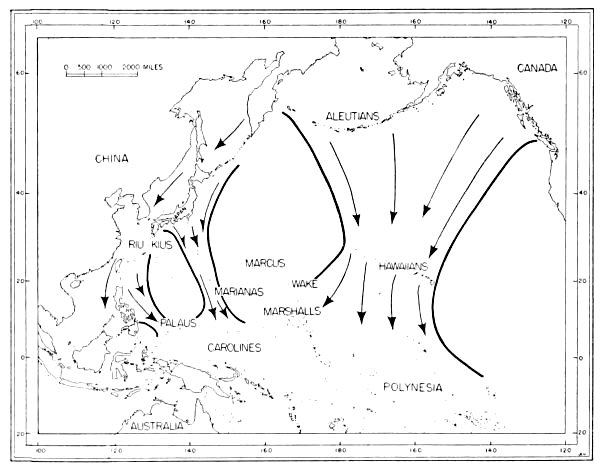
Fig. 6. Routes of migration used by shore birds in the Pacific area. From west to east these are: The Asiatic-Palauan Flyway, the Japanese-Marianan Flyway, the Nearctic-Hawaiian Flyway.
The small and isolated islands of Oceania might, upon first inspection, seem to offer but little attraction to shore birds. Hesse, Allee and Schmidt (1937:172, 173) point out that the "open southeastern Pacific" being least supplied with water from land sources, which is an important means of fertility, is known to have one of the poorest faunas found anywhere in the oceans. However, there are extensive tidal flats, especially on the leeward sides of the islands, and these flats apparently afford extensive feeding grounds for these birds. Also, the absence of competition from resident birds as well as the virtual absence of predatory animals (native man and his domesticated animals excepted) are other factors which may help to make the islands attractive wintering grounds for shore birds.
Only a few birds have been banded in the Pacific, and the knowledge which comes from the recovery of banded birds gives but little aid to the student of movements of birds in the Pacific. The probable flyways for migratory shore birds there have to be deduced from sight records, data from specimens collected, known stations of breeding and wintering (summarized by Peters, 1934:234-293), and from a study of maps of the region. Analysis of information from the above-mentioned sources indicates that there are three routes taken by shore birds which migrate from Micronesia to and from their northern breeding grounds (see figure 6): (1) Asiatic-Palauan Flyway; (2) Japanese-Marianan Flyway; (3) Nearctic-Hawaiian Flyway.
1. Asiatic-Palauan Flyway. For shore birds, there appears to be a migration route extending almost due south from the Riu Kiu and the Japanese islands to the Palau Islands. Some birds may migrate via the Philippines and others may pass to the east of the Philippines. This route is considered to be distinct from that used by birds which follow the Asiatic Coast and coastal islands, because the Palau Islands are situated approximately 600 miles east of the Philippines. Moreover, there are fewer species—only 20 recorded from the Palaus as compared with the number recorded from islands closer to the mainland of Asia. Delacour and Mayr (1946:68-74) list 46 species of shore birds from the Philippines; the Hand-list of Japanese Birds (Hachisuka et al, 1942) lists 34 species from the Riu Kiu Islands.
The information available indicates that migrant shore birds which utilize this flyway move east into the Carolines (examples, Tringa nebularia, Charadrius leschenaultii); however, the recording of 20 species from the Palaus as compared with only 12 species in the western Carolines (table 4) indicates that this spread eastward may not be very pronounced. Migrants in autumn probably move from the Palaus in a southerly direction toward the New Guinea area. Eight species of shore birds which reach the Palaus (and adjacent islands in the western Carolines), are not recorded from other parts of Micronesia. Species which apparently utilize the Asiatic-Palauan Flyway are listed in table 5.
2. Japanese-Marianan Flyway. Shore birds from Asiatic, and probably Aleutian and Alaskan, breeding grounds may follow the Asiatic Coast or the adjacent island chains southeast to the Japanese Archipelago. From there some of the birds apparently fly south through the Bonin and Volcano islands to the Marianas, from where they may spread in fanlike fashion to the southeast, south and southwest, even reaching to the Palau Islands (example, Heteroscelus incanus). The number of species of shore birds recorded from the Marianas (see table 4) is greater than that found in the Carolines, but it must be remembered that more intensive investigations have been made by ornithologists in the Marianas, which might account for the recording of more species (especially stragglers, such as Gallinago gallinago). Species which apparently use this flyway are named in table 6.
3. Nearctic-Hawaiian Flyway. Shore birds from breeding grounds in western Canada, Alaska, the Aleutians, the Bering Sea area, and probably northeastern Asia may fly in a southerly direction along a broad front to the Hawaiian Islands. This flyway is probably the one which supplies to central and eastern Oceania the largest wintering populations of shore birds. From the Hawaiian Islands birds may fly directly south through the scattered islands to southern Polynesia, or they may fly in a southwesterly direction and reach the Marshall Islands. The shore birds which visit the Marshall Islands apparently move south through the Gilbert, Ellice and other more southern island groups rather than west into the Carolines as exemplified by the fact that Numenius tahitiensis, a characteristic migrant through the Marshalls from the Hawaiian Islands, is rarely found west of the Marshall Islands in Micronesia. Species which apparently use this flyway are listed in table 7.
Flyways additional to the three suggested above may be utilized by some shore birds on their southward (and northward) migrations. Species reaching Wake and the Marcus Islands may fly directly south from the islands of the North Pacific. Bryan (1903:115, 116) lists four species of shore birds from Marcus (Erolia acuminata, Heteroscelus incanus, Pluvialis dominica, Arenaria interpres).
Table 4. List of Species of Shore Birds Known From Five Geographical Areas of Micronesia
Palaus Western Carolines Marianas Central Carolines Eastern Carolines Marshalls
Number of species 20 12 17 11 10 10
Table 5. Shore Birds Which May Use the Asiatic-Palauan Flyway
Regular Visitors Uncommon? Visitors
Pluvialis dominica fulva Charadrius dubius curonicus
Charadrius mongolus stegmanni Charadrius alexandrinus
Charadrius leschenaultii Calidris tenuirostris
Numenius phaeopus variegatus Erolia ferruginea
Numenius madagascariensis Erolia subminuta
Limosa lapponica baueri Limicola falcinellus sibirica
Tringa nebularia
Tringa glareola
Actitis hypoleucos
Heteroscelus brevipes
Arenaria i. interpres
Gallinago megala
Erolia minuta ruficollis
Erolia acuminata
Table 6. Shore Birds Which May Use the Japanese-Marianan Flyway
Regular Visitors Uncommon? Visitors
Pluvialis dominica fulva Squatarola squatarola
Charadrius mongolus stegmanni Numenius tahitiensis
Numenius phaeopus variegatus Numenius madagascariensis
Limosa lapponica baueri Tringa glareola
Actitis hypoleucos Gallinago gallinago gallinago
Heteroscelus brevipes Erolia minuta ruficollis
Heteroscelus incanus
Arenaria i. interpres
Gallinago megala
Crocethia alba
Erolia acuminata
Table 7. Shore Birds Which May Use the Nearctic-Hawaiian Flyway
Regular Visitors Uncommon? Visitors
Pluvialis dominica fulva* Squatarola squatarola*
Numenius tahitiensis* Charadrius hiaticula semipalmatus[+]
Heteroscelus incanus* Charadrius v. vociferus
Arenaria i. interpres* Limosa lapponica baueri*
Crocethia alba* Tringa melanoleuca*[+]
Phalaropus fulicarius Gallinago delicata
Phalaropus lobatus*? Erolia melanotos*
Erolia acuminata*
* Indicates species which are found in Micronesia. [+] Indicates species not recorded from the Hawaiian Islands; see Bryan and Greenway (1944:109-115).
Populations of Shore Birds in Micronesia
Although shore birds have been observed in Micronesia on many occasions, actual counts of numbers of individuals of the different birds have rarely been made. Kubary, Finsch, Marche, Seale and other early collectors and observers record some data of this kind as have the Japanese investigators in later times. William Coultas of the Whitney South Sea Expedition obtained considerable information of this nature at Guam, Saipan, Kusiae, Ponapé, and the Palaus, but it is unpublished. His records were made in fall, winter and spring, when migrants were present in large numbers and these observations offer evidence that many of the migrants are comparatively numerous, especially in the Carolines, throughout the winter months. McElroy's observations made on his trip for NAMRU2 to Truk in December, 1945, offer further evidence of this.
Table 8. Populations of Migratory Shore Birds Seen at Guam in 1945
Chara- drius mongolus Pluvialis dominica Numenius phaeopus Actitis hypo- leucos Hetero- scelus spp. Hetero- scelus incanus[+] Hetero- scelus brevipes[+] Limosa lapponica Arenaria interpres Uniden- tified Total No. of indivi- duals Total No. of species
March 11 x x 1
March 17 10 1 2 13 3
March 19 x x x x x 5
April 24 x x 1
April 26 1 1 1
May 19 3 2 5 1
May 21 4 4 1
May 26 x 2 x 1
June 1 1 1 1
June 6* 1 x x 1 x x 4
June 11 1 1 1
June 12 12 2 14 2
June 22 2 1 3 2
June 30 2 2 1
July 7 2 2 1
July 8 3 x 1 x 3
July 16* 6 3 3 4 1 17 4
July 19 x x x x 3
July 24* 10 6 3 2 3 5 29 5
July 26 8 8 1
August 2 x x x 2
August 3 1 1 1
August 6* 6 12 18 2
September 29 x x x x 2
October 3* x x x 2
October 10 x x x 2 x x 4
October 11 2 2 1
October 23* x x x 1 1 x x 5
October 24 x x 1
* Observations made on beach at Agfayan Bay area. x Observed but numbers not recorded. [+] Figures based on identified skins.
None of the above workers, however, obtained very much information on comparative numbers of species.
Tables 8, 9, and 10 present the writer's findings on populations of migratory shore birds in Micronesia in 1945. At Guam, as shown in table 8, the records for March, April and early May are few, owing to a limited amount of field observation. Beginning in late May and until October 24 a greater amount of time was spent in the field and more regular records were obtained. No observations were made by the author at Guam in the period from August 11 to September 25. The dates marked with an asterisk are those on which observations were made on the extensive tidal flats at Agfayan Bay and vicinity. These flats, at low tide, present excellent feeding grounds for waders and in 1945 were undisturbed by parties of service personnel, because the area was "off-limits."
Table 8 shows that Pluvialis dominica, Numenius phaeopus, and Heteroscelus spp. were the shore birds most frequently found at Guam in this period. Pluvialis dominica was the most numerous of the three species. Of Heteroscelus there was approximately equal representation of H. incanus and H. brevipes as indicated by specimens collected. These birds were not identified to species in the field.
Although records were made only infrequently in the spring migration, such information as was obtained indicates that the populations were largest in March and early April. On April 24, Pluvialis dominica was the only bird observed on beaches and in upland openings. On April 26, a single Limosa lapponica was recorded. On May 15, no shore bird was seen on a trip along several beaches. In late May and early June, single individuals of Heteroscelus were found. Of this genus, those collected in May were in nuptial plumage, and those collected in June were in winter plumage and probably should be classed as non-migrants. Numenius phaeopus was occasionally recorded beginning in early June, but waders were totally absent from beaches at Agfayan Bay and vicinity on June 18 and 19. Few shore birds were seen in early August. In late September, birds, especially Pluvialis dominica, Numenius phaeopus, and Heteroscelus spp., were numerous. These species were numerous until October 24, when observations were discontinued.
Of the 17 species of migratory shore birds recorded from the Mariana Islands, eight were identified. Of these eight, three species, Limosa lapponica, Actitis hypoleucos, and Charadrius mongolus, were found on only one occasion. Never more than four species were identified on a single field trip. These data give an idea of the lack of variety of species that may be observed on Micronesian islands.
Table 9. Populations of Migratory Shore Birds Seen at Ulithi Atoll in 1945
Species Island and Date
Potangeras Fas- sari Mange- jang Pau Losiep
Aug. 14 Aug. 15 Aug. 16 Aug. 17 Aug. 19 Aug. 20 Aug. 21 Aug. 22
Pluvialis dominica 6 5 4 10 5
Charadrius mongolus x 2
Numenius phaeopus 1 4 1 1 2
Actitus hypoleucos 2 2
Heteroscelus spp. 2 6 3
H. incanus* 1 2
Crocethia alba 30 5
Total No. of Individuals 1 4 6 6 6 1 49 21
Total No. of Species 1 1 1 2 2 1 6 6
* Figures based on identified skins. x Observed but numbers not recorded.
Table 9 lists the shore birds seen at Ulithi Atoll, Caroline Islands, on eight field excursions in the period from August 14 to August 22, 1945. Of seven species of shore birds known to visit the atoll, six were taken in this period. As observed at Guam, Pluvialis dominica and Numenius phaeopus were the species most frequently found. Heteroscelus was seen on three occasions; those collected were identified as H. incanus. Most of the shore birds were seen at Pau and Losiep, islands unoccupied by man. Similar tidal flats are present at most of the other small islands in the atoll, but these islands (Asor, Fallalop, Potangeras, Fassarai and Mangejang were visited) were occupied by small detachments of service personnel or by natives, which may have tended to keep many of the shore birds away. At the more populated islands of Asor and Fallalop, no shore birds were seen. Almost as many species were recorded at Ulithi on the eight field trips as were found by the author at Guam in eight months of observations.
Table 10. Populations of Migratory Shore Birds Seen at the Palau Islands in 194
Species Peleliu Angaur
August September Sept. 21
24 28 1 6* 8* 9[+] 16* 20*
Pluvialis dominicaa x x x 25 20 x x
Charadrius mongolu x 25 5 x x
C. leschenaultii x 25 5 x x
Numenius phaeopus 3 x 30 20 x x
N. madagascariensis 1 1 15
Limosa lapponica 3 4
Tringa nebularia 6 3
T. glareola[++] 1
Actitis hypoleucos 2
Heteroscelus sp. x x 75 x x x
H. brevipes[++] 3 2 2
Arenaria interpres 20
Capella megala 4
Calidris tenuirostris 15 20
Erolia minuta x 50 50 x x
E. acuminata[++] 3
E. ferruginea[++] 1
Limicola falcinellus[++] 1
Unidentified x x x x x x
Total No. of Individuals x 6 x x 271+ 3 129+ x x
Total No. of Species 1 1 3 7 10 2 9 7 10
* Observations made on beaches at Akarakoro Point, Peleliu. x Observed but numbers not recorded. [+] Observations made at fresh water ponds. [++] Figures based on identified skins.
Table 10 presents field counts at the Palau Islands in the period from August 24 to September 21, 1945. Of 20 species of shore birds known from the Palaus, 17 species were collected or identified on this trip. It was apparent that the fall migration was at its height at this time. Birds were numerous at inland openings and ponds, air field strips, and on the extensive tidal flats at Akarakoro Point. The latter area is between Peleliu and the adjacent island of Ngesebus to the north. Several observations were made at this area (as indicated by the dates marked with asterisks in the table); on September 8, 271+ shore birds were counted; on September 16, 129+ were counted. Six species were observed to be abundant. The majority of the birds found at these beaches were in small flocks which consisted of several birds of one or more species.
The birds observed at Angaur on September 21 were seen at several fresh and brackish ponds. Four species (Tringa glareola, Erolia acuminata, Limicola falcinellus, Gallinago megala), which were not taken on the tidal flats or elsewhere at Peleliu, were found at these ponds.
The abundance, and more especially the variety, of shore birds at the Palau Islands during this period was in marked contrast to the smaller and less diversified populations of shore birds in rather similar insular environments at Ulithi and Guam. These differences offer support for the supposition that the Asiatic-Palauan Migratory Shore Bird Flyway is distinct from the Japanese-Marianan Migratory Shore Bird Flyway.
Land and Fresh-water Birds
The land and fresh-water avifauna of Micronesia consists of 147 kinds of birds. Of these, 37 kinds are non-residents, 104 kinds are residents, and 6 kinds have been introduced by man. The 104 resident birds include 98 kinds (94 percent) which are found only within the confines of Micronesia. Included in these 98 kinds which are restricted to Micronesia are 5 endemic genera, 31 endemic species and 76 endemic subspecies.
Gulick (1932: 407, 413) stresses that the fauna and flora of the oceanic islands may be "disharmonic" (he uses Easter Island as his example) and says, "It is evident that mature groups of islands will attain an internal harmony, from the standpoint of the systematist. But this harmony, instead of reflecting the pre-existing harmony of some continental source (as in the case of the continental islands or land-bridge remnants) will be recognizably derivable by descent from a quite limited number of original importations, at the start distinctly miscellaneous and 'disharmonic'." Analysis of the land and fresh-water avifauna of Micronesia supports Gulick's view.
Fig. 7. Divisions of the islands of part of the Pacific Basin from the standpoint of the distribution of land birds and fresh-water birds: (1) Micronesia; (2) Hawaii; (3) Central Polynesia; (4) Eastern Polynesia; (5) Southern Melanesia; (6) Melanesia.
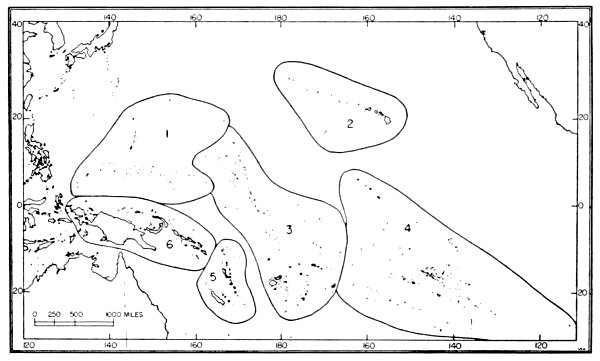
As mentioned previously, the islands of Micronesia, from the zoogeographical viewpoint, have been regarded as a part of the Polynesian Subregion of the Australian Region. Mayr (1941a: 192) defines the Polynesian Subregion as comprising "all the tropical and subtropical islands of the Pacific Basin which indicate by their impoverished fauna that they have had no recent continental connection (after early Tertiary) and which derived the major part of their fauna directly or indirectly from the Papuan Region or jointly from Australia and the Papuan Region." As based on the distribution of the resident avifauna, Mayr (1941a:193) subdivides the Polynesian Subregion into the following districts: Micronesia ("including Palau, the Marianne, Caroline, Marshall, and Gilbert islands"); Central Polynesia ("including Fiji, Tonga, Samoa, Phoenix, Ellice, Union islands, and a number of small islands, such as Rotuma, Fotuna, Keppel, Niue, Niouafu, and Uvea"); Eastern Polynesia ("all the islands east of 165° W"); and Southern Melanesia ("including the Santa Cruz group, Banks Islands, New Hebrides, Loyalty Islands, and New Caledonia"). He considers that the Hawaiian Islands, Solomon Islands, and possibly New Caledonia are bordering districts to the Polynesian Subregion. Figure 7 shows the divisions of the islands of the Pacific Basin from the standpoint of the distribution of the land and fresh-water birds. I have placed the Gilbert and Marshall islands in the Central Polynesian rather than in the Micronesian District. For purposes of discussion in this report, however, I am considering the Marshalls to be a part of Micronesia. The birdlife of the Bonin and Volcano islands northward of the Marianas is regarded as having its closest affinities to the Japanese avifauna. The Papuan or Melanesian Subregion of the Australian Region includes the districts of New Guinea and Northern Melanesia, including the Bismarck Archipelago, the Admiralty Islands, and the Solomon Islands.
The resident land and fresh-water birds of Micronesia have been derived from several sources. Studies of these birds and their closest relatives in adjacent areas indicate that the avifauna has been derived from five different sources: Polynesia, Melanesia, the Moluccas and Celebes, Philippines, and Palearctica.
Polynesian Component
Aphanolimnas monasa (extinct?), Ptilinopus porphyraceus, and Ducula oceanica are the only species of birds which have reached Micronesia directly from Polynesia. There are in Micronesia, as Mayr (1941b: 204) points out, eight species "which are members of typically Polynesian species or genera" and six species which are either Papuan or Polynesian. The relationships between Polynesian and Micronesian birds is evident, but insofar as the pathways of colonization are concerned the majority of these Micronesian species listed by Mayr have come from elsewhere than Polynesia and the birds of these two areas are thought to have arisen from common ancestors. Aphanolimnas, Ptilinopus, and Ducula apparently invaded Micronesia from Central Polynesia via the Marshall Islands through a rather continuous chain of islands and atolls. Aphanolimnas is known only from Kusaie in the extreme eastern part of the Carolines while Ptilinopus and Ducula are known from the Marshalls, Carolines, and Palaus.
Melanesian Component
The Papuan or Melanesian Region (New Guinea, Bismarck Archipelago, Solomon Islands) has supplied to Micronesia its greatest number of endemic land and fresh-water residents. Fifty kinds of birds belonging to the following species reached Micronesia from Melanesia: Nycticorax caledonicus, Megapodius lapérouse, Ptilinopus roseicapillus, Gallicolumba xanthonura, G. canifrons, Caloenas nicobarica, Halcyon cinnamomina, Trichoglossus rubiginosus, Collocalia inquieta, Edolisoma tenuirostre, Rhipidura rufifrons, Metabolus regensis, Monarcha godeffroyi, M. takatsukasae, Colluricincla tenebrosa, Aplonis opacus, A. pelzelni, A. corvinus (extinct?), Cleptornis marchei, Myzomela cardinalis (probably by way of Southern Melanesia), Rukia palauensis, R. oleaginea, R. ruki, R. sanfordi, Erythrura trichroa. The colonization of Micronesia by these species has probably extended over a considerable period of time. Megapodius, Trichoglossus, and Aplonis corvinus may represent older colonizations which have become well differentiated from the ancestral forms; Nycticorax, Myzomela, and Erythrura may have become established later and have had "less time" to become modified from the ancestral forms. Birds from Melanesia have reached Micronesia probably by direct flight to the Caroline Islands. Aided by favorable winds which blow from the southwest, south and southeast during the period from May to November, birds, particularly the young of the year, might conceivably be blown in the direction of the Carolines, where 57 percent of the birds derived from Melanesia reside. The Palaus are populated with 15 percent, the Marianas with 28 percent, and the Marshalls (lacking "high" islands) with none; these may be secondary colonizations from the Carolinas excepting Ptilinopus, Megapodius, Gallicolumba canifrons, Cleptornis, and Colluricincla. The Marshall Islands have received no avian components from Melanesia. The absence of "high" islands in the Marshalls and the possible inability of birds accustomed to life on the luxuriant islands of Melanesia to become established on relatively barren atolls are logical reasons for this. Instead of New Guinea itself, the outlying islands of Melanesia (Bismarck Archipelago, Solomons, Southern Melanesia) probably have been the principal "taking-off" places for birds invading Micronesia.
Moluccan and Celebesian Components
Birds which reached Micronesia by way of the islands of Celebes and the Moluccas may have been derived originally from Melanesia. The following birds appear to have used this route: Porphyrio porphyrio, probably Halcyon chloris, Rhipidura lepida, Myiagra oceanica, Zosterops conspicillata, and Z. cinerea. These birds apparently became established initially in the Palaus; Porphyrio and Rhipidura lepida have not been recorded elsewhere in Micronesia, but Myiagra and the two species of Zosterops have spread to the Carolines and Marianas, although not into the Marshall Islands. Wind from the southeast in summer and fall has probably been a factor aiding these colonizations. The population of Gallinula chloropus resident at Palau may also have arrived by this route.
Philippine Component
Ten of the kinds of birds of Micronesia have come from or by way of the Philippine area. These are known principally from the Palaus and the Marianas and include: Rallus philippinus, R. owstoni, Poliolimnas cinereus, Caprimulgus indicus, Corvus kubaryi, Psamathia annae, Artamus leucorhynchus, possibly Lonchura nigerrima, and Collocalia inexpectata. The Philippines may have been the actual point of dispersal of the birds (example, Psamathia), or may have been used as a stepping stone to Micronesia by birds coming from Melanesia (examples, Rallus and Artamus), by birds from Malaysia (example, Collocalia), and by birds from Asia (example, Caprimulgus). Two birds of this component have reached the islands of eastern Micronesia. A subspecies of Lonchura nigerrima is endemic at Ponapé, and a subspecies of Poliolimnas cinereus occurs on several islands in the Carolines and has even been recorded at Bikini in the Marshall Islands. Three species are known only from the Palaus; two are known only from the Marianas.
Palearctic Component
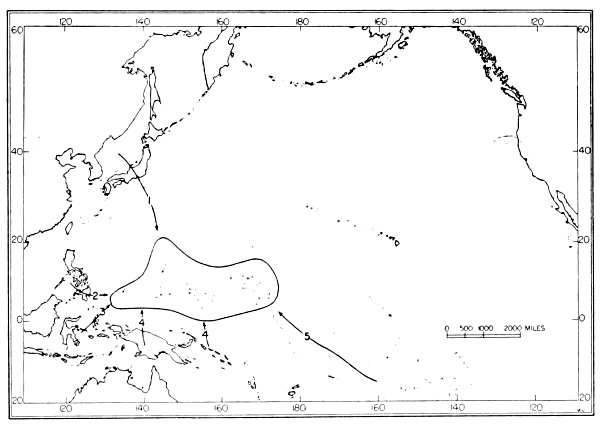
Fig. 8. Faunal areas from which the resident land birds and fresh-water birds of Micronesia have been derived. (1) Palearctica; (2) Philippines; (3) Moluccas and Celebes (Malaysia); (4) Melanesia (New Guinea and northern Melanesia); (5) Polynesia.
Birds of Micronesia which have been derived directly from Palearctica are Gallinula chloropus guami, Otus podarginus, Asio flammeus, Acrocephalus luscinia and Anas oustaleti. Apparently Gallinula, Asio, and Acrocephalus arrived in Micronesia by way of the chain of islands from Japan southward to the Bonins, Volcanoes, and Marianas. Otus reached Palau from Asia, possibly by way of the Philippines. The smallness of the representation of this component may result partly from lesser ability of the northern birds to adapt themselves to, and to establish themselves on, the semi-tropical and tropical islands of Micronesia as compared with birds from Melanesia where the climate and ecologic conditions resemble more closely those found in Micronesia. Evidence supporting this possibility is the large number of Palearctic residents in the Bonin and Volcano islands as compared with fewer in the Marianas; the Bonins and Volcanoes are less tropical and more temperate in climate.
Table 11 lists the birds concerned, by faunal areas from which the birds have been derived and shows the number of kinds of birds which are present as a result of these colonizations. There is some overlap in the numbers since some endemics may be found in more than one area in Micronesia. Figure 8 shows the faunal areas from which the endemic land and fresh-water birds of Micronesia have been derived. Melanesia (Papua) supplied 52 percent of this population. Birds reaching Micronesia by way of the Moluccas and Celebes include 21 percent of the total population. The Philippines have supplied 10 percent; Polynesia, 9 percent; and Palearctica, 8 percent. This population of endemic land birds and fresh-water birds has seemingly evolved from 46 colonizations, of which 27 have been derived from Melanesia, 6 from the Philippines, 5 from the Moluccan and Celebean areas, 5 from Palearctica, and 3 from Polynesia.
The Palaus have received a large part of their avifauna from the west (Moluccas, Philippines, Palearctica). Their Melanesian component is mostly the result of secondary colonization from the Carolines. The Carolines have received a greater share of their land birds and fresh-water birds from Melanesia and a smaller share from Polynesia. The Marshalls are definitely associated with the Polynesian element. The Marianas exhibit a considerable amount of secondary colonization from other Micronesian islands, as well as some unique components from the Philippines, Melanesia, and Palearctica. Thus, the number of endemics in Micronesia provides little information concerning the actual number of successful colonizations by birds from other areas. Many of the endemics probably have resulted in this way: Individuals of an endemic subspecies flew to another island and there underwent further differentiation, producing another endemic subspecies. Such secondary colonization probably is going on now.
This analysis of the avifauna shows that Micronesia, with the exception of the Marshall Islands (and the Gilbert Islands), has but little affinity to Polynesia. It has greater affinity, from the zoogeographical standpoint, with the Papuan Region (Melanesia).
Table 11. Avifaunal Components Which Make Up the Endemic Resident Land and Fresh-water Bird Population of Micronesia
Faunal Component Palau Western and central Carolines Eastern Carolines Marianas Marshalls
Polynesian 2 3 5 0 3
Melanesian 11 14 16 12 0
Moluccan-Celebean 6 3 4 7 0
Philippine 6 2 2 4 1
Palearctic 2 1 2 5 0
Totals 27 23 29 28 4
Speciation
Of the 104 native fresh-water birds and land birds which are resident in Micronesia, only 7 kinds or 6.5 percent remain undifferentiated from populations elsewhere. These birds are Phalacrocorax melanoleucus, Pandion haliaetus, Demigretta sacra, Ixobrychus sinensis, Anas poecilorhyncha, and possibly Lonchura punctulata (may be an introduction by man). Another bird, Gallinula chloropus, a resident at Palau, may or may not be distinct from the gallinule of Malaysia, G. c. orientalis. Of the 104 resident birds, 97 kinds or 93.5 percent have become differentiated and can be separated taxonomically from populations elsewhere. Of the kinds of birds which are found only in Micronesia, there are 5 endemic genera (16 percent), 31 endemic species (32 percent) and 76 endemic subspecies (75 percent). If we consider the avifauna of Micronesia as a single element, the endemism is high as compared with that on larger and less isolated islands. For example, Mayr (1944a:174) found 137 resident birds on Timor including 22 endemic species (16 percent) and 67 endemic subspecies (47.5 percent). Stresemann (1939b:313) found 220 species including 84 endemic species (38.2 percent) on Celebes. Mayr (1944a:174) also writes that on Java, of 337 breeding species, 16 (4.8 percent) are endemic, and on New Caledonia, of 68 species 19 (27.9 percent) are endemic. Speciation in Micronesia has not progressed much farther than that at New Caledonia and not so far as at Celebes, but subspeciation has progressed considerably more than at the island of Timor. The avifauna of the Hawaiian Islands, as recorded by Bryan and Greenway (1944), has 73 resident land birds and fresh-water birds, all of which are endemic, including one family, 23 genera and 36 species. The North American night heron, Nycticorax n. hoactli, may be included in this list as the only resident which is undifferentiated. The development of full specific differentiation within the resident avifauna is greater in the more isolated Hawaiian chain where 49 percent of these birds are regarded as endemic species, while in Micronesia, which is less remote from other bodies of land, the specific endemism is only 32 percent.
Table 12. Endemism in Families of Native Land and Fresh-water Birds in Micronesia
Family Residents Endemic genera Endemic species Endemic subspecies Total endemic
Phalacrocoracidae 1 0 0 0 0
Ardeidae 3 0 0 1 1
Anatidae 2 0 1 0 1
Accipitridae 1 0 0 0 0
Megapodidae 2 0 1 2 2
Rallidae 7 1* 2 4 6
Columbidae 13 0 4 11 13
Psittacidae 1 0 1 0 1
Strigidae 1 0 1 1 2
Caprimulgidae 1 0 0 1 1
Apodidae 5 0 1 5 5
Alcedinidae 7 0 1 7 7
Apodidae 3 0 0 3 3
Corvidae 1 0 1 0 1
Sylviidae 5 1 2 4 5
Muscicapidae 14 1 6 9 14
Artamidae 1 0 0 1 1
Sturnidae 9 0 3[+] 7 9
Meliphagidae 7 1 1 6 7
Zosteropidae 14 1 6 10 14
Ploceidae 5 0 0 4 4
Totals 104 5 31 76 97
* Aphanolimonasa is included but may be extinct. [+] Aplonis corvinus is included but may be extinct.
Table 12 lists the families of land birds and fresh-water birds which have resident members as part of the avifauna of Micronesia. It can be observed from the table that only two families are represented by no endemic kinds, several families are represented by one or two endemic kinds, and others are represented by as many as 14 endemic kinds. Endemism has reached its greatest development in the families Rallidae (6), Columbidae (13), Apodidae (5), Alcedinidae (7), Sylviidae (5), Muscicapidae (14), Sturnidae (9), Meliphagidae (7), and Zosteropidae (14). Generic endemism is greatest in the Sylviidae where one endemic genus occurs among 5 endemic species and subspecies (20 percent), in Rallidae one in 6 (17 percent), in Meliphagidae one in 7 (14 percent). Specific endemism is greatest in Psittacidae and Corvidae where the single representative of each family in Micronesia is considered specifically distinct (100 percent), in Megapodidae and Strigidae one in 2 (50 percent), in Muscicapidae and Zosteropidae 6 in 14 (43 percent) in Sylviidae 2 in 5 (40 percent), in Rallidae 2 in 6 (33 percent), in Sturnidae 3 in 9 (33 percent) in Columbidae 4 in 13 (31 percent). Subspeciation within species which are endemic in Micronesia has occurred in 8 families, occurring within two species in each of the families Columbidae and Zosteropidae and once in each of the families Megapodidae, Apodidae, Alcedinidae, Sylviidae, Muscicapidae, and Sturnidae.
In summary, the families of land and fresh-water birds found in Micronesia which have the greatest number of endemic forms are Muscicapidae (14), Zosteropidae (14), Columbidae (13), and Sturnidae (9). Speciation has occurred in the single representative of the families Psittacidae (Trichoglossus rubiginosus) and Corvidae (Corvus kubaryi). Where family representation is large, speciation has occurred most frequently, as in the Muscicapidae (6 in 14 = 43 percent), in the Zosteropidae (6 in 14 = 43 percent), and in the Columbidae (4 in 13 = 31 percent). Subspeciation has occurred in 8 families, in two species in the Columbidae and Zosteropidae and in one species in each of 6 other families.
Time of Colonization
Previously (and in the accounts of the species to follow), comments are made concerning the subjects of from where and by what route the various kinds of birds have arrived at Micronesia. The problem of when these birds arrived is a difficult and usually unanswerable one. Although geology provides some evidence on the relative age of the islands, and although deposits of bird guano on now elevated coral islands show that oceanic birds have inhabited these islands for a long time, there is no evidence to show the time of the first colonization by land birds. No fossil remains of land birds or fresh-water birds have been found in Micronesia. The relative extent of differentiation in color and structure, which has taken place between different birds, offers one means for estimating the relative length of residence in the area, provided all other factors are equivalent. Concerning the birds of the Galapagos, Lack (1947:113) writes "That Darwin's finches are so highly differentiated suggests that they colonized the Galapagos considerably ahead of the other land birds." Evidence from this source actually is of little value, because the speed of evolution is unknown and its rate may be different in different species, even though they live under the same circumstances. Dobzhansky (1941) says that evolution is a modification of the genetic equilibrium, which, if true, may not result in similar manifestations in different kinds of birds living under the same conditions of life. Relative antiquity of the birds might be ascertained by measuring their ecologic adaptations. The Guam Rail (Rallus owstoni) and the Micronesian White-browed Rail (Poliolimnas) can be examined in this way. R. owstoni has the ability to live in both brackish and fresh water swamps, as well as in the scrub and grass of the uplands and in the virtually barren, rocky areas in the dense jungles. Poliolimnas, on the other hand, appears to be restricted to swampy areas in Micronesia. If the swampy areas were removed this rail probably would become extinct. R. owstoni appears to have been resident in Micronesia longer than Poliolimnas. However, ability to live in a variety of habitats might be acquired by R. owstoni in a relatively short time.
Another possibility is that the birds, which are less differentiated from their ancestral stocks, may be less differentiated because of suppression of newly evolved characters by dilutions, which result from interbreeding with new birds, which may be arriving at irregular intervals from the ancestral home. Interbreeding of the resident population with newcomers may overshadow any modifications which might have appeared as a result of insular isolation, especially modifications which have little adaptive significance. One would suspect, from their modifications, that Rallus owstoni, Metabolus rugensis, Corvus kubaryi, and other endemic forms have experienced less of this "dilution," than such birds as Rallus philippensis pelewensis, Artamus leucorhynchus pelewensis, Myzomela cardinalis, and others. Murphy (1938) mentions this "dilution" effect in his discussion of "strong" and "weak" subspecies among warblers of the Marquesas. He writes that "strong" subspecies may develop if the birds are present on islands which are upwind from islands containing related subspecies. The wind acts to block interisland migration in these weak-flyers. On the other hand, "weak" subspecies may show the effect of "dilution," being situated on islands downwind from islands containing related subspecies. The direction of the wind acts to aid the weak flyers to move to the downwind islands and continually "dilute" the resident subspecies. Similar examples can be cited for Micronesian birds. Hesse, Allee, and Schmidt (1937:87) write, "Endemism on islands is most frequent in forms for which the difficulty of reaching the island is most extreme, so that new increments of the parent form are unlikely to follow."
Employing the criteria mentioned above, the birds of Micronesia can be tentatively divided into four groups as regards the relative time when they arrived at the islands:
1. Birds of ancient colonizations which reached certain individual islands, became modified, and dispersed no farther. Examples are Aphanolimnas, Rallus owstoni, Aplonis corvinus, Metabolus rugensis, and Corvus kubaryi.
2. Birds of ancient colonizations which reached or dispersed through a number of islands but are now restricted to relatively few islands. Examples are Ducula oceanica, Ptilinopus porphyraceus, Megapodius lapérouse, Asio flammeus, and Acrocephalus luscinia.
3. Birds of ancient, or possibly more recent, colonizations which initially reached or subsequently dispersed to many of the islands of Micronesia possessing habitat suitable for them. Examples are Myzomela cardinalis, the two species of Halcyon, Aplonis opacus, and Zosterops conspicillata.
4. Birds of rather recent colonizations, which may have reached only a few islands and are relatively unmodified from their parental stocks. Examples are Artamus leucorhynchus, Caprimulgus indicus, Poliolimnas cinereus, and Nycticorax caledonicus.
Factors Causing Dispersal
Darlington (1938:274) in discussing the origin of the fauna of the Greater Antilles uses the term "over-water dispersal" in referring to the spread of terrestrial animals across water. He is against the use of the term "accidental dispersal" since many factors besides accident are involved. He contends, as do others, that certain forms of organisms, owing to their "nature and behavior" cross water barriers more successfully than others. These observations may be applied to the "over-water dispersal" of birdlife to the islands of Micronesia. Certain groups of birds are more evident in Micronesia than others. Certain groups of birds which are found on other islands of the Pacific basin are found in Micronesia only in small numbers or may not be represented; Mayr (1945a:284) writes, "Remarkable is the almost complete absence of parrots and honey-eaters, the small number of pigeons and the absence of such widespread genera as Lalage, Turdus, and Pachycephala." The absence of some species and the presence of others produces the characteristic insular effect termed "disharmonic" by Gulick (1932:407), as compared with the continental area or island which derived its avifauna by way of a land bridge. One would think from looking at table 12 that members of the families Rallidae, Columbidae, Muscicapidae, Sturnidae, and Zosteropidae were the most successful colonizers in Micronesia on the basis of the number of successful colonizations (not necessarily on the number of endemics developed from a single colonization). Of these families, Sturnidae and Zosteropidae and possibly Columbidae contain species which often move in flocks. Furthermore, these families as well as the Muscicapidae feed on either fruits, seeds, or insects, any one of which is a type of food which might "give out" suddenly, stimulating a migratory behavior within the birds. From a flock embarking seaward in "search" of more food, a part or even all of the birds might survive in a chance flight to an isolated island in Micronesia. If a flock containing both males and females reaches an island, the species has a good chance of becoming established. Evidence that such a rapid colonization by flocks of birds can take place is found in the remarkable colonization of New Zealand by Zosterops lateralis from the Australian area. The bird was first seen as a winter migrant in New Zealand in 1856 and records of nestings were obtained at North Island in 1862, according to Oliver (1930:489). In the case of rails there is no evidence that they move in flocks; however, they are among the most successful colonizers and are on many of the oceanic islands in the tropical and subtropical oceans. Representatives of several species of the family Rallidae have invaded Micronesia and have successfully established 6, or possibly 7, "colonies."
Darlington (1938:274) further writes that "it is no accident that some islands, because of their nature and position, the direction of winds and currents, and the nature of the neighboring land, receive more organisms than other islands do." Semper (1881:294) writes that the distribution of flying creatures "must be in a great degree dependent on the direction and strength of atmospheric currents." These statements are applicable to the history of the avifauna of Micronesia. The Caroline Islands, for example, present a "broad front" for wanderers from the Melanesian islands. As mentioned previously, the prevailing winds in the late spring, summer, and early fall are from the south, southwest, and southeast and would favor bird flight to the northward towards the Carolines. In addition, the breeding season of many of the birds in Melanesia is from November to February, and in the spring and summer, restless young birds seeking living space might fly seaward and aided by the winds fly northward towards Micronesia. Adults, which may have well-established home territories, may be less likely to attempt such a movement.
One could conclude from the above discussion that the Micronesian islands, especially the Carolines, might be well populated with a large variety of birds from Melanesia, a scant 500 or more miles away. As it turns out, there are only a few islands in this extensive archipelago possessing proper vegetation, fresh water, and other qualities which make them capable of supporting the land and fresh-water birds of Melanesia. The few islands which have these qualities are the so-called "high" islands, including the entire Mariana chain, the Palaus, and four widely separated islands in the Carolines: Yap, Truk, Ponapé, and Kusaie. The other islands of Micronesia are "low" coral islands, which often lack fresh water and have a meager variety of fruits, insects and other foods. Thus, if birds do reach Micronesia but arrive at the atolls instead of the "high" islands, these birds may be doomed. It is noteworthy that the Micronesian islands are small compared with the Solomons, Fijis, and others. The smaller the island, the fewer the number of ecologic niches and the fewer the kinds of birds present.
Mayr (1941b:215) writes that the distance from the nearest land mass and the climatic conditions are important factors controlling dispersal. With regard to the degree of remoteness of the islands, table 13 lists the number of resident land and fresh-water birds present in the Palaus and the "high" islands of the Carolines. Also, the approximate distance from the nearest large land mass and the area in square miles are given. There is some correlation between the distance from the nearest land mass and the number of resident land birds and fresh-water birds. For example, Palau, with 32 resident birds, is only 410 miles from the nearest land mass whereas Kusaie, with only 11 resident birds, is 720 miles from the nearest land mass. The comparative size of the land mass must also be taken into account, as shown by the fact that the large island of Ponapé contains more kinds of birds but is more remote from large land masses than either Yap or Truk.
Table 13. Correlation Between Number of Resident Land and Fresh-water Birds and Distance From Large Land Masses of "High" Islands of Micronesia
Island No. of Birds Approximate distance from nearest land mass (statute miles) Nearest land mass Area in square miles
Palau 32 410 Approximately equal distance from Mindanao, Morotai, New Guinea 171
Yap 13 580 New Guinea 83
Truk 17 525 New Ireland 50
Ponapé 20 630 New Ireland 145
Kusaie 11 720 Malaita (Solomons) 42
Climatic factors are important in the dispersal of bird life; Micronesia, where the climate is tropical to subtropical, is better suited for colonization by birds from the tropics (Melanesia) than by birds from the temperate or cold climates (Palearctica). The climatic factor may be one of the principal reasons why birds from Palearctica make up only a small part of the avifauna of Micronesia.
Analysis of Speciation
The process of speciation within insular populations has been discussed by many authors. Hesse, Allee, and Schmidt (1937:517) list the motives for differentiation as, "Special character of insular faunae rests on the conditions common to all islands—isolation, freedom from competition, space restriction, and special insular climates." This combination of characteristics is seldom found elsewhere in nature, and as Murphy (1938:357) points out, an island is the nearest approach to a "man-controlled laboratory." Isolation of small populations is probably the most influential factor in the process of speciation in insular organisms. Lack (1947:134) writes that "in all organisms the isolation of populations is an essential preliminary to the origin of new species." Buxton (1938:265) also stresses this point with regard to the formation of species of insects in Samoa and emphasizes that evolution may occur more quickly in small populations. When mutations appear in such small and isolated populations, they have a greater chance to become fixed than do mutations in less restricted populations in a larger land mass, where such a mutation might be lost by the swamping effects of outbreedings. In addition, Wright (1931 and elsewhere) suggests the possibility of change by accidental elimination and recombination of hereditary characters in micropopulations. This mechanism could well be a factor in Micronesian bird populations, many of which possess no more than a few hundred individuals. Huxley (1938:256) emphasizes that "accidental" mutations may be perpetuated in small, isolated groups. It might be added that such changes might be either advantageous or disadvantageous to the organism concerned. Huxley (1938:263) states also that geographic isolation may promote nonadaptive differentiation, which may be caused by "colonization by a random sample" or by subsequent "preservation of nonadaptive mutations in numerically small isolated groups." Mayr (1942b:237) cites the importance of the "founder" principal for reduced variability in small populations. He points out that if the "founders" of the population carried with them only "a very small proportion of the variability of the parent population," one would expect to see divergence from the ancestral stock.
Freedom from competition, especially interspecific strife, is an important factor in differentiation; this is especially true in the early period of colonization. Lack (1947:113) points to the absence of food competitors, especially in the initial period of colonization, as an important influence in the evolution of Darwin's finches at the Galapagos Islands. Once a population has become established and "adjusted" to a given environment on a small island, intraspecific competition might bring about adaptative selection. Subsequent colonists might be eliminated by the competition brought about by these previously adapted organisms, especially if both organisms were adapted for life in the same ecologic niche. Space restriction may be important in such Micronesian birds as Rhipidura and Myiagra, which appear to possess recognizable territories. A new colonist entering the territory of one of these birds might be forced out. This competition might not play such an important part among birds, which live in flocks and do not range in closely guarded territories; birds in this group include some pigeons, starlings, and white-eyes.
Freedom from the pressure of predation probably exerts a direct influence on formation of species. Aside from a few migrant hawks and two kinds of resident owls, most of the avifauna feeds on vegetable and invertebrate foods. The large lizard Varanus may be classed as the only native predator on many of the islands. Man has been responsible for the introduction of rats, house cats, and other mammals, which may be destructive to birds. Thus, before the advent of man the factor of predation may not have been of great consequence. As mentioned previously, nonadaptive modifications may be perpetuated where the "weeding-out" process by predation is not an influence. Flightless rails have apparently developed in the absence of predation.
The absence of the pressure of predation should remove a certain amount of control on the population turn-over. As Hesse, Allee, and Schmidt (1937:521) write, a characteristic of the faunas of oceanic islands is the fact that they are distinguished by the occurrence of "disproportionately developed taxonomic groups in which one or a few basic types have undergone adaptative radiation and come to fill unduly large proportions of the population as compared with conditions that obtain on neighboring continents." Lack (1947:114) writes, "that the absence of predators may well have accelerated the adaptative radiation" in the Galapagos finches. In Micronesia, the starling (Aplonis opacus) dominates much of the available habitat on some of the Caroline atolls, and even on "high" islands, where other land birds are present. There appears to be no tendency towards selective adaptations occurring, or towards ecologic isolation.
Available data indicate that the life spans of individual birds in Micronesia may be short. For example, it was obvious on many of the islands visited by the NAMRU2 party that starlings (Aplonis opacus) in immature plumage outnumbered starlings in adult plumage, although it is possible that immature plumages are retained longer in these island birds than in others. Similar observations were made by Coultas, who noted the ratio of birds in immature plumage to birds in adult plumage at Kusaie to be 5 to 1. If the life span is shorter in these insular forms as compared with that of the ancestral stocks, the higher annual population turn-over would allow for the speed of genetic changes to be accelerated.
The origin of species by hybridization between different kinds of organisms has been a subject of frequent discussion. Lack (1947:100) concludes that it is improbable that hybridization has played an important part in the origin of new kinds of birds. Nevertheless, the absence of sufficient mates in the confines of a small island probably stimulates the crossbreeding between two species of birds. Fertile offspring of such a cross might conceivably account for some of the populations, the origins of which are puzzles to present day taxonomists. Such Micronesian forms as Metabolus and Cleptornis could conceivably have been derived in such a manner. Yamashina (1948) has described the origin of Anas oustaleti as a result of hybridization between A. platyrhynchos and A. poecilorhyncha. It might be difficult to explain every case of the formation of other insular species on the basis of the effects of isolation and paucity alone. However, Mayr (1942b:236) includes the development of questionable and unusual kinds of insular forms in a general statement: "The potentiality for rapid divergent evolution in small populations explains also why we have on islands so many dwarf or giant races, or races with peculiar color characters (albinism, melanism), or with peculiar structure (long bills in birds), or other peculiar characters (loss of male plumage in birds)."
Nutrition may be also a factor influencing speciation in bird life. The types of food plants (coconut, papaya, breadfruit, pandanus, etc.) might be similar on a Micronesian island and on a continental island in the Philippine region; however, the value of these plants as foods might vary and might reflect differences in mineral content of the soils. For example, if the soils on an island lack, or by leaching out have lost, sufficient amounts of potassium and other elements, plants may store foods, not as proteins, but possibly as carbohydrates, simple sugars, or alkaloids. Whether nutritional influences might have a selective effect on the bird populations, has not been ascertained.
In summary, it may be said that genetic change altering the phenotypic expression of avian characteristics is no more apt to happen in insular populations than in continental populations but genetic change may have a greater chance of being perpetuated in small insular populations where isolation, limited competition, freedom from the selective influences of predation, and other factors exert influences.