ACCOUNTS OF THE KINDS OF BIRDS OF MICRONESIA (continued 8)
Reading edition
Immature male: Resembles adult female, but scarlet coloring of tips of feathers of head and neck narrower.
Immature female: Resembles immature female of M. c. rubrata, but upper parts grayer; underparts darker.
Measurements.—Measurements are listed in table 48.
Specimens examined.—Total number, 19 (13 males, 6 females), as follows: Caroline Islands, USNM—Truk, 2 (Feb. 16, Dec. 13); AMNH—Truk, 17 (Feb., March, Nov., Dec.).
Nesting.—Concerning the honey-eater at Truk, Hartert (1900:2) writes "many nests were found from end of May to July, and one in March." McElroy examined three males in December, which had swollen testes. As seems to be the case with other races of this species, the Cardinal Honey-eater at Truk may nest at all times of the year.
Molt.—Specimens examined that were taken in November, December and February are in fresh or in molting plumages.
Remarks.—Bonaparte described his Myzomela major as "Similis praecedenti, sed major et percoccinea." He compares it here with Myzomela rubrata, which he considered as a resident of the Mariana Islands. According to Oustalet (1895:202) Hombron and Jacquinot obtained one specimen of the honey-eater at Truk in 1841. This subspecies, as well as most of the others of M. cardinalis in Micronesia, is best distinguished by the characteristics of the female. The male of the different subspecies shows much less geographic variation.
Myzomela cardinalis saffordi Wetmore
Cardinal Honey-eater
Myzomela rubratra saffordi Wetmore, Proc. Biol. Soc. Washington, 30, 1917, p. 117. (Type locality, Guam.)
Cinnyris rubrater Lesson (part), Dict. Sci. Nat., éd. Levrault, 50, 1827, p. 30 (Mariannes); idem (part), Voy. "La Coquille," Zool., 2, 1828, p. 678 (Mariannes); idem (part), Man. d'Ornith., 2, 1828, p. 55 (Mariannes); idem (part), Traité d'Ornith., 1831, p. 299 (Mariannes); Kittlitz (part), Kupfertaf. Naturgesch. Vögel, 1, 1832. p. 6, pl. 8, fig. 1 (Guaham); idem (part), Denkw. Reise russ. Amer. Micron. und Kamchat., 1, 1858, pp. 364, 381; 2, 1858, pp. 39, 49 (Guaham).
Certhia cardinalis Kittlitz, Obser. Zool., in Lutké, Voy. "Le Séniavine," 3, 1836, p. 304 (Guaham).
Myzomela rubrater Hartlaub (part), Archiv f. Naturgesch., 18, 1852, p. 109 (Mariannen); Finsch and Hartlaub (part), Fauna Centralpolynesiens, 1867, p. 57 (Guaham).
Myzomela rubratra Bonaparte, Comptes Rendus Acad. Sci. Paris, 38, 1854, p. 263 (Mariannes); Hartlaub (part), Journ. f. Ornith., 1854, p. 167 (Mariannen); Gray (part), Cat. Birds Trop. Is. Pacific Ocean, 1859, p. 11 (Guam); idem (part), Handlist Birds, 1, 1869, p. 154 (Marian); Finsch (part), Journ. Mus. Godeffroy, 12, 1876, pp. 17, 26 (Marianen); Forbes (part), Proc. Zool. Soc. London, 1879, p. 270 (Marianis); Giebel (part), Thes. Ornith., 2, 1875, p. 681 (Marinae); Finsch (part), Mitth. Ornith. Ver. Wien, 1884, p. 48 (Guam); Wiglesworth (part), Abhandl. und Ber. Zool. Mus. Dresden, no. 6, 1890-1891 (1891), p. 31 (Marianne); Oustalet (part), Nouv. Arch. Mus. Hist. Nat. Paris, (3), 7, 1895, p. 197 (Guam, Rota, Saypan, Pagan, Agrigan); Hartert (part), Novit. Zool., 5, 1898, p. 55 (Guam, Saipan, Pagan, Agrigan); idem (part), Novit. Zool., 7, 1900, p. 2 (Guam); Wheeler, Report Island of Guam, 1900, p. 13 (Guam); Seale (part), Occ. Papers Bernice P. Bishop Mus., 1, 1901, p. 55 (Marianae); Safford, The Plant World, 7, 1904, p. 263 (Guam); idem, Contr. U. S. Nat. Herb., 9, 1905, p. 79 (Guam); Mearns, Proc. U. S. Nat. Mus., 36, 1909, p. 477 (Guam); Reichenow (part), Die Vögel, 2, 1914, p. 482 (Marianen); Takatsukasa and Kuroda (part), Tori, 1, 1915, p. 64 (Marianas); Cox, Island of Guam, 1917, p. 21 (Guam).
Myzomela rubrata Oustalet, Le Nat., 1889, p. 260 (Mariannes); Matschie (part), Journ. f. Ornith., 1901, p. 112 (Guam, Saipan); Safford, Osprey, 1902, p. 69 (Guam); Prowazek, Die deutschen Marianen, 1913, p. 101 (Saipan).
Myzomela rubratra saffordi Wetmore, in Townsend and Wetmore, Bull. Mus. Comp. Zoöl., 63, 1919, p. 221 (Guam, Saipan); Momiyama, Birds Micronesia, 1922, pp. 17, 20, 21, 22 (Guam, Rota, Saipan, Pagan, Agrigan); Kuroda in Momiyama, Birds Micronesia, 1922, p. 74 (Guam, Rota, Saipan, Pagan, Agrigan); Mathews, Syst. Avium Australasianarum, 2, 1930, p. 744 (Guam); Yamashina, Tori, 7, 1932, p. 395 (Marianas?); Hand-list Japanese Birds, rev., 1932, p. 171 (Marianas); Bryan, Guam Rec., vol. 13, no. 2. 1936, p. 25 (Guam); Hand-list Japanese Birds, 3d ed., 1942, p. 190 (Guam, Rota, Agiguan, Tinian, Saipan, Almagan, Pagan, Agrigan, Assongsong).
Myzomela rubrata saffordi Yamashina, Tori, 19, 1940, p. 673 (Assongsong, Agiguan).
Myzomela cardinalis saffordi Mayr, Birds Southwest Pacific, 1945, p. 299 (Marianas); Downs, Trans. Kansas Acad. Sci., 49, 1946, p. 103 (Tinian); Borror, Auk, 1947, p. 417 (Agrihan); Stott, Auk, 1947, p. 527 (Saipan, Guam); Baker, Smithson. Misc. Coll., vol. 107, no. 15, 1948, p. 72 (Guam, Rota).
Myzomela cardinalis Watson, The Raven, 17, 1946, p. 41 (Guam); Strophlet, Auk, 1946, p. 540 (Guam); Baker, Condor, 49, 1947, p. 125 (Guam).
Geographic range.—Micronesia: Mariana Islands—Guam, Rota, Tinian, Agiguan, Saipan, Almagan, Pagan, Agrihan, Asuncion.
Characters.—Adult male: Resembles M. c. rubratra, but smaller with red coloring lighter and more orange; edges of wing and tail feathers olivaceous. Differs from adult males of M. c. dichromata and M. c. major by smaller size and presence of olivaceous edgings on wing and tail feathers.
Adult female: Resembles adult female of M. c. rubratra, but smaller and paler with upper parts dark olivaceous-gray, sparsely mottled with scarlet; outer edges of wing and tail feathers greenish-olive; abdomen and under tail-coverts buffy-gray. Differs from M. c. dichromata by smaller size and presence of scarlet tips of feathers on top of head. Differs from M. c. major by smaller size and presence of broad olivaceous edges on tail feathers.
Immature male: Resembles adult male, but red coloring less brilliant, upper parts, lower breast, and abdomen more narrowly edged with the red coloring; plumage of breast, abdomen, and under tail-coverts buffy-gray, lighter in very young birds.
Table 49. Measurements of Adult Males of Myzomela cardinalis saffordi from the Mariana Islands
Island No. Wing Tail Full culmen Tarsus
Guam 0_535 72 54 20.0 22
(69-75) (51-56) (19.5-20.5) (21-23)
Rota 1 73 20.0 22
Tinian 5 73 53 19.5 22
(71-74) (52-55) (19.0-20.0) (21-24)
Saipan 4 74 54 19.5 22
(72-76) (53-55) (19.0-20.5) (22-23)
Agrihan 1 77 55 20.0 22
Immature female: Resembles adult female, but paler with upper parts darker brown; underparts pale buffy-brown; outer edges of wing and tail. feathers greenish-olive, more extensive than in adult.
Measurements.—Measurements of the subspecies of M. cardinalis in Micronesia are listed in table 48. Measurements of male specimens of M. c. saffordi from various islands in the Marianas are listed in table 49.
Weights.—The author (1948:72) records weights of M. c. saffordi from Guam as: 17 adult males, 12.7-18.0 (15.0), and 5 adult females, 10.4-15.0 (12.7).
Specimens examined.—Total number, 80 (61 males, 17 females, 2 unsexed), as follows: Mariana Islands, USNM—Guam, 43 (Jan. 22, May 26, 30, June 2, 3, 5, 7, 8, 9, 13, 18, 19, 25, 28, July 6, 10, 12, 17, 19, 20, 21, Sept., Nov. 20, 21)—Rota, 2 (Oct. 10)—Tinian, 3 (Oct. 23, 25)—Saipan 2 (Sept. 27, 30); AMNH—Guam, 23 (Jan. 22, 23, Feb. 5, 7, 9, 16, March 8, 10, 11, 13, 23, June 28, July 8, 21, Aug. 22, Nov. 25, Dec. 4, 11)—Tinian, 2 (Sept. 7, 14)—Saipan, 3 (July 8, Aug. 5, 22)—Asuncion, 1 (June)—Agrihan, 1 (June).
Nesting.—Seale (1901:55) obtained nests and eggs in the period from May to July at Guam. He found the nests 8 to 15 feet above the ground. Strophlet (1946:540) observed a pair of honey-eaters with two young on October 9 at Guam. In 1945 at Guam the NAMRU2 party obtained individuals with enlarged gonads on January 22, June 2, 5, July 21 and 23, and found evidence of nesting on June 16. Hartert (1898:56) writes that Owston's Japanese collectors obtained nests in January, February, and March. Each nest contained two eggs; they were placed four to eight feet from the ground. Probably the Cardinal Honey-eater in the Marianas nests at most times of the year.
Molt.—Specimens, with molting plumage, have been examined that were taken at most times of the year. I suspect that this bird molts at irregular intervals.
Food habits.—The honey-eater feeds partly on insect life and partly on nectar and juices from flowers. At Guam, the honey-eater was frequently found at flowers of the ink berry bush, where evidently both nectar and insects were obtained. The birds were attracted also to the coconut palms, especially when the reproductive parts of the palms were developing.
Remarks.—The Cardinal Honey-eater is one of the most conspicuous land birds in the Mariana Islands. Its scarlet plumage and characteristic fluttering flight cause it to stand out against its habitat of forest, scrub, and garden. At Guam, the author (1947b:124) found the honey-eater on 37.6 percent of the 125 roadside birds counts made in 1945. The species included 3.9 percent of all of the birds observed on these counts. Seale (1901:55) and Strophlet (1946:540) also commented on its abundance at Guam; however, in 1931, Coultas (field notes) wrote that the bird was rare; he obtained only one skin at Guam. At Rota, the NAMRU2 party found the honey-eater to be abundant. Coultas obtained only a few birds at Tinian and Saipan in 1931. In 1945, Downs (1946:103) saw only a single pair at Tinian; Gleise (1945:220) estimated the population at Tinian to be 12 in 1945. At Agrihan, Borror (1947:417) reported that the honey-eater was a common bird in 1945.
Table 49 lists the measurements of males of M. c. saffordi from several islands in the Marianas. Measurements of birds from Guam, Rota, Tinian, and Saipan are fairly similar, although the birds at Saipan seem to have a slightly longer wing than those at Guam. A single skin from Agrigan has larger measurements than those of birds obtained in the southern Marianas. Whether the birds in the northern Marianas are separable because of larger size can only be ascertained by the studying of more material from that region.
Mayr (1945a:102) writes that males of M. cardinalis seem to outnumber the females by approximately four to one. On the basis of collections and field observations, the males were found to outnumber the females in the Micronesian islands; although the ratio may not be so great as four to one. At Guam, the NAMRU2 party obtained 21 males and 8 females. Although these birds are often seen as pairs (male and female), single males are frequently observed. The females do not appear to have more secretive habits than the males.
Myzomela cardinalis kurodai Momiyama
Cardinal Honey-eater
Myzomela rubratra kurodai Momiyama, Birds Micronesia, 1922, p. 17. (Type locality, Yap.)
Myzomela rubratra Hartlaub and Finsch (part), Proc. Soc. London, 1872, pp. 89, 94 (Uap); Gräffe, Journ. Mus. Godeffroy, 2, 1873, p. 122 (Yap); Finsch (part), Journ. Mus. Godeffroy, 8, 1875, p. 4 (Yap); Forbes (part), Proc. Zool. Soc. London, 1879, p. 271 (Yap); Wiglesworth (part), Abhandl. und. Ber. Zool. Mus. Dresden, no. 6, 1890-1891 (1891), p. 31 (Uap); Oustalet (part), Nouv. Arch. Mus. Hist. Nat. Paris, (3), 7, 1895, p. 202 (Yap); Takatsukasa and Kuroda (part), Tori, 1, 1915, p. 64 (Yap); Kuroda, Dobutsu. Zasshi, 27, 1915, pp. 331, 332 (Yap).
Myzomela rubrata Matschie (part), Journ. f. Ornith., 1901, p. 112 (Yap).
Myzomela rubrata kurodai Kuroda, in Momiyama, Birds Micronesia, 1922, p. 74 (Yap); Mathews, Syst. Avium Australasianarum, 2, 1930, p. 743 (Yap); Hand-list Japanese Birds (part), rev., 1932, p. 172 (Yap); Hand-list Japanese Birds (part), 3d ed., 1942, p. 190 (Yap).
Myzomela cardinalis kurodai Mayr, Birds Southwest Pacific, 1945, p. 299 (Yap).
Geographic range.—Micronesia: Caroline Islands—Yap.
Characters.—Adult male: According to Momiyama (1922:17), M. c. kurodai is "Similar to M. r. saffordi Wetmore from Southern Marianne islands, but the tarsus is decidedly shorter, not exceeding 21 mm. (more than 21 mm. in M. r. saffordi), and the colour of plumage is not so much tinged with vermillion. It differs from M. r. rubratra, M. r. dichromata, and M. r. wetmorei by the body measuring much shorter, and by the scarlet colour of plumage being less pronounced. The length of bill in M. r. wetmorei and kurodai is nearly the same."
Adult female: According to Momiyama (1922:17), "Upper-parts of body dark olivaceous brown; under-parts, including chin, throat and fore neck like upper-parts, but somewhat paler; breast and abdomen yellowish ashy-white; head, lower back, rump, upper tail-coverts, chin, throat as well as lower breast tinged with scarlet (the red colour more distinct on lower back but less so on lower breast); pale olive margin to the outer web of flight-feathers."
Measurements.—Measurements are listed in table 48.
Specimens examined.—Total number, 2 males, from Caroline Islands, AMNH—Yap (Sept.).
Remarks.—This subspecies is tentatively recognized as distinct from M. c. kobayashii of Palau. No female has been examined, and the two males seen and the description by Momiyama indicate that the population at Yap closely resembles the one at Palau. The Hand-list of Japanese Birds (Hachisuka et al., 1932:172) places the birds from Yap and Palau in the same subspecies.
Myzomela cardinalis kobayashii Momiyama
Cardinal Honey-eater
Myzomela rubratra kobayashii Momiyama, Birds Micronesia, 1922, p. 19. (Type locality, Pelew Islands.)
Cinnyris rubrater Lesson (part), Dict. Sci. Nat., éd., Levrault, 50, 1827, p. 30 (Pelew); idem (part), Voy. "La Coquille," Zool., 1, 1828, p. 678 (Pelew); idem (part), Man. d'Ornith., 2, 1828, p. 55 (Pelew).
Myzomela rubratra Gray (part), Cat. Birds Trop. Is. Pacific Ocean, 1859, p. 11 (Pelew); Hartlaub (part), Proc. Zool. Soc. London, 1867 (1868), p. 829 (Pelew); Hartlaub and Finsch, Proc. Zool. Soc. London, 1868, pp. 5, 116, 118 (Pelew); Gray (part), Hand-list Birds, 1, 1869, p. 154 (Pelew); Hartlaub and Finsch (part), Proc. Zool. Soc. London, 1872, pp. 89, 94 (Pelew); Finsch (part), Journ. Mus. Godeffroy, 8, 1875, pp. 4, 16 (Palau); idem (part), Journ. Mus. Godeffroy, 12, 1876, pp. 17, 26 (Palau); Forbes (part), Proc. Zool. Soc. London, 1879, p. 270 (Pelew); Finsch (part), Mitth. Ornith. Ver. Wien, 1884, p. 48 (Palau); Gadow, Cat. Birds British Mus., 9, 1884, p. 129 (Pelew); Tristram, Cat. Birds, 1889, p. 206 (Pelew); Wiglesworth (part), Abhandl. und Ber. Zool. Mus. Dresden, no. 6, 1890-1891 (1891), p. 31 (Pelew); Oustalet (part), Nouv. Arch. Mus. Hist. Nat. Paris, (3), 7, 1895, p. 202 (Palaos); Nehrkorn, Kat. Eiers., 1899, p. 79 (Palau-inseln); Seale (part), Occ. Papers Bernice P. Bishop Mus., 1, 1901, p. 57 (Pelew); Reichenow (part), Die Vögel, 2, 1914, p. 482 (Palau); Takatsukasa and Kuroda (part), Tori, 1, 1915, p. 64 (Pelew).
Myzomela rubratra Nehrkorn (part), Journ. f. Ornith., 1879, p. 397 (Palau); Matschie (part), Journ. f. Ornith., 1901, p. 112 (Palau); Takatsukasa and Kuroda (part), Tori, 1, 1915, p. 55 (Pelew); Kuroda, Dobutsu. Zasshi, 28, 1916, p. 71 (Pelew).
Myzomela rubratra kobayshii Kuroda, in Momiyama, Birds Micronesia, 1922, p. 74 (Pelew); Mathews, Syst. Avium Australasianarum, 2, 1930, p. 722 (Pelew).
Myzomela rubratra kurodai Hand-list Japanese Birds (part), rev., 1932, p. 172 (Palau); Hand-list Japanese Birds (part), 3d ed., 1942, p. 190 (Babelthuap, Koror, Peleliu).
Myzomela rubratra kurodai Yamashina, Tori, 10, 1940, p. 674 (Palau).
Myzomela cardinalis kobayashii Mayr, Birds Southwest Pacific, 1945, p. 299 (Palau); Baker, Smithson. Misc. Coll., vol. 107, no. 15, 1948, p. 72 (Peleliu).
Geographic range.—Micronesia: Palau Islands;—Babelthuap, Koror, Garakayo, Peleliu, Angaur.
Characters.—Adult male: Resembles M. c. rubratra, but smaller and with red coloring darker, near "scarlet-red"; margins of wing feathers olivaceous. Differs from adult males of other subspecies of M. cardinalis by red coloring of feathers being darker.
Adult female: Resembles adult female of M. c. dichromata but red coloring darker, top of head only partly red; abdomen, under tail-coverts, and axillaries buff-gray; outer edges of wing and tail feathers light olive. Differs from adult females of other subspecies of M. cardinalis by having top of head only partly red.
Immature male: Resembles adult male, but red coloring lighter and thinly distributed; wings and tail brownish-olive; abdomen and under tail-coverts grayish.
Immature female: Resembles adult female, but red coloring paler and underparts more buffy and less grayish.
Measurements.—Measurements are listed in table 48.
Specimens examined.—Total number, 42 (28 males, 11 females, 3 unsexed), as follows: Palau Islands, USNM—Koror, 4 (Nov.)—Peleliu, 11 (Aug. 29, 30, 31, Sept. 1, 5); AMNH—exact locality not given, 27 (Oct., Nov., Dec.).
Molt.—Many of the specimens taken from late August to December are in molt. Of the adult males obtained during this period almost a half had enlarged testes.
Food habits.—Stomachs of specimens obtained by the NAMRU2 party in August and September, 1945, contained vegetable matter, seeds and small insects.
Remarks.—Honey-eaters were found by the NAMRU2 party in open woodlands, in coconut groves and about human habitations. They were not seen in dense jungle areas, and appeared to prefer the plantation areas.
The Cardinal Honey-eater at Palau is distinguished from other subspecies of M. cardinalis in Micronesia by its deeper red coloring. In size, it closely resembles the bird at Yap and in the Marianas.
Evolutionary history of Myzomela cardinalis in Micronesia.—The genus Myzomela is found in Australia, northward to Timor, Tenimber, Moluccas, Celebes, Melanesia, Polynesia and Micronesia. The range of the species M. cardinalis includes the islands from the eastern Solomons, New Hebrides, and Loyalty Islands east to central Polynesia and north to Micronesia. It appears likely that M. cardinalis was derived, probably along with M. nigrita, M. lafargei and others, from an ancestral stock in the Melanesian area. Within the species M. cardinalis there is one group of subspecies which exhibits a marked degree of sexual dimorphism, with the males having a much greater amount of red coloration than the females. These subspecies occur in the southern part of the range of the species (Loyalty, Santa Cruz, New Hebrides, and Samoa islands). A second group of subspecies exhibit a lesser amount of sexual dimorphism, the females possessing more of the red coloration and resembling the males more closely. This second group includes subspecies which occur in the more northern part of the range of the species (Solomons, Micronesia, and Rotuma islands). The males of the various subspecies of M. cardinalis vary one from another considerably less than do the females.
Fig. 16. Geographic distribution of Myzomela cardinalis and routes of its dispersal. (1) Probable center of dispersal of Myzomela; (2) ranges of M. c. sanfordi and M. c. pulcherrima in the Solomon Islands; (3) M. c. rubratra; (4) M. c. dichromata; (5) M. c. major; (6) M. c. kurodai; (7) M. c. kobayashii; (8) M. c. saffordi; (9) M. c. chermesina; (10) range of M. cardinalis in the Santa Cruz, New Hebrides, Banks and Loyalty islands; (11) M. c. nigriventris.
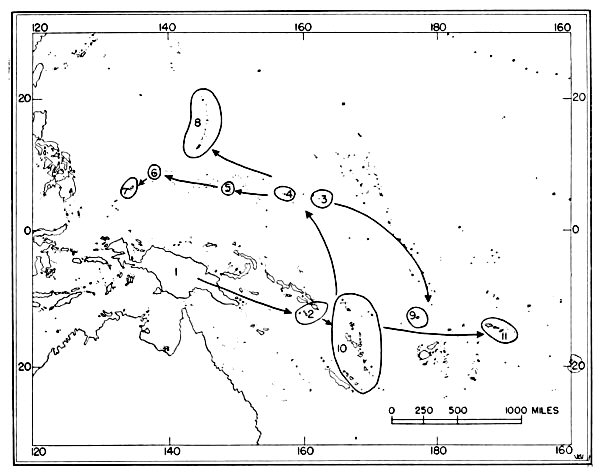
Figure 16 shows the probable routes of colonization used by M. cardinalis to attain its present distribution in the Pacific islands. The subspecies in the eastern Solomon Islands (M. c. pulcherrima Ramsey and M. c. sanfordi Mayr) may be representative of the first colonization by the supposed ancestral stock. From a focal point in this area, M. cardinalis has dispersed by what may be considered as two routes. One route evidently was to the south as far as the Loyalty Islands with a side branch extending to the Samoan Islands where M. c. nigriventris Peale occurs. The second route extended north to the islands of Micronesia. The Caroline Islands were seemingly inhabited initially, with invasions of the Palaus made via Yap, and of the Marianas via Kusaie or Ponapé (as indicated by the comparison of specimens). Mayr (in conversation) has pointed out the close relationship between the subspecies in Micronesia and M. c. chermesina Gray of Rotuma Island. This subspecies at Rotuma, which is located between Santa Cruz and Samoa, resembles closely M. c. dichromata of Ponapé, especially in the case of the female. It is evident that the honey-eater arrived at Rotuma from Micronesia, rather than from the Solomon and Santa Cruz area to the west.
Zosterops conspicillata conspicillata (Kittlitz)
Bridled White-eye
Dicaeum conspicillatum Kittlitz, Kupfertaf. Naturgesch. Vögel, 2, 1833, p. 15, pl. 19, fig. 1. (Type locality, Guaham.)
Dicaeum conspicillatum Kittlitz, Mém. Acad. Imp. Sci. St. Pétersbourg, 2, 1835, p. 3, pl. 4 (Guaham); idem, Obser. Zool., in Lutké, Voy. "Le Séniavine," 3, 1836, p. 305 (Guaham).
Zosterops conspicillatum Bonaparte, Consp. Avium, 1, 1850, p. 398 (Mariann. = Guam).
Zosterops conspicillata Reichenbach, Syn. Avium, 1852, p. 92 (Guaham); Hartlaub, Journ. f. Ornith., 1854, p. 187 (Mariannen = Guam); Gray, Cat. Birds Trop. Is. Pacific Ocean, 1859, p. 16 (Guam); Hartlaub, Journ. f. Ornith., 1865, pp. 5, 17 (Guaham); Gray, Hand-list Birds, 1, 1869, p. 163 (Ladrone = Guam); Hartlaub and Finsch, Proc. Zool. Soc. London, 1872, p. 95 (Guaham); Giebel, Thes. Ornith., 3, 1877, p. 775 (Ladrone = Guam); Gadow, Cat. Birds British Mus., 9, 1884, p. 187 (Guam); Wiglesworth, Abhandl. und Ber. Zool. Mus. Dresden, no. 6, 1890-1891 (1891), p. 37 (Guam); Oustalet (part), Nouv. Arch. Mus. Hist. Nat. Paris, (3), 7, 1895, p. 205 (Guam); Hartert (part), Novit. Zool., 5, 1898, p. 57 (Guam); Hartert, Novit. Zool., 7, 1900, p. 3 (Guam); Matschie (part), Journ. f. Ornith., 1901, pp. 112, 113 (Guam); Seale, Occ. Papers Bernice P. Bishop Mus., 1, 1901, p. 58 (Guam); Finsch (part), Das Tierreich, no. 15, 1901, p. 37 (Guam); Safford, Osprey, 1902, p. 69 (Guam); Dubois, Syn. Avium, 1, 1902, p. 711 (Guam); Safford, The Plant World, 7, 1904, p. 264 (Guam); idem, Contr. U. S. Nat. Herb., 9, 1905, p. 79 (Guam); Takatsukasa and Kuroda (part), Tori, 1, 1901, p. 64 (Marianne = Guam); Cox, Island of Guam, 1917, p. 21 (Guam); Mathews, Syst. Avium Australasianarum, 2, 1930, p. 706 (Guam); Bryan, Guam. Rec., vol. 13, no. 2, 1936, p. 25 (Guam); Strophlet, Auk, 1948, p. 540 (Guam).
Zosterops conspicillatus Kuroda (part), in Momiyama, Birds Micronesia, 1922, p. 76 (Guam).
Zosterops conspicillata conspicillata Stresemann, Mitt. Zool. Mus. Berlin, 17, 1931, p. 227 (Guam); Hand-list Japanese Birds, rev., 1932, p. 173 (Guam); Hand-list Japanese Birds, 3d ed., 1942, p. 192 (Guam); Mayr, Amer. Mus. Novit., no. 1269, 1944, p. 7 (Guam); idem, Birds Southwest Pacific, 1945, p. 299 (Guam); Baker, Smithson. Misc. Coll., vol. 107, no. 15, 1948, pp. 72, 73 (Guam).
Geographic range.—Micronesia: Mariana Islands—Guam.
Characters.—Adult: A small white-eye with upper parts near "serpentine green," becoming slightly lighter on the rump; orbital ring broad and white; fronto-loral band light yellowish-white; auriculars grayish-green; chin and throat yellowish-white; breast and abdomen dingy yellow; wing and tail feathers dark brown with greenish-yellow edges; upper mandible horn colored, lower mandible lighter yellow; legs and feet dark olive-gray; iris light umber. Adult female may be lighter on underparts.
Immature: Resembles adult, but underparts paler yellow and upper mandible light yellowish-brown.
Measurements.—Measurements of Z. c. conspicillata are listed in table 50. Males and females have measurements which are nearly equal.
Table 50. Measurements of the Subspecies of Zosterops conspicillata
Subspecies No. Wing Tail Full culmen Tarsus
Z. c. conspicillata 43 56 41 13.5 19
(52-59) (37-43) (13.0-14.5) (18-20)
Z. c. saypani 29 52 38 12.5 18
(50-55) (35-40) (12.0-13.5) (17-19)
Z. c. rotensis 3 53 42 13.0 18
(51-55) (42-43) (13.0-13.5) (18-19)
Z. c. semperi 28 55 38 12.5 18
(54-57) (36-41) (12.0-13.5) (17-19)
Z. c. owstoni 22 55 36 12.5 19
(52-57) (34-38) (12.0-13.0) (18-20)
Z. c. takatsukasai 16 54 36 13.0 19
(53-55) (34-39) (13.0-14.0) (19-20)
Weights.—The author (1948:73) records the weights of 11 adult males as 9.5-14.0 (10.5), of 3 adult females as 8.0-10.0 (9.3).
Specimens examined.—Total number, 61 (33 males, 17 females, 11 unsexed), as follows: Mariana Islands, USNM—Guam, 27 (May 24, 29, 30, June 2, 3, 25, 28, July 12, 18, 19, 20, 23, 26, Sept., Oct. 8); AMNH—Guam, 34 (Jan., March, July, Aug., Sept., Nov., Dec.).
Nesting.—Seale (1901:58) reports the taking of one nestling and three nests with eggs of the bridled white-eye at Guam in the period from May to July. The NAMRU2 party obtained little evidence of nesting in late May to July. Three males taken in the period of June and July had enlarged gonads. Hartert (1898:57) records several nests taken in February and March at Guam. He writes, "The nest is a fairly deep cup, placed in the fork of a branch, woven together of fine grasses and roots, and on the outside ornamented with cobwebs, wool and cottonwood, varying in width from 8 to 5 cm. The clutches consist of 2 or 3 eggs. The eggs are pale blue, like all Zosterops eggs. They measure 18:13, 17:13.2, 17:12.2, 15.5:12:5, 17:13.5, and between these measurements." Coultas obtained specimens with enlarged gonads in August. According to Oustalet (1895:207), Marche found nests and young in May or June.
Remarks.—Kittlitz obtained the Bridled White-eye at Guam, when he visited the island, in March, 1828. He found the birds common and they reminded him of titmice. Marche obtained a series of 21 skins at Guam in August and September, 1887, and in February and March, 1888. Seale (1901:58) observed the birds in flocks of 10 to 20 in roadside bushes and in waste areas. He mentions that their principal foods are insects. The NAMRU2 party found the birds to be restricted to certain areas on Guam, where they were found in small flocks moving about in low trees. They were taken at only five localities, two of these being at the northern end of the island in vegetation along the high, coastal cliffs. The other localities were in the central part of the island in low trees in the uplands. Strophlet (1946:540) found them in grasslands on the foothills. Arvey (field notes) saw a flock of 12 white-eyes at Mount Tenjo in July, 1946.
The white-eye is a very active bird, always moving rapidly through the vegetation or flying across open areas to disappear into scrub foliage. As they move about they make a twittering sound, which is considered to be a flocking call.
Zosterops conspicillata saypani Dubois
Bridled White-eye
Zosterops conspicillata Saypani Dubois, Syn. Avium, 1, 1902, p. 711. (Type locality, Saypan.)
Zosterops conspicillata Oustalet (part), Nouv. Arch. Mus. Hist. Nat. Paris, (3), 7, 1895, p. 205 (Saypan); Hartert (part), Novit. Zool., 5, 1898, p. 57 (Saipan); Finsch (part), Das Tierreich, no. 15, 1901, p. 37 (Saipan); Matschie (part), Journ. f. Ornith., 1901, pp. 112, 113 (Saipan); Prowazek, Die deutschen Marianen, 1913, p. 101 (Saipan); Takatsukasa and Kuroda (part), Tori, 1, 1915, p. 64 (Marianne = Saipan).
Zosterops conspicillata var. saypani Snouckaert, Alauda, (2), 3, 1931, p. 22 (Saypan).
Zosterops conspicillatus Kuroda (part), in Momiyama, Birds Micronesia, 1922; p. 76 (Saipan).
Zosterops saipani Mathews, Syst. Avium Australasianarum, 2, 1930, p. 706 (Saipan).
Zosterops conspicillata saipani Stresemann, Mitt. Zool. Mus. Berlin, 17, 1931, p. 227 (Saipan); Hand-list Japanese Birds, rev., 1932, p. 173 (Saipan, Tinian); Hand-list Japanese Birds, 3d ed., 1942, p. 192 (Saipan, Tinian); Mayr, Amer. Mus. Novit., no. 1269, 1944, p. 7 (Tinian, Saipan); idem, Birds Southwest Pacific, 1945, p. 299 (Saipan, Tinian); Downs, Trans. Kansas Acad. Sci., 49, 1946, p. 104 (Tinian); Stott, Auk, 64, 1947, p. 527 (Saipan); Baker, Smithson, Misc. Coll., vol. 107, no. 15, 1948, p. 73 (Saipan, Tinian).
Zosterops conspicillatus saipani Yamashina, Tori, 7, 1932, p. 398 (Tinian).
Geographic range.—Micronesia: Mariana Islands—Tinian, Saipan.
Characters.—Adult: Resembles Z. c. conspicillata, but slightly smaller with fronto-loral band more greenish yellow; auriculars olivaceous; orbital ring narrower; upper parts brighter olive; underparts pale yellowish-white; bill darker. Birds from Saipan resemble closely birds from Tinian, but upper parts may be slightly brighter and underparts slightly more yellowish; iris chestnut.
Measurements.—Measurements are listed in table 50. Twenty-three birds from Tinian measure: wing, 51 (50-53); tail, 38 (35-41); full culmen, 12.0 (12.0-13.0); tarsus, 18 (17-18); six birds from Saipan measure: wing, 54 (52-55); tail, 37 (35-39); full culmen, 13.0 (13.0-15.0); tarsus, 18 (17-19). Birds from Saipan are slightly larger than birds from Tinian.
Specimens examined.—Total number, 33 (18 males, 13 females, 2 unsexed), as follows: Mariana Islands, USNM—7 (Oct. 7, 8, 9, 10, 23); AMNH—26 (July, Aug., Sept.).
Nesting.—Yamashina (1932a:398) records the taking of three nests of the Bridled White-eye at Tinian on January 8, 1932. The nests contained one, two, and three eggs, respectively. The color of the eggs is uniformly pale blue; the nests were situated two to four meters from the ground. Oustalet (1895:207) writes that Marche obtained records of nesting at Saipan in the period from May to July. Of 18 birds taken by Coultas at Tinian in September, 1931, one-half of them had enlarged gonads.
Molt.—Specimens examined that were taken in July, August, September, and October have molting plumage.
Remarks.—Marche obtained the first skins of this white-eye at Saipan; he got 23 specimens in May, June, and July, 1887. The population at Saipan was initially considered similar to that at Guam; it was later given subspecific separation by Dubois. The birds at Tinian exhibit some differences from the birds at Saipan, and it is possible that these two populations should be regarded as subspecifically distinct from one another.
In 1931, Coultas (field notes) found this white-eye common at Saipan and Tinian. He writes "The little fellow has adjusted himself to the gardens and shrubs in the villages. He is a seed eater and makes himself at home now around human habitation. I have seen him climbing over potted plants on the window ledges of dwellings. His cheerful little sibilation uttered continuously while at work or while on the wing makes him friends wherever he goes. He is no longer a bird of the forest as he has none here to go to." Several observers in the late war have published notes on this white-eye. Stott (1947:527) writes that he was reminded of the bush-tit (Psaltriparus) when he observed the behavior of this white-eye; Moran (1946:262) writes that it is "Similar in size and behavior to our vireos." Gleise (1945:220) estimated the population of white-eyes at Tinian at 500 plus in 1945. Downs (1946:104-105) found the birds to be abundant at Tinian; he found them in small flocks in low brush or trees and at edges of open fields as well as elsewhere. He saw a white-eye eating "a large green fuzzy caterpillar."
Zosterops conspicillata rotensis Takatsukasa and Yamashina
Bridled White-eye
Zosterops semperi rotensis Takatsukasa and Yamashina, Dobutsu. Zasshi, 43, 1931, p. 486. (Type locality, Rota.)
Zosterops semperi Oustalet (part), Nouv. Arch. Mus. Hist. Nat. Paris, (3), 7, 1895, p. 207 (Rota); Hartert (part), Novit. Zool., 5, 1898, p. 57 (Rota); Finsch (part), Das Tierreich, no. 15, 1901, p. 30 (Rota); Seale (part), Occ. Papers Bernice P. Bishop Mus., 1, 1901, p. 58 (Rota); Dubois (part), Syn. Avium, 1, 1902, p. 710 (Rota); Takatsukasa and Kuroda (part), Tori, 1, 1915, p. 64 (Marianne = Rota).
Zosterops semperi semperi Momiyama (part), Birds Micronesia, 1922, p. 23 (Rota); Kuroda, (part) in Momiyama, Birds Micronesia, 1922, p. 75 (Rota).
Zosterops semperi rotensis Snouckaert, Alauda. (2), 4, 1932, p. 459 (Rota); Yamashina, Tori, 7, 1932, p. 399 (Rota); Hand-list Japanese Birds, rev., 1932, p. 173 (Rota).
Zosterops conspicillata rotensis Hand-list Japanese Birds, 3d ed., 1942, p. 193 (Rota); Mayr, Amer. Mus. Novit., no. 1269, 1944, p. 7 (Rota); idem, Birds Southwest Pacific, 1945, p. 299 (Rota); Baker, Smithson. Misc. Coll., vol. 107, no. 15, 1948, p. 73 (Rota).
Geographic range.—Micronesia: Mariana Islands—Rota.
Characters.—Adult: Upper parts and sides of neck between "warbler green" and "pyrite yellow" becoming lighter on the rump; auriculars light yellowish-green; orbital ring white; fronto-loral band narrowly tinged with yellow; underparts dingy yellow; wing and tail feathers dark with light greenish-yellow edges; upper mandible light brown; lower mandible light yellowish-brown; feet light brown.
Resembles Z. c. conspicillata, but brighter greenish-yellow above; chin and throat yellow like rest of underparts; fronto-loral band tinged with bright yellow; auriculars resemble closely the upper parts in color; narrow orbital ring.
Measurements.—Measurements are listed in table 50.
Specimens examined.—Total number, 5 (3 males, 1 female, 1 unsexed), from Mariana Islands, USNM—Rota (Oct. 18, 20, 22).
Nesting.—Yamashina (1932a:399) records the taking of one nest containing two eggs at Rota on March 7, 1931.
Molt.—Specimens taken in October were in molt.
Remarks.—Oustalet (1895:207) reported on two specimens of white-eye taken at Rota by Marche. He considered them as being similar to the birds at Palau. The birds at Rota were named as a separate subspecies by Takatsukasa and Yamashina in 1931. The NAMRU2 party found the birds to be numerous at Rota in October, 1945.
Zosterops conspicillata semperi Hartlaub
Bridled White-eye
Zosterops semperi Hartlaub, in Hartlaub and Finsch, Proc. Zool. Soc. London, 1868, p. 117. (Type locality, Pelew Islands.)
Zosterops semperi Hartlaub and Finsch, Proc. Zool. Soc. London, 1872, pp. 89, 95 (Pelew); Finsch, Journ. Mus. Godeffroy, 8, 1875, pp. 4, 16, pl. 4, fig. 1 (Palau); Giebel, Thes. Ornith., 3, 1877, p. 777 (Pelew); Nehrkorn, Journ. f. Ornith., 1879, p. 396 (Palau); Finsch (part), Journ. f. Ornith., 1880, p. 286 (Palau); idem (part), Ibis, 1881, p. 111 (Pelew); Schmeltz and Krause (part), Ethnogr. Abth. Mus. Godeffroy, 1881, p. 407 (Palau); Finsch (part), Mitth. Ornith. Ver. Wien, 1884, p. 48 (Palau); Gadow (part), Cat. Birds British Mus., 9, 1884, p. 183 (Pelew); Tristram, Cat. Birds, 1889, p. 212 (Pelew); Wiglesworth (part), Abhandl. und Ber. Zool. Mus. Dresden, no. 6, 1890-1891 (1891), p. 37 (Pelew); Oustalet (part), Nouv. Arch. Mus. Hist. Nat. Paris, (3), 7, 1895, p. 208 (Palaos); Hartert (part), Novit. Zool., 5, 1898, p. 57 (Pelew); Matschie, Journ. f. Ornith., 1901, pp. 112, 113 (Palau); Finsch (part), Das Tierreich, no. 15, 1901, p. 30 (Palau); Seale (part), Occ. Papers Bernice P. Bishop Mus., 1, 1901, p. 58 (Pelew); Dubois (part), Syn. Avium, 1, 1902, p. 710 (Palau); Takatsukasa and Kuroda (part), Tori, 1, 1915, pp. 55, 64 (Pelew).
Zosterops semperi semperi Hartert, Novit. Zool., 7, 1900, p. 2 (Pelew); Momiyama (part), Birds Micronesia, 1922, pp. 22, 23 (Pelew); Kuroda (part), in Momiyama, Birds Micronesia, 1922, p. 75 (Pelew); Mathews, Syst. Avium Australasianarum, 2, 1930, p. 705 (Pelew); Takatsukasa and Yamashina, Dobutsu. Zasshi, 43, 1931, p. 486 (Pelew); Hand-list Japanese Birds, rev., 1932, p. 174 (Palau).
Zosterops conspicillata semperi Stresemann, Mitt. Zool. Mus. Berlin, 17, 1931, p. 227 (Palau); Hand-list Japanese Birds, 3d ed., 1942, p. 193 (Babelthuap, Koror, Peliliu); Mayr, Amer. Mus. Novit., no. 1269, 1944, p. 7 (Palau); Mayr, Birds Southwest Pacific, 1945, p. 299 (Palau); Baker, Smithson. Misc. Coll., vol. 107, no. 15, 1945, p. 73 (Garakayo).
Geographic range.—Micronesia: Palau Islands—Babelthuap, Koror, Garakayo, Peleliu.
Characters.—Adult: Resembles adult of Z. c. rotensis, but fronto-loral band lighter yellow, and coloring is usually not continuous above; auriculars paler; breast and abdomen paler yellow; maxilla and feet darker; mandible whitish. Resembles adult of Z. c. conspicillata, but brighter greenish-yellow above; coloring of chin and throat like that of rest of underparts; auriculars colored like back; fronto-loral band narrowly tinged with bright yellow and not completely connected above; orbital ring narrow; iris grayish-white.
Measurements.—Measurements are listed in table 50.
Specimens examined.—Total number, 30 (15 males, 14 females, 1 unsexed), as follows: Palau Islands, USNM—Babelthuap, 2 (Nov. 27)—Koror, 4 (Nov. 14, 19)—Garakayo, 4 (Sept. 18, 19); AMNH—exact locality not given, 20 (Oct., Nov., Dec.).
Molt.—All birds examined (taken in September, October, and November) are in molting plumage.
Food habits.—At Garakayo, birds were observed in small flocks feeding in low trees. Two stomachs examined, which were from individuals of these flocks, contained very small seeds.
Remarks.—Oustalet (1895:207) first pointed out the relationship between the Bridled White-eye at Palau and the one at Rota. Hartert (1898:57) thought that the occurrence of the same kind of bird at Palau and at Rota was "very peculiar." It was not until 1931 that Takatsukasa and Yamashina separated the two populations by name.
Coultas (field notes) found the Bridled White-eye to be uncommon in the Palaus in 1931. He observed them in the tops of trees, noting that they were wary and easily frightened away by the shooting of a gun. Coultas writes that he found the birds to be numerous at Peleliu; in 1945, the NAMRU2 party did not find the birds at that island. The only locality where they were found to occur was on the small island of Garakayo where the writer shot four Bridled White-eyes on September 18 and 19. He found two or three small flocks in low trees near the summit of a hill on the island. Approximately 25 birds were in this area.
Zosterops conspicillata owstoni Hartert
Bridled White-eye
Zosterops semperi owstoni Hartert, Novit., Zool., 7, 1900, p. 2. (Type locality, Ruk.)
Zosterops semperi semperi Finsch (part), Journ. f. Ornith., 1880, p. 287 (Ruck); idem (part), Proc. Zool. Soc. London, 1880, p. 575 (Ruk); idem (part), Ibis, 1881, p. 110 (Ruk); Schmeltz and Krause (part), Ethnogr. Abth. Mus. Godeffroy, 1881, p. 353 (Ruk); Gadow (part), Cat. Birds British Mus., 9, 1884, p. 183 (Central Carolines=Truk); Wiglesworth (part), Abhandl. und Ber. Zool. Mus. Dresden, no. 6, 1890-1891 (1891), p. 37 (Ruk); Oustalet (part), Nouv. Arch. Mus. Hist. Nat. Paris, (3), 7, 1895, p. 208 (Ruk); Hartert (part), Novit. Zool., 5, 1898, p. 57 (Ruk); Nehrkorn, Kat. Eiers, 1899, p. 80 (Ruk).
Zosterops semperi owstoni Dubois, Syn. Avium, 1, 1902, p. 710 (Ruk); Wetmore, in Townsend and Wetmore, Bull. Mus. Comp. Zoöl., 63, 1919, p. 223 (Truk); Momiyama, Birds Micronesia, 1922, p. 24 (Ruk); Kuroda, in Momiyama, Birds Micronesia, 1922, p. 75 (Ruk); Mathews, Syst. Avium Australasianarum, 2, 1930, p. 705 (Ruk); Takatsukasa and Yamashina, Dobutsu. Zasshi, 43, 1931, p. 496 (Ruk); Yamashina, Tori, 7, 1932, p. 400 (Truk); Hand-list Japanese Birds, rev., 1932, p. 174 (Truk).
Zosterops owstoni Finsch, Das Tierreich, no. 15, 1901, p. 31 (Ruk); Matschie (part), Journ. f. Ornith., 1901, pp. 112, 113 (Ruck); Reichenow, Die Vögel, 2, 1914, p. 470 (Karolinen = Truk); Takatsukasa and Kuroda, Tori, 1, 1915, pp. 55, 64 (Ruk).
Zosterops conspicillata owstoni Stresemann, Mitt. Zool. Mus. Berlin, 17, 1931, p. 277 (Truk); Hand-list Japanese Birds, 3d ed., 1942, p. 193 (Truk); Mayr, Amer. Mus. Novit., no. 1269, 1944, p. 7 (Truk); idem, Birds Southwest Pacific, 1945, p. 299 (Truk); Baker, Smithson. Misc. Coll., vol. 107, no. 15, 1948, pp. 73, 74 (Truk).
Geographic range.—Micronesia: Caroline Islands—Truk.
Characters.—Adult: Resembles adult of Z. c. semperi, but upper parts darker olive and less yellowish-green; fronto-loral band deeper yellow; auriculars slightly darker; black line on lores and under eye more distinct; underparts deeper yellow; abdomen with greenish tinges. Resembles adult of Z. c. rotensis, but upper parts duller, more green and less yellow; fronto-loral band lighter and less distinct, coloring near that of Z. c. semperi; auriculars darker green; underparts slightly darker, more olive-green and less yellow.
Measurements.—Measurements are listed in table 50.
Specimens examined.—Total number, 23 (12 males, 10 females, 1 unsexed), as follows: Caroline Islands, USNM—Truk, 3 (Feb. 16); AMNH—Truk, 20 (Feb., March, May, Nov.).
Nesting.—Yamashina (1932a:400) records the taking of a nest with one egg at Truk in May. Hartert (1900:2) records nests containing single eggs taken at Truk from May to July. Nests were found in bushes and trees four to eight feet above the ground. The eggs are pale blue. He gives measurements of seven eggs.
Remarks.—Kubary obtained the first specimens of the Bridled White-eye at Truk. Hartert described the population as a new subspecies using material taken by Owston's collectors. The bird was named in honor of Alan Owston. McElroy of the NAMRU2 party visited Truk in December, 1945. He found this white-eye in the mountainous areas at Moen and Udot islands.
Zosterops conspicillata takatsukasai Momiyama
Bridled White-eye
Zosterops semperi takatsukasai Momiyama, Birds Micronesia, 1922, p. 22. (Type locality, Ponapé.)
Zosterops semperi (part), Finsch, Journ. f. Ornith., 1880, p. 286 (Ponapé); idem (part), Proc. Zool. Soc. London, 1880, p. 575 (Ponapé); idem (part), Ibis, 1881, p. 115 (Ponapé); Schmeltz and Krause (part), Ethnogr. Abth. Mus. Godeffroy, 1881, p. 281 (Ponapé); Finsch (part), Mitth. Ornith. Ver. Wien, 1884, p. 48 (Ponapé); Gadow (part), Cat. Birds British Mus., 9, 1884, p. 183 (Central Carolines, Ponapé); Wiglesworth (part), Abhandl. und Ber. Zool. Mus. Dresden, no. 6, 1890-1891 (1891), p. 37 (Ponapé); Oustalet (part), Nouv. Arch. Mus. Hist. Nat. Paris, (3), 7, 1895, p. 208 (Ponapé); Finsch, Das Tierreich, no. 15, 1901, p. 30 (Ponapé); Dubois (part), Syn. Avium, 1, 1902, p. 710 (Ponapé); Takatsukasa and Kuroda (part), Tori, 1, 1915, pp. 55, 64 (Ponapé).
Zosterops owstoni Matschie (part), Journ. f. Ornith., 1901, pp. 112, 113 (Ponapé).
Zosterops semperi takatsukasai Kuroda, in Momiyama, Birds Micronesia, 1922, p. 76 (Ponapé); Mathews, Syst. Avium Australasianarum, 2, 1930, p. 705 (Ponapé); Snouchaert, Alauda, (2), 3, 1931, p. 22 (Ponapé); Takatsukasa and Yamashina, Tori, 7, 1932, p. 400 (Ponapé); Hand-list Japanese Birds, rev., 1932, p. 174 (Ponapé).
Zosterops conspicillata takatsukasai Stresemann, Mitt. Zool. Mus. Berlin, 17, 1931, p. 227 (Ponapé); Hand-list Japanese Birds, 3d ed., 1942, p. 193 (Ponapé); Mayr, Amer. Mus. Novit., no. 1269, 1944, p. 7 (Ponapé); idem, Birds Southwest Pacific, 1945, p. 299 (Ponapé); Baker, Smithson. Misc. Coll., vol. 107, no. 15, 1948, p. 73 (Ponapé).
Zosterops conspicillata Mayr, Proc. 6th Pacific Sci. Congr., 4, 1941, p. 204 (Ponapé).
Geographic range.—Micronesia: Caroline Islands—Ponapé.
Characters.—Adult: Resembles adult of Z. c. semperi, but slightly smaller with fronto-loral area more sulfur-yellow; underparts brighter, especially the coloring of the abdomen and under tail-coverts; iris light chestnut.
Measurements.—Measurements are listed in table 50.
Specimens examined.—Total number, 20 (10 males, 9 females, 1 unsexed) from Caroline Islands, AMNH—Ponapé (Nov., Dec.).
Nesting.—Yamashina (1932a:400) records nests and eggs of Z. c. takatsukasai. The nests, each containing a single egg, were taken on July 10 and 20, 1931. Coultas (field notes) writes that the nest consists of a small, cup-shaped structure of grasses and hair. The natives told him that two eggs were laid. In birds taken by Coultas in November the gonads were beginning to enlarge; specimens taken in December had swollen gonads. From the evidence at hand, it would appear that the Bridled White-eye at Ponapé breeds at two periods of the year, the winter and the summer.
Molt.—Specimens examined, which were taken by Coultas in November and December, are in fresh plumage.
Remarks.—In 1931, Coultas (field notes) found this white-eye to be rare at Ponapé. He obtained almost every one that he saw to get his series of 20 specimens. He found the birds usually in pairs around yellow-flowering bushy trees. A specimen taken by Richards had "small insects" in its stomach.
Zosterops conspicillata hypolais Hartlaub and Finsch
Bridled White-eye
Zosterops hypolais Hartlaub and Finsch, Proc. Zool. Soc. London, 1872, p. 95. (Type locality, Uap.)
Zosterops hypolais Gräffe, Journ. Mus. Godeffroy, 2, 1873, p. 122 (Yap); Giebel, Thes. Ornith., 3, 1877, p. 776 (Carolinae=Yap); Schmeltz and Krause, Ethnogr. Abth. Mus. Godeffroy, 1881, p. 391 (Yap); Gadow. Cat. Birds British Mus., 9, 1884, p. 186 (Uap); Wiglesworth, Abhandl. und Ber. Zool. Mus. Dresden, no. 6, 1890-1891 (1891), p. 37 (Uap); Oustalet, Nouv. Arch. Mus. Hist. Nat. Paris, (3), 7, 1895, p. 208 (Uap); Bolau, Mitteil. Naturhist. Mus. Hamburg, 1898, p. 60 (Yap); Finsch, Das Tierreich, no. 15, 1901, p. 24 (Yap); Matschie, Journ. f. Ornith., 1901, pp. 112, 113 (Yap); Dubois, Syn. Avium, 1, 1902, p. 708 (Uap); Reichenow, Die Vögel, 2, 1914, p. 469 (Karolinen=Yap); Takatsukasa and Kuroda, Tori, 1, 1915, p. 64 (Mackenzie=Yap); Kuroda, in Momiyama, Birds Micronesia, 1922, p. 76 (Yap); Mathews, Syst. Avium Australasianarum, 2, 1930, p. 700 (Yap); Hand-list Japanese Birds, 3d ed., 1942, p. 192 (Yap).
Zosterops conspicillata hypolais Stresemann, Mitt. Zool. Mus. Berlin, 17, 1931, p. 227 (Yap); Mayr, Amer. Mus. Novit., no. 1269, 1944, p. 7 (Yap); idem, Birds Southwest Pacific, 1945, p. 299 (Yap).
Zosterops hypolais Hand-list Japanese Birds, rev., 1932, p. 173 (Yap).
Geographic range.—Micronesia: Caroline Islands—Yap.
Characters.—According to Hartlaub and Finsch (1872:95), "Upper parts of a pale greyish green, throat and under tail-coverts a pure but very pale whitish-yellow; breast and abdomen of a mixed pale grey and pale yellow; wing- and tail-feathers pale blackish, margined with greenish colour of the back; under wing-coverts and inner margins of remiges white; eye-ring indistinct; beak fuscous, the under mandible paler, except at the tip; feet plumbeous."
Remarks.—No specimen has been examined by me. I am following Stresemann (1931:227) in placing the Bridled White-eye at Yap as a subspecies of Z. conspicillata. This is one arrangement; the committee who prepared the Hand-list of Japanese Birds (1942:192) treat this bird as a separate species. The Japanese probably have more specimens of this bird than anyone else and may be in a better position to judge its taxonomic status. Specimens of this white-eye were taken by Fisher in 1946 at Yap. His report (soon to be published) may throw additional light on the degree of distinctness of Z. c. hypolais. On the basis of published descriptions it is evident that Z. c. hypolais has a few characters in common with other members of the species.
Evolutionary history of Zosterops conspicillata.—The small olive-green and yellow white-eyes of Micronesia have been considered as belonging to several species by authors in the past. As late as 1930, Mathews (1930; 700, 706) placed them in four species. Stresemann (1931a: 227) put them all in the species Z. conspicillata, an arrangement which is being followed in this report. It is evident, however, that these subspecies of Z. conspicillata can be associated into three groups. The author (1948:73) states that Z. c. conspicillata and Z. c. saypani have pale chins and throats, light fronto-loral bands, blackish coloring at the bend of the wings and broad, white orbital rings. Another group, Z. c. rotensis, Z. c. semperi, Z. c. owstoni, and Z. c. takatsukasai, have bright yellow chins and throats, matching the rest of the underparts, obscure fronto-loral bands, which are narrowly tinged with yellow, yellowish coloring at the bend of the wings, and narrow, white orbital rings. Z. c. hypolais apparently falls into a third group by itself, as indicated by the published descriptions. There is apparently some variation in the color of the eyes of these subspecies; they may be either whitish or chestnut in color. The data are insufficient to determine the significance of this color character.
Z. conspicillata is restricted to Micronesia and appears to have little close relationship to other species of the genus. Z. conspicillata shows little affinity to white-eyes to the north and northwest of Micronesia belonging to the species Z. japonica, of which representatives are found in the Bonin and Volcano islands. Z. conspicillata shows greater affinity to species found to the west and to the south of Micronesia.
It may have colonized Micronesia from the south or southeast (Polynesia), even though the species is absent at Kusaie; however, Z. conspicillata shows more relationships to species now living to the westward and the southwestward, and it probably invaded Micronesia from some place in that direction. Z. conspicillata differs from species found in Melanesia and Malaysia chiefly in color of the forehead, lores, fronto-loral band, crown, nape, breast, abdomen, orbital ring, and bill. Also there are differences in the breadth of the orbital ring.
Z. conspicillata shows evidence of relationships with Z. nigrorum of the Philippines and Z. montanus of the Philippines and other parts of Malaysia. Z. nigrorum resembles Z. c. semperi of Palau in size, but is brighter yellow-green above with a darker and less curved bill and brighter underparts. The fronto-loral band and the lores are colored the same in Z. nigrorum and Z. c. semperi. Z. montanus resembles Z. conspicillata especially in size and in shape of the bill. Z. lutea intermedia of the Makassar area shows some affinity to Z. conspicillata, although the bill is heavier. The Micronesia species also bears a close resemblance to Z. griseotincta of the Papuan region. This is especially true of Z. c. takatsukasai at Ponapé; however, Z. griseotincta has a heavier and larger bill. Z. lateralis from southern Melanesia and Australia is not very different from Z. conspicillata aside from its grayish and brownish coloring.
Z. conspicillata probably was derived from an ancestral stock which came to Micronesia from the Philippine or Moluccan area, rather than directly from Melanesia. Z. conspicillata seemingly shows the closest resemblance to Z. nigrorum or to some of its relatives in the Australo-Moluccan area. The subspecies at Palau, Z. c. semperi, appears to be the connecting link. Whether the form at Yap represents an independent colonization is not known; such might also be true in the case of the subspecies at Guam and at Saipan and Tinian. If these are considered as separate colonizations, then the populations can be regarded as separate species. Mayr, (in conversation) has pointed out the affinity of the white-eye at Samoa, Z. samoensis, with Z. conspicillata and suggests that Z. samoensis is derived from the Micronesian species.
Zosterops cinerea cinerea (Kittlitz)
Micronesian Dusky White-eye
Drepanis cinerea Kittlitz, Kupfertaf. Naturgesch. Vögel, 1, 1832, p. 6, pl. 8, fig. 2. (Type locality, Ualan = Kusaie.)
Drepanis cinerea Kittlitz, Mém. Acad. Imp. Sci., St. Pétersbourg, 2, 1835, p. 4, pl. 5 (Ualan); idem, Obser. Zool., in Lutké, Voy. "Le Séniavine," 3, 1836, p. 285 (Ualan); Reichenbach, Syn. Avium, 1853, p. 242 (Ualan); Kittlitz, Denkw. Reise, russ. Amer. Micron. und Kamchat., 1, 1858, p. 367 (Ualan).
Zosterops cinerea Hartlaub, Archiv f. Naturgesch., 18, 1852, p. 131 (Ualan); Gray, Cat. Birds Trop. Is. Pacific Ocean, 1859, p. 16 (Oualan); idem, Hand-list Birds, 1, 1869, p. 163 (Caroline = Kusaie); Hartlaub and Finsch, Proc. Zool. Soc. London, 1872, p. 96 (Ualan); Finsch, Journ. Mus. Godeffroy, 12, 1876, p. 27 (Ualan); idem, Ibis, 1881, pp. 107, 108 (Kuschai); Gadow, Cat. Birds British Mus., 9, 1884, p. 198 (Kushai); Tristram, Cat. Birds, 1889, p. 210 (Kuschai); Wiglesworth, Abhandl. und Ber. Zool. Mus. Dresden, no. 6, 1890-1891 (1891), p. 36 (Ualan); Hartert, Kat. Vogelsamml., Senckenb., 1891, p. 31 (Ualan); Oustalet, Nouv. Arch. Mus. Hist. Nat. Paris, (3), 7, 1895, p. 208 (Oualan); Finsch, Das Tierreich, no. 15, 1901, p. 45 (Kusaie); Dubois, Syn. Avium, 1, 1902, p. 713 (Kusaie); Takatsukasa and Kuroda, Tori, 1, 1915, pp. 55, 64 (Kusaie); Wetmore, in Townsend and Wetmore, Bull. Mus. Comp. Zoöl., 63, 1919, p. 224 (Kusaie); Stresemann, Mitt. Zool. Mus. Berlin, 17, 1931, p. 230 (Kusaie); Hand-list Japanese Birds, rev., 1932, p. 173 (Kusaie); Hand-list Japanese Birds, 3d ed., 1942, p. 192 (Kusaie).
Dicaeum cinereum Hartlaub, Journ. f. Ornith., 1854, p. 168 (Carolinen = Kusaie).
Zosterops cinereus Finsch, Journ. Mus. Godeffroy, 8, 1875, p. 17 (Ualan); idem, Journ. f. Ornith., 1880, pp. 286, 297, 300 (Kuschai); idem, Mitth. Ornith. Ver. Wien, 1884, p. 48 (Kuschai).
Zosterops Kittlitzi Finsch, Journ. f. Ornith., 1880, p. 300 (Type locality, Kusaie); Reichenow and Schalow, Journ. f. Ornith., 1881, p. 94 (Kusaie?).
Tephras cinereus Matschie, Journ. f. Ornith., 1901, pp. 111, 112, 113 (Ualan).
Tephras cinerea Kuroda, in Momiyama, Birds Micronesia, 1922, p. 77 (Kusaie); Mathews, Syst. Avium Australasianarum, 2, 1930, p. 712 (Oualan).
Zosterops cinerea cinerea Mayr, Amer. Mus. Novit., no. 1269, 1944, p. 7 (Kusaie?); idem, Birds Southwest Pacific, 1945, p. 300 (Kusaie).
Geographic range.—Micronesia: Caroline Islands—Kusaie.
Characters.—Adult: A small, dusky white-eye with upper parts smoky olivaceous-gray; lores dingy white; auriculars brownish; no white orbital ring; wing and tail feathers dark brownish-gray with paler greenish-gray outer edges; underparts pale ashy-gray, chin lighter, flanks darker; bill black; feet light brown; iris brown.
Measurements.—Measurements of Z. cinerea are listed in table 51. Males and females have approximately equal measurements.
Table 51. Measurements of Zosterops cinerea
Subspecies No. Wing Tail Culmen Tarsus
Z. c. cinerea 47 63 37 15.0 20
(60-65) (35-39) (14.0-16.5) (19-20)
Z. c. ponapensis 38 59 38 13.5 20
(57-61) (36-40) (13.0-14.5) (18-21)
Z. c. finschii 30 65 43 17.5 21
(63-67) (40-46) (16.0-18.5) (20-23)
Specimens examined.—Total number, 50 (33 males, 17 females), as follows: Caroline Islands, USNM—Kusaie, 1 (Feb. 9); AMNH—Kusaie, 49 (Jan., Feb., March).
Nesting.—Coultas found that approximately one-half of the males which he obtained in March, 1931, had swollen gonads.
Molt.—Many of the birds obtained in January and February were molting, and many of those obtained in March were in fresh plumage.
Remarks.—Coultas obtained a large series of these birds at Kusaie in 1931, where he found them to be common.
Zosterops cinerea ponapensis Finsch
Micronesian Dusky White-eye
Zosterops ponapensis Finsch, Proc. Zool. Soc. London, 1875 (1876), p. 643. (Type locality, Ponapé.)
Zosterops ponapensis Finsch, Journ. Mus. Godeffroy, 12, 1876, pp. 17, 27, pl. 2, fig. 1 (Ponapé); idem., Proc. Zool. Soc. London, 1877 (1878), p. 778 (Ponapé); Nehrkorn, Journ. Mus. Godeffroy, 1879, p. 396 (Ponapé?); Finsch, Journ. f. Ornith., 1880, pp. 286, 300 (Ponapé); idem, Ibis. 1881, pp. 110, 111, 115 (Ponapé); Schmeltz and Krause, Ethnogr. Abth. Mus. Godeffroy, 1881, p. 281 (Ponapé); Finsch, Mitth. Ornith. Ver. Wien, 1884, p. 48 (Ponapé); Gadow, Cat. Birds British Mus., 9, 1884, p. 198 (Ponapé); Wiglesworth, Abhandl. und Ber. Zool. Mus. Dresden, no. 6, 1890-1891 (1891), p. 36 (Ponapé); Bolau, Mitteil. Naturhist. Mus. Hamburg. 1898, p. 60 (Ponapé); Nehrkorn, Kat. Eiers., 1899, p. 80 (Ponapé); Finsch, Das Tierreich, no. 15, 1901, p. 46 (Ponapé); Dubois, Syn. Avium, 1, 1902, p. 713 (Ponapé); Reichenow, Die Vögel, 2, 1914, p. 470 (Ponapé); Takatsukasa and Kuroda, Tori, 1, 1915, pp. 55, 65 (Ponapé); Stresemann, Mitt. Zool. Mus. Berlin, 17, 1931, p. 230 (Ponapè); Yamashina, Tori, 7, 1932, p. 397 (Ponapé); Hand-list Japanese Birds, rev., 1932, p. 173 (Ponapé); Mayr, Proc. 6th Pacific Sci. Congr., 4, 1941, p. 204 (Ponapé); Hand-list Japanese Birds, 3d ed., 1942, p. 192 (Ponapé).
Tephras ponapensis Matschie, Journ. f. Ornith., 1901, pp. 111, 112, 113 (Ponapé); Kuroda, in Momiyama, Birds Micronesia, 1922, p. 77 (Ponapé); Mathews, Syst. Avium Australasianarum, 2, 1930, p. 712 (Ponapé).
Zosterops ponapenensis Wetmore, in Townsend and Wetmore, Bull. Mus. Comp. Zoöl., 63, 1919, p. 224 (Ponapé).
Zosterops cinerea ponapensis Mayr, Amer. Mus. Novit., no. 1269, 1944, p. 7 (Ponapé?); idem, Birds Southwest Pacific, 1945, p. 300 (Ponapé).
Geographic range.—Micronesia: Caroline Islands—Ponapé.
Characters.—Adult: Resembles adult of Z. c. cinerea, but smaller with upper parts umber-brown, forehead pale gray; underparts mostly pale gray, sides of breast and abdomen brownish-buff; under tail-coverts pale buffy-gray.
Measurements.—Measurements are listed in table 51.
Specimens examined.—Total number, 47 (28 males, 17 females, 2 unsexed), as follows: Caroline Islands, USNM—Ponapé, 1 (Feb. 11); AMNH—Ponapé, 46 (Nov., Dec.).
Nesting.—Yamashina (1931a:397-398) describes two nests of Z. c. ponapensis, each containing one egg. These were taken at Ponapé on August 4 and 11, 1931. The nests were located 2.5 meters from the ground. The eggs are light blue and pale greenish-blue in color; one measures 18.5 by 13.5. He writes, "The nest consists of two layers, the inner and the outer. The outer layer is made of fine roots, fibers, leaves and petals, interwoven with a large quantity of cotton-wool, and the inner layer is made of fibers of fine roots only." Coultas found that a large number of birds taken in November had enlarged gonads, especially the males; in December, fewer birds with swollen gonads were obtained.
Remarks.—Coultas found this white-eye to be common at Ponapé, when he visited that island in November and December, 1930. He observed the birds in flocks and found them noisy and quarrelsome. They feed in bushes and small trees on seeds and insects. Richards obtained "small large-seeded blackish berries" from the stomach of a female from Ponapé. He found the birds to frequent low altitudes in and about native gardens.
Zosterops cinerea finschii (Hartlaub)
Micronesian Dusky White-eye
Tephras finschii Hartlaub, in Hartlaub and Finsch, Proc. Zool. Soc. London, 1868, p. 6, pl. 3. (Type locality, Pelew Islands.)
Tephras finschii Hartlaub and Finsch, Proc. Zool. Soc. London, 1868, pp. 117, 118 (Pelew Islands).
Zosterops finschii Gray, Hand-list Birds, 1, 1869, p. 164 (Pelew); Gadow, Cat. Birds British Mus., 9, 1884, p. 197 (Pelew); Bolau, Mitteil. Naturhist. Mus. Hamburg, 1898, p. 60 (Palau).
Zosterops finschi Hartlaub and Finsch, Proc. Zool. Soc. London, 1872, pp. 89, 96 (Pelew); Finsch, Journ. Mus. Godeffroy, 8, 1875, pp. 4, 17 (Palau); idem, Journ. Mus. Godeffroy, 12, 1876, p. 27 (Palau); Giebel, Thes. Ornith., 3, 1877, p. 775 (Pelew); Finsch, Journ. f. Ornith., 1880, p. 300 (Pelew?); Schmeltz and Krause, Ethnogr. Abth. Mus. Godeffroy, 1881, p. 407 (Palau); Tristram, Cat. Birds, 1889, p. 211 (Pelew); Wiglesworth, Abhandl. und Ber. Zool. Mus. Dresden, no. 6, 1890-1891 (1891), p. 36 (Pelew); Finsch, Das Tierreich, no. 15, 1901, p. 45 (Palau); Dubois, Syn. Avium, 1, 1902, p. 713 (Pelew); Reichenow, Die Vögel, 2, 1914, p. 470 (Palau); Takatsukasa and Kuroda, Tori, 1, 1915, pp. 55, 64 (Pelew); Stresemann, Mitt. Zool. Mus. Berlin, 17, 1931, p. 230 (Palau); Hand-list Japanese Birds, rev., 1932, p. 173 (Palau); Hand-list Japanese Birds, 3d ed., 1942, p. 192 (Babelthuap, Koror).
Tephras finschi Matschie, Journ. f. Ornith., 1901, pp. 112, 113 (Palau); Kuroda, in Momiyama, Birds Micronesia, 1922, p. 77 (Pelew); Mathews, Syst. Avium Australasianarum, 2, 1930, p. 712 (Pelew).
Zosterops cinerea finschi Mayr, Birds Southwest Pacific, 1945, p. 300 (Palau).
Zosterops cinerea finschii Baker, Smithson. Misc. Coll., vol. 107, no. 15, 1948, p. 74 (Peleliu, Garakayo).
Geographic range.—Micronesia: Palau Islands—Babelthuap, Koror, Garakayo, Peleliu, Ngabad.
Characters.—Adult: Resembles adult of Z. c. cinerea, but upper parts mostly browner; wing and tail feathers browner; head blacker; rump lighter than back; auriculars grayish-brown; lores dark; sides of head and neck brownish; underparts mostly dark; chin and throat smoky gray; breast and abdomen more brown less gray; sides, flanks and under tail-coverts brown. Resembles adult of Z. c. ponapensis, but larger with underparts more buffy; upper parts darker.
Measurements.—Measurements are listed in table 51.
Specimens examined.—Total number, 37 (15 males, 19 females, 3 unsexed), as follows: Palau Islands, USNM—Babelthuap, 1 (Nov. 27)—Koror, 3 (Nov. 4, 5)—Garakayo, 6 (Sept. 18)—Peleliu, 5 (Aug. 27, Sept. 10); AMNH—exact locality not given, 22 (Oct., Nov., Dec.).
Molt.—Many of the specimens of Z. c. finschii taken in the period from August to December show evidences of molt. Some of the birds taken in November and in December appear to be in fresh plumage. All three subspecies of Z. cinerea evidently undergo a period of molt in the late summer and fall.
Remarks.—The Micronesian Dusky White-eye of Palau was found on several of the islands of the southern Palaus by the NAMRU2 party in 1945. The bird was observed in flocks of five or more individuals moving rapidly through the foliage of trees and shrubs. It was not found in the dense, undisturbed jungle areas, but rather in second growth vegetation and along the margins of woodlands. At Peleliu, birds were noted in trees and shrubs along the roadways; at Garakayo, birds were seen in low trees near the summits of hills. At Garakayo, Z. cinerea and Z. conspicillata were found in the same areas near the tops of the hills. Both species appeared to be feeding on seeds of the same trees (unidentified but resembling the hibiscus). Z. cinerea was more numerous than Z. conspicillata and appeared (from observations made on September 18, 1945) to be the dominant species and was seen to chase the smaller Z. conspicillata away. Coultas (field notes) found Z. cinerea "fairly common" in 1931 at Palau.
Evolutionary history of Zosterops cinerea.—The dusky white-eyes of Micronesia were considered as separate species until 1944, when Mayr (1944b:7) treated them as conspecific, stating that the bird at Ponapé has characters intermediate between those at Kusaie and Palau. Earlier, Hartert (1900:3) suggested a close association between Z. cinerea and the species at Truk (now Rukia ruki). Mayr concludes that Z. cinerea and R. ruki are not closely related, and points out that the absence of a white orbital ring in Z. cinerea does not necessarily mean that the bird should be considered as belonging to a genus other than Zosterops.
The pathway of colonization and the ancestral stock of Z. cinerea are not certainly known. Among the white-eyes of the Polynesian, Melanesian and Malayan areas, there are few kinds which Z. cinerea resembles closely. Mayr (1941b:204) writes that the Z. cinerea at Ponapé was derived from either Polynesia or Papua. I find little in common between Z. cinerea and the species in these areas, and in my opinion Z. cinerea is closest to Z. atriceps of the Moluccas. Z. atriceps has plumage which is part grayish and part brownish. Its underparts resemble those of Z. c. cinerea but are paler gray; crown, neck, and shoulder much like that of Z. c. ponapensis and Z. c. finschii; and bill resembling that of Z. c. cinerea. Z. atriceps differs by having olive-green coloring on back and wings and yellowish coloring on under side of tail. Thus, it is possible that Z. cinerea invaded Micronesia from the Moluccan region, reaching either Palau or Ponapé initially.
Rukia palauensis (Reichenow)
Palau Greater White-eye
Cleptornis palauensis Reichenow, Journ. f. Ornith., 1915, p. 125. (Type locality, Babeldzuap = Babelthuap, Palauinseln.)
Megazosterops palauensis Stresemann, Ornith. Monatsber., 38, 1930, p. 159 (Baobeltaob); Snouckaert, Alauda (2), 3, 1931, p. 26 (Palau); Stresemann, Mitt. Zool. Mus. Berlin, 17, 1931, p. 235 (Baobel Taob = Babelthuap); Mathews, Ibis, 1931, p. 48 (Palau); Hand-list Japanese Birds, rev., 1932, p. 172 (Palau); Yamashina, Tori, 10, 1940, p. 674 (Palau); Hand-list Japanese Birds, 3d ed., 1942, p. 191 (Babelthuap, Peleliu).
Rukia palauensis Mayr, Amer. Novit., no. 1269, 1944, p. 7 (Palau); idem, Birds Southwest Pacific, 1945, pp. 294, 300 (Peliliu); Baker, Smithson. Misc. Coll., vol. 107, no. 15, 1948, pp. 67, 74 (Peleliu).
Geographic range.—Micronesia: Palau Islands-Babelthuap, Peleliu.
Characters.—Adult: A large white-eye with upper parts near "Saccardo's olive" (some individuals darker brown), head and neck more olivacious, rump browner; auriculars blackish with pale yellow streaks; narrow supra-orbital stripe pale olive; orbital ring indistinct; underparts near "olive lake," chin lighter, under tail-coverts light yellowish-brown; wing and tail feathers dark brown, except for tawny outer edges and whitish inner edges; maxilla horn-color; mandible yellowish to tawny; feet tawny; iris grayish-brown.
Measurements.—Measurements of Rukia are listed in table 52. Measurements of males and females are comparable within the same species.
Table 52. Measurements of Rukia
Species No. Wing Tail Culmen Tarsus
R. palauensis 19 80 54 21.5 25
(76-84) (51-57) (20.0-22.5) (24-26)
R. ruki 8 81 52 21.5 23
(76-85) (51-52) (20.0-23.0) (22-24)
R. sanfordi 18 70 44 23.0 21
(67-71) (41-47) (22.0-24.0) (20-22)
Specimens examined.—Total number, 21 (12 males, 9 females), as follows: Palau Islands, USNM—Peleliu, 11 (Aug. 27, 29, 30, Sept. 4, 5, 6, 7, Dec. 4, 5); AMNH—Peleliu?, 10 (Dec.).
Molt.—Specimens taken in August and September are in worn plumage, a few individuals show evidence of molt. Specimens taken in December are in fresh plumage, although two or three individuals are in the final stages of molt. This places the period of molt as September, October, and November. Nesting evidently occurs in the summer; one male taken on August 27, 1945, had enlarged gonads.
Remarks.—The Palau Greater White-eye was described under the generic name Cleptornis by Reichenow. This generic allocation was not followed by subsequent authors; Stresemann proposed the generic name Megazosterops in 1930, and Mayr (1944b:7) placed this white-eye in the genus Rukia along with other large white-eyes from Micronesia. In employing this name, Mayr writes, "The generic names Rukia (for ruki) and Kubaryum (for oleaginea) were published simultaneously in the same publication. As first reviser I select the name Rukia, which not only is shorter but is also based on a species which I have been able to examine."
R. palauensis is recorded from Babelthuap and Peleliu of the Palau Islands. In 1931, Coultas found the birds only at the island of Peleliu, where he obtained nine specimens from a flock. In 1940, Yamashina (1940:674) writes that it is a very rare species at Palau. Marshall (1949:219) found the bird at Peleliu but at no other islands visited. In 1945, the NAMRU2 party obtained eight specimens at Peleliu from two localities on the eastern side of the island in jungle areas relatively undisturbed by war activities. The birds were fairly common in the brush and vines of the jungle undergrowth at these two areas. There were no flocks seen; usually singles or pairs were noted. The bird bears a striking resemblance to Psamathia annae, which lives in the same environment and has a somewhat similar coloration, shape and posture. These two birds probably have undergone a parallel development. Competition between the two was not noted. Psamathia is evidently less restricted in its distribution.
R. palauensis has a restricted distribution in the Palau Islands, as indicated by the observations of Coultas, the Japanese and the NAMRU2 party. The disturbance resulting from the war activities has undoubtedly influenced the population and restricted further the preferred habitat of this white-eye, especially at Peleliu.
Rukia oleaginea (Hartlaub and Finsch)
Yap Greater White-eye
Zosterops oleaginea Hartlaub and Finsch, Proc. Zool. Soc. London, 1872, p. 95. (Type locality, Uap.)
Zosterops oleaginea Gräffe, Journ. Mus. Godeffroy, 2, 1873, p. 122 (Yap); Gadow, Cat. Birds British Mus., 9, 1884, p. 187 (Yap); Finsch, Das Tierreich, no. 15, 1901, p. 24 (Yap); Dubois, Syn. Avium, 1, 1902, p. 708 (Uap); Reichenow, Die Vögel, 2, 1914, p. 469 (Karolinen=Yap); Takatsukasa and Kuroda, Tori, 1, 1915, p. 64 (Mackenzie); Stresemann, Mitt. Zool. Mus. Berlin, 17, 1931, p. 230 (Yap); Hand-list Japanese Birds, rev., 1932, p. 173 (Yap); Hand-list Japanese Birds, 3d ed., 1942, p. 192 (Yap).
Zosterops oleaginea Giebel, Thes. Ornith., 3, 1877, p. 777 (Mackenzie); Schmeltz and Krause, Ethnogr. Abth. Mus. Godeffroy, 1881, p. 391 (Yap); Wiglesworth, Abhandl. und Ber. Zool. Mus. Dresden, no. 6, 1890-1891 (1891), p. 37 (Uap); Oustalet, Nouv. Arch. Mus. Hist. Nat. Paris, (3), 7, 1895, p. 208 (Uap); Bolau, Mitteil. Naturhist. Mus. Hamburg, 1898, p. 60 (Yap).
Tephras oleaginea Matschie, Journ. f. Ornith., 1901, pp. 112, 113 (Yap).
Kubaryum oleaginus Momiyama, Birds Micronesia, 1922, p. 1 (Yap); Kuroda, in Momiyama, Birds Micronesia, 1922, p. 77 (Yap).
Kubaryum oleagineum Mathews, Syst. Avium Australasianarum, 2, 1930, p. 712 (Yap).
Rukia oleaginea Mayr, Amer. Mus. Novit., no. 1269, 1944, p. 7 (Yap); idem, Birds Southwest Pacific, 1945, p. 300 (Yap).
Geographic range.—Micronesia: Caroline Islands—Yap.
Characters.—According to Hartlaub and Finsch (1872:95), "General colour a deep oil-green, with a decided fulvous hue; underparts a little paler, and a little more yellowish; eye-ring satin-white; ears blackish; upper and under tail coverts with a slight rufous tinge; wing- and tail-feathers blackish, with oil-green margins; under wing-coverts whitish-grey; beak fulvous, under mandible, except at the tip, yellowish; feet pale, probably yellow; iris reddish white."
Remarks.—No specimens of R. oleaginea have been examined by me, and I am following Mayr (1944b:7) in including it with the other large white-eyes of Micronesia in the genus Rukia.
Rukia ruki (Hartert)
Truk Greater White-eye
Tephras ruki Hartert, Bull. British Ornith. Club, 7, 1897, p. 5. (Type locality, Ruk.)
Tephras ruki Hartert, Ibis, 1898, p. 144 (Ruk); idem, Novit. Zool., 7, 1900, p. 3 (Ruk); Matschie, Journ. f. Ornith., 1901, pp. 111, 112, 113 (Ruck); Mathews, Syst. Avium Australasianarum, 2, 1930, p. 712 (Ruk).
Zosterops ruki Finsch, Das Tierreich, no. 15, 1901, p. 46 (Ruk); Dubois, Syn. Avium, 1, 1902, p. 713 (Ruk); Reichenow, Die Vögel, 2, 1914, p. 470 (Ruk); Takatsukasa and Kuroda, Tori, 1, 1915, p. 64 (Ruk); Stresemann, Mitt. Zool. Mus. Berlin, 17, 1931, p. 230 (Truk); Hand-list Japanese Birds, rev., 1932, pp. 172 (Truk); Hand-list Japanese Birds, 3d ed., 1942, p. 191 (Truk).
Rukia ruki Momiyama, Birds Micronesia, 1922, p. 2 (Ruk); Kuroda, in Momiyama, Birds Micronesia, 1922, p. 78 (Ruk); Mayr, Amer. Mus. Novit., no. 1269, 1944, p. 7 (Truk); idem, Birds Southwest Pacific, 1945, p. 301 (Truk).
Geographic range.—Micronesia: Caroline Islands—Truk.
Characters.—According to Hartert (1897:5), "Entirely sepia-brown, the inner webs of the remiges and under wing-coverts lighter, inclining to whitish; the primaries darker, the outer webs bordered with the same colour as the back. Bill black; iris red; tarsi and feet orange-rufous; claws mouse-brown." R. ruki may be distinguished from other species of Rukia by its dark olive-brown coloring.
Measurements.—Measurements are listed in table 52.
Specimens examined.—Total number, 7 (4 males, 2 females, 1 unsexed), from Caroline Islands, AMNH—Truk (Nov., Dec.).
Remarks.—This white-eye was first obtained by Owston's collectors in 1895 at Truk. Hartert (1900:3) writes, "It is most peculiar that the late J. Kubary, who was an excellent collector, and who spent more than fourteen months on Ruk, did not obtain this bird. It is probably not numerous, and occurs only on a certain secluded spot not visited by Kubary." In like manner, R. palauensis was not described from Palau until 1915, although several collectors had visited the island at previous times. Hartert included the Truk Greater White-eye in the genus Tephras of Hartlaub. Later, Momiyama (1922:2) made this bird the type for his new genus Rukia, in which Mayr has placed all of the large white-eyes of Micronesia.
Rukia sanfordi (Mayr)
Ponapé Greater White-eye
Rhamphozosterops sanfordi Mayr, Ornith. Monatsber., 39, 1931 [mailing date, Nov. 4, 1931, ex Mayr, 1944b:8], p. 182. (Type locality, Ponapé.)
Cinnyrorhyncha longirostra Takatsukasa and Yamashina, Dobutsu. Zasshi, 43, 1931 [printed date, Oct. 15, 1931, but mailing date for extra-Japanese recipients, Nov. 23, 1931, ex Mayr, 1944b:8], p. 599. (Type locality, Ponapé); Hand-list Japanese Birds, rev., 1932, p. 172 (Ponapé); Hand-list Japanese Birds, 3d ed., 1942, p. 191 (Ponapé).
Cinnyrorhyncha longirostris Mathews, Ibis, 1933, p. 94 (Ponapé).
Rhamphozosterops sanfordi Mayr, Proc. 6th Pacific Sci. Congr., 4, 1941, p. 204 (Ponapé).
Rukia sanfordi Mayr, Amer. Mus. Novit., no. 1269, 1944, p. 7 (Ponapé); idem, Birds Southwest Pacific, 1945, p. 301 (Ponapé).
Geographic range.—Micronesia: Caroline Islands—Ponapé.
Characters.—Adult: upper parts buffy-olive, head greenish, rump and upper tail-coverts buffy-brown; wing and tail feathers dark brown, outer edges yellowish-olive; underparts grayish-buff, chin and throat faintly washed with greenish-yellow; under tail-coverts darker; bill long, curved and brownish-black, base of mandible paler; feet yellowish; iris chestnut. R. sanfordi is distinguished from other species of Rukia by its smaller size, its paler coloration and its longer and more curved bill.
Measurements.—Measurements are listed in table 52.
Specimens examined.—Total number, 18 (12 males, 6 females), from Caroline Islands, AMNH—Ponapé (Nov., Dec.).
Remarks.—Coultas obtained this white-eye at Ponapé in 1931; he writes (field notes) that it is "a very rare bird on Ponapé. I found them at one tree, a sort of a gum-tree, at about 2,000 feet, where they were collecting from the flowers of the tree. I was attracted by their deep-throated sibilation that is uttered while feeding. They were not in the least disturbed by the noise of the gun and remained long enough for me to collect a substantial series. One old man, who lives not far from the tree, was the only one I could find who knew the bird." Six males and one female taken in December had swollen gonads. Richards found this bird to be rare at Ponapé in 1947-1948. He writes (field notes) that the bird was seen twice (he obtained one male), once in deep forest at about 700 feet and once at the summit of Jokaj at 900 feet. He observed a group of three birds "wildly and loudly chasing one another from tree to tree." The male obtained had yellowish sap adhering to its bill.
The Ponapé Greater White-eye has an appearance very much like that of some of the honey-eaters. Takatsukasa and Yamashina (1931c:599) write, "General appearance very much like either Cinnyris or Myzomela, but it differs from them by its very small first primary, which is far shorter than the primary coverts, and also the smooth cutting edge of the bill, though the bill is similarly shaped as to that of Cinnyris. These characteristics show that this bird belongs to Zosteropidae but not Nectarinidae or Meliphagidae."
Mayr and the Japanese workers, Takatsukasa and Yamashina, published descriptions of this white-eye at Ponapé almost simultaneously. Mayr (1944b:8) contends that his name, Rhamphozosterops sanfordi, is valid because the mailing date of the journal (Ornithologische Monatsberichte) in which R. sanfordi was proposed was November 4, 1931, while his investigations show that the earliest mailing date to European and American ornithologists and libraries of the issue of Dobutsugaku Zasshi in which the name Cinnyrorhyncha longirostra, proposed by Takatsukasa and Yamashina, appeared was November 23, 1931. Mayr (1944b:8) points out that Japanese friends of the authors of the name C. longirostra assert that they saw copies of the description [inferentially printed copies] prior to November 23, 1931. These Japanese, as far as is known, have not claimed that they saw copies before November 4, 1931, and Mayr's conclusion that his name, R. sanfordi, has priority is here accepted. If the name C. longirostra Takatsukasa and Yamashina appeared in printed form and if copies, in requisite number, were distributed to specialists or libraries in Japan, or anywhere else, on or before November 3, 1931, the name C. longirostris has priority over R. sanfordi.
Evolutionary history of Rukia in Micronesia.—There is little known concerning the status of the large white-eyes of Micronesia. Most of them were not found by the earlier collectors and are at present reported to be rare or restricted in their distribution. Little is known concerning the food preferences and nesting activities of the birds and also whether they are actually in danger of extermination or whether their populations are normally as low as have been reported. Originally described under four different generic names, they are now considered as belonging in a single genus, Rukia.
I have compared specimens of Rukia with those of other members of the family Zosteropidae found in the Pacific area. Rukia is apparently not closely related to Z. conspicillata and Z. cinerea of Micronesia but has been derived from a different source or sources. The author has compared Rukia with the genera Zosterops, Woodfordia, Hypocryptadius, Apoia, Chlorocharis, Pseudozosterops, and Tephrozosterops. Results of these comparisons indicate that large and well-differentiated white-eyes are found on a number of the islands of Oceania. These white-eyes include Woodfordia, Rukia, Zosterops inornata, Z. albogularis, Z. tenuirostris, and Z. strenua. These birds are all large, have large bills (either longer or stouter or both), large and long tarsi, and often short and rounded wings. Rukia apparently has undergone a differentiation which parallels that which has taken place in these other white-eyes, but there is no evidence of a close relationship between these birds and Rukia. There are some resemblances between Rukia and Woodfordia superciliosa of Rennell Island; W. superciliosa is the same size and has a bill somewhat similar to that of R. ruki and a coloration not very different from that of R. sanfordi. R. ruki and R. sanfordi may have been derived originally from a common ancestral stock in Melanesia, with subsequent isolation on small islands for considerable time where differentiation took place. Rukia also shows some resemblance to the genus Apoia, especially to A. pinaiae of Ceram. There is also a possibility that the large white-eyes of Micronesia are merely highly modified species of the genus Zosterops; this has been suggested by Mayr (1944b:7). It is my opinion that Rukia is a valid genus and is as much different from the genus Zosterops (or more so) than other recognized genera of large white-eyes (Woodfordia and Apoia). There is also the strong possibility that the large white-eyes of Micronesia have been derived from more than one source (and are falsely united in one genus); however, it is my feeling that they represent a single colonization, which successfully established itself at four islands and evolved into four divergent species. Possibly R. oleaginea is the least specialized and is closest to the ancestral stock; however, this supposition is based on study of the original description and on a colored plate of the bird in a paper by Kuroda (1922b:pl. 7, fig. 4).
In summary, it seems that the large Micronesian white-eyes of the genus Rukia came originally from Melanesia. Possibly they came from Malaysia. Probably the birds have been derived from a single ancestral stock, that became established at four islands of Micronesia and became differentiated along diverse lines, so much so that some ornithologists have considered them as belonging to separate endemic genera.
Erythrura trichroa trichroa (Kittlitz)
Blue-faced Parrot-finch
Fringilla trichroa Kittlitz, Mém. Acad. Imp. Sci. St. Pétersbourg, 2, 1835, p. 8, pl. 10. (Type locality, Ualan = Kusaie.)
Fringilla trichroa Kittlitz, Obser. Zool., in Lutké, Voy. "Le Séniavine," 3, 1836, p. 285 (Ualan); idem, Denk. Reise russ. Amer. Micron. und Kamchat., 2, 1858, p. 38 (Ualan).
Estrelda trichroa Gray, Genera Birds, 2, 1849, p. 369 (Kusaie?); Gray, Cat. Birds Trop. Is. Pacific Ocean, 1859, p. 27 (Oualan).
Erythrura trichroa Bonaparte, Consp. Avium, 1, 1850, p. 457 (Ualan); Hartlaub, Archiv f. Naturgesch., 18, 1852, p. 133 (Carolinen = Kusaie); idem, Journ. f. Ornith., 1854, p. 168 (Carolinen = Kusaie); Gray, Hand-list Birds, 2, 1870, p. 58 (Ualan); Giebel, Thes. Ornith., 2, 1875, p. 118 (Carolinen = Ualan); Finsch, Journ. Mus. Godeffroy, 12, 1876, p. 36 (Ualan); idem (part), Journ. f. Ornith., 1880, pp. 290, 297, 302 (Kusaie); idem (part), Ibis, 1881, pp. 104, 108 (Kuschai); Salvadori (part), Ornith. Papuasia, 2, 1881, p. 442 (Carolinis = Kusaie?); Schmeltz and Krause (part), Ethnogr. Abth. Mus. Godeffroy, 1881, p. 281 (Kusaie); Sclater (part), Ibis, 1881, p. 545 (Ualan); Sharpe (part), Cat. Birds British Mus., 13, 1890, p. 385 (Carolines = Kusaie); Wiglesworth (part), Abhandl. und Ber. Zool. Mus. Dresden, no. 6, 1890-1891 (1891), p. 42 (Ualan); Matschie (part), Journ. f. Ornith., 1901, p. 112 (Ualan); Dubois (part), Syn. Avium, 1, 1902, pp. 583 (Carolines = Kusaie); Takatsukasa and Kuroda (part), Tori, 1, 1915, p. 64 (Kusaie).
Erythrura kittlitzi Bonaparte, Consp. Avium, 1, 1850, p. 457 (ex Bonaparte MSS.) (Type locality, Ualan); Gray, Hand-list Birds, 2, 1870, p. 58 (Caroline Islands = Kusaie).
Erythrura trichros trichros Hartert (part), Novit. Zool., 7, 1900, p. 6 (Kusaie); Kuroda (part), in Momiyama, Birds Micronesia, 1922, pp. 27, 29, 78 (Kusaie); Mayr (part), Amer. Mus. Novit., no. 489, 1931, p. 4 (Kusaie); Takatsukasa and Yamashina, Tori, 7, 1931, p. 110 (Kusaie); Hand-list Japanese Birds, rev., 1932, p. 170 (Kusaie); Hand-list Japanese Birds, 3d ed., 1942, p. 189 (Kusaie); Mayr, Birds Southwest Pacific, 1945, p. 302 (Kusaie).
Chloromunia trichroa trichroa Mathews (part), Syst. Avium Australasianarum, 2, 1930, p. 840 (Ualan).
Geographic range.—Micronesia: Caroline Islands—Kusaie.
Characters.—Adult: A small finch with thick, stout bill; head, neck, back, and scapulars between "parrot green" and "grass green"; forehead, orbital area, auriculars, and malar area bluish; sides of neck green tinged with yellowish; edge of forehead and lores blackish; wing-coverts and outer margins of wings yellowish-green; underparts like back but paler green; rump, upper tail-coverts and outer edges of tail feathers near "Pompeian red"; wing and tail feathers mostly brownish; bend of wing greenish; under wing-coverts brownish; axillaries buffy tinged with greenish; bill black; feet light yellowish-brown; iris brown. Adult female duller than male.
Immature: Resembles adult, but lacks bluish coloring on sides of head and on forehead; underparts washed with buffy brown; rump and tail duller carmine.
Measurements.—Measurements are listed in table 53.
Specimens examined.—Total number, 14 (12 males, 2 females), from Caroline Islands, AMNH—Kusaie (Feb., March, April).
Molt.—Specimens taken in February and March have mostly new feathers, molt having been almost completed when obtained.
Remarks.—Kittlitz was the first person to describe the Blue-faced Parrot-finch; he found it at Kusaie when he visited the island in the winter of 1827-28. Later, it was found to have an extensive range in Micronesia, Melanesia, northern Australia, Celebes, and the Moluccas. This small finch may be kept as a pet in a cage by native peoples, but as far as I know there is no evidence that the bird has been introduced to island areas as a result of this practice.
Table 53. Measurements of Erythrura trichroa in Micronesia
Subspecies No. Wing Tail Culmen Tarsus
E. t. trichroa 6 58 46 13.0 17
(57-59) (43-48) (12.5-13.5) (16-17)
E. t. clara 29 59 45 13.5 17
(57-62) (41-50) (13.0-14.5) (17-18)
E. t. pelewensis* 1 61.5 51 13.5 18
* Kuroda (1922:28).
Coultas observed the finch at Kusaie in 1931; he wrote (field notes) that it is a common bird but difficult to obtain. He found it in most parts of the island and at all elevations; the bird appeared to prefer dense underbrush of the jungle or marginal vegetation. He found no evidence of breeding activity in February, March or April.
Erythrura trichroa clara Takatsukasa and Yamashina
Blue-faced Parrot-finch
Erythrura trichroa clara Takatsukasa and Yamashina, Tori, 7, 1931, p. 110. (Type locality, Ruk Island.)
Erythrura trichroa Finsch (part), Journ. f. Ornith., 1880, p. 290 (Ponapé, Hügeln = Truk); idem, Proc. Zool. Soc. London, 1880, p. 576 (Ruk); idem (part), Ibis, 1881, pp. 104, 110, 112, 115 (Ponapé); Schmeltz and Krause (part), Ethnogr. Abth. Mus. Godeffroy, 1881, p. 353 (Ruk); Salvadori (part), Ornith. Papuasia, 2, 1881, p. 442 (Ponapé); Sclater (part), Ibis, 1881, p. 545 (Ponapé, Ruk); Sharpe (part), Cat. Birds British Mus., 13, 1890, p. 385 (Carolines = Truk, Ponapé); Wiglesworth (part), Abhandl. und Ber. Zool. Mus. Dresden, no. 6, 1890-1891 (1891), p. 42 (Ponapé, Ruk); Nehrkorn, Kat. Eiers, 1899, p. 122 (Ruk); Matschie (part), Journ. f. Ornith., 1901, p. 112 (Ruk, Ponapé); Dubois (part), Syn. Avium, 1, 1902, p. 583 (Carolines = Ponapé); Takatsukasa and Kuroda (part), Tori, 1, 1915, pp. 55, 64 (Ponapé); Mayr, Proc. 6th Pacific Sci. Congr., 4, 1941, p. 204 (Ponapé).
Erythrura trichroa trichroa Hartert (part), Novit. Zool., 7, 1900, p. 6 (Ruk, Ponapé); Kuroda (part), in Momiyama, Birds Micronesia, 1922, pp. 27, 28, 29, 78 (Ponapé, Ruk); Mayr (part), Amer. Mus., Novit., no. 489, 1931, p. 4 (Ponapé, Ruk).
Chloromunia trichroa Mathews, Birds Australia, 12, 1925, p. 208 (Ruk).
Chloromunia trichroa trichroa Mathews (part), Syst. Avium Australasianarum, 2, 1930, p. 840 (Carolines = Truk, Ponapé).
Erythrura trichroa clara Hand-list Japanese Birds, rev., 1932, p. 170 (Truk, Ponapé); Hand-list Japanese Birds, 3d ed., 1942, p. 189 (Truk, Ponapé); Mayr, Birds Southwest Pacific, 1945, p. 302 (Truk, Ponapé); Baker, Smithson. Misc. Coll., vol. 107, no. 15, 1948, p. 74 (Truk).
Lobospingus trichroa clara Mathews, Ibis, 1933, p. 96 (Ruk, Ponapé).
Geographic range.—Micronesia: Caroline Islands—Truk, Ponapé, Lukunor?
Characters.—Adult: Resembles adult of E. t. trichroa, but slightly larger with underparts more yellowish and less greenish; blue on head slightly paler; sides of neck tinged more strongly with yellowish. Birds from Ponapé are slightly paler than those from Truk.
Measurements.—Measurements are listed in table 53. Birds from Ponapé and Truk differ but little in measurements.
Specimens examined.—Total number, 39 (22 males, 16 females, 1 unsexed), as follows: Caroline Islands, USNM—Truk, 2 (May 5, Dec.); AMNH—Truk, 15 (March, June, Nov.)—Ponapé, 22 (Dec.).
Molt.—Birds taken in March and June are not in molt. Some of the specimens obtained in November and December are in molt.
Remarks.—The differences between E. t. trichroa at Kusaie and E. t. clara at Ponapé and Truk are slight. Takatsukasa and Yamashina (1931d:110) separate E. t. clara from E. t. trichroa of Kusaie on the basis of a paler blue coloring on head, body more yellowish green and sides of neck more distinctly golden-yellow.
Coultas obtained specimens at Ponapé in 1930 and reports (field notes) that the bird occurs in the extensive grassland areas of the island but that the numbers are small. He estimates the population to be less than 100 individuals. He learned that the Japanese had trapped them for shipment to Japan as caged birds. Coultas writes that the finch at Ponapé "is very shy and flies readily when he is disturbed. As soon as a call of alarm is uttered the whole flock flies up from the ground and heads for the true forest where they will hide. They will also work along in the grass, and make a getaway. The bird has a little hissing sybilation that it utters when on the wing." He found the bird in flocks of 3 to 20; immatures were frequently found alone.
McElroy of the NAMRU2 party obtained a female at Moen Island in the Truk Atoll in December, 1945. He found small flocks of these birds in dense vegetation along streams.
Erythrura trichroa pelewensis Kuroda
Blue-faced Parrot-finch
Erythrura trichroa pelewensis Kuroda, in Momiyama, Birds Micronesia, 1922, p. 27. (Type locality, Pelew Islands).
Erythrura trichroa pelewensis Kuroda, Ibis, 1927, p. 692 (Pelew); Mayr. Amer. Mus. Novit., no. 489, 1931, p. 4 (Pelew); Hand-list Japanese Birds, rev., 1932, p. 171 (Palau); Hand-list Japanese Birds, 3d ed., 1942, p. 189 (Babelthuap); Mayr, Birds Southwest Pacific, 1945, p. 301 (Palau).
Chloromunia trichroa pelewensis Mathews, Syst. Avium Australasianarum, 2, 1930, p. 840 (Pelew).
Geographic range.—Micronesia: Palau Islands—Babelthuap.
Characters.—Kuroda (1922a:27) describes the bird as follows, "Resembles E. trichroa (Kittlitz) from Carolines (the type from Kusaie), but distinguishable from it by the bill being much thicker and stouter, by the chin being tinged with blue, by the under-parts being paler throughout and somewhat tinged with bluish, by the rump and upper tail-coverts being bright crimson instead of dull crimson, by the central tail-feathers brownish red instead of dull crimson, by the distinct shafts of central tail-feathers and by longer wing and tail."
Measurements.—The measurements by Kuroda of a single specimen are listed in table 53.
Remarks.—Only one specimen of this subspecies is known. The NAMRU2 party did not obtain any record of it in the southern Palaus in 1945. If still present in the islands, it may be confined to the higher forested areas of Babelthuap.
Evolutionary history of Erythrura trichroa in Micronesia.—The Blue-faced Parrot-finch has been recorded from Kusaie, Ponapé, Truk and Palau, which are all "high" islands of southern Micronesia. This bird belongs to a species which occurs in Melanesia, northern Australia, Celebes, and the Moluccas. Stresemann (1940:40) points out the interesting observation that this species ranges only east of Wallace's Line. Mayr (1931c:1-10) has reviewed the parrot-finches of the genus Erythrura and places E. trichroa in the subgenus Erythrura, noting that E. t. cyaneifrons from Banks and the New Hebrides is similar to the subspecies found in Micronesia. As a group the subspecies of E. trichroa are very similar, but the populations in Micronesia appear closest to subspecies from the Solomons, Admiralty Islands and possibly to E. t. modesta from the Moluccas, which appears to indicate that Micronesia was invaded from the south or from the southwest via the Moluccas. Whether the little known subspecies at Palau represents an independent invader from the Moluccas is uncertain.
Lonchura nigerrima minor (Yamashina)
Black-breasted Weaver-finch
Munia (Donacola) hunsteini minor Yamashina, in Takatsukasa and Yamashina, Dobutsu. Zasshi, 43, 1931, p. 600. (Type locality, Ponapé.)
Lonchura hunsteini minor Hand-list Japanese Birds, rev., 1932, p. 171 (Ponapé, Truk); Hand-list Japanese Birds, 3d ed., 1942, p. 190 (Ponapé, Truk).
Donacola hunsteini minor Mathews, Ibis, 1933, p. 95 (Ponapé).
Lonchura nigerrima minor Mayr, Birds Southwest Pacific, 1945, p. 301 (Ponapé, ?Truk).
Geographic range.—Micronesia: Caroline Islands—Ponapé, Truk?
Characters.—Yamashina in Takatsukasa and Yamashina (1931c:600) characterizes this subspecies as similar to M. hunsteini from New Ireland, but smaller; the wing of the adult of the bird from Ponapé is from 46 to 49 mm, instead of 50-51 mm. as in the New Ireland bird. Moreover the crown and nape are white instead of pearl gray.
Remarks.—Little is known concerning this subspecies named by Yamashina at Ponapé. No specimens have been seen by me. Richards obtained one male at Ponapé in 1947-1948. He found the birds in large flocks.
Lonchura punctulata cabanisi (Sharpe)
Philippine Nutmeg Mannikin
Munia cabanisi Sharpe, Cat. Birds British Mus., 13, 1890, p. 353. (Type locality, Luzon.)
Munia punctulata cabanisi Kuroda, in Momiyama, Birds Micronesia, 1922, p. 78 (Yap).
Lonchura punctulata cabanisi Yamashina, Tori, 7, 1932, p. 395 (Yap); Hand-list Japanese Birds, rev., 1932, p. 171 (Yap); Hand-list Japanese Birds, 3d ed., 1942, p. 189 (Yap).
Geographic range.—Philippine Islands and Micronesia. In Micronesia: Palau Islands; Caroline Islands—Yap.
Characters.—A small finch with upper parts light grayish-brown, feathers with white shafts producing a streaked appearance; lores, anterior part of auriculars, malar region, and feathers of chin and throat chocolate-brown with faint white shafts; breast and sides mottled white and dark brown, middle of abdomen and under tail-coverts pale buffy-white, wings brown with lighter edges, under wing dark with lighter coverts; upper tail-coverts and middle tail feathers dark olive, outer tail feathers colored like wings; bill heavy and black; feet dark brown.
Remarks.—The Philippine Nutmeg Mannikin is a resident on the island of Yap. Yamashina (1932a:395) records a nest containing one egg taken there on May 15, 1932. Marshall (1949:221) records this bird at Palau on November 6 and December 2, 1945. Whether this bird was introduced to Yap and Palau by man or whether it reached there by independent invasion is unknown.