ACCOUNTS OF THE KINDS OF BIRDS OF MICRONESIA (continued 4)
Reading edition
The tern found in the Hawaiians has the palest body and the most chalky-white forehead of any of the birds of the Pacific. Bryan (1903:101) found terns from Marcus Island to agree with specimens from Guam and to be "slightly darker" than birds from Midway and Laysan in the Hawaiian chain. The birds from the Riu Kius are darker and thus similar to the few specimens seen from Malaysia. Birds from Polynesia and Melanesia possess the most sooty underparts while those from Micronesia are only slightly less pale. This condition also seems to be true for the birds in the Australian area and for specimens seen from islands in the Indian Ocean. With fading, or wear, or both, there is a change from dusky black to dusky brown in the plumage; effort was made by me to compare specimens with relatively similar conditions of plumage. In summary, the systematic position of the Common Noddy Terns of the Pacific seemingly depends on the characteristics of specimens from the type locality in the Philippines. When topotypes are available for study, they may be found to be nearer the darker forms of Malaysia or may tend toward the paler, oceanic forms. The Hawaiian population probably is distinct.
In Micronesia the Common Noddy Tern is not a conspicuous bird except during its breeding period. Probably it spends most of its life at sea, being unlike Gygis alba in this respect. Large flocks seem less wary of man than are small groups and singles, which are often easily disturbed. Birds of this species appear to prefer the low atolls and offshore islets where both tall vegetation and bare ground are utilized for nesting or roosting. At Ponapé, Coultas (field notes) observed the birds to fly to sea at daybreak and to begin to return to their roosts by 4:00 pm. Wallace (field notes) observed similar activities at Kwajalein in May, 1944, where he saw approximately forty individuals in a flock with Gygis alba.
Anoüs stolidus is divided naturally into an Atlantic subspecies, which is distinguished by its browner color, and into several subspecies which are distinguished by their blacker color in the Pacific and Indian oceans. Whether the genus and species evolved in the Atlantic or in the Pacific region is not known. If it were the Pacific region, the center of differentiation may very well have been the islands of Oceania. There, relatively little variation is observable within populations covering a large area. To the eastward, birds along the American coast are darker or lighter, to the northward, the birds of Hawaii are paler, to the southward and southwestward, the birds are smaller and to the westward, the birds are smaller and darker. The virtual absence of ground-living, predatory animals which might prey on nesting colonies has probably been a reason for the lack of discrimination by this tern in selecting breeding sites. This is probably true of other birds which nest in colonies.
Anous tenuirostris marcusi (Bryan)
White-capped Noddy
Micranous marcusi Bryan, Occ. Papers Bernice P. Bishop Mus., 2, 1903, p. 101. (Type locality, Marcus Island.)
Sterna tenuirostris Kittlitz, Obser. Zool., in Lutké, Voy. "Le Séniavine," 3, 1836, pp. 286, 308 (Ualan, Ouleai); idem, Denkw. Reise russ. Amer. Micron. und Kamchat., 2, 1858, p. 64 (Ualan).
Anous tenuirostris Hartlaub and Finsch, Proc. Zool. Soc. London, 1872, pp. 90, 113 (Pelew, Carolines); Finsch, Journ. Mus. Godeffroy, 8, 1875, pp. 6, 42 (Palau); Schmeltz and Krause, Ethnogr. Abth. Mus. Godeffroy, 1881, pp. 299, 330 (Mortlock, Nukuor); Stott, Auk, 64, 1947, p. 526 (Saipan).
Anous melanogenys Finsch, Proc. Zool. Soc. London, 1877 (1878), p. 781 (Palau); idem, Journ. f. Ornith., 1880, pp. 295, 308 (Ponapé, Kuschai); idem, Ibis, 1880, pp. 219, 220, 332 (Taluit, Arno); idem, Proc. Zool. Soc. London, 1880, p. 577 (Ruk); idem, Ibis, 1881, pp. 107, 109, 115 (Kuschai, Ponape); Salvadori, Ornith. Papuasia, 3, 1882, p. 456 (Pelew, Ponapé, Marshalls); Finsch, Mitth. Ornith. Ver. Wien, 1884, p. 52 (Jaluit, Arno, Kuschai); Wiglesworth, Abhandl. und Ber. Zool. Mus. Dresden, no. 6, 1890-1901 (1891), p. 77 (Pelew, Ualan, Ponapé, Nukuor, Luganor, Ruk); Hartert, Katalog Vogelsamml. Senckenb., 1891, p. 238 (Ualan); Takatsukasa and Kuroda, Tori, 1, 1915, p. 62 (Ruk); Kuroda, in Momiyama, Birds Micronesia, 1922, p. 50 (Pelew, Ruk, Wolea, Luganor, Nukuor, Ponapé, Kusaie, Marshalls).
Anous leucocapillus Finsch, Proc. Zool. Soc. London, 1877 (1878), p. 781 (Ponapé); Nehrkorn, Journ. f. Ornith., 1879, p. 410 (Ponapé); Schmeltz and Krause, Ethnogr. Abth. Mus. Godeffroy, 1881, p. 281 (Ponapé); Finsch, Mitth. Ornith. Ver. Wien, 1884, p. 52 (Jaluit); Tristram, Cat. Coll. Birds, 1889, p. 10 (Pelew); Salvadori, Ornith. Papuasia, 3, 1882, p. 457 (Pelew); Wiglesworth, Abhandl. und Ber Zool. Mus. Dresden, no. 6, 1890-1891 (1891), p. 77 (Pelew); Oustalet, Nouv. Arch. Mus. Hist. Nat. Paris, (3), 8, 1896, p. 60 (Saypan, Palaos, Ruk, Luganor, Nukuor, Ponapé, Kuschai, Bonham); Hartert, Novit. Zool., 5, 1898, p. 68 (Marianne); Seale, Occ. Papers Bernice P. Bishop Mus., 1, 1901, p. 20 (Saipan?); Safford, Osprey, 1902, p. 66 (Marianas); idem, The Plant World, 7, 1904, p. 267 (Guam); Schnee, Zool. Jahrbücher, 20, 1904, p. 390 (Marschall-Inseln); Safford, Contr. U. S. Nat. Herb., 9, 1905, p. 80 (Guam); Cox, Island of Guam, 1917, p. 22 (Guam).
Micranous leucocapillus Saunders, Cat. Birds British Mus., 25, 1896, p. 145 (Pelew, Caroline Islands); Nehrkorn, Kat. Eiers., 1899, p. 222 (Kusai); Hartert, Novit. Zool., 7, 1900, p. 9 (Ruk); Takatsukasa and Kuroda, Tori, 1, 1915, p. 51 (Pelew).
Megalopterus minutus marcusi Mathews, Birds Australia, 2, 1912, p. 423 (Marianas?); Ridgway, Bull. U. S. Nat. Mus., 50, pt. 8, 1919, p. 553 (Mariannes?); Mathews, Syst. Avium Australasianarum, 1, 1927, p. 146 (Mariannes); Hachisuka, Birds Philippines, 2, 1932, p. 343 (Mariannes).
Megalopterus tenuirostris leucocapillus Kuroda, in Momiyama, Birds Micronesia, 1922, p. 50 (Saipan, Pelew, Ruk, Ponapé, Kusaie).
Megalopterus minutus minutus Fisher and Wetmore, Proc. U. S. Nat. Mus., 79, 1931, p. 45 (Caroline Islands).
Anous minutus worcesteri Yamashina, Tori, 7, 1932, p. 409 (Coror, Namo, Iringlab); Hand-list Japanese Birds, rev., 1932, p. 195 (Saipan, Babelthuap, Koror, Truk, Ponapé, Kusaie, Ebon, Namorik, Jaluit, Elmore, Mille, Aurh, Wotze, Ailuk); Yamashina, Tori, 10, 1940, p. 678 (Assongsong, Saipan); Hand-list Japanese Birds, 3d ed., 1942, p. 219 (Assongsong, Saipan, Babelthuap, Koror, Peliliu, Truk, Ponapé, Kusaie, Ebon, Namorik, Jaluit, Elmore, Mille, Aurh, Wotze, Ailuk).
Anous minutus marcusi Peters, Check-list Birds World, 2, 1934, p. 347 (Caroline Islands).
Anous minutus Bequaert, Mushi, 12, 1939, p. 82 (Ponapé); idem, Occ. Papers Bernice P. Bishop Mus., 16, 1941, p. 253 (Ponapé, Palau).
Anous tenuirostris marcusi Mayr, Birds Southwest Pacific, 1945, p. 27 (Micronesia); Baker, Smithson. Misc. Coll., vol. 107, no. 15, 1948, p. 56 (Peleliu, Ulithi, Truk).
Geographic range.—Marcus, Wake, and Micronesia. In Micronesia: Mariana Islands—Asuncion, Saipan, Guam?; Palau Islands—Babelthuap, Koror, Peleliu; Caroline Islands—Ulithi, Truk, Ponapé, Luganor, Nukuor, Wolea; Marshall Islands—Ebon, Namorik, Jaluit, Elmore, Mille, Aurh, Wotze, Ailuk.
Characters.—Adult: A small tern with sooty-black plumage, grayer on rump and tail; forehead and crown white becoming grayer on nape to merge with blackish on shoulder; narrow, black superciliary stripe; lores black, lower eyelid with white streak, upper eyelid with white spot. Resembles A. t. melanogenys but wing and tail longer and superciliary stripe narrower. Resembles A. t. minutus but with narrower, black superciliary stripe.
abruptly at nape, with mottling in some birds; plumage of body with brownish wash.
Measurements.—Measurements are listed in table 22.
Specimens examined.—Total number, 51 (27 males, 22 females, 2 unsexed), as follows: Mariana Islands, AMNH—Asuncion, 1 (Jan. 18); Palau Islands, USNM—Peleliu, 2 (Sept. 9, 12); AMNH—exact locality not given, 2 (Nov. 3); Caroline Islands, USNM—Ulithi, 4 (Aug. 20); AMNH—Truk, 5 (Nov. 16, 21, 22)—Ponapé, 15 (Dec. 15)—Kusaie, 17 (Jan. 10, March 10-30, April 1-10); Marshall Islands, USNM—Bikini, 4 (May 2, 14); AMNH—no locality given, 1 (Sept. 3).
Table 22. Measurements of Anoüs tenuirostris of the Pacific Area
Location No. Wing Tail Exposed culmen
Anoüs tenuirostris melanogenys Hawaiian Islands 29 222 113 41
210-229 105-120 41-48
Anoüs tenuirostris marcusi Hawaiian Islands 8 227 118 45
218-231 112-124 44-48
Mariana Islands 1 223 117 44
Palau Islands 3 228 122 43
227-228 117-126 41-45
Caroline Islands 32 229 120 44
220-240 113-127 40-47
Marshall Islands 5 224 118 44
222-229 114-123 41-46
Anoüs tenuirostris minutus Hawaiian Islands 13 227 120 44
220-234 108-128 41-46
Phoenix, Howland, Union, Danger, Suvarov Islands 9 229 119 46
226-233 113-124 42-48
Anoüs tenuirostris minutus Marquesas Islands 10 226 117 45
220-233 115-124 42-48
Tuamotu Archipelago 17 229 118 45
222-234 112-126 42-47
Society, Cook, Austral Islands 12 230 118 46
223-238 114-120 43-47
Samoa, Fiji, Tonga Islands 6 228 118 44
224-231 115-121 42-47
Kermadec, Norfolk Isl'ds, New Zealand 15 226 116 44
219-235 112-121 42-47
New Hebrides, Solomon, Bismarck, Admiralty Islands, New Guinea 34 229 117 43
222-237 109-130 40-46
Anoüs tenuirostris diamesus Marquesas Islands 14 230 120 44
224-237 114-127 41-47
Nesting.—Few reports have been obtained concerning the nesting of the White-capped Noddy in Micronesia. Finsch (1881b:107) recorded nests, and Nehrkorn (1899:222) reported on eggs taken at Kusaie. Yamashina (1932a:409) recorded the taking of eggs at Koror in the Palau Islands on January 19 and November 10 and in the Marshalls at Namo on October 19, and at Iringlab on October 21. No evidence of nestings was obtained by the NAMRU2 party in 1945, although a number of birds were seen at Ulithi in August. Coultas (field notes) writes that a colony of approximately 20 birds began nesting about Christmas time on a small offshore island near Ponapé. Nests were placed in the crotches of limbs of mangroves, 8 to 15 feet above the ground.
Food habits.—The NAMRU2 party found small fish in the stomachs of terns taken at Ulithi and Peleliu.
Parasites.—Bequaert (1939:82 and 1941:253) records the fly (Hippoboscidae), Alfersia aenescens, from the White-capped Noddy taken at Ponapé and Palau.
Remarks.—The subspecies of Anoüs tenuirostris are well differentiated by color and to a lesser extent by measurements. Table 22 lists measurements which show that the Hawaiian subspecies, A. t. melanogenys, has the shortest wing and the shortest tail whereas the subspecies from Cocos and Clipperton islands, A. t. diamesus, has the longest wing and the longest tail. The exposed culmen varies in length but little among the four subspecies. The systematic position of A. t. worcesteri from Cavilli Island in the Sula Sea has not been determined because of lack of material. In the third edition of the Hand-list of Japanese Birds (Hachisuka et al., 1942:219) the birds from Micronesia are referred to A. t. worcesteri as they are also in other recent publications by the Japanese. Specimens from the Philippines are needed for examination to determine satisfactorily the subspecies status of the birds under consideration.
Field observations indicate that the White-capped Noddy is not abundant in the Mariana Islands. According to Oustalet (1896:60), Marche obtained a female at Saipan in June, 1888, and Yamashina (1940:678) records five adults from Assongsong (Asuncion). Owston's collectors obtained a specimen at Asuncion on January 18, 1904. In the Palaus, Carolines, and Marshalls birds of this species are numerous and have been observed or collected at many of the islands. Coultas with the Whitney South Sea Expedition obtained specimens at Kusaie, Ponapé and Palau. He found them along the shores of the large islands and, especially, on the smaller offshore islets. At Ulithi Atoll in August, 1945, the NAMRU2 party observed small flocks of four to ten individuals flying offshore and feeding inside the reef. They were frequently observed in company with Sterna sumatrana. Fewer birds were seen in September, 1945, at the Palau Islands by the NAMRU2 party.
Gygis alba candida (Gmelin)
White Tern
Sterna candida Gmelin, Syst. Nat., 1, pt. 2, 1789, p. 607. (Type locality, Christmas Island.)
Gygis candida Finsch, Ibis, 1880, p. 220 (Taluit); Saunders (part), Cat. Birds British Mus., 25, 1896, p. 149 (Marshalls); Schnee, Zool. Jahrbücher, 20, 1904, p. 390 (Marschall-Inseln).
Gygis alba Finsch, Ibis, 1880, pp. 330, 332 (Taluit); Wiglesworth (part), Abhandl. und Ber. Zool. Mus. Dresden, no. 6, 1890-1891 (1891), p. 78 (Marshalls); Oustalet (part), Nouv. Arch. Mus. Hist. Nat. Paris, (3), 8, 1896, p. 58 (Saypan, Pagan, Agrigan, Marshalls); Safford, Guam, 1912, p. 19 (Guam); Strophlet, Auk, 63, 1946, p. 537 (Guam); Baker, Condor, 49, 1947, p. 125 (Guam); Stott, Auk, 64, 1947, p. 525 (Saipan); Baker (part), Smithson. Misc. Coll., vol. 107, no. 15, 1948, p. 57 (Guam, Rota, Saipan).
Gygis alba kittlitzi Hartert, Novit. Zool., 5, 1898, p. 67 (Saipan, Guam); Seale, Occ. Papers Bernice P. Bishop Mus., 1, 1901, p. 21 (Guam); Safford, Osprey, 1902, 66 (Marianas); idem, The Plant World, 7, 1904, p. 267 (Guam); idem, Contr. U. S. Nat. Herb., 9, 1905, p. 80 (Guam); Mathews (part), Birds Australia, 2, 1912, p. 443 (Marianas); Prowazek, Die deutschen Marianen, 1913, p. 100 (Marianan); Cox, Island of Guam, 1917, p. 22 (Guam); Ridgway (part), Bull. U. S. Nat. Mus., 50, pt. 8, 1919, p. 559 (Mariannes); Kuroda, Avifauna Riu Kiu, 1925, p. 193 (?Mariannes); Yamashina, Tori, 7, 1931, p. 410 (Saipan); Yamashina, Tori, 7, 1932, p. 409 (Iringlab, Namo, Aruno); Hand-list Japanese Birds (part), rev., 1932, p. 196 (Guam, Tinian, Saipan, Pagan, Agrigan, Jaluit, Mille, Aurh, Wotze, Likieb, Mejit); Yamashina (part), Tori, 10, 1940, p. 678 (Assongsong).
Gygys alba Wheeler, Report Island of Guam, 1900, p. 13 (Guam).
Gygis albus kittlitzi Kuroda (part), in Momiyama, Birds Micronesia, 1922, p. 50 (Guam, Saipan, Pagan, Agrigan, Marshalls).
Leucanous albus kittlitzi Mathews (part), Syst. Avium Australasianarum, 1, 1927, p. 143 (Marianne).
Gygis alba microrhyncha La Touche (part), Handbook Birds Eastern China, 2, 1933, p. 335 (Marianne).
Gygis alba candida Bryan, Guam Rec., vol. 13, no. 2, 1936, p. 24 (Guam); Hand-list Japanese Birds (part), 3d ed., 1942, p. 219 (Guam, Tinian, Saipan, Pagan, Agrigan, Assongsong, Jaluit, Mille, Aurh, Wotze, Likieb, Mejit); Downs, Trans. Kansas Acad. Sci., 49, 1946, p. 94 (Tinian); Borror, Auk, 64, 1947, p. 417 (Agrihan).
Geographic range.—Northern Pacific from Bonins and Marianas east to Wake and Hawaiian Chain, south to Marshall, Phoenix, Christmas and Fanning islands (see figure 12). In Micronesia: Mariana Islands—Guam, Rota, Tinian, Saipan, Pagan, Agrihan; Marshall Islands—Jaluit, Mille, Aurh, Wotze, Likieb, Mejit, Eniwetok, Bikini, Kwajalein.
Characters.—Adult: A small tern with ivory-white plumage except for black, narrow, orbital ring; shafts of primary quills dark brown; shafts of tail feathers blackish; bill black with bluish base; tarsus dark bluish with yellowish webs; iris and skin black.
Immature: Resembles adult, but with light brown mottlings on upper parts, especially on the mantle; feathers softer, bill shorter.
Measurements.—Measurements are listed on table 23.
Weights.—The NAMRU2 party obtained weights of 11 adult males from Guam and Rota as 110 (97-124); weights of 6 adult females from Guam as 108 (100-116). These specimens were taken from May to October, 1945.
Specimens examined.—Total number, 41 (23 males, 14 females, 4 unsexed), as follows: Mariana Islands, USNM—Guam, 20 (May 24, 29, June 6, 8, 14, 15, 16, 18, 23, July 10, 19, 20)—Rota, 2 (Oct. 19, 27)—Saipan, 1 (Sept. 26); AMNH—Guam, 4 (March 7, 9, 20)—Tinian, 1 (Sept. 8)—Asuncion, 4 (Jan. 1, 18, 25); MCZ—Saipan, 3 (Jan. 7, March 20, April 17); Marshall Islands, USNM—Bikini, 6 (Feb. 27, March 2, 16, 19).
>Nesting.—Gygis alba does not construct a nest but places its single egg rather precariously in the crotch of a branch in a tree (or on rock). In Micronesia nesting activities have been observed at various times of the year. Yamashina (1932a:409, 410) reported on eggs taken in the Marianas at Saipan on February 2 and in the Marshalls at Arhno on September 26, at Iringlab on October 21 and at Namo on October 19. At Guam a pair of White Terns was seen in a large tree on March 27, 1945, by the NAMRU2 observers. Because of their behavior, it was suspected that they had an egg or young in the tree. Further inspection revealed, on March 31, a downy young sitting in the tree. The young bird was attended by the parents until it began to fly on April 17. Hartert (1898:68) reports that eggs of the White Tern were taken at Saipan on July 28 and August 11. Morrison obtained a male nestling on March 16 and eggs on March 22 at Bikini in 1946.
Remarks.—The White Tern is usually restricted to the remote islands in the Pacific, Indian and South Atlantic oceans; there, according to the latest treatment, which is that of Peters (1934:348, 349), six subspecies are recognized. In studying the geographical variation of the species, the writer has examined 595 adult specimens, including previously unstudied material collected by the Whitney South Sea Expedition, which is deposited in the American Museum of Natural History.
This ivory-white species presents an unusual problem in that there are few characters available to distinguish the subspecies. Measurements of taxonomic value include those of the wing, tail, exposed culmen, and depth and the shape of the culmen. There appears to be no significant secondary sexual difference between males and females, and measurements of the two sexes are combined. The chief problem within this species seems to hinge on how to classify isolated, but relatively similar, populations. The examination of the large series of specimens from the Whitney collections has yielded more complete information to assist in the solution of this problem.
Gygis alba alba (Sparrman) of the South Atlantic Ocean (Fernando de Noronha, South Trinidad, Ascension, and St. Helena islands) and G. a. monte Mathews of the Indian Ocean (Seychelles, Aldabra, Mascarene and Chagos islands) are isolated populations. Specimens examined are those which have previously been studied by other workers; measurements are shown in table 23.
With the exception of G. a. microrhyncha, G. a. monte has the smallest average length of wing of all of the subspecies of G. alba. In G. a. alba the length of wing as well as most of the other measurements differ but slightly from those of some of the populations in the Pacific area although the slender bill of the Atlantic bird is a distinctive character, as pointed out by Murphy (1936:1166).
Table 23. Measurements of Subspecies of Gygis alba From the Atlantic and Indian Ocean Area
Subspecies No. Wing Longest tail feather Shortest tail feather Exposed culmen Depth culmen Tarsus
Gygis alba alba 24 246 99 71 40 8.0 14.5
239-256 93-111 68-77 35-44 7.5-9.0 13.0-16.5
Gygis alba monte 35 232 106 71 39 8.5 13.5
224-244 98-116 64-81 37-44 8.0-8.5 12.5-14.0
The taxonomic position of the White Terns of the Pacific area has been one of uncertainty for a long time; as Peters (1934:349) puts it, "It is obvious that the last word on the Pacific races of Gygis has not yet been said." A principal feature of the problem in this region is the presence in the Marquesas of a well-marked subspecies, G. a. microrhyncha, virtually surrounded by a wide-ranging and relatively undifferentiated form, G. a. pacifica (Lesson) (see figure 12). The small cormorant (Phalacrocorax melanoleucus brevicauda Mayr) from Rennell Island, Solomons, is another example of a distinct form surrounded by a widely distributed subspecies.
In all, 55 adult specimens of G. a. microrhyncha have been examined from the following islands in the Marquesas Group: Mukahiva, Eiau, Motane, Hivaoa, Uapu, Tahuata, Uahuka, Fatuhiva. The measurements are listed in table 24, and show that the White Tern in the Marquesas is a much smaller bird than the other subspecies and has a shorter bill, wing, and tail. The tail possesses a shallow fork as compared with the deeper fork of the tail of other subspecies. In addition, the depth of the culmen averages two millimeters less in the subspecies in the Marquesas. The presence of a wider, black eye-ring is also a distinguishing character in this subspecies.
Gygis a. microryhncha was for a long time treated as a species distinct from G. alba but has recently been considered as a subspecies G. alba by Peters and others. On the islands of Hatutu and Motane in the Marquesas, the Whitney South Sea Expedition obtained some birds which appear to be intergrades between the two subspecies of White Terns in the area. The measurements of nine birds which show intergradation between G. a. microrhyncha and G. a. pacifica are listed in table 24. Probably the Marquesas population is tending toward complete reproductive isolation.
Fig. 12. Geographic distribution of Gygis alba in the Pacific area. (1) G. a. candida; (2) G. a. pacifica; (3) G. a. microrhyncha; (4) G. a. royana.
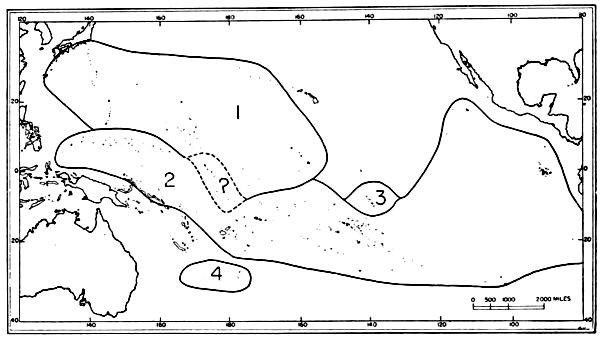
Peters (1934:348, 349) recognizes three other subspecies from the Pacific area: G. a. rothschildi Hartert from Laysan, Lisiansky, and Krusenstern islands; G. a. candida (Gmelin) from "the Carolines east to Christmas Island and south to the Tonga and Society Islands"; and G. a. royana Mathews from Norfolk and the Kermadec Islands. Birds from Revilla Gigedo, Cocos and Clipperton islands, although geographically isolated, are placed in G. a. candida. On the basis of a critical study of specimens at hand, the populations in the Pacific fit into three groups. Small birds, G. a. candida, are found in the North Pacific from the Bonins and Marianas east to Wake and the Hawaiian Chain and south to the Marshall, Phoenix, Christmas and the Fanning islands (see figure 12). Larger birds, G. a. pacifica, are found in the Central Pacific and South Pacific from the Carolines in the west southeastward through Melanesia and eastward through Samoa, to the Tuamotus and Easter to Cocos, Clipperton, and Revilla Gigedo islands. In the Southwest Pacific, at Norfolk and the Kermadec Islands, a longer-winged population occurs; it is separable as G. a. royana. The measurements of these birds are given in table 24.
Table 24. Measurements of Gygis alba From the Pacific Area
Location No. Wing Longest tail feather Shortest tail feather Exposed culmen Depth culmen Tarsus
Gygis alba candida (Gmelin) Japan, Bonins 4 238 109 65 36
34-38
Mariana Islands 35 237 111 69 38 9.0 13.0
227-246 98-120 61-75 36-41 12.0-14.0
Wake Islands 10 236 109 69 38 13.0
232-243 101-118 64-77 37-41 13.0-14.0
Hawaiian Islands 36 235 109 68 37 8.5 13.0
220-246 102-118 64-74 33-40 8.0-9.0 12.0-14.0
Marshall Islands 4 234 111 71 39
231-238 107-115 70-73 38-40
Phoenix, Howland, Hull, Canton Islands 8 238 107 70 39 8.5 14.0
237-240 101-116 64-76 37-41
Fanning, Washington, Christmas Islands 19 238 107 68 38 8.0 13.5
227-242 97-119 65-72 37-42 7.5-9.0 12.0-15.0
Totals 116 236 109 69 38 8.5 13.0
220-246 107-120 61-77 33-42 7.5-9.0 12.0-15.0
Gygis alba pacifica (Lesson) Caroline, Palau Islands 33 245 116 73 42 8.5 13.5
236-253 112-125 67-76 38-44 13.0-13.5
Bismarck Arch., Solomon Islands 12 247 116 74 42
242-256 105-129 68-78 39-45
Samoa, Wallis, Fiji, Tonga, Niue Islands 20 247 115 71 42
239-254 110-127 67-78 39-44
Line, Danger Islands 13 245 115 73 41
238-252 107-118 69-78 39-42
Cook, Austral Islands 29 247 114 73 42
241-255 104-124 65-78 40-45
Society Islands 37 249 113 71 42 8.5 13.5
241-257 107-126 62-76 40-45 8.0-9.0 12.0-14.0
Tuamotu Arch 118 245 114 72 42
236-252 107-127 62-82 38-46
Rapa, Bass Rocks, Oeno, Henderson, Ducie, Pitcairn, Easter Islands 54 247 113 73 41
240-255 106-126 63-84 40-45
Clipperton, Cocos Islands 10 245 115 72 40 8.5 13.5
240-253 110-120 71-73 38-43 8.5-9.5 13.0-14.0
Totals 326 246 114 72 42 8.5 13.5
236-257 104-129 62-84 38-46 8.0-9.5 12.0-14.0
Intergrades between G. a. microrhyncha and G. a. pacifica 9 237 105 74 38 7.5 13.0
230-247 93-122 67-89 36-41 7.0-8.0 12.0-14.0
Gygis alba microrhyncha 55 218 78 64 36 6.5 12.0
211-235 72-96 60-75 32-39 6.0-8.0 11.0-12.5
Gygis alba royana Mathews Norfolk Island 16 250 113 73 42
242-257 105-124 68-79 41-44
Kermadec Islands 12 251 115 75 43
244-255 110-121 71-81 40-46
Totals 28 250 114 74 42
242-257 105-124 68-81 40-46
The measurements indicate that there is a gradient in size from small in the north to large in the south; however, there is a definite separation in average measurements—ten millimeters in length of wing and four millimeters in length of exposed culmen—between the two populations which are designated as G. a. candida and G. a. pacifica. In studying material from Micronesia and the Hawaiian Islands, I (1948:57) pointed out the similarities between birds of the Marianas and the Hawaiians and separated these from terns found in the Caroline Islands. The systematic position of the White Tern in the Gilbert and Ellice islands will remain in doubt until specimens are available for examination.
G. a. royana is provisionally retained as the name for the Fairy Tern of the Kermadecs and Norfolk Island; there is considerable overlap in measurements between G. a. royana and G. a. pacifica. Measurements have given evidence of the degrees of structural resemblance of the White Terns of the different islands, but it is not certain that the groupings made on this basis are natural; more data is needed on ecology and life history. Of particular importance is to learn whether these birds fly regularly from island to island. On the basis of eleven months of rather continuous observation in Micronesia, I suspect that the White Tern has little tendency to make inter-island migrations. This might account for the differences in size in the populations at Guam in the Marianas (G. a. candida) and at Ulithi in the Carolines (G. a. pacifica) where only approximately 400 miles of open water separate the two islands. The occurrence of the distinct G. a. microrhyncha in the Marquesas may be accounted for by such nonmigratory behavior. Mayr (1945a:27), however, is of the opinion that White Terns found in the Bismarck Archipelago, the Solomons, Santa Cruz and New Hebrides islands may not breed there, which is another way of saying that they are migrants. Swarth (1934:221) and Murphy (1936:1268) record the wandering of the White Tern to the Galapagos Islands, probably from breeding grounds at Cocos Island. Swarth suggests that the tern is not established at the Galapagos because of the presence of colder water in the area. Murphy (1936:1166) is of the opinion that the South Atlantic White Terns are sedentary, but reports evidence of pelagic migration in the Pacific at the Kermadecs. The fact that G. alba is restricted in its distribution to widely separated groups of islands in tropical and subtropical areas of the South Atlantic, Indian and Pacific oceans may indicate that the birds at one time had a more extensive range than at present, probably including even coastal regions of the continents and large continental islands.
Gygis alba pacifica (Lesson)
White Tern
Sterna pacifica Lesson, Ann. Sci. Nat., 4, 1825, p. 101. (Type locality, Society Islands, Paumotu Islands, and Bora Bora.)
Sterna alba Kittlitz, Kupfertaf. Naturgesch. Vögel, 3, 1833, p. 28 (Carolinen); idem, Obser. Zool., in Lutké, Voy. "Le Séniavine," 3, 1836, pp. 286, 299, 308 (Ualan, Lougounor, Ouleai).
Gygis candida Hartlaub, Archiv f. Naturgesch., 18, 1852, p. 137 (Carolinen); Hartlaub, Journ. f. Ornith., 1854, p. 168 (Carolinen); Kittlitz, Denkw. Reise russ. Amer. Micron. und Kamchat., 1, 1858, p. 382, 2, 1858, pp. 39, 60 (Ualan); Gray, Cat. Birds Trop. Is. Pacific Ocean, 1859, p. 59 (Caroline Islands); Saunders (part), Cat. Birds British Mus., 25, 1896, p. 149 (Pelew, Carolines); Takatsukasa and Kuroda, Tori, 1, 1915, p. 51 (Ruk, Pelew).
Gygis alba Finsch and Hartlaub, Fauna Centralpolynesiens, 1867, p. 233 (Carolinen); Hartlaub, Proc. Zool. Soc. London, 1867 (1868), p. 832 (Pelew); Hartlaub and Finsch, Proc. Zool. Soc. London, 1868, pp. 9, 118 (Pelew); Finsch and Hartlaub, Journ. f. Ornith., 1870, p. 140 (Pelew); Hartlaub and Finsch, Proc. Zool. Soc. London, 1872, pp. 90, 114 (Pelew, Uap, Ualan); Gräffe, Journ. Mus. Godeffroy, 2, 1873, p. 123 (Yap); Finsch, Journ. Mus. Godeffroy, 8, 1875, pp. 6, 43 (Palau); idem, Journ. Mus. Godeffroy, 12, 1876, pp. 18, 40 (Ponapé); idem, Proc. Zool. Soc. London, 1877 (1878), p. 782 (Ponapé); idem, Journ. f. Ornith., 1880, pp. 295, 309 (Ponapé, Kuschai); idem, Proc. Zool. Soc. London, 1880, p. 577 (Ruk); idem, Ibis, 1881, pp. 105, 106, 109, 115, 246, 247 (Kushai, Ponapé); Schmeltz and Krause, Ethnogr. Abth. Mus. Godeffroy, 1881, pp. 299, 330, 353 (Mortlock, Nukuor, Ruk); Finsch, Mitth. Ornith. Ver. Wien, 1884, p. 52 (Kuschai); Wiglesworth (part), Abhandl. und Ber. Zool. Mus. Dresden, no. 6, 1890-1891 (1891), p. 78 (Pelew, Uap, Luganor, Nukuor, Ruk, Ponapé, Ualan); Oustalet (part), Nouv. Arch. Mus. Hist. Nat. Paris, (3), 8, 1896, p. 58 (Palaos, Carolines); Baker (part), Smithson. Misc. Coll., vol. 107, no. 15, 1948, p. 57 (Peleliu, Ulithi, Truk, Kusaie).
Gygis alba kittlitzi Hartert, Katalog Vogelsamml. Senckenb., 1891, p. 237 (Type locality, Ulea = Wolea); idem, Novit. Zool., 7, 1900, p. 10 (Ruk); Dubois, Syn. Avium, 2, 1904, p. 1020 (Carolines); Mathews (part), Birds Australia, 2, 1912, p. 443 (Carolines); Ridgway (part), Bull. U. S. Nat. Mus., 50, pt. 8, 1919, p. 559 (Carolines); Kuroda (part), Avifauna Riu Kiu, 1925, p. 193 (Carolines); Hand-list Japanese Birds (part), rev., 1932, p. 196 (Pelew, Yap, Wolea, Luganor, Ruk, Ponapé, Kusaie); Yamashina (part), Tori, 10, 1940, p. 678 (Babelthuap).
Gygis albus kittlitzi Kuroda (part), in Momiyama, Birds Micronesia, 1922, p. 50 (Pelews, Yap, Wolea, Luganor, Nukuor, Ruk, Ponapé, Kusaie).
Leucanous albus kittlitzi Mathews (part), Syst. Avium Australasianarum, 1, 1927, p. 143 (Carolines).
Gygis alba candida Peters, Check-list Birds World, 2, 1934, p. 349 (Carolines); Hand-list Japanese Birds (part), 3d ed., 1942, p. 219 (Babelthuap, Koror, Angaur, Yap, Wolea, Truk, Lukunor, Nukuoro, Ponapé, Kusaie).
Geographic range.—Central and southern Pacific from Carolines southeast through Melanesia and east through Samoa to Tuamotus, Easter to Cocos and Clipperton (see figure 12). In Micronesia: Palau Islands—Angaur, Peleliu, Garakayo, Koror, Babelthuap, Kayangel; Caroline Islands—Yap, Ulithi, Wolea, Truk, Lukunor, Ponapé, Kusaie.
Characters.—Resembles G. a. candida, but size larger, wing length of adult males and females 236-253 (245); length of exposed culmen 38-44 (42).
Measurements.—Measurements are listed in table 24.
Specimens examined.—Total number, 36 (22 males, 12 females, 2 unsexed), as follows: Palau Islands, USNM—Peleliu, 1 (Sept. 1); AMNH—exact locality not given, 1 (Nov. 13);-Caroline Islands, USNM—Ulithi, 12 (Aug. 14, 15, 16, 20, 21)—Truk, 1 (Dec. 13); AMNH—Truk, 7 (Mar. 8, May 7, June 8, Nov. 11, 26)—Ponapé, 1 (undated)—Kusaie, 10 (Jan., Feb., March 20-30, April 1-10); MCZ—Yap, 3 (Jan. 13).
Nesting.—The NAMRU2 party learned that in May and June, 1945, several young White Terns were seen at Asor, Ulithi Atoll, by service personnel. These young were observed in breadfruit trees within a recreational area; the presence of the service personnel seemingly had little disturbing effect on the terns. At Bulubul, another island of this atoll, a downy young was obtained on August 22. Hartert (1900:10) reports that eggs of the White Tern were found on the ground and in forks of branches of trees at Truk in June.
Food Habits.—The author (1948:58) reports that stomachs of birds taken at Ulithi and Peleliu contained fish, insects and marine crustaceans. Probably the birds feed to a large extent along the edge of the tidal reef. They almost certainly obtain food also on the islands as indicated by the presence of insects in stomach contents; this is not surprising since the birds frequent woodland habitats.
Remarks.—Gygis alba is one of the most characteristic birds in Micronesia. It is seemingly more numerous at the coral atolls than at the high, volcanic islands. At the latter islands the birds prefer the coastal coconut grove environment. At Pau and Bulubul, two small islands in the Ulithi Atoll, the writer counted approximately 100 birds on August 21, 1945. Kittlitz was the first to publish an account of these birds in the Caroline Islands. Tetens, Peters, Semper and Kubary reported their presence in the Palaus. No doubt, these terns attract the attention of every traveler in the islands owing to their conspicuously white beauty and their seemingly friendly behavior toward man. Their habit of hovering in small flocks close over the head of the observer is indeed spectacular.
Columba livia Gmelin
Blue Rock Pigeon
Columba domestica [Greek: b] livia Gmelin, Syst. Nat., 1, pt. 2, 1789, p. 769. (No type locality = Europe.)
Columba livia Bryan, Guam Rec., vol. 13, no. 2, 1936, p. 24 (Guam); Marshall, Condor, vol. 51, 1949, p. 221 (Tinian).
Geographic range.—Europe and Asia Minor. Introduced to many parts of the world. In Micronesia: Mariana Islands—Guam, Tinian.
Remarks.—In 1945, the NAMRU2 party observed pigeons about the towns on Guam, particularly at the town of Inarajan. Bryan (1936:24) writes that the birds were introduced by the United States Navy and Marine Corps at Guam; the stock originating from escaped carrier pigeons. Marshall (1949:221) records this bird from Tinian.
Ptilinopus porphyraceus ponapensis (Finsch)
Crimson-crowned Fruit Dove
Ptilinopus ponapensis Finsch, Proc. Zool. Soc. London, 1877 (1878), p. 779. (Type locality, Ponapé.)
Ptilinopus? fasciatus Finsch, Journ. Mus. Godeffroy, 12, 1876, pp. 18, 37 (Ponapé).
Ptilopus fasciatus Elliot, Proc. Zool. Soc. London, 1878, p. 536 (Ponapé); Tristram, Cat. Birds, 1889, p. 44 (Ponapé).
Ptilopus ponapensis Schmeltz, Verhandl. Ver. nat. Unterhaltung Hamburg, 1877 (1879), pp. 178, 179 (Ponapé); Finsch, Proc. Zool. Soc. London, 1880, p. 576 (Ruk, Ponapé); idem, Journ. f. Ornith., 1880, pp. 291, 303 (Ponapé); idem, Proc. Zool. Soc. London, 1880, p. 578 (Ruk, Ponapé); idem, Ibis, 1881, pp. 113, 115 (Ponapé); Wiglesworth, Ibis, 1891, p. 583 (Ponapé, Ruk); idem, Abhandl. und Ber. Zool. Mus. Dresden, no. 6, 1890-1891 (1891), p. 50 (Ponapé, Ruk); Salvadori, Cat. Birds British Mus., 21, 1893, p. 93 (Ponapé, Ruk); Oustalet, Nouv. Arch. Mus. Hist. Nat., Paris, (3), 7, 1895, p. 222 (Ponapé); Nehrkron, Kat. Eiers., 1899, p. 180 (Ruk); Dubois, Syn. Avium, 2, 1904, p. 736 (Ruck, Ponapé); Reichenow, Die Vögel, 1, 1913, p. 354 (Ruk, Ponapé); Takatsukasa and Kuroda, Tori, 1, 1915, p. 52 (Ruk, Ponapé); Wetmore, in Townsend and Wetmore, Bull. Mus. Comp. Zoöl., 63, 1919, p. 189 (Uala, Ponapé).
Ptilinopus ponapensis Schmeltz and Krause, Ethnogr. Abth. Mus. Godeffroy, 1881, p. 353 (Ruk); Hartert, Novit. Zool., 7, 1900, p. 7 (Ruk, Ponapé); Seale, Occ. Papers Bernice P. Bishop Mus., 1, 1901, p. 42 (Ponapé); Matschie, Journ. f. Ornith., 1901, p. 113 (Ruck, Ponapé); Mathews, Syst. Avium Australasianarum, 1, 1927, p. 32 (Ponapé); Bequaert, Mushi, 12, 1939, pp. 81, 82 (Ponapé); Mayr. Proc. 6th Pacific Sci. Congr., 4, 1939 (1941), p. 204 (Ponapé); Bequaert, Occ. Papers Bernice P. Bishop Mus., 16, 1941, pp. 266, 290 (Ponapé).
Ptilinopus Ponapensis Christian, The Caroline Islands, 1899, p. 357 (Ponapé).
Ptilinopus ponepensis ponapensis Kuroda, in Momiyama, Birds Micronesia, 1922, p. 57 (Ponapé, Ruk); Yamashina, Tori, 7, 1932, p. 408 (Ponapé); Hand-list Japanese Birds, rev., 1932, p. 190 (Ponapé, Ruk); Peters, Check-list Birds World, 3, 1937, p. 31 (Ruk, Ponapé); Hand-list Japanese Birds, 3d ed., 1942, p. 213 (Ponapé, Truk).
Ptilinopus porphyraceus ponapensis Ripley and Birckhead, Amer. Mus. Novit., no. 1192, 1942, p. 7 (Ruk, Ponapé); Mayr, Birds Southwest Pacific, 1945, p. 289 (Truk, Ponapé); Baker, Smithson. Misc. Coll., vol. 107, no. 15, 1948, p. 59 (Truk).
Geographic range.—Micronesia: Caroline Islands—Truk, Ponapé. Characters.—Adult male: A green fruit dove with forehead, anterior lores and crown near "pansy purple," faintly margined with yellow; occiput, sides of head, neck, upper breast grayish-green with bifid feathers of midbreast more olivaceous; chin and midthroat light yellow; breast, sides and tibia green; midpart of lower breast dark bluish-green, tinged with dark purple; lower abdomen, vent, and undertail yellow, under tail-coverts deeper yellow tinged with orange; upper parts dark green; wings metallic green on outer webs and tips, inner secondaries and some posterior scapulars with purple spots near tips; primaries and secondaries edged on outer webs with yellowish; underwing gray with yellow edges on hind, under wing-coverts; upper side of tail metallic green with terminal, broad yellow band; under side of tail gray; bill lead-colored, feet wine-brown, iris whitish to pale brown. Adult female resembles adult male, but slightly smaller and duller.
Immature: Resembles adult, but entirely green with yellow edgings on feathers and lacking crimson crown and colored breast patch.
Measurements.—Measurements of subspecies of P. porphyraceus in Micronesia are presented in table 25.
Table 25. Measurements of Ptilinopus porphyraceus in Micronesia
Subspecies Number Wing Exposed culmen Tarsus
P. p. ponapensis 12 males 137 (133-141) 14 (13-15) 25 (24-27)
11 females 133 (126-137) 14 (13-15) 25 (24-26)
P. p. hernsheimi 6 males 134 (130-138) 13 (12-14) 25 (24-26)
5 females 127 (125-130) 13 (12-13) 25 (24-25)
P. p. pelewensis 10 males 133 (131-134) 15 (13-15) 25 (23-26)
4 females 133 (130-138) 15 (14-15) 24 (23-24)
Specimens examined.—Total number, 81 (52 males, 26 females, 3 unsexed), as follows: Caroline Islands, USNM—Truk, 4 (Feb. 16, Dec. 24); AMNH—Truk, 24 (Jan., June, Oct.)—Ponapé, 53 (Nov., Dec).
Nesting.—Yamashina (1932a:408) reports on eggs taken at Ponapé on the following dates: July 10, 12, August 1, 12, 15, 21. Only one egg was found to a nest. Hartert (1900:8) records nests containing eggs in May and June at Truk. Coultas (field notes) describes the nest as a flimsy affair. At Ponapé in November and December he found nests on low branches (10 to 20 feet from the ground) each containing a single egg. Nests were found also in the tops of tree ferns. Females taken in these months had enlarged gonads.
Parasites.—Bequaert (1939:81, 82, and 1941:266, 290) records the two flies (Hippoboscidae), Ornithoctona plicata and O. pusilla, from the fruit dove at Ponapé.
Remarks.—McElroy of the NAMRU2 party found the birds in mountainous areas at Truk in December, 1945. At Ponapé in November and December, 1931, Coultas (field notes) comments that the bird is rapidly disappearing owing to persistent hunting by the natives and, at that time, by the Japanese. He found the birds to be strictly forest-living and to frequent the larger fruit-bearing trees of the lowlands and the mountain sides. Coultas writes that the Japanese hunters attracted the doves by the use of calls. The natives catch the birds with a gum mixture obtained from bread-fruit gum and coconut oil.
Ptilinopus porphyraceus hernsheimi (Finsch)
Crimson-crowned Fruit Dove
Ptilopus Hernsheimi Finsch., Journ. f. Ornith., 1880, p. 303. (Type locality, Kuschai.)
Ptilopus hernsheimi Finsch, Proc. Zool. Soc. London, 1880, p. 577 (Kuschai); Reichenow and Schalow, Journ. f. Ornith., 1881, p. 75 (Kuschai); Finsch, Ibis, 1881, pp. 106, 107, 108 (Kushai); Wiglesworth, Ibis, 1891, p. 583 (Ualan); idem, Abhandl. und Ber. Zool. Mus. Dresden, no. 6, 1890-1891 (1891), p. 51 (Ualan); Salvadori, Cat. Birds British Mus., 21, 1893, p. 94 (Ualan); Oustalet, Nouv. Arch. Mus. Hist. Nat., Paris, (3), 7, 1895, p. 222 (Oualan); Dubois, Syn. Avium, 2, 1904, p. 736 (Kuschai); Reichenow, Die Vögel, 1, 1913, p. 355 (Kuschai); Wetmore, in Townsend and Wetmore, Bull. Mus. Comp. Zoöl., 63, 1919, p. 189 (Kusaie).
Ptilinopus hernsheimi Matschie, Journ. f. Ornith., 1901, p. 113 (Ualan); Mathews, Syst. Avium Australasianarum, 1, 1927, p. 33 (Kusaie).
Ptilinopus ponapensis hernsheimi Kuroda, in Momiyama, Birds Micronesia, 1922, p. 57 (Kusaie); Hand-list Japanese Birds, rev., 1932, p. 190 (Kusaie); Peters, Check-list Birds World, 3, 1937, p. 31 (Kusaie); Hand-list Japanese Birds, 3d ed., 1942, p. 212 (Kusaie).
Ptilinopus marshallianus Peters and Griscom, Proc. New England Zool. Club, 10, 1928, p. 104 (Type locality, Ebon); Hand-list Japanese Birds, rev., 1932, p. 190 (Ebon).
Ptilinopus ponapensis marshallianus Peters, Check-list Birds World, 3, 1937, p. 31 (Ebon); Hand-list Japanese Birds, 3d ed., 1942, p. 213 (Ebon).
Ptilinopus porphyraceus hernsheimi Ripley and Birckhead, Amer. Mus. Novit., no. 1192, 1942, p. 6 (Kusaie, Ebon); Mayr, Birds Southwest Pacific, 1945, p. 289 (Kusaie).
Geographic range.—Micronesia: Caroline Islands—Kusaie; Marshall Islands—Ebon (extinct?).
Characters.—Adult: Resembles P. p. ponapensis, but occiput, nape, sides of head more gray and less greenish-yellow; chin and midthroat paler; crown coloring very faintly margined with yellow; tail band brighter yellow; under tail-coverts more orange; abdominal spot may be present as a brownish-red tinge; abdomen slightly more yellowish.
Immature: Resembles immature of P. p. ponapensis.
Measurements.—Measurements are listed in table 25. Ripley and Birckhead (1942:7) give the measurements of the only known specimen from Ebon (Marshall Islands) as: wing, 124; tail, 74; bill from base, 15.
Specimens examined.—Total number, 11 (6 males, 5 females), as follows: Caroline Islands, USNM—Kusaie, 1 (Feb. 9); AMNH—Kusaie, 10 (Jan., Feb., March, April).
Remarks.—I am following Ripley and Birckhead (1942:6) in identifying the dove from Ebon Island as of the subspecies P. p. hernsheimi. This specimen from Ebon may, however, represent the final vestige of a formerly well-distributed population in the Marshall Islands. This distribution is of particular interest because it may show the pathway by which these small fruit pigeons invaded eastern Micronesia from Polynesia.
The small fruit dove at Kusaie has apparently the same habitat requirements as others of the species. Coultas (field notes) comments that in 1931 the birds were "quite common." He found them in the high trees on the mountain sides away from the native villages and gardens.
Ptilinopus porphyraceus pelewensis Hartlaub and Finsch
Crimson-crowned Fruit Dove
Ptilinopus pelewensis Hartlaub and Finsch, Proc. Zool. Soc. London, 1868, p. 7. (Type locality, Pelew Islands.)
Ptilinopus pelewensis Hartlaub and Finsch, Proc. Zool. Soc. London, 1868, p. 118 (Pelew); Gray, Hand-list Birds, 2, 1870, p. 225 (Pelew); Hartlaub and Finsch, Proc. Zool. Soc. London, 1872, pp. 89, 101 (Pelew); Gräffe, Journ. Mus. Godeffroy, 1, 1873, pl. 7, fig. 5 (Pelew); Finsch, Journ. Mus. Godeffroy, 8, 1875, pp. 5, 24 (Palau); Finsch, Journ. Mus. Godeffroy, 12, 1876, p. 37 (Palau); Schmeltz and Krause, Ethnogr. Abth. Mus. Godeffroy, 1881, p. 407 (Palau); Matschie, Journ. f. Ornith., 1901, p. 113 (Palau); Kuroda, in Momiyama, Birds Micronesia, 1922, p. 56 (Pelew); Mathews, Syst. Avium Australasianarum, 1, 1927, p. 32 (Pelew); Hand-list Japanese Birds, rev., 1932, p. 190 (Palau); Peters, Check-list Birds World, 3, 1937, p. 31 (Babeltop, Korror); Hand-list Japanese Birds, 3d ed., 1942, p. 213 (Babelthuap, Koror).
Ptilonopus pelewensis Finsch, Proc. Zool. Soc. London, 1874, p. 94 (Pelew).
Ptilopus pelewensis Giebel, Thes. Ornith., 3, 1877, p. 366 (Pelew); Elliot, Proc. Zool. Soc. London, 1878, p. 531 (Palau); Schmeltz, Verhandl. Ver. nat. Unterhatlung Hamburg, 1877 (1879), p. 178 (Pelew); Tristram, Cat. Birds, 1889, p. 44 (Pelew); Wiglesworth, Ibis, 1891, p. 584 (Pelew); idem, Abhandl. und Ber. Zool. Mus. Dresden, no. 6, 1890-1891 (1891), p. 48 (Pelew); Salvadori, Cat. Birds British Mus., 21, 1893, p. 86 (Pelew); Dubois, Syn. Avium, 2, 1904, p. 736 (Pelew); Reichenow, Die Vögel, 1, 1913, p. 354 (Palau); Takatsukasa and Kuroda, Tori, 1, 1915, p. 52 (Pelew).
Ptilinopus porphyraceus pelewensis Ripley and Birckhead, Amer. Mus. Novit., no. 1192, 1942, p. 7 (Palau); Mayr, Birds Southwest Pacific, 1945, p. 289 (Palau); Baker, Smithson. Misc. Coll., vol. 107, no. 15, 1948, p. 60 (Peleliu, Ngabad, Garakayo).
Geographic range.—Micronesia: Palau Islands—Babelthuap, Koror, Garakayo, Peleliu, Ngabad, Anguar.
Characters.—Adult male: A green fruit pigeon with anterior lores and crown purple, margined with pale yellow; forehead paler than crown; chin and midthroat pale yellow; neck, sides of head, and breast greenish-gray, darker on occiput; feathers of upper breast cross-banded with partly concealed violet bands; abdomen orange, its lower part and region of vent yellow; sides greenish; tibia grayish; under tail-coverts near "Indian lake" with yellowish-orange edgings; upper parts green; wings metallic green, secondaries and primaries margined on outer webs with yellow; inner secondaries spotted with violet-blue near tips; under wing gray; upper side of tail green with pale yellow terminal band; under side of tail gray; bill lead-colored; feet dark blood-red.
Adult female: Resembles adult male, but upper parts greener with upper side of wing and upper tail-coverts washed with olivaceous-brown; breast duskier. Immature resembles adult, but lacks purple crown, violet breast spot, orange abdomen and maroon under tail-coverts; upper and lower parts margined with yellow; forehead pale green; supercillary stripe pale yellow.
P. p. pelewensis resembles P. p. ponapensis, but crown more purple; yellow tail-bar narrower; bifurcated, central breast feathers violet; abdomen orange; and under tail-coverts near "Indian lake".
Measurements.—Measurements are presented in table 25.
Specimens examined.—Total number, 14 (10 males, 4 females), as follows: Palau Islands, USNM—Koror, 3 (Nov. 14, Dec. 3)—Garakayo, 1 (Sept. 19)—Peleliu, 3 (Aug. 27, Sept. 1, 4)—Ngabad, 2 (Sept. 11)—Pelew, 2 (Mar. 1, 2); AMNH—Palau, 3 (Oct., Dec.).
Nesting.—At Ngabad Island on September 11, 1945, the NAMRU2 party found a nest in jungle in a low tree about six feet above the ground. It was loosely constructed and contained a single white egg, size 31 by 23 mm. Another nest was found at Ngabad the same day. It was on the branch of a tree approximately 20 feet from the ground. The nest was not examined other than to observe a parent bird on the nest. Three males obtained in August and in September had enlarged testes. Males taken in December by Coultas had enlarged testes.
Food Habits.—Stomachs examined by the NAMRU2 party contained fruit parts and seeds. This species seemingly obtains its foods from the large fruit-producing trees and to a lesser extent from the smaller shrubs or from ground berries.
Remarks.—P. p. pelewensis was found in small numbers at all islands visited in the southern Palaus by the NAMRU2 party in 1945. At Peleliu, the bird was restricted to undisturbed woodlands and thickets, although some were seen in the thickly growing vegetation covering over the battle areas. The bird evidently lives a solitary existence; it was only rarely observed in pairs. It was often located by its calls. Coultas (field notes) reports that in 1931 the species was becoming rare in the Palaus, owing to persistent hunting by the Japanese, who sold the bird for 25 sen each.
Ptilinopus roseicapillus (Lesson)
Marianas Fruit Dove
Columba roseicapilla Lesson, Traité d'Ornith., 6, 1831, p. 472. (Type locality, Marianne Islands.)
Columba roseicapilla Lesson, Compl. de Buffon, 2d ed., 2, Oiseaux, 1838, p. 278 (Mariannes).
Columba purpurata Kittlitz, Kupfertaf. Naturgesch. Vögel, 3, 1833, p. 25, pl. 23, fig. 2 (Guahan); idem, Obser. Zool., in Lutké, Voy. "Le Séniavine," 3, 1836, p. 305 (Guahan).
Ptilinopus purpuratus Hartlaub, Journ. f. Ornith., 1854, p. 167 (Mariannen); Hartert, Katalog Vogelsamml. Senckenb., 1891, p. 190 (Guaham).
Ptilopus roseicapillus Bonaparte, Comptes Rendus Acad. Sci. Paris, 39, 1854, p. 877 (Mariannes); idem, Icon. Pigeons, 1857, pl. 23 and desc. letterpress (Mariannes); Schlegel, Mus. Pays-Bas, 6, no. 35, 1873, p. 8 (Guam); Giebel, Thes. Ornith., 3, 1877, p. 368 (Mariannae); Elliot, Proc. Zool. Soc. London, 1878, p. 537 (Marianne); Oustalet, Le Nat., 1889, p. 261 (Mariannes); Wiglesworth, Ibis, 1891, p. 584 (Marianne); idem, Abhandl. und Ber Zool. Mus. Dresden, no. 6, 1890-1891 (1891), p. 48 (Marianne); Salvadori, Cat. Birds British Mus., 21, 1893, p. 108 (Marianne Islands); Oustalet, Nouv. Arch. Mus. Hist. Nat., Paris, (3), 7, 1895, p. 218 (Saypan, Guam, Rota); Safford, The Plant World, 7, 1904, p. 264 (Guam); Dubois, Syn. Avium, 2, 1904, p. 736 (Mariannes); Safford, Contr. U. S. Nat. Herb., 9, 1905, p. 78 (Guam); Schnee, Zeitschr. f. Naturwisch., 82, 1912, p. 465 (Marianen); Prowazek, Die deutschen Marianen, 1913, p. 101 (Marianen); Reichenow, Die Vögel, 1, 1913, p. 354 (Marianen); Cox, Island of Guam, 1917, p. 20 (Guam); Bryan, Guam Rec. vol. 13, no. 2, 1936, p. 24 (Guam); Thompson, Guam and its people, 1942, p. 23 (Guam).
Kurukuru roseicapillus Prévost and Des Murs, Voy. "Venus," Oiseaux, 1855, pp. 221, 231, 257, 259, 269 (Guam).
Ptilopus roseicapilla Bonaparte, Consp. Avium, 2, 1855, p. 21 (Mariannis).
Ptilonopus roseicapillus Gray, Cat. Birds Trop. Is. Pacific Ocean, 1859, p. 31 (Guam); Reichenbach, Tauben, 1861, p. 96 (Mariannen); Finsch, Proc. Zool. Soc. London, 1874, p. 94 (Mariannes).
Ptilinopus roseicapillus Finsch and Hartlaub, Fauna Centralpolynesiens, 1867, pp. 122, 127 (Mariannen); Gray, Hand-list Birds, 2, 1870, p. 225 (Ladrones); Hartert, Novit. Zool., 5, 1898, p. 60 (Guam, Rota, Saipan); Wheeler, Report Island of Guam, 1900, p. 13 (Guam); Seale, Occ. Papers Bernice P. Bishop Mus., 1, 1901, p. 39 (Guam, Rota, Saipan); Matschie, Journ. f. Ornith., 1901, p. 113 (Guam, Saipan); Safford, Osprey, 1902, p. 68 (Marianas); idem, Amer. Anthro., 4, 1902, p. 711 (Guam); Kuroda, in Momiyama, Birds Micronesia, 1922, p. 56 (Guam, Rota, Saipan); Mathews, Syst. Avium Australasianarum, 1, 1927, p. 33 (Marianne); Hand-list Japanese Birds, rev., 1932, p. 190 (Tinian, Saipan, Rota); Hand-list Japanese Birds, 3d ed., 1942, p. 212 (Guam, Rota, Tinian, Saipan); Mayr, Birds Southwest Pacific, 1945, p. 288 (Marianas); Downs, Trans. Kansas Acad. Sci., 49, 1946, p. 95 (Tinian); Watson, The Raven, 17, 1946, p. 42 (Guam); Strophlet, Auk, 63, 1946, p. 538 (Guam); Baker, Condor, 49, 1947, p. 125 (Guam); Stott, Auk, 64, 1947, p. 526 (Saipan); Baker, Smithson. Misc. Coll., vol. 107, no. 15, 1948, p. 59 (Guam, Rota).
Ptilopus diadematus Giebel, Thes. Ornith., 3, 1877, p. 363 (Marianae).
Ptilinopus roseicapilla Peters, Check-list Birds World, 3, 1937, p. 31 (Saipan, Tinian, Rota, Guam); Ripley and Birckhead, Amer. Mus. Novit., no. 1192, 1942, p. 3 (Guam, Rota, Tinian, Saipan).
Geographic range.—Micronesia: Mariana Islands—Guam, Rota, Tinian, Saipan.
Characters.—Adult male: A green dove with crown, forehead, anterior lores, and spot at base of mandible near "aster purple," margined with pale yellow especially on top of head; chin and throat pale yellow to white; sides of head greenish-gray, darker on occiput; breast green with pearly-gray tinge on feathers of middle part; lower breast with dark purple patch; abdomen orange with yellowish-green coloring at midline; anal region and lower tail-coverts yellow, tinged with orange on lower tail-coverts; sides and tibia greenish with yellow tinges; upper parts green, more yellowish-green on rump; wings glossy, upper wing-coverts brighter in middle and margined with yellow; under side of wing and under side of tail gray; upper side of tail green with broad grayish terminal band margined with yellow; iris pale yellow; bill grass-green; legs and feet reddish-black.
Adult female: Resembles male, but slightly smaller with neck greener. Immature resembles adult, but lacking colored crown; body feathers edged with yellow.
Birds from Guam, Rota, and Tinian exhibit no conspicuous differences. P. roseicapillus is closest to P. regina of southern Papua, Lesser Sunda Islands, and Australia being, according to Ripley and Birckhead (1942:3), "Similar to regina, but crown and abdominal band darker; malar apex concolorous with crown; hind neck more grayish; tail-bar wider and paler."
Measurements.—Measurements of P. roseicapillus are presented in table 26.
Weights.—In 1948 (1948:59) I listed the weights of 14 adult males as 81-103 (90), of 4 adult females as 85-99 (92), and of one nestling in post natal molt as 44 grams. These were taken at Guam.
Specimens examined.—Total number, 43 (32 males, 10 females, 1 unsexed), as follows: Mariana Islands, USNM—Guam, 28 (March 8, May 25, 27, June 3, 12, 14, July 2, 6, 10, 18, 19, 29, Aug. 21)—Rota, 3 (Oct. 28, 31, Nov. 2)—Tinian, 1 (Oct. 26); AMNH—Guam, 8 (Aug.)—Tinian, 3 (Sept.).
Table 26. Measurements of Ptilinopus roseicapillus
Number Wing Tail Exposed culmen Tarsus
32 adult males 127 (122-133) 80 (75-84) 14 (13-15.3) 25 (24-27)
10 adult females 124 (121-130) 76 (75-79) 13 (12-13.7) 24 (22-25.5)
Nesting.—At Guam, I obtained records of nests of fruit doves on March 1, 1927, and May 7, 1945. David H. Johnson observed a pair of fruit doves in the act of copulation on May 26, 1945. Birds with enlarged gonads were taken by the NAMRU2 party in March and July. A nestling in post natal molt, just beginning to fly, was taken on July 6. Seale (1901:39) reports two nests, each containing one white egg, taken in the period from May to July. These nests were found in trees eight to ten feet above the ground.
Food habits.—The Marianas Fruit Dove feeds on fruits and seeds of trees and shrubs. The birds are apparently strictly tree dwellers; I saw no birds on the ground. A favorite fruit is that of a flowering shrub known as the "ink berry." Birds were collected which contained stomachs full of these small black berries. The fruit of the papaya is also a favorite food.
Remarks.—The NAMRU2 party found the Marianas Fruit Dove at Guam to be fairly numerous in undisturbed jungle, and more abundant in the heavy, second-growth, scrub-forest as was found on Amantes Point in 1945. The birds were secretive but were easily located by their calls. They were usually found as singles sitting quietly concealed in thick vegetation. Birds were seen flying rather infrequently, and then only for short distances. The removal of large tracts of jungle to provide space for the construction of air strips and installations in the late war has disturbed some of the habitat of these birds. Although vast tracts of forest were undisturbed, the birds probably have decreased at Guam. Coultas (field notes) found the birds common at the northern end of Guam in 1931. He commented that natives catch them with snares and bird lime for the local markets. At Tinian in 1931, Coultas found few birds. Downs (1946:95) and Stott (1947:526) record the birds at Tinian and Saipan, respectively, in 1945. At Rota, the NAMRU2 party found the dove to be numerous.
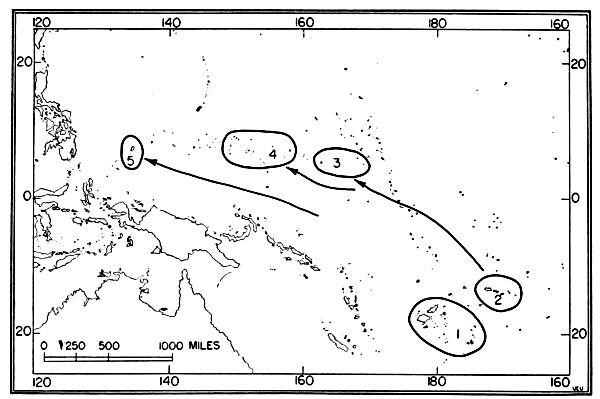
Evolutionary history of Ptilinopus in Micronesia.—Oceania is especially rich in species and subspecies of the genus Ptilinopus. Ripley and Birckhead (1942) have made the most recent and most thorough contribution concerning these birds. They state that the center of distribution for the genus lies in the Papuan region. Within the Oceanic region there are several species of Ptilinopus which in one way or another are rather closely related; Rensch (1938:277) uses these as examples of species which have been formed by isolation. These include P. perousii from Samoa, Fiji, and Tonga; P. mercierii from the Marquesas; P. dupetithouarsii from the Marquesas; P. huttoni from Rapa; P. purpuratus from Henderson, Tuamotus, Societies; P. porphyraceus from Samoa, Fiji, Tonga, Carolines, Solomons, New Hebrides, New Caledonia, and adjacent areas; and P. roseicapillus from Marianas. In all of these birds the crown is wine-red except in P. dupetithouarsii in which it is whitish. P. porphyraceus appears to be more closely related to P. purpuratus than to any other species and is characterized by an often brightly washed spot of color of some shade of red or orange on the breast. These birds may have invaded Micronesia from the region of the Solomon Islands, although it appears more likely that they arose in the Samoa-Fiji-Tonga region and moved northward, probably by way of the Marshall Islands. P. p. hernsheimi from Kusaie and P. p. ponapensis from Ponapé and Truk resemble P. p. faciatus Peale from Samoa more closely than they do any other subspecies. P. p. pelewensis from Palau, on the other hand shows little relation to these other two Micronesian subspecies and appears to be closest to P. p. porphyraceus of Fiji and Tonga or possibly to P. grayi from Melanesia. Ripley and Birckhead (1942:7) suggest that the subspecies at Palau owes its marked divergence to its isolated position at the periphery of the range of the species. P. p. pelewensis probably represents an independent and an earlier colonization, possibly from a stock different from that from which the two subspecies in the Carolines arose. The presence in the Palaus of subspecies singularly different from subspecies in the Carolines can also be observed in other genera, as for example, Rhipidura, and Myiagra. Figure 13 shows the inferred routes of colonization of Ptilinopus to Micronesia.
P. roseicapillus seemingly represents a remnant, or perhaps a successful straggler, of an early invasion to Micronesia. Ripley and Birckhead (1942:2) classify this species as "Old Stock," along with P. monachus, P. coronulatus and P. regina. Its pathway of invasion to the Marianas was probably directly northward from the Papuan area and not by way of the Polynesian islands. Its resemblance to the species P. regina of southern Papua, Lesser Sundas, and Australia is most unusual, especially since there is a separation between the two species of some 1,400 miles; this is pointed out by Ripley and Birckhead (1942:4). As I have said (1948:59) elsewhere, "On the basis of its characters the Mariana birds would merit only subspecific separation, but owing to the great distance between the two doves and the possibility of independent origin and subsequent convergence, it may be more advisable to continue to regard the two as separate species."
Fig. 13. Geographic distribution of Ptilinopus porphyraceus and routes of its dispersal. (1) P. p. porphyraceus; (2) P. p. fasciatus; (3) P. p. hernsheimi; (4) P. p. ponapensis; (5) P. p. pelewensis.
Ducula oceanica monacha (Momiyama)
Micronesian Pigeon
Globicera oceanica monacha Momiyama, Birds Micronesia, March, 1922, p. 4. (Type locality, Yap.)
Columba oceanica Lesson and Garnot (part), Dict. Sci. Nat., éd. Levrault, 40, 1826, p. 317 (Pelew); Lesson (part), Man. d'Ornith., 2, 1828, p. 166 (Pelew); idem (part), Voy. "La Coquille," Zool., 2, 1828, pp. 432, 709 (Pelew); idem, Compl. de Buffon, 2d ed., 2, Oiseaux, 1838, p. 292 (Pelew); Prévost and Knip, Les Pigeons, 2, 1838-43, p. 49 (Pelew).
Carpophaga oceanica Hartlaub (part), Archiv. f. Naturgesch., 18, 1852, p. 115 (Pelewinseln); idem, Proc. Zool. Soc. London, 1867 (1868), p. 830 (Pelew); Gray (part), Hand-list Birds, 2, 1870, p. 229 (Pelew); Hartlaub and Finsch (part), Proc. Zool. Soc. London, 1872, pp. 89, 101 (Pelew); Finsch, Journ. Mus. Godeffroy, 8, 1875, pp. 5, 26 (Palau); idem (part), Proc. Zool. Soc. London, 1877 (1878), pp. 775, 780 (Palau); Salvadori (part), Cronaca del R. Liceo-Ginnasio Cavour, 1878, pp. 3, 8 (Pelew); idem, Ibis, 1879, p. 364 (Pelew); Tristram, Cat. Birds, 1889, p. 42 (Pelew); Wiglesworth (part), Abhandl. und Ber. Zool. Mus. Dresden, no. 6, 1890-1891 (1891), p. 52 (Pelew); Matschie (part), Journ. f. Ornith., 1901, p. 113 (Palau); Dubois (part), Syn. Avium, 2, 1904, p. 743 (Pelew); Reichenow (part), Die Vögel, 1, 1913, p. 351 (Palau).
Globicera oceanica Bonaparte (part), Consp. Avium, 2, 1855, p. 31 (Pelew); Reichenbach (part), Tauben, 1861, p. 120 (Pelew); Salvadori (part), Cat. Birds British Mus., 21, 1893, p. 176 (Pelew); Takatsukasa and Kuroda (part), Tori, 1, 1915, p. 52 (Pelew); Uchida, Annot. Zool. Japon., 9, 1918, pp. 486, 489 (Palau).
Carpophaga (Globicera) oceanica Gray (part), Cat. Birds Trop. Is. Pacific Ocean, 1859, p. 41 (Pelew).
Carpophaga pacifica Finsch and Hartlaub (part), Fauna Centralpolynesiens, 1867, p. 145 (Pelew); Hartlaub and Finsch, Proc. Zool. Soc. London, 1868, pp. 7, 118 (Pelew); Finsch and Hartlaub, Journ. f. Ornith., 1870, p. 134 (Pelew).
Globicera oceanica monacha Kuroda, in Momiyama, Birds Micronesia, 1922, p. 55 (Yap); Mathews, Syst. Avium Australasianarum, 1, 1927, p. 46 (Yap); Yamashina, Tori, 7, 1932, p. 408 (Yap); Hand-list Japanese Birds, rev., 1932, p. 189 (Yap, Palau, Current = Palo Anna).
Globicera oceanica momiyamai Kuroda, in Momiyama, Birds Micronesia, March, 1922, pp. 25, 56 (Type locality, Angaur); Mathews, Syst. Avium Australasianarum, 1, 1927, p. 46 (Pelew); Kuroda, Ibis, 1927, p. 719 (Pelew).
Muscadivora oceanica winkleri Neumann, Verhandl. Ornith. Ges. Bayern, 25, Sept. 1, 1922, p. 234 (Type locality, Palau).
Ducula oceanica monacha Peters, Check-list Birds World, 3, 1937, p. 43 (Yap, Babelthuap, Koror, Angaur, Current); Hand-list Japanese Birds, 3d ed., 1942, p. 211 (Yap, Babelthuap, Koror, Angaur, Current); Amadon, Amer. Mus. Novit., no. 1237, 1943, p. 11 (Yap, Palau); Mayr, Birds Southwest Pacific, 1945, p. 289 (Palau, Yap); Baker, Smithson. Misc. Coll., vol. 107, no. 15, 1948, p. 66 (Peleliu, Garakayo, Babelthuap).
Geographic range.—Micronesia: Palau Islands—Babelthuap, Koror, Garakayo, Peleliu, Angaur, Palo Anna; Caroline Islands—Yap.
Characters.—Adult: Resembles D. o. oceanica from Kusaie but throat, breast, head, and neck light ashy-gray; feathers around bill grayish-white; abdomen and under tail-coverts tipped with light brown.
Immature: Resembles adult, but underparts paler; back lacking dark bluish spots; back feathers and wing feathers edged with light brown.
Measurements.—Measurements of D. oceanica are listed in table 27.
Table 27. Measurements of Ducula oceanica
Subspecies Number Wing Exposed culmen Tarsus
D. o. monacha 8 males 228 (219-233) 36 (34-37)
6 females 221 (214-228) 22.5 (22.0-23.0) 31 (29-33)
D. o. teraokai 5 males 230 (225-237) 23.5 (23.0-25.0) 34 (33-35)
8 females 231 (221-238) 23.0 (21.5-24.5) 34 (33-35)
D. o. townsendi 8 males 226 (211-234) 24.0 (23.5-25.0) 34 (32-35)
5 females 226 (215-233) 24.0 (23.0-24.5) 33 (32-34)
D. o. oceanica 4 males 222 (217-228) 25.0 (24.5-26.0) 35 (34-36)
13 females 219 (213-226) 24.0 (23.0-25.0) 32 (30-34)
D. o. ratakensis[B] 6 males (211-217) (25.0-27.
3 females (208-213) (25.0-26.0)
[B] From Takatsukasa and Yamashina (1932:221).
Specimens examined.—Total number, 17 (9 males, 8 females), as follows: Palau Islands, USNM—Garakayo, 1 (Sept. 19)—Peleliu, 7 (Aug. 27, 28, 29, Sept. 4, 5); AMNH—Palau, 9 (Oct., Nov. 13, 15, 21, Dec. 1).
Nesting.—Yamashina (1932a:408) records the finding of one egg at Yap on December 3, 1930. The NAMRU2 party obtained no evidence of breeding activity of these pigeons at the Palaus in August and September, 1945. Coultas, in November and December of 1931, obtained birds with enlarged gonads at Palau. Probably the nesting season begins in November or December.
Food habits.—The pigeons feed on both fruits and green stuffs. The NAMRU2 party found berries, fruit parts and green plant materials in stomachs of birds taken in September, 1945. The birds were found to be exceedingly fat at this time.
Parasites.—Uchida (1918:486, 489) records the bird lice (Mallophaga), Goniocotes carpohagae and Colopocephalum unicolor, from this pigeon at Palau.
Remarks.—The Micronesian Pigeon at Palau was first observed in 1783, when Captain Henry Wilson of the packet "Antelope" was shipwrecked in these islands. In his account of the islands, as compiled by George Keate (Wilson, 1788), Wilson described the large pigeons, which were kept as pets by the natives and were eaten by only certain classes of people. In 1826, Lesson and Garnot made first reference to the birds found by Wilson. It was almost 100 years after Wilson's visit that the bird was again observed; this time it was obtained by the sea captains, Tetens and Heinsohn, and by Kubary, the collector for the Godeffroy Museum.
It is surprising that a pigeon as large and conspicuous as this one, has not already been exterminated by man on these small islands. Every traveller to the islands, who has made observations, writes that the pressure of hunting on these birds is severe. Coultas (field notes) reports that in 1931 the birds were "very scarce and wild." He comments that the Japanese hunters obtained the birds and received the market price of 35 sen for each one. He writes, "There is a group of Japanese hunters in the islands who vie with one another to see who can obtain the most birds. They are all atrocious shots but some employ natives and since so many of them are in the business they are inflicting considerable damage to the bird life. During my stay there one Japanese was sentenced to six weeks hard labor for hiring native hunters. The native hunter who preferred charges claimed that money was due him for having shot some 3,500 birds and the account had been standing over a year." Price (1936b:491) shows a picture of a captive pigeon at Palau. The natives used this bird as a calling decoy to attract others within range of their blowguns.
The NAMRU2 party observed pigeons at all islands visited in August and September, 1945. At Peleliu, the pigeons were found to be restricted to relatively undisturbed areas where tall trees remained or where shrubs were present on the faces of overhanging cliffs. The shrubs on cliffs were favorite roosting places. Although the pigeons remained in these relatively inaccessible areas, they were not especially difficult to obtain with shotguns. I can see that it might be difficult for unarmed hunters to obtain the birds. The present writer (1946b:210) has recorded the extensive utilization of pigeons, rails and megapodes by Japanese troops and by their prisoners of war at Babelthuap and Koror during the latter part of the war.
During our stay at Peleliu we were unable to learn whether the pigeon was still present at Pulo Anna (Current Island), a coral island some 160 miles southeast of Peleliu. The U. S. Navy frequently dispatched a ship to the island, but we did not learn of it until our stay at Peleliu was nearly over. Dr. C. K. Dorsey, then of the U. S. Naval Epidemiology Unit at Peleliu, reported that various kinds of birds were numerous at Pulo Anna, but he did not recall seeing the pigeon. This pigeon may occur also at Fais, a raised coral island west of Yap and Ulithi in the Carolines. I know of no reports dealing with the avifauna of this phosphate island, but I examined several pictures, taken by Navy landing parties and the Military Government personnel, which show the island to be covered with extensive and luxuriant vegetation. I suspect that an intensive survey of the island will reveal several new records for birds.
Ducula oceanica teraokai (Momiyama)
Micronesian Pigeon
Globicera oceanica teraokai Momiyama, Birds Micronesia, 1922, p. 2. (Type locality, Tol, Truk Islands.)
Columba oceanica Kittlitz (part), Kupfertaf. Naturgesch. Vögel, 3, 1833, p. 25, pl. 33, fig. 1 (Lugunor); idem (part), Obser. Zool., in Lutké, Voy. "Le Séniavine," 3, 1836, p. 299 (Lougounor); Hartlaub (part), Archiv f. Naturgesch., 18, 1852, pp. 115, 185, (Mordlockinseln).
Carpophaga (Globicera) pacifica Gray (part), Cat. Birds Trop. Is. Pacific Ocean, 1859, p. 41 (Mortlock's Island).
Carpophaga pacifica Finsch and Hartlaub, Fauna Centralpolynesiens, 1867, p. 146 (Lugunor).
Carpophaga oceanica Finsch, Proc. Zool. Soc. London, 1880, p. 576 (Ruk); Schmeltz and Krause (part), Ethnogr. Abth. Mus. Godeffroy, 1881, pp. 330, 353 (Nukuor, Ruk); Wiglesworth (part), Abhandl. und Ber. Zool. Mus. Dresden, no. 6, 1890-1891 (1891), p. 52 (Luganor, Ruk, Nukuor); Hartert, Novit. Zool., 7, 1900, p. 8 (Ruk).
Globicera oceanica Salvadori (part), Cat. Birds British Mus., 21, 1893, p. 176 (Ruk); Takatsukasa and Kuroda (part), Tori, 1, 1915, p. 52 (Ruk).
Globicera oceanica teraokai Kuroda, in Momiyama, Birds Micronesia, 1922, p. 55 (Ruk, ?Mortlock, ?Nukuor); Mathews, Syst. Avium Australasianarum, 1, 1927, p. 45 (Ruk); Hand-list Japanese Birds, rev., 1932, p. 189 (Truk).
M[uscadivora] o[ceanica] oceanica Neumann (part), Verhandl. Ornith. Ges. Bayern, 25, 1922, p. 234 (Ualam = Truk).
Ducula oceanica teraokai Peters, Check-list Birds World, 3, 1937, p. 43 (Truk); Hand-list Japanese Birds, 3d ed., 1942, p. 212 (Truk); Amadon, Amer. Mus. Novit., no. 1237, 1943, p. 11 (Truk); Mayr, Birds Southwest Pacific, 1945, p. 289 (Truk).
Geographic range.—Micronesia: Caroline Islands—Truk, ?Lukunor, ?Nukuoro.
Characters.—Adult: Resembles D. o. monacha, but slightly darker on crown, nape, and mantle; back more bluish and less greenish, underparts slightly darker chestnut. Differs from D. o. townsendi by being paler and gray on crown, nape, shoulder, side of neck, and upper breast; abdomen and under tail-coverts slightly deeper chestnut. Differs from D. o. oceanica by larger size; upper parts paler; abdomen and under side of tail deeper chestnut. I agree with Amadon (1943:11) that this subspecies is only doubtfully distinct from D. o. monacha and that it might be advisable to unite these under one subspecific name.
Measurements.—Measurements are listed in table 27.
Specimens examined.—Total number, 14 (5 males, 9 females, 1 unsexed) from Caroline Islands, AMNH—Truk (Nov., Dec.).
Remarks.—The Micronesian Pigeon at Truk was observed by Kittlitz (1836:299) and later by Kubary at the islands of Lukunor and Nukuoro. Momiyama (1922:4) remarks that he did not see specimens from these two islands but concludes that they probably belong to the subspecies named from Truk. It is possible that birds at these two atolls have been exterminated, although adequate field investigations have not been made.
There is little information published concerning the natural history of this subspecies. McElroy, who visited Truk in December, 1945, did not find the bird; however, he did not visit all of the islands in the group during his stay.
Ducula oceanica townsendi (Wetmore)
Micronesian Pigeon
Globicera oceanica townsendi Wetmore, in Townsend and Wetmore, Bull. Mus. Comp. Zoöl., 63, 1919, p. 191. (Type locality, Ponapé).
Carpophaga oceanica Finsch (part), Proc. Zool. Soc. London, 1877 (1878), p. 780 (Ponapé); Nehrkorn, Journ. f. Ornith., 1879, p. 407 (Ponapé); Finsch (part), Journ. f. Ornith., 1880, p. 292 (Ponapé); idem, 1881, pp. 113, 115 (Ponapé); Schmeltz and Krause (part), Ethnogr. Abth. Mus. Godeffroy, 1881, p. 281 (Ponapé); Wiglesworth (part), Abhandl. und Ber. Zool. Mus. Dresden, no. 6, 1890-1891 (1891), p. 52 (Ponapé); Matschie (part), Journ. f. Ornith., 1901, p. 113 (Guam, error = Ponapé).
Globicera oceanica Salvadori (part), Cat. Birds British Mus., 21, 1893, p. 176 (Ponapé).
Globicera oceanica townsendi Momiyama, Birds Micronesia, 1922, p. 6 (Ponapé); Kuroda, in Momiyama, Birds Micronesia, 1922, p. 55 (Ponapé); Mathews, Syst. Avium Australasianarum, 1, 1927, p. 45 (Ponapé); Hand-list Japanese Birds, rev., 1932, p. 190 (Ponapé).
Ducula oceanica townsendi Peters, Check-list Birds World, 3, 1937, p. 44 (Ponapé); Bequaert, Mushi, vol. 12, no. 2, 1939, pp. 81, 82 (Ponapé); idem, Occ. Papers Bernice P. Bishop Mus., 16, 1941, pp. 266, 290 (Ponapé); Hand-list Japanese Birds, 3d ed., 1942, p. 212 (Ponapé); Amadon, Amer. Mus. Novit., no. 1237, 1943, p. 11 (Ponapé); Mayr, Birds Southwest Pacific, 1945, p. 289 (Ponapé).
Geographic range.—Micronesia: Caroline Islands—Ponapé.
Characters.—Adult: Resembles D. o. teraokai, but darker. Resembles. closely D. o. oceanica but larger and darker on crown and nape; lower parts slightly paler but chin more cream-buff in color. As Adamon (1943:11) states, there is little difference between D. o. townsendi and D. o. oceanica except in size.
Measurements.—Measurements are listed in table 27.
Specimens examined.—Total number 21 (11 males, 9 females, 1 unsexed), as follows: Caroline Islands, USNM—Ponapé, 2 (Feb. 11, 12); AMNH—Ponapé, 19 (Nov. 22, 29, Dec. 1, 2, 3).
Nesting.—Coultas (field notes) writes that the pigeon at Ponapé nests the year around, probably two or three times a year. He describes the nest as being made of loose twigs and as placed on a fork of a limb in a tall tree. One egg is laid. Coultas saw "two or three" females nesting in December.
Parasites.—Bequaert (1939:81, 82 and 1941:266, 290) found the flies (Hippoboscidae), Ornithoctona plicata and O. pusilla, on pigeons from Ponapé.
Remarks.—Coultas (field notes) writes that in 1930 several Japanese made a livelihood as professional hunters of pigeons at Ponapé. He notes, "Two or three years ago, 4 or 5 Japanese, each, averaged from 75 to 100 birds per day, which they sold to the inhabitants for 35 sen (17-1/2 cents) per bird.... Now these same hunters are fortunate if they obtain 4 or 5 Ducula each per day and are able to do so only by starting before daylight and covering great distances. Other birds are now replacing Ducula on the market." Coultas further records in his notes that the hunters used calls to attract the pigeons. In 1930, Coultas regarded the pigeon at Ponapé as a rapidly disappearing species; he found it only in small areas in remote regions of the mountains. With the shipping of supplies cut off to the Japanese garrison forces at Ponapé, as well as at Kusaie, Truk, and Yap by the effective American blockade during the latter part of the war, it is probable that the pigeons were hunted more intensively by the Japanese hunting parties than ever before. Richards obtained two specimens at Ponapé in the period from August, 1947, to January, 1948.
Ducula oceanica oceanica (Lesson and Garnot)
Micronesian Pigeon
Columba oceanica Lesson and Garnot, Dict. Sci. Nat., éd., Levrault, 40, 1826, p. 316. (Type locality, Oualan = Kusaie.)
Columba oceanica Lesson (part), Voy. "La Coquille," Zool.; Atlas, 1826, pl. 41; vol. 2, 1828, pp. 432, 708 (Oualan or Strong); idem, (part), Man. d'Ornith., 11, 1828, p. 166 (Oualan); Kittlitz (part), Kupfertaf. Naturgesch. Vögel, 3, 1833, p. 25, pl. 23, fig. 1 (Ualan); idem (part), Observ. Zool., in Lutké, Voy. "Le Séniavine," 3, 1836, p. 284 (Ualan); Lesson, Compl. de Buffon, 2d ed., 2, Oiseaux, 1839, p. 292 (Oualan); Prévost and Knip (part), Les Pigeons, 2, 1838-43, p. 47, pl. 24 (Oualan); Bonaparte, Comptes Rendus Acad. Sci. Paris, 39, 1854, p. 1072 (Oualan); Kittlitz, Denkw. Reise russ. Amer. Micron. und Kamchat., 1, 1858, pp. 39, 49, 62 (Ualan).
Carpohaga oceanica Hartlaub (part), Archiv f. Naturgesch., 18, 1852, pp. 115, 185 (Ualan); idem, Journ. f. Ornith., 1854, p. 168 (Carolinen = Kusaie); Hartlaub and Finsch (part), Proc. Zool. Soc. London, 1872, p. 101 (Ualan); Schlegel, Mus. Pays-Bas, 6, no. 35, 1873, p. 87 (Oualan); Salvadori (part). Cronaca del R. Liceo-Ginnasio Cavour, 1878, pp. 3, 8 (Oualan); Finsch (part), Ibis, 1880, pp. 220, 331, 332 (Taluit); idem (part), Journ. f. Ornith., 1880, pp. 292, 304 (Kuschai); idem, Ibis, 1881, p. 108 (Kuschai); idem, Mitth. Ornith. Ver. Wien, 1884, p. 50 (Kuschai, Jaluit); Hartert, Katalog Vogelsamml, Senckenb., 1891, p. 190 (Ualan); Wiglesworth (part), Abhandl. und Ber. Zool. Mus. Dresden, no. 6, 1890-1891 (1891), p. 52 (Ualan, Taluit); Matschie (part), Journ. f. Ornith., 1901, p. 113 (Ualan).
Globicera oceanica Bonaparte (part), Consp. Avium, 2, 1855, p. 31 (Oualan); idem, Comptes Rendus Acad. Sci. Paris, 43, 1856, p. 835 (Oualan); Reichenbach (part), Tauben, 1861, p. 120 (Oualan); Salvadori (part), Cat. Birds British Mus., 21, 1893, p. 176 (Kushai).
Carpophaga pacifica Finsch and Hartlaub (part), Fauna Centralpolynesiens, 1867, p. 145 (Ualan).
Carpophaga (Globicera) oceanica Gray (part), Cat. Birds Trop. Is. Pacific Ocean, 1859, p. 41 (Oualan).
Globicera oceanica oceanica Wetmore, in Townsend and Wetmore, Bull. Mus. Comp. Zoöl., 63, 1919, p. 191 (Kusaie); Momiyama (part), Birds Micronesia, 1922, p. 6 (Kusaie, Taluit); Kuroda (part), in Momiyama, Birds Micronesia, 1922, p. 55 (Kusaie, Taluit); Mathews, Syst. Avium Australasianarum, 1, 1927, p. 45 (Kusaie); Takatsukasa and Yamashina, Dobutsu. Zasshi, 44, 1932, p. 221 (Jaluit, Iringlob, Kusaie); Hand-list Japanese Birds, rev., 1932, p. 190 (Kusaie, Jaluit, Elmore).
Muscadivora oceanica oceanica Neumann (part), Verhandl. Ornith. Ges. Bayern, 25, 1922, p. 234 (Kushai).
Ducula Oceanica oceanica Peters, Check-list Birds World, 3, 1937, p. 44 (Kusaie, Jaluit, Elmore); Bequaert, Mushi, 12, 1939, p. 81 (Kusaie); idem, Occ. Papers Bernice P. Bishop Mus., 16, 1941, p. 266 (Kusaie); Hand-list Japanese Birds, 3d ed., 1942, p. 212 (Kusaie, Jaluit, Elmore); Amadon, Amer. Mus. Novit., no. 1237, 1943, p. 11 (Kusaie, Jaluit, Elmore); Mayr, Birds Southwest Pacific, 1945, p. 289 (Kusaie, Jaluit, Elmore).
Geographic range.—Micronesia: Caroline Islands—Kusaie; Marshall Islands—Jaluit, Elmore.
Characters.—Adult male: A large knob-billed pigeon with breast gray, washed with buff; head and neck dark gray; feathers at base of bill and on chin buff-white; abdomen and under tail-coverts near "burnt sienna," sides grayer; mantle, back, rump, upper tail-coverts, wings and tail bronze-green edged with a dark bluish sheen; under side of wing and under side of tail brown; bill and knob black; feet blackish-red; iris reddish-brown. Adult female resembles adult male but smaller and possibly a little darker bluish-green on back, wings, and tail.
D. o. oceania resembles D. o. townsendi, but is smaller with upper parts slightly darker and abdomen and under side of tail lighter.
Measurements.—Measurements are presented in table 27.
Specimens examined.—Total number, 47 (25 males, 22 females), as follows: Caroline Islands, USNM—Kusaie, 2 (Feb. 8, 9,); AMNH—Kusaie, 45 (Jan., Feb., March).
Parasites.—Bequaert (1939:81 and 1941:266) obtained the fly (Hippoboscidae) Ornithoctona plicata from the pigeon at Kusaie.
Remarks.—The Micronesian Pigeon at Kusaie has been known since 1824, when from June 5 to June 15 of that year personnel from the corvette "La Coquille" visited the island and observed the bird. Kittlitz visited Kusaie and observed the pigeon in December, 1827, and January, 1828. Finsch (1880c and 1880d) found the bird in the Marshalls at Jaluit. Takatsukasa and Yamashina (1932:221) record the bird from Elmore in the Marshalls. Coultas (field notes) writes that the pigeon was numerous at Kusaie in 1931. He remarks that they appear stupid and are easily killed by the natives, who use a call to attract them. With regard to their habits he writes, "About four o'clock in the afternoon these birds begin congregating in the high trees of the lowlands close to the salt water where they roost for the night. At daybreak they begin migrating to the high mountain sides and peaks where they spend the time feeding."
Ducula oceanica ratakensis (Takatsukasa and Yamashina)
Micronesian Pigeon
Globecera oceanica ratakensis Takatsukasa and Yamashina, Dobutsu. Zasshi, 44, 1932, p. 221. (Type locality, Aruno.)
Columba australis Chamisso, in Kotzebue's, Voy. "Rurick," 3, 1821, p. 157 (Radak).
Carpophaga oceanica Finsch, Ibis, 1880, p. 331 (Arno); Wiglesworth (part), Abhandl. und Ber. Zool. Mus. Dresden, no. 6, 1890-1891 (1891), p. 52 (Arno); idem, Ibis, 1893, p. 211 (Marshalls).
Globicera oceanica oceanica Momiyama (part), Birds Micronesia, 1922, p. 5 (Arno); Kuroda (part), in Momiyama, Birds Micronesia, 1922, p. 55 (Arno).
Globicera oceanica ratakensis Hand-list Japanese Birds, rev., 1932, p. 190 (Arhno, Wotze); Mathews, Ibis, 1933, p. 87 (Aruno, Wozzie).
Ducala oceanica ratakensis Peters, Check-list Birds World, 3, 1937, p. 44 (Arno, Wotje); Hand-list Japanese Birds, 3d ed., 1942, p. 212 (Arhno, Wotze); Amadon, Amer. Mus. Novit., no. 1237, 1943, p. 12 (Arno, Wotje); Mayr. Birds Southwest Pacific, 1945, p. 289 (Arno, Wotje).
Geographic range.—Micronesia: Marshall Islands (Radak Chain)—Wotje, Arhno.
Characters.—Takatsukasa and Yamashina (1932:221) describe this subspecies as follows, "This form differs from all other forms of Globicera oceanica by its smaller size, more bronze-sheen on the back, more vinaceous grey on the breast and duller brown on the abdomen." On examining two specimens from Arno in the collection of the Museum of Comparative Zoölogy, Amadon (1943:12) writes that he finds no distinguishing color characters between D. o. oceanica and D. o. ratakensis. He also questions whether there is any difference in size between the two populations.
Measurements.—Measurements are listed in table 27.
Remarks.—Chamisso (1821), the naturalist on board the ship "Rurick," was the first person to write of the pigeon in the Radak Chain of the Marshall Islands. The ship visited this area in 1817. Finsch (1880b) published an account of the bird when he visited the area about 1880. Takatsukasa and Yamashina (1932:221) described this bird as new on the basis of an examination of nine skins taken at Arhno and Wotje.
Evolutionary history of Ducula oceanica in Micronesia.—The distribution and evolutionary history of Ducula oceanica have been treated by Mayr (1940) and Amadon (1943). These authors place D. oceanica within a superspecies containing D. pacifica (Melanesia to Samoa and Cook Islands), D. aurorea (Society Islands), D. galeata (Marquesas Islands), and possibly other species in Papua and Malaysia. According to Mayr (1942b:fig. 7), D. pacifica is the species which is ancestral to other species of pigeons in Oceania. Apparently D. oceanica was derived from this ancestral stock and reached Micronesia via the Ellice and Gilbert islands. Records of Ducula were obtained in the Gilbert Islands in the days of exploration; Amadon (1943:11) tentatively refers these to D. o. oceanica.
The irregular distribution of D. oceanica in the islands of Micronesia and the fact that the bird exists on both "high" volcanic islands as well as on "low" coral atolls suggest that the present population may be a remnant of a once more widely distributed one. The fact that D. oceanica may be divided into several subspecies shows that a greater amount of geographic variation has occurred as compared with its probable ancestral stock, D. pacifica, which is virtually undifferentiated over most of its extensive range. The pigeon of Micronesia has a more rounded wing than that of D. pacifica, which might, as Amadon has suggested, cause the bird to be more sedentary and lend itself more readily to differentiation through geographic isolation. D. pacifica is known to fly from island to island. As shown by the measurements in table 27, the length of wing of D. oceanica differs, in the various insular populations, being longer in the west and shorter in the east. This cline has been discussed by Amadon (1943:11).
It is interesting that Ducula or some other large pigeon has not become established in the Mariana Islands. Ducula is present at Yap and Truk, which are not very distant from Guam. Another tropical pigeon, Columba vitiensis, has extended its range northward and reached the Bonin Islands; probably it arrived there via the Philippines or the Riu Kiu Islands. Thus, there are representatives of large pigeons on islands to the southeast, south, west and northwest of the Marianas, but none has become established in the Marianas themselves.
Streptopelia bitorquata dusumieri (Temminck)
Philippine Turtle Dove
Columba dusumieri Temminck, Pl. col., livr. 32, 1832, p. 188. (Type locality, Vicinity of Manila, Luzon, Philippine Islands.)
Colombe Dussumier Quoy and Gaimard, Voy. "Uranie," Zool., 1824, pp. 35, 680 (Mariannes); idem, Ann. Sci. Nat. Paris, 6, 1825, p. 148 (Mariannes).
Columba dusumieri Wagler, Syst. Avium Columba, 1827, p. 266, sp. 99 (Marianis).
Columba Dussumieri Kittlitz, Obser. Zool., in Lutké, Voy. "Le Séniavine," 3, 1836, p. 305 (Guahan).
Streptopelia gaimardi Bonaparte, Consp. Avium, 2, 1854, p. 66 (Type locality, Mariannes); idem, Comptes Rendus Acad. Sci. Paris, 40, 1855, p. 18 (Mariannes); Reichenbach, Tauben, 1862, p. 76 (Mariannen).
Turtur (Streptopelia) Giamardi Gray, Cat. Birds Trop. Is. Pacific Ocean, 1859, p. 43 (Guam).
Turtur gaimardi Gray, Hand-list Birds, 2, 1870, p. 239 (Marian).
Turtur dussumieri Schlegel, Mus. Pays-Bas, 6, no. 35, 1873, p. 120 (Mariannes); Wiglesworth, Abhandl. Und Ber. Zool. Mus. Dresden, no. 6, 1890-1891 (1891), p. 54 (Marianne); Salvadori, Cat. Birds British Mus., 21, 1893, p. 423 (Mariannes); Oustalet, Nouv. Arch. Mus. Hist. Nat. Paris, (3), 7, 1895, p. 222 (Guam); Hartert, Novit. Zool., 5, 1898, p. 60 (Guam, Saipan); Wheeler, Report Island of Guam, 1900, p. 13 (Guam); Seale, Occ. Papers Bernice P. Bishop Mus., 1, 1901, p. 43 (Marianas); Safford, Osprey, 1902, p. 68 (Marianas); idem, Amer. Anthro., 4, 1902, p. 711 (Guam); idem, The Plant World, 7, 1904, p. 264 (Guam); Dubois, Syn. Avium, 2, 1904, p. 760 (Marianne); Safford, Contr. U. S. Nat. Herb., 9, 1905, p. 78 (Guam); Schnee, Zeitschr. f. Naturwisch., 82, 1912, p. 466 (Marianen); Prowazek, Die deutschen Marianen, 1913, p. 101 (Marianen); Reichenow, Die Vögel, 1, 1913, p. 341 (Marianen); Cox, Island of Guam, 1917, p. 20 (Guam).
Streptopelia dussumieri Kuroda, in Momiyama, Birds Micronesia, 1922, p. 54 (Guam, Saipan); Mathews, Syst. Avium Australasianarum, 1, 1927, p. 62 (Marianas); Hand-list Japanese Birds, rev., 1932, p. 189 (Saipan, Tinian, Rota).
Tuttur dessumieri Bryan, Guam Rec., vol. 13, no. 2, 1936, p. 24 (Guam).
Streptopelia bitorquata dusumieri Peters, Check-list Birds World, 3, 1937, p. 96 (Marianne); Hand-list Japanese Birds, 3d ed., 1942, p. 211 (Saipan, Tinian, Rota); Mayr, Birds Southwest Pacific, 1945, p. 289 (Marianas); Watson, The Raven, 17, 1946, p. 41 (Guam); Downs, Trans. Kansas Acad. Sci., 49, 1946, p. 96 (Tinian); Strophlet, Auk, 1946, p. 538 (Guam); Stott, Auk, 1947, p. 526 (Saipan); Baker, Smithson. Misc. Coll., vol. 107, no. 15, 1948, p. 60 (Guam, Rota).
Streptopelia bitorquata Baker, Trans. 11th N. American Wildlife Conf., 1946, p. 208 (Guam); idem, Condor. 49, 1947, p. 125 (Guam).
Geographic range.—Philippine Islands, Sula Archipelago, northern Borneo. In Micronesia: Mariana Islands (introduced)—Guam, Rota, Tinian, Saipan.
Characters.—Adult: A medium-sized dove with head and nape near "light Quaker drab" with a vinous tinge; chin and upper throat whitish becoming near "vinaceous buff" on lower throat and to near "vinaceous-faun" on breast and upper abdomen; lower abdomen, vent, and under tail-coverts white; tibia grayish; neck feathers dark with grayish centers and metallic greenish-slate edges; color near "Japan rose"; back, rump, upper tail-coverts, scapulars, upper wing-coverts, and inner secondaries dark "drab"; sides, upper wing coverts, outer secondaries, and under wing-coverts lead colored; primaries blackish edged with light gray; central tail feathers like back but paler, outer feathers of tail darker with brownish tinge on edges; outermost tail feathers blackish tipped with gray and with outer webs whitish; bill dark; feet reddish; iris orange.
Measurements.—Measurements of 15 adult males from Guam, Rota and Tinian: wing, 154-162 (158); tail, 127-135 (130); culmen, 16.2-18.1 (17.2); tarsus, 24-27 (25.5); of 10 adult females from Guam and Rota: wing, 150-162 (156); tail, 120-130 (127); culmen, 16.2-19.1 (17.5); tarsus, 24-26 (25). No differences in measurements were found between populations from Guam, Rota and Tinian.
Weights.—The author (1948:61) reports the weights of five adult males as 130-167 (152) and of six adult females as 135-159 (146). These birds were taken at Guam.
Specimens examined.—Total number, 27 (16 males, 11 females), as follows: Mariana Islands, USNM—Guam, 21 (Feb. 7, May 25, 26, June 9, July 6, 7, 10, 18, 23, Aug. 2, 11, Sept. 8, Oct. 8)—Rota, 4 (Oct. 18, 22, 23, Nov. 2)—Tinian, 2 (Oct. 24, 25).
Nesting.—The NAMRU2 party found evidences of nesting by this dove at Guam in February, March, April, and June. Nests were observed on May 29 and June 28. On the latter date a nest containing one nestling and one unhatched egg was found near Mount Santa Rosa. The nest was situated approximately five feet from the ground in a low bush. Two eggs taken by Necker at Rota on October 31, 1945, are white and measure 29.6 by 23.0 and 30.1 by 23.0. Strophlet (1946:538) observed a bird carrying nest materials at Guam on November 13. Hartert (1898:60) reports on nests found at Guam in April and May. Each nest contained one egg. It is probable that this bird nests at all times of the year. The nuptial flight of these birds reminds one very much of that of the mourning dove of North America.
Remarks.—The Philippine Turtle Dove was introduced from the Philippines to Guam and other islands of the southern Marianas by the Spanish probably in the 18th Century; it was in 1771-1774 that the Philippine deer (Rusa) was introduced to Guam. Perhaps these birds were initially introduced as caged birds or possibly were liberated to offer hunting for the colonial governors. They have been a very successful introduction and are well established. At Guam (see Baker 1947b:124), this species comprised 15.5 percent of all birds seen along roadways. Although open areas appear to be preferred by this dove and although it may be on the increase owing to the clearing operations of the war effort, it appears to be equally adapted to forested areas and coconut groves. It feeds on the ground to a large extent, fitting into an ecologic niche which few other species of birds of the islands occupy. It was even observed feeding on sandy beaches and tidal flats at low tide.
In 1931, Coultas found the dove to be numerous at Guam, but thought that it was in danger of extinction at Tinian and Saipan owing to extensive hunting. Downs (1946:96) reported that in 1945 the dove was abundant at Tinian. Gleise (1945:22) estimated the population of these doves at 300 on Tinian in 1945. From the remarks of Stott (1947:526), we may assume that the population at Saipan is in no immediate danger of extinction.
A comparison of specimens from the Marianas with those from the Philippines reveals no significant difference between the two. Bonaparte described the dove in the Marianas as new, naming it Streptopelia gaimardi. The name Turtur prevostianus has been used by some authors to denote the dove in the Marianas, but this was through error as explained by Salvadori (1893:410). This name refers to a dove found on Marianne, an island of the Seychelles in the Indian Ocean.
Gallicolumba canifrons (Hartlaub and Finsch)
Palau Ground Dove
Phlegoenas canifrons Hartlaub and Finsch, Proc. Zool. Soc. London, 1872, p. 101. (Type locality, Pelew Islands.)
Phlegoenas canifrons Finsch, Journ. Mus. Godeffroy, 8, 1875, pp. 5, 27, pl. 5, fig. 1 (Palau); Schmeltz and Krause, Ethnogr. Abth. Mus. Godeffroy, 1881, p. 407 (Palau); Wiglesworth, Abhandl. und Ber. Zool. Mus. Dresden, no. 6, 1890-1891 (1891), p. 57 (Pelew); Hartert; Novit. Zool., 5, 1898, p. 61 (Pelew); Matschie, Journ. f. Ornith., 1901, p. 113 (Palau); Kuroda, in Momiyama, Birds Micronesia, 1922, p. 53 (Pelews).
Phlogoenas canifrons Sclater, Proc. Zool. Soc. London, 1877, p. 112 (Pelew); Salvadori, Ornith.] Papuasia, 3, 1882, p. 169 (Pelew); idem, Cat. Birds British Mus., 21, 1893, p. 592 (Pelew); Oustalet, Nouv. Arch. Mus. Hist. Nat. Paris, (3), 7, 1895, p. 227 (Palaos); Bolau. Mitteil. Naturhist. Mus. Hamburg, 1898, p. 68 (Palau); Dubois, Syn. Avium, 2, 1904, p. 772 (Pelew).
Phaps canifrons Giebel, Thes. Ornith., 3, 1877, p. 89 (Pelew).
Gallicolumba canifrons canifrons Mathews, Syst. Avium Australasianarum, 1, 1927, p. 74 (Pelew).
Gallicolumba canifrons Hand-list Japanese Birds, rev., 1932, p. 189 (Palau); Mayr, Amer. Mus. Novit., no. 828, 1936, p. 4 (Palau); Peters, Check-list Birds World, 3, 1937, p. 136 (Palau); Hand-list Japanese Birds, 3d ed., 1942, p. 211 (Babelthuap); Mayr, Birds Southwest Pacific, 1945, p. 290 (Palau); Mayr, Audubon Mag., 47, 1945, p. 282 (Palau); Baker, Smithson. Misc. Coll., vol. 107, no. 15, 1948, p. 62 (Garakayo, Peleliu).
Geographic range.—Micronesia: Palau Islands—Babelthuap, Koror, Garakayo, Peleliu, Ngabad, Angaur.
Characters.—Adult male: A small, ground dove with forehead, crown, sides of head, chin, throat, and breast ashy gray, lighter on forehead, chin, and throat, and washed with "light vinaceous-faun" on breast; occiput, nape and mantle dark "ferruginous"; rest of upper parts glossed with bronze-olive; lesser and middle wing-coverts tipped with metallic purple; wings reddish-brown with dark brown tips; under side of wing reddish-brown to brown; abdomen, vent and under tail-coverts dark grayish-brown; tail colored like back, outer feathers have a paler brown terminal band rather obscure; bill horn colored; feet red; iris brown.
Female: A female molting into adult plumage is cinnamon colored, mottled with dark brown; on the back an olive-green sheen is beginning to appear; tail brown with some greenish sheen; tips of tail edged with light brown; bill and feet light brown.
Measurements.—Measurements of six adult males are: wing, 112-119 (115); tail, 65-72 (70); exposed culmen, 15.3-16.1 (15.7); tarsus, 30.1-31.2 (30.8); of one female in postjuvenal molt: wing, 107; tail, 69; exposed culmen, 17.1; tarsus, 30.
Specimens examined.—Total number, 8 (7 males, 1 female), as follows: Palau Islands, USNM—Koror, 1 (Nov. 18)—Garakayo, 2 (Sept. 17, 19)—Peleliu, 2 (Sept. 1, Dec. 5)—Ngabad, 1 (Sept. 11); AMNH—exact locality not given, 1 (Dec. 1).
Food habits.—Stomachs of specimens taken by the NAMRU2 party at Peleliu and Garakayo contained one and one-half to two cc. of hard seeds and seed parts.
Remarks.—The Palau Ground Dove, according to Amadon (1943:19), is a member of a superspecies containing G. hoedti (Wetar), G. beccarii (New Guinea, Bismarcks, Solomons), G. sanctaecrucis (Santa Cruz, New Hebrides), and G. stairi (central Polynesia).
G. canifrons apparently came to the Palaus from either New Guinea or the region of the Bismarck Archipelago, evolving from G. beccarii or some related form. The Palau Ground Dove has a copper-colored occiput, nape, and shoulder patch, but otherwise it resembles this Melanesian species, G. beccarii. Amadon (1943:20) discusses two types of plumage of females in G. stairi; one is a male type of plumage. The lack of female specimens prevents me from determining whether this characteristic is present in G. canifrons.
Coultas (field notes) had difficulty in obtaining even one specimen of G. canifrons in the Palaus in 1931. He concluded that either the bird was practically extinct or that he just could not find it. From the experience of the NAMRU2 party in the southern Palaus in 1945, I would think that he merely did not find the bird. Although it is probably rare in comparison with some other members of the family Columbidae of these islands, we found this bird on most of the islands visited.
The NAMRU2 party arrived at Palau expecting to find the ground dove a fairly conspicuous member of the avifauna and expecting to see it sitting in trees and flying across the roads much in the same manner as did the ground dove at Guam, G. x. xanthonura. At first, we did not find the bird, but in the dense jungles a low, penetrating, and intermittent, call was heard which may be described as a moan. This was the call of the ground dove. The bird was difficult to discover because its color blended so well with the shadows and dark background of the coral rocks and forest litter. The bird was very active and moved along rapidly pecking at food particles. Also it was wary. Once the distinctive call note was recognized, it was not difficult to locate the area in which the bird was living; however, finding the bird was difficult. On one occasion I stalked a dove for at least a half an hour knowing that it was always within fifty yards of me. A bird that was flushed, flew about twenty-five feet and dropped down in open forest litter and disappeared. On the basis of specimens collected and call notes heard, I estimate that the population of the Palau Ground Dove on the islands visited in 1945 was as follows: Peleliu—a minimum of 15 (found in most forested areas which were not greatly damaged by the invasion operations); Garakayo—a minimum of 10 (the doves were found to live equally well on the steep hillsides or in flat jungle on this islet); Ngabad—5 to 10 (doves were heard in several areas on this small islet); Angaur—not estimated (one call was heard in brush near the edge of a fresh water lake).
Gallicolumba xanthonura xanthonura (Temminck)
White-throated Ground Dove
Columba xanthonura Temminck, Pl. col., livr. 32, 1823, pl. 190. (Type locality, Mariannes.)
Columba xanthonura Lesson, Compl. de Buffon, 2nd ed., 2, Oiseaux, 1838, p. 281 (Mariannes).
Columba Pampusan Quoy and Gaimard, Voy. "Uranie," Zool., 1824, pp. 121, 681, pl. 30 (Mariannes); Dumont, Dict. Sci. Nat., ed. Levrault, 40, 1826, p. 345 (Guam); Lesson, Traité d'Ornith., 1831, p. 471 (Mariannes); Hartlaub, Journ. f. Ornith., 1854, p. 167 (Mariannen).
Columba erythroptera Lesson, Traité d'Ornith., 1831, p. 471 (Mariannes); Kittlitz, Obser. Zool., in Lutké, Voy. "Le Séniavine," 3, 1836, p. 305 (Guahan); Hartlaub, Journ. f. Ornith., 1854, p. 167 (Mariannen).
Columba xanthura Prévost and Knip, Les Pigeons, 2, 1838-43, p. 45, pl. 23 (Guam).
Pampusana xanthua Bonaparte, Consp. Avium, 2, 1854, p. 89 (Mariannis); idem, Comptes Rendus Acad. Sci. Paris, 40, 1855, p. 207 (Mariannes); Reichenbach, Tauben, 1861, p. 39 (Guam).
Caloenas (Pampusana) xanthura Gray, Cat. Birds Trop. Is. Pacific Ocean, 1859, p. 45 (Guam).
Phlegoenas erythroptera Reichenbach, Tauben, 1861, p. 41 (Mariannen).
Caloenas xanthura Gray, Hand-list Birds, 2, 1870, p. 247 (Marian).
Phlegoenas yapensis Hartlaub and Finsch, 1872, p. 102 (Type locality, Uap); Gräffe, Journ. Mus. Godeffroy, 2, 1873, pp. 122, 123 (Yap); Schmeltz and Krause, Ethnogr. Abth. Mus. Godeffroy, 1881, p. 391 (Yap); Wiglesworth, Abhandl. und Ber. Zool. Mus. Dresden, no. 6, 1890-1891 (1891), p. 57 (Yap); Hartert, Novit. Zool., 5, 1898, p. 61 (Yap); Matschie, Journ. f. Ornith., 1901, p. 113 (Yap).
Pampusana rousseaui Hartlaub and Finsch, Proc. Zool. Soc. London, 1872, p. 103 (Marianne).
Phaps erythroptera Giebel (part), Thes. Ornith., 3, 1877, p. 89 (Marianne).
Phaps xanthura Giebel, Thes. Ornith., 3, 1877, p. 91 (Marianne).
Phaps yapensis Giebel, Thes. Ornith., 3, 1877, p. 91 (Uap).
Phlegoenas virgo Reichenow. Journ. f. Ornith., 1885, p. 110 (Type locality, Palau-Inseln, error = Guam).
Phlogaenas erythroptera Oustalet, Le Nat., 1889, p. 261 (Mariannes).
Phlegoenas pampusan Wiglesworth, Abhandl. und Ber. Zool. Mus. Dresden, no. 6, 1890-1891 (1891), p. 55 (Marianne); Oustalet, Nouv. Arch. Mus. Hist. Nat. Paris, (3), 7, 1895, p. 224 (Saypan, Guam, Rota).
Phlogoenas yapensis Salvadori, Cat. Birds British Mus., 21, 1893, p. 593 (Uap); Oustalet, Nouv. Arch. Mus. Hist. Nat. Paris, (3), 7, 1895, p. 227 (Mackensie); Bolau, Mitteil. Naturhist. Mus. Hamburg, 1898, p. 68 (Yap); Dubois, Syn. Avium, 2. 1904, p. 772 (Uap).
Phlogoenas pampusan Salvadori, Cat. Birds British Mus., 21, 1893, p. 602 (Marianne).
Phlegoenas xanthonura Hartert, Novit. Zool., 5, 1898, p. 60 (Guam, Saipan); Wheeler, Report Island of Guam, 1900, p. 13 (Guam); Matschie, Journ. f. Ornith., 1901, p. 113 (Guam, Saipan); Safford, Amer. Anthro., 4, 1902, p. 711 (Guam); idem, Osprey, 1902, p. 68 (Mariannas); idem, The Plant World, 7, 1904, p. 264 (Guam); idem, Contr. U. S. Nat. Herb., 9, 1905, p. 78 (Guam); Cox, Island of Guam, 1917, p. 20 (Guam).
Phlogoenas xanthonura Seale, Occ. Papers Bernice P. Bishop Mus., 1, 1901, p. 42 (Marianas); Reichenow, Die Vögel, 1, 1913, p. 331 (Mariannen); Bryan, Guam Rec., vol. 13, no. 2, 1936, p. 24 (Guam).
Phlegoenas xanthonura xanthonura Kuroda, in Momiyama, Birds Micronesia, 1922, p. 54 (Guam, Rota, Saipan).
Phlegoenas xanthonura yapensis Kuroda, in Momoyama, Birds Micronesia, 1922, p. 54 (Yap).
Gallicolumba xanthonura Mathews, Syst. Avium Australasianarum, 1, 1927, p. 75 (Marianas, Mackenzie); Hand-list Japanese Birds, rev., 1932, p. 189 (Pagan, Almagan, Saipan, Tinian, Rota, Mackenzie); Mayr, Amer. Mus. Novit., no. 828, 1936, p. 4 (Marianne); Peters, Check-list Birds World, 3, 1937, p. 136 (Marianne, Yap); Hand-list Japanese Birds, 3d ed., 1942, p. 211 (Yap, Assongsong, Pagan, Almagan, Saipan, Tinian, Rota); Strophlet, Auk, 1946, p. 538 (Guam); Wharton, Ecol. Monogr., 16, 1946, p. 174 (Guam); Baker, Condor, 49, 1947, p. 125 (Guam).
Gallicolumba canifrons yapensis Mathews, Syst. Avium Australasianarum, 1, 1927, p. 74 (Yap).
Terricolumba xanthonura Yamashina, Tori, 10, 1940, p. 677 (Assongsong).
Gallicolumba xanthonura xanthonura Mayr, Birds Southwest Pacific, 1945, p. 290 (Marianas, Yap); Watson, The Raven, 17, 1946, p. 41 (Guam); Stott, Auk, 1947, p. 526 (Saipan); Baker, Smithson. Misc. Coll., vol. 107, no. 15, 1948, p. 61 (Guam, Rota Yap).
Gallecolumba xanthonura xanthonura Downs, Trans. Kansas Acad. Sci., 49, 1946, p. 96 (Tinian).
Fig. 14. Geographic distribution of Gallicolumba of Micronesia and Eastern Polynesia and routes of its dispersal. (1) G. jobiensis; (2) G. x. kubaryi; (3) G. x. xanthonura; (4) G. erythroptera; (5) G. rubescens.