ACCOUNTS OF THE KINDS OF BIRDS OF MICRONESIA (continued 5)
Reading edition
Geographic range.—Micronesia: Mariana Islands—Asuncion, Pagan, Almagan, Saipan, Tinian, Rota, Guam; Caroline Islands—Yap.
Characters.—Adult male: Forehead, face, chin, throat, and upper breast white, lightly washed with pale buff; crown, occiput, sides of head, and nape rusty brown to dark brown; rest of upper parts dark bronze-olive; feathers of mantle and upper wing-coverts broadly edged with metallic purple-violet; primaries, under wing-coverts and axillaries brown; tail, lower breast and rest of underparts dark brown; bill and feet dark brown.
Adult female: Resembles adult male, but smaller and with underparts colored between "ochraceous-tawny" and "cinnamon brown" instead of dark brown and white; head and neck darker and with more rufous than underparts; remainder of upper surface resembles underparts but with striking olive green sheen, especially on upper wing-coverts; primaries brown but outer webs lighter; tail rufous-brown, with a broad, black subterminal band.
The male type of plumage in the adult female is: breast light drab tinged with light brown and darkening anteriorly; crown resembles that of normal female although darker and becoming lighter and grayer on neck and nape; shoulder and wing-coverts compare favorably with that of adult male although lighter and with yellowish tinge; back bronzed olive-green as in normal female but mantle with a few purplish feathers characteristic of male; abdomen near "olive brown" with buffy-brown edges to feathers.
Immature male: Resembles adult male, but head and nape darker brown; throat and upper breast may be more brown and less white.
Immature female: Resembles adult female, but with more rufous coloring; olive-green sheen on feathers reduced in amount or absent.
Measurements.—Measurements are found in table 28.
Table 28. Measurements of Gallicolumba xanthonura
Subspecies Number Wing Tail Culmen Tarsus
G. x. xanthonura 43 males 146 102 22.0 32
(139-153) (97-111) (21.0-23.0) (31-33)
31 females 136 94 20.5 30
(131-141) (90-98) (20.0-21.5) (28-32)
G. x. kubaryi 7 males 157 23.0 35
(152-160) (20.5-23.5) (33-35)
7 females 148 23.0 33
(145-151) (22.5-23.5) (32-34)
There is little difference in the measurements of specimens from Guam, Rota, Tinian, Saipan, and Asuncion. No specimens from Yap were available for examination.
Weights.—The NAMRU2 party obtained weights of this ground dove from Guam as follows: seven adult males 119-154 (130); seven adult females 96-150 (118).
Specimens examined.—Total number, 96 (50 males, 38 females, 8 unsexed) as follows: Mariana Islands, USNM—Guam, 29 (Mar. 18, April 4, 17, May 20, 28, June 2, 9, 13, 14, 15, 20, 23, 24, 27, 28, July 2, 6, 10, 23, Aug. 11, 21)—Rota, 6 (Oct. 20, 22, 25, 26, Nov. 1, 2)—Tinian, 4 (Oct. 24, 26); AMNH—Guam, 40 (Jan. 17, 30, Feb. 12, 20, March 3, 5, 7, 11, 13, 23, April 13, 19, June 13, 15, July 10, 25, Aug. 4, 10, 11, 13, 15, 18, 20, 21, 22, Sept. 4, Dec. 26, 30)—Tinian, 8 (Sept. 7, 10, 11, 12, 13)—Saipan, 6 (July 13, 15, Aug. 24, Sept. 7, 8)—Asuncion, 3 (Jan. 18, Feb. 7, June).
Nesting.—The NAMRU2 party found the ground dove nesting at Guam in the winter and spring months beginning in late January. Nests were observed in tall trees, many of which were well isolated from other trees and vegetation. On February 10 a nest was discovered in a breadfruit tree near one of the NAMRU2 barracks on Oca Point. It was approximately 50 feet above the ground. On February 26 I found pieces of egg shell beneath the tree. Occasionally during the day, the male, but never the female, was observed sitting on this nest. On February 10, a dove (the male) was observed building a nest in a large banyan tree at Oca Point. Another nest was being constructed by a female on March 7. On March 17 a young female dove, just beginning to fly, was taken; another was found on April 3. Adult birds with enlarged gonads were taken in April, May, June, and July. Marche, according to Oustalet (1895:224), obtained eggs in May, 1887.
Food habits.—Stomachs of doves taken at Guam contained fruits and fruit parts. On March 9, a dove was observed feeding on the berries of the shrub known as "inkbush." This appeared to be a favorite food. Seale (1901:42) also mentions that this berry is a preferred food.
Parasites.—Wharton (1946:174) lists the chigger (Acarina), Trombicula sp., from the ground dove at Guam.
Remarks.—At Guam, the NAMRU2 party observed the ground dove to be fairly common in 1945. Along roadways, the present author (1947b:124) found that individuals of this species comprised 2.5 percent of the total population of birds observed, and the ground dove was seen on 31.2 percent of 125 road counts made. The male was much more in evidence than the female and was frequently seen flying high over the roadways and jungle areas; eighty percent of the ground doves seen while road-counts were being made were males. The female was found less frequently; it was a less conspicuous bird and was seen only occasionally in flight. Neither sex appeared to have the secretive, terrestrial habits of G. canifrons of the Palau Islands. On the basis of our observations at Guam, I would say that the name "ground dove" for the bird at Guam is not descriptive. The birds were found to spend considerable time in tall trees; the closest that I saw them to the ground was when they were feeding only three to four feet from the ground in the ink berry bushes.
The call note of this dove is much like that of the Palau Ground Dove; Seale (1901:42) describes it as follows, "These pigeons seem to prefer the deep jungle, from whence their deep low moan, like the sound of a man dying in great distress, comes with a weird uncanny effect, heightened by the gloom and darkness of the unknown forest.... This sound, which always seems to come from a long distance, is very misleading, and one is considerably surprised to find he is perhaps within a few feet of the bird." Seale writes that they were very common on Guam in 1900. In 1931, Coultas found the dove "quite common at the north end of the island." The bird apparently prefers the dense forest or second growth brushy areas, but was found also in the partly cleared areas surrounding the NAMRU2 headquarters at Oca Point in 1945. At Rota, the NAMRU2 party found the birds to be numerous in 1945. Coultas observed only a few birds on Tinian in 1931; Downs (1946:96) found only a small population at this island in 1945. The extensive cultivation and clearing activities at Tinian have removed much of the habitat suitable for these, as well as other birds. At Saipan, Stott (1947:526) writes that the bird is common on "brush-covered hillsides and semi-wooded country." There is little information published regarding the status of this dove in the northern Marianas.
Gallicolumba xanthonura kubaryi (Finsch)
White-throated Ground Dove
Phlegoenas Kubaryi Finsch, Journ. f. Ornith., 1880, p. 292. (Type locality, Ruck and Ponapé.)
Phlegoenas erythroptera Bonaparte, Consp. Avium, 2, 1854, p. 89 (Carolines); Reichenbach, Tauben, 1862, p. 41 (Carolines); Finsch, Proc. Zool. Soc. London, 1877 (1878), p. 780 (Ponapé); idem, Ibis, 1881, p. 115 (Ponapé); Schmeltz and Krause, Ethnogr. Abth. Mus. Godeffroy, 1881, pp. 281, 353 (Ponapé, Ruk); Tristram, Cat. Birds, 1889, p. 41 (Ruk).
Phlegoenas kubaryi Reichenow and Schalow, Journ. f. Ornith., 1881, p. 75 (Ruk, Ponapé); Wiglesworth, Abhandl. und Ber. Zool. Mus. Dresden, no. 6, 1890-1891 (1891), p. 55 (Ruk, Ponapé); Hartert, Novit. Zool., 7, 1900, p. 8 (Ruk, Ponapé); Matschie, Journ. f. Ornith., 1901, p. 113 (Ruck, Ponapé); Kuroda, in Momiyama, Birds Micronesia, 1922, p. 53 (Ruk, Ponapé).
Phlogoenas erythroptera Finsch, Proc. Zool. Soc. London, 1880, p. 576 (Ponapé, Ruk); Takatsukasa and Kuroda, Tori, 1, 1915, p. 52 (Ruk).
Phlogoenas kubaryi Salvadori, Cat. Birds British Mus., 21, 1893, p. 599 (Ruk, Ponapé); Oustalet, Nouv. Arch. Mus. Hist. Nat. Paris, (3), 7, 1895, p. 227 (Caroline = Truk); Bolau, Mitteil. Naturhist. Mus. Hamburg, 1898, p. 68 (Ruck); Reichenow, Die Vögel, 1, 1913, p. 331 (Karolinen).
Phlegaenas kubaryi Christian, The Caroline Islands, 1899, p. 357 (Ponapé).
Gallicolumba kubaryi Mathews, Syst. Avium Australasianarum, 1, 1927, p. 74 (Caroline Is.); Hand-list Japanese Birds, rev., 1932, p. 189 (Truk, Ponapé); Peters, Check-list Birds World, 3, 1947, p. 136 (Ruk, Ponapé); Mayr, Proc. 6th Pacific Sci. Congr., 4, 1941, p. 204 (Ponapé); Bequaert, Mushi, 12, 1939, p. 81 (Ponapé); idem, Occ. Papers Bernice P. Bishop Mus., 16, 1941, p. 266 (Ponapé); Hand-list Japanese Birds, 3d ed., 1942, p. 211 (Truk, Ponapé).
Gallicolumba xanthonura kubaryi Mayr, Birds Southwest Pacific, 1945, p. 290 (Truk, Ponapé); Baker, Smithson. Misc. Coll., vol. 107, no. 15, 1948, p. 62 (Truk).
Geographic range.—Micronesia: Caroline Islands—Truk, Ponapé.
Characters.—Adult male: Resembles adult male of G. x. xanthonura, but larger with crown, nape, and hind neck sooty-black; upper back and lesser upper wing-coverts purplish-violet, extending lower on back than in G. x. xanthonura.
Adult female: Resembles adult male, but smaller and paler with upper back glossy, bronze-green margined with purplish-violet; lower back and rump glossy, olive-green; upper tail-coverts greenish-brown; central tail feathers blackish-brown; innermost secondaries bright, glossy green tinged with bluish.
Measurements.—Measurements are presented in table 28.
Specimens examined.—Total number, 21 (9 males, 11 females, 1 unsexed), as follows: Caroline Islands, USNM—Truk, 1 (July); AMNH—Ponapé, 13 (Nov., Dec.)—Truk, 7 (Jan., Feb., May).
Nesting.—At Ponapé in November and December, Coultas obtained specimens which had enlarged gonads. He did not find the nest of this bird but writes (field notes) that the natives told him that the nest is placed in the top of the tree fern 10 or 15 feet above the ground. In contrast, the ground dove at Guam may select a nesting site considerably higher in the tree. Coultas reports that one egg is laid by C. x. kubaryi.
Food habits.—Coultas (field notes) writes that the bird feeds and lives on the ground at Ponapé. He lists food as small snails, seeds, and worms.
Parasites.—Bequaert (1939:81 and 1941:266) records the fly (Hippoboscidae), Ornithoctona plicata, from the ground dove at Ponapé.
Remarks.—Coultas (field notes) writes that in 1930 the ground dove at Ponapé was rare in the forested areas and generally found more along the sea coast and in the upland valleys. Coultas describes its call as an infrequent shrill, whistle-like call. He writes that hunting by the Japanese and natives was reducing the population of G. x. kubaryi at Ponapé in 1930. In 1945, McElroy of the NAMRU2 party found the dove at Truk on forested slopes in tall trees, and reported that its habits at Truk were similar to those of C. x. xanthonura at Guam. In 1947-1948, Richards noted (in litt.) that the dove at Ponapé was rare (he saw only one specimen). At Truk, he found the bird to be "rather common" in thickets, dry gullies, and flying over grassy slopes. He found the bird near sea level, never in country above 300 feet in altitude and not in deep forest. I offer no explanation for the conflicting reports concerning the habits of this species, unless it be that the bird is capable of varying its habits to fit particular habitats; for example, in jungle areas it may be ground-living and in open woodlands it may be tree-living.
Evolutionary history of Gallicolumba in Micronesia.—There have been two unrelated invasions of Micronesia by the genus Gallicolumba. One invasion established G. canifrons at the Palau Islands. The other established the populations of G. xanthonura in the Caroline and Mariana islands, Mayr (1936:4) points out that G. xanthonura is related to G. jobiensis (New Guinea and Northern Melanesia), G. erythroptera (Society and Tuamotu islands), and G. rubescens (Marquesas Islands). This group may be regarded as a superspecies. The adults of G. jobiensis, the male and female, resemble one another. In both, the head, neck, and auriculoloral stripes are sooty-black; the eye stripe, chin, throat, and breast are white; the abdomen is dark; and the upper parts are blackish with a coppery sheen. Immatures are rusty-brown. G. xanthonura is closely related to G. jobiensis, and they conceivably, along with G. erythroptera, might be considered conspecific. The close relationship between the G. xanthonura in Micronesia and G. erythroptera has been noted by Oustalet (1896:71). Among named kinds, G. x. kubaryi most closely resembles G. jobiensis with sooty-black coloring present on the head. The male and female of G. x. kubaryi closely resemble each other, although immature type of plumage may occur in adult females as indicated by the immature plumage of a bird containing well-developed eggs taken at Ponapé by Coultas.
In G. x. xanthonura the male lacks the sooty-black head and has lost some of the coppery sheen from the middle of the back. The female has taken on the immature type of plumage, except for occasional near-male type plumage. In G. erythroptera the male has lost some of the sooty-black coloring on the forehead, anterior crown, and loral area and some of the coppery sheen in the middle of the back. The female of G. erythroptera resembles the female of G. x. xanthonura except that the throat and breast are faintly outlined by the brownish color. The head and malar stripe are also outlined in this manner. Some females have some coppery gloss on the shoulder and a few white feathers on the breast; these may be considered as in the near-male type of plumage.
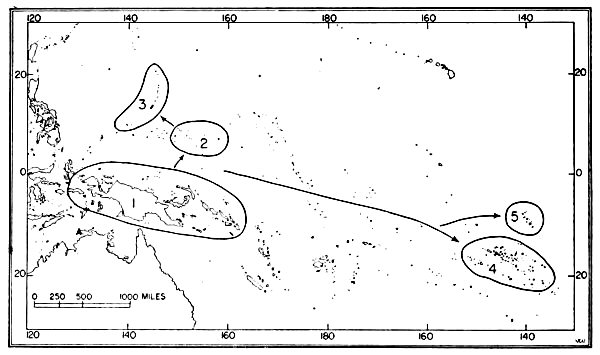
The tendencies in the evolution of these insular populations of Gallicolumba include a reduction of sooty-black on the head and a reduction of coppery gloss on the back of the male and the reduction of malelike plumage in the female. G. rubescens of the Marquesas Islands is smaller and darker. It retains the coppery gloss on the back and has, in addition, a white bar on the tail and one on the wing. On the basis of color and structural characters, it is apparent that this superspecies of Gallicolumba has evolved from a center of evolution in the region of New Guinea (as shown in figure 14) with a colonization of Micronesia, from which (probably from G. x. kubaryi) an invasion of eastern Polynesia occurred establishing G. erythroptera in the Society and Tuamotu islands, although it is also possible that G. erythroptera may have reached Polynesia by way of a more direct route from Melanesia. Such a pathway of colonization as that just described is not unusual since representatives of other genera including Acrocephalus, Myzomela, and Zosterops may have followed similar paths of dispersal from Micronesia into Polynesia. Apparently a population isolated in the Marquesas has evolved the distinctive G. rubescens.
Caloenas nicobarica pelewensis Finsch
Nicobar Pigeon
Caloenas nicobarica var. pelewensis Finsch, Journ. Mus. Godeffroy, 8, 1875, p. 159 (in reprint p. 27). (Type locality, Palau.)
Caloenas nicobarica pelewensis Mathews, Syst. Avium Australasianarum, 1, 1927, p. 77 (Pelew); Hand-list Japanese Birds, rev., 1932, p. 188 (Palau); Peters, Check-list Birds World, 3, 1937, p. 139 (Palau); Hand-list Japanese Birds, 3d ed., 1942, p. 210 (Babelthuap, Koror); Mayr, Birds Southwest Pacific, 1945, p. 291 (Palau); Baker, Smithson. Misc. Coll., vol. 107, no. 15, 1948, p. 62 (Garakayo).
Caloenas nicobarica Salvadori, Ornith. Papuasia, 3, 1882, p. 211 (Pelew); Wiglesworth, Abhandl. und. Ber. Zool. Mus. Dresden, no. 6, 1890-1891 (1891), p. 57 (Pelew).
Caloenas pelewensis Salvadori, Cat. Birds British Mus., 21, 1893, p. 618 (Pelew); Bolau, Mitteil. Naturhist. Mus. Hamburg, 1898, p. 69 (Palau); Matschie, Journ. f. Ornith., 1901, p. 113 (Palau); Reichenow, Die Vögel, 1, 1913, p. 328 (Palauinseln); Takatsukasa and Kuroda, Tori, 1, 1915, p. 52 (Pelew).
Caloenas nicobaricus pelewensis Kuroda, in Momiyama, Birds Micronesia, 1922, p. 53 (Pelew).
Geographic range.—Micronesia: Palau Islands-Babelthuap, Koror, Garakayo.
Characters.—Adult: A large heavy-bodied pigeon with head, neck, and upper breast blackish; rest of plumage metallic bluish-green with coppery sheen; wings glossy green; tail and under tail-coverts white; feathers of hind-neck long and lanceolate; bill heavy and slightly hooked with lump at base.
Resembles C. n. nicobarica (Linnaeus), but slightly smaller and with upper parts metallic bluish-green and underparts darker and less green.
Measurements.—One adult female measures: wing, 232; tail, 82; culmen, 31; tarsus, 44; one immature female: wing, 236; tail, 89; culmen, 32; tarsus, 45.
Specimens examined.—Total number, three females from Palau Islands, AMNH—exact locality not given (undated).
Remarks.—C. nicobarica is distributed from the Nicobar Islands east through Malaysia to Melanesia as a single undifferentiated form. In the northeasternmost part of its range, in the Palau Islands, it exhibits geographic variation and is considered to be subspecifically distinct from the rest of the population. C. nicobarica appears to have no close relatives. It may represent the last remnant of some ancient group of pigeons.
The Nicobar Pigeon is rare. Coultas, who visited the islands in 1931, did not obtain the bird. The only specimens available for study are those in the collections of the American Museum of Natural History taken by Kubary in the period between 1870 and 1880. The NAMRU2 party did not obtain specimens but saw the bird on five occasions at the island of Garakayo in the middle Palaus. The writer expected the bird to be ground-living in habit, but the individuals, which I saw at Garakayo, were either perched on scrubby vegetation on high and inaccessible cliffs or were flying high overhead. In its flight overhead, the short, white tail was a particularly conspicuous mark of identification. The flight reminded me very much of that of the Black Vulture (Córagyps atrátus) of North America. No birds were found at Peleliu or Angaur, and the small population of this pigeon that remains is probably restricted to uninhabited coral islets, as Mayr (1945a:291) has already noted. Marshall (1949: 207) saw one bird on Peleliu and one on Koror in November and December, 1945. This endemic subspecies is probably on the road to extinction unless governmental protection can be established and enforced.
Trichoglossus rubiginosus (Bonaparte)
Ponapé Lory
Chalcopsitta rubiginosus Bonaparte, Comptes Rendus Acad. Sci. Paris, 30, February, 1850, p. 134; Consp. Avium, 1, after April 15, 1850, p. 3. (Type locality, "ex Insulis Barabay et Guebe," error = Ponapé.)
Chalcopsitta rubiginosus Bonaparte, Proc. Zool. Soc. London, 1850, p. 26, pl. 16 ("Ins. Barabay et Guebe," error = Ponapé); Pelzeln, Reise "Novara," Vögel, 1865, pp. 99, 162 (Puynipet); Reichenow, Journ. f. Ornith., 1881, p. 162 ("Nordwestl. Polynessische subregion Carolinen" = Ponapé); Tristram, Cat. Birds, 1889, p. 73 (Ponapé); Finsch, Deut. Verein zum Schultze der Vogelwelt, 18, 1893, p. 458 (Carolinen = Ponapé); Matschie, Journ. f. Ornith., 1901, p. 112 (Ponapé).
Domicella rubiginosa Finsch, Die Papageien, 2, 1868, p. 781 (Puynipet); Hartlaub and Finsch, Proc. Zool. Soc. London, 1872, p. 88 (Puinipet).
Lorius rubiginosus Gray, Hand-list Birds, 2, 1870, p. 153 (Puynipet); Schlegel, Mus. Pays-Bas, 3, no. 38, 1874, p. 58 (Puynipet).
Lorius rubiginosa Giebel, Thes. Ornith., 2, 1875, p. 502 (Senjawin = Ponapé).
Trichoglossus rubiginosus Finsch, Journ. Mus. Godeffroy, 12, 1876, pp. 17, 18 (Ponapé); idem, Proc. Zool. Soc. London, 1877 (1878), p. 778 (Ponapé); idem, Journ. f. Ornith., 1880, p. 284 (Ponapé); Schmeltz and Krause, Ethnogr. Abth. Mus. Godeffroy, 1881, p. 281 (Ponapé); Finsch, Ibis, 1881, pp. 110, 111, 114 (Ponapé); idem, Mitth. Ornith. Ver. Wien, 1884, p. 49 (Ponapé); Hartert, Kat. Vogelsamml. Senckenb., 1891, p. 161 (Puypinet); Wiglesworth, Abhandl. und Ber. Zool. Mus. Dresden, no. 6 1890-1891 (1891), p. 8 (Ponapé); Peters, Check-list Birds World, 3, 1937, p. 151 (Ponapé); Mayr, Proc. Sixth Pac. Sci. Congr., 4, 1941, p. 204 (Ponapé); Hand-list Japanese Birds, 3d ed., 1942, p. 201 (Ponapé); Mayr, Birds Southwest Pacific, 1945, p. 291 (Ponapé).
Eos rubiginosa Salvadori, Ornith. Papuasia, 1, 1880, p. 267 (Puynipet); idem, Cat. Birds British Mus., 20, 1891, p. 29 (Ponapé); Christian, The Caroline Islands, 1899, p. 357 (Ponapé); Finsch, Notes Leyden Mus., 22, 1900, p. 142 (Ponapé); Dubois, Syn. Avium, 1902, p. 29 (Puinipet); Uchida, Annot. Zool. Japon., 9, 1918, pp. 484, 493 (Ponapé); Wetmore, in Townsend and Wetmore, Bull. Mus. Comp. Zoöl., 63, 1919, p. 192 (Ponapé).
Chalcopsittacus rubiginosus Finsch, Sammlung wissensch. Vorträge, 14th Ser., 1900, p. 639 (Ponapé).
Oenopsittacus rubiginosus Reichenow, Die Vögel, 1, 1913, p. 443 (Karolinen = Ponapé); Kuroda, in Momiyama, Birds Micronesia, 1922, p. 58 (Ponapé); Mathews, Syst. Avium Australasianarum, 1, 1927, p. 295 (Ponapé); Hand-list Japanese Birds, rev., 1932, p. 181 (Ponapé).
Eos rubiginosus Takastukasa and Kuroda, Tori, 1, 1915, p. 53 (Ponapé).
Geographic range.—Micronesia: Caroline Islands—Ponapé.
Characters.—Adult: A medium-sized, dark raspberry-red lory with head and nape deep purplish-red; upper back, scapulars, and upper wing-coverts raspberry-red, edged with blackish; lower back, rump, and upper tail-coverts more purplish; tail yellowish-green becoming more yellow and less green toward tip; wings black with outer webs olivaceous-green; outer edges of primaries more yellowish; lores, chin, auriculars, sides of head, and neck deep purplish-red, chin feathers faintly barred with raspberry and edged with blackish; throat, breast, abdomen, and flanks raspberry-red, feathers edged with blackish except on lower abdomen; under tail-coverts orange-red, under wing-coverts deep purple with black edges; bill of male orange, of female paler yellow; feet black; iris of male light yellowish-orange, of female grayish-white.
Immature: Resembles adult, but with narrow and more sharply pointed tail feathers.
Measurements.—Measurements are presented in table 29.
Table 29. Measurements of Trichoglossus rubiginosus
Sex No. Wing Tail Culmenybr />from cere Tarsus
Adult males 18 147 105 20 16
(143-153) (100-110) (19-20) (15-17)
Adult females 13 142 101 19 16
(141-146) (98-104) (18-19) (15-17)
Specimens examined.—Total number, 31 (18 males, 13 females), as follows: Caroline Islands, USNM—Ponapé, 2 (Feb. 12); AMNH—Ponapé, 29 (Nov.).
Nesting.—According to Coultas (field notes) the nest is placed in the top of a coconut tree or in a hollow of a large forest tree. He says that one egg is laid, but does not record dates of nesting. Four of the birds taken by Coultas at Ponapé in November had swollen gonads.
Molt.—Specimens taken in November by Coultas were either in fresh plumage or were completing the molt when obtained.
Parasites.—Uchida (1918:484, 493) found the bird lice (Mallophaga), Psittaconirmus harrisoni and Eomenopon denticulatus, on the Ponapé Lory.
Remarks.—There is little written information concerning the habits of the Ponapé lory. Mayr (1945a:291) describes the bird as being "very noisy" and with "habits apparently similar to T. haematodus." Coultas made a number of observations on this species; some of these unpublished notes are essentially as follows: Trichoglossus is common on Ponapé. It is found everywhere on the island, preferring the coconut palms; it is noisy and quarrelsome. The parrot travels usually in small groups of two to six or eight birds, keeping up a continuous chatter all of the time. This chatter quiets down into a very pleasant-sounding crooning-tone after sunset. Trichoglossus is a continual nuisance to the hunter, inquisitive and easily attracted by the slightest noise, to which the bird responds with a frantic yapping that frightens everything within a radius of a mile. One sometimes finds a bird alone working quietly about among the low trees of the high mountain ridges. The natives' name for the bird, "se ridt," means "always hide out in rain." The bird stays under a big leaf and keeps dry during the rain. This lory is intelligent, easily tamed, and sometimes learns to repeat a few words.
Evolutionary history of Trichoglossus rubiginosus.—The Ponapé Lory is the only native parrot in Micronesia. It is an aberrant species and seemingly is of long residence on the island, as indicated by its differences from related forms to the southward and southwestward. The bird shows some relationships to T. ornatus (Linnaeus) of Celebes, but the plumage of T. rubiginosus lacks the brilliant red, green, and yellow of this bird. The plumage of the Ponapé Lory is also softer in texture; this is a character exhibited also by other Micronesian birds, for example, Cleptornus and Colluricincla. T. rubiginosus and T. ornatus correspond, however, in having the feathers of the breast edged with blackish. T. rubiginosus resembles also T. flavovirides of Celebes and Sula in that the edges of the feathers of the breast are dark, no markings are present on the inner web of the wing, and feathers of the upper back are edged with dark coloring. T. rubiginosus may have been derived from either of these two species; however, it shows a close relationship also to the T. haematodus group from the Papuan region. In any case, the Ponapé Lory, isolated in Micronesia, has not the multicolored plumage of its relatives and has, instead, a rather uniformly colored plumage. The presence of this parrot at only a single island in Micronesia is difficult to explain; perhaps at one time the bird was more widely distributed in Micronesia, or it may be that the population represents a single successful invasion to Ponapé. Like Aplonis pelzelni, another endemic species at Ponapé, this lory may have reached the island as a straggler, perhaps being carried north by the prevailing winds in the post-nesting season.
Cuculus canorus telephonus Heine
Common Cuckoo
Cuculus telephonus Heine, Journ. f. Ornith., 1863, p. 332. (Type locality, Japan.)
Cuculus canorus Hartlaub and Finsch, Proc. Zool. Soc. London, 1872, pp. 89, 100 (Pelew); Finsch, Journ. Mus. Godeffroy, 8, 1875, pp. 4, 12 (Palau); Wiglesworth, Abhandl. und Ber. Zool. Mus. Dresden, no. 6, 1890-1891 (1891), p. 10 (Pelew); Takatsukasa and Kuroda, Tori, 1, 1915, p. 63 (Pelew).
Cuculus canorus telephonus Kuroda, in Momiyama, Birds Micronesia, 1922, p. 57 (Pelew); Hand-list Japanese Birds, rev., 1932, p. 181 (Palau); Hand-list Japanese Birds, 3d ed., 1942, p. 201 (Palau); Mayr, Birds Southwest Pacific, 1945, p. 302 (Palau).
Geographic range.—Breeds in northeastern Asia and Japan. Winters south to India, Malaysia, and Melanesia. In Micronesia: Palau Islands—exact locality not given.
Remarks.—The Common Cuckoo is a straggler on winter migration to the Palau Islands.
Cuculus saturatus horsfieldi Moore
Oriental Cuckoo
Cuculus horsfieldi Moore, in Moore and Horsfield, Cat. Birds Mus. Hon. East-India Co., 2, 1856-58 (1857), p. 703. (Type locality, Java.)
Cuculus striatus Hartlaub and Finsch, Proc. Zool. Soc. London, 1872, pp. 89, 100 (Pelew); Finsch. Journ. Mus. Godeffroy, 8, 1875, pp. 4, 12 (Palau); Takatsukasa and Kuroda, Tori, 1, 1915, p. 63 (Pelew).
Cuculus intermedius Wiglesworth. Abhandl. und Ber. Zool. Mus. Dresden, no. 6, 1890-1891 (1891), p. 10 (Pelew).
Cuculus optatus optatus Kuroda, in Momiyama, Birds Micronesia, 1922, p. 57 (Pelew); Hand-list Japanese Birds, rev., 1932, p. 181 (Palau).
Cuculus saturatus horsfieldi Hand-list Japanese Birds, 3d ed., 1942, p. 201 (Babelthuap, Koror); Mayr, Birds Southwest Pacific, 1945, p. 302 (Palau).
Geographic range.—Breeds in eastern Asia and Japan. Winters south to India, Malaysia, and Melanesia. In Micronesia: Palau Islands—Babelthuap, Koror.
Remarks.—The Oriental Cuckoo reaches the Palau Islands as a winter visitor. On November 11 and 25 of 1931, Coultas obtained four immature birds at Palau near taro swamps. The natives told him that the cuckoo visited the islands each year from December to June. On September 21 at Angaur the NAMRU2 party saw one bird which may have been this cuckoo.
Eudynamis taitensis (Sparrman)
Long-tailed New Zealand Cuckoo
Cuculus taitensis Sparrman, Mus. Carls., fasc, 2, 1787, pl. 32. (No type locality = Tahiti.)
Eudynamis tahitiensis Gräffe, Journ. Mus. Godeffroy, 2, 1873, p. 123 (Yap).
Eudynamis taitiensis Finsch, Journ. Mus. Godeffroy, 8, 1875, p. 49 (Palau); idem, Journ. Mus. Godeffroy, 12, 1876, pp. 17, 20 (Ponapé); idem, Proc. Zool. Soc. London, 1877 (1878), p. 778 (Ponapé); idem, Journ. f. Ornith., 1880, pp. 284, 298 (Ponapé, Kuschai, Palaos, Marshalls); idem, Ibis, 1880, pp. 331, 332 (Taluit); idem, Ibis, 1881, pp. 104, 108, 113, 114 (Kushai, Uleai, Ponapé); Schmeltz and Krause, Ethnogr. Abth. Mus. Godeffroy, 1881, pp. 281, 299, 353 (Ponapé, Mortlock, Ruk); Christian, The Caroline Islands, 1899, p. 358 (Ponapé).
Urodynamis taitensis Finsch, Mitth. Ornith. Ver. Wien, 1884, p. 53 (Jaluit, Ponapé, Palau); Bogert, Amer. Mus. Novit., no. 933, 1937, p. 9 (Palau, Ruk, Kusaie, Ponapé, Truk, Iringlove, Wozzie, Auru, Jaluit, Ratak); Peters, Check-list Birds World, 4, 1940, p. 40 (Palaus, Carolines, Marshall); Hand-list Japanese Birds, 3d ed., 1942, p. 201 (Palau, Truk, Lukunor, Ponapé, Kusaie, Jaluit, Elmore, Aurh, Wotze).
Urodynamis taitiensis Wiglesworth, Abhandl. und Ber. Zool. Mus. Dresden, no. 6, 1890-1891 (1891), p. 11 (Pelew, Ualan, Ponapé, Luganor, Taluit); idem, Ibis, 1893, p. 212 (Marshalls); Hartert, Novit. Zool., 7, 1900, p. 7 (Ruk); Finsch, Notes Leyden Mus., 22, 1900, p. 120 (Ponapé, Palau, Kuschai, Ruk, Mortlock, Uleai, Jaluit); Takatsukasa and Kuroda, Tori, 1, 1915, p. 52 (Ruk); Kuroda, in Momiyama, Birds Micronesia, 1922, p. 58 (Pelew, Ualan, Ponapé, Luganor, Ruk, Taluit); Hand-list Japanese Birds, rev., 1932, p. 180 (Palau, Kusaie, Ponapé, Luganor, Truk, Jaluit, Elmore, Aurh, Wotze).
Urdynamis taitiensis Finsch, Sammulung wissensch. Vorträge, 14th ser., 1900, p. 659 (Palau).
Eudynamis taitiensis Schnee, Zool. Jahrbücher, 20, 1904, p. 389 (Marshalls); Mayr, Birds Southwest Pacific, 1945, p. 302 (Micronesia).
Geographic range.—Breeds in New Zealand and adjacent islands. Winters chiefly in Polynesia, also Melanesia and Micronesia. In Micronesia: Palau Islands—exact locality unknown; Caroline Islands—Yap, Lukunor, Truk, Ponapé, Kusaie; Marshall Islands—Jaluit, Elmore, Auru, Wotze, Bikini.
Characters.—Adult: A large, long-tailed cuckoo with upper parts dark brown; top of head spotted with white; wings, upper back and tail barred with rufous; underparts pale rufous or buffy-rufous with shafts of feathers streaked with brown.
Specimens examined.—Total number, 4 (2 males, 2 females), as follows: Caroline Islands, AMNH—Truk, 1 (Jan. 7)—Kusaie, 2 (March); Marshall Islands, USNM—Bikini, 1 (May 1).
Remarks.—Bogert (1937) has summarized the information known concerning the migration of the New Zealand Long-tailed Cuckoo. Its principal winter range is in eastern and central Polynesia: Fiji, Samoa, Tonga, Union, Cook, Society, and Tuamotu islands. The bird reaches the northern extent of its range in the Marshall and Caroline islands (see map in Bogert, 1937:3-4). There are no records for the Marianas and only one record from the Palaus (taken by Peters, as recorded by Finsch, 1875:49). The bird is seemingly much more numerous as a winter visitor in the Marshall Islands than in the Caroline Islands. Coultas (field notes) writes that the cuckoo appears at Kusaie about the first of February. Bogert (1937) remarks that the cuckoo arrives at New Zealand for the breeding period in October or November and leaves for the northern wintering grounds in February or March.
Bogert (1937:11) discusses briefly the history of migration of this bird. She presents as a possible reason for the migration the fact that the cuckoo feeds principally on caterpillars and that as a consequence it moves northward to the tropics during the winter months because this food is not available at the breeding grounds in the winter months. Perhaps this cuckoo in developing its ability to fly long distances over water on migration has expanded the breadth of its range eastward into the oceanic islands, rather than westward through Malaysia and Melanesia, because it has found less competition from resident birds and from other migrants for feed and habitat. On many of the islands and atolls of the Pacific Basin, this species is the only land bird known.
Otus podarginus (Hartlaub and Finsch)
Palau Scops Owl
Noctua podargina Hartlaub and Finsch, Proc. Zool. Soc. London, 1872, p. 90. (Type locality, Pelew Islands.)
Noctua podargina Finsch, Journ. Mus. Godeffroy, 8, 1875, pp. 4, 8, pl. 1, fig. 1 and 2 (Palau); Giebel, Thes. Ornith., 2, 1875, p. 720 (Pelew); Schmeltz and Krause, Ethnogr. Abth. Mus. Godeffroy, 1881, p. 407 (Palau).
Ninox podargina Sharpe, Cat. Birds British Mus., 2, 1875, p. 151 (Palau); Bolau, Mitteil. Naturhist. Mus. Hamburg, 1898, p. 51 (Palau); Kuroda, in Momiyama, Birds Micronesia, 1922, p. 61 (Pelew); Hand-list Japanese Birds, rev., 1932, p. 181 (Palau).
Scops podargina Sharpe, Cat. Birds British Mus., 2, 1875, p. 313 (Palau); Nehrkorn, Journ. f. Ornith., 1879, p. 394 (Palau); Wiglesworth, Abhandl. und Ber. Zool. Dresden, no. 6, 1890-1891 (1891), p. 3 (Pelew); Matschie, Journ. f. Ornith., 1901, p. 112 (Palau); Dubois, Syn. Avium, 2, 1904, p. 883 (Pelew).
P[isorhina] podargina Reichenow, Die Vögel, 1913, p. 424 (Palau).
Otus podarginus Mathews, Syst. Avium Australasianarum, 1, 1927, p. 268 (Palau); Mayr. Amer. Mus. Novit., no. 1269, 1944, p. 3 (Palau); idem, Birds Southwest Pacific, 1945, p. 291 (Palau).
Pyrroglaux podargina Yamashina, Tori, 10, 1938, p. 1 (Pelew); Peters, Check-list Birds World, 4, 1940, p. 109 (Babelthuap, Koror); Hand-list Japanese Birds, 3d ed., 1942, p. 202 (Palau).
Geographic range.—Micronesia: Palau Islands—Koror, Babelthuap, Angaur.
Characters.—Adult male: A small owl with forehead and superciliary area whitish tinged with buff and narrowly barred blackish-brown; feathers at base of upper mandible with long, blackish shafts, crown and back rufous-brown; some feathers on neck narrowly barred ochraceous and black; some scapulars with outer webs barred dark brown and white; rump and upper tail-coverts dark rufous, barred white and dark brown; tail rufous, barred indistinctly dark brown, inner webs barred white and dark brown; wings sandy rufous, outer edges of all but first primary spotted buffy-white; lores rufous, shafts white; indistinct eye ring rufous; ear-coverts whitish with rufous tips, chin white; throat white narrowly barred with wavy dark lines and tipped with rufous; breast pale rufous, feathers barred with white and black; abdomen paler rufous; under tail-coverts often barred with black and white without rufous wash; under wing-coverts white barred with dark brown; bill and feet whitish; iris brown.
Adult female: Resembles adult male, but darker brown above with fine vermiculations of blackish color; underparts may be pale or dark rufous with slight or heavy white and brown barrings and spots.
Immature: Resembles adult male, but upper parts darker brown; forehead, crown, and back barred ochraceous and black; scapulars with white shaft streaks and spots of white; underparts more heavily barred.
Measurements.—Eight males measure: wing, 155-163 (159); tail, 82-88 (84); culmen, 22.0-23.5 (23.0); tarsus, 32-35 (33); two females measure: wing, 158, 165; tail, 83, 90; culmen, 23.5, 24.0; tarsus, 33, 35.
Specimens examined.—Total number, 11 (9 males, 2 females), as follows: Palau Islands, USNM—Koror, 1 (Nov. 3); AMNH—exact locality not given, 10 (Oct., Nov., Dec.).
Remarks.—Coultas (field notes) found the Palau Scops Owl fairly common around villages on the island of Koror. He obtained specimens at night with the use of a flashlight. He writes that the bird moves about considerably remaining on one perch and calling for only approximately three minutes. The bird stays in the mangrove thickets in the daylight hours. Marshall (1949:207) also found the owl at Koror as well as at Peleliu in 1945. He observed 33 pairs on Koror (approximately one-half of the total population) and four pairs on Peleliu. The NAMRU2 party did not find the owl in the southern Palaus in 1945.
Yamashina (1938:1) gave the Palau Scops Owl the generic name, Pyrroglaux. Mayr (1944b:3) has reviewed this treatment and presents evidence to show that the name Pyrroglaux should not be recognized and that the bird correctly belongs in the genus Otus. He presents a detailed discussion to show its relationship to O. spilocephalus, and that the characters possessed by O. podarginus are no more different or unusual than those found in other members of this widespread genus. It is pointed out that the reduction of the feathering is probably caused by the change in habitat—from a colder one in Asia to a warmer, tropical one in the Palaus. The bird is probably derived from O. spilocephalus of Asia and Malaysia.
Asio flammeus flammeus (Pontoppidan)
Short-eared Owl
Strix Flammea Pontoppidan, Danske, Atlas, 1, 1763, p. 617, pl. 25. (Type locality, Sweden.)
Strix stridula Quoy and Gaimard, Voy. "Uranie," Zool., 1824, pp. 680, 696 (Mariannes); idem, Ann. Sci. Nat. Paris, 6, 1825, p. 149 (Mariannes).
Otus brachyotus Hartlaub, Journ. f. Ornith., 1854, p. 167 (Mariannen); Finsch (part), Journ. Mus. Godeffroy, 12, 1876, pp. 17, 18 (Mariannen?).
Asio accipitrinus Wiglesworth (part), Abhandl. und Ber. Zool. Mus. Dresden, no. 6, 1890-1891 (1891), p. 3 (Marianne); Oustalet (part), Nouv. Arch. Mus. Hist. Nat. Paris, (3), 7, 1895, p. 168 (Mariannes); Hartert, Novit. Zool., 5, 1898, p. 51 (Marianne); Seale, Occ. Papers Bernice P. Bishop Mus., 1, 1901, p. 44 (Mariannes); Safford, Osprey, 1902, p. 68 (Marianas); idem, Amer. Anthro., 4, 1902, p. 711 (Guam); idem, The Plant World, 7, 1904, p. 263 (Tinian); idem, Contr. U. S. Nat. Herb., 9, 1905, p. 79 (Tinian); Prowazek, Die deutschen Marianen, 1913, p. 88 (Marianen).
Asi accipitrimus Wheeler, Report Island of Guam, 1900, p. 12 (Guam).
Asio flammeus sandwichensis Kuroda (part), in Momiyama, Birds Micronesia, 1922, p. 61 (Marianne); Hand-list Japanese Birds (part), rev., 1932, p. 182 (Marianas).
Asio flammeus ponapensis Hand-list Japanese Birds (part), 3d ed., 1942, p. 202 (Pagan).
Asio flammeus flammeus Mayr, Birds Southwest Pacific, 1945, p. 292 (Marianas).
Geographic range.—Breeds in Europe, Asia, and North America. Winters to tropics. In Micronesia: Mariana Islands—Pagan, Tinian.
Remarks.—The Short-eared Owl was taken at Tinian by Quoy and Gaimard (1824:680, 696) and in recent years has been recorded at Pagan. The committee which prepared the Hand-list of Japanese Birds (Hachisuka et al., 1942:202) writes that the bird taken at Pagan has a short wing (288) and indicates that it belongs to A. f. ponapensis. In the present work this bird is considered to be A. f. flammeus, a migrant from Asia; possibly, however, there is an unrecorded resident population of the Short-eared Owl in the northern Marianas, which may be closely related to A. f. ponapensis of Ponapé. Owls may have at one time been resident in the southern Marianas. At Guam, for instance, owls are well known to the native peoples, and there is suitable habitat for the owl in the extensive grassland areas of the island. Perhaps an owl was resident at Guam and at other islands but has been eliminated partly by the overgrazing and burning of the grassy habitats preferred by the owl.
Asio flammeus ponapensis Mayr
Short-eared Owl
Asio flammeus ponapensis Mayr, Amer. Mus. Novit., no. 609, 1933, p. 1. (Type locality, Ponapé.)
Otus brachyotus Finsch (part), Journ. Mus. Godeffroy, 12, 1876, pp. 17, 18 (Ponapé); idem, Proc. Zool. Soc. London, 1877 (1878), p. 778 (Ponapé); idem, Journ. f. Ornith., 1880, p. 283 (Ponapé); idem, Mitth. Ornith. Ver. Wien, 1884, p. 47 (Ponapé); idem, Sammlung wissensch. Vorträge, 14 ser., 1900, p. 659 (Ponapé).
Asio brachyotus Finsch, Ibis, 1881, pp. 113, 114 (Ponapé).
Asio accipitrinus Ridgway, Proc. U. S. Nat. Mus., 4, 1882, p. 367 (Strong's Island = Kusaie); Wiglesworth (part), Abhandl. und Ber. Zool. Mus. Dresden, no. 6, 1890-1891 (1891), p. 3 (Ponapé); Oustalet (part), Nouv. Arch. Mus. Hist. Nat. Paris, (3), 7, 1895, p. 169 (Ponapi).
Asio flammeus sandwichensis Kuroda (part), in Momiyama, Birds Micronesia, 1922, p. 61 (Ponapé); Hand-list Japanese Birds (part), rev., 1932, p. 182 (Ponapé).
Asio flammeus ponapensis Kelso, Oölogist, 1938, p. 183 (Kusaie); Peters, Check-list Birds World, 4, 1940, p. 170 (Ponapé); Hand-list Japanese Birds (part), 3d ed., 1942, p. 202 (Ponapé); Mayr, Birds Southwest Pacific, 1945, p. 291 (Ponapé).
Geographic range.—Micronesia: Caroline Islands—Ponapé, Kusaie?
Characters.—Adult: a large, short-eared owl, dark brown above streaked with buff and lighter below streaked with dark brown. An adult female has upper parts dark brown, outer webs of feathers buffy to give a streaked appearance; rump pale buff, feathers edged subterminally with darker brown; scapulars like head and back; wing-coverts dark brown tipped and edged with splotches of buffy to buffy-rufous; primaries and secondaries brown with large spots of pale rufous; tail brown barred with whitish buff spots, webs with dark centers; forehead whitish tinged with buff; region below and behind eye dark; chin pale with rufous tinged sides; throat and breast rufous-buff with heavy streaks of brown, becoming narrower on abdomen and under tail; under wing-coverts buffy streaked with dark brown; auxilaries buffy; feathering of tibia and tarsus pale buff; bill dark slate; feet grey-brown; iris yellow.
Resembles A. f. flammeus, but wing shorter and color darker.
Measurements.—Mayr (1933:2) lists the following measurements for two adult females: wing, 295, 307; tail, 135, 139; culmen, 17, 17.5; and tarsus, 48, 51.
Specimens examined.—Total number, 2 females, from Caroline Islands, AMNH—Ponapé (Dec.).
Nesting.—Coultas (field notes) writes that the Short-eared Owl at Ponapé builds its nest in the grass on the ground. He did not observe the nest but received reports of it from the natives.
Remarks.—The owl at Ponapé has been known since the time of Kubary. Coultas, visiting the island in 1930, was the first naturalist to record very much concerning the habits. According to him (field notes) the bird inhabits the open grasslands of Ponapé and apparently has somewhat the same habits as other members of the species. He estimated the population in 1930 as two dozen or more. He found the birds extremely secretive during the daylight hours. They were observed flying over the patches of grassland at twilight and on moonlight nights. He comments that the catlike call of this owl is heard occasionally in the night. Richards writes (in litt.) that twice in late December, 1947, he saw this owl in a forested area near the summit of Jokaj Island (900 feet).
Kelso (1938:138) records the Short-eared Owl from Kusaie on the basis of a specimen taken by Gulick, which Ridgway (1882:367) thought came from the West Indies. The specimen is labeled Strong's Island, which is an old name for Kusaie. Kelso gives the measurements of this bird as: wing, 275; tail, 141; culmen from cere, 19.5, and comments that the wings are shorter than those of specimens from Asia. The skin is in the U. S. National Museum.
The Short-eared Owl at Ponapé closely resembles A. f. flammeus but is slightly smaller and darker. Apparently the owl came to Ponapé as a straggler on migration from Asia, and becoming acclimated and adapted to the grassy areas at Ponapé remained as a resident. The occurrence of A. f. flammeus in the Marianas on migration offers evidence as to how the bird originally reached Ponapé.
Caprimulgus indicus jotaka Temminck and Schlegel
Jungle Nightjar
Caprimulgus jotaka Temminck and Schlegel, in Siebold's Fauna Japonica, Aves, 1847, p. 37, pl. 12, 13. (Type locality, Japan.)
Caprimulgus indicus jotaka Hand-list Japanese Birds, rev., 1932, p. 179 (Palau); Hand-list Japanese Birds, 3d ed., 1942, p. 199 (Palau); Mayr, Birds Southwest Pacific, 1945, p. 302 (Palau).
Geographic range.—Breeds in eastern Asia and Japan. Winters south to tropics. In Micronesia: Palau Islands—exact locality unknown.
Remarks.—According to the committee who prepared the Hand-list of Japanese Birds (Hachisuka et al., 1942:199), one female was obtained by Oba in the Palaus in November, 1930. The skin was placed in the Kuroda collection. Coultas obtained a male on December 9, 1931, in the Palaus, which is in the American Museum of Natural History. The bird is apparently an occasional migrant to western Micronesia.
Caprimulgus indicus phalaena Hartlaub and Finsch
Jungle Nightjar
Caprimulgus phalaena Hartlaub and Finsch, Proc. Zool. Soc. London, 1872, p. 91. (Type locality, Pelew.)
Caprimulgus phalaena Finsch, Journ. Mus. Godeffroy, 8, 1875, pp. 4, 13, pl. 2, fig. 1, 2 (Palau); Schmeltz and Krause, Ethnogr. Abth. Mus. Godeffroy, 1881, p. 407 (Palau); Wiglesworth, Abhandl. und Ber. Zool. Mus. Dresden, no. 6, 1890-1891 (1891), p. 17 (Pelew); Hartert, Cat. Birds British Mus., 16, 1892, p. 545 (Pelew); idem, Das Tierreich, no. 1, 1897, p. 51 (Palau); Bolau, Mitteil. Naturhist. Mus. Hamburg, 1898, p. 65 (Palau); Matschie, Journ. f. Ornith., 1901, p. 112 (Palau); Dubois, Syn. Avium 1, 1902, p. 124 (Pelew); Reichenow, Die Vögel, 2, 1914, p. 154 (Palau); Mathews, Syst. Avium. Australasianarum, 1, 1927, p. 396 (Pelew); Hachisuka, Birds Philippines, 2, 1934, p. 120 (Pelew).
Caprimulgus indicus phalaena Kuroda, in Momiyama, Birds Micronesia, 1922, p. 61 (Pelew); Hand-list Japanese Birds, rev., 1932, p. 179 (Palau); Peters, Check-list Birds World, 4, 1940, p. 204 (Palau); Hand-list Japanese Birds, 3d ed., 1942, p. 199 (Babelthuap, Koror); Mayr, Birds Southwest Pacific, 1945, p. 292 (Palau).
Geographic range.—Micronesia: Palau Islands—Babeltuap, Koror, Garakayo.
Characters.—Adult male: "Above grayish-brown, very finely vermiculated, more rufous on the back, with large longitudinal streaks and a few cross markings; scapulars partly with pale buff bands, mostly pale gray at the basal portion; primaries deep brown, with a white spot to the inner web of the first primary not extending to the shaft, second and third primary with fine spots to the inner web extending to the shaft and obsolete white spots to the outer web, fourth primary with a smaller and less pure white spot; chin and throat blackish brown, barred with rufous, with two white spots on the throat; breast brownish gray, vermiculated and spotted with brown and blackish; abdomen dirty ochraceous buff barred with brown, the bars wider on the lower tail-coverts; retrices rufous-brown with blackish bars, outer ones with broad white terminal spots." (Hartert, 1892:545.) Bill basally whitish with black tip; feet blackish pink; iris dark brown.
Adult female: According to Hartert (1892:545) similar to male, but with small, more or less obsolete, rufous-buff (not white) spots on the primaries; rectrices without white spots.
Immature: Resembles adult but paler and less distinctly marked.
C. i. phalaena resembles C. i. jotaka, but is paler; the male is more broadly barred and more buffy on abdomen and under side of tail; the female has paler spots on wing.
Measurements.—Measurements of four males: wing, 161-168 (165); tail, 118-129 (124); culmen, 22; tarsus, 14.0-15.1 (14.5); of four females: wing, 161-165 (163); tail, 118-127 (123); culmen, 22; tarsus, 14.5-15.6 (15.1).
Specimens examined.—Total number, 8 (4 males, 4 females), as follows: Palau Islands, USNM—Koror, 3 (Nov. 3, 20, 29); AMNH—exact locality not given, 5 (Oct., Nov., Dec.).
Remarks.—This subspecies of the Jungle Nightjar is restricted to the Palau Islands and particularly to those islands possessing damp, shady forests and mangrove swamps. In September, 1945, two birds were observed at the edge of a mangrove swamp at Garakayo at twilight by the NAMRU2 party, but neither of them was taken. Coultas (field notes) found the nightjar in mangrove swamps. He writes that they remain quiet there during the daylight hours. He took specimens both in the evening and at dawn. He considers the bird as not very common. Marshall (1949:208) obtained specimens at Koror in 1945.
Among the races of C. indicus, the coloration of C. i. phalaena resembles most closely that of C. i. jotaka; probably C. i. phalaena was derived from C. i. jotaka of Asia. Apparently this bird arrived at the Palaus by way of the Philippines. It is found only in these islands of Micronesia and maybe another one of that group of species which reached the Palaus without expanding their ranges farther into Micronesia.
Collocalia inexpectata pelewensis Mayr
Edible Nest Swiftlet
Collocalia pelewensis Mayr, Amer. Mus. Novit., no. 820, 1935, p. 3. (Type locality, Palau Islands.)
Collocalia vanicorensis Hartlaub, Proc. Zool. Soc. London, 1867 (1868), p. 829 (Pelew); Hartlaub and Finsch, Proc. Zool. Soc. London, 1868, pp. 4, 116, 118 (Pelew); idem, Proc. Zool. Soc. London, 1872, p. 89 (Pelew); Finsch, Journ. Mus. Godeffroy, 8, 1875, pp. 4, 15 (Palau); idem (part), Journ. Mus. Godeffroy, 12, 1876, pp. 17, 24 (Palau); idem (part), Proc. Zool. Soc. London, 1880, p. 575 (Palaos); idem (part), Ibis, 1881, p. 104 (Pelew); Tristram, Cat. Birds, 1889, p. 111 (Pelew); Wiglesworth (part), Abhandl. und Ber. Zool. Mus. Dresden, no. 6, 1890-1891 (1891), p. 18 (Pelew); Matschie (part), Journ. f. Ornith., 1901, p. 112 (Palau).
Collocalia vanikorensis Gray, Hand-list Birds, 1, 1869, p. 66 (Pelew); Giebel, Thes. Ornith., 1, 1872, p. 737 (Pelew).
Collocalia fuciphaga Oustalet (part), Nouv. Arch. Mus. Hist. Nat. Paris, (3), 7, 1895, p. 189 (Palaos); Reichenow, Die Vögel, 2, 1914, p. 161 (Palau).
Collocalia francica Takatsukasa and Kuroda, Tori, 1915, p. 53 (Pelew).
Collocalia fuciphaga inquieta Kuroda (part), in Momiyama, Birds Micronesia, 1922, p. 62 (Pelew).
Collocalia unicolor amelis Kuroda (part), in Momiyama, Birds Micronesia, 1922, p. 63 (Pelew).
Collocalia fuciphaga amelis Hand-list Japanese Birds, rev., 1932, p. 179 (Palau).
Collocalia (vanikorensis) pelewensis Mayr, Amer. Mus. Novit., no. 828, 1936, p. 11 (Palau).
Collocalia germani pelewensis Mayr, Amer. Mus. Novit., no. 915, 1937, p. 18 (Palau).
Collocalia inexpectata pelewensis Peters, Check-list Birds World, 4, 1940, p. 224 (Palau); Mayr, Birds Southwest Pacific, 1945, p. 292 (Palau); Baker, Smithson. Misc. Coll., vol. 107, no. 15, 1948, p. 63 (Garakayo, Peleliu).
Collocalia vanikorensis pelewensis Hand-list Japanese Birds, 3d ed., 1942, p. 199 (Babelthuap, Koror).
Geographic range.—Micronesia: Palau Islands—Babelthuap, Koror, Garakayo, Peleliu, Angaur.
Characters.—Adult, according to Mayr (1935:3): "Small; tarsus naked; upper parts dark fuscous-green, with a brownish tone on back; crown not much darker than back; rump pale but no distinct light gray bar across rump as in C. spodiopygia; color of the rump showing much individual variation, bases of feathers always being pale gray, but tips sometimes strongly glossy green; inner margins of wing-feathers not particularly light; feathers of chin and throat soft, with fuscous bases and rather sharply defined silvery-gray edges, but no shaft-streaks; abdomen dull gray, slightly darker than throat, inconspicuous shaft-streaks on breast and abdomen, more pronounced shaft-streaks on under tail-coverts; longest under tail-coverts fairly glossy green; white loral spot inconspicuous."
Measurements.—Measurements are listed in table 30.
Table 30. Measurements of Collocalia inexpectata in Micronesia
Subspecies No. Wing Tail
C. i. pelewensis 14 111 (109-113) 50 (47-51)
C. i. bartschi 13 108 (105-108) 54 (52-57)
Specimens examined.—Total number, 20 (12 males, 8 females), as follows: Palau Islands, USNM—Peleliu, 1 (Sept. 13)—Garakayo, 2 (Sept. 18)—Koror, 3 (Nov. 5, 6, 7); AMNH—exact locality not given, 14 (Oct., Dec.).
Remarks.—The NAMRU2 party found the swiftlet to be numerous on islands in the southern Palaus in 1945. The birds were observed flying in clearings and about the cliffs. Coultas writes (field notes) that they nest in caves on the smaller islands.
Collocalia inexpectata bartschi Mearns
Edible Nest Swiftlet
Collocalia bartschi Mearns, Proc. U. S. Nat. Mus., 36, 1909, p. 476. (Type locality, Guam.)
Cypselus inquietus Kittlitz (part), Obser. Zool., in Lutké., Voy. "Le Séniavine," 3, 1836, p. 304 (Guahan); idem (part), Denkw. Reise russ. Amer. Micron. und Kamchat., 2, 1858, p. 26 (Guahan).
Collocalia nidifica Gray (part), Ann. Mag. Nat. Hist., (3), 17, 1866, p. 125 (Marianne); idem (part), Hand-list Birds, 1, 1869, p. 65 (Marianne).
Collocalia vanicorensis Finsch (part), Journ. Mus. Godeffroy, 12, 1876, p. 24 (Marianen); idem (part), Ibis, 1881, p. 105 (Guam); Oustalet, Le Nat., 1889, p. 260 (Mariannes); Wiglesworth (part), Abhandl. und Ber. Zool. Mus. Dresden, no. 6, 1890-1891 (1891), p. 18 (Marianne); Matschie (part), Journ. f. Ornith., 1901, p. 112 (Guam, Saipan).
Collocalia fuciphaga Sclater, Proc. Zool. Soc. London, 1865, p. 616 (Marianne); Oustalet (part), Nouv. Arch. Mus. Hist. Nat. Paris, (3), 7, 1895, p. 187 (Mariannes); Hartert, Novit. Zool., 5, 1898, p. 53 (Rota, Guam, Saipan); Seale, Occ. Papers Bernice P. Bishop Mus., 1, 1901, p. 46 (Marianas); Safford, Osprey, 1902, p. 60 (Marianas); idem, The Plant World, 7, 1904, pp. 84, 263 (Guam); idem, Contr. U. S. Nat. Herb., 9, 1905, p. 79 (Guam); Prowazek, Die deutschen Marianen, 1913, p. 102 (Marianen); Cox, Island of Guam, 1917, p. 21 (Guam); Bryan, Guam Rec., vol. 13, no. 2, 1936, p. 25 (Guam).
Collocalia fuchphaga Wheeler, Report Island of Guam, 1900, p. 13 (Guam).
Collocalia fuciphaga fuciphaga Oberholser (part), Proc. Acad. Nat. Sci. Phila., 1906, p. 186 (Guam).
Collocalia unicolor amelis Oberholser, Proc. Acad. Nat. Sci. Phila., 1906, p. 193 (Guam); Kuroda, in Momiyama, Birds Micronesia, 1922, p. 63 (Guam).
Collocalia fuciphaga tachyptera Obersolser, Proc. U. S. Nat. Mus., 42, 1912, p. 20 (Type locality, Guam); Stresemann, Verhandl. Ornith. Gesellsch. Bayern, 12, 1914, p. 11 (Guam); Takatsukasa and Kuroda, Tori, 1, 1915, p. 63 (Marianas); Kuroda, in Momiyama, Birds Michnoseia, 1922, p. 62 (Guam, Saipan, Rota).
Collocalia unicolor bartschi Kuroda, in Momiyama, Birds Micronesia, 1922, p. 63 (Guam).
Collocalia fuciphaga bartschi Mathews, Syst. Avium Australasianarum, 1, 1927, p. 402 (Guam); Hand-list Japanese Birds, rev., 1932, p. 178 (Marianas).
Collocalia vanikorensis bartschi Mayr, Amer. Mus. Novit., no. 828, 1936, p. 11 (Marianne); Hand-list Japanese Birds, 3d ed., 1942, p. 198 (Saipan, Rota, Guam).
Collocalia germani bartschi Mayr, Amer. Mus. Novit., no. 915, 1937, p. 18 (Marianne).
Collocalia inexpectata bartschi Peters, Check-list Birds World, 4, 1940, p. 224 (Marianne); Mayr, Birds Southwest Pacific, 1945, p. 292 (Marianas); Watson, The Raven, 17, 1946, p. 41 (Guam); Downs, Trans. Kansas Acad. Sci., 49, 1946, p. 105 (Tinian); Stott, Auk, 64, 1947, p. 526 (Saipan); Baker, Smithson. Misc. Coll., vol. 107, no. 15, 1948, p. 63 (Guam, Rota).
Collocalia inexpectata Strophlet, Auk, 63, 1946, p. 538 (Guam); Baker, Condor, 49, 1947, p. 125 (Guam).
Geographic range.—Micronesia: Mariana Islands—Guam, Rota, Tinian, Saipan.
Characters.—Resembles C. i. pelewensis, but with wing shorter; upper parts lighter; underparts more brownish and lacking dark shaft-streaks on breast and abdomen; feathers on lores whiter basally.
Measurements.—Measurements are presented in table 30.
Weights.—The present author (1948:63) lists the weights of seven adult males as 6.4-7.3 (6.8); of three adult females as 6.8-7.6 (7.1). These birds were taken at Guam.
Specimens examined.—Total number, 48 (17 males, 19 females, 12 unsexed), as follows: Mariana Islands, USNM—Guam, 21 (Jan. 29, May 20, June 21, July 20, 29)—Rota, 1 (Oct. 27); AMNH—Guam, 18 (Jan. 22, 29, Feb. 15, July 10, Aug. 11, 12)—Saipan, 8 (Sept. 17).
Remarks.—The taxonomic relationships of the species and subspecies of the genus Collocalia are not fully known. The many different name combinations applied to the five kinds named from Micronesia are evidence of the lack of agreement among previous writers as to the correct systematic positions of the kinds. The genus is widely distributed in southeastern Asia and adjacent islands and is divisible into a number of species and subspecies. This diversity is apparently influenced by the restriction of the birds to local habitats caused, as Stresemann (1931b:83) states, by the necessity of staying by their nesting areas which are in caves. Stresemann also points out that the birds are thus dependent on "narrowly limited ecological conditions." The birds are confined to certain areas and are, therefore, isolated from other populations. Most of the volcanic islands of Micronesia have numerous caves which are suitable to the swiftlets for nesting. C. inexpectata evolved in the Malayan region and apparently spread to Micronesia via the Philippines to Palau and to the Marianas. The two subspecies of C. inexpectata in Micronesia resemble closely those to the westward but are smaller. I am following Peters (1940:224) in the treatment of these, and although some future reviser may rearrange these species and subspecies, it appears to me that the Micronesian swiftlets fall into the two natural groups (C. inexpectata and C. inquieta) now recognized, even though their parent stocks in Malaysia, in my opinion, are inadequately known.
At Guam and Rota, the NAMRU2 party found swiftlets concentrated at cliff areas, flying about in large groups. Away from the cliffs fewer were seen and singles were observed in woodland openings, over fields, and in the coconut groves. On May 18, 1945, a colony of nesting birds was found approximately two miles east of Agaña on Guam. This colony was in a coral sink-hole which was approximately 75 feet deep and 60 feet in diameter. The nests were grouped in clusters of 5 to 25 or more, on underhanging ledges, sheltered from the light. The nests, which were fastened securely to the irregular ledges, were knocked down by shots from our collecting guns. Approximately 250 nests were found; no eggs were observed, the nests containing young birds. The young were in various stages of development; some were with little feather growth, others were completely feathered. Nests examined contained only one young each. The pile of guano below each cluster of nests was large; an estimate made at the time indicated that there were 10 or more tons in each pile. Guano deposits in large quantities were found also in caves at Amantes Point, Guam.
Collocalia inquieta inquieta (Kittlitz)
Carolines Swiftlet
Cypselus inquietus Kittlitz, Obser. Zool., in Lutké, Voy. "Le Séniavine," 3, 1836, p. 285. (Type locality, Ualan.)
Cypselus inquietus Kittlitz (part), Denkw. Reise russ. Amer. Micron. und Kamchat., 2, 1858, p. 26 (Ualan).
Collocalia ualensis Streubel, Isis, 1848, p. 368 (no type locality = Kusaie?).
Collocalia nidifica ualensis Gray, Ann. Nat. Hist., 17, 1866, p. 123 (Caroline Islands = Kusaie?).
Collocalia vanicorensis Finsch (part), Journ. Mus. Godeffroy, 12, 1876, p. 24 (Ualan); idem (part), Proc. Zool. Soc. London, 1880, p. 575 (Kuschai); idem (part), Journ. f. Ornith., 1880, pp. 285, 298 (Kuschai); idem (part), Ibis, 1881, pp. 104, 108 (Kushai); Wiglesworth (part), Abhandl. und Ber. Zool. Mus. Dresden, no. 6, 1890-1891 (1891), p. 18 (Ualan); Matschie (part), Journ. f. Ornith., 1901, p. 112 (Ualan).
Collocalia fuciphaga Hartert (part), Cat. Birds British Mus., 16, 1892, p. 498 (Kuschai); Oustalet (part), Nouv. Arch. Mus. Hist. Nat. Paris, (3), 7, 1895, p. 190 (Oualan).
Collocalia fuciphaga fuciphaga Oberholser (part), Proc. Acad. Nat. Sci. Phila., 1906, p. 186 (Ualan).
Collocalia fuciphaga vanikorensis Oberholser (part), Proc. U. S. Nat. Mus., 42, 1912, p. 20 (Kusaie).
Collocalia fuciphaga inquieta Stresemann, Verhandl. Ornith. Gesellsch. Bayern, 12, 1914, pp. 9, 11 (Ualan); Kuroda (part), in Momiyama, Birds Micronesia, 1922, p. 62 (Kusaie); Hand-list Japanese Birds (part), rev., 1932, p. 179 (Kusaie).
Collocalia inquieta inquieta Mayr, Amer. Mus., Novit., no. 915, 1937, p. 11 (Kusaie); Peters, Check-list Birds World, 4, 1940, p. 225 (Kusaie); Mayr, Birds Southwest Pacific, 1945, p. 292 (Kusaie).
Collocalia vanikorensis inquieta Hand-list Japanese Birds, 3d ed., 1942, p. 199 (Kusaie).
Geographic range.—Micronesia: Caroline Islands—Kusaie.
Characters.—Adult: Upper parts dark (sooty-black) with a slight greenish gloss on head and back and a more conspicuous bluish-purple gloss on the wings and tail; feathers of lores white, tipped with black; underparts smoky-gray; feet brownish; bill black; iris dark brown.
Measurements.—Measurements are presented in table 31.
Specimens examined.—Total number, 42 (21 males, 20 females, 1 unsexed), as follows: Caroline Islands, USNM—Kusaie, 1 (Feb. 8); AMNH—Kusaie, 41 (Jan., Feb., March).
Remarks.—Kittlitz obtained this swiftlet when he visited Kusaie from December 8, 1827, to January 1, 1828. In 1931, Coultas found the bird common at Kusaie. The name Collocalia ualensis, published by Streubel in Isis in 1848, p. 368, is without mention of a locality, but is later used by Gray to denote the swiftlet in the Caroline Islands.
Table 31. Measurements of Collocalia inquieta
Subspecies No. Wing
Collocalia i. inquieta 11 119 (116-125)
Collocalia i. ponapensis 10 110 (107-114)
Collocalia i. rukensis 10 (112-119.5)[C]
[C] (Mayr, 1935:3).
Collocalia inquieta rukensis Kuroda
Carolines Swiftlet
Collocalia fuciphaga rukensis Kuroda, Tori, 1, 1915, pp. 58, 59, pl. 3, fig. 1. (Type locality, Ruk.)
Collocalia vanicorensis Finsch (part), Proc. Zool. London, 1880, p. 575 (Ruk); Schmeltz and Krause, Ethnogr. Abth. Mus. Godeffroy, 1881, p. 353 (Ruk); Wiglesworth, Abhandl. und Ber. Zool. Mus. Dresden, no. 6, 1890-1891 (1891), p. 18 (Uap and Ruk); Hartert, Novit. Zool., 7, 1900, p. 11 (Ruk); Matschie, Journ. f. Ornith., 1901, p. 112 (Yap, Ruk).
Collocalia fuciphaga vanikorensis Oberholser (part), Proc. U. S. Nat. Mus., 42, 1912, p. 20 (Uala = Truk).
Collocalia fuciphaga rukensis Takatsukasa and Kuroda, Tori, 1, 1915, p. 53 (Ruk); Kuroda, in Momiyama, Birds Micronesia, 1922, p. 62 (Ruk, Yap); Kuroda, Ibis, 1927, p. 706 (Truk); Mathews, Syst. Avium Australasianarum, 1, 1927, p. 402 (Ruk); Hand-list Japanese Birds, rev., 1932, p. 178 (Ruk).
Collocalia fuciphaga inquieta Kuroda, in Momiyama, Birds Micronesia, 1922, p. 62 (Ruk).
Collocalia inquieta rukensis Mayr, Amer. Mus. Novit., no. 915, 1937, p. 11 (Ruk); Peters, Check-list Birds World, 4, 1940, p. 225 (Truk, Yap); Mayr, Birds Southwest Pacific, 1945, p. 292 (Yap, Truk).
Collocalia vanikorensis rukensis Hand-list Japanese Birds, 3d ed., 1942, p. 198 (Truk, Yap).
Geographic range.—Micronesia: Caroline Islands—Truk, Yap.
Characters.—Adult: Resembles C. i. inquieta but with wing shorter.
Measurements.—Measurements are given in table 31.
Specimen examined.—One unsexed bird from Caroline Islands, USNM—Truk (Feb. 16).
Remarks.—Little is known concerning this swiftlet. The bird at Yap is referred to this race; I have not seen specimens from this island. McElroy reports seeing no swiftlets at Truk in December, 1945. C. i. rukensis appears to be intermediate in size between C. i. inquieta and C. i. ponapensis. Richards writes (in litt.) that he found swiftlets common at Truk in 1948. He also noted a large swiftlike bird in "January or February," 1948, near the summit of Mount Tonáchian on Moen Island. From his description, the bird may have been a large migratory swift, possibly Apus pacificus or Chaetura caudacuta, neither of which have been reported previously from Micronesia.
Collocalia inquieta ponapensis Mayr
Carolines Swiftlet
Collocalia vanikorensis ponapensis Mayr, Amer. Mus. Novit., no. 820, 1935, p. 3. (Type locality, Ponapé.)
Collocalia vanicorensis Finsch (part), Journ. Mus. Godeffroy, 12, 1876, pp. 17, 23 (Ponapé); idem, Proc. Zool. Soc. London, 1877 (1878), p. 778 (Ponapé); idem (part), Journ. f. Ornith., 1880, p. 285 (Ponapé); idem, Ibis, 1881, p. 115 (Ponapé); Wiglesworth (part), Abhandl. und Ber. Zool. Mus. Dresden, no. 6, 1890-1891 (1891), p. 18 (Ponapé); Matschie (part), Journ. f. Ornith., 1901, p. 112 (Ponapé).
Collocalia fuciphaga Hartert, Cat. Birds British Mus., 16, 1892, p. 498 (Ponapé).
Collocalia fuciphaga vanikorensis Takatsukasa and Kuroda, Tori, 1, 1915, p. 53 (Ponapé).
Collocalia fuciphaga inquieta Kuroda (part), in Momiyama, Birds Micronesia, 1922, p. 62 (Ponapé).
Collocalia vanikorensis ponapensis Mayr, Amer. Mus. Novit., no. 828, 1936, p. 12 (Ponapé); Hand-list Japanese Birds, 3d ed., 1942, p. 198 (Ponapé).
Collocalia inquieta ponapensis Mayr, Amer. Novit., no. 915, 1937, p. 11 (Ponapé); Peters, Check-list Birds World, 4, 1940, p. 225 (Ponapé); Mayr, Birds Southwest Pacific, 1945, p. 292 (Ponapé).
Collocalia inquieta Mayr, Proc. 6th Pac. Sci. Congr., 4, 1941, p. 204 (Ponapé).
Geographic range.—Micronesia: Caroline Islands—Ponapé.
Characters.—Adult: According to Mayr (1936:12), "Very similar to inquieta, but much smaller; on the upper parts apparently somewhat less glossy, and not so dark, more brownish; under parts very variable, sometimes very dark (partly on account of greasing), sometimes quite silvery on the throat; very dark specimens show some greenish gloss not only on the longest under tail-coverts, but also on the entire under side, except on the throat; rump of the same color as the back; tarsus unfeathered."
Measurements.—Measurements are listed in table 31.
Specimens examined.—Total number, 37 (19 males, 18 females) from Caroline Islands, AMNH—Ponapé (Nov., Dec.).
Nesting.—Coultas obtained young birds from nests in caves in November and December.
Remarks.—I am following Mayr (1937:11) and Peters (1940:225) in this treatment of these Caroline swiftlets, even though the differences between C. inquieta and C. vanikorensis appear to be slight indeed. C. inquieta appears closest to the forms of C. vanikorensis in Northern Melanesia. The birds found in New Guinea and the Solomons are similar in size to the birds in the Carolines, while those in the Moluccas, Admiralties and Lihir are larger. Color differences are slight with the pale color of the sides of the head and underparts being variable. All of these dark-rumped birds evidently evolved in the Melanesian area.
Halcyon cinnamomina cinnamomina Swainson
Micronesian Kingfisher
Halcyon cinnamomina Swainson, Zool. Illustr., 2, 1821, text to pl. 67. (No type locality = Guam.)
Halcyon cinnamomina Hartlaub, Journ. f. Ornith., 1854, p. 167 (Marianen = Guam); Gray, Cat. Birds Trop. Is. Pacific Ocean, 1859, p. 5 (Ladrone or Marian Islands = Guam); Sharpe (part), Monogr. Alced., 1868-71, pp. xxxii, 213, pl. 80 (Guam); Gray, Hand-list Birds, 1, 1869, p. 93 (Mariannes = Guam); Oustalet, Le Nat., 1889, p. 260 (Mariannes = Guam); Wiglesworth, Abhandl. und Ber. Zool. Mus. Dresden, no. 6, 1890-1891 (1891), p. 16 (Guam); Oustalet, Nouv. Arch. Mus. Hist. Nat. Paris, (3), 7, 1895, p. 175 (Guam); Hartert, Novit. Zool., 5, 1898, p. 53 (Guam); Matschie, Journ. f. Ornith., 1901, pp. 112, 113, 114 (Guam); Wharton, Ecol. Monogr., 16, 1946, p. 174 (Guam); Strophlet, Auk, 63, 1946, p. 538 (Guam); Baker, Condor, 49, 1947, p. 125 (Guam).
Alcedo ruficeps Dumont, Dict. Sci. Nat., 29, 1823, p. 273 (Mariannes = Guam); Pucheran, Rev. et Mag. de Zool., 1853, p. 387 (Mariannes = Guam); Hartlaub, Journ. f. Ornith., 1855, p. 423 (Mariannen = Guam).
Dacela ruficeps Lesson, Traité d'Ornith., 1831, p. 247 (Mariannes = Guam).
Halcyon cinnamomeus Kittlitz, Obser. Zool., in Lutké, Voy. "Le Séniavine," 3, 1836, p. 304 (Guahan).
Dacelo cinnamomina Kittlitz, Denkw. Reise russ. Amer. Micron. und Kamchat., 2, 1858, p. 131 (Guahan); Schlegel, Mus. Pays-Bas, 3, no. 17, 1863, p. 39; no. 39, 1874, p. 29 (Mariannes = Guam); Giebel, Thes. Ornith., 2, 1875, p. 3 (Mariannae = Guam).
Todiramphus cinnamominus Cassin, U. S. Expl. Exped. 1838-'42, 1858, pp. 220, 225 (Ladrone or Marianna Islands = Guam).
Sauropatis cinnamomina Cabanis, Mus. Hein., 2, 1859-'60, p. 159 (Marianen); Salvadori (part), Ornith. Papuasia, 1, 1880, p. 481 (Marianne = Guam).
Halcyon cinnamominus Finsch (part), Journ. Mus. Godeffroy, 12, 1876, pp. 17, 20 (Marianen = Guam); Sharpe, Cat. Birds British Mus., 17, 1892, p. 259 (Marianne = Guam); Seale, Occ. Papers Bernice P. Bishop Mus., 1, 1901, p. 45 (Guam); Safford, Osprey, 1902, p. 69 (Guam); Dubois, Syn. Avium, 1, 1902, p. 108 (Guam); Safford, The Plant World, 7, 1904, p. 263 (Guam); idem, Contr. U. S. Nat. Herb., 9, 1905, p. 79 (Guam); Mearns, Proc. U. S. Nat. Mus., 36, 1909, p. 476 (Guam); Reichenow, Die Vögel, 2, 1914, p. 116 (Marianen = Guam); Takatsukasa and Kuroda, Tori, 1, 1915, p. 63 (Mariannes = Guam); Cox, Islands of Guam, 1917, p. 21 (Guam); Thompson, Guam and its people, 1942, p. 23 (Guam).
Halcyon rufigularis Sharpe, Cat. Birds British Mus., 17, 1892, p. 260 (No type locality = Guam).
Halcyon cinnamanea Wheeler, Report Island of Guam, 1900, p. 12 (Guam).
Halcyon cinnamonius Prowazek, Die deutschen Marianen, 1913, p. 102 (Marianen = Guam).
Souropatis cinnamominus Kuroda, in Momiyama, Birds Micronesia, 1922, p. 59 (Guam).
Hyposyma cinnamomina Mathews, Syst. Avium Australasianarum, 1, 1927, p. 384 (Marianne = Guam).
Halcyon cinnamomina cinnamomina Hand-list Japanese Birds, rev., 1932, p. 179 (Guam); Hand-list Japanese Birds, 3d ed., 1942, p. 200 (Guam); Mayr, Birds Southwest Pacific, 1945, p. 293 (Guam); Peters, Check-list Birds World, 5, 1945, p. 206 (Guam); Watson, The Raven, 17, 1946, p. 41 (Guam); Baker, Smithson. Misc. Coll., vol. 107, no. 15, 1948, p. 63 (Guam).
Halcyon cinnamomius Bryan, Guam, Rec., vol. 13, no. 2, 1936, p. 25 (Guam).
Geographic range.—Micronesia: Mariana Islands—Guam.
Characters.—Adult male: Head, neck, upper back, and entire under surface near "Sanford's brown"; auriculars black with bluish wash; narrow black line extending around nape; orbital ring black; lower back, lesser wing-coverts, and scapulars deep greenish-blue; outer webs of wing feathers and tail blue; rump resembles tail but slightly lighter; under wing-coverts greenish-blue; feet dark brown; bill black, base of mandible paler; iris dark brown.
Adult female: Resembles adult male, but chin, throat, and upper breast paler; rest of underparts and under wing-coverts white; a few cinnamon-tipped feathers on tibia and at bend of wing; back and scapulars darker olive-green and less blue.
Immature: Resembles adult, but brown of crown mixed with greenish-blue; back and wing-coverts edged with pale cinnamon; chin and throat whitish; rest of underparts buffy-white in male and paler in female; feathers on breast and nape with dark edgings.
Measurements.—Measurements are listed in table 32.
Table 32. Measurements of Halcyon cinnamomina
Subspecies Number Wing Tail Exposed culmen Tarsus
H. c. cinnamomina 31 males 102 (96-105) 77 (73-83) 37 (35-39) 15 (14-17)
25 females 102 (99-106) 79 (74-84) 38 (35-38) 15 (14-17)
H. c. pelewensis 5 males 89 (88-89) 61 (58-64) 39 (38-40) 14 (13-14)
4 females 88 (88-89) 64 (61-67) 39 (38-39) 14 (13-14)
H. c. reichenbachii 14 males 99 (95-101) 74 (72-77) 41 (39-43) 16 (16-17)
15 females 100 (96-102) 74 (71-76) 41 (39-42) 16 (15-17)
Weights.—The NAMRU2 party obtained the following weights: 11 adult males, 56-62 (59); 10 adult females, 58-76 (66).
Specimens examined.—Total number, 72 (40 males, 32 females), as follows: Mariana Islands, USNM—Guam, 38 (Feb. 14, 24, March 8, May 25, 26, 30, June 2, 3, 4, 6, 13, 14, 16, 18, 19, 28, 29, July 6, 7, 10, 18, 20, Aug. 24, 30, Nov. 19); AMNH—Guam, 34 (Jan., Feb., March, April, July, Aug., Sept., Nov., Dec.).
Nesting.—In 1945, the NAMRU2 party found the kingfisher nesting in the months of March, April, May, and July. Nests were placed in hollows of trees, usually ten or more feet above the ground. On April 3, a nest was found in a banyan tree approximately 25 feet above the ground in a hollow limb. There were two entrances to the nest cavity and both the male and female were observed to feed the young. They did not enter the hollow but placed food in the protruding beaks of the young; the parents and nestling both were exceedingly noisy throughout most of the feeding period. On July 8, McElroy found a nest containing two white eggs, partly incubated, in a cavity of a felled coconut palm at Agfayan Bay.
Molt.—Examination of specimens indicates that the time of molt is irregular or that molting may occur at any time of the year. However, there may be a peak in molting in July, August and September; many of the adult birds taken then show evidence of molting of wing and tail. This is immediately following the period of greatest nesting activity.
Food habits.—The Micronesian Kingfisher at Guam feeds on various kinds of animal life; lizards and insects are the principal items. Of three birds taken on February 14, the stomach of one contained a blue-tailed skink; one contained parts of insects and one contained parts of a gecko. I watched a kingfisher capture and swallow a skink on January 14. The bird remained motionless on its perch until the reptile approached within striking distance. Seale (1901:45) writes that the bird has a bad reputation as a chicken thief. He remarks, "I rather doubted his ability in this line until one day I actually saw him attack a brood of small chicks quite near me, and he would have undoubtedly secured one had not the mother hen rushed to the rescue."
Parasites.—Wharton (1946:174) obtained the chigger (Acarina), Trombicula sp., from the Guam Kingfisher.
Remarks.—In 1820, Quoy and Gaimard (1824:35) obtained five specimens of this kingfisher at Guam and called the bird "Martin-chasseur à têterouse." Kittlitz recorded the bird in March, 1828. Marche obtained a series of 57 skins at Guam in 1887 and 1888; these were sent to the Paris Museum. Sharpe described the female as a separate species in 1892. There is considerable variation in the coloration of adult birds, which is mostly due to fading, as suggested by Hartert (1898:52). Some individuals have the crown feathers much abraided as a result of rubbing the crown against the edge of the nest holes as the birds enter and leave them.
The kingfisher is fairly common at Guam. It is primarily a bird of the forest, preferring particularly the marginal habitats between woodlands and openings. I saw only a few birds in open country; only rarely were birds seen sitting on the telephone lines along the roads. The writer (1947b:124) found that of all the birds frequenting habitat along roadways on Guam, the kingfisher comprised only 1.2 percent. Thus, it can be said that it is not a bird of very conspicuous habits, although its noisy "rattle" may be heard in the day and at night.
Halcyon cinnamomina pelewensis Wiglesworth
Micronesian Kingfisher
Halcyon pelewensis Wiglesworth, Abhandl. und Ber. Zool. Mus. Dresden, no. 6, 1890-1891 (1891), p. 15. (Type locality, Pelew Islands.)
Halcyon reichenbachii Hartlaub and Finsch, Proc. Zool. Soc. London, 1868, pp. 4, 118 (Pelew); Sharpe, Cat. Birds British Mus., 17, 1892, p. 261 (Pelew).
Halcyon cinnamomina Sharpe (part), Monogr. Alced., 1868-'71, pp. xxxii, 213, pl. 30 (Pelew); Tristram (part), Cat. Birds, 1889, p. 92 (Pelew).
Dacelo reichenbachii Schlegel, Mus. Pay-Bas, 3, no. 39, 1874, p. 29 (Pelew).
Halcyon reichenbachi Finsch, Journ. Mus. Godeffroy, 8, 1875, pp. 4, 11 (Palau); Reichenow, Die Vögel, 2, 1914, p. 116 (Palau).
Halcyon cinnamominus Finsch (part), Journ. Mus. Godeffroy, 12, 1876, pp. 17, 20 (Palau).
Sauropatis cinnamomina Salvadori (part), Ornith. Papuasia, 1, 1880, p. 481 (Pelew).
Halcyon pelewensis Hartert, Novit. Zool., 5, 1898, p. 53 (Pelew); Matschie, Journ. f. Ornith., 1901, pp. 112, 113 (Palau); Takatsukasa and Kuroda, Tori, 1, 1915, p. 53 (Pelew); Uchida, Annot. Zool. Japan., 9, 1918, p. 483 (Palau).
Halcyon Reichenbachi var. pelewensis Oustalet, Nouv. Arch. Mus. Hist. Nat. Paris, (3), 7, 1895, p. 186 (Pelew).
Halcyon cinnamominus var? pelewensis Dubois, Syn. Avium, 1, 1902, p. 108 (Pelew).
Sauropatis reichenbachii pelewensis Kuroda, in Momiyama, Birds Micronesia, 1932, p. 60 (Angaur).
Hyposyma cinnamomina pelewensis Mathews, Syst. Avium Australasianarum, 1, 1927, p. 385 (Palau).
Halcyon cinnamomina pelewensis Hand-list Japanese Birds, rev., 1932, p. 180 (Palau); Hand-list Japanese Birds, 3d ed., 1942, p. 200 (Babelthuap, Koror); Mayr, Birds Southwest Pacific, 1945, p. 293 (Palau); Peters, Check-list Birds World, 5, 1945, p. 206 (Babelthuap, Koror); Baker, Smithson. Misc. Coll., vol. 107, no. 15, 1948, pp. 63, 64 (Peleliu, Ngabad).
Geographic range.—Micronesia: Palau Islands—Kayangel, Babelthuap, Koror, Garakayo, Ngabad, Angaur.
Characters.—Adult: Resembles adult of H. c. cinnamomina, but smaller and with underparts white; auriculars with less bluish wash; outer webs of outer tail feathers edged with white.
Immature: Resembles immature female of H. c. cinnamomina, but smaller with white underparts edged with black on throat, breast, and upper abdomen; outer webs of outer tail feathers edged with white.
Measurements.—Measurements are presented in table 32.
Specimens examined.—Total number, 17 (8 males, 8 females, 1 unsexed), as follows: Palau Islands, USNM—Babelthuap, 1 (Nov. 30)—Peleliu, 1 (Sept. 10)—Ngabad, 3 (Sept. 11); AMNH—exact locality not given, 12 (Oct., Nov., Dec.).
Food habits.—Stomachs of specimens obtained by the NAMRU2 party at Palau contained insects. One male had a large cicada in its stomach. Coultas (field notes) writes that foods of this bird consist of grubs and ants.
Parasites.—Uchida (1918:483) found the bird louse (Mallophaga), Docophorus alatoclypeatus, on this bird at Palau.
Remarks.—In 1945, the NAMRU2 party found this kingfisher in forested areas and at the edges of mangrove swamps on small islands near Peleliu. Only six birds were seen. The bird was located by listening for and determining the direction of its rasping call. After a search of the area of leafy foliage from where the call was coming, the bird would be seen sitting motionless on a near-by perch. McElroy of the NAMRU2 party saw a kingfisher with cinnamon underparts at Bulubul Island at Ulithi Atoll on August 21, 1945. It was not taken.
Halcyon cinnamomina reichenbachii (Hartlaub)
Micronesian Kingfisher
Todirhamphus Reichenbachii Hartlaub, Archiv f. Naturgesch., 18, 1852, p. 131. (Type locality, Ponapé.)
Halcyon cinnamominus Finsch (part), Journ. Mus. Godeffroy, 12, 1876, pp. 17, 19 (Ponapé); idem, Proc. Zool. Soc. London, 1877 (1878), p. 778 (Ponapé); idem, Journ. f. Ornith., 1880, p. 285 (Ponapé); idem, Journ. f. Ornith., 1880, p. 285 (Ponapé); idem, Mitth. Ornith. Ver. Wien, 1884, p. 47 (Ponapé).
Sauropatis cinnamomina Salvadori (part), Ornith. Papuasia, 1, 1880, p. 481 (Ponapé).
Halcyon cinnamomina Finsch, Ibis, 1881, pp. 112, 114 (Ponapé); Tristram (part), Cat. Birds, 1889, p. 92 (Ponapé).
Halcyon mediocris Sharpe, Cat. Birds British Mus., 17, 1892, p. 260 (Type locality, Ponapé); Wiglesworth, Abhandl. and Ber. Zool. Mus. Dresden, no. 6, 1890-1891 (1891), p. 16 (Ponapé); Oustalet, Nouv. Arch. Mus. Hist. Nat. Paris, (3), 7, 1895, pp. 177, 180, 181, 184, 185, 186 (Ponapi); Reichenow, Die Vögel, 2, 1914, p. 116 (Ponapé).
Halcyon reichenbachi Wiglesworth, Abhandl. und Ber. Zool. Mus. Dresden, no. 6, 1890-1891 (1891), p. 15 (Ponapé); Oustalet, Nouv. Arch. Mus. Hist. Nat. Paris, (3), 7, 1895, pp. 176, 180, 181, 182, 183, 184, 185, 186 (Ponapi); Hartert, Novit. Zool., 5, 1898, p. 53 (Ponapé); Matschie, Journ. f. Ornith., 1901, pp. 112, 113 (Ponapé); Mayr, Proc. 6th Pacific Sci. Congr., 4, 1941, p. 204 (Ponapé).
Halcyon cinnamominus var. reichenbachi Dubois, Syn. Avium, 1, 1902, p. 108 (Ponapé).
Halcyon cinnamominus var. mediocris Dubois, Syn. Avium, 1, 1902, p. 108 (Ponapé).
Halcyon reichenbachii Takatsukasa and Kuroda, Tori, 1, 1915, p. 53 (Ponapé).
Sauropatis mediocris Wetmore, in Townsend and Wetmore, Bull. Mus. Comp. Zoöl., 63, 1919, p. 195 (Ponapé).
Sauropatis reichenbachii reichenbachii Kuroda, in Momiyama, Birds Micronesia, 1922, p. 60 (Ponapé).
Hyposyma cinnamomina reichenbachii Mathews, Syst. Avium Australasianarum, 1, 1927, p. 384 (Ponapé).
Halycyon cinnamomina reichenbachii Hand-list Japanese Birds, rev., 1932, p. 180 (Ponapé); Hand-list Japanese Birds, 3d ed., 1942, p. 200 (Ponapé); Mayr, Birds Southwest Pacific, 1945, p. 293 (Ponapé); Peters, Check-list Birds World, 5, 1945, p. 206 (Ponapé).
Halcyon cinnamomina reichenbachii Bequaert, Mushi, 12, 1939, p. 82 (Ponapé); idem, Occ. Papers Bernice P. Bishop Mus., 16, 1941, p. 290 (Ponapé).
Geographic range.—Micronesia: Caroline Islands—Ponapé.
Characters.—Adult male: Resembles adult male of H. c. cinnamomina, but with slightly smaller wing and smaller tail; slightly longer bill; top of head paler cinnamon; feathers of back tipped with cinnamon and bordered by backish; underparts white.
Adult female: Resembles adult male, but feathers forward of black nape band may be mixed white and cinnamon; back and scapulars duller and less olive.
Immature: Resembles adult, but crown streaked with greenish-black; back and scapulars darker; wing-coverts edged with cinnamon, in male chin and throat creamy, sides of throat, breast, and flanks cinnamon, and axillaries, under wing-coverts, abdomen, under tail-coverts paler cinnamon; in female chin and throat white and rest of underparts paler than in male.
Measurements.—Measurements are presented in table 32.
Specimens examined.—Total number, 49 (25 males, 24 females), as follows: Caroline Islands, USNM—Ponapé, 1 (Feb. 12); AMNH—Ponapé, 48 (Nov., Dec).
Molt.—Most of the specimens taken by Coultas in November and December are either worn or in molt.
Parasites.—Bequaert (1939:82 and 1941:290) records a fly (Hippoboscidae), Ornithoica pusilla, from the Micronesian Kingfisher at Ponapé.
Remarks.—The difference in coloration between the adults and immatures has resulted in considerable confusion concerning the taxonomy of this subspecies. According to Wiglesworth (1891a:15), the name Halcyon reichenbachii was established by Gustav Hartlaub in 1852 for a kingfisher with a white abdomen in the Dresden Museum, which had been figured by Reichenbach (Synopsis Avium, Alcedineae, 1851) and called Todiramphus cinnamomina. This specimen had been mislabeled and Hartlaub and Finsch (1868a:4), noting a resemblance between this bird and specimens from the Palau Islands, used the name H. reichenbachii for the birds from the Palaus. Later, when specimens from Ponapé were taken, Hartlaub's bird was found to be identical with them; thus the name H. reichenbachii could be restricted to the bird at Ponapé, and Wiglesworth supplied the new name H. pelewensis for the population at Palau. H. mediocris was used by Sharpe to designate the cinnamon-breasted birds at Ponapé, because they were assumed to belong to a species different from the white-breasted ones. This confused situation was not clarified until additional collections were obtained by the Japanese.
Coultas (field notes) comments on the conspicuously different field characters of the two color types in this bird. In 1930, he found the bird common and usually in marginal habitat in the lowlands and at the edges of mangrove swamps.
Evolutionary history of Halcyon cinnamomina.—The three races of kingfishers belonging to the species H. cinnamomina have been derived from H. chloris. The principal distinction between the two species is the presence of the cinnamon coloring in H. cinnamomina, although within H. chloris there are some subspecies possessing traces of this coloration. The link between these two species, as pointed out to me by Mayr, appears to be H. chloris matthias Heinroth of the St. Matthias and Squally islands, which is colored like H. chloris except that on the head, especially on the occiput, there is a faint wash of color ranging from buff to ochre. This coloration of the head is a step toward the condition in the Micronesian populations of H. cinnamomina.
In H. c. pelewensis and H. c. reichenbachii, the adult birds resemble each other, although the former subspecies is slightly smaller. The immatures of H. c. reichenbachii, however, possess cinnamon coloring on the cheeks, sides of body, and breast in addition to that present on the crown and nape. The crown and nape are of this same color in the adults. In the subspecies at Guam, H. c. cinnamomina, the adult male has the immature type of plumage found in H. c. reichenbachii. The female of H. c. cinnamomina has this cinnamon coloring on the throat, but the breast, abdomen and under tail are white. The original stock from which the Micronesian birds came may have invaded the area via the Palau Islands, although Mayr (1940) is of the opinion that they reached Micronesia via Ponapé (eastern Carolines) and spread to Guam and Palau. He states further (1942b:181, 182) that the presence of H. cinnamomina and H. chloris as reproductively isolated groups in the Palaus may not indicate that they are distinct species, but that they represent the overlap of terminal links of the same species, which have diverged to such an extent as to leave these terminal links reproductively isolated.
Halcyon chloris teraokai Kuroda
White-collared Kingfisher
Halcyon chloris teraokai Kuroda, Tori, 1, 1915, p. 56, pl. 3, fig. 3. (Type locality, Pelew.)
Halcyon albicilla Hartlaub, Proc. Zool. Soc. London, 1867 (1868), p. 828 (Pelew); Hartlaub and Finsch, Proc. Zool. Soc. London, 1868, pp. 4, 118 (Pelew); Gray (part), Hand-list Birds, 1, 1869, p. 93 (Pelew); Finsch, Journ. Mus. Godeffroy, 8, 1875, p. 49 (Palau, Mackenzie, Matetotas); Oustalet (part), Nouv. Arch. Mus. Hist. Nat. Paris, (3), 7, 1895, p. 171 (Pelew).
Halcyon chloris Hartlaub and Finsch, Proc. Zool. Soc. London, 1872, pp. 89, 93 (Pelew); Finsch, Journ. Mus. Godeffroy, 8, 1875, pp. 4, 10 (Palau); Wiglesworth, Abhandl. und Ber. Zool. Mus. Dresden, no. 6, 1890-1891 (1891), p. 14 (Pelew); Mayr, Amer. Mus. Novit., no. 469, 1931, p. 3 (Pelew).
Dacelo albicilla Giebel (part), Thes. Ornith., 2, 1875, p. 1 (Pelew).
Halcyon sanctus Finsch, Journ. Mus. Godeffroy, 8, 1875, p. 50 (Palau); Sharpe, Cat. Birds British Mus., 17, 1892, p. 267 (Pelew).
Dacelo albicilla Giebel (part), Thes. Ornith., 2, 1875, p. 1 (Pelew).
Sauropatis chloris Salvadori, Ornith. Papuasia, 1, 1880, p. 470 (Pelew).
Halcyon chloris teraokai Uchida, Annot. Zool. Japon., 9, 1918, p. 482 (Palau); Kuroda, Ibis, 1927, p. 707 (Pelew); Takatsukasa and Yamashina, Dobutsu. Zasshi, 43, 1931, p. 484 (Pelew); Hand-list Japanese Birds, rev., 1932, p. 180 (Palau); Bequaert, Mushi, 2, 1939, p. 82 (Palau); idem, Occ. Papers Bernice P. Bishop Mus., 16, 1941, p. 290 (Palau); Hand-list Japanese Birds, 3d ed., 1942, p. 201 (Babelthuap, Koror, Angaur); Mayr, Birds Southwest Pacific, 1945, p. 293 (Palau); Peters, Check-list Birds World, 5, 1945, p. 209 (Babelthuap, Koror, Angaur); Baker, Smithson. Misc. Coll., vol. 107, no. 15, 1948, p. 64 (Peleliu, Garakayo).
Sauropatis chloris teraokai Oberholser, Proc. U. S. Nat. Mus., 55, 1919, p. 357 (Pelew); Kuroda, in Momiyama, Birds Micronesia, 1922, p. 59 (Angaur); Mathews, Syst. Avium Australasianarum, 1, 1927, p. 381 (Palau).
Geographic range.—Micronesia: Palau Islands—Kayangel, Babelthuap, Koror, Garakayo, Peleliu, Angaur.
Characters.—Adult male: Dorsal surface bluish, head slightly darker, back and scapulars more greenish, rump lighter blue; outer webs of feathers of wing and of tail dark blue, entire first primary blue, inner webs of other primaries black; collar and underparts white; ariculars black with bluish wash, the black extending around neck above white band; spot on upper lores and narrow line above eye white; orbital ring and lower part of lores black; under wing-coverts white; under tail black; feet black; bill black, mandible with whitish base; iris dark brown.
Adult female: Resembles adult male, but crown and back more green and less blue; auriculars with greenish-blue wash.
Immature: Resembles adult, but feathers of forehead edged with buff; spot on lores and underparts buffy margined with dusky.
H. c. teraokai resembles closely H. c. chloris (Boddaert), but more greenish and less bluish, especially on tail.
Measurements.—Measurements are listed in table 33. Adult males and females have similar measurements and are treated together.
Table 33. Measurements of Halcyon chloris in Micronesia
Subspecies No. Wing Tail Exposed culmen Tarsus
H. c. teraokai 17 113 (110-116) 76 (72-81) 45 (41-52) 14 (13-16)
H. c. orii 9 111 (109-116) 80 (78-83) 44 (42-45) 16 (15-16)
H. c. albicilla 17 116 (109-119) 81 (78-84) 46 (42-49) 16 (14-17)
H. c. owstoni 3 115 (114-116) 81 (80-82) 44 (42-45) 17 (16-17)
Specimens examined.—Total number, 53 (25 males, 28 females), as follows: Palau Islands, USNM—Garakayo, 3 (Sept. 20)—Peleliu, 14 (Aug. 27, 29, 30, 31, Sept. 1, 5, 6, Nov. 7); AMNH—exact locality not given, 36 (Oct., Nov., Dec.).
Food habits.—Unlike H. cinnamomina, H. chloris obtains much of its food by fishing in inland waters or in tidal flats and lagoons. It does, however, obtain terrestrial foods also. Stomachs of birds taken by the NAMRU2 party at Palau contained insects, fish, crab, and shrimp. One stomach contained 3 cc. of fragments of crab, another 2 cc. of shrimp and other crustacea, and another 2 cc. of grasshoppers. Marshall (1949:210) records the house mouse as a food of this bird.
Parasites.—Uchida (1918:483) records the bird louse (Mallophaga), Docophorus alatoclypeatus, from this bird at Palau. Bequaert (1939:82 and 1941:290) lists the fly (Hippoboscidae), Ornithoica pusilla, from H. c. teraokai.
Remarks.—The White-collared Kingfisher at Palau is a showy and conspicuous bird. It cannot be classed as a forest bird but seems to prefer openings and marginal woodlands. Its range does not overlap that of the secretive and inconspicuous H. cinnamomina pelewensis, which prefers the denser forests. In 1945, the NAMRU2 party found H. c. teraokai to be numerous in the cleared battle areas at Peleliu and Angaur. A favorite perch of this bird was the telephone lines, from which a number of our specimens were shot. Usually the bird was observed singly; occasionally two birds were found together. A pair was seen in copulation on August 29. The call of this bird, a loud and harsh rattle, is noticeably different from the low rasping note of H. c. pelewensis. Coultas found H. c. teraokai to be numerous in 1931. He comments (field notes) that the bird frequents salt water areas, especially the mangrove swamps. He noted the bird fishing at the outer reef.
Halcyon chloris orii Takatsukasa and Yamashina
White-collared Kingfisher
Halcyon chloris orii Takatsukasa and Yamashina, Dobutsu. Zasshi, 43, 1931, p. 484. (Type locality, Rota.)
Halcyon albicillus Sharpe (part), Cat. Birds British Mus., 17, 1892, p. 249 (Marianne = Rota).
Halcyon albicilla Oustalet (part), Nouv. Arch. Mus. Hist. Nat. Paris, (3), 7, 1895, p. 169 (Rota); Hartert (part), Novit. Zool., 5, 1898, p. 53 (Rota).
Sauropatis albicillus Kuroda (part), in Momiyama, Birds Micronesia, 1922, p. 58 (Rota).
Halcyon chloris orii] Hand-list Japanese Birds, rev., 1932, p. 180 (Rota); Hand-list Japanese Birds, 3d ed., 1942, p. 200 (Rota, Saipan as straggler); Mayr, Birds Southwest Pacific, 1945, p. 293 (Rota); Peters, Check-list Birds World, 5, 1945, p. 210 (Rota); Baker, Smithson. Misc. Coll., vol. 107, no. 15, 1948, p. 64 (Rota).
Geographic range.—Micronesia: Mariana Islands—Rota.
Characters.—Adult: Resembles H. c. teraokai, but loral spot larger and more buffy; occiput lightly streaked with white and white line above eye; top of head and back more oily green and less blue, darker in female.
Immature: Resembles adult, but underparts and loral spot buffy with dusky edges; feathers of forehead tipped with buff; remainder of upper parts slightly darker.
Measurements.—Measurements are listed in table 33.
Weights.—The author (1948:64) lists the weights of two adult females as 84 and 85.
Specimens examined.—Total number, 11 (4 males, 6 females, 1 unsexed), from Mariana Islands, USNM—Rota (Oct. 18, 19, 22, 26, Nov. 2).
Molt.—The 11 specimens taken by the NAMRU2 party at Rota in October and November are in molt.
Remarks.—The kingfisher at Rota was taken by Marche in June and July, 1888, and reported by Oustalet (1895:169). It was taken later by the Japanese and described by Takatsukasa and Yamashina as a new subspecies. Apparently, no other specimens were taken until the NAMRU party visited Rota in October and November, 1945, and obtained 11 skins. The bird is conspicuous and common at Rota.
The color characters of white feathers intermingled with the bluish coloring of the crown and the occiput and the large, whitish loral spot place this subspecies as intermediate between H. c. teraokai and the two subspecies known from the more northern Marianas.
Halcyon chloris albicilla (Dumont)
White-headed Kingfisher
Alcedo albicilla Dumont, Dict. Sci. Nat., éd. Levrault, 29, 1823, p. 273. (Type locality, Marianne = Tinian.)
Alcedo albicilla Pucheran, Rev. et Mag. Zool., 1853, p. 388 (Marianne = Tinian); Hartlaub, Journ. f. Ornith., 1855, p. 423 (Mariannen = Tinian); Cassin, U. S. Expl. Exped. 1838-'42, 1858, p. 225 (Mariannes = Tinian).
Todiramphus albicilla Reichenbach, Syn. Avium, Alcedineae, 1851, p. 30 (Mariannen = Tinian).
Halcyon albicilla Hartlaub, Journ. f. Ornith., 1854, p. 167 (Mariannen = Tinian); Gray, Cat. Birds Trop. Is. Pacific Ocean, 1859, p. 5 (Ladrone or Marian Islands = Tinian); Gray (part), Hand-list Birds, 1, 1869, p. 93 (Mariannes = Tinian); Oustalet, Le Nat., 1889, p. 260, (Saypan); Wiglesworth (part), Abhandl. und Ber. Zool. Mus. Dresden, no. 6, 1890-1891 (1891), p. 14 (Marianne = Tinian); Oustalet (part), Nouv. Arch. Mus. Hist. Nat. Paris, (3), 7, 1895, p. 169 (Saypan); Hartert (part), Novit. Zool., 5, 1898, p. 52 (Saipan); Matschie, Journ. f. Ornith., 1901, pp. 112, 113, 114 (Saipan); Seale, Occ. Papers Bernice P. Bishop Mus., 1, 1901, p. 45 (Saipan).
Dacelo albicilla Giebel (part), Thes. Ornith., 2, 1875, p. 1 (Marianne = Tinian).
Sauropatis albicilla Salvadori, Ornith. Papuasia, 1, 1880, p. 470 (Marianne = Tinian).
Halcyon albicillus Sharpe (part), Cat. Birds British Mus., 17, 1892, p. 249 (Marianne = Saipan).
Halcyon saurophagus Schnee, Zeitschr. f. Naturwisch., 82, 1912, p. 463 (Saipan).
Sauropatis albicillus Kuroda (part), in Momiyama, Birds Micronesia, 1922, p. 58 (Saipan).
Leucalcyon albicilla albicilla Mathews (part), Syst. Avium Australasianarum, 1, 1927, p. 376 (Saipan).
Halcyon chloris albicilla, Hand-list Japanese Birds, rev., 1932, p. 180 (Saipan, Tinian); Hand-list Japanese Birds, 3d ed., 1942, p. 200 (Saipan, Tinian, Yap?); Mayr, Birds Southwest Pacific, 1945, p. 293 (Saipan, Tinian); Peters, Check-list Birds World, 5, 1945, p. 210 (Saipan, Tinian); Downs, Trans. Kansas Acad. Sci., 49, 1946, p. 97 (Tinian); Stott, Auk, 64, 1947, p. 526 (Saipan).
Geographic range.—Micronesia: Mariana Islands—Saipan, Tinian.
Characters.—Adult: Resembles H. c. teraokai, but slightly larger; pileum white; white collar broad; black band on nape narrow and faint in some individuals; back and scapulars more oily green and less blue.
Immature: Resembles adult, but pileum pale buff streaked with bluish-green; back and scapulars darker; upper wing-coverts edged with white; breast feathers edged with dusky black.
Measurements.—Measurements are listed in table 33.
Specimens examined.—Total number, 20 (12 males, 8 females), as follows: Mariana Islands, USNM—Saipan, 1 (Sept. 27)—Tinian, 4 (Oct. 18, 23, 26); AMNH—Saipan, 11 (July 8, 9, 11, 13, 15, 17, August 5, 21, 26)—Tinian, 4 (Sept. 7, 8, 10).
Nesting.—Hartert (1898:42) records an egg found in a hole of a tree at Saipan on July 31, 1895. He writes that the egg "is only slightly glossy, very thin, pure white, but soiled all over with deep brown spots, evidently from the decaying wood in the nest hole. It measures 33:25 mm."
Molt.—Most of the birds taken in July, August, September, and October are in molt.
Remarks.—Quoy and Gaimard, who visited the Marianas while on the expedition in the "Uranie," obtained this kingfisher at Tinian. Additional material was taken by Marche in 1887 at Saipan and by Owston's Japanese collectors in 1895. In 1932, Coultas (field notes) found the bird to be common on both Tinian and Saipan, especially in open country. At Saipan, Stott (1947:526) found the birds as singles or in pairs on wooded hillsides. At Tinian, Gleise (1945:220) estimated the population in 1945 as 150.
The completely white head in H. c. albicilla closely resembles that in H. s. saurophaga Gould of Melanesia. These two species resemble each other in several other respects. H. saurophaga is smaller than H. chloris with black or greenish blue on the anterior part of the ear-coverts and the color of the back, wings, and tail is more greenish. The presence of both H. saurophaga and H. chloris on the same islands in Melanesia is an indication that the two groups are specifically distinct.
Halcyon chloris owstoni Rothschild
White-collared Kingfisher
Halcyon owstoni Rothschild, Bull. British Ornith. Club, 15, 1904, p. 6. (Type locality, Asuncion.)
Halcyon albicillus Sharpe (part), Cat. Birds British Mus., 17, 1892, p. 249 (Marianne = Pagan, Agrigan).
Halcyon albicilla Oustalet (part), Nouv. Arch. Mus. Hist. Nat. Paris, (3), 7, 1895, pp. 169, 170 (Pagan, Agrigan); Hartert, Novit. Zool., 5, 1898, p. 52 (Pagan, Agrigan).
Sauropatis chloris owstoni Kuroda, in Momiyama, Birds Micronesia, 1922, p. 59 (Asuncion).
Leucalcyon albicilla owstoni Mathews, Syst. Avium Australasianarum, 1, 1927, p. 376 (Asuncion).
Halcyon chloris owstoni Takatsukasa and Yamashina, Dobutsu. Zasshi, 43, 1931, p. 484 (Asuncion); Hand-list Japanese Birds, rev., 1932, p. 180 (Asuncion); Hand-list Japanese Birds, 3d ed., 1942, p. 200 (Assongsong, Pagan, Almagan); Mayr, Birds Southwest Pacific, 1945, p. 293 (Almagan, Pagan, Agrigan, Asuncion); Peters, Checklist Birds World, 5, 1945, p. 209 (Asuncion, Pagan, Alamagan); Borror, Auk, 64, 1947, p. 417 (Agrigan).
Geographic range.—Micronesia: Mariana Islands—Asuncion, Agrigan, Pagan, Almagan.
Characters.—Adult: Resembles H. c. albicilla, but hind part of crown blue-green and black collar broader.
Immature: Resembles adult, but forehead buffy and edges of feathering on anterior crown, upper wing-coverts, and tips of secondaries brownish.
Measurements.—Measurements are listed in table 33.
Specimens examined.—Total number, 4 (2 males, 1 female, 1 unsexed), as follows: Mariana Islands, AMNH—Asuncion, 4 (Jan., July).
Remarks.—Marche obtained specimens of this bird at Pagan in November, 1887, and at Agrigan in December, 1888, and in February, 1889. Owston's Japanese collectors obtained birds at Asuncion in 1904, which were named as new by Rothschild. Apparently he used an immature specimen in preparing the diagnosis of his new subspecies. Borror (1947:417) visited Agrigan in 1945 and obtained specimens of this kingfisher. He reports that the bird is a "common and abundant species and probably nests on the island."
Evolutionary history of Halcyon chloris in Micronesia.—Halcyon chloris is distributed from eastern Africa at the Red Sea eastward through southern Asia to Malaysia, Australia and the Pacific islands. Peters (1945:207-213) recognized 47 subspecies within this species.
In its colonization of Micronesia, H. chloris apparently arrived first at the Palaus probably from the Philippines or the Moluccas. Whether H. cinnamomina was established at Palau prior to the arrival of H. chloris is unknown. H. chloris teraokai dominates most of the available habitats at Palau, although it has differentiated but little from subspecies to the west and southwest of Palau. Among named kinds it most closely resembles H. c. chloris (Boddaert) of the Moluccas, Lesser Sundas and adjacent areas in color and structure. The species did not succeed in establishing itself in the Carolines or at Guam, but did so in the Marianas at Rota and northward. In comparison with other subspecies of H. chloris those in the Marianas are characterized by a slight increase in size and a replacement of the bluish-green coloring of the head either partly or wholly by white. It is noteworthy that on the islands of Tinian and Saipan, which occupy a geographically intermediate position in the Mariana chain, the bird has an almost completely white head, whereas the birds on islands to the north and south have only partly white heads.
The geographic ranges of H. chloris and H. cinnamomina in Micronesia overlap only at Palau as shown by Mayr (1942b:181). Even here each is restricted to a different habitat. Possibly the present ranges resulted from competition between each group, and both may have had more extensive ranges in Micronesia in the past. Another possibility is that the original stock of H. chloris arrived in Micronesia via the Palaus and that of H. cinnamomina via Ponapé (eastern Carolinas), and that the resulting successful colonizations were a matter of chance. If this were the case the present day ranges may represent the total amount of dispersal that has taken place. The absence of kingfishers from Kusaie, Yap, Truk and other apparently suitable islands favors this possibility.
Eurystomus orientalis connectens Stresemann
Dollar Bird
Eurystomus orientalis connectens Stresemann, Novit. Zool., 20, 1913, p. 302. (Type locality, Moa.)
Eurystomus orientalis connectens Yamashina, Tori, 10, 1940, p. 675 (Babelthuap); Hand-list Japanese Birds, 3d ed., 1942, p. 199 (Babelthuap).
Eurystomus orientalis pacificus Mayr, Birds Southwest Pacific, 1945, p. 302 (Palau).
Geographic range.—Celebes and adjacent islands, Lesser Sunda Islands from Lombock to Damar, Southeastern Islands. In Micronesia: Palau Islands—Babelthuap.
Remarks.—Yamashina (1940:675) records an adult male taken at Babelthuap in 1938. He assigns it to E. o. connectens, comparing it with a series of 15 specimens of this race from Celebes, Halmahera and Batchian. Mayr (1045a:302) refers this visitor to Palau to E. o. pacificus (Latham); this form is migratory and may fly north from Australia to the Melanesian area between breeding seasons.
Hirundo rustica gutturalis Scopoli
Eastern Barn Swallow
Hirundo gutturalis Scopoli, Del. Flor. et Faune, Insubr., 2, 1786, p. 96. (Type locality, "in Nova Guinea," error = Panay, Philippine Islands.)
Hirundo rustica Gräffe, Journ. Mus. Godeffroy, 2, 1873, p. 112 (Yap); Schmeltz and Krause, Ethnogr. Abth. Mus. Godeffroy, 1881, p. 391 (Yap).
Hirundo rustica gutturalis Hand-list Japanese Birds, rev., 1932, p. 178 (Koror); Hand-list Japanese Birds, 3d ed., 1942, p. 198 (Koror); Mayr, Birds Southwest Pacific, 1945, p. 302 (Palau); Baker, Smithson. Mus. Coll., vol. 107, no. 15, 1948, p. 65 (Guam, Angaur, Ngesebus).