ACCOUNTS OF THE KINDS OF BIRDS OF MICRONESIA (continued 2)
Reading edition
This remarkable explanation for the development of the Marianas Mallard is not questioned by this author, who feels that hybridization may be found to be the cause for other unusual forms of life in island habitats whose ancestry has not been explained. As Yamashina comments, the special environments of islands together with small and restricted populations of animals are factors which could favor such development.
Anas poecilorhyncha pelewensis Hartlaub and Finsch
Australian Gray Duck
Anas superciliosa var. pelewensis Hartlaub and Finsch, Proc. Zool. Soc. London, 1872, p. 108. (Type locality, Pelew Islands.)
Anas superciliosa Hartlaub and Finsch, Proc. Zool. London, 1868, pp. 8, 118 (Pelew); Sclater, Proc. Zool. Soc. London, 1869, p. 659 (Pelew); Gray, Hand-list Birds, 3, 1871, p. 82 (Pelew); Salvadori, Ornith. Papuasia, 3, 1882, p. 395 (Pelew); Wiglesworth, Abhandl. und Ber. Zool. Mus. Dresden, no. 6, 1890-1891 (1891), p. 70 (Pelew); Salvadori, Cat. Birds British Mus., 27, 1895, p. 206 (Pelew); Oustalet, Nouv. Arch. Mus. Hist. Nat. Paris, (3), 8, 1896, p. 50 (Palaos).
Anas superciliosa pelewensis Dubois, Syn. Avium, 2, 1904, p. 990 (Pelew); Mathews, Birds Australia, 4, 1915, p. 90 (Pelew); Phillips, Nat. Hist. Ducks, 2, 1923, p. 113 (Pelew); Mathews, Syst. Avium Australasianarum, 1, 1927, p. 215 (Pelew); Hartert, Novit. Zool., 36, 1930, p. 112 (Pelew); Peters, Check-list Birds World, 1, 1931, p. 160 (Pelew); Hand-list Japanese Birds, rev., 1932, p. 184 (Palaus, Truk); Hand-list Japanese Birds, 3d ed., 1942, p. 205 (Babelthuap, Peliliu); Amadon, Amer. Mus. Novit., no. 1237, 1943, p. 3 (Palau); Mayr, Birds Southwest Pacific, 1945, p. 286 (Palaus, Truk); Baker, Smithson. Misc. Coll., vol. 107, no. 15, 1948, p. 45 (Peleliu, Truk).
Anas pelewensis Finsch, Journ. Mus. Godeffroy, 8, 1875, pp. 5, 40 (Palau); Schmeltz and Krause, Ethnogr. Abth. Mus. Godeffroy, 1881, p. 407 (Palau); Bolau, Mitteil. Naturhist. Mus. Hamburg, 1898, p. 71 (Palau).
Polionetta superciliosa pelewensis Kuroda, in Momiyama, Birds Micronesia, 1922, p. 38 (Pelew).
Anas superciliosa rukensis Kuroda, "Gan to Kamo" (Geese and Ducks), 1939, page not numbered, description between pls. 52 and 53 (Type locality, Ruk); Hand-list Japanese Birds, 3d ed., 1942, p. 206 (Truk).
Anas poecilorhyncha superciliosa Delacour and Mayr, Wilson Bull., 57, 1945, pp. 21, 39 (no locality given); Yamashina, Pacific Science, 2, 1948, p. 122 (Palau, Truk).
Geographic range.—Islands of Micronesia, Polynesia, and Melanesia. In Micronesia: Palau Islands—Babelthuap, Peleliu; Caroline Islands—Truk.
Characters.—Adult: A medium-sized duck with upper parts dark brown, feathers edged with buff; top of head blackish merging into gray on hind neck with narrow buff line below; eye-stripe broad and blackish; lower parts uniformly dark brown to gray brown, feathers edged with buff; face, chin and throat light buff with some dark streakings; under wing white; speculum green; bill plumbeous with nail black; legs yellow-brown to yellowish, webs dusky. A. p. pelewensis resembles A. p. rogersi Mathews, but is smaller with a wing length averaging as much as 20 mm. shorter.
Measurements.—As given by Amadon (1943:4) seven unsexed skins from the Palaus, studied by Finsch (1875:40), have wing lengths of 207, 212, 212, 214, 223, 235, 230. For an adult male taken by Coultas at Palau, the exposed culmen measures 45 and the tarsus 37.
Specimens examined.—Total number, 3 males from Palau Islands, AMNH—exact locality not given (Oct. 26, Nov. 25).
Remarks.—A. p. pelewensis is apparently rare in the Palau Islands. Coultas, who visited the Palaus in October to December, 1931, writes (field notes) that he received reports that the birds were present and nested in numbers on fresh water lakes. He took specimens in taro patches and comments that the ducks probably feed at night and have retiring habits during the day. At Peleliu in 1945, the NAMRU2 party received several reports of ducks but failed to find the birds. At Truk, in December, 1945, McElroy of the NAMRU2 party found ducks to be fairly numerous in rice paddies, marshes, and swamps. He observed that the birds roosted at Moen Island at night but that they apparently flew to outlying islands to spend the day. Richards observed ducks on Moen Island on August 28 and 29, 1947, and again in the period from January 19 to February 10, 1948. He saw several flocks of ducks including one containing "about a dozen ducks" at ponds along a roadway and at an airstrip. Kuroda named the population at Truk as distinct in 1939. I have not been able to examine his description and no specimens are available for study, but if the birds at Truk represent an independent colonization (different from that of the birds at Palau) they might exhibit recognizable variation. Amadon (1943:5) has already pointed out that the shortness of the wing of specimens in the Palaus may merit subspecific status for the population. Delacour and Mayr (1945:21) propose that the Palau Gray Duck is a subspecies of A. poecilorhyncha; this treatment is followed in the present work.
Evolutionary history.—A. p. pelewensis, as Amadon (1943:1) has stated, represents a population of mallards which became separated from the ancestral stock in the Australian or Malayan area and when once differentiated, invaded New Zealand and other parts of Polynesia, Melanesia, and southwestern Micronesia. Amadon points out that its range in the Pacific islands is more or less complimentary to that of A. oustaleti in the Marianas and the Philippine Mallard (A. poecilorhyncha luzonica Fraser), as well as to the Hawaiian forms (A. wyvilliana Sclater and A. laysanensis Rothschild). The range of A. p. pelewensis gives one the impression that its present distribution may be only a stage in a gradual spreading of the species, for it certainly has not yet occupied all habitats suitable for it in southern Micronesia nor elsewhere in Oceania. As in the case of A. oustaleti, A. p. pelewensis appears to prefer areas of fresh, and possibly brackish, water on the larger islands.
A. p. luzonica is a near relative of A. p. pelewensis but has rufous-brown instead of buffy-brown coloring on the chin, throat, sides of head, and superciliary region. The underparts of the Philippine Mallard are much less mottled. The specula are similar. Both of these forms were probably derived from a mallard of the A. p. poecilorhyncha type.
Anas querquedula Linnaeus
Garganey Teal
Anas Querquedula Linnaeus, Syst. Nat., ed. 10, 1, 1758, p. 126. (Type locality, Europe, restricted to Sweden.)
Anas querquedula Marshall, Condor, 51, 1949, p. 221 (Tinian).
Geographic range.—Breeds in Europe and Asia. Winters from northern Africa to New Guinea. In Micronesia: Mariana Islands—Tinian.
Remarks.—Marshall (1949:221) obtained one of a pair of these ducks which he observed "daily in April on Lake Hagoi" at Tinian.
Anas crecca crecca Linnaeus
European Teal
Anas Crecca Linnaeus, Syst. Nat., ed. 10, 1, 1758, p. 126. (Type locality, Europe, restricted to Sweden.)
Querquedula crecca crecca Hand-list Japanese Birds, rev., 1932, p. 185 (Pagan).
Anas crecca crecca Hand-list Japanese Birds, 3d ed., 1942, p. 206 (Pagan).
Anas crecca Mayr, Birds Southwest Pacific, 1945, p. 302 (Micronesia).
Geographic range.—Breeds in Iceland, northern Europe, Asia, and Aleutians. Winters south to northern Africa, Asia and Philippines. In Micronesia: Mariana Islands—Pagan.
Remarks.—The European Teal has been recorded by the Japanese at Pagan in the northern Marianas. It appears to be an uncommon winter visitor to Micronesia.
Anas crecca carolinensis Gmelin
Green-winged Teal
Anas carolinensis Gmelin, Syst. Nat., 1, pt. 2, 1789, p. 533. (Type locality, Carolina to Hudson Bay.)
Anas carolinensis Reichenow, Ornith. Monatsber., 1901, p. 17 (Jaluit); Schnee, Ornith. Monatsber., 1901, p. 131 (Marshalls); idem, Zool. Jahrbücher, 20, 1904, p. 390 (Marschall Inseln); Phillips, Nat. Hist. Ducks, 2, 1923, p. 235 (Marshall Islands).
Querquedula crecca carolinensis Hand-list Japanese Birds, rev., 1932, p. 185 (Marshall Islands).
Anas crecca carolinensis Hand-list Japanese Birds, 3d ed., 1942, p. 206 (Marshall Islands).
Geographic range.—Breeds in northwestern and northcentral North America. Winters to West Indies, Central America and Mexico. In Micronesia: Marshall Islands—Jaluit.
Remarks.—Reichenow (1901:17) and Schnee (1901:131) record the Green-wing Teal in the Marshall Islands. It is the only record known for Micronesia. Bryan and Greenway (1944:104) record the teal as a migrant to the Hawaiian Islands.
Anas acuta acuta Linnaeus
Pintail
Anas acuta Linnaeus, Syst. Nat., ed. 10, 1, 1758, p. 126. (Type locality, Europe, restricted to Sweden.)
Dafila acuta acuta Hand-list Japanese Birds, rev., 1932, p. 185 (Pagan).
Anas acuta acuta Hand-list Japanese Birds, 3d ed., 1942, p. 206 (Pagan).
Anas acuta Mayr, Birds Southwest Pacific, 1945, p. 302 (Micronesia).
Geographic range.—Breeds in Iceland, northern Europe and Asia. Winters south to northern Africa, Asia and Philippines. In Micronesia: Mariana Islands—Pagan, Guam; Palau Islands—exact locality unknown.
Remarks.—The Pintail has been recorded from Pagan and Guam in the northern Marianas and from the Palau Islands and is thought to be an uncommon visitor to Micronesia. At Guam, Flavin (field notes) recorded one female on October 27, 1945, and three females and two drakes on January 19, 1946. Marshall (1949:221) saw a flock of fifteen Pintails at Saipan on February 7, 1945.
Anas acuta tzitzihoa Vieillot
Pintail
Anas tzitzihoa Vieillot, Nouv. Dict. Hist. Nat., 5, 1816, p. 163. (Type locality, Mexico, ex Hernandez.)
Anas acuta americana Reichenow, Ornith. Monatsber., 1901, p. 17 (Jaluit); Schnee, Zool. Jahrbücher, 20, 1904, p. 390 (Marschall Inseln).
Anas acuta Schnee, Ornith. Monatsber., 1901, p. 131 (Marshalls); Phillips, Nat. Hist. Ducks, 2, 1923, p. 316 (Jaluit).
Anas acuta tzitzihoa Hand-list Japanese Birds, 3d ed., 1942, p. 206 (Marshall Islands).
Geographic range.—Breeds in northwestern and northcentral North America. Winters south to West Indies, Panamá, and west to Hawaiian Islands. In Micronesia: Marshall Islands—Jaluit.
Remarks.—Reichenow (1901:17) and Schnee (1901:131) reported that flocks of ducks belonging to this and other American species were observed in the Marshall Islands in October, 1899, and May, 1900. This species may winter in the Hawaiian Islands, according to Peters (1931:167). If so it is not surprising that occasional visitors reach eastern Micronesia.
Anas penelope Linnaeus
Widgeon
Anas penelope Linnaeus, Syst. Nat., ed. 10, 1, 1758, p. 126. (Type locality, Europe, restricted to Sweden.)
Anas penelope Finsch, Ibis, 1880, pp. 332, 333 (Taluit); Schnee, Zool. Jahrbücher, 20, 1904, p. 390 (Marschall Inseln); Phillips, Nat. Hist. Ducks, 2, 1923, p. 175 (Taluit); Hand-list Japanese Birds, 3d ed., 1942, p. 206 (Tinian, Yap, Jaluit); Mayr, Birds Southwest Pacific, 1945, p. 302 (Micronesia).
Mareca penelope Finsch, Mitth. Ornith. Ver. Wien, 1884, p. 56 (Jaluit); Wiglesworth, Abhandl. und Ber Zool. Mus. Dresden, no. 6, 1890-1891 (1891), p. 71 (Taluit); Finsch, Deut. Ver. zum Schultze der Vogelwelt, 18, 1893, p. 458 (Marshalls); Kuroda, in Momoyama, Birds Micronesia, 1922, p. 38 (Taluit); Hand-list Japanese Birds, rev., 1932, p. 185 (Tinian, Yap, Jaluit).
Geographic range.—Breeds in Iceland, northern Europe and Asia. Winters south to Africa, southern Asia and Philippines; casual to eastern North America. In Micronesia: Mariana Islands—Tinian; Caroline Islands—Yap; Marshall Islands—Jaluit.
Remarks.—The Widgeon may be an occasional winter visitor to Micronesia. The record at Jaluit in the Marshall Islands may be questioned.
Anas clypeata Linnaeus
Shoveller
Anas clypeata Linnaeus, Syst. Nat., ed. 10, 1, 1758, p. 124. (Type locality, Coasts of Europe, restricted to southern Sweden.)
Spatula clypeata Hand-list Japanese Birds, rev., 1932, p. 185 (Pagan); Yamashina, Tori, 10, 1940, p. 676 (Pingelap); Hand-list Japanese Birds, 3d ed., 1942, p. 206 (Pagan, Pingelap).
Anas clypeata Mayr, Birds Southwest Pacific, 1945, p. 302 (Micronesia).
Geographic range.—Breeds in northern Europe, Asia, North America and adjacent islands. Winters to northern Africa, southern Asia, Philippines, Hawaiians, southern United States to Central America. In Micronesia: Mariana Islands—Pagan, Tinian; Caroline Islands—Ponapé, Pingelap.
Specimens examined.—One female from Mariana Islands, USNM—Tinian (Oct. 12).
Remarks.—The Shoveller is known from localities in the Marianas and in the Carolines. In the collections of the American Museum of Natural History there is a female taken by Rollo Beck at Kauehi, Tuamotu Archipelago, on March 6, 1923. A specimen examined from Tinian was taken there by Joe T. Marshall, Jr., at Lake Hogoya on October 12, 1945. Richards obtained two Shovellers (one immature male and one immature female) at Ponapé on December 21, 1947, and January 6, 1948, respectively. He found them in a pond in a bomb crater. This duck appears to be a casual winter visitor to Micronesia and other parts of Oceania.
Aythya fuligula (Linnaeus)
Tufted Duck
Anas fuligula Linnaeus, Syst. Nat., ed. 10, 1, 1758, p. 128. (Type locality, Europe, restricted to Sweden.)
Fuligula cristata Hartlaub and Finsch, Proc. Zool. Soc. London, 1868, pp. 9, 118 (Pelew); idem, Proc. Zool. Soc. London, 1872, p. 90 (Pelew); Finsch, Journ. Mus. Godeffroy, 8, 1875, pp. 5, 40 (Palau); Wiglesworth, Abhandl. und Ber. Zool. Mus. Dresden, no. 6, 1890-1891 (1891), p. 71 (Pelew); Oustalet, Nouv. Arch. Mus. Hist. Nat. Paris, (3), 8, 1896, p. 50 (Mariannes, Palaos).
Fuligula fuligula Salvadori, Cat. Birds British Mus., 27, 1895, p. 363 (Pelew); Hartert, Novit. Zool., 5, 1898, p. 68 (Marianne); Seale, Occ. Papers Bernice P. Bishop Mus., 1, 1901, p. 26 (Micronesia); Safford, Osprey, 1902, p. 70 (Mariannes); idem, The Plant World, 7, 1904, p. 268 (Guam); Kuroda, in Momiyama, Birds Micronesia, 1922, p. 38 (Mariane, Pelew, Yap); idem, Avifauna Riu Kiu, 1925, p. 143 (Pelew, Marianne).
Marila fuligula McGregor, Man. Philippine Birds, 1909, p. 199 (Marianne, Pelew).
Nyroca fuligula Phillips, Nat. Hist. Ducks, 3, 1925, p. 234 (Guam); Hand-list Japanese Birds, rev., 1932, p. 185 (Pagan, Saipan, Palau, Yap); Bryan, Guam Rec., vol. 13, no. 2, 1936, p. 15 (Guam); Mayr, Birds Southwest Pacific, 1945, p. 302 (Micronesia).
Aytha fuligula Hand-list Japanese Birds, 3d ed., 1942, p. 207 (Pagan, Saipan, Tinian, Guam, Yap, Palau).
Geographic range.—Breeds in Iceland, Europe, northern Asia. Winters in Europe, Africa, Asia, Malaysia, and parts of Oceana. In Micronesia: Mariana Islands—Pagan, Saipan, Tinian, Guam; Palau—exact locality unknown; Caroline Islands—Yap.
Remarks.—The Tufted Duck is a winter migrant to western Micronesia. It has been recorded only a few times and may be an irregular visitor. Flavin observed a duck, which he thought to be of this species, at Guam on January 19, 1946. Marshall (1949:221) reports that two Tufted Ducks were seen at Lake Hagoi in April 1945.
Aythya valisineria (Wilson)
Canvasback
Anas valisineria Wilson, Amer. Ornith., 8, 1814, p. 103, pl. 70, f. 5. (Type locality, Eastern United States.)
Nyroca valilisineria Reichenow, Ornith. Monatsber., 1901, p. 17 (Jaluit); Schnee, Ornith. Monatsber., 1901, p. 131 (Marshalls); idem, Zool. Jahrbücher, 20, 1904, p. 390 (Marschall Inseln).
Nyroca valisineria Phillips, Nat. Hist. Ducks, 3, 1923, p. 124 (Marshall Islands).
Aythya valisineria Hand-list Japanese Birds, 3d ed., 1942, p. 207 (Marshall Islands).
Geographic range.—Breeds in northwestern and northcentral North America. Winters south to Gulf States, Florida and Mexico. In Micronesia: Marshall Islands—Jaluit.
Remarks.—Reichenow (1901:17) and Schnee (1901:131) reported three species of American ducks (Aythya valisineria, Anas acuta tzitzihoa and Anas crecca carolinensis) in the Marshalls in October, 1899, and May, 1900. These species may be stragglers to eastern Micronesia.
Accipiter soloënsis (Horsfield)
Chinese Goshawk
Falco Soloënsis Horsfield, Trans. Linn. Soc. London, 13, 1821, p. 137. (Type locality, Java.)
Accipiter soloënsis Hand-list Japanese Birds, rev., 1932, p. 182 (Yap); Hand-list Japanese Birds, 3d ed., 1942, p. 203 (Yap, Rota); Mayr, Birds Southwest Pacific, 1945, p. 302 (Yap).
Geographic range.—Breeds in northern China south to Kwangtung. Winters to Malaysia. In Micronesia: Mariana Islands—Rota; Caroline Islands—Yap.
Remarks.—The Chinese Goshawk is a winter visitor to Micronesia and has been recorded at Rota and Yap. The NAMRU2 party saw several unidentified hawks in Micronesia in 1945. At Mt. Tenjo, Guam, Muennink saw a small hawk, resembling an accipiter, darting at swiftlets on June 8, 1945. At Angaur, the writer saw a small hawk flying through heavy vegetation along the rugged coast line on September 21, 1945. A hawk "Butio(?)" was reported at Saipan in 1945 by Moran (1946:262); this hawk may have been Butastur indicus (Gmelin). Marshall (1949:221) reports seeing "three kinds of hawks" on Palau in November, 1945. Obviously, further observations and collecting will increase our knowledge of the known number of kinds of hawks which visit Micronesia.
Accipiter virgatus gularis (Temminck and Schlegel)
Asiatic Sparrow Hawk
Astur (Nisus) gularis Temminck and Schlegel, in Siebold, Fauna Japon., Aves, 1845, p. 5, pl. 2. (Type locality, Japan.)
Accipiter nisoides Oustalet, Nouv. Arch. Mus. Hist. Nat. Paris, (3), 7, 1895, p. 166 (Guam); Hartert, Novit. Zool., 5, 1898, p. 51 (Marianne); Seale, Occ. Papers Bernice P. Bishop Mus., 1, 1901, p. 44 (Guam); Safford, Osprey, 1902, p. 70 (Marianas).
Accipiter gularis Kuroda, in Momiyama, Birds Micronesia, 1922, p. 39 (Guam).
Accipiter virgatus gularis Hand-list Japanese Birds, rev., 1932, p. 182 (Guam); Hand-list Japanese Birds, 3d ed., 1942, p. 203 (Guam); Mayr, Birds Southwest Pacific, 1945, p. 302 (Micronesia).
Accipiter virgatus nisoides Bryan, Guam. Rec., vol. 13, no. 2, 1936, p. 15 (Guam).
Geographic range.—Breeds in Japan and northern China. Winters south to Philippines and Malaysia. In Micronesia: Mariana Islands—Guam.
Remarks.—Oustalet (1895:166) records a male bird shot by Marche at Guam in October, 1887. Seale (1901:44) records a specimen taken at Guam by Owston's Japanese collectors. These are the only records found for Micronesia, and the hawk may be classed as a casual winter visitor. Strophlet (1946:535) observed "a small light-throated" falcon at Guam on November 7, 1945, which may have been of this species.
Pandion haliaetus melvillensis Mathews
Osprey
Pandion haliaëtus melvillensis Mathews, Australian Avium Rec., 1, 1912, p. 34. (Type locality, Melville Island.)
Pandion leucocephalus Finsch, Journ. Mus. Godeffroy, 8, 1875, p. 49 (Palau).
Pandion haliaetus leucocephalus Wiglesworth, Abhandl. und Ber. Zool. Mus. Dresden, no. 6, 1890-1891 (1891), p. 1 (Pelew).
Pandion haliaëtus cristatus Kuroda, in Momiyama, Birds Micronesia, 1922, p. 40 (Pelew); Hand-list Japanese Birds, rev., 1932, p. 182 (Pelew); Hand-list Japanese Birds, 3d ed., 1942, p. 203 (Palau).
Pandion haliaëtus melvillensis Mayr, Birds Southwest Pacific, 1945, pp. 55, 286 (Palau); Baker, Smithson. Misc. Coll., vol. 107, no. 15, 1948, p. 46 (Guam, Palau).
Geographic range.—Malaysia, northern Australia, Melanesia. In Micronesia: Mariana Islands—Guam; Palau Islands—Peleliu.
Remarks.—The Osprey was first recorded at Palau by Finsch (1875:49). The author (1948:46) cites records obtained by C. K. Dorsey at Peleliu in 1944 and 1945. Dorsey saw the Osprey on several occasions; the NAMRU2 party did not find the bird while on their stay there in August and September, 1945. B. V. Travis of NAMRU2 saw an Osprey at Agaña Bay, Guam, in December, 1945. He observed the bird to be carrying a fish in its talons. Flavin observed the Osprey at Guam on January 28, 1945, and on December 23, 1945. Mayr (1945a:286) says that the Osprey apparently breeds at Palau. The bird seen in the Marianas may have been P. h. haliaetus (Linnaeus), a visitor from Asia, which is known to winter in the Philippines and adjacent areas.
The Osprey is the only resident member of the order Falconiformes, and it is principally a fish eater. The few records of mammal and bird eating hawks in Micronesia indicate that predation on insular vertebrate populations from this source is at a minimum. The absence of this predation may have a pronounced effect on the resident land birds, particularly from the standpoint of the perpetuation of nonadaptive mutations, which might be "weeded out" under what might be considered as normal predatory pressure in continental bird populations.
Falco peregrinus japonensis Gmelin
Peregrine Falcon
Falco japonensis Gmelin, Syst. Nat., 1, pt. 1, 1788, p. 257. (Type locality, Off the coast of Japan.)
Falco peregrinus Hartlaub and Finsch, Proc. Zool. Soc. London, 1872, pp. 89, 90 (Mackenzie); Gräffe, Journ. Mus. Godeffroy, 2, 1873, p. 122 (Yap); Finsch, Journ. Mus. Godeffroy, 8, 1875, pp. 4, 8 (Palau); Schmeltz and Krause, Ethnogr. Abth. Mus. Godeffroy, 1881, p. 391 (Yap); Wiglesworth, Abhandl. und Ber. Zool. Mus. Dresden, no. 6, 1890-1891 (1891), p. 1 (Yap, Pelew); Hand-list Japanese Birds, rev. 1932, p. 182 (Yap, Palau); Hand-list Japanese Birds, 3d ed., 1942, p. 202 (Yap, Palau); Mayr, Birds Southwest Pacific, 1945, p. 302 (Yap, Palau); Baker, Smithson. Misc. Coll., vol. 107, no. 15, 1948, p. 46 (Guam).
?Falco peregrinus calidus Kuroda, in Momiyama, Birds Micronesia, 1922, p. 40 (Yap, Pelew).
Geographic range.—Breeds in northern Asia. Winters to southern Asia, Malaysia and Melanesia. In Micronesia: Mariana Islands—Guam; Palau Islands—exact locality unknown; Caroline Islands—Yap.
Remarks.—The Peregrine Falcon may be classed as a casual winter visitor to Micronesia. It has been recorded by Hartlaub and Finsch at Yap and Palau. A specimen from Yap was taken by Kubary in November, 1870. On November 2, 1945, at Guam as previously recorded (Baker, 1948:46) Irvin O. Buss saw a falcon alight on the superstructure of his ship. He watched it catch and eat a Common Noddy (Anous stolidus). As the ship approached the island, the bird flew to the rugged cliffs near Facpi Point. Strophlet (1946:535) saw a large falcon, "presumed to be a Duck Hawk," at Guam on November 16, 1945. Possibly these two observers saw the same bird. In July, 1945, Flavin observed a Peregrine Falcon at Guam. F. p. fruitii Momiyama, which is known from the Volcano Islands, may occur in Micronesia.
Megapodius lapérouse senex Hartlaub
Micronesian Megapode
Megapodius senex Hartlaub, Proc. Zool. Soc. London, 1867 (1868), p. 820. (Type locality, Pelew Islands.)
Megapodius senex Hartlaub and Finsch, Proc. Zool. Soc. London, 1868, pp. 7, 118 (Pelew); Gray, Hand-list Birds, 2, 1870, p. 256 (Pelew); Hartlaub and Finsch, Proc. Zool. Soc. London, 1872, pp. 89, 103 (Pelew); Finsch, Journ. Mus. Godeffroy, 8, 1875, pp. 5, 29, pl. 5, fig. 2, 3 (Palau); Giebel, Thes. Ornith., 2, 1875, p. 547 (Pelew); Schmeltz and Krause, Ethnogr. Abth. Mus. Godeffroy, 1881, p. 407 (Palau); Oustalet, Ann. Sci. Nat., (6), art. 2, 1881, pp. 63, 140, 145, 171, 175 (Pelew); Tristram, Cat. Birds, 1889, p. 30 (Pelew); Wiglesworth, Abhandl. und Ber. Zool. Mus. Dresden, no. 6, 1890-1891 (1891), p. 58 (Pelew); Oustalet, Ann. Sci. Nat. Zool., 11, 1891, p. 196 (Peleu); idem, Nouv. Arch Mus. Hist. Nat. Paris, (3), 8, 1896, p. 30 (Palaos); Ogilvie-Grant, Hand-book Game-birds, 2, 1897, p. 182 (Pelew); Hartert, Novit. Zool., 5, 1898, p. 62 (Pelew); Bolau, Mitteil, Naturhist. Mus. Hamburg, 1898, p. 69 (Palau); Finsch, Sammlung wissensch. Vorträge, 14 ser., 1900, p. 659 (Palau); Matschie, Journ. f. Ornith., 1901, p. 113 (Palau); Lister, Proc. Zool. Soc. London, 1911, p. 757 (Pelew).
Megapodius laperousii Ogilvie-Grant (part), Cat. Birds British Mus., 22, 1893, p. 460 (Pelew); Takastukasa and Kuroda, Tori, 1, 1915, p. 51 (Pelew); Kuroda, Dobutsu. Zasshi, 27, 1915, p. 390 (Pelew); idem, Dobutsu. Zasshi, 28, 1916, p. 69 (Pelew).
Megapodius laperousi Seale (part), Occ. Papers Bernice P. Bishop Mus., 1, 1901, p. 39 (Pelew); Safford (part), The Plant World, 7, 1904, p. 265 (Pelew); Uchida, Annot. Zool. Japon., 9, 1918, pp. 486, 487 (Palau).
Megapodius laperousii var. senex Dubois, Syn. Avium, 2, 1904, p. 787 (Pelew).
M[egapodius] lapeyrousei Reichenow (part), Die Vögel, 1, 1913, p. 273 (Palauinseln).
Megapodius laperousei senex Kuroda, in Momiyama, Birds Micronesia, 1922, p. 40 (Pelew).
Megapodius lapérouse senex Mathews, Syst. Avium Australasianarum, 1, 1927, p. 14 (Pelew); Takastukasa, Birds Nippon, vol. 1, pt. 1, 1932, p. 13, pl. 4, 5 (Pelew); Yamashina, Tori, 7, 1932, p. 412 (Ngesebus, Auror, Peliliu); Hand-list Japanese Birds, rev., 1932, p. 198 (Palau); Peters, Check-list Birds World, 2, 1934, p. 6 (Palau); Yamashina, Tori, 10, 1940, p. 679 (Gayangas, Arumidin); Amadon, Amer. Mus. Novit., no. 1175, 1942, p. 9 (Palau); Mayr, Birds Southwest Pacific, 1945, p. 286 (Palau); Baker, Smithson. Misc. Coll., vol. 107, no. 15, 1948, p. 46 (Garakayo, Peleliu, Ngabad).
Megapodius la pérouse senex Hand-list Japanese Birds, 3d ed., 1942, p. 223 (Babelthuap, Koror, Auror, Ngesebus, Peliliu, Gayangas, Arumidin).
Megapodius laperouse Wharton and Hardcastle, Journ. Parasitology, 32, 1946, p. 294 (Garakayo).
Geographic range.—Micronesia: Palau Islands—Babelthuap, Koror, Auror, Kayangel, Garakayo, Ngesebus, Peleliu, Ngabad, Gayangas, Arumidin.
Characters.—Adult: A small megapode with top of head near "mouse gray"; forehead, sides of face and neck, chin, and throat thinly covered with feathers of the same color; mantle and upper breast grayish-black becoming dark olive-brown on wings; lower back, rump and upper tail-coverts dark brown; tail blackish-brown; underparts grayish-brown, lighter on midline of belly; under wings dark brown; exposed skin of head reddish to yellowish-red; bill yellowish, basally blackish; legs yellowish; feet and claws black; iris tan.
Measurements.—Measurements of three adult males: wing, 178, 182, 188; tail, 55, 63; culmen, 22.7, 23.3; tarsus, 55, 56, 57; of seven adult females: wing, 171-189 (182); tail, 46-68 (58); culmen, 25-30 (27); tarsus, 45-60 (55). Takatsukasa (1932:14) lists the following measurements: males—wing, 176-181; tail, 59-67; culmen, 25.5-26.0; tarsus, 58-61; females—wing, 177-187; tail, 62-68; culmen, 24.0-26.0; tarsus, 55-58.
Specimens examined.—Total number, 23 (11 males, 8 females, 4 unsexed), as follows: Palau Islands, USNM—Koror, 1 (Nov. 28)—Garakayo, 5 (Sept. 17, 18, 19)—Peleliu, 2 (Aug. 31, Sept. 1)—Ngabad, 1 (Sept. 11); AMNH—Palau, 16 (Nov., Dec., not dated).
Nesting.—The megapodes do not incubate their eggs, but the female deposits them in a moundlike structure of sand, volcanic ash, and forest litter or some other type of soil in which there is warmth sufficient to hatch the eggs after an extended period (perhaps 40 days or more) without further attention from the parent bird. The young dig out and lead an independent existence. Several megapodes may utilize one nest site, which ordinarily is at a low elevation near a beach or lagoon.
The NAMRU2 party obtained two downy chicks at Gayakayo Island on September 18 and 19, 1945. A female taken on September 1 at Peleliu contained large eggs. Coultas obtained two chicks (one in postnatal molt) in November and December, 1931. Kubary, as quoted by Takatsukasa (1932:15), says that eggs may be found in the mounds throughout the year at Palau but are found most numerously in the south-east monsoon (April to November). Yamashina (1932a:412) reports on eggs taken in 1932 as follows: eight eggs from Auror Island on January 15; one egg from Ngesebus Island on January 16; and four eggs from Peleliu Island on January 16. Takatsukasa (1932:15) states that eggs are most numerous in the mounds in the months of May and June. The chicks obtained by NAMRU2 in September were of such a size as to suggest that they too had been laid in June.
Takatsukasa (1932:15) comments, "Whilst Dr. Yaichir[=o] Okada was in the Pelew Group, he found two nests on Kajangel Island, which is an uninhabited island about twelve sea-miles southeast of the island of Malacal. He says that he found two nests, one of which was obsolete and the other was in use.
The first one was oval in shape; the diameter of the largest part was twenty-four feet, and the smallest part was twenty feet, and it had a height of four feet. The second one was fan-shaped, as an obstacle existed at one side of the nest, and its diameter was twelve feet and the height was a little more than four feet, and the native whom he asked to dig out the eggs got three. One of the eggs contained a well-advanced embryo and the others were not so advanced as the first one. This distance from the top of the mound to the spot where the eggs were laid was about two and a half feet, and the natives made a great deal of effort to get these eggs. These nests were found in the bush by the natives." The NAMRU2 party observed a mound on Ngabad Island, a small islet near Peleliu, on September 11. It was much like those described by Takatsukasa, being approximately six feet high and some twelve or fifteen feet across. It was not excavated.
Molt.—Birds taken in August, September and November were molting body feathers. Birds taken in December were molting wing feathers.
Food habits.—Takatsukasa (1932:16) comments, "My collector reports to me that this bird diets on insects and tender shoots which it gets from under the soil by scratching with its large and powerful feet." According to Captain Tetens, as noted by Takatsukasa, the food of the bird consists of insects and berries. Birds taken by the NAMRU2 party had the following food items in their stomachs: adult female—2 cc. seeds, grit; adult female—3 cc. crab parts, grit; adult female—2 cc. seeds, sand; male chick—1 cc. ground food, grit; female chick—1 cc. ground food, grit, in crop 3 cc. small wood roaches (Blattidae).
Parasites.—Wharton and Hardcastle (1946:294) obtained the chigger (Acarina), Neoschöngastia yeomansi, from the megapode at Palau. Uchida (1918:486, 487) found the bird lice (Mallophaga), Goniocotes minor and Lipeurus sinuatus, on megapodes from the Palaus.
Remarks.—The NAMRU2 party arrived at the Palau Islands on August 23, 1945, with little notion that the megapode would be found on the war-torn island of Peleliu. As reported by the author (1946b:209 and 1948:46) we found birds in small numbers in the relatively undisturbed areas of rough coral covered by jungle and a few birds in the heavy matting of viny and brushy vegetation which was rapidly covering the battlefields. The finding of a higher population on the more isolated and relatively undisturbed offshore islets (Ngabad, Garakayo) by the NAMRU2 party was an observation similar to those of Takatsukasa (1932:15, 16) and Coultas (field notes). Takatsukasa (1932:16) remarks, "Dr. Finsch said that this Megapode frequents nearly all the islands of the Pelew Group ... but it is very noticeable that this bird has either disappeared, or only very rarely exists in the following islands: Koror, Ngarekobasanga, and especially the main island of Babelthuap." He quotes Otto Finsch as remarking that, "It seems that the bird occasionally moves from one island to another, as the bird is a good flier." Takatsukasa continues, "According to Tetens, this Megapode runs very swiftly among the bushes, and when it is startled it takes to the nearest tree.... Captain Wilson says nothing about the Megapode, but Dr. Finsch wrote that Captain Wilson is probably referring to the egg of this bird under 'Wild Fowls,' when he said that the natives of the Palaus do not eat the flesh of the birds, but they go to the woods and bring back the eggs; they do not appreciate the newly laid eggs, but they consider it as a delicacy to swallow the well advanced embryo."
The NAMRU2 party found the birds to prefer rough, coral jungle where there was considerable heavy undergrowth and ground litter. The birds were located by their loud screeches and cackles but were difficult to stalk. It was best to remain quiet and let them approach within shooting distance. Young chicks were extremely active and wild. One of the two chicks taken at Garakayo was obtained by a fortunate shot as the bird was flying rapidly through the brush. The natives use them as food, and I learned of one serviceman who had worked out a technique for trapping the birds. He traded the live birds to the natives for island souvenirs. As Wilson and Takatsukasa note, the natives apparently prefer the eggs to the adults as food, and in normal times of food abundance they probably do not molest the adults but hunt for their eggs. This seems logical, since if a determined trapping program were in operation by the natives, it should not take many decades to eliminate completely the entire population. On four islands visited by the NAMRU2 party in August and September, 1945, I estimated the following populations: Garakayo—20 to 30; Ngabad—5 to 10; Peleliu—10 to 20; Angaur—less than 10.
Megapodius lapérouse lapérouse Gaimard
Micronesian Megapode
Megapodius La Pérouse Gaimard, Bull. Gén. Univ. Annon. Nouv. Sci., 2, 1823, 451. (Type locality, Tinian, Archipel des Mariannes.)
Megapodius La Pérouse Quoy and Gaimard, Voy. "Uranie," Zool., 1824, pp. 127, 693, Atlas, pl. 33 (Tinian); idem, Ann. Sci. Nat. Paris, 6, 1825, p. 149 (Tinian).
Megapodius La Pérousii Quoy and Gaimard, Voy. "Uranie," Zool., 1824, p. 127, pl. 33 (Tinian); Wagler, Isis, 1829, p. 735 (Tinian, Guam, Rota); Gray, Cat. Birds Trop. Is. Pacific Ocean, 1859, p. 46 (Tinian); Oustalet, Ann. Sci. Nat., (6), art. 2, 1881, pp. 63, 138, 140, 143, 171, 175, 176, 177 (Tinian); idem, Le Nat., 1889, p. 261 (Mariannes); idem, Ann. Sci. Nat., Zool., 11, 1891, p. 196 (Tinian, Seypan, Pagon).
Megapodius La Peyrouse Lesson, Man. d'Ornith., 2, 1828, p. 221 (Tinian); idem, Compl. de Buffon, 2d ed., 2, Ois., 1838, p. 255 and accompanying plate (Tinian).
Megapodius laperousii Lesson, Traité d'Ornith., 1831, p. 478 (Mariannes); Gray, Hand-list Birds, 2, 1870, p. 256 (Marian); Ogilvie-Grant, Hand-book Game-birds, 2, 1897, p. 183 (Marianne); Dubois, Syn. Avium, 2, 1904, p. 787 (Mariannes); Lister, Proc. Zool. Soc. London, 1911, p. 757 (Marianne).
Megapodius Lapeyrousii Hartlaub, Journ. f. Ornith., 1854, p. 167 (Mariannen).
Megapodius La Peyrousii Reichenbach, Tauben, 1861, p. 5 (Marianen).
Megapodius la-perousi Gray, Proc. Zool. Soc. London, 1864, p. 43 (Guam, Botta, Tinian).
Megapodius laperousi Giebel, Thes. Ornith., 2, 1875, p. 547 (Marianae); Seale, Occ. Papers Bernice P. Bishop Mus., 1, 1901, p. 39 (Marianas); Safford; Osprey, 1902, p. 68 (Tinian); idem, The Plant World, 7, 1904, p. 265 (Tinian); idem, Contr. U. S. Nat. Herb., 9, 1905, p. 78 (Rota, Saipan, Pagan, Agrigan); Schnee, Zeitschr, f. Naturwisch., 82, 1912, p. 467 (Marianen); Prowazek, Die deutschen Marianen, 1913, pp. 47, 101 (Marianen); Linsley, Guam, Rec., vol. 12, no. 8, 1935, p. 249 (Rota, Saipan, Pagan, Agrigan).
Megapodius perousei Finsch, Journ. Mus. Godeffroy, 8, 1875, p. 30 (Marianen); Wiglesworth, Abhandl. und Ber. Zool. Mus. Dresden, no. 6, 1890-1891 (1891), p. 58 (Guam, Botta, Tinian, Pagon).
Megapodius laperousii Ogilvie-Grant (part), Cat. Birds British Mus., 22, 1893, p. 460 (Marianne).
Megapodius la perousei Oustalet, Nouv. Arch. Mus. Hist. Nat. Paris, (3), 8, 1896, p. 26 (Saypan, Pagan, Rota, Agrigan, Tinian).
Megapodius laperouse Hartert, Novit. Zool., 5, 1898, p. 61 (Saipan, Tinian, Rota, Guam).
Megapodius laperousei Finsch, Sammlung wissensch. Vorträge, 14 ser., 1900, p. 660 (Marianen); Prowazek, Die deutschen Marianen, 1913, p. 87 (Marianen).
Megapodius lapeyrouse Matschie, Journ. f. Ornith., 1901, p. 113 (Guam, Saipan).
M[egapodius] lapeyrousei Reichenow (part), Die Vögel, 1, 1913, p. 273 (Mariannen).
Megapodius laperousei laperousei Kuroda, in Momiyama, Birds Micronesia, 1922, p. 40 (Guam, Saipan, Rota, Tinian, Pagan, Agrigan).
Megapodius lapérouse lapérouse Mathews, Syst. Avium Australasianarum, 1, 1927, p. 16 (Marianas); Takatsukasa, Birds Nippon, vol. 1, pt. 1, 1932, p. 6, pl. 4, 5 (Marianne); Yamashina, Tori, 7, 1932, p. 411 (Pagan Agrigan); Hand-list Japanese Birds, rev., 1932, p. 198 (Marianas); Peters, Check-list Birds World, 2, 1934, p. 7 (Marianne Islands); Yamashina, Tori, 10, 1940, p. 679 (Assongsong); Amadon, Amer. Mus. Novit., no. 1175, 1942, p. 9 (Asuncion, Saipan, Guam); Mayr, Birds Southwest Pacific, 1945, p. 286 (Marianas).
Megapodius laperousi laperousi Bryan, Guam Rec., vol. 13, no. 2, 1936, p. 15 (Guam).
Megapodius la pérouse la pérouse Hand-list Japanese Birds, 3d ed., 1942, p. 223 (Assongsong, Agrigan, Pagan, Almagan, Saipan, Tinian, Agiguan, Rota, Guam).
Geographic range.—Micronesia: Mariana Islands—Asuncion, Agrihan, Pagan, Almagan, Saipan, Tinian, Agiguan, Rota, Guam. Probably extinct on Saipan, Tinian, Rota, Guam.
Characters.—Adult: Resembles M. l. senex, but crown slightly darker gray; back, wing-coverts and scapulars more heavily washed with olivaceous-brown; mantle less slate; underparts paler and more brownish, especially belly. (Note—The specimens examined from the Marianas are old and rather worn in appearance.)
Measurements.—Two males measure: wing 180?, 182?; tail 62, 63; tarsus 55, 55; three females: wing 181?, 181?; tail 55, 59, 62; tarsus 54, 54, 56. Takatsukasa (1932: 10) lists the following measurements: males—wing, 155-169; tail, 54-62; culmen, 22.5-24; tarsus, 51-54; females—wing, 158-170; tail, 56-65; culmen, 23-25; tarsus, 50-55.
Specimens examined.—Total number, 10 (3 males, 4 females, 3 unsexed), as follows: Mariana Islands, AMNH—Guam, 1 (June 6)—Saipan, 6 (1895)—Asuncion, 3 (1904).
Nesting.—Concerning the nest of the Micronesian Megapode in the Marianas, Takatsukasa (1932:10) writes: "The nest is a large mound of sand mixed with grass and is made in the wooded land along the seashore. The mound is over one hundred feet in circumference and a few yards in height, and is built by the united efforts of the male and female, by scratching sand and grass with their large feet. The eggs are laid in this mound and they are hatched by the heat of the sun and that produced by the fermentation of the grass, and they are never hatched by the parent birds. The egg is of a pale brown, but always stained by nesting materials."
Takatsukasa (1932:11) quotes Oustalet as follows: "Specimens collected by Mr. Marche have proved that the breeding season of La Pérouse's Megapode is rather long, like the other species of the same family, it begins to breed in January or February and ends in June. Accordingly, in this period the eggs just laid, the chicks, the young and adult can be seen at one place, but Mr. Marche did not obtain any egg." Hartert (1898:61) records a chick taken on July 17. Yamashina (1932a: 411) records eggs taken in 1931 as follows: two eggs from Pagan, February 17; three eggs from Pagan, May 15; four eggs from Agrihan, June 24. The breeding season for both of the incubator birds, M. l. senex and M. l. lapérouse, is apparently from about January to August.
Remarks.—The Micronesian Megapode was first taken in the Marianas by the expedition of the Uranie. Bérard, a member of the expedition, obtained the bird at Tinian in December, 1820. Quoy and Gaimard (1824:27), who studied the birds of this expedition, reported that according to native tradition the species was in former times widely distributed in the Marianas and domesticated by the ancient people of the islands, but that in 1819 and 1820 the birds were not numerous on Tinian and not found on Guam and Rota. Marche (in Oustalet, 1896:27) obtained twenty-three birds at Saipan, one from Rota, two from Agrihan, and five from Pagan in 1887, 1888, and 1889; it is apparent that Quoy and Gaimard missed the bird at Rota. Marche was of the opinion that the megapodes were never domesticated and that they would probably not last much longer at Saipan and Rota owing to the incessant hunting for them by the natives. As in the Palaus, the natives apparently prefer the eggs to the adults. The latest collections of these birds in the Marianas were made by the Japanese. Yamashina (1932:411) obtained eggs in 1931 at Pagan and Agrihan, and again in 1940. He (1940:679) reported birds at Assongsong (Asuncion). Takatsukasa (1932:12) says, "A collector, working for Marquis Yamashina and myself, lately procured many specimens in Saipan and Pagan." Linsley (1935:249, 250) in searching for the megapode at Guam found little evidence of the birds. He interviewed people between the ages of forty-five and eighty and only two or three remembered seeing the bird. He said he saw one or two cross the road; but I suspect that they might have been rails (Rallus owstoni). Service personnel stationed at various islands in the Marianas during the late war have not reported the birds. The NAMRU2 party found no trace of the bird at Guam or Rota. Joe T. Marshall, Jr. (1949:203), did not find the bird at Saipan, Tinian, or Guam in 1945. Its status on Agiguan is unknown; isolated Japanese troops present on this small island from the time of the American invasion (1944) until the armistice (1945) may have used the birds for food and depleted the population seriously. At present the birds apparently still occur on islands in the northern Marianas. It seems that if these birds are to survive, they must be given some protection.
Evolutionary history.—The genus Megapodius consists, according to Peters (1934:1-7), of nine species which are distributed through the islands from the Philippines and Borneo to Australia and Melanesia. These have been redesignated under three specific names by Mayr (1938). Outlying forms occur in the Nicobar Group to the west and in Tonga (Niuafou Island) in the east and in the Palaus and Marianas to the extreme northeast. Lister (1911:757) is of the opinion that the megapodes may have reached these outlying islands by having been transported by the natives, by whom the eggs were highly valued as food. This idea is also maintained by Rutland (1896:29-30) and Christian (1926:260). Possibility and not factual evidence support this hypothesis. From their seeming ancestral stocks, M. pritchardii Gray of Niuafou Island and M. lapérouse of Micronesia are remarkably distinct which may indicate their early arrival at these islands and subsequent change from their ancestral stocks.
Like M. pritchardii, the Micronesian species is smaller than its relatives to the southwest and has short, rather rounded wings, although its feet are heavily built whereas those of M. pritchardii are lightly constructed. In comparing these birds with the species of megapode found in the Philippines, Celebes and Melanesia, it seems that both M. pritchardii and M. Lapérouse are closely related to the widespread species, M. freycinet, which may have been ancestral to both. The differences between M. prichardii and M. lapérouse indicate that they represent independent invasions. Nevertheless these megapodes may have had a wider range in Oceania in former times; man may have eliminated the birds from some islands by using their eggs. The eggs are laid in conspicuous mounds which are easily found by man.
M. lapérouse differs from M. freycinet of New Guinea and other parts of Melanesia and the Philippines; its small size, short wing and pearl gray head are distinctive characters. It shows greatest resemblance to the subspecies in Celebes (M. f. gilberti) in size and to the subspecies in the Moluccas (M. f. freycinet) in coloring; possibly M. lapérouse represents stock from one of these regions. Apparently the group as a whole evolved from a center of dispersal in the New Guinea area. Mayr (1942b:167) regarded all the species of Megapodius as belonging to one polytypic species, except M. lapérouse and M. pritchardii, which are allopatric species.
Coturnix chinensis lineata (Scopoli)
Painted Quail
Oriolus lineatus Scopoli, Del. Flor. et Faun. Insubr., fasc. 2, 1786, p. 87. (Type locality, Luzon, ex Sonnerat.)
Excalfactoria sinensis Hartert, Novit. Zool., 5, 1898, p. 61 (Guam); Seale, Occ. Papers Bernice P. Bishop Mus., 1, 1901, p. 37 (Guam); Safford, Osprey, 1902, p. 68 (Guam); idem, Amer. Anthro., 4, 1902, p. 711 (Guam); idem, The Plant World, 7, 1904, p. 265 (Guam); idem, Contr. U. S. Nat. Herb., 9, 1905, p. 78 (Guam); Cox, Island of Guam, 1917, p. 21 (Guam); Nelson, Proc. 1st Pan-Pacific Sci. Conf., 1921, p. 273 (Guam).
Excalfactoria chinensis lineata Wetmore, in Townsend and Wetmore, Bull. Mus. Comp. Zoöl., 63, 1919, p. 176 (Guam); Kuroda, in Momiyama, Birds Micronesia, 1922, p. 41 (Guam); Mathews, Syst. Avium Australasianarum, 1, 1927, p. 20 (Marianne); Hand-list Japanese Birds, rev., 1932, p. 198 (Guam); Peters, Check-list Birds World, 2, 1934, p. 96 (Guam); Bryan, Guam. Rec., vol. 13, no. 2, 1936, p. 15 (Guam); Hand-list Japanese Birds, 3d ed., 1942, p. 223 (Guam); Mayr, Birds Southwest Pacific, 1945, p. 287 (Guam).
Excalfactoria chinensis Strophlet, Auk, 1946, p. 536 (Guam).
Coturnix chinensis lineata Baker, Smithson. Misc. Coll., vol. 107, no. 15, 1948, p. 47 (Guam).
Geographic range.—Philippines and parts of Malaysia. In Micronesia: Mariana Islands—Guam (introduced).
Characters.—Adult: A small quail with upper parts brown splotched with black and streaked with buff; males with face and throat black surrounded by white line, upper breast blue gray, lower breast, belly and under tail-coverts and tail near "burnt sienna"; females lighter than males, underparts pale brown, mottled with blackish on breast and sides of body; bill dark lead colored, feet yellow.
Measurements.—Three adult males from Guam measure: wing, 66, 67, 67; culmen, 9.2, 10.0, 10.3; tarsus, 18.1, 18.7, 22.6.
Weights.—Two adult males taken by NAMRU2 at Guam weigh 34.5 and 35.5 grams.
Specimens examined.—Total number, 3 males from Mariana Islands, USNM—Guam (Feb. 24, June 13, 28).
Remarks.—Seale (1901:37) writes that the Painted Quail was introduced to Guam from Manila, or the island of Luzon in the Philippine Islands, by Captain Pedro Duarty of the Spanish Army in 1894. It was a successful introduction; the bird is well adapted to the grasslands, open hillsides, and fallow rice paddies. The bird appears to offer no serious competition to native species, because there are few native birds which depend largely on this habitat. The NAMRU2 party obtained specimens at Mt. Santa Rosa and near Agat; others were seen as singles or pairs near Umatac and on Mount Tenjo. Strophlet (1946:536) observed the birds in the southern part of Guam in 1945. He found them as singles or pairs in the months of September, October and November. Wilfred Crabb reported a covey of seven birds in June, 1945. Two males taken in June had enlarged testes. Seale (1901:37) obtained a nest of seven eggs.
Gallus gallus (Linnaeus)
Red Jungle Fowl
Phasianus Gallus Linnaeus, Syst. Nat., ed. 10, 1, 1758, p. 158. (Type locality, "India orientali, Pouli condor etc.," restricted to Pulo Condor, off mouths of the Mekong.)
Phasianus Gallus Kittlitz, Obser. Zool., in Lutké, Voy. "Le Séniavine," 3, 1836, p. 284 (Ualan = Kusaie).
Gallus bankiva Hartlaub and Finsch, Proc. Zool. Soc. London, 1872, pp. 89, 103 (Pelew); Finsch, Journ. Mus. Godeffroy, 8, 1875, pp. 5, 29 (Palau); Schmeltz and Krause, Ethnogr. Abth. Mus. Godeffroy, 1881, pp. 281, 298, 353 (Ponapé, Mortlock, Ruk); Wiglesworth, Abhandl. und Ber. Zool. Mus. Dresden, no. 6, 1890-1891 (1891), p. 59 (Pelew, Caroline, Marianne, Marshall); Oustalet, Nouv. Arch. Mus. Hist. Nat., Paris, (3), 8, 1896, p. 25 (Saypan, Palaos, Marshall); Hartert, Novit. Zool., 5, 1898, p. 61 (Saipan); Seale, Occ. Papers Bernice P. Bishop Mus., 1, 1901, p. 38 (Marianas); Safford, Osprey, 1902, p. 70 (Marianas).
Gallus ferrugineus Finsch, Proc. Zool. Soc. London, 1877 (1878), p. 780 (Ponapé); idem, Ibis, 1881, p. 114 (Ponapé, Kushai).
Gallus gallus bankiva Kuroda, in Momiyama, Birds Micronesia, 1922, p. 41 (Saipan, Pelew, Ponapé, Marshall).
Gallus gallus Mathews, Syst. Avium Australasianarum, 1, 1927, p. 21 (Micronesia); Cram, Bull. U. S. Nat. Mus., 140, 1927, pp. 238, 328 (Guam); Bequaert, Mushi, 12, 1939, p. 81 (Kusaie); idem, Occ. Papers Bernice P. Bishop Mus., 16, 1941, p. 266 (Kusaie); Mayr, Birds Southwest Pacific, 1945, pp. 57, 286 (Marianas, Carolines, Palaus); Wharton and Hardcastle, Journ. Parasitology, 32, 1946, pp. 294, 310 (Ulithi, Garakayo); Stott, Auk, 1947, p. 525 (Saipan).
Gallus gallus domesticus Hand-list Japanese Birds, rev., 1932, p. 198 (Marianas, Palaus, Carolines, Marshalls).
Gallus gallus micronesiae Hachisuka, Tori, 10, 1939 (1940), p. 600 (Type locality, Truk, also from Pelew, Rota, Yap, Ponapé); Hand-list Japanese Birds, 3d ed., 1942, p. 222 (Saipan, Rota, Babelthuap, Koror, Yap, Truk, Lukunor, Ponapé, Kusaie, Marshalls).
Gallus gallus gallus Baker, Smithson. Misc. Coll., vol. 107, no. 15, 1948, p. 47 (Peleliu, Ngabad, Garakayo, Ulithi, Truk).
Geographic range.—Southeastern Asia and Malaysia; introduced into many islands of Oceana. In Micronesia: Mariana Islands—Saipan, Rota; Palau Islands—Kayangel, Babelthuap, Koror, Garakayo, Peleliu, Ngabad, Angaur; Caroline Islands—Ulithi, Yap, Truk, Lukunor, Ponapé, Kusaie; Marshall Islands—exact locality not known.
Specimens examined.—Total number, 3 (1 male, 2 females) as follows: Palau Islands, USNM—Garakayo, 1 (Sept. 19)—Peleliu, 1 (Sept. 13)—Ngabad, 1 (Sept. 11).
Parasites.—Cram (1927:238, 328) found the round worms (Nematoda), Dispharnyx nasuta and Oxyspirura mansoni in birds from Guam. Bequaert (1939:81 and 1941:266) found the fly (Hippoboscidae) Ornithoctona plicata, on fowl from Kusaie. Wharton and Hardcastle (1946:294, 310) obtained the chiggers (Acarina), Neoschöngastia yeomansi and N. ewingi from fowl at Ulithi and Garakayo.
Remarks.—The Red Jungle Fowl has been introduced in Micronesia, as it has been in other parts of Oceania. It is found on many of the islands of Micronesia, including the volcanic islands and the atolls. The NAMRU2 party did not find feral fowl at Guam but found the wary birds at Ulithi and in the Palaus. The birds at Ulithi were small and of a mixed breed. At Palau some fine examples of typical jungle fowl were observed. Coultas obtained similar specimens at Ponapé and Kusaie. The natives have apparently allowed these birds to go wild, but catch them for food. These wild stocks may represent the earlier "liberations" while domestic fowl kept by natives at present appear to include several other breeds probably obtained from Europeans.
The committee that prepared the Hand-list of Japanese Birds (Hachisuka et al., 1942:222) points out that although many ornithologists believe the Red Jungle Fowl to be introduced in Micronesia and other parts of Oceania, it is their opinion (based on a series of more than 100 skins before them) that the population in Micronesia is racially distinct. They further comment, as did Hachisuka (1939b:600), that one may find hybrids between these birds and the domestic fowl belonging to the native peoples; this is commonly seen on the more populated islands such as Koror and Saipan. I have no doubt that these skins show distinct features; nevertheless, I am reluctant to recognize these by subspecific name, since the birds may be a mixture of domestic strains introduced by man at different times after the jungle fowl was first brought by the early Micronesians. It seems that the production of hybrids between the feral and domestic fowl, which we find there today, may have been going on ever since the European colonists arrived with their fancy breeds of chickens.
Phasianus colchicus Linnaeus
Ring-necked Pheasant
Phasianus colchicus Linnaeus, Syst. Nat., ed. 10, 1, 1758, p. 158. (Type locality, Africa, Asia = Rion.)
Phasianus torquatus Baker, Smithson. Misc. Coll., vol. 107, no. 15, 1948, p. 47 (Guam).
Geographic range.—Eastern China and northeastern Tonkin. Widely introduced into North America, Europe, and New Zealand. In Micronesia: Mariana Islands—Guam (introduced).
Remarks.—On July 4, 1945, fifty-seven Ring-necked Pheasants (sixteen cocks and forty-one hens) were liberated at Guam by personnel of the U. S. Navy. The birds were eleven weeks old when released, having been brought by plane from the hatcheries of the State Division of Game and Fish in California. Twenty-four birds were liberated at the site of CincPoa headquarters near Mt. Tenjo. Thirty-three were placed near the FEA dairy farm, approximately one and one-fourth miles west of Price School. One month after release the birds were present at the liberation sites, although there were reports that some had drifted as far away as a mile or more. The birds were not banded. This liberation has been reported on by Quinn (1946:32-33) and by the author (1946b:211 and 1948:47). In using the name P. colchicus, I am following Delacour (in McAtee, 1945:8) and the twenty-third supplement to the American Ornithologists' Union check-list of North American birds (Auk, 65, 1948:440).
Rallus philippensis pelewensis (Mayr)
Banded Rail
Hypotaenidia philippensis pelewensis Mayr, Amer. Mus. Novit., no. 609, 1933, p. 3. (Type locality, Palau Islands.)
Rallus philippensis Hartlaub, Proc. Zool. Soc. London, 1867 (1868), p. 831 (Pelew); Finsch, Journ. Mus. Godeffroy, 8, 1875, pp. 5, 37 (Palau); idem, Proc. Zool. Soc. London, 1877, p. 587 (Palau); Wiglesworth (part), Abhandl. und Ber. Zool. Mus. Dresden, no. 6, 1890-1891 (1891), p. 59 (Pelew); Finsch, Deut. Ver. zum Schulze der Vogelwelt, 18, 1893, p. 459, Palau).
Rallus pectoralis Hartlaub and Finsch, Proc. Zool. Soc. London, 1868, pp. 8, 117, 118 (Pelew); idem, Proc. Zool. Soc. London, 1872, pp. 89, 107 (Pelew).
Eulabeornis forsteri Gray (part), Hand-list Birds, 3, 1871, p. 57 (Pelew).
Hypotaenidia philippensis Salvadori (part), Ornith. Papuasia, 3, 1882, p. 261 (Pelew); Sharpe (part), Cat. Birds British Mus., 23, 1894, p. 39 (Pelew); Kuroda, in Momiyama, Birds Micronesia, 1922, p. 42 (Pelew).
Eulabeornis philippensis? Mathews, Birds Australia, 1, 1910-1911, p. 199 (Pelew).
Hypotaenidia philippinensis philippensis Hand-list Japanese Birds, rev., 1932, p. 196 (Palau).
Rallus philippensis pelewensis Hand-list Japanese Birds, 3d ed., 1942, p. 220 (Babelthuap, Koror); Mayr, Birds Southwest Pacific, 1945, p. 287 (Palau); Baker, Smithson. Misc. Coll., vol. 107, no. 15, 1948, p. 48 (Peleliu, Garakayo).
Geographic range.—Micronesia: Palau Islands—Babelthuap, Koror, Arakabesan, Garakayo, Peleliu, Angaur.
Characters.—Adult: A large, slender rail with black crown streaked with brown; superciliary stripe ashy-gray, lighter toward bill; eye stripe brown becoming more rufous behind eye and on nape; chin ashy-gray; throat near "mouse gray" tinged with olive especially toward breast; breast, belly and sides barred with black and white, with a broad "tawny" band on breast; posterior part of belly and vent buffy with some barring; under tail-coverts barred with black, white, and buff; mantle black with feathers subterminally barred with white; back, scapulars, inner wing-coverts, and rump black with white spotting and feathers edged with olive brown; outer wing-coverts, secondaries, and primaries barred with black and rufous with some buffy-white on outer webs; under wing barred black and white with some brownish markings; tail with both bars and blotches of black, white, and buffy-rufous; maxilla horn-colored; mandible yellowish; feet light brown.
R. p. pelewensis resembles R. p. philippensis Linnaeus of the Philippines, but is darker with nape more rufous-brown; upper parts marked with narrower and darker edgings to feathers and with pronounced whitish spotting.
Resembles R. p. chandleri (Mathews) of Celebes, but with wing shorter; more pronounced band on breast; bird darker above and below; rump and upper tail-coverts less spotted.
Measurements.—Specimens in the collection of the United States National Museum measure as follows: four adult males—wing, 130-134 (132); tail, 59-63 (61); full culmen, 30-37 (34); tarsus, 38-45 (43); four adult females—wing, 125-130 (127); tail, 54-61 (58); full culmen, 29-35 (32); tarsus, 38-42 (40). Mayr (1933c:4) lists the following measurements: twelve adult males—127-143 (134.6); tail, 54-65 (60); exposed bill, 25-28 (27.7); tarsus, 41-46 (43.5); three adult females—wing, 129, 136, 136; tail, 56, 57, 58; exposed bill, 23, 24, 25; tarsus, 40, 41, 42.
Specimens examined.—Total number, 27 (18 males, 9 females), as follows: Palau Islands, USNM—Garakayo, 4 (Sept. 18, 19, 20)—Peleliu, 4 (Aug. 27, 28, Sept. 16)—Arakabesan, 1 (Nov. 26); AMNH—exact locality not given, 18 (Oct., Nov., Dec.).
Nesting.—The condition of the gonads in specimens obtained indicates that the breeding season is principally in the fall and winter. Of adult rails taken by Coultas in October, November and December, 1931, 6 of 12 males and 3 or 4 females had enlarged gonads. In September, 1945, the NAMRU2 party obtained two adult males with swollen testes. Marshall (1949:219) recorded breeding in September and November.
Food habits.—Stomachs of rails obtained by the NAMRU2 party contained insects, seeds and small mollusks. Coultas (field notes) notes that the birds eat snails, roots and other vegetable matter.
Remarks.—Rallus philippensis is geographically widespread, being found from Tasmania and Australia north to Malaysia and the Philippines west to Cocos Keeling Island east to Melanesia and western Polynesia and north to the Palau Islands. The species is divisible into several subspecies. The one in the Palaus, although distinctive, does not appear to have undergone a higher degree of differentiation (even though isolated as a small population) than any of the subspecies in Malaysia or Melanesia. Perhaps the form on Palau as well as the relatively undifferentiated Poliolimnas cinereus are rather recent invaders of Micronesia, as compared with Rallus owstoni and Aphanolimnas monasa.
The Banded Rail is less secretive in habits than Rallus owstoni of Guam, and neither was seen to fly. At Angaur, Peleliu and Garakayo, the NAMRU2 party found the rail in areas of swamp and marsh as well as in the rocky uplands; it probably prefers the former habitats. Several rails were observed and shot in open places, but they probably prefer to remain in dense cover. Coultas found the birds at taro patches and swamps. I watched a rail feeding along an open trail on Garakayo. The bird was eating small mollusks and other items which were in the open area. Being a true skulker, the bird would make a quick dash to the feeding place, remain only a few moments, hurriedly return to the protective cover, and then repeat the process. The best means that I found of obtaining these birds was using traps baited with peanut butter and oatmeal. The traps had to be visited frequently or the ants made short work of the captured birds.
Rallus owstoni (Rothschild)
Guam Rail
Hypotaenidia owstoni Rothschild, Novit. Zool., 2, 1895, p. 481. (Type locality, Guam.)
?Rallus philippinus Gray, Cat. Birds Trop. Is. Pacific Ocean, 1859, p. 51 (Marian or Ladrone Is.).
Rallus pectoralis Finsch and Hartlaub, Fauna Centralpolynesiens, 1867, p. 157 (Guam).
Eulabeornis forsteri Gray (part), Hand-list Birds, 3, 1871, p. 57 (Marian).
Hypotaenidia philippensis Pelzeln, Ibis, 1873, p. 41 (Marianne Isl.); Salvadori (part), Ornith. Papuasia, 3, 1882, p. 261 (Marianas); Sharpe (part), Cat. Birds British Mus., 23, 1894, p. 39 (Guam).
Rallus philippinus Wiglesworth (part), Abhandl. und Ber. Zool. Mus. Dresden, no. 6, 1890-1891 (1891), p. 59 (Guam).
Hypotaenidia owstoni Hartert, Novit. Zool., 5, 1898, p. 62 (Guam); Safford, Osprey, 1902, pp. 41, 67 (Guam); idem, The Plant World, 7, 1904, p. 265 (Guam); Dubois, Syn. Avium, 2, 1904, p. 961 (Mariannes); Safford, Contr. U. S. Nat. Herb., 9, 1905, p. 79 (Guam); Cox, Island of Guam, 1917, p. 21 (Guam); Kuroda, in Momiyama, Birds Micronesia, 1922, p. 42 (Guam); Hartert, Novit. Zool., 34, 1927, p. 22 (Guam); Mathews, Syst. Avium Australasianarum, 1, 1927, p. 84 (Guam); Hand-list Japanese Birds, rev., 1932, p. 196 (Guam).
Hypotaenidia marchei Oustalet, Nouv. Arch. Mus. Hist. Nat., Paris, (3), 8, 1896, p. 32 (Type locality, Guam).
Hypotaenidia oustini Seale, Occ. Papers Bernice P. Bishop Mus., 1, 1901, p. 30 (Guam).
Rallus owstoni Peters, Check-list Birds World, 2, 1934, p. 166 (Guam); Bryan, Guam Rec., vol. 13, no. 2, 1936, p. 15 (Guam); Hand-list Japanese Birds, 3d ed., 1942, p. 220 (Guam); Mayr, Birds Southwest Pacific, 1945, p. 287 (Guam); idem, Audubon Mag., 47, 1945, p. 279 (Guam); Watson, Raven, 17, 1946, p. 41 (Guam); Strophlet, Auk, 1946, p. 536 (Guam); Baker, Smithson. Misc. Coll., vol. 107, no. 15, 1948, p. 48 (Guam).
Geographic range.—Micronesia: Mariana Islands—Guam.
Characters.—Adult: A large rail with head, neck, and eye stripe near "mummy brown" with feathers on sides of neck tipped with "russet"; superciliary stripe to back of neck, throat and upper breast near "mouse gray"; mantle, back, scapulars, and some upper wing-coverts dark olive-brown becoming browner on rump and upper tail-coverts; wings dark with brownish spots and barred with white; lower breast, abdomen, under tail-coverts, and tail blackish with white barrings; bill lead colored; feet dark brown; tibia brown; iris red.
Measurements.—Four adult males measure: wing, 120-123 (121); tail, 46-54 (50); full culmen, 37-43 (41); tarsus, 47-51 (50); six adult females measure: wing, 108-118 (112); tail, 38-46 (42); full culmen, 36-39 (37); tarsus, 43-47 (45).
Weights.—The NAMRU2 party obtained specimens with the following weights: two adult males 256, 257; four females 147, 153, 210, 252 grams.
Specimens examined.—Total number, 13 (5 males, 6 females, 2 unsexed), from Mariana Islands, USNM—Guam (Jan. 29, May 8, June 19, 20, 23, 28, 30, July 14, 19, 23, Sept. 8).
Nesting.—A nest was found by McElroy of the NAMRU2 party at Guam on October 24, 1945, in dense grass on a hillside near Mount Santa Rosa. The nest contained three eggs, which the author (1948:48) describes as "white with a pinkish cast and a scattering of small spots of colors near 'russet' and near 'pear blue' which are concentrated at the large ends. They measure 37.5 by 29.1, 39.1 by 28.0, and 40.7 by 29.0." Downey, black chicks were found on April 1, May 16, and May 26. M. Dale Arvey found a chick on August 2, 1946, near Tumon Bay. A parent bird with young ones was seen near Merizo on October 2. A male taken on January 26 had enlarged gonads. Seale (1901:30) obtained a black chick in June or July. On the basis of the above observations it seems that the nesting season extends from spring to fall, although Marshall (1949:219) assumes that this rail breeds the year around.
Remarks.—The Guam Rail was first reported by Quoy and Gaimard who called it "Ralê tiklin," but was not described as new until 1895 by Rothschild. It appears to be equally at home in upland grassy areas and in jungle areas. The species was not seen frequently by the NAMRU2 party, although birds were occasionally observed crossing the roads. Few birds were shot; most of the specimens were taken in rat traps, which may be the most satisfactory method of obtaining them. Coultas took his specimens with the aid of a dog. On June 19, 1945, a small patch of woodland was being removed by a bulldozer. Four rails, which were hiding in this thicket, were surrounded and three were captured by hand. These birds tried to escape over the cleared ground by running with wings flapping but made no effort to fly. I am inclined to believe, as the natives do, that these birds are virtually incapable of actual flight.
The Guam Rail usually appeared to be a quiet bird, but at Tarague Point on July 12, 1945, I heard its loud penetrating cry; it was a series of rapid screeches. At the same time rapid movement made considerable noise in the undercover. The bird making the call suddenly appeared, either rapidly chasing, or being chased by, another rail. The birds had abandoned their usual skulking habits and had little concern for the observer. I took this to be breeding behavior, comparable to that of some of the North American rails during the mating period.
The Guam Rail is probably not in serious danger of extermination. It is utilized by the natives as food; they capture the bird, using dogs and trail snares. Its skulking habits and ability to inhabit most types of cover on the island should insure its existence for a long time to come.
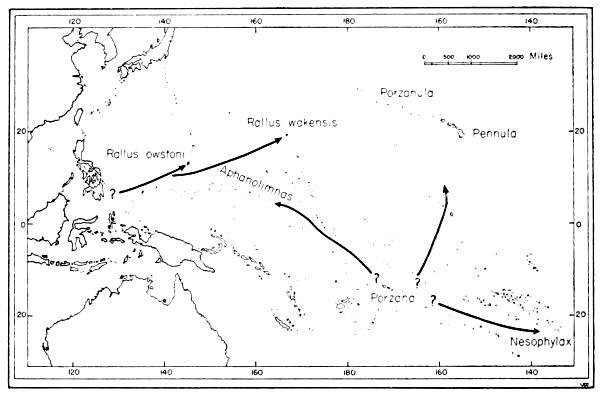
Evolutionary history.—Rallus owstoni is endemic to the island of Guam with no closely related forms nearby. It is one of the several rails found in the Pacific which live on isolated islands. In comparison with other species in the region, it has some resemblance to both R. torquatus and R. philippensis. In general, the underparts of R. owstoni resemble those of the R. philippensis group, although the upper parts resemble somewhat those of R. torquatus. Certain specimens of R. owstoni have a slight indication of a pale pectoral band. The bill is shorter and heavier than that of R. torquatus, possibly more like that of R. philippensis. The short rounded wing is a distinctive character. The bird came from an ancestral stock possibly resembling R. philippensis and probably originated in the Philippine or Papuan areas. It may have invaded Micronesia at an early date and may have had a wider distribution in the islands in former times. Perhaps this same invasion resulted in the establishment of R. wakensis (Rothschild) at Wake. The supposed route of colonization is shown in figure 9.
Fig. 9. Routes of dispersal of rails in the Pacific area.
Rallina fasciata (Raffles)
Malay Banded Crake
Rallus fasciatus Raffles, Trans. Linn. Soc. London, 13, pt. 2, 1822, p. 328. (Type locality, Benkulen, western Sumatra.)
Rallina fasciata Hartlaub, Proc. Zool. Soc. London, 1867 (1868), p. 831 (Pelew); Hartlaub and Finsch, Proc. Zool. Soc. London, 1868, pp. 7, 118 (Pelew); idem, Proc. Zool. Soc. London, 1872, pp. 89, 106 (Pelew); Finsch, Journ. Mus. Godeffroy, 8, 1875, pp. 5, 37 (Palau); Salvadori, Ornith. Papuasia, 3, 1882, p. 264 (Pelew); Wiglesworth, Abhandl. und Ber. Zool. Mus. Dresden, no. 6, 1890-1891 (1891), p. 60 (Pelew); Sharpe, Cat. Birds British Mus., 23, 1894, p. 75 (Pelew); Finsch, Deut. Ver. zum Schulze der Vogelwelt, 18, 1893, p. 459 (Palau); Kuroda, in Momiyama, Birds Micronesia, 1922, p. 41 (Pelew); Mathews, Syst. Avium Australasianarum, 1, 1927, p. 88 (Pelew); Hand-list Japanese Birds, rev., 1932, p. 196 (Palau); Peters, Check-list Birds World, 2, 1934, p. 171 (Pelew); Hand-list Japanese Birds, 3d ed., 1942, p. 221 (Palau); Mayr, Birds Southwest Pacific, 1945, p. 287 (Palau); Delacour, Birds Malaysia, 1947, p. 77 (Palau).
Geographic range.—Burma east and south to Malaysia and the Philippines. In Micronesia: Palau—exact locality unknown.
Remarks.—The Malay Banded Crake is known in the Palau Islands from birds taken by captains Tetens, Heinsohn, and Peters and by Kubary according to Finsch (1875: 37). It has not been taken by later collectors. Two unsexed and undated skins are in the collection of the American Museum of Natural History; these are from the Kubary collection.
Rallina eurizonoides eurizonoides (Lafresnaye)
Philippine Banded Crake
Gallinula eurizonoïdes Lafresnaye, Rev. Zool., 1845, p. 368. (No locality; the type agrees with specimens from the Philippine Islands.)
Rallina eurizonoides eurizonoides Hand-list Japanese Birds, rev. 1932, p. 196 (Koror); Hand-list Japanese Birds, 3d ed., 1942, p. 221 (Koror).
Rallina eurizonoides subsp. Mayr, Birds Southwest Pacific, 1945, p. 302 (Palau).
Geographic range.—Philippine Islands. In Micronesia: Palau Islands—Koror.
Remarks.—This crake is apparently a straggler to western Micronesia from the Philippine area.
Aphanolimnas monasa (Kittlitz)
Kusaie Black Rail
Rallus monasa Kittlitz, Denks. Riese russ. Amer. Micron. und Kamchat., 2, 1858, p. 30. (Type locality, Kushai.)
Rallus tabuensis? Kittlitz, Obser. Zool., in Lutké, Voy. "Le Séniavine," 3, 1836, p. 286 (Ualan).
Ortygometra tabuensis Finsch, Journ. f. Ornith., 1880, pp. 297, 307 (Kuschai); idem, Ibis, 1881, pp. 106, 109 (Kushai); Wiglesworth, Abhandl. und Ber. Zool. Mus. Dresden, no. 6, 1890-1891 (1891), p. 60 (Ualan).
Kittlitzia monasa Hartlaub, Abhandl. nat. Ver. Bremen, 12, 1892, p. 391 (Kuschai); Finsch, Mitth. Ornith. Ver. Wien, 17, 1893, p. 1 (Kuschai).
Aphanolimnas monasa Sharpe, Bull. British Ornith. Club, 1892, p. 20 (Kuschai); Finsch, Deut. Ver. zum Schulze der Vogelwelt, 18, 1893, p. 457, pl. 4 (Ualan); Wiglesworth, Ibis, 1893, p. 214 (Kushai); Sharpe, Cat. Birds British Museum, 23, 1894, p. 115 (Kushai); Matschie, Journ. f. Ornith., 1901, pp. 110, 113 (Ualan); Mathews, Syst. Avium Australasianarum, 1, 1927, p. 93 (Caroline Islands); Hand-list Japanese Birds, rev., 1932, p. 197 (Kusaie); Peters, Check-list Birds World, 2, 1934, p. 189 (Kusaie); Hand-list Japanese Birds, 3d ed., 1942, p. 221 (Kusaie); Mayr, Birds Southwest Pacific, 1945, p. 288 (Kusaie); idem, Audubon Mag., 47, 1945, p. 280 (Kusaie).
Porzana tabuensis Sharpe, Cat. Birds British Mus., 23, 1894, p. 111 (Kushai).
Pennula monasa Dubois, Syn. Avium, 2, 1904, p. 969 (Kuschai).
Porzana tabuensis tabuensis Kuroda, in Momiyama, Birds Micronesia, 1922, p. 42 (Kusaie).
Geographic range.—Micronesia: Caroline Islands—Kusaie (probably extinct).
Characters.—Sharpe (1894:115) gives the following description: "Adult. Black with a bluish-grey reflexion; quills and tail somewhat browner; inner wing-coverts brownish with white spotting, outer edge of first primary dull brownish, chin and middle of the throat somewhat paler; bill blackish (Hartlaub.)."
Remarks.—Two specimens of this rail are known. The two were taken by Kittlitz on his visit to Kusaie in December and January of 1827-'28. Coultas made a search for the bird in 1931 and failed to obtain it; he suggested that the high population of introduced rodents may have been a factor contributing to its extinction. The bird is considered to be extinct by the authors of the Hand-list of Japanese Birds (Hachisuka et al., 1942:221).
The two known specimens are in Leningrad, and Mayr sent examples of Porzana tabuensis there for comparison. The following is a translation of the letter received by Mayr from Boris Stegmann dated at Leningrad, December 7, 1937.
"I have compared the two specimens of Porzana tabuensis with our specimens of Aphanolimnas monasa. The difference is in my opinion of generic value. Aphanolimnas is distinctly larger and more robust. The bill is not only absolutely but also relatively longer. Its length (measured from the forehead) reaches to the end of the second phalanx of the middle toe while it not nearly reaches it in tabuensis. The proportions of feet and toes are the same in both, but the feet are distinctly heavier in Aphanolimnas. The wings are relatively shorter in Aphanolimnas and the wing feathers are very soft. The wing is also much more rounded, the first primary is about 21 mm. shorter than the wing tip. The tail consists of very soft loose feathers which resemble only distantly true tail feathers. It is therefore questionable whether this bird was at all able to fly.
"The coloration is in general dull black, brownish black on head and wings, chin and upper throat are dark slate colored lighter in the middle. The under wing and tail-coverts are marked with scattered white spots (querflecken). The first primary has an irregular whitish brown margin on the outer web. The bill is dark and the feet yellowish."
Possibly this rail represents an ancient colonization of Kusaie from an ancestral stock of Porzana in Polynesia. Mayr (1941b:203) is also of this opinion, and if this is true there is no close relationship between Aphanolimnas and the rails at Guam and Wake, Rallus owstoni and R. wakensis, which are probably colonizers from the Philippines or the Papuan area. Mayr (1943:46) remarks further that the Hawaiian flightless rail (Peuula) is of doubtful taxonomic position, but may be related to the "Aphanolimnas-Porzanoidea-Nesophylax stock," although there is no evidence that Pennula is not related to Rallus. Supposed colonization routes are shown in figure 9.
Poliolimnas cinereus micronesiae Hachisuka
White-browed Rail
Poliolimnas cinereus micronesiae Hachisuka, Bull. British Ornith. Club, 59, 1939, p. 151. (Type locality, Yap.)
Ortygometra quadristrigata Hartlaub and Finsch, Proc. Zool. Soc. London, 1868, pp. 8, 118 (Pelew); idem, Proc. Zool. Soc. London, 1872, pp. 90, 107 (Pelew, Uap).
Ortygometra cinerea Finsch, Journ. Mus. Godeffroy, 8, 1875, pp. 5, 38 (Palau, Yap); idem, Proc. Zool. Soc. London, 1880, p. 577 (Ruk); Salvadori, Ornith. Papuasia, 3, 1882, p. 273 (Yap, Pelew); Wiglesworth, Abhandl. und Ber. Zool. Mus. Dresden, no. 6, 1890-1891 (1891), p. 61 (Pelew, Yap, Ruk); Finsch, Deut. Ver. zum Schulze der Vogelwelt, 18, 1893, p. 459 (Palau).
Ortygometra cinerea = quadristrigata Schmeltz and Krause, Ethnogr. Abth. Mus. Godeffroy, 1881, p. 353 (Ruk).
Poliolimnas cinereus Sharpe, Cat. Birds British Mus., 23, 1894, p. 130 (Pelew, Yap, Ruk); Hartert, Novit. Zool., 5, 1898, p. 64 (Guam); idem, Novit. Zool., 7, 1900, p. 9 (Ruk); Scale, Occ. Papers Bernice P. Bishop Mus., 1, 1901, p. 30 (Guam); Safford, Osprey, 1902, p. 67 (Mariannes); idem, The Plant World, 7, 1904, p. 265 (Guam); idem, Contr. U. S. Nat. Herb., 9, 1905, p. 79 (Guam); Cox, Island of Guam, 1917, p. 21 (Guam); Kuroda, in Momiyama, Birds Micronesia, 1922, p. 42 (Guam, Pelew, Yap, Ruk).
Porzana cinerea Stresemann, Novit. Zool., 21, 1914, p. 54 (Guam, Truk).
Porzana cinerea ocularis Hartert, Novit. Zool., 31, 1924, p. 264 (Ruk, Guam).
Poliolimnas cinereus collingwoodi Mathews, Syst. Avium Australasianarum, 1, 1927, p. 95 (Pelew, Marianne, Carolines); Hand-list Japanese Birds, rev., 1932, p. 197 (Guam, Koror, Yap, Truk); Hachisuka, Birds Philippine Islands, 1, 1932, p. 236 (Marianne, Pelew, Caroline); Peters, Check-list Birds World, 2, 1934, p. 198 (Marianne, Caroline, Pelew); Bryan, Guam Rev., vol. 13, no. 2, 1936, p. 15 (Guam); Mayr, Birds Southwest Pacific, 1945, p. 288 (Guam, Palau, Yap, Truk, Bikini); Delacour and Mayr, Birds Philippines, 1946, p. 64 (Micronesia); Baker, Smithson. Misc. Coll., vol. 107, no. 15, 1948, p. 48 (Ulithi?, Truk).
Porzana cinerea collingwoodi Rensch, Mitt. Zool., 1931, p. 468 (Marianne, Karolinen, Palau).
Poliolimnas cinereus micronesiae Yamashina, Tori, 10, 1940, p. 679 (Bikini); Hand-list Japanese Birds, 3d ed., 1942, p. 221 (Guam, Babelthuap, Koror, Yap, Truk, Bikini).
Geographic range.—Micronesia: Mariana Islands—Guam; Palau Islands—Koror, Babelthuap; Caroline Islands—Yap, Ulithi?, Truk; Marshall Islands—Bikini.
Characters.—Adult: A slightly built, long-legged rail with forehead and anterior crown light gray with darker, slate-colored feather shafts; color more olive-brown on occiput and nape; eyestripe dark slate extending to occiput; superciliary from bill to eye, and stripe below eye, white; chin and throat ashy-white; sides of head, neck and breast ashy-gray, lighter on breast and whitish on abdomen; sides of abdomen ashy-brown becoming more buffy on tibia and under tail-coverts; mantle olive-colored becoming lighter and more brownish on back, rump, and scapulars; wing-coverts similar in color but feathers with broad dark brown shaft-marks; wings brown, first primary with whitish outer web; under wing gray with some lighter streaks; tail dark brown, lighter on edges; bill horn colored, tan below; feet brown; iris vermillion.
Immature: Resembles adult, but head more rufous, upper parts marked with buffy rufous; eye stripe light rufous-brown; underparts tinged with rufous.
P. c. micronesiae differs from P. c. collingwoodi Mathews of the Philippines by having more pale gray and less olivaceous-brown on the nape and shoulder; darker on the under tail-coverts; and having a shorter culmen. P. c. brevipes (Ingram) of the Volcano Islands differs from P. c. micronesiae by being paler on upper parts, particularly back and wing-coverts and more washed with buff below; by having a shorter, thicker culmen; and by having a shorter tarsus.
Measurements.—Measurements are shown in table 17.
Table 17. Measurements of Three Subspecies of Poliolimnas cinereus
Location No. Wing Tail Full culmen Tarsus
Poliolimnas cinereus collingwoodi Philippines, Talaut. Celebes 13 98 22.5 38.0
92-108 21.0-24.0 35.0-41.0
Poliolimnas cinereus micronesiae Guam 10 95 51 21.0 37.0
91-102 50-53 20.0-22.5 34.5-39.0
Palau 10 93 51 21.0 37.0
89-95 51-53 20.0-23.0 34.0-38.0
Truk 5 95 51 21.0 36.0
94-97 51-53 20.5-22.5 35.0-37.0
Poliolimnas cinereus brevipes S. Dionisio Island 8 96 19.0 30.0
94-97 17.0-20.0 29.0-32.0
Specimens examined.—Total number, 25 (11 males, 13 females, 1 unsexed), as follows: Mariana Islands, AMNH—Guam, 10 (July 13, Aug. 1, 5, 7, 13, 19, 23, 31); Palau Islands, AMNH—exact locality not given, 10 (Nov. 11, 13, 15, 23, 25); Caroline Islands, AMNH—Truk, 5 (June 3, 8, 16, 17, 18).
Nesting.—Hartert (1900:9) describes two nests found on swampy ground. One contained three eggs, the other four eggs. He writes, "The eggs are pale buff, or cream-colour, speckled all over with brownish rufous, more frequently near the broad end. In some eggs, these spots are larger, in others minute, and there are often some, underlying pale purplish gray spots."
Remarks.—Superficially, the White-browned Rail of Micronesia is distinct from its near relative, P. c. collingwoodi, but the differences are not so well marked as they are between insular populations of other species of rails. It is probably a comparatively recent addition to the Micronesian avifauna, and its pattern of distribution may represent an early stage in the development of endemism in contrast to the pattern of later stages in the development of insular forms shown by the isolated rails, Rallus owstoni and Aphanolimnas monasa. The fact that Poliolimnas cinereus is found only on widely separated islands in Micronesia does not necessarily mean that it has become "extinct" on the intervening islands, but that it may be partial to the larger, "high" islands, or that it is actually present but remains to be discovered on these intervening islands when more intensive field investigations are made. Hachisuka (1939a:151), in naming the Micronesian form, comments that it has a shorter bill than P. c. collingwoodi of the Philippines and Celebes, and that it is intermediate between this subspecies and P. c. brevipes of the Volcano Island to the north. Within these three subspecies there are trends toward a shorter culmen and shorter tarsus and, less markedly, toward a shorter wing. From the evidence at hand, it can be concluded that Poliolimnas first colonized Micronesia probably from the Philippine area (or Papuan area) through the Palaus and Carolines, to the Marianas and north to the Volcano Islands. Further, this has probably been a relatively recent invasion, although the subspecies in the Volcano Islands shows marked change in length of tarsus and culmen. This extension of range to the islands north of the Marianas is unusual and resembles somewhat the distribution of Nycticorax caledonicus in the same general area.
The Micronesian White-browed Rail is a shy bird with the typical skulking habits of most rails. The NAMRU2 party did not find the bird at Guam, although reports were obtained that it was present in the marsh and swamp areas. Coultas (field notes) tells of observing the rail at Palau at a fresh water lake on Babelthuap, where it was difficult to obtain and apparently rare. Seale (1901:30) obtained a female specimen at Guam from native boys who snared it in a sweet potato patch near the Agaña River. This bird, taken in June or July, had eggs ready for laying. McElroy of the NAMRU2 party observed rails at Truk in brackish swamps, where he found them to be fairly common. A male which was taken in December had enlarged gonads. At Asor in the Ulithi Atoll, the NAMRU2 party learned that a small rail (possibly of this species) was found at taro patches in the early days of occupation, but that it was apparently eliminated by clearing operations. The taking of a bird at Bikini, as reported by Yamashina (1940:679), is further evidence that these birds may subsist on coral atolls as well as on the high volcanic islands; possibly the bird of the Marshalls may have been derived from the south rather than from the west. Unlike Rallus owstoni, this bird is apparently restricted to swampy areas, and may be eliminated from its habitat by drainage or clearing by man. It may always persist, however, in the taro patches maintained by the natives.
Gallinula chloropus subsp. near orientalis Horsfield
Gallinule
Gallinula orientalis Horsfield, Trans. Linn. Soc. London, 13, 1821, p. 195. (Type locality, Java.)
Gallinula chloropus indicus Hand-list Japanese Birds, rev., 1932, p. 197 (Babelthuap); Takatsukasa and Yamashina, Dobutsu. Zasshi, 44, 1932, p. 266 (Pelew, Coror).
Gallinula chloropus indica Hand-list Japanese Birds, 3d ed., 1942, p. 221 (Babelthuap).
Gallinula chloropus subsp. Baker, Smithson. Misc. Coll., vol. 107, no. 15, 1948, p. 49 (Peleliu, Angaur).
Geographic range.—Malaysia from southern Malay Peninsula to Celebes. In Micronesia: Palau Islands—Babelthuap, Koror, Peleliu, Angaur.
Characters.—Adult: Resembles G. c. indica Blyth, G. c. lozanoi Lletget and G. c. guami Hartert, but smaller and paler; upper wing-coverts less olivaceous-brown and more slate-colored; back, rump, and scapulars less richly washed with olivaceous-brown. Resembles G. c. orientalis from Java in size, but much paler.
Measurements.—An unsexed adult bird from Angaur measures: wing, 150; bill from rictes, 27.1; bill from nostril, 13.4; tarsus, 46.
Specimens examined.—Total number, 3 (2 males, 1 unsexed) from Palau Islands, USNM—Angaur (Sept. 21).
Remarks.—Owing to the lack of sufficient material, I am unable to determine the exact status of the resident gallinule in the Palau Islands. On the basis of a single, unsexed adult and two immatures there is not very much that can be said. The adult is smaller and paler than G. c. indica, G. c. lozonoi, and G. c. guami. It resembles specimens of the subspecies G. c. orientalis in size but is also paler than the skins of this race which I have examined. It seems closest to this latter subspecies to which I tentatively refer it. If it is closest to this subspecies, it probably reached Palau from the Celebean region, rather than from the Philippines or some other route. Whether specimens taken by the Japanese at Babelthuap and Koror are G. c. indica is questionable, unless the skins were from migrants which may visit Palau from the west or northwest. The Hand-list of Japanese Birds (Hachisuka et al., 1942:177) records G. c. indica from the Bonin Islands.
The three Gallinules were taken by the NAMRU2 party at fresh and brackish water swamps at Angaur on September 21, 1945. Several Gallinules were seen in the area and several were observed also at Peleliu Island. One of the immatures was just growing its wing feathers, indicating that the birds must breed in the Palau Islands.
Gallinula chloropus guami Hartert
Gallinule
Gallinula chloropus guami Hartert, Novit. Zool., 24, 1917, p. 268. Type locality, Guam).
Fulica chloropus Quoy and Gaimard, Voy. "Uranie," Zool., 1824, p. 703 (Guam); Kittlitz, Obser. Zool., in Lutké, Voy. "Le Séniavine," 3, 1836, p. 305 (Guahan).
Gallinula galeata var. sandwichensis Oustalet, Nouv. Arch. Mus. Hist. Nat. Paris, (3), 8, 1896, p. 34 (Saypan, Tinian, Guam).
Gallinula chloropus Hartert, Novit. Zool., 5, 1898, p. 62 (Guam); Seale, Occ. Papers Bernice P. Bishop Mus., 1, 1901, p. 31 (Guam); Safford, Osprey, 1902, p. 67 (Marianas); idem, Amer. Anthro., 4, 1902, p. 711 (Guam); idem, The Plant World, 7, 1904, p. 265 (Guam); idem, Contr. U. S. Nat. Herb., 9, 1905, p. 79 (Guam); Prowazek, Die deutschen Marianen, 1913, p. 101 (Marianen); Cox, Island of Guam, 1917, p. 21 (Guam); Wetmore, in Townsend and Wetmore, Bull. Mus. Comp. Zoöl., 63, 1919, p. 177 (Guam); Strophlet, Auk, 63, 1946, p. 536 (Guam).
Gallinula chloropus guami Hartert, Vögel pal. Fauna, 15, 1921, p. 1843 (Guam); Kuroda, Avifauna Riu Kiu, 1925, p. 199 (Guam); Kuroda, in Momiyama, Birds Micronesia, 1922, p. 43 (Guam, Tinian, Saipan); Mathews, Syst. Avium Australasianarum, 1, 1927, p. 99 (Mariana Islands); Takatsukasa and Yamashina, Dobutsu. Zasshi, 44, 1932, p. 226 (Pagan); Hand-list Japanese Birds, rev., 1932, p. 197 (Guam, Tinian, Saipan, Pagan); Hachisuka, Birds Philippine Islands, 1, 1932, p. 241 (Guam); Peters, Checklist Birds World, 2, 1934, p. 204 (Marianne Islands); Bryan, Guam. Rec., vol. 13, no. 2, 1936, p. 15 (Guam); Hand-list Japanese Birds, 3d ed., 1942, p. 222 (Guam, Tinian, Saipan, Pagan); Mayr, Birds Southwest Pacific, 1945, p. 288 (Marianas); Downs, Trans. Kansas Acad. Sci., 49, 1946, p. 92 (Tinian); Stott, Auk, 1947, p. 525 (Saipan); Baker, Smithson. Misc. Coll., vol. 107, no. 15, 1948, p. 49 (Guam, Tinian, Saipan).
Geographic range.—Micronesia: Mariana Islands—Pagan, Saipan, Tinian, Guam.
Characters.—Adult: Head and neck sooty black; upper back dark, bluish slate-gray; lower back and wing-coverts brownish; tail blackish-brown; wings dark brown, outer edge of first primary white; breast and upper abdomen dark slate-gray, feathers on sides of breast with longitudinal white streak; under wing dark with white edges; lower abdomen grayish with white-tipped feathers; vent black; under tail-coverts white; bill and frontal shield red, tip of bill yellowish; legs and feet olive-green.
Adult female: Resembles adult male but usually with smaller frontal shield.
Immature: Resembles adult, but forehead mottled white and brown, with sides of head less distinctly speckled with brown; crown, neck and upper back dusky brown; back, scapulars and upper tail-coverts olivaceous-brown; chin and throat whitish; breast feathers pearly-gray tipped with white; abdomen white; sides gray, washed with buff. Older birds are darker above and more brownish-gray below; frontal shield small.
G. c. guami resembles G. c. indica, but upper wing-coverts darker and near "olivaceous black"; back, rump and scapulars darker and less olivaceous brown, although not so dark as in G. c. orientalis. From G. c. lozanoi, G. c. guami differs in: slightly darker upper wing-coverts; richer olivaceous-brown on back, scapulars and rump; thinner culmen with possibly less yellow coloring on tip. G. c. guami resembles G. c. sandvicensis Streets of the Hawaiian Islands, but has less olive wash on the feathers and a smaller frontal shield.
Measurements.—Measurements of Gallinula chloropus are presented in table 18. In general, females are smaller than males.
Table 18. Measurements of Gallinula chloropus
Location No. Wing Bill from rictus Bill from nostril Tarsus
G. c. indica 15 164 27 14.4 48
158-173 24-29 13.1-18.1 44-50
G. c. orientalis 3 152 27 13.8 45
146-152 26-29 13.1-14.4 44-46
G. c. lozanoi 11 164 27 14.5 50
153-170 24-29 13.1-15.2 45-57
G. c. guami 11 164 27 14.7 49
156-171 24-28 13.1-16.2 47-56
G. c. sandvicensis 2 150-158 27 13.4 52-56
Weights.—From Guam an adult male weighed 291 grams and an adult female 256 (Baker, 1948:49).
Specimens examined.—Total number, 42 (16 males, 22 females, 4 unsexed), as follows: Mariana Islands, USNM—Guam, 5 (Feb. 24, May, June 5, 7, 18—Tinian, 3 (Oct. 12, 18)—Saipan, 3 (Sept. 28, 30); AMNH—Guam, 25 (Feb. 21, April 6, July 13, 28, 30, Aug. 1, 3, 6, 7, 13, 19, 23, 30, 31, Sept. 3, 17, Dec. 11—Tinian, 5 (June 11, Sept. 12, 13, 14).
Nesting.—Hartert (1898:63) reports nests of the Gallinule at Guam in grass and on swampy ground in December and March. A male with enlarged gonads was taken by the NAMRU2 party at Guam on June 7. Marshall (1949:219) is of the opinion that this bird breeds all year.
Food habits.—Seale (1901:31) found grass, insects, and larvae in stomachs obtained at Guam.
Remarks.—The subspecies G. c. indica, G. c. lozanoi, G. c. guami, and G. c. sandvicensis bear a close resemblance to one another in size and color. G. c. guami and G. c. lozanoi resemble each other so closely that it would be difficult to separate unlabeled specimens of the two subspecies. G. c. orientalis differs from all of the gallinules in smaller size and darker color. Study of these forms indicates that the Gallinule has colonized the Marianas from Asia probably by way of Japan and the Bonin and Volcano islands. The Hawaiian subspecies is probably of American origin, as pointed out by Mayr (1943:46), and is not a close relative of the Mariana subspecies. The fact that these insular subspecies have not undergone much differentiation does not necessarily mean that they are recent arrivals, but probably is a reflection of the lack of plasticity of the species; as a whole the species does not exhibit anywhere a great amount of geographic variation. A thorough study of all insular populations of this species (including specimens from the Azores, Seychelles, Réunion, Mauritus, and the Greater and Lesser Antilles) might reveal the effect of isolation on the species in general. Its ability to become established on isolated islands is apparent, although it is indeed peculiar that the species has not reached the Caroline Islands.
The Gallinule in the Marianas is restricted to fresh water lakes, marshes and swamps on the islands of Guam, Tinian, Saipan and Pagan. Coultas (field notes), on visiting the island of Tinian in 1931, comments that the bird is rare and found at only one lake on the island. Downs (1946:92) noted the species in 1945, and Joe T. Marshall Jr. obtained three specimens at Lake Hagoya in October of the same year. Gleise (1945:220) estimated the population of Gallinules on Tinian in 1945 at 70 individuals. Stott (1947:525) reports that the birds were abundant at Lake Susupe, Saipan, in 1945. Seale (1901:31) found the Gallinule to be abundant at Guam in marshes and taro patches. In 1945, the NAMRU2 party found fairly large populations of the Gallinule in fresh water marshes and fallow rice paddies at Guam. The greatest concentration of birds appeared to be in the Agaña Swamp and along the Ylig River. They seldom ventured out into open water but preferred weedy edges into which they could suddenly dart when disturbed. It was interesting to note such wary behavior, for an observer would think that after the bird had been in an environment virtually devoid of birds of prey (except for an occasional migrant) for a number of generations, it would have lost such behaviorisms as a result of the absence of the selective processes involved in predation.
Porphyrio porphyrio pelewensis Hartlaub and Finsch
Purple Swamphen
Porphyrio melanotus Temm. var. pelewensis Hartlaub and Finsch, Proc. Zool. Soc. London, 1872, p. 107. (Type locality, Pelew Islands.)
Porphyrio melanotus Hartlaub and Finsch, Proc. Zool. Soc. London, 1868, pp. 8, 117, 118 (Pelew); Gray, Hand-list Birds, 3, 1871, p. 64 (Pelew).
Porphyrio melanotus pelewensis Wiglesworth, Abhandl. und Ber. Zool. Mus. Dresden, no. 6, 1890-1891 (1891), p. 61 (Pelew); Bolau, Mitteil. Naturhist. Mus. Hamburg, 1898, p. 70 (Palau); Dubois, Syn. Avium, 2, 1904, p. 976 (Pelew); Mathews, Birds Australia, 1, 1911, p. 241 (Pelew); Kuroda, in Momiyama, Birds Micronesia, 1922, p. 43 (Pelew); Mathews, Syst. Avium Australasianarum, 1, 1927, p. 100 (Pelew); Hand-list Japanese Birds, rev., 1932, p. 197 (Palau); Hachisuka, Birds Philippines, 1, 1932, p. 245 (Pelew).
Porphyrio pelewensis Finsch, Journ. Mus. Godeffroy, 8, 1875, pp. 5, 39 (Palau); Salvadori, Atti Accad. Sci. Torino, 14, 1879, p. 1169 (Pelew); Schmeltz and Krause, Ethnogr. Abth. Mus. Godeffroy, 1881, p. 407 (Palau); Finsch, Deut. Ver. zum Schutze der Vogelwelt, 18, 1893, p. 459 (Palau); Sharpe, Cat. Birds British Mus., 23, 1894, p. 206 (Pelew); Nehrkorn, Nat. Eiers., 1899, p. 205 (Palau-Inseln); Matschie, Journ. f. Ornith., 1901, p. 113 (Palau); Reichenow, Die Vögel, 1, 1913, p. 216 (Palauinseln); Takatsukasa and Kuroda, Tori, 1, 1915, p. 51 (Pelew).
Porphyrio cyanocephalus Elliot, Stray Feathers, 7, 1878, pp. 10, 13 (Palau).
Porphyrio poliocephalus pelewensis Peters, Check-list Birds World, 2, 1934, p. 208 (Pelew); Hand-list Japanese Birds, 3d ed., 1942, p. 222 (Koror).
Porphyrio porphyrio pelewensis Mayr, Birds Southwest Pacific, 1945, p. 288 (Palau); Baker, Smithson. Misc. Coll., vol. 107, no. 15, 1948, p. 49 (Angaur).
Geographic range.—Micronesia: Palau Islands—Koror, Angaur.
Characters.—Adult: A large, purplish-blue, marsh bird with crown and sides of head dusky-black; wing-coverts purplish-blue; rest of upper parts dark, washed with olivaceous-brown; outer webs of primaries and secondaries tinged with purplish-blue; chin, axillaries and under wing-coverts dusky; under tail-coverts whitish; rest of underparts purplish-blue, blacker on abdomen.
Porphyrio p. pelewensis resembles P. p. palliatus Bruggemann of Celebes and P. p. melanopterus Bonaparte of the Moluccas and New Guinea but upper parts paler and slightly less glossy; lesser and primary wing-coverts more purplish-blue and less greenish-blue; outer webs of primaries and secondaries lighter purplish-blue; underparts less blue with patch on throat and breast paler blue with less green (patch present on only one specimen from the Palaus).
Measurements.—Measurements of one male: wing, 227; tail, 81; culmen and shield, 62.5; tarsus, 77; of three females: wing, 212, 218, 227; tail, 77, 81, 86; culmen and shield, 57, 61, 64; tarsus, 75, 75, 77.
Specimens examined.—Total number, 6 (1 male, 3 females, 2 unsexed), as follows: Palau Islands, USNM—Angaur, 1 chick (Sept. 21) AMNH—exact locality not given, 5 (Nov. 13, 19, Dec. 17-19, undated).
Nesting.—A black, downy chick was captured on September 21, 1945, at the edge of a fresh-water lake on Angaur by Davidson of the NAMRU2 party (Baker, 1948:49). Two females taken by Coultas in December had enlarged gonads.
Remarks.—The Purple Swamphen in the Palaus stands out as one of the more distinctive subspecies of P. porphyrio. It also marks the most northeastern extension of the range of this species. The subspecies in the Palaus shows affinities to that found to the south and southwest and probably reached Micronesia via the Papuan area, Celebes or the Moluccas rather than from the Philippines. It is interesting that this bird, as well as several other species, has been able to establish itself at the Palau Islands, but has not extended its range farther into other islands of Micronesia. Perhaps, the bird is now in an early stage in its island occupation.
The Purple Swamphen is probably not abundant in the Palaus. It is a large and conspicuous bird, and its restriction to swamps and areas around lakes may allow native hunters to obtain it rather easily, particularly by snares or by organized drives. Coultas (field notes) obtained specimens in taro swamps; he saw only 4 individuals and remarks that the birds utter harsh cries at night. The NAMRU2 party flushed an adult from lake side vegetation at Angaur on September 21, 1945. This bird was not taken, but a downy young was obtained in the area the same day.
Fulica atra atra Linnaeus
Common Coot
Fulica atra Linnaeus, Syst. Nat., ed. 10, 1, 1758, p. 152. (Type locality, Europe, restricted to Sweden.)
Fulica atra Hartert, Novit. Zool., 5, 1898, pp. 64, 69 (Guam); Seale, Occ. Papers Bernice P. Bishop Mus., 1, 1901, p. 32 (Guam); Safford, Osprey, 1902, p. 70 (Marianas); idem, The Plant World, 7, 1904, p. 268 (Guam); Kuroda, in Momiyama, Birds Micronesia, 1922, p. 43 (Guam); Bryan, Guam Rec., vol. 13, no. 2, 1936, p. 15 (Guam).
Fulica atra atra Hartert, Vögel pal. Fauna, 15, 1921, p. 1852 (Guam); Hand-list Japanese Birds, rev., 1932, p. 197 (Tinian, Guam); Hand-list Japanese Birds, 3d ed., 1942, p. 222, (Tinian, Guam); Mayr, Birds Southwest Pacific, 1945, p. 302 (Micronesia).
Geographic range.—Breeds in Europe, northern Africa, and Asia. Winters south to Africa, Malaysia, southern Asia. In Micronesia: Mariana Islands—Tinian, Guam.
Remarks.—The Common Coot is a straggler to Micronesia in winter. It has been recorded from Guam and Tinian. An unsexed specimen in the collections of the American Museum of Natural History was taken at Guam in the fall of 1896 by one of Owston's collectors.
Squatarola squatarola (Linnaeus)
Black-bellied Plover
Tringa Squatarola Linnaeus, Syst. Nat., ed. 10, 1, 1758, p. 149. (Type locality, Europe, restricted to Sweden.)
Charadrius squatarola Hartert, Novit. Zool., 5, 1898, p. 66 (Saipan); Seale, Occ. Papers Bernice P. Bishop Mus., 1, 1901, p. 35 (Micronesia); Safford, Osprey, 1902, p. 67 (Marianas).
Squatarola squatarola Hartert, Novit. Zool., 7, 1900, p. 9 (Ruk); Safford, The Plant World, 7, 1904, p. 266 (Guam); idem, Contr. U. S. Nat. Herb., 9, 1905, p. 80 (Guam); Cox, Island of Guam, 1917, p. 22 (Guam); Ridgway, Bull. U. S. Nat. Mus., 50, pt. 8, 1919, p. 72 (Ruk); Bryan, Guam Rec., vol. 13, no. 2, 1936, p. 15 (Guam); Hand-list Japanese Birds, 3d ed., 1942, p. 216 (Saipan, Truk); Mayr, Birds Southwest Pacific, 1945, p. 36 (Truk); Baker, Smithson. Misc. Coll., vol. 107, no. 15, 1948, p. 50 (Guam).
Squatarola helvetica Takatsukasa and Kuroda, Tori, 1, 1915, p. 61 (Marianas, Ruk).
Squatarola squatarola hypomelaena Kuroda, in Momiyama, Birds Micronesia, 1922, p. 43 (Ruk, Saipan); Hand-list Japanese Birds, rev., 1932, p. 193 (Saipan, Truk).
Geographic range.—Breeds in arctic regions of Holarctica. Winters in Southern Hemisphere. In Micronesia: Mariana Islands—Guam, Saipan; Caroline Islands—Truk; Marshall Islands—Eniwetok.
Specimens examined.—One female from Mariana Islands. USNM—Guam (Aug. 27).
Remarks.—The Black-bellied Plover is an uncommon visitor to Micronesia. One bird was obtained by Markley of the NAMRU2 party at Guam on August 27, 1945; Flavin recorded five of these birds from November, 1944, to January, 1946. Bryan and Greenway (1944:109) record this species as an occasional visitor to the Hawaiian Islands. Gleise and Genelly (1945:221) observed the Black-bellied Plover at Eniwetok in 1945.
Pluvialis dominica fulva (Gmelin)
Pacific Golden Plover
Charadrius fulvus Gmelin, Syst. Nat., 1, pt. 2, 1789, p. 687. (Type locality, Tahiti.)
Charadrius pluvialis Kittlitz, Obser. Zool., in Lutké., Voy. "Le Séniavine," 3, 1836, pp. 287, 299, 304 (Ualan, Longounor, Guahan); idem, Denkw. Reise russ. Amer. Micron. und Kamchat., 2, 1858, pp. 32, 55 (Ualan).
Charadrius virginianus Hartlaub, Journ. f. Ornith., 1854, p. 167 (Mariannen, Carolinen).
Charadrius longipes? Gray, Cat. Birds Trop. Is. Pacific Ocean, 1859, p. 47 (Ladrone or Marian Islands, Oualan).
Pluvialis fulvus Schlegel, Mus. Pays-Bas, 6, no. 29, 1865, p. 52 (Micronesie).
Charadrius fulvus Finsch and Hartlaub, Fauna Central-polynesiens, 1867, p. 196 (Marianen, Ualan); Hartlaub and Finsch, Proc. Zool. Soc. London, 1868, pp. 8, 117, 118 (Pelews); Finsch and Hartlaub, Journ. f. Ornith., 1870, p. 139 (Pelew); Finsch, Journ. f. Ornith., 1872, p. 52 (Pelew, Carolinen); Hartlaub and Finsch, Proc. Zool. Soc. London, 1872, pp. 89, 104 (Pelew, Mackenzie, Uap); Gräffe, Journ. Mus. Godeffroy, 2, 1873, p. 123 (Yap); Finsch, Journ. Mus. Godeffroy, 8, 1875, pp. 5, 31 (Palau); idem, Journ. Mus. Godeffroy, 12, 1876, pp. 18, 38 (Ponapé); idem., Proc. Zool. Soc. London, 1877 (1878), p. 781 (Ponapé); idem, Proc. Zool. Soc. London, 1880, p. 576 (Ruk); idem, Journ. f. Ornith., 1880, pp. 293, 305 (Ponapé, Kuschai); idem, Ibis, 1880, pp. 220, 331, 332 (Taluit); Schmeltz and Krause, Ethnogr. Abth. Mus. Godeffroy, 1881, pp. 281, 353 (Ponapé, Ruk); Finsch, Ibis, 1881, pp. 105, 106, 109, 113, 115 (Kushai, Ponapé); Salvadori, Ornith. Papuasia, 3, 1882, p. 395 (Carolines, Pelews, Marianas); Finsch, Mitth. Ornith. Ver. Wien, 1884, p. 55 (Jaluit, Milli, Kuschai); Wiglesworth, Abhandl. und Ber. Zool. Mus. Dresden, no. 6, 1890-1891 (1891), p. 63 (Marshall Islands, Ualan, Luganor, Ponapé, Ruk, Uap, Pelew, Marianne); Oustalet, Nouv. Arch. Mus. Hist. Nat. Paris, (3), 8, 1896, p. 46 (Guam, Hogoleu, Marshalls, Palaos); Hartert, Novit. Zool. 5, 1898, p. 66 (Guam); idem, Novit. Zool., 7, 1900, p. 9 (Ruk); Seale, Occ. Papers Bernice P. Bishop Mus., 1, 1901, p. 36 (Micronesia); Schnee, Ornith. Monatsber., 1901, p. 132 (Marshalls); Safford, Osprey, 1902, p. 68 (Marianas); idem, The Plant World, 7, 1904, p. 266 (Guam); Schnee, Zool. Jahrbücher, 20, 1904, p. 389 (Marschall-Inseln); Takatsukasa and Kuroda, Tori, 1, 1915, p. 51 (Ponapé).
Charadrius dominicus fulvus Safford, Contr. U. S. Nat. Herb., 9, 1905, p. 80 (Guam); Cox, Island of Guam, 1917, p. 22 (Guam).
Charadrius dominicus Sharpe, Cat. Birds British Mus., 24, 1896, p. 195 (Micronesia).
Pluvialis dominicus fulvus Ridgway, Bull. U. S. Nat. Mus., 50, pt. 8, 1919, p. 89 (Kuschai, Pelew, Ruk, Marianas, Mackenzie, Ponapé); Wetmore, in Townsend and Wetmore, Bull. Mus. Comp. Zoöl., 63, 1919, p. 177 (Uala, Arhno, Rongelab); Kuroda, in Momiyama, Birds Micronesia, 1922, p. 44 (Guam, Angaur, Ualan, Luganor, Ponapé, Ruk, Yap, Arhno); Hand-list Japanese Birds, 3d ed., 1942, p. 216 (Saipan, Tinian, Guam, Babelthuap, Koror, Peliliu, Angaur, Yap, Ulithi, Truk, Lukunor, Ponapé, Kusaie, Mille, Arhno, Majuro, Likieb).
Pluvialis apricarius fulvus Hand-list Japanese Birds, rev., 1932, p. 193 (Saipan, Tinian, Babelthuap, Koror, Pelilieu, Angaur, Yap, Uluthi, Truk, Lukunor, Ponapé, Kusaie, Mille, Arhno, Majuro, Likieb).
Pluvialis dominica fulva Peters, Check-list Birds World, 2, 1934, p. 244 (Oceania); Bryan, Guam, Rec., vol. 13, no. 2, 1936, p. 24 (Guam); Stickney, Amer. Mus. Novit., no. 1248, 1943, p. 3 (Saipan, Guam, Palau, Ponapé, Kusaie, Ruk, Tarawa); Mayr, Birds Southwest Pacific, 1945, p. 39 (Oceania); Downs, Trans. Kansas Acad. Sci., 49, 1946, p. 93 (Tinian); Strophlet, Auk, 1946, p. 536 (Guam); Borror, Auk, 1947, p. 417 (Agrihan); Stott, Auk, 1947, p. 525 (Saipan); Baker, Smithson. Misc. Coll., vol. 107, no. 15, 1948, p. 50 (Guam, Rota, Peleliu, Garakayo, Ulithi, Truk).