ACCOUNTS OF THE KINDS OF BIRDS OF MICRONESIA (continued 3)
Reading edition
Pluvialis dominica Wharton and Hardcastle, Journ. Parasitology, 32, 1946, pp. 306, 310, 313, 316, 318 (Ulithi, Guam); Wharton, Ecol. Monogr., 16, 1946, pp. 174, 175 (Guam).
Geographic range.—Breeds from Siberia to western Alaska. Winters from India east to Oceania; stragglers occur west to Africa and east to Pacific coast of North America. In Micronesia: Mariana Islands—Guam, Rota, Tinian, Saipan, Agrihan, Asuncion; Palau Islands—Angaur, Peleliu, Ngabad, Garakayo, Koror, Babelthaup; Caroline Islands—Yap, Ulithi, Truk, Lukunor, Ponapé, Kusaie; Marshall Islands—Mille, Arhno, Rongelab, Majuro, Likieb, Bikini.
Specimens examined.—Total number, 69 (39 males, 26 females, 4 unsexed), as follows: Mariana Islands, USNM—Guam, 17 (July 8, 19, 24, Aug. 31, Sept. 4, 17, 19, 26, Oct. 5, 8, 23, 24)—Rota, 5 (Oct. 20, 25); AMNH—Guam, 6 (Mar. 7, 8, 27, Aug. 15)—Saipan, 1 (Sept. 8)—Asuncion, 2 (Feb. 16); Palau Islands, USNM—Peleliu, 9 (Sept. 6-20)—Garakayo, 1 (Sept. 20); AMNH—exact locality not given, 7 (Oct. 13, Nov. 13, 15); Caroline Islands, USNM—Ulithi, 4 (Aug. 16, 21); AMNH—Kusaie, 9 (Mar. 10-30)—Ponapé, 2 (Dec. 15)—Truk, 3 (Feb. 6); Marshall Islands, USNM—Bikini, 3 (Mar. 4, 7, May 3).
Parasites.—Wharton (1946:174, 175) records the following chiggers (Acarina) from Pluvialis taken by the NAMRU2 party at Guam: Acariscus pluvius, A. anous, Neoschöngastia carveri, and N. namrui; and at Ulithi: N. pauensis and N. ewingi.
Weights.—Birds taken at Guam and Rota weighed as follows: seven males, 107-125 (117); four females, 109-120 (114).
Remarks.—The Pacific Golden Plover is one of the most abundant migratory shore birds to visit Micronesia. So characteristic of Micronesia is this species that almost all ornithologists who have made observations in the area have recorded it. Finsch observed the plover in the Carolines and Marshalls. Coultas made notes on, and collected specimens of, it in the Marianas, Carolines, and Palaus. The Hand-list of Japanese Birds (Hachisuka et al., 1942:216) lists Pluvialis from 17 islands in Micronesia.
Stickney (1943:3, 4) discusses the migrations of the Pacific Golden Plover through Oceania, using as a basis for her remarks the data from the extensive collections made by the Whitney South Sea Expedition. She states that the northward migration begins in March from the southern islands (New Zealand and southern Australia). At Guam in 1945, the writer observed flocks of plover beginning on February 11. Birds were seen in small groups in March and April. In the latter month most of the birds seen were in nuptial plumage. For the year 1945, the latest spring record at Guam was April 28. In the same year, Gleise (1945:220) observed his last spring record at Tinian "between April 26 and 27." In 1946, Morrison obtained plover in nuptial plumage at Bikini on May 3.
In an effort to obtain dates when shore birds appeared at Guam, field parties of NAMRU2 made observations at several beaches in late spring, summer, and early fall, as is shown in table 8. Pacific Golden Plovers in post-nuptial molt were first observed and collected on July 8. Following this date, small flocks and later large flocks were more numerous; by September 29, plover were abundant. Similar findings were obtained at Ulithi (see table 9) and in the Palau Islands (see table 10) in August and September. The birds collected by the NAMRU2 party at Guam, Ulithi, Peleliu, and Garakayo in July, August, September, and early October were in postnuptial molt. Birds taken at Rota on October 20 and 26 were in winter plumage. Downs (1946:93) observed plover in small flocks at Tinian in 1945, beginning after September 5. Borror (1947:417) saw two birds at Agrihan on August 10, 1945.
The flocks of plover seen by the NAMRU2 party varied in size from three to 30 birds, the average being less than ten. Coultas (field notes) noted "large flocks" at the Palaus from October to December, 1931. Although plover was often found on the same beach as other birds, the NAMRU2 observers rarely saw plover together with other shore birds. However, on air strips Pluvialis occasionally occurred with small numbers of Arenaria, Heteroscelus spp., and Numenius phaeopus. Pluvialis and N. phaeopus were the only shore birds found to use open grassy flats and other inland areas at Guam and Peleliu in 1945.
Stickney (1943) records Pluvialis in late spring and summer from Polynesia, indicating these to be birds remaining in the winter range during the breeding season. The NAMRU2 party observed no Pacific Golden Plovers at Guam which might be regarded as non-migrants, but other species of shore birds were found which might be considered as such. The lingering of individuals in the winter range is not unusual among migratory birds, and as Stickney points out, most of the non-migrants retain their winter dress or assume an incomplete breeding plumage.
Charadrius hiaticula semipalmatus Bonaparte
Semipalmated Plover
Charadrius semipalmatus Bonaparte, Journ. Acad. Nat. Sci. Phila., 5, 1825, p. 98. New name for Tringa hiaticula Ord. not Charadrius hiaticula Linnaeus, in Wilson's Amer. Ornith., Ord. repr., 7, 1824, p. 65. (Type locality, Coast of New Jersey.)
Charadrius hiaticula Finsch, Ibis, 1880, p. 331 (Taluit); Wiglesworth, Abhandl. und Ber. Zool. Mus. Dresden, no. 6, 1890-1891 (1891), p. 64 (Taluit or Bonham); Schnee, Zool. Jahrbücher, 20, 1904, p. 389 (Marschall-Inseln); Kuroda, in Momiyama, Birds Micronesia, 1922, p. 45 (Taluit).
Geographic range.—Breeds from Arctic America south to coastal Canada. Winters from southern United States to South America. In Micronesia: Marshall Islands—Jaluit.
Remarks.—Finsch (1880d:331) reported this bird (sight record) at Jaluit in the Marshall Islands. Other than this observation, there is no history of the species in Micronesia.
Charadrius dubius curonicus Gmelin
Ring-necked Plover
Charadrius curonicus Gmelin, Syst. Nat., 1, pt. 2, 1789, p. 692. (Type locality, Kurland.)
Charadrius dubius curonicus Hand-list Japanese Birds, rev., 1932, p. 194 (Yap); Hand-list Japanese Birds, 3d ed., 1942, p. 217 (Yap); Mayr, Birds Southwest Pacific, 1945, p. 37 (Micronesia).
Geographic range.—Breeds in northern Europe and Asia. Winters from Africa east to Malaysia and Melanesia. In Micronesia: Caroline Islands—Yap.
Remarks.—The Ring-necked Plover has been recorded at Yap by the Japanese collectors. Mayr (1945a:37) remarks that the bird is an occasional migrant through Micronesia. Gleise and Genelly (1945:221) observed four "Papuan" Ring-necked Plovers at Eniwetok in 1945. Apparently no specimen was obtained.
Charadrius alexandrinus nihonensis Deignan
Kentish Plover
Charadrius alexandrinus nihonensis Deignan, Journ. Washington Acad. Sci., vol. 31, 1941, p. 106. (Type locality, Aomori, Hondo.)
Charadrius cantianus Hartlaub and Finsch, Proc. Zool. Soc. London, 1868, pp. 117, 118 (Pelew); idem, Proc. Zool. Soc. London, p. 89 (Pelew); Finsch, Journ. Mus. Godeffroy, 8, 1875, p. 31 (Palau).
Aegialitis cantianus Wiglesworth, Abhandl. und Ber. Zool. Mus. Dresden, no. 6, 1890-1891 (1891), p. 64 (Pelew); Takatsukasa and Kuroda, Tori, 1, 1915, p. 62 (Pelew).
Aegialitis alexandrinus dealbatus Kuroda, in Momiyama, Birds Micronesia, 1922, p. 45 (Pelew).
Charadrius alexandrinus dealbatus Hand-list Japanese Birds, rev., 1932, p. 194 (Palau); Hand-list Japanese Birds, 3d ed., 1942, p. 217 (Palau); Mayr, Birds Southwest Pacific, 1945, p. 37 (Palau).
Geographic range.—Breeds in Japan and possibly on adjacent parts of the Asiatic mainland. Winters south to Malaya. In Micronesia: Palau Islands—exact locality unknown.
Remarks.—The Kentish Plover is known from a single record obtained by Semper in the Palau Islands. It is tentatively assigned to C. a. nihonensis, which breeds directly north of the Palau Islands on Japan. C. a. dealbatus (Swinhoe) breeds more to the west on the Asiatic mainland and adjacent islands south of Japan. Additional specimens are needed before the subspecific status of migrants to Micronesia can be accurately determined.
Charadrius mongolus stegmanni Stresemann
Mongolian Dotterel
Charadrius mongolus stegmanni Stresemann, Ornith. Monatsb., 48, 1940, p. 55. New name for Charadrius mongolus littoralis Stegmann, 1937, preoccupied. (Type locality, Behring Island.)
Charadrius sanguineus Lesson, Man. d'Ornith., 2, 1828, p. 330 (No type locality = Mariana Islands, ex Oustalet, Nouv. Arch. Mus. Hist. Nat. Paris, (3), 8, 1896, p. 48); idem, Traité d'Ornith., 1831, p. 544 (no locality = Mariana Islands); Hartlaub, Journ. f. Ornith., 1854, p. 167 (Mariannen).
Charadrius mongolicus Oustalet, Nouv. Arch. Mus. Hist. Nat. Paris, (3), 8, 1896, p. 48 (Guam, Jaluit, Palaos, Carolines); Hartert, Novit. Zool., 5, 1898, p. 66 (Guam); Seale, Occ. Papers Bernice P. Bishop Mus., 1, 1901, p. 36 (Guam); Safford, Osprey, 1902, p. 68 (Guam).
Aegialitis mongolus Hartert, Novit. Zool., 7, 1900, p. 9 (Ruk).
Aegialis mongola Safford, Contr. U. S. Nat. Herb., 9, 1905, p. 80 (Guam).
Aegialites mongola Cox, Island of Guam, 1917, p. 22 (Guam).
Ochthodromus mongolicus Takatsukasa and Kuroda, Tori, 1, 1915, p. 62 (Marianas, Ruk).
Charadrius mongolus Ridgway, Bull. U. S. Nat. Mus., 50, pt. 8, 1919, p. 132 (Ruk); Mayr, Birds Southwest Pacific, 1945, p. 38 (Micronesia).
Charadrius mongolus mongolus Hartert, Vögel pal. Fauna, 11-12, 1920, p. 1543 (Marianen, Karolinen); Hand-list Japanese Birds, rev., 1932, p. 194 (Guam, Truk, Iuripik, Kusaie, Jaluit, Majuro); Peters, Check-list Birds World, 2, 1934, p. 253 (Carolines, Marianas); Bryan, Guam Rec., vol. 13, no. 2, 1936, p. 24 (Guam); Baker, Smithson. Misc. Coll., vol. 107, no. 15, 1948, p. 50 (Guam, Peleliu, Ulithi).
Cirrepidesmus mongolus mongolus Kuroda, in Momiyama, Birds Micronesia, 1922, p. 44 (Guam, Ruk).
Charadrius mongolus stegmanni Hand-list Japanese Birds, 3d ed., 1942, p. 217 (Guam, Peliliu, Truk, Iuripik, Kusaie, Jaluit, Majuro).
Geographic range.—Breeds in northeastern Siberia and Bering Sea area. Winters south to eastern Malaysia, Melanesia, and Australia. In Micronesia: Mariana Islands—Guam; Palau Islands—Angaur, Peleliu; Caroline Islands—Ulithi, Truk, Iuripik, Kusaie; Marshall Islands—Jaluit, Majuro.
Specimens examined.—Total number, 10 (4 males, 5 females, 1 unsexed), as follows: Mariana Islands, USNM—Guam, 2 (June 7, Sept. 1); AMNH—Guam, 3 (Aug. 15, 18, Nov. 30); Palau Islands, USNM—Peleliu, 3 (Sept. 7-12); Caroline Islands, USNM—Ulithi, 1 (Aug. 22); AMNH—Truk, 1 (Feb. 8).
Remarks.—According to Oustalet (1896:48), Lesson used two specimens of this species, which were collected in the Marianas by the expedition in the "Uranie," as types for his Charadrius sanguineus.
The Mongolian Dotterel is a regular visitor to western Micronesia. It is recorded also from the Marshall Islands, which it probably reaches from the westward by way of the Carolines, since the species has not been recorded in the Hawaiian Islands.
A bird taken by the writer at Guam on June 7, 1945, was in winter plumage and probably nonmigratory. The species was recorded also at Guam in September. At Peleliu in September, 1945, the Mongolian Dotterel was seen frequently on tidal flats by the NAMRU2 party. On September 8 there was a flock of approximately fifty birds, in company with Charadrius leschenaultii, at Akarakoro Point. In August at Ulithi, birds were on the beaches in company with Crocethia alba. At Angaur on September 21, 1945, the species was with other shore birds in small groups at fresh water ponds.
I am tentatively referring all specimens examined to C. m. stegmanni although at this writing (1948) I am inclined to the opinion that a critical reexamination of the referred specimens might reveal one or a few individuals of the subspecies C. m. mongolus Pallas.
Charadrius leschenaultii Lesson
Large Sand Dotterel
Charadrius Leschenaultii Lesson, Dict. Sci. Nat., ed. Levrault, 42, 1826, p. 36. (Type locality, Pondichery, India.)
Charadrius griseus Lesson, Traité d'Ornith., 1831, p. 544 (Oulan).
Charadrius geoffroyi Hartlaub and Finsch, Proc. Zool. Soc. London, 1868, pp. 117, 118 (Pelew); idem, Proc. Zool. Soc. London, 1872, p. 89 (Pelew); Finsch, Journ. Mus. Godeffroy, 8, 1875, pp. 5, 31 (Palau).
Aegialitis geoffroyi Salvadori, Ornith. Papuasia, 3, 1882, p. 299 (Ualan, Pelew); Wiglesworth, Abhandl. und Ber. Zool. Mus. Dresden, no. 6, 1890-1891 (1891), p. 64 (Pelew, Ualan).
Ochthodromus geoffroyi Sharpe, Cat. Birds British Mus., 24, 1896, p. 217 (Pelew, Ualan); Takatsukasa and Kuroda, Tori, 1, 1915, p. 62 (Pelew).
Pagoa leschenaultii Kuroda, in Momiyama, Birds Micronesia, 1922, p. 44 (Pelew, Kusaie, Yap).
Charadrius leschenaultii leschenaultii Hand-list Japanese Birds, rev., 1932, p. 193 (Yap, Kusaie, Palau); Hand-list Japanese Birds, 3d ed., 1942, p. 216 (Yap, Kusaie, Palau).
Charadrius leschenaultii Mayr, Birds Southwest Pacific, 1945, p. 38 (Micronesia); Baker, Smithson. Misc. Coll., vol. 107, no. 15, 1948, p. 51 (Peleliu).
Geographic range.—Breeds in Asia south to Persia. Winters from Malaysia east to Australia and Melanesia. In Micronesia: Palau Islands—Peleliu; Caroline Islands—Yap, Kusaie.
Specimens examined.—Total number, 9 (2 males and 7 females), as follows: Palau Islands, USNM—Peleliu, 7 (Sept. 6-12); AMNH—exact locality not given, 2 (Nov. 21, 25).
Remarks.—The Large Sand Dotterel is a regular visitor to the Palau Islands. It has been recorded also at Yap and Kusaie in the Carolines, where it may be considered as an uncommon visitor.
At Peleliu, the species was seen on several occasions in September, 1945, by the NAMRU2 party. The birds were found on tidal flats in company with Charadrius mongolus stegmanni in flocks of 10 to 30 individuals.
Numenius phaeopus variegatus (Scopoli)
Whimbrel
Tantalus variegatus Scopoli, Del. Flor. et Faun. Insubr., fasc. 2, 1786, p. 92. (Type locality, Luzon, ex. Sonnerat.)
Scolopax phaeopus Lesson, Traité d'Ornith., 1831, p. 566 (Marianas).
Numenius phaeopus Kittlitz, Obser. Zool., in Lutké, Voy. "Le Séniavine," 3, 1836, pp. 287, 304 (Ualan, Guahan), Hartlaub, Journ. f. Ornith., 1854, p. 167 (Mariannen); Kittlitz, Denkw. Reise russ. Amer. Micron. und Kamchat., 2, 1858, p. 129 (Ualan); Hartlaub, Proc. Zool. Soc. London, 1867 (1868), p. 831 (Pelew, Matelotas); Hartlaub and Finsch, Proc. Zool. Soc. London, 1868, pp. 8, 118 (Pelew); idem, Proc. Zool. Soc. London, 1872, pp. 89, 106 (Uap, Pelews); Gräffe, Journ. Mus. Godeffroy, 2, 1873, p. 123 (Yap); Finsch, Journ. Mus. Godeffroy, 8, 1875, pp. 5, 35 (Palau); idem, Journ. f Ornith., 1880, pp. 294, 307 (Ponapé, Kuschai); idem, Proc. Zool. Soc. London, 1880, p. 576 (Ruk); idem, Ibis, 1881, pp. 107, 109, 115 (Kushai, Ponapé); Schmeltz and Krause, Ethnogr. Abth. Mus. Godeffroy, 1881, pp. 281, 299, 353 (Ponapé, Mortlock, Ruk); Wharton and Hardcastle, Journ. Parasitology, 32, 1946, pp. 308, 316, 318, 320 (Ulithi, Guam); Wharton, Ecol. Monogr., 16, 1946, pp. 174, 175 (Guam).
Numenius tenuirostris Kittlitz, Denkw. Reise russ. Amer. Micron. und Kamchat., 2, 1858, p. 55 (Marianas, Ualan).
Numenius uropygialis Gray, Hand-list Birds, 3, 1871, p. 43 (Pelew).
Numenius variegatus Salvadori, Ornith. Papuasia, 3, 1882, p. 332 (Pelew, Ponapé); Wiglesworth, Abhandl. und Ber. Zool. Mus. Dresden, no. 6, 1890-1891 (1891), p. 66 (Marianne, Pelew, Matalotas, Luganor, Ruk, Ponapé, Ualan); Sharpe, Cat. Birds British Mus., 24, 1896, p. 361 (Micronesia); Safford, The Plant World, 7, 1904, p. 266 (Guam).
Numenius phaeopus variegatus Oustalet, Nouv. Arch. Mus. Hist. Nat Paris, (3), 8, 1896, p. 39 (Mariannes, Palaos, Carolines, Jaluit); Hartert, Novit. Zool., 5, 1898, p. 65 (Guam); idem, Novit. Zool., 7, 1900, p. 8 (Ruk); Seale, Occ. Papers Bernice P. Bishop Mus., 1, 1901, p. 34 (Guam); Safford, Osprey, 1902, p. 67 (Marianas); idem, Contr. U. S. Nat. Herb., 9, 1905, p. 80 (Guam); Takatsukasa and Kuroda, Tori, 1, 1915, p. 62 (Marianas, Carolines, Pelews); Cox, Island of Guam, 1917, p. 21 (Guam); Hartert, Vögel pal. Fauna, 13-14, 1921, p. 1649 (Guam); Hand-list Japanese Birds, rev., 1932, p. 192 (Marianas, Carolines, Palaus, Marshalls); Peters, Check-list Birds World, 2, 1934, p. 261 (Caroline, Marianne, Pelew); Bryan, Guam Rec., vol. 13, no. 2, 1936, p. 24 (Guam); Hand-list Japanese Birds, 3d ed., 1942, p. 215 (Guam, Koror, Babelthuap, Ngulu, Yap, Uluthi, Iuripik, Truk, Lukunor, Ponapé, Kusaie, Jaluit, Wotze); Mayr, Birds Southwest Pacific, 1945, p. 39 (Micronesia); Strophlet, Auk, 1946, p. 537 (Guam); Stott, Auk, 1947, p. 525 (Saipan); Baker, Smithson. Misc. Coll., vol. 107, no. 15, 1948, p. 51 (Guam, Angaur, Peleliu, Ulithi).
Phaeopus phaeopus variegatus Wetmore, in Townsend and Wetmore, Bull. Mus. Comp. Zoöl., 63, 1919, p. 178 (Guam); Kuroda, in Momiyama, Birds Micronesia, 1922, p. 45 (Palaus, Carolines, Marians).
Geographic range.—Breeds in northeastern Asia. Winters from Malaysia east to Oceania. In Micronesia: Mariana Islands—Guam; Palau Islands—Angaur, Peleliu, Koror, Babelthuap; Caroline Islands—Ngulu, Yap, Ulithi, Truk, Lukunor, Iuripik, Ponapé, Kusaie; Marshall Islands—Jaluit, Wotze.
Specimens examined.—Total number, 26 (9 males, 17 females), as follows: Mariana Islands, USNM—Guam, 16 (June 4, 6, July 24, 26, 27, Sept. 1, 19, 25, Oct. 8); Palau Islands, USNM—Peleliu, 5 (Sept. 8, 12, 14)—Angaur, 4 (Sept. 21); Caroline Islands, USNM—Ulithi, 1 (Aug. 17).
Weights.—At Guam, the NAMRU2 party obtained the weights of two males, 373 and 435, and of six females, 295-426 (384).
Parasites.—Wharton (1946:174, 175) lists the following species of chiggers (Acarina) taken from the Whimbrel at Guam: Acariscus pluvius, A. anous, Neoschöngastia strongi, and N. carveri; and at Ulithi: N. namrui and N. atollensis.
Remarks.—The Whimbrel is an abundant visitor to western Micronesia. It was first taken by Quoy and Gaimard, who found it in the Marianas. It is recorded in the Marshall Islands (Jaluit and Wotze), but apparently reaches these islands from the west, since the species is unknown in the Hawaiian Islands.
As shown in table 8, the NAMRU2 party observed the Whimbrel at Guam on spring migration in March, 1945, the last record being on March 21. In June and July, single birds or small groups were occasionally seen on the tidal flats. Some of these birds may have been nonmigratory. Beginning on July 24, more birds were recorded as they began to migrate south after their nesting season. Whimbrels were numerous from August until the conclusion of the observations in October. Birds were abundant at the Palaus in September; only a few were noted at Ulithi in late August. The Whitney South Sea Expedition of the American Museum of Natural History made collections of this species at several islands in Micronesia. At Ponapé, Coultas (field notes) writes that in November and December, 1930, a few birds were seen on the reefs and at the edges of mangrove swamps. At Peleliu in October to December, 1931, he found Whimbrels concentrated on a small islet between Koror and Babelthuap. At both Ponapé and Palau Coultas received reports that the birds remain at the islands throughout the year.
Numenius tahitiensis (Gmelin)
Bristle-thighed Curlew
Scolopax tahitiensis Gmelin, Syst. Nat., 1, pt. 2, 1789, p. 656. (Type locality, Tahiti, Society Islands, based on the Otaheiti Curlew of Latham, Gen. Syn., 3, pt. 1, 1785, p. 122, no. 4.)
Numenius femoralis Finsch, Ibis, 1880, pp. 220, 331, 332 (Jaluit, Arno).
Numenius tahitiensis Seebohm, Geogr. Dist. Charadriidae, 1887, p. 332 (Marshalls); Wiglesworth, Abhandl. und Ber. Zool. Mus. Dresden, no. 6, 1890-1891 (1891), p. 66 (Marianne?, Marshalls); Sharpe, Cat. Birds British Mus., 24, 1896, p. 367 (Marianas, Marshalls); Schnee, Zool. Jahrbücher, 20, 1904, p. 390 (Marschall-Inseln); Takatsukasa and Kuroda, Tori, 1, 1915, p. 62 (Marianas, Pelews); Kuroda, in Momiyama, Birds Micronesia, 1922, p. 49 (Marianas, Marshalls); Bent, Bull. U. S. Nat. Mus., 146, 1929, p. 143 (Jaluit); Hand-list Japanese Birds, rev., 1932, p. 192 (Saipan, Marshalls); Peters, Check-list Birds World, 2, 1934, p. 261 (Marshalls); Yamashina, Tori, 10, 1940, p. 677 (Jarchi); Hand-list Japanese Birds, 3d ed., 1942, p. 215 (Saipan, Jaluit, Arhno, Maloelab, Wotze, Ailuk, Ringelab, Larchi); Stickney, Amer. Mus. Novit., no. 1248, 1943, p. 4 (Ponapé, Marshalls); Mayr, Birds Southwest Pacific, 1945, p. 39 (Marshalls, straggler to Carolines and Marianas).
Phaeopus tahitiensis Wetmore, in Townsend and Wetmore, Bull. Mus. Comp. Zoöl., 63, 1919, p. 179 (Rongelab); Ridgway, Bull. U. S. Nat. Mus., 50, pt. 8, 1919, p. 407 (Marianas, Marshalls).
Geographic range.—Breeds in western Alaska. Winters in eastern and central Polynesia. In Micronesia: Mariana Islands—Saipan; Caroline Islands—Ponapé; Marshall Islands—Jaluit, Arhno, Moloelab, Wotze, Ailuk, Rongelab, Larchi, Bikini.
Specimens examined.—Total number, 6 (3 males, 3 females), as follows: Caroline Islands, AMNH—Ponapé, 2 (Dec. 15); Marshall Islands, USNM—Bikini, 4 (Mar. 10, 14, April 2, 30).
Remarks.—The Bristle-thighed Curlew is a regular migrant through the Marshall Islands of eastern Micronesia. It is recorded as a straggler to the Caroline and Mariana islands. Stickney (1943:4, fig. 1) shows a map and discusses the breeding and wintering ranges of this curlew. As can be observed from her map, the principal wintering areas are east and south of Micronesia. She records the species from the Bonin Islands, which is the westernmost record.
It is difficult to offer plausible reasons for the present migratory habits of the Bristle-thighed Curlew. It is related to both the Asiatic form, N. phaeopus, and to the American species, N. hudsonicus, but its origin is not understood. The characteristics of its route of migration resemble that of some continental migrants and might have come about by a slow adjustment of the species to its environment, probably through an expansion of range from the west.
Numenius madagascariensis (Linnaeus)
Long-billed Curlew
Scolopax madagascariensis Linnaeus, Syst. Nat., ed. 12, 1, 1766, p. 242. (Type locality, Madagascar, error = Manila, Philippine Islands, fide Stresemann.)
Numenius cyanopus Hartert, Novit. Zool., 5, 1898, p. 65 (Guam); Seale, Occ. Papers Bernice P. Bishop Mus., 1, 1901, p. 35 (Micronesia); Safford, Osprey, 1902, p. 67 (Marianas); idem, The Plant World, 7, 1904, p. 266 (Guam); idem, Contr. U. S. Nat. Herb., 9, 1905, p. 80 (Guam); Cox, Island of Guam, 1917, p. 21 (Guam); Hartert, Vögel pal. Fauna, 13-14, 1921, p. 1645 (Guam); Kuroda, in Momiyama, Birds Micronesia, 1922, p. 45 (Guam); Hand-list Japanese Birds, rev., 1932, p. 192 (Guam).
Numenius madagascariensis Hand-list Japanese Birds, 3d ed., 1942, p. 214 (Guam); Mayr, Birds Southwest Pacific, 1945, p. 40 (Micronesia); Baker, Smithson. Misc. Coll., vol. 107, no. 15, 1948, p. 51 (Guam, Ngesebus).
Geographic range.—Breeds in eastern Siberia. Winters from Malaysia east to Australia and Melanesia. In Micronesia: Mariana Islands—Guam; Palau Islands—Peleliu, Ngesebus.
Remarks.—The Long-billed Curlew is a regular visitor to western Micronesia, especially to the Palau Islands. It is apparently a less common migrant in the Marianas, although it has been recorded from Guam. At Guam, the NAMRU2 party observed a single bird on June 6 and two on October 3 at tidal beaches. At Peleliu these large curlews were seen on several occasions between September 9 and 16, 1945. They were found usually as singles feeding on tidal flats in company with other shorebirds.
Limosa lapponica baueri Naumann
Pacific Godwit
Limosa Baueri Naumann, Naturg. Vög. Deutschl., 8, 1836, p. 429. (Type locality, New Holland = Victoria, apud Mathews; Novit. Zool., 18, 1912, p. 220.)
Limosa uropygialis Schmeltz and Krause, Ethnogr. Abth. Mus. Godeffroy, 1881, p. 299 (Mortlock).
Limosa novae-sealandiae Wiglesworth, Abhandl. und Ber. Zool. Mus. Dresden, no. 6, 1890-1891 (1891), p. 66 (Luganor).
Limosa lapponica baueri Hartert, Novit. Zool., 5, 1898, p. 65 (Guam); Seale, Occ. Papers Bernice P. Bishop Mus., 1, 1901, p. 34 (Guam); Safford, Osprey, 1902, p. 67 (Marianas); idem, The Plant World, 7, 1904, p. 266 (Guam); idem, Contr. U. S. Nat. Herb., 9, 1905, p. 80 (Guam); Prowazek, Die deutschen Marianen, 1913, p. 101 (Marianen); Cox, Island of Guam, 1917, p. 21 (Guam); Hartert, Vögel pal. Fauna, 13-14, 1921, p. 1641, (Guam); Kuroda, in Momiyama, Birds Micronesia, 1922, p. 46 (Carolines, Marianas); Hand-list Japanese Birds, rev., 1932, p. 191 (Marianas, Carolines); Bryan, Guam Rec., vol. 13, no. 2, 1936, p. 24 (Guam); Stickney, Amer. Mus. Novit., no. 1248, 1943, p. 5 (Guam, Palau); Mayr, Birds Southwest Pacific, 1945, p. 41 (Oceania); Strophlet, Auk, 1946, p. 537 (Guam); Baker, Smithson. Misc. Coll., vol. 107, no. 15, 1948, p. 52 (Guam, Peleliu).
Limosa lapponica novazealandiae Hartert, Novit. Zool., 7, 1900, p. 8 (Ruk); Hand-list Japanese Birds, 3d ed., 1942, p. 214 (Guam, Truk).
Limosa rufa uropygialis Takatsukasa and Kuroda, Tori, 1, 1915, p. 62 (Marianas, Ruk).
Geographic range.—Breeds in northeastern Asia and northwestern North America. Winters from Malaysia east to Oceania. In Micronesia: Mariana Islands—Guam; Palau Islands—Peleliu; Caroline Islands—Truk.
Specimens examined.—Total number, 5 (2 males, 3 females), as follows: Mariana Islands, AMNH—Guam, 2 (Sept. 26); Palau Islands, USNM—Peleliu, 1 (Sept. 7); AMNH—exact locality not given, 2 (Nov. 21, 23).
Remarks.—The principal wintering grounds of the Pacific Godwit are probably in Australia and New Zealand according to Stickney (1943:5). The bird reaches these areas from Arctic breeding grounds by migrating to a great extent along the edge of the Asiatic Continent. It may also be considered as a regular migrant in western Micronesia, and probably reaches eastern Micronesia as an uncommon visitor, since it is occasionally recorded in the Hawaiian Islands.
At Guam in 1945, the NAMRU2 party found the Pacific Godwit at tidal beaches on April 26 and October 15. Strophlet (1946:537) recorded one bird from Guam on October 20, 1945. At Peleliu, the NAMRU2 party found birds at beaches on September 7 and 16. Coultas (field notes) reported that "a few" were seen at Peleliu from October to December, 1931. McElroy did not find any of these birds at Truk in December, 1945.
Tringa nebularia (Gunnerus)
Greenshank
Scolopax nebularis Gunnerus, in Leem, Beskr. Finm. Lapper, 1767, p. 251. (Type locality, District of Trondhjem, Norway.)
Glottis nebularius Kuroda, in Momiyama, Birds Micronesia, 1922, p. 47 (Yap); Takatsukasa and Yamashina, Dobutsu. Zasshi, 44, 1932, p. 225 (Truk); Hand-list Japanese Birds, rev., 1932, p. 191 (Yap, Truk).
Tringa nebularis Hand-list Japanese Birds, 3d ed., 1942, p. 214 (Yap, Truk); Mayr, Birds Southwest Pacific, 1945, p. 41 (Yap, Truk); Baker, Smithson. Misc. Coll., vol. 107, no. 15, 1948, p. 52 (Peleliu).
Geographic range.—Breeds in northern Eurasia. Winters in Mediterranean area, Africa, southern Asia, Malaysia, Australia and Melanesia. In Micronesia: Palau Islands—Peleliu; Caroline Islands—Yap, Truk.
Specimens examined.—Total number, 4 (1 male, 3 females) from Palau Islands, USNM—Peleliu (Aug. 28, Sept. 14, 15).
Remarks.—The Greenshank has been recorded at the Palau Islands and at Yap and Truk in the Caroline Islands. It is apparently a regular visitor to western Micronesia. It probably reaches the western Carolines as an occasional visitor from the region of the Palaus to the westward, rather than from the northward, since the bird has not been observed in the Marianas.
The NAMRU2 party observed two small flocks of these birds at Peleliu in August and September, 1945. One group of six birds was found wading in the shallow water of a mangrove swamp on August 28. Another group of three birds was seen on a tidal beach on September 14 and 15, where they were observed feeding apart from other species of shore birds.
Tringa melanoleuca (Gmelin)
Greater Yellow-legs
Scolopax melanoleuca Gmelin, Syst. Nat., 1, pt. 2, 1789, p. 659. (Type locality, Sandy shores of Labrador = Chateau Bay, Labrador.)
Tringa melanoleuca Kuroda, Dobutsu. Zasshi, 46, 1934, p. 313 (Jaluit); Hand-list Japanese Birds, 3d ed., 1942, p. 214 (Jaluit).
Geographic range.—Breeds in Alaska and Canada. Winters from California east to the Gulf States and the West Indies and south to South America. In Micronesia: Marshall Islands—Jaluit.
Remarks.—Kuroda records one specimen of the Greater Yellow-legs from Jaluit Atoll in the Marshall Islands. It is a straggler to Oceania and has not been recorded in the Hawaiian Islands.
Tringa glareola Linnaeus
Wood Sandpiper
Tringa glareola Linnaeus, Syst. Nat., ed. 10, 1, 1758, p. 149. (Europe, restricted type locality, Sweden.)
Totanus glareola Oustalet, Nouv. Arch. Mus. Hist. Nat. Paris, (3), 8, 1896, p. 43 (Guam); Hartert, Novit. Zool., 5, 1898, pp. 65, 69 (Guam); Seale, Occ. Papers Bernice P. Bishop Mus., 1, 1901, p. 34 (Guam); Safford, Osprey, 1902, p. 70 (Guam); idem, The Plant World, 7, 1904, p. 268 (Guam).
Rhyacophilus glareola Kuroda, in Momiyama, Birds Micronesia, 1922, p. 48 (Guam, Angaur).
Tringa glareola Hand-list Japanese Birds, rev., 1932, p. 191 (Guam, Angaur, Koror); Hand-list Japanese Birds, 3d ed., 1942, p. 213 (Guam, Anguar, Koror); Mayr, Birds Southwest Pacific, 1945, p. 41 (Guam, Palau); Baker, Smithson. Misc. Coll., vol. 107, no. 15, 1948, p. 52 (Anguar).
Tringa glariola Bryan, Guam Rec., vol. 13, no. 2, 1936, p. 24 (Guam).
Geographic range.—Breeds in northern Eurasia from Norway and Germany east to Siberia, Sakhalin, and Kamchatka. Winters from Africa east to southern Asia, Malaysia, and Australia. In Micronesia: Mariana Islands—Guam; Palau Islands—Anguar, Koror.
Specimens examined.—Total number, 2 (1 male, 1 female), as follows: Palau Islands, USNM—Angaur, 1 (Sept. 21); AMNH—exact locality not given, 1 (October 26).
Remarks.—Marche, in 1877, first recorded the Wood Sandpiper in Micronesia (at Guam). In the Marianas it is apparently an uncommon migrant but it is considered to be a regular visitor in the Palau Islands. At the Palaus in September, 1945, the writer found the bird at a fresh water pond on Angaur. It was not observed on the tidal beaches at Peleliu.
Actitis hypoleucos Linnaeus
Common Sandpiper
Tringa Hypoleucos Linnaeus, Syst. Nat., ed. 10, 1, 1858, p. 149 (Europe, restricted type locality, Sweden.)
Totanus hypoleucos Lesson, Traité d'Ornith., 1831, p. 552 (Marianas).
Totanus (Tringoides) hypoleucus Gray, Birds Trop. Is. Pacific Ocean, 1859, p. 51 (Marianas).
Actitis hypoleuca Hartlaub and Finsch, Proc. Zool. Soc. London, 1868, p. 8 (Pelew).
Actitis hypoleucus Hartlaub and Finsch, Proc. Zool. Soc. London, 1868, p. 118 (Pelew); idem, Proc. Zool. Soc. London, 1872, pp. 89, 106 (Pelew); Finsch, Journ. Mus. Godeffroy, 8, 1875, p. 36 (Pelew); Schmeltz and Krause, Ethnogr. Abth. Mus. Godeffroy, 1881, pp. 299, 353 (Ruk, Mortlock); Wiglesworth, Abhandl. und Ber. Zool. Mus. Dresden, no. 6, 1890-1891 (1891), p. 64 (Luganor, Marianne, Pelew); Oustalet, Nouv. Arch. Mus. Hist. Nat. Paris (3), 8, 1896, p. 43 (Guam, Palaos, Luganor).
Tringoides hypoleucos Gray, Hand-list Birds, 3, 1871, p. 46 (Pelew, Ladrone); Salvadori, Ornith. Papuasia, 3, 1882, p. 318 (Pelew).
Tringoides hypoleucus Sharpe, Cat. Birds British Mus., 24, 1896, p. 456 (Micronesia); Takatsukasa and Kuroda, Tori, 1, 1915, pp. 51, 62 (Pelews, Marianas).
Totanus hypoleucus Hartert, Novit. Zool., 5, 1898, p. 65 (Saipan); Seale, Occ. Papers Bernice P. Bishop Mus., 1, 1901, p. 34 (Guam); Safford, Osprey, 1902, p. 70 (Mariannes); idem, The Plant World, 7, 1904, p. 268 (Guam).
Actitis hypoleucos Ridgway, Bull. U. S. Nat. Mus., 50, pt. 8, 1919, p. 372 (Micronesia); Kuroda, in Momiyama, Birds Micronesia, 1922, p. 47 (Marianas, Carolines, Pelews); Peters, Check-list Birds World, 2, 1934, p. 269 (Micronesia); Bryan, Guam Rec., vol. 13, no. 1, 1936, p. 24 (Guam); Mayr, Birds Southwest Pacific, 1945, p. 42 (Micronesia); Strophlet, Auk, 1946, p. 537 (Guam); Baker, Smithson. Misc. Coll., vol. 107, no. 15, 1948, p. 52 (Guam, Peleliu, Ulithi).
Tringa hypoleucos Hand-list Japanese Birds, rev., 1932, p. 191 (Marianas, Carolines, Pelews); Hand-list Japanese Birds, 3d ed. 1942, p. 214 (Saipan, Babelthuap, Koror, Peleliu, Angaur, Ulithi, Truk).
Geographic range.—Breeds in Europe and Asia. Winters from Africa east to Polynesia. In Micronesia: Mariana Islands—Guam, Saipan; Palau Islands—Angaur, Peleliu, Koror, Babelthuap; Caroline Islands—Ulithi, Truk, Lukunor.
Specimens examined.—Total number, 12 (4 males, 7 females, 1 unsexed), as follows: Mariana Islands, USNM—Guam, 4 (July 16, Sept. 20); AMNH—Saipan, 1 (July 27); Palau Islands, USNM—Peleliu, 3 (Sept. 9, 14).—Koror, 1 (Nov. 7); AMNH—exact locality not given, 2 (Nov. 11, 19); Caroline Islands, USNM—Ulithi, 1 (Aug. 22).
Weights.—The present author (1948:52) recorded the weight of one male taken at Guam as 67 grams, and of two females as 57 and 63 grams. These were fall migrants taken by the NAMRU2 party.
Remarks.—The Common Sandpiper has been known from Micronesia since the time of Lesson. Tetens, Peters and Kubary obtained specimens in the Palaus; the latter collector obtained the bird at Lukunor and probably also at Truk. In recent years several collectors have taken the birds in western Micronesia, where the species appears to be a regular visitor. Field observations by the NAMRU2 party indicate that the birds are usually found as singles and remain apart from other species of migratory shorebirds which visit the islands. The margins of inland ponds and beaches consisting of rocks and pebbles appear to be preferred over the sandy, tidal flats. At Peleliu on September 9, 1945, two birds were taken at a bare bank of coral at an inland pond. These were the only two Common Sandpipers seen at the island. A specimen taken by the NAMRU2 party at Ulithi on August 22 at a beach, piled with debris from ships, has its entire and underparts stained by fuel oil.
Heteroscelus brevipes (Vieillot)
Gray-tailed Tattler
Totanus brevipes Vieillot, Nouv. Dict. Hist. Nat., 6, 1816, p. 410. (No locality given, the type is from Timor.)
Totanus pedestris Lesson, Traité d'Ornith., 1831, p. 552 (Marianne, Ualan).
Totanus brevipes Kittlitz, Obser. Zool., in Lutké, Voy. "Le Séniavine," 3, 1836, pp. 287, 299, 304 (Ualan, Lougounor, Guahan); Gray, Cat. Birds Trop. Is. Pacific Ocean, 1859, p. 51 (Ladrone or Marian Is.); Pelzeln, Reise "Novara," Vögel, 1865, p. 129, 162 (Puynipet, Ualan).
Totanus incanus Finsch and Hartlaub (part), Fauna Centralpolynesians, 1867, p. 187 (Mariannen, Ualan, Puynipet); Salvadori (part), Ornith. Papuasia, 3, 1882, p. 322 (Micronesia); Wiglesworth (part), Abhandl. und Ber. Zool. Mus. Dresden, no. 6, 1890-1891 (1891), p. 65 (Mulgrave, Taluit, Ualan, Ponapé, Ruk, Luganor, Uap, Pelew, Marianas); Oustalet (part), Nouv. Arch. Mus. Hist. Nat. Paris, (3), 8, 1896, p. 41 (Saypan, Guam, Jaluit, Carolines, Palaos).
Heteractitis brevipes Seale, Occ. Papers Bernice P. Bishop Mus., 1, 1901, p. 35 (Marianas); Safford, Osprey, 1902, p. 67 (Marianas); idem, Contr. U. S. Nat. Herb., 9, 1905, p. 80 (Guam); Cox, Island of Guam, 1917, p. 21 (Guam); Wetmore, in Townsend and Wetmore, Bull. Mus. Comp. Zoöl., 63, 1919, p. 180 (Uala = Truk); Mathews, Syst. Avium Australasianarum, 1, 1927, p. 170 (Carolines).
Heteractitis brevis Prowazek, Die deutschen Marianen, 1913, pp. 47, 101 (Marianen).
Heteroscelus brevipes Ridgway, Bull. U. S. Nat. Mus., 50, pt. 8, 1919, p. 367 (Western Pacific); Peters, Check-list Birds World, 2, 1934, p. 270 (Carolines).
Tringa incana brevipes Hartert, Vögel pal. Fauna, 13-14, 1921, p. 1623 (Guam, Truk); Hand-list Japanese Birds, rev., 1932, p. 191 (Palaus, Carolines); Hand-list Japanese Birds, 3d ed., 1942, p. 213 (Babelthuap, Koror, Angaur, Yap, Iuripik, Faraulep, Truk, Ponapé).
Heteroscelus incanus brevipes Kuroda, in Momiyama, Birds Micronesia, 1922, p. 47 (Pelew, Yap, Ruk); Kuroda, Avifauna Riu Kiu, 1925, p. 177 (Micronesia); Stickney, Amer. Mus. Novit., no. 1248, 1943, p. 5 (Saipan, Guam, Palau, Ruk, Kusaie); Mayr, Birds Southwest Pacific, 1945, p. 43 (Micronesia); Baker, Smithson. Misc. Coll., vol. 107, no. 15, 1948, p. 52 (Guam, Peleliu, Truk).
Heteroscelus incanus Wharton and Hardcastle (part), Journ. Parasitology, 32, 1946, pp. 296, 316, 318 (Guam, Peleliu).
Geographic range.—Breeds in eastern Siberia and adjacent areas. Winters south to Malaysia and east to Australia and Oceania. In Micronesia: Mariana Islands—Guam, Saipan; Palau Islands—Angaur, Peleliu, Koror, Babelthuap; Caroline Islands—Yap, Truk, Iuripik, Faraulep, Ponapé, Kusaie.
Specimens examined.—Total number, 39 (11 males, 27 females, 1 unsexed), as follows: Mariana Islands, USNM—Guam, 16 (June 4, 6, July 16, 24, Aug. 6, 27, Sept. 4, 6, 27, Oct. 23); AMNH—Saipan, 1 (Sept. 8),—Guam, 5 (Feb. 11, Mar. 4, 13, Sept. 14, Dec. 5); Palau Islands, USNM—Peleliu, 7 (Sept. 6-8, 16); AMNH—exact locality not given, 4 (Nov. 8); Caroline Islands, USNM—Truk, 1 (Dec. 13); AMNH—Truk, 3 (Feb. 6, 26, Oct. 14),—Kusaie, 2 (Mar., April).
Weights.—Weights of birds obtained by the NAMRU2 party were as follows: three males from Guam, 90-104 (95); six females from Guam, 99-116 (104).
Remarks.—It is not clear whether some of the accounts cited above refer to this species or to the species, Heteroscelus incanus. Owing to the fact that specimens used in some of these early reports have not been examined by me, the identifications of the birds concerned cannot be verified and consequently it is impossible to be certain to which species some of the references pertain. In listing these accounts in the literature, I am following Sharpe (1896:455) whenever possible.
Tattlers were among the first birds observed and taken in Micronesia. Quoy and Gaimard found them in the Marianas, and Kittlitz and Kubary recorded the species in the Carolines. Kubary also reported the birds at the Palaus.
The Gray-tailed Tattler apparently does not reach the Marshall Islands but visits only the western part of Micronesia. Stickney (1943:2) shows a map of the known geographic range of this species in Micronesia. The separation of H. brevipes and H. incanus in the field is not always possible. For identification, the NAMRU2 party depended primarily on specimens collected. At Guam, specimens of H. brevipes, thought to be nonmigratory, were taken in early June. These were in winter plumage. Beginning in mid-July there was an increase in the number of tattlers seen; apparently fall migration had begun. At Peleliu in September, 1945, the NAMRU2 party found tattlers to be numerous. Apparently all were of this species; no H. incanus were taken there. On September 8, approximately 75 individuals in small and large flocks were counted at Akarakoro Point on the tidal flats. The birds remained apart from the other shorebirds which were feeding at the same locality.
Heteroscelus incanus (Gmelin)
American Wandering Tattler
Scolopax incana Gmelin, Syst. Nat., 1, pt. 2, 1789, p. 658. (Type locality, Eimeo = Moorea, Society Islands and Palmerton Islands.)
Totanus oceanicus Lesson, Mamm. et Ois., 2, 1847, p. 244 (Kusaie); Hartlaub, Archiv f. Naturgesch., 1852, p. 135 (Carolinen); idem, Journ. f. Ornith., 1854, pp. 167, 168 (Carolinen, Mariannen).
Tryanga glareola Kittlitz, Denkw. Reise russ. Amer. Micron. und Kamchat., 1, 1858, p. 365, 2, pp. 55, 86 (Ualan).
Totanus incanus Schlegel, Mus. Pays-Bas, 5, no. 27, 1864, p. 74 (Micronésie); Salvadori (part), Ornith. Papuasia, 3, 1882, p. 322 (Ualan, Puynipet, Marshalls, Mariannis); Wiglesworth (part), Abhandl. und. Ber. Zool. Mus. Dresden, no. 6, 1890-1891 (1891), p. 65 (Mulgrave, Taluit, Ualan, Ponapé, Ruk, Luganor, Uap, Marianne, Pelew); Oustalet (part), Nouv. Arch. Mus. Hist. Nat. Paris, (3), 8, 1896, p. 41 (Saypan, Guam, Jaluit, Carolines, Palaos); Hartert, Novit. Zool., 5, 1898, p. 64 (Guam); idem, Novit. Zool. 7, 1900, p. 8 (Ruk); Schnee, Zool. Jahrbücher, 20, 1904, p. 389 (Marschall-Inseln).
Actitis incanus Finsch and Hartlaub (part), Fauna Centralpolynesions, 1867, p. 187 (Mariannen, Ualan, Puynipet); Hartlaub and Finsch, Proc. Zool. Soc. London, 1872, pp. 89, 106 (Uap, Ualan); Gräffe, Journ. Mus. Godeffroy, 2, 1873, p. 123 (Yap); Finsch, Journ. Mus. Godeffroy, 8, 1875, pp. 5, 36 (Palau); idem, Journ. Mus. Godeffroy, 12, 1876, pp. 18, 38 (Ponapé); idem, Journ. f. Ornith., 1880, pp. 294, 306 (Ponapé, Kuschai, Marshalls); idem, Ibis, 1881, pp. 105, 109, 115 (Kushai, Ponapé); Schmeltz and Krause, Ethnogr. Abth. Mus. Godeffroy, 1881, p. 299 (Mortlock); Finsch, Mitth. Ornith. Ver. Wien, 1884, p. 55 (Jaluit, Arno, Kuschai).
Actitis incana Finsch, Proc. Zool. Soc. London, 1877 (1878), p. 781 (Ponapé); idem, Proc. Zool. Soc. London, 1880, p. 576 (Ruk); idem, Ibis, 1880, pp. 219, 220, 330, 332 Milli or Mulgrave, Taluit).
Heteractitis incanus Sharpe, Cat. Birds British Mus., 24, 1906, p. 455 (Oceania); Safford, The Plant World, 7, 1904, p. 268 (Guam); Takatsukasa and Kuroda, Tori, 1, 1915, p. 62 (Yap, Ruk, Ponapé, Kusaie); Wetmore, in Townsend and Wetmore, Bull. Mus. Comp. Zoöl., 63, 1919, p. 179 (Kusaie); Mathews, Syst. Avium Australasianarum, 1, 1927, p. 70 (westcentral Pacific).
Heteroscelus incanus Ridgway, Bull. U. S. Nat. Mus., 50, pt. 8, 1919, p. 367 (Carolines, Marianas); Peters, Check-list Birds World, 2, 1934, p. 270 (Micronesia); Bryan, Guam Rec., vol. 13, no. 2, 1936, p. 24 (Guam): Watson, The Raven, 17, 1946, p. 42 (Guam); Wharton and Hardcastle (part), Journ. Parasitology, 32, 1946, pp. 296, 316, 318 (Guam, Peleliu); Downs, Trans. Kansas Acad. Sci., 49, 1946, p. 93 (Tinian); Strophlet, Auk, 1946, p. 537 (Guam); Wharton, Ecol. Monogr., 16, 1946, pp. 174, 175 (Guam); Borror, Auk, 1947, p. 417 (Agrihan).
Tringa incana incana Hartert, Vögel pal. Fauna, 13-14, 1921, p. 1623 (Guam); Hand-list Japanese Birds, rev., 1932, p. 191 (Marianas, Carolines, Marshalls, Palaus); Hand-list Japanese Birds, 3d ed., 1942, p. 214 (Saipan, Guam, Koror, Angaur, Yap, Faraulep, Lamatrek, Truk, Ponapé, Kusaie, Jaluit, Mille, Arhno, Majuro, Maloelab, Wotze, Likieb, Ailuk).
Heteroscelus incanus incanus Kuroda, in Momiyama, Birds Micronesia, 1922, p. 46 (Kusaie, Ruk, Ponapé, Yap, Marianas, Mulgrave, Taluit, Pelew); Stickney, Amer. Mus. Novit., no. 1248, 1943, p. 7 (Guam, Palau, Ponapé, Ruk, Kusaie); Mayr, Birds Southwest Pacific, 1945, p. 42 (Palau, Marianas); Baker, Smithson. Misc. Coll., vol. 107, no. 15, 1948, p. 53 (Guam, Rota, Ulithi).
Geographic range.—Breeds in Alaska south to Prince William Sound. Winters in North and South America and west in Oceania to Melanesia. In Micronesia: Mariana Islands—Guam, Rota, Saipan, Agrihan; Palau Islands—Angaur, Koror; Caroline Islands—Yap, Ulithi, Truk, Faraulep, Lamatrek, Ponapé, Kusaie; Marshall Islands—Jaluit, Mille, Arhno, Majuro, Maloelab, Wotze, Likieb, Ailuk, Bikini.
Specimens examined.—Total number, 47 (23 males, 20 females, 4 unsexed) as follows: Mariana Islands, USNM—Guam, 13 (May 21-29, Sept. 19-27, Oct. 10, 23),—Rota, 2 (Oct. 23, 25); AMNH—Guam, 4 (April 23, Aug. 16); Palau Islands, AMNH—exact locality not given, 1 (no date); Caroline Islands, USNM—Ulithi, 3 (Aug. 20, 22); AMNH—Truk, 1 (June 25),—Ponapé, 1 (Dec. 15),—Kusaie, 19 (Feb., Mar., April 1-10); Marshall Islands, USNM—Bikini, 3 (Feb. 26, 28, April 28).
Weights.—In 1948 (1948:53) I listed weights of two males from Guam as 175 (May) and 109 (September); weights of two females from Guam were 175 and 192 (both in May). These data were obtained by the NAMRU2 field party.
Parasites.—Wharton and Hardcastle (1946:296, 316, 318) list the following chiggers (Acarina) from tattlers taken by NAMRU2 collectors at Guam and Peleliu: Neoschöngastia bougainvillensis, N. ewingi, N. carveri, and N. namrui. Wharton (1946:174, 175) records the chiggers, Acariscus pluvius and A. anous, from tattlers from Guam. It is not certain from which species of Heteroscelus these chiggers were obtained.
Remarks.—Records indicate that the American Wandering Tattler is a regular visitor to eastern Micronesia, and that it only occasionally reaches the Palau Islands in western Micronesia.
The NAMRU2 field parties found H. brevipes as singles or in small groups of five or less. They remained apart from other species and appeared to prefer rocky beaches and coral-reef rocks to the sandy beaches. At Guam in 1945, the latest spring migrants were taken on May 29. These birds were in nuptial plumage. Birds taken at Bikini by Morrison on February 26 and April 28, 1946, were in worn, winter plumage. At Guam, the NAMRU2 observers obtained the first fall migrants on September 19. These observations in 1945, showed that H. incanus arrived at Guam on its southbound flight fully one month after the first individuals of H. brevipes began to appear (mid-July). This difference may partly result from the fact that the distance to the Asiatic breeding grounds of H. brevipes is not so great as that to the American breeding grounds of H. incanus.
Whether the two tattlers, H. brevipes and H. incanus, are distinct species (allopatric species insofar as breeding ranges are concerned), or whether they are mere subspecies (geographic races) is open to question. I failed to find evidences of intergradation in the few specimens which I examined critically; however, the final answer to the problem might be obtained by collecting series of birds from breeding grounds where ranges closely approach each other or overlap (if they do). Stickney (1943:6, 7) lists the distinctive differences in these two birds, particularly the character of the nasal groove, and does not mention having found any evidence of intergradation. Wetmore (in Townsend and Wetmore, 1919:180) gives evidence that they belong to two separate species.
Arenaria interpres interpres (Linnaeus)
Turnstone
Tringa Interpres Linnaeus, Syst. Nat., ed. 10, 1, 1758, p. 148. (Type locality, Europe and North America, restricted to Gotland, Sweden.)
Tringa interpres Quoy and Gaimard, Voy. "Uranie," Zool., 1824, p. 708 (Guam).
Strepsila collaris Kittlitz, Obser. Zool., in Lutké, Voy. "Le Séniavine," 3, 1836, pp. 287, 299, 304 (Ualan, Lougounor, Guahan); idem, Denkw. Reise russ. Amer. Micron. und Kamchat., 2, 1858, p. 32 (Ualan).
Strepsilas interpres Kittlitz, Denk. Reise russ. Amer. Micron. und Kamchat., 2, 1858, pp. 32, 55, 86 (Ualan); Pelzeln, Reise "Novara," Vögel, 1865, p. 117 (Mariannen); Finsch and Hartlaub, Fauna Ornith. Centralpolynesian, 1867, p. 200 (Mariannen); Hartlaub, Proc. Zool. Soc. London, 1867 (1868), p. 831 (Pelew); Hartlaub and Finsch, Proc. Zool. Soc. London, 1868, pp. 8, 118 (Pelew); idem, Proc. Zool. Soc. London, 1872, pp. 89, 104 (Pelew, Uap, Mackenzie); Gräffe, Journ. Mus. Godeffroy, 2, 1873, p. 123 (Yap); Finsch, Journ. Mus. Godeffroy, 8, 1875, pp. 5, 32 (Palau); idem, Proc. Zool. Soc. London, 1877 (1878), p. 781 (Ponapé); idem, Ibis, 1880, pp. 220, 330, 332 (Taluit); idem, Journ. f. Ornith., 1880, pp. 294, 306 (Ponapé, Kuschai); idem, Proc. Zool. Soc. London, 1880, p. 576 (Ruk); idem, Ibis, 1881, pp. 105, 109, 115 (Kushai, Ponapé); Schmeltz and Krause, Ethnogr. Abth. Mus. Godeffroy, 1881, pp. 281, 330, 353 (Ponapé, Nukuor, Ruk); Salvadori, Ornith. Papuasia, 3, 1882, p. 289 (Pelew, Mariannis); Finsch, Mitth. Ornith. Ver. Wien, 1884, p. 56 (Jaluit, Kuschai); Wiglesworth, Abhandl. und Ber. Zool. Mus. Dresden, no. 6, 1890-1891 (1891); p. 63 (Ualan, Ponapé, Luganor, Nukuor, Ruk, Mackenzie, Pelew, Marianne); Oustalet, Nouv. Arch. Mus. Hist. Nat. Paris, (3), 8, 1896, p. 45 (Guam, Saypan, Hogoleu, Marshalls, Mackensie, Palaos); Hartert, Novit. Zool., 5, 1898, p. 66 (Guam); idem, Novit. Zool., 7, 1900, p. 9 (Ruk); Takatsukasa and Kuroda, Tori, 1, 1915, p. 51 (Ponapé); Uchida, Annot. Zool. Japon., 9, 1918, p. 489 (Ponapé).
Cinclus interpres Gray, Cat. Birds Trop. Is. Pacific Ocean, 1859, p. 48 (Ladrones).
Arenaria interpres Sharpe, Cat. Birds British Mus., 24, 1896, p. 92 (Micronesia); Seale, Occ. Papers Bernice P. Bishop Mus., 1, 1901, p. 37 (Guam); Safford, Osprey, 1902, p. 68 (Marianas); idem, The Plant World, 7, 1904, p. 266 (Guam); Schnee, Zool. Jahrbücher, 20, 1904, p. 389 (Marshall Islands); Safford, Contr. U. S. Nat. Herb., 9, 1905, p. 80 (Guam), Cox, Island of Guam, 1917, p. 22 (Guam); Wharton and Hardcastle, Journ. Parasitology, 32, 1946, pp. 316, 320 (Guam, Peleliu); Downs, Trans. Kansas Acad. Sci., 49, 1946, p. 105 (Tinian); Strophlet, Auk, 1946, p. 537 (Guam); Wharton, Ecol. Monogr., 16, 1946, pp. 174, 175 (Guam); Borror, Auk, 1947, p. 417 (Agrihan); Baker, Smithson. Misc. Coll., vol. 107, no. 15, 1948, p. 53 (Guam, Rota, Peleliu, Truk).
Arenaria interpres oahuensis Wetmore, in Townsend and Wetmore, Bull. Mus. Comp. Zoöl., 66, 1919, p. 177 (Jaluit, Rongelab, Uala); Kuroda, in Momiyama, Birds Micronesia, 1922, p. 45 (Guam, Saipan, Pelew, Angaur, Kusaie, Ponapé, Luganor, Nukuor, Ruk, Yap, Mackenzie, Taluit, Rongelab).
Arenaria interpres interpres Ridgway, Bull. U. S. Nat. Mus., 50, pt. 8, 1919, p. 45 (Micronesia); Hand-list Japanese Birds, rev., 1932, p. 194 (Guam, Saipan, Anguar, Kusaie, Ponapé, Luganor, Nukuor, Ruk, Yap, Mackenzie, Taluit, Rongelab, Mille, Majuro, Wotze, Likieb); Bryan, Guam Rec., vol. 13, no. 2, 1936, p. 24 (Guam); Hand-list Japanese Birds, 3d ed., 1942, p. 217 (Guam, Saipan, Angaur, Kusaie, Ponapé, Luganor, Ruk, Yap, Mackenzie, Taluit, Rongelab, Mille, Majuro, Wotze, Likieb); Stickney, Amer. Mus. Novit., no. 1248, 1943, p. 8 (Guam, Palau, Ponapé, Kusaie).
Geographic range.—Breeds in northern parts of the Northern Hemisphere. Winters to Southern Hemisphere. In Micronesia: Mariana Islands—Guam, Rota, Saipan; Palau Islands—Angaur, Peleliu, Caroline Islands—Yap, Ulithi, Truk, Lugunor, Nukuor, Ponapé, Kusaie; Marshall Islands—Jaluit, Rongelab, Mille, Majuro, Wotze, Likieb, Bikini.
Specimens examined.—Total number, 36 (17 males, 16 females, 3 unsexed), as follows: Mariana Islands. USNM—Guam, 7 (Oct. 10-26)—Rota, 2 (Oct. 20, Nov. 2); AMNH—Guam, 4 (Mar. 22, 27, Aug. 18); Palau Islands, USNM—Peleliu, 1 (Sept. 8); AMNH—exact locality not given, 3 (Dec. 8); Caroline Islands, USNM—Truk, 1 (Dec. 22); AMNH—Ponapé, 4 (Dec. 16)—Truk, 4 (Feb. 5, 7, July 14)—Kusaie, 7 (Mar. 10-30); Marshall Islands, USNM—Bikini, 3 (Feb. 26, Mar. 4).
Weights.—The NAMRU2 party obtained the weights of four males taken at Guam and Rota as 77-99 (92) and one female from Guam as 90. These birds were obtained in October and November.
Parasites.—Wharton and Hardcastle (1946:316, 320) list the following chiggers (Acarina) from the Turnstone from Guam and Peleliu: Neoschöngastia carveri and N. strongi. Wharton (1946:174) records also Acariscus anous from the Turnstone at Guam. Uchida (1918:489) records the bird louse (Mallophaga), Colpocephalum pediculoides, from this bird at Ponapé.
Remarks.—The Turnstone is a regular visitor to Micronesia and to most other parts of Oceania. As pointed out by Stickney (1943:8), the material obtained by the Whitney South Sea Expedition yields evidence that the population which winters in Oceania is as widespread as that of Pluvialis dominica fulva but less abundant. The writer's observations at Guam, Ulithi and the Palaus are in agreement with this evidence. Stickney suggests that the reason the Turnstone was not recorded by the Whitney South Sea Expedition in eastern Polynesia was because of "a tendency of the turnstone to hug the continental coasts more closely, avoiding extensive overseas migrations."
At Guam in 1945, the NAMRU2 party recorded the Turnstone on its northward migration as late as March 19; on its southward migration it was first seen at Guam on July 24. On its southward migration the bird was not numerous until September. Our observations indicated that in 1945, the principal waves of migration of the Turnstone appeared approximately two weeks after those of the Pacific Golden Plover and the Whimbrel. Stickney remarks that the spring migratory season in Oceania is completed in May and that the fall migratory season begins in August. Borror (1947:417) found small flocks on the beaches at Agrihan on August 10 and 11, 1945.
Bryan and Greenway (1944:112) indicate that the subspecies, Arenaria interpres morinella, which breeds in North America, east of Point Barrow, Alaska, may reach the Hawaiians. Careful examination of specimens from eastern Micronesia might reveal its presence there also. The name Areneria interpres oahuensis (Bloxham) may apply to specimens from eastern Micronesia but Peters (1934:271) considers oahuensis to be inseparable from Arenaria interpres interpres (Linnaeus).
Gallinago megala Swinhoe
Marsh Snipe
Gallinago megala Swinhoe, Ibis, 1861, p. 343. (Type locality, Between Takoo and Pekin, China.
Gallinago heteroeaca Finsch, Journ. Mus. Godeffroy, 8, 1875, pp. 5, 36 (Palau).
Gallinago megala Salvadori, Ornith. Papuasia, 3, 1882, p. 337 (Pelew); Wiglesworth, Abhandl. und Ber. Zool. Mus. Dresden, no. 6, 1890-1891 (1891), p. 67 (Pelew); Sharpe, Cat. Birds British Mus., 24, 1896, p. 624 (Pelew); Hartert, Novit. Zool., 5, 1898, p. 65 (Guam); Seale, Occ. Papers Bernice P. Bishop Mus., 1, 1901, p. 33 (Mariannas); Safford, Osprey, 1902, p. 67 (Mariannas); idem, The Plant World, 7, 1904, p. 266 (Guam); idem, Contr. U. S. Nat. Herb., 9, 1905, p. 80 (Guam); Cox, Island of Guam, 1917, p. 21 (Guam); Hartert, Vögel pal. Fauna, 13-14, 1921, p. 1665 (Palau, Guam); Mayr, Birds Southwest Pacific, 1945, p. 44 (Guam, Palau); Strophlet, Auk, 63, 1946, p. 537 (Guam); Baker, Smithson. Misc. Coll., vol. 107, no. 15, 1948, p. 54 (Angaur).
Subspilura megala Kuroda, in Momiyama, Birds Micronesia, 1922, p. 49 (Guam, Pelew).
Capella megala Hand-list Japanese Birds, rev., 1932, p. 193 (Guam, Koror); Bryan, Guam Rec., vol. 13, no. 2, 1936, p. 24 (Guam); Robinson and Chasen, Birds Malay Peninsula, 3, 1936, p. 170 (Pelew, Marianne); Hand-list Japanese Birds, 3d ed., 1942, p. 316 (Guam, Koror).
Geographic range.—Breeds in east-central Asia. Winters south to Malaysia, Australia, and parts of Melanesia. In Micronesia: Mariana Islands—Guam; Palau Islands—Koror, Angaur.
Specimens examined.—One female from Palau Islands, USNM—Angaur (Sept. 21).
Remarks.—The Marsh Snipe is a regular visitor to western Micronesia, being recorded from the Mariana and Palau islands. At Angaur on September 21, 1945, the NAMRU2 party observed four birds at the edge of a brackish water swamp, which was margined with reeds and other vegetation. Birds were not seen on tidal beaches at Peleliu. Strophlet (1946:537) records the Marsh Snipe at Guam on October 21 and December 3, 1945.
Gallinago gallinago gallinago (Linnaeus)
Common Snipe
Scolopax Gallinago Linnaeus, Syst. Nat., ed. 10, 1, 1758, p. 147. (Europe, restricted type locality, Sweden.)
Capella gallinago roddei Takatsukasa and Yamashina, Dobutsu. Zasshi, 44, 1932, p. 224 (Saipan).
Capella gallinago gallinago Hand-list Japanese Birds, rev., 1932, p. 193 (Saipan); Hand-list Japanese Birds, 3d ed., 1942, p. 216 (Saipan).
Gallinago gallinago Mayr, Birds Southwest Pacific, 1945, p. 44 (Saipan).
Geographic range.—Breeds in northern Eurasia. Winters in southern part of breeding range and south to Africa and east to Malaysia. In Micronesia: Mariana Islands—Saipan.
Remarks.—From Micronesia there is a single record of the taking of this bird at Saipan, apparently by Japanese collectors. It is probably an occasional straggler to the area, but owing to its similarity to Gallinago megala it may not often be recognized in the field.
Crocethia alba (Pallas)
Sanderling
Trynga alba Pallas, in Vroeg's Cat., 1764, Adumbr., p. 7. (Type locality, Coast of the North Sea.)
Calidris arenaria Finsch, Ibis, 1880, pp. 331, 332 (Taluit); idem, Mitth. Ornith. Ver. Wien, 1884, p. 56 (Jaluit); Seale, Occ. Papers Bernice P. Bishop Mus., 1, 1901, p. 33 (Guam); Safford, Osprey, 1902, p. 70 (Mariannes); idem, The Plant World, 7, 1904, p. 268 (Guam); Schnee, Zool. Jahrbücher, 20, 1904, p. 390 (Marschall-Inseln).
Tringa arenaria Wiglesworth, Abhandl. und Ber. Zool. Mus. Dresden, no. 6, 1890-1891 (1891), p. 64 (Taluit); Hartert, Novit. Zool., 5, 1898, pp. 65, 69 (Guam).
Calidris alba Ridgway, Bull. U. S. Nat. Mus., 50, pt. 8, 1919, p. 308 (Marshall Islands).
Crocethia alba Kuroda, in Momiyama, Birds Micronesia, 1922, p. 48 (Taluit, Guam); Hand-list Japanese Birds, rev., 1932, p. 193 (Taluit, Guam); Bryan, Guam Rec., vol. 13, no. 2, 1936, p. 24 (Guam); Hand-list Japanese Birds, 3d ed., 1942, p. 215 (Jaluit, Guam); Stickney, Amer. Mus. Novit., no. 1248, 1943, p. 9 (Guam, Jaluit); Mayr, Birds Southwest Pacific, 1945, p. 44 (Marianas, Marshalls); Baker, Smithson. Misc. Coll., vol. 107, no. 15, 1948, p. 54 (Ulithi).
Geographic range.—Breeds in Arctic regions of the Northern Hemisphere. Winters to Southern Hemisphere. In Micronesia: Mariana Islands—Guam; Caroline Islands—Ulithi; Marshall Islands—Jaluit.
Specimens examined.—Total number, 5 (2 males, 3 females), as follows: Mariana Islands, AMNH—Guam, 4 (Dec. 2-4); Caroline Islands, USNM, 1 (Aug. 21).
Remarks.—Stickney (1943:8, 9) summarizes the available information concerning the Sanderling in Oceania. The bird may be classed as a regular visitor in eastern Micronesia; the most western record is from Ulithi in the western Carolines. It has been recorded also at Guam and Jaluit.
The NAMRU2 party secured one Sanderling from a flock of approximately thirty birds containing this species and Charadrius mongolus stegmanni at Pau Island, Ulithi Atoll, on August 21, 1945.
Calidris tenuirostris (Horsfield)
Asiatic Knot
Totanus tenuirostris Horsfield, Trans. Linn. Soc. London, 13, pt. 1, 1821, p. 192. (Type locality, Java.)
Calidris tenuirostris Baker, Smithson. Misc. Coll., vol. 107, no. 15, 1948, p. 54 (Peleliu).
Geographic range.—Breeds in northeastern Siberia. Winters from India east to Malaysia and Australia. In Micronesia: Palau Islands—Peleliu.
Specimens examined.—Four males from Palau Islands, USNM—Peleliu (Sept. 16).
Remarks.—The Asiatic Knot was observed and obtained by the NAMRU2 party at Peleliu in September, 1945. Flocks containing fifteen to twenty birds were noted at the tidal flats of Akarakoro Point on September 8 and 16. The birds appeared to remain apart from other shore birds in this area.
Erolia minuta ruficollis (Pallas)
Little Stint
Trynga ruficollis Pallas, Reise versch. Prov. Russ. Reichs, 3, 1776, p. 700. (Type locality, "Circa lacus salsos Dauriae campestris" = Kulussutai, southern Transbaikalia.)
Tringa minuta Hartlaub and Finsch, Proc. Zool. Soc. London, 1868, pp. 8, 118 (Pelew); Gray, Hand-list Birds, pt. 3, 1871, p. 50 (Pelew); Hartlaub and Finsch, Proc. Zool. Soc. London, 1872, pp. 89, 106 (Pelew); Finsch, Journ. Mus. Godeffroy, 8, 1875, pp. 5, 36 (Palau).
Tringa albescens Salvadori, Ornith. Papuasia, 3, 1882, p. 316 (Pelew); Wiglesworth, Abhandl. und Ber. Zool. Mus. Dresden, no. 6, 1890-1891 (1891), p. 64 (Pelew).
Limonites minuta Takatsukasa and Kudora, Tori, 1, 1915, p. 62 (Pelew).
Pisobia ruficollis Ridgway, Bull. U. S. Nat. Mus., 50, pt. 8, 1919, p. 290 (Pelew).
Pisobia minuta ruficollis Kuroda, in Momiyama, Birds Micronesia, 1922, p. 48 (Palau, Ulithi); Hand-list Japanese Birds, rev., 1932, p. 192 (Palau, Ulithi).
Calidris ruficollis ruficollis Hand-list Japanese Birds, 3d ed., 1942, p. 215 (Palau, Ulithi).
Calidris minuta ruficollis Mayr, Birds Southwest Pacific, 1945, p. 45 (Micronesia); Baker, Smithson. Misc. Coll., vol. 107, no. 15, 1948, p. 54 (Rota, Peleliu).
Geographic range.—Breeds from northeastern Siberia to northwestern Alaska. Winters south from the Malay area to Australia. In Micronesia: Mariana Islands—Rota; Palau Islands—Angaur, Peleliu; Caroline Islands—Ulithi.
Specimens examined.—Total number, 16 (4 males, 12 females), as follows: Mariana Islands, USNM—Rota, 1 (Oct. 20); Palau Islands, USNM—Peleliu, 14 (Sept. 6-14)—Angaur, 1 (Sept. 21).
Remarks.—The Little Stint is apparently a regular visitor to the Palau Islands and a less common visitor to the Mariana Islands. At Peleliu and Angaur the NAMRU2 party found these birds in small flocks of 10 to 15 at tidal flats and at inland ponds. On tidal flats the species appeared to remain apart from other kinds of shore birds, but at inland ponds the Little Stint was found in company with other species. On shooting into a mixed flock of shore birds at an island pond at Angaur, the writer secured specimens of this species and also of Erolia acuminata.
Erolia subminuta (Middendorff)
Least Sandpiper
Tringa subminuta Middendorff, Reise Nord. und Ost. Siberien, 2, Th. 2, 1853, p. 222, pl. 19, fig. 6. (Type locality, Western slopes of the Stanovoi Mountains and mouth of the Udá.)
Pisobia minutilla subminuta Hand-list Japanese Birds, rev., 1932, p. 192 (Koror).
Calidris minutilla subminuta Hand-list Japanese Birds, 3d ed., 1942, p. 215 (Koror); Mayr, Birds Southwest Pacific, 1945, p. 45 (Palau).
Geographic range.—Breeds in northeastern Asia. Winters south to India and east to Malaysia. In Micronesia: Palau Islands—Koror.
Remarks.—The Least Sandpiper has been recorded in the Palau Islands by the Japanese investigators. It is probably an uncommon visitor to this area.
Erolia melanotos (Vieillot)
Pectoral Sandpiper
Tringa melanotos Vieillot, Nouv. Dict. Hist. Nat., 34, 1819, p. 462. (Type locality, Paraguay.)
Pisobia melanota Hand-list Japanese Birds, rev., 1932, p. 192 (Ponapé).
Calidris melanotos Hand-list Japanese Birds, 3d ed., 1942, p. 215 (Ponapé).
Calidris melanota Mayr, Birds Southwest Pacific, 1945, p. 45 (Ponapé).
Geographic range.—Breeds on the Arctic coast of northeastern Asia and eastward into Arctic America. Winters to South America. In Micronesia: Caroline Islands—Ponapé.
Remarks.—The Pectoral Sandpiper has been recorded from Ponapé. Bryan and Greenway (1944:114) list the species as an "accidental" visitor to the Hawaiian Islands from North America.
Erolia acuminata (Horsfield)
Sharp-tailed Sandpiper
Totanus acuminatus Horsfield, Trans. Linn. Soc. London, 13, pt. 1, 1821, p. 192. (Type locality, Java.)
Tringa acuminata Hartlaub and Finsch, Proc. Zool. Soc. London, 1868, pp. 8, 118 (Pelew); idem, Proc. Zool. Soc. London, 1872, pp. 89, 106 (Pelew); Finsch, Journ. Mus. Godeffroy, 8, 1875, pp. 5, 35 (Palau); Salvadori, Ornith. Papuasia, 3, 1882, p. 314 (Pelew); Wiglesworth, Abhandl. und Ber. Zool. Mus. Dresden, no. 6, 1890-1891 (1891), p. 64 (Pelew); Hartert, Novit. Zool., 5, 1898, p. 65 (Marianne); Seale, Occ. Papers Bernice P. Bishop Mus., 1, 1901, p. 33 (Guam); Safford, Osprey, 1902, p. 70 (Marianas); idem, The Plant World, 7, 1904, p. 268 (Guam).
Heteropygia acuminata Sharpe, Cat. Birds British Mus., 24, 1896, p. 566 (Pelew); Hartert, Novit. Zool., 7, 1900, p. 8 (Ruk); Takatsukasa and Kuroda, Tori, 1, 1915, p. 62 (Marianas, Ruk, Pelew); Kuroda, in Momiyama, Birds Micronesia, 1922, p. 48 (Pagan, Pelew, Ruk).
Tringa maculata var. acuminata Oustalet, Nouv. Arch. Mus. Hist. Nat. Paris, (3) 8, 1896, p. 44 (Pagan, Palaos).
Pisobia acuminata Ridgway, Bull. U. S. Nat. Mus., 50, pt. 8, 1919, p. 276 (Caroline Islands).
Erolia acuminata Hartert, Vögel pal. Fauna, 11-12, 1920, p. 1586 (Palau, Karolinen); Bryan, Guam Rec., vol. 13, no. 2, 1936, p. 24 (Guam).
Pisobia acuminatus Hand-list Japanese Birds, rev., 1932, p. 192 (Ponapé, Truk, Pagan, Jaluit, Koror).
Calidris acuminata Hand-list Japanese Birds, 3d ed., 1942, p. 215 (Pagan, Jaluit, Koror, Truk, Ponapé); Mayr, Birds Southwest Pacific, 1945, p. 45 (Micronesia); Baker, Smithson. Misc. Coll., vol. 107, no. 15, 1948, p. 54 (Guam, Angaur).
Geographic range.—Breeds in northeastern Siberia. Winters from the Malay Archipelago and Australia to the Southwest Pacific. In Micronesia: Mariana Islands—Guam, Pagan; Palau Islands—Angaur; Caroline Islands—Truk, Ponapé; Marshall Islands—Jaluit.
Specimens examined.—Total number, 4 (2 males, 2 females), as follows: Mariana Islands, USNM—Guam, 1 (Sept. 17); Palau Islands, USNM—Angaur, 3 (Sept. 21).
Remarks.—The Sharp-tailed Sandpiper is a regular visitor to western Micronesia and an uncommon visitor to eastern Micronesia. It was first recorded from the Palau Islands in 1868, where the bird was taken by Tetens, Heinsohn, and Kubary. In 1896 and 1898, records of this bird in the Mariana and Caroline islands were published by Oustalet and Hartert.
The NAMRU2 party obtained one specimen at Guam on September 17 and three at Angaur on September 21. At Angaur several birds of this species were seen at fresh water ponds in company with Erolia minuta ruficollis, Limicola falcinellus sibirica, Tringa glareola, and other shore birds.
Erolia ferruginea (Pontoppidan)
Curlew Sandpiper
Tringa ferrugineus Pontoppidan, Danske Atlas, 1, 1763, p. 624. (No type locality = Denmark.)
Calidris ferruginea Baker, Smithson. Misc. Coll., vol. 107, no. 15, 1948, p. 55 (Peleliu).
Geographic range.—Breeds in northern Asia. Winters from Africa east to Australia. In Micronesia: Palau Islands—Peleliu.
Specimens examined.—One female from Palau Islands, USNM—Peleliu (Sept. 6).
Remarks.—The NAMRU2 party obtained one female on September 6 at a tidal flat on Peleliu. The Curlew Sandpiper is seemingly a rare visitor to the Palau Islands from Asia. In using this specific name, I am following Mayr (in Delacour and Mayr, 1945:107).
Limicola falcinellus sibirica Dresser
Broad-billed Sandpiper
Limicola sibirica Dresser, Proc. Zool. Soc. London, 1876, p. 674. (Type locality, Siberia and China.)
Limicola falcinellus sibirica Baker, Smithson. Misc. Coll., vol. 107, no. 15, 1948, p. 55 (Angaur).
Geographic range.—Breeds in northeastern Asia. Winters from India east to Australia. In Micronesia: Palau Islands—Angaur.
Specimens examined.—One male from Palau Islands, USNM—Angaur (Sept. 21).
Remarks.—A single male bird was taken by the NAMRU2 party at a fresh water pond on Angaur Island on September 21, 1945. This is the only known record for this bird from Micronesia.
Phalaropus lobatus (Linnaeus)
Northern Phalarope
Tringa lobata Linnaeus, Syst. Nat., ed. 10, 1, 1758, p. 148, in Emendanda, p. 824. (Type locality, Hudson Bay.)
Geographic range.—Breeds throughout Arctic region. Winters at sea in tropical and subtropical waters.
Remarks.—The Northern Phalarope has not been found in Micronesia. Mayr (1945a:46) records it in the pelagic areas north of the New Guinea region. The occurrence there suggests that migration is through the Micronesian area.
Larus argentatus vegae Palmén
Herring Gull
Larus argentatus Brünn. var. Vegae Palmén, in Nordenskiöld, Vega-Exped. Vetensk. Iakttag., 5, 1887, p. 370. (Type locality, Pidlin, northeastern Siberia.)
Larus vegae Oustalet, Nouv. Arch. Mus. Hist. Nat. Paris, (3), 8, 1896, p. 56 (Agrigan); Hartert, Novit. Zool., 5, 1898, p. 68 (Marianne); Seale, Occ. Papers Bernice P. Bishop Mus., 1, 1901, p. 20 (Marianas); Safford, Osprey, 1902, p. 70 (Marianas); idem, The Plant World, 7, 1904, p. 268 (Guam?).
Larus vegae Takatsukasa and Kuroda, Tori, 1, 1915, p. 62 (Marianas).
Larus argentatus vegae Kuroda, in Momiyama, Birds Micronesia, 1922, p. 49 (Agrigan); Hand-list Japanese Birds, rev., 1932, p. 196 (Agrigan); Hand-list Japanese Birds, 3d ed., 1942, p. 220 (Agrigan).
Geographic range.—Breeds in northern Siberia. Ranges east to Alaska and south to the Philippines and the China coast. In Micronesia: Mariana Islands—Agrihan.
Remarks.—The Herring Gull is ascribed to Micronesia on the basis of one bird obtained by Marche in January, 1889, at Agrihan in the northern Marianas and reported on by Oustalet (1896:56). The gull is considered a straggler to the northern Marianas from the northward. Stott (1947:525) observed a gull, which was thought to be this species or Larus ridibundus, at Lake Susupe, Saipan, in 1945.
Chlidonias leucopterus (Temminck)
White-winged Black Tern
Sterna leucoptera Temminck, Man. d'Ornith., 1815, p. 483. (Type locality, Coasts of the Mediterranean.)
Hydrochelidon leucoptera Oustalet, Nouv. Arch. Mus. Hist. Nat. Paris, (3), 8, 1896, p. 57 (Guam); Hartert, Novit. Zool., 5, 1898, p. 67 (Guam); Seale, Occ. Papers Bernice P. Bishop Mus., 1, 1901, p. 20 (Guam); Safford, Osprey, 1902, p. 70 (Marianas); idem, The Plant World, 7, 1904, p. 268 (Guam); Hartert, Vögel pal. Fauna, 13-14, 1921, p. 1686 (Guam); Kuroda, in Momiyama, Birds Micronesia, 1922, p. 51 (Guam).
Chlidonias leucoptera Hand-list Japanese Birds, rev., 1932, p. 194 (Guam); Hand-list Japanese Birds, 3d ed., 1942, p. 217 (Guam); Baker, Smithson. Misc. Coll., vol. 107, no. 15, 1948, p. 55 (Angaur).
Geographic range.—Breeds in central and southern Eurasia. Winters from Africa east to Australia. In Micronesia: Mariana Islands—Guam; Palau Islands—Angaur.
Measurements.—One adult male has the following measurements: wing, 211; tail, 72; exposed culmen, 27; tarsus, 20; one adult female: wing, 210; exposed culmen, 25.5. These specimens were taken at the Palau Islands.
Specimens examined.—Total number, 6 (3 males, 3 females), as follows: Palau Islands, USNM—Angaur, 1 (Sept. 21); AMNH—exact locality not given, 5 (Oct. 13).
Remarks.—The White-winged Black Tern was first collected at Guam in October, 1887, by Marche and reported on by Oustalet (1896:57). It was later taken at the Palau Islands by Coultas in 1931, and by the NAMRU2 party at Angaur in 1945. The bird is seemingly an uncommon winter visitor to Micronesia.
At Angaur, the NAMRU2 party obtained one of four terns seen at a small fresh water lake. Coultas took five birds at the Palau Islands. He writes (field notes) that a flock of 14 of the terns appeared at the island following a heavy typhoon. All birds examined are in winter plumage (September and October).
Sterna hirundo longipennis Nordmann
Black-billed Common Tern
Sterna longipennis Nordmann, in Erman's Verz. Thier. Pflanz., 1835, p. 17. (Type locality, Mouth of the Kutchui River, Sea of Okhotsk.)
Sterna longipennis Hartlaub and Finsch, Proc. Zool. Soc. London, 1872, pp. 90, 112 (Pelew); Finsch, Journ. Mus. Godeffroy, 8, 1875, pp. 5, 41 (Palau); Salvadori, Ornith. Papuasia, 3, 1882, p. 440 (Pelew); Wiglesworth, Abhandl. und Ber. Zool. Mus. Dresden, no. 6, 1890-1891 (1891), p. 74 (Pelew); Saunders, Cat. Birds British Mus., 25, 1896, p. 67 (Pelew); Takatsukasa and Kuroda, Tori, 1, 1915, p. 62 (Pelew); Kuroda, in Momiyama, Birds Micronesia, 1922, p. 21 (Pelew).
Sterna hirundo longipennis Hand-list Japanese Birds, rev., 1932, p. 195 (Palau); Hand-list Japanese Birds, 3d ed., 1942, p. 218, (Palau); Mayr, Birds Southwest Pacific, 1945, p. 25 (Palau).
Geographic range.—Breeds in northeastern Asia. Winters south to Melanesia. In Micronesia: Palau Islands—exact locality unknown.
Remarks.—Finsch (1875:41) states that Heinsohn and Kubary obtained specimens of this tern from the Palau Islands for the Godeffroy Museum. These are the only records for the occurrence of the Black-billed Common Tern in Micronesia.
Sterna sumatrana sumatrana Raffles
Black-naped Tern
Sterna Sumatrana Raffles, Trans. Linn. Soc. London, 13, pt. 2, 1822, p. 329. (Type locality, Sumatra.)
Sterna melanauchen Kittlitz, Obser. Zool., in Lutké, Voy. "Le Séniavine," 3, 1836, pp. 306, 308 (Guahan, Ouleai); Hartlaub and Finsch, Proc. Zool. Soc. London, 1872, pp. 90, 113 (Pelew, Uap); Gräffe, Journ. Mus. Godeffroy, 2, 1873, p. 123 (Yap); Finsch, Journ. Mus. Godeffroy, 8, 1875, pp. 5, 41 (Palau); idem, Ibis, 1880, pp. 220, 330, 332 (Taluit); idem, Journ. f. Ornith., 1880, p. 295 (Ponapé); idem, Proc. Zool. Soc. London, 1880, p. 577 (Ruk); idem, Ibis, 1881, pp. 113, 115 (Ponapé); Schmeltz and Krause, Ethnogr. Abth. Mus. Godeffroy, 1881, pp. 281, 299, 330, 353 (Ponapé, Mortlock, Nukuor, Ruk); Salvadori, Ornith. Papuasia, 3, 1882, p. 444 (Pelew, Mackenzie, Ruk, Ponapé, Marshalls); Wiglesworth, Abhandl. und Ber. Zool. Mus. Dresden, no. 6, 1890-1891 (1891), p. 74 (Pelew, Uap, Ruk, Luganor, Nukuor, Ponapé, Taluit); Sanders, Cat. Birds British Mus., 25, 1896, p. 126 (Carolines, Pelews, Marshalls); Nehrkorn, Kat. Eiers., 1899, p. 222 (Palau); Hartert, Novit. Zool., 7, 1900, p. 10 (Ruk); Schnee, Zool. Jahrbücher, 20, 1904, p. 390 (Marschall-Inseln); Takatsukasa and Kuroda, Tori, 1, 1915, p. 52 (Ruk, Ponapé); Uchida, Annot. Zool. Japon., 9, 1918, pp. 483, 488 (Ponapé).
Sterna sumatrana Wetmore, in Townsend and Wetmore, Bull. Mus. Comp. Zoöl., 63, 1919, p. 186 (Arhno).
Gygisterna sumatrana Kuroda, in Momiyama, Birds Micronesia, 1922, p. 52 (Pelew, Mackenzie, Yap, Ruk, Luganor, Nukuor, Ponapé, Taluit, Arhno).
Gygisterna sumatrana sumatrana Kuroda, Avifauna Riu Kiu, 1925, p. 192 (Carolines, Pelews).
Sterna sumatrana sumatrana Yamashina, Tori, 7, 1932, p. 410 (Aruno); Hachisuka, Birds Philippines, 2, 1932, p. 335 (Caroline, Pelew); Hand-list Japanese Birds, rev., 1932, p. 195 (Palau, Guam, Saipan, Yap, Truk, Lukunor, Nukuoro, Ponapé, Jaluit, Namu, Arhno, Majuro, Aurh); Peters, Check-list Birds World, 2, 1934, p. 336 (Caroline Islands); Mayr, List New Guinea Birds, 1941, p. 36 (Micronesia); Hand-list Japanese Birds, 3d ed., 1942, p. 218 (Babelthuap, Koror, Yap, Truk, Lukunor, Nukuoro, Ponapé, Jaluit, Namu, Arhno, Majuro, Aurh); Mayr, Birds Southwest Pacific, 1945, p. 24 (Micronesia); Baker, Smithson. Misc. Coll., vol. 107, no. 15, 1948, p. 55 (Peleliu, Ulithi).
Geographic range.—Micronesia, central Polynesia, northern Australia, Malaysia, west to India, and north to the Riu Kiu Islands. In Micronesia: Palau Islands—Babelthuap, Koror, Peleliu; Caroline Islands—Yap, Ulithi, Truk, Lukunor, Nukuoro, Ponapé; Marshall Islands—Jaluit, Namu, Majuro, Aurh, Bikini.
Characters.—Adult: A small tern with a long, forked tail and white plumage often with pinkish cast except for mantle, back, rump, tail, wing-coverts, and scapulars which are pale pearl-gray; band across nape, spot in front of eye, and outer web of outer primary black; bill and feet black.
Immature: Resembles adult, but black and white mottling on upper parts.
Measurements.—Measurements are listed in table 19.
Specimens examined.—Total number, 15 (8 males, 6 females, 1 female?), as follows: Palau Islands, AMNH—exact locality not given, 4 (Oct.-Dec.); Caroline Islands, USNM—Ulithi Atoll, 6 (Aug. 15, 16, 20, 22); AMNH—Truk, 1 (Feb. 10); Marshall Islands, USNM—Bikini, 4 (March 26, April 30).
Nesting.—Nehrkorn (1899:222) recorded eggs taken at the Palau Islands. Yamashina (1932a:410) listed the finding of three nests containing one egg each on September 26, 1931, at Arhno in the Marshall Islands. The NAMRU2 party obtained no evidence of nesting at Ulithi or Palau in August and September, 1945. Coultas (field notes) obtained reports of the finding of two eggs at the Palau Islands in the period October to December, 1931.
Parasites.—Uchida (1918:483, 488) records the following Mallophaga taken at Ponapé from this tern: Docophorus albemarlensis, Colpocephalum milleri, and Colpocephalum impertunum.
Remarks.—There are no records for the Black-naped Tern from the Mariana Islands, although the species is known from the Palau, Caroline and Marshall Islands. At Ulithi Atoll, the NAMRU2 party observed these terns at the islands of Potangeras, Mangejang, Pau, and Losiep in August, 1945. They were found in groups of 4 to 15, either sitting on sandy beaches or rocky exposures or flying over the reefs. Unlike the Crested Tern, these birds appeared quite unafraid of man and would hover over a freshly killed or wounded individual of their own kind, making of themselves easy targets. The writer saw only one Black-naped Tern at the Palau Islands (Peleliu, on September 16, 1945). The birds seem to prefer the "low" atolls to the "high" volcanic islands of Micronesia.
Two subspecies of Sterna sumatrana are recognized by Peters (1934:336): Sterna sumatrana mathewsi known from islands of the western Indian Ocean and Sterna s. sumatrana from islands of Oceania, Australia, Malaysia, and China coast. There is a considerable area separating these subspecies. For populations in the Pacific area, other names which have been proposed are Sterna sumatrana kempi Mathews for birds from Torres Straits and Gygis decorata Hartlaub for birds from the Fiji Islands. A study of 201 specimens of this species from various parts of its range (in the collections of the American Museum of Natural History and the United States National Museum) shows that there is little color variation within the species. This observation is the same as that of Mathews (1912:372).
As listed in table 19, measurements of the length of the wing show little variation. The length of the tail of birds from localities more remote from the continent of Asia (Micronesia, Phoenix, Union, Fiji, Samoa, Tonga, and the islands of the Indian Ocean: Aldabra and Providence) is, on the average, shorter than the length of the tail of birds from islands nearer the Asiatic mainland. This shortness is reflected also in the measurement of the difference between the shortest and longest tail feather.
Table 19. Measurements of Gallinula chloropus
Location No. Wing Tail Difference: Longest and shortest tail feather Exposed culmen Tarsus
S. s. sumatrana Micronesia 13 221 127 65 37 20.5
211-225 117-138 54-79 35-39 20.0-21.0
Phoenix and Union 5 228 113 66 37 19.5
36-38 18.5-20.0
Fiji, Samoa, Tonga 29 221 131 63 38 20.0
218-229 122-142 51-74 36-41 18.0-21.0
New Caledonia Loyalty, New Hebrides 8 224 141 72 39 19.5
221-230 135-148 68-81 37-41 18.5-20.0
Queensland, Torres Straits 4 229 142 78 38 19.5
139-148 71-83 36-40 18.5-20.0
Solomons 52 227 144 77 36 19.0
220-232 129-162 66-95 34.0-38.5 18.5-20.5
New Guinea, Bismarcks 10 224 143 76 34 19.5
219-231 135-146 67-81 32.0-36.5 18.5-20.0
Malay area 49 228 141 74 34 20.0
220-234 125-153 63-84 32.0-37.0 19.0-20.5
China coast, Riu Kiu 21 223 144 77 35 19.5
212-234 130-151 67-85 31.5-38.0 19.0-20.0
S. s. mathewsi Micronesia 10 220 125 71 38 19.0
35.0-40.0 18.0-20.0
The differences in the length of the exposed culmen of these terns shows that birds from islands more remotely oceanic possess longer bills than do those from islands closer to the Asiatic continent. Murphy (1938:538) has written that this phenomenon is characteristic among some species which have both continental and insular populations (or subspecies). Figure 10 shows the southeastern part of the range of the subspecies, Sterna s. sumatrana, and gives the average measurements of the exposed culmen of birds from several localities. These localities are given in table 19. Terns with longer bills (37-39) were taken in Micronesia, in the Polynesian islands, and in northern Australia. Terns with shorter bills (34-36) were taken in Melanesia, Malaysia, and the coastal region of China, but there appears to be no abrupt line of demarkation between them. Further evidence of this tendency may be obtained from the literature. Kuroda (1925:191) gives the measurements of the exposed culmen of seven males and five females from the Riu Kius as averaging 35 mm. (range 31-40.5). It is also of interest to note that the length of the exposed culmen of the males averages one to two mm. longer than that of the females. The status of Sterna sumatrana mathewsi may be questioned. I find no characters separating my series of mostly poor specimens. The systematic position of this subspecies from the Indian Ocean (and likewise the status of subspecies of other sea birds which range into the Indian Ocean) may not be known with certainty until additional material is obtained.
Fig. 10. Geographic variation in the average length of the exposed culmen of Sterna sumatrana sumatrana.
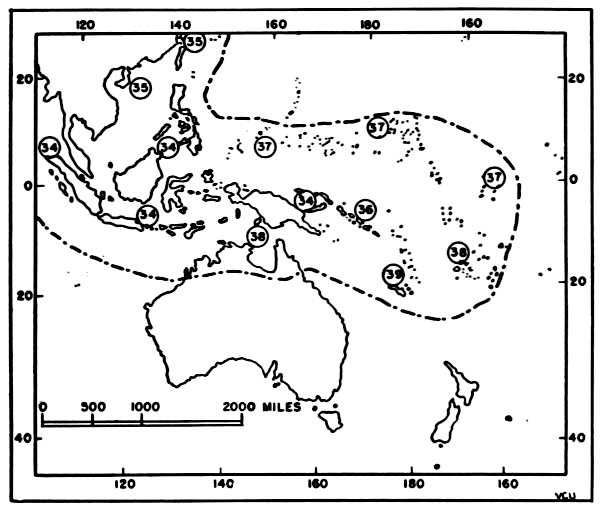
Sterna lunata Peale
Spectacled Tern
Sterna lunata Peale, U. S. Expl. Exped., 8, 1848, p. 277. (Type locality, Vincennes Island, Paumotu Group.)
Sterna lunata Hartlaub, Proc. Zool. Soc. London, 1867 (1868), p. 831 (Pelew); Hartlaub and Finsch, Proc. Zool. Soc. London, 1868, pp. 9, 118 (Pelew); idem, Proc. Zool. Soc. London, 1872, pp. 90, 113 (Pelew); Finsch, Journ. Mus. Godeffroy, 8, 1875, pp. 5, 41 (Palau); Saunders, Cat. Birds British Mus., 25, 1896, p. 100 (Pelew); Takatsukasa and Kuroda, 1, 1915, p. 62 (Ruk, Pelew); Hand-list Japanese Birds, rev., 1932, p. 195 (Palau); Hand-list Japanese Birds, 3d ed., 1942, p. 218 (Palau); Mayr, Birds Southwest Pacific, 1945, p. 26 (Micronesia).
Onychoprion lunatus Salvadori, Ornith. Papuasia, 3, 1882, p. 451 (Pelew); Wiglesworth, Abhandl. und Ber. Zool. Mus. Dresden, no. 6, 1890-1891 (1891), p. 76 (Pelew).
Melanosterna lunata Kuroda, in Momiyama, Birds Micronesia, 1922, p. 52 (Pelew).
Geographic range.—Breeds in Oceania from the Hawaiian Group south to Fiji and the Tuamotus and west to the Moluccas. In Micronesia: Palau Islands—exact locality not known.
Remarks.—Finsch (1875:41) recorded specimens taken by Tetens, Peters and Kubary at the Palau Islands. Coultas obtained one immature male at sea south of the eastern Caroline Islands at 1° 25´ N and 159° E on October 19, 1930. The Spectacled Tern ranges throughout the tropical Pacific, spending considerable time at sea, and probably reaches most parts of Micronesia in its travels.
Sterna anaetheta anaetheta Scopoli
Bridled Tern
Sterna Anaethetus Scopoli, Del. Flor. et Faun., Insubr., fasc. 2, 1786, p. 92. (Type locality, "In Guinea" = Panay, Philippine Islands, ex. Sonnerat.)
Sterna anaestheta Takatsukasa and Kuroda, Tori, 1, 1915, p. 62 (Pelew).
Melanosterna anaestheta anaestheta Kuroda, in Momiyama, Birds Micronesia, 1922, p. 52 (Pelew).
Sterna anaethetus anaethetus Hand-list Japanese Birds, rev., 1932, p. 195 (Palau); Yamashina, Tori, 10, 1940, p. 678 (Bikar); Hand-list Japanese Birds, 3d ed., 1942, p. 218 (Palau, Bikar).
Sterna anaetheta anaetheta Mayr, Birds Southwest Pacific, 1945, p. 26 (Palau).
Geographic range.—Breeds from Malaysia to Australia and Oceania and north to Formosa. Ranges west to Ceylon and north to Japan. In Micronesia: Palau Islands—exact locality not known; Marshall Islands—Bikar.
Measurements.—Four adult males from the Palau Islands have the following measurements: wing 246-254, longest tail feather 147-177, shortest tail feather 71-72, exposed culmen 40-44, tarsus 21-23; one adult female: wing 266, exposed culmen 40.5, tarsus 22.5.
Specimens examined.—Total number, 7 (4 males, 3 females) from Palau Islands, AMNH—exact locality not given (Dec. 20).
Remarks.—The Bridled Tern is known from the Palau Islands and from Bikar in the Marshall Islands. In Micronesia, the species apparently reaches the northeastern extent of its range. In the Palaus, Coultas found the terns on small outlying islands. He observed them to fly to sea early in the day and to return to the islands in the evening. Of the seven specimens obtained by him, two males and one female had enlarged gonads (Dec. 20).
Sterna fuscata oahuensis Bloxham
Sooty Tern
Sterna Oahuensis Bloxham, Voy. "Blonde," 1826, p. 251. (Type locality, Oahu, Hawaiian Islands.)
Sterna fuliginosa Finsch, Journ. Mus. Godeffroy, 12, 1876, pp. 18, 39 (Ponapé); idem, Proc. Zool. Soc. London, 1877 (1878), p. 781 (Ponapé); idem, Journ. f. Ornith., 1880, p. 295 (Ponapé); Takatsukasa and Kuroda, Tori, 1, 1915, p. 62 (Ponapé).
Onychoprion fuscata infuscata Kuroda, in Momiyama, Birds Micronesia, 1922, p. 51 (Ponapé).
Sterna fuscata nibilosa Hand-list Japanese Birds, rev., 1932, p. 195 (Ponapé); Yamashina, Tori, 10, 1940, p. 677 (Helen Reef); Hand-list Japanese Birds, 3d ed., 1942, p. 218 (Ponapé, Helen Reef).
Sterna fuscata oahuensis Mayr, Birds Southwest Pacific, 1945, p. 25 (Micronesia).
Geographic range.—Breeds from the Hawaiian, Marcus, and Bonin islands south to the Phoenix Islands and Micronesia. In Micronesia: Mariana Islands—Asuncion; Palau Islands—Helen Reef; Caroline Islands—Ponapé.
Specimens examined.—Total number, 1 unsexed from Mariana Islands, AMNH—Asuncion (Jan. 18).
Remarks.—The systematic position of the Sooty Tern in Micronesia is uncertain; in using this name I am following Peters (1934:338), who comments that the species "is badly in need of revision." Coultas obtained one immature female at O° 90´ S and 159° 50´ E, a position south of the eastern Caroline Islands. The bird is tentatively placed in the subspecies S. f. oahuensis. The Sooty Tern probably does not breed in large numbers in Micronesia, unless it be in the northern Marianas. Bryan (1903:97) reports that this species is very abundant at Marcus Island, which is north and east of the Marianas.
Sterna albifrons sinensis Gmelin
Least Tern
Sterna sinensis Gmelin, Syst. Nat., 1, pt. 2, 1789, p. 608. (Type locality, China, ex Latham.)
Sterna albifrons Marshall, Condor, 51, 1949, p. 221 (Saipan).
Geographic range.—Found on coastal areas from Korea and China south to New Guinea. In Micronesia: Mariana Islands—Saipan.
Specimens examined.—One female from Mariana Islands, USNM—Saipan (Sept. 26).
Remarks.—Marshall (1949:221) took one of two Least Terns at Lake Susupe on Saipan on September 26, 1945. The specimen taken, a female, is in post juvenal molt.
Thalasseus bergii pelecanoides (King)
Crested Tern
Sterna pelecanoides King, Surv. Intertrop. and Western Coasts Australia, 2, 1827, p. 422. (Type locality, Torres Strait, northern Queensland.)
Sterna bergii Finsch, Journ. Mus. Godeffroy, 8, 1875, p. 50 (Palau); idem, Proc. Zool. Soc. London, 1877 (1878), p. 781 (Ponapé); idem, Ibis, 1880, pp. 330, 332 (Ratak Chain); idem, Journ. f. Ornith., 1880, p. 295 (Ponapé); idem, Proc. Zool. Soc. London, 1880, p. 577 (Ruk); idem, Ibis, 1881, pp. 113, 115 (Ponapé); Schmeltz and Krause, Ethnogr. Abth. Mus. Godeffroy, 1881, pp. 281, 299, 330, 353 (Ponapé, Mortlock, Nukuor, Ruk); Salvadori, Ornith. Papuasia, 3, 1882, p. 434 (Ruk, Ponapé, Marshalls); Finsch, Mitth. Ornith. Ver. Wien, 1884, p. 51 (Jaluit); Wiglesworth, Abhandl. und Ber. Zool. Mus. Dresden, no. 6, 1890-1891 (1891), p. 74 (Pelew, Luganor, Nukuor, Ruk, Ponapé, Marshall Islands); Hartert, Novit. Zool., 7, 1900, p. 10 (Ruk); Saunders, Cat. Birds British Mus., 25, 1896, p. 89 (Ponapé, Marshalls); Takatsukasa and Kuroda, Tori, 1, 1915, p. 52 (Ponapé); Uchida, Annot. Zool. Japon., 9, 1918, pp. 483, 488 (Ponapé).
Sterna bergeri Schnee, Zool. Jahrbücher, 20, 1904, p. 390 (Marschall-Inseln).
Sterna bergii cristata Stresemann, Novit. Zool., 21, 1914, p. 58 (Truk).
Thalasseus bergii pelecanoides Oberholser, Proc. U. S. Nat. Mus., 49, 1915, p. 523 (Marshall Islands); Kuroda, in Momiyama, Birds Micronesia, 1922, p. 51 (Luganor, Nukuor, Ruk, Ponapé, Marshall Islands); Kuroda, Avifauna Riu Kiu, 1925, p. 188 (Marshall Islands); Hand-list Japanese Birds, rev., 1932, p. 194 (Palau, Faraulep, Truk, Lukunor, Nukuoro, Ponapé, Jaluit, Mille, Aurh, Maloelab, Ailuk); Yamashina, Tori, 10, 1940, p. 677 (Helen Reef, Babelthuap); Hand-list Japanese Birds, 3d ed., 1942, p. 218, (Babelthuap, Helen Reef, Faraulep, Truk, Lukunor, Nukuoro, Ponapé, Jaluit, Mille, Aurh, Maloelab, Ailuk).
Thalasseus bergii cristatus Peters, Check-list Birds World, 2, 1934, p. 342 (Carolines, Marshalls); Mayr, Birds Southwest Pacific, 1945, p. 26 (Micronesia); Baker, Smithson. Misc. Coll., vol. 107, no. 15, 1948, p. 55 (Peleliu, Ngajangel [Kayangel], Truk).
Geographic range.—Malaysia and east coast of Australia south to Tasmania, east to Melanesia and Polynesia, north to Phoenix Islands and Micronesia (see figure 11). In Micronesia: Palau Islands—Helen Reef, Peleliu, Babelthuap; Caroline Islands—Ulithi, Truk, Faraulep, Lukunor, Nukuoro, Ponapé; Marshall Islands—Jaluit, Mille, Aurh, Moloelab, Ailuk, Bikini.
Characters.—Adult: A large, white tern with back, rump, tail, wing-coverts, wing, and axillaries pearl gray; outer edges of primaries pearly grayish-black; crown black with crest; bill greenish-yellow with blackish base; feet black. Crown black, mottled with white and mantle paler in postnuptial plumage.
Immature: Resembles adult, but crown and back dark, mottled with white and crest small.
Measurements.—Measurements of Crested Terns of the Pacific area are listed in table 20.
Specimens examined.—Total number, 10 (6 males, 4 females), as follows: Caroline Islands, USNM—Ulithi, 1 (Aug. 21); AMNH—Truk, 2 (May 7, Dec. 5)—Ponapé, 3 (Nov. 1, 7); Marshall Islands, USNM—Bikini, 4 (March 4, 11, 12).
Parasites.—Uchida (1918:483, 488) obtained the following species of bird lice (Mallophaga) from the Crested Tern at Ponapé: Docophorus albemarlensis and Colpocephalum importunum.
Remarks.—Oberholser (1915:520-526, pl. 66) lists five subspecies (T. b. cristatus, T. b. halodramus, T. b. pelecanoides, T. b. rectirostris, and T. b. poliocercus) in the region including the coast of China, the Riu Kiu Islands, Malaysia, Melanesia, eastern Australia, Polynesia, and Micronesia. Only one subspecies, T. b. cristatus, is recognized in this area by Stresemann (1914:58), Hartert (1921:1695-1696), and Peters (1934:341-342), who mention that there is much variation in size and coloring.
Table 20. Measurements of Thalasseus bergii in the Pacific Area
Location No. Wing Longest tail feather Shortest tail feather Exposed culmen Tarsus
Thalasseus bergii pelecanoides Palaus, Carolines, Marshalls 6 343 168 82 60
334-352 153-184 80-85 58-65
Christmas, Phoenix, Tuamotus, Society, Fiji, Loyalty, New Hebrides 48 344 170 83 58 27
329-362 145-198 77-92 54-64 25-29
Eastern Australia 14 345 165 88 58 27
338-349 152-174 84-92 55-63 26-29
New Guinea, Bismarck, Archipelago, Moluccas 18 342 168 81 59 27
332-361 144-194 75-87 53-64 26-28
Totals 86 344 169 83 58 27
329-362 144-198 75-92 53-65 25-29
Thalasseus bergii cristatus Philippines, China, Formosa, Riu Kius 18 332 162 81 58 28
324-342 149-182 78-87 55-64 26-30
Thalasseus bergii gwendolenae Western Australia 14 354 171 86 58 27
339-369 162-182 81-91 53-65 25-29
Measurements, as shown in table 20, indicate a wide range of sizes but, in most series, the averages are nearly the same. Nevertheless, it is evident that birds from the coast of China, the Riu Kius, Formosa, and the Philippines have a distinctly shorter wing than birds from the Moluccas, Melanesia, eastern Australia, Polynesia, and Micronesia. Further evidence of this is presented by Kuroda (1925:186) who lists the measurements of the wing of eight Crested Terns from the Riu Kiu Islands as 322 to 340 (average 330). The occurrence of populations with shorter wings has already been pointed out in the work of Oberholser (1915:520-526), who divided the short-winged birds into two subspecies. It seems advisable to recognize but one subspecies, T. b. cristatus, for the birds with short wings and another subspecies, T. b. pelecanoides, to include the birds with the longer wings (see figure 11). The average measurements of the length of wings of these two subspecies, 332, and 344, differ significantly, although there is some overlap in measurements. A few specimens at hand from the western part of Malaysia are in poor condition and not measurable.
Fig. 11. Geographic distribution of Thalasseus bergii. (1) T. b. bergii; (2) T. b. thalassinnus; (3) T. b. velox; (4) T. b. cristatus; (5) T. b. gwendolenae; (6) T. b. pelecanoides.
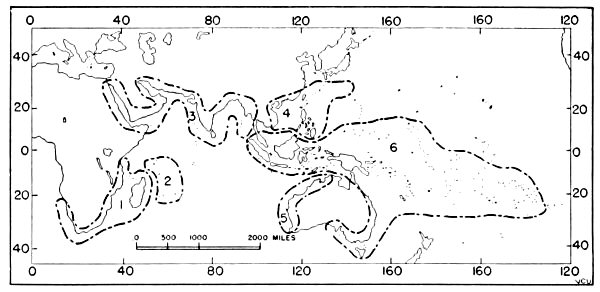
Most specimens of T. b. cristatus and T. b. pelecanoides have lighter-colored upper parts than specimens of T. b. velox, but not so light-colored as specimens of T. b. gwendolenae. Size probably is a better character than color to use in separating these groups.
In Micronesia, the NAMRU2 party observed Crested Terns at Ulithi, Peleliu and Truk, in August, September, and December, 1945, respectively. Birds were seen as singles or in small groups flying over the reefs. The birds were wary and difficult to approach, but they were conspicuous and easily identified.
Procelsterna cerulea saxatilis W. K. Fisher
Blue-gray Tern
Procelsterna saxatilis W. K. Fisher, Proc. U. S. Nat. Mus., 26, 1903, p. 559. (Type locality, Necker Island, Hawaiian Islands.)
Procelsterna cerulea saxatilis Yamashina, Tori, 10, 1940, p. 678 (Bikar); Hand-list Japanese Birds, 3d ed., 1942, p. 219 (Bikar); Mayr, Birds Southwest Pacific, 1945, p. 27 (Micronesia).
Geographic range.—Known from Marcus Island and the western Hawaiian Islands. In Micronesia: Marshall Islands—Bikar.
Remarks.—Yamashina (1940:678) recorded the taking of eight of these terns (5 adult males, 3 adult females) on July 10, 1932, at Bikar in the Marshall Islands. He gives the following measurements: wing, 180.5-188; tail, 104-113.5; exposed culmen, 24-26.5. This is the only known record for the species in Micronesia.
Anous stolidus pileatus (Scopoli)
Common Noddy
Sterna pileata Scopoli, Del. Flor. et Faun. Insubr., fasc. 2, 1786, p. 92. (No type locality = Philippines, ex. Sonnerat.)
Sterna stolida Chamisso, in Kotzebue's Voy. "Rurick," 3, 1821, pp. 150, 157 (Marshall Islands); Kittlitz, Kupfertaf. Naturgesch. Vögel, 3, 1833, p. 27, pl. 36, fig. 1 (Mordloks-Inseln); idem, Obser. Zool., in Lutké, Voy. "Le Séniavine," 3, 1836, pp. 286, 299, 308, 309 (Ualan, Lougounor, Ouleai); idem, Denkw. Reise russ. Amer. Micron. und Kamchat., 1, 1858, p. 364, 2, pp. 77, 86 (Ualan); Wiglesworth, Ibis, 1893, p. 212 (Marshalls).
Anous stolidus Hartlaub, Archiv f. Naturgesch., 18, 1852, p. 137 (Mortlock); idem, Journ. f. Ornith., 1854, p. 168 (Carolinen); Gray, Cat. Birds Trop. Is. Pacific Ocean, 1859, p. 59 (Carolines); Finsch and Hartlaub, Fauna Centralpolynesiens, 1867, p. 236 (Mordlocks, Puynipet = Ponapé); Hartlaub and Finsch, Proc. Zool. Soc. London, 1868, pp. 9, 118 (Pelew); idem, Proc. Zool. Soc. London, 1872, pp. 90, 112 (Pelew); Finsch, Journ. Mus. Godeffroy, 8, 1875, pp. 6, 42 (Palau); idem, Journ. Mus. Godeffroy, 12, 1876, pp. 18, 40 (Ponapé); idem, Proc. Zool. Soc. London, 1877 (1878), p. 781 (Ponapé); idem, Journ. f. Ornith., 1880, pp. 295, 307 (Ponapé, Ruck, Kuschai); idem, Proc. Zool. Soc. London, 1880, p. 577 (Ruk, Ponapé, Kuschai); idem, Ibis, 1881, pp. 105, 109, 115, 246, 247 (Kuschai, Ponapé); Schmeltz and Krause, Ethnogr. Abth. Mus. Godeffroy, 1881, pp. 299, 330, 353 (Mortlock, Nukuor, Ruk); Salvadori, Ornith. Papuasia, 3, 1882, p. 455 (Pelews, Carolines, Marshalls); Finsch, Mitth. Ornith. Ver. Wien, 1884, p. 51 (Jaluit, Ponapé); Wiglesworth, Abhandl. und Ber. Zool. Mus. Dresden, no. 6, 1890-1891 (1891), p. 76 (Pelew, Mortlock, Ruk, Nukuor, Ponapé, Ualan, Marshalls); Saunders, Cat. Birds British Museum, 25, 1896, p. 136 (Pelew, Carolines, Marshalls); Oustalet, Nouv. Arch. Mus. Hist. Nat. Paris, (3), 8, 1896, p. 59 (Saypan, Guam, Rota, Agrigan, Hogoleu = Truk, Kushai, Ponapi, Marshalls); Hartert, Novit. Zool., 5, 1898, p. 68 (Guam); Seale, Occ. Papers Bernice P. Bishop Mus., 1, 1901, p. 21 (Guam); Safford, Osprey, 1902, p. 66 (Mariannas); Bryan, Occ. Papers Bernice P. Bishop Mus., 2, 1903, p. 101 (Guam); Schnee, Zool. Jahrbücher, 20, 1904, p. 390 (Marshall-Inseln); Safford, The Plant World, 7, 1904, p. 267 (Guam); idem, Contr. U. S. Nat. Herb., 9, 1905, p. 80 (Guam); Prowazek, Die deutschen Marianen, 1913, p. 100 (Marianen); Takastukasa and Kuroda, Tori, 1, 1915, p. 51 (Ponapé, Ruk); Cox, Island of Guam, 1917, p. 22 (Guam); Uchida, Annot. Zool. Japon., 9, 1918, pp. 484, 488 (Palau, Ponapé); Wharton, Ecol. Monogr., 16, 1946, p. 174 (Guam); Wharton and Hardcastle, Journ. Parasitology, 32, 1946, pp. 292, 296, 306 (Guam, Ulithi).
Anous pileatus Pelzeln, Reise "Novara," Vögel, 1865, pp. 155, 162 (Puynipet = Ponapé).
Anous stolidus pileatus Hartert, Novit. Zool., 7, 1900, p. 9 (Ruk); Wetmore, in Townsend and Wetmore, Bull. Mus. Comp. Zoöl., 63, 1919, p. 183 (Kusaie); Kuroda, in Momiyama, Birds Micronesia, 1922, p. 49 (Guam, Saipan, Pelew, Mortlock, Ruk, Wolea, Nukuoro, Ponapé, Kusaie, Marshalls); Hand-list Japanese Birds, rev., 1932, p. 195 (Koror, Urukthapel, Angaur, Saipan, Guam, Wolea, Truk, Mortlock, Lukunor, Nukuoro, Ponapé, Kusaie, Jaluit, Mille, Aurh, Wotze); Bryan, Guam Rec., vol. 13, no. 2, 1936, p. 24 (Guam); Yamashina, Tori, 10, 1940, p. 678 (Assongsong, Babelthuap); Hand-list Japanese Birds, 3d ed., 1942, p. 219 (Saipan, Assongsong, Guam, Babelthuap, Koror, Urukthapel, Peliliu, Angaur, Wolea, Truk, Mortlock, Lukunor, Nukuoro, Ponapé, Kusaie, Taluit, Mille, Aurh, Wotze); Borror, Auk, 1947, p. 417 (Agrihan); Baker, Smithson. Misc. Coll., vol. 107, no. 15, 1948, p. 56 (Rota, Guam, Peleliu, Ngabad, Ulithi, Truk).
Anous stolidus unicolor? Ridgway, Bull. U. S. Nat. Mus., 50, pt. 8, 1919, p. 547 (Guam).
Table 21. Measurements of Anoüs stolidus of the Pacific Area
Location No. Wing Tail Exposed culmen
Anoüs stolidus ridgwayi Isabella, Cocos, Clipperton Islands 18 278 158 41
260-295 147-166 38-42
Anoüs stolidus galapagensis Galapagos Islands 11 277 151 40
274-282 142-160 38-42
Anoüs stolidus pileatus Hawaiian Islands: Nihoa to Midway 35 281 162 42
268-299 149-176 38-40
Wake Islands 8 278 159 41
273-285 152-170 39-43
Mariana Islands: Guam, Rota 12 280 167 41
275-288 159-187 39-43
Palau Islands 9 278 161 41
268-283 155-166 39-42
Caroline Islands 41 282 164 42
270-291 150-173 39-45
Marshall Islands 3 282 164 42
270-289 154-174 41-43
Ellice, Phoenix, Danger, Suvarov Islands 27 284 162 41
265-295 152-174 39-44
Christmas Island 13 287 162 43
280-292 152-174 40-46
Marquesas Islands 19 282 163 42
275-291 155-170 40-43
Tuamotu Archipelago 38 287 165 42
277-299 154-173 39-46
Society, Austral, Cook, Rapa Islands 16 290 164 43
280-301 155-173 40-45
Oeno, Henderson, Ducie, Easter Islands 6 293 164 44
285-298 154-175 41-45
Samoa, Fiji, Tonga 19 285 164 42
277-295 153-173 39-44
Kermadecs, Norfolk 23 276 158 41
269-289 148-173 38-43
New Hebrides, Solomons, New Guinea area 31 278 158 41
265-287 150-172 39-44
Northwest Australia 9 263 145 40
258-267 138-152 38-42
South China Sea area, Strait of Malacca 4 271 153 39
262-278 148-257 37-40
Riu Kius, Japan 5 268 148 39
259-275 143-155 37-40
Indian Ocean area: Seychelles, Aldebra, Providence, Somaliland 20 276 154 41
270-286 146-164 39-42
Geographic range.—Islands in the Indian Ocean east to tropical parts of western and central Pacific. In Micronesia: Mariana Islands—Agrihan, Asuncion, Saipan, Rota, Guam; Palau Islands—Kayangel, Babelthuap, Koror, Urukthapel, Ngabad, Peleliu, Angaur; Caroline Islands—Ulithi, Truk, Wolea, Mortlock, Lukunor, Nukuoro, Ponapé, Kusaie; Marshall Islands—Jaluit, Mille, Aurh, Wotze, Bikini, Kwajalein.
Characters.—Adult: A large, dark-brown tern with grayish crown and whitish forehead; line above eye white; crescent of white on lower eyelid; lores blackish; bill black; feet brownish, iris dark.
Immature: Resembles adult, but lighter and browner and top of head grayish-brown.
A. s. pileatus resembles A. s. ridgwayi, but darker and less brownish, although not so dark as A. s. galapagensis; forehead and crown usually duller; length of wing and tail average larger (282 and 161) than in A. s. ridgwayi (278 and 158) and A. s. galapagensis (277 and 151).
Measurements.—Measurements of the Common Noddy of the Pacific area are listed in table 21.
Weights.—In 1948 (1948:56) I listed the weights of specimens from Guam and Rota as follows: four adult males 187-204 (197); three adult females 177-203 (189).
Specimens examined.—Total number, 92 (43 males, 39 females, 10 unsexed), as follows: Mariana Islands, USNM—Guam, 7 (May 24, June 15, July 6, 21)—Rota, 3 (Oct. 18, 24); AMNH—Guam, 4 (April 21, 27, Aug. 18)—Asuncion, 1 (Jan. 18); Palau Islands, USNM—Peleliu, 2 (Sept. 1)—Ngabad, 1 (Sept. 11); AMNH—exact locality not given, 6 (Nov. 3, 8); Caroline Islands, USNM—Ulithi, 3 (Aug. 15)—Kusaie, 1 (Feb. 8); AMNH—Truk, 15 (Feb. 1, 8, 25, March 10, May 6, June 12, 13, Nov. 25, Dec. 25)—Ponapé, 20 (Dec. 3, 5, 8, 12, 15)—Kusaie, 24 (Jan., March 10-30, April 1-10); Marshall Islands, USNM—Bikini, 5 (Feb. 28, March 2, 19).
Nesting.—Murphy (1936:1152) writes that the Atlantic subspecies, A. s. stolidus, breeds in tropical localities every month of the year, although there may be a part of the resident population away at sea at any given time. In the Pacific area, Kirby (1925:187) found nests "on platforms of sticks built on tufts of grass" at Christmas Island in August. In Micronesia, Coultas obtained young birds at Kusaie in January and April and commented (field notes) that they probably nest "spasmodically at all times of the year." At Ponapé, Coultas observed nests in high trees in December, and birds obtained by him in that month had enlarged gonads. At Bikini, Morrison obtained eggs on March 2 and 19, and young on March 19. At Palau, Coultas took one female tern in postnatal molt on November 8. Adults obtained by him in that month had enlarged gonads. At Ulithi, the NAMRU2 party recorded one nest containing a single egg on August 21. At the same atoll the NAMRU2 party received reports of a large colony of nesting noddys in May to July, 1945. In the following August few noddies were seen by the NAMRU2 party. McElroy found nests on cliffs and in coconut trees at Truk in December, 1945. Hartert (1900:10) reports on eggs taken at Truk in the period from March to July 1. The NAMRU2 party observed birds carrying nest materials at Peleliu on August 28 but failed to find the nests. At Guam, the writer found terns in numbers varying from 4 to 75 in May to July, 1945, along the rocky cliffs but no evidence of nesting activity was obtained. Strophlet (1946:537) reports that nests may have been present on Orote Peninsula at Guam on December 13, 1945. Coultas (field notes) is of the opinion that the birds do not nest at Guam but do nest farther north in the Marianas. Borror (1947:417) found two colonies at Agrihan on August 10, 1945. Thus, there are records of nesting in nine months of the year in Micronesia; although I suspect that the larger flocks of terns have more regular breeding habits correlated with their pelagic feeding activities. "Stragglers" probably nest irregularly.
Food habits.—The author (1948:56) records small fish and crustaceans in stomachs of terns taken at Ulithi and Peleliu. At Ypao Point, Guam, birds were seen to fly back and forth in the day from their roosts on the sea-cliffs. On one occasion I saw these birds feeding approximately a half mile from shore.
Parasites.—Wharton (1946:174) and Wharton and Hardcastle (1946:292, 296, 306) list the following species of chiggers (Acarina) from the Common Noddy from Guam and Ulithi: Neoschöngastia bougainvillensis, N. americana solomonis, N. egretta, Acariscus pluvius, and A. anous. Uchida (1918:484, 488) found the bird louse (Mallophaga), Nirmus separatus, on terms at Palau and at Ponapé he found Colpocephalum milleri on the bird. Bequaert (in litt.) has identified a fly (Hippoboscidae) as Olfersia aenescens from a tern from Rota.
Remarks.—Of the Common Noddy Tern of the Pacific area, three subspecies are recognized by Peters (1934:346-347). Anoüs stolidus ridgwayi is known from islands off the western coast of Mexico and Central America; A. s. galapagensis is recorded from the Galapagos Archipelago; and A. s. pileatus is found on tropical islands throughout the Pacific and west to Madagascar and the African coast in the Indian Ocean. These subspecies differ from one another principally in color, as noted by Ridgway (1919:545); A. s. galapagensis is the darkest form, A. s. ridgwayi is less blackish and more brownish in color of body, and A. s. pileatus is between the two in coloring. A. s. pileatus averages larger in length of wing and tail, but these measurements do not appear to be significant from a taxonomic standpoint.
As shown in table 21, measurements of length of wing for specimens from throughout most of the Pacific area are almost the same. Length of tail is correspondingly uniform. There is a gradual increase in size of birds in the Tuamotus and Societies and east to Easter Island. In this region the average measurement for length of wing is 293 millimeters. The lengths of wing and tails are shorter in specimens from the Kermadecs and Norfolk Island, which may indicate relationships with the smaller birds of the Australian area, Western Melanesia and possibly Malaysia and the Riu Kiu Islands. I am unable to determine the subspecific status of the birds from the Kermadecs and Norfolk Island, because of the lack of sufficient material from the Australian region and Malaysia. Possibly Mathews' name, A. s. gilberti, is valid for the noddys of Australia and also for the birds at Norfolk and the Kermadecs. The small-sized birds of the Riu Kiu Islands have been designated as A. s. pullus by Bangs. When specimens from the type locality of A. s. pileatus in the Philippine Islands are available, the true relationships of the populations from Micronesia and the other areas in the Pacific can be ascertained.