ACCOUNTS OF THE KINDS OF BIRDS OF MICRONESIA (continued 6)
Reading edition
Geographic range.—Breeds in northeastern Asia, winters south to Australia and Pacific islands. In Micronesia: Mariana Islands—Guam, Tinian; Palau Islands—Babelthuap, Koror, Ngesebus, Peleliu, Angaur; Caroline Islands—Yap.
Specimens examined.—Total number, 13 (9 males, 3 females, 1 unsexed), as follows: Mariana Islands, USNM—Tinian, 10 (Oct. 23, 25); Palau Islands, USNM—Babelthuap, 1 (Nov. 27)—Angaur, 1 (Sept. 21); AMNH—exact locality not given, 1 (Oct. 26).
Remarks.—This swallow is a winter migrant to western Micronesia from Asia. In the Palau Islands in September, 1945, the NAMRU2 party saw the swallow at Ngesebus and Angaur in small flocks. At Guam, the NAMRU2 party saw one bird on October 7 and four birds flying near Agaña River on October 11. Strophlet (1946:535) saw one bird on October 28, 1945, and six birds on November 16 at Guam. Marshall (1949:221) found swallows at Tinian, Saipan and Palau from October to February. He found only immature birds.
Edolisoma tenuirostre monachum (Hartlaub and Finsch)
Cicada Bird
Campephaga monacha Hartlaub and Finsch, Proc. Zool. Soc. London, 1872, p. 99. (Type locality, Pelew Islands.)
Volvocivora monacha Finsch, Journ. Mus. Godeffroy, 8, 1875, pp. 4, 19, pl. 3, fig. 2-3 (Palau); idem, Journ. Mus. Godeffroy, 12, 1876, p. 28 (Palau); Schmeltz and Krause, Ethnogr. Abth. Mus. Godeffroy, 1881, p. 407 (Palau).
Lalage monacha Sharpe, Cat. Birds British Mus., 4, 1879, p. 105 (Pelew); Tristram, Cat. Birds, 1889, p. 186 (Pelew); Wiglesworth, Abhandl. und Ber. Zool. Mus. Dresden, no. 6, 1890-1891 (1891), p. 25 (Pelew); Bolau, Mitteil. Naturhist. Mus. Hamburg, 1898, p. 53 (Palau); Matschie, Journ. f. Ornith., 1901, pp. 112, 113 (Palau); Dubois, Syn. Avium., 1, 1902, p. 303 (Pelew); Reichenow, Die Vögel, 2, 1914, p. 276 (Palau); Takatsukasa and Kuroda, Tori, 1, 1915, p. 54 (Pelew); Kuroda, in Momiyama, Birds Micronesia, 1922, p. 68 (Pelew); Hand-list Japanese Birds, rev., 1932, p. 175 (Palau); Hand-list Japanese Birds, 3d ed., 1942, p. 194 (Babelthuap, Koror).
Edolisoma monacha Mathews, Syst. Avium Australasianarum, 2, 1930, p. 541 (Pelew).
Edolisoma tenuirostre monacha Stresemann, Ornith. Monatsber., 47, 1939, p. 126 (Palau); Mayr, Birds Southwest Pacific, 1945, p. 294 (Palau); Baker, Smithson. Misc. Coll., vol. 107, no. 15, 1948, p. 65 (Peleliu).
Geographic range.—Micronesia: Palau Islands—Babelthuap, Koror, Peleliu.
Characters.—Adult male: Forehead, crown, nape, back, and underparts near "Tyrian blue"; auriculars darker than back; lores and chin black; throat black washed with blue gray; wing feathers black, margined with pale blue; black tail tipped with whitish, and basal part of middle two rectrices colored like back; under wing dark except for whitish inner margins of secondaries; bill and feet black; iris dark brown.
Adult female: Resembles adult male, but forehead and under eye pale buff; superciliary stripe darker buff; crown, nape, and sides of neck dark slate-blue; mantle brown, feathers with buffy centers; back brown washed with burnt brown; feathers of rump and upper tail-coverts with terminal black bar edged with buff; wing and tail brownish-black, primaries margined with buff, innermost three secondaries and upper wing-coverts broadly edged with lighter buff, tail tipped with buff, more broadly so on outermost tail feathers, two outermost tail feathers with outer edge buff; two central tail feathers basally dark ochre; ear-coverts buff, tinged with black; chin, throat, and under wing-coverts deep buff; breast, abdomen, and flanks buff, feathers with subterminal blackish bar; under tail buff.
Immature: Resembles adult female, but crown, nape, and sides of neck brown; back faintly mottled with buff; tail feathers and primary wing-coverts tipped with white; younger birds may have upper parts margined with pale buff.
Measurements.—Measurements are listed in table 34.
Specimens examined.—Total number, 23 (13 males, 10 females), as follows: Palau Islands, USNM—Koror, 4 (Nov. 6, 14, 26, Dec. 5)—Peleliu, 2 (Aug. 29, 30); AMNH—exact locality not given, 17 (Oct., Nov., Dec.).
Table 34. Measurements of Edolisoma tenuirostre in Micronesia
Subspecies No. Wing Tail Exposed culmen Tarsus
E. t. monachum 10 98 80 21.0 23.0
96-103 76-83 20.0-22.5 22.5-24.0
E. t. insperatum 35 109 86 23.0 24.0
107-112 82-91 22.0-24.0 23.0-25.0
Molt.—Molt in this bird appears to take place in the period from August to December. Most of the specimens taken in August, October, November and December were in molt. None was taken in other months.
Food habits.—This bird feeds principally on insects. A female taken on August 29 had in its stomach about one and a half cc. of parts of grasshopper. Marshall (1949:212) records both animal and vegetable matter in the stomach of this bird.
Remarks.—The Cicada Bird at Palau inhabits the jungles, especially the marginal areas between the thick jungle and the more open woodlands. In 1945, the NAMRU2 party observed only two birds, both of which were obtained. These were found at Peleliu in a small area of undisturbed woodland at the edge of a mangrove swamp. Each bird was perched approximately 25 feet above the ground on the outer branches of a densely foliated tree. The bird is thought not to be so rare as our records indicate; probably its secretive habits conceal it from man except as he makes special search for it. Coultas (field notes) describes the bird as one of the true forest. He found it shy and retiring and possessing a very weak voice.
It may be noted that Delacour (1946:2) does not accept the genus Edolisoma but places birds which are currently assigned to it in the genus Coracina.
Edolisoma tenuirostre nesiotis (Hartlaub and Finsch)
Cicada Bird
Campephaga nesiotis Hartlaub and Finsch, Proc. Zool. Soc. London, 1872, p. 98. (Type locality, Uap.)
Campehaga nesiotis Gräffe, Journ. Mus. Godeffroy, 2, 1873, p. 123 (Yap); Schmeltz and Krause, Ethnogr. Abth. Mus. Godeffroy, 1881, p. 391 (Yap).
Volvocivora nesiotis Finsch, Journ. Mus. Godeffroy, 12, 1876, p. 28 (Yap).
Edoliisoma nesiotis Sharpe, Cat. Birds British Mus., 4, 1879, p. 56 (Yap); Wiglesworth, Abhandl. und Ber. Zool. Mus. Dresden, no. 6, 1890-1891 (1891), p. 25 (Uap); Bolau, Mitteil. Naturhist. Mus. Hamburg, 1898, p. 53 (Yap); Matschie, Journ. f. Ornith., 1901, p. 112 (Yap); Dubois, Syn. Avium, 1, 1902, p. 299 (Uap); Reichenow, Die Vögel, 2, 1914, p. 274 (Karolinen = Yap); Kuroda, in Momiyama, Birds Micronesia, 1922, p. 68 (Mackenzie, Yap).
Edolisoma nesiotis Mathews, Syst. Avium Australasianarum, 2, 1930, p. 542 (Mackenzie group); Hand-list Japanese Birds, rev., 1932, p. 174 (Yap); Hand-list Japanese Birds, 3d ed., 1942, p. 194 (Yap).
Edolisoma tenuirostre nesiotis Stresemann, Ornith. Monatsber., 49, 1939, p. 126 (Yap); Mayr, Birds Southwest Pacific, 1945, p. 294 (Yap).
Geographic range.—Micronesia: Caroline Islands—Yap.
Characters.—Adult male: Resembles adult male of E. t. monachum. Adult female: Resembles adult female of E. t. monachum, but wings and upper parts less buffy and more rufous; eye-stripe rufous; breast barred on sides only.
Remarks.—No specimen of the Cicada Bird from Yap has been examined by me. For a long time this bird was thought to be a species distinct from any other member of this genus, but Stresemann (1939:126) arranged it as a subspecies of Edolisoma tenuirostre. The type specimen is an immature, and the adult is unknown. The presence of rufous coloring shows a relationship with E. t. insperatum of Ponapé, but Mayr, who has examined the type of E. t. nesiotis in the Hamburg Museum, and has obligingly showed me his notes on the bird, says that it has a greater resemblance to the Cicada Bird at Palau especially because of the amount of barring on the underparts. The true status of this bird, as well as that of other members of the avifauna of Yap, will be incompletely known until such time as good collections are available from this island group.
Edolisoma tenuirostre insperatum (Finsch)
Cicada Bird
Volvocivora inseperata Finsch, Proc. Zool. Soc. London, 1875, (1876), p. 644. (Type locality, Ponapé.)
Volvocivora insperata Finsch, Journ. Mus. Godeffroy, 12, 1876, pp. 17, 27 (Ponapé); idem, Proc. Zool. Soc. London, 1877 (1878), p. 779 (Ponapé); idem, Ibis, 1881, pp. 110, 112, 115 (Ponapé); Schmeltz and Krause, Ethnogr. Abth. Mus. Godeffroy, 1881, p. 281 (Ponapé).
Volvozivora insperata Finsch, Journ. f. Ornith., 1880, p. 289 (Ponapé).
Lalage insperata Sharpe, Cat. Birds British Mus., 4, 1879, p. 108 (Ponapé); Wiglesworth, Abhandl. und Ber. Zool. Mus. Dresden, no. 6, 1890-1891 (1891), p. 25 (Ponapé); Bolau, Mitteil. Naturhist. Mus. Hamburg, 1898, p. 53 (Ponapé); Matschie, Journ. f. Ornith., 1901, pp. 112, 113 (Ponapé); Reichenow, Die Vögel, 2, 1914, p. 276 (Karolinen = Ponapé); Kuroda, in Momiyama, Birds Micronesia, 1922, p. 68 (Ponapé); Hand-list Japanese Birds, rev., 1932, p. 174 (Ponapé); Hand-list Japanese Birds, 3d ed., 1942, p. 194 (Ponapé).
Lisomada insperata Mathews, Novit. Zool., 24, 1928, p. 372 (new generic name); idem, Syst. Avium Australasianarum, 2, 1930, p. 545 (Ponapé).
Edolisoma tenuirostre insperata Stresemann, Ornith. Monatsber., 47, 1939, p. 126 (Ponapé); Mayr, Birds Southwest Pacific, 1945, p. 294 (Ponapé).
Edolisoma tenuirostre Mayr, Proc. 6th Pacific Sci. Congr., 4, 1941, p. 204 (Ponapé).
Geographic range.—Micronesia: Caroline Islands—Ponapé.
Characters.—Adult male: Resembles adult male of E. t. monachum, but larger; upper parts more grayish-blue; wings with outer edges bluish-gray and inner webbings grayish-white; central tail feathers with subterminal, roundish, black spots; two outermost tail feathers black tipped with broad, pale bluish-gray coloring; lores more bluish-gray and less black; ear-coverts pale bluish-gray; chin, throat, breast, abdomen, flanks, under wing, and under tail-coverts grayish-blue; bill and feet black; iris dark brown.
Adult female: Resembles adult female of E. t. monachum, but larger; forehead slate-gray; crown brownish-gray, browner on nape; back chocolate-brown; rump rufous; upper tail-coverts more cinnamon; wing and tail brownish-black, outer margins of primaries edged with buff; outer margins of secondaries and upper wing-coverts except primary wing-coverts edged with rufous; central tail feathers like back but tipped with buff, other tail feathers more broadly tipped with buff; lores grayish-black; malar stripe to auriculars darker and more brownish-black with lighter shafts; underparts rufous, under wing paler and more buffy.
Immature: Resembles adult female, but forehead grayish tinged with ochre; crown and neck brown becoming slightly more reddish on back and more burnt reddish-brown on rump; tail edged and tipped with buff; primaries tipped with whitish, secondaries broadly edged with buff, primary wing-coverts tipped with buffy-white; lores blackish; ear-coverts rufous with lighter shafts; tail feathers pointed while in adult more rounded. Younger birds resemble older ones, but plumage except wings and tail may be spotted or barred with buff and black with whitish margins.
Measurements.—Measurements are listed in table 34.
Specimens examined.—Total number, 46 (23 males, 23 females), from Caroline Islands, AMNH—Ponapé (Nov., Dec.).
Nesting.—Coultas (field notes) writes that the nest is cup-shaped, made of grasses and strands of hair fern, and placed at low elevations in small trees and bushes. He was told that two eggs are laid. He comments that the nesting season had just been completed in November and December (the time of his visit to Ponapé), because he noted juveniles being attended and fed by the adults.
Molt.—Most of the specimens taken by Coultas in November and December are in fresh plumage or in the final stages of molt, indicating that the molt was initiated possibly in September and would be completed possibly in January. This time of molt appears to be approximately one month later than the time of molt of E. t. monachum of Palau. Probably the bird at the Palau Islands breeds slightly earlier in the year than the subspecies on Ponapé.
Examination of the large series of birds taken by Coultas at Ponapé shows the presence of three types of plumages. The writer has not made a thorough diagnosis of these plumages, but suspects that the phenomenon obtained here is the same as was found by Mayr (1933e) in his study of Neolalage banksiana (Gray), which is a related bird. Immatures of E. t. insperatum seemingly present two plumages, which, if Mayr's arrangement is followed, may be interpreted as a more primitive or "retarded" type in one case, with less striking plumage, barred with black and buff, and a more advanced or "progressive" type in the other case, with plumage of the latter resembling more the adult type, especially the adult female. It was not ascertained whether any of these specimens represented adult birds in "retarded" plumage.
Remarks.—The Cicada Bird at Ponapé resembles in habits its related subspecies at Palau. Coultas (field notes) writes that it is a forest bird, with retiring habits. He observed the birds in small groups, and describes their musical call notes as "to-to-wee, to-to-wee" repeated several times.
Evolutionary history of Edolisoma tenuirostre in Micronesia.—Mayr (in Stresemann, 1939:126) first pointed out the close relationship between the cicada birds of Micronesia and Edolisoma tenuirostre of the Solomon Islands. Up to that time the Micronesian birds were considered to belong to the genus Lalage. The cicada birds probably invaded Micronesia along two independent routes from a dispersal center in the Papuan area. The form at Palau, E. t. monachum, resembles closely several of the subspecies to the south and southwest, particularly those in the New Guinea area. Aside from the smaller size of the Palau form there are differences in coloration between this bird and those of Melanesia. In the adult female and the juvenile there are differences in the amount of barring on the underparts and in the shade of color on the upper parts. In the adult male there are differences in the marginal coloring of the primaries and secondaries. E. t. nesiotis may have arrived at Yap from Palau. Little is known concerning the taxonomic position of this bird. On the basis of the information available, it appears closer to the Palau bird than the Ponapé bird in color; however, in size it probably more closely approaches the latter subspecies.
The Ponapé Cicada Bird, E. t. insperatum, appears to represent a colonization distinct from that which established the populations at Yap and Palau. This conclusion is based on the fact that the adult female of E. t. insperatum has distinctive reddish coloring and lacks the barring on the underparts, and that it may have been derived from an ancestral stock, which was reddish and not barred, such as E. t. remotum of the New Ireland area. The three subspecies in Micronesia may represent remnants of a single colonization, since additional material from Yap may prove that this island population has characters intermediate between those of the other subspecies of Micronesia.
Dicrurus macrocercus harterti S. Baker
Black Drongo
Dicrurus ater harterti S. Baker, Novit. Zool., 26, 1918, p. 299. (Type locality, Formosa.)
Dicrurus macrocercus Baker, Trans. 11th N. Amer. Wildlife Conf., 1946, p. 211 (Rota).
Dicrurus macrocercus harterti Baker, Smithson. Misc. Coll., vol. 107, no. 15, 1948, p. 65 (Rota).
Geographic range.—Formosa. In Micronesia: Mariana Islands—Rota (introduced).
Specimens examined.—Total number, 7 (4 males, 3 females), from Mariana Islands, USNM—Rota (Oct. 18, 19, Nov. 2).
Remarks.—This drongo was introduced from Formosa to Rota by the Japanese South Seas Development Company (Nanyo Kohatsu Kabushiki Kaisha) apparently in 1935. An illustrated booklet, printed by this organization and seen by members of the NAMRU2 party at the Rota Civil Government headquarters, showed pictures of the captive birds before release and indicated that they had been brought to Rota for the purpose of controlling destructive insects. Dr. Charles Vaurie has examined these birds and compared them with a series of drongos from Formosa in the collection of the American Museum of Natural History.
The drongo appears well adapted at Rota, where it prefers cultivated areas and the bombed village sites to thick woodlands. Birds were found in small flocks often perched in large shade trees in village areas. Weights of two immature males are 53 and 61 grams. One adult male measures: wing, 144, tail, 153, culmen, 26, tarsus, 22.
Corvus kubaryi Reichenow
Marianas Crow
Corvus Kubaryi Reichenow, Journ. f. Ornith., 1885, p. 110. (Type locality, Palau, error = Guam.)
Corvus solitarius Kittlitz, Obser. Zool., in Lutké, Voy. "Le Séniavine," 3, 1836, p. 305 (Guahan); Bonaparte, Comptes Rendus Acad. Sci. Paris, 37, 1853, p. 830 (Mariannes); Kittlitz, Denkw. Reise russ. Amer. Micron. und Kamchat., 2, 1858, p. 143 (Guahan); Oustalet, Nouv. Arch. Mus. Hist. Nat. Paris, (3), 7, 1895, p. 216 (Guam and Rota).
Corvus spec. Hartlaub, Journ. f. Ornith., 1854, p. 167 (Mariannen); Gray, Hand-list Birds, 2, 1870, p. 12 (Marianne).
Corvus kubaryi Hartert, Novit. Zool., 5, 1898, p. 59 (Guam, Rota); Wheeler, Report Island of Guam, 1900, p. 13 (Guam); Matschie, Journ. f. Ornith., 1901, p. 112 (Guam); Seale, Occ. Papers Bernice P. Bishop Mus., 1901, p. 55 (Guam); Safford, Osprey, 1902, p. 69 (Guam); idem, The Plant World, 7, 1904, pp. 3, 264 (Guam); idem, Contr. U. S. Nat. Herb., 9, 1905, p. 79 (Guam); Prowazek, Die deutschen Marianen, 1913, pp. 87, 102 (Marianen); Reichenow, Die Vögel, 2, 1914, p. 306 (Palau); Takatsukasa and Kuroda, Tori, 1, 1915, p. 64 (Marianne); Cox, Island of Guam, 1917, p. 21 (Guam); Kuroda, in Momiyama, Birds Micronesia, 1922, p. 69 (Guam, Rota); Meinertzhagen, Novit. Zool., 33, 1926, p. 73 (Guam); Hand-list Japanese Birds, rev., 1932, p. 169 (Guam, Rota); Bryan, Guam Rec., vol. 13, no. 2, 1936, p. 25 (Guam); Hand-list Japanese Birds, 3d ed., 1942, p. 187 (Guam, Rota); Mayr, Birds Southwest Pacific, 1945, p. 298 (Guam, Rota); Watson, The Raven, 17, 1946, p. 41 (Guam); Wharton, Ecol. Monogr., 16, 1946, p. 174 (Guam); Strophlet, Auk, 1946, p. 540 (Guam); Baker, Ecol. Monogr., 16, 1946, p. 408 (Guam); idem, Condor, 49, 1947, p. 125 (Guam); idem, Smithson. Misc. Coll., vol. 107, no. 15, 1948, p. 66 (Guam, Rota).
Corone phillipina Wiglesworth, Abhandl. und Ber. Zool. Mus. Dresden, no. 6, 1890-1891 (1891), p. 46 (Marianne).
Corone kubaryi Wiglesworth, Abhandl. und Ber. Zool. Mus. Dresden, no. 6, 1890-1891 (1891), p. 46 (Pelew, error = Guam).
Geographic range.—Micronesia: Mariana Islands—Guam, Rota.
Characters.—Adult: A small, black crow with a slight greenish-black gloss on head; back, wings, and tail with bluish-black gloss; underparts with dull, greenish-black gloss; bases of feathers light grayish, more nearly white on neck, producing a somewhat ragged appearance; nasal bristles short but extending over nostrils and base of culmen; bill and feet black; iris dark brown. Female smaller.
Immature: Resembles adult, but feathers with less gloss; wings and tail browner.
Measurements.—Measurements of Corvus kubaryi are listed in table 35.
Weights.—The NAMRU2 party obtained weights of the Marianas Crow as follows: from Guam, 5 males, 231-270 (256), 11 females, 205-260 (242); from Rota, 1 male, 256; 1 female, 260 grams.
Table 35. Measurements of Corvus kubaryi
Location Number and sex Wing Tail Full culmen Tarsus
Guam 9 males 236 (229-244) 165 (158-170) 55 (51-57) 51 (49-52)
19 females 227 (222-241) 151 (143-166) 50 (47-54) 50 (46-54)
Rota 3 males 235 (233-236) 167 (166-169) 54 (53-56) 50 (49-51)
Specimens examined.—Total number, 49 (20 males, 27 females, 2 unsexed), as follows: Mariana Islands, USNM—Guam, 26 (May 25, 29, June 4, 7, 8, 9, 18, 28, 29, July 10, 12, 18, Sept. 5, 11)—Rota, 4 (Oct. 22, 25, 29); AMNH—Guam, 19 (Jan., Feb., March, Aug., Sept., Dec.).
Nesting.—In the spring of 1945, the NAMRU2 party obtained records of nesting activities by crows. One nest was observed on March 8 in a banyan tree. Specimens collected from May to September were not in breeding condition, and it is thought that the nesting period is concentrated in the winter and spring months. Watson (1946:41) reports finding a young crow being fed on May 8 by an adult.
Molt.—The Marianas Crow molts in the period from May to August or September. Most of the birds taken by the NAMRU2 party in this period were in the process of molt. Skins obtained at Rota in late October also exhibit signs of molt. Specimens taken in December, January and February are in fresh or slightly worn plumage. The crow presents an exceedingly shabby appearance in molt, because the grayish and whitish basal parts of the feathers are exposed.
Food habits.—The crow is an omnivorous feeder. Stomachs examined contained both plant and animal food. Both Seale (1901:55) and Safford (1905:79) comment on the damage which the crow does to the corn crop at Guam. Seale remarks that the crow has a reputation for plundering nests of other birds. The NAMRU2 party saw crows being chased by starlings on several occasions.
Parasites.—Wharton (1946:174) obtained the chigger (Acarina), Trombicula sp., from the crow at Guam.
Remarks.—The Marianas Crow is confined to the forested areas and to the coconut plantations at Guam. The birds were seen as singles or in small flocks, often along the roadways. In a count of the number of birds seen along the roadways of Guam, the author (1947:124) found crows to constitute 2.4 per cent of the total population of birds counted and observed the crow on 21.6 per cent of the 125 roadway counts made. Coultas (field notes) noted the birds at the northern part of Guam. The NAMRU2 party found the birds distributed in most parts of the island but usually they were infrequent near areas where large numbers of service personnel were stationed. The birds were often noisy when flying in small flocks or in pairs; Seale (1901:55) also notes this. When observed in jungle areas, the birds were generally quiet, feeding and perching in dense foliage. At Rota, the NAMRU2 party found the bird to be fairly numerous and with habits resembling those of the crow at Guam. No differences in color or structure could be found between the specimens of crows obtained at the two islands.
Kittlitz (1836:305) was the first person to write an account of the crow at Guam. He called it Corvus solitarius and remarked that he later found the same species in the Philippines. Wiglesworth (1891a:46) also considered the crow at Guam to resemble one found in the Philippines and called it Corone phillipina. Later Reichenow named the bird Corvus kubaryi with the type locality as the Palau Islands. This locality proved to be erroneous and the bird was judged to be from Guam by Hartert (1898:59), who did not use the name C. solitarius because it was a nomen nudum, and recognized C. kubaryi as the correct name.
Evolutionary history of Corvus kubaryi.—Meinertzhagen (1926:59) writes that "Environmental influences seem to be mainly, if not entirely, responsible for geographic differences in the genus Corvus." Such may be the case in C. kubaryi, which is a small, dull-colored crow with a relatively unmodified bill. In structure, it has little resemblance to other crows found in the Pacific area. Kittlitz was the first to note a resemblance between the bird at Guam and one in the Philippines. Oustalet (1896:70) wrote that the bird at Guam is related to crows of the Moluccas and New Guinea. Although not closely related to the Hawaiian Crow, C. tropicus, both have little gloss on their feathers, a character which is common to many of the insular populations of crows. Mayr (1943:46) is of the opinion that the Hawaiian bird was derived from a North American ancestor, although Bryan (1941:187) suggests that it is related to C. macrorhynchus of southeastern Asia and remarks that the Hawaiian Crow, "has some relation to the Guam Crow." In looking for the ancestral stock of C. kubaryi, the several species of crows which occur to the north, west and south of the Marianas have been examined. In size and general structure, C. kubaryi appears to be closest to the C. enca group, and not as closely related to the C. macrorhynchus group. The small size, the shape of the culmen, the lack of pointed feathers on the breast, and the presence of white on the basal parts of the feathers of the nape are characters which C. kubaryi has in common with C. enca. Nasal bristles cover the frontal base of the culmen in C. kubaryi; this character is found also in C. enca florensis. C. kubaryi differs from the C. enca group by lacking the purple sheen on the upper parts; this sheen is conspicuous in the latter species. C. kubaryi appears to have little in common with C. meeki of the Solomons and C. orru of the Moluccas and New Guinea area. There is apparently no close relation between the Marianas Crow and the crow which reaches the Bonins. The latter crow, according to the Hand-list of Japanese Birds (Hachisuka et al., 1932:1), is called C. coronoides hondoensis Momiyama and is apparently now extinct in the Bonins.
In summary, it may be said that C. kubaryi is an isolated and modified species of crow, which probably has been living at Guam and Rota for a considerable length of time. Whether it once lived on other islands in Micronesia is unknown, but it is entirely possible that the present population may represent a remnant of one which formerly had a more extensive distribution. The characters which show its distinctness from possible ancestral species include its small size, its slender bill, and its dull coloration. It is thought to have been derived from the C. enca group, C. e. pusillus of the Philippines or C. e. celebensis of the Celebean area.
Luscinia calliope calliope (Pallas)
Siberian Rubythroat
Motacilla Calliope Pallas, Reise durch versch. Prov. russ. Reichs, 3, 1776, pp. 261, 325, 697. (Type locality, Yenesei.)
Luscinia calliope calliope Hand-list Japanese Birds, rev., 1932, p. 178 (Koror); Hand-list Japanese Birds, 3d ed., 1942, p. 197 (Koror); Mayr, Birds Southwest Pacific, 1945, p. 302 (Palau).
Geographic range.—Breeds in northeastern Asia. Winters south to Malaysia. In Micronesia: Palau Islands—Koror.
Remarks.—The Siberian Rubythroat is considered to be a casual winter visitor to the Palau Islands.
Monticola solitaria philippensis (Müller)
Chinese Blue Rock Thrush
Turdus philippensis Müller, Natursystem Supplements- und Register-Band, 1776, p. 145. (Type locality, Philippine Islands, ex Buffon.)
Monticola philippensis philippensis Hand-list Japanese Birds, rev., 1932, p. 177 (Koror); Mayr, Birds Southwest Pacific, 1945, p. 302 (Palau).
Monticola solitarius philippensis Hand-list Japanese Birds, 3d ed., 1942, p. 197 (Koror).
Geographic range.—Breeds in northeastern Asia and Japan. Winters south to Malaysia. In Micronesia: Palau Islands—Koror.
Remarks.—The Chinese Blue Rock Thrush is apparently an infrequent winter visitor to the Palau Islands.
Turdus obscurus obscurus Gmelin
Dusky Thrush
Turdus obscuras Gmelin, Syst. Nat., 1, 1789, p. 816. (Type locality, Lake Baikal.)
Turdus obscuras Hartlaub and Finsch, Proc. Zool. Soc. London, 1872, pp. 89, 96 (Pelew); Finsch, Journ. Mus. Godeffroy, 8, 1875, pp. 5, 22 (Palau); Kuroda, in Momiyama, Birds Micronesia, 1922, p. 66 (Pelew).
Merula obscura Wiglesworth, Abhandl. und Ber. Zool. Mus. Dresden, no. 6, 1890-1891 (1891), p. 39 (Pelew).
Turdus obscuras obscuras Hand-list Japanese Birds, rev., 1932, p. 177 (Koror); Hand-list Japanese Birds, 3d ed., 1942, p. 197 (Koror); Mayr, Birds Southwest Pacific, 1945, p. 302 (Palau).
Geographic range.—Breeds in northeastern Asia. Winters south to Malaysia. In Micronesia: Palau Islands—Koror.
Remarks.—The Dusky Thrush is considered to be a casual winter visitor to the Palau Islands. It was first taken there by Captain Heinsohn, according to Hartlaub and Finsch (1872:96).
Psamathia annae Hartlaub and Finsch
Palau Bush-warbler
Psamathia annae Hartlaub and Finsch, Proc. Zool. Soc. London, 1868, p. 5, pl. 2. (Type locality, Pelew Islands.)
Psamathia annae Hartlaub and Finsch, Proc. Zool. Soc. London, 1868, pp. 116, 118 (Pelew); idem, Proc. Zool. Soc. London, 1872, pp. 89, 94 (Pelew); Finsch, Journ. Mus. Godeffroy, 8, 1875, pp. 5, 22 (Palau); Nehrkorn, Journ. f. Ornith., 1879, pp. 399, 404 (Palau); Schmeltz and Krause, Ethnogr. Abth. Mus. Godeffroy, 1881, p. 407 (Palau); Sharpe, Cat. Birds British Mus., 7, 1883, p. 101 (Pelew); Tristram, Cat. Birds, 1889, p. 155 (Pelew); Wiglesworth, Abhandl. und Ber. Zool. Mus. Dresden, no. 6, 1890-1891 (1891), p. 40 (Pelew); Bolau, Mitteil. Naturhist. Mus. Hamburg, 1898, p. 57 (Palau); Matschie, Journ. f. Ornith., 1901, p. 112 (Palau); Reichenow, Die Vögel, 2, 1914, p. 536 (Palau); Takatsukasa and Kuroda, Tori, 1, 1915, p. 54 (Pelew); Kuroda, in Momiyama, Birds Micronesia, 1922, p. 67 (Pelew); Mathews, Syst. Avium Australasianarum, 2, 1930, p. 629 (Pelew); Hand-list Japanese Birds, rev., 1932, p. 177 (Palau); Hand-list Japanese Birds, 3d ed., 1942, p. 196 (Babelthuap, Koror, Peleliu); Delacour, Ibis, 84, 1942, p. 514 (Palau); Mayr, Birds Southwest Pacific, 1945, p. 294 (Palau); Baker, Smithson. Misc. Coll., vol. 107, no. 15, 1948, p. 197 (Peleliu, Ngabad).
Calamodyta annae Gray, Hand-list Birds, 1, 1869, p. 208 (Pelew).
Geographic range.—Micronesia: Palau Islands—Babelthuap, Koror, Garakayo, Peleliu, Ngabad.
Characters.—Adult: A medium-sized warbler with a rather long bill and tail; upper parts near "buff olive," slightly lighter on head; lores olive-gray to olive-green; supraloral stripe and orbital ring pale yellow-buff; auriculars yellow-brown; underparts lighter and more olive-yellow than back, especially in midsection; chin paler; sides, tibia and under tail-coverts darker and more olivaceus; wings and tail dark brown with outer edges olive; under wing-coverts light yellow; axillaries more whitish; upper mandible horn-colored, darker at base; lower mandible yellowish, darker at base; legs and feet light yellowish-brown; iris grayish-brown. Adult female resembles adult male but is slightly smaller. Immature: Resembles adult but forehead and crown slightly lighter and more yellowish; back and rump more brownish.
Measurements.—Measurements are listed in table 36.
Table 36. Measurements of Psamathia annae
Sex No. Wing Tail Exposed culmen Tarsus
Adult males 7 74 64 21.0 28.5
(72-77) (62-68) (19.5-22.5) (27.0-30.0)
Adult females 11 69 58 21.0 26.5
(65-74) (55-61) (19.5-22.0) (25.0-29.0)
Specimens examined.—Total number, 23 (9 males, 14 females), as follows: Palau Islands, USNM—Koror, 5 (Nov. 7, 9, 11, 18, 19)—Peleliu, 4 (Aug. 29, 30, Sept. 4, Dec. 5)—Ngabad, 1 (Sept. 11); AMNH—exact locality not given, 13 (Nov., Dec.).
Nesting.—Nehrkorn (1879:399, 404) records the egg of Psamathia from Palau. The NAMRU2 party obtained no evidence of nesting of this bird in August and September, 1945. In 1931, Coultas secured birds in November and December, which had enlarged gonads. Marshall (1949:219) records breeding in November and December.
Molt.—Most of the skins taken from August to December have worn or molting feathers. Apparently there is a high point in the molting process in autumn and early winter.
Food habits.—Stomachs obtained from birds taken by the NAMRU2 party in August and September contained parts of insects and small seeds. One stomach contained about one-half cc. of parts of insects. Coultas (field notes) found the bird scratching "on the ground for seeds as well as working in the low trees and bushes." Marshall (1949:212) records insects and snails as food items.
Remarks.—Psamathia has the habit of a typical bushwarbler, occurring in jungle undergrowth and along woodland margins. In 1945, specimens were obtained by the NAMRU2 party in the scrub vegetation which was growing over the devastated battle areas of Peleliu. The bird was not common in this habitat, nor was it very numerous on the smaller offshore islands. Coultas (field notes) found the bird to be rather tame and frequently to live close to human habitation. Its call, as noted by Coultas, is a loud whistle that breaks off into a beautiful song. The bird is quick in its movements; one seen by the writer at Ngabad was constantly moving about in low, second-growth vegetation and was making a low, whistling call. The resemblance of Psamathia to Rukia palauensis is noteworthy. These two unrelated birds live together in jungle areas, although Psamathia is perhaps confined more to the forested undergrowth and is more solitary in its habits. Aside from its longer legs and bill, Psamathia closely resembles Rukia in shape and coloration. They appear to have developed along somewhat similar evolutionary lines with regard to structure, color and ecologic requirements.
The Palau Warbler was first discovered by Captain Tetens and described as belonging to a new genus by Hartlaub and Finsch (1868a:5). In the original description the authors remark that, "The generic position of this new form is in the Calamoherpe group; the feet are the same as in Calamoherpe; but the beak is weaker and slenderer, and the wings are very different. Calamoherpe has the first quill quite spurious, the third is the longest, and the second and sixth are subequal. In Calamoherpe there are twelve tail-feathers; in Psamathia I can find only ten. Tatare is a very different form, with a scutellated tarsi, a very different structure of the plumage, a much more elongated beak, and a twelve-feathered tail. Tatare syrinx is a typical Calamoherpe. In the structure of the wing of Psamathia, there seems to be a great resemblance to the genus Arundinax of Blyth, a form with which it is not in my power to compare." The genera Calamoherpe and Tatare are now included in Acrocephalus; the describers were comparing the Palau Warbler with the reed-warblers of Micronesia and Polynesia.
Sharpe (1883:93) writes that the Palau Bush-warblers are "Aberrant reed warblers, and should, in my opinion, be placed in future classifications of the Cichlomorphae near the genera Cettia and Acrocephalus, from which they are separated by their larger first primary only. Through Megalurus and Sphenoeacus they approach the grass-warblers and Cisticolae especially."
Mayr (1941b:203) cites Psamathia as an example of "restricted endemism" and points out that the nearest relative occurs in the Philippines. Delacour (1942:514), in a discussion of the bush-warblers of the genera Cettia, Bradypterus and related forms, says, "Psamathia annae, from Palau Islands, is related to Cettia, differing mainly in its much longer bill and legs."
Psamathia is a specialized bush-warbler and has followed a pattern of evolution which characterizes some of the other island birds in that the bill and legs are long and the wing is rather short and rounded. Psamathia resembles many of the bush-warblers, as well as the reed-warblers {Acrocephalus); in general, body coloring being paler below and darker above. It differs from Acrocephalus by having a longer tenth primary, smaller second and third primaries, only ten tail feathers, a more rounded wing, differently shaped nostrils, and by much softer plumage (the latter character is found also in Collurcincla tenebrosus and Cleptornis marchei of Micronesia). Rather than being related to the reed-warblers, as was supposed by Hartlaub and Finsch, Psamathia seems closest to Cettia, especially to Cettia (Horeites) diphone seebohmi of the Philippine Islands. Psamathia has a longer bill than this bird, but the general appearance and structure of the feet, tail, wing, body and bill are the same.
Acrocephalus luscinia luscinia (Quoy and Gaimard)
Nightingale Reed-warbler
Thryothorus luscinius Quoy and Gaimard, Voy. "l'Astrolabe," Zool., 1, 1830, p. 202, pl. 5, fig. 2. (Type locality, Marian Is. = Guam.)
Sylvia syrinx Kittlitz (part), Obser. Zool., in Lutké, Voy. "Le Seniavine," 3, 1836, p. 306 (Guahan); idem (part), Denkw. Reise russ. Amer. Micron. und Kamchat., 2, 1858, p. 141 (Guaham).
Tatare luscinia Gray, Genera Birds, 3, 1849, App. 8 (Marian Is. = Guam); Hartlaub, Journ. f. Ornith., 1854, p. 167 (Mariannen = Guam); Gray, Cat. Birds Trop. Is. Pacific Ocean, 1859, p. 14 (Ladrone or Marian Is. = Guam); Finsch, Journ. Mus. Godeffroy, 12, 1876, p. 31 (Guaham); Wiglesworth, Abhandl. und Ber. Zool. Mus. Dresden, no. 6, 1890-1891 (1891), p. 41 (Guam); Büttikofer, Notes Leyden Mus., 14, 1892, p. 16 (Guam); Oustalet, Nouv. Arch. Mus. Hist. Nat. Paris, (3), 7, 1895, p. 209 (Guam).
Tatare luscinius Bonaparte, Consp. Avium, 1, 1850, p. 224 (Guam); idem, Comptes Rendus Acad. Sci. Paris, 41, 1855, p. 1111 (Mariannes = Guam); Gray, Hand-list Birds, 1, 1869, p. 194 (Ladrone = Guam).
Hybristes [luscinia] Reichenbach, Syst. Avium, 1850, pl. 57, fig. 7 (no locality = Guam).
Acrocephalus orientalis Pelzeln, Reise, "Novara," Vögel, 1865, p. 64 (Guaham).
Tatares luscinius Giebel, Thes. Ornith., 3, 1877, p. 599 (Marianae).
Acrocephalus mariannae Tristram, Ibis, 1883, p. 45 (Type locality, Guam).
Tatare mariannae Sharpe, Cat. Birds British Mus., 7, 1883, p. 528 (Marianne = Guam); Oustalet, Le Nat., 1889, p. 260 (Mariannes = Guam).
Acrocephalus luscinia Hartert, Novit. Zool., 5, 1898, p. 57 (Guam, Saipan); Seale, Occ. Papers Bernice P. Bishop Mus., 1, 1901, p. 53 (Guam, Saipan); Matschie, Journ. f. Ornith., 1901, pp. 112, 113 (Guam, Saipan); Safford, Osprey, 1902, p. 69 (Guam); Dubois, Syn. Avium, 1, 1902, p. 369 (Marianne); Safford, Amer. Anthro., 4, 1902, p. 711 (Guam); idem, The Plant World, 7, 1904, p. 264 (Guam); idem, Contr. U. S. Nat. Herb., 9, 1905, pp. 30, 79 (Guam); Reichenow, Die Vögel, 2, 1914, p. 545 (Marianen); Cox, Island of Guam, 1917, p. 21 (Guam); Kuroda, in Momiyama, Birds Micronesia, 1922, p. 67 (Guam, Saipan); Bryan, Guam Rec., vol. 13, no. 2, 1936, p. 25 (Guam); Thompson, Guam and its people, 1942, p. 23 (Guam); Strophlet, Auk, 1946, p. 539 (Guam).
Conopoderas luscinia Mathews, Syst. Avium Australasianarum, 2, 1930, p. 594 (Marianas); Hand-list Japanese Birds, rev., 1932, p. 177 (Marianas).
Conopoderas luscinia hivae Yamashina, Bull. Biogeogr. Soc. Japan, 12, 1942, p. 81 (Type locality, Saipan); Hand-list Japanese Birds, 3d ed., 1942, p. 196 (Almagan, Saipan).
Conopoderas luscinia luscinia Hand-list Japanese Birds, 3d ed., 1942, p. 197 (Guam).
Acrocephalus luscinia luscinia Mayr (part), Birds Southwest Pacific, 1945, p. 294 (Guam, Saipan, Almagan); Stott, Auk, 1947, p. 526 (Saipan); Baker, Smithson. Misc. Coll., vol. 107, no. 15, 1948, p. 67 (Guam).
Geographic range.—Micronesia: Mariana Islands—Guam, Saipan, Almagan.
Character.—Adult: A rather large warbler with long, curved bill; upper parts near "Saccardo olive"; feathers of head grayer because of darker shafts; rump paler and browner; lores dark; supraloral stripe light buffy-yellow; auriculars, cheeks, and sides of neck slightly darker; chin, throat, breast, and abdomen pale buffy-yellow; tibia darker and more olivaceous-brown; under tail-coverts pale yellow-buff; wing and tail feathers brown, edged with ochraceous; under wing grayish, inner edges lighter; axillaries pinkish-white; upper mandible dark horn colored; lower mandible lighter yellow; feet light gray; iris brown. Female resembles male but is slightly smaller.
Table 37. Measurements of Acrocephalus luscinia
Subspecies No. Sex Wing Tail Exposed culmen Tarsus
A. l. luscinia 11 males 84 83 36.0 30.5
(81-86) (80-86) (35.5-39.0) (30.0-31.0)
1 female 78 73 37.0 28.5
A. l. syrinx 31 males 78 71 26.5 26.5
(76-80) (68-75) (25.0-27.0) (25.0-29.0)
12 females 75 68 25.5 26.0
(74-78) (65-70) (24.0-27.0) (24.0-26.0)
Immature: Resembles adult, but upper parts duller and more brown and less olive; underparts less yellow; wing and tail feathers lighter brown.
Measurements.—Measurements are listed in table 37.
Weights.—The weights of three adult males obtained at Guam by the NAMRU2 party are 30, 30, and 31 grams. An adult female from Guam weighed 27 grams.
Specimens examined.—Total number, 12 (11 males, 1 female), as follows: Mariana Islands, USNM—Guam, 6 (June 2, 13, July 2, 18)—Saipan, 6 (Sept. 27, 30).
Nesting.—Oustalet (1895:209) writes that Marche found nests at Guam in June, 1887. The NAMRU2 party obtained two males with enlarged gonads in June, 1945.
Molt.—Specimens taken in June, July, and September are either in worn plumage or in molt. Birds in worn plumage become a faded straw-brown above. Oustalet apparently interpreted this coloring of the worn plumage as a seasonal coloration.
Food habits.—Seale (1901:53) reports that four stomachs which he examined contained insects and larvae. Marshall (1949:21) lists as food items: lizards, snails, spiders, and insects.
Remarks.—The Nightingale Reed-warbler at Guam is restricted to cane thickets and adjacent areas in and near fresh and brackish water marshes. In 1945, the NAMRU2 party found the bird fairly numerous in some of these habitats. Seale (1901:53) writes, "This bird is now quite scarce on the island of Guam. It lives exclusively among the reedy swamps, and those swamps are now being drained to make room for the Chinaman's rice paddies." Mayr (1945a:295) also notes the rarity of the species. As a result of the late war, the cultivation of rice was reduced and the reed-warbler probably has been able to increase in some of the now fallow areas. The most extensive range of this bird at Guam is found in the Agaña Swamp, where there is a large area consisting of thick cane. Here, and in the other large cane patches, the chief hazard to the bird population appears to be fire. In dry periods, the entire habitat might be easily destroyed by fire. The birds are extremely shy; their melodious songs may be heard in the reeds, but their active movements in the thick cane are difficult to observe. While hunting for these birds along the edges of Agaña Swamp on June 2, the writer observed, or located the calls of, at least six or seven individuals but could only get within shooting range of three birds. Within the cane thickets, these birds feed and move about near the ground or the surface of the water. Rarely do they perch in a conspicuous manner in the upper parts of the cover. Their color patterns blend perfectly with the coloration of the dry cane stalks. Perhaps failure to find many of the birds because of their secretive habits has caused many observers to assume that the bird is near extinction. Nevertheless, it is my contention that the bird, being restricted to these limited areas, has never been very abundant at Guam. The absence of natural enemies, especially snakes, may be one of the principal reasons why they have been able to survive.
Reed-warblers were not found by the NAMRU2 party at Rota in 1945, nor have they been reported from Tinian. Yamashina in 1942 described the populations at Saipan and Almagan as distinct. I have not seen this description, but on the basis of examinations of specimens from Saipan, I can see no recognizable differences between these and birds from Guam.
Acrocophalus luscinia syrinx (Kittlitz)
Nightingale Reed-warbler
Sylvia syrinx Kittlitz, Mém. Acad. Imp. Sci. St. Petersbourg, 2, 1835, p. 6, pl. 8. (Type locality, Lugunor and Ulcei = Woleai.)
Sylvia syrinx Kittlitz (part), Obser. Zool., in Lutké, Voy. "Le Séniavine," 3, 1836, p. 297 (Lougounor); idem, Denkw. Reise russ. Amer. Micron. und Kamchat., 2, 1858, p. 92 (Ualan, Lugunor, Ulea).
Eparnetes Reichenbach, Syst. Avium, 1850, pl. 57 (no locality = Carolines); Bonaparte, Comptes Rendus Acad. Sci. Paris, 41, 1855, p. 1111 (Carolines).
Tatare syrinx Hartlaub, Archiv f. Naturgesch., 18, 1852, p. 131 (Ualan, Lugunor); Pucheran, Voy. Pôle Sud, 3, 1853, p. 92 (Hogoleu = Truk); Hartlaub, Journ. f. Ornith., 1854, pp. 164, 168 (Hogoleu); Gray, Cat. Birds Trop. Is. Pacific Ocean, 1859, p. 14 (Ualan); Sharpe, Cat. Birds British Mus., 7, 1883, p. 527 (Carolines); Wiglesworth, Abhandl. und Ber. Zool. Mus. Dresden, no. 6, 1890-1891 (1891), p. 41 (Ruk, Ualan, Luganor, Uleei, Nukuor, Ponapé); Oustalet (part), Nouv. Arch. Mus. Hist. Nat. Paris, (3), 7, 1895, p. 210 (Ruk, Ponapi, Mortlock, Kusaie, Uleei, Nukuor).
Acrocephalus orientalis Pelzeln, Reise "Novara," Vögel, 1865, pp. 63, 162 (Puynipet, Lugunor, Ulcei).
Calamodyta syrinx Gray, Hand-list Birds, 1, 1869, p. 208 (Ualan); Giebel, Thes. Ornith., 1, 1872, p. 529 (Carolin.).
Calamoherpe syrinx Finsch, Journ. Mus. Godeffroy, 12, 1876, p. 17 (Ponapé, Lugunor, Ruck, Ualan, Uleei); idem, Proc. Zool. Soc. London, 1877 (1878), p. 778 (Ponapé); idem, Journ. f. Ornith, 1880, pp. 287, 297 (Ponapé, Ruck, Mortlocks, Kuschai); idem, Proc. Zool. Soc. London, 1880, p. 575 (Ruk, Ponapé); idem, Ibis, 1881, pp. 108, 112, 115, 247 (Kuschai, Ruck, Ponapé, Mortlocks); Schmeltz and Krause, Ethnogr. Abth. Mus. Godeffroy, 1881, pp. 298, 330, 353 (Ponapé, Mortlocks, Nukor, Ruk); Finsch, Ibis, 1883, p. 143 (Ruck); idem, Mitth. Ornith. Ver. Wien, 1884, p. 49 (Ponapé); idem, Sammlung wissensch. Vorträge, 14 ser., 1900, p. 659 (Carolinen).
Acrocephalus syrinx Seebohm, Cat. Birds British Mus., 5, 1881, p. 100 (Ponapé); Tristram, Ibis, 1883, p. 44 (Ponapé, Ruk, Mortlock, Lugunor, Uleei); idem, Cat. Birds, 1889, p. 152 (Ponape, Ruk); Nehrkorn, Kat. Eiers., 1899, p. 33 (Ponapé, Ruk); Hartert (part), Novit. Zool., 5, 1898, p. 58 (Carolines); idem, Novit. Zool., 7, 1900, p. 3 (Ruk); Seale (part), Occ. Papers Bernice P. Bishop Mus., 1, 1901, p. 53 (Ponapé); Matschie, Journ. f. Ornith., 1900, pp. 112, 113 (Ruk, Ponapé, Ualan); Dubois, Syn. Avium, 1, 1902, p. 369 (Ponapé); Reichenow, Die Vögel, 2, 1914, p. 545 (Ponapé); Takatsukasa and Kuroda, Tori, 1, 1915, p. 54 (Ponapé, Ruk); Mayr, Proc. 6th Pacific Sci. Congr., 4, 1941, p. 204 (Ponapé).
Conopoderas syrinx Wetmore, in Townsend and Wetmore, Bull. Mus. Comp. Zoöl., 63, 1919, p. 214 (Ponapé, Truk); Takatsukasa and Yamashina, Dobotsu. Zasshi, 43, 1931, p. 485 (Caroline Is.); Yamashina, Tori, 7, 1932, p. 405 (Ponapé); Hand-list Japanese Birds, rev., 1932, p. 177 (Carolines).
Acrocephalus stentoreus syrinx Kuroda (part), in Momiyama, Birds Micronesia, 1922, p. 67 (Ruk, Ualan, Lugunor, Wolea, Nukuoro, Ponapé).
Conopoderas luscinia syrinx, Hand-list Japanese Birds, 3d ed., 1942, p. 197 (Wolea, Lamotrek, Truk, Lukunor, Nukuoro, Ponapé, Kusaie).
Acrocephalus luscinia syrinx Mayr, Birds Southwest Pacific, 1945, p. 294 (Carolines); Baker, Smithson. Misc. Coll., vol. 107, no. 15, 1948, p. 67 (Truk).
Geographic range.—Micronesia: Caroline Islands—Woleai, Lamotrek, Truk, Lukunor, Nukuoro, Ponapé, Kusaie.
Characters.—Adult: Resembles A. l. luscinia, but smaller; with shorter, straighter bill; head and neck more reddish-brown; back, rump, wing, and tail edged with cinnamon; flight feathers faintly tipped with white.
Immature: Resembles adult, but lighter and more rufous in color; wings and rump paler, wings edged with rufous buff.
Measurements.—Measurements are listed in table 37.
Specimens examined.—Total number, 62 (35 males, 20 females, 7 unsexed), as follows: Caroline Islands, USNM—Ponapé, 1 (Feb. 12)—Truk, 4 (Feb. 16, Mar. 15); AMNH—Ponapé, 35 (Nov., Dec.)—Truk, 22 (Feb., March, May, June, Nov.).
Nesting.—Birds nest in reedy swamps and scrub vegetation in the Caroline Islands, although Finsch (1881b:115), recording a field note by Kubary, states that nests were found in trees at Mortlock Atoll (= Lukunor). Yamashina (1932a:405) reports the collecting of seven sets of eggs at Ponapé in July and August, 1931. The sets consisted of one or two eggs each. McElroy of the NAMRU2 party obtained specimens with enlarged gonads at Truk in December and noted that birds were carrying nest materials to cane swamps. Of the birds secured by Coultas in November and December at Ponapé, only a small number had enlarged gonads. He also found nests containing no eggs in low bushes at Ponapé. Hartert (1900:3) reports that at Truk Owston's Japanese collectors obtained "many nests" from the end of May to the beginning of July. These nests contained one or two eggs and were found 7 to 20 feet above the ground in breadfruit, coconut and ivory-nut palm trees. Hartert writes, "The eggs are white, covered with darker and lighter brown patches, and underlying ashy grey or lavender-grey spots. These spots are generally thicker near the broad end, sometimes forming a loose ring, and they are sometimes equally spread over the whole surface." He lists measurements of 48 eggs.
Molt.—Of the specimens examined by me, those taken in the spring and summer are in fresh or worn plumage; those taken in fall and winter are in molt, with a few skins exhibiting worn or fresh plumage in the latter period. Apparently the peak in the molting process occurs from September to December.
Food habits.—The reed-warbler is an insect feeder. Coultas, in his observations of the bird at Ponapé, relates that he was able to locate the warbler by listening for the "snapping of the mandibles as the bird is catching food."
Remarks.—From the observations of Kittlitz, Kubary, Coultas, McElroy, and others, it is apparent that the Nightingale Reed-warbler in the Caroline Islands is restricted to the lower elevations of the islands. Whereas the reed-warbler at Guam seems closely associated with cane swamps and adjacent vegetation, the bird in the Carolines may range more extensively into brush lands, forest margin and grass lands. Coultas (field notes) notes that the reed-warbler at Ponapé is a "common bird of the small bush and grasslands. One is attracted by its warbler-like song. The bird spends hours perched on a stem of a bush caroling the time of day. When feeding, one finds it on the ground or working away quietly among the bushes. Acrocephalus is a friendly bird who does not become frightened easily. He responds to man-made calls."
The Nightingale Reed-warbler is found on many of the islands in the Caroline Chain, including both the "high" volcanic islands (Ponapé and Truk) and the "low" coral islands (Lukunor and Nukunor). Although the bird has been recorded at Kusaie by Kittlitz and Finsch, it was not taken there by Coultas in 1931. Reed-warblers are unknown at Yap, Ulithi, Fais or at other islands of the extreme western Carolines, or in the Palau Archipelago.
They are unrecorded also in the Marshall Islands, but at Nauru in the Gilbert Islands, to the southeast, an isolated population of this bird occurs and has been named A. l. rehsei (Finsch).
Acrocephalus luscinia yamashinae (Takatsukasa)
Nightingale Reed-warbler
Conopoderas yamashinae Takatsukasa, Dobutsu. Zasshi, 43, 1931, p. 485. (Type locality, Pagan.)
Tatare syrinx Oustalet (part), Nouv. Arch. Mus. Hist. Nat. Paris, (3), 7, 1895, p. 210 (Pagan).
Acrocephalus syrinx Hartert (part), Novit. Zool., 5, 1898, p. 58 (Pagan); Seale (part), Occ. Papers Bernice P. Bishop Mus., 1, 1901, p. 53 (Pagan).
Acrocephalus stentoreus syrinx Kuroda (part), in Momiyama, Birds Micronesia, 1922, p. 67 (Pagan).
Conopoderas yamashinae, Hand-list Japanese Birds, rev., 1932, p. 177 (Pagan).
Conopoderas luscinia yamashinae Hand-list Japanese Birds, 3d ed., 1942, p. 196 (Pagan).
Acrocephalus luscinia yamashinae Mayr, Birds Southwest Pacific, 1945, p. 294 (Pagan).
Geographic range.—Micronesia: Mariana Islands—Pagan.
Characters.—Resembles A. l. syrinx, but duller and more brownish and less olive-rufous on back, rump and tail; bill shorter and more curved.
Takatsukasa (1931:485) gives the following description: "Upperparts dark olive brown, paler on the lower rump; remiges and rectrices dark olive-brown, margined with brown. Superciliary stripe distinct and buff; chin, throat, breast and abdomen pale brown; ear-coverts, sides of neck, sides of breast and flanks dusty greyish brown, belly and under tail-coverts pale buff. Bill clove brown, legs grey, and iris Van Dyke brown." He continues, "It differs from Conopoderas syrinx of Caroline Islands by its colouration and the shape of the bill, namely in the new form the culmen is more curved and more stout, and the tail is less roundish and nearly square."
Measurements.—Takatsukasa and Yamashina (1931b:485) lists the following measurements: 13 adult males—wing, 75-80; tail, 65-70; culmen, 20-22; 6 adult females—wing, 73-77; tail, 60-65; culmen, 20-22.
Mayr examined seven specimens from Pagan in the Paris Museum. His measurements are: five males—wing, 76-79; tail, 66-69; bill from nostril, 14-14.5; two females—wing, 75, 77; tail, 66, 67; bill from nostril, 14.5, 15.
Remarks.—No specimens have been examined by me. Oustalet (1895:210) was the first to note the difference between the reed-warblers from Pagan and those from Guam and Saipan (A. l. luscinia). He regarded those from Pagan as similar to the population in the Carolines, calling them Tatare syrinx. Hartert, Seale, and Momiyama followed Oustalet in this regard, and it was not until 1931 that the population at Pagan was recognized as distinct, when further collections were made by the Japanese.
Acrocephalus luscinia nijoi (Yamashina)
Nightingale Reed-warbler
Conopoderas luscinia nijoi Yamashina, Tori, 10, 1940, p. 674. (Type locality, Agiguan.)
Conopoderas luscinia nijoi Hand-list Japanese Birds, 3d ed., 1942, p. 196 (Agiguan).
Acrocephalus luscinia luscinia Mayr (part), Birds Southwest Pacific, 1945, p. 294 (Agiguan).
Geographic range.—Micronesia: Mariana Islands—Agiguan.
Characters.—Adult: Resembles A. l. luscinia, but with shorter bill. Yamashina (1940:674) describes the birds as, "upper parts much less rusty in colour and the flanks and bellies are darker and more brownish than those of the specimens from Almagan and Saipan."
Measurements.—Yamashina (1940:674) gives the measurements of five adult birds from Agiguan as: exposed culmen 27-29, bill from nostril 17.0-20.0; as compared with 27 adult birds from Almagan and Saipan as: exposed culmen 30-34, bill from nostril 21.2-24.5.
Remarks.—No specimens have been examined by me. The island of Agiguan is a very small one lying offshore from Tinian and not far from Saipan, where A. l. luscinia occurs. A. l. nijoi is given tentative recognition, on the basis of the measurements of the five adult specimens given by Yamashina. These indicate that the population has a distinctly shorter bill.
Evolutionary history of Acrocephalus luscinia.—The species of Acrocephalus in Micronesia and Polynesia have received several taxonomic treatments. In regard to the Micronesian forms, Quoy and Gaimard called the population at Guam Thryothorus while Kittlitz called the population in the Carolines, Sylvia. Evidently to emphasize the distinctness of these two birds, Reichenbach in 1850 renamed the bird in the Marianas as Hybristes and the bird in the Carolines as Eparnetes. The birds were later placed in the genus, Tatare, by Hartlaub, Gray, Sharpe and other workers. Gray also used the name, Calamodyta, for the bird in the Carolines. The generic term, Calamoherpe, was employed also by a number of workers for the Caroline population. Sharpe (1883:525) placed the reed-warblers in the family Timelidae and retained the name, Tatare, for the Micronesian and Polynesian forms. In distinguishing Acrocephalus from Tatare he has the following to say of Acrocephalus: "besides having a much shorter bill, possesses a very much more pointed wing, the distance between the primaries and the secondaries being much more than the length of the hind toe and claw; whereas in Tatare the wing is much more obtuse, and the distance between the primaries and the secondaries is less than the length of the hind toe and claw." More recent authors have followed Sharpe using the generic name, Conopoderas (= Tatare, old name preoccupied). However, Tristram (1883:38-46) regarded the separation of these oceanic forms from Acrocephalus as a taxonomic error. He said that this is "one of the very few links (the others being the solitary Hirundo tahitica and the Merulae) between the avifauna of Oceania and our own; and it has a much wider range east and west than either of the other links, extending from the Carolines in the east to the Marquesas in the west." Mayr has pointed out (orally to the writer) that the separation of the Oceanic reed-warblers from Acrocephalus is an unnatural one, although it is perfectly true that the extreme members (A. caffra and A. l. luscinia) have a very long bill, but forms with shorter bills like A. l. syrinx point to the close affinity between the continental species and these insular birds. This has also been noted by Hartert (1898:58). Mayr (in litt.) comments that "There is no difference between Acrocephalus and Conopoderas in regard to the wing formula, provided that we compare the Polynesian species with the tropical forms of Acrocephalus (such as toxopei and cervinus). The character mentioned by Sharpe is very artificial and merely indicates the difference in the wing between a migrant of the temperate zone and a resident of the tropics. There is no denying that some of the warblers of eastern Polynesia are no longer reed-warblers but have become dwellers of trees and bushes. However, this same tendency prevails among some of the unquestionable species of Acrocephalus (scirpaceus and palustris) and at any rate a slight change in habits is not sufficient for generic separation." Earlier, Mayr (1942b:169) used Conopoderas as one of the several genera that is based on "morphologically distinct geographic forms." The degree of modification that has occurred in these oceanic reed-warblers, would, if the birds were in a continental area, undoubtedly be considered worthy of specific or even generic rank by some authors; however, as Mayr (1942b:162) points out, "the majority of well-isolated subspecies have all the characters of good species and are indeed considered to be such by the more conservative systematists." Owing to their differentiation, the Micronesian and Polynesian reed-warblers might not be considered by some ornithologists as belonging to a single superspecies; however, all evidence seems to point to the origin of this group by a single invasion from Asia."
Tristram (1883:41) was the first worker to recognize the relationship of the Micronesian and Polynesian reed-warblers to the continental forms, when he placed them within the genus Acrocephalus. Rothschild (1893:2) further stated, "Tatare cannot be separated generically from Acrocephalus." In discussing the status of the Hawaiian species, A. familiaris, Hartert (1898:58) also follows this treatment. Bryan (1941:187) also comments on the relationship of the "miller" birds of Laysan and Nihoa to species at Guam, Christmas and other islands of the Pacific.
The reed-warblers of Polynesia and Micronesia represent an ancient invasion from Asia. The continental form, Acrocephalus arundinaceous, is apparently closest to the ancestral stock of these oceanic birds. This species resembles the oceanic populations in size, general coloring, shape of bill, and wing and tail structure. Some of the continental races of this species have a shorter first primary which is similar to that in the oceanic forms. How rapid the spread was of the reed warbler through the large insular area that it now occupies is unknown. A. syrinx of Micronesia has a shortened wing and some populations have a long bill. Species in Polynesia have stronger wings than the one in Micronesia, but have become differentiated in other ways, as, for example, by the long bill of A. caffra and the small size of A. aequinoctialis. In addition, call notes have become varied, as noted by Chapin (in Mayr, 1942b:54). Also certain of the reed-warblers have become bush and tree-living birds. The Hawaiian birds are reduced in size and have become tree-living in a manner similar to that of other Polynesian species. These modifications of the reed-warblers of the Oceanic area appear, according to Murphy and Mathews (1929), to indicate their long-time residence in the islands, as compared with subspecies of A. arundinaceous that are found in Melanesia. The latter birds, which are not ancestral to the Polynesian birds, resemble closely their Asiatic ancestors and have also retained their swamp-living habits. This would seem to indicate that the birds in Melanesia may be of more recent occurrence. Stresemann (1939b:324) presents a map of the distribution of A. arundinaceous in southeastern Asia and adjacent islands. The original stock came from a point in China, north of Indochina, spreading to the Philippines and to Celebes, from where it reached the Solomons and New Guinea via the Lesser Sundas and Australia.
Fig. 15. Geographic distribution of Acrocephalus in the Pacific area and routes of its dispersal. (1) A. arundinaceus; (2) A. luscinia; (3) ranges of A. atypha, A. caffra, and A. vaughani; (4) A. aequinoctialis; (5) A. familiaris.
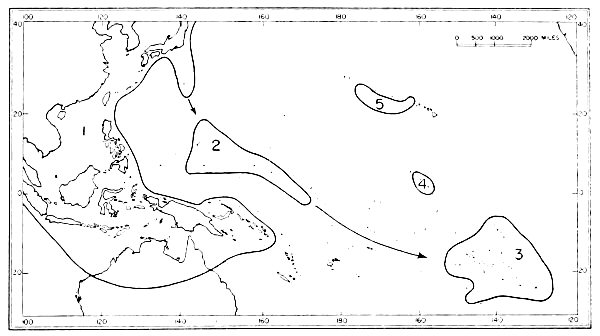
The path of invasion of Oceania by the reed-warbler is pictured in figure 15. Probably the birds became established in Micronesia by an invasion from the Bonins, where A. arundinaceus orientalis is known to occur today. From the Marianas and Carolines, the birds spread to Polynesia; A. l. rehsei of the Gilbert Islands (Nauru) might well be a connecting link. Possibly, the Hawaiian birds came as a separate invasion via the Volcano and Bonin islands or through the Micronesia Chain, or through the Line and Christmas islands from the south. It seems evident, however, that owing to their geographic proximity and comparative structural similarity, the species in Hawaii is closest to A. luscinia of Micronesia. The absence of reed-warblers from the western Carolines and Palaus seems to reduce the possibility of an invasion from the Philippine region. However, reed-warblers are absent from the Marshall and the northern Gilbert islands, where there is undoubtedly suitable habitat for their occurrence. Possibly these islands were once occupied by the birds but they were eliminated by natural causes or by man and his land uses.
Rhipidura rufifrons uraniae Oustalet
Rufous-fronted Fantail
Rhipidura Uraniae Oustalet, Bull. Soc. Philom. Paris, (7), 5, 1881, p. 76. (Type locality, Mariannes = Guam.)
Rhipidura pectoralis Gray, Cat. Birds Trop. Is. Pacific Ocean, 1859, p. 17 (Ladrone or Marian Is. = Guam).
Rhipidura uraniae Reichenow and Schlow, Journ. f. Ornith., 1884, p. 398 (Mariannes = Guam); Hartert, Novit. Zool., 5, 1898, p. 53 (Guam); Wiglesworth, Abhandl. und Ber. Zool. Mus. Dresden, no. 6, 1890-1891 (1891), p. 20 (Marianne = Guam); Büttikofer, Notes Leyden Mus., 15, 1893, p. 76 (Guam); Wheeler, Report Island of Guam, 1900, p. 13 (Guam); Matschie, Journ. f. Ornith., 1901, pp. 112, 113 (Guam); Seale, Occ. Papers Bernice P. Bishop Mus., 1, 1901, p. 48 (Guam); Safford, Osprey, 1902, p. 69 (Guam); Dubois, Syn. Avium, 1, 1902, p. 277 (Guam); Safford, The Plant World, 7, 1904, p. 263 (Guam); idem, Contr. U. S. Nat. Herb., 9, 1905, p. 79 (Guam); Mearns, Proc. U. S. Nat. Mus., 36, 1909, p. 477 (Guam); Schnee, Zeitschr. f. Naturwisch., 82, 1910, p. 464 (Marianen = Guam); Reichenow, Die Vögel, 2, 1914, p. 267 (Marianen = Guam); Cox, Island of Guam, 1917, p. 21 (Guam); Kuroda, in Momiyama, Birds Micronesia, 1922, p. 65 (Guam); Bryan, Guam Rec., vol. 13, no. 2, 1936, p. 25 (Guam).
Rhipidura atrigularis Reichenow, Journ. f. Ornith., 1885, p. 110 (Type locality, Palau, error = Guam); Wiglesworth, Abhandl. und Ber. Zool. Mus. Dresden, no. 6, 1890-1891 (1891), p. 21 (Pelew, error = Guam); Takatsukasa and Kuroda, Tori, 1, 1915, p. 63 (Marianne = Guam).
Rhipidura versicolor Oustalet (part), Nouv. Arch. Mus. Hist. Nat. Paris, (3), 7, 1895, p. 190 (Guam).
Rhipidura rufifrons uraniae Mathews, Syst. Avium Australasianarum, 2, 1930, p. 490 (Marianne = Guam); Hand-list Japanese Birds, rev., 1932, p. 176 (Guam); Hand-list Japanese Birds, 3d ed., 1942, p. 195 (Guam); Mayr, Birds Southwest Pacific, 1945, p. 295 (Guam); Watson, The Raven, 17, 1946, p. 42 (Guam); Mayr and Moynihan, Amer. Mus. Novit., no. 1321, 1946, pp. 3, 9 (Guam); Baker, Proc. Biol. Soc. Washington, 59, 1946, p. 77 (Guam); idem, Smithson. Misc. Coll., vol. 107, no. 15, 1948, p. 67 (Guam).
Rhipidura rufifrons Wharton, Ecol. Monogr., 16, 1948, p. 174 (Guam); Strophlet, Auk, 1946, p. 339 (Guam).
Geographic range.—Micronesia: Mariana Islands—Guam.
Characters.—Adult: Forehead and anterior crown near "cinnamon-buff"; lores and orbital ring black, auriculars more brownish than lores; malar stripe white; a few feathers in posterior malar region tipped with "citrine drab"; anterior part of chin white; posterior part of chin, throat, and upper breast black; feathers on breast edged with white; lower breast, abdomen, sides, flanks, tibia, vent, and under tail-coverts near "royal brown," becoming lighter on breast and more rufous on under tail-coverts; sides of neck and back near "Dresden brown," becoming grayer on neck and crown where feathers have darker shafts; rump and upper tail-coverts near "orange rufous"; basal half of tail slightly lighter than rump; terminal part of tail black, tipped with white; wings dark edged with coloring like back; under wing grayish with axillaries tipped with buffy-white; bill black with base of upper mandible lighter; feet dark brown; iris dark brown.
Immature: Resembles adult, but head, neck, scapulars, and secondaries edged with rufous; feathers of chin and throat edged with whitish. Younger birds may have less rufous on head but feathers of body more rufous with creamy edges.
Measurements.—Measurements are listed in table 38.
Table 38. Measurements of Rhipidura rufifrons in Micronesia
Subspecies Number and sex Wing Tail Exposed culmen Tarsus
R. r. uraniae 11 males 66 78 13.6 16.6
(64-69) (75-82) (13.1-14.5) (15.6-17.2)
6 females 65 76 12.3 16.8
(61-68) (73-81) (11.6-12.5) (16.1-17.6)
R. r. saipanensis 7 males 68 81 13.3 17.3
(68-69) (80-83) (13.0-13.5) (16.2-18.4)
6 females 64 76 12.7 17.9
(62-66) (72-81) (12.4-13.4) (17.2-18.1)
R. r. mariae 2 males 65, 67 82, 82 12.1, 12.4 17.1, 17.2
R. r. kubaryi 14 males 77 88 14.4 20.0
(75-79) (82-95) (13.6-15.0) (19.0-21.0)
10 females 72 87 14.5 20.0
(69-75) (83-90) (14.0-15.0) (20.0-20.5)
Weights.—The NAMRU2 party recorded the weights of nine males as 9.0-10.0 (9.0); of three females as 7.2-9.6 (8.8) grams.
Specimens examined.—Total number, 41 (19 males, 14 females, 8 unsexed), as follows: Mariana Islands, USNM—Guam, 17 (May 29, 30, June 6, 14, 18, July 12, 20); AMNH—Guam, 24 (Jan., Feb., March, Aug., Sept., Dec.).
Nesting.—Hartert (1898:54) recorded nests taken at Guam in February and March.
Molt.—On the basis of specimens examined, it is apparent that molt begins in August or September and continues through the months of the fall.
Parasites.—Wharton (1946:174) obtained the chigger (Acarina), Trombicula sp., from this bird at Guam.
Remarks.—The Rufous-fronted Fantail at Guam is a bird of the forest and forest scrub. It prefers the areas where leafy undergrowth is present. It moves rapidly about continually fluttering its wings and spreading its long fanlike tail. The birds are usually observed in pairs. On January 21, 1945, E. W. Coleman of the NAMRU2 party killed a fantail but before he could retrieve it, a large toad (Bufo marinus) seized the fallen bird and carried it into a hole in the ground.
Rhipidura rufifrons saipanensis Hartert
Rufous-fronted Fantail
Rhipidura saipanensis Hartert, Novit. Zool., 5, 1898, p. 54. (Type locality, Saipan).
Rhipidura versicolor Oustalet, Le Nat., 1889, p. 260 (Mariannes = Saipan); Wiglesworth (part), Abhandl. und Ber. Zool. Mus. Dresden, no. 6, 1890-1891 (1891), p. 21 (Marianne = Saipan); Oustalet (part), Nouv. Arch. Mus. Hist. Nat. Paris, (3), 7, 1895, p. 190 (Saipan).
Rhipidura saipanensis Matschie, Journ. f. Ornith., 1901, pp. 112, 113 (Saipan); Seale, Occ. Papers Bernice P. Bishop Mus., 1, 1901, p. 48 (Saipan); Dubois, Syn. Avium, 1, 1902, p. 277 (Saipan); Takatsukasa and Kuroda, Tori, 1, 1915, p. 63 (Marianne = Saipan).
Rhipidura rufifrons saipanensis Kuroda, in Momiyama, Birds Micronesia, 1922, p. 65 (Saipan); Mathews, Syst. Avium Australasianarum, 2, 1930, p. 490 (Saipan); Hand-list Japanese Birds (part), rev., 1932, p. 176 (Saipan, Tinian); Hand-list Japanese Birds (part), 3d ed., 1942, p. 195 (Saipan, Tinian); Mayr (part), Birds Southwest Pacific, 1945, p. 295 (Saipan, Tinian); Mayr and Moynihan (part), Amer. Mus. Novit., no. 1321, 1946, p. 3 (Saipan, Tinian); Baker, Proc. Biol. Soc. Washington, 59, 1946, p. 77 (Saipan, Tinian); Downs, Trans. Kansas Acad. Sci., 49, 1946, p. 98 (Tinian).
Rhipidura lepida saipanensis Stott, Auk, 64, 1946, p. 527 (Saipan).
Geographic range.—Micronesia: Mariana Islands—Saipan, Tinian.
Characters.—Adult: Resembles adult of R. r. uraniae, but forehead and anterior crown more rufous; posterior crown and nape lighter; rump and upper tail-coverts lighter and richer in color; white malar stripe broader; chin with white feathering more extensive, covering edge of upper throat.
Measurements.—Measurements are listed in table 38.
Specimens examined.—Total number, 16 (9 males, 6 females, 1 unsexed), as follows: Mariana Islands, USNM—Saipan, 1 (Dec. 15)—Tinian, 3 (Oct. 16, 23); AMNH—Saipan, 6 (July, Aug.)—Tinian, 6 (Sept.).
Molt.—Molt begins in July and extends through the autumn. Most of the specimens examined, that were taken in this period, are in molt.
Food habits.—Stott (1947:527) writes that the fantail forages for insects in the undergrowth and also while on the wing captures flying insects. Downs (1946:99) made similar observations concerning this bird at Tinian.
Remarks.—In studying the collection of fantails obtained by Marche at Guam and Saipan, Oustalet (1895:191) reached the conclusion that the birds from these two islands were the same as the bird from Yap, which he called R. versicolor. He thought that the white-throated birds were in breeding plumage, and that the black-throated birds (from Guam) were in autumn and winter dress. This error was corrected by Hartert (1898:53).
Downs (1946:98-100) has published some interesting observations concerning the fantail at Tinian. He describes feeding behavior and the song which he says is "a beautiful rolling whistle, starting rather shrilly, then rolling on. Something like a meadow-lark and song sparrow combined." Gleise (1945:220) estimated the population of fantails at Tinian to be "40-50" in 1945. In 1931, Coultas found the bird at Tinian but not at Saipan. Stott (1947:527) observed the bird at Saipan "in forested areas and vine-draped crevices in the lava above Magicienne Bay."
Rhipidura rufifrons mariae R. H. Baker
Rufous-fronted Fantail
Rhipidura rufifrons mariae R. H. Baker, Proc. Biol. Soc. Washington, 59, 1946, p. 7. (Type locality, Rota.)
Rhipidura rufifrons saipanensis Takatsukasa and Yamashina, Dobutsu. Zasshi, 44, 1932, p. 222 (Rota); Hand-list Japanese Birds (part), rev., 1932, p. 176 (Rota); Hand-list Japanese Birds (part), 3d ed., 1942, p. 195 (Rota); Mayr (part), Birds Southwest Pacific, 1945, p. 295 (Rota); Mayr and Moynihan (part), Amer. Mus. Novit., no. 1321, 1946, p. 3 (Rota).
Rhipidura rufifrons mariae Baker, Smithson. Misc. Coll., vol. 107, no. 15, 1948, p. 68 (Rota).
Geographic range.—Micronesia: Mariana Islands—Rota.
Characters.—Adult: Resembles adult of R. r. saipanensis, but with richer brown coloring on the breast and abdomen; darker above, especially the forehead, rump, and basal part of tail; chin with small mount of white; malar line of white thinner.
Measurements.—Measurements are listed in table 38.
Weights.—Baker (1946:78) records the weights of two adult males from Rota as 8.3 and 9.0 grams.
Specimens examined.—Total number, 2 males, from Mariana Islands, USNM—Rota (Oct. 22).
Remarks.—Takatsukasa and Yamashina (1932:222) published the first account of the fantail from Rota although Coultas (field notes) obtained a report of its presence at Rota in 1931. The NAMRU2 party obtained the two specimens studied, and reported that the birds were numerous in the forested areas of Rota in 1945.
Rhipidura rufifrons versicolor Hartlaub and Finsch
Rufous-fronted Fantail
Rhipidura versicolor Hartlaub and Finsch, Proc. Zool. Soc. London, 1872, p. 96. (Type locality, Uap.)
Rhipidura versicolor Gräffe, Journ. Mus. Godeffroy, 2, 1873, p. 123 (Yap); Sharpe, Cat. Birds British Mus., 4, 1879, p. 320 (Yap); Nehrkorn, Journ. f. Ornith., 1879, p. 402 (Yap); Oustalet, Bull. Soc. Philom. Paris, (7), 5, 1881, p. 76 (Uap); Schmeltz and Krause, Ethnogr. Abth. Mus. Godeffroy, 1881, p. 391 (Yap); Wiglesworth (part), Abhandl. und Ber. Zool. Mus. Dresden, no. 6, 1890-1891 (1891), p. 21 (Uap); Büttikofer, Notes Leyden Mus., 15, 1893, p. 78 (Uap); Oustalet (part), Nouv. Arch. Mus. Hist. Nat. Paris, (3), 7, 1895, p. 191 (Yap); Hartert, Novit. Zool., 5, 1898, p. 54 (Yap); Bolau, Mitteil. Naturhist. Mus. Hamburg, 1898, p. 54 (Yap); Matschie, Journ. f. Ornith., 1901, pp. 112, 113 (Yap); Dubois, Syn. Avium, 1, 1902, p. 277 (Yap); Reichenow, Die Vögel, 2, 1914, p. 267 (Yap); Takatsukasa and Kuroda, Tori, 1, 1915, p. 64 (Mackenzie = Yap); Kuroda, in Momiyama, Birds Micronesia, 1922, p. 66 (Yap); Hand-list Japanese Birds, rev., 1932, p. 176 (Yap).
Rhipidura rufifrons versicolor Mathews, Syst. Avium Australasianarum, 2, 1930, p. 489 (Uap); Hand-list Japanese Birds, 3d ed., 1942, p. 196 (Yap); Mayr, Birds Southwest Pacific, 1945, p. 295 (Yap); Mayr and Moynihan, Amer. Mus. Novit., no. 1321, 1946, p. 3 (Yap).
Geographic range.—Micronesia: Caroline Islands—Yap.
Characters.—Adult: Resembles R. r. uraniae, but chin and upper throat white; upper parts darker; abdomen whitish.
The description of the adult given by Hartlaub and Finsch (1872:96) is "Upper parts a rich brown with a slight reddish tinge; forehead bright rufous; upper and under tail-coverts rufous; throat white, margined underneath by an irregular jugular band of pure black; pectoral plumes black, broadly margined with yellowish white; middle of abdomen whitish, sides of a paler olive-brown under wing-coverts whitish; wing-feathers blackish brown; tail feathers brownish black, all largely tipped with white, the four middle ones rufous at the base, the white terminal spots becoming smaller towards the middle; beak fuscous, the under mandible paler except at tip; feet fuscous."
Hartert (1898:54) writes that R. r. saipanensis differs from the bird at Yap "in having the bases of all rectrices rufous, the rump and upper tail-coverts rufous. The sides of the abdomen are not olive-brown, but rufous."
Remarks.—No specimens of the Rufous-fronted Fantail of Yap have been seen by me. On the basis of published descriptions and comments, it appears that the bird is subspecifically distinct from the forms in the Marianas but shows close relationships to them. R. r. versicolor has the chin and throat white; R. r. saipanensis has the chin and part of the throat white and a heavy, white line in the malar region; R. r. mariae has the chin and only a small amount of the throat white and a thinner, white malar stripe; R. r. uraniae has only a small amount of white present on the chin and a very thin, white line in the malar region.
Rhipidura rufifrons kubaryi Finsch
Rufous-fronted Fantail
Rhipidura kubaryi Finsch, Proc. Zool. Soc. London, 1875 (1876), p. 644. (Type locality, Ponapé.)
Rhipidura kubaryi Finsch, Journ. Mus. Godeffroy, 12. 1876, pp. 17, 29, pl. 2, fig. 2 (Ponapé); idem, Proc. Zool. Soc. London, 1877 (1878), p. 779 (Ponapé); Nehrkorn, Journ. f. Ornith., 1879, p. 403 (Ponapé); Finsch, Journ. f. Ornith., 1880, p. 289 (Ponapé); idem, Ibis, 1881, pp. 110, 112, 115 (Ponapé); Schmeltz and Krause, Ethnogr. Abth. Mus. Godeffroy, 1881, p. 281 (Ponapé); Tristram, Cat. Birds, 1889, p. 198 (Ponapé); Wiglesworth, Abhandl. und Ber. Zool. Mus. Dresden, no. 6, 1890-1891 (1891), p. 20 (Ponapé); Büttikofer, Notes Leyden Mus., 15, 1893, p. 76 (Ponapé); Matschie, Journ. f. Ornith., 1901, pp. 112, 113 (Ponapé); Dubois, Syn. Avium, 1, 1902, p. 277 (Ponapé); Takatsukasa and Kuroda, Tori, 1, 1915, pp. 54, 64 (Ponapé); Wetmore, in Townsend and Wetmore, Bull. Mus. Comp. Zool., 63, 1919, p. 204 (Ponapé); Kuroda, in Momiyama, Birds Micronesia, 1922, p. 65 (Ponapé); Yamashina, Tori, 7, 1932, p. 403 (Ponapé); Hand-list Japanese Birds, rev., 1932, p. 176 (Ponapé); Mayr, Proc. 6th Pacific Sci. Congr., 4, 1941, p. 204 (Ponapé); Hand-list Japanese Birds, 3d ed., 1942, p. 196 (Ponapé).
Rhipidura kubarii Sharpe, Cat. Birds British Mus., 4, 1879, p. 314 (Ponapé); Bolau, Mitteil. Naturhist. Mus. Hamburg, 1898, p. 55 (Ponapé).
Rhipdura rufifrons kubaryi Mayr, Birds Southwest Pacific, 1945, p. 295 (Ponapé); Mayr and Moynihan, Amer. Mus. Novit., no. 1321, 1946, pp. 3, 6, 9, 11, 12, 15, 16 (Ponapé).
Geographic range.—Micronesia: Caroline Islands—Ponapé.
Characters.—Adult: Upper parts smoky olivaceous-brown, less smoky on rump and upper tail-coverts; anterior forehead and supraloral region narrowly edged with white; lores and orbital ring black; auriculars brown; feathers of chin and malar region tipped with white; rest of chin and throat black, lower feathers of throat edged with white; abdomen dark olivaceous-brown with whitish mid-portion anteriorily; sides and under tail-coverts ashy, the latter broadly tipped with white; wings and tail dark, tail tipped with white and outer rectrices more broadly so; axillaries and under wing-coverts gray, broadly tipped with white; bill and feet black, mandible basally whitish; iris dark brown.
R. r. kubaryi resembles R. r. uraniae, but larger; lacking rufous coloring; smaller and shorter, white malar stripe; white on chin reduced.
Measurements.—Measurements are listed in table 38.
Specimens examined.—Total number, 40 (24 males, 15 females, 1 unsexed), as follows: Caroline Islands, USNM—Ponapé, 1 (Feb. 12); AMNH—Ponapé, 39 (Nov., Dec.).
Nesting.—Yamashina (1932a:403) records nests containing one or two eggs taken at Ponapé in 1931 on the following dates: July 11, August 2, 14, 19, 22, 30. Coultas (field notes) obtained reports that the eggs are two in number and laid in a cup-shaped nest of grass and fern, which is placed near the ground.
Molt.—Many of the specimens examined that were taken in November and December are in fresh or slightly worn plumage. Only a few are molting. Apparently molt occurs earlier, perhaps beginning in August and continuing until October or November.
Remarks.—Coultas obtained a large series of these birds at Ponapé in 1931. He writes (field notes) that the fantail is a common bird and is found in forest and brush lands. This bird has a nervous behavior similar to that of other fantails and is constantly "wagging its long tail." Coultas describes it as an aggressive bird, chasing honey-eaters and white-eyes.
Rhipidura lepida Hartlaub and Finsch
Palau Fantail
Rhipidura lepida Hartlaub and Finsch, Proc. Zool. Soc. London, 1868, p. 6. (Type locality, Pelew Islands.)
Rhipidura lepida Hartlaub and Finsch, Proc. Zool. Soc. London, 1868, pp. 117, 118 (Pelew Islands); Gray, Hand-list Birds, 1, 1869, p. 331 (Pelew); Hartlaub and Finsch, Proc. Zool. Soc. London, 1872, pp. 89, 97 (Pelew); Finsch, Journ. Mus. Godeffroy, 8, 1875, pp. 4, 21, pl. 4, fig. 2-3 (Palau); Sharpe, Cat. Birds British Mus., 4, 1879, p. 322 (Pelew); Schmeltz and Krause, Ethnogr. Abth. Mus. Godeffroy, 1881, p. 407 (Palau); Tristram, Cat. Birds, 1889, p. 198 (Pelew); Wiglesworth, Abhandl. und Ber. Zool. Mus. Dresden, no. 6, 1890-1891 (1891), p. 21 (Pelew); Büttikofer, Notes Leyden Mus., 15, 1893, p. 81 (Pelew); Bolau, Mitteil. Naturhist. Mus. Hamburg, 1898, p. 55 (Palau); Matschie, Journ. f. Ornith., 1901, pp. 112, 113 (Palau); Dubois, Syn. Avium, 1, 1902, p. 278 (Pelew); Reichenow, Die Vögel, 2, 1914, p. 267 (Palau); Takatsukasa and Kuroda, Tori, 1, 1915, p. 54 (Pelew); Kuroda, in Momiyama, Birds Micronesia, 1922, p. 66 (Pelew); Mathews, Syst. Avium Australasianarum], 2, 1930, p. 484 (Pelew); Hand-list Japanese Birds, rev., 1932, p. 176 (Palau); Hand-list Japanese Birds, 3d ed., 1942, p. 196 (Babelthuap, Koror, Peliliu); Mayr and Moynihan, Amer. Mus. Novit., no. 1321, 1946, pp. 3, 5, 8, 10, 12, 19 (Palau); Baker, Smithson. Misc. Coll., vol. 107, no. 15, 1948, p. 68 (Peleliu).
Geographic range.—Micronesia: Palau Islands—Babelthuap, Koror, Garakayo, Peleliu, Ngabad.
Characters.—Adult: Upper parts near "cinnamon-rufous," slightly lighter on the upper wing-coverts, scapulars, edges of inner secondaries, and rump; lores blackish; orbital ring and auriculars dark brown; chin, upper throat, and malar region white; lower throat and upper breast black with ashy-gray sides; lower breast whitish; rest of underparts like back but slightly paler; wings dark; tail black with tips rufous, inner rectrices with rufous tips narrower than on tail; under wing-coverts and axillaries broadly edged with rufous; bill blackish, lower mandible whitish at base; feet brownish; iris dark brown. Female slightly smaller.
Immature: Resembles adult, but head and neck brown; throat coloring dingy; patch on breast blackish cinnamon. Younger individuals may be more tinged with rufous above and below.
Measurements.—Measurements are listed in table 39.
Table 39. Measurements of Rhipidura lepida
Number and Sex Wing Tail Culmen Tarsus
7 adult males 80 89 15.5 23.3
(77-83) (85-94) (14.5-16.0) (23.0-24.0)
7 adult females 77 86 15.5 22.5
(76-79) (83-88) (14.5-15.0) (21.7-23.0)
Specimens examined.—Total number, 18 (9 males, 9 females), as follows: Palau Islands, USNM—Koror, 2 (Nov. 6, 18)—Babelthuap, 1 (Nov. 27)—Peleliu, 4 (Aug. 29, 30, 31); AMNH—exact locality not given, 11 (Nov., Dec.).
Molt.—Some of the birds taken in August are in molt. Specimens taken in November and December are mostly in fresh plumage. Apparently this bird molts in late summer and early fall.
Remarks.—In 1945 the NAMRU2 party found the Palau Fantail in small numbers at Peleliu, Garakayo and Ngabad. At Peleliu the birds were noted as singles or in pairs in brushy undergrowth in forested areas. The birds were observed also in the second growth vegetation in the battle areas. Coultas (field notes) found the bird to be rare and restricted to the true forest, when he visited the Palau Islands in 1931. The fantail is one of the most attractive birds found in the jungles of the Palau Islands. Its bright rufous coloring is conspicuously displayed by the rapid movements of the wings and tail as the bird moves and feeds in the undergrowth. The population is apparently not large, and the individual or pair of birds probably ranges in a relatively large home territory.
Evolutionary History of Rhipidura in Micronesia.—The evolutionary history of Rhipidura in Micronesia has been studied considerably more than that of some of the other genera in the area. Oustalet (1896:70) notes a close relation between Rhipidura of the Marianas and R. rufifrons of Australia. Mayr (1941b:202, 203) regards the genus Rhipidura as typical of the Polynesian area and remarks that speciation within this genus has proceeded at a relatively rapid rate. Mayr and Moynihan (1946) have devoted a 21-page paper to a thorough discussion of the R. rufifrons group, based on the extensive collections at the American Museum of Natural History. They remark that no other genera are closely related to Rhipidura and that evolution has proceeded further in R. rufifrons than in any other species of the genus. These authors regard the Papuan area, probably New Guinea, as the original home of this group. From their study they point out that many of the subspecies of R. rufifrons of the Papuan area, especially those of the Louisiades and the Solomons, appear to be the least specialized of the species, and that this lack of specialization in these subspecies indicates that the ancestral stock of the species R. rufifrons acquired its specificity somewhere in that area. With regard to the kinds of Rhipidura in Micronesia, Mayr and Moynihan (1946:fig. 2) have logically found three separate colonizations within the area: one represented today by R. lepida at Palau; one of subspecies of R. rufifrons at Yap and in the Marianas; and one by R. r. kubaryi at Ponapé.
R. lepida, according to Mayr and Moynihan (1946), is a result of an early colonization by Rhipidura. It is related to R. dedemi, R. superflua, and R. teijsmanni, which are mostly monotypic or have only two or three subspecies within the species. These three species are found in the region including Celebes and the Moluccas. R. lepida apparently invaded the Palau Islands from Celebes or an adjacent area and, among named species, most closely resembles R. teijsmanni. Both of these species have a white chin and throat, black breast patch, and rufous abdomen. R. lepida has become differentiated chiefly by the presence of a rufous head and back, a more distinct breast band, and proportionately different amounts of rufous and black coloration of the tail feathers.
Mayr and Moynihan (1946:6) give as the chief characters of R. rufifrons the following: "a rufous forehead, a grayish brown head and upper back, a well-defined rufous rump, a white chin and throat, a black breast band with scaling at its lower edge, and a dark brown tail with a distinct rufous base and a white tip." The Micronesian subspecies of R. rufifrons at Yap and in the Marianas display these characters. Of the four subspecies found in the area including Yap and the Marianas, R. r. versicolor, R. r. saipanensis, R. r. mariae and R. r. uraniae, the two first named most closely approach the ancestral stock, which may have been R. r. commoda Hartert of the northern Solomons or some near relative in Melanesia. The amount of white on the chin and throat and on the malar stripe, in R. r. versicolor and R. r. saipanensis is probably nearer that which obtained in the ancestor. At Rota, R. r. mariae, exhibits less white on the throat and a thinner, white malar stripe, while at Guam, R. r. uraniae possesses only a small amount of white on the chin and only a very thin line of white in the malar region. This variation in coloration suggests that the birds may have originally become established at Yap, Saipan and Tinian and later, birds from Saipan and Tinian spread to Rota and lastly to Guam.
R. r. kubaryi of Ponapé, although considered as a subspecies of R. rufifrons by most workers, has lost the rufous coloring found in most members of the species. Mayr and Moynihan (1946:6) point to its evolution through subspecies in the Santa Cruz Islands, where in R. r. agilis Mayr the rufous of the lower back is restricted to the upper tail-coverts, and in R. r. melanolaema Sharpe and R. r. utupuae Mayr the rufous is absent. In the latter two subspecies, as well as in R. r. kubaryi, the forehead is white instead of rufous.
The invasion of Micronesia by Rhipidura has undoubtedly been the result of abnormally long flights by a relatively weak flyer. The fact that Rhipidura has succeeded in establishing itself at only a few of the seemingly suitable islands in Micronesia may indicate that the possibilities for chance migration and resulting colonization are small, but that new colonization may be expected in the future.
It is my opinion that the populations of Rhipidura, as I have observed them in Micronesia, are small because each individual or pair of birds is dependent on a relatively large area of woodland to satisfy its habitat requirements, especially for food. This suggestion needs to be tested by observation made in the field. In comparison with the insect fauna of New Guinea or some other large island, that of Micronesia is indeed small in number of kinds. Hesse, Allee and Schmidt (1937:524) explain the absence of insectivorous animals such as "swallows, swifts, flycatchers, and insectivorous bats" in island communities on the basis of the small number of flying insects in these communities. Probably Rhipidura is able to forage for sedentary insect life as well as for the flying forms.
Metabolus rugensis (Hombron and Jacquinot)
Truk Monarch
Muscicapa Rugensis Hombron and Jacquinot, Ann. Sci. Nat. Paris, (2), 16, 1841, p. 312. (Type locality, Roug = Truk.)
Monarcha rugensis Hartlaub, Archiv. f. Naturgesch., 18, 1852, p. 133 (Gruppe Roug. = Truk); idem, Journ. f. Ornith., 1854, p. 168 (Carolinen = Truk); idem, Proc. Zool. Soc. London, 1867 (1868), p. 829 (Hogoleu = Truk); Gray, Hand-list Birds, 1, 1869, p. 321 (Caroline = Truk); Giebel, Thes. Ornith., 2, 1875, p. 614 (Carolinae = Truk); Schmeltz and Krause, Ethnogr. Abth. Mus. Godeffroy, 1881, p. 353 (Ruk).
Colluricincla rugensis Pucheran, Voy. Pôle Sud, Zool., 3, 1853, p. 62 (Ruk); Hartlaub, Journ. f. Ornith., 1854, p. 162 (Roug = Truk).
Metabolus rugensis Bonaparte, Comptes Rendus Acad. Sci. Paris, 38, 1854, p. 650 (no locality = Truk); Sharpe, Cat. Birds British Mus., 4, 1879, p. 238 (Ruk); Finsch, Proc. Zool. Soc. London, 1880, p. 575 (Ruk); Tristram, Cat. Birds, 1889, p. 197 (Ruk); Wiglesworth, Abhandl. und Ber. Zool. Mus. Dresden, no. 6, 1890-1891 (1891), p. 19 (Ruk); Nehrkorn, Kat. Eiers., 1899, p. 26 (Ruk); Hartert, Novit. Zool., 7, 1900, p. 4 (Ruk); Matschie, Journ. f. Ornith., 1901, p. 112 (Ruk); Reichenow, Die Vögel, 2, 1914, p. 262 (Karolinen = Truk); Takatsukasa and Kuroda, Tori, 1, 1915, p. 54 (Ruk); Wetmore, in Townsend and Wetmore, Bull. Mus. Comp. Zool., 63, 1919, p. 203 (Truk); Kuroda, in Momiyama, Birds Micronesia, 1922, p. 63 (Ruk); Mathews, Syst. Avium Australasianarum, 2, 1930, p. 470 (Ruk); Yamashina, Tori, 7, 1932, p. 404 (Truk); Hand-list Japanese Birds, rev., 1932, p. 178 (Truk); Hand-list Japanese Birds, 3d ed., 1942, p. 197 (Truk); Mayr, Birds Southwest Pacific, 1945, p. 295 (Truk).
Monarcha (Metabolus) rugensis Gray, Cat. Birds Trop. Is. Pacific Ocean, 1859, p. 19 (Caroline Islands).
Geographic range.—Micronesia: Caroline Islands—Truk.
Characters.—Adult male: White feathers (with dark bases) throughout except for black ones on forehead, lores, chin, and throat; chin and throat with steel-blue gloss; tips of second to fifth or seventh primaries black, black coloring extending along inner webs; shafts of primaries and basal half of tail feathers black; bill and feet black.
Adult female: Resembles adult male, but generally sooty-black, darker above; under tail-coverts and sometimes rump splotched with white; white coloring may also be present on tips of secondaries, on chin, and on tail.
Immature: Resembles adult, but bright cinnamon on upper parts and on wings and tail; inner webs of primaries grayish or dark brown, shafts of primaries lighter on basal half; lores, chin and throat white or washed with creamy-buff; breast and abdomen whitish, washed with cinnamon, sides darker rufous, under wing-coverts, axillaries, and under tail-coverts usually light rufous although somewhat variable in color; basal part of bill yellow, tip of bill horn colored. Immatures may be observed in all stages of color change toward the adult condition.
Measurements.—Measurements are listed in table 40.
Table 40. Measurements of Metabolus rugensi
Number and Sex Wing Tail Culmen Tarsus
8 males 103 91 27 26
(98-105) (88-93) (26-28) (25-27)
6 females 100 87 27 26
(97-101) (86-89) (26-28) (25-27)
Specimens examined.—Total number, 27 (14 males, 13 females), as follows: Caroline Islands, USNM—Truk, 2 (Feb. 16, not dated); AMNH—Truk, 25 (Jan. 29, Feb. 1, 8, 10, 11, May 6, 9, June 11, 13, 14, 15, Oct. 11, 31, Nov. 2, 11, Dec. 3, 12, 17, 20).
Nesting.—Yamashina (1932a:404) reports on the taking of a nest containing one egg at Natsushima, Truk Atoll, in May, 1931. According to Hartert (1900:5) Owston's collectors obtained nests on June 1, 4, and 12. Two were in breadfruit trees about twenty feet above the ground. Each nest contained one egg. Hartert writes, "The eggs are cream-coloured, speckled with brownish red, more frequently and often very thickly on the large end, and with some deeper lying pale purplish grey patches, and one has some very fine black lines on the large end."
Molt.—A study of adult specimens obtained at various times of the year indicates that Metabolus normally molts in the period from about October through January.
Mayr (1933e:1-10) has studied the variation of immature and adult plumages in Neolalage banksiana (Gray) and other birds pointing out the occurrence of "retarded" and "progressive" plumages. Bogert has followed this work in interpreting the condition of the plumages in Metabolus, and through the kindness of Ernst Mayr I have examined Bogert's unpublished manuscript on the series of Metabolus at the American Museum of Natural History, from which the following account of the plumage is taken.
In the series of skins, there are specimens of non-molting, immature males with "normal" plumage (that is to say, plumage with upper parts cinnamon-colored and lower parts whitish and darker buff) taken in October and in February. There are also specimens of non-molting, immature females with "normal" plumage taken in November and in May. These immatures are in fresh or slightly worn plumages. In addition, there is one non-molting, male specimen (November) which has some white on the crown and throat, some black on the lores and chin, but because the black feathers are fresh, the specimen is considered to be a "transition" bird and may be either a "retarded" adult or a "progressive" immature male. One non-molting female (October) shows some sooty-black mottling on the chin and throat and a few black feathers on the crown; this is apparently a "progressive" immature because the lower mandible has a yellow basal part, characteristic of the immature. Another female (June) shows black feathers on the crown, nape, chin, throat, and breast; this bird is in the process of molting with the black feathers representing new growth and is an immature assuming the adult condition—in "progressive" plumage. One non-molting male (January) has an intermingling of white feathers in the cinnamon coloring of the head and body, black on the forehead, chin and throat, primaries black with cinnamon edges, and bill similar in color to that of the adult; it is considered to be an adult with "retarded" plumage. Two molting males (December) resemble adults except for cinnamon coloring on shoulders, back, primaries, retrices and a slight cinnamon wash on breast feathers; these may be "retarded" adults. One molting female (June) has mixed cinnamon and sooty-black feathering; this may also be a "retarded" adult. Another molting female (December) with more sooty-black feathering and less cinnamon feathering is also considered to be a "retarded" adult. In fully adult birds there is considerable individual variation, especially in the males where the amount of black on the throat, the extent of the black on the terminal part of the primaries, and the extent of the black on the basal part of the tail feathers is variable. Scattered white feathers may be present on adult females.
Remarks.—Hombron and Jacquinot first obtained the Truk Monarch, but it was not until the time of Kubary and of the Japanese collectors of Owston that very much was learned concerning the bird. In 1945, McElroy of the NAMRU2 party reported that he found no birds at the several islands of Truk that he visited in December. Some of the Japanese residents of the islands told McElroy that they did not know the bird. Evidently, its numbers are low or it has been eliminated, at least on the islands then populated by the Japanese.
Metabolus belongs to a group of flycatchers including the genera Pomarea, Mayrornis, Neolalage, Monarcha, and Clytorhynchus. The different plumages of the adults and the immatures are not unusual in this group of genera, this feature being observed in many of the flycatchers of Oceania. Mayr (1933c:1) points out some of the relationships between Metabolus and some of these other genera; he comments that all of them have rather thin bills, in contrast to those of other flycatchers.
Metabolus became established at Truk probably as the result of an independent colonization. It is a well differentiated genus showing little resemblance to Monarcha godeffroyi of Yap. In looking over the genera found in the Pacific area, it appears that Metabolus is closest to Clytorhynchus of the Melanesian region, especially to Clytorhynchus hamlini Mayr, which is resident at Rennell in the Solomon Islands. The bills of these two birds are similar, both being long and thin, with a pronounced hook. In coloration there is some resemblance; C. hamlini has the blackish forehead and chin like the male Metabolus and also the burnt-orange underparts. In C. hamlini, however, the sexes are similar, Metabolus also resembles C. nigrogularis. Like Metabolus, the immatures of this latter species are different in color from the adults.
Monarcha godeffroyi Hartlaub
Yap Monarch
Monarcha godeffroyi Hartlaub, Proc. Zool. Soc. London, 1867 (1868), p. 829, pl. 38. (Type locality, Yap.)
Monarcha godeffroyi Finsch, Journ. Mus. Godeffroy, 8, 1875, p. 50 (Yap); Sharpe, Cat. Birds British Mus., 4, 1879, p. 432 (Yap); Nehrkorn, Journ. f. Ornith., 1879, p. 403 (Yap); Bolau, Mitteil. Naturhist. Mus. Hamburg, 1898, p. 56 (Yap); Dubois, Syn. Avium, 1, 1902, p. 289 (Yap); Reichenow, Die Vögel, 2, 1914, p. 261 (Yap); Mayr, Birds Southwest Pacific, 1945, p. 295 (Yap).
Monarcha godeffroyi Gray, Hand-list Birds, 1, 1869, p. 321 (Yap); Hand-list Japanese Birds, rev., 1932, p. 175 (Yap); Hand-list Japanese Birds, 3d ed., 1942, p. 194 (Yap).
Monarches godeffroyi Hartlaub and Finsch, Proc. Zool. Soc. London, 1872, pp. 89, 97 (Yap); Gräffe, Journ. Mus. Godeffroy, 2, 1873, p. 123 (Yap); Schmeltz and Krause, Ethnogr. Abth. Mus. Godeffroy, 1881, p. 391 (Yap); Kuroda, in Momiyama, Birds Micronesia, 1922, p. 63 (Yap).
Pomarea godeffroyi Wiglesworth, Abhandl. und Ber. Zool. Mus. Dresden, no. 6, 1890-1891 (1891), p. 19 (Yap); Matschie, Journ. f. Ornith., 1901, p. 112 (Yap).
Monarcharses geoffroyii Mathews, Bull. British Ornith. Club, 45, 1925, p. 94 (new generic name); idem, Syst. Avium Australasianarum, 2, 1930, p. 514 (Yap).
Monarcharses godeffroyi Takatsukasa and Yamashina, Dobutsu. Zasshi, 43, 1931, p. 486 (Yap?).
Geographic range.—Micronesia: Caroline Islands—Yap.
Characters.—Adult male: according to Sharpe (1879:432). "General colour above white, from the hind neck to the rump and including scapulars; wings black, the quills browner; upper tail-coverts and tail black; head all around black, including the lower throat; sides of neck and rest of under surface, from the foreneck downwards, pure white; thighs and under tail-coverts black; under wing-coverts black, quills ashy blackish below; white along the inner edge of the primaries; 'bill entirely blue; feet whitish blue; iris black' (Kubary M. S.)."
Adult female: "Entirely black, excepting the hind neck and upper mantle, sides of neck, lower throat, and fore neck, which are pure white" (Sharpe, 1879:432).
Immature: "Above brown, the head and hind neck ashy grey, the scapulars rufescent at the tips, the rump rufous, becoming paler and more fulvous on the upper tail-coverts; wing-coverts dusky brown, broadly edged externally with rufous-buff, becoming fulvous on the median and greater coverts; quills dark brown, externally edged with rufous, the primaries narrowly, the secondaries more broadly, the innermost of the latter edged and tipped with buff; tail-feathers ashy brown, narrowly edged with ochraceous brown and tipped with white, more broadly on the outer feathers; lores and a broad eyebrow rufous-buff; ear-coverts rather deeper rufous, shading on to the sides of the throat; under surface of body light cinnamon-rufous inclining to rufous on the throat and under tail-coverts; under wing-coverts light cinnamon, like the breast; quills light brown below, whitish along the inner web; 'bill horn-colour, the point brown, under mandible paler, feet dirty white, iris black' (Kubary M. S.)." (Sharpe, 1879:433).
Remarks.—No specimens of this species have been seen by me. Most taxonomists have regarded this bird as a member of the genus Monarcha, although Mathews did propose the name Monarcharses for this bird. On the basis of descriptions and pictures (especially plate 38 in Hartlaub, 1868:828) the bird appears to be related to the monarch flycatchers of the Melanesian area. It may be closest to Monarcha menckei from the Bismarcks, M. manadensis of the New Guinea region, M. barbatus from the Solomons or to M. leucurus from Buru. The drab color of the immatures and the black and white color of the adults are characteristics of the Yap Monarch which are shared with some of the other species of Monarcha. The connection between M. godeffroyi and Metabolus rugensis of Truk is not known, but they evidently represent separate colonizations. M. takatsukasae of Tinian appears to be an offshoot of M. godeffroyi of Yap, in which the black and white plumage has been suppressed (or never developed). As indicated by the published descriptions, the immature of M. godeffroyi shows a close resemblance to the adult of M. takatsukasae. The latter also shows relationships to immature specimens of M. leucotis and to M. guttula of Melanesia.
The relationship of the two species of Monarcha in Micronesia to the Hawaiian Flycatcher, Chasiempsis sandwichensis is not known. It is apparent that this Hawaiian form was derived from some ancestor from Melanesia, which arrived in the Hawaiian Islands by way of either Polynesia or Micronesia. Mayr (1943:45) has already pointed out that Chasiempsis is "related to the Monarcha group (Pomarea, Mayrornis, etc.)."