THE TECHNICAL CULTURE OF THE ANDAMAN ISLANDERS (continued 2)
Reading edition
Two plants that were not identified are used in the North Andaman for making baskets. The methods of preparing these will be described later.
The natives of the Great Andaman Division make use of the leaves of the Pandanus Andamanensium for making belts for women and ornaments that are worn on ceremonial occasions. These leaves do not seem to be used in the Little Andaman.
The pods of one or more species of Dendrobium are collected by the natives of both Great Andaman and Little Andaman. They are roasted in the fire, until the outer skin turns a bright yellow, and this is torn off in strips and used for ornamenting nets, baskets, rope, etc.
The above description includes all the more important vegetable substances used by the Andamanese for their rope, string, netting, and basket-work. There are many other substances that they might use if they wished, of the properties of which they are fully aware. Their knowledge of the trees and plants of the forests and of the peculiar properties of each is very extensive. They themselves say that they use only those that best serve their purposes.
The Andamanese make rope and string or thread, but in all cases it is only two-ply. Rope is made by men only, and is used for the lines of turtle harpoons, and was formerly used for turtle nets. The ropes made from Hibiscus fibre are very strong and durable, being quite as good as the best hempen ropes of the same diameter. In rope-making the Hibiscus or other fibre (Sterculia or Grewia) is taken and twisted into a long strand, either with the fingers, or on the thigh by rolling beneath the palm of the hand, short lengths of fibre being added until a single twisted strand of sufficient length and uniform thickness is produced. The middle of this strand is passed over a piece of wood held by the toes, one half of it being wound on to a reel (kutobi in Aka-Jeru) made by tying together crossways two pieces of cane or wood each about 20 cm. long and 6 mm. in diameter. The other half of the strand is loose, and is held (near the point where it is tied to the wood held in the toes) between the finger and thumb of the left hand, the rest of it passing across the palm, over the left forearm, under the armpit, across the back and over the right shoulder, hanging down loosely to the worker’s right side. This arrangement is in order that the loose strand shall not become entangled or get in the man’s way as he works. The reel is held in the right hand and is passed first under the left hand, then back again over it, the two strands being thus twisted into a firm two-ply cord.
The natives of the Little Andaman make rope in much the same way, but they pass the reel from right to left over the other strand and back under it, the twist being thus in the opposite direction from that used in the Great Andaman.
String or thread is made by both men and women. It is put to many uses, the chief being for binding the heads of arrows, harpoons and spears and the ends of bows, and in making nets, baskets, mats and personal ornaments. In making string the man or woman sits down with legs outstretched. Thin strands of fibre, varying in thickness according to the thickness of the string required, are taken and each twisted singly by being rolled between the palm of the right hand and the right thigh, the motion being away from the body. When a sufficient number of short single strands has been thus made, two of them are taken and placed together on the thigh, being held at one end in the left hand. The two strands are rolled together beneath the palm of the right hand, the motion being inwards towards the body. A well twisted thread is thus produced. When some 10 cm. or so have been thus twisted, the thread is rolled once beneath the palm of the hand in the opposite direction, i.e. away from the body, this action rendering it more compact. As soon as the end of the two strands that are being twisted is neared, two more are taken and joined on, first one and then the other, by being rolled in with the first two. Fresh strands are thus continually added as the string grows in length. String of any desired length is made in this way, of considerable strength and of surprisingly uniform thickness.
String is made in this way from the fibre of Anadendron, Gnetum and Hibiscus scandens in the Great Andaman Division, and from Gnetum and ulu fibre in the Little Andaman. In the Great Andaman string made from Anadendron fibre is rendered more durable by being waxed with black bee’s-wax, but this treatment is not considered necessary for string made from Gnetum fibre or from Hibiscus scandens.
Ornamental rope is made for men’s belts in the Great Andaman. Hibiscus fibre is twisted into a single strand. Around this strand strips of Dendrobium skin are wound spirally so that it is entirely covered, and the strand itself is twisted into a two-ply cord.
Two other forms of cord have been already mentioned, namely the bow-string, of twisted fibre of the Ficus laccifera in the Little Andaman, and of wrapped fibre of the Anadendron in the Great Andaman Division, and the special cord used in the Great Andaman for attaching the head of a pig-arrow to the shaft. The Andamanese make very little use of plaited cord. I have only met with it in personal ornaments made of Pandanus leaf in the Great Andaman.
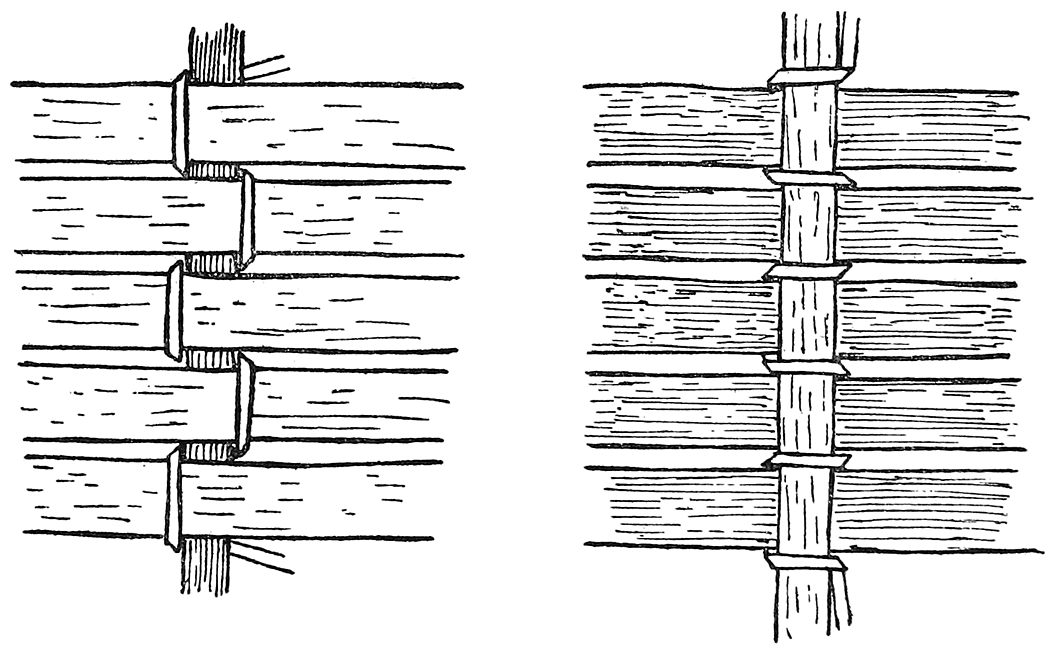
Fig. 29. Method of making bamboo mat, Little Andaman
The mat-work of the Andamanese is very simple. The natives of the Little Andaman make bamboo mats on which they sleep. Strips of bamboo of about 120 cm. in length and ·75 cm. in width are attached by means of thin strips of cane to other strips of bamboo at right angles to the first series. The technique is illustrated in Fig. 29 which shows the back and the front of a portion of such a mat. It is that usually known as wrapped-twined work.
A similar technique is used in both the Little Andaman and the Great Andaman in making thatching of cane-leaves. There is a difference, however, the wrapping used in making thatch being that shown diagrammatically in Fig. 30.
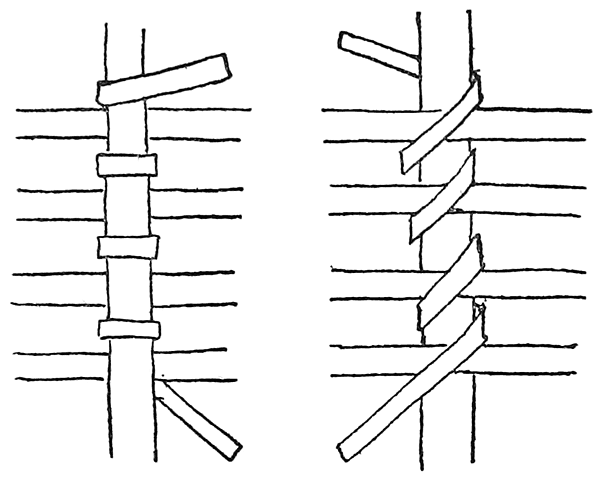
Fig. 30. Diagram showing the technique used in making mats of thatch
The natives of the Great Andaman make sleeping mats from the outer sheath of the leaf-stem of the Calamus tigrinus. Lengths of the material are prepared and cleaned and are cut to a uniform length, generally about 60 to 80 cm., having a breadth of 3 to 5 mm. A length of thread, generally of the less valuable Gnetum fibre, but occasionally of Anadendron fibre, is made and is wound on to two netting needles, one half on each. With this thread the strips of cane-leaf are fastened together. The technique is different in the North Andaman and in the South Andaman.
In the North the technique, which is represented diagrammatically in Fig. 31, A is that known as wrapped-twined work. One of the two threads of which the work is composed is held taut, the needle on which it is wound being held in the toes, and the other thread is wrapped spirally round it, one of the strips of cane-leaf sheath being enclosed at every turn. Thus the method is exactly the same as that adopted in making mats of thatch.
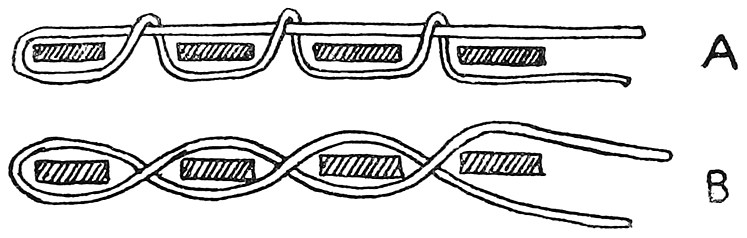
Fig. 31. Diagram showing the technique used in Great Andaman mats A, North Andaman; B, South Andaman
In the South the technique is that known as twined work or fitching. The two wefts (i.e. the threads) are twisted together in the same direction one under the other, enclosing at each half turn one of the strips of leaf-sheath. This is shown diagrammatically in Fig. 31, B.
The mat is made by parallel lines of such twining or wrapped-twining. At each side of the mat the line of threading is quite close to the ends of the strips of which the mat is made. In the South Andaman the work on each side of the mat is different from that in the middle. Each of the two threads is alternately given a complete turn round one of the strips of material.
Mats may be of any length, and examples vary from 1 metre to 10 metres. When in use about a metre and a half is unrolled and the remainder serves as a pillow. If the mat be short a split log does service as a pillow instead, but the full-length mat is certainly a more comfortable bed. When a mat begins to wear or fall to pieces in some part it is not thrown away, but this part is kept rolled up, and an unbroken part of the mat is unrolled to sleep on, the remainder being kept rolled up either at the head, where it forms a pillow, or at the foot. An old mat may be continually increased in length by additions made to it. The work of making these mats is performed by women only.
The Jarawa and the natives of the Little Andaman make mats of a somewhat similar pattern, but I have not been able to secure one so as to see how it is made.
To explain the different forms of the Andamanese baskets, it is most convenient to begin by considering the way in which the natives of the North Andaman tie up their pots. The small cooking-pots of the North Andaman are fragile things and are not easily made, and it is therefore necessary to take care of them. A leaf of the Licuala palm is taken. The leaflets are plaited over one another, close to the point of their insertion in the petiole, so as to form a sort of rosette with leaflets radiating from it in every direction (Fig. 32 a). This is laid on the ground, the pot is placed on it upside down, and the leaflets are brought up all round the pot so as to meet at the point, and are there roughly fastened. Three strips of cane are then taken and are tied together crossways in the middle so as to form a sort of six-rayed star with six approximately equal angles. This is laid on the ground with the outer surface of the canes downwards, the pot is placed on it upside down, and the strips of cane are bent upwards over the pot so as to meet at the point. The ends of two opposite strips of cane are left projecting for a few centimetres above the point, and the ends of the other four are fastened firmly down. Another strip of cane is now fastened round the middle of the pot, being applied to the six canes previously mentioned by wrapping, i.e. a turn is taken with it round each of the six strips in turn. The pot is now safely tied up and can be hung in the hut or carried on a journey without much fear of its coming to grief. To use the pot it is of course necessary to untie it. A pot wrapped up in this way is shown in Fig. 32 a and b.
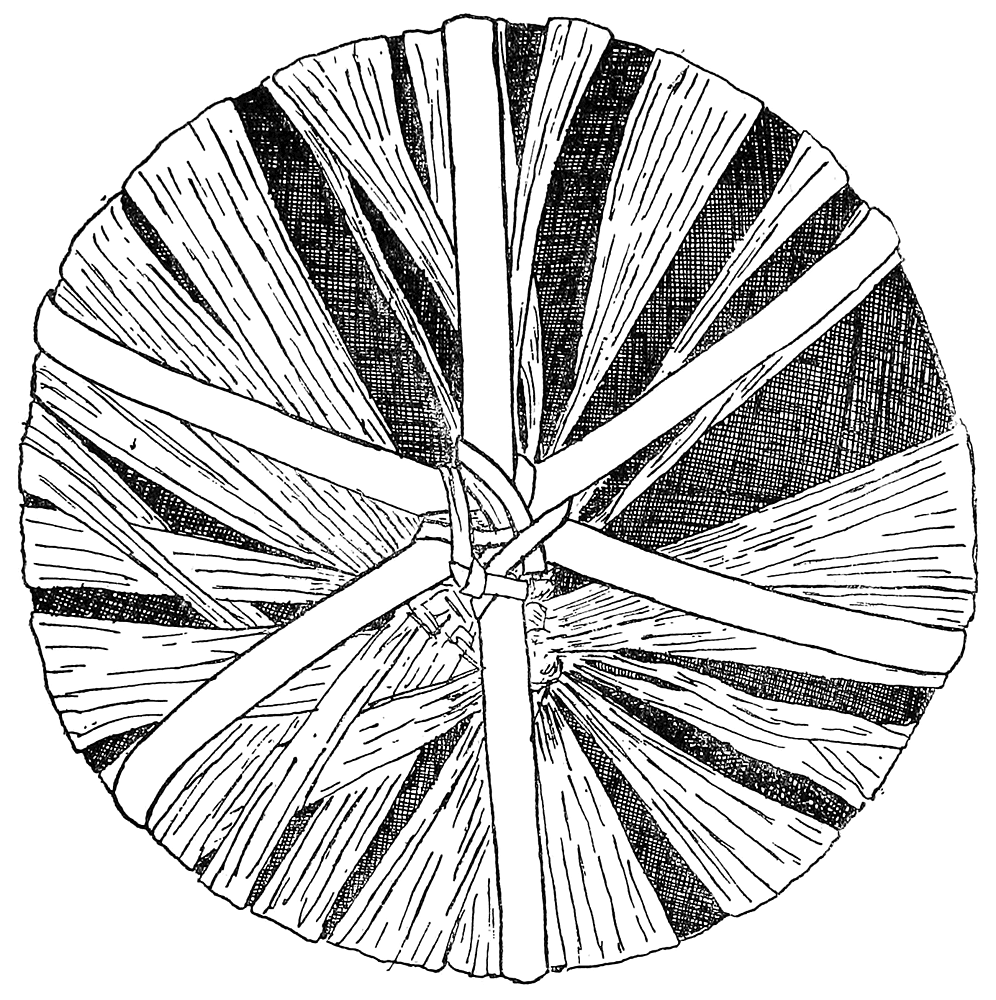
Fig. 32 a
In the South Andaman the pots have rounded bottoms. They are not tied up in the same way as in the North Andaman, but for purposes of safety and carriage each pot is provided with a rude basket. The basket is made so as to fit the pot. Six strips of cane are taken and tied together in the middle, as previously described. A stout strip of cane is then taken and is bent round into a circle so as to be just a little larger than the outside rim of the pot. This, which is to form the rim of the basket, is placed in position and the six strips of cane before mentioned are bent round and attached to it. The manner of attaching the uprights of the basket to the rim is shown in Fig. 33. The strip of cane forming the upright is thinned down beyond the point where it reaches the rim. It is given one turn round the rim, ascending on the outside and descending inside, then a half turn round the standing part of itself, immediately below the rim from left to right, then another complete turn round the rim ascending inside and descending outside, a half turn behind its own standing part below the rim, a third complete turn round the rim, and the end is fastened with an overhand knot.
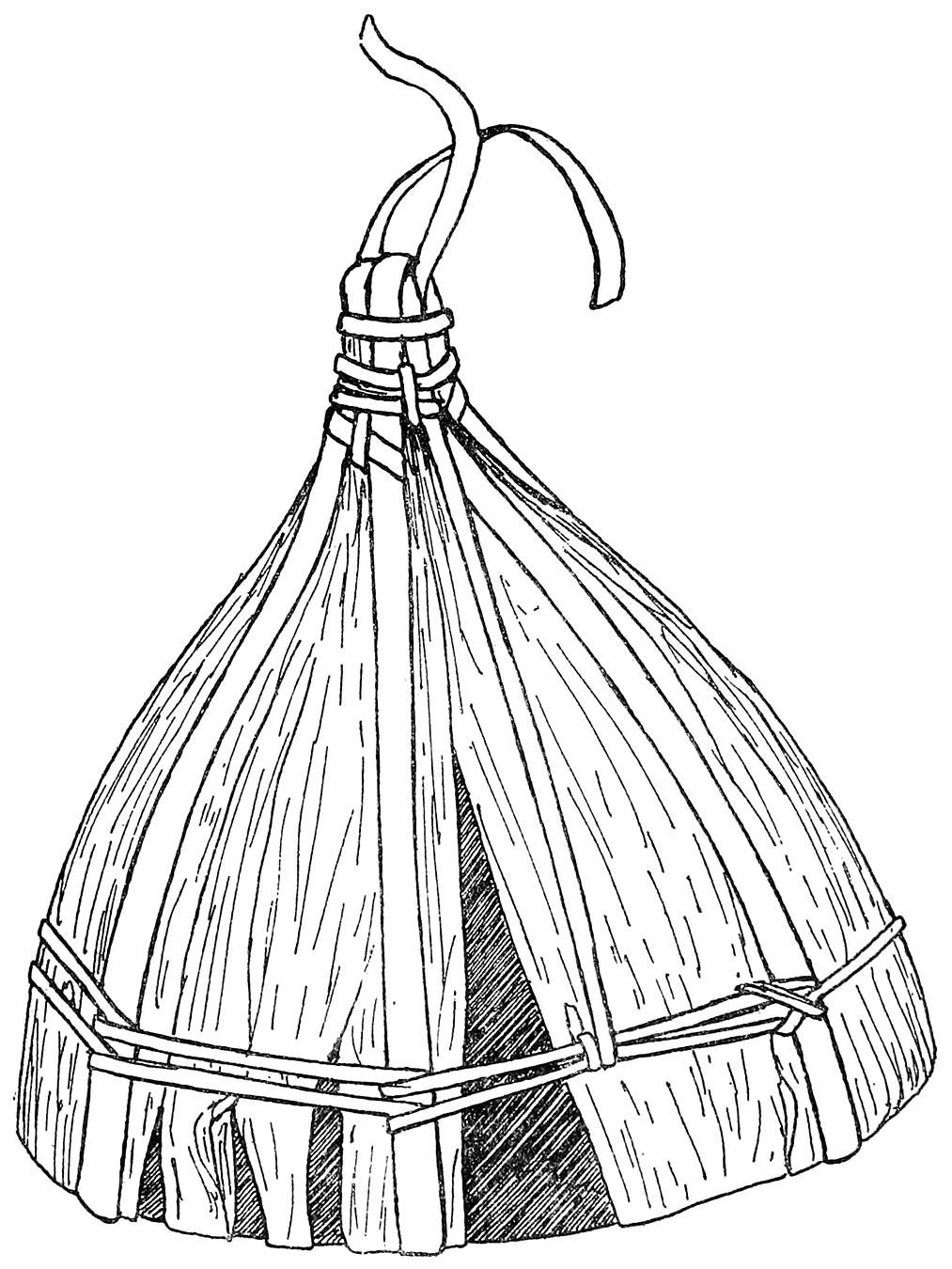
Fig. 32 b. Pot, tied up for carrying, North Andaman
A thinner strip of cane is now taken and wound round the six uprights (the warp of the basket) being given a turn round one after another. The technique is that known as wrapped work. If the strip be not long enough another is joined to it with a reef or sailor’s knot. The weft (as this thinner strip may be called) is given five or six spiral turns, and thus leaves a very open and rather weak basket. The basket is then further strengthened by other strips of cane attached by one end to the rim and carried downwards, with one turn round each of the horizontal canes (weft) and the other end attached to the centre of the bottom of the basket. A strip of cane or bark is attached to the rim by its two ends to provide a strap by which the basket with its pot may be carried on the back. Before the pot is placed in it the basket is lined with the leaflets of the Licuala palm.
We may now turn to the baskets of the Little Andaman, of which there are two varieties, one made with more care than the other. As regards shape both varieties are the same, and the shape is exactly that of the Little Andaman pots.
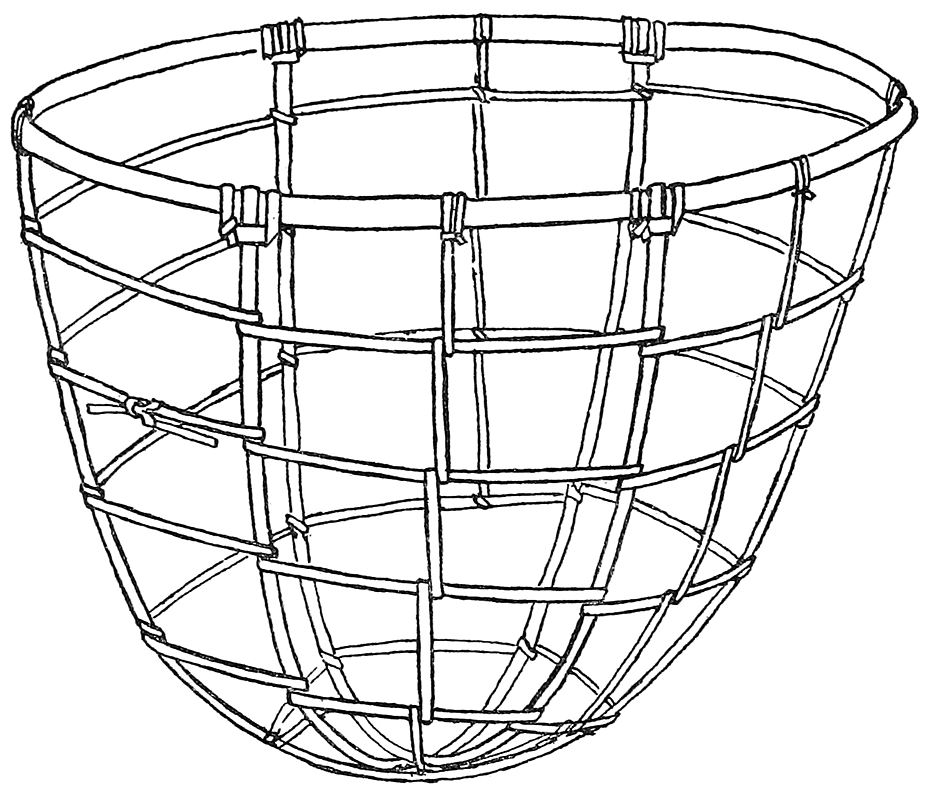
Fig. 33. Basket for carrying pot, South Andaman
The following is a description of a small but typical specimen of the better variety of Little Andaman basket. The foundation consists of twelve whole canes. A little under 80 cm. of the cane is left whole, and at each end it is thinned down to a strip. The twelve canes are taken in four bundles of three each and placed so as to cross each other in the middle. They are bent into a somewhat conical shape, and the ends (where the cane is thinned) are attached to a rim composed of a whole cane bent into a circle and tied. The method by which each of the uprights or stakes is attached to the rim is shown in Fig. 34. It is almost identical with that used in the South Andaman pot basket. The weaving is then begun near the bottom of the basket. A thin strip of the outside of a cane is taken, and is applied to the uprights (warp or stakes) by wrapped work, i.e. it is given a complete turn round each of them in turn. This wrapped weaving is continued spirally from near the bottom of the basket to near the rim. Near the top of the basket, between 4 and 5 cm. from the rim, the weaving is so arranged that for about three-quarters of the way round the basket there is a gap of about 1·5 cm. between two rows of weft (see Fig. 34). The purpose of this will be mentioned later. The basket now consists of a rim to which are attached twelve uprights forming the warp of the basket, around which a fine strip of cane has been spirally wrapped from the bottom to the top. Twelve fine strips of the outside of a cane are now taken. One end of each is fastened to the rim in between two of the stakes, the mode of fastening being shown in Fig. 34. The strip is then carried down the basket, on the outside, as far as the bottom row of weaving, round which it is doubled, and is then wound spirally, from the bottom to the top of the basket, around its own standing part, including at each spiral turn one of the wefts. Thus each of these twelve strips of cane is attached to the outside of the basket by the process known as wrapped-twined work. The basket is furnished with a handle of bark fibre which is attached by its two ends to the rim on that side where there is no gap between the rows of weft near the top.
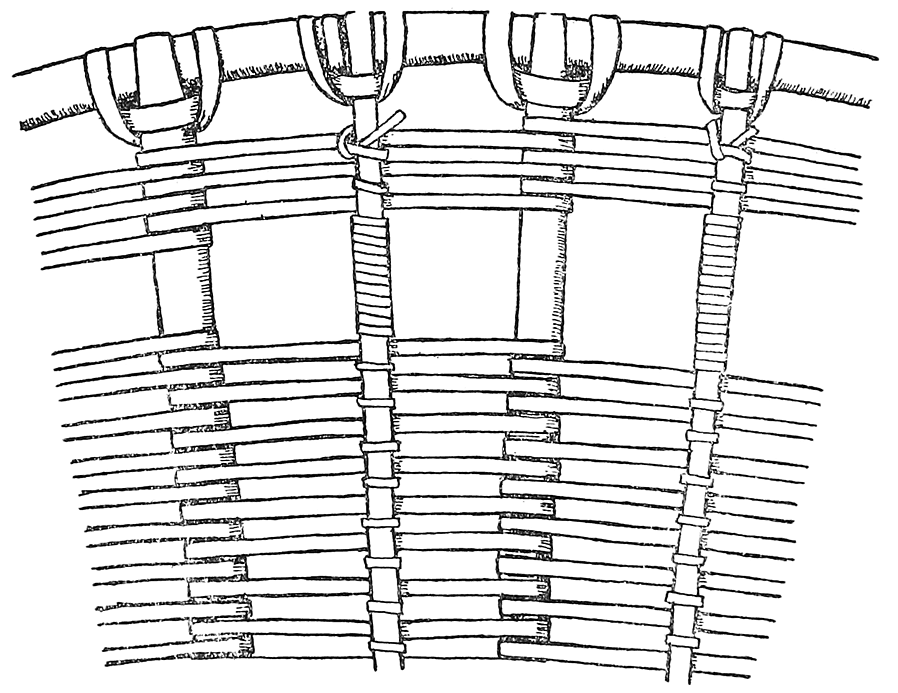
Fig. 34. Portion of basket of Little Andaman
In the less carefully made baskets of the Little Andaman there are a few important differences. The stakes of the basket are not thin whole canes, but are strips of larger canes. The weft is applied in wrapped work, as in the basket already described, but the rows of weft are not so close together and are therefore not so numerous. After the first process, when the basket consists of stakes and horizontal (spiral) weft only, vertical strengthening strips are added, but these are applied, not in wrapped-twined work as in the basket described, but in wrapped work, in exactly the same way as in the South Andaman pot-basket. Thus, apart from its shape, which is that of the Little Andaman pot, the Little Andaman basket of this kind is very similar to the South Andaman pot-basket.
The natives of the Little Andaman make pots that are much larger and deeper than those of the South Andaman, and have a more rounded bottom than those of the North Andaman. For every pot a basket is made that exactly fits it, and in this basket it is stored and carried. Every basket that is made in the Little Andaman, whether it be used for carrying a pot or for any other purpose, is made of exactly the same shape.
The purpose of the gap that is left near the top of the basket as described above is in order that strips of string or fibre may be tied across the mouth of the basket, from side to side, in order to keep its contents safe.
We may now return to the Great Andaman and consider the baskets of the South Andaman Group of tribes. These are made from the best canes. From 80 to 120 fine strips of cane are taken which are to form the stakes or uprights. A slight hollow is made in the ground, and the strips of cane are placed crossways across one another in this hollow, the inner surfaces of the canes being downwards. As the strips are being arranged, and when the weaving is begun, the centre, i.e., the point where the strips cross one another in the middle of the hollow, is pressed firmly beneath the heel so as to maintain them in position. The first few strips are sometimes tied together in the middle, but this is not always done. When all the strips are arranged evenly the weaving of the basket is begun with a length of thread, which is slewed in and out between the strips of cane, beginning as near the centre as possible, the stroke being that of ordinary wicker-work. After four or five spiral turns have been taken with the thread it is fastened. The bottom of the basket is then reversed, the stakes being bent over, and the weaving proper is begun with a fine strip of cane. This is applied by wicker-work nearly as far as the top of the basket. At the top, the weaving is finished off with three or four spiral turns of wrapped-twined work in cane (see Fig. 35). The rim of the basket is formed of a thin piece of wood (circular in section) bent round into a circle of the right size and the two ends tied together. The stakes or uprights are attached to this rim (after the weaving is finished) but a space of about 5 cm. is left between the top of the weaving and the rim. The mode of attaching the uprights to the rim is shown in Fig. 35.
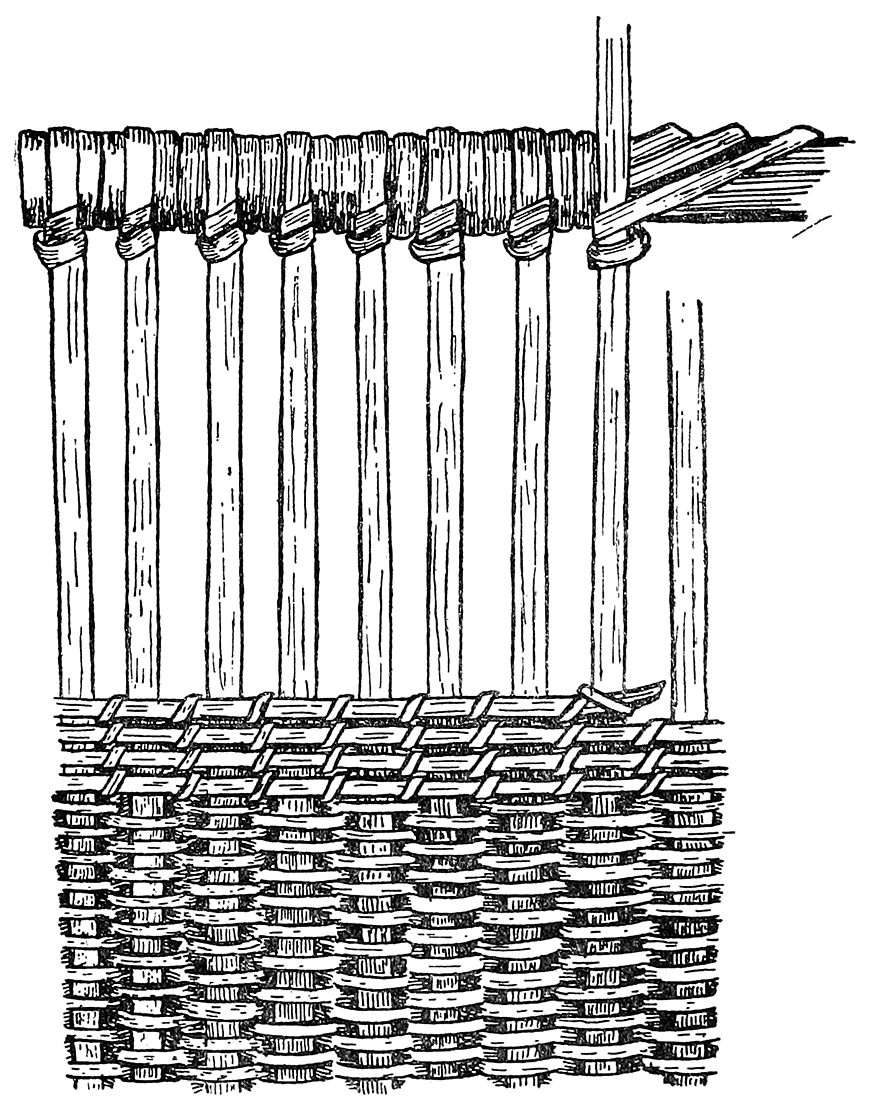
Fig. 35. Portion of basket of South Andaman
The South Andaman basket is really a conical basket with the bottom reversed or dented inwards to form a “kick” like the kick of a bottle. If it were not for the kick it would be the same shape as the Little Andaman basket. The kick enables it to stand upright, although it is inclined to be top-heavy, but renders it unfit for carrying pots.
The space between the top of the weaving and the rim is to admit of strings being tied across the mouth of the basket to keep its contents safe.
A handle of Hibiscus fibre is attached to the rim and rests across the front of the chest when the basket is carried on the back.
South Andaman baskets are sometimes ornamented, in the process of making, with strips of Dendrobium skin, applied horizontally by overlaid interlacing. The strip of Dendrobium skin is laid over the weft and woven in with it for one turn round the basket. I have never seen ornamentation with Dendrobium skin applied to the South Andaman baskets by any method save this one.
Patterns of red paint and white clay are occasionally painted on baskets when they are newly made. Shells are sometimes attached to different parts of the basket by thread, for the purpose of ornament.
In the North Andaman, baskets are made that differ in several important features from those of the South Andaman. They are not made of cane but of two different materials. One of these is the stem of a creeper called čup-to̱i. Lengths of the creeper are cut and dried and then split lengthways into two or three pieces according to their size. The outer bark or skin is then scraped off with a Cyrena shell. These strips are to form the stakes or warp of the basket. The other material is another creeper called bobi. The long tough tendrils of this plant are taken and the soft outer sheath removed by drawing the tendril through a piece of split cane or bamboo bent double so that the tendril is scraped between the two inner surfaces. The fibre that remains is split longitudinally into two pieces and dried.
A bundle of strips of the čup-to̱i is taken, sufficient in length and number for the required size of basket. The bundle is divided into two equal bundles and these are tied together in the middle crossways with thread. This cross forms the beginning of the basket. The weaving is begun with thread, which is slewed in and out between the warp, from 4 to 7 spiral turns being made. During this process the centre of the basket, i.e., the cross, is pressed beneath the heel into a slight hollow made in the ground, to give it a curve which, in the finished basket, will form the “kick.” The thread is tied, the bottom is turned upside down, the stakes are bent back and the weaving is continued, not with thread but with strips of bobi, till a short distance from the top of the basket, and then three or four rows of wrapped-twined work are made, the strip of bobi being coiled round the basket and attached to the uprights with thread. A rim is made of a strip of cane bent into a circle. This is placed inside the uprights and tied to them in two or three places. The remaining portion of each of the uprights, projecting above the rim, is bent down outside and slightly obliquely, and tied down by a thread passing over each in turn and round the rim. A very rough and untidy rim is thus produced, and this is again served or bound over with thread. A handle of Hibiscus fibre is added.
In the North Andaman baskets, as in those of the South Andaman, a space of a few centimetres is left between the top of the weaving and the rim, there being for that space only warp or uprights and no weft. This allows string to be tied in any direction across the mouth of the basket, so as to keep its contents safe.
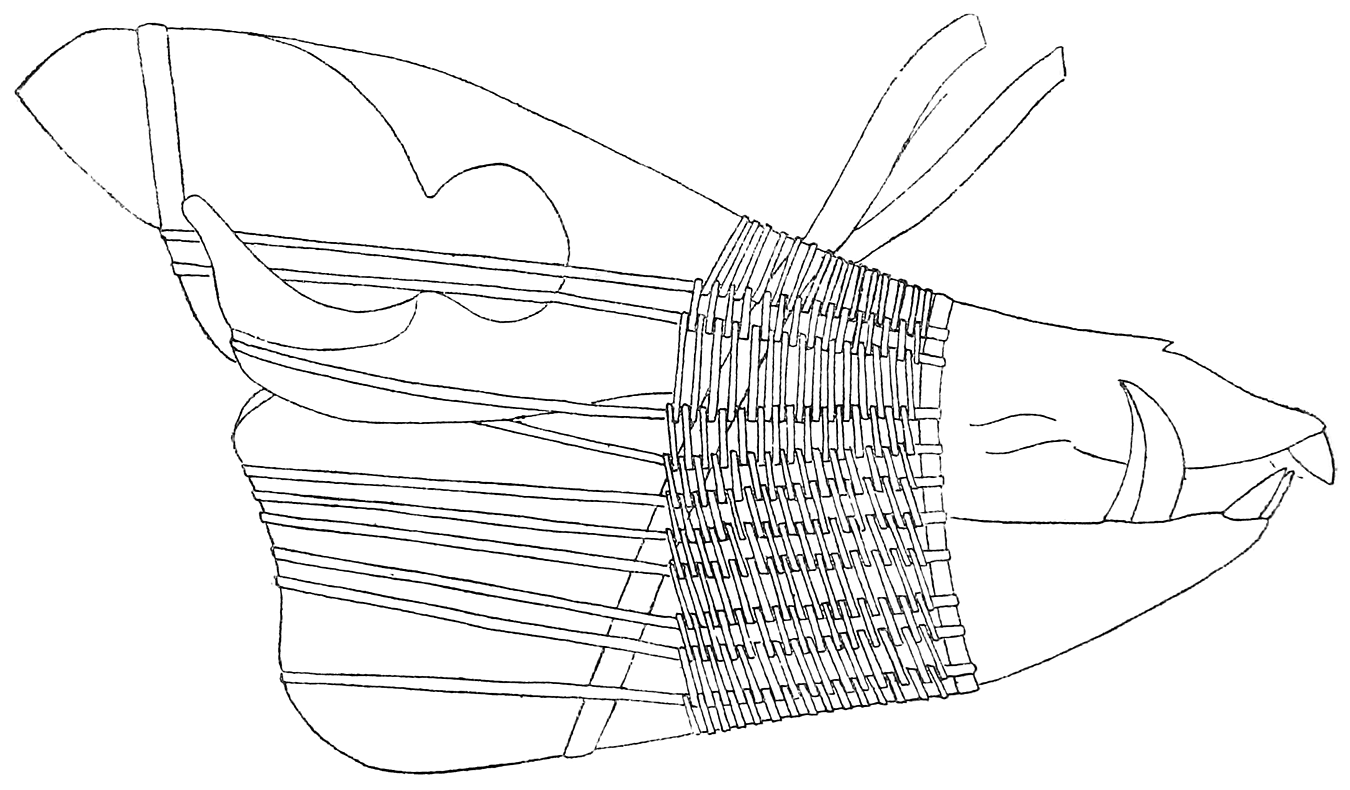
Fig. 36. Pig’s skull with basket-work, Jarawa
The shape of the North Andaman baskets is different from that of the southern baskets, the former having a sort of belly at the bottom and narrowing somewhat above. The result is that the northern baskets will stand more firmly, being less top-heavy when either full or empty than those of the south.
In the North Andaman baskets are ornamented as they are made with worked-in strips of Dendrobium fibre. There are several different methods of working this ornamentation, resulting in different patterns. Baskets are also ornamented, when new, with painted patterns in white and red, though this is not general, and occasionally shells are attached to them by thread.
One more form of basket-work remains to be briefly mentioned. The natives of all parts of the islands were formerly in the habit of preserving as trophies the skulls of pigs and turtle that were killed in the chase. The natives of the Great Andaman Division do not now trouble to preserve all the skulls of the pigs they kill, and they give as their reason for this that now that they have dogs the hunting of pigs is not a sport that requires any great skill. The Jarawa however still keep up the old custom, and they go so far as carefully to encase every skull in basket-work. As may be seen from Fig. 36 the basket-work in question is of simple wrapped work, the material being strips of cane.
It is of some interest to consider the different forms of technique used by the Andamanese in dealing with flexible materials. Rope and string are only made two-ply. It would seem that the Andamanese have not discovered that three-ply cord is stronger for a given diameter than two-ply. They have, in the bow-string of the Great Andaman, an interesting form of cord that may perhaps best be described as wrapped cord. The making of a rope involves the twisting of two strands of material around one another. The making of a wrapped cord involves the spiral wrapping of one strand of material round another. This is exactly the same process as “serving,” and it is one that is used by the Andamanese in all sorts of ways. In serving their arrows with thread and in serving the ends of bows and the heads of harpoons the Andamanese have several different methods of making fast the ends, and I regret that I did not take more detailed notes on this subject. Their skill in handling this technique is shown in the strength of the binding on their arrows.
This spiral wrapping of one strand round a flexible or rigid object lies at the base of much else in their technique. We have seen that they make considerable use of wrapped-twined work. In this work a strip of material crosses at right angles a number of strips of the same or other material, and a weft is wound round the former, taking in one of the latter at each turn. There are two methods of doing this, either by simple spiral wrapping, as in the mats of thatch, or by what may be called “right and left” or “zig-zag” wrapping, as in the bamboo mat of the Little Andaman. A difference is also made according as the strip of material around which the weft is wrapped is rigid, as in the Little Andaman bamboo mat or in thatching, or flexible, as in the North Andaman mat, where it is one thread while the weft is another thread.
Wrapped work, in which a strip of weft is wound successively round one after another of a number of rigid stakes, is another very simple process that is employed in a number of different ways by the Andamanese. The most important development of wrapped work amongst them is seen in the pot-basket of the South Andaman, in the baskets of the Jarawa and Little Andaman and in the pig’s-skull basket-work of the Jarawa.
Simple twined work is rare in the Andamans. There is hardly any example of it except in the mats of the South Andaman. It would seem probable that the North Andaman mat technique of wrapped-twined work is the earlier, being more in agreement with what we may call the technical habits of the Andamanese, and that the South Andaman mat technique is a later elaboration. In this connection it may be remembered that plaiting, in which also several wefts are twisted one over another, is rarely used in the Andamans.
The process of nippering, by which the natives of the Great Andaman make the cord of their pig-arrows, and the somewhat similar process used in the Little Andaman in making personal ornaments, are quite in accordance with the general trend of the technique, but when such a process is applied to a number of parallel strips of material instead of to two only it constitutes a step towards wicker-work. It is notable, however, that it is only in the Great Andaman that wicker-work is used, and this suggests that it has only been invented or adopted since the separation of the two divisions of the Andamanese.
It is very tempting to regard the different forms of basket, in the order in which they are described above, as so many stages of a process of evolution. It is, at any rate, worth while to state the argument, and to show what the differences between them exactly are. In the North Andaman pot-covering we have (1) the technique simple wrapped work, and (2) the basis six strips of cane tied together in the middle. In the South Andaman pot-basket we have both these features, but the difference in the shape of the pots allows them to be carried in a true basket and we have therefore (3) a rim, with (4) a peculiar method of attaching the uprights to the rim, (5) a number of horizontal (wrapped) wefts instead of one or two, and (6) strengthening strips applied to the horizontal wefts in wrapped work. In the rougher kind of basket made in the Little Andaman we have nearly all the features of the South Andaman pot-basket. The only differences, apart from the shape of the basket, which in each case follows the shape of the pot, are (2) more than six uprights may be used, and (5) the number of horizontal wefts, i.e. the number of spiral turns taken round the basket, is as a rule greater. In the more carefully made Little Andaman basket there are several differences. The uprights are fine whole canes instead of strips of split cane. It is undoubtedly more difficult to procure whole canes of the proper size than simply to split up larger canes, but where the technique is wrapped work the circular section of the uprights improves the quality of the resulting basket, as a strip of cane is more easily wound round a whole cane than round a split cane, and there is less chance of it breaking when a strain is put upon it. Another difference is that in the better Little Andaman baskets the rows of weft are as close together as the peculiar technique will allow. This makes a finer and stronger basket, and is an obvious improvement. The third difference is that in these baskets the strengthening strips are applied not in wrapped work, but in wrapped-twined work, which, however, we have seen is a common technique in the Andamans. In the better baskets of the Little Andaman we find a special feature of some interest in the gap that is left in the weaving near the rim, to allow of strings being tied across the mouth.
When we look at the South Andaman basket the first thing that strikes us is that it is really a conical basket of much the same shape as the Little Andaman basket, but with the bottom dented in to make a kick, so allowing the basket to stand on its bottom. This denting is only rendered possible, however, by the fact that the uprights of the South Andaman basket are thin strips of cane that can be easily bent, and this again depends on the use of wicker-work in the basket instead of wrapped work. It must be remembered that the top of the weaving is finished off with three rows of wrapped-twined work, and this suggests that there may possibly have been a stage of development between the Little Andaman basket and the South Andaman form, in which the uprights were thin strips of cane, and the weft was applied in wrapped-twined work from top to bottom. This, however, is only a surmise. It does certainly seem probable that the South Andaman basket is derived immediately from a form of basket similar to that of the Little Andaman, the great difference being the change to wicker-work technique. The method of attaching the uprights to the rim was doubtless introduced owing to the fact that the original method is unsatisfactory when the uprights are thin and easily broken strips, instead of stout ones.
The North Andaman basket seems to have been derived from one similar to that of the South Andaman by the introduction of two changes, (1) the use of different materials, and (2) the change of shape. The materials used in the north are such as to give a basket on the whole stronger and more durable than that of the south. If a heavy weight be carried in a southern basket the pressure of the basket on the back tends to crack the canes of which it is composed. In the case of a northern basket it may lose its shape, but the materials of which it is composed will give or bend without cracking so readily. The shape of the northern basket is certainly an improvement, as it avoids the top-heaviness of the southern shape. Both the northern and the southern baskets have a gap between the top of the weaving and the rim, like the basket of the Little Andaman.
Thus every step, or nearly every step, in a hypothetical process of evolution is exhibited in the different forms of basket-work. First we have the pot-covering of the North Andaman, then the pot-basket of the South Andaman, then the rougher kind of Little Andaman basket, of the same shape as the pot, then the South Andaman basket of cane with a kick and finally the basket of the North Andaman. The better kind of Little Andaman basket is simply an independent improvement of the other, involving no new technique.
However much or little probability we may attach to this hypothetical reconstruction of the history of basket-work in the Andamans, one thing does seem fairly certain, and that is that the original ancestors of the Andamanese were not acquainted with wicker-work, or had no use for it. In the Little Andaman Division only wrapped work and wrapped-twined work are used, and the wicker-work of the Great Andaman Division has almost certainly been adopted since the two divisions were separated. The consideration of the general technical bias of the Andamanese in their dealings with flexible materials supports the view that in their case wicker-work is later than wrapped work and wrapped-twined work. It seems more than likely that the Andamanese of the larger island have invented wicker-work in its simplest form on the basis of a previous technique of wrapped and wrapped-twined work. To us wicker-work seems such a simple process as almost to need no inventing. It must be recognized however that the general bias of the Andamanese is against using materials in this way. The Andaman Islander shows a decided preference for those processes in which he uses a single flexible material which he winds or wraps round other rigid or flexible material, as in nippering, or wrapped work or wrapped-twined work.
It is impossible to obtain confirmation of this view, however, from a comparison of the Andamanese with the Semang and the Philippine Negritos. The Semang make mat-work bags and wallets of check, and they make (or use) baskets of hexagonal work. Both check and hexagonal work are used by other races in the Malay Peninsula and in Malaysia generally. The present mats and baskets of the Semang cannot therefore be regarded as original Negrito productions. They have almost certainly been adopted through contact with other cultures.
The same thing would seem to apply to the present basket-work of the Philippine Negritos, of which however we know very little.
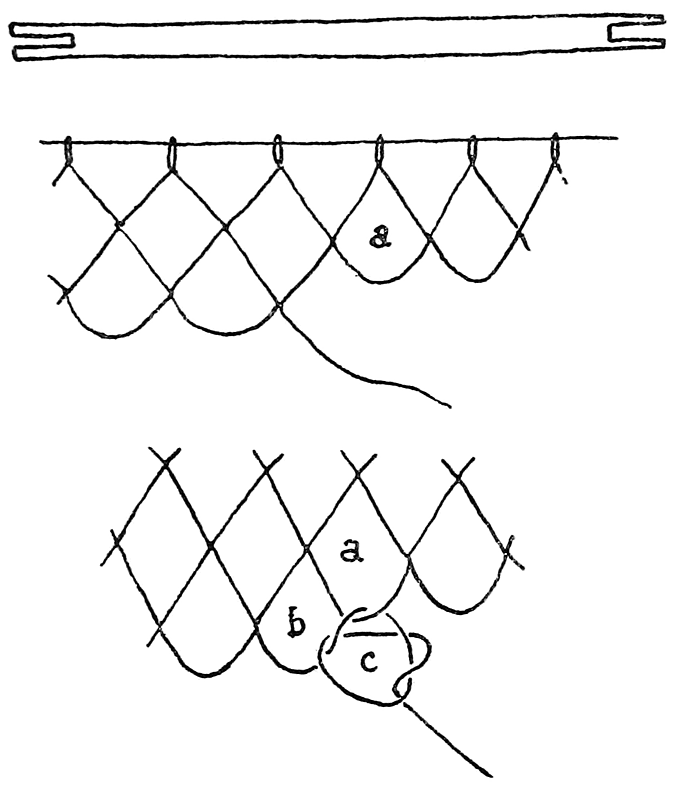
Fig. 37. Diagram showing netting needle, and method of netting
Netted bags of string are made by the women of both the Great Andaman and the Little Andaman Divisions, and are used for carrying or storing small objects such as shells, fruit, roots, etc. The string used for these is made from the fibre of the Gnetum edule in the Little Andaman, and is generally made from the same fibre in the Great Andaman, but in the latter division the fibre of Hibiscus scandens is prized for this purpose and is used instead of that of the Gnetum when it is available. Small hand fishing nets are made by the women in both divisions from thread of Gnetum fibre. In the Great Andaman Division netting is also used for personal ornaments, the thread used for this purpose being generally made from Anadendron fibre.
The mode of netting is always the same. Netting needles are used, made from slips of bamboo or cane, and varying in size according to the work for which they are intended. The netting string or thread is wound on to this needle. For the foundation of the net a short length of string is taken and the two ends tied together, the loop thus formed being placed over the big toe as the woman sits on the ground.
The knot used in netting is that known as the fisherman’s knot, in use all over the world. The needle is held in the right hand, is passed from above downwards through the loop marked a in the figure, and is drawn through far enough to leave a new loop b of the required size. This loop is held between the thumb and forefinger of the left hand, the uniformity in mesh being apparently obtained largely by the sense of touch. The needle is then passed through the new loop b again from above and is drawn out leaving a loop c, through which the needle is passed once more, forming the finished knot, which is then drawn taut.
When netting is made for personal apparel it is generally ornamented with strips of Dendrobium skin worked in with the thread in the course of the netting. Netting for personal ornaments consists of a sort of bag open at both ends. Each end is tied with a string passed through the ultimate loops, and this string serves to tie the band of net round the waist or neck or wrist or knee.
Fishing nets are attached to a handle. The handles of the Little Andaman Division and those of the Great Andaman Division are different in shape. The Great Andaman net with its hoop can be folded up compactly for carriage, while that of the Little Andaman cannot.
The nets of rope formerly used in the Great Andaman for catching turtle have been already described.
[
Contents
]
Domestic Implements and Utensils.
The Andamanese are perhaps the only people in the world who have no method of their own of making fire. At the present time they obtain matches from the Settlement of Port Blair, and a few of them have learnt, either from Burmese or from Nicobarese, a method of making fire by the friction of pieces of split bamboo. Formerly, however, they had no knowledge of any method by which fire could be produced. Fires were and still are carefully kept alive in the village, and are carefully carried when travelling. Every hunting party carries its fire with it. The natives are very skilful in selecting wood that will smoulder for a long time without going out and without breaking into flame.
The most interesting of the Andamanese domestic utensils is undoubtedly the cooking-pot. Pots are made in all parts of the Andamans where suitable clay is to be found. The clay is obtained and is freed as far as possible from stones and gritty matter with the hands. It is then moistened with water and kneaded on a board consisting of a portion of a broken canoe. It is worked very stiff and after kneading is rolled beneath the palm of the hand into long thin rolls. These are built up into a pot by coiling, the requisite degree of thickness being obtained by pressure of the thumb and first finger. When the pot has been built up to the required size and shape, the surface, inside and out, is moistened and is scraped over in all directions with an Arca shell. The pot is dried in the sun for a few hours and is then baked by placing inside and around it pieces of burning wood. The pot often cracks in the baking, and another has to be made.
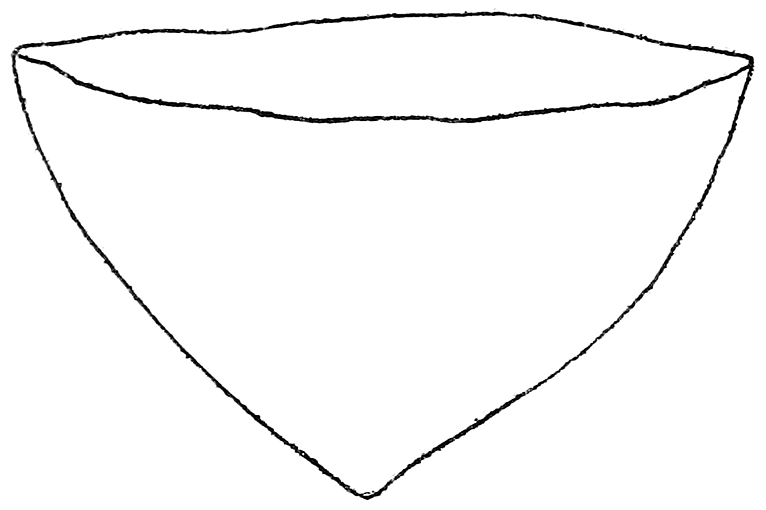
Fig. 38. Shape of North Andaman pot; actual diameter 17 cm.
In the North Andaman the pots are made with pointed bottoms, and are generally small, the largest having a capacity of only six or seven pints. They are made by women only. In the South Andaman the pots have rounded bottoms and, on the average, are larger and thicker than those of the North Andaman. They are made by both men and women, the best being made by men. In the Little Andaman the pots are larger, and, particularly, deeper than those of the South Andaman, and have somewhat pointed bottoms. The pots of the Jarawa are similar to those of the Little Andaman.
In the North Andaman pots are not ornamented, but in the South Andaman they are decorated with usually simple patterns of dots and lines made with a small pointed stick. The Little Andaman pots that I have seen were not decorated.
The pots are used for cooking, i.e. for boiling meat and vegetables. In the North Andaman small pots are specially made for melting the composition used for covering the binding on the heads of arrows.
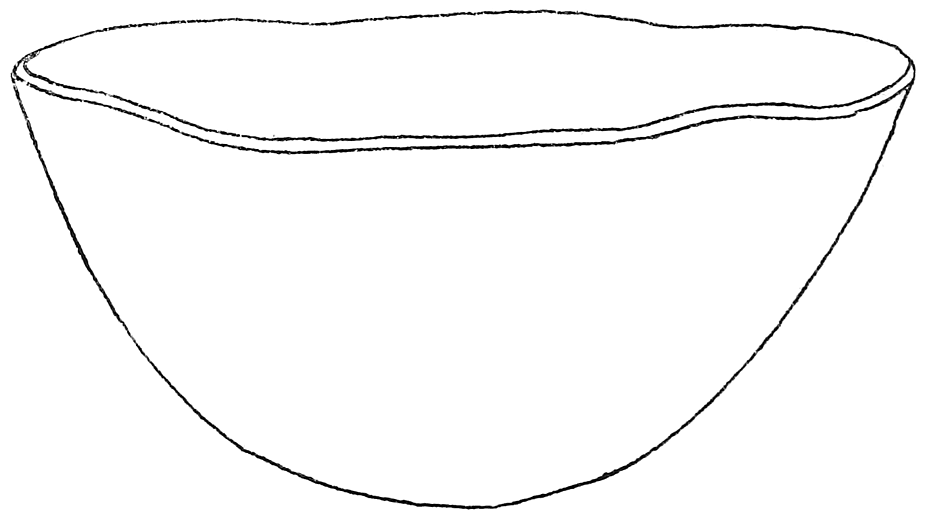
Fig. 39. Shape of South Andaman pot; actual diameter 24 cm.
Neither the Semang nor the Philippine Negritos make any kind of pottery. The origin of Andamanese pottery therefore is a problem of some interest. It is almost certain that the early Andamanese were acquainted with pottery before they were divided into the Great Andaman and Little Andaman Divisions. One of the very few words which is the same in all Andamanese languages is the word for pot, buču in the Little Andaman, buǰ in Aka-Bea and peč in Aka-Jeru. The most reasonable hypothesis would therefore seem to be that the Andamanese learnt the method of making pottery by coiling before they reached the Andaman Islands but after they had become separated from that part of the Negrito race from which the Semang and the Philippine Negritos are descended. Of course it is possible that the art of pottery may have been an original possession of the Negritos and that the Semang and Philippine Negritos may have lost it. A people could easily lose the art if they were compelled in the course of their migrations to spend three or four generations in a region that lacked clay suitable for the purpose.
The Andamanese make buckets of wood, which they use for carrying and holding a supply of water. A solid piece is cut from the trunk of a soft-wooded tree and is hollowed out with a chisel made by attaching the blade of an adze to a stick. The natural form of the wood is retained, only the bark being removed from the outside while the inside is chiselled out to leave sides of about a centimetre thick and a bottom of somewhat greater thickness. In order to render the bottom of the bucket water-tight the natives of the Little Andaman pour over it on the inside melted bees’-wax. The natives of the Great Andaman use for this purpose the same composition with which they cover the bindings of their arrows, which certainly is superior to bees’-wax.
A bucket of the shape used in the Great Andaman is shown in Plate VII, on the left. A strip of cane is attached round the middle of the bucket, and to this in turn is attached another strip of cane which, being passed across the front of the chest, enables the bucket to be carried on the back.
The buckets of the Little Andaman are cut with thinner sides than those of the Great Andaman. A strip of cane is fastened round the bucket near the top. From this two other strips of cane are attached by both ends, passing under the bottom, and a third strip is attached which passes over the head and supports the bucket when it is carried on the back. In the Little Andaman the outside of the bucket is charred with fire.
Occasionally pieces of the giant bamboo, which does not grow in the Andamans, are found on the shore, having drifted from the Burma coast. When a sound piece is found it is made into buckets each formed of a single joint.
Water vessels are made from bamboos that do grow in the islands. A length of bamboo of good diameter is cut, containing three joints. The partition of the lowest node is preserved to serve as a bottom, and the other partitions are broken through with an arrow. This is the usual vessel used for carrying water on a journey by land or in a canoe, and for keeping a supply of drinking water in the hut.
A single joint of the same kind of bamboo is used as a cooking vessel. It is cleaned, washed, and dried, and is then filled with meat tightly packed. The top is closed with leaves and the bamboo is placed on the fire until the meat is cooked. Meat is not cooked in this way for immediate consumption. It will keep for twenty-four hours or even longer if not opened. To obtain the contents the bamboo is split open with an adze.
Trays used for food are cut from soft wood of a species of Sterculia with an adze. They are shallow and somewhat long and narrow, with pointed ends.
A large Pinna shell is occasionally used as a tray or dish for holding food, or for mixing clay with water for painting. A Nautilus shell forms a fairly convenient cup or drinking vessel and is frequently used for that purpose, as well as for baling out water from a canoe.
Bamboo tongs are made by bending double a piece split from a bamboo, and cutting the ends to the required shape. They are used for lifting from the fire anything too hot to be taken in the hand and are chiefly of service in cooking.
Digging sticks are made from various kinds of wood, being simply pointed at one or both ends. These sticks are not as a rule preserved, but made as required with an adze and thrown away after use. They are used for digging up edible roots.
Hooks for picking fruit, such as the Artocarpus, are made by attaching a small piece of wood to the end of a bamboo. Hooks for catching crabs are made from the wood of the Rhizophora by taking advantage of the natural form where a small branch joins a larger one.
The fan-shaped leaf of a Licuala palm is made use of in many ways. The edges of the leaflets are sewn together with fine strips of cane, and the sewn leaf is then used either as a sunshade or umbrella for protection from sunshine or rain, as a sleeping mat if the proper article be lacking, as a screen to make the roof or sides of a hut more wind or rain proof, as a wrapper for making objects of all sorts into bundles, and as a winding sheet for a corpse.
Torches are made from resin, which is broken into small pieces and wrapped up in leaves of a species of Crinum (? lorifolium), a few pieces of smouldering charcoal being added before it is tied up. The torch is then parcelled by marling with a strip of cane or a length of some tough creeper. These resin torches are used in turtle-hunting and fishing expeditions on dark nights.
Other torches are made of fragments of rotten Dipterocarpus wood. They are used only in the village.
[
Contents
]
Personal Ornament; Great Andaman.
At the present time the natives of the Great Andaman Division obtain from the Settlement of Port Blair cloth which both men and women wear round the loins. They also obtain beads from which they make necklaces.
The following is a list of the various personal ornaments made by the natives of the Great Andaman Division, and worn by them.
Rope girdle. Every man wears some sort of girdle round his waist, and this was formerly the only object that was constantly worn by men. The girdle may consist of a length of rope of Hibiscus fibre or a length of ornamental cord made by wrapping the yellow skin of the Dendrobium over two strands of Hibiscus fibre and then twisting these into a two-ply cord.
Necklaces and garters of string. Both men and women are often to be seen with a simple piece of string, usually of Anadendron fibre, tied round the neck or around the leg just below the knee.
Ornaments of Pandanus leaf. Every married woman always wears a belt of Pandanus leaf which she is never without for even a moment. When the belt she is wearing needs renewing she puts the new one on before taking the other off. To make such a belt two leaves of the Pandanus Andamanensium are taken and cut to a sufficient length (about 20 cm.). The thorns at the edge of the leaf are removed by cutting off a strip of about 3 mm. wide from the edge, leaving a strip of leaf about 4 cm. broad. The two leaves are placed one on the other and are wound spirally round in three turns so as to give a belt of six thicknesses of leaf, the upper surface of the leaf being on the outside of the belt. The leaves are secured together by tying with thread at the back where the two ends just overlap. At the point where the leaves are tied one or two bundles of strips of Pandanus leaf are attached with thread. The bundle is made of a number of strips of leaf about 90 cm. long and 2·5 cm. broad which are chewed in the mouth to make them soft and then placed together and served over with thread for about 12 cm. in the middle. Belts of this kind are generally worn by married women, but precisely similar belts are worn by men on certain ceremonial occasions. They are called toto t’er-bua in Aka-Jeru.
A very similar belt is made in exactly the same way save that the tassel of leaves at the back consists of narrow strips of Pandanus leaf instead of broad strips. This kind of belt is worn by women only. Examples may be seen in Plate IV (the lower belt of the two) and in Plate XVIII. It is called toto t’er-nyarab in Aka-Jeru.
A belt is made in much the same way out of Pandanus leaves split in half down the midrib, giving strips of about 2·5 cm. broad. Such belts have only a scanty tassel of thin strips of leaf at the back. They are worn by girls and women only. They are called kudu in Aka-Jeru.
Yet another variety of belt is made of whole leaves in exactly the same way as the toto t’er-bua but has no tassel at the back. An example may be seen in Plate IV (the upper belt). It is worn by women.
Girdles are made of strips of Pandanus leaf of about 1·25 cm. broad without any tassel, but with strings of Dentalium shell attached at various points. A girdle of this kind is shown in Plate XV.
Girdles are also made by cutting a number of strips of leaf and softening them by chewing them in the mouth. These strips are laid together and either served over or marled with thread so as to make a girdle of round section. A tassel of leaves similar to that of the toto t’er-bua is attached to the back, and very frequently strings of Dentalium shell are attached at various points. Such a girdle may be worn by either men or women. It is called toto t’er-ŋau in Aka-Jeru.
Yet another kind of girdle is made by splitting Pandanus leaves into thin strips and making them into a kind of wrapped cord, one strip being wrapped spirally round one or more others by the same technique as that used in making bow-strings. A number of coils of strands made in this way are tied together with thread at various points and a tassel similar to that of the toto t’er-bua is added at the back. Such girdles are usually improved by the addition of a few pendent strings of Dentalium shell. They may be worn by either men or women. Their name in Aka-Jeru is toto t’er-mo̱i.
Ornaments of Pandanus leaf to be worn either round the leg just below the knee or round the wrist are made in exactly the same way as the belt called toto t’er-bua, each having a tassel of Pandanus leaf strips attached. Such garters and bracelets are worn at a dance by men.
Other ornaments for wearing round the wrist or knee when dancing are made by the same method as the girdle called toto t’er-ŋau, each having a tassel of strips of leaf.
Similar dancing ornaments are made by plaiting strips of leaf into a three-plait cord of the right length, a tassel of loose leaf strips being left at each end. These are tied round the wrist or knee.
Ornaments for the knee or wrist, such as those shown on the legs of the man in Plate XII, are made by winding spirally a narrow strip of leaf and sewing it. A number of pendent strings of Dentalium shell are attached round it, and often strings are attached at the end of which small shells hang suspended which rattle against one another as the wearer walks or dances.
Chaplets or headdresses worn by men when dancing, and occasionally by women, are made of fairly broad strips of leaf in the same way as the toto t’er-bua. Such a chaplet may have a tassel of narrow strips of Pandanus leaf at the back to which are attached shells that rattle as the wearer moves, or it may have pendent strings of Dentalium shells round the hinder half of its circumference.
In making ornaments of Pandanus leaf such as the toto t’er-bua the upper surface of the strip of leaf is usually ornamented with a design scratched on it with a pointed piece of wood. The design usually covers not only the portion of leaf that is visible when the belt or other object is finished, but also that portion which is not visible, being underneath. Many ornaments of this kind are further decorated when finished with the composition used for covering the bindings of arrows, which is applied with a pointed stick in simple geometrical patterns. The woman shown in Plate X is wearing two belts that have been ornamented with composition in this way.
Woman’s leaf apron. In the South Andaman the women wear a sort of small apron consisting of a number of leaves of the Mimusops littoralis laid one over the other, the stalk ends of the leaves being tucked in between the layers of a belt of Pandanus leaf. The leaves thus hang suspended so as to cover, somewhat inadequately, the pudenda. The natives say that the leaves of the Mimusops are chosen because they remain green longer than those of any other species. As soon as the leaves fade and turn yellow they are renewed. The appearance of the leaf apron may be seen in Plates IV and XV.
The women of the North Andaman have within recent years adopted the fashion of those of the South Andaman in this matter, but formerly they made a similar use of a different kind of leaf from a plant called čainyo in Aka-Jeru, and over the top of the leaves they wore a tassel of the fibre called ko̱ro.
Ornaments of netting and Dentalium shells. Bands of netting (in shape of a cylinder or bag open at both ends) are made of suitable size to tie round the waist, the neck, the leg below the knee or the wrist. Such netting is generally ornamented as it is being made with strips of Dendrobium skin worked in the net. Along the lower edge of the band of netting are attached a number of threads each having Dentalium shells strung on to it like beads. Ornaments of this kind are shown in Plates V and IX. They are worn by both men and women, but usually only on the occasion of a dance or some other ceremony.
Ornaments of bone, etc. These are made with human bones, with the bones of such animals as pig, turtle, dugong, Paradoxurus, monitor lizard, or with pieces of wood or cane, or of coral, of suitable shape. A length of cord, of the fibre of the Hibiscus tiliaceus or of the Ficus laccifera, is taken, and the bones are attached to it by thread. As a rule, strips of Dendrobium skin are worked in, being laid on the bone and bound over with the thread.
Ornaments of shell. Various kinds of shells are perforated and attached to string and are worn round the neck, the head, the knee, or the wrist. A necklace of fresh-water shells (ino ko̱lo to̱i in Aka-Jeru) is shown in Plate IX. A necklace of small sea-shells is shown in Plate XIII. The favourite shell of the Great Andaman tribes is the Dentalium octogonum. The shells are collected from the shore by the women. The closed end of each is bitten off with the teeth and the shells, which thus form cylindrical beads, are strung on to a piece of thread. These strings of shell are worn as necklaces, as shown in Plates IV and XII, and are tied round the wrist and knee and ankle as shown in Plate IV.
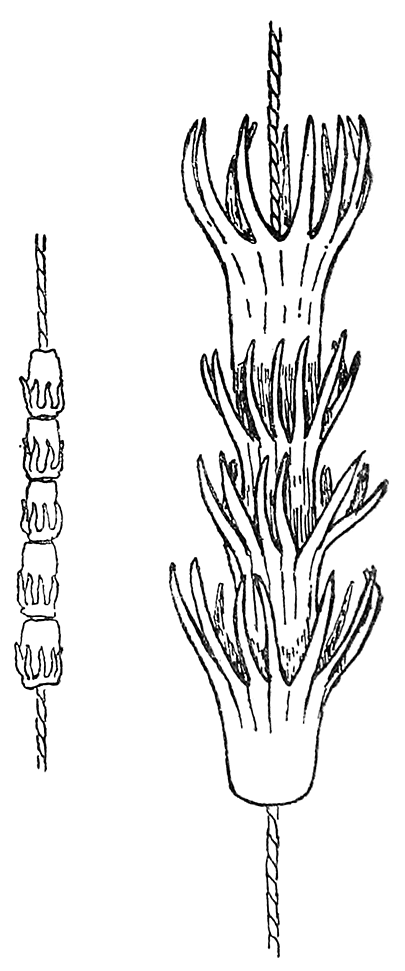
Fig. 40. Necklaces of mangrove seed-tops, Great Andaman
Ornaments of seed. The seed-tops of two or three species of mangrove are collected and strung on to thread and worn round the neck. Fig. 40 shows the two kinds of mangrove seed commonly used in this way.
Bamboo necklaces. A necklace is sometimes made of a number of short pieces of bamboo arrow-shaft threaded on to a string. The pieces of bamboo are ornamented with simple designs scratched or cut on them with a shell.
Sling of bark. Another object that may perhaps be mentioned amongst objects of personal ornament is the sling used in carrying children. It is made of a broad strip of the bark of the Hibiscus tiliaceus. Some slings are covered entirely with netting, while others are ornamented with shells in various ways. Plate XIV shows one with strings of Dentalium shell sewn on to it.
Dancing ornaments of Tetranthera wood. A piece of Tetranthera wood, usually part of the shaft of an old pig-arrow, about 30 to 35 cm. long, is taken and made into shavings with a Cyrena shell. The wood is shaved carefully round and round, so as to make a continuous sheet of fibre, as though unwinding a roll of material. A bundle of these shavings is tied at one end and covered with red paint, and forms an object that is carried in the hand or worn in the belt at dances.
[
Contents
]
Personal Ornament; Little Andaman.
The personal ornaments of the Little Andaman and of the Jarawa are different from those of the Great Andaman Division, and therefore need to be described separately.
Ornaments of bark. Strips of bark (? Celtis cinnamonea) are worn by the men round the waist and round the arm.
Ornamental cord. These are the ornaments most frequently met with both in the Little Andaman and amongst the Jarawa. The basis is a strip of cane, varying in breadth in different examples. On one side of this are laid strips of the yellow skin of the Dendrobium, varying in number according to the breadth of the cane, and the whole is served over or bound with thread. The technique in shown in Fig. 41, which represents diagrammatically the method adopted when there are two strips of Dendrobium skin. Such ornamental cord is made in pieces of considerable length. Often tassels of thread (of Ficus hispida fibre) are attached to it at intervals. The cord is worn wound round the waist, the neck, or the arm. Both men and women wear it.
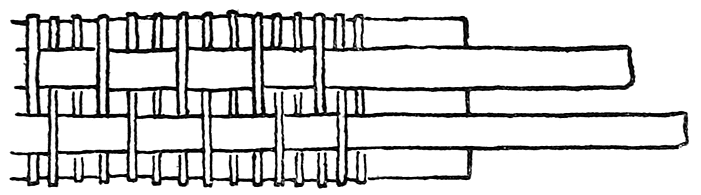
Fig. 41. Diagram showing method of making ornamental cord, Little Andaman
Woman’s girdle. In the Little Andaman this is made of a number of fine strips of cane tied together with thread. At the front is attached a tassel of fibre made from young unopened palm-leaves (the fibre called ko̱ro in Aka-Jeru).
Woman’s shoulder strap. The women of the Little Andaman wear a strip of bark over the shoulders, crossing over the chest and passing beneath the breasts.
The above brief description of the ornaments of the Andamanese is perhaps sufficient for the purpose of this appendix, which is to determine as far as possible the elements of a primitive Negrito culture. Any complete account of the subject would need a large number of figures and a discussion of many comparatively unimportant details. The first point of importance to be noted is that the personal ornaments of the Little Andaman Division differ markedly from those of the Great Andaman Division. One difference is that the Pandanus leaf, which is used so much and in so many ways in the Great Andaman, seems not to be used at all in the Little Andaman. Another is that shells, which are much used in the Great Andaman, are used to a far less extent in the Little Andaman. The natives of the Little Andaman told me that they sometimes make ornaments of Dentalium shell, but I did not see any such ornament, nor any other ornament of shell, in use. The ornaments of netting worn in the Great Andaman, and forming the usual dancing costume, seem not to be used in the Little Andaman. Finally, perhaps most important of all, there is at present no evidence that the natives of the Little Andaman make ornaments of either human or animal bones. In the Little Andaman the lower jaw of a child is preserved by the parents and is worn by them, but I never saw a human skull (whether of child or adult) so worn, and I was not able to obtain any evidence of the use of strings of human bones such as are constantly seen in a camp of the Great Andaman.
The points of similarity between the ornaments of the Little Andaman and those of the Great Andaman are very few. One of the most striking is the great use that is made in both divisions of the yellow skin of the Dendrobium. It seems probable that here we have evidence of one element of a primitive Negrito culture, for the Negritos of the Philippines also are fond of using a yellow vegetable fibre for their personal ornaments. So far as it is possible to judge from the figure and description, the armlet given by Meyer in Plate iii, No. 11, seems to be very similar to the ornamental cord of the Little Andaman. It is described as a “mit schwarz und gelben Grasstreifchen umflocktener Bambus-reif.”
Another point of resemblance between the Great Andaman and the Little Andaman is that in both very little use is made of feathers or flowers. The natives of the Great Andaman never make use of the feathers of birds. The Jarawa occasionally wear in a chaplet a feather of the king-crow (Dicrurus macrocercus) if we may judge from a specimen in the British Museum. The natives of the Little Andaman certainly do not as a rule make any use of feathers. It would seem, from all accounts, that the Semang and the Philippine Negritos do not make any considerable use of feathers for personal ornament. We may perhaps hazard the conclusion that this is a mark of the Negrito culture distinguishing them from such people as the Papuans or Australians in whose personal ornaments the feathers of birds occupy an important place.
In the Great Andaman flowers are not used as personal ornaments. In the British Museum there is an ornament from the Little Andaman consisting of a strip of bark-fibre with a few flowers attached.
As regards personal ornament, therefore, the only elements of a primitive Negrito culture that we seem to be able to trace in the Andamans at the present day are (1) the use of yellow vegetable fibre, and (2) the absence of any considerable use of feathers.
One element of a primitive Andamanese culture, though not necessarily of a primitive Negrito culture, would seem to be the use of a tassel of the fibre obtained from an unopened palm-leaf which is used by women to cover their genitals in the Little Andaman, and was similarly used until recently in the North Andaman.
[
Contents
]
Hair-dressing, Scarification, and Body-painting.
At the present time the usual method of hair-dressing in the Great Andaman is to shave a portion of the scalp all round so as to leave a sort of skull-cap of hair, as may be seen in many of the plates of this volume. In some cases a “parting” is made by shaving a narrow strip over the crown. (See Plate XV, for example.) When the hair grows so long as to be uncomfortable the whole head is shaved, and it is then permitted to grow again. In these days the natives cut their hair whenever they have an opportunity of obtaining a pair of scissors. In the Little Andaman women and old men are frequently to be seen with the head entirely shaved. The younger men shave away the lower edge of the hair all round in the same way as the natives of the Great Andaman, but this may be a recent practice.
The operation of shaving, which is done with a flake of glass or quartz, is performed by women, and never, or very rarely, by men.
Mention has been made in an earlier part of the work of the way in which the natives of the Great Andaman scarify the skin of the body and limbs with a flake of glass or quartz. The Semang do not scarify themselves in this way, but some, at any rate, of the Negritos of the Philippines do.
The natives of the Great Andaman, as described earlier in this work, paint their bodies with a grey clay called odu or og, with a fine white clay, and with red paint made by mixing burnt oxide of iron with fat or oil. The natives of the Little Andaman use the same kind of clay as that called odu or og in the Great Andaman, but instead of applying it in patterns they smear it roughly on the back and front of the trunk. They also use red paint, with which they smear their hair, a practice never met with in the Great Andaman.
[
Contents
]
Ornamentation.
The Andamanese have simple designs which they paint or incise on their bodies and on a great number of the objects that they make and use. A few typical designs such as are incised or painted on belts of Pandanus leaf are shown in Fig. 42. A very large number of designs are based on the zig-zag line. Examples are shown in Fig. 42 c, e, and g. In all parts of the Great Andaman and also in the Little Andaman the zig-zag line is associated with snakes. Thus in the Little Andaman the simple zig-zag line is called dobo kwolage (dobo = snake). In the North Andaman the design of zig-zag lines painted on the body with white clay is called or-čubi t’era-bat, or-čubi being the name of a species of large snake.
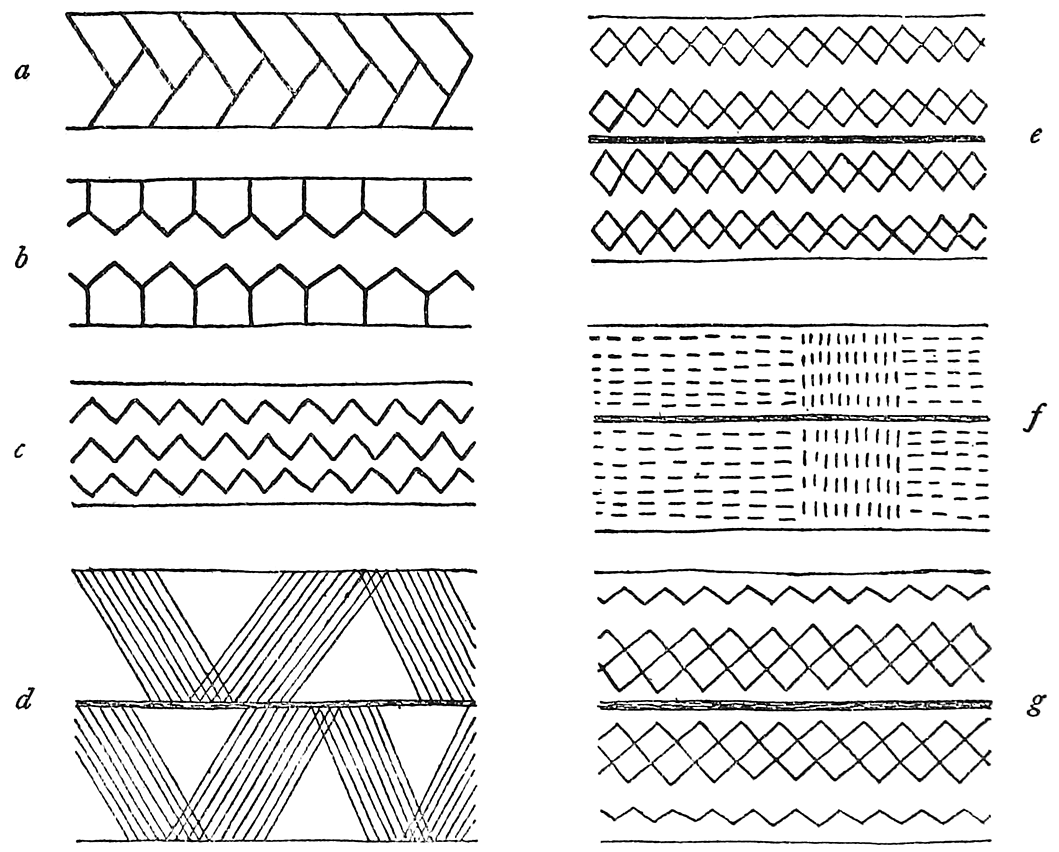
Fig. 42. Designs incised or painted on belts of Pandanus leaf, Great Andaman
A number of other common designs consist of parallel lines of dots or of short strokes, an example of which is shown in Fig. 42 f.
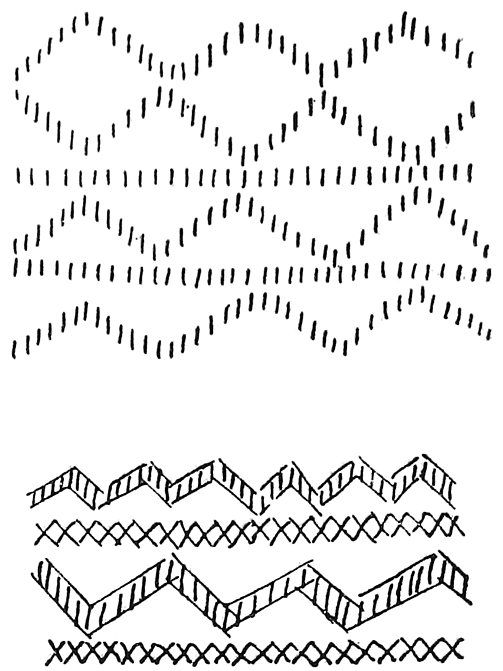
Fig. 43. Designs on bamboo necklace from the North Andaman
By far the greater number of the Andamanese designs are based on the following elements, (1) parallel lines crossing a surface from side to side at right angles to the edge or else in a sloping direction (about 45°), (2) parallel lines of dots or of short lines, i.e. parallel broken lines, as in Fig. 42 f, (3) zig-zag lines, which may be single, or parallel or opposed so as to make lines of lozenges. As an example of the way in which these elements may be combined two designs copied from bamboo necklaces are shown in Fig. 43.
It would perhaps be possible to show that there is a real connection between the ornamentation of the Andamanese and that of the Semang, as there is certainly a considerable degree of superficial resemblance, but at present we understand so little the psychological processes underlying the use of ornament amongst primitive peoples that the subject is one of considerable difficulty.
[
Contents
]
Canoes.
Canoes are in regular use on the coast in all parts of the islands. There are three types of canoe. (1) The Little Andaman canoe, with one outrigger, propelled with paddles or with a pole. (2) The Great Andaman small canoe, with one outrigger, propelled with paddles or with a pole. (3) The Great Andaman large canoe, without outrigger, propelled with oars.
Canoes of this type are propelled by rowing with short oars, except in shallow water where they are poled. This method of propulsion (rowing as opposed to paddling) was adopted in imitation of the boats with which they have become familiar since the European occupation.
For the small canoe of the Great Andaman five or six species of soft-wooded trees are used, of which three are species of Sterculia. A suitable tree is selected near the shore or a creek, and is felled. Care is taken to make it fall in a particular direction. Thus, if the trunk is curved, the convex side of the curve will have to be the bottom of the canoe, and the tree should fall so that this side lies on the ground. Trees are very rarely regular and before beginning the work of cutting the natives have to decide how it should be cut so as to give the best result, i.e., the greatest stability.
After the tree is felled the trunk is cut to the requisite length. The inside of the canoe is first roughly hollowed out with the adze, no use being made of fire. The bark is then removed from the outside of the trunk and the two ends are shaped. Finally, the inside is carefully finished with the adze so as to reduce the sides and bottom to the requisite thickness.
Except at the stem and stern, the canoe retains the shape of the tree, only the bark being removed, and the sides and bottom being formed of the alburnum or sap-wood. At the stern a small platform is cut projecting over the water, which serves as a seat for the steersman. At the prow a larger platform is cut, on which the harpooner stands when he is harpooning turtle or fish. Below these two platforms the ends are not cut away squarely but are rounded from side to side. The prow of the canoe is in every case the lower and therefore broader end of the trunk. It is only in this way that a sufficiently large platform can be provided for the harpooner.
The trees used for canoes have a pithy core and there is therefore a small patch in both the prow and the stern which would admit the water. In former times these two places were caulked with bees’-wax. At the present time the natives often nail a piece of tin (part of an old kerosene tin, for example), with some rags beneath it, on the outside of the canoe at these two places.
The float is attached to a number of booms, of which there are never less than three in the smallest canoes, while there may be as many as eight or nine in a large canoe. A medium-sized canoe has five or six booms. The boom is a thin straight piece of tough wood, of which one end is sharpened and thrust right through two holes cut in the gunwales of the canoe opposite to one another, the sharpened end projecting for a few inches on the port side of the canoe. The boom thus projects about three feet on the starboard side on the level of the gunwale.
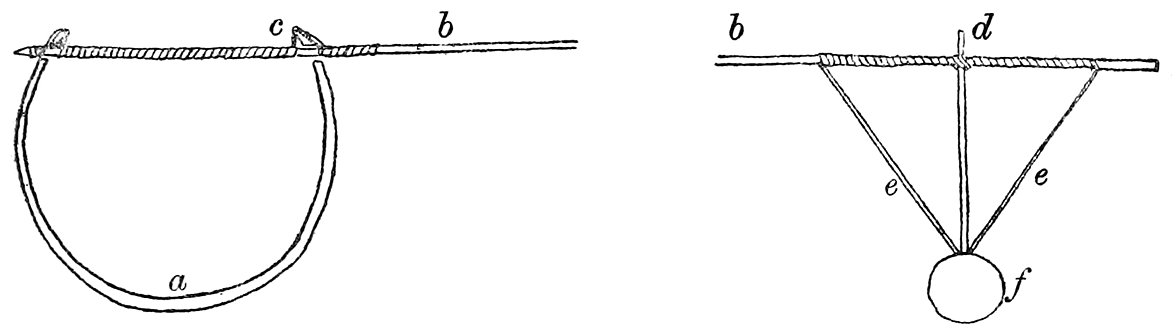
Fig. 44. Transverse section of canoe and outrigger. a, hull; b, boom; c, cane binding over boom; d, stick attaching boom to float; e, stays of cane; f, float
Where the boom passes through the gunwales of the canoe it is bound with cane, and the cane is bound round the whole of that part of the boom that is within the canoe between the two gunwales. (See Fig. 44.) This portion of the boom forms a seat for the man paddling the canoe, so that he sits on a level with the gunwale with his feet on the floor of the canoe.
The boom is attached to the float by means of sticks of tough wood. These sticks, having pointed ends, are driven into the float, one perpendicular, and the other two at an angle on each side. The tops of the three sticks are fastened to the boom a few inches from its end by means of a strip of cane. The arrangement of the three sticks is shown in Fig. 45.
The strip of cane with which the sticks are bound to the boom is wound spirally round the boom itself for a few inches and is then carried down round the float and back to the boom again on the other side. The three sticks provide an efficient resistance against a longitudinal thrust (i.e., a thrust in the same direction as the line of the canoe). The strip of cane passing from the boom round the float and back to the boom again provides a resistance against any lateral thrust on the float. The three sticks, being driven in when the wood of the float is dry, do not readily work loose, as the water in which it is constantly immersed keeps the wood swollen. The cane binding, including the stays on each side, may work loose, but can readily be tightened or renewed. Each of the booms is attached to the float in exactly the same way, and the whole arrangement is very efficient in keeping the float rigidly attached to the hull in such a position that it rests on the surface of the water when the hull itself rides freely balanced.
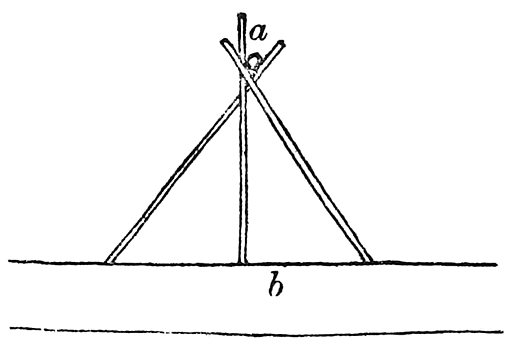
Fig. 45. Showing manner in which the boom (a) is connected with the float (b).
Canoes of this type vary in dimensions within wide limits. A small canoe with only three booms, which would carry three persons, measured 4·85 metres in length over all with a beam of about 35 centimetres. A large canoe may measure as much as 9 metres with a proportionate beam.
A well-made canoe will often balance well enough as it stands, but it is sometimes necessary to balance it with ballast of stones or pieces of coral. In any case the canoe is easily overturned in a rough sea unless the occupants can maintain the balance with their bodies. As the canoe is made of light wood it cannot sink even when full of water, and the natives easily right an overturned canoe, bale it out, and get in again, even in a rough sea.
The furniture of a canoe consists of the ballast (of stone), a piece of stone (or sometimes a piece of tin) on which to keep a small fire smouldering, an anchor consisting of a lump of coral or stone attached to a length of rope, a Nautilus shell or two for baling out the canoe, a bamboo pole of about 18 feet in length for poling the canoe in shallow water, and paddles.
In the platform overhanging the prow a few holes are cut. These holes are sometimes used to attach the rope by which the canoe is fastened to an anchor. One or more turtle skulls are often attached so as to hang down beneath the platform. In turtle-hunting expeditions on dark nights a torch is slung beneath the forward platform so as to shed its light on the water while the harpooner remains in shadow.
When a canoe is finished it is decorated with designs painted on it with red paint and white clay, particularly on the forward platform and along the gunwale. These designs soon wear off when the canoe is in use and are not renewed.

Fig. 46. Paddle
The paddles used by the Andamanese vary considerably in size and to some extent in shape, but the following description with its accompanying figure gives a fair idea of a typical specimen. The whole paddle has a length of 123·5 centimetres, the shaft being 85 centimetres and the blade 38·5 centimetres. The diameter of the shaft from the blade to the middle is 2·6 centimetres, and from the middle towards the handle end it tapers to a point. The shaft is circular in section throughout its length. The blade is leaf-shaped, pointed bluntly at the apex. In section it is plano-convex, with a maximum thickness of 1·3 centimetres and a width of 8·7 centimetres. Paddles are cut with an adze from the wood of the Myristica longifolia and planed with a boar’s tusk. They are often ornamented, when new, with painted designs in red and white.
In deep water the canoe is paddled. Each of the occupants sits facing forward. The steersman sits on the stern platform. The others sit on the seats provided by the outrigger booms. Each man paddles on which side he chooses. It rests with the steersman to maintain the canoe in its proper course. In shallow water the canoe is propelled with a pole. A man stands on the forward platform and poles the canoe, steering as he does so. In a fairly large canoe a man at the stern may also take a pole and, standing up, help to propel the canoe.
All the work connected with the making of canoes and paddles is done by men alone, except the painting, which is usually done by women. It is the men also who make most use of canoes.
The large canoe, that is now made by all the tribes of the Great Andaman Division, is simply a canoe of the same general shape as the Great Andaman outrigger canoe, cut from a larger tree and without the outrigger. The shape of the hull, with its platforms fore and aft, is exactly the same. It seems that when the natives obtained a plentiful supply of iron tools (after 1858) they began to cut down and hollow out larger trees than formerly. Having made these larger canoes they found that they would, when well cut and ballasted with stone, float quite well without an outrigger. (It may be mentioned that the hull of a small canoe is always tested on the water before the outrigger is attached.) Indeed a well cut canoe of large size floats and balances better in a rough sea than a smaller one with an outrigger. It is possible that at first these large canoes were propelled with paddles just as the outrigger canoes are, the paddlers facing forward. Having learnt to understand the principle of the oar, through their contact with the Penal Settlement, the natives applied this principle to their own canoes. It could not, of course, be applied to the small canoes, as the shape of the canoe and the position of the paddler make the use of an oar impossible. It could be applied very easily, however, to the new large canoes. In these the oarsman does not sit on a level with the gunwale, but sits down in the hull itself on a piece of wood resting on the two sides of the hull a few inches above the floor. The gunwale of the canoe is thus about on a level with the bottom of his sternum. A number of holes are made in the gunwale on each side, and by means of these, loops of cane are attached to the gunwale. The oar, which is shaped in imitation of European oars, but with a short shaft, is thrust through the loop of cane, which serves as a fulcrum or rowlock. The rowers face aft. A man at the stern steers with a paddle. In shallow water the large canoes are propelled with poles in exactly the same way as the smaller canoes.
In the bow, at about the position that would be occupied by the foremost boom in an outrigger canoe, holes are made in the gunwale on each side and a piece of wood is thrust through them as a sort of thwart. This is to provide a means of making fast the end of the harpoon line or the anchor line, and thus serves a purpose that is served by the foremost boom in the outrigger canoe.
The large canoes are not quite so useful in turtle-hunting as the smaller outrigger variety, as they cannot be so quickly turned when the pursued turtle doubles. Very often a large canoe and a small canoe are taken together on an expedition, the harpooning being mostly done from the smaller one while the captured turtles are placed in the larger one. A small canoe with three or four men cannot hold more than one or at most two big turtles, whereas as many as ten or a dozen can be stowed in one of the large canoes.
The chief use of the large canoes is to make journeys from place to place. One of the largest will hold as many as thirty men and women with their baggage, whereas an outrigger canoe would never carry more than nine or ten. Further, there is less chance of an even heavily laden big canoe capsizing in a rough sea than of an outrigger canoe doing so. One result of the introduction of the large canoe has therefore been to enable the natives to move much more freely about the islands than formerly. The passage from the South Andaman to Ritchie’s Archipelago, for instance, would only be attempted in an outrigger canoe on a very calm day, whereas in a large canoe it can be successfully accomplished even when there is something of a sea running.
The small canoe of the Little Andaman is fairly similar to that of the Great Andaman. There are three differences. (1) The stem and stern are squarely cut in the Little Andaman, instead of being rounded off. (2) The outrigger booms are attached to the top of the gunwale by cane binding which passes through holes made in the gunwales, instead of being themselves passed through holes in the gunwale. (3) The float is attached to the booms in a different and less efficient manner. Three pointed hard-wood sticks are driven into the float, but they are all three approximately perpendicular. They are bound at the top to the boom, but there are no stays of cane to maintain the float rigid against a lateral thrust. In other respects the Little Andaman canoe is the same as the Great Andaman canoe.
The Jarawa of the South Andaman do not at the present time make use of canoes. This is apparently because, through their hostility with the Aka-Bea, they have been confined to the interior of the island. They make rafts of bamboos lashed together for crossing creeks and inlets. The forest-dwellers of the Great Andaman Division seem also to have made occasional use of similar rafts for the same purpose.
This description shows that the canoe of the North Sentinel is on the whole more like that of the Little Andaman than like that of the Great Andaman.
It seems probable that the Andaman Islands were peopled by sea from the coast of Burma. If this were so, then the original ancestors of the Andamanese must have been in possession of canoes. A consideration of the present Andaman canoes suggests that their ancestors had canoes with a single outrigger on the starboard side, with a number of booms. Of the different methods of attaching the booms to the float, it is possible that the method now in use in the Little Andaman (and apparently also in the North Sentinel) is primitive, and that the Great Andaman attachment is an improvement that has been invented since the separation of the two divisions. On the other hand it is not impossible that the Great Andaman attachment is primitive, and that in the Little Andaman we have a degeneration that might be due to the fact that the Little Andaman (and equally the North Sentinel) provides much less scope for maritime pursuits than the Great Andaman.
The recent invention of the large canoe in the Great Andaman and the adoption of the principle of the oar shows that the Andamanese readily adopt new inventions when these are clearly of service to them.
Turning now to the Semang, as these people live inland they have no use for canoes. They make rafts of bamboos lashed together with which they float down the rivers, returning overland.
Some of the Philippine Negritos seem to live on the coast and possibly have canoes, but nothing is known about these.
[
Contents
]
Conclusion.
The examination of the technical culture of the Andamanese given above has been sufficient to enable us to make a few statements as to what was probably the culture of the Negritos before they were split up into isolated groups. It is highly probable that they obtained their subsistence solely by hunting and collecting vegetable products. They had bows and arrows, the form of bow being probably fairly similar to that used at the present day in the Little Andaman, while for hunting the larger animals they had arrows with detachable heads. They possibly had no knowledge of any way of making implements of stone, but made use only of such materials as wood, bone, and shell. It is not probable that they possessed the art of making pottery, and their basketry and mat-work were probably confined to very simple forms. In their personal ornaments there is reason to think that they showed a fondness for bright yellow vegetable fibre, and made little or no use of the feathers of birds. The ornamentation of their utensils was probably confined to the use of the simplest forms of geometric design with a preponderance of the zig-zag and the lozenge. Finally their huts consisted of a single sloping roof sufficient to afford shelter for a single family or larger huts consisting of such small huts joined together.
We have seen that since the Andamanese have occupied their present home, or at any rate since the Great Andaman Division and the Little Andaman Division have been separated from one another, many changes, some of considerable importance, have taken place in the Andaman technology. In general it would seem that the technical culture of the Great Andaman has changed more than that of the Little Andaman. Putting aside the effect on the technology of the introduction of iron, there is no evidence that any of the changes that have taken place in the Great Andaman have been due to outside influence. Important modifications have taken place in the form of the bow, in the forms and technique of baskets, and in personal ornaments, and in all these instances there is no reason to think that these changes have not been brought about by the natives themselves without the influence of contact with other people. Their method of working iron, based as it is, to all appearance, on their former method of working shell, shows that even here, though the iron itself came to them from outside, and even though they may have learnt its use from seeing it used by aliens, still they have not learnt from others how to fashion the metal into shape by heating it. Thus, so far as their technical culture is concerned, there is no evidence whatever that the Andamanese have ever been influenced by contact with any other race since the time, now many centuries ago, when they first reached the islands.
On the other hand there is some probability that the ancestors of the Andamanese, before they first reached the islands, or at any rate before the isolation of the Little Andaman from the Great Andaman, had learnt from some other race how to make pottery, and it is possible that at the same time they may have acquired other elements of their culture, such as the outrigger canoe. We may even give a guess as to the particular culture from which the ancestors of the Andamanese may have adopted these elements, which may well have been that of a branch of that people of whom an offshoot peopled the Nicobars.
Confirmation of these hypotheses, if confirmation be ever forthcoming, can only be obtained in the study of the history of races and of culture in south-eastern Asia. Until we have much fuller knowledge of the culture of the Semang and the Negritos of the Philippines, any conclusions that may be drawn from the study of the Andamanese alone must be regarded as provisional working hypotheses only, and it is as such that they are here put forward.
[
Contents
]