Chapter II · CEREMONIAL CUSTOMS (continued 2)
Reading edition
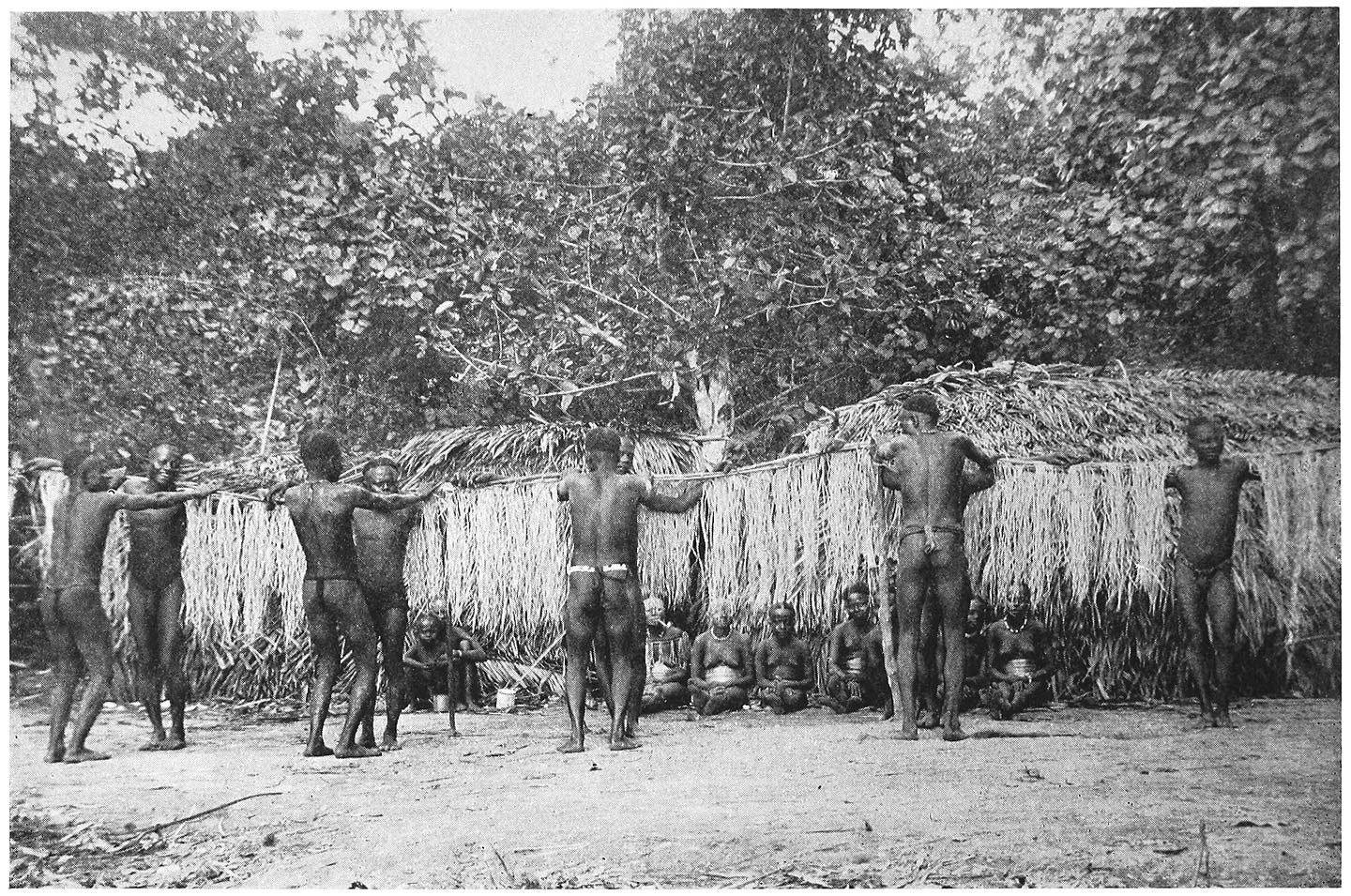
Plate XIX
The peace-making dance of the North Andaman
The visitors, who are, if we may so put it, the forgiving party, while the home party are those who have committed the last act of hostility, advance into the camp dancing, the step being that of the ordinary dance. The women of the home party mark the time of the dance by clapping their hands on their thighs. I was told that the visitors carry their weapons with them, but when the dance was performed at my request the dancers were without weapons. The visitors dance forward in front of the men standing at the koro-čop, and then, still dancing all the time, pass backwards and forwards between the standing men, bending their heads as they pass beneath the suspended cane. The dancers make threatening gestures at the men standing at the koro-čop, and every now and then break into a shrill shout. The men at the koro stand silent and motionless and are expected to show no sign of fear.
After they have been dancing thus for a little time, the leader of the dancers approaches the man at one end of the koro and, taking him by the shoulders from the front, leaps vigorously up and down to the time of the dance, thus giving the man he holds a good shaking. The leader then passes on to the next man in the row while another of the dancers goes through the same performance with the first man. This is continued until each of the dancers has “shaken” each of the standing men. The dancers then pass under the koro and shake their enemies in the same manner from the back. After a little more dancing the dancers retire, and the women of the visiting group come forward and dance in much the same way that the men have done, each woman giving each of the men of the other group a good shaking.
When the women have been through their dance the two parties of men and women sit down and weep together.
The two groups remain camped together for a few days, spending the time in hunting and dancing together. Presents are exchanged, as at the ordinary meetings of different groups. The men of the two groups exchange bows with one another.
[
Contents
]