THE TECHNICAL CULTURE OF THE ANDAMAN ISLANDERS
Reading edition
In this appendix I shall give a brief account of the technical culture of the Andaman Islanders, with a few comparative notes on the technology of the Semang of the Malay Peninsula and the Negritos of the Philippine Islands. The Andamanese, the Semang and the Philippine Negritos are so similar in physical characteristics that it is reasonable to suppose that they are descended from a single stock. It is on the basis of this hypothesis that they are all spoken of as belonging to one race, the Negrito race. It is therefore of some interest to compare the culture of these three different peoples to see if we can determine what was the culture of their ancestors.
In such hypothetical reconstructions of the past it is necessary to proceed with extreme caution, as there is no means of controlling results. The method I have adopted is to compare first of all the different types of technological products or activities found in different parts of the Andamans in order to determine as far as possible what was the technical culture of the ancestors of the Andamanese when they first reached the islands, and what changes have taken place since the islands were occupied. It is only this primitive or generalised Andamanese culture that can be compared with that of the Semang or the Philippine Negritos.
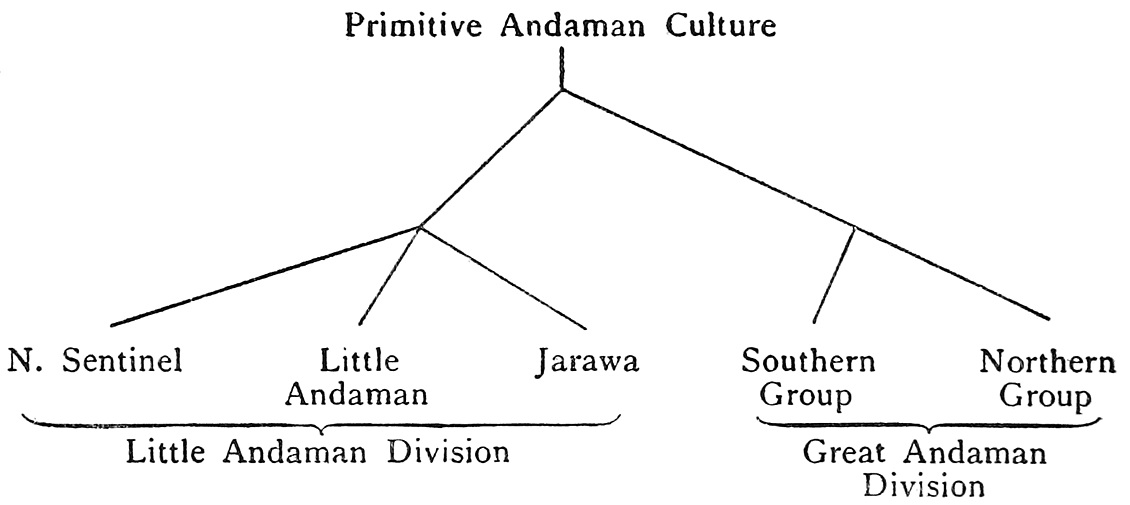
I have provisionally included the natives of the North Sentinel Island in the Little Andaman Division. The ground for so doing is that the form of bow in use in the North Sentinel Island is similar to that of the Little Andaman and unlike that of the Great Andaman. Unfortunately, almost nothing is known about the technology of the North Sentinel, and nothing whatever about the language. It is possible that the natives of this outlying islet have been isolated for many centuries from both the Little Andaman and the Great Andaman, and further information about them might show that their technology is different in important respects from that of the Little Andaman.
Within the Great Andaman Division there are a number of differences in technology between the tribes of the North Andaman and those of the South Andaman and Middle Andaman.
In order to render the exposition and argument that follows more easily understood the supposed relations of the different types of culture are shown in the form of a diagram or tree. The justification for this arrangement will appear as we proceed.
[
Contents
]
Habitations.
The huts of the Andamanese are best understood by considering first of all the simplest and most temporary structures. A man away from the main camp at night (on a hunting expedition) erects for himself a simple shelter of leaves. Such hunting shelters vary considerably according to circumstances. In the rainy season they are built much more substantially than in the dry season. Sometimes shelter is found between the buttresses of large trees, a few leaves being added. There is, however, one type of hunting shelter that is usual. Two poles are cut and erected perpendicularly in the ground so that they stand about four feet apart and about four feet high. To the top of these is tied, with cane or creeper, a horizontal pole. A few poles or sticks of sufficient length are placed so as to lean against the horizontal pole at an angle of about 45°, the ends resting on the ground. On these are placed any leaves that can be obtained, preferably the leaves of canes and other palms. The shelter thus consists of a single rectangular roof, one end of which rests on the ground, while the other rests on a horizontal bar attached to the top of two perpendicular supports. The shelter is built facing to leeward.
The usual family hut of the Andamans is built on exactly the same principles as a hunter’s shelter, but, being intended for occupation for some weeks or even months, is more carefully built. For a small hut, to be occupied by one family, four posts are erected, two at the back being from two to four feet high above the ground, while two at the front are from five to seven feet high. Two horizontal poles are attached, one to the top of the front posts and the other to the back posts, with strips of cane. If poles of a convenient size and forked at the top are available these may be used for the posts of the hut, the horizontal poles being supported in the forks, but a native would not trouble to search for such timbers, being satisfied with an unforked post. A few slender timbers, preferably of mangrove wood (Bruguiera), are placed on the two horizontal poles and bound to them with cane. These rafters, as they may be called, project for a foot or two above or beyond the higher horizontal, and similarly project a foot beyond the lower one so as almost to reach the ground.
In the better kind of hut a mat is made of palm leaves, and this mat is placed on the rafters and tied to them with strips of cane. To make a mat a number of strips of bamboo or cane of sufficient length are taken and placed on the ground parallel to each other. Leaves of a species of cane are collected and each leaf is divided into two parts down the middle. These half-leaves are then attached to the strips of bamboo or cane, by means of strips of the outside of canes, the technique being wrapped-twined work. The half-leaves are attached so that the leaflets, which are attached to the leaf-stem at an angle, incline alternately to one side and the other. The photograph reproduced in Plate VII shows a hut of the kind here described. Mats in course of making are shown lying on the ground in Plates VI and VII.
A quicker, but less efficient way of thatching the hut is to take the half-leaves such as are used for making a mat and fasten them in bundles of five or six directly to the rafters.
Huts of this type, each occupied by a single family, are built by the natives of the Great Andaman Division in the form of villages. The Jarawa and the natives of the Little Andaman build similar huts in their hunting camps, occupied during the fine weather.
Some huts of this type are provided with a floor raised above the ground. Such a floor is erected on short posts, and may be made of bamboos or of planks or pieces of broken-up canoes. A floor of this kind, raised a foot or so above the ground, is shown in Plate VII. Huts are sometimes to be seen with a floor raised as much as three feet above the ground.
The simple Andaman hut as above described is entirely open at the front and on each side. In an exposed situation screens of palm-leaves may be erected at the side. If still more shelter is required, a hut may be built with two roofs. Such a hut requires six posts, two taller ones six or seven feet high, and four shorter ones, two on each side. For such a hut two mats are made, and are so attached that one mat projects above the other. No attempt is made to fasten the two mats together at the top, but on the contrary a space of several inches is left between them to allow the smoke of the fire to escape, rain being excluded by the overhang of one of the mats. Huts of this type may be seen in Plate VI.
The hunting camps of the Jarawa are sometimes arranged on the same principle as those of the tribes of the Great Andaman Division, i.e., all facing in one direction and as nearly in one line side by side as the site will allow.
The natives of the Little Andaman erect hunting camps in the fine weather. In the only one that I have seen the huts were arranged irregularly so as to make the best use of the available space.
Amongst the coast-dwelling tribes there are sites that have been used for encampments for many centuries. At these spots there are found heaps of refuse that have accumulated year by year. These kitchen-middens, as they are sometimes called, consist of the shells of molluscs, bones of animals, stones that have been used for cooking, fragments of pottery, and loam produced from decayed wood and other refuse.
The relation of this type of communal hut, in which all the members of one local group are brought together under a single roof of one slope, to the ordinary family hut of the Andamans, and the arrangement of the hunting camp in a line, is obvious.
To the arrangement of huts in a village around a central open space corresponds the second type of communal hut, which may be called the round hut. Communal huts of this type were formerly built by the natives of the Great Andaman Division, but have fallen into disuse in recent times, owing to the natives having become much more migratory in their habits. Huts of the same type are built at the present day by the natives of the Little Andaman and by the Jarawa.
In its typical form this kind of hut is built by erecting two circles of posts, a smaller circle of tall posts, and a wider circle of shorter posts. The tops of these posts are connected by horizontal and sloping timbers, which make the framework of the roof. The roof is made of a number of mats of palm-leaves, which are laid on the rafters and tied to them with strips of cane. The mats are made in exactly the same way as the smaller mats used for the small huts and already described. They are sometimes rectangular in shape, though occasionally an attempt is made to make them narrower at the top and broader at the bottom. They are arranged on the roof so as to overlap one another and thus make the hut rain-proof. They are not joined in the centre, but a small space is left for the smoke of the fires to escape, and the rain is prevented from entering by letting one or two of the mats overhang the others at the top.
In the round huts of the Jarawa and the Little Andaman there is no centre-post, and according to the statements made to me by the natives of the Great Andaman they did not use a centre-post for their huts. In the description attached to a photograph in the British Museum Mr Portman speaks of the centre-post of a communal hut, which is shown in the photograph still standing, although the hut had been pulled down. It would therefore seem that in the Great Andaman the natives did sometimes erect a centre-post for their round huts. The typical round hut, however, has no centre-post.
It is clear that the round hut has been developed from the village. If all the small huts of a village be drawn together so as to touch each other, and if the mats of thatching be lengthened so as to meet and overlap in the middle, we have a round hut in its typical form. The evidence that this is so is afforded by the thatching, consisting of separate mats, often rectangular in shape (like the mats used for family huts), placed so as to overlap one another. This crude way of thatching could hardly have originated in any other way. Further evidence is afforded, as we shall see, by the internal arrangement of the hut.
Although the hut is here called a round hut, it must not be supposed that the shape is always regularly circular. It may be somewhat oval, and in any case is rarely very regularly constructed. In general, however, the shape approaches more or less nearly to a circle.
Huts of this kind vary in size according to the number of families occupying them. The height in the middle may be as much as 30 feet and the diameter may be 60 feet. The smallest I have seen was a Jarawa hut on Rutland Island, which was only nine feet high and 15 feet maximum diameter. In exposed situations the mats of thatching reach as far as the ground, but huts are sometimes built in sheltered situations with a space of a foot or two left between the ends of the thatch and the ground. A low doorway is provided on one side.
Within the hut there is a central space that is the common part of the hut and corresponds to the dancing ground of the village. In the wet season the communal fire is situated in this open space, and here the communal cooking is performed. In Jarawa huts the roof of the central part of the hut is hung with trophies of the chase consisting of pigs’ skulls bound with cane. In former times the natives of the Great Andaman Division hung similar trophies in their round huts. Around the central space are the spaces allotted to the different families, these being marked off by means of short lengths of wood laid on the ground.
It is thus clear that the basis of Andamanese architecture is the use of a single rectangular roof giving a shelter open at the front. This is the usual form of the hunter’s shelter and of the family hut in the village. For additional shelter two such roofs may be used, but no attempt is made to join them, one being made to overlap the other. There are two customary modes of arranging huts, either side by side facing in the same direction or round an open space facing inwards. Where, instead of separate roofs for each family, we have a united roof, these two arrangements of the camp give rise to two different types of communal hut, the long hut and the round hut.
In a village each hut is occupied by one family. In the communal hut (of either type) each family has a special portion of the hut marked off for its special use. Whether in a village or in a communal hut each family has its own small fire, at which the family meals are prepared. At one side of this fire is erected a small platform about a foot above the ground, supported on either three or four upright sticks. This platform is used for storing food. The natives of the Little Andaman erect low bamboo platforms to serve as beds, arranged round the communal hut, each family having its own. In the Great Andaman the natives, as a rule, make a bed of leaves on the ground and lay a sleeping mat on the top of this. In damp situations, however, they sometimes, as already mentioned, make a floor to the hut, raised a foot or two above the ground, and sleep on that. The Jarawa have a habit of sleeping in the wood-ashes of their fires in their cold weather hunting camps.
A comparison of the three branches of the Negrito race in the light of present information shows that the usual form of habitation amongst them is a sloping roof or screen of palm-leaves. One form of this, the simplest to construct, but only suitable as a temporary shelter, is in common use amongst the Semang and is found amongst the Negritos of Casiguran. The other form, more permanent but requiring more labour to erect, is in common use in the Andamans and amongst the Negritos of Zambales. Of communal huts we have no evidence in the Philippines. The communal shelter of the Semang consists of two screens leaning towards one another. The two types of communal hut of the Andamans are both derived from the family hut.
[
Contents
]
Hunting, Fishing, etc.
The Andaman Islanders depend for their subsistence entirely upon the natural productions of the forest and the sea. They make no attempt whatever to cultivate the soil. Until the introduction of dogs in 1858 they had no domestic animals. Young pigs are occasionally kept in captivity till they are grown, but they are killed for food and are not bred in captivity. Thus the Andamanese provide themselves with food by three different forms of activity: (1) collecting such things as roots and fruits and honey, (2) fishing in the sea and in the creeks, (3) hunting the wild animals of the forest.
For hunting the Andamanese rely entirely on the bow and arrow. Since they have had dogs they occasionally make hunting spears, but they did not do so in former times. They make no use whatever of any method of trapping game or birds. For fishing they also make use of the bow and arrow, wading out on to the reefs and shooting the fish, and in this they are very skilful. Crustaceans, such as crabs and crayfish, are captured in the same way. In the North Andaman a sort of short fish spear was formerly in use as an occasional substitute for the bow and arrow. In all parts of the islands small nets are used by the women for catching small fish and prawns. In the Great Andaman large nets were formerly used for capturing turtle, dugong and large fish near the shore. At the present time the natives of the Great Andaman Division make use of harpoons with which they capture turtle, dugong and large fish from their canoes. Harpoons are not used in the Little Andaman. The Andamanese are also aware of methods of poisoning or stupefying fish in pools by means of certain plants that they crush and place in the water, but I have never seen them use this method of fishing, although they say that they formerly did so. They have no fish hooks and no fish traps. At the present time a few of the natives have learnt to take fish with hook and line, but they are unable to make hooks for themselves, and have to obtain them from the Settlement at Port Blair.
In collecting roots a digging stick is used, and a hooked pole is used for gathering fruit, but they have no other special implements in use in collecting natural productions, and have no need of any. The adze is used for obtaining molluscs and for cutting honey-combs from hollow trees.
It is thus clear that by far the most important utensil of the Andamanese is the bow and arrow. We may say that they are essentially a bow and arrow people. This is even more true of the natives of the Little Andaman Division than of those of the Great Andaman Division.
It may be noted here that the Andamanese have no weapons that are used only for fighting. They fight with their chief hunting weapon, the bow and arrow. Nor have they any special defensive weapons, the shield being unknown.
As the most important weapon of the Andamanese, and indeed of the Negritos in general, is the bow, we may consider this first. Different kinds of bow are in use in different parts of the Andamans, but by a careful comparison of them it is possible to show how they are all derived from one original pattern.
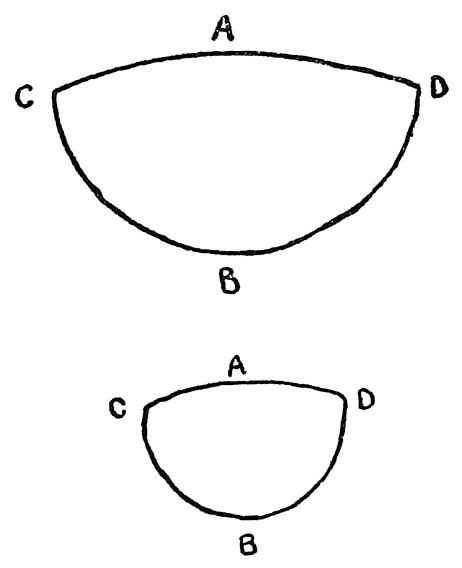
The first kind of bow to be described is that in use in the Little Andaman. These bows are all made of a reddish-brown wood (possibly Mimusops littoralis). They are cut with an adze from a straight piece of wood, and are planed but not polished. The length varies within fairly wide limits. Six specimens selected as typical have lengths of 131, 150, 159·5, 163, 168 and 188 centimetres, giving an average of about 160 centimetres (= 63 inches). In section the bow is markedly convex on the one side and slightly convex on the other. The two figures (Fig. 1) show the section at the middle and at a point 7 cm. from the end of a typical specimen. The shape in section varies a little from one example to another, and the dimensions of breadth and thickness also vary. At the broadest point, which is in the middle, the average breadth of six bows is 3·2 cm., the broadest being 3·7 cm., and the narrowest 2·3 cm. The average thickness in the middle is 1·8 cm., the actual figures ranging from 2·1 to 1·3 cm. From the middle the bow tapers slightly towards each end. At a distance of 7 cm. from the end of the bow the average breadth is 1·8 cm., and the average thickness 1·2 cm.
The flatter side is the inside of the bow. Referring to the figures, the side marked A is that which faces a man as he holds the bow ready to shoot (called here the inside). C is thus the right-hand side and D the left-hand. By breadth is meant the distance from C to D, and by thickness the distance from A to B.
Fig. 1. Section of Little Andaman bow, in the middle and near the end Fig. 2. Shoulder of Little Andaman bow
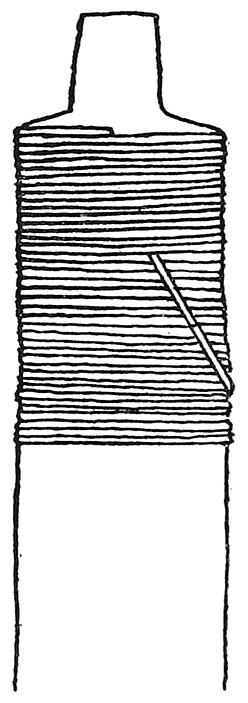
At each end of the bow there is a shoulder, as shown in Fig. 2. The length from the shoulder to the end of the bow, i.e. the length of the point on which the string is looped, is about 10 to 12 mm. Both ends are the same. For a few centimetres below the shoulder the bow is served over with string or fibre. In a carefully finished bow the serving is usually done with ornamental string, i.e. with string round which is twisted the dried yellow skin of the Dendrobium. In other examples plain string is used, or a strip of twisted Ficus fibre, or even nowadays a twisted strip of cotton cloth.
Bows are never ornamented in the Little Andaman either with paint or with incised patterns.
The bow-string of the Little Andaman is made of strips of the bark of the Ficus laccifera. The number and width of the strips used depend on the size of the bow. In a small bow now in the Cambridge Museum the string is made of a single strip of bark about 1 cm. in width. This strip is simply twisted, the twist being that of a right-hand or male screw. When two strips are used they are not twisted around one another in the way that a two-ply rope is made, but are laid flat together and twisted together, so that when the string is finished only one of the strips is visible, the other being inside. In a stout string for a large bow three or four strips may be twisted together in this way. The bow-string is not a rope, but a twisted strand (Fig. 3.)
Fig. 3. Bow-string of twisted fibre, Little Andaman Fig. 4. Diagram showing the method of making the loop in the end of the Little Andaman bow-string

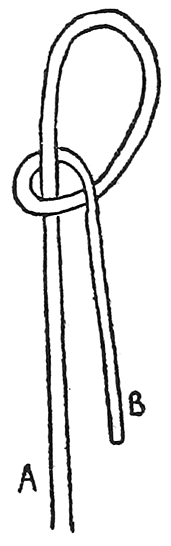
At one end of the string a loop is made, as shown in Fig. 4. The end is doubled over to make a loop of the right size, a round turn is made over the standing part (A) and the end (B) is twisted in with the standing part by untwisting the latter, laying the end in, and twisting up again. If this splicing, as it may perhaps be loosely called, be not sufficiently secure, it is served over or stopped with finer fibre of the same kind. This loop is of sufficient size to slip down over the shoulders. At the other end the string is attached to the peg either with a knot, or else by means of a small loop (just large enough to go over the peg, but not large enough to slip over the shoulder) made in exactly the same way as the loop already described. When the bow is to be strung the larger loop is slipped over the peg at the top end of the bow and is pushed down over the shoulder. The other end (with the smaller loop) is then slipped on the peg at the lower end, resting on the shoulder. The lower end is placed on the ground, while the top end is held in the hand. The man places his foot against the middle of the bow and draws the top towards him until he is able to slip the top loop of the string up over the shoulder so that it catches the peg or tip. The bow is then ready for use.
Toy bows are made for small boys of exactly the same general pattern as the large bows. A toy bow of this kind, now in the Cambridge Museum, is 107 cm. long and 18 mm. broad in the middle.
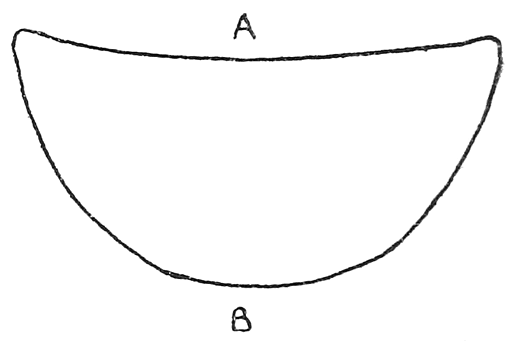
Fig. 5. Section of bow from North Sentinel Island Fig. 6. Section of Jarawa bow
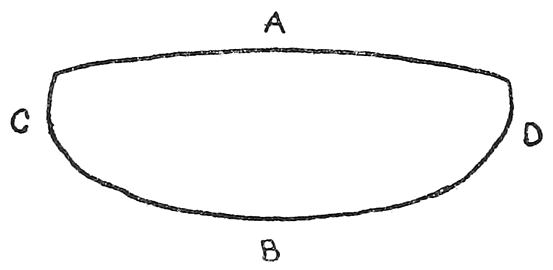
The next type of bow to be considered is that used by the natives of the North Sentinel Island. I have only been able to see one specimen of this type, which is in the British Museum. It is made of a different kind of wood from that used in the Little Andaman. The length is 155·5 cm., and the breadth at the middle is 4·3 cm. The section in the middle, which is shown in Fig. 5, is slightly different from that of the average Little Andaman bow, but it has the same feature of greater convexity on the outside and less convexity on the inside, and it lies just within the range of variation of the Little Andaman type. The ends of the bow are shaped in the same way as those of the Little Andaman bow. The breadth at the shoulder, however, is 2·5 cm., which is greater than the corresponding measurement of the Little Andaman bow. The bow is not ornamented either with a painted or incised pattern. The string is missing. There is no binding at the ends below the shoulders, but this has possibly been present and come off, as the specimen is one that has been thrown away by its owner owing to the wood having split. So far as we can tell from this single specimen the bow of the North Sentinel differs very little from that of the Little Andaman.
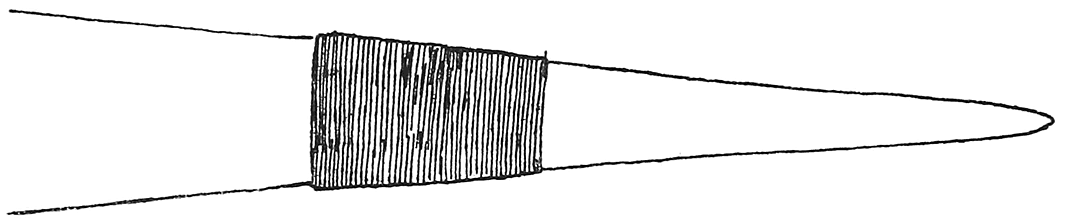
Fig. 7. Upper end of South Andaman bow
We now come to the bows of the Jarawa of the South Andaman. The Jarawa of Rutland Island, of whom there are now very few, but of whom there were a larger number twenty or thirty years ago, make bows exactly like those of the Little Andaman, and apparently do not make any other kind. The Jarawa to the north of Port Blair, who have been driven northwards by the spread of the Penal Settlement, also make bows of this type, which it is not possible to distinguish from Little Andaman bows. These northern Jarawa, however, also make bows of a different kind. These will be spoken of as belonging to the “modified Jarawa type.” They are larger than Little Andaman bows, having an average length of about 185 cm., with a breadth of about 5 cm. The section, throughout the greater part of the length, is either plano-convex, or, more frequently, concavo-convex. The section of a typical example is shown in Fig. 6. At the middle of the bow, where it is held in the hand, there is a slight thickening produced by a protuberance on the inside, i.e. on the flat or concave side. In a certain number of specimens the bow, instead of being straight, is slightly recurved outwards. Finally, the wood from which these bows are cut is not the same as that used in the Little Andaman.
The Little Andaman bow, the North Sentinel bow and the Jarawa bow are all varieties of one type. The Little Andaman form is probably nearest to the original of the type, and I shall show later how the modifications found in the modified Jarawa type came to be adopted.
We now come to bows of a different type, of which there are two varieties, one used in the South and Middle Andaman, and the other used in the North Andaman.
The bow of the South Andaman tribes is not cut from a straight piece of wood, but is cut from a tree that has bent in the course of its growth into a suitable curve. A tree has to be found that will provide a piece of wood of the required shape. From this the bow is shaped with an adze, and is finished by planing with a boar’s tusk.
Bows of this kind vary in length between 180 and 210 cm., the most usual length being between 190 and 195 cm. At the upper end the bow is brought to a point approximately circular in section. From this point it broadens out until, at a distance of about 50 or 55 cm., or between one-quarter and one-third of the length of the bow, it reaches its maximum breadth, which is, on the average, about 5·5 cm. The section of the bow at this point is convex on the outer side, while on the inner side it may be flat or slightly concave, or even in rare instances slightly convex. In many specimens there is a very slightly raised keel running down the middle of the inside of the bow. The thickness of the bow at the point mentioned is usually 1·5 to 1·75 cm., and there is little variation in this respect in different specimens. (See Fig. 8.)
At the middle the bow decreases in breadth and increases in thickness to form a handle. At the handle the usual section may be described as pear-shaped, the greatest diameter being the thickness (from inside to outside) and not the breadth.
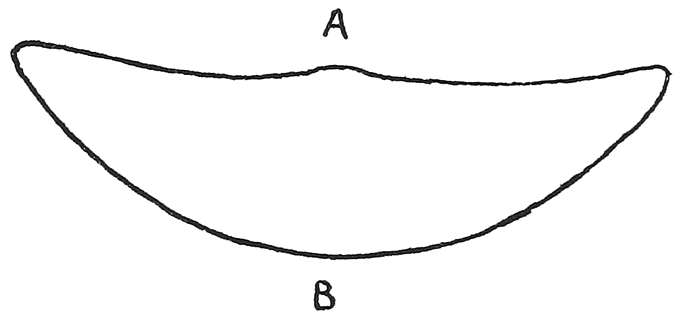
Fig. 8. Section across the blade of a South Andaman bow
From the handle towards the lower end the bow again increases in breadth, so that the lower portion is about the same breadth and thickness as the upper portion. At the lower end it tapers to a point, circular in section, but the point is blunter than at the upper end.
Thus the whole bow consists of a leaf-shaped upper portion or blade which is straight (i.e. neither curved inwards nor outwards), a waist or handle, and a lower blade that is curved backwards or outwards at about its middle, this being the position of the bend in the wood from which it is cut. A bow of this type is shown in Plate V.
Near each end the bow is served over with string for a distance of 3 or 4 cm., leaving a bare point at the upper end of about 7 cm. long, and a point at the lower end of about 1·5 cm. (Fig. 7.)
A bow-string is made from the fibre of the Anadendron. A number of strands of the fibre are taken and are waxed with black bees’-wax. Four of these strands are taken, three of them are placed together and the fourth is wound spirally round them. When the end of the active strand (the one being twisted round the others) is neared, a new strand is taken and laid in. The twisting is continued for a few turns and the newly inserted one is then taken, the end of the first active strand being laid in and wound over in its turn. The process continues in this way, new strands being added until a cord of sufficient length has been made. This is again waxed over on the outside.
At one end of the cord a knot is tied. At the other end a loop or eye is formed. To make this eye, when the cord is of sufficient length, the end of it is bent over to form a loop of about 1 cm. or a little more in diameter. This loop is then served over with thread made of Anadendron fibre. The serving is continued over the neck of the loop for about 1·5 cm. This gives an eye with the appearance shown in Fig. 9. A loose strand of fibre is left at the neck of the loop. This is wound spirally over the cord, as described before, new strands being added one after another until the cord has been treated in this way for about 35 cm. from the eye. It is then stopped by serving it over for about 2 cm. with Anadendron thread. It is clear from this description that the cord is somewhat thicker for about 35 cm. from the end with the eye than it is in the rest of its length.
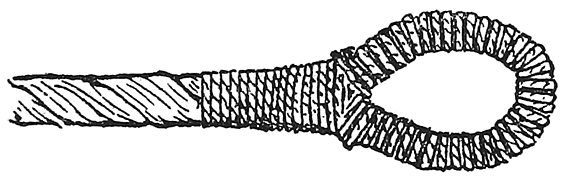
Fig. 9. Loop of bow-string, South Andaman
To string the bow the knotted end of the bow-string is fastened round the top end of the bow with a slip knot, so that it rests on the top of the string serving. The bow is then turned upside down and the top end (now temporarily at the bottom) is fixed in the ground or against a stone, so that it will not slip. The other end of the bow is taken by the left hand, while the cord is held in the right, the right foot is placed against the handle or middle of the bow and the bow is bent, the end held by the hand being drawn towards the operator until he is able to slip over it the eye or loop at the end of the string.
After the bow has been strung the upper portion, which before was straight, is now curved inwards, and the bow therefore appears as S-shaped when seen from the side. When a man starts out hunting or fishing he strings his bow and tests it, and it remains strung till he returns, when he unstrings it and places it in his hut.
The advantage of having a knot at one end of the string seems to be that should the string be stretched by use it can be tightened by altering the position of the knot.
At the point where the nock of the arrow is placed when the bow is drawn, it is usual to serve the string over with thread of Anadendron fibre.
The peculiar features of the South Andaman bow depend on the fact that the bow takes advantage of the greater toughness and elasticity of wood that has been compressed in the course of its growth. When the bow is drawn the strain does not fall evenly, but, by reason of the shape of the bow, is concentrated on one portion, namely the lower portion of the bow where it is curved outwards. This is easily seen when a bow is strongly drawn, for from the S-shape that it has before, it becomes very nearly true arc-shaped when fully drawn. The lower portion of the bow works as though hinged, and thus the strain is largely borne by the curved portion of the bow. Now this portion is cut from the concave side of a tree that has been bent while growing, and consequently the fibres of the wood are here stronger, tougher and more elastic. The result is that for a given amount of energy spent in drawing the bow a greater force of propulsion is given to the arrow than with a bow of the Little Andaman type.

Fig. 10. Ornament on South Andaman bow
The breadth of the bow is necessitated by its shape, for if it were narrow the string would slip round on to the outside of the bow. The narrowing at the handle is necessary for holding the bow. The adoption of tapered ends instead of shoulders is a definite improvement as it makes the bow less liable to split at the ends.
The bows of the South Andaman group of tribes are always decorated with incised patterns. The conventional pattern is shown in Fig. 10. One line of such pattern runs down each edge of both the inside and the outside of the bow, and on the inside a similar line of pattern runs down the middle. When bows are newly made they are often also decorated with designs in red paint and white clay, particularly if they are intended as gifts. These painted designs soon wear off and are not renewed.
In these tribes bows are sometimes made of a size so large as to be almost useless for hunting. One such bow, now in the Cambridge Museum, is 220 cm. long and with a maximum breadth of 10 cm. Such bows are very carefully made and decorated and are intended as gifts. A man generally makes such a bow with the deliberate intention of giving it to some person whom he wishes to please. The bow that I have was specially made to give to me in this way. A man who possessed such a bow would not dream of using it in hunting, but he might use it in a shooting match, in order to show his skill.
In the South Andaman tribes toy bows are made for boys of somewhat the same shape as the ordinary hunting bow. An example of such a bow, now in the Cambridge Museum, is 121 cm. long. It is cut from a bent piece of wood in such a way that the lower portion is curved outwards. The section in the middle is plano-convex, very nearly the half of a circle, the breadth being 26 mm. and the thickness 13 mm. It is broadest in the middle, and tapers towards each end. When strung it assumes the typical S-shape of the South Andaman bow. It is served over with thread at one end and with a strip of cotton cloth at the other, leaving two points for the string. The latter is of the usual South Andaman type, but of smaller dimensions.
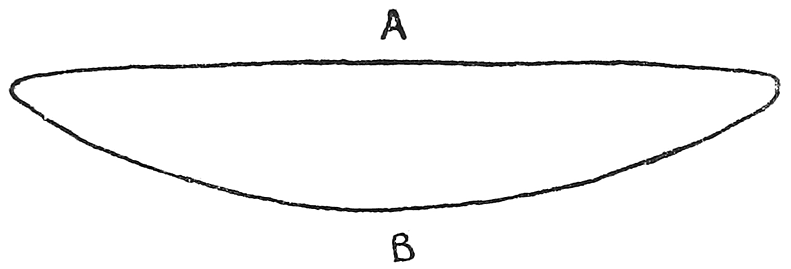
Fig. 11. Section across the blade of a North Andaman bow
We must turn now to the bow used by the four tribes of the North Andaman, which is of a somewhat different pattern from that just described. It is, in the first place, shorter, lighter and more slenderly made. Of ten typical specimens the shortest is 153 cm. long, and the longest is 182 cm. The usual length is about 160 to 165 cm. In its broadest part the North Andaman bow is broader than the South Andaman bow, the breadth varying from 6·5 to 7·5 cm. in different specimens.
Although the North Andaman bow is, as a rule, cut from a curved piece of wood, it may, on occasion, be cut from a piece that is practically straight.
At the upper end of the bow there is a long point. In a specimen that is in every way typical, at about 5 cm. from the point the section is circular and the diameter is about 5 mm.; at about 30 cm. from the end the section is slightly flattened or oval, and the maximum diameter (the breadth from side to side) is about 1·5 cm. From this the bow broadens fairly rapidly, until at a distance of about 60 cm. from the end it is 7 cm. broad. The section at a point 60 cm. from the end is shown in Fig. 11, where it may be seen to be convex on the outside and only very slightly convex on the inside. At about 75 cm. from the end the bow narrows in breadth to form a handle, at the same time increasing slightly in thickness. The handle is approximately circular in section in the middle, which is about 95 cm. from the upper end, and about 80 cm. from the lower end, the diameter being about 2·2 cm. Below the handle the bow broadens out once more into a lower blade which in shape and section is similar to the upper blade. At a distance of about 30 cm. from the lower end the bow once more narrows off to a point approximately circular in section. The lower point of the bow is not so long or so tapering as the upper point.
The whole bow thus consists of two blade-shaped portions tapering to a point at each end, and with a waist or handle between them. The upper blade is straight, i.e. is not curved either outwards or inwards. The lower blade is curved outwards (like that of the South Andaman bow) in nearly every newly made bow and in every bow that has been in use.
The upper part of the bow is served over with string for about 1·5 cm. (at a distance of 15·5 cm. from the end in the bow that has been described), and the lower end is similarly served (at a distance of 6 cm. from the end). The general shape of the bow as seen from inside is shown in Fig. 12.
The bow-string of the North Andaman is made from Anadendron fibre in much the same way as described in connection with the South Andaman bow, but in the North there is a loop or eye at both ends of the string. As soon as the first few centimetres of the cord have been made (by the method previously described) it is bent over into a loop, and this loop is served with Anadendron thread, just as in the case of the South Andaman string. The making of the string then proceeds in the usual way until a sufficient length has been made, this depending, of course, on the length of the bow for which it is intended. The end is then bent over into a loop, and this loop is served over with thread. The loose end of fibre is not in this case (as it is in the South Andaman string) twisted round the standing part of the cord, but is laid beside it, and the thread that has been used for serving is wound spirally round them both for a distance of about 10 cm. from the neck of the loop, so that the end is stopped.
Fig. 12 Fig. 13

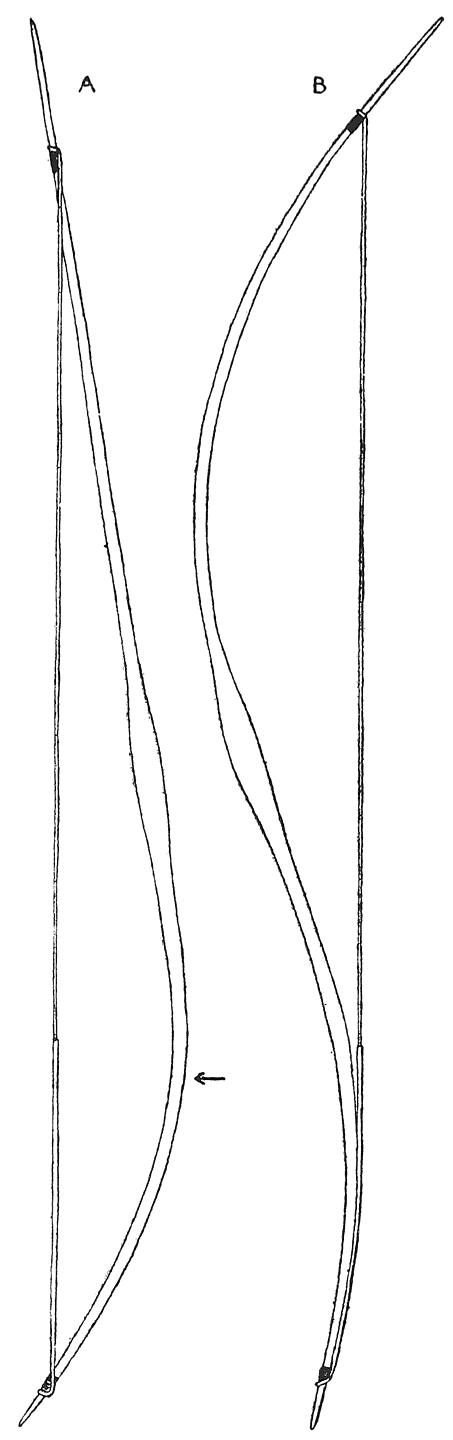
Fig. 12. North Andaman bow seen from the front
Fig. 13. North Andaman bow; A, in the half-strung or reversed position, B, in the fully strung position. The arrow shows the point where the bow is seasoned over the fire.
When the bow is to be strung the first made loop is slipped over the top end of the bow so that it rests on the thread serving already mentioned, the neck of the loop being on the inside of the bow. The bow is then laid on the ground, inside downwards, a foot is placed on the middle, and the lower end of the bow is bent upwards (and therefore outwards) far enough to allow the other loop of the cord to be slipped over the end. The bow is now in what may be called the half-strung position, and in order to understand the mechanical principles of this type of bow it is necessary to make quite clear what this position is. It is shown in Fig. 13, A. The string passes from the top to the bottom on the outside of the bow, so that the bow is, so to speak, reversed, and is subjected to a strain that causes it to curve outwards. In most bows, when they are first made, there is an outward curve in the lower portion, owing to the bow having been cut from a curved piece of wood. When the bow is half strung this outward curvature is increased. If a bow be made from a straight piece of wood, an outward curve is produced by the operation of stringing it, as described above.
As soon as a bow is completed it is strung in the reversed position described, and is then placed over a fire, in such a position that the lower (curved) blade is immediately above the fire. The smoke and heat of the fire season the wood of this portion of the bow. Any specimen of a bow of this type, unless it has been newly made and not seasoned, is blackened on the inner surface of its lower part. The bow is left to season in this way for some time. A man places his bow over the fire of his own hut, which is kept constantly burning day and night. It must be remembered that all the time it is being seasoned the bow is subjected to a slight strain curving it outwards.
After the bow has been sufficiently seasoned it is brought into use. When a bow that is half strung or strung in a reversed way is to be used, it is taken by the handle in the left hand, with the string away from the body, the bow being upside down. The lower part of the bow (i.e. what is really the top of the bow when it is in its normal position) is rested against the thigh. The string is taken in the right hand and pulled over towards the body, so that the bow reverses itself and appears in the fully strung position shown in Fig. 13, B. It is then ready for immediate use.
A bow of this type is hardly ever entirely unstrung. When a man has finished with his bow for the time being, he puts it once more in the half-strung position, by an action the reverse of that described above, and then hangs the bow over the fire. Thus while the bow is in active use it is in the fully strung position, and at all other times it is kept in the half-strung position.
It is clear that the North Andaman bow depends on a principle that is not made use of in the South Andaman bow, which we may state by saying that if a piece of wood be subjected to the influence of heat and smoke while it is bent in one position it will acquire greater strength and elasticity to react against a strain that bends it in the opposite direction. When the bow is fully strung it is S-shaped. When it is drawn the greater part of the strain falls on the lower portion where it is curved outwards. It is this portion of the bow that is strengthened by seasoning.
The North Andaman bow is very much lighter than the South Andaman bow and is much more elastic. I always found it very difficult to shoot with a South Andaman bow, but on the other hand I found the North Andaman bow very easy to use. In drawing it only a slight pull is required in order to send an arrow with considerable velocity. The disadvantage of the northern bow is that, owing to its slighter build, it does not last very long, and is liable to be broken. However, it only takes a man a few days to make a new bow, string included, and the very definite superiority of the North Andaman bow over that of the South Andaman amply compensates for its shorter life.
Bows of exactly the same shape but of smaller dimensions are made in the North Andaman for boys, the length varying from about 90 cm. to about 120 cm. For very small boys toy bows of a different pattern are made. The bow is formed of a piece of wood about 90 cm. long and from 2 to 2·5 cm. broad in the middle. The section in the middle is convexo-convex, with a high degree of convexity on the outside and a much slighter convexity on the inside. The bow tapers to a point at each end, but it tapers more gradually at the top than at the bottom. The bow-string is a simple piece of string (two-ply) made of Anadendron fibre. It is tied to the lower end of the bow at a distance of 1·5 to 3 cm. from the end, and at the top it is tied at from 4 to 7 cm. from the end. The shape of a toy bow of this kind as seen from the side is shown in Fig. 14. It is not S-shaped, like the toy bow of the South Andaman previously described, but the curvature is asymmetrical.
I obtained a specimen of a toy bow made of bamboo. Unfortunately there was no string, but it was probably intended to be strung in the fashion of the North Andaman toy bow just described. The outer surface of the bamboo was the outside of the bow, with the result that in section the inner side of the bow was more convex than the outer side. This is the only bow in the whole of the Andamans in which I ever saw this feature. In all other bows of whatever type the outer side is markedly convex and the inner side is either concave, flat or only slightly convex.

Fig. 14. Toy bow of the North Andaman
It is now possible to compare one with another the different forms of bow in use in the Andamans. It would seem almost certain that the North Andaman bow can only have been derived from the form in use in the South Andaman or from one very similar to it. It is only after they were in the habit of making bows with an outward curve in the lower portion that the natives could have devised the method of seasoning this portion of the bow and keeping it in the reversed or half-strung position. It is unnecessary to argue the matter in detail, and we may conclude that the North Andaman type is derived from the South Andaman type.
It is less certain, but still highly probable, that the South Andaman form was derived from a bow similar to that still in use in the Little Andaman. The South Andaman toy bow shows a stage intermediate between the Little Andaman bow and the usual South Andaman form. The section of this toy bow is very similar to that of the Little Andaman bow. It has no blades, and therefore no waist for the handle. The shape, however, is asymmetrical. Owing to the different method of stringing it, the shoulder at the end of the bow is unnecessary, and the bow is strengthened (prevented from splitting so easily) by tapering the end to a point instead. The difference between the toy bow and the general South Andaman bow is the presence in the latter of the two blades and the waist. The broadening of the bow into the blades is necessary in order to prevent it from accidentally reversing itself.
We have still to consider the modified form of the Jarawa bow. The origin of this is easy to discover by the examination of a few typical specimens. Since the Jarawa have been in the South Andaman they have been in hostile contact with the tribes of the South Andaman Division. They have had opportunities of handling bows of the kind made by these tribes, and they have apparently discovered that these bows are more efficient than their own, but they have had no opportunity, such as only friendly intercourse would give, of discovering the principles on which the South Andaman bow is made. They have attempted to imitate it to the best of their ability, and this they have done (1) by making their bows longer and broader, (2) by making them concavo-convex in section instead of convexo-convex, (3) by cutting them occasionally from wood that gives them an outward curve in the lower portion, (4) by imitating the shape of the handle without, however, giving the bow a waist, (5) by serving over the bow-string with thread at the point where the arrow touches it, (6) by ornamenting their bows with incised and painted patterns. These are the only differences between the modified Jarawa type and the Little Andaman type, and all these may be explained as attempts to imitate the bows of the South Andaman Division. In not a single one of the modified Jarawa bows that I have seen is the fundamental principle of the South Andaman bow successfully applied.
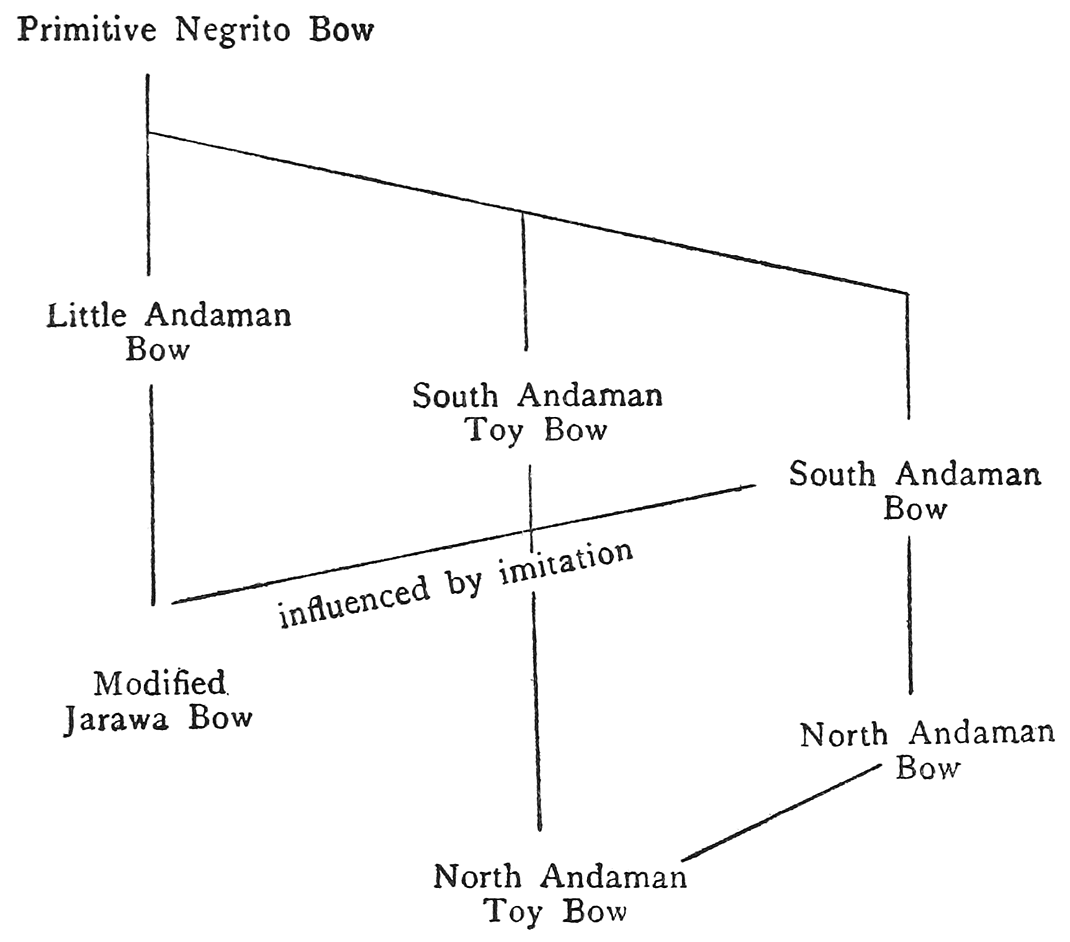
We may conclude that the ancestors of the Andamanese at one time used a bow resembling that in use in the Little Andaman at the present day, and that the S-shaped bow of the Great Andaman has been invented since the separation of the two main divisions of the race.
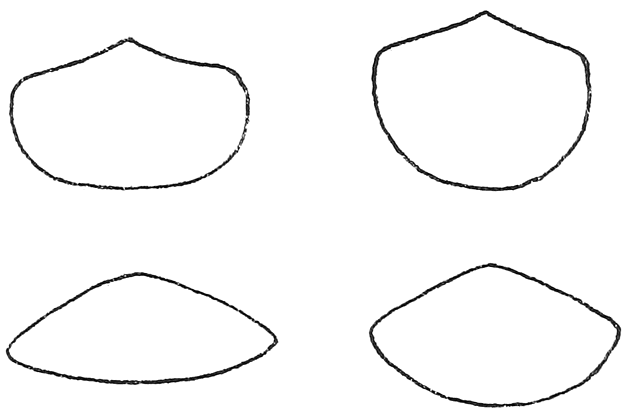
Fig. 15. Section across the middle of four Semang bows
The other two specimens do not conform to this type. One is of wood, 134 cm. long, and 3·5 cm. broad in the middle. One end is provided with a notch on each side for the string, while the other end has three pairs of notches. The string is a three-ply cord with a loop or eye at each end. The other specimen is made of bamboo, and is 147 cm. long and 2·25 cm. broad in the middle. One end has one pair of notches and the other has two pairs. The string is two-ply with a loop at each end.
From a study of the available material it seems that we are justified in concluding that the primitive Negrito bow was made of wood, with a shoulder at each end, probably with a section rounded on one side and flattened or keeled on the other, and that it had a string of twisted fibre with a loop or eye at one end, the other end being attached with a knot.
The Andaman Islanders use two different kinds of arrows, one for shooting fish and the other for shooting pigs.
The common fish-arrow, as at present used in all parts of the Great Andaman Division, consists of three parts—a shaft, a fore-shaft, and a point. The shaft is a length of bamboo straightened by means of heat, and may vary in length from 70 to 110 cm. At one end the bamboo is cut off about 3 cm. beyond one of the nodes, and a nock is made (Fig. 16). At this end the shaft is roughened with a Cyrena shell so as to give a firm grip for the fingers. At the other end the shaft is tapered for about a centimetre. At this end the bamboo is roughened with a shell to give a hold to the thread with which it is bound. The fore-shaft is a length of wood from 15 to 40 cm. long. One end is slightly tapered so that it fits tightly into the end of the bamboo shaft. The other end is tapered to a point, which is flattened on one side. The fore-shaft is inserted into the end of the shaft and the joint is bound over for a distance of about 2·5 cm. with thread. The point consists of a piece of iron wire, sharply pointed at both ends. This is laid against the flattened side of the fore-shaft and is bound to it with thread in such a way that one point projects at the back to form a barb (Fig. 16). When the binding is completed it is covered entirely over with a composition made by melting together bees’-wax, resin and red ochre. The composition is melted over a fire, is applied with a short piece of wood and is then smoothed over with a hot Cyrena shell. Only the binding attaching the point to the fore-shaft is covered with composition, and not that at the joining of the fore-shaft and the shaft.
Arrows of this kind are used for shooting fish, but they also serve to shoot snakes or rats and on rare occasions birds.
Similar fish-arrows are made in the Little Andaman, but they are larger (i.e. both longer and thicker) than those of the Great Andaman Division. The two ends of the bamboo shaft are not roughened, and the binding attaching the point to the fore-shaft is not covered with composition (which seems to be unknown in the Little Andaman) but with bees’-wax only.
This seems to be the traditional form of fish-arrow of the Andamans. Before iron was plentiful the point consisted either of the serrated bone from the tail of the sting-ray or of a piece of the tibia of a pig ground down to the requisite dimensions on a piece of stone, and sharpened at each end.
In the Little Andaman fish-arrows are sometimes used with two or four prongs attached to a bamboo shaft. In the British Museum there is an arrow from the North Sentinel Island with four prongs tied on to a wooden shaft, each prong being barbed by a detached piece of wood at the end.
A simple form of arrow is made in both the Great Andaman and the Little Andaman consisting of a bamboo shaft with a pointed wooden head, the point being hardened in the fire. Such arrows are now very rarely used, save for shooting at a mark, but it is probable that before iron was plentiful they were used as a substitute for the fish-arrow described above, being easier to make although less serviceable.
The pig-arrow in use in the Great Andaman consists of a shaft, and a fore-shaft to which is attached a head. The shaft is a piece of the wood of the Tetranthera lancæfolia, cut from the tree and straightened by means of heat. At the narrower end a nock about 1 cm. deep is cut, and the arrow is served with thread of Anadendron fibre for about 1·6 cm. above the nock, in order to prevent splitting. At the other end the shaft is hollowed out to a depth of about a centimetre. This hollowing is done with the point of a fish-arrow or other similar piece of pointed iron. For a distance of about 1·5 cm. the end of the shaft is served over with thread of Anadendron fibre, so as to prevent it from splitting.
Fig. 16 Fig. 17 Fig. 18

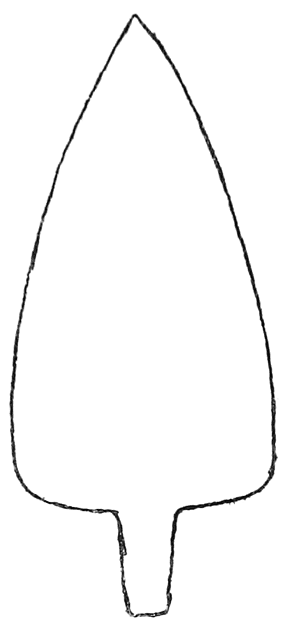

Fig. 19
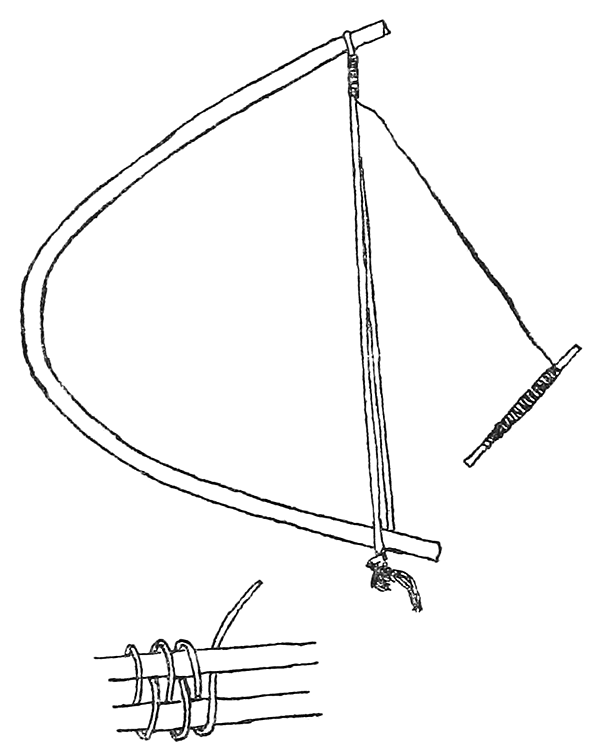
Fig. 16. Fish-arrow of the Great Andaman
Fig. 17. Head of pig-arrow, Great Andaman
Fig. 18. Pig-arrow with detachable head, Great Andaman
Fig. 19. Method of making the cord of the Great Andaman pig-arrow
The fore-shaft consists of a piece of tough wood one end of which is cut to such a size that it will fit fairly tightly into the hollow at the end of the shaft. At the other end it is split so as to admit the head.
The head consists of a piece of iron broken into shape with the aid of a stone hammer and then ground down and sharpened on a whet-stone or with a file if one be obtainable. The usual shape is shown in Fig. 17. The head is inserted into the split end of the fore-shaft and the end of the latter is then served over with thread. A few centimetres below the head either one or two sharp-pointed pieces of iron wire are placed against the fore-shaft in the same plane as the head and are bound firmly to it with the thread, so as to provide a barb or barbs.
A cord is made and one end of it is attached to the shaft and the other end to the fore-shaft. This cord is made as follows. A number of strands of Anadendron fibre are taken and waxed with bees’-wax. These are made into a cord by the same method as that described in connection with the Great Andaman bow-string, one strand being wrapped round the others. About 40 cm. of single cord is made in this way and the two ends are tied together. A piece of elastic wood is bent into the form of an arc and the loop of cord is placed over this so that it is stretched tight. A length of thread (of Anadendron fibre) is made and wound on to a fine netting needle or on to a thin slip of wood, and the two cords as they are stretched side by side are bound together with this thread by the process known as “nippering” (Fig. 19). In this way a firm and strong flattened cord is produced. One end of this is fastened to the fore-shaft immediately above the end that fits into the shaft. The other end is fastened to the shaft a few centimetres from the end, leaving a short length of the shaft around which the cord may be spirally wound when the arrow is in use. (Fig. 18.)
Finally, the thread on the fore-shaft, i.e. that which holds the head and barbs in place, and also that which serves to attach the end of the cord, are covered with the composition already described as used on fish-arrows.
Arrows of this kind are used in pig-hunting. The fore-shaft is inserted into the end of the shaft, the cord attaching the two being wound spirally round the end of the shaft. When a pig is struck the barbs prevent the head from coming out of the wound. As the pig attempts to run away the shaft catches against the undergrowth of the jungle and comes loose from the fore-shaft. Sooner or later the shaft becomes entangled in the undergrowth and holds the wounded pig fast till the hunters can come up with it and despatch it. It is obvious that the cord of the arrow needs to be so strong that the pig cannot break it.
The natives of the Great Andaman tribes say that before they had plenty of iron they made similar pig-arrows with heads of shell and barbs of pig’s bone.
The natives of the Little Andaman make a pig-arrow very similar to that of the Great Andaman tribes, but on the average somewhat longer. The cord attaching the fore-shaft to the shaft consists of a length of double two-ply rope of Hibiscus fibre. The binding of the arrow is done with thread of the Gnetum fibre instead of Anadendron, and is not coated with composition but is smeared with bees’-wax. The barb (there being usually only one) is not fixed in the same plane as the head, but in the plane at right angles to it. (Fig. 20.)
Amongst the Jarawa the head of the pig-arrow is attached to the fore-shaft by a different method, holes being made in the iron through which the thread that holds it is passed. (Fig. 21.)
Another kind of pig-arrow is sometimes made in the Great Andaman that has not a detachable head. The shaft is a length of bamboo into one end of which is fitted a fore-shaft of wood. The end of this fore-shaft is split and a head of iron is inserted into it and bound there. Such an arrow may be without barbs or may have one or two barbs of iron. It is used only rarely and then chiefly for despatching a pig that has already been struck by an arrow of the usual kind. The natives say that in former times arrows of this kind were used in fighting in preference to ordinary pig-arrows, which, however, were also used.
In former times the natives of the Great Andaman, according to their own statements, made an arrow consisting of a bamboo shaft at the end of which was inserted a head made of Areca wood. An arrow of this kind, made for me by a native, is shown in Fig. 22.
None of the arrows made in any part of the Andamans is feathered.
Fig. 20 Fig. 21 Fig. 22 Fig. 23

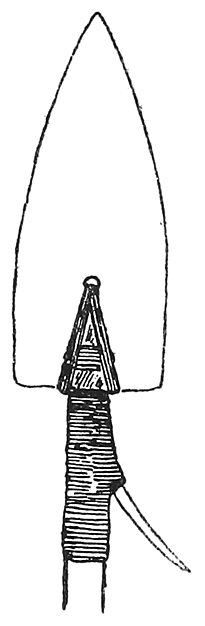

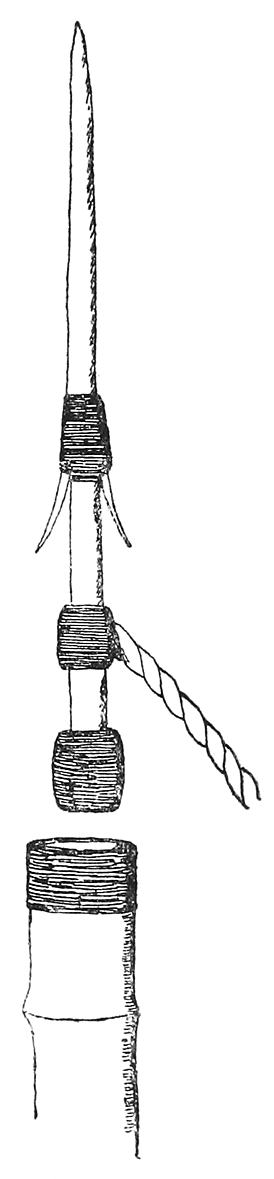
Fig. 20. Pig-arrow, Little Andaman
Fig. 21. Head of Jarawa pig-arrow
Fig. 22. Arrow with head of Areca wood, Great Andaman
Fig. 23. Harpoon, Great Andaman
Another important point of difference is that the Semang poison their arrows, while the Andamanese do not. In this connection it must be remembered that the former people have for long been neighbours of people who use blow-pipes with poisoned darts.
After the bow and arrow the most important hunting weapon of the Great Andaman is the harpoon which is used in capturing dugong, turtle, porpoise, and large fish. The harpoon consists of a head, a shaft and a line. The line is a length of rope of Hibiscus fibre of as much as twenty fathoms or more in length. The shaft is a bamboo of about 18 feet in length. One end is cut off fairly near a node and is then served over with thread, and slightly hollowed. The head consists of a long piece of iron, such as a stout nail, brought to a sharp point at one end. The other end is served over with thread in such a way as to make it fit fairly tightly into the end of the bamboo shaft. Some distance from the point of the head two barbs of iron are attached by thread, and between this point and the lower end the line is attached. (See Fig. 23.)
A man using the harpoon stands on the forward platform of the canoe, holding the bamboo shaft in his hand. The head is inserted in the upper end of this, and the line passes over his shoulder and is coiled in the bottom of the canoe, the other end being attached to the forward out-rigger boom or to the thwart that takes its place in a large canoe. He poles the canoe along the reef with the harpoon shaft. When about to make a throw he raises the shaft till he can hold the butt end in his right hand, with the point directed towards the fish or turtle, and he then leaps forward so that if he succeeds in his aim the weapon strikes with all the force of his weight behind it. When the turtle or fish is struck the bamboo shaft floats loose and this is secured by the man in the water, who returns to the canoe. It may be necessary to strike the prey with a second harpoon, but if the first was well thrown the animal is firmly held by the line.
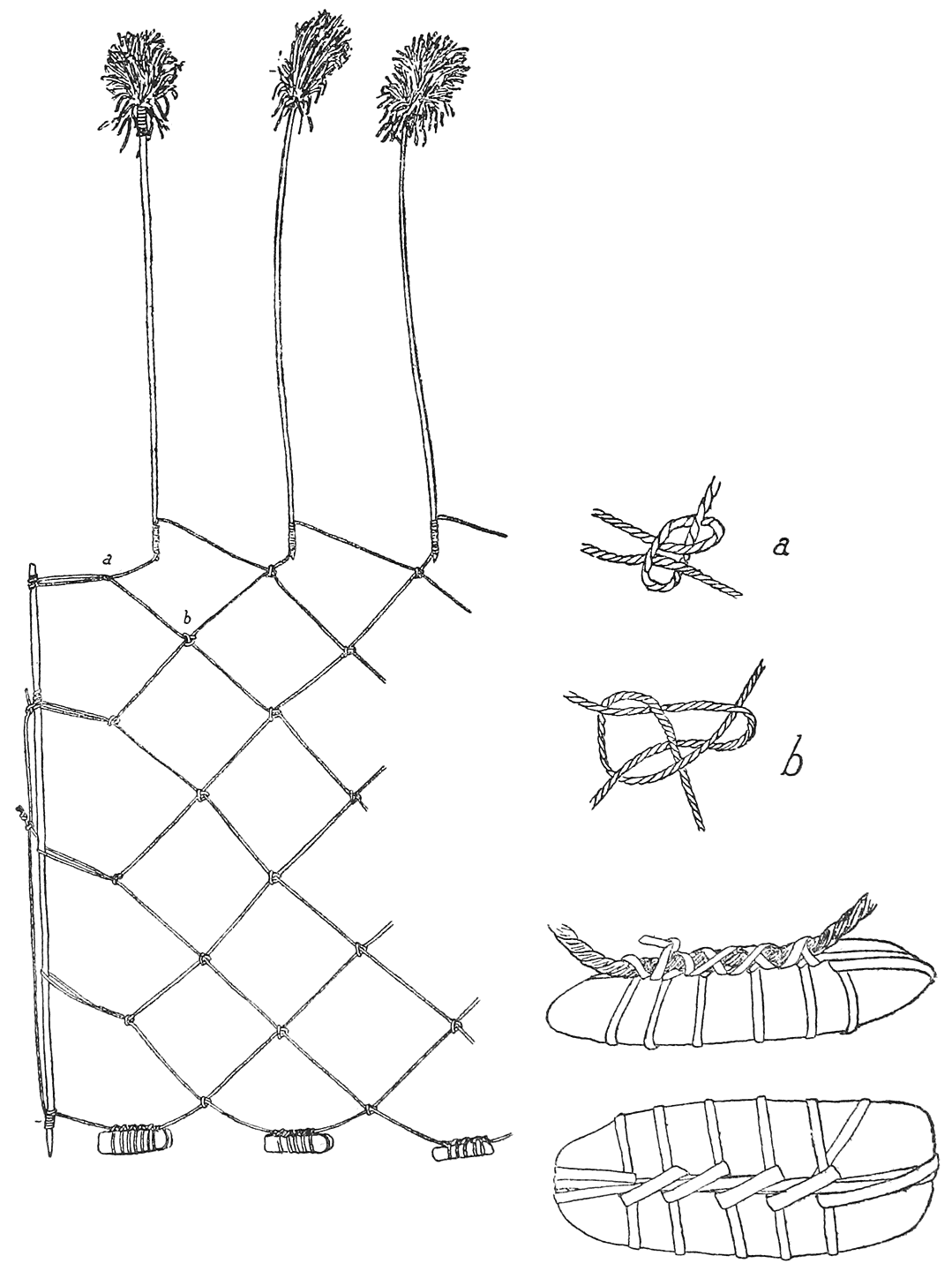
Fig. 24. Turtle net, South Andaman
Harpoons are not used in the Little Andaman. The natives of the Great Andaman say that they themselves have only used them since they were able to obtain iron and that before that time they could only capture turtle and dugong in nets. It would seem therefore that the harpoon has been invented or adopted by the tribes of the Great Andaman Division in comparatively recent times, and was not an element of the primitive Andamanese culture.
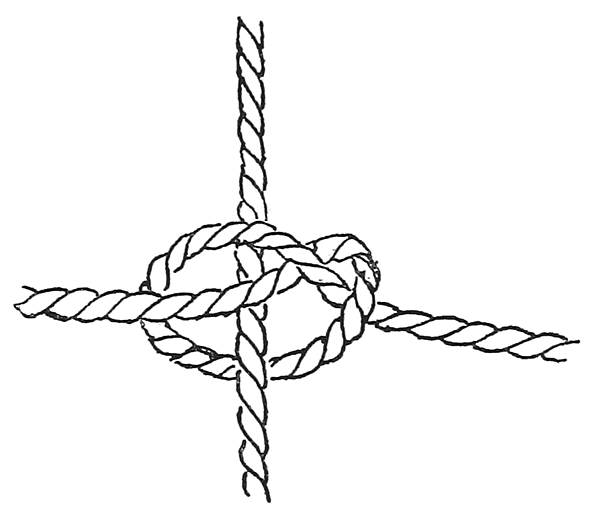
Fig. 25. Knot used in making the North Andaman turtle net
The turtle net is no longer used, as the natives prefer the harpoon and have all the iron they need. Such nets were formerly made of rope of Hibiscus fibre. A net was about 150 cm. in width and of variable length. One specimen that was made for me had an open mesh of about 25 cm. square, while another had a smaller mesh. The knot used in a net from the South Andaman is the ordinary fisherman’s knot shown in Fig. 24 b. In a net from the North Andaman the knot used is a slip-knot, one strand being tied with an overhand knot over another which it crosses at right angles as shown in Fig. 25.
Each end of the turtle net is attached to a stake pointed at the lower end. The lower edge of the net is weighted with stones attached as shown in Fig. 24, while to the upper edge are attached a number of floats, each consisting of a long thin stick of Hibiscus wood to the upper end of which is attached a tassel of fibre.
The net was placed in shallow water so that the stones rested on the bottom while the tassels at the upper ends of the floats appeared above the surface. As soon as a turtle was entangled in the net the agitation could be observed by those watching who would proceed to the spot to secure their capture.
So far as is known it would seem that nets of this description are not used in the Little Andaman.
The Andamanese make practically no use of spears. At the present time the natives of the Great Andaman Division sometimes make pig-spears of a length of stout cane or rattan with a head of iron attached. The natives themselves say that such spears have only been made since the occupation of the islands, and it is probable that they were first made in imitation of spears used by Burmese convicts for pig-hunting. They are hardly ever used, the pig-arrow being preferred.
The true fish-spear is unknown in the Andamans though use is sometimes made of a harpoon similar to the turtle harpoon, but of smaller dimensions and with a finer line, for harpooning fish.

Fig. 26. North Andaman fish-gig
In the North Andaman a sort of fish-gig was formerly in use made of about twelve pieces of Areca wood of about 105 to 110 cm. long and 1 cm. or less broad and with tapered and sharp-pointed ends. These were fastened side by side by means of a strip of wood near one end, as shown in Fig. 26. This weapon was used for spearing small fish in pools on the reef.
[
Contents
]
Cutting Implements.
At the present time the Andamanese make use of iron for their cutting implements. It is uncertain when they first learnt the use of iron, but it was certainly before the end of the eighteenth century. What iron they had was obtained from wrecks, of which there have always been a number on the Andamans. The metal has only become plentiful since the European settlement of 1858.
It is highly probable that the Andamanese, though they may have learnt the use of iron from implements used by visitors to their shores, have not learnt from any other people the method of working the metal. Even at the present day they do not make any use of heat in the manufacture of their iron implements, the metal being worked cold. It seems highly probable that they have simply adopted in connection with iron the methods they formerly used in dealing with other materials, particularly shells.
The materials used by the Andamanese, apart from iron, are wood, bone, shell and stone. We may begin by considering their use of stone.
In former times quartz flakes were used by the Andamanese for the two purposes of shaving and scarifying the skin, and for hardly any other purpose. (Among minor uses of stone flakes may be mentioned those of cutting the finger-nails, and sharpening boars’ tusks.) A quartz pebble is held in the left hand and is struck with a hard rounded pebble of any suitable kind. A flake is thus knocked off and falls into the palm of the left hand. The flake is examined, and if it be suitable it is at once used. If it be unsuitable it is thrown away and another made. For shaving, flakes with a sharp blade-like edge are required; for scarifying, flakes with a fine point are preferred. A flake is used till its fine edge is lost and is then thrown away and another made. Thus a woman who is shaving some one’s head may use as many as twenty flakes one after another, and to obtain twenty suitable flakes she probably makes as many as forty or even more. The kitchen-middens or heaps of refuse that are found on the sites of old encampments contain thousands of quartz pebbles that have been used as cores, and thousands of flakes.
Besides quartz there is a flinty kind of stone that is used in much the same way for making flakes. Suitable pieces of the stone are obtained and are placed in the fire for a few hours. They are taken out, and when they are cold are used in exactly the same way as a quartz pebble.
At the present time quartz is hardly ever used in this way, for the natives greatly prefer glass, and they obtain sufficient old bottles from Port Blair to satisfy their requirements. The bottom of a bottle is treated in every way as though it was a quartz pebble, a flake being knocked off and used, and then another and so on till the operation in hand (whether shaving or scarifying) is completed. The flake is held between the thumb and first finger when it is being used. In no case is a flake of quartz or glass ever kept. It is only made when required and after having been used is thrown away.
The natives themselves say that they formerly never made any use of stone for cutting purposes save in the case of stone flakes as described above. As against this there are three statements that must be considered. Colebrooke, who visited the islands in 1789, says of the Andamanese that “their canoes are hollowed out of the trunks of trees by means of fire and instruments of stone, having no iron in use amongst them, except such utensils as they have procured from the Europeans and sailors who have lately visited these islands; or from the wrecks of vessels formerly stranded on their coasts.” The accuracy of Colebrooke’s statement is made doubtful by the fact that at the present time (since 1858) the natives do not use fire in making their canoes, and it seems improbable that if they had this custom in 1789 they should have discontinued it and have entirely forgotten that it ever existed. Further if they used implements of stone in 1789 it is certainly strange that by 1858 they should have entirely forgotten that they ever did so. When Mr Man was making his enquiries the oldest men all agreed in stating that they never used stone for their adzes. We may conclude that Colebrooke’s statement is untrustworthy.
A third statement that needs to be considered is one by Mr Portman, who presented to the British Museum an arrow with a head of stone made specially for him by a native of the North Andaman who stated that in former times such arrow-heads were used by the Andamanese. At the present time the arrow-head is broken and it would seem to be so fragile as to be entirely worthless for the purpose to which it was supposed to be put. The natives of the North Andaman whom I questioned stated that they did not use stone for their arrow-heads, but shell. We may therefore hold that the evidence given by Mr Portman is not at all satisfactory.
In the Akar-Bale tribe I heard a legend that at a certain spot there is a kind of stone which was used by the ancestors for making adzes. I visited the spot and the stone was pointed out to me. Unfortunately the specimen that I took was lost and I am therefore unable to state what the stone was, but it was such that it would have been utterly impossible to make any sort of adze out of it. It was of a crystalline nature and was easily fractured by a blow against even a soft substance such as wood. It was clear that the native statements about it were merely a legend having no historical value.
We may justifiably conclude that it is probable that the statement of the natives to the effect that before they possessed iron in any quantity they made their adzes and arrow-heads out of shell and not out of stone, is correct. Their use of stone for cutting was therefore confined to the flakes which have been described.
The most important material to the Andamanese seems to have been shell. Mollusc shells were used in the natural form or after having been manufactured. The chief shell used in its natural form is the Cyrena which serves at the present time as a knife, a scraper and a spoon. Even when they have knives of iron and steel they still use the Cyrena shell in preference for some purposes. It is used as a scraper in preparing fibres for rope and thread, in making arrows, as a knife for cutting thatching leaves and cane and even thread and rope, and for making incised patterns on bows and arrows. The shells are always to be found lying about their encampments, and a few are always carried with them when they migrate to a fresh camp. Those living inland obtain their supply of shells from their friends on the coast.
When in use the shell is clasped between the thumb and first finger, the thumb passing over the convex side and the finger round the hinged edge. The remaining fingers are used to clasp the object that is being scraped or cut. In cutting, the motion is away from the body, being produced by a twist of the wrist. In scraping the motion is away from the body, or from left to right. A knife of iron or steel is held in this way by the natives whenever it is used for any purpose for which they formerly would have used a shell. The blade is clasped near the handle between the thumb and first finger, the back of the blade pressing against the root of the thumb, and the handle away from the body.
Another shell that is used in its natural form is a small whelk shell that is used as a scraper for scraping off the outer skin of mangrove seeds in preparing them for food.
A shell that is used in very nearly its natural form is a kind of pearl shell that grows along creeks through the mangrove swamps. The shell is only very slightly curved and it is for this reason that it is selected as suitable. The weak edge or lip of the valve is broken away, and the edge is then slightly ground on a stone. This implement is used by women for slicing yams and certain other vegetables such as some kinds of seeds when they are being prepared for food.
The natives say that before iron was plentiful they used shells for the heads of their pig-arrows. Several different species of shell seem to have been used, the chief concern being to obtain a piece of sufficient size that was as nearly flat as possible. Such shells are those belonging to the larger bivalves. The natives state that their method of working the shell was to break it roughly into shape with stones and then grind it down on a whet-stone until it was given a sufficiently sharp point and edge. Some arrow-heads of shell were made for me by this method at my request by one of the old men of the North Andaman.
The natives state that before they had iron they made their adzes of shell. Two different men of the North Andaman made two shell adzes for me, one of Pinna shell, and the other of a shell that I omitted to identify. The Pinna shell adze seemed to me only suitable for light work such as finishing off a bow or a canoe, as it seemed likely to break under a strong blow. The other adze was much stronger and therefore capable of heavy work, and although the edge seemed to me to make it a poor implement with which to cut down a tree yet it certainly did not seem less suitable than the stone adzes used by many primitive peoples. If I were given a choice of implements with which to fell a tree, between the shell adze of the Andamanese and a stone axe of South-western Australia I should certainly choose the former.
According to the natives they formerly used bone for the points of their fish-arrows and for the barbs of their pig-arrows. For both of these purposes they now use iron. The bone was broken into a piece of suitable length and then ground down with a whet-stone. Apparently the bone most frequently used was the tibia of the pig. For their fish-arrows they also made use of the bone of the tail of the sting-ray,—its “sting.” When the fish was caught the bone was knocked off and reserved for use. It required no treatment whatever, being simply bound on to the point of the fore-shaft in the same way that an iron point is now attached.
Colebrooke, in 1789, described their arrows as “headed with fish-bones or the tusks of wild hogs, sometimes merely with a sharp bit of wood hardened in the fire.” By fish-bone he probably means the bone of the sting-ray. Where he writes the tusks of wild hogs we should probably read “the bones.” A boar’s tusk is curved, and it seems impossible to imagine how it could possibly be used as an arrow-head or arrow-point.
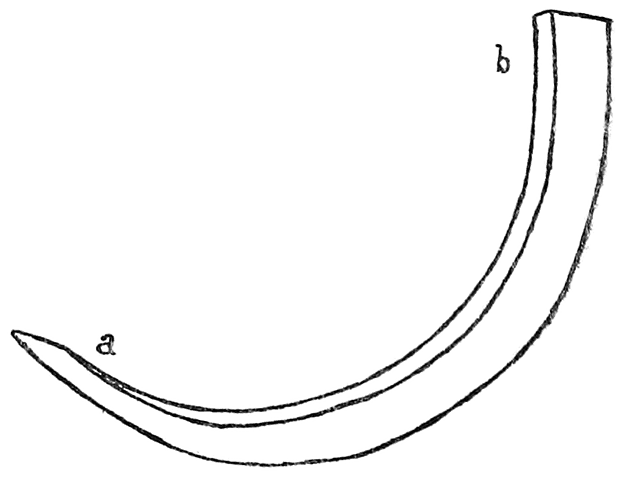
Fig. 27. Boar’s tusk, used as a spokeshave
The boar’s tusk is used by the Andamanese as an implement, however, making a very efficient sort of spokeshave. The edge which is used is kept sharp by scraping with a quartz or glass flake or with a Cyrena shell. The edge is near the point (at a in Fig. 27) and the tusk is clasped at the other end between the forefinger and the root of the thumb (at b in Fig. 27), the movement being away from the body. It is used for planing bows and paddles, and in the hands of an Andaman Islander is a very efficient implement, producing a beautifully smooth and even surface.
Of wood the Andamanese formerly made knives and arrow-points. The knives were made of a slip of bamboo or cane shaped and sharpened with a Cyrena shell. Such knives were used for cutting meat and apparently for no other purpose. A knife was always attached by a short length of cord to a skewer of pointed Areca wood. The double implement was used in cooking and eating, the skewer serving to lift pieces of meat in and out of a pot, while the knife served to cut them. At the present time the cane or bamboo knife is replaced by a knife made from hoop-iron, but the shape of the original implement is retained as nearly as possible and a skewer of Areca wood is generally attached to it.
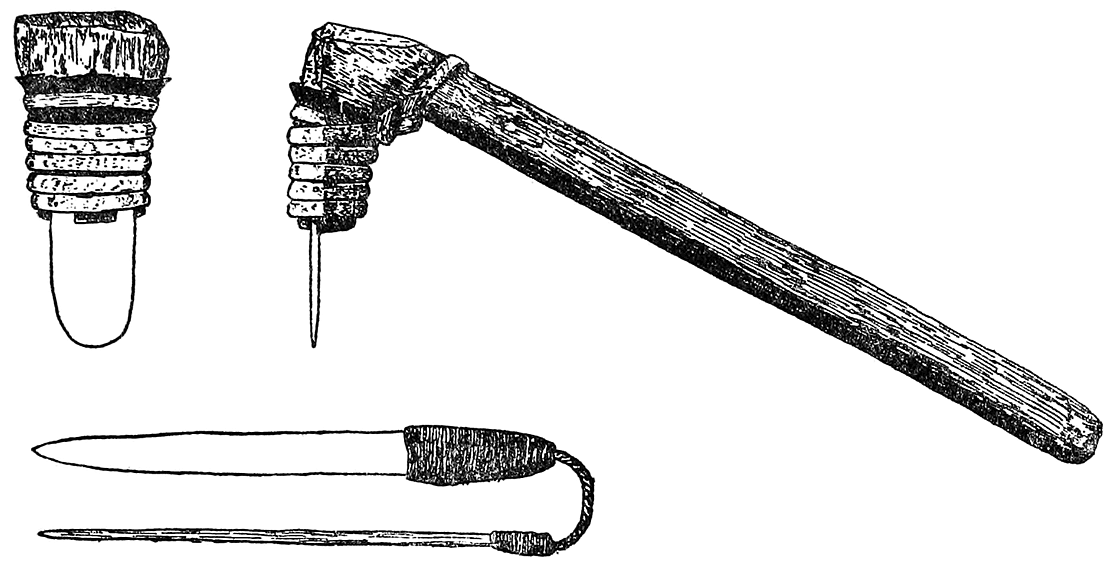
Fig. 28. Adze and knife
As has been already stated the Andamanese formerly used hard wood such as that of the Areca palm for the points and heads of their arrows. They do not seem to have made use of bamboo in this way.
At the present time iron is used for the blades of adzes, for the heads and barbs of pig-arrows, the points of fish-arrows, the heads of harpoons, and for knives. The method of working the metal is apparently exactly the same as the method they formerly used for working shell and bone. For the head of a pig-arrow a suitable piece of iron is taken and a fragment of about the right size is broken off by means of a stone hammer. This is then roughly broken into the required shape, no heat being used, and no advantage being taken of the malleability of the metal. The next process is to grind it on a whet-stone. The natives are always eager to obtain files which enable them to do this part of the work much more rapidly. When the arrow-head has been ground into shape the edges are sharpened. Blades for adzes are made in exactly the same way from any suitable piece of iron or steel, such as a cutlass or an old file or a piece of thick hoop-iron. The adze-blade is attached to a handle of mangrove wood by the method shown in Fig. 28.
The barbs of pig-arrows and the points of fish-arrows are made in the same way by breaking the metal into a suitable shape and then grinding it on a whet-stone. It is probable that this was the method that was formerly used for dealing with bone for these purposes.
In the case of the knife, iron or steel is now substituted for cane or bamboo, but the knife has retained its shape in spite of the change of material. The shape of a knife, whether of cane or of iron, with its attached skewer of Areca wood is shown in Fig. 28.
In the case of the harpoon the native tradition is that this implement was only made after they had discovered the use of iron.
In an attempt to reconstruct the primitive Negrito culture it would seem that the most reasonable hypothesis is that the primitive Negritos had no knowledge of iron and had not learnt to fashion implements out of stone, but relied entirely on such materials as wood, bone and shell. The Andamanese, becoming possessed of iron through wrecks upon their islands, applied to it the technique that they had developed for dealing with shell, and thereby invented their present method of working iron without heating it. The Semang and the Negritos of the Philippines probably first learnt the use of iron from their neighbours of other races. There is not at present any evidence to show that the Negritos ever had any method of working stone except the very simple one at present in use in the Andamans for making flakes.
[
Contents
]
String, Rope, Mats, Baskets, and Netting.
For string, rope and thread the Andaman Islanders make use of a number of different vegetable substances, but they make no use whatever of any animal substances. Some of the more important fibres, with their uses and the methods of preparing them, are mentioned below.
The bark of the Hibiscus tiliaceus, which occurs in the beach vegetation in all parts of the islands, provides the Andamanese with one of their most important fibres. By the coast-dwellers of the Great and Little Andaman Divisions it is used for making rope. In the Great Andaman Division the rope made from it was formerly used for making turtle nets, and is now used for the lines of turtle harpoons, and for hawsers to attach a canoe either to a stone used as an anchor or to a tree. No other fibre is used for these purposes. The Hibiscus rope does not seem to be much affected by salt water. The forest-dwellers of the Great Andaman have less use for rope, and at the same time are not able to obtain so readily the Hibiscus fibre. What rope they do have is therefore obtained from the coast-dwellers or is made of some other fibre. In the Little Andaman the Hibiscus is regularly used for rope. It is also used for the short cord by which the detachable head of the pig-arrow is attached to the shaft. In the Great Andaman a strip of the bark of the Hibiscus is used for the sling in which children are carried. Strips of the bark are worn by the women of the Little Andaman across their shoulders and breasts, as a sort of ornament.
To obtain the fibre young straight shoots of about 120 cm. in length are cut from the tree, those free from gnarls, and having a smooth bark, being chosen. The bark (inner and outer layers) is peeled off in strips of from 1·5 to 3 cm. in width. The inner or liber layer is then separated from the outer layer of the bark, is well scraped with a Cyrena shell and dried in the sun or over a fire. When dry it is worked in the hands until the various layers of fibre separate one from another. It is then ready to be made into rope. The fibre is interlacing, and when freshly made is a lustrous greyish brown. After exposure to salt water it turns a dark brown.
Mr E. H. Man, in his work on the Andamans, speaks of the Melochia velutina as providing fibre for rope. This is an error. The tree to which Mr Man refers is the Hibiscus tiliaceus. It is extremely common on the shores of the islands, as it is in many other parts of the tropics. It is very easily identified, as it bears its characteristic yellow flowers for a long time every year. There is no doubt whatever that this is the tree from which the natives regularly obtain the fibre for the rope they use in turtle-hunting and fishing and in their canoes. Other writers, following Mr Man, have repeated his error in calling it the Melochia velutina, for example Sir Richard Temple and Mr Portman. In Mr Portman’s collection of photographs in the British Museum there is a good photograph of a Hibiscus tiliaceus tree labelled “Melochia velutina.” I looked carefully in the Andaman jungles for the Melochia velutina but was unable to find it, and I am quite certain that in any case, even if it be found there, it is not commonly used by the natives for rope.
The bark of a number of other trees provides fibre of which the natives occasionally make use. Amongst these are one or more species of Sterculia (S. villosa?), and a tree that I identified somewhat doubtfully as Grewia laevigata. The coarse fibre of the liber layer of these trees may be made into rope by the same method as that employed in dealing with Hibiscus tiliaceus. Very little actual use is made of them however. A fibre which looks very like that obtained from one species of Sterculia is frequently used by the natives of the Little Andaman (and also by the Jarawa) for their personal ornaments. Mr Portman says that this fibre is obtained from the Celtis cinnamonea.
A species of Hibiscus, which I believe is Hibiscus scandens, growing in the jungles and not along the shore, provides a fibre that is prized by the natives of the Great Andaman tribes for making string or fine rope. The fibre is less easily obtained than that of the Hibiscus tiliaceus, but owing to its quality (it is not so interlacing) is capable of being made into finer rope and string. It is often made into string and then used for making netted bags. I did not find this fibre in use in the Little Andaman, but as it is not very often met with even in the Great Andaman, it may possibly be used in the Little Andaman.
There are several species of Ficus in the Andaman forests, and the natives know that they can obtain fibre from the bark of these trees. The only one that is regularly made use of is the Ficus laccifera. The natives of the Great Andaman Division use the bark of this tree for making their personal ornaments. In the Little Andaman it is used for bow-strings. A fibre called in the Little Andaman ulu, and said by Mr Portman to be obtained from the Ficus hispida, is used in that island, and by the Jarawa, for making personal ornaments.
The Gnetum edule, a climbing plant that is fairly common, is used in all parts of the Andamans for thread and string. The creeper is cut into short lengths at the nodes and is dried for a few days. The outer layer of bark is then scraped off with a Cyrena shell, and the liber layer beneath it is peeled off in fine strips and these are made into thread or string. This string is used in the Great Andaman Division for making netted bags and fishing nets. In the Little Andaman it is used for binding their arrows, as well as for netting.
The most valuable fibre of the Great Andaman tribes is that of the Anadendron paniculatum, which is used for string and thread and for bow-strings. Until recent times the method of preparing the fibre was not known to the natives of the Little Andaman, but they have now learnt it from the natives of the Great Andaman with whom they have been brought in contact, and the use of the fibre for string and thread is coming in amongst them.
The fibre is not easy to prepare. Long thin branches of the creeper are cut, which must be neither too young nor too old. To obtain these it is often necessary to climb up into high trees, for the Anadendron is a climbing plant. The creeper is cut into lengths of from 20 to 40 cm. The bark (inner and outer layers) is peeled off these in strips of from 7 to 10 mm. in width. A strip of the bark is taken and placed on the thigh, inner surface downwards, and is scraped with a Cyrena shell until the outer bark is entirely removed and the fibres remain clean and separate. These are dried in the sun or over a fire and, if not needed for immediate use, are stored for future occasion. The fibre is fine and of a light greyish brown colour. In its qualities it somewhat resembles ramie fibre. It is extremely strong.
There are a number of other trees and plants that are known by the natives to afford fibre, but they are not used, or if they are, it is extremely rarely.
The Andaman jungles have a number of different species of Calamus, and the canes or rattans of these are put to all sorts of uses, such as the making of baskets, the lashings and furnishings of canoes, and in building huts. In the Little Andaman one species of cane is used to provide the fibre for women’s belts. The outer skin is removed and the remainder of the cane is divided into fine strips or threads. A bundle of these tied together constitutes the belt worn by the women of the Little Andaman. The outer sheath of the leaf-stem of the Calamus tigrinus is used by the natives of the Great Andaman Division for making mats. Lengths of the leaf-stem are cut and the outer skin is removed in strips of about 3 to 5 mm. in width. The still adhering pith is removed with a Cyrena shell, and the strips are dried in the sun and then made into mats.
The leaf-stem of a species of palm is cut while green and is then shredded into long strips. The fibre thus obtained really consists of the leaflets of the young unopened leaves of the palm. It is used in the Little Andaman to make the tassel that women wear over the pudenda. The women of the North Andaman formerly wore a tassel of this fibre, but have now discontinued the custom, since their contact with the South Andaman. In the Great Andaman tribes this material has important ceremonial uses. It is called ko̱ro in Aka-Jeru and ara in Aka-Bea, and has been frequently mentioned in this volume. A tassel of the fibre is suspended near the grave of a dead person and at the entrance of the village at which the death took place. In the North Andaman a suspended cane hung with a fringe of the fibre is erected for the peace-making ceremony. (See Plate XIX.)