Chapter VI · THE INTERPRETATION OF ANDAMANESE CUSTOMS AND BELIEFS: MYTHS AND LEGENDS
Reading edition
In the last chapter I tried to explain, by reference to psychological principles, the more important ritual and ceremonial observances of the Andamanese; in the present chapter I shall deal in a similar manner with the legends recorded in Chapter IV. That is to say, I propose to explain, not how the legends arose, but what they mean, what part they play at the present time in the mental life of the Andaman Islander. Customs that seem at first sight meaningless or ridiculous have been shown to fulfil most important functions in the social economy, and similarly I hope to prove that the tales that might seem merely the products of a somewhat childish fancy are very far indeed from being merely fanciful and are the means by which the Andamanese express and systematise their fundamental notions of life and nature and the sentiments attaching to those notions.
The facts stated above enable us to understand what may be called the skeleton of the legend. One of the ancestors killed a cicada (a forbidden act), the cicada uttered its cry (as it does when hurt), and as a result, darkness covered the world (as it always does when the cicada sings in the evening). Leaving aside, for the present, the rest of the story, we may try to make clear to ourselves just what this part of it expresses. The explanation that I propose is to the effect that the legend is simply an expression or a statement of the “social value” of the phenomenon of the alternation of day and night. By the social value of anything I mean, as explained in the last chapter, the way in which that thing affects the life of the society (either beneficially or adversely) and therefore the way in which it affects the social sentiments of the individuals who compose the society. There is no need to discuss at length and in all its bearings, the way in which the alternation of day and night affects the social life of the Andamanese. The one outstanding feature of first importance is that the day is the time of social activity whereas the night is a period when the society is, as a rule, not active. It was shown in the last chapter that one of the most important elements in the mental complex revealed by a study of the ceremonial is the recognition of the fact that it is on the activity of the society that the individual depends for his security and well-being. So long as he can feel that he is an active member of an active community the individual feels that he has for his support (morally and physically) a great force on which he can rely. If, for any reason, he is temporarily cut off from the society and from participation in its life, he is in a position of insecurity, and believes himself to be in danger from the powers of the world of spirits. It is an inevitable result of this that the daytime, when the society is active, should be felt to be a period of comparative security, while the night, when all social activity ceases, should be felt to be a period of comparative insecurity. That the day and night are so regarded is shown in the belief of the natives that the spirits are more to be dreaded during the night than during the day.
The interpretation that I would offer of the Akar-Bale legend is that it is an expression of these sentiments relating to the night, an expression that takes advantage of the connection between the song of the cicada and the alternation of night and day. One feature of the manner of expression will be explained later in the chapter, namely that it takes the form of a story relating to a mythical period of the past. For the present the necessity of this particular form must be accepted as a postulate. Granting this it remains only to show that the legend does express the social value of night as defined above.
The legend of the Akar-Bale tribe is simply an elaboration of this theme. In the beginning there was no night, no darkness. Social life was continuous and was not subject to periods of diminished intensity. Then one of the ancestors (apparently in a fit of temper owing to his lack of success in fishing) crushed a cicada, and the cry of the insect brought darkness upon the world. The darkness, with its inhibition of activity, is clearly regarded as an evil, i.e., as a manifestation of force hostile to the society, and this accords with the definition of the social value of night given above, where it was shown that this value is negative, that night is a source of social dysphoria.
This interpretation is confirmed by the statements about the night made in the North Andaman (where this legend does not seem to exist), such as that the night is made by the spirits (Lau) who draw a mat or cloth across the sky. When we remember that the spirits are the embodiment of the forces hostile to the society we see how this statement expresses the feeling that night is the time when such hostile forces are in the ascendant.
Dancing, except on a few special ceremonial occasions, always takes place at night. Night, as we have seen, is a source of social dysphoria. It prevents the pursuit of the common social activities, such as hunting or making canoes or weapons. The condition produced by darkness can be neutralised by means of singing and dancing, the dance being a condition of intense social euphoria, in which social activity is at its maximum, and all the social sentiments are pleasurably and intensely excited.
This belief that dancing and singing are means by which the evil influence of darkness can be overcome is shown in the custom observed when a corpse remains in a camp all night, of sitting round it and singing, in order (so the natives say) to keep away the spirits that have caused the death. They do not dance, because the pleasurable excitement of the more intense activity would be incompatible with the condition naturally resulting from a death. This custom affords clear evidence that singing, and in a yet higher degree the combined activity of singing and dancing, possess magical efficacy against the dangers prevalent at night.
This relation between the (negative) social value of night and the (positive) social value of dancing and singing is simply and clearly expressed in the legend. It was the “singing” of the cicada that produced the darkness. The ancestors, finding themselves overwhelmed with darkness, set to work to remedy this evil by singing (and, it is to be presumed, by dancing to the song). One after another they sang a song, just as at a dance one man after another sings until he is tired. Finally, after the dance had gone on for a number of hours, Ko̱ŋoro took his turn at singing and the night came to an end and day appeared. So effectual was the means adopted of neutralising the evils of darkness that it finally resulted in the return of the daylight in which ordinary social life is possible.
The reference to resin in the legend can be easily understood. The Andamanese use resin to provide the light by which they dance, as well as for torches for fishing on dark nights. It is their only artificial light, and without resin a dance would be a very poor affair. Thus the social value of resin is that it affords a means of neutralising to a certain extent the effects of darkness.
These are, I think, all the essential elements of the story. One of the ancestors, under the influence of an anti-social passion, killed a cicada, which uttered its cry, and thereupon the world was covered with darkness. The ancestors then made torches of resin which enabled them to neutralise the darkness to some extent. They then invented dancing and singing and after they had continued for a number of hours the light came back. Since that time day and night regularly alternate with one another, and the cicada sings at each period of change. Men have learnt how to use resin for artificial light, and how to remedy the effects of darkness by dancing and singing.
The legend is thus simply the expression in a particular form of the relation between the society and a certain natural phenomenon in terms of what have been called social values. We find expressed the social values of night and of resin and dancing. It may be noted that the legend also gives a special social value to the ancestors, different from and greater than that of men or women at the present day. The ancestors of the Andamanese were able to do many things that men cannot do now; they were able to affect the processes of nature in a way that is no longer possible. This notion of the social value of the ancestors, of the past, will be shown to be one of the most important elements in the legends, it being this that is responsible for the general form of the stories. The consideration of this subject, however, must be postponed.
There is one reason for the inclusion of the yam incident that it is worth while to note. By its means it is told how Da Teŋat discovered a new object of each of the three kinds—animal, vegetable, and mineral. The new animal was the cicada, the new vegetable was the yam, and the new mineral was the resin, which, as the story shows, the natives classify as a “stone,” although they know its vegetable origin. The story is thus rounded off and given an air of completeness and symmetry.
Now we have here a very important feature of the legend which it will not do to overlook. We shall find that it is a principle of the Andaman legends that evil results follow from evil actions. Night, which, by reason of its negative social value, is regarded as an evil, is shown to be the result of the misbehaviour of one of the ancestors in giving way to anti-social feelings of anger or annoyance. It is a case of like producing like. When an individual gives way to such feelings as anger he becomes a source of danger to the society, or at any rate a source of social dysphoria by disturbing the harmony of the community. Thus, in the legend, it was the wickedness of the ancestor in giving way to his feeling of irritation that led to the social disaster. Inversely, it was through the combined effort of the ancestors joining in a harmonious action (singing and dancing) that the day was brought back.
The events of the legend are supposed to have taken place at a spot named Golugma. I only visited this spot once and did not take particular note of it, nor have I information about the position it occupied in the social life of that part of the island in former times. We do know, however, from the name Golugma Bud, that at one time it was the site of a communal hut and was therefore an important camping place. It may have been a place at which dance-meetings were frequently held, and this would be a sufficient reason for its selection as the legendary site of the first dance.
One of the minor motives of the Akar-Bale version of this story is the identity of the ancestor who appears as the chief actor. I regret to say that I have never found the exact meaning of the word teŋat. Though I asked the natives to bring me a specimen they did not do so. It is probably either a species of spider or of ant. However, even if I had succeeded in identifying the teŋat, it is possible that I should not have discovered the reason why this particular creature was selected as the hero of the story. This can be shown by considering another of the incidents of the story. All the ancestors who sang and tried to bring back the day failed except the ko̱ŋoro. This is a species of small red ant. Whenever I heard this story told or referred to, this particular incident (the successful singing of ko̱ŋoro) caused great amusement amongst the listeners. It was obvious that it was a good joke. Yet in spite of my endeavours on more than one occasion I was unable to see what the joke was.
In the above analysis I have drawn a distinction between what may be called major and minor motives of the story. The validity of the interpretation of the legends offered in this chapter depends on the validity of this distinction, and it is therefore important to provide a method by which we can separate major from minor motives. This can only be done when there are several versions of the same legend. Major motives may be defined as those which appear in all the versions of one legend, while minor motives are those which may vary from one version to another without producing any fundamental change in the legend itself. Thus, by a comparison of the Akar-Bale and the A-Pučikwar versions it can be shown that the identity of the chief actor is a minor and not a major motive.
If we compare the Akar-Bale legend with the Aka-Bea version recorded by Mr Man we see that they have in common (1) the explanation of the origin of night as due to the breaking of a rule, (2) the tracing back of the trouble to the anti-social passion of anger on the part of the actor or actors, (3) the account of the origin of dancing and singing as a means of neutralising the effects of darkness. All the other elements of the story are different in the two versions. In the Aka-Bea story it is the killing of a grub (gurug) that brings on the night, which is itself called gurug. What the meaning of this may be I cannot say. I did not hear this version of the story, and was not able to make any enquiries concerning it. All that it is necessary to note is that both the legends express the social value of night, and they both express it in very much the same way, the difference being that the Akar-Bale version makes use of the connection between night and day and the cicada, while the Aka-Bea story makes a similar use of some connection (not yet explained) between the night and a grub.
Thus the comparison of different versions confirms the interpretation here given. The legend expresses the negative social value of night as a period when social activity is diminished and the power of protection of the society therefore lessened. It does so by telling how the night first arose as the result of disobedience to a ritual prohibition, i.e., of meddling with the forces of nature. It traces the original cause yet further back to the anger of one of the ancestors, anger being itself a source of social disturbance. It passes on to express the social value of the dance, with its accompanying song, and exhibits the relation, within the system of social values, of dancing and darkness. Thus, although the manner of expression may differ, yet what is expressed is the same in both versions, and we are therefore justified in regarding this as the essential content of them.
An exactly parallel explanation can be given of the Andaman notions relating to the moon. The social value of moonlight is due to the fact that it enables the natives to fish and catch turtle and dugong by night. A clear moonlight night affords the best opportunity for harpooning dugong. During the second quarter the light of the moon steadily increases, and the period of moonlight falls in the first part of the night. After the change to the third quarter the light steadily diminishes, and moreover there is a gradually increasing period of complete darkness at the beginning of the night. The natives do not care to get up in the middle of the night to go fishing or hunting turtle. Therefore the second quarter is the time when they undertake such expeditions, and after the change to the third quarter they abandon them largely or entirely, and if they do go out they have to depend on torches. Therefore we may say that during the second quarter the moon gives valuable help to the natives, but during the third quarter withdraws that help.
At the beginning of the third quarter the moon rises in the evening with a ruddy hue. The natives explain this red and swollen appearance by saying that the moon is angry. When a man does something that hurts or damages another it is generally (in Andamanese life) because he is angry. So to say that the moon is angry is equivalent to saying that he is damaging or hurting someone, as he is indeed damaging the society by withdrawing the light by which for the past week or so they have been able to capture fish and turtle. The phenomena of the change of the moon in so far as they affect the social life are represented as if they were the actions of a human being. We may describe this briefly by saying that the moon is personified, using that term in a special sense to be defined more exactly later. Amongst the Andamanese, as amongst ourselves, anger is associated with heat, and this explains why the red glow of the moon when he rises during the first few nights of the third quarter is regarded as the visible sign of his anger.
Even the moon, however, is not to be expected to be angry without a cause. The natives say that the anger is due to some bright light having been visible at the time the moon rises. The personification is thus further elaborated. The moon gives the light by which fishing and turtle hunting at night are possible. This light has a positive social value, and its withdrawal is an evil. They therefore regard the moon as jealous, so jealous that if anyone makes use of an artificial light, as of a fire or torch or burning resin, the moon immediately is consumed with anger and withdraws the light that has been of so much use and has not been sufficiently appreciated. This belief is a means by which the value of the moonlight is recognized. Thus the beliefs about the moon can be interpreted in exactly the same way as the legend about night; both express, in accordance with the same psychological laws, the social values of natural phenomena.
This legend is a widespread one, being found both in the north and in the south of the islands. The fact that the actor is different in the three recorded versions proves that the identity of the hero of the tale is a minor motive, i.e., one that may be varied without affecting the essential meaning of the myth.
The story serves as an explanation of the markings on birds and fishes, these being where the ancestor who became the species was burnt by the fire. Thus the legend is of the kind that is often called etiological. The common method of explaining such legends is to say that they are crude attempts on the part of primitive man to explain the natural phenomena with which they deal, in this case the bright colours of birds and fishes. Such an interpretation cannot be regarded as adequate. Why should the Andaman Islanders want to explain the markings of animals? Why should they explain them in the form of a legend, and why should the legend take this peculiar form?
The clue to the true interpretation of the three stories mentioned must be sought in the social value of fire. It was shown in the last chapter that fire is regarded as the symbol of social life and social activity, the centre around which the social life revolves, the source from which it draws its force. We may say, in a word, that it is the possession of fire that makes social life (as the Andamanese know it) possible. It was shown that it is on account of this relation of the society to fire that the latter is believed to be a source of security, of protection against the spirits. Now amongst all the creatures that inhabit the world, man is the only one that possesses and makes use of fire. Here, then, is the fundamental notion that is expressed in these legends. At first, so the story runs, animals and human beings were one, were not distinguished. Then came the discovery of fire. Some of the (undifferentiated) ancestors fled from the fire, because they were afraid of it, or because it burnt them. They became birds and beasts and fishes, retaining their fear of the fire, and being cut off for ever from the human society which, from that moment, constitutes itself around the fire. It is the possession of the fire that makes human beings what they are, that makes life as they live it possible. It is equally (according to the legend) the lack of fire, or the lack of ability to make use of fire, that makes the animals what they are, that cuts them off from participation in human life.
The three stories considered above contain three motives. (1) They express the social value of fire, by making the foundation of human society (through the differentiation of men and animals) depend on the discovery of fire. (2) They express a peculiar notion as to the relation of the human species to other animals, which is found also in other legends. (3) They give a legendary explanation of some of the characteristics of animals, such as the bright colours of certain birds and fishes.
It would seem that these same motives are present in many of the legends relating to the origin of fire. In the common version of the fire legend the fire is stolen from Biliku (Puluga) by the kingfisher. This bird has a patch of bright red feathers at the neck and these are explained as being where he was struck by the fire or the pearl-shell (lightning) flung by Biliku. In one variant the kingfisher swallowed the fire and had his head cut off by the lightning, whereupon the fire came out of his neck where the red feathers now are. In most of the versions it would seem to be implied that though the kingfisher succeeded in obtaining fire for the use of the ancestors, he was himself unable to profit by his own exertions, for he was turned into a bird condemned to eat his fish raw for ever. In one story, however, from the Aka-Kede tribe, it would seem that the kingfisher, by the possession of fire, and through the loss of his wings and tail, became a man. There is a lack of logic here which it is worth while to note. Although the kingfisher became a man yet the legend is clearly based on the explanation of the red feathers of the bird’s neck as due to the action of the fire. The psychological significance of such inconsistencies as this will have to be discussed later on.
Let us now consider another group of legends. We have seen that one explanation (in the mythological sense) of how the birds arose is that they were ancestors who fled from the fire. There are other stories that give a different account and relate that the animals came into existence through a great flood or storm that overwhelmed the ancestors. Both of these legends are to be found in the same tribes. Their incompatibility does not prevent them from being both equally accepted. If it can be shown that the story of the flood is simply an alternative method of expressing the same set of representations that underlie the story of the origin of the animals through the discovery of fire, the interpretation of the latter will be in some degree confirmed.
One account of the flood or storm, variants of which were obtained from both the north and south of the islands, tells how the ancestors only with great difficulty succeeded in saving the fire. Although it is not explicitly stated, we may conclude, I think, that it was because some of the ancestors kept their fire alight that they remained human, while those who lost their fire were turned into animals. If my personal impressions are of any value, this is really the idea that does underlie the legend in the native mind. Thus it would appear that this version of the flood myth is simply a reversal of the fire legend previously considered. They both express the same thing in different ways. They both make the possession of fire the thing on which social (i.e., human) life depends, the fundamental difference between man and animals.
It may be objected to this interpretation that in some of the versions of the flood myth there is no reference to the ancestors being turned into animals, while in others there is no reference to the saving of the fire. The reply to this is that if we are to understand the legends we must not consider each separately, but must seek out the connections between the different stories, connections that are not always obvious. Thus, as there are, in each of the tribes, different versions of a flood myth it might be supposed that the natives believe in several different floods having taken place in the times of the ancestors. Mr Man seems to have come to the conclusion that there were two distinct floods. I am fully satisfied, from personal knowledge, that the natives think of only one flood or catastrophe, and refer to it all the different legends. Sometimes a man will relate how the flood came and the fire was nearly lost, but will make no mention of the origin of animals at this time. At another time the same man will relate how the flood turned the ancestors into animals, but will make no mention of the saving of the fire. To understand the meaning of the legends we must connect these different stories together, for we know that they are connected in the minds of the Andaman Islanders themselves. Every native knows that it was at the time of the flood that the animals came into existence and he may remember this fact when he hears the story of how the fire was nearly lost. Similarly, when he hears the story of how the animals came into existence he remembers the other story of how the fire was nearly lost. Thus one man gave me a legend of the flood which explained the origin of the animals, and at the very end he mentioned as an afterthought “It was at this time that the fire was saved by Maia Taolu.”
The repeated mention of the Dipterocarpus tree in these legends would seem to indicate that it is a motive of importance. The tree is the tallest tree of the Andaman forests, and is very common, but it is probable that this does not afford an adequate explanation, and that there are other ideas connected with it in the minds of the Andamanese that would justify the place it occupies in the mythology. In one Aka-J̌eru story the whole forest is said to have sprung from a Dipterocarpus seed dropped by Biliku after she had destroyed the original forest in her anger. It may be noted in passing that in the languages of the North Andaman the word for this tree is the same as the word for dugong.
In the Akar-Bale story the part which explains how one of the ancestors came to give way to anger is highly elaborated. It starts with the quarrel of the tree-lizard with some of the ancestors. (It may be noted in passing that the tree-lizard is quarrelsome in reality.) This leads to the death of the lizard (or his transformation into an animal that still bears the name), and so to the grief of his mother and her anger against the ancestors who have killed her son. This elaboration of one part of the story tends to obscure the meaning of the whole. This is particularly the case in the version recorded by myself in which the anger of the tree-lizard is the direct cause of the change of some of the ancestors into animals. The narrator sets out to explain how a flood or cyclone came and turned the ancestors into fishes and birds. He elaborates the details of the first part of the story to such an extent that he loses sight of the conclusion. The purpose of the story as explaining the origin of animals remains in his mind, however, and gives rise to the description of how some of the animals had their origin as animals (i.e., were cut off from the human society) by being thrown by the lizard into the forest or into the sea. The legend in this form may therefore be regarded as giving an alternative explanation of the separation of the animals from the human society, the cause of the separation being a great quarrel in which they were all involved. In other words, human society is only possible if personal anger be subordinated to the need of good order; the animals are cut off from human society because they could not live peaceably together without quarrelling.
The examination of the variants of the flood-myth has taken us away from the main argument. In the various stories there are two separable elements. There is first the explanation of how a disastrous flood or storm was caused by the non-observance of ritual prohibitions connected with Biliku (Puluga). This element will have to be considered in relation to the Biliku myth. There is secondly the account of how through the flood or storm the birds and fishes became separated from the human race, and the three regions of the world, as the Andaman Islander knows it, became established. It is this second element that I have sought to explain. To repeat the argument, I would hold that it is really through the loss of the fire that the birds and fishes became cut off from mankind, and that therefore this element of the legends of the flood expresses exactly the same notion as the legend of the catastrophe that followed the discovery of fire. The two groups of legends result from the way the Andaman Islander feels about the fire as being the one thing on which the society most completely depends for its welfare.
The preceding analysis has shown that the legends relating to the origin of animals, whether through the action of fire, or by the flood, serve to express the social value of fire. If this interpretation be correct we have a close parallel to the explanation of the story of the origin of night. In both cases, it has been argued, what the legend really expresses is the way in which a particular phenomenon (fire, in one case, the alternation of day and night in the other) affects the life of the society and the sentiments on which that life depends. The legends of the catastrophe, however, obviously contain another element of importance, revealing as they do a certain way of thinking about the animals. This element has not yet been explained. The representation of the birds, etc., as ancestors is not confined to one particular legend or group of legends, but runs through them all. Its explanation is therefore better postponed until we come to deal with the general features of the mythology, and will then have to be undertaken.
Let us now turn to the legends that concern Biliku (Puluga) and Tarai (Deria), which are of capital importance in the Andaman mythology. The clue to the understanding of them lies in the Andamanese notions about the weather and the seasons. In the Andaman Islands the year may be divided into four seasons. There is the cool season lasting from the beginning of December to the middle of February; immediately following this is the hot season from February to the middle of May; then comes the rainy season, from May to the end of September; October and November constitute a short season to themselves. In the cool season the weather is uniformly cool; there is very little rain, and storms are almost unknown; the wind blows uniformly from the N.E. In the hot season there is little or no rain; the wind is generally N.E., but may be variable; summer lightning is frequent, but there are no violent storms except at the very end of the season. During the rainy season, after a short period of uncertain stormy weather with which it begins, the wind blows uniformly from the S.W.; it rains heavily, sometimes every day for weeks together, but violent storms (cyclones) are very rare. Between the rainy season proper and the cool season there is a period of six or eight weeks in which the weather is unsettled; the wind is variable; fine weather alternates with storms that are sometimes of terrific violence; waterspouts are frequent; it is at this season that violent cyclonic storms are likely to occur. This season is called by the Andamanese Kimil (Gumul of Aka-Bea). We have seen in the last chapter that the word kimil denotes a condition of social danger, or of contact with the power possessed by all things that can affect the life and safety of the society. It is obviously in this sense, and not as meaning “hot,” that it is applied to the season in question, for the months of October and November are fairly cool, certainly very much cooler than February and March. We shall find that this is an important point in connection with the Biliku myth.
The life of the Andaman Islander is profoundly affected by the alternation of the seasons. There are, first of all, the violent cyclonic storms that occasionally occur. Such a storm may uproot the jungle for miles, making it impassable for years to come, and thus destroying some of the native hunting grounds. The wind is sometimes so violent as to tear every leaf from the trees in its path. While the storm lasts there is danger to the lives of the natives. An old man recounted to me how on the occasion of a violent cyclone he and the others of his village took refuge in the sea and on the open shore from the danger of falling trees, and remained there till the violence of the storm had abated. The usual name for a cyclone in Aka-J̌eru is to̱ko-po̱r, i.e. “falling wood” or “falling trees.” Even if all the natives escape the danger of death or injury, there is still the extreme fear and discomfort of the experience. If a storm lasts for any length of time the natives, who are unable or afraid to go out hunting, have to do without food until it is over. Incidentally the storm may destroy their huts, canoes, and other property and thus cause loss that has to be made up by toil.
The second important effect of the seasons on the life of the Andamanese is through the food supply. During the cool season, and the succeeding hot season, a number of vegetable foods, including the very important roots and some of the most prized fruits, are available. On the other hand, during these seasons the land animals are in poor condition. In the hot season, at any rate, lizards, snakes and the civet-cat are not eaten. Pigs are breeding and are in such poor condition that often a pig that has been killed is left in the jungle as being not good enough to eat. The hot season is pre-eminently the season of honey, which is so abundant that the natives are able to obtain much more than they can consume. In the rainy season there are few vegetable foods and very little honey, but on the other hand the jungle animals are in good condition and flesh food is abundant; fish are more plentiful in this season than during the dry weather. In the Kimil season (October and November) the natives add to their food supply two varieties of grub (the larvæ of the cicada and of a beetle) which are regarded as great delicacies. Roughly we can say that the rainy season is the season of flesh food, the Kimil season is the season of grubs, the cool season is the season of fruits and roots, and the hot season is the season of honey.
By reference to the prevailing wind the year may be divided into two parts, the N.E. monsoon from November to May, and the S.W. monsoon from May to November.
I propose to show that the Andaman Islanders express the social value of the phenomena of the weather and the seasons, i.e., the way these phenomena affect the social life and the social sentiments, by means of legends and beliefs relating to the two mythical beings whom they call Biliku and Tarai. Using the word personification in a sense to be defined later in the chapter, we may say that the Andamanese personify the weather and the seasons in the persons of Biliku and Tarai. Biliku is associated with the N.E. monsoon; she lives in the N.E.; the wind from that quarter is called “the Biliku wind”; to Biliku, therefore, belong the cool and the hot seasons, these being the seasons of the N.E. monsoon. Tarai is associated with the S.W. monsoon; he lives in the S.W.; the wind from that quarter is called “the Tarai wind,” or, in Aka-Bea, simply Deria; to Tarai therefore belongs the rainy season. It is possible to show that the Andaman Islanders associate with these two beings all the phenomena of the weather and the seasons, and are able to represent the changes of the latter as though they were the actions of human or anthropomorphic beings.
In the mass of beliefs and stories relating to Biliku and Tarai there are some elements on which there is absolute agreement in all the tribes of the Great Andaman Division. I propose to treat these as being the most important elements. There is absolute unanimity, for instance, as to the connection of Biliku and Tarai with the N.E. and the S.W. respectively, and with the winds that blow from these two points of the compass. Further, this belief does not conflict in any way with any other belief of the Andamanese. There is similar unanimity in the beliefs that Biliku is angry at the digging up of yams, and at the melting of bees’-wax. There are other matters on which the agreement is fairly general but not absolute. For instance, there is a common belief that it was Biliku who first discovered fire, but there are also legends as to the origin of fire in which Biliku does not figure. I propose to treat such elements as these as being of secondary importance. Finally there are other elements with regard to which the beliefs of different tribes are not in agreement. For instance, in the South Andaman Puluga is regarded as male, while in the North Andaman Biliku is female. I propose to regard such elements as being of only minor importance, i.e., as not being closely connected with the central notion or notions expressed in the myth.
Two things of importance are shown by the consideration of these facts. The first is that there is a sense in which it may be said that the Andaman Islanders personify the winds in the persons of Biliku and Tarai; they apply to the natural phenomenon a name which is also the name of a mythological person, and they apply it directly and not in a possessive form, i.e., they say “the Bilik” or “the Biliku wind” and not “Biliku’s wind.” The second is that only the S.W. wind is associated with Tarai and all the other winds are associated with Biliku.
The last point is one of considerable importance in the interpretation of the myth. If we divide the year by reference to the prevailing winds, then the rainy season, with the exception of its beginning and its end, belongs to the S.W. wind; the hot season (save its end) and the cool season may be regarded as belonging to the N.E. wind, though the wind may be variable in the hot season; there remain two portions of the year, at the change of the monsoon, when the wind is variable, which cannot be classified as belonging strictly to the S.W. or to the N.E. wind. The fact that all these variable winds are denoted in the A-Pučikwar tribe by the name Bilik shows that in this tribe they are all classified with the N.E. wind. In this way the year is divided into two slightly unequal parts, one belonging to Teria or Tarai including the whole of the rainy season except the end and the very beginning, the other belonging to Bilik (Biliku) including the Kimil season, the cool season, the hot season, and even the first few days of the rainy season. This strict division only appears in the A-Pučikwar tribe, but it will be shown that an approximation to the same notion is found in the other tribes.
We have already seen how the Andaman Islander represents any natural phenomenon having negative social value as though it were the result of the action of a person in anger, this being the one anti-social passion with which he is most familiar in his own life. Thus the withdrawing of the light of the moon after the full is explained as being due to the anger of the moon. The negative social value of a violent storm is obvious. In accordance with the general principles of his mythology the Andaman Islander therefore explains the storm as being due to the anger of a personal mythical being. But storms are intimately connected with the winds, so that it must be Biliku and Tarai (in whom the winds are personified) who are responsible for the storms. Further, in the Andamans, violent storms are very rare except at two special periods of the year, at the change of the monsoon. This gives a further ground of association with Biliku and Tarai between whom the seasons are divided. We have seen that in classifying the winds the natives (of one tribe at any rate) associate with Tarai only the steady S.W. wind which brings not cyclones and violent storms but steady rain, while all the other winds are associated with Biliku. If this be so it is clear that a cyclone, with its wind veering from one quarter to another, must be the work of Biliku. Further, if the Biliku season be regarded as including all the periods of variable northerly and easterly winds as well as the period of the steady N.E., then we can say that it is only in the Biliku period that violent storms are likely to occur. It is evident therefore that an examination of the natural phenomena themselves gives us an adequate reason for the preponderance of Biliku over Tarai in the legends. This will be made even more evident as we proceed.
Another law of the Andaman mythology is that a person, such as the moon, is never angry without cause. There are a number of actions that are believed by the Andamanese to cause the anger of Biliku; of these there are three of extreme importance, all the others being certainly of much less importance. It is necessary, therefore, to examine these three carefully and find their meaning.
There is absolute agreement in all the tribes with regard to the belief that Biliku is angry and sends bad weather when bees’-wax is melted or burnt. The season of honey is the hot season from February to May. During the rainy season scarcely any honey is to be found and that only of the inferior (black) variety. It is clear therefore that honey belongs particularly to the Biliku portion of the year. During the hot season honey is abundant and large quantities are collected. As the natives make use of the wax, and as this is useless till it has been melted, this is the special season of the melting of bees’-wax. At the beginning of the season the Biliku wind blows calmly from the N.N.E. As the season draws to a close the wind becomes variable, uncertain, and in some years violent storms occur ushering in the rains of the S.W. monsoon. Year after year the wax-melting season comes to a close in stormy weather. Now stormy weather and the anger of Biliku are, for the Andaman Islander, one and the same thing, so that to say that the anger of Biliku follows the melting of bees’-wax is in one sense simply a statement of actual observable fact.
Another belief about which there is absolute unanimity in all parts of the Islands is that Biliku is angry when certain plants are cut down or dug up. These plants include some of the most valuable vegetable foods of the Andamanese, such as the yams and the pith of the Caryota palm. Amongst the roots and fruits associated with Biliku there are one or two that were not botanically identified. All of them, however, about which I was able to obtain any information whatever, are available as food during the cool and hot seasons, and either not at all or in very small quantities during the rainy season. On the other hand, of the vegetable foods that are available during the rainy season, not one is ever mentioned as being in any way connected with Biliku. Further, amongst all the foods of the cool and hot seasons only those are intimately connected with Biliku which begin to be available during the Kimil season. A few examples may be mentioned. The yams and other edible roots are not found at all in the rainy season, but the tubers begin to form in the Kimil season (October and November) and small quantities of these roots are available for food at that time. By the time the cool season has set in the roots become abundant, and they continue to be found until well on into the hot season. All these roots are regarded as being specially connected with Biliku and are spoken of as her foods. The same thing applies to the Caryota sobolifera of which the pith is eaten either raw or cooked. The pith begins to form in the Kimil season, and this highly prized food is available right through the cool season. The fruit of the Cycas, which is another of those belonging to Biliku, also begins to ripen at the beginning of the cool weather. As regards the Entada scandens, Kurz, in his Burmese Flora, mentions it as seeding in the “cold season.” I neglected to take note of the relation of this plant to the seasons, but the statement of Kurz may be relied on. Thus it is seen that the vegetable foods that are associated with Biliku are those that begin to be available for food during the Kimil season and are abundant during the cool season. Now the Kimil season, which is really the opening of the N.E. or Biliku monsoon, is the season at which cyclonic storms are likely to occur. Here again therefore, as in the case of bees’-wax, there is a definite ground of association in familiar natural phenomena. Year after year, as these foods begin to ripen and to be eaten, the islands are visited with stormy weather, sometimes of exceptional violence. When the Andaman Islander says that the stormy weather which is the sign of the anger of Biliku follows the digging up of yams and the cutting down of the Caryota palm or the gathering of the seeds of the Cycas or Entada, he is stating what is an actual fact.
The case of these vegetable foods is in one way different from that of bees’-wax. The melting of the wax goes on for some weeks before the anger of Biliku is finally aroused, when storms come to punish the offenders, and the change of season cuts short the supply of honey. In the case of the roots, etc., it would seem that it is only the first step that counts. The danger lies in the beginning of the season. Once the anger of Biliku has burst forth the bad weather ceases, the danger is past, and weeks of fine weather ensue, during which the natives may eat freely of the foods in question without fear of consequences. In this connection considerable importance may be attached to a statement made to me on more than one occasion, to the effect that the most efficient way of stopping a storm is to go into the forest and destroy the plants that belong to Biliku, i.e., do the very things that make her angry. We may apply this to the events of the Kimil season. The natives begin to dig up yams and collect other vegetable foods, and thereupon Biliku becomes angry and stormy weather follows. All that the natives have to do is to show sufficient persistence in continuing to eat yams, etc., and the anger of Biliku is bound to subside and the stormy weather to cease.
The grub of the cicada is eaten during the Kimil season, and at no other time of the year. Here the association is simple enough. The killing of the cicada (grub) takes place only during a brief season, and this is the season when cyclones occur. However, the grub of a beetle is eaten at the same season and yet I never heard of any connection between Biliku and this other grub. Certainly if there is a belief in such a connection it is very much less important than the belief relating to the cicada. Further, there is the belief that if the imago of the cicada be killed or if a noise be made while the cicada is singing, Biliku will be angry and will send bad weather, which is obviously not simply the result of the custom of eating the grub of the cicada during the Kimil season.
The relation of the cicada to Biliku is almost certainly due to the connection of the insect with the seasons. Unfortunately, not then recognizing the importance of the matter, I did not, while in the Andamans, take particular note of the relation of the life-cycle of the cicada to the revolution of the seasons, and I am reluctant to trust to vague memories of matters to which I did not pay special attention. Mr Man states, apparently on the authority of a native, that during the cold and dry seasons the cicada is seldom seen (and is therefore presumably also seldom heard). What I believe to be the life-cycle of the insect is as follows. During the rainy season only the adult insects are to be found. They lay their eggs at some period during the rainy season, possibly towards the end. In October and November the eggs have developed into pupæ, and it is these that the natives eat; but apparently the adult insects, or some of them, still survive at this time and are to be seen and heard. By about December the last of the adult insects die out and the grubs have not yet attained the adult form, so that there is a period during which no adult insects are either seen or heard. It is probable that the new generation makes its first appearance in adult form as soon as the first rains of the rainy season begin.
The essential point, on which we can base an interpretation of the myth, is that the cicada is not seen or heard during the fine weather (December to March). It probably, as stated above, makes its reappearance just at the period of the stormy weather that ushers in the rainy season. Similarly, it does not disappear until after the end of the stormy period of the Kimil season. (I have certainly heard and seen the insect in October, and to the best of my recollection in November also.) Thus the cicada is definitely associated with the part of the year including the rainy season and the two stormy periods at its beginning and end. I believe that this is the fundamental fact that explains the Andamanese beliefs about the connection of the insect with the weather.
The explanation that I have to offer of these beliefs relating to Biliku and to the things that offend her is that they are simply the statement in a special form of observable facts of nature. The rainy season comes to an end, the wind becomes variable, yams and other vegetable products begin to ripen and are used for food, and stormy weather comes, some years bringing cyclones of exceptional violence. Then follows a period of steady N.E. winds with fine weather and abundance of vegetable foods, during which the noise of the cicada is not to be heard. Then comes the honey season, when everyone is busy collecting honey and melting bees’-wax. The wind becomes very variable, storms come, the fine weather comes to an end and the rainy season begins again. These facts affect the feelings of the Andaman Islander and he expresses his impressions by regarding all these happenings as if they were the actions of an anthropomorphic being. The vegetable products, the cicada, and the honey all belong to Biliku. When the yams are dug up she is angry, or in other words, storms occur; a storm is the anger of Biliku. The cessation of the song of the cicada removes one of the possible causes of the anger of Biliku, and therefore marks the period of fine weather. That anger appears once more when the natives busy themselves with melting bees’-wax.
It may be noted that these beliefs about Biliku give an expression of the social value of honey and bees’-wax and of vegetable foods such as yams. The Andaman Islands provide few fruits containing natural sugar. Yet the natives are inordinately fond of sweet things; they greatly enjoy the sugar that they now obtain from the Settlement of Port Blair. Honey, which was almost their only sweet food in former times, was therefore very greatly valued. Apart from the yams and other foods associated with Biliku there are very few productions of the Andamans containing starch in a palatable form. To the native who has been living during the rainy season almost entirely on meat and fish, the starchy foods of the stormy season (yams, Caryota, etc.) are of great value, and they are very highly prized. Thus the foods associated with Biliku all have a high value.
Returning now to the subject of Biliku as the sender of cyclones, it is necessary for the argument, even at the risk of repetition, to show (1) that this is by far the most important attribute of Biliku, and (2) that it follows immediately from her connection with the N.E. monsoon.
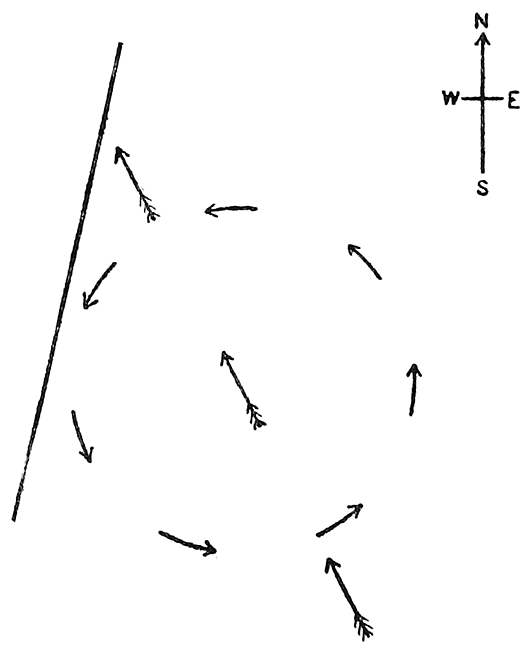
The line represents the position of the Andaman Islands. The larger arrows show the direction in which the cyclonic disturbance is moving. The smaller arrows show the direction of the wind.
Taking the second point first, we may note, in the first place, that while Tarai is associated with the steady S.W. wind which blows with very little variation for months at a time, Biliku is associated with the variable winds of the hot season. Now a characteristic of a cyclonic storm is the way in which the wind veers from one quarter to another. Further, as most of the cyclones that cross the Andamans travel from the south-east in a north-westerly direction, and the movement of the cyclone is in a counter-clockwise direction, the first wind of a cyclonic storm when it strikes the islands comes from the north-east. This may be seen from the accompanying diagram. It is only at the very end of the storm, when the storm centre has passed, that the wind blows from the south-west. Thus it is clear that the association of cyclones with Biliku and not with Tarai is determined by the nature of the phenomena which the Biliku-Tarai myth sets out to explain.
We are now in a position to compare the characters of Biliku and Tarai and explain their relative positions in the myth. The reason for the preponderance of Biliku lies in the fact that it is she who sends cyclones, while Tarai sends nothing more than heavy showers of rain. Tarai is never responsible for the destruction of life and property, whereas Biliku is. Thus the preponderance of Biliku follows from the essentials of the myth. Secondly, Tarai is constant, ever the same, whereas Biliku is changeable. The rainy season of one year is exactly like that of another, and during the time it lasts the weather is consistent throughout. On the contrary, one year the Biliku season brings a terrific storm, and another year it is much less violent, while, from day to day during certain parts of the Biliku season the weather is unsettled, so that you cannot tell what the morrow will bring with it. It is obvious that this uncertainty about the actions of Biliku, the fact that she cannot altogether be reckoned with, would tend to make her of greater importance in the eyes of the Andamanese than her consort Tarai.
Let us now consider the question of the sex of Biliku. On this matter there is a lack of agreement. In the North Andaman Tarai is declared to be male and Biliku female. It can readily be shown that this results from the position of Biliku and Tarai as regulating the seasons. Tarai rules over the rainy season, in which the chief food is the flesh of animals of the land and of the sea; it is the business of men to provide flesh-food. On the contrary Biliku rules over the seasons in which the chief foods are vegetable products of different kinds; it is the business of women to provide such foods. It is only men who go out hunting for pigs or turtle or who harpoon or shoot fish, and it is always the men who attend to the first part of the cooking of pig, turtle and dugong; it is the women who dig up the yams and collect the fruits and seeds, and it is the women also who cook them. There is a very real sense, then, in which flesh foods may be called the foods of men, and vegetable foods may be called the foods of women, and, since flesh foods are the foods of Tarai and vegetable foods are the foods of Biliku, there is a sound reason for calling Tarai male and Biliku female.
This way of thinking of Biliku as female is in harmony with her character as outlined above. Women (in the Andamans) are notoriously uncertain, changeable creatures. You can always reckon fairly well what a man will do, but not so with a woman. Moreover, when the Andaman Islander wishes to picture to himself a pair of closely associated beings, it is natural that he should compare them to the most closely associated couple with which he is familiar,—husband and wife. This tendency leads him to make the sun and moon man and wife in many of his legends, and it may well be expected to have its influence on the Biliku myth also.
In the South Andaman however, both Puluga and Daria are said to be male. It can be shown that this view is also appropriate in its way. The Akar-Bale say that Puluga and Daria were once friends, but have quarrelled and now live at opposite ends of the earth and are perpetually renewing their quarrel. Daria has things to himself for a few months (the S.W. monsoon) and sends his wind; then Puluga makes an attack on him; some weeks of unsettled weather ensue while they are fighting, until Daria is beaten and Puluga takes over the control of the weather and sends the N.E. wind. By and by, however, Daria shows himself again and there is another quarrel, with its unsettled and stormy weather, which ends in the defeat of Puluga and the reinstatement for a period of Daria. Even the bald language in which it is stated does not quite hide the poetical grandeur of this conception of the world as the arena of two battling giants in a never-ending quarrel. Those who have lived through a tropical cyclone with its wind changing from one quarter to another, its consummate violence, its sudden onslaught, its pause (that is felt to be merely a pause) as the centre of the disturbance reaches and passes you, and then its sudden renewal of the mad combat with the wind coming now from the opposite quarter, cannot but recognize in the Akar-Bale myth a successful attempt to describe such a storm in figurative language.
A most important element of the myth is the connection of Biliku (Puluga) with fire. In all the tribes there are legends that represent Biliku as the first possessor of fire, which was, according to some versions, given by her to the ancestors, and according to others stolen from her by one of them. There can be no doubt that these legends owe their origin to the connection between Biliku the storm-sender and lightning.
There are several different beliefs about the lightning. According to one of these the lightning (Ele) and the thunder (Korude) are persons, who produce the phenomena of the same name. Another belief is that thunder and lightning are produced by Biliku and Tarai. On the whole, it would seem that the latter belief is the one which is most frequently present to the minds of the natives. A man seeing lightning in the sky will say, according to the season, the prevailing wind, etc., Biliku čatobom, or Tarai čatobom; “Biliku (or Tarai) is at work.” There are different accounts, however, of the way in which Biliku makes the lightning. One belief is that it is a fire-brand flung by her through the sky; a second is that it is a mother-of-pearl shell (be) similarly flung; yet a third statement is that she produces the lightning by striking a pearl shell (be) on a red stone.
There is no doubt that the Andamanese regard lightning as fire; the charring of trees struck by it is sufficient to convince them of this. Thus lightning and the sun are the only two natural fires that they know. (With the relation of Biliku to the sun I shall deal later.) As the wielder of lightning Biliku thus becomes the possessor of fire. The simplest of the different beliefs, the one following immediately from the natural phenomena, would be, therefore, that which makes the lightning a fire-brand. This is, on the whole, the one that is most usually expressed, at any rate in the South Andaman.
In the North Andaman the two views of lightning as a fire-brand and as a shell are both held, because they both, in different ways, fit in well with the rest of the myth. There is yet a third view in which these two contradictory beliefs are, as it were, reconciled. This is that Biliku produces lightning by striking a pearl shell against a red stone.
In the North Andaman the action of throwing a shell or a fire-brand is regarded as typical of Biliku; this is the way in which she is pictured by the native, and in which she would doubtless be portrayed if the Andamanese had a pictorial art. In the dance described in an earlier chapter, in which the dancer gave representations of various mythical beings, Biliku was represented by the dancer holding a shell in his hand and dancing round threatening to throw the shell at the spectators.
The representation of Biliku or Puluga as throwing her lightning in the form of a fire-brand or a shell appears in several of the legends of the origin of fire, and in particular in the legend of which different versions are found in all parts of the islands that tells how the kingfisher stole fire from Biliku and how the latter flung a fire-brand or a shell at the thief.
The most usual form of the fire legend, and the only one that I ever heard, is that in which the fire is stolen. Mr Man has recorded a version in which Puluga is represented as giving the fire to the ancestors. Considerable importance attaches to this motive of the story as it reveals to us the way in which the Andamanese usually think of Biliku and of their own relation to her. She is not, so far as these stories go, a benefactress who by the invention of fire has earned the gratitude of men, but rather a person with whom the human society, both in the time of the ancestors and at the present day, is in a condition of opposition. Though Biliku had fire, yet she kept it for herself and it was only obtained from her by stealth. She was angry when her fire was stolen and tried to punish the offender.
This opposition between Biliku and the ancestors is shown in other legends. In some of the stories she is represented not as living with the ancestors, but as living on one side of a narrow strait while the ancestors lived on the other, as in the Akar-Bale and A-Pučikwar legends. She is thus separated from the ancestors in the minds of the natives. In the Aka-Kede legend the ancestors eat the foods that Bilika regards as specially belonging to her, and she kills them. As a result the ancestors join together and kill Bilika. In the Akar-Bale version something of the same sort appears; Puluga is always getting angry with the ancestors because they eat vegetable foods, and in his anger he destroys their huts and other property (as a cyclone does, and as an Andaman Islander is sometimes known to do in a fit of temper); at last the ancestors send him away out of the world. In the A-Pučikwar legend Bilik goes away from the world in anger because the ancestors steal his fire. In the Aka-J̌eru version Biliku eats up all the food of the ancestors, and so they go away and leave her; she then destroys them with her shells (lightning) and finally perishes in an attempt to cross the sea on a stone. All these legends seem to express much the same thing in different ways, namely the existence of a condition of hostility between Biliku and human beings, based on the fact that the latter venture to make use of the things (yams, etc.) that Biliku regards as peculiarly her property. There can be no doubt that this is the usual way in which the Andamanese conceive the relation between Biliku and the ancestors, and therefore, since the ancestors represent the society in its beginnings, between Biliku and themselves. This relation is quite in agreement with what we have seen to be the essential basis of the myth. The natives obtain from the N.E. monsoon things highly valued, such as yams and honey, but they are given as it were grudgingly after a period of storms, and finally taken away in another period of storms.
The representation of Biliku as hostile to mankind depends upon her position as the angry storm-sender, and this, as the legends show, does seem to be the more usual way of regarding her. But there is another and contrary aspect of Biliku. The revolution of the seasons brings to the Andamanese new supplies of relished foods,—the grubs of the Kimil season, the yams and honey of the cool and hot seasons. One of the Andamanese names for the season of the N.E. monsoon means “the season of abundance.” Therefore Biliku, as the personification of this season, is herself the giver of good things. This aspect finds a partial expression in the legends. Biliku is regarded as having created or discovered the use of all the natural productions associated with her. (In one legend it is Pe̱rǰido, the son of Biliku, who discovers honey with his mother’s help.) She thus occupies a position similar to that of the other ancestors, towards whom the men of the present feel grateful for the benefits they have bestowed on mankind. This view of Biliku as benefactress is often extended in the North Andaman to the belief that it was she who invented all the arts now practised by women, and there are traces of a belief that it was her son Pe̱rǰido who was similarly responsible for the arts practised by men.
This view of Biliku as a benefactress, although it conflicts to some extent with the view of her as on the whole hostile to mankind, yet, since it springs from the essential basis of the myth, cannot be overlooked. During the stormy season the Andaman Islander may well forget every aspect of Biliku save that she is responsible for the storms of which he goes in fear, but during the fine weather of the N.E. monsoon, when there is no longer any fear of a violent storm and when he is enjoying an abundance of the good things that he regards as especially belonging to Biliku, his feeling towards her must be of a very different nature; she is then the being who gives him the fine weather, the relished foods. Thus, contrary though they be, these two aspects of Biliku are both integral parts of the myth.
But Biliku is also the first possessor of fire, and we have seen that fire is regarded by the Andamanese as the source of the life of society, and therefore, in a way, of all life. Biliku as the source from which comes the fire is also the source of life. This view of Biliku is certainly to be found in all parts of the islands, though it has been developed more in the South than in the North. Biliku thus becomes responsible for the beginning of the society, and since the whole universe centres in the society, of the whole universe. She becomes the being who created or arranged the order in which men live.
There is only one more point that needs to be discussed, and that is the connection of Biliku with the spirits. It is clear that Biliku and Tarai must be distinguished from the spirits (Lau), yet at the same time Biliku is brought into relation with the spirits by the existence of two alternative explanations of bad weather. One of the explanations is that storms are due to Biliku, while the other is that they are due to the spirits, particularly the spirits of the sea. Both these beliefs, contradictory as they seem, are held by the Andamanese. The connection of the spirits with the weather is due to the fact that the weather is a thing that can limit the activity of the society, and we saw in the last chapter that there is a tendency to associate with the spirits of the dead all things that in any way interfere with the smooth progress of social life. When it is said that a storm can be stopped by swishing arrows in the sea, or by placing in the sea a piece of Anadendron creeper, it is to the spirits of the sea, who are afraid of arrows and of the Anadendron, that the storm is attributed, and not to Biliku.
In the A-Pučikwar tribe I found an association of Bilik with the spirits. One man of this tribe (a medicine-man or dreamer) stated that the Bilik are a distinct class of spirits, distinct from the Lau and the J̌urua, yet similar to them. It is the Bilik who control the weather. Certain men, when they die, become not Lau or J̌urua, but Bilik. Thus in one of his dreams that he related to me he met and conversed with the spirit of a deceased friend whom he spoke of as Boičo Bilik, Boičo having been his name when he was alive. A medicine-man is able to control the weather through his communication with the Bilik in dreams. In this tribe therefore we find a doctrine according to which Bilik is not the name of a single being but of a class of beings similar in essentials to the other two classes of spirits. It seemed to me possible that these beliefs are a comparatively late introduction by some of the medicine-men of the tribe. The Boičo about whom my informant Tora dreamed seemed to have had some part in the development of the doctrine. This does not, however, in the least detract from its value as affording us an insight into the beliefs of the Andamanese.
These beliefs clearly spring from an attempt to distinguish from one another the different northerly and easterly winds, each of the recognizable winds being regarded as a separate person, and from the merging together of the two contrary beliefs in the weather as regulated by spirits and by Bilik and Teria. The general system of beliefs about spirits as being responsible for all things that may affect human well-being inevitably leads to the notion that the weather is controlled by the spirits, and this is implied also in the belief that a medicine-man (whose power is derived from contact with the spirits) is also able to influence the weather to some extent. This doctrine, however, conflicts with the view of the weather and the seasons as controlled by Biliku and Tarai, who are not spirits but personifications of natural phenomena. It is perhaps this conflict between doctrines, both of them important and indeed necessary, that has led to the elaboration of the peculiar beliefs met with in the A-Pučikwar tribe.
I have dealt with most of the more important details of the Biliku-Tarai myth, and have tried to show that the whole myth is an expression of the social value of the phenomena of the weather and the seasons. These phenomena affect the social life in certain definite ways and thereby become the objects of certain sentiments; these sentiments are expressed in the legends. Biliku and Tarai are personifications of the N.E. and S.W. monsoons; as such they are responsible for the weather; feelings awakened by the weather are therefore referred to Biliku and Tarai; thus the fear of a cyclone at certain periods of the year is expressed as a fear of the anger of Biliku. Since the time when men go in fear of storms is also the time when they are just beginning to dig up yams and eat them, the myth connects the anger of Biliku with the digging up of yams, and similarly in the cases of honey and the cicada. As Biliku is associated with vegetable foods, and these are things with which women chiefly have to do, Biliku (in the North Andaman) is regarded as female; Tarai, being associated with flesh foods, is male; the two are therefore conceived as wife and husband. As the maker of storms Biliku is responsible for the lightning and is therefore possessed of fire. She thus comes to be regarded as the first possessor of fire. This gives rise to stories of how the ancestors obtained their fire from Biliku, and as she is generally regarded as being hostile rather than friendly towards mankind, the stories relate how the fire was stolen from her. But besides being the maker of storms Biliku is also the dispenser of the good things of the season of the N.E. monsoon and when this aspect of the procession of the seasons is prominent before their minds the natives think of Biliku as a benefactress of mankind. As she is the possessor of fire, and as fire is the source of the life of the society, she comes to be regarded as herself the source of life, though there is an alternative myth that gives this position to a being associated with the sun.
Such is a brief outline of the explanation that I have tried to demonstrate. It may be objected that there are a few important details and several minor details that I have not explained. To that extent my explanation is incomplete, but I hope that I have given sufficient evidence for it to justify us in using it as an integral part of the explanation of the meaning and function of the Andaman mythology in general.
It is not necessary, for the purpose of this chapter, to examine one by one all the legends recorded. Indeed, there are many details of the Andaman mythology that I cannot explain, owing simply, I believe, to my lack of insight into the ways of thought of the natives. The examples already considered are sufficient for the argument. If the interpretations given of these be correct we can base on them certain general conclusions.
I have explained some of the more important of the legends as being expressions or statements of the social value of natural phenomena. The alternation of day and night, for example, affects the life of the society in a certain definite manner and this gives rise to a certain way of thinking and feeling about the phenomenon in question. These thoughts and feelings, however, remain vague and without fixity until they are formulated and expressed either in the form of some definite rule of behaviour, such as the prohibition against noise while the cicada is singing, or in some concrete statement, such as that afforded by the legend of the origin of night. Similarly the legends relating to the origin of fire or the saving of the fire during the flood serve to give definite and permanent form to the vague feelings that result from the way in which the possession of fire affects the social life. Finally, I have tried to show that the myths relating to Biliku and Tarai are nothing but the expression in concrete form of the ideas and feelings that result from the effects of the weather and the seasons on the life of the Andaman Islanders. From these examples I now propose to draw a general conclusion. All the legends, I wish to maintain, are simply the expression in concrete form of the feelings and ideas aroused by things of all kinds as the result of the way in which these things affect the moral and social life of the Andaman Islanders. In other words the legends have for their function to express the social values of different objects,—to express in general the system of social values that is characteristic of the Andaman social organisation. To justify this general statement it will be necessary to show how it comes about that these representations are expressed in the form of myths and legends dealing with the ancestors and with such anthropomorphic beings as Biliku and Tarai.
Throughout the myths we meet with examples of what I have called the personification of natural phenomena. It is now necessary to give a more exact definition of this term. By it I mean the association of a natural phenomenon with the idea of a person in such a way that the characteristics of the phenomenon may be regarded as though they were actions or characteristics of the person. The simplest form is that in which the phenomenon itself is spoken of and thought of as if it were an actual person. Thus the sun and the moon are spoken of as Lady Sun and Sir Moon. Similarly, in the North Andaman, the night is personified and is called Lady Night (Mimi Bat). In many cases of personification however, while the person may or may not possess the same name as the phenomenon, the latter is said to be produced by the former. Thus, in the North Andaman, Ele is the name of the lightning, and Ele is spoken of as a person; yet, if we enquire further, we are told that Ele (the person) produces the lightning by shaking his leg. A somewhat similar case is that of Biliku and Tarai. These two beings are said to produce the winds that blow from the different quarters of the compass. But when we enquire as to the names of the winds, we find that in the South Andaman (A-Pučikwar tribe) the S.W. wind is called Teria, and the other winds are all called Bilik. Thus the name of the person is also used as the name of the phenomenon of which he is (in the phraseology here used) the personification. In the North Andaman we find a difference, the winds being called “the Biliku wind” and “the Tarai wind.” It is necessary to insist on this translation of the native Biliku bo̱to and Tarai bo̱to. We should expect, if Biliku were simply a person who produced the winds, that the latter would be called “the wind of Biliku,” a possessive form (Biliku ičo bo̱to) being used, but this is not so, and the phrase habitually used can only be properly translated “the Biliku wind” just as we might say “the north wind.” Thus, even in the North Andaman Biliku and Tarai are used as the names of the two chief winds.
In all these cases, sun and moon, Biliku and Tarai, etc., I propose to use the term personification, as being the most convenient and not liable to be misunderstood after having been carefully defined. We have now to seek an explanation of this process of personification. A great deal has been written on the subject of personification in mythology, and it is therefore not without diffidence that I venture to put forward an explanation which can only be very briefly stated in this place and would require for its full exhibition a lengthy psychological explanation.
An insight into the process of personification is afforded by considering our own use of figurative language. We talk of the angry storm, the raging sea. In such cases we allow ourselves for a moment to regard the natural phenomenon as if it were a person or the action of a person, and we do not even trouble distinctly to express the “as if.” We use such phrases in order to attain a more forcible expression of our thoughts and feelings. How is it that such expressions succeed in the purpose for which they are used?
The reason would seem to be that our knowledge and understanding of persons is much more intimate than our knowledge of things. The fact that we are able, by the action of sympathy, to know what persons with whom we are in contact are feeling, gives us an understanding of them that we can never reach with inanimate objects.
In all human society the most important elements of the experience of the individual are due to his relations with other persons. In the development of the emotional life of the child, persons intervene at every turn, and there is thus built up a system of sentiments and representations which forms the very foundation of the individual’s affective life. In other words the first organised experience that the individual attains is all connected with persons and their relations to himself. This early experience provides a basis on which we may and do organise later experiences. The perception of the leaping waves and lashing spray of a sea in tempest arouses in us a vague emotional reaction, but it is an experience that we have not learned to formulate exactly. The feeling awakened in us is, so to speak, unclassified, there is no exact word by which we can express it. We therefore fall back upon that system of affective experiences that have been classified, and for which we do have adequate words, and we apply the word “angry” to the scene before us. At the utterance of the word, with its appeal to infantile memories and to the long series of experiences that have been associated with it, the emotion becomes more definite, if not more intense. We are thus enabled to classify our present experience, to associate it with past experiences that have been arranged in our minds in an organised system, and to find a place for it in that system.
Applying this to the case of the myths we must first of all note that the Andaman Islander has no interest in nature save in so far as it directly affects the social life. Scientific and artistic interest in nature are products of civilisation. The Andaman Islander has no desire to understand the processes of nature as a scientist would wish to do, nor has he any conception of nature as a subject of esthetic contemplation. Natural phenomena affect him immediately by their influence on his own life and on the life of his fellows, and are thereby the source of a number of emotional experiences. In order to express these he has to make use of that part of his own experience that is already thoroughly organised, namely, that relating to the actions of one person as affecting another or as affecting the society. Only in this way is he able to organise his experiences arising from the processes of nature, to classify and render definite the vague impressions that are aroused in him. He interprets nature in terms of the world with which he is most familiar, the world of persons, being enabled to do so by the presence within him of a regulated and definite body of experience which he has derived from his relations with persons from the time of his first awakening to the consciousness of the external world.
There is a parallelism here, as in many other matters, between the psychological development of the individual and that of the race. The fundamental need for the child is to learn to accommodate himself to his environment. In this environment by far the most important objects are persons—parents and other children—and the first business of the growing child is to learn to adapt his actions to the requirements of this intercourse with persons. This is so overwhelmingly important that the other need (of adapting himself to inanimate objects) is quite overshadowed by it. The child has to make experiments and observations upon persons, to learn how they will act. He meets with such a phenomenon as anger, for example, the anger of a parent, or of another child, and by means of a succession of experiences he comes to a satisfactory understanding of this particular thing, and what it means with reference to himself and his actions. This notion of the anger of a parent becomes the nucleus around which is organised the experience of similar phenomena. In play or sometimes in earnest, the child treats all sorts of inanimate objects and events connected with them as if they were persons or the actions of persons. By this means, and by this means alone, he is able to exercise himself in his newly acquired experience and to extend and organise it yet further.
In the history of the race the development of society depends upon the organisation of personal relations. The task of man in primitive society is therefore similar to the task of the child. The needs of his life compel him above everything else to devote himself to organising that part of his experience that relates to the actions of persons upon one another; all else is subordinated to this supreme need; and just as the child organises and develops his experience by treating inanimate objects as if they were persons in such a way that we can hardly tell if he is in play or in earnest, so primitive man, in exactly the same way, organises and develops his social experience by conceiving the whole universe as if it were the interaction of personal forces.
This explanation of the nature of personification helps us to understand some of the Andamanese beliefs. Natural phenomena such as the alternation of day and night, the changes of the moon, the procession of the seasons, and variations of the weather, have important effects on the welfare of the society. The latter, in so far as it is regulated from within, depends on the adaptation of persons to one another. Men must learn to live in harmony, to sacrifice their own desires at times to the needs of others, to avoid occasions of giving offence, and not readily to give way to anger when offence is given. The Andaman Islander represents this fundamental law of the society as though it were the fundamental law of the whole universe. When any evil befalls the society it is as though some personal power were in question, as though some one were angry at some offence. Thus the moon and Biliku are represented as persons who can be offended and whose anger has unpleasant results. Conversely when all goes well it is because there is harmony or solidarity between men and the nature beings which affect men’s lives. In a word, the forces with which the Andaman Islander is most familiar as affecting his welfare are those of solidarity and opposition; it is solidarity that maintains the harmony of social life, opposition that destroys it. The forces of nature in so far as they affect the society are therefore represented as being of the same nature; there can be either solidarity or opposition between men and nature; the former leads to well-being, the latter to misfortune.
Thus the personification of natural phenomena is one of the methods by which the Andaman Islander projects into the world of nature the moral forces that he experiences in the society. The process is essentially similar to that described in the last chapter in connection with the ceremonial, save that there the forces we were considering were largely impersonal. Perhaps, rather than speaking of it as a projection of moral forces into nature, we should regard it as a process of bringing within the circle of the social life those aspects of nature that are of importance to the well-being of the society, making the moon and the monsoons a part of the social order and therefore subject to the same moral forces that have sway therein.
The personification of natural phenomena is not, however, the only method by which their social value can be expressed. The Akar-Bale legend of the origin of day and night, as we saw at the beginning of the chapter, expresses the social value of the alternation of light and darkness by means of a story of how it originated in the time of the ancestors. If we seek to understand all that this legend means we must ask why the Andaman Islanders believe in the existence of the ancestors, and why they attribute to them the characteristics that are exhibited in the stories they tell about them. The ground of the belief in the ancestors is to be found in the existence of a sentiment fundamental in all human society, which I shall call the feeling of tradition. When an Andaman Islander is asked the question “Why do you do so and so?” he very frequently replies “Because our fathers did so before us.” This answer expresses in its simplest form the feeling of tradition. In all his actions, in the way he obtains and cooks his food, in the way in which he makes his various implements and weapons, in the moral and ritual customs that he is required to observe, the native acts in accordance with tradition. If he should ever feel inclined to deviate from it he finds himself in conflict with a powerful compulsive force. In tradition, therefore, the individual is aware of a force stronger than himself, to which he must submit whether he will or not. Further, he is aware that the power which he possesses, as a member of the society, whereby he is able to face the hostile or at best indifferent forces of nature and provide himself with food and maintain himself in security and happiness, is not simply a product of his own personality, but is derived by him from the past. Towards this past, therefore, on which his own life so obviously depends, he feels a grateful dependence. So long as he acts in conformity with tradition he can enjoy safety and happiness, because he is relying on something much greater than his own qualities of mind and body.
To put the matter in a few words, the individual finds himself in relation with an ordered system—the social order—to which he has to adapt himself. The two chief moments in his affective attitude towards that order are his sense of his own dependence upon it and of the need of conforming to its requirements in his actions. It is this,—his sense of his own relation to the social order,—that the Andaman Islander expresses in the legends about the ancestors, which recount how that order came into existence as the result of actions of anthropomorphic beings.
Some of the legends recount the invention of weapons or implements or the discovery of the uses of natural objects. In one of the North Andaman stories it is said that all the weapons and implements now used by men were invented by the first man, whose name, J̌utpu, probably means “alone,” i.e., the man who was at first by himself. This first man made himself a wife from the nest of the white ant. The regulated society of the ants, and the numerous population that a nest contains, give this story its symbolic meaning.
Besides what may be called general culture legends, of which the story of J̌utpu is an example, there are several special culture legends relating to various discoveries and inventions, such as the tale of how the use of yams for food was first discovered, or that which tells how the monitor lizard discovered quartz and scarified himself with it. By means of these legends the Andaman Islander expresses his sense of his own dependence on the past. He pictures a time when the social order as it now is had not begun, or was just beginning; the knowledge he now possesses was then being acquired, the weapons he uses were being invented, the moral and ritual laws that he obeys were in process of being formulated.
Besides the social order there is another, the order of nature, which is constantly acting upon the social order. To this also the individual has to adapt himself, and his knowledge of how to do so is equally derived from the past. The order of nature only affects him through the social order, and the two therefore necessarily seem to him merely two parts of one whole,—the order of the universe. In the legends he tells how not only the social order but also the order of nature came into existence; an example is the story of the origin of night.
The Andaman Islander finds himself in an ordered world, a world subject to law, controlled by unseen forces. The laws are not to him what natural laws are to the scientist of to-day, they are rather of the nature of moral laws. He recognizes only one meaning of the word right and of the word wrong; right action is that which is in conformity with law, wrong action is that in opposition to the law; it is wrong to give way to anger, it is wrong to kill a cicada, or to have a bright light in camp when the moon is rising in the third quarter, and it is wrong also to try and use unsuitable material for an implement or weapon. Wrong actions always lead to harm; if you use unsuitable wood for your bow it will break and your labour be wasted; if you kill a cicada it will rain heavily; if you give way to anger readily you will earn the dislike of your fellows that may some day lead to your undoing. Right and wrong mean acting in accordance with the laws of the world or in opposition to them, and this means acting in accordance with or in opposition to custom. Custom and law are indeed here two words for the same thing.