Chapter II · CEREMONIAL CUSTOMS
Reading edition
In such a society as that of the Andaman Islanders it is possible to distinguish three different ways in which the actions of individuals are regulated or determined by the society. There are, first of all, what we may distinguish as “moral customs,” whereby the actions of individuals in relation to one another are regulated on principles of right and wrong conduct. It was with customs of this kind that we were concerned in the last chapter. Secondly, the activities by which the natives obtain their food and make the various objects of which they have need are determined by tradition. Such activities are purely utilitarian and they are regulated, not by commandments similar to those of the moral law, but by accumulated technical knowledge as to the means by which a particular object may be attained. These we may speak of as the “technical customs” of the society.
There are customs of a third kind which are distinguishable both from moral customs and from technical customs. For example, when a man dies, his near relatives observe certain mourning customs, such as covering their bodies with clay. Such customs are distinguished from technical customs by having no utilitarian purpose. They are distinguished from moral customs by this, that they are not immediately concerned with the effects of the action of one person upon another.
It is difficult to find a satisfactory name for all the customs of this kind. A large number of them may be spoken of as “ceremonial customs,” and it is this that explains the title of the present chapter.
It is not pretended that this division of social customs into three different kinds is of any great or permanent value, and it is only introduced as an aid to the exposition of the customs of the Andamanese. It will be argued in a later chapter that many of the customs described in the present chapter have a common psychological basis.
Of any customs in connection with the birth of children I was able to learn very little, as no births at which I could be present occurred during my stay at the islands. Earlier writers have given very little information on this subject.
During the latter part of the period of pregnancy, and for about a month after the birth of the child, the mother and father must observe certain restrictions. In particular there are certain foods that they may not eat. The statements of different informants on this matter did not quite agree with each other, and it seems that there were slightly different rules in different tribes. According to an Akar-Bale informant the man and woman may not eat dugong, honey and yams; they may eat the flesh of small but not of full-grown pigs and turtle. An informant of one of the Northern tribes said that the woman may not eat full-grown pig, Paradoxurus, turtle, dugong, the fish komar, monitor lizard, honey and yams; her husband may eat these things but must carefully avoid eating certain fishes.
The natives give two different reasons for these rules. One is that if these foods be eaten by the parents the child will be ill. The other is that the parents themselves will be ill. The latter is the explanation most commonly offered.
The baby is named some time before it is born, and from that time the parents are not addressed or spoken of by name. For example, if the name chosen be Rea, the father will be spoken of as Rea aka-mai (Rea’s father) instead of by his own name. The mother may be referred to as Rea it-pet, from the word it-pet meaning “belly.” This practice is continued till some weeks after the birth, when the use of the names of the parents is once more resumed.
In child-birth the woman is assisted by the matrons of the camp. She is seated in her hut in the village on fresh leaves, and a piece of wood is placed at her back for her to lean against. Her legs are flexed so that her knees may be clasped by her arms. The only manipulation is pressure exerted on the upper part of the abdomen by one of the attendant women. The umbilical cord is severed with a knife, formerly of cane or bamboo, but in these days of iron. The after-birth is buried in the jungle. The infant is washed and then scraped with a Cyrena shell. After a few days he (or she) is given a coating of clay (odu).
If a baby dies and within a year or two the mother again becomes pregnant, it is said that it is the same baby born again, and the name of the deceased child is given to it. Thus one woman had three children of the same name, the first two having died soon after birth. According to the native ideas this was really the same child born three times. It is only those who die in infancy that are thus reincarnated.
In the Northern tribes it is believed that a woman can tell the sex of her unborn child. If she feels it on the left side it is a male, because men hold the bow (the typical masculine implement) in the left hand. If she feels it on the right side it is a female, because it is in her right hand that a woman holds her fishing net.
A married man who is childless and desires a child will wear a čiba (sling of bark used for carrying children) round his shoulders when he is sitting in camp. The čiba and the way it is used for carrying children may be seen in the photograph in Plate XIV. If a childless woman wishes to have a child she may catch, cook and eat a certain species of small frog.
In the North Andaman there is some sort of association between the unborn souls of babies, the green pigeon and the Ficus laccifera tree. The same name, Reŋko, is used to denote both the green pigeon and also the Ficus laccifera, of the fruit of which the pigeon is very fond. The belief of the natives is sometimes stated by saying that the souls of unborn children live in the Ficus trees, and that if a baby dies before it has been weaned its soul goes back to the tree. Another statement of the natives is that it is when the green pigeon is calling that the soul of a baby goes into its mother. The Ficus is to a certain extent tabu. I was told that the tree must not be cut or damaged. Nevertheless the natives do cut the tree in order to obtain the bark of the aerial roots from which they prepare a fibre that they use for making personal ornaments. There is no tabu in connection with the green pigeon, which may be killed and eaten.
In most primitive societies, if not in all, there are ritual or ceremonial observances in connection with the change by which a boy or girl becomes a man or woman. The ceremonies that are performed to mark this change are commonly spoken of in ethnological literature as “initiation ceremonies.” The term is not perhaps the best that could be chosen, but usage has rendered it familiar.
The life of an Andaman Islander is divided into three well-marked periods, corresponding roughly with the physiological periods of childhood, adolescence, and maturity. The first period lasts from birth till about the advent of puberty; the second lasts from puberty till after marriage; the third extends from marriage to death.
During the period of childhood the boy or girl lives with his or her parents, or, in the later years of the period, with adopted parents, having a place in the family hut and a share in the family meal. A girl continues to live with her parents or with her adopted parents until she marries. When boys have finished growing, and have reached the condition of young men, they cease to live with their parents or adopted parents and, until they are married, they occupy a bachelors’ hut of their own, and have their own meal.
Every boy and girl has to undergo the operation of scarification. This is begun when the child is quite young, and a small portion of the body is operated on. The operation is repeated at intervals during childhood, until the whole body has been scarified. A small flake of quartz or glass is used, and a series of fine incisions are made in the skin. The usual method is to cover a small portion of the skin with a number of parallel rows of short cuts. The choice of the design (if it can be called such) rests entirely with the person who performs the operation, who is in all cases a woman. The incisions leave scars that can usually only be seen when close to the person. In the photograph of Plate XV a pattern of scars may be seen. In this case the incisions became infected and raised scars were produced, and it is for this reason that they are visible in the photograph. In ordinary cases raised scars are not produced and the scarification is hardly visible in a photograph.
The only reason that the natives give for this custom is either that it improves the personal appearance, or else that it helps to make the child grow strong.
In the case of a girl the period of childhood is brought to a close by a ceremony that takes place on the occasion of her first menstrual discharge. The ceremony I describe is that in use in the Northern tribes, but I believe that the ceremony of the Southern tribes is very similar. On the occurrence of the first menstrual discharge the girl tells her parents, who weep over her. She must then go and bathe in the sea for an hour or two by herself. After that she goes back to her parents’ hut or to a special shelter that is put up for the occasion. She is not required to go away from the camp. All ornaments are removed from her, only a single belt of Pandanus leaf being left, with an apron of čainyo leaves. Strips of Pandanus leaf are attached round her arms near the shoulders and round her wrists, and others are placed as bands crossing her chest from the shoulder to the waist on the opposite side, and crossing her abdomen from the iliac crest on the one side to the trochanter on the other. These are so attached that the long loose ends hang down at the girl’s side. Bunches of leaves, either čelmo (Tetranthera lancæfolia) or, if these be not obtainable, poramo (Myristica longifolia) are fastened beneath her belt before and behind. Other leaves of the same kind are placed for her to sit upon. The strips of Pandanus leaf and the bundle of leaves are visible in the photograph reproduced in Plate XVI.
The girl sits thus for three days. Early every morning she leaves the hut to bathe for an hour in the sea. At the end of the three days she resumes her life in the village. For a month following she must bathe in the sea every morning at dawn.
During the ceremony and for a short time afterwards the girl is not addressed or spoken of by name, but is referred to as Alebe or Toto. The meaning of the first word is not known. Toto is the name of the species of Pandanus from which women’s belts are made and the leaves of which are used in the ceremony. On the occasion of this ceremony the girl is given a new name, her “flower-name,” and from this time till after the birth of her first child she is never addressed or spoken of by the name which she had as a child, but only by the name given to her at this ceremony. The name given is that of a plant or tree which is in flower at the time. If the ceremony takes place when the ǰili is in flower she is called J̌ili; if when the ǰeru is in flower she is named J̌eru, and so on. These names will be mentioned again later in the present chapter.
After this ceremony the girl is said to be aka-ndu-kolo̱t. For some time afterwards she must not have her head shaved, and she must not use red paint or white clay.
I was not able to learn much about the native ideas in connection with the menstrual function. According to the account given me by one informant I gathered that the girl’s first menstrual discharge is supposed to be due to sexual intercourse. The man’s breath goes into her nose and this produces the discharge. It is believed that if a man were to touch a girl during this period, either during the ceremony or for some time after it, his arm would swell up.
At every recurrence of the menstrual period a woman is required to abstain from eating certain foods. According to an Akar-Bale informant these are, in that tribe, pork, turtle, Paradoxurus, honey and yams. An Aka-Čari informant added to the above list dugong, monitor lizard, and the fish komar. If she ate any of these things at such a time she would be ill. This continues throughout her life till the climacteric. A menstruating woman is not required to leave the camp, as she is in many savage communities.
From the moment of the ceremony just described the girl enters a new condition which is denoted in the Aka-J̌eru language by the word aka-op (aka-yaba in Aka-Bea). This word means that the person to whom it is applied is under certain ritual restrictions, chiefly concerned with foods that may not be eaten.
When the friends and relatives of a boy decide that he is old enough to have the incisions made in his back a dance is held in the evening, and the boy is required to dance through the whole night till he is tired. As soon as morning breaks he is made to bathe in the sea for two hours or so. He is then seated in some convenient place, not in a hut. The boy kneels down and bends forward till his elbows rest on the ground in front. One of the older men takes a pig-arrow and with the sharpened blade makes a series of cuts on the boy’s back. Each cut is horizontal, and they are arranged in three vertical rows, each row consisting of from 20 to 30 cuts. When the cutting is finished the boy sits up, with a fire at his back, until the bleeding stops. During the operation and for a few hours following it the boy must remain silent. There is no treatment of the wounds to produce raised scars. The scars are much more noticeable on some men than on others.
The boy does not receive a new name on this occasion, but for a few weeks his own name is dropped and he is addressed and spoken of as Eǰido. From this time the boy is described as being oko-taliŋ-kolo̱t, this being the masculine term corresponding to aka-ndu-kolo̱t for girls. From the time the cuts are made on his back the boy becomes aka-op and is under certain restrictions as to what foods he may eat.
When the wounds on his back are thoroughly healed similar cuts are made on his chest. I found a certain number of men who had no visible scars on their chests, but in the North Andaman every man has the three rows of scars on his back. Some of the women of the North Andaman have similar scars on their chests and a very few have them also on the back. These scars on women are not regularly made as part of the initiation ceremonies, and may be made after the woman has been married for some years.
During the period that a boy or girl is aka-op he or she is required by the customs of the tribe to abstain from eating certain foods. The exact rules in this matter differ from tribe to tribe. More particularly there are important differences between the coast-dwellers on the one hand and the jungle-dwellers on the other. The general principle, however, is in all cases the same. The boy (or girl) must abstain from all the chief foods of the people, and since he could not abstain from them all at one time without starving, he takes them in turn. It is in the order in which the different foods are forbidden that the chief differences occur.
In the Aka-Čari tribe of the North Andaman, where all are coast-dwellers, the boy or girl, during the first part of the aka-op period must not eat turtle, dugong, porpoise, komar (a fish), hawksbill turtle, the two kinds of edible grubs (pata and čokele), the monitor lizard, the flying fox (Pteropus), certain birds (perhaps all birds), certain shell-fish, the four varieties of mangrove seed (kao, čimi, kabal and kaplo), three edible roots (mino, labo and mikulu), and a large number of other vegetable foods, including lo̱itok, poroto (if cooked, but it may be eaten raw), biǰo, čoroŋo, celet, buroŋ, bui, bakle, čo, čatali, and kata. A certain number of fishes must be added to this list. This period is brought to a end by the turtle-eating ceremony which will be presently described. After this ceremony, turtle, which is one of the chief foods of the Aka-Čari, may be eaten, although certain parts of the turtle (such as the intestinal fat) are still forbidden, and the youth is also allowed to eat many of the other foods previously forbidden. On the other hand he is now required not to eat pork and a number of other foods both animal and vegetable. During this second period certain minor ceremonies take place, as for instance on the first occasion on which turtle’s eggs are eaten. This period is brought to an end by the pig-eating ceremony. After that the youth is again free to eat pork. As turtle and pork are the two most important foods the ceremonies and observances in connection with these occupy a position of greater importance. After the pig-eating ceremony the youth is made free of one food after another, until some time after he is married he becomes free to partake of any of the foods available. In the case of some of the more important foods, such as honey, dugong, porpoise, the fish komar, etc., there is a sort of minor ceremony. The only ceremonies of any great importance in this tribe are the turtle-eating and the pig-eating ceremonies.
In the forest-dwelling communities of the North Andaman things are necessarily different. These people only eat such foods as turtle, dugong, etc. when they are visiting their friends on the coast. The three most important ceremonies amongst these people are the ńyuri-eating, the pig-eating and the honey-eating ceremonies. (The ńyuri is a fish that is found in the creeks.) According to my informants of the Aka-Bo tribe the foods that must be avoided during the first part of the abstention period are all species of fish found in inland creeks (ńyuri, burto, bari, bol, kuato), the monitor lizard, sucking-pig, two species of snake (or-čubi and uluku-čubi), a number of vegetable foods and also honey. After the ńyuri-eating ceremony the different kinds of fish mentioned may be eaten, but the youth or girl must then abstain from pork.
These examples, without entering into further details, will suffice to show what is the nature of the aka-op period. During that period the youth must abstain for a certain length of time from each one of the more important foods of his community. After a certain period of abstention he is permitted to eat the particular food. On each occasion of thus eating a food for the first time after the abstention, there are certain ritual customs that must be observed, and these customs are more important in some cases (such as pig, turtle and honey) than in others. In the case of some of the foods the only ritual observed is that the food must be given by an older man, who is himself free to eat it, that it must be eaten in silence, and that the man must be painted afterwards with clay (odu). In the case of pork and turtle, however, there are fairly elaborate ceremonies. The ceremonies are very similar in different parts of the islands. The description given below applies to the coast-dwellers of the North Andaman. In these communities the period of abstention from turtle and other foods begins in the case of a girl at the first menstruation, and in the case of a boy when his back is cut. It may last only one year or several years, according to circumstances, and is brought to a close by the turtle-eating ceremony. The details of this are exactly the same in the case of a girl and a boy.
On the morning of the third day a belt and necklace are made of pieces of the creeper called terkobito-balo, i.e. “centipede creeper” (Pothos scandens), and these are placed round the youth’s waist and neck. On this day he is permitted to sleep. Either on the same day, or early the next morning, he has a bath in the sea, to remove some of the red paint and clay, and he is then decorated with red paint made of red ochre and turtle fat, and with white clay (to̱l-odu). The red paint is put on in stripes over his body, and his ears are daubed with it. The white clay is put on in a zig-zag pattern to be described later, the lines of white clay alternating with those of red paint. This decoration is done by female relatives.
The youth then returns to his hut and resumes his former position. He may now, if he wishes, talk to his friends and he may sleep. He must retain the bundles of Hibiscus leaves and the necklace and belt of Pothos leaves. The dance is sometimes repeated in the afternoon. It is in any case repeated on each of the two days following, and after that the youth resumes his ordinary life. For a week or two he may not touch a bow and arrow. The Pothos leaves are worn till they are faded and are then discarded. The paint on the body wears off and is not renewed, but his ears are kept painted with red paint. For some weeks the youth is supposed to be in an abnormal condition and is carefully watched by his friends.
At the turtle-eating ceremony a new name is given to the youth. This name, however, never seems to be used afterwards either in speaking of or to the person to whom it belongs. A youth of the Aka-J̌eru tribe whose birth name was Čop (from a species of tree) and whose nick-name or second name was Komar (from a species of fish) had two new names given to him on the occasion of the turtle-eating ceremony, Čokbi-čiro (meaning turtle-liver) and Pilečar (high-tide). Neither of these names was ever used in addressing him.
In the coast-dwelling communities of the Northern tribes, the youth or girl who has passed through the turtle-eating ceremony is thereafter free to eat turtle flesh (though not the liver nor the intestinal fat of the turtle) and a certain number of the other foods that were previously forbidden. On the other hand, he or she is now forbidden to eat pork and a number of other foods which previously were permitted. The period during which these new prohibitions are in force may last for a few months or for a year or even longer. It is, however, generally shorter than the first period of abstention from turtle. It is brought to an end by a pig-eating ceremony which is similar in many ways to the turtle-eating ceremony already described. A boar must be killed if the initiate be a youth, or a sow if it be a girl who is to go through the ceremony. The youth is seated in a hut on leaves of the čelmo (Tetranthera) and the carcase of the boar is brought and pressed upon the youth’s shoulders and back by one of the men. The girl is not treated in this way. The pork is then cooked and the youth is first anointed and then fed with some of the fat. He is then rubbed with red ochre, massaged and splashed with clay, just as in the turtle-eating ceremony. He must sit silent with arms crossed, and covered with Tetranthera leaves for a day and a night. During this time he may only eat pork, and must not touch his food with his hands but must use a skewer of Tetranthera wood. On the following day he is decorated with white clay (to̱l-odu) and with red paint, and takes part in a dance. The dance is almost exactly the same as the dance on the occasion of the turtle-eating ceremony, the only differences being that instead of Hibiscus leaves those of the Tetranthera are used, and that the dancer does not leap with both feet from the ground, but raises one foot and stamps with it.
In the Northern tribes these are the two most important ceremonies. After the pig-eating ceremony the youth is free to eat pork and a certain number of previously forbidden foods. There remain a considerable number of foods, however, which he is still forbidden. In connection with each of these there is some sort of minor ceremony. The older men, when occasion arises, offer the youth or girl some of the forbidden food, first rubbing it over his or her mouth. The food is then eaten in silence. I only saw one such ceremony, when a man ate for the first time after his abstention the intestinal fat of the turtle. The man was about 24 years of age and had long since been through the chief ceremonies, and was married. The ceremony is perhaps more elaborate in the case of the similar first eating of honey, dugong and a few other foods. One after another of the food prohibitions is removed until the man or woman is free to eat anything. There is no regular order in which this takes place, as in each case it is determined by chance circumstances. The only order that is rigorously observed is that of the two chief ceremonies connected with pork and turtle. These two are the principal meat foods of the coast-dwellers.
The above description applies strictly only to the coast-dwellers of the North Andaman (Aka-Čari, Aka-J̌eru and Aka-Ko̱ra). I was not able to see any ceremonies performed by the jungle-dwellers. The old men of the Aka-Bo tribe told me that the period of abstention begins when a boy or girl is forbidden to eat the fish ńyuri (Plotosus sp., probably P. arab), and a certain number of other foods, not including pork. The first ceremony is the eating of the ńyuri. The boy or girl is seated on leaves (kibir or tare or ra-čiro) and bundles of these are placed in his belt before and behind. A belt of Pandanus leaf is worn by the boys at this ceremony as well as by the girls. The initiate sits with his legs doubled up beneath him, and is fed with the fish. The ceremony lasts only one day. There is no special dance, but the initiate joins in an ordinary dance at the end of the ceremony, being decorated for this purpose with white clay. After this ceremony the youth must abstain from pork and other foods. The pig-eating ceremony, which closes this period of abstention, lasts altogether for three or four days, the initiate remaining awake for one night. The leaves used are the same as those of the first (fish-eating) ceremony. The third important ceremony of these communities is the honey-eating. The initiate sits cross-legged and honey is rubbed over his or her shoulders and chest, and he or she is fed with it.
I was told by one of my informants that in the Aka-Kede tribe the pig-eating ceremony precedes the turtle-eating, but I could not obtain reliable information about the ceremonies of this tribe.
My informants of the Akar-Bale tribe, which consists of coast-dwelling communities only, told me that the period of abstention begins with turtle, honey, turtle’s eggs, yams, and a number of fruits and seeds. This period lasts for three or four years. Then comes the turtle-eating ceremony, which is said to be similar in its details to that already described from the North Andaman. After this ceremony the initiate may not eat dugong, porpoise and a considerable number of fishes (including Tetrodon sp., Plotosus sp., Anguilla bengalensis, Trygon bleekari, T. siphen, Urogymnus asperrimus, Carcharias gangeticus, etc.). He must also abstain from turtle’s eggs, pig, yams, honey, and certain fruits (e.g. Artocarpus chaplasha, Mimusops littoralis, Baccaurea sapida, etc.). A few months after the turtle-eating ceremony there is a minor ceremony of eating turtle’s eggs, the eggs being eaten in silence and the meal followed by a dance. After another period follows the ceremony of eating pig’s kidney-fat. Then, as opportunity occurs, the initiate eats dugong, honey and the other forbidden foods, one after another. The ceremony in each case is not elaborate except in connection with such important foods as dugong and honey.
Mr E. H. Man has given a description of the ceremonies of the Aka-Bea tribe, which shows that they are essentially similar to those of the North. He does not distinguish between the ceremonies of the aryoto (coast-dwellers) and those of the eremtaga (jungle-dwellers). He states that the fasting period (aka-yaba) is divided into three parts, the first ending with the yadi- (turtle) gumul, the second with the aǰa- (honey) gumul, and the third with the reg-ǰiri- (kidney-fat of pig) gumul.
As I was not able to witness the honey-eating ceremony, I venture to reproduce below the description that Mr Man gives of this ceremony as it is conducted in the Aka-Bea tribe.
We may now proceed to the ritual customs connected with death and burial. In all the Great Andaman tribes disease and death are supposed to be due to the spirits of the jungle and the sea. The subject will be dealt with in the next chapter.
On the occurrence of a death the news quickly spreads through the camp, and all the women collect round the body and, sitting down, weep loudly until they are exhausted. The women then retire and the men come and weep over the corpse. All the adult members of the community then proceed to cover themselves with a wash of common clay smeared evenly over their bodies and limbs. This clay is of the kind called odu in Aka-J̌eru and og in Aka-Bea. The nearer relatives and more intimate friends of the deceased also plaster some of the same clay on their heads.
Some of the women, generally, but not necessarily, relatives, remove any ornaments the dead person may have been wearing, shave the head and decorate the body. This decoration consists of lines of fine pattern in white clay alternating with bands of red paint. A band of red paint is placed across the upper lip passing from ear to ear and the ears themselves are smeared with the pigment. The greater the estimation in which the deceased person is held the greater is the care lavished upon this the last decoration.
Thus decorated the body is prepared for burial. The legs and arms are flexed so that the knees come up under the chin and the fists rest against the cheeks. A Cyrena shell (or sometimes in these days a steel knife) is placed in the closed hand. A sleeping mat is wrapped round the body, and over this a number of the large palm leaves known as ko̱bo (Aka-J̌eru) are arranged and the whole is made into a bundle and tied up with rope. Before the ropes are all tied the relatives of the dead person take their last farewell by gently blowing on the face of the corpse.
The male relatives and friends then proceed to the spot selected for the burial, one of them carrying the corpse slung on his back. If the burial place can be reached by canoe, no hesitation is shown in making use of a canoe for the purpose. There are not, so far as could be discovered, any rules as to which of the men shall undertake the burial. Such relatives as brother, father, son or husband generally take the leading part. The women take no part in the actual burial. There are two modes of disposing of the body, in a grave dug in the ground, or upon a platform placed in a tree. The latter is considered the more honourable form of burial, and is only adopted in the case of a man or woman dying in the prime of life. The same grave is not used twice, in the case of interment, though a new grave may be made close to an old one. The natives said that the same tree might be used several times for platform-burial, but there was no opportunity of proving this statement. There are not, generally speaking, any regular burying grounds. Any convenient spot may be chosen so long as it is at some little distance from the camp. It does happen, however, that certain spots are fairly regularly used. In the case of one burial that I witnessed the spot chosen was about a mile distant from the camp, the journey being made in a canoe, and there were already five or six graves at the same place.
In the case of interment a hole is dug three or four feet in depth, the digging being done with an adze and a digging stick, and sometimes a wooden dish is used to scoop out the soil. The body is placed in the hole and the ropes tied round it are severed. The body is placed slightly on its side facing the east. I asked some of the natives the reason for this orientation, and was told that if the custom were not observed the sun would not rise and the world would be left in darkness. A pillow of wood is placed under the head, and a log of wood at each side of the corpse. Sometimes some object that has been worn by the deceased, such as a belt or necklace, is placed in the grave. The soil is then replaced, all present helping. Beside the grave a fire is lighted and some water contained in a bamboo vessel or in a nautilus shell is left for the corpse. In some cases the bow belonging to the deceased, if it be a man, and a few arrows are placed on the grave. In the Aka-Čari tribe a harpoon and line are substituted for the bow and arrows, and a bamboo harpoon shaft is erected vertically in the grave near the right hand of the body. In the same tribe it is usual to suspend near the grave a bundle of the prepared fibre of Anadendron paniculatum such as is used for making thread. There are probably slight variations of custom in this respect in different tribes or even in different cases in the same tribe.
In the case of platform-burial a platform of sticks is erected in a tree, twelve feet or so above the ground, and the body is placed thereon, lying sideways facing the east. Water and fire are placed beneath the tree. Mr Man states that in cases of tree-burial they are careful not to select a fruit tree or one of a species used for the manufacture of their canoes, bows and other implements. Such natives as I questioned on this point said that this was not so and that they would use any suitable tree whether one that was useful or not. I was unable definitely to prove the point, as I did not see a single instance of tree-burial during my stay in the islands. A tree that is sometimes used for this purpose is the Ficus laccifera, which as we have seen has a special connection with the spirits of new-born children. On the coast, mangrove trees, such as the Rhizophora or Bruguiera, are said to be used.
When the burial is completed, whether in a grave or a tree, plumes made of shredded palm-leaf stem koro (Aka-J̌eru) or ara (Aka-Bea) are attached near the graves to the branches of trees or shrubs or to sticks put up for the purpose. This is done, it is said, to show any native, who might inadvertently approach, that there has been a burial at the spot. The undergrowth is cleared for a short distance round the grave.
The men then return to the camp, where the women have been busy packing up all belongings. Plumes of shredded palm-leaf stem (koro) are put up at the entrance to the camp, to show chance visitors that there has been a death. The camp is then deserted, the natives moving to some other camping ground until the period of mourning is over, when they may, if they wish, return to the deserted village. No one goes near the grave again until the period of mourning is over.
In the case of very young children the burial ceremony is different. There is no general mourning of the whole camp. Only the father and mother and a few other relatives weep over the dead body. The head of the corpse is shaved and the body is decorated in the same way as that of an adult. The body is wrapped up in palm leaves (Licuala), the limbs being flexed. The fire is then removed from its customary place and a grave is dug there in the floor of the hut. In this the child’s body is placed, the grave is filled in and the fire replaced above it. Not only is the camp not deserted, but there seems to be an obligation on the parents not to leave the place until the bones have been dug up, or at any rate for some weeks after the death. If the mother went away, the natives say, the baby would cry for its mother’s milk. This is the custom of the Northern tribes. Referring to the Southern tribes, Mr Man says that the baby is buried beneath the fireplace and the camp is then deserted, the mother placing beside the grave a shell containing some milk squeezed from her breasts. Some of my informants of the Southern tribes (Akar-Bale, etc.) told me however that the camp would not be deserted in the case of the death of an infant, thus contradicting Mr Man’s statement. As there was no opportunity of testing the point by reference to an actual case, it must be left as doubtful. In the Northern tribes when an older child dies the body is buried away from the camp, but the latter is not, at any rate in all instances, deserted, though the hut in which the death occurred may be destroyed and a new one built a short distance away. It is only in the case of the death of an adult that the camp is abandoned.
In connection with the burial of a baby beneath the hearth there is a belief that the soul of the dead baby may re-enter the mother and be born again. This would seem to be one of the reasons why the mother does not leave the camp when her baby dies.
Should a person die while on a visit, he or she is buried in the usual way and news of the death and place of burial is sent to the relatives. A stranger who dies or is killed is buried unceremoniously or is cast into the sea. Among the Northern tribes the body of such a one used in former days to be disposed of by cutting it into pieces and burning it on a fire. The natives say that if this be done the ‘blood’ and the ‘fat’ of the dead man go up to the sky and this removes all danger to the living from the dead man. The blood of persons so burnt is seen in the sky at sunset. If a man were killed in a fight between two communities and his body remained with the enemy, they would dispose of it in this way. If the friends secured the body they would bury it in the usual way. It may be worthy of remark that this custom of burning the bodies of slain enemies is perhaps the real origin of the belief that the Andamanese are or were cannibals. We can well imagine that when, as must have often happened, sailors venturing to land on the islands have been killed and the survivors have seen the bodies of their companions cut up and placed on fires, they would readily conclude that they were witnessing a cannibal feast. There can be no doubt whatever that since the islands were occupied in 1858 the inhabitants have not practised cannibalism, and there is no good reason to suppose that they once followed the custom and then abandoned it.
The burial is conducted, if possible, on the day of the death. If it has to be deferred till the morrow all the inhabitants of the camp keep awake. The relatives sit round the corpse weeping at intervals, while some of the men take it in turn to sing songs during the hours of darkness. This, so they say, is to keep away the spirits that have caused the death, and so prevent them from further mischief. When a man or woman dies in the prime of life after a short illness the friends and relatives often break out in anger which they express in different ways. A man will shout threats and curses at the spirits that he conceives to be responsible for the death of his friend. He may pick up his bow and discharge his arrows in all directions, or in some other way give expression to his angry feelings. On the occasion of a death in one of the Akar-Bale villages the relatives expressed their grief by cutting down a coconut tree that grew there.
The period of mourning for near relatives—parent, adult child, consort, brother or sister—lasts for several months. In the case of a young child only the parents mourn. The essentials of mourning are (1) the use of clay (odu), and (2) abstention from certain foods, from dancing, and from the use of white clay (to̱l) and red paint. As stated above, every adult in the camp covers himself or herself with clay on the death of an adult member of the community, but when this wears off, or is washed off in the course of two or three days, it is not renewed. The near relatives retain this covering of clay for many weeks, constantly renewing it. The clay is smeared evenly over the body, and is not put on in patterns, as on other occasions. The relatives, but not the others, plaster some of the same clay on their heads. A widow mourning for her husband covers her whole head with a thick layer of clay, renewing it from time to time. For a lesser degree of mourning, the custom is to plaster clay on the forehead only. After some weeks or months of mourning, the near relatives discontinue the use of clay on their bodies, but retain a band of clay over the forehead as shown in Plates IX, X, and XVII.
The name of the clay thus used is odu in the Northern languages, and a mourner is called aka-odu. In the Aka-Bea language the name of the clay is og and the term for a mourner is aka-og.
During the period of mourning the name of the dead person is carefully avoided and no one uses it. If it is necessary to refer to the dead this is done by using some such phrase as “he who is buried by the big rock” or “he who is laid in the fig tree” or by mentioning the name of the place of burial. There is no prohibition against mentioning the name itself in other connections. Thus if a man were called Buio, from the name of a species of Mucuna, it is not necessary to avoid the word buio when speaking of the plant. Further if there is another person alive of the same name as the dead man it is not necessary to avoid the name in referring to the living individual. The custom is that a dead person must not be spoken of unless it is absolutely necessary, and then must not be spoken of by name. After the period of mourning is over the dead person may again be spoken of by name.
During the period of mourning a near relative of the deceased is never addressed or spoken of by name. There are certain terms which are used for this purpose, being terms of address that can be substituted for the names that are avoided. Thus in the Aka-J̌eru language one such term is Bolok, meaning “orphan,” used in addressing or speaking of a person who has lately lost a parent. Another term of the same language is Ropuč, applicable to one who has lost a brother or sister. After the period of mourning is over the use of the personal name of the mourner is resumed.
During the period of mourning the near relatives of the deceased are required by custom to abstain from dancing and from using red paint or white clay. The white clay here referred to is that called to̱l or to̱l-odu in Aka-J̌eru and tala-og in Aka-Bea, and is used for decorating the body on ceremonial occasions, such as that of a big dance. Further, the mourners must abstain from eating certain foods. The customs with regard to the foods to be avoided are different in different parts. There is however the universal rule that coast-dwellers must not eat turtle, and jungle-dwellers must avoid pork. Other foods that are included amongst those to be avoided are dugong, certain fishes such as that called komar in Aka-J̌eru, and in some parts yams and honey.
The exact duration of the period of mourning is difficult to discover. It seems to vary considerably in different cases. In all cases it must last long enough for the flesh to decay from the bones. The proceedings at the end of mourning consist of (1) digging up the bones of the dead man or woman and (2) a dance in which all the mourners join. The bones are generally dug up by the men who performed the burial. They cover themselves with clay (odu) and proceed to the grave or tree and dig up or take down the bones and weep over them. These are then washed in the sea or a creek and are taken back to camp. Here they are received by the women who weep over them in their turn. The skull and jawbone are decorated with red paint and white clay, and each separately has a band of ornamental netting attached to it so that it may be worn around the neck. Additional ornament is frequently added in the form of strings of Dentalium or other shells. The skulls and jawbones of deceased relatives are preserved for a long time, and are worn round the neck either in front or behind. The photograph in Plate XVIII shows a woman wearing the skull of her deceased sister. Like all their other possessions these relics are lent or exchanged, passing from one person to another, until sometimes a skull may be found in the possession of a man who does not know to whom it belonged. The other bones are also preserved. The limb bones are generally painted with red paint and white clay and are kept in the roof of the hut. They are not treasured as much as the skull and jaw, and are often mislaid. Thus, while every camp is sure to contain a number of skulls and jaw-bones it is comparatively rarely that the limb bones are to be found. The other bones are made into strings, such bones as those of the hand and foot being used as they are, while ribs and vertebrae are broken up into pieces of convenient size. The bones or pieces of bone are attached to a length of rope by means of thread and the string thus produced is often ornamented with the dried yellow skin of the Dendrobium and with shells. The whole is covered with red paint. These strings of bone are worn as cures for and preventives of illness. If a man has a head-ache, for instance, he will attach one of the strings round his head. They are in almost constant use in every camp and every man and woman is sure to possess one or two. The bones are made into strings by the female relatives of the deceased and are then given away as presents.
At about the time that the bones are recovered there takes place a special ceremony referred to as “taking off the clay” or “the shedding of tears.” The object of this ceremony is to release the mourners from the restrictions that they have had to observe. The ceremony takes place in the evening, and an occasion is chosen when there are plenty of people in the camp. The mourners, male and female, remove the odu clay from their foreheads and decorate themselves with red paint and white clay in the way described in connection with dancing. They also put on what ornaments of Pandanus leaf or netting and Dentalium shell they may possess or be able to borrow. When all the members of the camp are assembled around the dancing ground one of the male mourners takes his stand at the sounding-board and sings a song. This song does not refer in any way to the dead man or woman; it is just an ordinary song of hunting or canoe-cutting or any other subject, though it may have been specially composed for the occasion. Those women who are not in mourning sit near the singer and take up the chorus. When the song is fairly started the mourners, male and female, begin to dance. There is nothing special about the dance, which is exactly like any other dance. After dancing for a short time the mourners seat themselves at one end of the dancing ground and their friends begin to weep and wail. Everybody present joins in the lamentation until they are tired. The mourners then rise and again dance. After a time the women retire and seat themselves with the chorus, but the men continue the dance (in which they are joined by the other men present), till they are tired, which often means till near dawn. After this ceremony the mourners are free to eat any of the foods up till then forbidden, and are free once more to use red paint and white clay and to take their part in all dances and other festivities.
It has been seen from the preceding descriptions that the Andamanese have a number of ritual customs relating to food. There are certain occasions in the life of every individual when he or she must abstain from eating certain foods. A person mourning for the death of a relative is subjected to restrictions of this kind, and so are the parents of a new-born child for a short period before and after the birth. A woman must not eat certain things when she is menstruating. Restrictions as to diet are imposed by custom on all persons who are ill. The most important restrictions, however, are those imposed on every boy and girl during the period of adolescence. During this period of life, as we have seen, the initiate is required to abstain for a longer or shorter period from all the most important foods of the Andamanese.
Although I made repeated enquiries amongst the natives of both the North and the South Andaman I was not able to confirm this observation of Mr Man. It is quite true that if a certain food is observed to disagree with a child he or she is taught to avoid that food for the rest of life, but it is not necessary for every person to have some forbidden food. Many men told me that they were under no such prohibition and might eat any food they liked, apart from the restrictions on special occasions. On a minor point it may be noted that skate and even shark are not by any means so little relished as the statement of Mr Man would imply. The liver of skates and rays, and even the liver of sharks is rather regarded as a delicacy.
I noticed on several occasions that men would not eat certain foods when they were away from their own part of the islands. Thus one man of the North Andaman told me that he would not eat dugong when he was with me in the South Andaman. Another said that though he would eat the fish komar when he was at home, he would not eat it when he was in a strange place, as at the Settlement of Port Blair, for fear that it would make him ill.
In the North Andaman I was told that when a dugong is caught and the people feast on it they do not leave the camp till some hours after the meat is all finished, either to go fishing or hunting. The reason they give for this is that the spirits of the jungle and the sea may smell them, attracted by the odour of the food they have eaten and may cause them to be ill. They therefore remain in the camp and eat up all the dugong and do not venture out till they begin to feel hungry and must go in search of food. I believe that the same custom is observed in the South Andaman also.
Turtle meat may only be cooked on a fire of the wood of the Hibiscus tiliaceus.
A pig is killed as it runs, without ceremony, but there is one special way in which it must be cut up. The pig is first disembowelled, and the joints of the legs are severed. The abdominal cavity is then filled with leaves, of which only certain special kinds are used. It is placed on a fire and roasted whole, and is then cut up. Should the carcase be cut up by any other than the traditional method, the natives believe that the meat would be “bad,” and they would not eat it.
A number of beliefs relating to vegetable foods will be mentioned in the next chapter.
In several of the ceremonies described in this chapter it will be noticed that the weeping of relatives and friends occurs as an essential part of the ceremony. The female relatives of a youth or girl who is being initiated come and weep over him or her at the turtle-eating ceremony. Their friends weep over, or with, the mourners at the dance at the end of mourning. The friends of a bride and bridegroom weep over them when they are married. The friends and relatives weep over a corpse before it is buried and over the bones when they are recovered. In all cases it is real weeping. The man or woman sits down and wails or howls, and the tears stream down his or her face. On one occasion I asked the natives to show how it was done and two or three of them sat down and were immediately weeping real tears at my request. The weeping in this way is really a ceremony or rite. When two friends or relatives meet who have been separated from one another for a few weeks or longer, they greet each other by sitting down, one on the lap of the other, with their arms around each other’s necks, and weeping and wailing for two or three minutes till they are tired. Two brothers greet each other in this way, and so do father and son, mother and son, mother and daughter, and husband and wife. When husband and wife meet, it is the man who sits on the lap of the woman. When two friends part from one another, one of them lifts up the hand of the other towards his mouth and gently blows on it.
Reference has already been made in this chapter to a number of customs relating to personal names. It will be useful to bring together the scattered references, and give a general account of the whole matter.
Every Andaman Islander has a personal name that is given to him or her before birth, and which we may speak of as the birth-name. As soon as a woman realises that she is pregnant, she and her husband begin to think of a name for the child. The name is selected by the parents, but the suggestions of their friends and relatives are always considered. It is regarded as a compliment to name the child after some man or woman. Sometimes a man may request the parents that the child shall be named after him, and such a request is rarely, if ever, refused. The names given before birth are of course applicable to both sexes, there being no difference between the names of men and those of women. There are a considerable number of names in common use, but some of them are more popular at a given time and place than others. It therefore happens that there are several persons, both men and women, bearing the same name.
Buio Mucuna sp., a plant with edible beans.
Bol Hibiscus tiliaceus.
Čop a tree with edible nuts.
Ko̱nmo Dioscorea sp.
Čokbi turtle.
Maro honey.
Meo a stone.
Čeo a knife.
Bani the oriole.
In the case of a number of names it is not possible to discover with certainty the derivation, and the statements of the natives regarding them do not always agree. Such names in the North Andaman, with their meanings as stated by the natives, are:—
Kea one who turns in his sleep.
Bo̱ičo one who wrestles.
Elpe one who comes and goes.
Kiǰe̱ri one who walks backwards and forwards.
Nimi one who catches hold.
Some time after a child is born it is given a nick-name. Nick-names may be given at any time of life, and some persons may have several nick-names given to them at different times. New nick-names are from time to time invented, but there are a certain number of recognized names from which a choice is usually made. A few examples from the North Andaman are:—
Ra-t’ot-betč pig’s hair.
Renya-čope much baggage, or many possessions.
Po̱ičo-tomo the wood (literally flesh) of the Sterculia (po̱ičo) tree.
Lau-tei spirit blood.
Luremo rope.
Remu-to̱i a piece of iron.
Čokbi-čiro turtle liver.
Tarenǰek angry.
During childhood boys and girls are addressed by either the birth-name or the nick-name.
When a girl reaches the age of puberty she receives a new name. This is one of a limited number of names, each of which is the name of a tree or plant. The name given to the girl is that of the tree or plant that is in flower at the time of her first menstruation.
There is a succession of trees and plants flowering one after another throughout the year. The natives describe the different parts of the year by reference to the plants in flower at the time. The plants selected as typical of the different seasons all have flowers from which the native bees make honey. Each of them has a distinctive scent and gives to the honey made from it a distinctive flavour. The flower-names are given below in Aka-Bea and Aka-J̌eru.
Aka-Bea Aka-J̌eru
Čilipa Čelibi From the middle of November to the middle of February.
Moda Mukui From the middle of February to the middle of May, in order.

Ora Oko̱r
Jidga
Yere J̌eru
Pataka Bo̱tek
Balya Puliu
Reče Re From the middle of May to the end of August.

Čagara Čokoro
Čarapa Čarap September, October and the first half of November.

Čenra To̱ro̱k?
Yulu J̌ili
From the time that a girl receives her flower-name her birth-name and nick-name fall entirely out of use. No one would address an unmarried girl by any name except the flower-name. This continues until some time after the girl is married. Properly speaking a woman should be known by her flower-name from the advent of puberty until after the birth of her first child. In these days of childless women the flower-name drops out of use after a few years of married life. After the birth of her first child the woman is known by her birth-name or by a nick-name. Thus a woman who was named before her birth Kaba (from kabal, a species of mangrove) was called by that name until puberty; thereafter she was called J̌ili (her flower-name) until the birth of her first child; after this event she is again called Kaba, and no one would think of addressing her as J̌ili. A woman named Ele (lightning) at birth was known by this name until puberty, and thereafter was called Bo̱tek. When I knew her she had been married for three years or so, but had not had a child. A few of the younger men and women addressed her as Ele, but the older people still called her Bo̱tek. If she should bear a child, the name Bo̱tek would fall entirely out of use and she would be known as Ele by both her juniors and her seniors.
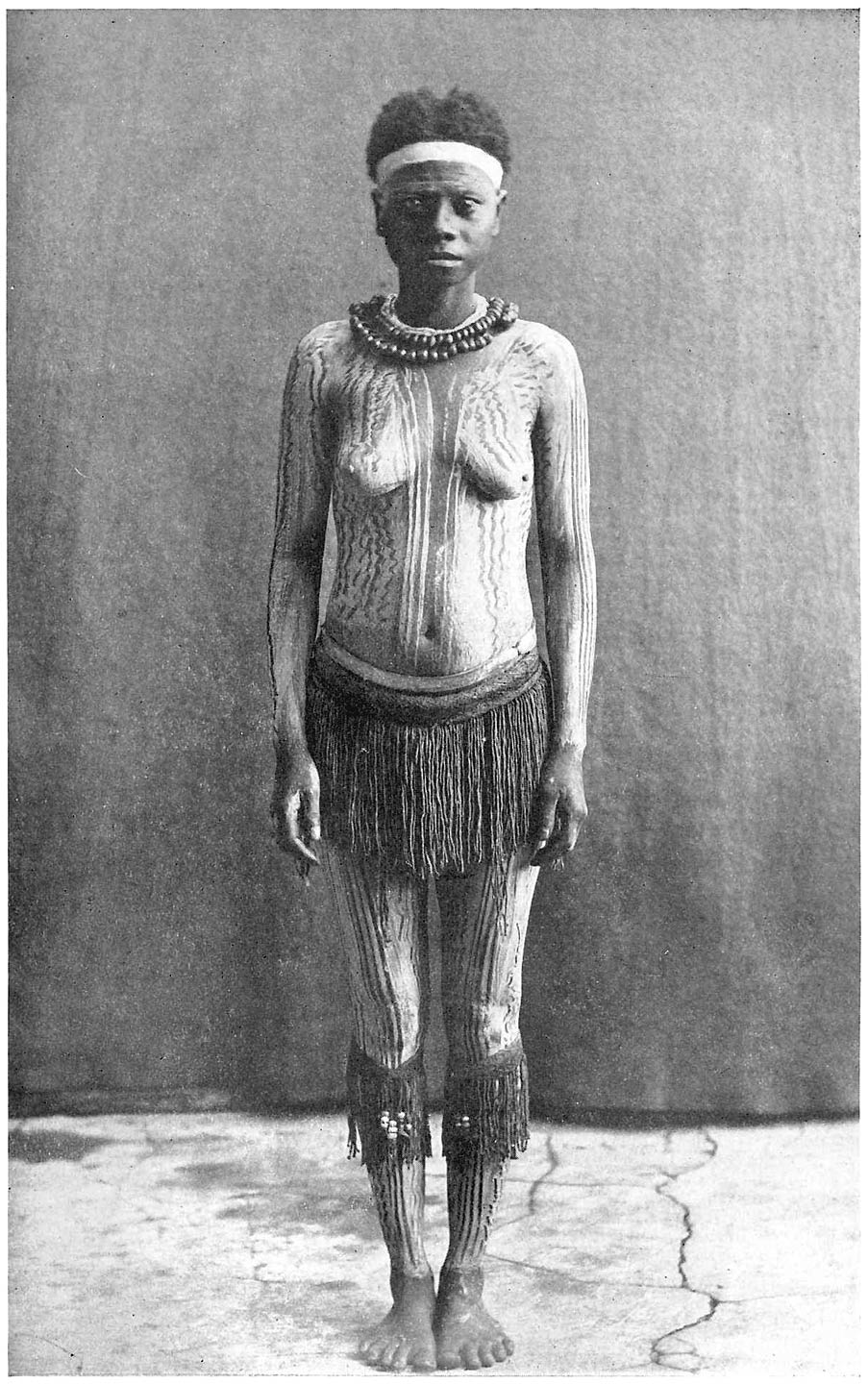
Plate IX
Woman decorated with odu clay
In the case of a boy there is nothing corresponding to the flower-names of girls. He continues to be known by his birth-name and his nick-name from the time he is born until he dies. During adolescence a youth has to pass through certain ceremonies of initiation as described in the present chapter. At the turtle-eating ceremony the youth is given a new name, of the nature of a nick-name. The name given in this way is never used either in addressing the youth or in speaking of him. It is possible that he also receives a new name on the occasion of the pig-eating ceremony, but of this I am not sure. Though girls pass through the same ceremonies as boys, I did not discover whether or not they also are given new names on these occasions.
Names are used freely in speaking of and to one another. An older person always speaks of or to the younger one by the name alone. When a younger person is speaking to an older one it is customary and polite to use one of the terms of address, either by itself, or prefixed to the name of the person spoken to, as Maia Buio, Mimi Kaba, etc. A native generally hesitates to tell his own name, and if asked the question “What is your name?” often asks a bystander to give the required information. There is, however, no hesitation about mentioning the name of any other person, except under certain special conditions.
There are certain occasions when the name of a man or woman is temporarily avoided. After the death of a relative and during the period of mourning, a mourner’s name is not mentioned, either in speaking to him or of him. There are a few terms that may be used instead. One who has lost a parent is addressed as Bolok, one who has lost a brother or sister as Ropuč. For a short time before and after the birth of a child the names of the father and mother are not mentioned. A bride and bridegroom are not addressed or spoken of by name for a short period after their marriage, though if their names be A and B there seems to be no harm in referring to A as “the husband of B,” or to B as “the wife of A.” During the initiation ceremonies through which every boy and girl must pass, the name of the initiate is avoided. Thus on the occasion of the turtle-eating ceremony or the pig-eating ceremony, during the few days the ceremony lasts and for a few weeks afterwards, the youth or girl is never addressed or spoken of by name, but is referred to as Kimil. During the ceremony that takes place on the occasion of the advent of puberty, and for some weeks after, a girl is not spoken of or to either by her birth-name or her flower-name, but is called Toto. When a boy, in the Northern tribes, has the scars made on his back, which show him to be no longer a child, his name is avoided for a few weeks and he is called Eǰido.
The name of a dead man or woman is not mentioned during the period of mourning, which lasts for some months after the death.
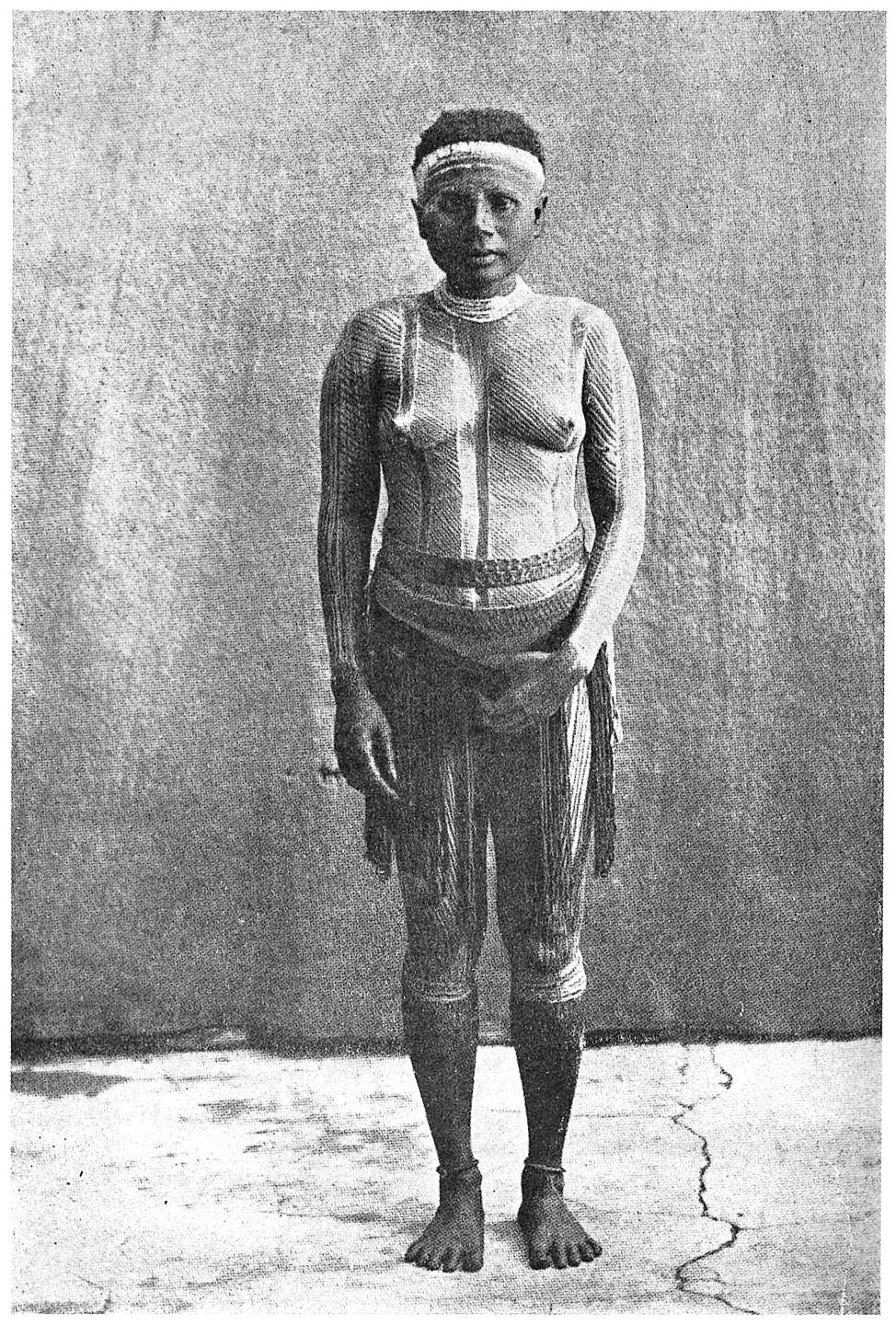
Plate X
Woman decorated with odu clay
In the preceding portions of the chapter reference has been made several times to the ornamentation of the body with clay and pigment. In the Great Andaman three different substances are used for painting the body. These are (1) a common clay of which different specimens are gray, yellow or pink, called odu in Aka-J̌eru and og in Aka-Bea; (2) a fine white pipe-clay which is rarer than the common clay and is more highly prized, called to̱l or to̱l-odu in Aka-J̌eru and tala-og in Aka-Bea; (3) a red pigment made by mixing burnt oxide of iron with animal or vegetable fat or oil, called keyip in Aka-J̌eru and ko̱iob in Aka-Bea.
The common clay (odu) is used in three different ways. After the death of a relative a man or woman smears himself all over with this clay and plasters it on his head. From this custom a person who is mourning for a dead relative is called aka-odu in Aka-J̌eru or aka-og in Aka-Bea. The same clay is used at a certain stage of the initiation ceremonies, as described above, being spattered over the initiate in the turtle-eating and pig-eating ceremonies. The third and most common use of this clay is to decorate the bodies of men and women with patterns called (in Aka-J̌eru) e̱ra-puli. These patterns are always made by the women, who decorate each other and their male relatives. The clay is mixed with water in a wooden dish or a shell and the mixture is applied to the body with the fingers. There is an almost indefinite variety in the patterns employed, although there are a certain number of what may be called usual designs. Each woman vies with others in her endeavours to produce some novelty of detail in her designs, and a successful innovation is immediately copied by others. I was able to watch the rise and development and ultimate disappearance of “fashions” in this connection in one of the camps of the North Andaman.
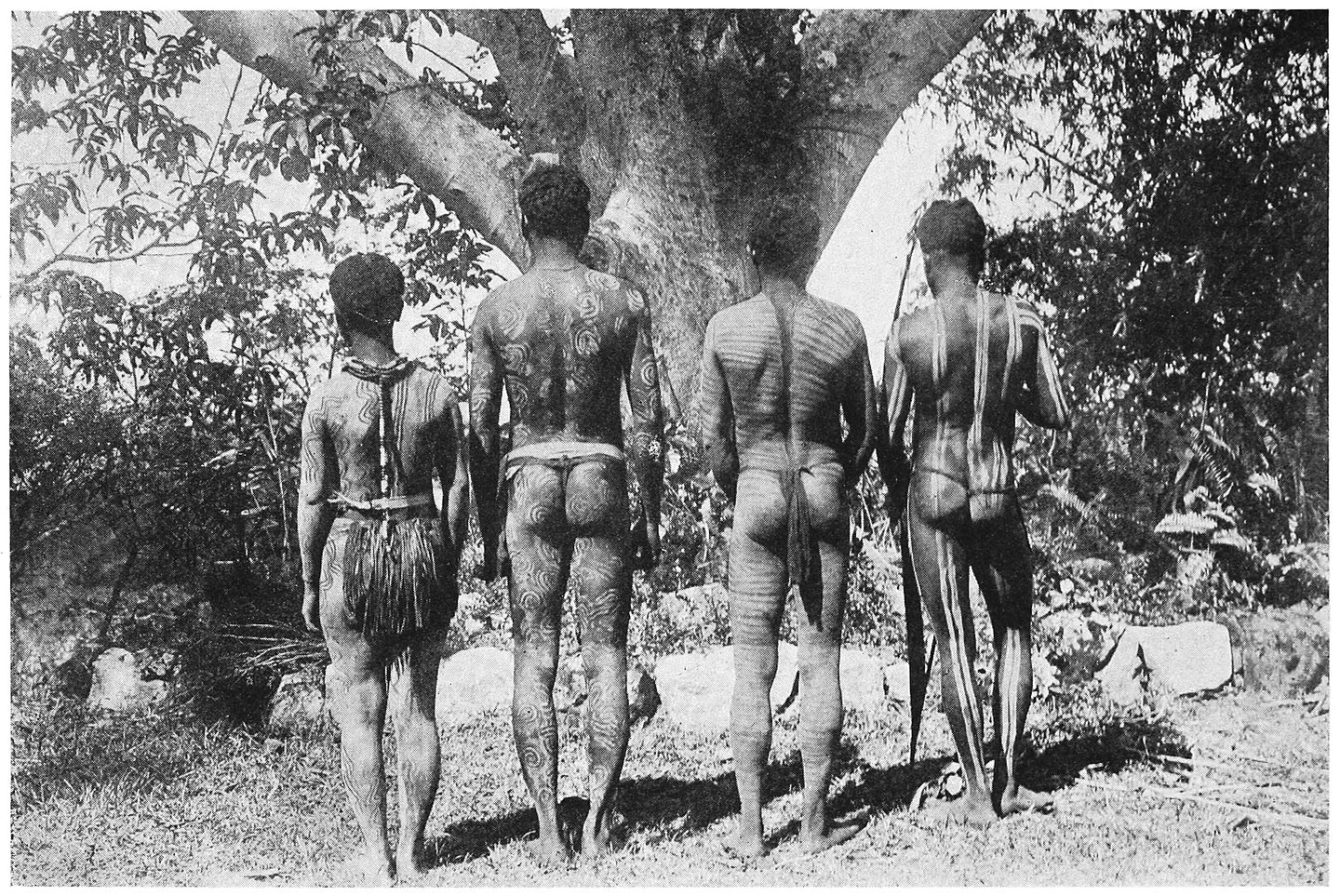
Plate XI
Three men and a young woman decorated with odu clay
The design is made in one of two ways. It may, in some cases, be formed by painting with the finger on the body, that is by tracing white (or gray) lines on a black surface. A design of this kind is shown on the back of the man on the right in the photograph of Plate XI. On the other hand, an equally common method is to cover a part of the body with an even smear of clay and then to scrape it away either with the fingers or with a small fish-bone or with a little instrument made of small strips of bamboo, so as to leave a design of black lines where the skin shows through the smeared clay. Two not very striking designs of this kind are shown in Plates IX and X. As a rule the designs are more or less symmetrical, the right and the left sides of the body being treated alike, but in a few cases different patterns are made on the two sides, and I have seen a man with one side of his body painted and the other not. The painting may cover the whole of the body and limbs with the exception of the hands and feet, or it may be confined to the front and back of the trunk, or it may be on the front only. The face is often painted, the designs being made with greater care than those on the body.
These patterns are made in the afternoon after the men return from their day’s hunting, and always either just before or just after a meal.
If a man be asked what pattern he is painted with, he replies by mentioning the food that he has just eaten. A man who has been eating turtle will say that the painting on his body is čokbi-t’e̱ra-puli, turtle pattern, while if he has been eating pork he will call it ra-t’e̱ra-puli, pig pattern. There is not, however, a strict uniformity in the use of particular patterns in connection with special foods. When the whole camp has been feasting on turtle many different and (apparently) unrelated designs are to be seen on the bodies of the men and women. I did not find it possible, even after a study of the matter, to distinguish by means of the design a man who has been eating turtle from one who has been eating pork. There is one design, or group of closely related designs, that seemed to be based on the pattern of the plates on a turtle’s carapace. A pattern of this distinctive kind was never, so far as my experience went, used except after eating turtle. Other patterns, however, which were used after eating turtle, did not seem to me to be related in any way to what I may call the specific turtle pattern. In some of the patterns used after eating pork I noticed a tendency to make use of vertical lines or bands on the back and chest. There may be a connection here with the longitudinal markings on the back of the wild pig.
Of special patterns I was only able to discover two. One of these is called kimil-t’e̱ra-puli and is only used to paint a person who is aka-kimil, i.e., who has just been through one of the initiation ceremonies. This pattern is shown on the back of a man in the photograph reproduced as Plate XI (the second figure from the left). Another special pattern is called toto-t’e̱ra-puli (Pandanus pattern), and is used, I believe, to decorate a girl after the ceremony at her first menstruation.
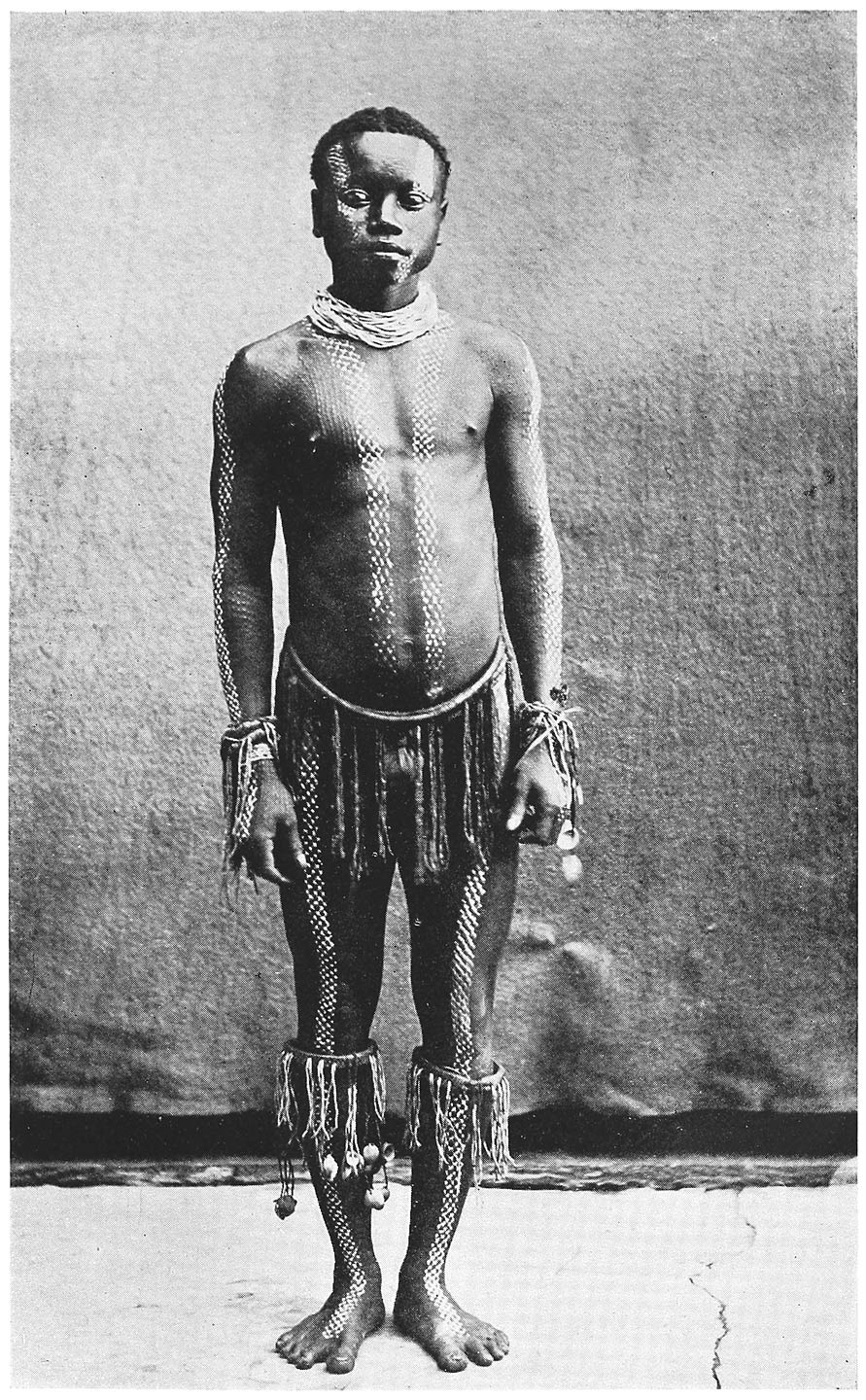
Plate XII
A young man decorated with white clay in readiness for a dance
The fine white clay called to̱l-odu in Aka-J̌eru is used in a different way and on different occasions. When it is used to ornament the body it is always applied in one customary pattern. The name of this pattern in Aka-J̌eru is o̱r-čubi-t’e̱ra-bat, from the name of a species of snake, o̱r-čubi. Exactly the same name is used in A-Pučikwar, wara-čupi-l’ar-par. Mr Man gives the Aka-Bea name as ǰobo-tartaŋa, from ǰobo the name for snake in general. A man decorated with this “snake pattern,” as it may be called, is shown in Plate XII, and a pattern of the same kind is shown on the head of the man in Plate XIII. The pattern is built up of zig-zag lines. They are made by taking a little of the clay mixed with water between the thumb and first finger; by a movement of the thumb the space between the nail and the skin of the finger is filled with the clay, and the end of the finger is then applied to the skin so that it leaves a short and fine line of clay. A zig-zag line is thus built up of short lines each a finger’s breadth in length. A second line is then added, not parallel to the first, but opposed to it, so that the two lines together form a row of lozenges. A third and sometimes a fourth or fifth line are similarly added. As shown in Plate XII the lines of pattern are carried down the front of the body, down the sides of the arms, and down the front of the legs, and they are similarly worked on the back of the body, and the back of the legs. The face also is decorated. These patterns are made by the women. It is one of the duties of a wife to decorate her husband in this way when occasion requires.
The only reason that the natives give for ornamenting themselves in this way is that it makes them “look well.” On the occasion of a big dance many of the performers are thus ornamented. This is always so at the dances held when two or more local groups meet together. There are certain special occasions, already mentioned in this chapter, when the use of the “snake pattern” is required by custom. One of these is the dance at the end of mourning. During the period of mourning the mourners are forbidden to make use of this form of decoration. The same pattern is used to decorate a bride and bridegroom after their marriage. In the initiation ceremonies the youth or girl is decorated in this way before the dances at the turtle-eating and pig-eating ceremonies. The same pattern is also made on a corpse before burial.
In all these cases the whole body is decorated. On less ceremonial occasions, such as an ordinary dance when there are no visitors of importance in the camp, a man frequently has his face alone decorated with white clay, as in the photograph of Plate XIII.
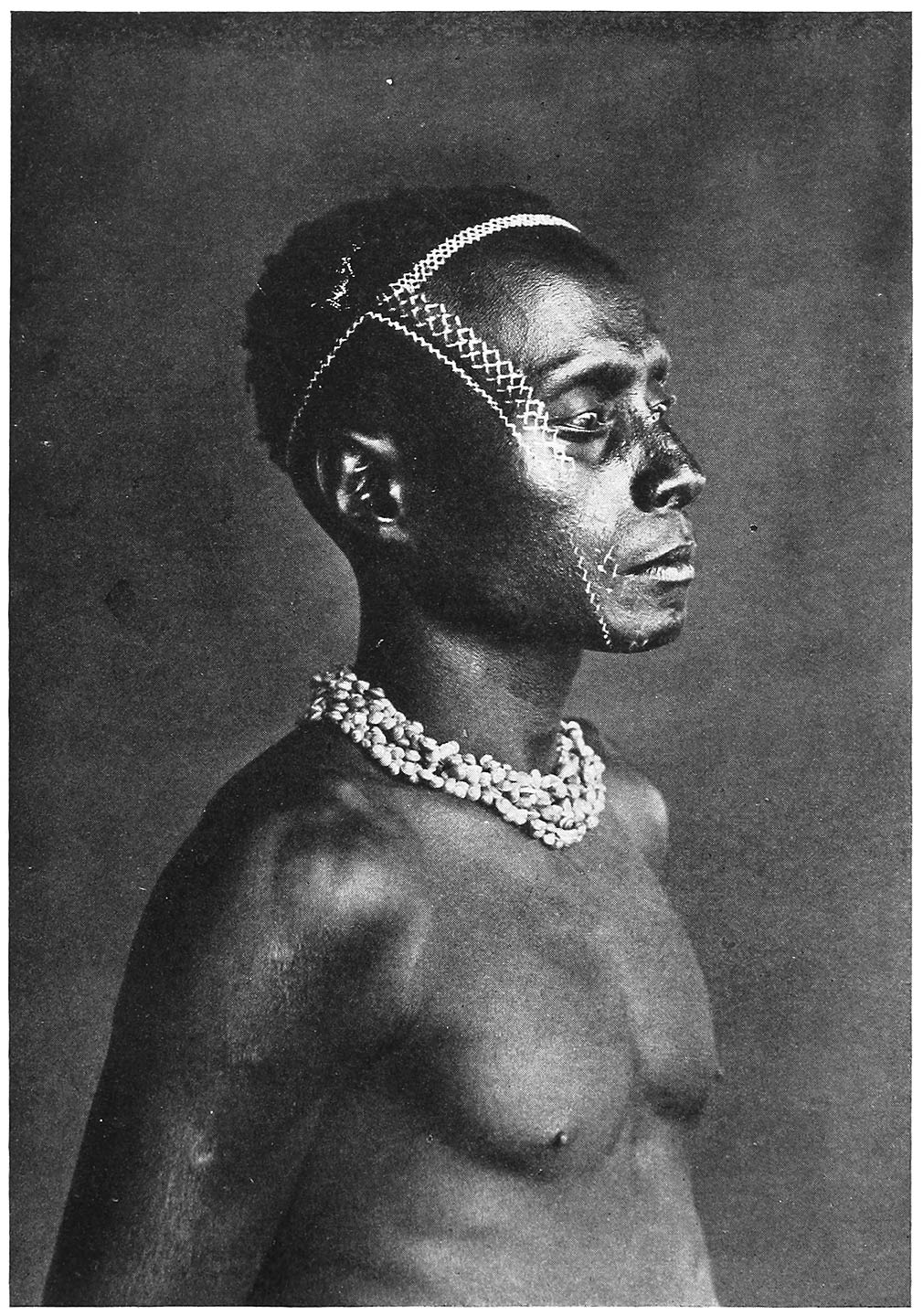
Plate XIII
A man with a pattern of white clay on his face
The third kind of material used for painting the body is red paint. This is applied in two different ways. When a man or woman is ill he or she is generally to be seen with some part of his body smeared with red paint. For colds and coughs the chest and neck are painted. In fevers red paint is smeared on the upper lip. Besides the medical use of red paint, if we may call it so, there is a ceremonial use, the pigment being used in combination with white clay, lines of red paint being applied to the body between the lines of clay of the snake pattern. It is used in this way to decorate the body of a dead person for burial, and on ceremonial occasions such as the dance at the end of mourning and the dances in connection with the initiation ceremonies.
Most of the ornaments worn at various times by the Andaman Islanders have a ceremonial or a magical purpose. The only things worn by men that can be considered to have a utilitarian value are the belt of rope and the necklet of string. The belt may be a plain piece of rope, or it may be ornamented with the yellow skin of a species of Dendrobium. It serves as a receptacle in which the natives carry such things as adzes, fish, roots, or even arrows. It is the one object that is constantly worn by men. The string necklet is simply a length of thin string tied round the neck. It serves as a means of carrying a knife and skewer. The knife, in former days made of a slip of cane, but in these times from a piece of scrap iron, is attached to a skewer of Areca wood by a short length of rope or stout string. By sliding either the knife or the skewer under the necklet at the back of the neck the double implement hangs securely in a position where it is not likely to get lost when running through the jungle, and where it is immediately accessible when wanted. The necklet also serves as a means of carrying bees’-wax, which is in constant use amongst the natives, a small ball of the wax being attached to one of the ends of the string of which the necklet is made.
As a rule, in everyday life, the men wear only a belt, or a belt and necklace. Those natives who visit the Settlement of Port Blair have been required by the European officers to wear a strip of cloth over the genitals. It has now become the rule to wear such a loin cloth whenever they are in the neighbourhood of a European. This, however, is a modern custom, and in former times the men went freely with no covering whatever, as do the inhabitants of the Little Andaman at the present time. As showing the extent to which the natives have been influenced in this matter by outside opinion, it may be mentioned that at the present day many of the younger men, particularly those who have been brought up at Port Blair, regard it as very immodest to be seen without some covering over the genitals.
On ceremonial occasions, such as the dance at the end of mourning, or a big dance-meeting, the men put on a number of ornaments. A common costume on such occasions consists of a belt, necklace, bracelets, and garters of netting and Dentalium shell. A belt and necklace of this kind are to be seen in Plate V, and garters are worn by the woman in Plate IX. An alternative costume for men consists of a set of ornaments of Pandanus leaf (belt, chaplet, bracelets and garters), decorated with Dentalium and other shells. Garters of this kind are shown in Plate XII.
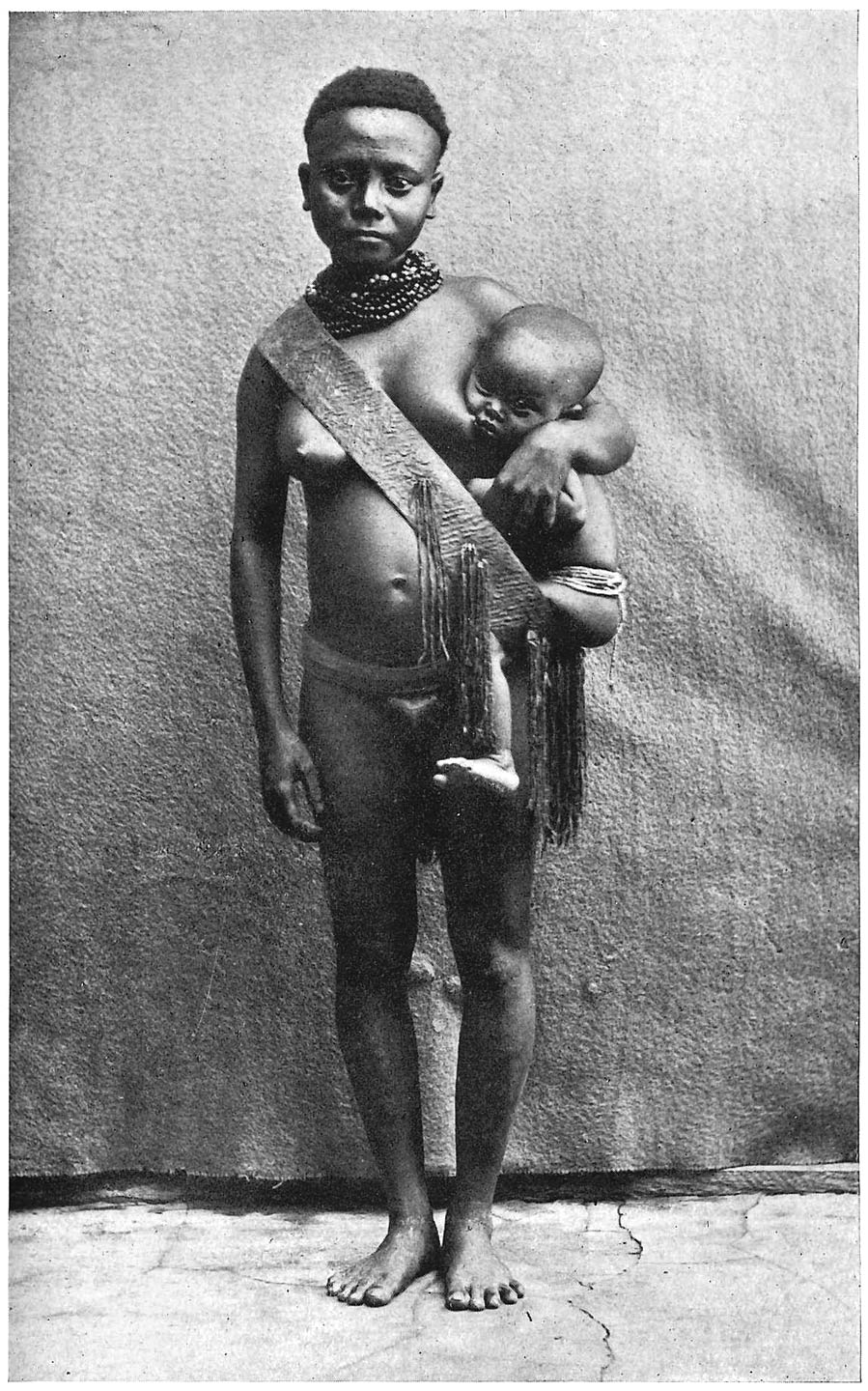
Plate XIV
A woman with her child
Other objects are worn by the natives for magical purposes. Chief amongst these are the strings made of human bones which are worn to prevent and cure sickness. The bones are attached to a length of rope, and this is generally decorated with shells or with Dendrobium skin. These strings of bones are worn most commonly as chaplets, necklaces or belts, but they may also be made into garters and bracelets. The bones of animals, such as pig, turtle, dugong, etc., are treated in exactly the same way as human bones, and ornaments made of them are commonly worn.
There are a number of other ornaments that are commonly worn, not only on ceremonial occasions, which, unlike the strings of human bones, do not obviously have a magical purpose. Such are necklaces made of various kinds of shells, and of mangrove seeds. At the present time the natives obtain beads from Port Blair and make ornaments of these.
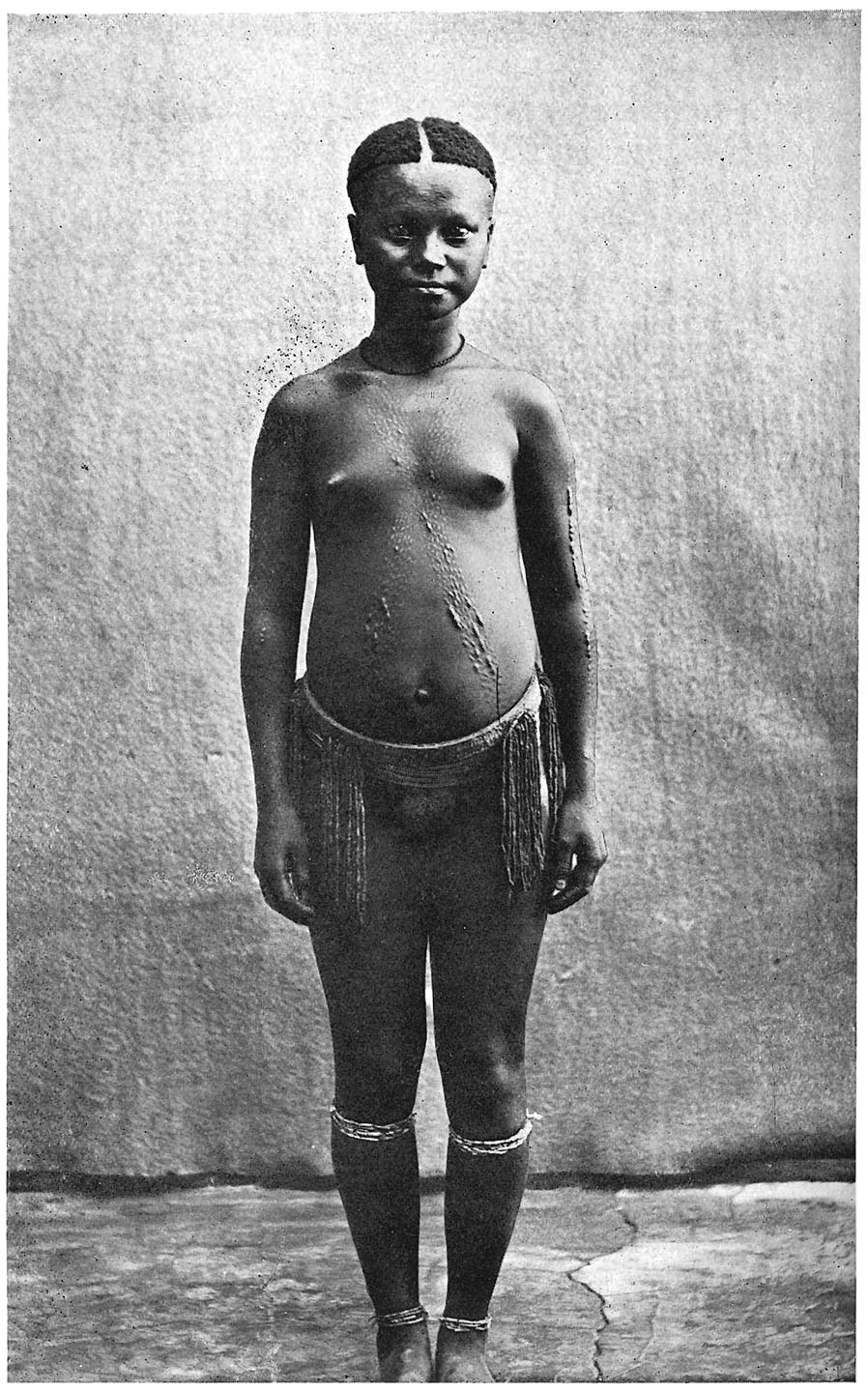
Plate XV
A young married woman, showing pattern scarified on body and arms
The ordinary costume of the women is different from that of the men. Every woman and girl wears at least one belt of Pandanus leaf. There is one kind of belt that is always worn by married women and which may not be worn by unmarried girls. There is another kind of belt that may only be worn by unmarried girls. The women of the Southern tribes wear a bundle of leaves of the Mimusops littoralis laid one over another suspended from the front of the belt so as to cover the pudenda. In the Northern tribes it was formerly the custom for the women to wear a similar apron of the leaves of a plant called čainyo, and over this they also wore a tassel of shredded palm-leaf stem (koro). Within recent years the Northern tribes have given up their own custom in this matter and have adopted the custom of the Southern tribes.
Women often wear round the neck a piece of string similar to that worn by the men, but as they do not carry knives it does not serve the same purpose. It is more usual for a woman to wear a necklace of some sort. Nowadays they are rather fond of necklaces of beads which they obtain from the Settlement at Port Blair. In former times different kinds of shells were used, such as the Dentalium octogonum.
With the exception that men wear the belt of rope, and women wear the belt of Pandanus leaf and the apron of leaves, there is no difference between the ornaments worn by men and by women. On the occasion of a dance or other ceremony a woman may wear any of the objects described as being worn by men on such occasions. They also wear in the same way strings of human or animal bones.
One object which would seem to have a purely utilitarian purpose is the sling used for carrying children (called in Aka-J̌eru čiba). This object, however, seems to have its ceremonial uses also. In one of the initiation ceremonies that I saw, the man who was officiating wore such a sling round his shoulders during the ceremony.
In the earlier parts of this chapter reference has been made several times to the dance of the Andaman Islanders. For the natives the dance is both a means of enjoyment and also a ceremony. The period of mourning for the dead is brought to a close by a dance, in which all the mourners join. As will be shown later, a dance was generally held before a fight, in former times when fights occurred. The ceremony by which two hostile local groups made peace with one another was a dance.
In the initiation ceremonies there are special dances, which have already been described, in connection with the pig-eating and turtle-eating ceremonies. With the exception of these special dances, and the peace-making dance to be described later, there is only one kind of dance in any given tribe. Thus the dance at the end of mourning, or before setting out on an attack on enemies, is in all essentials exactly the same as the dance in which the natives indulge when the day’s hunting has been successful and the evening is fine.
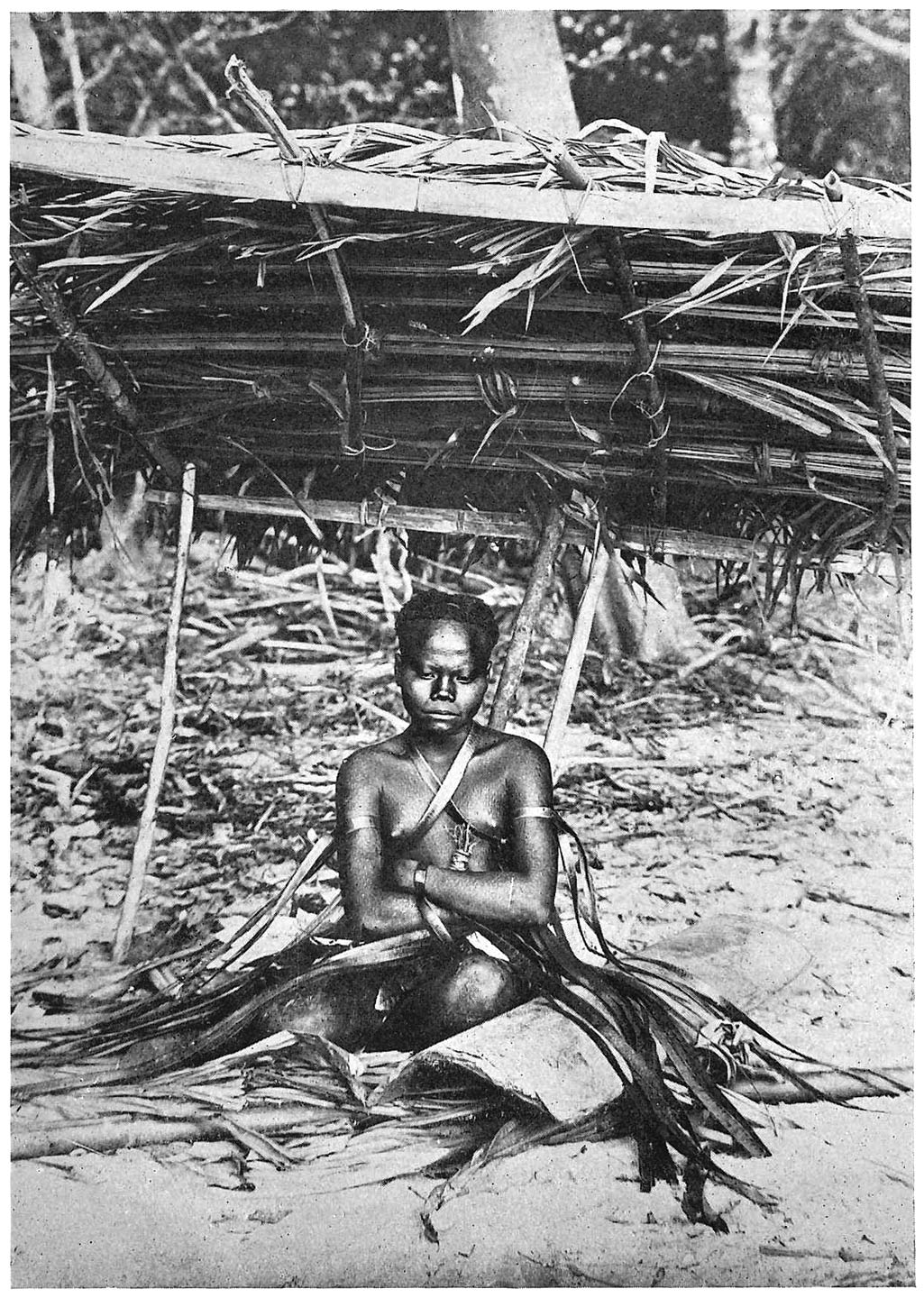
Plate XVI
A girl during the ceremony at puberty, decorated with strips of Pandanus leaf
The time for dancing, except in connection with certain ceremonies, is at night, after the evening meal. The dance takes place on the open ground in the centre of the village. This is swept clean by the women and the younger men. One or two fires are lighted, and little heaps of resin are placed in convenient situations to provide lights. These have to be replenished from time to time as the dance proceeds. Near one end of the dancing ground is placed a sounding-board, upon which it is the duty of one man to beat time with his foot. A sounding-board is a piece of wood somewhat of the shape of a large shield, cut from the hard Pterocarpus tree. One is shown in Plate VI. Behind the sounding-board, or a little to one side of it, the women, who form the chorus, sit in a row, with their legs stretched out in front of them, facing the dancing-ground. The men who intend to dance sit or stand round the edge of the space reserved for the dance.
When all is ready a man who has volunteered to sing the first song takes his stand at the sounding-board, and sings his song through. When he reaches the chorus the women take it up and repeat it after him, and as they do so each woman marks time by clapping her hands on the hollow formed by her thighs, the legs being crossed one over the other at the ankle. The singer continues to sing, thus leading the chorus, and at the same time marks the time of the song by beating on the sounding-board with his foot. As soon as the chorus begins the dancers begin to dance. The step of each dancer is the same, but there is very little attempt to form a figure. When the singer and the chorus get tired, the singing ceases, but the man at the sounding-board continues to mark time for the dancers. The singer repeats his song several times, and he may sing several songs, each repeated several times. When he gets tired he is relieved by another man. In a dance that lasts for any time, one singer succeeds another, and the singing and dancing are kept up continuously, sometimes for five or six hours.
The above description applies to all the tribes of the Great Andaman, but there are some differences between the four tribes of the North Andaman, and the tribes of the Middle and South Andaman.
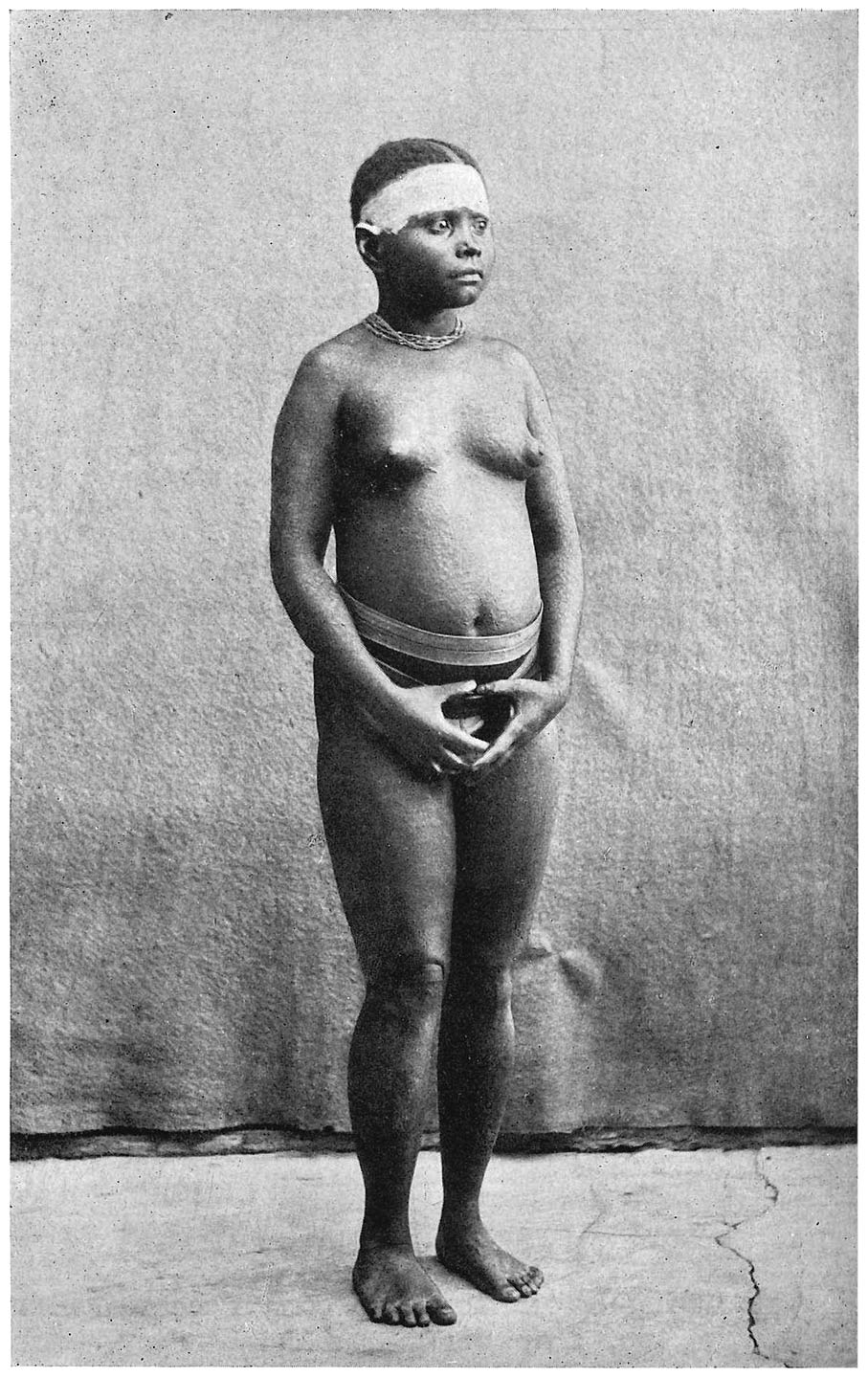
Plate XVII
A woman wearing clay on her forehead as a sign of mourning
In the North Andaman the song is sung through once from beginning to end by the singer, and is then repeated three or four times by the chorus. In the South Andaman each song consists of one verse and a refrain, if we may speak of them thus. The singer sings the verse and the refrain, and then the refrain only is repeated an indefinite number of times by the chorus.
In the dance of the Southern tribes, each dancer dances alternately on the right foot or on the left. When dancing on the right foot the first movement is a slight hop with the right foot, then the left foot is raised and brought down with a backward scrape along the ground, then another hop on the right foot. These three movements, which occupy the time of two beats of the song, are repeated until the right leg is tired, and the dancer then changes the movement to a hop with the left foot, followed by a scrape with the right and another hop with the left. The time of the movement is as follows, the upper line being the rhythm of the dance, while the lower line shows the beats of the song, which is marked on the sounding-board and by the clapping of the women.
or


The body of the dancer is bent slightly forward from the hips, the legs being flexed at the knees and the back being curved well inwards. There are several ways of holding the hands and arms, one of the commonest being to hold the arms outstretched in front on a level with the shoulders, while the thumb and forefinger of one hand are interlocked with those of the other. When a man does not wish to cease altogether from dancing but desires to have a short rest, he marks the time by raising each heel alternately from the ground. As a man dances he remains in one spot for a short time, and then, still continuing the same step, moves for a yard or two around the circle of the dancing ground. Every now and then a dancer is to be seen trotting from one position to another across the dancing ground, abandoning the step of the dance, but still keeping time to the song.
The Northern tribes have now adopted the same kind of dance as the tribes of the South, but formerly their dance was slightly different. There was a little more attempt at forming a figure, the dancers moving for the most part in a circle, some in one direction and others in the other. The step was as follows: a step forward with the right foot, a hop on the right foot, a scrape with the left, then another hop with the right, a step forward with the left foot, a hop with the left, a scrape with the right and a hop with the left. The rhythm is as follows:—
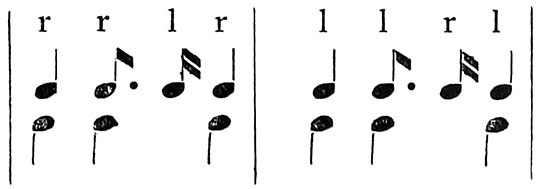
The lower line shows the beats on the sounding-board.
Some of the dancers occasionally break into the regular Southern step. A dancer sometimes changes from the usual step to another called ko̱i, in which each foot is alternately struck on the ground and scraped backwards. Other slight variations of the movement may be introduced.
In both the Southern and the Northern dance each dancer pleases himself as to the direction in which he moves, and the step that he adopts at any given moment. All the dancers, however independently of one another they dance, keep strict time to the music.
Women do not, as a rule, join in the ordinary dances held in the evening. Their share in the entertainment consists of forming the chorus. When they do dance, as they do on certain occasions, such as the dance at the end of mourning, their step is different from that of the men. In the Southern tribes the female dancer stands at one spot with knees flexed and lifts her heels alternately from the ground in time to the music, thus producing a slight swaying or swinging motion of the hips. After dancing thus at one spot for a few moments, she moves forward a few steps to a new position, keeping time to the music in all her movements, and then repeats the same performance. The arms are swung in time to the dance, or else are held before the breast with one wrist crossed over the other.
In the Northern tribes the common dance of the women is a sort of modification of that of the men. A woman advances across the ground in regular time, but at every third step she gives a peculiar little hop which has something of the effect of a bobbing curtsey. The time is as follows:—
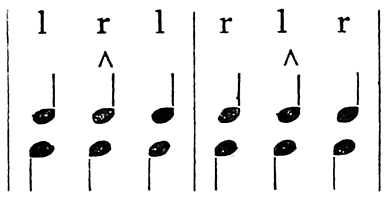
l and r standing for left and right foot, and the accent indicating the hop or curtsey. Every now and then a dancer stops and remains at one spot, alternately scraping each foot backwards, holding her knees flexed, and swinging both arms together.
The ordinary dance of the Andamanese, as described above, must always be accompanied by a song, and the purpose of every song is to serve as the accompaniment to a dance. Every man composes his own songs. No one would ever sing (at a dance) a song composed by any other person. There are no traditional songs. Women occasionally compose songs, but I never heard a woman sing at a dance except in the chorus.
Every man composes songs, and the boys begin to practise themselves in the art of composition when they are still young. A man composes his song as he cuts a canoe or a bow or as he paddles a canoe, singing it over softly to himself, until he is satisfied with it. He then awaits an opportunity to sing it in public, and for this he has to wait for a dance. Before the dance he takes care to teach the chorus to one or two of his female relatives so that they can lead the chorus of women. He sings his song, and if it is successful he repeats it several times, and thereafter it becomes part of his repertory, for every man of any age has a repertory of songs that he is prepared to repeat at any time. If the song is not successful, if the chorus and dancers do not like it, the composer abandons it and does not repeat it. Some men are recognized as being more skilful song-makers than others.
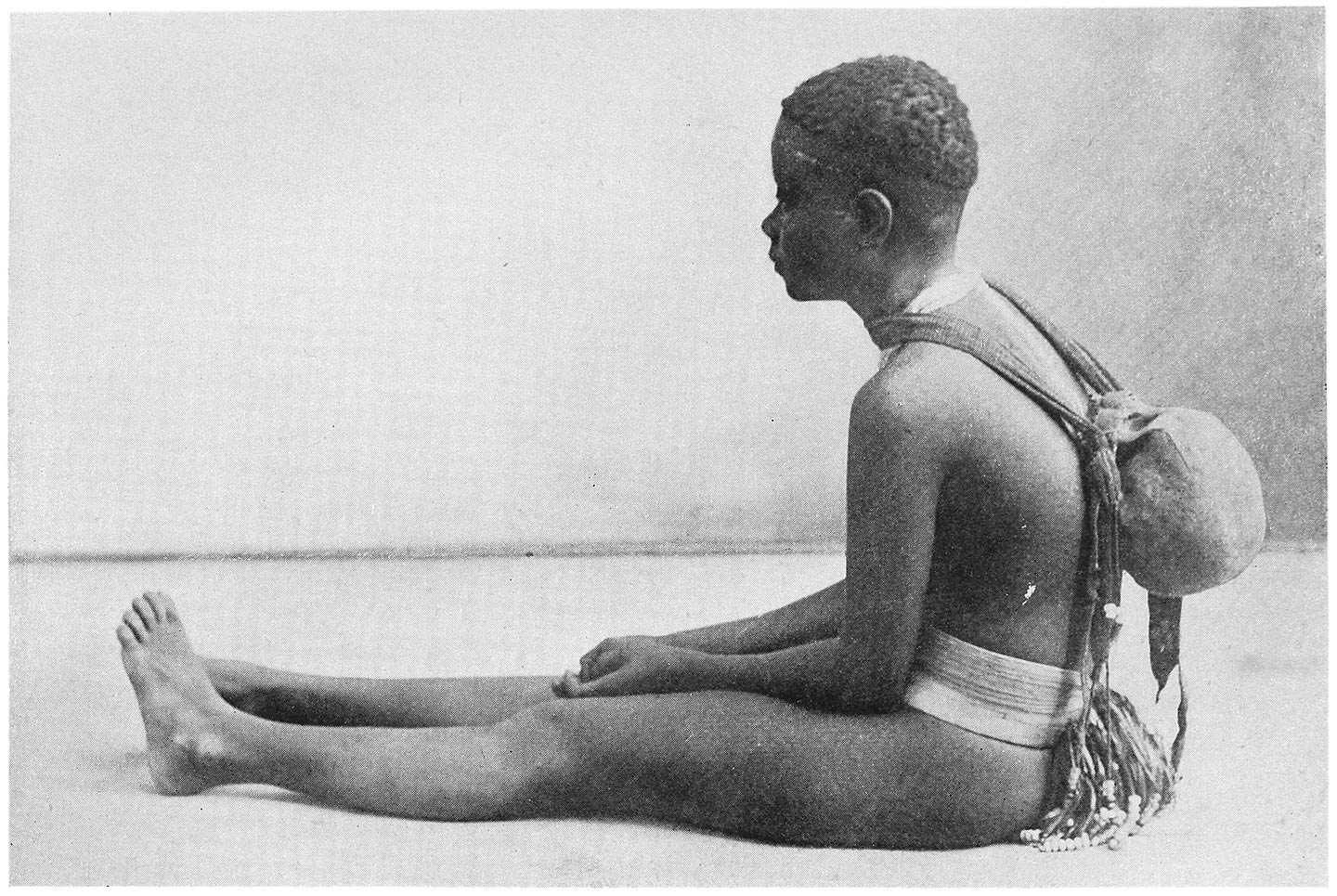
Plate XVIII
A girl wearing her sister’s skull
According to the statements of the natives it was formerly the custom to have a dance before setting out to a fight. There was no special war-dance, the warriors joining in an ordinary dance such as has just been described. Those who intended to take part in the attack on their enemies, i.e., all the able-bodied adult males, decorated themselves with red paint and white clay, and put on ornaments of Pandanus leaf or netting and shells. Each man held in his hands or placed in his belt or head-dress plumes of shredded Tetranthera wood (called čelmo in Aka-J̌eru, uǰ in Aka-Bea). These plumes of shredded wood are now often worn or carried in an ordinary dance, but I believe that in former times they were the distinctive sign of a war-dance. To make them, a short length of the wood is taken (generally a piece of an old broken pig-arrow) and the wood is carefully shredded with a Cyrena shell, care being taken not to break any of the longitudinal fibres. One end is then tied with a piece of string or fibre. Similar plumes are made from Pandanus wood, and are carried or worn in a similar manner.
When the attacking party set out from their village each man wears a plume of shredded Tetranthera wood thrust into the back of his belt. They rub their bows with the shredded wood, and say that this has the effect of making their own bows shoot well and those of their enemies shoot badly.
If a man kills another in a fight between two villages, or in a private quarrel, he leaves his village and goes to live by himself in the jungle, where he must stay for some weeks, or even months. His wife, and one or two of his friends may live with him or visit him and attend to his wants. For some weeks the homicide must observe a rigorous tabu. He must not handle a bow or arrow. He must not feed himself or touch any food with his hands, but must be fed by his wife or a friend. He must keep his neck and upper lip covered with red paint, and must wear plumes of shredded Tetranthera wood (čelmo) in his belt before and behind, and in his necklace at the back of his neck. If he breaks any of these rules it is supposed that the spirit of the man he has killed will cause him to be ill. At the end of a few weeks the homicide undergoes a sort of purification ceremony. His hands are first rubbed with white clay (to̱l-odu) and then with red paint. After this he may wash his hands and may then feed himself with his hands and may handle bows and arrows. He retains the plumes of shredded wood for a year or so.
In the North Andaman, and possibly in the South also, there was a ceremony by which two hostile local groups made peace with one another. When the two groups have agreed to make friends and bring their quarrel to an end, arrangements are made for this ceremony. The arrangements are made through the women of the two parties. A day is fixed for the ceremony, which takes place in the country of the group that made the last attack. In the village of this group the dancing ground is prepared, and across it is erected what is called a koro-čop. Posts are put up in a line, to the tops of these is attached a length of strong cane, and from the cane are suspended bundles of shredded palm-leaf (koro). The appearance of this construction may be seen from the photograph reproduced in Plate XIX. The women of the camp keep a look-out for the approach of the visitors. When they are known to be near the camp, the women sit down on one side of the dancing ground, and the men take up positions in front of the decorated cane. Each man stands with his back against the koro-čop, with his arms stretched out sideways along the top of it. None of them has any weapons.