Chapter I · THE SOCIAL ORGANISATION
Reading edition
In the present chapter we are to deal with the customs and institutions by which the natives of the Great Andaman regulate the conduct of persons one to another. At the outset it is necessary to get as clear an idea as possible of the structure of the Andamanese society. That structure, as will be shown, is extremely simple.
What is really of interest to the ethnologist is the social organisation of these tribes as it existed before the European occupation of the islands. The changes that have taken place in recent years have been extensive, the most important being the great diminution in numbers and the merging together of what were formerly distinct and often hostile communities. It is fairly easy, however, to discover from the natives themselves what was the constitution of the society in former times, though there remain a few points about which no satisfactory information can be obtained.
When the islands were first occupied by the British, before depopulation had affected their institutions, the natives of the Great Andaman were to be found living in small communities scattered over the islands, mostly on the coast, but some of them in the forest of the interior of the island. Each such community, which will be spoken of as a “local group,” was independent and autonomous, leading its own life and regulating its own affairs. Each group had occasional relations with other neighbouring groups; visitors might pass from one to another; or the two groups might meet together for a few days and join in feasting and dancing. On the other hand there were often quarrels between neighbouring groups, which might result in a state of feud between them for many months. Between communities separated from one another by a distance of only 50 miles or even less there were no direct relations whatever. The members of one community kept to their own part of the country, only leaving it to visit their friends within a narrow radius.
These local groups were united into what are here called tribes. A tribe consisted of a number of local groups all speaking what the natives themselves regard as one language, each tribe having its own language and its name. The tribe was of very little importance in regulating the social life, and was merely a loose aggregate of independent local groups.
The local groups are further distinguished by the natives themselves as being of two kinds according as they lived on the coast or inland. This division was independent of that into tribes. Some tribes consisted of coast-dwellers only, while others included both coast-dwellers and forest-dwellers.
Within the local group the only division was that into families. A family consists of a man and his wife and their unmarried children own or adopted.
These were the only social divisions existing among the Andamanese, who were without any of those divisions known as “clans” which are characteristic of many primitive societies.
The natives of the Great Andaman (leaving aside the J̌a̤rawa, who by language and culture belong to the Little Andaman division of the race) are divided into ten tribes, each occupying a certain area of country. Each tribe consists of a number of persons who speak what is regarded by the natives themselves as one language. That the tribe is fundamentally a linguistic group is shown by the tribal names. These are all formed from a stem with the prefix aka-, which prefix is used in the languages of the Great Andaman to convey a reference to the mouth and thereby to the function of speech. Thus in the Aka-J̌eru language the stem poŋ means “a hole of any kind,” and aka-poŋ means “the mouth,” there being no other word for that part of the body. In the same language the stem -ar- meaning “to talk” can only be used with the prefix aka-, as ak’-ar-ka, “he says.” The prefix which is characteristic of the tribal names, indicates, therefore, that these are really the names of languages.
Aka-Bea Fresh water.
O̱ko̱-J̌uwo̱i They cut patterns on their bows.
Aka-Ko̱l Bitter or salt taste.
I may take this opportunity of pointing out two errors in the names of the tribes given in the “Census Report” of 1901. The name Aka-Čari is given as Aka-Chariar; the stem -ar- means “to talk” and is not an essential part of the tribal name; Aka-Čari-ar-bom means “he talks the Čari language.” The name Aka-Bo is given as Aka-Tabo; t’a-Bo means “I (am) Aka-Bo,” just as t’a-J̌eru means “I (am) Aka-J̌eru,” the prefix aka- being contracted to a- after the personal pronoun t’ = I or my.
Although the natives themselves thus recognize and give names to ten distinct languages, all of them are closely related. There is, on the whole, not a great deal of difference between two neighbouring languages. A man of the Aka-J̌eru tribe could understand without any great difficulty a man speaking Aka-Bo. On the other hand many of the languages included two or even more distinct dialects. In the Akar-Bale tribe there were two dialects, one in the southern half of the Archipelago, which was allied to Aka-Bea, and the other in the northern half, showing affinities with A-Pučikwar. Even in such a small tribe as the Aka-Čari it would seem that there were differences of dialect. Thus, even from the point of view of language, the tribe was not entirely homogeneous.
Leaving aside the Aka-Bea, the average extent of territory occupied by a tribe was about 165 square miles. Of the nine tribes the largest, as regards area, was the Aka-Kede, with over 300 square miles, while the smallest was probably the Aka-Čari, with less than 100 square miles. Save in the case of the Akar-Bale tribe, which occupied the islands of Ritchie’s Archipelago, it is difficult to find any marked geographical features that might be supposed to have determined the extent and the boundaries of the different tribes.
The Aka-Bea tribe was in an abnormal position as there was no recognized boundary between them and the J̌a̤rawa. Together, these two divisions of the Andamanese occupied an area of about 600 square miles. The Aka-Bea seem to have kept more to the coast while the J̌a̤rawa occupied the interior of the South Andaman and Rutland Island.
Besides the division into tribes, and independent of it, the Andamanese recognize another division into coast-dwellers and forest-dwellers. In the Aka-Bea language the coast-dwellers are called Ar-yoto, while the forest-dwellers are called Erem-taga. The difference between them is due solely to the difference of their food supply. The Ar-yoto obtain much of their food from the sea. They are expert in fishing and turtle hunting. They make canoes and use them not only for hunting but also for travelling from one camp to another. Some portion of their food they also obtain from the forest, edible roots and fruits and the flesh of the wild pig being the chief. On the other hand the Erem-taga rely solely on the forest and the inland creeks for their food supply. Their only use for canoes is in the creeks. They are entirely ignorant of such matters as turtle or dugong hunting, but they are more at home than the coast-dwellers in the forest, and are generally more skilful at pig-hunting. The advantage certainly rests with the coast-dwellers, for they have both the sea and the forest to draw upon for their sustenance.
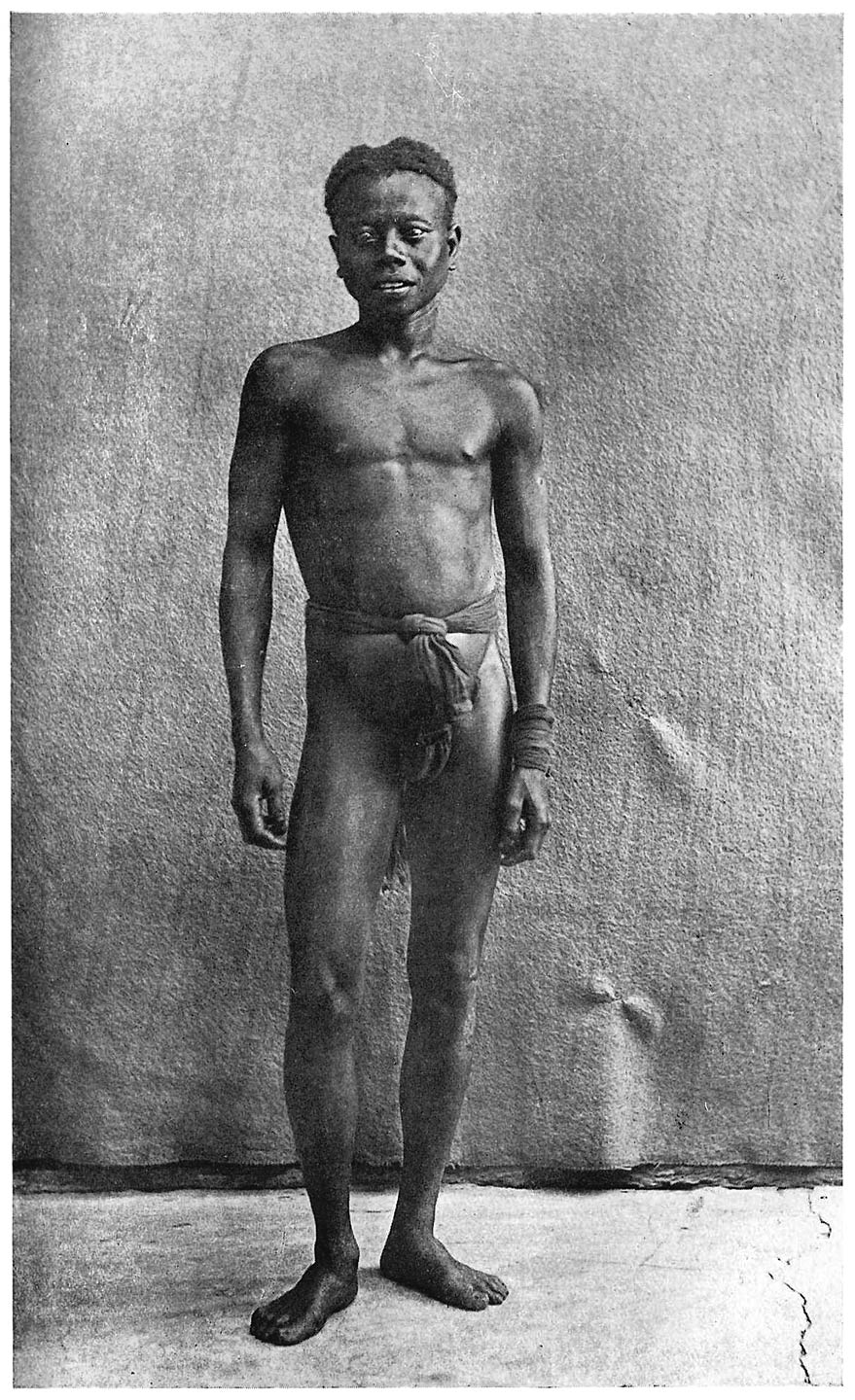
Plate I
A young man of the North Andaman
Some tribes consist only of coast-dwellers, such as the Aka-Čari, the Akar-Bale and perhaps the Aka-Ko̱l. On the other hand the Aka-Bo, although their territory includes a part of the west coast, are, by their occupations and mode of life, forest-dwellers, and the same seems to have been the case of the O̱ko̱-J̌uwo̱i. The A-Pučikwar, the Aka-Kede, the Aka-J̌eru and perhaps also the Aka-Ko̱ra tribes contained both coast-dwellers and forest-dwellers.
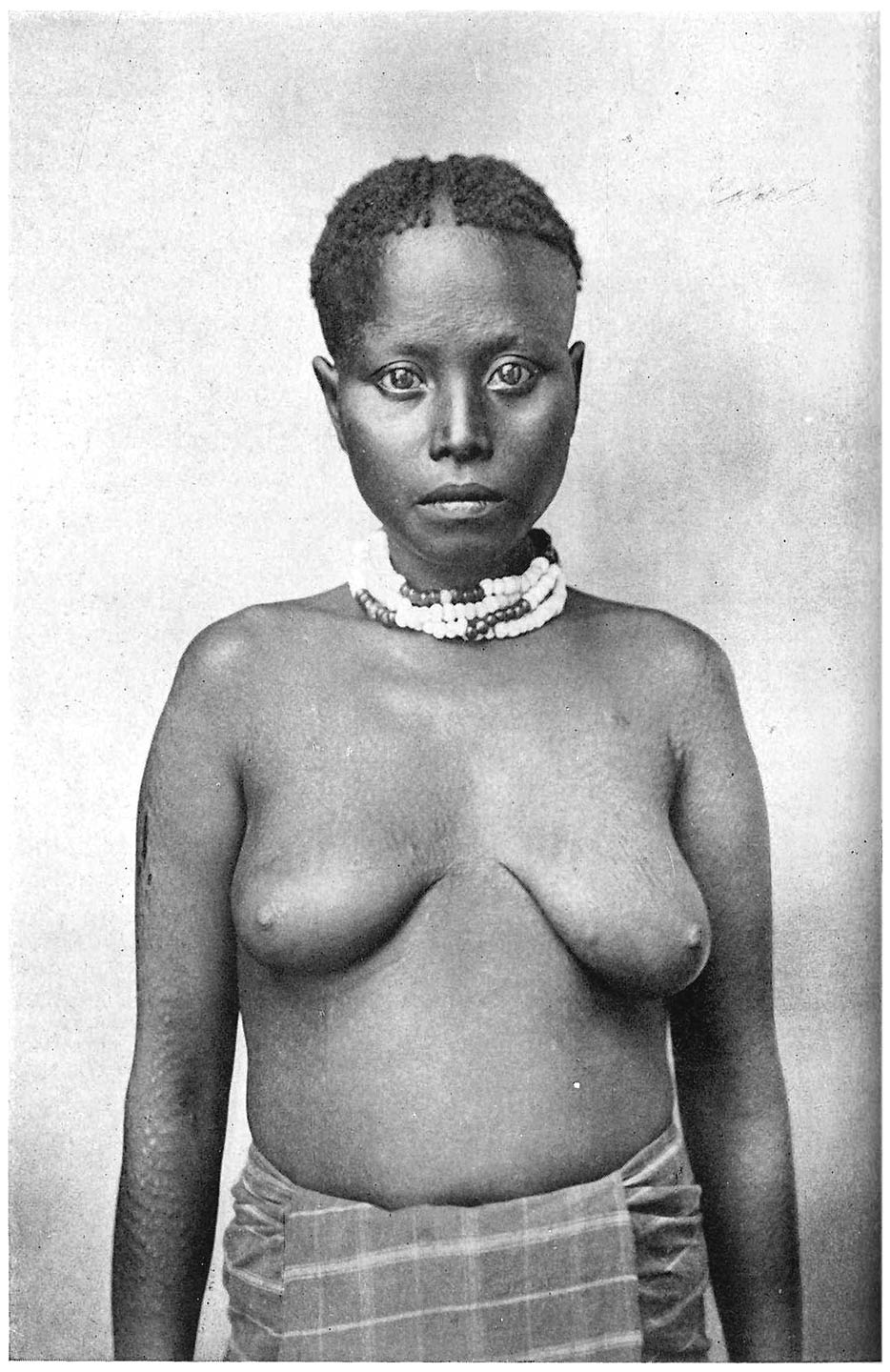
Plate II
A young married woman
From the information that I was able to obtain from the natives themselves I came to the conclusion that an average local group consisted of from 40 to 50 persons of all ages, the average number of local groups to a tribe being about 10. This would give the average extent of country occupied by each local group as about 16 square miles, but some groups certainly had a larger territory than this and some had smaller.
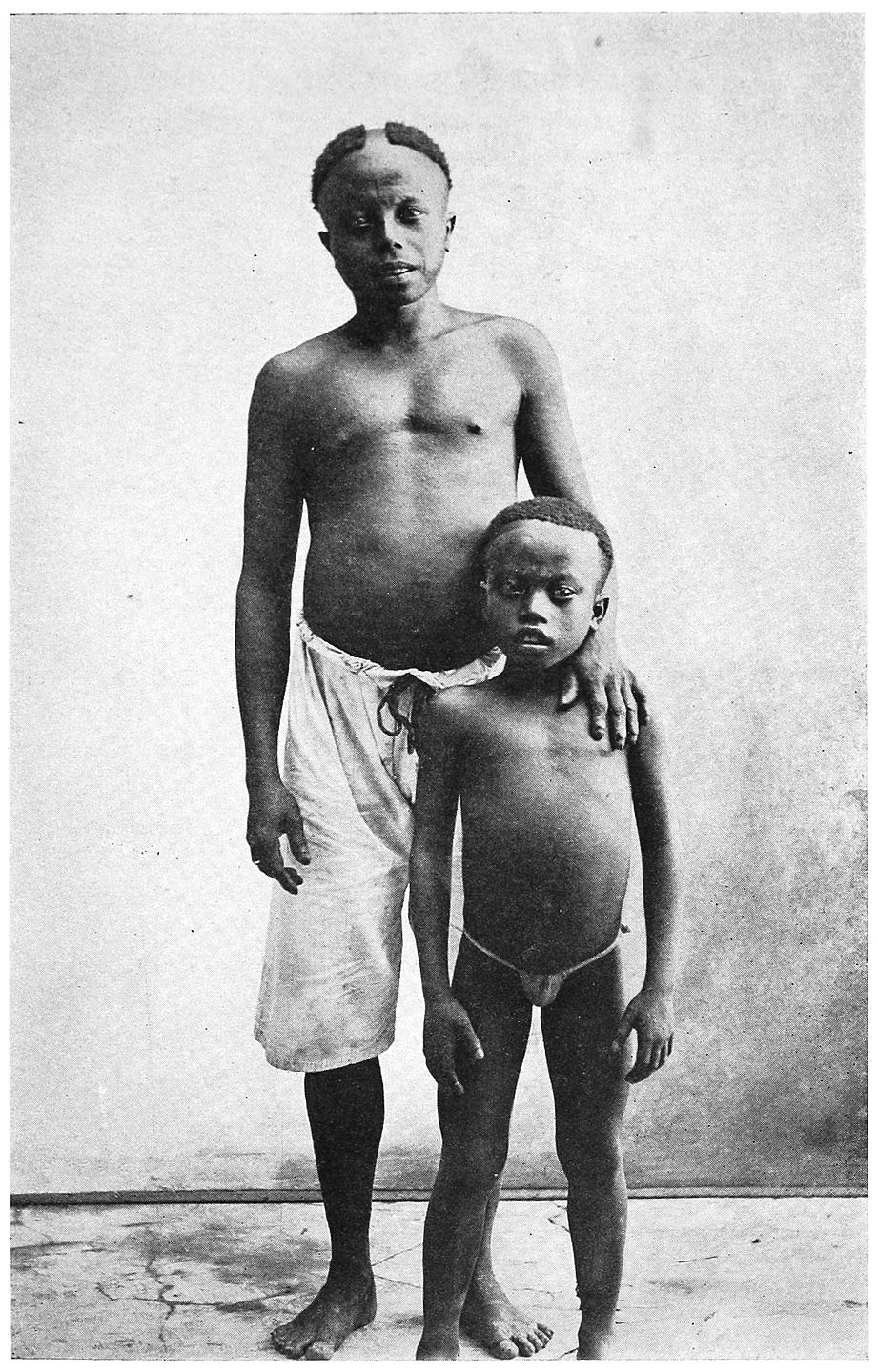
Plate III
A man of the North Andaman and his son. (The man’s height is 1438 mm., 4 feet 8 inches)
There were, strictly speaking, no distinctive names for the local groups. A local group might be denoted by a reference to the district that it occupied or to one of its chief camping places. Thus, in the Akar-Bale tribe, those occupying the island of Teb-ǰuru were spoken of as Teb-ǰuru-wa, the word wa meaning “people,” and the inhabitants of the east coast of Havelock Island were similarly denoted as Puluga-l’ar-mugu-wa from the name of the district that they occupied. In the tribes of the North Andaman the word equivalent to wa of the South is koloko. Some of the local groups of the Aka-Bo tribe were distinguished as Teraut buliu koloko, Kelera buliu koloko, Teradikili buliu koloko etc., from the names of the creeks (buliu) that they occupied. In the Aka-Čari tribe the local group occupying the island of To̱nmuket and the adjoining mainland were called Taroto̱lo koloko. When a man was asked to what part of the country he belonged he would generally answer by mentioning one of the chief camping places of his local group. Thus a man of the Taroto̱lo koloko might say that he belonged to Laropuli, this being one of the chief camps of that country. A man of the Teraut buliu koloko might similarly say that he belonged to the village of Čaičue.
A man or woman is generally regarded as belonging to the local group in the country of which he or she was born. There is nothing, however, to prevent a person from taking up his residence with any other local group if he so wishes, and if the members of that group are willing to welcome him. It would seem that there were a fair number of such cases in which a man or a woman left his or her own local group to join another. In particular, when two young people belonging to different groups got married they might fix their residence either with his or with her parents.
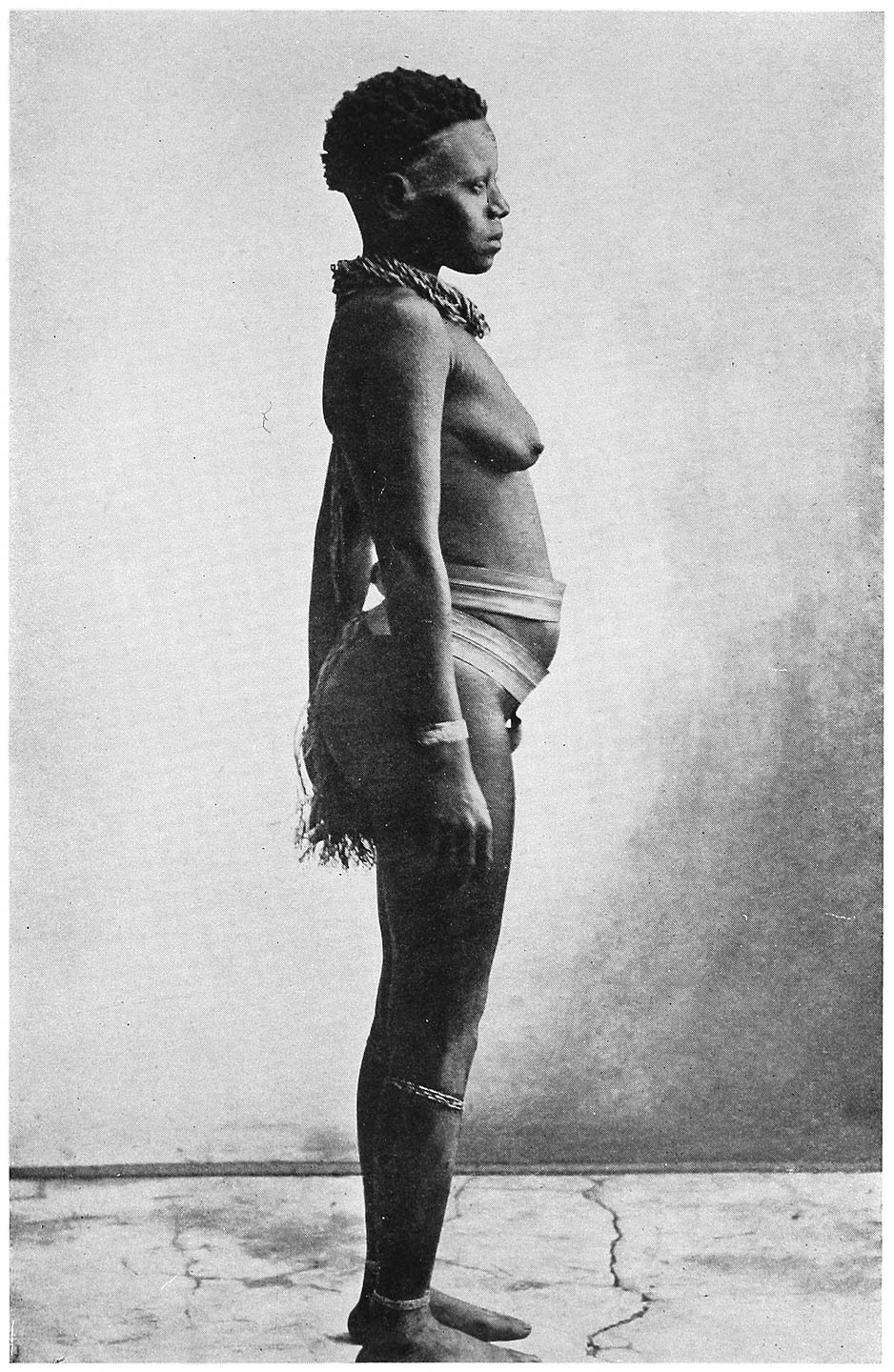
Plate IV
A married woman of the Great Andaman wearing belts of Pandanus leaf and ornaments of Dentalium shell
The local group, as stated above, was characterised as the land-owning group. A man might hunt over the country of his own group at all times, but he might not hunt over the country of another group without the permission of the members of that group. Even at the present day, when the local organisation has largely broken down, some of these hunting rights are still observed. I noticed a case in which some of the men asked and obtained permission to hunt pig in a certain part from a man who was explained to be the owner of that part of the country, being one of the few survivors of the local group to which it belonged. It would, in former times, have been an offence that might easily have led to a serious quarrel for the men of one group to hunt or fish in the country or the waters of another group without having been granted permission to do so.
Within the territory of each local group there are a number of recognized camping places. During the greater part of every year the members of the local group would be found living together at one or other of these. Some of these camping-grounds have been in use for many centuries, as is shown by the heaps of refuse many feet deep, chiefly consisting of the shells of molluscs and the bones of animals. Such kitchen-middens, as they have been called, are to be found in numbers all around the coasts of the islands.
In the case of the coast-dwelling communities the camping sites are always close to the sea-shore or to a creek, so that they can be reached by canoe. In the case of those dwelling inland this is of course not so. In any case one of the chief factors determining the choice of the site is the existence of a supply of fresh water. This is of extreme importance in the case of a site to be occupied during the dry season when fresh water becomes scarce.
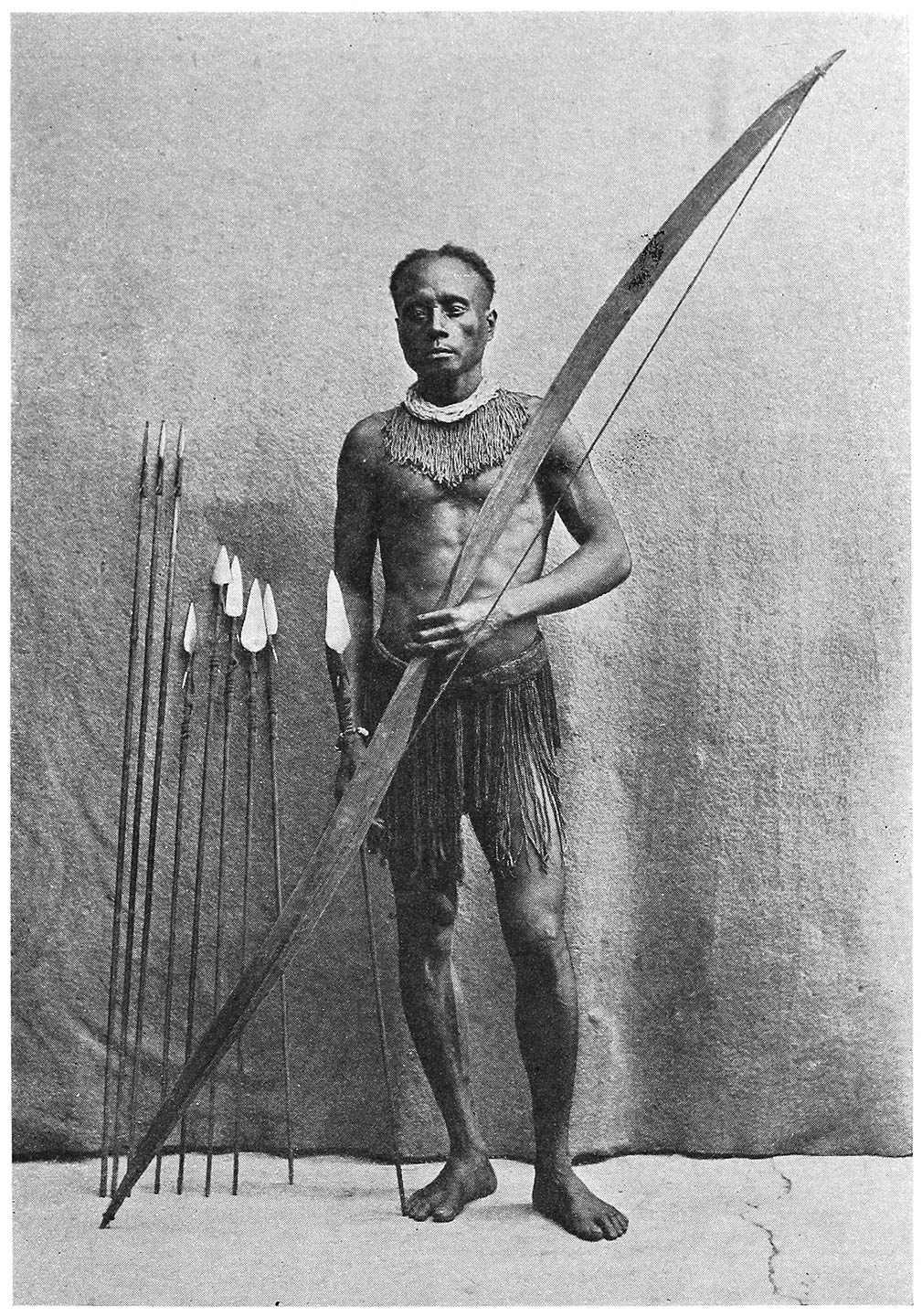
Plate V
A man of the Akar-Bale tribe with South Andaman bow and arrows, wearing belt and necklace of netting and Dentalium shell. (Height 1494 mm., 4 feet 9 inches)
Within their own territory the local group is what we may speak of as semi-nomadic. The coast-dwellers rarely reside continuously at the same spot for more than a few months, but shift from one camp to another, moved by different causes. If a death occurs the camp is deserted for several months and a new one is occupied. A change of camp often takes place at a change of season, some spots presenting particular advantages, such as shelter from the prevailing wind, or better hunting or fishing, at certain times of the year. Another cause of the abandonment of a camp by the coast-dwellers is that all refuse is thrown away close to the camp, and after a few months the decaying animal matter thus accumulated renders the spot uninhabitable. The natives seem to find it easier to move their camp than to clear away their refuse. The truth is, perhaps, that they are so accustomed to change their camp from one spot to another, in order to make the best use of the natural resources available, that there is no necessity for them to take those sanitary measures that would be essential if they wished to remain for many months continuously at the same place.
The forest-dwellers are less nomadic in their habits than the coast-dwellers. One of the reasons for this is that as they cannot convey their belongings from one place to another by canoe, but must carry them overland, the moving of a camp is a more tiresome business with them than it is with the coast-dwellers. During a great part of the year the forest-dwellers were accustomed to remain at one camp, which was thus the chief camp of the group. In particular they would spend there the whole of the rainy season. During the cool and hot seasons they would leave the chief camp for a few months, leading during that time a more nomadic life, living in temporary hunting camps and paying visits to their friends in other groups. At the opening of the rainy season they would return once more to the main camp.
A large communal hut took some little time to erect. The posts had to be cut and erected, this being the work of the men, and the palm-leaves had to be collected and then made into mats by the women. Once the hut was built it would last for several years, and if it were in fairly constant use, particularly if it were not abandoned in the rains, it might be used, with a little occasional patching, for ten years or even more.
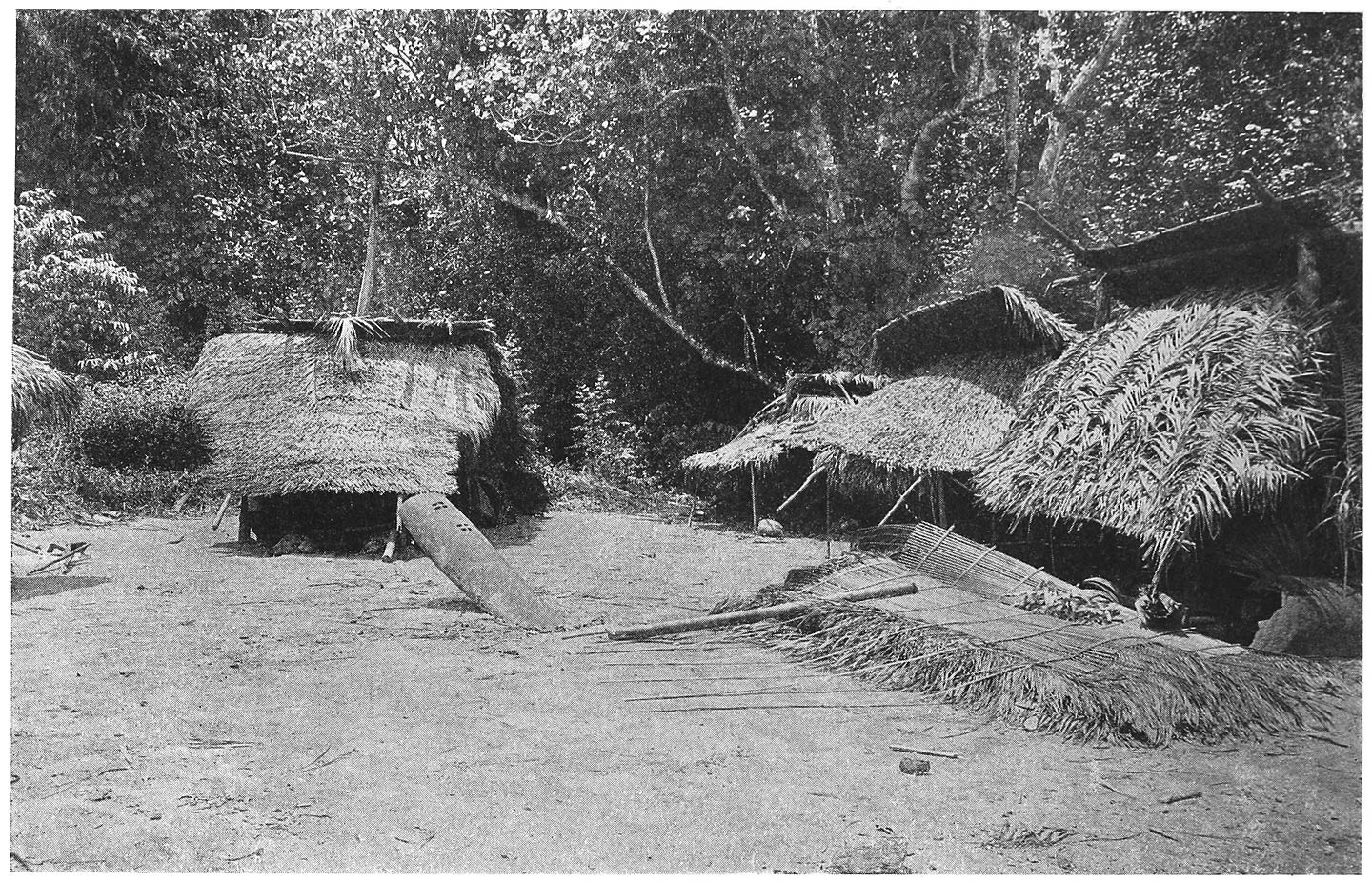
Plate VI
Portion of the village of Moi-lepto, Akar-Bale tribe. On the right is an unfinished mat of palm leaves for the roof of a new hut
Among the coast-dwellers it was more usual to erect at the headquarters a semi-permanent village. A portion of such a village is shown in the photographs reproduced in Plates VI and VII.
The village occupied a small clearing in the forest close to the sea-shore at a place called Mo̱i-lepto in the country of the Akar-Bale tribe. A spring or soak close to the village provided the fresh water. The site is a favourite one as it is well sheltered, and is within convenient distance of good fishing and turtle hunting grounds. It was formerly one of the chief camping places of the local group known as the Boroin wa (Hill people).
The village was composed of eight huts, ranged round a central open space, and all of them facing inwards towards the centre. This open space is kept clear and clean for dancing, and is simply the village dancing ground. Each of the single huts was occupied by a family group, consisting of a man and his wife with their children and dependants. One hut was occupied by an old widower and a bachelor.
The way the huts are built can be seen in the photographs. In the simplest form the hut consists of a sloping roof made of palm-leaves, erected on four posts, two taller ones at the front and two short ones at the back. A hut of this kind is shown in Plate VII. If more shelter is required a second roof is added in such a way that the top of one overhangs the top of the other. In some cases a third roof may be added on one side. In Plates VI and VII two mats of palm-leaf are shown in the course of construction, lying on the ground.
Huts such as these, in which the leaves are first made into a mat which is then attached to the rafters, will last for some time. Even if the village be deserted for several weeks, at any rate in the dry weather, very little work will be needed to make it habitable again when the occupants return to it.
A second kind of camp was made when the natives did not intend to stay more than two to three months. Such camps were erected by the forest folk during the dry season, or at any time when they were compelled to leave their chief camp through the death there of one of their number. Such a temporary camp is always put up in the form of a village, and never as a communal hut. The huts are similar to those already described, but are made more carelessly. The thatching leaves, instead of being made into mats, are simply tied in bundles on to the rafters. A hut of this kind will last quite well for three months or so and it can be built very rapidly at any place where there is a sufficient supply of thatching leaves. At the present day the natives rarely build a permanent camp for themselves, but are contented with temporary camps of the kind here described.
A third kind of camp remains to be briefly mentioned, which we may call the hunting camp. A hunting party (which may include women as well as men) spending a few days away from one of the main camps will erect for themselves a few huts or shelters consisting of nothing more than a simple lean-to of leaves.
Caves or rock shelters suitable for human occupation are almost unknown in the Andamans. In the Archipelago there are one or two small rock shelters that are occasionally used by a hunting party away from home for a night. I was told by the natives that on one of the islands off the west coast of the North Andaman there is a rock shelter of a fair size that was formerly used as one of their chief camps.
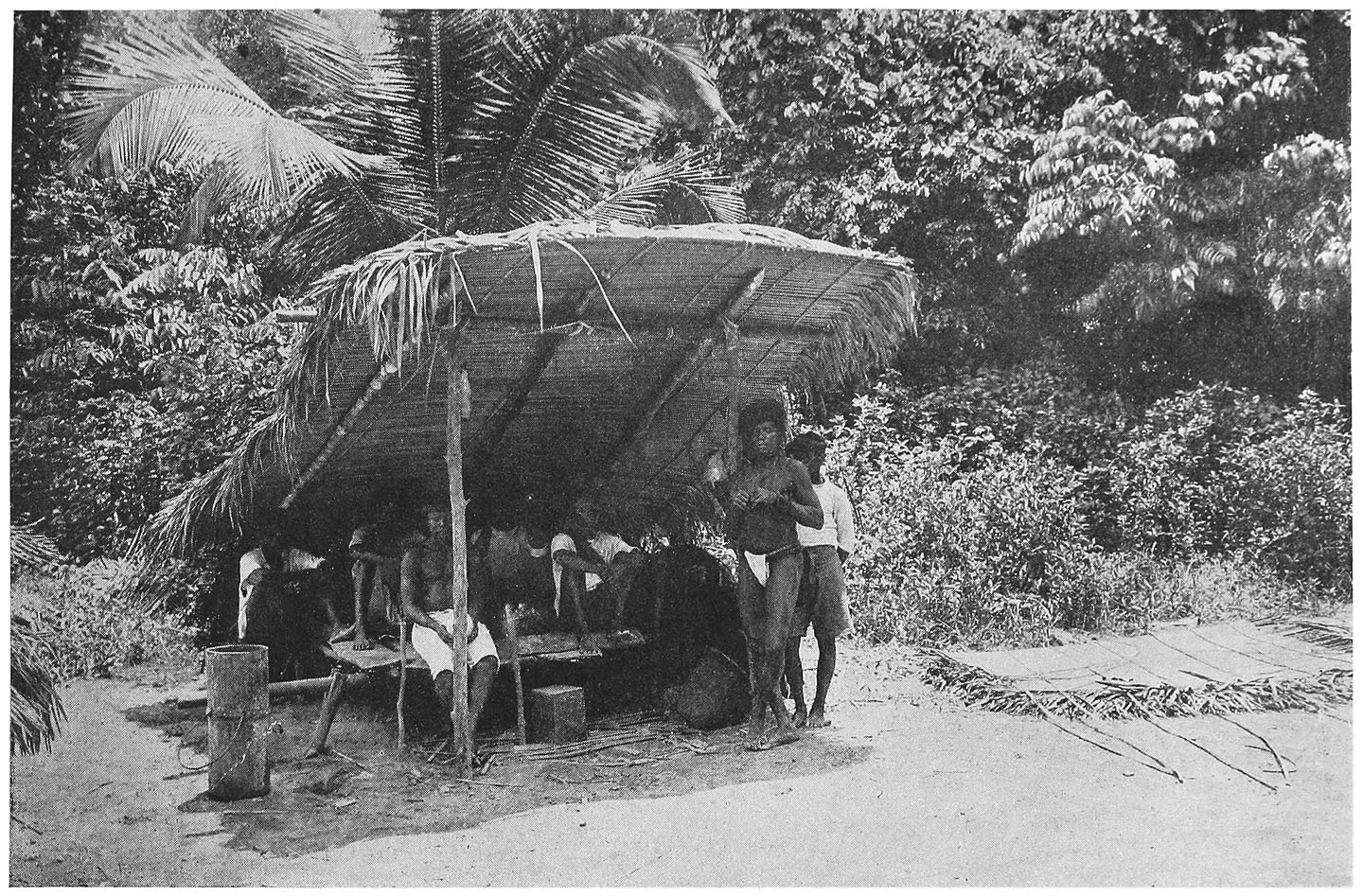
Plate VII
A hut in the village of Moi-lepto, showing the mode of construction
The following figure will give an idea of the Andamanese village and its arrangement. In hunting camps which are intended only to be occupied for a few days or a few weeks, this arrangement is not observed, but the huts or shelters are placed so as to give shelter from the prevailing wind with no particular regard to the respective position of the different units.
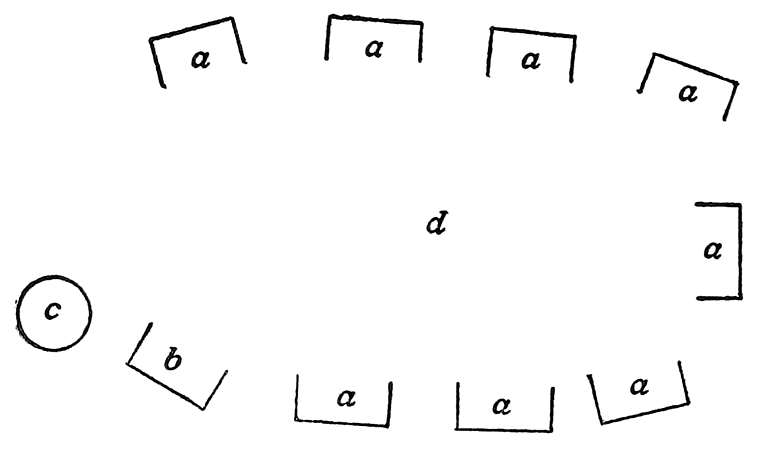
Plan of Andamanese Village
a. Huts of married people.
b. Bachelors’ hut.
c. Public cooking place.
d. Dancing ground.
All the huts face inwards towards an open space which is the dancing ground of the village, and, except in exposed situations, are generally entirely open in front. At some convenient spot on one side of the dancing ground is to be found the communal cooking place of the village. This is generally close to the bachelors’ hut, as it is the bachelors who attend to such cooking as is carried on there. Besides the public cooking place each family has its own fireplace in its own hut, on which a fire is kept continually alight. In the village two or more families may build their huts adjoining one another in such a way that they become for all practical purposes one hut, of which each family retains its own special portion. Two brothers will thus often make a sort of common household.
The communal hut, in the way in which it is arranged, and even in the way in which it is built, is really a village with all the huts drawn together so that each one is joined to the one next to it and the roofs meet in the middle. In the centre of the hut there is an open space corresponding to the dancing ground of the village. It is even used as a dancing ground, though for this purpose it is somewhat small. It is the public part of the hut. Around this are arranged the different families, each occupying its own special portion of the hut, which is marked off by means of short lengths of wood laid on the floor. The public cooking place is sometimes inside the hut, and there is the space marked off for the unmarried men. The advantage of the communal hut is that it affords a better protection from the weather; its disadvantage is that it leaves almost no room for dancing.
Thus it may be seen that the arrangement of the camp shows very plainly the constitution of a local group, consisting as it does of a few families. Each group seems to have contained, on an average, about ten families, with a few unmarried males and females.
The Andaman Islanders depend for their subsistence entirely on the natural products of the sea and the forest. From the sea they obtain dugong, turtle (both green and hawksbill), an enormous variety of different sorts of fish, crustaceans (crabs, crayfish and prawns) and molluscs. Fish and crabs are also to be found in the salt-water creeks which in many places penetrate inland for some miles. From the forest they obtain the flesh of the wild pig, wild honey, and a large number of vegetable foods—roots, fruits, and seeds.
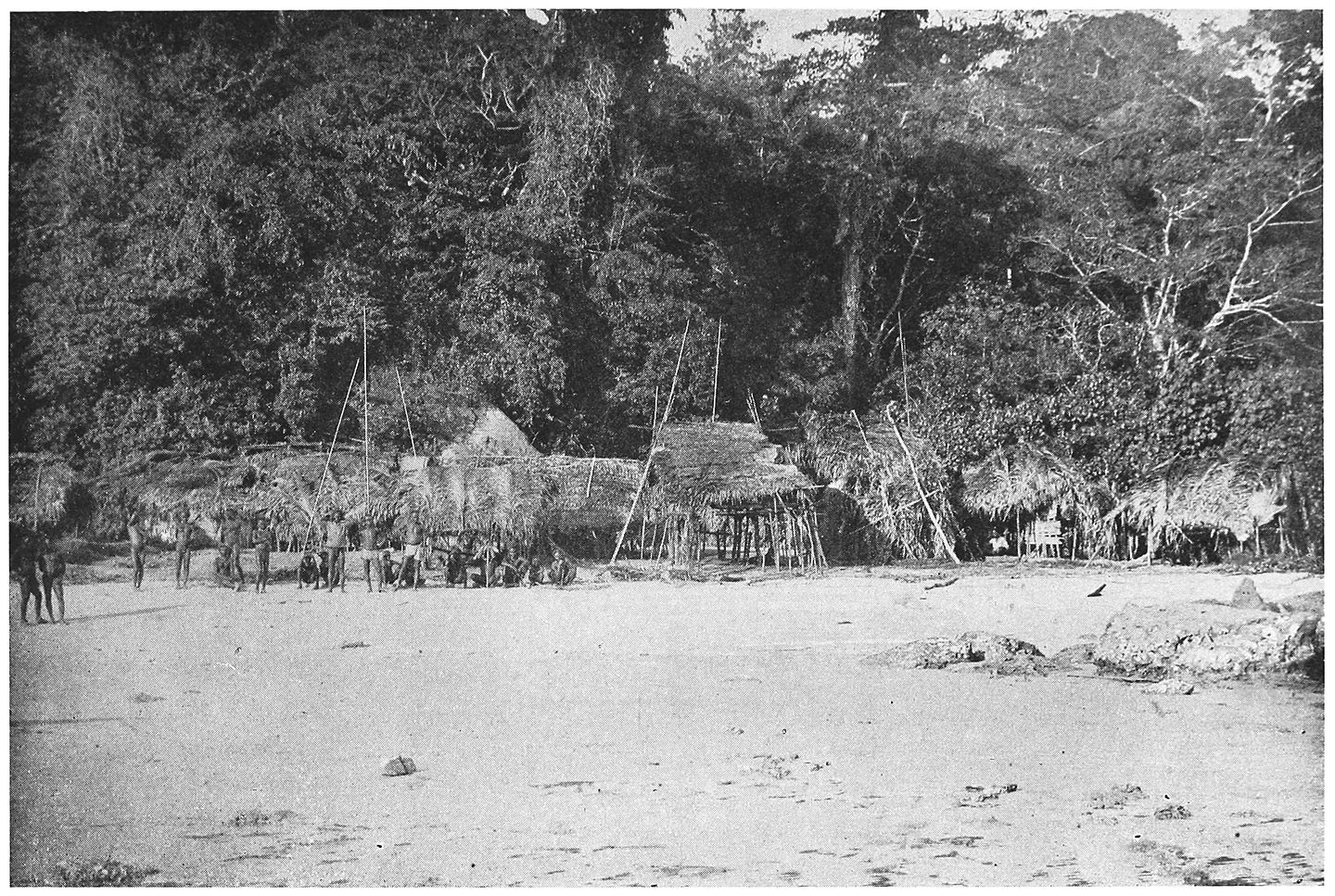
Plate VIII
A village of the Middle Andaman
When a pig has been killed it may be tied up and carried to the camp on the shoulders of one of the hunters, or a fire may be lighted then and there and the pig eviscerated and roasted. A cut is made in the abdomen and the viscera removed. The cavity is filled with leaves, the joints of the legs are half severed and the carcase is placed on the fire and turned over and shifted until every part is evenly roasted. It is then removed from the fire, the burnt skin is scraped clean and the meat is cut up. Meanwhile the intestines or some of the internal organs are cooked and eaten by the hunters. The meat is tied up in leaves and is carried to the camp. If the pig be carried home whole the process of roasting it and cutting it up is performed in exactly the same way at the public cooking place of the camp, the meat being distributed only after it has been thus partially cooked.
The provision of the vegetable food of the community is the work of the women, who must also supply the camp with firewood and water. While the men are away hunting the women, attended by the children, cut and carry the firewood, and either remain in the camp making baskets or nets or other objects, or else go into the forest to look for fruits and seeds. Thus by midday the camp may be quite deserted, save perhaps for one or two old men and women, and a few of the children.
In the afternoon the women return with what food they have obtained and then the men come in with their provision. The camp, unless the hunters have been unsuccessful, is then busy with the preparation of the evening meal, which is the chief meal of the day. If a pig has been brought home whole it is cooked at the public cooking place and is then cut up. The meat is distributed amongst the members of the community and the woman of each family then proceeds to cook the family meal. The pork, after it has been roasted and cut up, is further cooked by being boiled. The family meal is prepared at the fire that each family has in its hut. The meal is a family one, partaken by a man and his wife and children. The bachelors cook and eat their own meal, and the unmarried women also eat by themselves.
After the meal is over, darkness having by this time fallen, the men may spend an hour or two in dancing to the accompaniment of a song sung by one of them with the help of a chorus of women. In that case they would probably eat another meal after the dance was over. Another favourite amusement for the evening is what may be called “yarning.” A man sits down with a few listeners and tells them, with few words, and with many dramatic gestures, how he killed a pig. The same man may go on with tale after tale, till, by the time he finishes he has killed twenty or thirty pigs. Finally the whole camp retires to rest and nothing is to be seen but the dim light of the little fires burning in each hut or in each of the family quarters.
On a day when there is plenty of food left from the day before, or on a day of stormy weather even when food is not too plentiful, the men may remain in camp instead of going hunting. They busy themselves with making weapons and implements, such as bows, arrows, adzes, etc.
On occasions when game is not very plentiful a party of hunters may stay away from the camp for a few days, not returning till they have been successful in obtaining a fair supply of food. The women and children and old men, with perhaps a few of the able bodied men also, remain at home and provide for themselves as well as they can, the women devoting their time to collecting what vegetable foods are in season.
At the end of the rainy season there comes a brief period of unsettled weather, called by the natives of the North Andaman Kimil, and by those of the South, Gumul. During this season some of the vegetable foods begin to be available, though not in any quantities. At this time of the year the natives are able to obtain and feast upon what they regard as great delicacies, the larvae of the cicada and of the great capricornis beetle. The cool season, when fruits and roots are plentiful, begins at the end of November. The forest dwellers leave their main encampment during this season. Some of them go off to pay visits to their friends of other local groups. Such visits may last two or three months. Those who remain occupy temporary camps in convenient places. The men join the women in looking for roots and fruits, and do not spend so much of their time in hunting. Some of the men visit the main camp at intervals of a few days to see that it is all right. As the cool season gives way to the hot season (March to May) honey begins to be plentiful. At that time hunting for pig is almost abandoned. The pigs are in poor condition, and even when one is killed it is often left in the jungle by the natives as not being good enough to eat. On the other hand everyone is busy collecting honey. This is work in which both men and women join, though it is the men who climb up the trees and cut down the honeycomb. The natives have no means of keeping the honey for more than a very short time, as it rapidly ferments. While it is plentiful they almost live on it, supplementing it with roots and fruits and with fish, if they are near a creek. Towards the end of the hot season the fruit of the Artocarpus chaplasha, which is a favourite food of the natives, becomes ripe. The men and women, at this time, spend much of their time collecting the fruit. When it is collected the fruit is broken open and each of the seeds is sucked to obtain the juicy pulp or aril with which it is surrounded, and which has a very pleasant taste. The seeds are then partly boiled and are buried in the ground to remain there for a few weeks, when they will be dug up again and cooked and eaten. Any natives who may have been away from home on a visit, return before the Artocarpus comes into fruit in order to take their share in collecting it and providing a supply of the seeds for consumption in the rainy season. The natives then return to the headquarters camp and make any necessary repairs to the hut in preparation for the rainy season, which begins about the middle of May.
The coast-dwellers are not quite so much influenced by the seasons as the forest-dwellers. They can fish and collect molluscs all the year round. In the rainy season they divide their time between hunting pig in the forest and fishing or turtle hunting. They do not need, however, to remain at the same camp during the whole of the rainy season, but after a month or two at one place can move to what they hope to find better hunting grounds. During the cool and hot seasons they pay visits to one another. In the fine weather the men often go off on turtle-hunting expeditions for several days, leaving the women and children and older men in the village, where they provide for themselves with vegetable food and with fish and molluscs from the reefs.
It is during the fine weather that there take place the meetings of two or more local groups that are an important feature of the social life of the Andaman Islanders. These meetings will be described later in the present chapter.
Besides their food, which they must find from day to day, the natives have need of nothing save their weapons and implements. Of these each person makes his own, each man making his own bow, arrows, adze, etc., while the wife makes her baskets, nets and so on.
The economic life of the local group, though in effect it approaches to a sort of communism, is yet based on the notion of private property. Land is the only thing that is owned in common. The hunting grounds of a local group belong to the whole group, and all the members have an equal right to hunt over any part of it. There exists, however, a certain private ownership of trees. A man of one of the local groups of the coast may notice in the jungle a tree suitable for a canoe. He will tell the others that he has noticed such a tree, describing it and its whereabouts. Thenceforward that tree is regarded as his property, and even if some years should elapse, and he has made no use of it, yet another man would not cut it down without first asking the owner to give him the tree. In a similar way certain men claim to possess certain Artocarpus trees, though how the ownership in these cases had arisen I was unable to determine. No one would pick the fruit off such a tree without the permission of the owner, and having received permission and gathered the fruit he would give some part of it to the owner of the tree.
A pig belongs to the man whose arrow first strikes it, though if the arrow merely glanced off and did not remain in the wound it would not give any claim to ownership. A turtle or a dugong or big fish belongs to the man who throws the harpoon with which it is taken. A honeycomb belongs to the man who climbs the tree and cuts it down. The fish that a man shoots belong to him, and to a woman belong the roots she digs up, the seeds that she collects, the fish or prawns that she takes in her net or the molluscs that she brings from the reefs. Any weapon that a man makes belongs to him alone to do what he pleases with, and anything that a woman makes is her own property. A man is not free to dispose of the personal property of his wife without her permission.
In the village each family erects and keeps in repair its own hut, and the wife provides the hut with the firewood and water needed. In the case of a communal hut it would seem that this is really an example of a possession common to the whole group. This is so, however, only in appearance. The hut is built by all the different families, but each family is regarded as owning a certain portion of the hut when it is finished, and it is the family that keeps this part of the hut in repair.
A canoe is cut by a number of men together. From the outset, however, it is the property of one man, who selects the tree and superintends the operation of cutting it into shape. He is always one of the older men, and he enlists the services of the younger men to help him. When finished the canoe is his property, and he can do with it what he pleases, giving it away, if he wishes, and no one has any share of ownership in a canoe on the ground that he helped to make it.
While all portable property is thus owned by individuals, the Andamanese have customs which result in an approach to communism. One of these is the custom of constantly exchanging presents with one another. When two friends meet who have not seen each other for some time, one of the first things they do is to exchange presents with one another. Even in the ordinary everyday life of the village there is a constant giving and receiving of presents. A younger man or woman may give some article to an older one without expecting or receiving any return, but between equals a person who gives a present always expects that he will receive something of equal value in exchange. At the meetings that take place between neighbouring local groups the exchange of presents is of great importance. Each of the visitors brings with him a number of articles that he distributes amongst the members of the group that he visits. When the visitors depart they are loaded with presents received from their hosts. It requires a good deal of tact on the part of everyone concerned to avoid the unpleasantness that may arise if a man thinks that he has not received things as valuable as he has given, or if he fancies that he has not received quite the same amount of attention as has been accorded to others.
It is considered a breach of good manners ever to refuse the request of another. Thus if a man be asked by another to give him anything that he may possess, he will immediately do so. If the two men are equals a return of about the same value will have to be made. As between an older married man and a bachelor or a young married man, however, the younger would not make any request of such a nature, and if the older man asked the younger for anything the latter would give it without always expecting a return.
Almost every object that the Andamanese possess is thus constantly changing hands. Even canoes may be given away, but it is more usual for these to be lent by the owner to his friends.
It has been stated above that all food is private property and belongs to the man or woman who has obtained it. Every one who has food is expected, however, to give to those who have none. An older married man will reserve for himself sufficient for his family, and will then give the rest to his friends. A younger man is expected to give away the best of what he gets to the older men. This is particularly the case with the bachelors. Should a young unmarried man kill a pig he must be content to see it distributed by one of the older men, all the best parts going to the seniors, while he and his companions must be satisfied with the inferior parts. The result of these customs is that practically all the food obtained is evenly distributed through the whole camp, the only inequality being that the younger men do not fare so well as their elders. Generosity is esteemed by the Andaman Islanders one of the highest of virtues and is unremittingly practised by the majority of them.
Within the local group there is no such thing as a division of labour save as between the two sexes. In the coastal groups every man is expected to be able to hunt pig, to harpoon turtle and to catch fish, and also to cut a canoe, to make bows and arrows and all the other objects that are made by men. It happens that some men are more skilful in certain pursuits than in others. A skilful turtle-hunter, for example, may be an indifferent pig-hunter, and such a man will naturally prefer to devote himself to the pursuit in which he appears to most advantage.
The division of labour between the sexes is fairly clearly marked. A man hunts and fishes, using the bow and arrow and the harpoon; he makes his own bows and arrows, his adze and knife, cuts canoes and makes rope for harpoon lines. A woman collects fruits and digs up roots with her digging stick; she catches prawns and crabs and small fish with her small fishing net; she provides the firewood and the water of the family and does the cooking (i.e. the family cooking, but not the common cooking, which is entirely done by men); she makes all such objects as baskets, nets of thread, and personal ornaments either for herself or her husband.
There is no organised government in an Andamanese village. The affairs of the community are regulated entirely by the older men and women. The younger members of the community are brought up to pay respect to their elders and to submit to them in many ways. It has already been shown how, in the distribution of food, the elders get the best share. When it is a question of shifting camp to some better hunting ground the opinion of the older men would weigh against that of the younger if they disagreed. It must not be thought, however, that the older men are tyrannical or selfish. I only once heard a young man complain of the older men getting so much the best of everything. The respect for seniority is kept alive partly by tradition and partly by the fact that the older men have had a greater experience than the younger. It could probably not be maintained if it regularly gave rise to any tyrannical treatment of the younger by the elder.
The respect for seniors is shown in the existence of special terms of address which men and women use when speaking to their elders. In the languages of the North Andaman there are two such terms, Mai or Maia, applied to men, with a meaning equivalent to “Sir,” and Mimi, applied to women. These words may be used either alone or prefixed to the personal name of the person addressed. A younger man speaking to an older one whose name was Bora would address him either as Mai (Sir), or as Maia Bora (Sir Bora).
In the tribes of the South Andaman there are exactly similar terms. In the Aka-Bea tribe Maia or Maiola is used in addressing men and Čana or Čanola in speaking to women. In Akar-Bale the equivalent terms are Da and In. Besides these terms there is in these tribes another, Mam, Mama or Mamola, which may be used in speaking to either men or women, and which implies a higher degree of respect than Maia or Čana. In these tribes also there is a special way of showing respect by adding the suffix -la to the name of the person addressed, as Bia, Biala, Woičo, Woičo-la, etc.
In the legends of the Andamanese these titles are nearly always prefixed to the names of the legendary ancestors, as Maia J̌utpu and Mimi Biliku in Aka-J̌eru, or Da Duku and In Bain in Akar-Bale. The moon is similarly spoken of as Sir Moon (Maia Ogar in Aka-Bea) and the sun as Lady Sun (Čana Bodo).
Besides the respect for seniority there is another important factor in the regulation of the social life, namely the respect for certain personal qualities. These qualities are skill in hunting and in warfare, generosity and kindness, and freedom from bad temper. A man possessing them inevitably acquires a position of influence in the community. His opinion on any subject carries more weight than that of another even older man. The younger men attach themselves to him, are anxious to please him by giving him any presents that they can, or by helping him in such work as cutting a canoe, and to join him in hunting parties or turtle expeditions. In each local group there was usually to be found one man who thus by his influence could control and direct others. Amongst the chief men of several friendly local groups it would generally happen that one of them, by reason of his personal qualities, would attain to a position of higher rank than the others. Younger men would be desirous of joining the local group to which he belonged. He would find himself popular and respected at the annual meetings of the different groups, and his influence would thus spread beyond the narrow limits of his own small community.
There was no special word to denote such men and distinguish them from others. In the languages of the North Andaman they were spoken of as er-kuro = “big.”
Such men might perhaps be spoken of as “chiefs,” but the term is somewhat misleading, as it makes us think of the organised chieftainship of other savage races.
Where Mr Man speaks of the “authority” of the chiefs it would be better to speak of “influence.” Of authority the leading men have little or none, but of influence they have a good deal. Should any one venture to oppose a popular chief he would find the majority of the natives, including many of his friends, siding against him. The words “chief” and “authority” seem to imply some sort of organised rule and procedure, and of this there is nothing in the Andamans. Mr Man also implies that in each tribe there is always one recognized headman, but in reality each tribe may possess two or three leading men in different parts of the country, each with his own following. In any case a man’s influence is largely confined to his own local group, for it is only at the annual meetings that the men of other groups come in contact with him.
The early officers of the Andamanese Homes (before the time of Mr Man) established a system of chieftainship in the islands by selecting a few of the more trustworthy and intelligent men, whom they dignified with the title of raja, and who acted as the intermediaries between the Officer in Charge of the Andamanese and the natives. This system has been continued to the present day, and the natives have adopted the title raja for these men, having themselves no word for a chief. Where a man is selected who is already respected and esteemed by the natives his influence is considerably increased through the position thus assigned to him. The natives themselves do not recognize that he has any authority over them, but if he be a man of generosity and tact, the majority will always support him, and his advice in any matters of moment will be readily followed.
Women may occupy a position of influence similar to that of the men. The wife of a leading man generally exercises the same sort of influence over the women as her husband does over the men. A woman, however, would not exercise any influence over the men in matters connected with hunting. They do have a good deal of influence in connection with quarrels either of individuals or of local groups.
There are certain men, and possibly sometimes women, who have an influence over their fellows owing to their being credited with the possession of supernatural powers. These men, called in Aka-J̌eru oko-ǰumu (literally “one who speaks from dreams”), will be described in a later chapter. As they are believed to have command over the powers that produce and cure sickness everyone tries to be on good terms with them, avoiding giving them offence in any way, and seeking their favour by presents of food or other things. It sometimes happens that a chief (the leading man of a local group) is at the same time a medicine-man or oko-ǰumu, but the two positions are entirely distinct and separate, and a man may be a medicine-man who possesses none of the qualities that are necessary for a head man.
There does not appear to have been in the Andamans any such thing as the punishment of crime. We may distinguish two kinds of anti-social actions which are regarded by the natives as being wrong. The first kind are those actions which injure in some way a private individual. The second are those, which, while they do not injure any particular person, are yet regarded with disapproval by the society in general.
Amongst the anti-social actions of the first kind are murder, or wounding, theft and adultery, and wilful damage of the property of another.
No case of one Andamanese killing another has occurred in recent years. Quarrels sometimes occur between two men of the same camp. A good deal of hard swearing goes on, and sometimes one of the men will work himself up to a high pitch of anger, in which he may seize his bow and discharge an arrow near to the one who has offended him, or may vent his ill-temper by destroying any property that he can lay his hands on, including not only that of his enemy but also that of other persons and even his own. At such a display of anger the women and children flee into the jungle in terror, and if the angry man be at all a formidable person the men occasionally do the same. It apparently requires more courage than the natives usually possess to endeavour to allay such a storm of anger. Yet I found that the slightest show of authority would immediately bring such a scene to an end. A man of influence in his village was probably generally equal to the task of keeping order and preventing any serious damage from taking place. It was probably rare for a man so far to give way to his anger as to kill his opponent.
Quarrels were more likely to occur at the meetings of different local groups that took place in the fine weather, and such quarrels might occasionally end in the murder of some one. In such a case the quarrel would be taken up by the group of the murdered man, and a feud would be set up between them and the local group to which the murderer belonged. Such was one of the common causes of origin of the petty warfare that formerly existed in the Andamans, which will be referred to later in the present chapter.
Cases of theft seem to have been rare. It was left to the aggrieved person to take vengeance upon the thief, but if he killed him or seriously wounded him he would have to expect the possible vengeance of the relatives and friends. Adultery was regarded as a form of theft. I gathered that a man had the right to punish his wife for unfaithfulness, but if the punishment were too severe it would be an occasion for a quarrel with her relatives. It was difficult for the aggrieved husband to punish the man who had offended against him. If he killed him he would lay himself open to the revenge of the relatives. The most he could do was to vent his anger in violent words.
Women also occasionally quarrel with one another and swear forcibly at one another, or even get so far as to destroy one another’s belongings, or to fight with their fists or sticks. The men hesitate to interfere, and the quarrel can only be stopped by some woman of influence.
The frequent occurrence of serious quarrels is prevented both by the influence of the older men and by the fear that everyone has of the possible vengeance of others should he in any way offend them.
There are a number of actions which, while they do not offend any particular person, are regarded as being anti-social. One of these is laziness. Every man is expected to take his proper share in providing both himself and others with food. Should a man shirk this obligation, nothing would be said to him, unless he were a young unmarried man, and he would still be given food by others, but he would find himself occupying a position of inferiority in the camp, and would entirely lose the esteem of his fellows. Other qualities or actions that result in a similar loss of esteem are marital unfaithfulness, lack of respect to others and particularly to elders, meanness or niggardliness, and bad temper. One man was mentioned to me as being a bad man because he refused to take a wife after he had reached the age when it is considered proper for a man to marry. In recent times at least one young man has refused to undergo the privations connected with the initiation ceremonies. This was of course a case of gross rebellion against the customs of the tribe, but there was no way of punishing him or of compelling him to conform, save by showing him that he was an object of contempt and ridicule to others. Probably such a refusal to conform to tribal customs could not have taken place before the British occupation of the islands.
The medicine-men (oko-ǰumu) are credited with the power to work evil magic, and by its means to make other people ill, and even to kill them. A man suspected of evil magic might be liable to the vengeance of those who thought that they had been injured by him, but though the practice was regarded as reprehensible it does not seem that the society ever acted as a whole to punish a man suspected of it.
Children are reproved for improper behaviour, but they are never punished. During their years of infancy they are much spoilt, not only by their parents but by every one. During the period of adolescence every boy and girl has to undergo a somewhat severe discipline, to be described in a later chapter. This probation, if it may be so called, is enforced by a unanimous public opinion. The discipline lasts until the man or woman is married and a parent, or if childless as so many now are, until he or she has settled down to a position of responsibility.
Thus, though the Andaman Islanders had a well developed social conscience, that is, a system of moral notions as to what is right and wrong, there was no such thing as the punishment of a crime by the society. If one person injured another it was left to the injured one to seek vengeance if he wished and if he dared. There were probably always some who would side with the criminal, their attachment to him overcoming their disapproval of his actions. The only painful result of anti-social actions was the loss of the esteem of others. This in itself was a punishment that the Andamanese, with their great personal vanity, would feel keenly, and it was in most instances sufficient to prevent such actions. For the rest, good order depended largely on the influence of the more prominent men and women.
We have so far considered only the general regulation of conduct in the local group, without giving any attention to the more special regulations dependent on relationships by blood and by marriage. In all human societies there is a system of rights and duties regulating the conduct towards one another of persons who are related either by consanguinity or through marriage. In primitive societies these particular rights and duties occupy a position of preponderating importance, owing, no doubt, to the small number of persons with whom any single person comes into effective social contact. When a large proportion of the men and women with whom any person comes in contact are related to him, it is clear that relationship must count for a good deal in regulating the everyday life of the people.
The following is a list of terms used to denote relationship in the North Andaman. There seems to be very little difference in this matter between the four tribes of the North (Aka-Čari, Aka-Ko̱ra, Aka-Bo and Aka-J̌eru).
aka-mai his father
aka-mimi his mother
ot-tire his child
ot-otoatue his older brother
ot-otoatue-čip his older sister
ot-arai-čulute his younger brother
ot-arai-čulute-čip his younger sister
ot-e-bui or e-bui his wife (her husband)
e-pota-čiu his father-in-law
e-pota-čip his mother-in-law
ot-otone his son-in-law.
Aka-mai and aka-mimi. The words for “father” and “mother” are derived from the terms of address Maia and Mimi by the addition in each case of the prefix aka-. By itself the term Maia is used by any man or woman in speaking to a man older than himself or herself without implying any relation between them beyond that of respective age. The addition of the prefix aka- changes the word, giving it the meaning “the father of somebody.” Thus Maia Bora means “Mr Bora” or “Sir Bora,” if we may so translate it, but Bora aka-mai means “Bora’s father,” and aka-mai Bora means “his or her father Bora.” The Aka-J̌eru equivalent for “my father” is t’a-mai, the t’ being the personal pronoun “my,” after which the prefix aka- is contracted to a-. Similarly “thy father” is ŋ’a-mai and “their father” or “their fathers” is n’a-mai. The word aka-mimi is in every respect exactly parallel to aka-mai. These two terms are only used when it is necessary to refer to the actual father or mother of anybody. For example, if a man be asked Ačiu ŋ’a-mai bi? (Who your father is?), he will reply by giving the name of his own father.
The stem maia clearly relates to the social position of the father of a family. A man who is a father, or while not having any children, is married and occupies an equivalent social position to a father, is addressed by the term which shows his social position, Maia. When I call a man Maia, I do not imply that he is my father nor that he is related to me at all, but only that he is a father. On the other hand, the prefix aka- added to the stem makes a possessive form, so that aka-mai means “his father” and t’a-mai means “my father.” The word mimi is exactly parallel. By itself, the stem simply shows that the person addressed is a mother, while aka-mimi means “his mother.”
Ot-otoatue and ot-arai-čulute. I was unable to find in the languages of the North Andaman any words which could properly be translated “brother” or “sister.” The two words here given are used by the Andamanese to denote persons older or younger than the speaker, whether they be brothers and sisters or not. The derivation of ot-otoatue could not be ascertained, but the word means “he who was born before me,” and it is used in this sense to denote any person of the speaker’s generation who is older than himself. If it is necessary to emphasise the female sex of the person spoken of, the suffix -čip is added. An alternative word of exactly the same meaning is ot-areupu (fem. ot-arep-čip). The word ot-arai-čulute is formed from the stem čulu or čulutu meaning “following” or “after,” which always takes the prefix arai-. (This prefix conveys a reference to position in time or space.) The stem is found in such phrases as tio ŋ’arai-čulutu-bom, “I will follow you” (literally tio = I, ŋ’ = thou, čulutu = after, and -bom, verbal suffix), and tarai-čulik “afterwards” (t-arai-čulu-ik). The prefix ot- added in front of the usual prefix arai- determines the particular use of the word as referring to human beings. Thus the word ot-arai-čulute means, literally, “he or she who was born after me.” It is used in this sense by a man or woman to denote any person of the same generation who is younger than himself. The suffix -čip may be added to denote a female. Alternative words of the same meaning are ot-ara-liču and ot-ara-bela.
These words are not, properly speaking, terms of relationship, but serve only to denote the respective ages of two persons. I did not discover any terms whatever by which a man can distinguish his own brother or sister from any other man or woman of the same age.
Ot-e-bui. The stem -bui means “to marry,” as in n’ e-bui-om = they are married. “My husband” or “my wife” is simply t’e-bui or t’ot-e-bui.
E-pota-čiu and e-pota-čip. The derivation of these words was not discovered. They are the terms by which a man distinguishes his wife’s father and mother, and a woman her husband’s father and mother.
Ot-otone. The word and its meaning are somewhat doubtful. It was sometimes used by a man to denote his daughter’s husband, and perhaps also his son’s wife. I once heard it applied to a younger sister’s husband. It may be compared with the same word as used in the South Andaman to be mentioned presently.
So far as could be discovered, there are no words in the languages of the North Andaman for grandfather, grandmother, uncle, aunt, cousin, etc. The terms given above can be combined to describe relatives of this kind, as
T’a-mimi aka-mai my mother’s father
Ot-e-bui ot-arai-čulute his wife’s younger brother
Ŋ’ot-a-mai ot-arai-čulute thy father’s younger brother
T’ot-otoatue ot-tire my older brother’s child.
These compound terms are not often used, however.
The terms of relationship of the Akar-Bale tribe may be taken as representative of the tribes of the South Andaman. The following list contains all the more important of them.
da father
ab-atr father
in mother
ar-bua child
ar-kodire child (father speaking)
ab-atet child (mother speaking)
mama grandparent
ǰat grandchild
en-toaka-ŋa older brother or sister
ar-dotot younger brother or sister
otoni son-in-law
oten daughter-in-law
ab-i-ŋa consort (husband or wife)
aka-yat parent of child’s consort
aka-bua consort’s younger brother or sister
ep-taruo-ŋa step relative
ot-čat-ŋa relative by adoption
aka-kuam younger relative
ab-čuga older relative (male)
ab-čupal older relative (female).
Da and in. Da is the common term of address used when speaking to an older man to whom the speaker wishes to show respect. A man will speak of his own father as dege da, dege being the personal pronoun “my” as used before a word that has no prefix. The term In is the common term of address used in speaking to women. A man or woman will refer to his or her own mother as deg’ in. The use of these two terms as applied to parents is very similar to the use of aka-mai and aka-mimi in the North Andaman, with the difference that in Akar-Bale the stem da or in does not take a prefix to modify its meaning. While the use of the terms Da and In as terms of address does not in the least imply that there is any relationship between the person speaking and the person addressed, yet the phrase dege da would in general be understood as referring to the speaker’s own father.
Ab-atr. This is a word descriptive of the relationship of a father to his child. I never heard a man refer to his own father by this term, but it is heard in such phrases as deg’ in l’ab-atr = my mother’s father. It conveys a definite notion of the physiological relation between a father and his children, and might be translated “he who caused me to be conceived.” There is probably a feminine equivalent meaning “mother,” but it was not noted.
Mama. The word is translated above as meaning “grandparent,” but it has a wider meaning than this. It is used as a term of address to convey more respect than is conveyed by the terms Da and In, and is thus used in addressing any man or woman who is considerably older than the speaker. With the personal pronoun, dege mama, it may be applied by a man or woman to any of his grandparents, and also to his father-in-law and mother-in-law, and to other senior relatives.
J̌at. The word was explained to me by the natives as meaning “grandchild.” It seems to be a sort of reciprocal of mama, and is apparently applicable by any old man or woman to any child of the same generation as his or her own grandchildren.
En-toaka-ŋa and ar-dotot. These two words are used in exactly the same way as the words ot-otoatue and ot-arai-čulute of the North Andaman. They are not properly terms of relationship, but may be equally used in referring to non-relatives. En-toaka-ŋa means “he who was born before me,” and ar-dotot means “he who was born after me.” I was not able to discover any word by which a person could distinguish his own brother or sister from others of the same age. It is not certain, however, that such a word does not exist.
Otoni and oten. These are masculine and feminine forms of the same word, and are used to denote a daughter’s husband and a son’s wife. Otoni is also applied to a younger sister’s husband, and oten to a younger brother’s wife. The derivation of the words was not discovered.
Aka-yat. This is the native name for the relationship subsisting between a person’s parents and his parents-in-law. My own mother or father is aka-yat to my wife’s father or mother.
Aka-bua. The word is derived from the stem bua, meaning “child.” It is applied by a man to the younger brothers and sisters of his wife, and by a woman to the younger brothers and sisters of her husband.
Ab-i-ŋa. The word is translated “consort,” and means either husband or wife. It is derived from the verbal stem -i- meaning “to marry” (on-i-re), ab- being the prefix, and -ŋa the verbal suffix.
Ep-taruo-ŋa. The word is used to denote a step-child, or a younger step-brother or sister.
Ot-čat-ŋa. The word means “adopted.” “My adopted child” is simply expressed as d’ot-čat-ŋa, while “my foster father” is dege da ot-čat-ŋa. The stem is -čat-, -ŋa being the verbal suffix and ot- the prefix.
Aka-kuam. In spite of several enquiries, I was unable to ascertain the significance of this word. I heard it applied on different occasions to a younger brother or sister, to a younger first cousin, and to the brothers and sisters of a wife. The only suitable translation would seem to be “my younger relative,” but it is not certain that it even implies any relationship at all. It is perhaps really a term denoting respective social status and is used by a married man to denote other married men who are somewhat younger than himself, and with whom he is on friendly terms.
D’ab-maiola (D’ab-mai-ola). This is translated by Mr Man as “father.” In Aka-Bea the term Maia is the term of address corresponding to the Da of Akar-Bale and to the Mai of the North Andaman. The suffix -ola, added to this and other terms of address serves to convey additional respect, as Maia, Mai-ola, Čana, Čan-ola, Mama, Mam-ola. Thus ab-mai-ola corresponds to the aka-mai of the Northern languages.
Dia Maia. This is given by Mr Man as applicable to the following relatives:—my father’s brother, my mother’s brother, my father’s sister’s husband, my mother’s sister’s husband, my father’s father’s brother’s (or sister’s) son, my husband’s grandfather, my wife’s grandfather, my wife’s sister’s husband (if elder), my husband’s sister’s husband (if elder).
Dia maiola. My grandfather, my grandfather’s brother, my grandmother’s brother, my elder sister’s husband.
D’ ab-čanola. Given by Mr Man as meaning “my mother.” It is the feminine equivalent of d’ ab-mai-ola, Čana being the feminine of Maia, and corresponding to the In of Akar-Bale and the Mimi of Aka-J̌eru.
Dia čanola. This is given as the Aka-Bea translation of the following:—my father’s sister, my mother’s sister, my father’s brother’s wife, my mother’s brother’s wife, my grandmother, my great aunt, my father’s father’s sister’s daughter, my mother’s mother’s sister’s daughter, my husband’s grandmother, my wife’s grandmother, my husband’s sister (if senior and a mother), my elder brother’s wife (if a mother). In its formation the term is the feminine equivalent of dia mai-ola, while in its use it is the equivalent both of this term and of dia maia. This serves to show that there is no real precise distinction between dia maia and dia mai-ola, such as Mr Man’s list would seem to imply. Dia čan-ola is not, properly speaking, a term of relationship. Any married woman senior to the speaker is entitled to be addressed as Čana or Čan-ola.
D’ ar-odi-ŋa. This word is given by Mr Man as one of the equivalents for “my father.” It is parallel to the Akar-Bale term ab-atr, and is strictly a term of physiological relationship, meaning “he who caused me to be conceived.”
D’ab-eti-ŋa. This is translated by Mr Man as “my mother.” It is the corresponding term to d’ar-odi-ŋa, and refers to the physiological relationship.
D’ab-weǰi-ŋa or d’ab-weǰeri-ŋa. This also means “my mother,” and is only an alternative word for the above. The stems eti and weǰi or weǰeri seem to be two stems meaning the same thing.
D’ar-odi-re or d’ar-odi-yate. Given by Mr Man as meaning “my son” (if over three years of age, father speaking). It is the equivalent of the Akar-Bale ar-kodire.
D’ab-eti-re, d’ab-eti-yate, d’ab-weǰi-re, d’ab-weǰi-yate, d’ab-weǰeri-re, d’ab-weǰeri-yate. These are all given by Mr Man as translating “my son” (if over three years of age, mother speaking). They are equivalent to the Akar-Bale ab-atet.
The above words seem to be derived from three stems, -odi-, -eti-, and -weǰi- (or -weǰeri-), the stems -eti- and -weǰi- having exactly the same meaning, and belonging, perhaps, to different dialects. The words are formed by the addition of the prefixes ar- and ab-, and the verbal suffixes -ŋa, -re, -yate. Thus we have ar-odi-ŋa, “father,” and ar-odi-re or ar-odi-yate, “son.” Similarly we have ab-eti-ŋa, “mother,” and ab-eti-re or ab-eti-yate, “son” (mother speaking), while similar equivalents are made from the stem -weǰi-. The words given as meaning “son” may also be used to mean “daughter,” but when it is necessary to emphasise the female sex, the suffix -pail (meaning “female”) is added, as d’ar-odi-re-pail, d’ab-eti-re-pail.
Dia ota and dia kata. These are given by Mr Man as meaning respectively “my son” and “my daughter” (if under three years of age, either parent speaking). Ota and kata are the terms for the male and female genitals.
Dia ba. This is given by Mr Man as meaning “my daughter” (if over three years of age, either parent speaking). It is the phonetic equivalent of dege bua in Akar-Bale.
Dia ba-lola. Given as the equivalent of:—my grandson (either grandparent speaking), my brother’s grandson (male or female speaking), my sister’s grandson (male or female speaking). The same phrase with the addition of -pail, meaning “female,” is given as equivalent to:—my granddaughter, my brother’s granddaughter, and my sister’s granddaughter (male or female speaking).
D’ar-ba. According to Mr Man this term is applicable by a male or female to the son of a brother, a sister, a half-brother, a half-sister, or of a male or female first cousin. With the addition of -pail, meaning “female,” it is applicable to the daughter of any of the above.
Ad en-toba-re, ad en-toba-ŋa, ad en-toka-re, ad en-toka-ŋa. These terms are given by Mr Man as alternative equivalents for “my elder brother (male or female speaking).” The stem is -toba- or -toka-, with the prefix en- and the verbal suffix -re or -ŋa. The ad is a special form of the first personal pronoun, generally d’. With the addition of -pail, meaning “female,” the term is applicable to an elder sister. The word corresponds, both phonetically and in meaning, to the Akar-Bale en-toaka-ŋa.
D’ar-doati-ŋa. Given as meaning “my younger brother (male or female speaking).” With the addition of -pail, it is applied to a younger sister. Mr Man gives the word as being also applicable to a first cousin, if younger than the speaker.
D’ar-weǰi-ŋa or d’ar-weǰeri-ŋa. These are given by Mr Man as alternative terms for “younger brother,” and, with the addition of -pail, for “younger sister.” It is to be noted that the stem -weǰi- or -weǰeri- is the same that occurs in one of the terms for “mother,” but that the prefix is different, being in this case ar- instead of ab-.
Dia mama. This is given as meaning “my wife’s brother, or my husband’s brother (if of equal standing).”
Dia mam-ola. Given as the equivalent of the following:—my husband’s father, my husband’s mother, my wife’s father, my wife’s mother, my husband’s elder brother, my wife’s brother (if older), my husband’s sister’s husband (if older), my wife’s sister (if older and a mother), my husband’s brother’s wife (if older), my wife’s brother’s wife (if older).
Mama and Mam-ola are terms of address in Aka-Bea. Mam-ola implies a somewhat greater degree of respect than Mama, and this in its turn is more respectful than Mai-ola or Maia.
D’aka-kam. Mr Man gives this as a term applicable to the following relatives:—my younger brother, my younger half-brother. With the addition of -pail, it is applicable to a younger sister or half-sister.
Dia otoniya and dia otin. The first of these terms is given as meaning:—my son-in-law (male or female speaking), and my younger sister’s husband (male or female speaking). The second term is feminine, and is given as applicable to the following:—daughter-in-law, husband’s sister (if younger), husband’s brother’s wife (if younger), wife’s brother’s wife (if younger). The terms are thus equivalent, phonetically and in meaning, to the Akar-Bale terms otoni and oten.
Aka-yakat. This is given as the relationship subsisting between a married couple’s fathers-in-law, and between their mothers-in-law. It is the equivalent of the Akar-Bale word aka-yat.
D’aka-ba-bula and d’aka-ba-pail. The meaning of the first of these is given as “my husband’s brother (if younger),” and of the second as “my younger brother’s wife.” The suffixes -bula and -pail mean “male” and “female” respectively. The term aka-ba is the phonetic equivalent of the Akar-Bale word aka-bua. The latter seems to be applied to the younger brothers and sisters of a man’s wife or of a woman’s husband, and to these alone. The use of these terms and of the terms otoni and oten, as recorded from the Akar-Bale tribe, may be compared with the usage stated by Mr Man, as there is some disagreement. In the following table the Aka-Bea terms are given as they are found in Mr Man’s list, while those of the Akar-Bale tribe are given from my own information.
Aka-Bea Akar-Bale
Husband’s younger brother aka-ba-bula aka-bua
Husband’s younger sister otin aka-bua
Wife’s younger brother aka-bua
Wife’s younger sister aka-bua
Younger brother’s wife aka-ba-pail oten
Younger sister’s husband otoniya otoni.
It will be observed that the Akar-Bale list is consistent and logical throughout. It seems probable that there is an error in Mr Man’s list, and that “husband’s younger sister” should be aka-ba-pail instead of otin, while “younger brother’s wife” should be otin instead of aka-ba-pail. This would make the Aka-Bea list consistent with itself and with the Akar-Bale list.
Mr Man gives, in addition to the terms discussed above, a number of compound terms, which we may examine briefly.
D’ar-čabil-entoba-re. This is given as applicable to any first cousin or half-brother who is older than the speaker. The feminine form is given as d’ar-čanol-a-entoba-yate.
D’ar-čabil-entoba-re lai-ik-yate. This is applicable to the wife of any first cousin or half-brother, if older than the speaker. As lai-ik-yate means “his wife,” this is a descriptive term. There is a similar term dia čanol a-entoba-yate lai-ik-yate for the husband of an older female cousin or half-sister.
D’ar-ba lai-ik-yate. This means “the wife of my ar-ba,” and is therefore applicable to the wife of the son of a brother or sister or cousin, and to the husband of a daughter of a brother or sister or cousin.
There are a few other similar compounds that need not be given.
In Mr Man’s list a step-son is given as eb-aden-ire. The word for adoption is ot-čat-ŋa, d’ot-čat-ŋa meaning “my adopted child” and d’ab-mai-ot-čat-ŋa “my adopted father.”
The system of terms of relationship of the Andamanese is of great interest as being fundamentally different from the systems of other uncivilized peoples. It is by no means easy to discover the exact usage of the different terms that are mentioned above. It is, however, possible to gain a general idea, probably accurate in essentials, of the way in which the Andamanese languages express the notions of kinship.
We may consider first the terms of address and the terms of relationship formed from them. The terms of address are:—
Aka-Jeru Aka-Bea Akar-Bale
Maia or Mai Da Maia Sir
Mimi In Cana Lady
.….. Mama Mama or mamola.
The first of these is used in addressing males and the second in addressing females, while the third may be used either for males or for females and implies a higher degree of respect than the others.
In all the languages of the Great Andaman a man refers to his own father and mother by adding a personal pronoun to the words meaning “Sir” and “Lady.” In Aka-J̌eru a man speaks of his father as t’a-mai, and of his mother as t’a-mimi, the a- being a contracted form of the prefix aka-. This prefix is always used in this way in the Northern languages. It is not possible to say tičo maia, which would be the literal equivalent of dege da in Akar-Bale. In the Akar-Bale language the translation of “my father” and “my mother” is dege da and deg’ in, the dege being the personal pronoun “my” as used before a word that has no prefix. The same formation is present also in the A-Pučikwar and Aka-Ko̱l languages. For example in Aka-Ko̱l “my father” is tiye tao, and “my mother” tiye in. In the Aka-Bea language, according to the information given by Mr Man, the word maia (or maiola) may be used combined with a prefix, as in d’ab-maiola = “my father,” or it may be used simply with the personal pronoun as dia maia or dia maiola. According to Mr Man these last two terms are applied not to a man’s own father, but to the other persons whom he addresses as maia. This is contradicted by Mr Portman who gives dia maiola as the Aka-Bea for “my father.”
The next kind of words that we may consider are those that describe the respective social position of two persons. Such are the words ot-otoatue and ot-arai-čulute in Aka-J̌eru, meaning “he who was born before me” and “he who was born after me” respectively. These terms do not, strictly speaking, convey any idea of consanguinity, although they are commonly used to refer to a brother or a sister. Exactly equivalent terms are found in all the languages, for example the en-toaka-ŋa and ar-dot-ot of Akar-Bale. I was not able to discover in Aka-J̌eru nor yet in Akar-Bale any term to denote a brother or a sister. In Aka-Bea, however, Mr Man records the term ar-weǰi-ŋa or ar-weǰeri-ŋa. The stem -weǰi- or -weǰeri-, as we shall shortly see, is a verbal stem referring to the act of birth, -ŋa is a verbal suffix, and the prefix ar- conveys a reference to position in space or time. The whole word seems to mean “he or she who was born in the same womb as myself,” and is therefore strictly a word meaning “brother or sister.” It is possible that similar words exist in Akar-J̌eru and Akar-Bale, but I never came across them.
Other terms descriptive of social status are the Akar-Bale terms ab-čuga and ab-čupal which refer to married men and women particularly those older than the speaker. These also are not properly terms of relationship, though a man may refer to some of his relatives as d’ab-čuga, adding the personal pronoun to what is properly a word descriptive of the social position of the person in question. In Aka-Bea the equivalent terms are ab-čabil and ab-čana. It would seem that the term aka-kuam (aka-kam in Aka-Bea) is of the same kind, being applicable by an older married man to a younger. At any rate I was unable to discover that it conveyed to the natives any notion of relationship.
There are a certain number of terms that are descriptive of definite relationships. In the North ot-e-bui, and in Akar-Bale ab-i-ŋa are both of them derived from verbal stems meaning “to marry” and are used to denote a husband or a wife. In the North I did not discover any term descriptive of a father or a mother save those derived from the terms of address. In Akar-Bale and Aka-Bea there are such terms; ab-atr in Akar-Bale means “father” while the word for “mother” was not noted; in Aka-Bea a father is ar-odi-ŋa, and a mother is ab-eti-ŋa. These words are descriptive of the physiological relation between a parent and a child. A man’s adopted mother could not be his ab-eti-ŋa, for this term applies only to the woman from whose womb he issued. Similarly an adopted father or a step-father could not be ab-atr or ar-odi-ŋa. There are similar words for child, which also refer to the physiological relation of a child to its parent. In the North the stem -tire means “offspring.” The offspring of a plant, that is the young shoots, are denoted by the term era-tire, the prefix era- serving to convey a reference to trees and plants. The offspring of an animal or of a human being is e-tire. The word e-tire means “the child of somebody” without reference to any particular person as the parent. In the form ot-tire the word means “his or her child” with reference to some person understood. A man or woman cannot in strict accuracy apply the term ot-tire to his adopted child, though I believe that it might be used in this loose sense at times. An adopted child is “he whom I have adopted,” t’oi-čolo-kom. In Akar-Bale and Aka-Bea there are different terms for “child” according as the reference is to the child of a man or to that of a woman. Thus in Akar-Bale the child (in the physiological sense) of a father is ar-kodire, and the child of a mother is ab-atet. In Aka-Bea the physiological relation of a father and child is denoted by the verbal stem -odi-. This stem takes the prefix ar-. The word for father is formed by adding the verbal suffix -ŋa (ar-odi-ŋa). The word for child (father speaking) is formed by means of the verbal suffix -re or -yate (ar-odi-re or ar-odi-yate). We may translate d’ar-odi-ŋa as meaning “he who caused me to be conceived” while d’ar-odi-re or d’ar-odi-yate means “him whom I caused to be conceived.” In the same language the physiological relation of a mother and a child is denoted by the stem -eti-. This stem takes the prefix ab-. A mother is ab-eti-ŋa, and the child of a mother is ab-eti-re or ab-eti-yate, the verbal suffixes being used in a way similar to that in the case of the terms for father and child. In Aka-Bea there is also a stem -weǰi- or -weǰeri- which has exactly the same meaning as -eti- and can be substituted for it in the terms meaning mother and child, as ab-weǰi-ŋa = mother, ab-weǰi-re = child.
Other descriptive words used to denote specific relationships are e-pota-čiu and e-pota-čip and ot-otone in the Northern languages. The derivations of these words have not been ascertained. Similar terms in Akar-Bale are otoni and oten and aka-yat. In this language I did not discover any word descriptive of the relationship of father-in-law or mother-in-law. Finally there are such terms as ot-čat-ŋa (adopted) and ep-taruo-ŋa (step-relative).
As, in the languages of the Andamans, there are few words serving to denote relationship, and on the contrary a developed system of terms denoting social status, so in the social organisation of the Andamans there are very few special duties between relatives, and the conduct of persons to one another is chiefly determined by their respective social positions. This will become evident as we proceed, and it will thus be shown that there is a close connection between the way the natives denote relationships and the way in which their social life is affected by questions of relationship.
We have already seen that in the Andamanese social organisation the family is of great importance. A family is constituted by a permanent union between one man and one woman. In one of its aspects this union is a sexual one. By marriage a man acquires the sole right to sexual congress with the woman who becomes his wife. At the same time it is the duty of a married man to avoid sexual relations with other women whether married or unmarried. Promiscuous intercourse between the sexes is the rule before marriage, and no harm is thought of it. The love affairs of the boys and girls are carried on in secret, but the older members of the camp are generally fully aware of all that goes on. What generally happens is that after a time a youth forms an attachment with some girl and a marriage between them results from their love affair.
Besides the special sexual relation between a husband and wife there is a special economic relation, if we may speak of it as such. The two share one hut between them, or one portion of a communal hut. It is the duty of the wife to provide the fire-wood and the water for cooking and drinking, and to cook the meals at the family fire. It is the duty of the husband to provide flesh food for himself and for his wife, while it is her duty to provide and prepare vegetable food.
A marriage is not regarded as fully consummated until the birth of a child. Mr Man states that the survivor of a childless couple is not looked upon as the chief mourner. A father who has been away from home greets his wife first on his return and then greets his other relatives; but if no child has been born to him a husband first greets his blood-relatives (father, mother, brothers, etc.) and only after that does he visit his wife.
My observations did not confirm Mr Man’s statement that persons related by adoption are forbidden to marry. It is necessary, however, to distinguish two different kinds of adoption. When the parents of a child of less than six or seven years of age die, the child is adopted into some other family. We may call this “orphan adoption.” As will be explained later, there is another custom by which children of over seven or eight are adopted by a married couple belonging to a local group other than that of the parents, and live with them till they come of age. The parents of the child are still alive and they visit him or her at frequent intervals. No bar to marriage is set up by this kind of adoption. An adopted son may marry the daughter of his foster-parents. Indeed when children are betrothed it is the rule for the girl to be adopted by the boy’s parents, at any rate for a time. On the other hand it is quite possible that a child adopted when of tender years (as an orphan) would not be permitted to marry a child of his or her foster-parents. I was unable to satisfy myself on this point.
There seems to be a prejudice against a woman marrying a man younger than herself. Some of the women with whom I talked expressed strong contempt at the idea of marrying a man younger than themselves. Unfortunately, I neglected to obtain statistics as to the frequency with which such marriages occur, if they occur at all.
Beyond the prohibition of the marriage of near kin, I could not find any restriction on marriage. A man may marry a woman from his own local group or from another, from his own or from another tribe. That marriages between persons belonging to the same local group did occur in former times I was able to ascertain with certainty but I was not able to determine the proportion of such marriages to the whole number. It is probable that the majority of marriages, or at any rate a large proportion, were between persons belonging to different local groups.
Marriages are arranged by the older men and women. Children are sometimes betrothed by their parents while they are still infants. I found one such case in the North Andaman, and the betrothed couple, though they were yet small children, were spoken of as being “married.” Such betrothals are not very common at the present time.
When the parents of a youth who is of suitable age to be married perceive that he has formed an attachment with a girl, they take it upon them to arrange a marriage. The matter is first of all talked over between the young man and his parents. The man’s parents do not themselves speak to the girl’s parents of the matter, but request some one or more of their friends to do so. From the moment that the possibility of a marriage exists the man’s parents avoid speaking to the girl’s parents. Any communication between them is carried on through a third person. They send presents to each other, of food and other objects. The recipient of such a present hastens to make a return of equal value. If the marriage is arranged the parents on each side become related to one another by the relationship denoted in Akar-Bale by the word aka-yat. The duties implied by this relationship will be described later.
In the South Andaman the ceremony is much the same as in the North, the only difference being that the bridegroom is led to where the bride is sitting and is made to sit on her lap straightway, remaining there for a few minutes.
I was not able to come across a case in which a man had actually married his elder brother’s widow in recent years. The natives whom I questioned confirmed Mr Man’s statement, which, moreover, was based on at least one instance known to him as having occurred. It may be noted that in his description of this instance Mr Man says that the woman married her husband’s “brother or cousin,” leaving us in doubt as to which of these two relatives it really was. There is an ambiguity in the use of the term “younger brother,” for the Andamanese have no word meaning simply “younger brother,” but only such terms as ot-arai-čulute and the equivalents in other languages, which apply to any younger person, whether actually a brother or cousin or not.
The recent changes in the social life of the Andamanese render it difficult to determine what was the former practice in matters of this sort, but I believe that the custom was this, that when a man of a local group died the older men selected one of the unmarried men and required him to marry the widow. They selected a man who was younger than the deceased, that is who was his ot-arai-čulute, and gave the preference to an unmarried younger brother if there were one, or to a relative of the deceased, such as a father’s brother’s son.
I believe that, in connection with, or underlying this custom there was an objection against a widow marrying a man who was older than her former husband (and who would therefore be his ot-otoatue). I regret that I cannot speak with certainty on these matters.
We may turn now to the duties to one another of parents and children. During their infancy the children are in the care of the mother. Children are, however, such favourites with the Andamanese that a child is played with and petted and nursed not only by his own father and mother but by everyone in the village. A woman with an unweaned child will often give suck to the children of other women. Babies are not weaned till they are three or four years old.
Before the children can walk, they are carried about by the mother, and sometimes by the father or other persons, in a bark sling (called čiba in Aka-J̌eru), which is shown in Plate XIV. After they can walk the children generally accompany their mothers in their expeditions near the camp for firewood or vegetables. When they are not with their mothers they amuse themselves with games in the village or on the beach. All the children of the coast villages learn to swim when they are very young, in fact almost as soon as they learn to walk, and many of their games are conducted in the water.
When a boy reaches the age of five or six his father makes him a toy bow and arrows, and sometimes a toy canoe. From this time the boy begins to learn the occupations of men and begins to pick up knowledge about the animals and trees and fishes of his country. The girl, accompanying her mother on her expeditions to gather roots and seeds, or to catch fish or pick up molluscs on the reefs, learns what it is necessary for women to know.
Until the age of about eight to ten a child lives with his parents, having a place in the family hut, and a share of the family meal. The children are treated with extreme kindness, and are never punished, and hardly ever scolded. Should the parents die the children are adopted by friends or relatives, and such adopted children are treated by the foster-parents in exactly the same way as their own children.
At the age of ten, or a little before, a change is often brought about in the life of a child, owing to the custom of adoption. Mr Man writes of this custom as follows:
The above passage is quoted because Mr Man had better opportunities of observation in this matter than myself. At the present day there are not many children in the Andamans, and this is an obstacle in the way of this custom of adoption. From my own observation, however, I should put the age at which it is customary for children to be adopted at higher than six or seven. I found children of about seven or eight still living with their own parents. The usual age of adoption seemed to me to be from nine or ten years upwards.
A man and his wife adopt in this way children belonging to a local group other than their own. The adopted child lives with his or her foster-parents, having a place in their hut and a share of their meals. From about the age of ten children of both sexes begin to be of service to their parents or foster-parents in many ways. The foster-parents treat their adopted children in exactly the same way that they would treat their own children, and the children on the other hand show the same regard and affection to their foster-parents that they do to their own parents, and assist them in every way that they can. Their own parents come to visit them at regular intervals.
The period of childhood is brought to an end at about the age of puberty by certain ceremonies to be described in the next chapter. After the beginning of these ceremonies a boy ceases to live in the hut of his parents or his foster-parents, and must live with the young unmarried men and widowers in what has been called the bachelors’ hut. From this time until he marries, his services are constantly required by his parents or by his foster-parents, and he is expected to obey them and help them in any way he can. It is only after his marriage that he becomes relatively independent and free to please himself in his own actions, and even then he is required to provide his parents or his foster-parents with food, and to serve them in any way they may need.
A girl, during the period between the beginning of the initiation ceremonies and her marriage, continues, at any rate, in some cases, and in these days, to live with her parents or with foster-parents. Mr Man states that the unmarried women and girls occupy a spinsters’ hut similar to the bachelors’ hut. It is possible that this was the former custom. I found instances of an unmarried girl occupying a place in the hut of a married couple who made use of her services and controlled her conduct, regarding her in the light of a foster-daughter. On one occasion I found two unmarried girls occupying a separate hut adjoining that of a married couple, who looked after the girls who occupied it.
The position of an unmarried girl is very similar to that of an unmarried youth. She is required to help her elders, in particular either her parents or her foster-parents, i.e. the married couple under whose care she is for the time being.
After marriage a son continues to help his parents, providing them with food and seeing that they are comfortable. If either a man or a woman lives in a local group other than that of his or her parents, he or she pays frequent visits to them.