Chapter V · The Alcoholic Ferments.
Frank Faulkner translation
§ I.—On the Origin of Ferment.
Amongst the productions that appear spontaneously, or, we should rather say, without direct impregnation, in organic liquids exposed to contact with the air, there is one that more particularly claims our study. It is that one which, by reason of its active energy as an agent of decomposition, has been distinguished and utilized from the earliest times, and is considered as the type of ferments in general; we mean the ferment of wine, beer, and more generally, of all fermented beverages.
Yeast is that viscous sort of deposit which takes place in the vats or barrels of must or wort that is undergoing fermentation. This kind of ferment presents for consideration a physical fact of the most extraordinary character. Take a morsel of the substance and put it in sweetened water, in must, or in dough, which always contains a little sugar; after a time, the length of which varies, a few minutes often sufficing, we see these liquids or the dough rise, so to speak. This inflation of the mass, which is due to a liberation of carbonic acid gas, may cause it to overflow the vessels containing it, if their capacity is not considerably greater than the volume of the matters fermenting. It is equally remarkable that these phenomena are natural and spontaneous; that is to say that the must, the wort, and the dough are able to rise, as we have termed it, when left to themselves, without the least addition of foreign 144substances. The only difference that may occur in these phenomena is a certain amount of retardation, in cases where the yeast does not reach the saccharine matters in a perfectly natural form, inasmuch as it then requires a certain time to get itself together before it can begin to act.
It is necessary, indeed, that sugar should be present; for if we abstracted by some means or other from the must or dough all the sugar contained in it, without touching the other constituents, the addition of yeast would produce no gas. Everything would remain quiet until the moment when signs of a more or less advanced putrefaction showed themselves. Yeast is one of the most putrescible of substances, and it is worthy of notice that its alteration is also the consequence of the formation of one or more ferments, very different, however, from that of which we are speaking. As for the nature of yeast, the microscope has taught us what it is. That marvellous instrument, although still in its infancy, enabled Leuwenhoeck, towards the close of the 17th century, to discover that yeast is composed of a mass of cells. In 1835 Cagnard-Latour and Schwann took up Leuwenhoeck’s observations, and by employing a more perfect microscope, discovered that these same cells vegetate and multiply by a process of gemmation. Since then the physical and chemical phenomena already mentioned, such as the raising of the mass, the liberation of carbonic acid gas, and the formation of alcohol, have been announced as acts probably connected with the living processes of a little cellular plant, and subsequent researches have confirmed these views.
In introducing a quantity of yeast into a saccharine wort, it must be borne in mind that we are sowing a multitude of minute living cells, representing so many centres of life, capable of vegetating with extraordinary rapidity in a medium adapted to their nutrition. This phenomenon can occur at any temperature between zero and 55° C. (131° F.), although a temperature between 15° C. and 30° C. (59° F. and 86° F.) is the most favourable to its occurrence.
As regards the rapidity of the budding, the following observations 145will give some idea of what it is in the case of one of the ferments of natural must. The temperature was between 12° C. and 13° C. (55° F.).
“On October 12, 1861, at ten o’clock in the morning, we crushed some grapes, without filtering the juice that ran from them; afterwards, at different times during the day, we examined the juice under the microscope, until at last, although not before seven o’clock in the evening, we detected a couple of cells, as represented in Fig. 25, a.
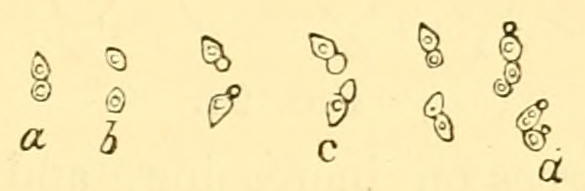
Fig. 25.
From that time we kept these contiguous cells constantly in view. At 7.10 we saw them separate and remove to some little distance from each other (Fig. 25, b). Between 7 and 7.30 we saw, on each of these cells, a very minute bud originate and grow little by little. These buds developed very near the point of contact, where the disjunction had just taken place. By 7.45 the buds had increased greatly in size (Fig. 25, c). By 8 they had attained the size of the mother-cells. By 9 each cell of each couple had put forth a new bud (Fig. 25, d). We did not follow the multiplication of the cells any farther, having seen that in the course of two hours two cellules had furnished eight, including the two mother-cells.”[82]
An increase like this, which would have been more rapid at a temperature between 15° and 25° (59° and 77° F.), and still more so between 25° and 30° (77° and 86° F.), may indeed seem surprising. It is really, however, nothing to what sometimes occurs. In choosing proper conditions of temperature and medium, of state and nature of yeast, it has sometimes happened that the bottom of a vessel has become covered with a white deposit of yeast cells, in the course of not more than five or six hours 146after we had sown a quantity of yeast so small as to effect no change at all in the transparency of the liquid contained in the vessel after it had been shaken up. Such a rapidity of vegetation reminded us of those exotic plants which are said to grow several feet in height in the course of twenty-four hours.
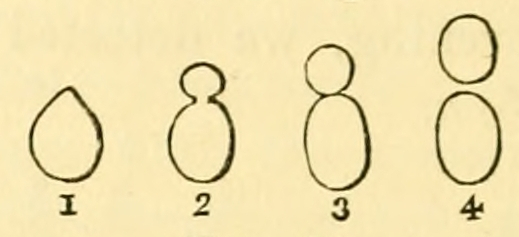
Fig. 26.
Budding commences in the form of a simple protuberance on the cell—a kind of little boss, as represented in Fig. 26, No. 1. This protuberance goes on increasing, and assumes a spherical or oval form. At the same time, there is a tendency in the points of attachment in the young cell to meet—a kind of strangulation occurs (Fig. 26, No. 2). The junction takes place a little sooner or later, according to the species (Fig. 26, No. 3); the two individuals then separate (Fig. 26, No. 4). In certain cases a single cell may give rise to several protuberances, and, consequently, to several daughter-cells. Where there is only one protuberance or bud we generally see it originate at the thick end and a little on one side of the apex of the oval outline, which, in a greater or less degree, characterizes the cells of the majority of ferments.
Certain authors have maintained that the method of budding which we have just described, and which we think was first promulgated by Mitscherlich, is merely an illusion, and that the cells of yeast break up and scatter their granular contents, and that these scattered granules eventually attach themselves to the cells, growing there, and so giving the appearance of buds or daughter-cells. This error has been revived quite recently.[83] Nothing can be less admissible. We could count the number 147of yeast cells which we have seen undergo this process of rupture in the course of some ten years of observation, every day of which, we may say, thousands of these cells have passed under our eyes. This breaking up of the cells is really of the most rare occurrence, and may always be explained by some abnormal circumstance affecting the yeast; being indeed a mechanical accident, not a physiological fact. We may easily convince ourselves of this by growing some yeast in a saccharine wort, filtered perfectly clear, and, consequently, deprived of all granular amorphous deposit that might deceive the observer. The cells will be observed to bud and multiply without exhibiting the most minute appearance of granulation, or disruption; moreover, there will always be cells of all sizes, ranging from the smallest visible up to the largest. This very simple piece of observation may be made in all the alcoholic ferments, and with any wort capable of fermenting, and in its presence the hypothesis, which we have been repudiating, cannot hold its own.
In Plate VII. (left side) there is represented a field of yeast, magnified 400 times. We see a mass of disjointed cells, such as appear after fermentations without sufficient aliment; of the kind represented some are nearly spherical, others oval or cylindrical, more or less elongated. If we mix a little of this yeast, of about the size of a pin’s head, with wort, and put the wort into a small, shallow, flat-bottomed basin, having a surface of about 1 square decimetre (10 sq. ins.) exposing it to the surrounding temperature, we shall find next day the bottom of the basin covered with a fine white deposit, of the forms of which we give a sketch in the right half of the plate. In this it will at once be observed that the cells sown have lost their interior granulations, having become more transparent and filled with a gelatinous protoplasm. The principal difference between the two halves of the plate consists in this, that whereas the cells in the left half are isolated and granular, those in the right half are more inflated, more transparent, and provided with buds, which may be seen in every stage of development, 148from their first appearance till they become as large as the parent cells. They continue to grow until they detach themselves; then they bud in their turn, so that the same figure may furnish examples of cells of the first, second, and third generations. In the right half, the protoplasm contained in the cells exhibits circular spots or vacuoles, which may be made to appear lighter or darker than the rest of the cell by slight movements of the object-glass of the microscope. These spots are due to a migration of the protoplasm towards the sides; they commonly occur in yeast cells the vitality of which, from deficient nourishment, has become suppressed—the shrivelled appearance which they then assume being due to their being forced to live upon themselves, so to speak. However, by introducing such cells into a nutritive and aerated liquid the vacuoles quickly disappear.
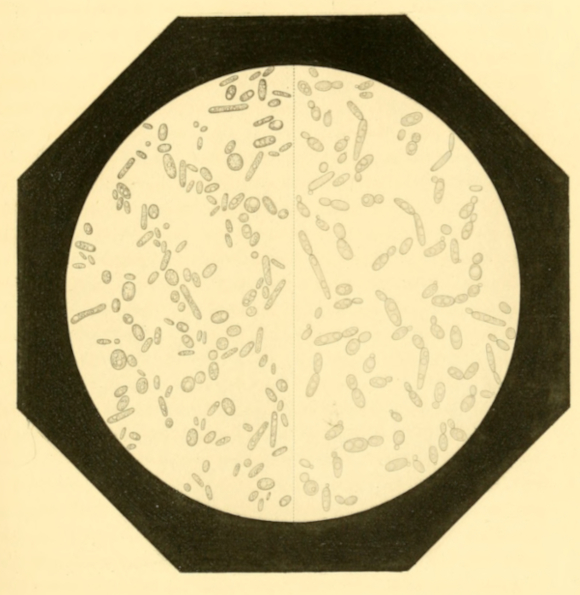
Plate 7. Yeast-cells—Worn out and Dissociated (left), after Revival in a Sweet Wort (right).
In the ordinary yeast, as met with in breweries, the majority of cells show one or more of these vacuoles; if, however, we place a little of this yeast in an aerated wort, and watch under the microscope the changes that occur in the cells, we shall witness, often in the course of a few seconds, a kind of turgescence, a greater tension of the cell-walls, which seem to grow thinner, and a complete disappearance of the vacuoles. At the same time the interior gelatinous matter will become filled with fine granulations that are scarcely visible, but which at a certain distance appear brilliant. At the same time protuberances begin to show themselves, and next day the budding will have already become very active. The newly-formed cells will have such a delicacy of aspect and contour as to be scarcely discernible in the field of the microscope. There will also be a tendency to ramification in the budding, which appearance will be more or less marked according to the kind of alcoholic ferments present, as we shall see presently, attaining its maximum in each case when the cells have been revived after exhaustion by rest and want of food. In the latter case, the process of rejuvenescence may be protracted; but this is not the case with cells of commercial yeast, which is always used within a few days of its formation. 149And thus, as I said a little ago, speaking of these cells, they often manifest the first signs of their budding in a few seconds.
In our preceding remarks we have expressly assumed that there are many kinds of alcoholic ferment. This is, beyond doubt, the case, as we have given incontestable proofs, first in 1862, in the Bulletin de la Société chimique of Paris, and later on, in 1864 and 1866, in a Note in the Comptes rendus, on the diseases of wines, as well as in our “Studies on Wine.” Moreover, we know that brewers have long recognized two distinct methods of fermentation—“high” fermentation and “low” fermentation—and two corresponding yeasts. It is true that the differences presented by these fermentations were believed to be caused by the different conditions under which they took place, and that it was supposed that we might change “high” yeast into “low” yeast, or inversely, by subjecting the first to a low temperature, or the second to a high one. In our observations of 1862, which we have just mentioned, we discovered that must gives rise to several yeasts; that the ferment of “high” beer cannot develop except with great difficulty in must, whilst one of the ferments of the grape grows rapidly and luxuriantly in wort; that it is easy to isolate the smallest of the ferments of the grape from its congeners, by subjecting filtered must to fermentation; and finally, that the secondary fermentations of wines which remain sweet furnish a remarkable ferment, very different in aspect to the ferment of beer.
We have not given specific names to these different ferments, any more than we have to the other microscopic organisms which we have had occasion to study. This was not from any disregard for names, but from a constant fear that, since the physiological functions of these minute forms was the exclusive object of our study, we might be led to attach too much importance to exterior characters. We have often found that forms, having nothing apparently in common, belong to one and the same species, whilst similarity of form may associate species far apart. We shall give some fresh 150examples of this fact in the present paragraph. A German naturalist, Dr. Rees, who has discovered new proofs of the diversity of alcoholic ferments, putting aside, perhaps rightly, such scruples, has attached specific names to the different kinds of ferments, in his brochure published in 1870, which we have already cited (p. 71). Indeed, we have often ourselves, for brevity’s sake, made use of the names proposed by Dr. Rees.[84]
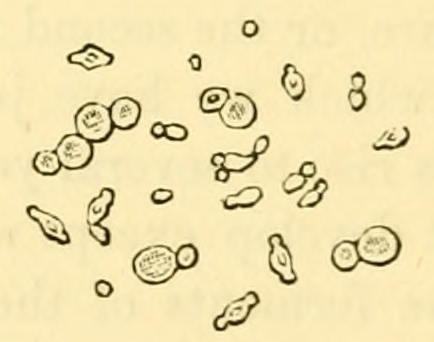
Fig. 27.
In a Note inserted in the Bulletin de la Société chimique de Paris, in 1862, we figured a ferment of small dimensions, which develops spontaneously in must, filtered or unfiltered, and which is very different from the ordinary ferment of wine. It is the first to make its appearance in the fermentation of the grape, and may even appear alone if the must has been previously well filtered, doubtless because its germs, being smaller than those of other ferments, pass through the filter more easily and in greater number. Fig. 27, extracted from our Note of 1862, represents this ferment, together with some spherical cells of high yeast, with the object of giving a more exact idea of the relative dimensions of these two ferments and their dissimilarities. Dr. Rees has named it saccharomyces apiculatus.
151The same savant has given the name of saccharomyces pastorianus to the yeast of the secondary fermentations of sweet liquids, such as wine that has remained sweet after its principal fermentation. We have described this yeast in a Note published in 1864, on the diseases of wine, from which we give the following extract:—[85]
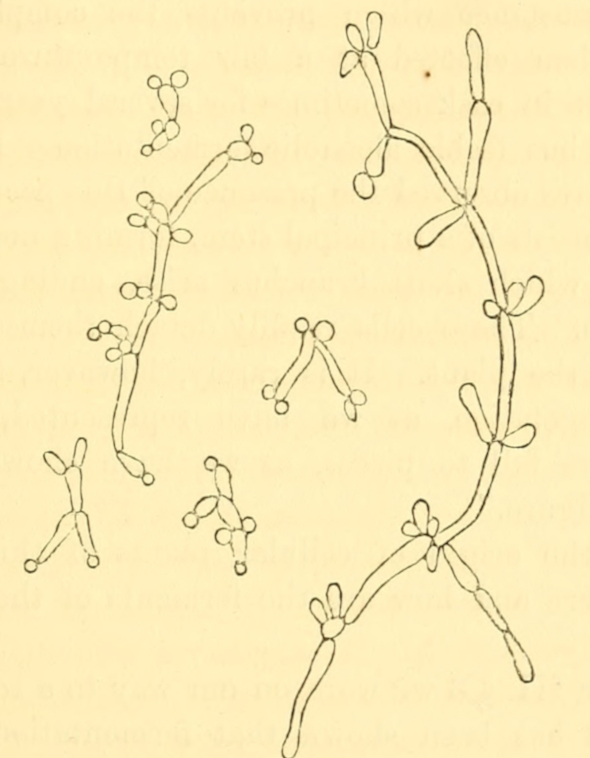
Fig. 28.
“Fig. 6 (Fig. 28 in this work) represents a very interesting 152variety of alcoholic ferment. It happens pretty often, especially in the Jura, where the vintage takes place about October 15th, when the season is already cold and little favourable to fermentation, that the wine is still sweet at the moment when it is put into casks. This is especially the case in good years, when the sugar is abundant and the proportion of alcohol high, a circumstance which prevents the completion of fermentation when effected at a low temperature. The wine remains sweet in cask sometimes for several years, undergoing a continuous but feeble alcoholic fermentation. In such wines we have always observed the presence of this peculiar ferment. In form it consists of a principal stem, forming nodes at various points, from which short branches arise, ending in spherical or ovoid cells. These cells readily detach themselves, and act as spores of the plant. It is rarely, however, that we see so perfect a vegetation as we have represented, because the different parts fall to pieces, as we have shown in the left half of the figure.”
What is the origin of cellular plants of this remarkable type? Where and how are the ferments of the grape generated?
In Chapter III. § 3 we were on our way to a solution of this question. It has been shown that fermentation cannot take place in the juice of crushed grapes if the must has not come into contact and been mixed with particles of dust on the surface of the grapes, or of the woody part of the bunch. It would, however, be sufficient that a vintage vat, of any capacity whatsoever, should receive the particles of dust existing on a single bunch in some cases, on even a single grape, for the whole mass to enter into fermentation.
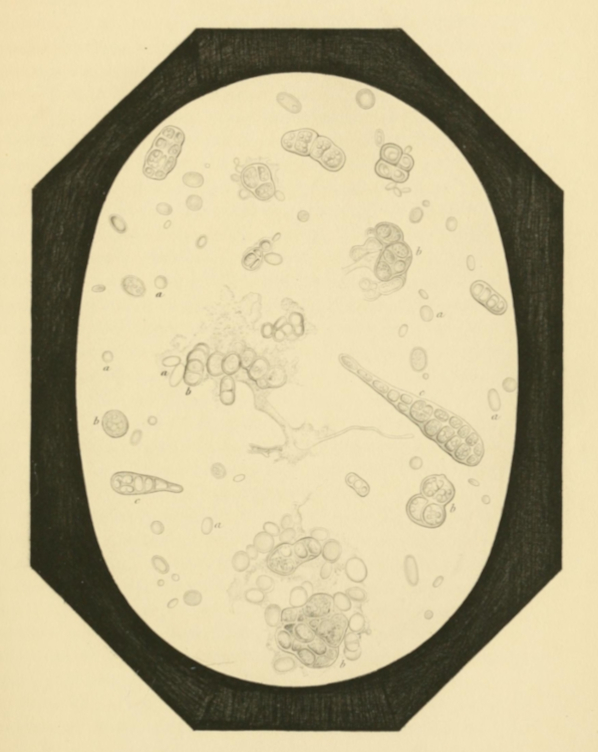
Plate 8. Fertile Mould-cells from the Outer Surface of Grapes.
What, then, we must ask ourselves, is the nature of these particles of dust? On September 27th, 1872, we picked from a vine, in the neighbourhood of Arbois, a bunch of grapes, of the variety called le noirin. The bunch selected, without any injury to a single grape, was brought to our laboratory in a sheet of paper that had been previously scorched in the flame of 153a spirit lamp, and the grapes were cut off with a pair of fine scissors, which had also been passed through the flame. By means of a badger-hair brush, thoroughly purified in water, each grape to which a portion of its peduncle remained attached, was washed in a little pure water. The successive washing of a dozen grapes in 3 c.c. of water was sufficient to make the water turbid; we then examined it under the microscope. Each field contained many little organized bodies, accidentally associated, now and again, with some very scarce crystalline spicules. As a rule, the organisms consisted of simple, transparent, colourless cells; some, indeed, of larger size had a yellowish brown colour, and were detached or united in irregular masses; and, lastly, there were club-shaped or bottle-shaped vessels, full of spores ready to germinate. We repeated this experiment with bunches of other varieties of grape, and also submitted to examination water in which the outer surfaces of gooseberries, plums, and pears had been washed; the result was in each case the same, that is, we found a great number of the same colourless cells, and the same irregular masses of darker cells, which latter, however, we must not confound with the masses of dead cells sometimes found covering parts of the epidermis of certain fruits.
As we had purposely left each fruit attached to part of its peduncle, we wished to ascertain if these corpuscles proceeded from the grapes or from the wood of the peduncle. For this purpose we washed separately the surface of the grapes and the woody part of the bunch. The water in which the latter was washed was visibly more charged with the minute organisms than that in which the grapes was washed, although the latter was by no means free from them.
Plate VIII. represents these corpuscles as they exist on the surface of fruits, magnified 500 times. The groups, b, b, b, ..., c, c, ... are of a brown colour, more or less dark, or of a reddish yellow; the cells a, a, ... are transparent. Amongst them are some spores of ordinary fungoid growths, and several cells which are probably the issue of a germination 154that had commenced in certain groups which have a hard, yellowish appearance, and which are provided with what seems to be a double case—b, b, b, ..., c, c, ..., a result of the moisture of the woody part of the bunch, or of rain that fell just before the commencement of our observations.
It is an easy matter to trace the germination of these different varieties of cells with the microscope. We put a drop of the water in which the woody part of a bunch of grapes has been washed into a small quantity of wort, previously boiled and filtered bright. Plate IX. presents a series of developments observed in the case of simple or grouped cells, A, D, G, and J. The process is as follows: The yellowish-brown cells soften and grow larger in the nutritive medium, and gradually become almost transparent and colourless. At the same time we see some very young buds appear on their margins; these rapidly increase in size, and detaching themselves to make room for others, move off as young cells that after a time bud in their turn. The rapidity with which these cells bud and multiply is often extraordinary. The group A and the cell D produced the groups C and F within twenty-four hours, passing through the intermediate stages represented in groups B, E. The cells A and D did not give rise to any filamentous growths, at least whilst under our observation. Some groups of cells, however, put forth, from the first, long filaments, having cross-partitions and resembling the mycelium in ordinary fungoid growths. Together with these, and along their whole length, was an abundance of cells, often in clusters, as represented by Fig. G, the whole of which growth took place in less than twenty-four hours.[86] But apart from contact with the air, there was a complete absence of life.
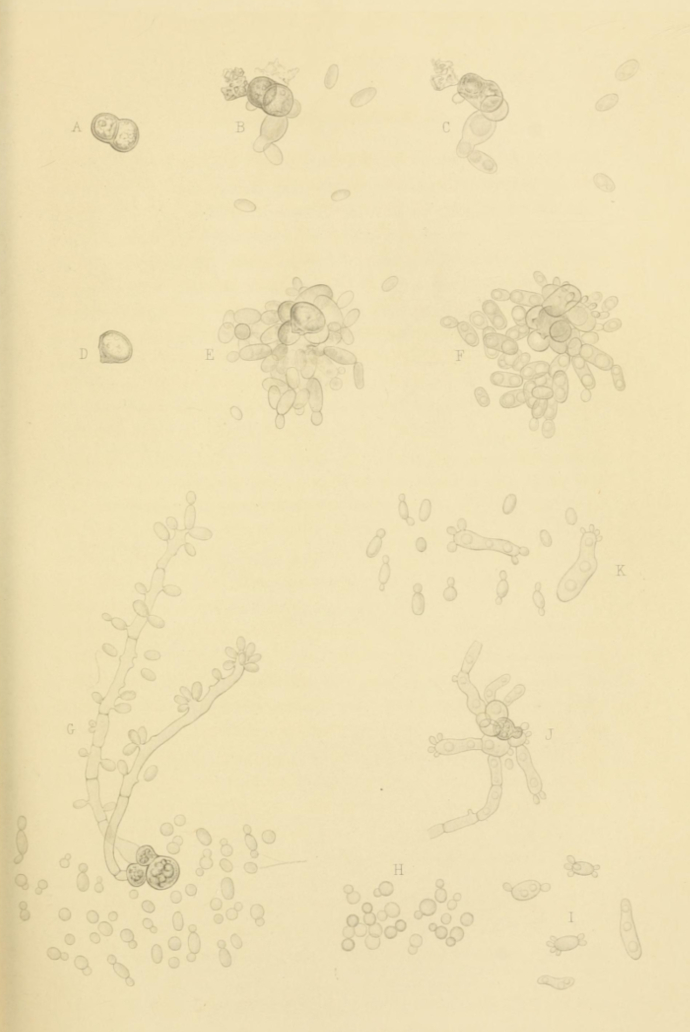
Plate 9. Various Examples of the Mode of Growth of Mould-cells from the Outer Surface of Grapes.
The figures H, I, J, K, represent other aspects of developing cells and filaments. The cells H are spherical; the cells I have numerous buds, as also have those marked K. These 155different forms were all produced in the course of twenty-four hours by the cell which may be observed in the centre of the group J. In connection with this same group, J, we may remark that on September 30, 1872, at 10 A.M., we witnessed the detachment of three oval cells at the points a, b, c; by 10.45 other buds of the size represented in our engraving had formed in their place; by about five o’clock that same afternoon these buds, a, b, c, having become transformed into cells, fell off in their turn.[87]
156It may be asked, what proof have we that amongst the filamentous and cellular growths which spring from the small, dark bodies existing in the particles of dust adhering to the surface of fruits, and which we here see bud and multiply with such marvellous rapidity, the ferment or ferments of vintage do actually exist? A very simple experiment will prove conclusively that this is the case. When in the course of twenty-four or forty-eight hours, by contact with saccharine must, and in presence of excess of air, the revival and development of the cells has taken place on the bottom of the little troughs employed in our observations; if then we fill up the trough with the same must, so that there remains no free air under the cover-glass, within a very short time—an hour, half-an-hour, or often less—we shall see bubbles of gas rise from the bottom, accompanied by an increase in the deposit of cells. This will be 157the must fermenting after the submersion of the cellular plants. It follows that the cells, or groups of cells, of a dark colour which cover the grapes, or the woody part of the clusters, are actual germs of the cells of yeast; more correctly speaking, that germs of yeast-cells exist amongst these groups, for it would not be consistent with truth to say that the various germinating forms present in the dust on the surface of grapes must all of them give rise to actual corresponding ferments. Thus the flask-shaped spores c, c, ... in Plate VIII., are reproductive organs of alternaria tenuis, which have probably nothing in common with alcoholic ferment or ferments, properly so called, except their outward form. We may repeat, however, and it is a point of great importance to bear in mind, that the cells of yeast originate from some or other of the little, brownish, organized bodies, which the microscope reveals in such numbers amongst the particles of dust existing on the surface of fruits.
The impossibility, which we have already demonstrated (Chapter III. § 3), of making grape juice ferment apart from the action of external particles of dust, and the knowledge which we have just acquired, that the particles of dust on the surface of the grapes and woody peduncles, at the moment when the grapes have attained maturity, contain certain reproductive cells which give rise to certain ferments, naturally lead us to the investigation of another point, which concerns the period at which these germs make their appearance on the different parts of the vine plant. The two following experiments tend to prove that the ferment can only appear about the time when the grapes attain maturity, and that it disappears during the winter, not to reappear before the end of the following summer.
I. In the month of October, 1873, we procured from a vineyard in the canton of Arbois some of the woody parts of very ripe clusters of grapes, taking the precaution to cut off all the grapes, one by one, with a very clean pair of scissors, whilst still on the vine; we then wrapped up the woody parts of the clusters, thus deprived of their grapes, in thin paper, to convey them to Paris. Our only object at that time was to secure for 158use in our subsequent studies the ferment-bearing dust found in October on the woody part of the vine, and, more particularly, on the clusters themselves, as already stated. After our return to Paris, and during the course of our experiments in October and November, it sufficed to wash a few scraps of the bunches in a little pure water, in order to obtain the grape-ferment in abundance; but later on in the winter we were astonished to find that the same procedure yielded no ferment, only some moulds. The bunches which, when put into boiled and filtered must, in October, very readily caused that must to ferment, at the end of winter could no longer produce the same effect, however favourable might be the temperature to which we raised the must. The particles of dust on the bunches had, therefore, become sterile, as sources of alcoholic ferments.
II. On February 17th, 1875, we purchased of Chevet, a dealer in provisions, two bunches of white grapes, which were perfectly sound, presenting not the slightest trace of injury or bruise. We took an iron pot full of mercury, which had been heated to 200° C. (392° F.), and then covered over its surface with a sheet of paper that had also been subjected to flame. When the mercury had cooled down we placed several of Chevet’s grapes, singly and in small bunches, on the surface of the metal, and, after having enclosed them in a glass cylinder that had been previously heated with and by means of the mercury, we crushed them in this vessel, in contact with air, by means of a strong, crooked iron wire that had been passed through the flame of a spirit lamp. The object of all these precautions was to prevent any cause of error, such as might have resulted from the accession of particles of dust associated with the mercury, or floating about our laboratory. We then placed our cylindrical jar in an oven, at a temperature of 25° C. (77° F.); but though the experiment was continued for several days following, no fermentation manifested itself. At last, to assure ourselves that the pulp and liquid were, notwithstanding this, well adapted to fermentation, we introduced into the test-flask an almost imperceptible quantity 159of yeast. This readily developed, and promptly produced fermentation.[91]
It seems possible, therefore, that the germs of ferment may not exist on bunches of sound grapes during winter, and that the well-known experiment of Gay-Lussac on the influence of air on the fermentation of the must of crushed grapes cannot succeed at all times.
The following observations will afford more than sufficient proof of this statement, being, after all, but an easy method of carrying out Gay-Lussac’s experiment, without having recourse to the use of mercury.
It may already be inferred from the preceding facts that there must be, in the course of the year, between the end of winter and autumn, a period when the vegetation of the cellules from which yeast proceeds undergoes a revival. When does this period occur? In other words, how long after winter does sterility of the plant continue, until it is again capable of yielding ferment? To ascertain this, we conducted numerous experiments during the summer and autumn of 1875 and the winter of 1876. Having to conduct them in a vine-growing country—in the vineyards of Arbois, Franche-Comté—at a distance from our laboratory, we were compelled to adopt a simple form 160of apparatus for our experiments, which, besides being very convenient, was at the same time sufficiently exact for the object we had in view.
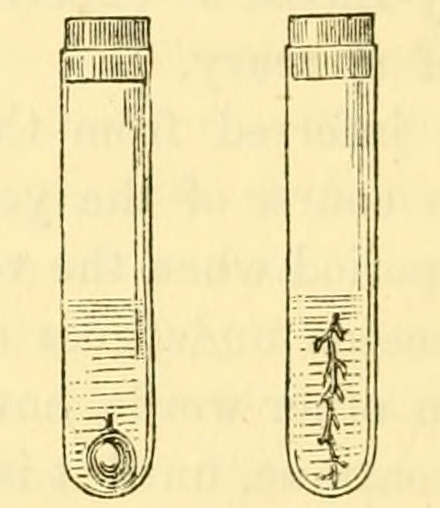
Fig. 32.
Into common test-tubes we poured some preserved must; we then boiled it, with the object of destroying all the germs that it might contain, and then, having passed the flame of a spirit lamp over the upper sides of the tubes, we closed them with corks which had been held in the flame until they began to carbonize (Fig. 32). Having provided ourselves with a series of tubes prepared in this manner, we carried them to a vine, and there dropped into some of them grapes, into others bunches, from which we had taken all the grapes, by cutting their peduncles; into others, fragments of leaves or the wood of the branches. The corks were again passed through the flame and replaced successively in each tube. Some of the grapes we dropped in whole, some we crushed at the bottom of the tubes with an iron rod that had previously been passed through the flame; others, again, at the same moment that we introduced them into the tubes, were cut open with scissors, likewise passed previously through the flame, so that a portion of their interior juice might mix with the must in the tube.
Our experiments gave the following results:—As long as the grapes were green, about the end of July and during the first fortnight of August, we obtained no fermentation in our must. Between the 20th and 25th of August a few tubes underwent fermentation, by the action of the little apiculated 161ferment; and in the course of September the number of tubes that fermented increased progressively. In each series of tubes, however, we always found a few in which there was a complete absence of fermentation.
Here are a few actual examples. In the beginning of September we placed grapes in thirteen tubes, into some whole, into others crushed ones, taken from bunches of the variety known as the ploussard, the fruit being already sufficiently ripe to be very pleasant to the taste. All the tubes of this series failing to give us any trace of fermentation, or anything besides ordinary moulds—which indeed appeared in all our experiments, whether there was or was not fermentation—we began a new series of experiments, under similar conditions, on September 28th, as follows:—
Nos. 1, 2, 3 and 4 tubes containing one uncrushed grape.
No. 5 tube containing two uncrushed grapes.
No. 6 tube containing two crushed grapes.
No. 7 tube containing two crushed grapes, in 2 c.c. of water previously boiled.
No. 8 tube with a fragment of a bunch from which grapes had been cut, and occupying the entire depth of liquid.
No. 9 tube with a fragment of wood from a branch.
Nos. 10, 11, and 12 tubes with a fragment of leaf.
On September 29th and 30th there was no appearance of fermentation in any of the flasks, but all contained flakes of fungoid mycelium. On the 1st of October fermentation more or less marked and active occurred in 2, 3, 4, and 5, in which uncrushed grapes were, accompanied by a general turbidity of the liquid, and a suspension of the development of the fungoid growths. It was still absent in 1, 6, and 7, of which the first contained an entire, the latter crushed grapes. No. 8, containing the woody part of the bunch, was in active fermentation. Nos. 9, 10, 11, and 12, with fragments of branch or leaves, showed no signs of fermentation. The following day No. 1 was fermenting; but from October 5th onwards there was no alteration in the number of fermenting tubes.
162In this series we determined the presence of the small apiculated form of yeast (S. apiculatus) in the tubes that fermented, only once finding it associated with saccharomyces pastorianus.
We need hardly say that the grapes which we employed were perfectly ripe, the vintage having already commenced in some of the Jura cantons.
This experiment shows that, even when the grapes are perfectly matured, it by no means follows that each individual grape must carry germs of ferment, and that some grapes may be crushed, in some instances several together may be crushed, without being able to set up a fermentation. In the presence of these novel facts, those who support the hypothesis of the transformation of the albuminous matter contained in the juice of grapes into yeast will no doubt admit the untenability of their opinions, since their hypothesis requires that every grape or number of grapes, when crushed, should ferment, in contact with air.
On the same day we prepared another series of tubes, using grapes of a variety called the trousseau.
Nos. 1, 2, 3, and 4 tubes containing one whole grape.
Nos. 5 and 6 tubes containing some of the wood of a branch.
No. 7 tube containing some of the wood of a branch from which the grapes had been detached.
In the course of the following days fermentation took place in 4, 5, and 7.
In this case three out of four of the uncrushed grapes did not cause the must in which they were placed to ferment; whilst the same must fermented in one of the two tubes containing wood of the branch, and in the other remained unchanged; and, lastly, the tube containing the woody peduncles of the bunch fermented.
We have already remarked that it was more particularly the wood of the bunch that was charged with germs of ferment. The truth of this assertion was proved by the following series of experiments.
163On October 2nd, 1875, we charged at the vineyard twenty-four tubes, all of which were about a third filled with pure must that had been previously boiled.
Nos. 1, 2, 3, 4, 5, and 6 tubes containing one crushed grape.
No. 7 tube containing two crushed grapes.
No. 8 tube containing one crushed grape.
Nos. 9, 10, 11, and 12 tubes containing some wood of a branch of the vine.
Nos. 13, 14, 15, 16, 17, 18, 19, 20, 21, 22, 23, and 24 tubes containing a fragment of the wood of a bunch from which the grapes had all been detached and removed.
In the course of the following days some of these tubes began to ferment; but in others only fungoid mycelia were visible.
On October 7th the following tubes were fermenting: the second of the first eight containing whole or crushed grapes; not one of the four that contained wood of the branches; whilst, on the other hand, of the tubes containing wood of the bunches, 15, 17, 20, 21, 22, 23, and 24 were all in full fermentation. In short, fermentation, and therefore germs of yeast, were present in one single tube out of eight containing grapes; in none of the four tubes containing wood of the vine branch; but in seven out of the dozen containing wood of the bunches. There was no subsequent change in the number of tubes that fermented.
The same day that we arranged this series of tubes we prepared twenty-four other similar ones, using the wood of bunches preserved from the vintage of the preceding year. Not one of these twenty-four tubes showed the least sign of fermentation, although they contained grape juice in presence of the wood of the bunches; this was a further confirmation of the sterility of the germs of ferment in the case of bunches of grapes preserved for a sufficient time.
The next question to be considered was, what length of time after the vintage do the germs on the surface of the woody part of bunches of grapes preserve the faculty of producing 164yeast? The following experiments were undertaken to determine this point.
We have just seen that on October 2 fragments of the woody peduncles introduced with must, on the spot, caused that must to ferment in seven cases out of twelve. In order that we might test the wood of these same bunches during winter we took care to wrap some fragments up in paper previously passed through the flame. We afterwards took occasion to test portions of these fragments as follows:—
On December 21st, 1875, we conducted an experiment with twelve. On the following days all began to show flakes of mycelium, or numerous multiplying cells of mycoderms, torulæ, and dematium; and only four subsequently produced yeast and alcoholic fermentation. From this we may conclude that, three months after the vintage, a large number of the germs of yeast spread over the woody part of the bunches lose their vitality, through desiccation by the surrounding air, since two-thirds of the examples taken had become sterile by that time.
On January 21st we conducted a similar experiment with twelve other tubes. At a temperature between 20° and 25° C. (68° to 77° F.) fermentation occurred in only two of them. On March 2nd we undertook another experiment, again using twelve tubes, and again fermentation occurred in two tubes.
By the beginning of April the sterility was absolute. At that period of the year (April and May) we made numerous experiments of this kind, using the woody parts of fresh bunches of grapes and white grapes preserved from the last vintage, plenty of which were still to be had in a state of freshness at the provision store. We also operated on some wood obtained from a vineyard at Meudon. In a great number of cases no fermentation occurred; it even happened that a whole bunch of fresh black grapes, very ripe, which were bought at Chevet’s on April 16th, and which had been grown in a hot-house, after having been crushed, did not ferment at all.
165Up to March not one of the tubes containing the wood of dry bunches brought from the Jura, which had fermented, showed any signs of apiculatus or of pastorianus, or anything besides the ordinary low yeast of wine, saccharomyces ellipsoideus.[93]
It would be a study of much interest to determine if yeast exists on other species of plants besides the vine. During the winter we could discover it on no others. Once during the winter, experimenting on box, we obtained fermentation in one of our tubes which contained must. In a great number of other experiments we obtained nothing besides moulds and growths of dematium, alternaria, and torulaceæ.
Our observations in Chap. III § 6, taken in connection with those which we have just made, prove that the yeasts of fermentation, after being dried, preserve the faculty of germination longer than the germ-cells which are scattered over the dead wood of the vine.
As might be expected, a microscopical examination of the particles of dust scattered over the surface of the fruit and woody peduncles of grapes, reveals great differences in the number of these fertile particles at different periods of the vegetation of the grapes. As long as the grapes are green and the vine in full activity we find scarcely any, or, at all events, very few spores which seem to belong to ordinary fungoid growths. Towards autumn, however, when the grape is ripening and the leaves becoming yellow, fungoid growths and numerous productions of great fertility accumulate on the vine, on the leaves, the branches, and the bunches. At this period we find the water in which the grapes and the woody parts of the bunches are washed swarming with different kinds of organized corpuscles; it is at this period, too, that the ferment-yielding 166moulds attain that phase of their vegetation in which, when mixed with the juice of grapes, they produce fermentation.
In the Jura district a peculiar kind of wine, called straw wine (vin de paille), is manufactured, which seems to contradict what we have said as to the advent of sterility towards the end of winter in the yeast-germs formed on the surface of preserved bunches of grapes. This straw wine is made of grapes preserved for long after the vintage on straw. From what we have said it might be supposed that fermentation could not occur under these circumstances. We have, in fact, no doubt that it is often really produced by quite different yeast-germs from those which cause fermentation in the vintage gathered in autumn. Fermentation as effected in the manufacture of straw wine is probably due to yeast-dust spread over the utensils of the vine-grower, and derived from the preceding vintage. We have seen (Chap. III. § 6) that yeast may be dried and reduced to powder, and yet preserve its faculty of germination for several months. It would be useful, however, to submit this surmise to the test of experiment, and it would be easy to do so provided we took care to crush the grapes so preserved in very clean vessels, previously heated to a temperature of 100° C. (212° F.), having first rejected every bunch containing injured grapes, which might have fermented or given occasion to the development of yeast. Fermentation, we believe, would not then take place.
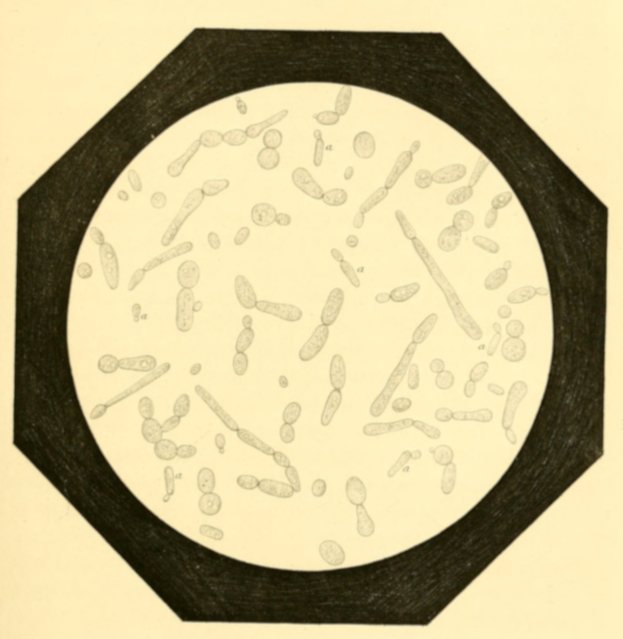
Plate 10. One of the Ferments of Acid Fruits at the Commencement of Fermentation in its Natural Medium.
Another consequence results from the various facts that we have brought out in relation to the origin of the wine-ferments, which is, that it would be easy to cultivate one or more vine-stocks so that the grapes gathered from them, and crushed to extract their juice, would be unable to ferment spontaneously even in autumn. For this purpose it would be sufficient to keep the bunches out of contact with particles of dust during the vegetation of the bunches and the ripening of the grapes, and then to effect the crushing in vessels thoroughly freed from germs of alcoholic ferments. Moreover, every fruit and 167every vegetable might be submitted to important investigations of this kind, the results of which, in our opinion, could hardly be doubtful.
The following observations, which relate to the polymorphism of saccharomyces pastorianus, seem to me to have an important bearing on the history of alcoholic ferments, as presenting a close analogy between the species of ferment and fungoid growths of a higher order, for example, such fungi as dematium, which are generally found on dead wood; and we would say that between the vine and other shrubs there is only this difference, that amongst the dematium forms of the vine there occur one or more which are anaërobian, at a certain period of the year, whilst, on the other hand, the dematia, alternaria, &c., of other shrubs are more generally aërobian. There would be nothing surprising in this result, considering that amongst the mucors, for instance, we find both aërobian and anaërobian forms, and that there are likewise torulæ-ferments or anaërobian forms, as well as torulæ-forms exclusively aërobian.
When saccharomyces pastorianus begins to develop from its natural germs, such as are scattered over the surface of acid fruits, it takes the form of elongated jointed filaments, branching, often pear-shaped, and more or less voluminous. In proportion as the oxygen held in solution in the liquid disappears and the buddings are repeated, the length and diameter of the filaments and cells diminish, and such is the transformation that we might, at last, suppose that we were dealing with a different ferment of smaller dimensions.
Plate X. represents this ferment, at the commencement of fermentation in cherry juice. In the course of a short time there is nothing to be seen but cells of comparatively small size, disjointed and round or oval, and filaments comparatively short and slender. This appearance is indicated in our drawing by the cells a, a, a. As these latter forms multiply with great rapidity, we soon have to search widely over the microscopic field before we find any of the long forms from which they 168spring. Instead of the forms given in Plate X., we have only those represented in Plate XI. In other words, the aspect of these ferments changes daily, from the very commencement of fermentation. Thus the yeast would appear to grow smaller, coincidently with the progress of fermentation passing from a condition in which it consists of large cells and long ramified filaments, to a condition in which the cells are small and the filaments short. These changes are principally due to an alteration in the method of budding and in the life-processes of the yeast, which speedily exhibits itself when the air supply is reduced, and not through any intermixture of foreign ferments. So, at least, all our observations up to the present time lead us to believe. As soon as the oxygen has been absorbed the cells which form are oval or globular, and the filaments do not lengthen or become so plump.
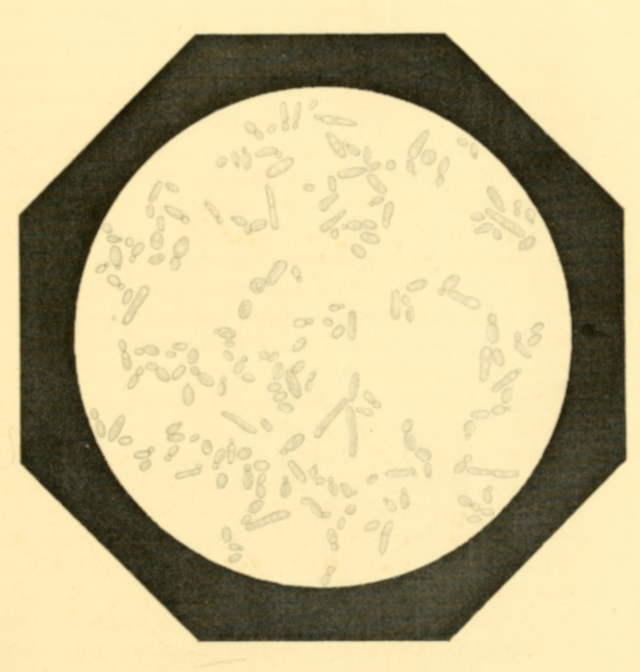
Plate 11. accharomyces Pastorianus, in course of Regular Growth.
This is, however, not the only cause of these changes in form and aspect, although the presence of air, in greater or less quantity, has a marked influence on the earlier developments of yeast; there is another circumstance to be taken into account, difficult indeed to state shortly, but which is demonstrated clearly by the microscope, and is connected with the actual state of the germ cells. As a general rule the budding of a cell is not an identical process when the cell is quite young, and when it has become exhausted from want of nourishment. Between these two conditions there is a difference which may be compared with that which exists, for example, between a newly-formed grain which would not germinate, and the same grain matured by rest, if we may use the expression, that is, which has been kept long enough for its germination to be possible. In other words, and as far as our subject is concerned, we are not to expect that, by reviving our old yeast cells and putting them to grow with abundance of air, in a saccharine, nutritive medium, we shall obtain the appearance of the earlier developments of the germ-cells on the surface of sweet and acid fruits. We see this clearly in Plate VII., the right-hand half of which represents the recruited budding of cells, such as those 169represented in the left-hand half, in a medium peculiarly adapted to their vitality, and in the presence of much air. As regards the length and size of filaments and cells, there is little appreciable difference between the two sides. The principal difference consists in the relative freshness and the budding going on in individuals in the right-hand half.
There is a simple means of transforming the small, disjointed forms of the yeast as it occurs in a deposit, at the end of a fermentation, back into the long, tubular, pear-shaped forms peculiar to the germination of the germ-cells, which exist amongst the particles of dust spread over the surface of fruits. Plate X. illustrates the result of the process. For this purpose we must effect as complete an exhaustion as possible of the ferment saccharomyces pastorianus, by leaving it to itself for a very long time, without aliment, in contact with pure air, in a damp state; or, better still, in presence of sweetened water. We cultivate some yeast in wort, in one of our two-necked flasks, and then carefully decanting the fermented liquid through the right-hand neck, leave the deposit of yeast on the sides of the flask. The glass stopper which closes the india-rubber tube must be replaced, and the moist yeast be left thus, in contact with pure air. The cells will steadily continue their activity, and so gradually age, without meanwhile losing their vitality. We use the word age, as we have already observed, because the period of rejuvenescence in the case of such a yeast is so much the slower the longer the plant has remained in that state.
Under these conditions the yeast rarely dies. It becomes attenuated and shrivelled but still preserves its vitality, that is, the power of reproducing itself after a lapse of several months or even several years. In the end, however, it dies, a fact which is proved by the cells, when sown in a nutritive medium, remaining inert.
To exhaust yeast, without destroying it, sweetened water is preferable. Having decanted the beer, we substitute in its place water sweetened with 10 per cent. of pure sugar. By 170effecting the substitution in the following manner, we escape the risk of introducing germs from floating particles of dust, which would nullify all experiments of this kind. We prepare, then, a flask containing sweetened water, free from all foreign germs, which we attach to the other flask [i.e., two of M. Pasteur’s flasks with two necks, one straight and wide, the other bent and narrow (Fig. 8)]. This is done by taking the india-rubber tube off the flask containing yeast, and removing the glass stopper from the other india-rubber tube attached to the flask containing the sweetened water; then, introducing the right-hand neck of the yeast flask into the india-rubber tube connected with the other, we raise the latter flask so as to pour the sweetened water on to the yeast. At the same time an assistant passes the flame of a spirit-lamp over the bent part of the curved tube attached to the water flask, with the object of destroying the vitality of the germs in the floating particles of dust, which enter the flask in proportion as it is emptied into the other.
The sweetened water, which is thus brought into contact with yeast of greater or less freshness, soon begins to ferment. Fermentation accomplished, the vinous liquid is decanted and replaced by fresh sweetened water, which ferments in its turn, although even at this stage with greater difficulty than the first; this second dose is again decanted, and again replaced by fresh sweetened water, and this process is repeated three or four times. The yeast becomes weaker and weaker, and eventually is unable to cause any fermentation in sweetened water poured on it.
This exhaustion of yeast in sweetened water may be produced more quickly by the following means:—It is sufficient to sow a mere trace of pure yeast in a large quantity of sweetened water, say 100 c.c. (nearly four fluid ounces), that is, instead of pouring the contents of a bottle of sweetened water upon the whole deposit of yeast in the flask which contained the fermented wort, we simply take a little yeast, by means of a fine tube, from the deposit at the bottom of the flask, and introduce it into the flask of sweetened water. This large proportion of 171liquid is itself sufficient to exhaust the small quantity of yeast, quickly checking the feeble fermentation which it had induced, so feeble indeed as frequently not to be detected by the eye, from the fact that the amount of liquid present is more than sufficient to dissolve any bubbles of carbonic acid gas that might otherwise have been liberated.
It is a remarkable fact that the yeast, which during its protracted stay in the sweetened water becomes enfeebled to such a degree that it can no longer excite the least fermentation in that water, but will remain in its presence for an indefinite time in a state of inert dust, does not die. In some of my experiments the yeast has remained alive in the sweetened water for more than two years.[94] It is almost unnecessary to point out that these results are altogether out of keeping with the various properties that are usually attributed to yeast.[95]
In these experiments we may use yeast-water[96] instead of water sweetened with sugar. Into some flasks of pure yeast-water we put a little yeast, taking all precautions to prevent the introduction of foreign germs. No fermentation results, there being no sugar present; the yeast, however, begins to bud, and this budding is more or less marked according to the quantity 172of carbohydrate food which we introduce along with the specimen. An interior chemical action also goes on, causing a gradual change in the aspect of the yeast. The plasma of the cells collects about the centres, assuming a yellowish-brown colour, becoming granular, and forming within the cells masses more or less irregular in shape, very rarely spherical.
We may observe here that these conditions seem to be peculiarly adapted to show the character of the interior sporulation of the cells discovered by Dr. Rees. Notwithstanding this we have never succeeded in finding it distinctly, under these circumstances.
The fact which should claim all our attention, we repeat, is, that this exhausted, shrivelled-up, aged-looking yeast preserves its faculty of germination for several years; that, moreover, this faculty may be aroused by placing it in aerated nutritive media, in which case it will exhibit all the peculiarities which, under similar conditions, characterize some of the germ-cells found on the surface of our sweet domestic fruits. In other words, this yeast, instead of multiplying, as it always does in the course of several growths in saccharine musts, in the form of cells which detach themselves readily as soon as they have nearly attained the form and size of the mother-cells, begins to shoot out into such beautiful forms as those of dematium pullulans, producing like that ferment long, well-grown, branching filaments, as well as plump and frequently pyriform cells, as represented in Plate X.
The following figures (33 to 37) and descriptions of the observations to which they relate will furnish fresh proofs of our assertions. In these figures we see saccharomyces pastorianus, which has been exhausted in sweetened water or in yeast-water, undergo revival in saccharine musts, give rise to elongated, branching, pear-shaped forms, such as belong to the original ferments of fruits, and afterwards assume the most minute forms that we find in fermentations progressing or completed.
Let us examine Fig. 33. The history of this growth is as follows:—
173Some spontaneous yeast which, after repeated cultivation, had acquired the aspect represented in Plate XI.—which aspect the saccharomyces pastorianus generally assumes under these circumstances—was exhausted in sweetened water, and subsequently revived in must at 10° C. to 11° C. (51° F.). At this temperature germination was not very marked before the end of eight days; at a temperature of 20° C. (68° F.), it only took three days, under similar conditions. The sketch includes but one of the long branches from which the ferment cells and the budding joints took rise, but there were a great number more. Some of the forms represented in the figure bear a striking resemblance, it appears to us, to some of those of dematium, in Plate IX.; and even we may trace out the several peculiarities of form which distinguish the figures in the latter plate.
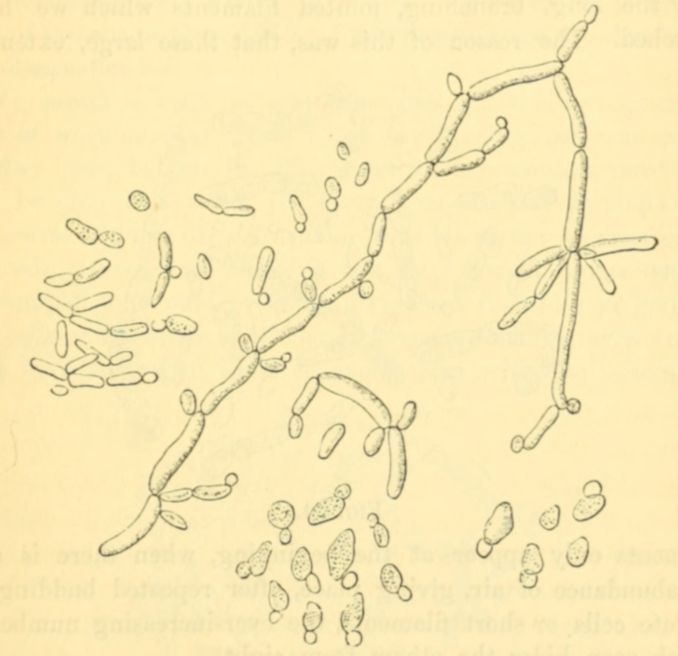
Fig. 33.
The next figure (34) represents the earliest forms of germination of another specimen of saccharomyces pastorianus in 174wort, after it had been exhausted by four successive growths in sweetened water. We here see the large ferment-form which appears at the commencement of fermentation, in acid fruits, such as cherries and gooseberries (Plate IX.), associated with smaller forms, which follow it and emanate from it, in proportion as the process of budding is repeated. The field was covered with this minute form, and we had to search about considerably before we could find any of the large cells and the long, branching, jointed filaments which we have sketched. The reason of this was, that these large, extended filaments only appear at the beginning, when there is still an abundance of air, giving place, after repeated budding, to minute cells or short filaments, the ever-increasing number of which soon hides the others from sight.
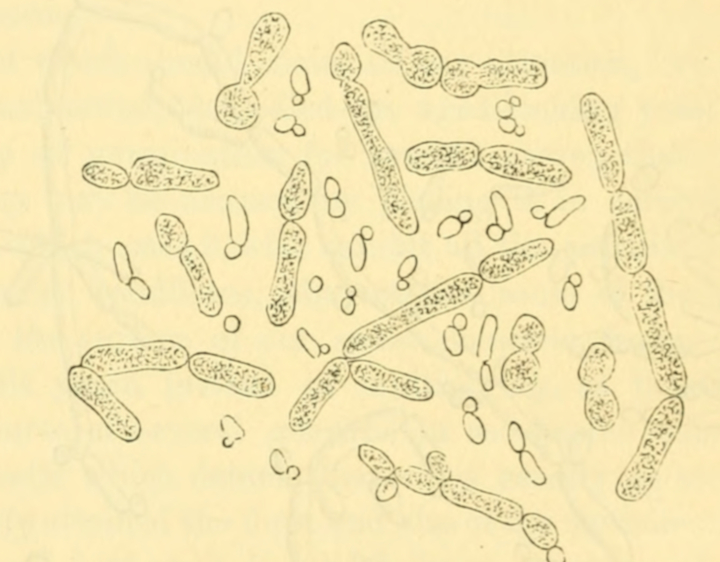
Fig. 34.
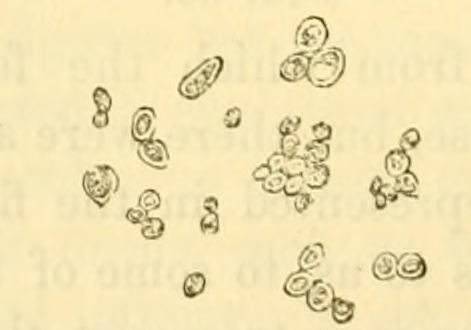
Fig. 35.
Fig. 35 represents saccharomyces pastorianus again, as it appears after having been exhausted by two years preservation 175in yeast-water, in contact with pure air. Strange to say, it has lost its elongated appearance, and would appear to have originated from a round ferment. The cells are much exhausted, and most of them seem to have a double border; their interior is very granular and of a yellowish colour. One might readily take the specimen to be a dead old ferment, which, however, it by no means is.
Fig. 36 represents the germination of this ferment, which had previously been revived in a flask of wort, at the temperature of the air, in May, 1875. The following are the details of our observation:—
We sowed a trace of the exhausted yeast (Fig. 35) in a flask of wort on May 16th. The sketch (Fig. 36) was made on May 19th, but on the 18th there was a sensible revival. It will be seen how much the little ferment had developed in the course of three days from the time when the process commenced. If we had waited a few days longer before taking our sample, we should probably have had difficulty in finding any cells or filaments of the large ferment form, as there would have been so few of them in comparison with the others.
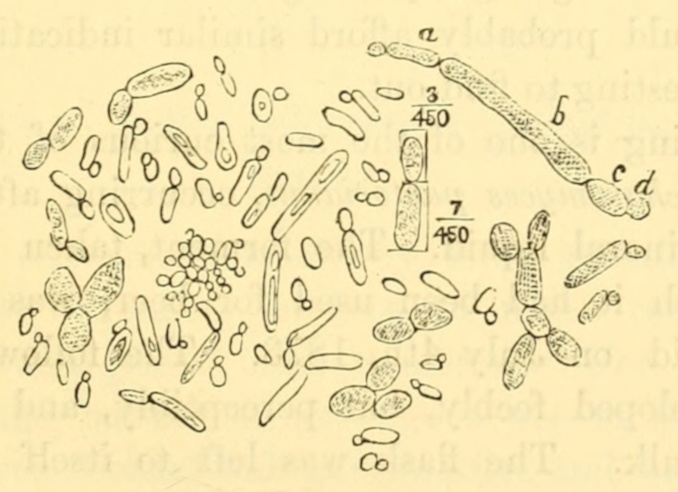
Fig. 36.
In the above figure we should remark the chain of large cells and long-jointed processes, a, b, c, d : d is one of the cells that we sowed; it has become transparent, and its contents, which are slightly granular, have lost their brownish tint; c is a large cell which sprang from the preceding one; its outline 176is clear, and it is full of fine, yellowish granules, which present a perfect resemblance to the large ferment-cells of fruits, proceeding from the germ-cells on the surface of those fruits, when it begins to appear in sweet juices; b is a long filament, sprung from the preceding cell; and, last of all, a is a joint and its bud, in which the border is not yet very clearly defined; it has scarcely any granules, and is finer than the others, belonging, in short, to the small ferment form represented in Plate XI. Here, then, we see the transition of the large ferment to the small, on the same branch, after two generations from the germination of the germ-cell d. This observation corroborates the opinion maintained by us, that in Figs. 33, 34, 36, as in Plate X., we have not a mixture of two ferments, the one consisting of large, elongated filaments, the other of small cells, but one and the same ferment, the differences in the form and size of which depend on particular conditions. The smallest ferment-form very soon becomes the only one visible, and it preserves its peculiar appearance in successive growths from inability to return to the full, elongated, filamentous forms before undergoing a prolonged exhaustion. The ferment of mucor would probably afford similar indications: it would be very interesting to find out.
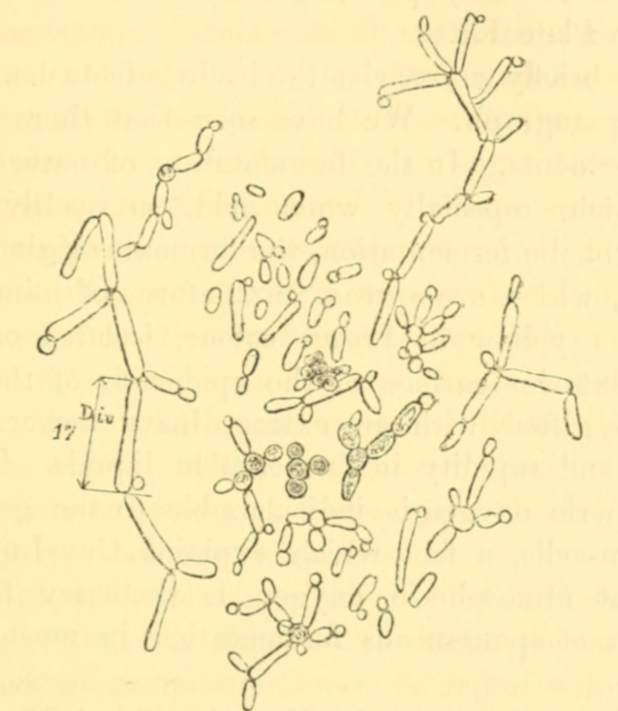
Fig. 37. 1 Div. = 1/450th of millimetre (1/11250th of in.).
The following is one of the most curious of the forms presented by saccharomyces pastorianus, occurring after exhaustion in a sweet mineral liquid. The ferment, taken from a closed vat, in which it had been used for beer, was sown in the mineral liquid on July 4th, 1873. The following days the ferment developed feebly, but perceptibly, and gradually increased in bulk. The flask was left to itself in an oven at 25° C. (77° F.) until December 3rd, when we ascertained that all the sugar had fermented. We then sowed a trace of the deposit, which had become abundant, in a flask of pure wort. On December 4th there was no perceptible change. On December 5th, however, fermentation was in active progress; a large quantity of froth covered the surface of the liquid, and a considerable deposit of ferment had already taken 177place at the bottom. We made a microscopical examination of this deposit, a sketch of which we append (Fig. 37). The dark, double-bordered cells are those which were sown but did not rejuvenesce. We may notice in different places several of these same cells, recognizable by their granular contents, which they are beginning to lose, to make room for germinating cells and joints, often numerous. For instance, in the group at the bottom of our figure one of the cells is in course of rejuvenescence and germination, and has given rise to no fewer than six cells, filaments, or groups of filaments. In different fields of our microscope we met with a crowd of branches, more or less ramified, and chains of cells, of greater or less length, of which we have sketched a few. In proportion as the budding of these branches is repeated, the cells and joints become more readily disunited, grow small, and assume the appearance of saccharomyces pastorianus in ordinary 178growths, almost as represented in Plate XI. At first, when the old, exhausted cells begin to germinate, their appearance rather resembles that of dematium pullulans, as seen in the germination of many of the corpuscles on the surface of clusters of grapes or fruits, or their woody parts, some specimens of which are to be found in Plate IX.
We may briefly summarize the leading facts demonstrated in the above paragraph. We have seen that there are different alcoholic ferments. In the fermentation of natural saccharine juices, which, especially when acid, so readily undergo a decided alcoholic fermentation, the ferments originate in certain germ-cells, which are spread in the form of minute spherical bodies of a yellow or brown colour, isolated or in groups, over the exterior surface of the epidermis of the plant, and which are gifted with an extraordinary power of budding with ease and rapidity in fermentable liquids. The presence of atmospheric oxygen is indispensable to the germination of these germ-cells, a fact which explains Gay-Lussac’s observation that atmospheric oxygen is necessary for the commencement of spontaneous fermentation in must.[97] Of these 179various ferments one deserves special mention—namely, the variety termed saccharomyces pastorianus. As is the case with all ferments, when we gather it from the deposits produced in must that has been fermented by its action, it is composed entirely of oval or spherical cells or of short joints. When again placed in a similar must it buds, like all the ordinary ferments, and the buds detach themselves from the joints or mother-cells as soon as they have attained the size of these latter, from which time in the new deposit is reproduced the original ferment-form from which it sprung, and so on. Under certain conditions of exhaustion, however, which may be easily obtained, and which we have already accurately described, the cells undergo an absolute change as regards their capabilities of budding and germinating. Each cell, modified in its structure by the conditions we have mentioned, shows a tendency to shoot out all around its surface, with astonishing rapidity, into a multitude of buds, from many of which spring branching chains, covered in parts, and more especially at the internodes, with cells and jointed filaments, which fall off and bud in their turn, soon to present the forms of the yeast deposit. In this way saccharomyces pastorianus seems to afford a kind of bond of union between the race of ferments on the one hand, and certain kinds of ordinary fungoid growths on the other. Of these latter the plant which De Bary has named dematium, and which is generally found on the surface of leaves or dead wood, more especially, however, on the wood of the vine at the end of autumn, the time of the vintage, presents a striking example.
There seems every reason to believe that at this period of the year one or more of the varieties of dematium furnish cells of yeast, or even that the ordinary aërobian varieties of 180dematium produce at a certain stage of their vegetation, in addition to aërobian cells and torulæ, other cells and torulæ which are anaërobian, that is, alcoholic ferments.
In this manner we arrive at the confirmation of an idea entertained by most authors who have studied yeast closely—namely, that it must be an organ detached from some more complex vegetable form. We may also add that in the case of saccharomyces the chains of filaments, both tubular and fusiform, and septate cells more or less pyriform originating in them, when attentively observed, remind us forcibly of the filamentous chains and spore-balls, or conidia of mucor racemosus when submerged, so that one might suppose that the spore-ferment of our dematium is itself an organ detached from some still more complex vegetable form, in the same way that conidia-ferment of mucor racemosus belongs to that more complex fungoid growth.
In the following passage De Bary uses, for the first time, the words dematium pullulans (Hofmeister, vol. ii. p. 182, 1866). The German naturalist begins by citing the opinions of Bail, Berkeley, and H. Hoffmann, the first of whom maintains that mucor mucedo becomes transformed into the yeast of beer, the second that yeast is a peculiar state of penicillium, and the third that it may be generated by fungi of very different nature, and especially by penicillium glaucum and mucor mucedo. He goes on to say: “I have taken great pains to repeat the experiments of Bail, Berkeley, and H. Hoffmann, but I have never been able to confirm the results which they have stated, either in the case of growths in microscopic cells or in experiments performed in test-tubes with the purest possible substances—specially prepared solutions or must of wine and spores of penicillium, mucor mucedo, botrytis cinerea, &c.” On this point M. De Bary arrives at exactly the same results which we communicated to the Société Philomathique and the Société Chimique of Paris, as already given in Chap. IV. § 4, p. 128, note.
M. De Bary goes on to say: “In researches of this kind 181it is difficult to eliminate two sources of error. On the one hand, it is beyond doubt that cells of ferment are actually scattered over everything, and that, consequently, they may easily get into the experimental liquid along with the spores that we sow, and so occasion mistakes. On the other hand, there are a great many fungi which develop budding processes similar to yeast, but incapable of producing fermentation, which yet in some cases spring directly from spores as well as from mycelium, especially we may instance exoascus. This last observation is especially applicable to the extraordinarily numerous variety of fungi which rank under the Dematiei and Sphaeriacei, and which I shall term, for convenience of naming, dematium pullulans.”[98]
We shall conclude this paragraph with a remark that has doubtless presented itself to the minds of our readers, which is, that it would be impossible to carry out the experiments we have described if we could not make sure of dealing with pure ferments, or, at least, with mixtures the components of which are sufficiently well known for us to assign to each the effect produced by it in the total phenomena observed. It would be extremely difficult to continue growths of yeast-deposit in sweetened water or in a moist atmosphere if the little plant were mixed with spores of other fungoid growths, a variety of ferment-forms, and germs of bacteria, vibrios, or 182infusoria in general. All these foreign organisms would tend to develop just in proportion as the conditions of the media were more or less favourable to their growth, and, in a very few days, our flasks would be filled with swarms of beings which, in most cases, would entirely conceal the facts relating to those forms, the separate study of which it was our object to follow out. We shall have occasion, therefore, to examine, in a subsequent paragraph, the preparation of ferments in a state of purity. At present we may state that yeast, which in its ordinary condition is a mass of cells so liable to change that its preservation in a moist state is impossible, manifesting in the course of a few days during the winter, and in twenty-four hours during the heat of summer, all the signs of incipient putrefaction, thereby losing its distinctive characteristics, is nevertheless capable, when pure, of enduring the highest atmospheric temperatures for whole years without showing the least signs of putrid change or contamination with any other microscopic organisms, and without the cells losing their power of reproduction. In the presence of facts like these, the theory of spontaneous generation must seem chimerical. The hypothesis of the possible transformation of yeast into penicillium glaucum, bacteria, and vibrios, or conversely, which the theories of Turpin, H. Hoffmann, Berkeley, Trécul, Hallier, and Béchamp involve, is equally refuted by these facts.
§ II.—On “Spontaneous” Ferment.
The expression spontaneous ferment may be applied to any ferment that appears in a fermentable liquid without having been purposely sown in it. In this respect the ferments mentioned in the preceding paragraph, those of all saccharine juices of fruit which ferment when left to themselves—the ferments of wine, for example—are spontaneous. The term, however, is not altogether appropriate, because, after all, the process is the same as if an actual sowing had been made, since, 183as we have shown, it is absolutely necessary for the juice to come into contact with the surfaces of the fruit, so that the ferment may be mixed with it, and so produce subsequent fermentation. Therefore, although we may apply the term spontaneous ferment to the ferments of fruits, we intend that expression to apply in this paragraph solely to those ferments that are generated in a saccharine liquid, in which, by previous boiling, we have destroyed all ferment germs, and which, nevertheless, enters into fermentation after being exposed in free contact with air. In such a case it is entirely from the particles of dust floating in the air that the ferment germs that appear in the liquid are derived. Such are typical spontaneous fermentations, and it is of the ferment so obtained that we are about to speak.
In the course of the researches which we undertook in order to ascertain whether mycoderma vini, or vinous efflorescence, became transformed, in the case of beer, into actual alcoholic ferment—researches which were the more protracted and varied in consequence of their leading to the condemnation as erroneous, on the faith of new and more precise experiments, such as those given in Chap. IV. § 2, of that transformation, in which we had for long believed—we had occasion to observe several spontaneous fermentations of this kind in various saccharine liquids. We then proceeded to describe our method of conducting the experiments. Having brought about the development of a film of mycoderma vini or cerevisiæ on the surface of a liquid, fermented or not, we submerged that film in wort, which we afterwards put into long-necked flasks, in which alcoholic fermentation generally took place in the course of a few days. This fermentation in no way resulted from the transformation of the cells constituting the efflorescence into ferment. The mycodermic film merely acted as a receptacle of true ferment germs, wafted thither with the particles of dust floating in the air of the laboratory, which germs developed in the liquid into actual alcoholic ferments amongst the cells of the submerged mycoderma. By conducting experiments in this manner we 184brought about several spontaneous fermentations, the germs of which could have been introduced by nothing but the particles of dust in the air. These fermentations, which we were obliged to follow very carefully with the microscope from the time when they first manifested themselves, on account of the transformation that we were seeking, which transformation we thought might possibly be that of the cells of mycoderma vini into cells of ferment, generally gave us during the first days of fermentation the large, elongated, branchy ferment represented in Plate X., which was succeeded by the small ferment represented in Plate XI.[99]
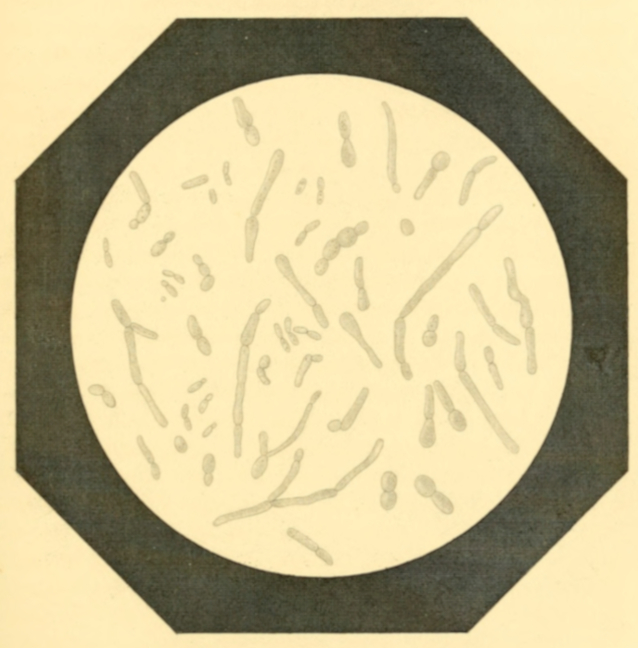
Plate 12. Ferment-cells from a Spontaneous Fermentation just starting.
Here let me describe one of these experiments. In the beginning of March, 1872, we grew some mycoderma vini, obtained from wine, on some wort contained in a shallow basin. On March 6th we submerged the efflorescence and put it all together, liquid and film, into a long-necked flask. On March 9th we detected incipient fermentation, and on March 12th we took a sketch of the yeast of the deposit, as given in Plate XII. This is the large and long branching, more or less pear-shaped form, which occurs at the beginning of fermentation in the sweet and acid musts of our domestic fruits. On March 16th we made another sketch of the deposit, in which the proportion of cells, in the form of elongated segments and filaments, reminded us, in some measure, of the filamentous mycelium of typical fungoid growths much diminished. In this case, however, the majority of cells were oval, round, and in short segments. On this day, March 16th, we added some fresh wort to that which had fermented, with the object of prolonging the duration of 185fermentation and increasing the proportion of yeast. On March 19th we made a fresh sketch, which it is not necessary either to reproduce; suffice it to say, that the yeast was now considerably more regular and uniform in appearance.
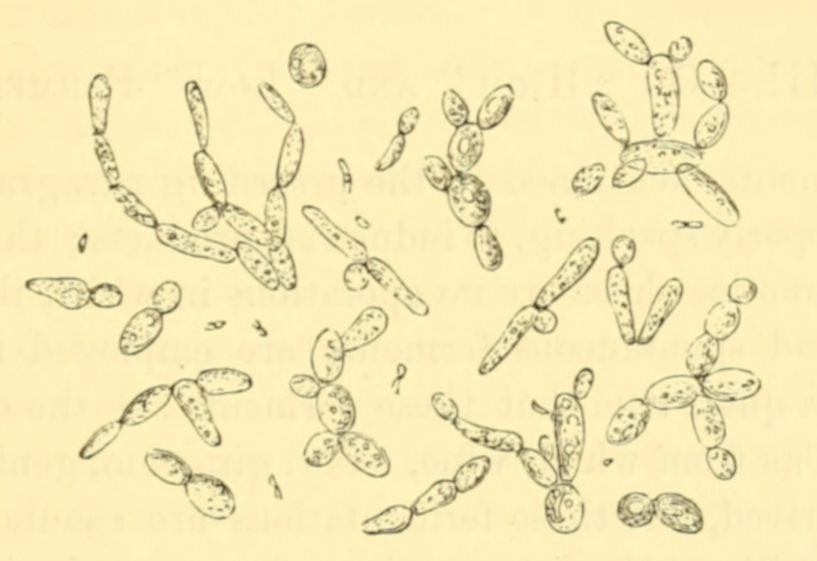
Fig. 38.
Spontaneous ferment, therefore, very often occurs in this large ferment-form, which, by repeated developments in the act of fermentation, becomes reduced by degrees after successive generations to the ferment which, following Dr. Rees, we have named saccharomyces pastorianus, a polymorphous ferment which must be studied closely that it may not be confounded with others, inasmuch as it is so universally diffused that we very seldom fail to find it in any ferment which has been exposed in contact with ordinary air, at least, we may repeat, in a laboratory devoted to researches on fermentation. We have found the same thing occur in a brewery, being there mixed with the ferments used in brewing.
There are, no doubt, several varieties of this saccharomyces. We sometimes find amongst the spontaneous ferments which repeated growths have brought to a more or less uniform state, the forms represented in Plate XI., but the cells and segments much smaller. Amongst others, Dr. Rees has distinguished a saccharomyces exiguus.
Fig. 38 represents another spontaneous ferment, which appeared in a boiled saccharine wort, which entered into fermentation after being exposed to the air of the laboratory.
186The sketch was made directly after the fermentation had commenced. Probably this is simply one of the earlier forms assumed by the saccharomyces, or by one of its varieties. It will be seen that the alcoholic ferment is associated with another little filiform ferment, probably the lactic. The spontaneous ferments are almost always impure, a circumstance that may be readily understood if we bear in mind the results described in Chapters III. and IV.
§ III.—On “High” and “Low” Ferments.
The ferments mentioned in the preceding paragraphs do not belong, properly speaking, to industrial products; that is to say, in actual practice there are no operations in which the ferments of fruits and spontaneous ferments are employed for the purpose. It is quite true that these ferments are the cause of the fermentations from which wine, cider, gin, rum, gentiana, mead, &c., are derived, but these fermentations are spontaneous, they take place without the intervention of man, and without man’s directing their production, or taking any notice of the agent which starts them.
In the manufacture of beer, on the other hand, the practice is quite different. We may say that the wort is never left to ferment spontaneously, the fermentation being invariably produced by the addition of yeast formed on the spot in a preceding operation, or procured from some other working brewery, which, again, had at some time been supplied from a third brewery, which itself had derived it from another, and so on, as far back as the oldest brewery that can be imagined. A brewer never prepares his own yeast. We have already had occasion to remark that the interchange of yeasts amongst breweries is a time-honoured custom, which has been observed in all countries at all periods, as far back as we can trace the history of brewing. The yeasts which in the present day produce beer in the brewery of Tourtel, near Nancy, in that of Grüber, at Strasburg, that of Dreher, at Vienna, and others, came originally 187from breweries, where and when it would be hard to say. In the case of the first working brewery, the yeast was, no doubt, derived from some spontaneous fermentation, which took place in an infusion of barley that had been left to itself, or, from some natural spontaneous ferment, and nothing could be easier than to realize this fact again. In the brewing industry there are two distinct modes of fermentation:—“high” fermentation and “low” fermentation, some of the distinctive characteristics of which we have pointed out in Chapter I. It may be questioned whether the spontaneous yeast employed in the first brewery, or that which a wort left to itself in the present day would yield, would be of the “high” or “low” type. It may be concluded from what we have said on the subject of spontaneous fermentations in wort, that wort, left to itself, would furnish ferments more or less resembling those of wine. We have never obtained in spontaneous fermentations of wort either a distinctly “high” ferment, or a distinctly “low” one, properly so called; nor, further, have we ever obtained either one of these distinct kinds, with its industrial characteristics, in experiments on the ferments of fruits. What, then, was the origin of the “high” and “low” ferments now used by brewers? What was the nature of their original germs? These are questions which we are unable to answer, but we are very much inclined to think that we have here another example of the modifications which plants as well as races of animals undergo, and which become hereditary in the course of prolonged domestication. We know nothing of corn in its wild state, we cannot tell what its first grain was like. We know nothing of the silk-worm in its original state, and we are ignorant of the characters of the race that furnished the first egg.
These reflections may seem to favour the supposition that there is a real difference between “high” yeast and “low” yeast, and that both of these differ from spontaneous ferments and the ferments of domestic fruits. These are propositions demanding most careful consideration, for it is generally admitted 188that these ferments become intermixed, that their morphological differences are merely a question of medium, and that the transition of one to the other is a simple matter. The following facts seem to contradict such statements.
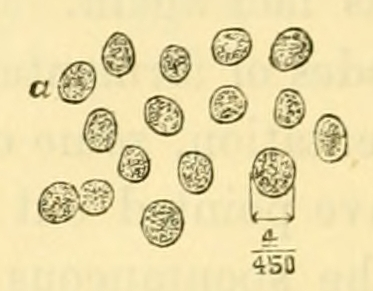
Fig. 39.
“High” Ferment.—Fig. 39 represents some “high” yeast taken from a deposit after fermentation, and Fig. 40 the same yeast in course of propagation in some aerated wort. In comparing “high” yeast with other alcoholic ferments at the same stage of development, there are three points which are especially striking: the diameter of its cells is relatively large, their general aspect is rounder, and when they are undergoing propagation their mode of budding produces a markedly ramified appearance, so that the cells always occur in clusters and branches. Fig. 40 gives a very exact idea of these characters. To investigate satisfactorily the branching habit of growth peculiar to this ferment we should examine it during the first few hours of its propagation, when, under the influence of the oxygen dissolved in the fermentable liquid, its vital activity is greatest. Later on, often on the day following the sowing, the groups become disconnected, and at the end of the fermentation the cells have quite separated from each other, not more than 2 or 3 per cent. remaining united, and even these in groups of not more than two cells together. This is represented in Fig. 39.
To give an idea of the rapidity with which this ferment multiplies, we may state that our sketch (Fig. 40) was made under the following conditions:—On April 28th, 1874, we caused a flask of wort to ferment by means of a trace of “high” yeast. On the morning of the next day, that is 189fourteen hours afterwards, an appreciable deposit of yeast had formed, and some frothy patches appeared on the surface of the liquid, showing that fermentation had set in. On May 1st we decanted the beer, substituting for it water sweetened with 10 per cent. of sugar. On May 2nd we decanted the sweetened water, and substituted a fresh quantity containing the same percentage of sugar. On May 3rd, at mid-day, we took some of the fermenting liquid from this flask and put it into a flask of wort; five hours after the introduction of the ferment we made the sketch in question. The field is covered with branching clusters, the groups being sketched exactly as they occurred in the field. Their activity was due to the condition of the ferment, and to the perfect fitness of the nutritive medium for its vegetation. In sweetened water the budding of the cells was considerably less active; no branching groups of cells are to be found. Budding, nevertheless, occurs to a considerable extent, but it is limited to one bud, or two at the most, to each cell. Fermentation in pure sweetened water is mostly correlative with the duration of vital activity in the globules already formed.
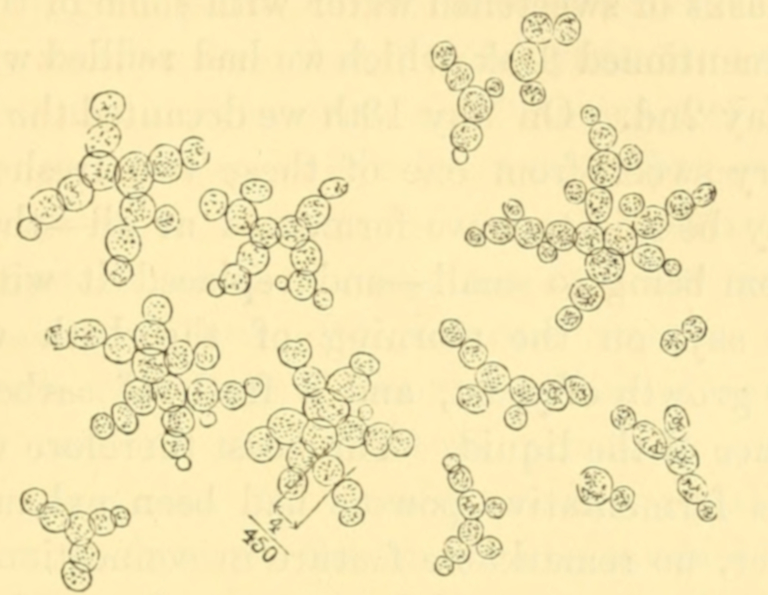
Fig. 40.
Let us next suffer our yeast to exhaust itself by keeping it in a great excess of sweetened water for a very long time; we shall then be able to observe its process of revival, and 190see if we can find any facts analogous to those presented by saccharomyces pastorianus (Chapter V. § 1).
With this object in view, on May 6th, 1874, we impregnated two fresh flasks of sweetened water with some of the contents of the before-mentioned flask, which we had refilled with sweetened water on May 2nd. On May 13th we decanted the liquid, which was still very sweet, from one of these two fresh flasks, which could hardly be said to have fermented at all—the quantity of yeast in them being so small—and replaced it with some wort. Strange to say, on the morning of the 14th we found an appreciable growth of yeast, and a froth of carbonic acid gas on the surface of the liquid. The yeast therefore was not dead, although its fermentative powers had been exhausted. There was, however, no remarkable feature in connection with its revival, nor did we find the slightest trace of any of the elongated ferment-form. What we got was simply the ramified groups of “high” yeast again, in round cells, but nothing more.
Fearing that our yeast might not have remained for a sufficient time in the sweetened water for exhaustion, we set aside, for a whole year, the other flask which we had prepared on May 6th. On May 16th, 1875, we decanted the sweetened liquid and replaced it with wort. This time, however, there was no revival of the yeast; it had perished. Fortunately, we had also saved the flask of yeast and sweetened water which was prepared on May 2nd, 1874, as already mentioned, and in this case, as will be seen, the vitality of the yeast had not been extinguished, doubtless, in consequence of the formation of what we shall presently designate by the name of aërobian ferment. On May 16th, 1875, we decanted the liquid from this last flask, and replaced it with wort. On the next day the surface of the wort was covered with a thin froth, indicating the commencement of fermentation. The microscope revealed nothing extraordinary, or indicative of the fermentation of any special ferment. To assure ourselves that our ferment had remained “high,” we sowed some of it in a fresh flask of wort on May 19th, and then, seven hours after impregnation, 191submitting it to examination, we could find nothing but ramified groups in fine condition, without a single elongated cell, indeed, it would have been impossible to find a more beautiful specimen of “high” yeast, or one of a more decided character.
It would seem, therefore, that “high” yeast cannot, under any circumstances, assume the form and character of the ferment saccharomyces pastorianus, or of other known ferments. We are justified, therefore, in regarding it as a distinct species of ferment, an opinion which is supported by other circumstances.
1. In equal quantities of saccharine wort a considerably greater growth of “high” yeast is obtained than of other yeasts. We need no very rigorous proofs to convince ourselves of this fact: for by simply causing equal volumes of the same wort to ferment, the one being pitched with saccharomyces pastorianus, for example, the other with “high” yeast, we shall obtain a perceptibly greater volume of “high” yeast than of the other, in certain cases even five or six times as much.
2. “High” yeast is of a tougher texture than the others, separating, when the fermented liquor and its deposit is shaken up, into lumps which refuse to disappear; whereas saccharomyces pastorianus diffuses through the whole liquid with the greatest ease.
3. “High” yeast produces a special beer, with a peculiar flavour, well known to consumers, but little esteemed at the present day. Hence the gradual displacement of breweries worked on the old “high” fermentation system by others in which “low” yeast (of which more anon) alone is employed.
4. Lastly, one characteristic of “high” yeast, which it shares in common with some other ferments, although not with all, and which, from a practical point of view, deserves special mention, is that as fermentation proceeds the yeast rises to the surface of the liquid. Whilst the process of the manufacture of beer by this ferment is going on, the yeast is seen to work out of the bung-holes, flowing over in considerable quantity. The ferment named after the author, as well as “low” yeast, does not possess this property: it remains 192at the bottom of the vessels. When “high” fermentation takes place in vessels that are not filled, the ferment forms a thick layer, a kind of cap on the surface of the beer. This characteristic may be witnessed even in the fermentation of very small quantities of liquid. In our flasks, in which the volume of fermenting wort does not exceed 100 c.c. or 150 c.c. (about 4 or 5 fluid ounces), we may perceive, as the violence of fermentation subsides, and the head falls, the sides of the vessel covered to a height of from 1 cm. to 2 cm. (about 3/4-in.) above the surface of the liquid, with particles of yeasty matter, in little masses, or in a thin film, raised to that height by the head, and left behind when that fell.
“Low” Ferment.—Whilst high yeast performs its functions in the breweries in which it is used at somewhat high temperatures—namely, between 16° C. and 20° C. (60° F. to 68° F.)—“low” yeast is never employed at a higher temperature than 10° C. (50° F.), and it is even thought preferable that it should not be subjected to more than 6° C., 7° C., or 8° C. (43° F. to 46° F.). At these comparatively low temperatures “high” yeast would have no perceptible action, whereas it is at such temperatures that “low” yeast best performs its functions.
In our Memoir on alcoholic fermentation, published in 1860, in the Annales de Chimie et de Physique, the idea of the identity of the two yeasts was accepted; but we had at that time made no special observations of our own on the subject.
Upon closer investigation we are inclined to believe that the two yeasts are quite distinct. We might keep our “high” yeast at the lowest temperatures that it can bear, and repeat our growths under these conditions; or, on the other hand, we might subject the “low” yeast to temperatures higher than those at which it ordinarily grows, without ever succeeding in changing the first into the second or the second into the first, supposing, of course, that each of our yeasts was pure to begin with. If they were intermixed the change in the conditions of development would cause one or the 193other to preponderate, and incline us to believe that a transformation had really occurred.
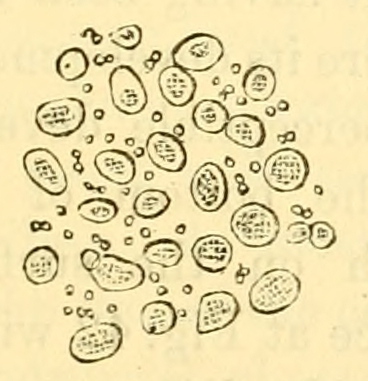
Fig. 41.
It is true that brewers generally are of a different opinion. Most of them assert that “low” yeast cultivated at a high temperature becomes “high” yeast; and conversely, that “high” yeast becomes “low” by repeated growths at a low temperature. Many have told us that they have proved this. Nevertheless it is our belief that the success of such transformation has been but apparent, attributable in each case to the fact, as we have just stated, of their having operated on a mixture of the two yeasts.
Mitscherlich, and various authors after him, have asserted that “high” yeast propagates by budding, and “low” yeast, on the contrary, by spores, formed by the endogenous division of the protoplasm of the cells, and set free by the rupture of the cell-wall, which then, increasing in size, assume the character of ordinary cells. But we have never been able to confirm this.
Fig. 41 represents a field of low yeast, taken from the deposit in a vat after the fermentation of the beer was finished. The granular matter mixed with the cells is altogether amorphous although in many cases perfectly spherical. It is a product in no way related to this yeast (see Plate I., No. 7).[100] “High” yeast and all the ferments of beer have this kind 194of deposit associated with them. There is no doubt that confused observations as regards these minute bodies have been the cause of the error which we had to deal with in connection with a particular mode of reproduction of low yeast, as to which we have already fully expressed our views (Chap. V. § 1, p. 146).
Comparing Fig. 41 with Fig. 40 (p. 189), it may be seen that the general aspect of low yeast is distinguished, in its early stages, although in no very decided manner, from that of “high” yeast, by being slightly smaller and less round or spherical in its cells than the latter.[101] These differences, however, would escape an unpractised eye.
As to the case of “high” yeast, the deposits of “low” yeast after fermentation appear as scattered, isolated cells; we do not find more than two or three per cent. of united cells. Nevertheless the two yeasts present, as we shall see, quite marked differences in the character of their budding and multiplication.
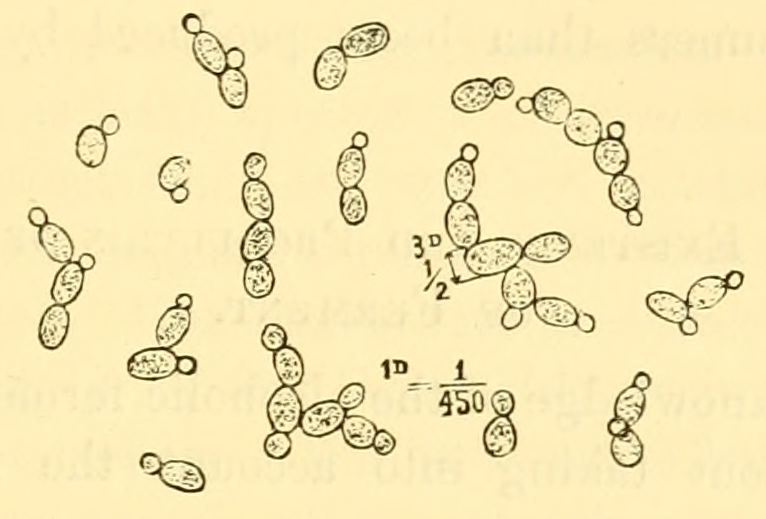
Fig. 42.
On May 28th, 1875, we put a trace of pure, unicellular, “low” yeast, taken at the end of a fermentation, into a flask of wort. On May 29th, sixteen hours after impregnation, the temperature during the night having been 15° C. (59° F.), we made a sketch of the yeast before its development had become apparent to the naked eye. No perceptible development, that is to say, no visible deposit at the bottom of the liquid and formation of patches of froth on the surface, took place before May 30th. A mere glance at Fig. 42 will be sufficient to enable us to detect a considerable difference between it and Fig. 40, which represents the multiplication of the cells of “high” 195yeast. The cells of the “low” yeast are slightly smaller and rather more oval, as we have already had occasion to notice, and the budding processes are considerably less ramified, in consequence of which there is a comparative absence of globular clusters which are so striking a feature in the development of “high” yeast, when examined early enough. Moreover, if we cause our “low” yeast to age, by leaving it for a longer or shorter time in the beer which it has formed, or if we exhaust it in sweetened water by leaving it for whole months in a volume of sweetened water considerably larger than what it is capable of fermenting, and then proceed to revive it and cause it to propagate in an aerated saccharine wort capable of nourishing it, this yeast will resume its original aspect, as sketched and described. At most we shall observe certain minute differences in the size of the cells in successive growths. A very remarkable industrial characteristic of this yeast is the fact that it never rises to the surface, no matter at what temperature it may be working, whether between 6° C. and 8° C. or 15° C. and 20° C.;[102] in other words, it is not buoyed up by the carbonic acid gas when the fermentation is at its height. At the end of the fermentation, the surface of the liquid and the sides of the vessel above the level of the liquid are clean and not covered with the yeast, which remains altogether at the bottom of the fermented liquid. Moreover, 196the weight of new yeast which it yields is always less than that yielded by “high” yeast, for the same quantity of fermentable liquid, although greater than that which saccharomyces pastorianus would give. Lastly, the beer possesses a flavour and delicacy which cause it to be held in higher esteem by consumers than beers produced by means of other ferments.[103]
§ IV.—On the Existence and Production of Other Species of Ferment.
Our present knowledge of the alcoholic ferments embraces the following, without taking into account the ferment-form of mucor:—
The ferment named after the author, which is found associated with the ferments of the grape and other domestic fruits, and with spontaneous ferments in general.
The ferment of “high” beer.