Chapter IV · The Growth of Different Organisms in a State of Purity: Their Autonomy.[49] (continued 2)
Frank Faulkner translation
On November 17th, 1873, we found a very beautiful specimen of mucor mucedo on a pear, under a glass bell jar. It was a mass of perfectly straight filaments, simple and isolated, very large in comparison with those ordinarily met with, each terminating in a sporange, identical to that of mucor mucedo, and proportionately well developed. We are able to distinguish mucor racemosus from mucor mucedo only by the circumstance of its having on its sporange-bearing hyphæ lateral branches which also terminate in sporanges.
We sowed only one of the terminal heads of the large erect hyphae in some wort, in which it soon produced an abundant mycelium, but without the least appearance of gas. For a very long time, up to January 7th, 1875, we studied the developments of this organism, which remained all the time perfectly pure, in consequence of our having cultivated it in one of our two-necked flasks on pure wort.
The total volume of liquid, which was 130 c.c., (4·57 fl. oz.) contained 2·3 grammes (35·3 grains) of alcohol. In spite of 141this rather large proportion of alcohol, a clear sign of undoubted fermentation, the plant had yielded no conidia at all, nor any cell-globules of ferment. Some of the filaments, however, were larger than the rest, and exhibited irregularly-shaped swellings, which in some cases were of enormous size. Whilst the natural mycelial filaments, by which we mean the vegetating part of mucor, which were supplied with abundance of air, only measured 3/450 of a millimetre[81] in diameter, the filaments that had grown probably with an insufficiency of oxygen, and performed the functions of ferment, measured 8/450, and the swellings as much as 30/450 of a millimetre in diameter, as represented in Fig. 24.
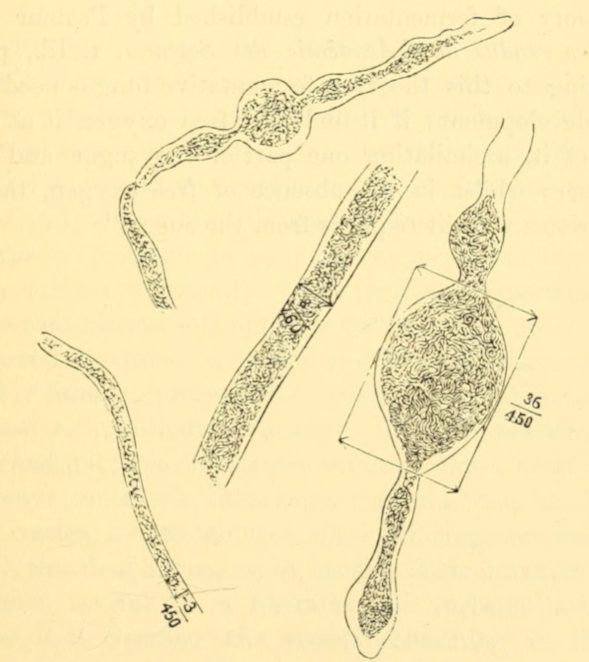
Fig. 24.
In concluding this paragraph, we may mention a very able research on fermentation which we have lately studied, the 142author of which, Dr. Fitz, communicated it to the Chemical Society of Berlin in 1873. In section II., page 48, this author explains his observations in a manner conformable to our own views, as may be seen from the following passage of the memoir:—
“In the presence of oxygen, the ferment of mucor develops into a mycelium and consumes the sugar; in the absence of oxygen, on the other hand, the spores develop into ferment of mucor, that buds and decomposes the sugar into the products of fermentation.
“The properties of mucor mucedo in a fermentable liquid, in the presence or in the absence of oxygen, accord perfectly with the theory of fermentation established by Pasteur in 1861 (Comptes rendus de l’Académie des Sciences, t. lii., p. 1260). According to this theory a fermentative fungus needs oxygen for its development; if it finds any free oxygen it utilizes the whole of it, assimilating one part of the sugar and burning the other; whilst in the absence of free oxygen, the fungus appropriates what it requires from the sugar.”
143